Search Results: "he"

16 February 2016

Daniel Pocock: FOSSASIA 2016, pgDay Asia 2016 and MiniDebConf Singapore

The FOSSASIA 2016 conference is taking place next month, 18-20 March at the Science Centre Singapore. The FOSSASIA community has also offered to host a MiniDebConf Singapore 2016 and pgDay Asia 2016. With sufficient interest from volunteers and participants, these events could do a lot to raise the profile of free software in the region. Applications from speakers and exhibition tables are still possible using the form. Real-time communications technology at FOSSASIA 2016 We are currently discussing a Real-time lounge and demo area for FOSSASIA, hopefully with a live linkup to the FSF's LibrePlanet 2016 in Boston. FOSSASIA have invited a number of developers to speak about SIP, XMPP, WebRTC and peer-to-peer communications solutions. Hopefully exact attendance and scheduling can be publicised soon. Sponsors needed Bringing leading free software developers to Singapore is not easy and further sponsorship is needed to ensure all the speakers who would like to participate can get there. If you or your organization can help with funding or accommodation please make contact. Google Summer of Code If you want to be selected for Google Summer of Code 2016 and you live in Singapore or a neighbouring country, FOSSASIA could be a great opportunity to meet potential mentors, hack on things together and talk about project ideas. Free software development is a community activity and the more you engage with the community, the more confident mentors are likely to be about selecting you. Questions and contact For general questions about FOSSASIA 2016 and Singapore, please ask the FOSSASIA mailing list. For questions about the MiniDebConf, see debconf-discuss and for pgDay Asia, please join the pgday-asia mailing list or otherwise try pgsql-general or the seasiapug regional list.

Vincent Fourmond: QSoas tips and tricks: better baselines using the "save points" feature

During data processing in our team, we often subtract plain polynomial baselines to our data, drawn by hand using the b command. Note that this is legitimate because we know that the signal we are looking for quickly drops to 0 outside a given range. The usual workflow is to just load the data, use b to draw a baseline and subtract it, and then have further fun with the baseline-subtracted data. This was the only possibility in the old SOAS. However, I don't like so much this kind of workflow, because such a baseline is arbitrary, and once it's subtracted, it's hard to reassess the baseline afterwards.
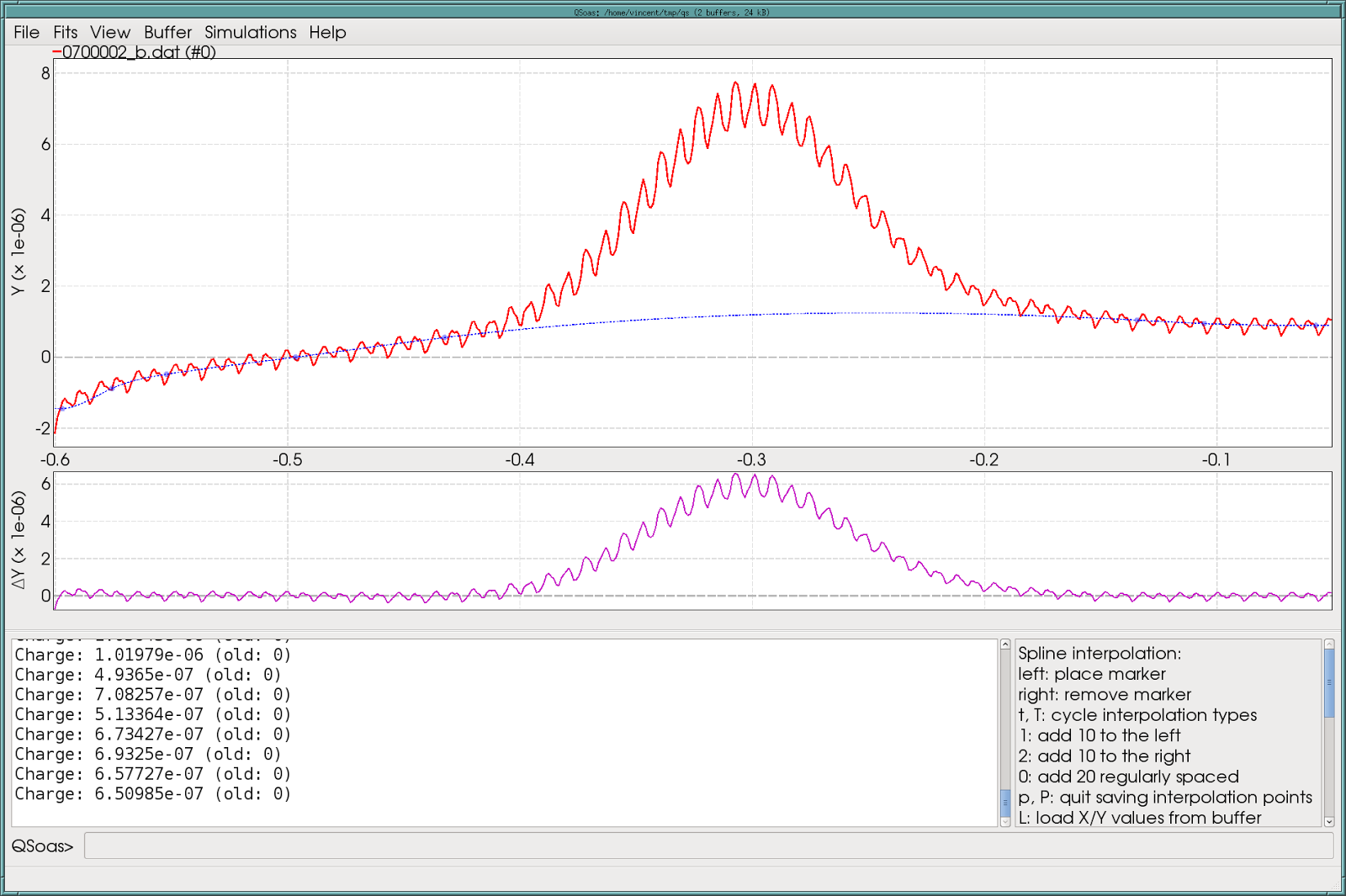
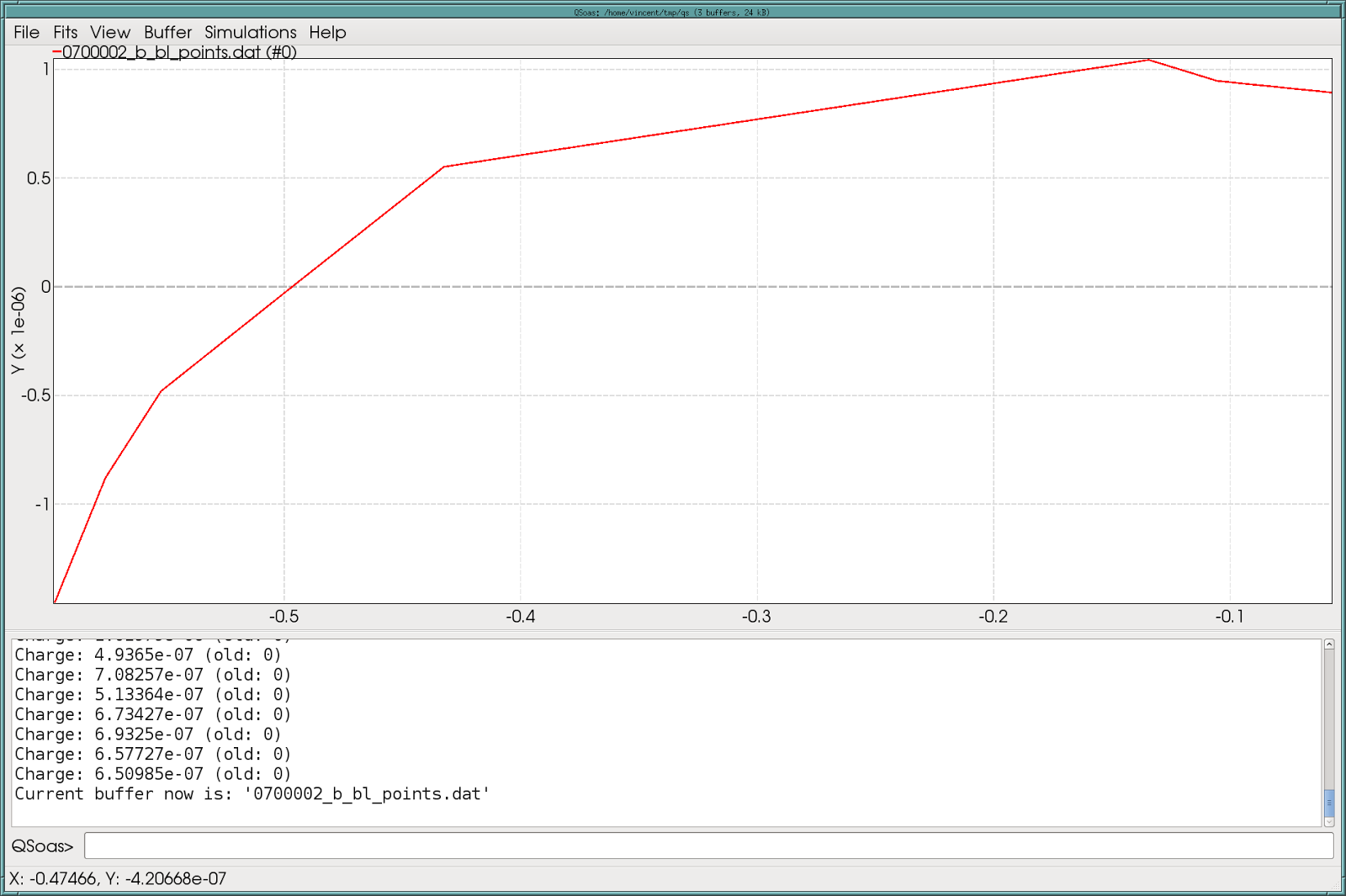
This is why I've designed a better way in QSoas: when you are done creating a baseline, push p: this exits pushing only the interpolation nodes:
Above, the baseline subtraction interface, and below, the resulting nodes:
The nodes can be reloaded by hitting uppercase L from within b and giving a buffer number (admittedly, the interface as of now isn't that good, I'll have to work on it). Alternatively, you can greenerate the baseline by using interpolate, and then further subtract it using S:
QSoas> interpolate 1 0
where 1 is the original buffer (in fact, only its X values will be used, so you don't have to use the same buffer) and 0 is the buffer containing the interpolation nodes. Saving only the interpolation nodes makes it possible to reedit the baseline easily, and regenerate the baseline-subtracted data using a script. This is my favorite approach, because I like to be able to trace every single step from the raw data to processed data. Another neat feature is that, from within b, you can reload only the X values of nodes using lowercase l (and giving buffer number): the Y values are computed as if you had clicked at the corresponding positions. This is very useful is you have a whole series of similar baselines to make: most often, you won't even need manual adjustment to get a good baseline. I hope you'll find this tip useful !

Michal Čihař: Weekly phpMyAdmin contributions 2016-W06

As we're getting closer to release of new major release (4.6.0), the focus moves to the bug fixing. Most of the fixed issues came from our error reporting server, which collects error reports from the installations. Vast majority if bugs were affecting older releases as well, so these were fixed for upcoming 4.5.5 as well. Besides bugfixing there was also some cleanups in the master branch - shared code for processing sprites and covering it by tests and removed caching of MySQL server information as that didn't bring any speed improvements and lead to cache consistency issues. All handled issues:

Filed under: English phpMyAdmin 0 comments

Norbert Preining: Debian/TeX Live 2015.20160215-1

About one month has passed and here is the usual updated of TeX Live packages for Debian. While I am not really calling for testers at the moment, building of preliminary packages for TeX Live 2016 has begone. The binaries are already uploaded to experimental, and arch=all packages for experimental will follow soon. Debian - TeX Live 2015 As with the last time, here is the list of new and updated pacakges with (auto-generated) links to the package pages on CTAN. New packages adtrees, babel-occitan, crimson, emisa, glossaries-extra, gloss-occitan, libertinus, luatex-def, mynsfc, nihbiosketch, signchart, smartunits, tikz-feynman, uhrzeit, xduthesis. Updated packages achemso, acro, animate, apnum, archaeologie, babel, babel-french, babel-greek, babel-macedonian, bangorcsthesis, biblatex-bookinarticle, biblatex-gost, biblatex-manuscripts-philology, br-lex, caption, chemgreek, chemmacros, chemnum, cmtiup, csplain, csquotes, ctanify, ctex, cweb, datatool, datetime2, datetime2-english, delimseasy, droit-fr, dvips, erewhon, exsheets, fibeamer, fira, fontspec, forest, geschichtsfrkl, glossaries, graphics, greek-fontenc, greektonoi, hyph-utf8, inconsolata, isodoc, l2tabu, l3build, l3experimental, l3kernel, l3packages, latex, latex-bin, latex-make, leadsheets, leaflet, luaotfload, luatexja, mathastext, mcf2graph, mcmthesis, media9, metrix, mhchem, ndsu-thesis, newpx, newtx, ocgx2, pas-tableur, pdftex, pdfx, pict2e, pst-perspective, pstricks, pstricks-add, ptex, quran, ran_toks, realscripts, schemata, showhyphens, siunitx, sr-vorl, sttools, tempora, tetex, tex4ht, texfot, texlive-scripts, thinsp, thuthesis, tkz-orm, tools, uantwerpendocs, ulthese, unicode-data, uptex, xassoccnt, xcjk2uni, xebaposter, xecjk, xetex, xetexko, xltxtra, xpinyin, zhnumber, zhspacing. Enjoy.

15 February 2016

Sven Hoexter: distribution specific details

To state the obvious: my personal preference is to run Debian GNU/Linux. My current workplace is a CentOS shop and usually I'm the first to claim that it doesn't matter at all, and distribution specific implementation details are irrelevant for what we do (running a JVM). Let's take a short detour to the RedHat network-scripts. Two weeks ago we found some systems we originally installed in a different network segment, with different DNS servers and different search domains, came back up after a reboot with a rewritten 'resolv.conf'. Later on cfengine replaced the generated 'resolv.conf' with the intended one, so it wasn't that obvious to spot in the first place. A colleague found the origin of the rewritten 'resolv.conf' in a device specific configuration file that defined the 'DNS 1,2 ' variables with the installation time DNS server IPs from the other segment. I expected to experience the same behaviour (resolv.conf rewritten during startup and replaced by cfengine later on) in other locations, but assumed we just didn't notice it because the main difference would be a slightly different list of search domains. And I was wrong. I checked the timestamps of several 'resolv.conf' files and their cfengine backup file. None were recently created or related somehow to a reboot. grep-ing through parts of the network-scripts I found the following conditional in '/etc/sysconfig/network-scripts/ifup'
if [ "$PEERDNS" != "no" ]  [ -n "$RESOLV_MODS" -a "$RESOLV_MODS" != "no" ]; then
   [ -n "$MS_DNS1" ] && DNS1=$MS_DNS1
   [ -n "$MS_DNS2" ] && DNS2=$MS_DNS2
      if [ -n "$DNS1" ] && ! grep -q "^nameserver $DNS1" /etc/resolv.conf &&
         tr=$(mktemp /tmp/XXXXXX) ; then
 ...
So if you adjust only the second nameserver IP you stored in "DNS2" in your configuration you end up without an update to your 'resolv.conf'. Now knowing that, I'd say this is relevant distribution specific knowledge, and I'm wondering how many of such subtle behaviours we've hidden in Debian specific solutions? Maybe knowledge about distribution specific implementation details even matters after all. Regardig the 'resolv.conf' issue itself the fault is on us. We as the responsible team did not read the documentation properly and thus deployed a configuration that later on let to some unexpected consequences. I try to remember those issues as an example for the next NetworkManager/systemd-networkd vs old-school-network-scripts argument.

Michal Čihař: Weblate supports Python 3

During the last days I've completed quite long time challenge - make Weblate compatible with Python 3. It's probably still not in shape you would use it on production server, but it runs fine and the testsuite completes without errors. As usual, the major obstacle are dependencies. The translate-toolkit doesn't support Python 3 in any released version, so you need latest Git snapshot. Another problematic bit is Mercurial, which will not support Python 3 in near future. But in case you need it, you can still install Python 2 version and use it from Weblate (it uses command line interface). The porting was mostly dealing with encoding mess - in Python 2 you really didn't have to distinguish between binary and text data, while Python 3 quite enforces that. This turned out to be especially tricky with CSV files where csv module expects text streams in Python 3, while translate-toolkit CSV parser expects binary ones. All this has one downside as well - the test matrix got bigger again, what makes the testsuite run longer with 5 workers available. While doing these changes, I've also decided to drop support for Django 1.7, this will allow us to get rid of lot of deprecation warnings in Django 1.9 and prepare codebase for Django 1.10.

Filed under: English Weblate 0 comments

Julien Danjou: Timeseries storage and data compression

The first major version of the scalable timeserie database I work on, Gnocchi was a released a few months ago. In this first iteration, it took a rather naive approach to data storage. We had little ideas about if and how our distributed back-ends were going to be heavily used, so we stuck to the code of the first proof-of-concept written a couple of years ago. Recently we got more feedbacks from our users, ran a few benchmarks. That gave us enough feedback to start investigating in improving our storage strategy. Data split Up to Gnocchi 1.3, all data for a single metric are stored in a single gigantic file per aggregation method (min, max, average ). This means that the file can grow to several megabytes in size, which make it slow to manipulate. For the next version of Gnocchi, our first work has been to rework that storage and split the data into smaller parts. Gnocchi Carbonara archives split The diagram above shows how data are organized inside Gnocchi. Until version 1.3, there would have been only one file for each aggregation methods. In the upcoming 2.0 version, Gnocchi will split all these data into smaller parts, where each data split is stored in a file/object. This allows to manipulate smaller pieces of data and to increase the parallelism of the CRUD operations on the back-end leading to large speed improvement. In order to split timeseries into several chunks, Gnocchi defines a maximum number of N points to keep per chunk, to limit their maximum size. It then defines a hash function that produces a non-unique key for any timestamp. It makes it easy to find in which chunk any timestamp should be stored or retrieved. Data compression Up to Gnocchi 1.3, the data stored for each metric is simply serialized using msgpack, a fast and small serialization format. Though, this format does not provide any compression. That means that storing data points needs 8 bytes for a timestamp (64 bits timestamp with nanosecond precision) and 8 bytes for a value (64 bits double-precision floating-point), plus some overhead (extra information and msgpack itself). After looking around on how to compress all these measures, I stumbled upon a paper from some Facebook engineers called about Gorilla, their in-memory timeserie database, entitled "Gorilla: A Fast, Scalable, In-Memory Time Series Database". For reference, part of this encoding is also used by InfluxDB in its new storage engine. The first technique I implemented is easy enough, and it's inspired from delta-of-delta encoding. Instead of storing each timestamp for each data point, and since all the data points are aggregated on a regular interval, we transpose points to be the time difference divided by the interval. For example, the suite of timestamps timestamps = [41230, 41235, 41240, 41250, 41255] is encoded into timestamps = [41230, 1, 1, 2, 1], interval = 5. This allows regular compression algorithms to reduce the size of the integer list using run-length encoding. To actually compress the values, I tried two different algorithms: I then benchmarked these solutions: Gnocchi Carbonara compression speed The XOR algorithm implemented in Python is pretty slow, compared to LZ4. Truth is that python-lz4 is fully implemented in C, which makes it fast. I've profiled my XOR implementation in Python, to discover that one operation took 20 % of the time: count_lead_and_trail_zeroes, which is in charge of counting the number of leading and trailing zeroes in a binary number. Gnocchi Carbonara compression XOR profiling I tried 2 Python implementations of the same algorithm (and submitted them to my friend and Python developer Victor Stinner by the way). The first version using string search with .index() is 10 faster than the second one that only do integer computation. Ah, Python As Victor explained, each Python operation is slow and there's a lot in the second version, whereas .index() is implemented in C and really well optimized and only needs 2 Python operations. Finally, I ended up optimizing that code by leveraging cffi to use directly ffsll() and flsll(). That decreased the run-time of count_lead_and_trail_zeroes by 45 %, making the entire XOR compression code speed increased by a small 7 %. This is not enough to catch up with LZ4 speed. At this stage, the only solution to achieve a high-speed would probably to go with a full C implementation. Gnocchi Carbonara compression size Considering the compression ratio of the different algorithms, they are pretty much identical. The worst case scenario (random values) for LZ4 compress down to 9 bytes per data point, whereas XOR can go down to 7.38 bytes per data point. In general XOR encoding beats LZ4 by 15 %, except for cases where all values are 0 or 1. However, LZ4 is faster than XOR by a factor of 4 -70 depending on cases. That means that we'll use LZ4 for data compression in Gnocchi 2.0. It's possible that we could achieve as fast compression/decompression algorithm, but I don't think it's worth the effort right now it'd represent a lot of code to write and to maintain.

14 February 2016

Lunar: Reproducible builds: week 42 in Stretch cycle

What happened in the reproducible builds effort between February 7th and February 13th 2016:

Toolchain fixes
  • James McCoy uploaded devscripts/2.16.1 which makes dcmd supports .buildinfo files. Original patch by josch.
  • Lisandro Dami n Nicanor P rez Meyer uploaded qt4-x11/4:4.8.7+dfsg-6 which make files created by qch reproducible by using a fixed date instead of the current time. Original patch by Dhole.
Norbert Preining rejected the patch submitted by Reiner Herrmann to make the CreationDate not appear in comments of DVI / PS files produced by TeX. He also mentioned that some timestamps can be replaced by using the -output-comment option and that the next version of pdftex will have patches inspired by reproducible build to mitigate the effects (see SOURCE_DATE_EPOCH patches) .

Packages fixed The following packages have become reproducible due to changes in their build dependencies: abntex, apt-dpkg-ref, arduino, c++-annotations, cfi, chaksem, clif, cppreference-doc, dejagnu, derivations, ecasound, fdutils, gnash, gnu-standards, gnuift, gsequencer, gss, gstreamer0.10, gstreamer1.0, harden-doc, haskell98-report, iproute2, java-policy, libbluray, libmodbus, lizardfs, mclibs, moon-buggy, nurpawiki, php-sasl, shishi, stealth, xmltex, xsom. The following packages became reproducible after getting fixed: Some uploads fixed some reproducibility issues, but not all of them: Patches submitted which have not made their way to the archive yet:
  • #813944 on cvm by Reiner Herrmann: remove gzip headers, fix permissions of some directories and the order of the md5sums.
  • #814019 on latexdiff by Reiner Herrmann: remove the current build date from documentation.
  • #814214 on rocksdb by Chris Lamb: add support for SOURCE_DATE_EPOCH.

reproducible.debian.net A new armhf build node has been added (thanks to Vagrant Cascadian) and integrated into the Jenkins setup for 4 new armhf builder jobs. (h01ger) All packages for Debian testing (Stretch) have been tested on armhf in just 42 days. It took 114 days to get the same point for unstable back when the armhf test infrastructure was much smaller. Package sets have been enabled for testing on armhf. (h01ger) Packages producing architecture-independent ( Arch:all ) binary packages together with architecture dependent packages targeted for specific architectures will now only be tested on matching architectures. (Steven Chamberlain, h01ger) As the Jenkins setup is now made of 252 different jobs, the overview has been split into 11 different smalller views. (h01ger)

Package reviews 222 reviews have been removed, 110 added and 50 updated in the previous week. 35 FTBFS reports were made by Chris Lamb, Danny Edel, and Niko Tyni.

Misc. The recordings of Ludovic Court s' talk at FOSDEM 16 about reproducible builds and GNU Guix is now available. One can also have a look at slides from Fabian Keil's talk about ElecrtroBSD and Baptiste Daroussin's talk about FreeBSD packages.

Sean Whitton: East 5th Street tech

There are three of us living here, and the plan is to switch all three of us from wireless to wired ethernet Internet connections by transporting cabling through the ventilation system using this remote-controlled car. Here s an action shot we took. My housemate put on his Gaming playlist and it reached a very suitable crescendo as we guided the car through its final journey, pulling the last piece of cotton which we would then use to pull the final cabal through. The timing of the music couldn t have been better. It reflected the risk of losing control of the car as we moved the controller around to enable the car to pick up the radio signals. A further risk was caused by the car only being able to turn right, not left, and there not being enough room in the air duct for it to make a full-circle rotation. Our backup plan was to try tossing a ball tied to a piece of string down the duct. Unfortunately I m still on a wireless connection because to reach my room we d have had to send the cable via the furnace/air conditioning unit which we decided against. Does a SATA-to-USB converter, for moving data off my old laptop hard drive which I had to replace this week, need to be this complicated?

Raphaël Hertzog: Freexian s report about Debian Long Term Support, January 2016

A Debian LTS logoLike each month, here comes a report about the work of paid contributors to Debian LTS. Individual reports In December, 113.50 work hours have been dispatched among 9 paid contributors. Their reports are available: Evolution of the situation As expected, we had a small drop in the amount of hours sponsored. New sponsors (re-)joined but others stopped too (Gree this time) mostly balancing the result. We only lost 2 hours of sponsored work. It would be nice if we could invert that curve and actually start again to get closer to our objective of funding the equivalent of a full time position. Let s hope that the switch to wheezy as the version supported by the LTS team will motivate many companies relying on Debian 7 in their IT system. In terms of security updates waiting to be handled, the situation is close to last month(17 packages in dla-needed.txt, 27 in the list of CVE). It looks like that having about 20 packages needing an update is the normal situation and that we can t really get further down given the time required to process some updates (sometimes we wait until the upstream authors provides a patch, and so on). Thanks to our sponsors New sponsors are in bold.

No comment Liked this article? Click here. My blog is Flattr-enabled.

Elena 'valhalla' Grandi: Happy #ilovefs

Happy #ilovefs

Happy I love Free Software Day https://fsfe.org/campaigns/ilovefs/2016/!

Immagine/fotohttp://ilovefs.org

My life has been full of Free Software for more than 15 years and listing all the software and projects I've used or interacted with would take a long post (and I would be sure to forget someone), so if you are reading this and are involved in Free Software: thank you! I may have used your work in the past, I may be using it some time in the future, or I may never use it personally, but you are making the world I live in a better place anyway.

Special thanks go to the local LUGs, where I've met my SO and to the @Debian project, where I've met a few people I can call friends.

@LIFO @Gruppo Linux Como #ilovefs

Bits from Debian: I love Free Software Day 2016: Show your love for Free Software

ILoveFS banner Today February 14th, the Free Software Foundation Europe (FSFE) celebrates the "I Love Free Software" day. I Love Free Software day is a day for Free Software users to appreciate and thank the contributors of their favourite software applications, projects and organisations. We take this opportunity to say "thank you" to all the Debian upstreams and downstreams, and all the Debian developers and contributors. Thanks for your work and dedication to free software! There are many ways to participate in this ILoveFS day and we encourage everybody to join in and celebrate. Show your love to Debian developers, contributors and teams virtually on social networks using the #ilovefs hashtag and spreading the word in your own social media circles, or by visiting the ILoveFS campaign website to find and use some of the promotional materials available such as postcards and banners. To learn more about the FSFE, you can read their announcement of this campaign or visit their general website.

13 February 2016

Mart n Ferrari: Why I am not touching node.js

Dear node.js/node-webkit people, what's the matter with you? I wanted to try out some stuff that requires node-webkit. So I try to use npm to download, build and install it, like CPAN would do. But then I see that the nodewebkit package is just a stub that downloads a 37MB file (using HTTP without TLS) containing pre-compiled binaries. Are you guys out of your minds? This is enough for me to never again get close to node.js and friends. I had already heard some awful stories, but this is just insane. Update: This was a rage post, and not really saying anything substantial, but I want to quote here the first comment reply from Christian as I think it is much more interesting:
I see a recurring pattern here: developers create something that they think is going to simplify distributing things by quite a bit, because what other people have been doing is way too complicated[tm]. In the initial iteration it usually turns out to have three significant problems:
  • a nightmare from a security perspective
  • there's no concern for stability, because the people working on it are devs and not people who have certain reliability requirements
  • bundling other software is often considered a good idea, because it makes life so much easier[tm]
Given a couple of years they start to catch up where the rest of the world (e.g. GNU/Linux distributions) is - at least to some extent. And then their solution is actually of a similar complexity compared to what is in use by other people, because they slowly realize that what they're trying to do is actually not that simple and that other people who have done things before were not stupid and the complexity is actually necessary... Just give node.js 4 or 5 more years or so, then you won't be so disappointed. ;-) I've seen this pattern over and over again:

  • the Ruby ecosystem was a catastrophe for quite some time (just ask e.g. the packages of Ruby software in distributions 4 or 5 years ago), and only now would I actually consider using things written in Ruby for anything productive
  • docker and vagrant were initially not designed with security in mind when it came to downloading images - only in the last one or two years have there actually been solutions available that even do the most basic cryptographic verification
  • the entire node.js ecosystem mess you're currently describing
Then the next new fad comes along in the development world and everything starts over again. The only thing that's unclear is what the next hype following this pattern is going to be.
And I also want to quote myself with what I think are some things you could do to improve this situation:
  1. You want to make sure your build is reproducible (in the most basic sense of being re-buildable from scratch), that you are not building upon scraps of code that nobody knows where they came from, or which version they are. If possible, at the package level don't vendor dependencies, depend on the user having the other dependencies pre-installed. Building should be a mainly automatic task. Automation tools then can take care of that (cpan, pip, npm).
  2. By doing this you are playing well with distributions, your software becomes available to people that can not live on the bleeding edge, and need to trust the traceability of the source code, stability, patching of security issues, etc.
  3. If you must download a binary blob, for example what Debian non-free does for Adobe Flashplayer, then for the love of all that is sacred, use TLS and verify checksums!
8 comments

Scott Kitterman: Debian LTS Work January 2016

This was my ninth month as a Freexian sponsored LTS contributor. I was assigned 8 hours for the month of January. My time this month was spent preparing updates for clamav and the associated libclamunrar for squeeze and wheezy. For wheezy, I ve only helped a little, mostly I worked on squeeze. This update is more complex than usual because with clamav 0.99 upstream bumped soname and so in addition to the normal case of transitions in unstable, we ve needed transitions for stable, oldstable, and squeeze-lts. We also try to be careful and maintain higher versions in newer releases, so stable needed to wait for 0.99 in testing, oldstable needed to wait for stable, etc. Currently 0.99 is in stable proposed updates and I ve requested that the update for wheezy (oldstable) go forward. Once that s done, I ve got squeeze-lts ready to go.

Norbert Preining: OpenPHT 1.5.1 for Debian/sid

I have updated the openpht repository with builds of OpenPHT 1.5.1 for Debian/sid for both amd64 and i386 architecture. For those who have forgotten it, OpenPHT is the open source fork of Plex Home Theater that is used on RasPlex, see my last post concerning OpenPHT for details. plex-debian-new sid and testing For sid use the following lines:
deb http://www.preining.info/debian/ openpht-sid main
deb-src http://www.preining.info/debian/ openpht-sid main
You can also grab the binary for amd64 directly here for amd64 and i386, you can get the source package with
dget http://www.preining.info/debian/pool/main/o/openpht/openpht_1.5.1.508-1.dsc
jessie Builds for Debian stable release jessie are not done by now. The release file and changes file are signed with my official Debian key 0x860CDC13. Now be ready for enjoying the next movie!

Mark Brown: Performance problems

Just over a year ago I implemented an optimization to the SPI core code in Linux that avoids some needless context switches to a worker thread in the main data path that most clients use. This was really nice, it was simple to do but saved a bunch of work for most drivers using SPI and made things noticeably faster. The code got merged in v4.0 and that was that, I kept on kicking a few more ideas for optimizations in this area around but that was that until the past month. What happened then was that for whatever reason people started picking up v4.0 and using it in production more. On some systems people started seeing problems when there was heavy SPI flash usage, often during things like distribution installation. In some cases the lockup detector fired, but the most entertaining error was that on Marvell Orion systems (which are single core) when the flash was being heavily used the SATA controller started having trouble handling interrupts. These problems all bisected down to the key commit in that series, 0461a4149836c79 (spi: Pump transfers inside calling context for spi_sync()). The problem is that there are a number of widely deployed SPI controllers out there that don t support DMA and instead require the CPU to explicitly read and write everything sent to and from registers in the controller. To make matters worse these accesses to the controller will usually take many CPU cycles to complete, each one stalling the CPU while they happen. This is fine for short transfers or if the CPU has nothing else to do but on a busy multitasking system it s an issue. Before the optimization the switches between the worker thread interacting with the hardware and the thread initiating the SPI operations provided breaks in this activity which allowed other things to switch in. Unfortunately when we optimize those away then if there s a lot of work for the controller being done from one thread then that thread can run for a long time without pause. The fix for affected drivers if there are no less CPU intensive ways of driving the hardware is to add some explicit sleeps into the driver itself, either at the end of the transfer_one() or perhaps in an unprepare_message() function. In a way I was quite pleased to see this, it was a clear demonstration that the optimization was having the intended effect though obviously users of affected systems will not find that so comforting. It s not the first time that making things faster or fixing a bug has revealed an underlying problem, I m sure it won t be the last.

12 February 2016

Benjamin Mako Hill: Unhappy Birthday Suspended

More than 10 years ago, I launched Unhappy Birthday in a fit of copyrighteous exuberance. In the last decade, I have been interviewed on the CBC show WireTap and have received an unrelenting stream of hate mail from random strangers. With a recently announced settlement suggesting that Happy Birthday is on its way into the public domain, it s not possible for even the highest-protectionist in me to justify the continuation of the campaign in its original form. As a result, I ve suspended the campaign while I plan my next move. Here s the full text of the notice I posted on the Unhappy Birthday website:
Unfortunately, a series of recent legal rulings have forced us to suspend our campaign. In 2015, Time Warner s copyright claim to Happy Birthday was declared invalid. In 2016, a settlement was announced that calls for a judge to officially declare that the song is in the public domain. This is horrible news for the future of music. It is horrible news for anybody who cares that creators, their heirs, etc., are fairly remunerated when their work is performed. What incentive will there be for anybody to pen the next Happy Birthday knowing that less than a century after their deaths their estates and the large multinational companies that buy their estates might not be able to reap the financial rewards from their hard work and creativity? We are currently planning a campaign to push for a retroactive extension of copyright law to place Happy Birthday, and other works, back into the private domain where they belong! We believe this is a winnable fight. After all, copyright has been retroactively extended before! Stay tuned! In the meantime, we ll keep this page here for historical purposes.

Copyrighteous Benjamin Mako Hill (2016-02-11)

11 February 2016

Jose M. Calhariz: Preview of amanda 3.3.8-1, second try.

I found a bug in amanda-3.3.8 that was quickly fixed by upstream. Please upgrade to this version. The updates will go to collab-maint.The debs files for jessie are here: amanda-common_3.3.8-1_cal1_i386.deb amanda-server_3.3.8-1_cal1_i386.deb amanda-client_3.3.8-1_cal1_i386.deb Here comes the changelog:
amanda (1:3.3.8-1~cal1) unstable; urgency=low
  * New Upstream version
    * Changes for 3.3.8
      * s3 devices
          New NEARLINE S3-STORAGE-CLASS for Google storage.
          New AWS4 STORAGE-API
      * amcryptsimple
          Works with newer gpg2.
      * amgtar
          Default SPARSE value is NO if tar < 1.28.
          Because a bug in tar with some filesystem.
      * amstar
          support include in backup mode.
      * ampgsql
          Add FULL-WAL property.
      * Many bugs fix.
    * Changes for 3.3.7p1
      * Fix build in 3.3.7
    * Changes for 3.3.7
      * amvault
          new --no-interactivity argument.
          new --src-labelstr argument.
      * amdump
          compute crc32 of the streams and write them to the debug files.
      * chg-robot
          Add a BROKEN-DRIVE-LOADED-SLOT property.
      * Many bugs fix.
  * Refreshed patches.
  * Dropped patches that were applied by the upstream: fix-misc-typos,
    automake-add-missing, fix-amcheck-M.patch,
    fix-device-src_rait-device.c, fix-amreport-perl_Amanda_Report_human.pm
  * Change the email of the maintainer.
  * "wrap-and-sort -at" all control files.
  * swig is a new build depend.
  * Bump standard version to 3.9.6, no changes needed.
  * Replace deprecated dependency perl5 by perl, (Closes: #808209), thank
    you Gregor Herrmann for the NMU.
  * New patch fix-amgtar-exclude to fix amgtar when the exclude file don't
    exist.
 -- Jose M Calhariz <jose@calhariz.com>  Thu, 11 Feb 2016 17:52:08 +0000

Bits from Debian: Tails installer is now in Debian

Tails (The amnesic incognito live system) is a live OS based on Debian GNU/Linux which aims at preserving the user's privacy and anonymity by using the Internet anonymously and circumventing censorship. Installed on a USB device, it is configured to leave no trace on the computer you are using unless asked explicitly. Tails Logo As of today, the people the most needy for digital security are not computer experts. Being able to get started easily with a new tool is critical to its adoption, and even more in high-risk and stressful environments. That's why we wanted to make it faster, simpler, and more secure to install Tails for new users. One of the components of Tails, the Tails Installer is now in Debian thanks to the Debian Privacy Tools Maintainers Team. Tails Installer is a graphical tool to install or upgrade Tails on a USB stick from an ISO image. It aims at making it easier and faster to get Tails up and running. The previous process for getting started with Tails was very complex and was problematic for less tech-savvy users. It required starting Tails three times, and copying the full ISO image onto a USB stick twice before having a fully functional Tails USB stick with persistence enabled. This can now be done simply by installing Tails Installer in your existing Debian system, using sid, stretch or jessie-backports, plugging a USB stick and choosing if one wants to update the USB stick or to install Tails using a previously downloaded ISO image. Tails Installer also helps Tails users to create an encrypted persistent storage for personal files and settings in the rest of the available space.

10 February 2016

Guido G nther: Debian Fun in January 2016

Debian LTS January was the ninth month I contributed to Debian LTS under the Freexian umbrella. In total I spent 13 hours working on: There was no progress on using the same nss in all suites. This will continue in February as does the Squeeze-lts Wheezy forward porting. Other Debian stuff

Next.

Previous.