Search Results: "ed"

3 January 2016

Gregor Herrmann: RC bugs 2015/53

& another round of RC bug fixes, still related to the perl 5.22 transition (& yay, 5.22 is in testing since some days!):

Lunar: Reproducible builds: week 35 in Stretch cycle

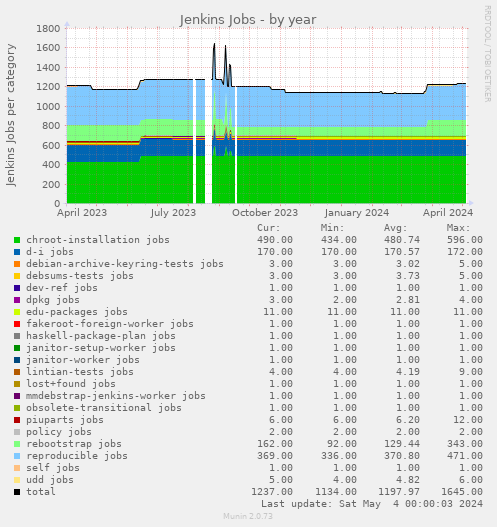
What happened in the reproducible builds effort between December 20th to December 26th: Toolchain fixes Mattia Rizzolo rebased our experimental versions of debhelper (twice!) and dpkg on top of the latest releases. Reiner Herrmann submited a patch for mozilla-devscripts to sort the file list in generated preferences.js files. To be able to lift the restriction that packages must be built in the same path, translation support for the __FILE__ C pre-processor macro would also be required. Joerg Sonnenberger submitted a patch back in 2010 that would still be useful today. Chris Lamb started work on providing a deterministic mode for debootstrap. Packages fixed The following packages have become reproducible due to changes in their build dependencies: bouncycastle, cairo-dock-plug-ins, darktable, gshare, libgpod, pafy, ruby-redis-namespace, ruby-rouge, sparkleshare. The following packages became reproducible after getting fixed: Some uploads fixed some reproducibility issues, but not all of them: Patches submitted which have not made their way to the archive yet: reproducible.debian.net Statistics for package sets are now visible for the armhf architecture. (h01ger) The second build now has a longer timeout (18 hours) than the first build (12 hours). This should prevent wasting resources when a machine is loaded. (h01ger) Builds of Arch Linux packages are now done using a tmpfs. (h01ger) 200 GiB have been added to jenkins.debian.net (thanks to ProfitBricks!) to make room for new jobs. The current count is at 962 and growing! diffoscope development Aside from some minor bugs that have been fixed, a one-line change made huge memory (and time) savings as the output of transformation tool is now streamed line by line instead of loaded entirely in memory at once. disorderfs development Andrew Ayer released disorderfs version 0.4.2-1 on December 22th. It fixes a memory corruption error when processing command line arguments that could cause command line options to be ignored. Documentation update Many small improvements for the documentation on reproducible-builds.org sent by Georg Koppen were merged. Package reviews 666 (!) reviews have been removed, 189 added and 162 updated in the previous week. 151 new fail to build from source reports have been made by Chris West, Chris Lamb, Mattia Rizzolo, and Niko Tyni. New issues identified: unsorted_filelist_in_xul_ext_preferences, nondeterminstic_output_generated_by_moarvm. Misc. Steven Chamberlain drew our attention to one analysis of the Juniper ScreenOS Authentication Backdoor: Whilst this may have been added in source code, it was well-disguised in the disassembly and just 7 instructions long. I thought this was a good example of the current state-of-the-art, and why we'd like our binaries and eventually, installer and VM images reproducible IMHO. Joanna Rutkowska has mentioned possible ways for Qubes to become reproducible on their development mailing-list.

Niels Thykier: Tor enabled MTA

As I posted earlier, I have migrated to use tor on my machine. Though I had a couple of unsolved issues back then. One of them being my Mail Transport Agent (MTA) did not support tor. A regular user might not have a lot of use for a MTA on their laptop. However, it is needed for a lot of Debian development scripts (bts, mass-bug, nmudiff), if they are to file/manipulate bugs for you. I have some requirements for my MTA I also have some non-requirements: Originally, I used postfix, which supported most of these requirements. Except: Per suggestion of Jakub Wilk, I tried msmtp, which turned out do what I wanted. The only feature I will probably miss is having a local queue, which can be rate limited. But all in all, I am quite happy with it so far. :)
Filed under: Debian

Russ Allbery: podlators 4.04

Now that I've fixed the major test suite problems with podlators, failure reports are now (mostly) useful. There's still the occasional failure to create a directory for temporary files, which I think is just a problem with the testing system, but Windows test failures revealed an actual test suite bug. This release also merges the changes made for merging podlators into blead Perl, which were relatively minor, and changes the package metadata to point to GitHub as the repository. That seems to be the growing convention in the Perl community and makes it easier for people to submit pull requests. I'm still maintaining my own public repository, but Git makes it easy to replicate things in multiple places. (Bug tracking will remain in the CPAN RT.) You can get the latest release from the podlators distribution page.

Amaya Rodrigo: If we have seen further

If we have seen further it is by standing on the shoulders of giants.
You are very dearly missed, Ian. You were one of those giants.

Iustin Pop: Orcas Island day trip, June 2015

I just finished going through my last set of pending-review pictures from 2015, so I'm starting 2016 with a post about the past. In June 2015 I travelled to Seattle/Kirkland area for work purposes, and took advantage of a weekend to plan some more outdoors stuff. After looking around on maps, I settled on the San Juan islands, so I started looking at hiking possibilities, and in the end Orcas island looked the best choice - all the others had much lower elevations. So, early in the morning, I started driving from Kirkland to Anacortes ferry terminal. The drive itself is quite nice: after getting past the more populated areas, passing Everett, the the view are very nice, especially in the early morning hours and with very few traffic. At Anacortes, there was already a small queue, fortunately I had a pre-ordered ticket, and there was not much to do until the ferry arrived except to look forward at the day, and hope that the weather will stay nice. On the ferry then, crossing the straits and enjoying the very nice views: Perfect blue Catching the morning wind The ferry stops at Orcas (is it a town or just the terminal), and the next stop is Eastsound town. I pre-planned here a stop to get a second mini-breakfast: however, I misjudged what the portion sizes are and got myself a maxi-cinnamon roll at Caffe Olga: Second breakfast :) At least I knew I wasn't going to be hungry for a while :) Driving on, briefly stopping at Cascade Lake (I also stopped on the way back, the view is nice), then reaching the parking at the Twin Lakes trail on the shore of Mountain Lake. Good think I arrived somewhat early the parking was quite full already. I also got a bit confused on which way the hike starts, since it's not well marked, but after that I started the hike. It's also possible to drive up to Mount Constitution, but that's just lame; hiking from the base it's quite easy, if you find how to start the hike. Anyway: Starting to climb Finished the steepest part At one point, one meets this particular sign: Which way now? Beware the Little Summit is not to be missed! After ~40 minutes of hiking, with some parts a tiny bit strenuous, the view is really breathtaking. It's definitely worth stopping by, as the view is (IMHO) nicer than the view from the top of Mt. Constitution: Wow! The reason I say this is better is because you look towards ocean, whereas later the view is back towards the continent. And looking towards the big ocean is just perfect! Plus, the many small island, fully covered with forest are also nice. Onwards then towards the peak of Mount Constitution. You cross the "ridge" of the island, and your view shifts to the other side. Which means you see back to the Mountain Lake where the hike starts: Loocking back towards the start Here the path is more exposed, not through tall forest like at the beginning: Watching the horizon Right before reaching the peak, you pass through an interesting forest: A different kind of forest And then you're finally reaching the peak. Compared to Switzerland, it's very much not impressive (730m), but nevertheless, being so close to the ocean results in some very nice views: Couldn't have asked for better weather You can go into the small tower, and read through the history of the location, including the personal life of Robert Moran (shipbuilder), who retired in 1905 to Orcas island to live what (his doctors said to be) his last months, and who instead ended living until 1943. Not bad! To be filled under "too much stress is bad, nature is good" heading, I think. After eating a small packed lunch, I started back. At the beginning the forest is similar to the one back at the beginning of the hike, but then, as you reach the level of lakes, it is slightly different. More tall (old?) trees, more moss and ferns: Afternoon sun in the forest I passed briefly by the Twin Lakes, which were interesting (lots of submerged trunks), and then finally on the Twin Lakes trail back to the start. The views of Mountain Lake from here are also nice, especially in the less harsh afternoon sun: Reached Mountain Lake How did those trees get there? And then the hike was over. I still had some time to spend before the ferry I had a ticket on was scheduled, so I drove down to Olga town, as I was curious what was at the end of "Olga Road". Not much, but again nice views, and this very picturesque pier: Nice pier in Olga And then it was back to the ferry, waiting in line, getting on the ferry, and crossing back: Goodbye Orcas! Overall, it was a day well spent, part different, part similar to last year's mostly road trip. Definitely recommended if you're in the area, and there are a couple of other hikes on Orcas Island, plus all the other islands which make up the San Juans. However, traffic on the way back was not that awesome :/ Small price though!

Benjamin Mako Hill: Access Without Empowerment (LibrePlanet 2015 Keynote)

At LibrePlanet 2015 (the FSF s annual conference), I gave a talk called Access Without Empowerment as one of the conference keynote addresses. As I did for my 2013 LibrePlanet talk, I ve edited together a version that includes the slides and I ve posted it online in WebM and on YouTube.
Here s the summary written up in the LibrePlanet program:
The free software movement has twin goals: promoting access to software through users freedom to share, and empowering users by giving them control over their technology. For all our movement s success, we have been much more successful at the former. I will use data from free software and from several related movements to explain why promoting empowerment is systematically more difficult than promoting access and I will explore how our movement might address the second challenge in the future.
In related news, registration is open for LibrePlanet 2016 and that it s free for FSF members. If you re not an FSF member, the FSF annual fundraiser is currently going on so now would be a great time to join.

2 January 2016

Daniel Pocock: The great life of Ian Murdock and police brutality in context

Tributes: (You can Follow or Tweet about this blog on Twitter) Over the last week, people have been saying a lot about the wonderful life of Ian Murdock and his contributions to Debian and the world of free software. According to one news site, a San Francisco police officer, Grace Gatpandan, has been doing the opposite, starting a PR spin operation, leaking snippets of information about what may have happened during Ian's final 24 hours. Sadly, these things are now starting to be regurgitated without proper scrutiny by the mainstream press (note the erroneous reference to SFGate with link to SFBay.ca, this is British tabloid media at its best). The report talks about somebody (no suggestion that it was even Ian) "trying to break into a residence". Let's translate that from the spin-doctor-speak back to English: it is the silly season, when many people have a couple of extra drinks and do silly things like losing their keys. "a residence", or just their own home perhaps? Maybe some AirBNB guest arriving late to the irritation of annoyed neighbours? Doesn't the choice of words make the motive sound so much more sinister? Nobody knows the full story and nobody knows if this was Ian, so snippets of information like this are inappropriate, especially when somebody is deceased. Did they really mean to leave people with the impression that one of the greatest visionaries of the Linux world was also a cat burglar? That somebody who spent his life giving selflessly and generously for the benefit of the whole world (his legacy is far greater than Steve Jobs, as Debian comes with no strings attached) spends the Christmas weekend taking things from other people's houses in the dark of the night? The report doesn't mention any evidence of a break-in or any charges for breaking-in. If having a few drinks and losing your keys in December is such a sorry state to be in, many of us could potentially be framed in the same terms at some point in our lives. That is one of the reasons I feel so compelled to write this: somebody else could be going through exactly the same experience at the moment you are reading this. Any of us could end up facing an assault as unpleasant as the tweets imply at some point in the future. At least I can console myself that as a privileged white male, the risk to myself is much lower than for those with mental illness, the homeless, transgender, Muslim or black people but as the tweets suggest, it could be any of us. The story reports that officers didn't actually come across Ian breaking in to anything, they encountered him at a nearby street corner. If he had weapons or drugs or he was known to police that would have almost certainly been emphasized. Is it right to rush in and deprive somebody of their liberties without first giving them an opportunity to identify themselves and possibly confirm if they had a reason to be there? The report goes on, "he was belligerent", "he became violent", "banging his head" all by himself. How often do you see intelligent and successful people like Ian Murdock spontaneously harming themselves in that way? Can you find anything like that in any of the 4,390 Ian Murdock videos on YouTube? How much more frequently do you see reports that somebody "banged their head", all by themselves of course, during some encounter with law enforcement? Do police never make mistakes like other human beings? If any person was genuinely trying to spontaneously inflict a head injury on himself, as the police have suggested, why wouldn't the police leave them in the hospital or other suitable care? Do they really think that when people are displaying signs of self-harm, rounding them up and taking them to jail will be in their best interests? Now, I'm not suggesting this started out with some sort of conspiracy. Police may have been at the end of a long shift (and it is a disgrace that many US police are not paid for their overtime) or just had a rough experience with somebody far more sinister. On the other hand, there may have been a mistake, gaps in police training or an inappropriate use of a procedure that is not always justified, like a strip search, that causes profound suffering for many victims. A select number of US police forces have been shamed around the world for a series of incidents of extreme violence in recent times, including the death of Michael Brown in Ferguson, shooting Walter Scott in the back, death of Freddie Gray in Baltimore and the attempts of Chicago's police to run an on-shore version of Guantanamo Bay. Beyond those highly violent incidents, the world has also seen the abuse of Ahmed Mohamed, the Muslim schoolboy arrested for his interest in electronics and in 2013, the suicide of Aaron Swartz which appears to be a direct consequence of the "Justice" department's obsession with him. What have the police learned from all this bad publicity? Are they changing their methods, or just hiring more spin doctors? If that is their response, then doesn't it leave them with a cruel advantage over those people who were deceased? Isn't it standard practice for some police to simply round up anybody who is a bit lost and write up a charge sheet for resisting arrest or assaulting an officer as insurance against questions about their own excessive use of force? When British police executed Jean Charles de Menezes on a crowded tube train and realized they had just done something incredibly outrageous, their PR office went to great lengths to try and protect their image, even photoshopping images of Menezes to make him look more like some other suspect in a wanted poster. To this day, they continue to refer to Menezes as a victim of the terrorists, could they be any more arrogant? While nobody believes the police woke up that morning thinking "let's kill some random guy on the tube", it is clear they made a mistake and like many people (not just police), they immediately prioritized protecting their reputation over protecting the truth. Nobody else knows exactly what Ian was doing and exactly what the police did to him. We may never know. However, any disparaging or irrelevant comments from the police should be viewed with some caution. The horrors of incarceration It would be hard for any of us to understand everything that an innocent person goes through when detained by the police. The recently released movie about The Stanford Prison Experiment may be an interesting place to start, a German version produced in 2001, Das Experiment, is also very highly respected. The United States has the largest prison population in the world and the second-highest per-capita incarceration rate. Many, including some on death row, are actually innocent, in the wrong place at the wrong time, without the funds to hire an attorney. The system, and the police and prison officers who operate it, treat these people as packages on a conveyor belt, without even the most basic human dignity. Whether their encounter lasts for just a few hours or decades, is it any surprise that something dies inside them when they discover this cruel side of American society? Worldwide, there is an increasing trend to make incarceration as degrading as possible. People may be innocent until proven guilty, but this hasn't stopped police in the UK from locking up and strip-searching over 4,500 children in a five year period, would these children go away feeling any different than if they had an encounter with Jimmy Saville or Rolf Harris? One can only wonder what they do to adults. What all this boils down to is that people shouldn't really be incarcerated unless it is clear the danger they pose to society is greater than the danger they may face in a prison. What can people do for Ian and for justice? Now that these unfortunate smears have appeared, it would be great to try and fill the Internet with stories of the great things Ian has done for the world. Write whatever you feel about Ian's work and your own experience of Debian. While the circumstances of the final tweets from his Twitter account are confusing, the tweets appear to be consistent with many other complaints about US law enforcement. Are there positive things that people can do in their community to help reduce the harm? Sending books to prisoners (the UK tried to ban this) can make a difference. Treat them like humans, even if the system doesn't. Recording incidents of police activities can also make a huge difference, such as the video of the shooting of Walter Scott or the UK police making a brutal unprovoked attack on a newspaper vendor. Don't just walk past a situation and assume everything is under control. People making recordings may find themselves in danger, it is recommended to use software that automatically duplicates each recording, preferably to the cloud, so that if the police ask you to delete such evidence, you can let them watch you delete it and still have a copy. Can anybody think of awards that Ian Murdock should be nominated for, either in free software, computing or engineering in general? Some, like the prestigious Queen Elizabeth Prize for Engineering can't be awarded posthumously but others may be within reach. Come and share your ideas on the debian-project mailing list, there are already some here. Best of all, Ian didn't just build software, he built an organization, Debian. Debian's principles have helped to unite many people from otherwise different backgrounds and carry on those principles even when Ian is no longer among us. Find out more, install it on your computer or even look for ways to participate in the project.

Lunar: Reproducible builds: week 33 in Stretch cycle

What happened in the reproducible builds effort between December 6th and December 12th: Toolchain fixes Reiner Herrmann rebased our experimental version of doxygen on version 1.8.9.1-6. Chris Lamb submitted a patch to make the manpages generated by ruby-ronn reproducible by using the locale-agnostic %Y-%m-%d for the dates. Daniel Kahn Gillmor took another shot at the issue of source path captured in DWARF symbols. A patch has been sent for review by GCC upstream to add the ability to read an environment variable with -fdebug-prefix-map. Packages fixed The following 24 packages have become reproducible due to changes in their build dependencies: gkeyfile-sharp, gprbuild, graphmonkey, gthumb, haskell-yi-language, ion, jackson-databind, jackson-dataformat-smile, jackson-dataformat-xml, jnr-ffi, libcommons-net-java, libproxy, maven-shared-utils, monodevelop-database, mydumper, ndesk-dbus, nini, notify-sharp, pixz, protozero, python-rtslib-fb, slurm-llnl, taglib-sharp, tomboy-latex. The following packages became reproducible after getting fixed: Some uploads fixed some reproducibility issues, but not all of them: These uploads might have fixed reproducibility issues but could not be tested yet: Patches submitted which have not made their way to the archive yet: reproducible.debian.net Files created with diffoscope now have diffoscope in their name instead debbindiff. (h01ger) Hostnames of first and second build node are now recorded and shown in the build history. (Mattia Rizzolo) Exchanges have started with F-Droid developers to better understand what would be required to test F-Droid applications. (h01ger) A first small set of Fedora 23 packages is now also being tested while development on a new framework for testing RPMs in general has begun. A new Jenkins job has been added to set up to mock, the build system used by Fedora. Another new job takes care of testing RPMs from Fedora 23 on x86_64. So far only 151 packages from the buildsys-build group are tested (currently all unreproducible), but the plan is to build all 17,000 source packages in Fedora 23 and rawhide. The page presenting the results should also soon be improved. (h01ger, Dhiru Kholia) For Arch Linux, all 2223 packages from the extra repository will also be tested from now on. Packages in extra" are tested every four weeks, while those from core every week. Statistics are now displayed alongside the results. (h01ger) jenkins.debian.net has been updated to jenkins-job-builder version 1.3.0. Many job configurations have been simplified and refactored using features of the new version. This was another milestone for the jenkins.debian.org migration. (Phil Hands, h01ger) diffoscope development Chris Lamb announced try.diffoscope.org: an online service that runs diffoscope on user provided files. Screenshot of try.diffoscope.org Improvements are welcome. The application is licensed under the AGPLv3. On diffoscope itself, most pending patches have now been merged. Expect a release soon! Most of the code implementing parallel processing has been polished. Sadly, unpacking archive is CPU-bound in most cases, so the current thread-only implementation does not offer much gain on big packages. More work is still require to also add concurrent processes. Documentation update Ximin Luo has started to write a specification for buildinfo files that could become a larger platform than the limited set of features that were thought so far for Debian .buildinfo. Package reviews 113 reviews have been removed, 111 added and 56 updated in the previous week. 42 new FTBFS bugs were opened by Chris Lamb and Niko Tyni. New issues identified this week: timestamps_in_documentation_generated_by_docbook_dbtimestamp, timestamps_in_sym_l_files_generated_by_malaga, timestamps_in_edj_files_generated_by_edje_cc. Misc. Chris Lamb presented reproducible builds at skroutz.gr.

Niels Thykier: dput change-all-of-debian.changes

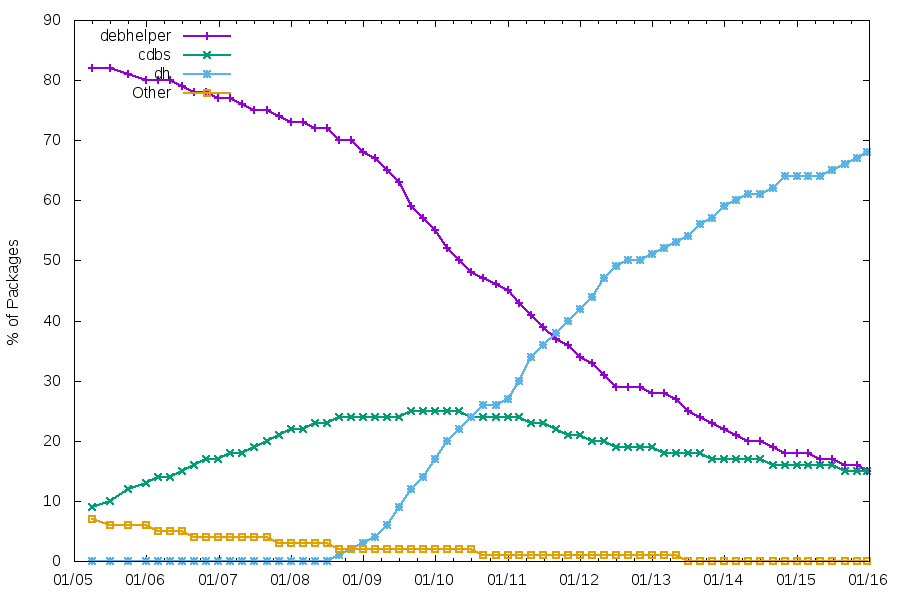
Lucas Nussbaum recently did a blog post called Debian is still changing . I found it a very welcome continuation of his previous blog post on the same topic. I find the graphs very interesting and was very happy to learn that he included relative graphs this time. Now I can with relatively ease say that 69% of all Debian packages are using a dh-style build (source). We have another 15% using classic debhelper, which means that at least 84% of all packages uses debhelper directly. Assuming all CDBS based packages rely on the debhelper class , we are at 99%! The latter is certainly an assumption, although I suspect it is probably pretty accurate[1]. Now, it is very cute to have world dominance , but that is not my primary interest in these numbers. Instead, we can use these numbers to determine that: Such as automatic dbgsym packages, indexable build-id from dbg(sym) packages via Packages files[2], and replacing maintscripts with ldconfig triggers. All of these changes happen to be changes that could be trivially deployed with very little risk and very high efficiency[3]. Notably, none of them required a compat bump (or a new debhelper tool). Of course, I do not intend to say that every change can (or should) be deployed via debhelper and much less into an existing dh_cmd -tool. Notably, dh_strip is reaching its breaking point for content. And if we were to require a compat bump for your change, we can now at least see the adoption rate via lintian. :) Nevertheless, it is nice to know that (politics aside) there is some agility in the Debian build system! :) [1] I would very much love to see numbers to (dis)prove my assumption about CDBS + debhelper. In fact, an absolute number of packages not using debhelper (indirectly) in Debian would be very intriguing. [2] New fields by default end up the Packages file. See e.g. the Packages.xz file on the debug mirror or your apt-cache via:
apt-cache show mscgen-dbgsym   grep ^Build-Ids
The latter assumes that you have the debug mirror in your sources list. [3] Efficiency here being features people rarely override/disable.
Filed under: Debhelper, Debian

Iain R. Learmonth: Adventures at London Luton

Continuing on my journey home, once again I was asked to step into the full-body scanner. This time I was certain that I didn't want to use it, I was so angry last time that I had been forced into it that I actually threw up. It wasn't until I was in tears and asking them to take my bags off the plane, planning to take the train instead, that they gave me the manual pat-down. "Voluntary" apparently has a different meaning to the one I'm familiar with here.

Steve Kemp: Restoring my system .. worked

A while back I wrote about some issues with converting a two-disk RAID system to a one-disk system, but just to recap: In the end we bought a small form-factor PC, with only a single drive and I moved one of the two drives from the old machine into it. Then converted it to run happily with only a single drive, and not email every day to say "device missing". So there things stood, we had a desktop with a single drive, and I ensured that I took full daily backup via attic. Over Chrismas the two-year old drive failed. To the extent I couldn't even get it to be recognized by the BIOS, and thus couldn't pull data off it. Time to test my backups in anger! I bought a new drive, installed a minimal installation of the Jessie release of Debian onto the system, and then ran:
 cd /
 .. restore latest backup ..
Two days later I'd pulled 1.3Tb over the network, and once I fixed up grub, /etc/fstab, and a couple of niggles it all just worked. Rebooted to make sure the temporary.home hostname, etc, was all gone and life was good. Restored backup! No errors! No data-loss! Perfect! The backup-script I use every day was very very good at making sure nothing was missed:
attic create --stats --checkpoint-interval=7200 attic@$ remote :/attic/storage::$ host -$(date +%Y-%m-%d-%H)
  --exclude=/proc      \
  --exclude=/sys       \
  --exclude=/run       \
  --exclude=/dev       \
  --exclude=/tmp       \
  --exclude=/var/tmp   \
  --exclude=/var/log   \
  /
In other news I published my module for controlling the new smart lights I've bought

Iain R. Learmonth: Fun in Hamburg Airport

Today I'm travelling home from 32c3, back to Aberdeen via London from Hamburg Airport. My experience passing through security to get to the gates this morning has angered me to the point that I had to vent. They have full-body scanners installed, which in my opinion are a massive invasion of my personal privacy. As I approached the security checkpoint, I noticed a sign where it stated that use of the scanner was not mandatory and that a manual screening process was available. Once I'd loaded my bags into the trays, I asked the security officer how to opt for the manual screening at which point I was told it was not available due to a lack of staff. I was forced to allow for an intimate scan to take place or miss my flight. I'm not really in a position to be making alternative arrangements for travel and so I had to submit but it has left me outraged. Privacy is about the ability to choose what I share and who I share it with. This was meant to be a right protected by the ECHR, but I guess human rights are outdated now we're entering 2016. Bring on the dystopian future!

Junichi Uekawa: 2015 added a new family member.

2015 added a new family member. That meant that I needed a new approach to working and my personal life. What awaits 2016?

1 January 2016

Russ Allbery: 2015 Book Reading in Review

2015 was another very busy year, but one of stabilization, rebuilding, and recovery. I got through the ramp-up period with my new job, found a better role inside the company for my personal talents and preferences, and ended the year on a professional high note. I also moved, to a place I like much better. It was a year for taking things as they come, focusing on priorities, letting other things slip, and being realistic about how much I can do. All of that, plus quite a lot of company, a business trip, and a few other unexpected distractions, meant less reading than I would have preferred. However, I did catch up completely on review writing, which is another happy sign of stabilization. Reviews came in spotty bursts, but they did come. The only explicit reading goal I'm making for 2016 is to read more than I did in 2015. I'm still working out the best priorities and schedule for me, and finding the best work/life balance points, so a predictable reading schedule will have to wait a while longer. The below statistics are confined to the books I reviewed in 2015, but thanks to significant catch-up work, I've only read one book that I have not yet reviewed (and I finished that one on December 31st). That book will be counted in 2016. Once again, the year saw two 10 out of 10 books, and once again, my favorite book of the year was written by Ann Leckie. The conclusion of the Imperial Radch trilogy, Ancillary Mercy, is as good or better than the start. The second book of the trilogy, Ancillary Sword, was also among my 2015 reviews and got 9 out of 10. I highly recommend the entire trilogy, beginning with Ancillary Justice (my book of the year in 2014), to anyone who hasn't read it. The second 10 out of 10 was non-fiction: Randall Munroe's What If? collection, featuring some material from the web site feature that accompanies xkcd and some original material. These are longer essays exploring interesting bits of science, math, and guesswork in the context of hypothetical questions that usually become surprisingly destructive. As the review says, try a few samples from the web site and see if this is your thing. I loved it. Despite my continuing low reading totals, this was a year full of fiction stand-outs. Becky Chambers's The Long Way to a Small, Angry Planet was the surprise of the year for me: a heart-warming, delightful story of chosen family. Jo Walton's My Real Children was less of a surprise because I already knew she is an excellent writer, but it was probably the best-written book I read all year. In turns sad, thoughtful, and determined, it's slice-of-life fiction so good that it overcame my normal dislike of that subject matter. Other fiction highlights are parts of series: the first two Steerswomen books by Rosemary Kirstein (The Steerswoman and The Outskirter's Secret), which dance between fantasy and scientific discovery, and Seanan McGuire's One Salt Sea, the best of all the October Daye books I've read. In non-fiction, the other book that stands out is Jenny Lawson's Let's Pretend This Never Happened. This combination of memoir and stand-up comedy in book form is one of the funniest things I've read, and it mixes that humor with self-awareness and generous openness. It's a book about being a little crazy and a lot anxious, finding ways to cope by laughing at yourself, and inviting the rest of the world to join in. Finally, Sydney Padua's The Thrilling Adventures of Lovelace and Babbage straddles the line between fiction and non-fiction, but certainly deserves a place in the year-end round-up. Full of great art, humor, steampunk, footnotes galore, and numerous forms of geekery, it's a collection I've been waiting for since Padua's very occasional comic got its moment of Internet fame. The full analysis includes some additional personal reading statistics, probably only of interest to me.

Mehdi Dogguy: In memoriam: Ian Murdock

It is with great sadness that I learned of the passing of Ian Murdock. I have never had the chance to meet him. Several persons testify for his kindness and talent. We will always remember him. His legacy influences our lives everyday!

Looking at his latest blog posts, he seemed a bit nostalgic about Debian and still very proud of it.

Later, he wrote about how he came to find Linux and the importance of telling the story of hackers of his generation. In his memory, I'll reread Stephen Levy s Hackers for the nth time too.

When (if?) his webserver will shut down, you will still be able to read his past blog posts using the archived version of his website or a static mirror that has been set up.

RIP Ian.

Bdale Garbee: Term Limited

I woke up this morning and realized that for the first time since 17 April 2001, I am no longer a member of the Debian Technical Committee. My departure from the committee is a consequence of the Debian General Resolution "limiting the term of the technical committee members" that was passed amending the Debian Constitution nearly a year ago. As the two longest-serving members, both over the term limit, Steve Langasek and I completed our service yesterday. In early March 2015, I stepped down from the role of chairman after serving in that role for the better part of a decade, to help ensure a smooth transition. Don Armstrong is now serving admirably in that role, I have the utmost respect for the remaining members of the TC, and the process of nominating replacements for the two now-vacant seats is already well underway. So, for the Debian project as a whole, today is really a non-event... which is exactly as it should be! Debian has been a part of my life since 1994, and I sincerely hope to be able to remain involved for many years to come!

Thorsten Alteholz: My Debian Activities in December 2015

FTP assistant Due to Christmas, I only marked 254 packages for accept and rejected 17 of them. I had to send 14 emails to maintainers. Squeeze LTS This was my eighteenth month that I did some work for the Squeeze LTS initiative, started by Raphael Hertzog at Freexian. As other members of the LTS team had to give back some hours of their workload, this month my initial workload of 18.25h had been increased to 21.25h. Altogether I uploaded those DLAs: I also started to work on CVEs for packages t-coffee and pitivi, only to recognize that the versions in Squeeze are not affected. Further I prepared patches for passenger and srtp but I could not test them yet, so an upload will be in January. This month I also experienced something strange. Due to the upload of the new version of mysql, I had to process a package for squeeze-lts in NEW. I seldom see a package, that creates so much red output from lintian. I assume this always happens when an old package will be checked by the latest lintian and is a good sign for all the development within Debian. I also tested Raphaels patch for #796784 and could confirm that everything works as expected. Unfortunately the php5 upload must be delayed until Januar. This month I also had another week of frontdesk duties. Other stuff The Advent season is over and the Debian Med Advent Calendar is full to bursting. The incredible number of 150 bugs have been closed this year! Due to the GSL transition a new upload of all meep packages had to be done and all in all I could close #748822, #807210, #807212, #807213, #807214, #807215 and #807747.

Zlatan Todori : Thank you ancenstor

When I found out that our founding father died it really was hard for me. I took it like a real man. I cried and then I choose to write a blog post. I never met Ian, but he changed my life with his humble but great decision some 22 years ago. Not only mine. He changed many of us. He empowered us, he gave us something we didn't have before. Without Debian I would never be person I am today and I am happy to say that I am still growing with incredible pace everyday. Every. Single. Day. We all are Ian and we will continue to keep up the fire on the torch. I can say one thing, in coming decades and centuries society is gonna get better and I am sure it will be because of Debian. Debian community will overtake the world because we are not only universal OS, we are social movement for better life where many of people I love found their home. You know, the swirl is the gear that keeps one awesome family keep going on and growing every single day. And I can be proud to say, I lived in time where Ian made a choice that changed the world. Thank you founding father, you will be remembered and celebrated forever.

Niels Thykier: Debian, please plan for Stretch

In the 4th quarter of 2016, we will freeze Debian Stretch. If you are hoping to do any larger changes for Stretch, please consider starting on them now. This also includes features that need to be in APT/dpkg (etc.) in Stretch, so we can start using them for Buster. Even something as trivial as the automatic dbgsym packages took over 8 months to complete (from the prototype was announced in April). I call it trivial because: NB: There were certainly other parties involved. But these were the most important ones. Mind you, the dbgsym saga is not complete yet. We are still lacking support for migrating dbgsym packages to testing (and, by extension, the next stable release as well). Meanwhile, you can pull the dbgsym packages from snapshot.debian.org. In summary: If you want a larger change to land in Debian Stretch, please start already now. :)
Filed under: Debian, Release-Team

Next.

Previous.