Search Results: "ana"

1 September 2007

Michael Prokop: Froscon 2007 - lessons learnt

Antti-Juhani Kaijanaho: Hey, I found a bug!

Bugi (In other news, I just uploaded darcs-monitor to Debian. It’s sitting waiting for NEW processing. In the meantime, you can get the package at the upstream distribution site.)

Lior Kaplan: OpenProj and the Common Public Attribution License

On August 20th, Projity have released OpenProj which is a Java based project management software (like Microsoft Project). With the release they made a .deb file available for download, which caught my attention. I checked the deb file, and while it probably does the work of installing the application, it’s far from being a valid Debian package. I contacted the company though the package maintainer (Laurent Chretienneau) to suggest they would invest time to make their software an official part of Debian, and I’m willing to help if needed. Laurent said they would be happy for OpenProj to be officially a part of Debian. Today, I decided it would be smart to open an ITP for the package, so other people won’t spend time doing the same packaging work as the company already did. For the ITP license field I had to check the license of the software. While it’s webpage states: ” OpenProj is a free, open source project management solution” I thought that would be a no brainer, but it seems they use the Common Public Attribution License, a recently OSI approved license. Of course the license should go though the usual debian-legal review, but I guess it would be non free due to some attribution requirements and limitations. I was disappointed to find that OpenProj isn’t licensed under the GPL or other common free software (and DFSG compliant) license. I’m still not sure if I want to invest time of they software due to this issue, I guess I’ll give it much lower priority now.

MJ Ray: Vuelta a Espa a

Eurosport are broadcasting the Vuelta a Espa a at 19 east from today with commentary in English (analogue only) and German. Scheduled times:-
Sat 01.09.2007
16:30-17:30 CET
Sun 02.09.2007
16:00-17:30 CET
Mon 03.09.2007 to Thu 06.09.2007
16:30-17:30 CET
Fri 07.09.2007 to Mon 10.09.2007
16:00-17:30 CET
Tue 11.09.2007
no show (MTB at 08:45)
Wed 12.09.2007
16:00-17:30 CET
Thu 13.09.2007
01:00-01:30 and 15:45-17:30 CET
Fri 14.09.2007 and Sat 15.09.2007
16:00-17:30 CET
TVEi are broadcasting at 13 and 19 east. Scheduled times:-
Sat 01.09.2007
16:40-18:00 CET
Sun 02.09.2007
16:40-18:30 CET
Mon 03.09.2007
16:35-18:00 CET
Tue 04.09.2007 to Sun 09.09.2007
16:40-18:00 CET
I'll post more times next week. I'd bet on a strong showing from Caisse d'Epargne after a relatively quiet TdF. Who would you tip? If you've not got your satellite set yet, some Lidl specials are still available and most Maplin branches have sets. Finding the broadcasts at 19 east is pretty easy in the UK. See my asteFAQ for hints and links. I've still not fixed my dish up properly, yet it gets most 19 east transmissions.

31 August 2007

Russell Coker: Interesting Ideas from George Monbiot

Here is a transcript of a lecture by George Monbiot about climate change and what we need to do. The latest scientific evidence suggests that we need to cut emissions to zero by 2030 to avoid significant increases in the sea level over the next century, George describes some options that will form part of a solution to this problem. Below are my comments on what I consider the most interesting (the ideas that I hadn’t heard of before), I recommend reading the full article for the rest.
  1. Have a carbon ration for each citizen. Wealthy people who want to use more resources could buy carbon rations from poorer people on an open market. That way people who use less than their ration still have an incentive to save more because the extra savings are worth money! As everyone would then have a financial incentive to reduce emissions there would be a lot of new development of methods and technologies for eliminating or compensating for carbon emissions, capitalism works!

  2. Build battery powered cars with interchangeable batteries. The idea is that you rent a battery from a fuel company, and whenever it runs low you go to a service station and swap it for a fully charged battery (for a small fee). If doing this the service station could use cheap night-time electricity to charge the batteries, and the batteries that are charged could be used to put electricity back into the grid at times of peak demand. A common idea is to have Prius+ type vehicles charge from the grid when not being used and then sell electricity back to the grid at peak times. Implementing such a system for millions of homes is technically challenging and expensive. But having a much smaller number of service stations sell larger quantities of electricity back to the grid is easier to manage.

  3. Reduce air travel by 90%. I wonder how much of this can be achieved by using high-speed trains for all national travel systems and for most travel within the EU. I have often travelled between Amsterdam and London by train, it’s much more civilised than flying.

  4. Classic quote from George on John Howard: “if Howard believes a slight reduction in consumption is a recessionary measure he ought to see what a total reduction of land area would be as a result of the melting of the west Antarctic ice sheet. The two things are just completely out of proportion..”

George Monbiot also has recently released a new book Heat: How to Stop the Planet from Burning.

John Goerzen: The Story of One Barn

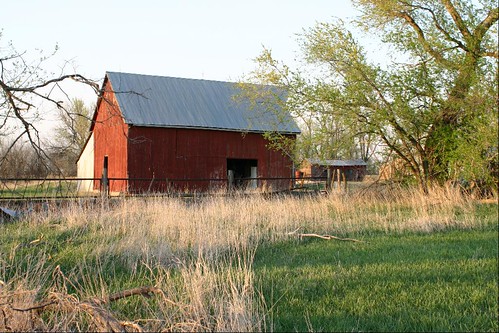
img_2575

About 80 years ago, a Kansas family -- the Janzens -- built this barn.

About 60 years ago, my grandparents moved onto the farm. Their cattle were kept right here. I remember Grandpa's red tractor being parked in the barn.

So many memories have this barn in the background. We had a visit from one of the Janzens that lived here as a child. He had fond memories of this building. My dad and his siblings once played in the deep snow in front of this barn.

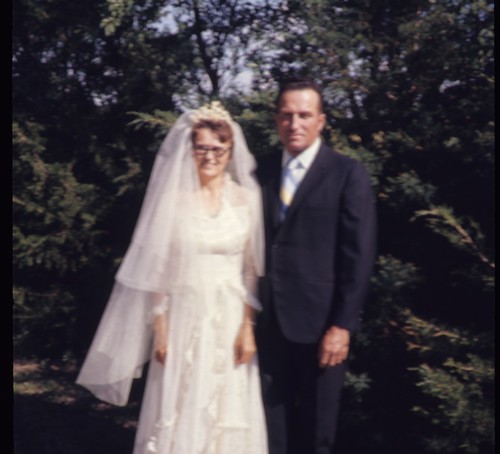
Here's one memory from those times:
078.jpg

That's my grandma and grandpa on their 25th anniversary in 1970. It was a working barn back then, so they probably weren't standing right next to it for this picture, if you get my drift. But they were on the yard.

About 25 years ago, Grandma lost her battle with cancer. At some point or another, Grandpa had eased out of farming, so the barn had a lot less activity. I remember exploring his outbuildings when I got bored at family gatherings. And I used to mow the lawn next to it every summer when Grandpa went off to be a cook at a camp. I didn't mind mowing next to the barn. But I always tried to go past one corner of the house as fast as I could, because there were wasp and hornet nests right there.

About 7 years ago, it was time for Grandpa to move off the farm. It was getting to be too much to keep up the old house, the barn, the yard, and deal with things like freezing water pipes and water getting in through the windows. He moved to an independent-living duplex in town. He was always worried about what would happen to the farm. Over the next few years, the farm would sometimes be vacant, sometimes have renters. Some renters did some work on the house, but the barn sat. Grandpa would eventually move into the nursing home because of his Parkinson's.

Two and a half years ago, Grandpa passed away. I shared some memories from Grandpa's place at the funeral.

But what of the house, the farm now? Renters went, and it sat empty. Nothing was in great shape, and the house needed a lot of work. Perhaps the whole place would be leveled and turned back into the prairie that it once was, or used as farmland. Perhaps someone would have an interest someday.

A year and a half ago, Jacob was on the way. Terah and I had occasionally thought of buying Grandpa's place, but we never talked about it seriously. We figured that we better finally decide what we're doing, before we have a baby around, or a child in school. So in April 2006, we went out to the farm and checked it out. The picture at the top of this post is from that visit. Terah and I checked out the house, the barns, the granary, the pasture, and the creek. As we walked past one of the barns, a pigeon flew out. Terah jumped with a shout. I grew up around barns and didn't really notice it. In the big red barn, besides Grandpa's tractor, we found some remnants from years ago: some old bales, corn cobs that raccoons had found long ago, several generations of electric fencers, old appliances.

And we decided to go for it and buy the farm. This was right at a year after Grandpa died.

The family always liked to get together for Easter. What would happen for 2006? Well, they decided to have a picnic out at the farm. It was vacant, and a bit eerie. Yet they knew that we were working on buying the place and moving in. All but one took a last look through the house before our renovations began. The one person who didn't was my great aunt, Grandma's sister. She said, "I haven't been in this house for years. I remember how it looked back then. I don't want to remember how it looks now, run down like this. So I'm not going in. But once you have it all fixed up, THEN I'll go in!"

In June of 2006, we bought the farm.

One month later, we lost this barn, and two other buildings, to a fire at our yard. This is what the beautiful red barn looked like that sad afternoon last year:
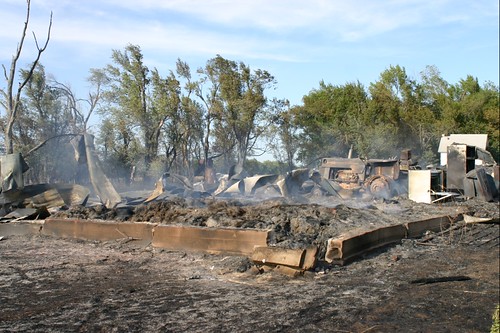
IMG_3630.JPG

As I wrote back then, nobody got hurt, the barn was insured, but "somehow, despite all these things, it still feels like we lost a little bit of Grandpa today."

2006 was a hot, dry summer. We had a patch of debris, then a patch of dirt, where the barn once stood.

7 months ago, Terah, Jacob, and I moved out to the farm. For the first time in 80 years, someone could stand in the farmhouse in the evening, look to the west, and see the colorful Kansas sunset over the pasture; the trees down by the creek; and even the neighbor's barn off in the distance. It was a beautiful sight, but it was also sad; that's not the view we had expected.

But then a surprise. This spring and summer, plants started coming up where none had grown for 80 years. But only where this barn stood -- not where the other two buildings were.

We watched as they grew tall. I'm sure decades of animals hanging out there were well appreciated by the plants.

As they grew, it looked like we might be seeing Terah's favorite flower: wild Kansas sunflowers.

And sure enough, they were.

Last weekend, Terah, Jacob, and I went out to the old barn. I took some pictures of its new appearance.

img_3429.jpg

This one stands where Grandpa's tractor used to be parked.

img_3401.jpg

And here we see a lifetime of flowers, from the old and withering, to the young just about ready to bloom.

img_3462.jpg

At the edge of the sunflowers, there's an old plow next to them. Though you might think it's barn-colored.

img_3411.jpg

Animals continue to be attracted to the area. Here's one of the smaller visitors.

img_3447.jpg

And here's a picture of almost the whole patch, right where the barn used to stand. I still mow right up to it.

I still miss the old barn. But somehow it still seems to be full of surprises and worth exploring. I wonder what next year will bring.

And I wonder if, a few years from now, Jacob will tell his friends about mowing right up to the sunflower patch, going fast to try to avoid any trouble with the bees.

30 August 2007

Steve Kemp: I gotta be cool relax, get hip

Fighting Spam Lots of people get spam and don't want to fight it themselves. Many of those people elect to use a service such as Google Mail, which does an adequate job of filtering most of the time. For people who wish to host their own mailservers, and off-load their anti-spam support to another entity, there are big companies such as MessageLabs. But if you can't/won't pay for somebody else how would you handle it? Right now I run my own mailserver and mostly it rocks. However I also manage a couple of servers for other people, and this mostly means that I have identical configuration(s) scattered across other machines. (Or as I recently discovered "mostly identical" setups scattered across N hosts.) After viewing a recent thread upon the forums of my employers I'm wondering how hard it would be to setup an anti-spam mail host. The idea being that users of domain example.org would continue to run their own mailserver (+optional POP/IMAP server). However this server wouldn't be listed in an MX record. Instead the MX record would point at the antispam server, which would then process and forward the mail on. (I'm assuming that the mailserver at example.org would be firewalled such that it would only accept SMTP connections from the anti-spam host). The only challenges I see would be: The last one is the killer point which makes me wonder if I'm wasting my time on the general case; I don't believe I could persuade people to pay for such a service (on the grounds that I wouldn't!) and if ever a mail were dropped I'd be the first person who would be blamed. And probably rightly so. The simple solution would be to always accept mail - but just tag it. Then you still have the same issue, but you have the excuse that "I still delivered your mail; just tagged wrongly". The downside of that is that the recipient still has to filter the mail; and still eats the bandwidth cost. The main gain is the lack of spam-processing CPU that is eaten locally. Anti-spam, and to a lesser extent anti-virus, topics are very interesting to me, and I'd love to hear any thoughts - or even what you use for yourself. Right now I'm 50/50 on setting up my main mailserver as the proxy for a few domains I have to manage (family, friends) to see how it works, but I'm not quite convinced yet. (Single point of failure == bad. Though centralised configuration == good.)

Theodore Ts'o: On the benevolent dictator model

Recently, Josh Berkus blogged about The Myth of the Benevolent Dictator. In it he complained about people who try to posit that a benevolent dictator was "an unalloyed asset" to their project, and that there were many successful and valid forms project governance other than the singleton project leader. Furthermore, he argues that the best way is to form a community, and then ends by suggesting that people who say "dictatorship good" is really saying "democracy bad", and perhaps the motives of the person using that argument should be questioned.

Given that I was one of the first people (and probably the first person) to use that phrase to describe Linus's governance model, obviously I feet the need to respond to his thoughts on the matter.

First of all, the term "benevolent dictator" comes from an old saying, "the best form of government is the benevolent dictator --- there's only one problem, finding the benevolent dictator"[1]. And in my presentations where I explained the Linux project management model, I was always careful to say that there were other models that were used by other projects, and that it was interesting to study why certain management models worked for some projects but not others.

So by definition, if a project is successful with a single project leader ultimately responsible for making decisions to settle conflicts, then that leader is a "benevolent dictator"; if they aren't successful, then that would be an example of a dictator who wasn't able to be "benevolent", eh? :-)

In all seriousness, though, I agree with Josh when he says that the key part of an open source project being successful is gathering together a healthy community. But let's unpack that a little. In order for a community to be healthy, there needs to be general consensus on the values and cultural norms for that community. So for example, in the case of Debian, which Josh holds up as a successful community, not everyone has the ability to vote; you have to pass a fairly stringent process which tests your technical skills and your willingness to subscribe to Debian's core values as embedded to the Debian Social Contract. People who do not pass the New Membership process do not have the right to vote in Debian, even if they are the most rabid, fanatical users of Debian.

This brings up a key point about governance analogies; they all don't map cleanly into the real world for two closely related and extremely important reasons: (1) No one has a fundamental human right to be a member in some OSS project, and (2) No one is forced to stay in a particular OSS project. These are really two sides of the same coin, and what it means is that, as in Debian, "democracy" does not mean that everyone is entitled to political franchise, or the right to vote, and in a project which has a "benevolent dictator", the powers of the dictator is fundamentally limited by the simple fact that if he is too unreasonable, people are always free to leave or fork the project. These differences are extremely important when trying to reason about "democracy" or "dictatorship" as being good or bad as applied to open source projects.

Democracy is rarely the best way for an open source project to make decisions. For technical issues, you want the right answer, and majority vote isn't necessarily way to resolve a technical issue. As far as policy decisions, if the decision can not be made by consensus, then some percentage of the community will be unhappy with how the decision, and that can cause a huge amount of arguments and dissension. If the community has very clearly expressed values, then the number of times where such votes need to be made will be minimal.

For example, Debian has an explicit declaration of its values and mission in its Debian Social Contract; people who don't agree to the Social Contract aren't allowed to become Debian Developers and thus are not allowed to vote. But, one of the more controversial disputes that have threatened to tear apart Debian is the question of the non-free packages, and that's fundamentally because of an ambiguity in the Social Contract. On the one hand, Debian has declared that it is fundamentally 100% about Free Software, to the extent that it has adopted Richard Stallman's rather petulant request that the Linux operating system be called GNU/Linux (which admittedly is better than Lignux.) On the other hand, the Social Contract also explicitly specifies the existent of the non-free section in the distribution. Over time, this ambiguity have been the source of a lot of highly passionate debate and controversial votes that have satisfied neither the FSF fanatics nor the more Linux-like moderate position tolerating the use of proprietary as well as open source software. I submit that if Debian had either explicitly stated an FSF-centric position, and only accepted members that supported point of view, or explicitly subscribed to a position that users should be able to use whatever software they feel meets their needs, as Ubuntu has, it would avoided many arguments that have threatened to tear apart Debian.

More recently the fact that the Social Contract has been silent about whether or not Debian Developers should be paid or purely be 100% volunteer. This was never an issue in the Linux Kernel community, but for some reason it has been a highly divisive and disruptive issue inside Debian. Democratic votes have not really resolved the conflicts, and in fact some might claim that these votes have if anything hardened various Debian Developers' positions.

Going back to Josh's final point, "Next time you hear the words 'benevolent dictator' you probably want to think about the motives of the person saying it. Because the corollary to 'dictator good' is 'democracy bad', and is that a place you really want to go?", I am quite proud to stand by my convictions that for Open Source Projects, pure democracy is a bad idea. If a projects wants to be technically successful, it needs to be a meritocracy, and chose the best technical decisions; Linus does not decide by abiding with majority vote whether or not a patch should be accepted, and that's as it should be.

Even Debian's "raw democracy" doesn't let any random luser get to vote on who should be the Debian Project Leader. Decisions need to be made by people who are competent to make a valid choice. Even in real life, one could argue that the choice made by Americans, over of which 70% believed that Saddam Hussein was "very likely" or "somewhat likely" to be personally involved with the 9/11 attacks even though there has been absolutely no evidence to support this "gut feeling", made a rather disastrous choice in voting to re-elect George Bush to the presidency. Democracy without sufficient education, literacy, and intellectual curiosity to learn about what is happening in the world can result in truly disastrous choices being made. So certainly, democracy is not a panacea. In the real world, it may be the best choice of many bad choices, given how much people have suffered under military dictatorships. However, in the Open Source world, things are different because people are always free to leave one project and affiliate with another --- not an alternative most people living in dictatorships have historically had. Given these key differences, I think it is clear that for open source projects, democracy is indeed often a bad idea, and that if you if a project has a single person with a strong technical vision and good interpersonal skills, the benevolent dictator model can indeed be a very viable and successful.

Does that mean that other forms of governance can't work? Of course not! The rotating dictatorship used by Perl[2], the core-team-with-strongarm leader used by OpenBSD, the corporate dominated scheme of MySQL, the self-selecting core team model of Samba, all are successful models. I just have to strongly disagree with Josh's claim the single strong leader approach is somehow inferior to "democracy" as if democracy was somehow a magic bullet.


[1] For am early example of this quote, nine years ago, please see this message, where I'm pretty sure I authored the colon prefixed quote, and I know I was using the term "benevolent dictator" much earlier than 1998.

[2] In the early days of Perl, it also used the benevolent dictator model. Larry Wall is a great exemplar of how someone who has a strong vision of what he wanted to accomplish, and was humble and easy to work with, both on-line and in person, can make all the difference in the world for an up-and-coming open source project.

29 August 2007

Russell Coker: The Silly BMW 745h

BMW has released a new prototype hydrogen powered car. The bmwworld.com web page about it claims the cruising range is 190 miles. Added to the 400-mile range of the normal fuel tank, the 745h can go 600 miles between fill-ups. The first issue is that 10 miles are not accounted for (maybe it finishes the 190 miles of hydrogen power at the top of a hill). But more seriously the hydrogen needed to drive for 190 miles would take as much space as petrol needed to drive for 646 miles (hydrogen needs 3.4* the volume to store an equivalent amount of energy). I wonder if that BMW has any space left in the boot/trunk? Now we have some green bloggers praising BMW. An internal combustion engine that burns hydrogen will not give no emissions other than water vapour, it will produce some nitrogen oxides. The processes to produce hydrogen for fuel all consume unreasonable amounts of energy (more than is required to charge a plug-in hybrid). BMW demonstrates their level of interest by giving the cars to some celebrities. This gets some PR but no analysis of the performance. They also introduce the prototype based on one of the most expensive models (the 745) which you almost never see on the roads. If they produced a 318 or 520 that ran on hydrogen it would demonstrate some level of interest in getting this working for the mass market. If BMW wanted to make their cars more environmentally friendly they would start by adopting some of the technology from the Prius. Rumour has it that part of Toyota’s plan to make money from Prius development is in licensing the technology that they patent. A couple of years ago I test drove a BMW 316 and a Prius. The Prius was very quiet and gave a smooth ride (you might call these luxury features), and also gave decent performance (it’s widely regarded that luxury cars should perform well - pity the BMW 316 is a slug). In Australia the concept of “badge engineering” of cars is well established. When government subsidies favoured large manufacturing runs the Ford Laser and Mazda 323 were essentially the same car. Maybe BMW could adopt this concept and sell a re-badged Prius i-tech with a few extra luxury features as a BMW 4 series (it’s a much better car than the 3 series BMW). Finally bmwworld.com has an amusing FAQ about hydrogen power, here are some of the mistakes that they make:
  1. They say “About 45 billion kilograms (50 million tons) [of hydrogen] is produced every year enough hydrogen to fuel 250 million fuel cell cars“, but only if the average fuel-cell car uses 180Kg of fuel per year. According to Wikipedia hydrogen has slightly more than 3* the energy density per mass than petrol, so 180Kg of fuel would be equivalent to 540L of petrol per year. The Australian Bureau of Statistics states that in 1996 the average annual distance travelled by car (it’s not clear whether this is per car or per person) was 14,600Km while among the countries listed the lowest was Japan with 10,130. When efficiently using hydrogen in a Prius (that is quoted as using 5.4L of petrol per 100Km) you might expect that 540/5.4*100=10,000Km could be travelled on the 180Kg of hydrogen. So the FAQ claim that 250M cars could be powered by the current hydrogen production would only apply if the cars are of Prius efficiency and driven the typical distances of Japanese drivers, or the cars were 46% more efficient than the Prius and driven in the Australian manner. Of course in the US things are even worse with 17,862Km being the average distance driven which means that their hypothetical fuel-cell car would need to be 78% more efficient than a Prius.

  2. They state that “the majority of merchant hydrogen is produced by a process called steam methane reforming“. Why not just run cars on methane then? Anything that burns can be used to fuel cars, and methane has a much higher boiling point than hydrogen so it would be easier to store and transport (see the Wikipedia page on methane).

  3. In regard to hydrogen production they say “about 95% of the total global hydrogen production is captive meaning it is used at the site where it is produced“, that is of course because it’s difficult and expensive to transport hydrogen.

  4. The final amusing fact is that it is noted that most hydrogen comes from fossil-fuels. What problem are they trying to solve here? Hydrogen isn’t going to help the environment if it comes from fossil fuels, it will be more expensive than other fuels. Apart from getting government grant money for BMW it doesn’t seem to do any good.

Jeff Bailey: First food, first tooth

And in Leif news, on Sunday his first tooth poked through and last night we decided to give him his first round of mashed bananas.

We followed the advice of some book and all got naked on some towels for the feeding. Then we all had showers and baths. You're going to get covered anyway, may as well plan for it. =) So.. No pictures, sorry. =)

Jeff Bailey: Ready to ride again!

We're in Albuquerque, NM now and have been for a couple of days. We made such excellent time across Oklahoma and Texas that we were able to stop and take a break for three nights.

Texas: Holy *crap* is Amarillo a dirty place. We spent three times what we've spend on any hotel this trip in order to get a place that we were sure was insect-free. And what we wound up with was a place over top of a bar. Luckily it wasn't all country, so we didn't mind too much. It was also (surprisingly) the best breakfast I'd had on the trip. They did hash-browns on a griddle, and had lots of ketchup (do I have to spell it catsup now?), tabasco, and pepper to go on it. Weirdly, they also had pre-mixed peanut butter and honey. Otherwise, the truck stop we stopped at had cockroaches on the floor, the bottled-water bottles were dirty on the outside, and the place smelled like an airport tarmac.

We left early and headed out to Albuquerque. Aside from the fact that whoever laid out the roads was certainly drunk at the time (We drove around in circles three times trying to get to a hotel we could see, but not find a way to legally drive to before giving up and going to a different hotel) this place is really pretty. I came here for my last meeting as a Regional Organising Consultant for Young Adult and Campus Ministry and got a chance to see a bit of the place and really wanted to show it to Angie. Instead we decided we'd had enough of driving and traveling. This hotel has laundry facilities and the town has a Whole Foods Market, so we stocked up on microwaveable foods, washed our clothes, watched TV and I finally finished Harry Potter during a nice long bath.

The next day (Yesterday), we headed out to the Puebo Cultural Centre to see the art pieces and learn a little about their successful resistance against the spanish resulting in actual land grants to the 19 local groups. We also got to see how different groups have influenced them over the years, with ancestry tracing something like 12,000 years back. From there we managed to find the old town and got to see the type of architecture that I wanted to show Angie. The little pink houses don't *just* exist in DisneyLand. ;) We went to a restaurant that looked really familiar - I think we ate there when I was here last. We had some wonderful New Mexico food and I introduced Angie to what the local sopapillas are like. Here's they're large puffy things, whereas the sopapillas in Texas and back home look like soft tortilla chips.

I've started uploading some pictures to Flickr, but it turns out that I hadn't done so since before Juniper's wedding and have over 400 pictures to send. Between hotel wireless being slow and f-spot being a fragile piece of crap I managed to upload something over 100 pictures of Leif to the family-only archives before giving up. I'll probably post the Opus pictures up on Facebook rather than flickr so that it's easier for other Opusers to find them

The next target is Flagstaff, AZ for Thursday night. We're meeting Karina and her husband for a day of wandering around the Grand Canyon, so we'll see if there's some interesting things between here and there. I suspect there will be. =)

*hugs*, all! Less than a week until I start my new job! I'm excited!

John Goerzen: Desktop Linux: Gnome

I had been intending to write an entire series of posts about our corporate switch to Linux on the Desktop. To date, I wrote only one introducing the project and our reasons for switching from Windows. That was back in April.

Today I'd like to start talking about it all some more.

We have standardized on Gnome for our desktops. Given the Windows background of our user base, it was pretty much a given that we would have to use either Gnome or KDE. Something like fvwm or a non-integrated environment just wouldn't be a good option.

We evaluated both Gnome and KDE. The very "clean" appearance of Gnome was a nice thing for us. KDE seemed to be to "chatty", talked about entering in audiocd:/ when it shouldn't have needed to, and generally violated the KISS and principle of least surprise too often. That said, I continue to run KDE for my personal desktop because Gnome just doesn't have the flexibility that KDE does. It is too bad that Gnome has gone on this remove functionality kick, and KDE hasn't gotten the KISS religion yet.

Anyway, Gnome worked well for the most part. We have set some defaults in gconf for things like panel icons. We also set a few mandatory defaults. I fixed a couple of bugs in the vfs system related to nfs4 support, which manifested themselves as icons for files newly saved to the desktop never showing up.

We wanted to present a customized menu to people based on what their job function is. That is, we are using a single system image, so all apps will be installed on all machines. But we didn't want people to have to see a ton of software that they don't use. That was easily enough accomplished for custom apps by creating desktop files with mode 0640 and setting the group to the set of people that should see the program on their menu. We removed a few stock programs (such as the terminal) from the menu as well, using dpkg-statoverride. That was also quite easily done. However, I will say that the entire Gnome XDG menu thing is woefully under-documented.

We use Firefox for the standard web browser. It is integrated well enough with Gnome and we have no problems there, aside from sites that are IE-only. We solve that with a Windows terminal server, which I'll discuss later.

Our network printing was already based on Cups. The individual machines are set up as Cups clients only, which works fine. We did find, however, that gnome-cups-manager automatically installs a tray monitor for cups. This monitor puts little printer icons on the tray when printers are in use. Unfortunately, it figures out which printers are in use by polling the server, and it is turned on by default out of the box, with no good way to disable it short of dpkg-statoverriding it to 0000. You can imagine that hundreds of users times dozens of printers times numerous polls per minute created quite the load on the server. This was a really braindead design and the people that wrote it should have known better. It is also quite useless to have icons coming on for all the printers on the network, which on some networks could be thousands, and not even on the same continent as the user.

Printing is generally a bit iffy in Gnome. They seem to be transitioning between about 3 different printing toolkits, all of which have different print dialog boxes with different supported features and different ways of selecting printers. One chief annoyance is that the print box in evince (the document/PDF viewer) does not let people access printer-specific features such as hole punching and stapling. So we installed gtklp and xpdf for people. The people that print heavy PDFs are huge fans of gtklp these days; it's a nicer solution than we had in Windows. Nobody really likes evince. We also have had some trouble with evince generating PostScript output that some printers can't grok. It sounds like all this should be much better in newer versions of Gnome, which if true, would be welcome news.

The Gnome screenshot tool makes it easy to save off a screenshot to a file, or to drag it into an email, but it is difficult to print it (you have to save it first). That was a common complaint around here, so I wrote a little wrapper around xwd and gtklp for printing screenshots. People really like that because gtklp gives them lots of options about orientation and size of the image if they want it, or a simple "Print" button to click if they don't care. We set a gconf default to bind this to Ctrl-PrintScr and it works well. KDE's screenshot tool is much more capable, and if we were using KDE, we wouldn't have had any problem with screenshots.

The bottom line on Gnome is that we, and are users, are happy with it after we've made these customizations. But we have had to do more customization that we should have. I still think that Gnome has been better for our users than KDE, but I do wonder how long we'll be able to survive with our "no KDE libraries" policy, as people want ksnapshot, kolour, etc.

28 August 2007

DebConf team: DebConf Resources (Posted by Joerg Jaspert)

I just setup a DNS entry for panama.mini.debconf.org, on request of David Moreno Garza. He also got a mailing-list for that upcoming mini Debian Conference. Which reminded me to blog about debconf.org resources again, so that more people know/remember that there is something they can use whenever they organize a Debian meeting. If you happen to organize a meeting of Debian Developers / interested Debian people you can chose to use any debconf.org resource you need for it. This currently means:
DNSa name within .debconf.org. Either pointing to your host, if you have one, or see below for hosting.
Current style seems to be $something.mini.debconf.org, but we also have some miniconfX.debconf.org entries, so are pretty open. And in case it doesn’t fit into .debconf.org - there is always .debconf.net without restrictions (as its not really used currently).
Mailing-ListWant a mailing-list?
HostingDon’t have an own server for it? .debconf.org possibly has space for you.
You would manage the content via a svn repository.
CMSConference Management System - AKA pentabarf. Available in future, more info on that point when we finally switched to a version that let’s us easily give access to other people without giving out all personal data. :)
GalleryUse our gallery. Actually - don’t bother asking, just use it, as long as you use it for Debian related event pictures.
Want more? We have a page listing most of our resources, maybe you find something you need. Want something? Mail admins@debconf.org and describe what you want, most possibly we will make it happen. Or try to get one of us admins on IRC, you are looking for one of the nicks Ganneff, mhy, sgran, gwolf or h01ger. No, we do not bite … usually. :)

Russell Coker: The Silly BMW 745h

BMW has released a new prototype hydrogen powered car. The bmwworld.com web page about it claims the cruising range is 190 miles. Added to the 400-mile range of the normal fuel tank, the 745h can go 600 miles between fill-ups. The first issue is that 10 miles are not accounted for (maybe it finishes the 190 miles of hydrogen power at the top of a hill). But more seriously the hydrogen needed to drive for 190 miles would take as much space as petrol needed to drive for 646 miles (hydrogen needs 3.4* the volume to store an equivalent amount of energy). I wonder if that BMW has any space left in the boot/trunk? Now we have some green bloggers praising BMW. An internal combustion engine that burns hydrogen will not give no emissions other than water vapour, it will produce some nitrogen oxides. The processes to produce hydrogen for fuel all consume unreasonable amounts of energy (more than is required to charge a plug-in hybrid). BMW demonstrates their level of interest by giving the cars to some celebrities. This gets some PR but no analysis of the performance. They also introduce the prototype based on one of the most expensive models (the 745) which you almost never see on the roads. If they produced a 318 or 520 that ran on hydrogen it would demonstrate some level of interest in getting this working for the mass market. If BMW wanted to make their cars more environmentally friendly they would start by adopting some of the technology from the Prius. Rumour has it that part of Toyota’s plan to make money from Prius development is in licensing the technology that they patent. A couple of years ago I test drove a BMW 316 and a Prius. The Prius was very quiet and gave a smooth ride (you might call these luxury features), and also gave decent performance (it’s widely regarded that luxury cars should perform well - pity the BMW 316 is a slug). In Australia the concept of “badge engineering” of cars is well established. When government subsidies favoured large manufacturing runs the Ford Laser and Mazda 323 were essentially the same car. Maybe BMW could adopt this concept and sell a re-badged Prius i-tech with a few extra luxury features as a BMW 4 series (it’s a much better car than the 3 series BMW).

Joerg Jaspert: UMTS (3G) in Linux - very simple, better than in Windows!

I got my UMTS (3G) card on monday and started to play with it. And from what I could read about the windows software that comes with the card - I am glad to have Linux. After all the only thing I had to figure out was the fact that everything just works and I just have to point my dialup app at the right interface… In Windows you have to install tons of megabytes of bullshit, possibly with ten reboots. Ha. For future reference, mainly for me but possibly others too - lets write down what I have: I got a Vodafone Option card, Model GE0201. It’s one for the new-style ExpressCard Slots, so it ships with an adapter to the older CardBus standard. Inserting the card into its slot (already in the adapter) the following dmesg output appears:
[15930.197929] pccard: CardBus card inserted into slot 0
[15930.198371] PCI: Enabling device 0000:06:00.0 (0000 -> 0002)
[15930.198385] ACPI: PCI Interrupt 0000:06:00.0[A] -> GSI 18 (level,low) -> IRQ 18
[15930.198416] PCI: Setting latency timer of device 0000:06:00.0 to 64
[15930.198424] ohci_hcd 0000:06:00.0: OHCI Host Controller
[15930.198480] ohci_hcd 0000:06:00.0: new USB bus registered, assigned bus number 6
[15930.198507] ohci_hcd 0000:06:00.0: irq 18, io mem 0x8c000000
[15930.764279] usb usb6: configuration #1 chosen from 1 choice
[15930.764308] hub 6-0:1.0: USB hub found
[15930.764320] hub 6-0:1.0: 2 ports detected
[15931.276444] PCI: Enabling device 0000:06:00.2 (0000 -> 0002)
[15931.276460] ACPI: PCI Interrupt 0000:06:00.2[A] -> GSI 18 (level,low) -> IRQ 18
[15931.276827] PCI: Setting latency timer of device 0000:06:00.2 to 64
[15931.276836] ehci_hcd 0000:06:00.2: EHCI Host Controller
[15931.277145] ehci_hcd 0000:06:00.2: new USB bus registered, assigned bus number 7
[15931.299893] ehci_hcd 0000:06:00.2: irq 18, io mem 0x8c001000
[15931.299916] ehci_hcd 0000:06:00.2: USB 2.0 started, EHCI 1.00, driver 10 Dec 2004
[15931.300351] usb usb7: configuration #1 chosen from 1 choice
[15931.300523] hub 7-0:1.0: USB hub found
[15931.300535] hub 7-0:1.0: 2 ports detected
[15934.837567] usb 6-1: new full speed USB device using ohci_hcd and address 2
[15935.033681] usb 6-1: configuration #1 chosen from 1 choice
[15935.036577] option 6-1:1.0: GSM modem (1-port) converter detected
[15935.036751] usb 6-1: GSM modem (1-port) converter now attached to ttyUSB0
[15935.039703] option 6-1:1.1: GSM modem (1-port) converter detected
[15935.039813] usb 6-1: GSM modem (1-port) converter now attached to ttyUSB1
[15935.043067] option 6-1:1.2: GSM modem (1-port) converter detected
[15935.043482] usb 6-1: GSM modem (1-port) converter now attached to ttyUSB2
Inserting the adapter alone already gives the output up to timecode 15931.300535, so it doesn’t seem to be a simple adapter only. I wonder what I get when I use it with random ExpressCard devices. (Not that I have any other than the option card atm). Looks like the card registers 3 GSM modem ports. Only 2 are usable, so don’t try to use ttyUSB1, doesn’t work anyway. In case the system doesn’t like the ports one may need to reload the usbserial module telling it the vendor and product id it should work for, but I did not need to do it. Now, getting online. The actual act is very simple, just let me write down some more detailed text as background info: There are 2 usable “modem” interfaces one can use. I chosed to use ttyUSB0 for internet connections, leaving ttyUSB2 to other apps. Like - getting status information or sending/receiving short messages. The first step one has to do is unlocking the card with your pin. The command for this is AT+CPIN=xxxx, replacing xxxx with the actual pin. (Type it into a minicom if you want). The card will “login” into the mobile system and change its flashing lights from “both lights flash” to “only umts light flashes”. Its also useful to tell your card which net to use for future connections. So type AT+CGDCONT=1,”IP”,”web.vodafone.de” and you did select the Vodafone net. There are a few other AT commands where you can tell the card the preferred way of operation, ie. should it prefer UMTS(3G) or GPRS connections or should it only support one of those:
at_opsys=0,2Only GPRS
at_opsys=1,2Only UMTS(3g)
at_opsys=2,2Prefer GPRS over UMTS(3G)
at_opsys=3,2Prefer UMTS(3G) over GPRS
I did use the 3,2 setting, but there may be situations where you want other settings. Type AT+CSQ to see your current signal strength. After having done all those preparations we want to get connected. Simple. Dial *99***1# and the card will connect. You only need to talk a bit of PPP and you have net. Of course noone wants to do all this by hand, so lets use wvdial for it. Its simple. Take the following config:
[Dialer Defaults]
Init1 = ATZ
Init2 = ATQ0 V1 E1 S0=0 &C1 &D2 +FCLASS=0
Modem Type = Analog Modem
Baud = 460800
New PPPD = yes
Modem = /dev/ttyUSB0
ISDN = 0
[Dialer pin]
Init3 = AT+CPIN=xxxx
[Dialer umts]
Dial Command = ATD
Carrier Check = no
Phone = *99***1#
Password = doesntmatter
Username = noonecares
Stupid Mode = 1
Init4 = AT+CGDCONT=1,"IP","web.vodafone.de"
Dial Attempts = 2
With it you type wvdial pin, wait a second and type wvdial umts and you have a working internet connection. Hit Ctrl-C to disconnect. Yes, thats all thats needed. Plugin card, type wvdial pin && sleep 1 && wvdial umts and have fun. Now, what to do with the second “modem” on the card. You could use it to get status info about your connection, like signal strenght. You could also point wammu/gammu at it and send or receive SMS. Ok, well. Wammu has a little bug currently and doesn’t really like the option card. I mailed its maintainer already and got a patch back, which fixes half of the problem, so full support should be there soon. (Guessing with the time he needed for the initial patch it should be there within days at max… :) ). Trying a KDE app (*shudder* :) ) named kmobiletools one can read SMS without any patch. One can even send SMS. But kmobiletools can’t delete SMS stored on the card.). Finally - testing the stuff in a real life situation: My trip to work, which is about 1.5hours in a german train (ICE). I am impressed, it’s way better than I feared. I was online for the whole trip, about 90% of the time with UMTS (3G), 8-9% GPRS and for 2% the card didn’t had any signal. Which was to be expected, having a multi-kilometre tunnel soon after trip starts. The card never lost its PPP connection and all applications did run fine. The card does have *huge* buffers for data, the 2% nothing did give me a ping time maximum of 150.000 ms but not a single lost package. Thats also what one experiences when the card switches from UMTS to GPRS - ping time goes up for some time until GPRS takes over, then it continues without any trouble and every pending stuff is send. (Except that GPRS ping times are slightly larger, of course). Soooo, summary for me is: It’s worth the money, as I can use it for about 3 hours every day I go to work. Sometimes thats 4 hours, depending on the time I leave work (bad train times). Having a price of about 40EUR per month for a real flat it sounds acceptable for me. PS: The only thing one should never try is to run pccardctl eject. While the kernel tells you it eject a card - you will end up with a zombie process, forever. And also unable to get the card working again, you have to reboot. So - just stop the apps accessing the card and then just unplug it. Sounds bad, but is the working way…

Clint Adams: I cans driving down the intarwebs. Lol

(clara) Oh really? My brother used to spray my butt with lysol when we used to go camping. (carol) did it burn? (clara) Yes, it was cold and then burned. Lol (clara) My brother used to sneak up behind me when I was in the woods pooping over a fallen tree. Lol. I know it sounds funny but he would do that. He also used to threaten me by putting my blanket out the window when driving down the interstate. Disclaimer: This is not the carol of the hallucinatory libtool reacharound.

27 August 2007

Russell Coker: Hydrogen Powered Cars Will Never Work

One of the most important issues for a commodity fuel for vehicles is that it be convenient and safe to transport. For quite a while LP Gas has been available as a cheaper car fuel. Even with increasing petrol prices it’s acceptance is well below 100% due to extra expense in storing the fuel (high pressure and more insulation are required), the more expensive technology in the engine to heat the fuel before injecting it into the engine, and the extreme difficulty in creating something as convenient as a Jerry Can for transporting LPG. LPG is mostly comprised of Propane and Butane. Propane has the lower boiling point of -42.09C. Hydrogen however has a boiling point of -252.87C and therefore is much more difficult to store and transport. The next problem with hydrogen as a fuel is that it has a very low density. The energy density per volume of liquid hydrogen is 10.1MJ/L while the energy density of petrol/gasoline is 34.6MJ/L. Not only is liquid hydrogen difficult to transport but the vessels you transport it in need to be 3.4 times the size! Having a 3.4x larger fuel tank in a car may not be a huge obstacle, but then there is the issue of trucks used to transport it to fuel stations which are already at maximum size so the truck fleet will need to be 3.4x larger with more people driving them etc. Once these problems are solved there are a variety of safety issues. Hydrogen burns with an almost invisible flame, sustains a fire when at a concentration of between 4% and 75% of the air and ignites at a low temperature. For an explosion you need a concentration of between 18.3% and 59%. I won’t risk promoting foolish behaviour by describing details, but when younger I have performed experiments with ethanol and witnessed experiments with petrol that demonstrate that they are both far less dangerous. Page 22 of this document by the US Bureau of Transportation and Statistics gives more information about the fire risks posed by hydrogen fuel. Page 35 of the same document describes fuel cells as being 45% efficient and an internal combustion engine for methane gas as being 30% efficient thus giving overall efficiencies of 33% and 29.5% respectively. Of course using an Atkinson Cycle engine will give a significant efficiency benefit over an Otto Cycle engine and outweigh this. Also it should be noted that fuel cells tend to require expensive materials such as Platinum in their manufacture. Hydrogen is promoted by clean-coal advocates (not that any form of coal power is clean) and the nuclear industry (electrolysis is one way of using a huge amount of electricity). But there are many better options for powering cars that are available right now at minimal cost, these include bio-Diesel, ethanol, and plug-in hybrid or electric vehicles.

Dave Noble: Random #qc meetup in Utrecht!

A couple random fans of the Questionable Content webcomic decided to meet today in Utrecht! The late August weather was fantastic; and it was an amusing way to kill a day.
#qclings
In other news, I am addicted to Boards of Canada again.

Joey Hess: confused by Debian vim addon policy

The new policy for vim addons on Debian is that the addons should not be enabled by default. You have to install vim-addon-manager and use vim-addons to turn them on. So while I can apt-get install insecured and the daemon will automatically be run, I can't apt-get install vim-vimoutliner and edit .otl files in outline mode by default. Seems weird or backwards, no? The vim-addons program does solve several problems, like being able to disable addons, or selectively enable addons from vim-scripts. But I've read all the docs I can find about this, and I can't find a rationalle for why the addons should be disabled by default. Seems to me that addons could simply run vim-addons from their maintainer scripts. Any reason not to?

Jeff Bailey: Fido cell phone

Hey'all! As part of moving, I need to get rid of a Fido contract that has two months left on it. Anyone looking to get a cellphone in Canada sometime soon? Taking over the contract has the advantage of giving you my $207 fido dollars which can be used towards getting a sexier cellphone than you otherwise would've gotten for the contract.

So if you're out there about to go get a cellphone anyway, drop me a line: jbailey@raspberryginger.com

Next.

Previous.