Search Results: "cas"

12 August 2007

Per Olofsson: Xorg and widescreen

When I got myself a widescreen LCD monitor, it didn't quite work as expected. The image showed up on the screen, but squeezed down to the wrong format. Fixing it was not trivial. Apparently, X uses the video mode supplied by the monitor through EDID, but the video mode is wrong. Whether this is because the monitor sends the wrong information, or because of a limitation in the EDID format, I don't know. Anyway, here's how I got it working. Note that I have an Intel graphics card and I use the new "intel" video driver. It might not work for your particular configuration. First, I generated a modeline with the cvt command. CVT means "Coordinated Video Timing", and it's some kind of VESA standard. Run the cvt command with the horizontal and vertical resolution as arguments:
$ cvt 1680 1050
# 1680x1050 59.95 Hz (CVT 1.76MA) hsync: 65.29 kHz; pclk: 146.25 MHz
Modeline "1680x1050_60.00"  146.25  1680 1784 1960 2240  1050 1053 1059 1089 -hsync +vsync
Now, put the modeline in the Monitor section of /etc/X11/xorg.conf:
Section "Monitor"
    Identifier  "Generic Monitor"
    # 1680x1050 59.95 Hz (CVT 1.76MA) hsync: 65.29 kHz; pclk: 146.25 MHz
    Modeline "1680x1050_60.00"  146.25  1680 1784 1960 2240  1050 1053 1059 1089 -hsync +vsync
    #
    Option "Preferred Mode" "1680x1050_60.00"
EndSection
The Preferred Mode option is needed so that the mode is actually chosen. In my case, I have a laptop, so there's also a built-in display, but the mode will not be used on it (the card knows the supported resolutions somehow). In order to be able to switch to a higher resolution when initially using a lower one, the framebuffer needs to be initialized to be big enough. This can be done in the Display subsection:
Section "Screen"
    ...
    SubSection "Display"
        Virtual 1680 1050
    EndSubSection
EndSection
Here's an interesting thing: the old Modes directives are not needed anymore. They are ignored by the intel driver. You only need one generic Display subsection. That's about it. The display should work automatically if it is connected when X is started. If it is connected afterwards, you can enable it with:
xrandr --output VGA --auto
It can be disabled with:
xrandr --output VGA --off
At least when running Gnome, the window manager automatically fits everything to the right screen size. See the xrandr(1) manual page for more options.
Daniel Jacobowitz: It s (still) alive!

The gloom from my last entry has more or less lifted. To refresh, my desktop died shortly after a lightning storm; no definite cause and effect relationship, but a strong correlation. I shut it down, and after the next reboot I got scary errors all over the place, starting with this disclaimer:
HARDWARE ERROR. This is *NOT* a software problem!
Please contact your hardware vendor
Now, that may be true, or it may not be. Certainly the disclaimer is sensible, since machine checks are usually caused by failing components. And it persisted for most of a day every time I tried to boot the machine, but there was quickly a new addition: different scary errors on ata1. And it got rapidly worse. On Friday morning, having let the machine cool and relax overnight, I brought it up on a rescue CD and could get at /boot (a separate partition), but not at /etc (from inside my RAID/LVM setup). I went out and bought a new SATA drive and attempted to recover /boot onto it, but I had waited too long; at this point I could still get at the partition table, but not the contents of /boot. Some things to note here. So, after some futzing around I was able to boot the Gentoo rescue CD, partition the new hard drive, mount the remaining disk in degraded mode, reinstall the handy Debian packages of my kernels, have it magically recreate ramdisks, and then reinstall grub. By the way, --no-floppy obviously means something different to grub than it does to me, as most of the reinstalling grub process was still spent waiting for my non-existant fd0 to time out. Then I added the new disk to the array, let it reconstruct for two hours, and rebooted. Lo and behold… no more machine checks! I am a happy camper. Despite the tribulations above I came out remarkably well, since I seem to have lost nothing but my grub menu.lst file. And now I have rdiff-backup configured to back up /boot onto the array in case I ever need to do this again.

Dirk Eddelbuettel: The amazing Prof. Ripley (cont'ed)

A little mini-meme got started on August 1 when Ben Bolker posted the following code to the r-devel list (and here I substituted the more standard '-' assignment operator for the less standard though-now permitted '='):
x <- readLines("http://developer.r-project.org/R.svnlog.2007")
rx <- x[grep("^r",x)]
who <- gsub(" ","",sapply(strsplit(rx,"\\ "),"[",2))
twho <- table(who)
twho["ripley"]/sum(twho)
In five lines (that could be shortened to three at the expense of some readibility), the SVN log for R is downloaded directly from the website, the revision authors are extraced and then tabulated by submitter. The relative percentage of Brian Ripley is found to be a staggering 74.8% -- or about three times as much as the other fifteen committers combined. Smokes. [ Oh, and for those who don't know him, he's also got a day job which presumably entails looking after his graduate students at Oxford. Who knows, he may even teach. Kidding aside, he's actually one of the nicest persons you'll ever meet in real life. ] Now yesterday, Simon Jackman who had at first simply repeated Ben's analysis on his own blog followed up with a nice analysis (albeit typeset in a way that rendered the code inoperational, which has now been fixes) that creates both a histogram and a dotplot of commits per hour of the day. Omitting Ben's code which Simon reuses, we have the following for histogram and dotchart:
tod <- unlist(sapply(rx,function(x)strsplit(x,split=" ")[[1]][6]))
tod <- tod[who=="ripley"]
tz <- sub(pattern=".*(-[0-9] 4 ).*",replacement="\\1",x=rx)
tz <- tz[who=="ripley"]
tz <- as.numeric(tz)/100
offset <- 3600*tz
z <- strptime(tod,format="%H:%M:%S")
hist(z,"hours",main="Ripley Commit Times in SVN TZ")
h <- z - offset
h <- format(h,format="%H")
h <- factor(as.numeric(h), levels=0:23)
dotchart(table(h), main="Ripley Commit Times, By Hour in GMT",
         labels=paste(0:23,1:24,sep=":"))
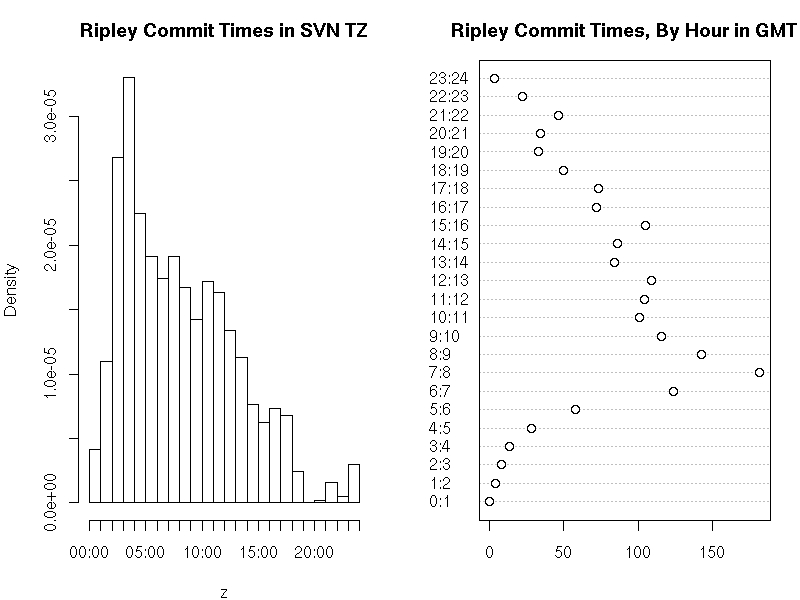
This extracts the commit times, subsets to the ones by Prof. Ripley, extracts the timezones component (as strptime seemingly doesn't do that which is a pain), extracts the tz-less time via strptime into a variable 'z' for which the histogram is drawn. He then corrects the times by the tz offset expressed in seconds, formats is as hour of the day and turns it into a 'factor' (an R data type for qualitative variables which may be ordered as is the case here) and draws a dotplot. This results in the following chart: Simon Jackman's per-hour charts of Brian Ripley's commit patterns Now, nobody has looked at the time series. So we correct this and add the following:
## rather extract both  date and time
dat <- unlist(sapply(rx, function(x)  
  txt <- strsplit(x,split=" ")[[1]]
  paste(txt[5], txt[6])
 ))
## subset on Prof Ripley
dat <- dat[who == "ripley"]
## and convert to POSIXct, correcting by tz as well
datpt <- as.POSIXct(strptime(dat,format="%Y-%m-%d %H:%M:%S")) - offset
## turn into zoo -- we use a constant series of ones as each
## committ is taken as a timestamped event
datzoo <- zoo(1, order.by=datpt)
## and use zoo to aggregate into commits per date
daily <- aggregate(datzoo, as.Date(index(datzoo)), sum)
## now plot as grey bars
plot(daily, col='darkgrey', type='h', lwd=2,
     ylab="Nb of SVN commits, three-week median",
     xlab="R release dates 2.5.0 and 2.5.1 shown in orange",
     main="The amazing Prof. Ripley")
## mark the two R releases of 2007
abline(v=c(as.Date("2007-04-24"),as.Date("2007-06-28")),col='orange',lwd=1.5)
## and do a quick centered rolling median
lines(rollmedian(daily, 21, align="center"), lwd=3)
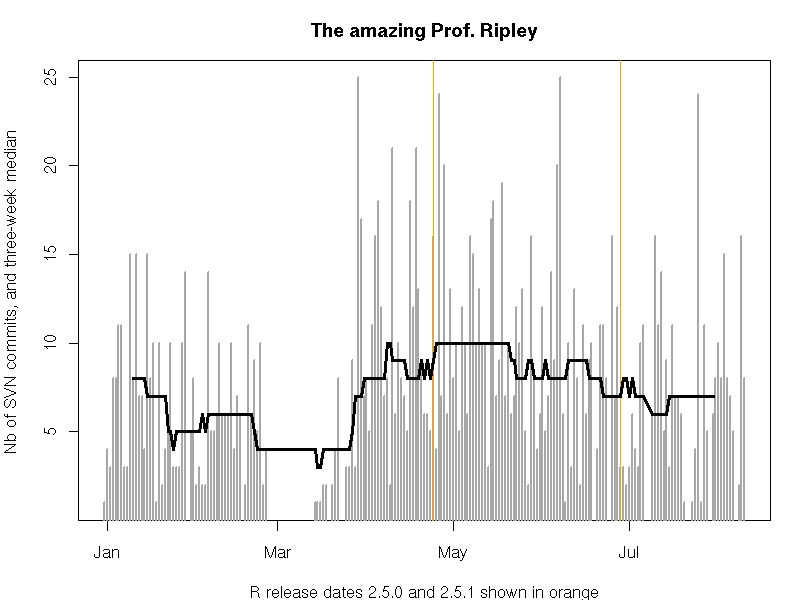
This extracts both date and time, creates a proper R time object (a so-called POSIXct type) from it, fills a zoo ('the' magic class for time series) object with it, uses zoo to aggregate commits per day and plots those in a barchart-alike (I know, I know, ...) plot to which we add the two releases as well as a rolling and centered three-week median (as a real quick hack rather than a proper smooth). Timeseries of Brian Ripley's commit patterns This shows that Prof Ripley averaged about ten commits a day before and after the release of R 2.5.0, and that he has slowed down ever so slightly since then to end up at around a mere seven commits a day. Every day. For the seven-plus months we looked at. So, anyone for analysing his r-help posting frequencies ?

11 August 2007

Alastair McKinstry: Planet 9 from Outer Space

While investigating planet formation (to justify support complement a PhD proposal on ocean planets), I found this discussion over at physicsforums following a blog entry by Dr Steinn Sigursson. (He uses Planet X in his posts but that is too frequently linked with the dwarf planet Xena Eris, and besides, Pluto has been demoted, so its Planet 9 we're looking for :-( ). The question is, how was our solar system created ?
"Looks like the outer solar system, with late heavy bombardment, would have come together nicely if there was another Neptune out there to begin with."
Basically, it appears as though there is a planet or substellar companion star out in the Oort cloud. This is not likely to be the Nemesis object of Hut's/Muller's theory, but would have been responsible for the Kuiper belt. Most of the discussion is about brown dwarfs, but following links leads to a paper by Gomes et al., simulating the possibility of outer Neptunes or Jupiters at 4000 AU or 5000 AU. The thread is all about the dynamics of such bodies, but what would they look like? Now, Hydrogen freezes solid at 14K, Helium is liquid at 4K. So we're talking about a liquid helium ocean on top, with no atmosphere worth speaking of. But Could it sustain life? Not as impossible as it seems. Ehrenreich and Cassan point out that an Ice Giant could host a liquid layer underneath an ice shell surface, heated by radiogenic energy, that could last for billions of years before freezing. So where would it be? This is the time to submit a grant proposal for more envelopes ... Tags , , , ,

MJ Ray: Deutschland-Tour and Volta a Portugal

The Deutschland-Tour 2007 is broadcast to Europe until next Saturday on ARD at 19 east and 13 east. After a wet start, Gerolsteiner's Robert F rster is leading them into today's team time trial, but it's only the second stage. The 69th Volta a Portugal is broadcast worldwide until next Wednesday on RTP Internacional and RTP Africa at all sorts of satellite positions. Candido Barbosa of Liberty Seguros (yet another cooperative cycling sponsor ) leads, but the advantage is small.

David Nusinow: This Is My Good Free Software Experience

What do you know? I wake up this morning, check my mail, and find that Paul Wise contacted the Free Software sticker book guys and got them to change their license to MIT, which is very much Free. Thanks to Paul and the sticker creators for acting on this so fast! Apparently they were going to GPL it, but they thought that the license terms wouldn't make sense because it refers to "software", so they went with CC because it supposedly made more sense.

I've seen this sort of thing show up on debian-legal before. The opinion of most of the people on the list is that it doesn't matter because software is speech, and everything else derives from that principle. I agree with this, but it'd be really nice to have a more generic license to point people to instead for cases like these just to get rid of the doubts. Perhaps the CC-BY-SA license is a good choice. On the other hand, maybe we really do want to add one more to the license proliferation pile to solve this problem.

9 August 2007

Filip Van Raemdonck: Dell's soon to be missing segment?

Last monday I had to order a computer for use as a workstation for a graphic designer. When I called Dell and asked for a specification on a Dimension system, the — overall very helpful and friendly — account manager stated that the Dimension range was discontinued for business customers and available for consumers only. He told me that the new Vostro line was their new SMB offer.

When I pointed out to him that not only was the Dimension still listed on their SMB web pages, but that the Vostro was inattractive because it could not be upgraded beyond 4GB of memory, he was surprised at first and then stated that a 64 bit OS was needed anyway to be able to use more than 4GB of memory'.
But if I needed more memory, a Precision workstation would be a good alternative. Well, any Precision I could configure on the Dell website would end up costing 1.5 times as much as a similarly configured Dimension. (which means that I had to add a graphics card with higher 3D performance on the Dimension as what was needed, since this computer was meant for 2D graphic design)
At this point, the sales representative tried building a Precision configuration himself to specifications I had provided him with, but with maximum discount he could apply the price still came out over 30% (meaning, over 300 EUR) more than a Dimension to these same specs. At which point he gave in :)

I seriously hope that the sales person was mistakenly saying that the Dimension would go away as a Dell business offer (though that means that some review of internal communications would be in order). While I'm sure the Vostro line has it's merit, these are some points that make it a lousy or at least undesirable option in some cases: The way I see it, the Vostro should be a valuable add-on to Dell's SMB offering at the bottom segment. Throwing out the Dimension would leave a hole between Vostro and Precision. And I'm not sure where exactly the Optiplex fits in; it appears to be more along the Vostro looking at specs, but it's price tag is closer to Precision — it's main feature seems to be a highr default support level.

Alexander Schmehl: No smoking area

Today is the 9th of August and we've been at a restaurant (well... a self service cafeteria). Nothing fancy so far about it, but it was the first time this month, which makes it kind of special: On the first a new law come into effect in Lower Saxony (and some other parts of Germany) prohibiting smoking in public restaurants (save in closed, separate rooms). Being a non-smoker it was a nice experience to see how the former smoking area had vanished from the restaurant. Especially, since in that special case you couldn't avoid the smoking zone: To get to the toilette you needed to go through the smoking zone. And where do you bring your tablet back? Right, in the smoking zone. Nice.

Evan Prodromou: 21 Thermidor CCXV

So, a few weeks ago (Journal/22 Prairial CCXV) I expressed some discomfort about the Mister Wong logo. I'm very happy to see that the company has taken my and other people's uneasiness into consideration and removed the logo from their site. They've started a new Mister Wong logo contest with a grand prize of $6000 (American, assumably) and two second prizes of $3000. That's a pretty good cash-out for a logo contest; Mister Wong is also a high-profile and growing site. I hope some of my designer friends and colleagues decide to jump in. (Yeah, Brigitte, Marie-Claude, Patrick, and Mark, I mean you!) I think it's definitely an interesting challenge for someone doing identity work. I'm not going to join the contest, though. My only idea right now is to do a copy of the current Mister Wong logo (same gray suit and tie) but with a Caucasian man's face instead. The sub-title? It can't be Wong when it feels so white. Yeah, that's why I don't get the big bucks in the corporate identity biz. tags:

Back on Planet So, I got a lot of feedback about removing my blog from Planet Debian -- all of it bad. People really felt that it was important for all Debian developers to be able to say their piece on PD. So, I re-instated it this morning. I'm going to try to make some changes to fix the main thing that seems to bother people: that my post titles are the current date in the French Revolutionary Calendar. For some reason, that really gets under people's skins. Unfortunately, a few things on my (hand-coded) wiki-blog site expect that format, so it's going to be a little tricky. One thing I might do is create and distribute a Greasemonkey script for planet.debian.org (and p.d.net) that seeks out titles that look like French revolutionary calendar dates and replaces them with a random selection from an array of more typical blog post titles:
  • "Some thoughts"
  • "A funny thing happened today"
  • "What I've been doing lately"
  • "Depressing thought"
  • "Haven't blogged in a while"
  • "WTF!?!?!"
  • "My opinion"
  • "Random notes"
  • "IMHO"
  • "Snapshots from my life"
  • "Further proof that we live in a crazy world"
  • "Memo to myself"
Any other suggestions for all-purpose blog-post titles to add to the array are welcome. tags:

Thijs Kinkhorst: Debian Birthday next week in Breda

Next week, Debian will turn 14. The celebration of this here in Holland means nothing specifically other than a good occasion to get together and have a drink. It will traditionally take place in Breda, organised by our good friend Geertje Stappers, on Thursday the 16th. See the wiki page for this and other celebrations.

Michael Janssen: UI Peeves: Locking, Proximity and Purpose

I have had, on occasion in the past, a reason to use the wonderful TortoiseSVN software. It is, by all standards, a really great solution for someone wanting to use SVN in a MS Windows environment, and uses the official svn client in order to leverage open source as much as possible. Recently I have been using it a bit more as I work at Honeywell as a programmer. I've come across a couple things that bug me about the interface.

The first is that some actions inexplicably lock the place that initiates that action. The best example I have of this is when I am looking at the window for an Update, and want to see what happened in the log, I click the button to open the log, and I can't use the window while the log downloads. Sometimes this can be an issue because the server is pretty slow at producing logs for some reason (it's beyond me, and NotMyProblem(tm) because I'm not in charge of the admin). This makes it irritating because I can't inspect other files while the log is downloading. Strangely, the server actually will return other requests quickly, like the request needed to see the diff between the working copy and the tree. It would be much better if the windows were separate - they're not related to each other in effect, so the locking of the initial window is completely useless. I could have called up the log from another action, that would leave the update window perfectly usable, so I know it's possible.

The second problem that I have run across more than once relates to the proximity of actions in the right click menu while committing a change. Take a look at the screenshot of this menu.
TortoiseSVN commit context menu

There have been many times when using this window that I realize that I forgot to add a file that I need to commit, so I right click on the file and move down to the "Add" menu item, only to miss and click on the "Delete" item. "Delete", when used on a unversioned file, performs a windows delete, causing me to curse at the (now missing) entry in the commit log and go running to the recycle bin to retrieve this temporarily lost file. These two options in the context menu are entirely too close to each other. The "Delete" and "Add" actions have completely opposite meanings and effects, and having the program do exactly the opposite of what you expect is what I consider to be a Very Bad Thing. I would move the "Add" action up to the top of the list (it is, by far, the most common reason for me to use the context menu), or at least place another menu item in between.

I'm feeling like I'm being very unhelpful here, complaining about these issues in an open source project and not producing a patch to fix these issues. I may produce one in the near future - unfortunately when I'm not at Honeywell, I don't really have a Windows development environment setup.

Comments: (1) Trackbacks: (0)

Comments
  1. JD: The reason diffs are quick is because svn keeps a copy of the original file in the checkout, so diffs and reverts don't need to hit the server.
Trackbacks
  1. No Trackbacks

8 August 2007

Miriam Ruiz: El rei de la casa

The Proof of the PuddingThis is an updated translation into English of the one-question interview with pjorge (based on Darren Rowse’s one-question interviews idea) in which Javier Candeira (Barrapunto co-founder and editor among many other things, and a good, loved friend of mine) comments about an interesting game of his creation that’s being exhibited in Barcelona and that deals with the fears many parents have towards the Internet and the new enterntainment technologies and videogames. The game code will be released as GPL, even though the game data will have a non-free Creative Commons (with a non-commercial clause). The game has a really interesting approach, and mixes the concept of pinball games with that of graphics generated with “paper dolls” techniques, to try to make people think about the ideas mainstream media are pushing, and the way they try to tell everybody how to raise their kids. You might like it or not, but it will probably won’t leave you indifferent. That’s what art is about, in fact, isn’t it? What is ‘El rei de la casa’? ‘El rei de la casa‘ (an expression that in Catalan and Spanish means “the precious child”) is an exhibition and a videogame. The exhibition deals with the cultural construction of the idea of childhood, and can be visited until September 24 in the Palau de la Virreina in Barcelona. From there. Among other works, in the exhibition there are photos by Loretta Lux and Bego a Egurbide, paintings by Marc Ryden, Kiki Smith and James Reilly… it’s really worth a visit. El rei/la reina de la casa. ( The videogame is a commission from Andr s Hispano and Marc Roig, curators of the exhibition. They wanted to portray Internet and videogame arcades (or cybercafes, which are their modern equivalent) as one of the “new forests”, these places where parents don’t dare allow their children go alone for fear of the dangers (real or imagined) that may lie in ambush. The Internet has entered into the collective imagination, and one of the memetic niches that it has crept into is that of the bogeyman, the scapegoat that bears the brunt of all the evil that happens in society. It is enough to look at the news programmes from right-wing TV stations with their adversative Internet coverage: “it’s good, but…”. All over the media you see headlines like “gang of pedophiles arrested who sold child pornography *on the internet*”. They conveniently skip that pedophiles filmed those poor kids *in a flat*, and that they did it *on a bed* and used *videocameras* just like those used by the reporters now sounding the alarm. But no, what’s bad is *the Internet*.
The other theme that we wanted to touch on with the pinball game is how videogames are presumed to corrupt childhood. When pinball games were introduced, the North American authorities laid down the law: it was an infernal machine that incited gambling and even lust. From the religious right to the secular left, every moral guardian has denounced the supposed harmful effects of videogames on childhood: because of them children and teenagers engage in murder, robbery, truancy, bad school grades and even untidy bedrooms and doubtful personal hygiene. For this reason, the “new forest” of the Internet and videogames had to be a videogame, proving once more that games are cultural vectors, a form of artistic, political or commercial expression like any other. It also had to be a videogame about the a triangle: on one side the children, on the second one the children minders (parents and society at large), and finally the Great Scapegoat: the Internet. After many abandoned and reworked proposals we arrived at the present design for the game: an emulated pinball game presented on a panoramic TV screen, and having two levels: one set in the real world and named after the exhibition, and a second one set in a more or less conventional cyberspace. This second level is called “Prey of the Net”, and portrays the vision of the Internet that a Fox viewer may have: you have Spam, game-playing killers, kids making more money than their parents, S&M gear, dildos… in short, everything that is scary and nothing that is comforting, at least to some.  Presa de la red! (All the illustrations for this pinball, both on the gameplay field and on the scoreboard, are by Mauro Entrialgo. For the scoreboard I asked him to prepare a set of drawings similar to KISS dolls (like the cut-up dolls that kids still played with in the last century). Thanks to these dress-up dolls the scoreboard shows more than the score (which grows randomly anyway); it also portrays the state of the boy or girl protagonist of the game. I say “boy” or “girl” because in the game, just like in real life, you have a 50/50 chance of starting the game of life with either sex. The fist level, ‘El rei de la casa’, portrays the stress that families feel when facing children’s media consumption. The targets trigger lines from the parents: “All day in front of the Idiot Box!” when you hit the tv, or “without a degree, you are nothing” when you hit the school. There are four targets on the right, which can be reached shooting the ball with the left flipper (the one representing the parents): school, museum, church and reading. On the left, and reachable from the right flipper, representing the kids’ id, are the TV, the kid’s peers and the videogame console; at the top of the playing field, towering above it, the internet-enabled computer. As the ball hits the different targets, the scoreboard dresses the kids in a housecoat, a leather jacket, and gives them a mortarboard or a saint’s halo. They are the pride of their parents, kids still not perverted by the Internet. It is cheap symbolism, I confess, two-dimensional sociology, but that was also something we aimed for. After all, pinballs have always been complicated allegories rather than complex ones. In a first design I planned to make computer accessible only under certain conditions, but that is not something that would have work in this exhibition: some people just play and play (which gives me an immense joy), but other people can’t or won’t give it much effort. It’s best to make it easier for everyone, so they can send the ball into the next level even without meaning to. The second level, “Prey of the Net”, is accessed when the player puts the ball through the PC’s screen. Here the character on the scoreboard keeps smiling while the game dresses them in a straightjacket, S&M headgear, or leaves them in their underwear, with their hands full of money, playing cards, bloody knives and sex toys… to their parents’ horror. The player has no fixed goal here, only to make the ball go through the pachinko and the spinning spider. These elements work as an atrocity generator and a rebuke distributor. Parents’ voices scold the player, faced with the horrors of the Internet. But the star is the scoreboard. Mauro rocks. Right now the code and content for downloadable game are done, and the people responsible for the ISO are giving it the final touches. It will be a bootable liveCD with some Debian variant that (hopefully) will run on any PC bought in the last two or three years. We will treat the computer as a games console, which may or may not be symbolic (if you want it symbolic, we can make it symbolic!). The game itself is under the GPL license (the pinball part is based on Henrik Enkvist’s Emilia, which is packaged in Debian), and only the graphic resources will be under a non-commercial Creative Commons license. The music is also under a non-free Creative Commons license because of the status of the original samples, but I recommend you download it and play it because its author is none other than man, the Barrapunto founder and sometimes editor.

Russell Coker: Tactical Voting

In response to a blog conversation on Planet Debian, Wouter Verhelst writes about voting tactics in which he claims that Instant-Runoff (wikipedia) (the method used in Australia to elect members of the house of representatives) is broken. I have read the Wikipedia review and neither it nor my previous understanding of Instant-Runoff leads me to believe that it is broken or prone to tactical voting problems. The main tactical voting issue in Australian elections is to give first preference to a small party (such as The Greens) in a seat where there is almost no chance of the small party winning. The idea is to have the vote effectively be a vote for whichever of the two major parties the voter prefers while also sending a message (by the first-preference votes which are widely publicised) as to their desires. If a major party wins a seat while 20% of the first preferences went to the Greens then they might find it an incentive to try and get some Green policies adopted if they want to win the next election (whether this actually works is debatable but it is a fact that people try it). There are many people who don’t understand how the Australian voting system works and believe that they have to vote for one of the major parties to avoid a “wasted vote”. This is not due to the voting system but due to American media - and ill-educated Australians who can’t work out which parts of the news apply to them. Wouter has an advantage in living in a country where English is not the primary language - English news does not directly concern him and his country-men can probably work out that English-language voting instructions should not be followed! The condorcet.org site has a useful analysis which demonstrates one theoretical flaw in IR, but realistically getting the average voter to use Condorcet would essentially be an IQ test as a pre-requisite to voting (numbering all the candidates in order for IR is difficult enough). The fact that an election system is not theoretically fair is not a valid criticism unless there is a viable alternative which is better. If the lower house is to actually represent the people of each electorate (which is rarely the case nowadays) then IR seems to be the best option. If members of the lower house are not expected to represent geographic regions then Wouter’s advocacy of proportional representation makes sense. As for the Australian Senate, the voting system for that is far too complex and I think that as a matter of principle any voting system which can not be understood by the majority of voters is wrong. A good case could be made for proportional representation in the senate. Update: In response to Wouter’s post - tactical voting that doesn’t change the outcome of the election and merely sends a message to a political party is OK IMHO. But if you convince enough people that tactical voting is the only option in the US then the result may change.

Lars Wirzenius: Random thought: bzr uncommit

One of the things that occasionally happens to me is that I mistakenly commit too much. I use Bazaar (bzr) as my version control tool of choice, and tend to do "microcommits": every time I make a change that is a useful, if very small, step in its own right, and "make check" still passes, I commit, even if it is only a one line change. This means that usually all the changed files need to be committed. Sometimes, but rarely, I make unrelated changes in several files at the same time, and then I need to commit each change separately. But then I forget to specify the files on the command line. With CVS, I would just shrug and continue. With Bazaar, I do "bzr uncommit", which removes the latest commit from the branch, and then re-commit with the proper files. This is a small, but important, change from CVS, for me. It makes me happy. "Ha! Foiled you again, you stupid over-eager Enter key." I have no idea whether other modern version control tools have the same thing; this entry is not to advertize Bazaar, but share my joy in victory over Enter.

7 August 2007

Evan Prodromou: 19 Thermidor CCXV

I'm on the plane down from Vancouver to San Francisco this morning. My flight from Taipei hit Vancouver around 8PM last night, so I stayed at the Fairmont Hotel at the airport. It was definitely a special treat -- the Fairmont's pretty pricey -- but this trip has been really low-budget and I needed a lot of rest and recharge. I had a good room with a view of the airport and the city beyond. My flight over was uneventful -- sleep, eat, Spiderman 3 -- which was good since I'd had such a big last day in Taipei. In the morning, I'd gone out to see Taipei 101, which claims to be the tallest building in the world by some standards. I think there are lots of ways to slice the "tallest building" category -- the CN Tower has a strong claim, but that's only counting the huge antenna on top. And there's an unfinished tower in Dubai that's already close to, or taller than, Taipei 101. Regardless, Taipei 101 is a real interesting site. The elevators are the fastest in the world -- 38 seconds to go from floor 5 to floor 87. The windowed observation deck is interesting, and there's an outdoor deck two flights above it. The outdoor deck is racked by Taipei's scorching heat -- when I was there, it was 31C, up above the city's protective smog belt. The sun and empty sky make for an otherworldly experience. After 101, I took Taipei's local subway, the MRT, to the National Palace Museum. I've found the MRT easy to get around on -- most of the information was available in English as well as Chinese -- but I got a little lost looking for the museum. I was disappointed that the information booth in the Taiwan Main Station had so little tourism information, and all of it in Chinese. (Yeah, I forgot to print out the Wikitravel Taipei guide before leaving the hotel. My bad.) But I managed to wend my way out to Shilin Station and took a cab to the museum. It was worth the search. When the Chinese Nationalists left the mainland for Taiwan, they took with them many of the treasures of the Imperial Palace (much to the chagrin of the victorious Communists). These form the core of the museum's collection, and they're really quite amazing -- articles in bronze, ivory and gold from the Neolithic era to the modern day. While Western culture has gone through so many distinct and discontinuous phases -- Egypt and Mesopotamia, Greco-Roman, Medieval and Modern -- China's has varied much more smoothly and continuously. It's a little disconcerting to see artistic themes from 4000BC that are echoed in items for sale in the stores today. I had to get back to the Wikimania site -- by then almost empty -- to do a GChat conference with Niko. There were a passel of Wikimaniacs still around after the conference looking around Taiwan like I was, and after consulting Wikitravel we decided to go to Taipei's most famous restaurant, Din Something Something. It's got a short menu of delicious steamed dumplings -- pork, veggie, crab and shrimp. The shop's claim to fame is the elastic skin that keeps a pocket of hot broth inside the dumplings. Hey: if you do something well, why vary the menu? It was the best meal I've had in a long time. The dumplings themselves were incredibly good -- moist and rich with complex flavors. But the company was even better -- about 14 Wikimedians from all continents and walks of life, some of the most fascinating and important people on the planet. We were a big enough group to be stowed in our own party room, and with basket after basket of steamed dumplings piled onto the table, washed down with shared bottles of the ubiquitous Taiwan Beer, we had a crazy chaotic and fun time. I'm so glad I took an extra day after the conference to see a bit of the city. I think there's a lot more that I missed, but I'm glad that I got a taste. tags:

Wikimania 2008 Inevitably the conversation at Din Something Something turned to Wikimania 2008 and possible venues for it. Right now, the only serious bid is from Alexandria, Egypt, home of the Biblioteca Alexandrina. This is a modern reconstruction of the famous Library of Alexandria, centre of learning for the ancient world and repository of all of its knowledge. The bid is to use the sleek, glamourous conference centre attached to the Biblioteca -- offered to us free of charge. You couldn't put together a more powerful metaphor -- Wikimedia being itself a project to capture the world's knowledge and share it with all humanity. Having our event on the African continent would also send a great message about the Foundation's commitment to making free information accessible to the developing world. North Africa is definitely the most accessible part of the continent for Europeans and North Americans -- many of whom balked at the price and distance of travel to Taipei. The big problem with planning Wikimanias (Wikimaniae?) in the past has been the short time-frame. Typically bids for the event don't start until after the previous one, and the bidding process takes several months. By the time a venue is selected, there may be only 6-8 months of planning time available. For an international conference of several hundred people, this is a stressful, breakneck schedule. The idea was floated to do a little stutter-step and put Wikimania on a more long-term planning schedule. The event committee would short-circuit the bidding process this year, and declare Alexandria the site for Wikimania 2008 unless other groups insisted on bids for other cities. Then, bidding for Wikimania 2009 would start in September or October, with a decision made by the end of 2007. This would give 20 months for the Wikimania 2009 organizing team to prepare. Most importantly, they'd be able to shadow the 2008 team, learn how the job is done, attend the 2008 conference, and present about their venue for the next year. I think this is a really good idea. The Biblioteca conference centre staff will be able to provide us some professional services, making the shorter schedule (still about 11 months) a lot easier. There are some concerns about fairness of the process, or appearance of same, but my guess is that if the 2009 bid process starts soon after, people won't have a big beef. There are two major concerns with going to Alexandria, though. First is Egypt's worrying problem with human rights -- specifically gay rights. Homosexual Egyptian men are subject to arrest, and the laws are occasionally enforced. One foreigner was arrested in 2002. That's enough to put Egypt on a no-visit list with some gay-rights groups. Depressing as it is, I think it might be too much to hope for a venue in a country with an absolutely spotless human rights record. Maybe parts of Scandinavia...? There's a cruel calculus needed to evaluate which national human rights abuses can be reluctantly overlooked, and which are unacceptable. It's also clear that my personal judgment might be clouded, since this particular human rights issue is not one I would be directly targeted by. My hope is that an official statement by the Foundation would make it clear to the Egyptian government that this kind of policy is not conducive to attracting overseas business and tourism. The second concern is that Egypt and the Arab world in general have only embryonic local Wikimedian communities. While there are many people who contribute to Arabic Wikipedia, there is not a Wikimedia chapter in Egypt, nor are there regular meetups in the country or region. This might be a chicken-and-egg problem: choosing Alexandria would probably kick-start local groups. I hope that ar: Wikimedians pick up the mantle of leadership that the world Wikimedia community is offering them. tags:

Adrian von Bidder: Fun with virtualisation

Since I seem to be the last person these days who doesn't run his servers inside Xen, Vserver, kvm, lguest or whatever, I decided to finally evaluate Xen. Not having spare hardware and not wanting to really touch my main workhorse, I started with Qemu. Installing etch inside a Qemu (why can't qemu have working tun/tap setup scripts by default?), then xenifying this according to Ganneff's excellent slides, I was stopped while booting into the Xen kernel with a hard freeze in the boot process (Inside Qemu, so no harm done.) Talking to some people in #xen resulted in me disabling kqemu, and a few minutes later I had a working dom0. Debootstrap is slooooooowwww (well, inside a non-accelerated Qemu machine...)! So I decided to use cdebootstrap instead. Sadly, xen-create-image has debootstrap hardcoded, so I had to "ln -sf /usr/bin/cdebootstrap debootstrap". (I decided to do this when debootstrap was still calculating dependencies after several minutes.) After that, creating and booting a domU Just Worked(tm). Having a running Xen environment, I finally wanted to play around with live migration (mostly I was just curious how robust this Qemu + Xen setup is...) So, just clone the qemu disk and boot them both. Whereupon the two qemu machines have the same MAC address, hence networking is not reliable. Change the MAC of the second Xen dom0, curse udev for thinking that now the network interface should be eth1 (persistent device naming is a good thing, generally. I'm not sure there is a sane solution possible that can cover all/most cases. Computers with only one network interface might warrant some special logic ... Oh well.) Having restored the networking setup, enabling the relocation service in the Xen configuration is trivial. After thinking about using plain files on NFS and seeing a Novell tutorial which uses iSCSI, I decided that I should try AoE because it should be much simpler to set up. And by installing the 'vblade' package, it is indeed possible to have an AoE server running within a few minutes (the vbladed command doesn't take the -m option, though.) And the client side is just as simple, just install the aoetools package, and /dev/etherd is automagically created and lists all available devices. That's how SANs should work! (Note: I had the AoE devices in the dom0 and passed them to the domU. A next experiment would obviously be to pass AoE directly to the domU as root devices. Not sure what the implications would be, though.) Ok, after all this, I have two dom0 machines and a domU. Just for fun, I've installed xdaliclock inside the domU and started a live migration. Result: it works stable (modulo some scary kernel messages popping up when booting the domU. I didn't experience any crashes in this light test), xdaliclock stops for a mere 20s (yes, seconds, not milliseconds. Remember, this is two layers of virtualisation without hardware support.) Normal migration (pausing the domU), the migration takes roughly 2 min (both dom0 have 384M RAM assigned in Qemu, the domU has 128M in Xen, the host is a 3GHz P4 with 1G physical ram. There is some swapping going on (I use KDE, so some of the RAM is lost there. I also didn't stop beagle for this experiment.) The full live migration takes about twice as much time. But this said, if you're using Xen inside qemu, timing values are not what you're after... I was, frankly, astonished at how well this worked. Hmmm. I wonder, if I can stack some other virtualisation layer somewhere in there? Just to see how silly it might get.

Sergio Talens-Oliag: Lifestyle, Resignations and the Peter Principle

I'll be 0x24 (hex) or pow(6,2) (dec) years old next Sunday and it is becoming obvious that I need to change my lifestyle. On the physical side I'm sure that I have to loose between 20 and 30 Kg. if I don't want to have health problems in the future. The plan is to change my eating habits and do sport regularly. The basic idea is to do a diet seriously and keep part of the rules more or less forever (that's the habits change); the other important thing is to do some exercise, I've never liked sports too much, but I'm sure I can try to walk some days and swim others (I've been going once a week to the swimming pool during the last months and I'll be doing it twice a week starting this September). On the mental side, I need to reduce my obligations and care less about the work problems in and out of the office. To reduce my obligations and have more free time I decided a couple of months ago that I was going to leave the Uni, as it was taking away a lot of time that I can use for more important things; I notified it and after this September I won't be working for the Universitat de Val ncia anymore. Initially my idea was to keep my main work and use some hours each week to work on my PhD Thesis, but the truth is that I'm not interested anymore; I don't have anything specially interesting to say and my main motivation for getting a PhD has also disappeared (at some point I thought about becoming a full time University professor, but after three and a half years I've had enough, at least for a looong while). This leaves me with my work at the ITI as my main and only work, but after some months I'm seriously considering leaving it also. My main problem there is that I believe that I'm starting to suffer the Peter Principle or something similar; almost all my professional career I've been working as a technician, first as a programmer and sysadmin and lately as analyst and team leader or technical manager, but now, as it seems to happen always in the Spanish IT companies, I'm being forced to move to a pure project management work and, to be fair, I don't like it. I don't know if that means that I'll get to my level of incompetence, but if that is the case I think I'll have to try the Peter's Parry, that basically means to refuse a promotion (I've already done it asking to get a place under my theoretical level, although not on a convincing manner, it seems) or use the Creative Incompetence technique, that is, give the impression that you have already arrived to your incompetence level (probably it is too late to do that at my current place, but maybe on the next one I'll be able to do it). Maybe this is not the last level of the Peter Principle, as I'm sure that I can and will do this work (I'm thinking about moving, but I will not do it until I have a plan for the future, and that will probably mean a new job), but I'm also sure that I will never do it as well as I can do technical tasks because I don't have any real motivation to do it and while I plan to get the skills needed, they are not attractive to me. I understand that on the current IT world we need to have project managers, and I really hate bad managers, but that does not mean I like to become one, I prefer to be a team leader and work only on one or two projects at a time, instead of having more than five and not do real work in any of them; my main problem is that the challenges and tasks a manager has to do have nothing in common with the things I like from computer science and I'm too perfectionist to handle people that does not care about how things are done in a lazy way (a team leader with a couple of projects can handle technical people, when you are a manager with multiple projects you miss the day to day perspective and problematic people is more difficult to handle). Oh well, we will see how things evolve. The good thing is that I believe that one way or another I'll end up having a better life and, if I'm able to care less about my own work (and the one done by others) maybe I'll be able to stay at an acceptable level on the hierarchy without getting burn out and maybe some day I'll be able to work again on the things I like and keep my promises.

Miriam Ruiz: How to make a Debian package without using a helper reviewed

My old tutorial “How to make a Debian package without using a helper” seems to be getting a lot of clicks, so I’ve decided to upgrade it a bit and put it up to date. There are not many changes anyway, but just in case someone is interested in downloading it: roaddemo_1.0.1-2.dsc, roaddemo_1.0.1-2.diff.gz and roaddemo_1.0.1.orig.tar.gz are available.

Andrew McMillan: Really Simple CalDAV Store - August 2007 Status

Having taken time out to go to the other side of the world to attend DebConf 7 in Edinburgh, and then after spending some time with my family, I have been somewhat distracted from things CalDAV for a wee while now. There are signs that I will be able to put a few more evenings and weekends into it in coming months. Current Status With the release of 0.8.0 I believe it is quite a usable application for shared group calendars. We use it at Catalyst for about 80 staff and, while we're not heavy calendar users, it manages without any noticeable performance problems. There have been an impressive number of downloads from Sourceforge, as well as substantial downloads from my Debian repository, and I believe that the program is in tens, if not hundreds, of installations. Future Plans In the immediate future I want to get the basic framework for querying properties about the owner of a calendar or a set of calendars. This will be used by Mozilla soon during their configuration of a new CalDAV source, and I think that Apple iCal probably uses them already. This is partly done, but it's implementation has been slowed by the necessity to refactor the handling of the REPORT method in general to make the code more modular and readable, and to support queries and properties in a more general manner. The refactoring of the REPORT method handling is in place now, so moving on to the handling of DAV:principal objects should become fairly straightforward. I may end up with a fair bit of quiet, undistracted time over the coming weekend so if I can get in the 'zone', it may get done, and we can start rolling towards a release 0.9. Release 0.9 will have a new name. One from the cast of thousands that have been submitted to me so far, or one that I will hastily think up in between, but the next released version will not be called RSCDS any longer. The main goals for further into the future are: Interoperability I think that RSCDS does fairly well on the interoperability front. Unfortunately I have no access to the preview of OS 10.5, with it's native CalDAV client (though I have been told that it works with RSCDS). Likewise, other commercial CalDAV clients aren't available to me for testing either, so I have concentrated my efforts on supporting the featureset used by the various free CalDAV clients. My initial work focused around supporting Evolution, in particular, but with the recent effort put in by the Mozilla Calendar team the primary interoperability challenge is to enhance RSCDS to support their areas of development. If I could see how the OS 10.5 client behaves, too, I believe that would help identify a few points to extend, as well as suggesting some future directions. The best place to review interoperability would probably be at the CalConnect Roundtable 10 but I think that without some sponsorship for airfares I probably won't be able to make that. Maybe next time. Specifications Compliance As I read, and reread, the CalDAV (and DAV, and HTTP, and ...) RFCs the compliance with the various specifications improves. Recently I have put a lot of work into the calendar-query report, in particular, which means it now supports querying against arbitrary properties much more comprehensively. This is important because some of the client software is starting to do arbitrary queries also, and it is inevitable that queries for the classification of events, or the percentage completion of todo items will become more common. And now I notice that there is a new version of DAV in RFC4918, though not too many changes as far as I can see. The intent of this release is mostly to clarify, and slightly to extend, primarily in order to improve client interoperability. Coverage of Related Specifications In terms of general calendaring activities, the biggest hole in the CalDAV specification at present is standardisation around the location of other people's schedules. The current draft of the Scheduling Extensions to CalDAV appears to address that, and a lot more besides. I expect to start working on parts of this at some point, but perhaps not sooner than I see a client which starts using it, or when it is ratified, whichever occurs soonest. Documentation The documentation is OK. The wiki, in particular, is a reasonable resource for resolving problems (I believe), but it would be good to have some documentation of other things. One area that could do with enhancement is some documentation of how to check out a copy of the code, and how to provide patches back to me. Even better if other people can maintain their own trees which I could pull patches from, since we're using a distributed version control system (Git) to start with. Configuration The administration interface for RSCDS is OK, but could do with a few improvements to make it more usable. Really there are not a lot of reasons to be in the administrative interface, so these improvements should be relatively few, and relatively easy. This would be a good area for someone interested in helping out to become involved, because it does not entail reading large reams of RFCs, or watching tcpdumps scroll past for the debugging. Installation One thing that I have done right, I believe, was to provide the software from the beginning in a packaged form to make the installation easier. Although the software is packaged for Debian, however, it has not yet been uploaded to the archive because I have been waiting for the webapps-common package to enter Debian so I can use that for configuration. I think I have waited long enough though, so I will upload the next version to Debian for use by a wider audience. Security Security has always been a focus for me and I have had the code reviewed for any obvious security flaws. If any particular vulnerabilities are found they will be addressed with appropriate haste. Retrospective I've been working on this for a little over a year now, and I think I have largely met my goals for the project. It has certainly been an educational experience for me, and the effect of this work on other projects that I also participate in has also been valuable. Any new open-source project is always at risk of the developer losing energy and interest, but I believe this one has made it to a state where the bulk of the infrastructure effort has been done, and there are enough interesting challenges in the future to continue to keep me (at least) working on it into the future. The scope of this project is good, in that it is not at risk of expanding to take over the world. The intention behind this is simply to provide a back-end service for client software which should be very much Someone Else's Problem. In reality there have been times when I have had to get to grips with some of that client software in order to resolve problems, but those have by and large been good experiences.

6 August 2007

Martin F. Krafft: Sending email via IMAP (or not?)

I am playing with the thought of using IMAP to send email from my mobile clients. The way this works is that mail is actually placed into a Maildir locally and synchronised with the IMAP server using a tool such as offlineimap. The Courier IMAP server supports such an outbox feature, for other servers you can use inotify or a cron job (I am planning to publish a writeup about my new mail setup sometime soon, so no scripts linked here yet). Anyway, it's trivial to get it working, and Dann Frazier has written it all up. The question is more whether I want to, or not. I am soliciting feedback. The advantages of using an IMAP-synchronised outbox are: Any solution with advantages comes with disadvantages, and these are: Can you think of any other advantages or disadvantages? Do you use an IMAP-synchronised outbox and would like to share your experiences with me? Or do you have yet another solution? Write to me! NP: OSI: Free

Next.

Previous.