Search Results: "tim"

22 January 2013

Michal Čihař: phpMyAdmin translations status

With release of first alpha for phpMyAdmin 4.0, it's time to resurrect my regular translation status posts. So let's look at which translations are at 100% right now: There are also several languages which need just few strings to be complete: As you can see, there is still lot of languages missing, this might be your opportunity to contribute to phpMyAdmin. Also you are welcome to translate phpMyAdmin 4.0 using translation server. If your language is already fully translated and you want to help as well, you can translate our documentation as well.

Filed under: English Phpmyadmin 0 comments Flattr this!

Julien Danjou: Extending Swift with middleware: example with ClamAV

In this article, I'm going to explain you how you can extend Swift, the OpenStack Object Storage project, so it performs extra action on files at upload or at download time. We're going to build an anti-virus filter inside Swift. The goal is to refuse uploaded data if they contain a virus. To help us with virus analyses, we'll use ClamAV. WSGI, paste and middleware
In a pipeline, a black cat can become a white cat with the help of some middleware.
To do our content analysis, the best place to hook in the Swift architecture is at the beginning of every request, on swift-proxy, before the file is actually stored on the cluster. Swift proxy uses, like many other OpenStack projects, paste to build his HTTP architecture. Paste uses WSGI and provides an architecture based on a pipeline. The pipeline is composed of a succession of middleware, ending with one application. Each middleware has the chance to look at the request or at the response, can modify it, and then pass it to the following middleware. The latest component of the pipeline is the real application, and in this case, the Swift proxy server. If you've already deployed Swift, you encountered a default pipeline in the swift-proxy.conf configuration file:
[pipeline:main]
pipeline = catch_errors healthcheck cache ratelimit tempauth proxy-logging proxy-server

This is a really basic pipeline with a few middleware. The first one catches error, the second one is in charge to return 200 OK response if you send a GET /healthcheck request on your proxy server. The third one is in charge of caching, the fourth one is used for rate limiting, the fifth for authentication, the sixth one for logging, and the final one is the actual proxy server, in charge of proxying the request to the account, container, or object servers (the others components of Swift). Of course, we could remove or add any of the middleware here at our convenience. Be aware that the order matters: for example, if you put healthcheck after tempauth, you won't be able to access the /healthcheck URL without being authenticated! ClamAV
If you don't know ClamAV, it's an antivirus engine designed for detecting trojans, viruses, malware and other malicious threats. Wwe're going to use it to scan every incoming file. To build the middleware, we'll use the Python binding pyclamd. The API is quite simple, see:
>>> import pyclamd
>>> pyclamd.init_unix_socket('/var/run/clamav/clamd.ctl')
>>> print pyclamd.scan_stream(pyclamd.EICAR)
'stream': 'Eicar-Test-Signature(44d88612fea8a8f36de82e1278abb02f:68)'
>>> print pyclamd.scan_stream("safe!")
None

Anatomy of a WSGI middleware Your WSGI middleware should consist of a callable object. Usually this is done with a class implementing the __call__ method. Here's a basic boilerplate:
class SwiftClamavMiddleware(object):
"""Middleware doing virus scan for Swift."""

def __init__(self, app, conf):
# app is the final application
self.app = app

def __call__(self, env, start_response):
return self.app(env, start_response)


def filter_factory(global_conf, **local_conf):
conf = global_conf.copy()
conf.update(local_conf)

def clamav_filter(app):
return SwiftClamavMiddleware(app, conf)
return clamav_filter

I'm not going to expand more on why this is built this way, but if you want to have more info on this kind of filter middleware, you can read their documentation on Paste. This middleware will just do nothing as it is. It's going to simply pass all requests it receives to the final application, and returns the result. Testing our basic middleware
Now is a really good time to add unit tests. I hope you didn't think we were going to write code without some tests, right? It's really easy to test a middleware, as we're going to use WebOb for that.
import unittest
from webob import Request


class FakeApp(object):
def __call__(self, env, start_response):
return Response(body="FAKE APP")(env, start_response)


class TestSwiftClamavMiddleware(unittest.TestCase):

def setUp(self):
self.app = SwiftClamavMiddleware(FakeApp(), )

def test_simple_request(self):
resp = Request.blank('/',
environ=
'REQUEST_METHOD': 'GET',
).get_response(self.app)
self.assertEqual(resp.body, "FAKE APP")

We create a FakeApp class, that represents a fake WSGI application. You could also use a real application, or write a fake application looking like the one you want to test. It'll require more time, but your tests will be closer to the reality. Here we write the simplest test we can for our middleware. We're just sending a GET / request to it, so it passes the request to the final application and returns the result. It is transparent, it does nothing. Now, with that solid base we'll able to add more features and test these features incrementally. Plugging ClamAV in With our base ready, we can start thinking about how to plug ClamAV in. What we want to check here, is the content of the file when it's uploaded. If we refer to the OpenStack object storage API , a file upload is done via a PUT request, so we're going to limit the check to that kind of requests. Obviously, more checks could be added, but we'll keep things simple here for the sake of comprehensibility. With WSGI, the content of the request is available in env['wsgi.input'] as an object implementing a file interface. We'll scan that stream with ClamAV to check for viruses.
import pyclamd
from webob import Response


class SwiftClamavMiddleware(object):
"""Middleware doing virus scan for Swift."""

def __init__(self, app, conf):
pyclamd.init_unix_socket('/var/run/clamav/clamd.ctl')
# app is the final application
self.app = app

def __call__(self, env, start_response):
if env['REQUEST_METHOD'] == "PUT":
# We have to read the whole content in memory because pyclamd
# forces us to, but this is a bad idea if the file is huge.
scan = pyclamd.scan_stream(env['wsgi.input'].read())
if scan:
return Response(status=403,
body="Virus %s detected" % scan['stream'],
content_type="text/plain")(env, start_response)
return self.app(env, start_response)


def filter_factory(global_conf, **local_conf):
conf = global_conf.copy()
conf.update(local_conf)

def clamav_filter(app):
return SwiftClamavMiddleware(app, conf)
return clamav_filter

That's it. We only check for PUT requests and if there's a virus in the file, we return a 403 Forbidden error with the name of the detected virus, bypassing entirely the rest of the middleware chain and the application handling. Then, we can simply test it.
import unittest
from cStringIO import StringIO
from webob import Request, Response


class FakeApp(object):
def __call__(self, env, start_response):
return Response(body="FAKE APP")(env, start_response)


class TestSwiftClamavMiddleware(unittest.TestCase):
def setUp(self):
self.app = SwiftClamavMiddleware(FakeApp(), )

def test_put_empty(self):
resp = Request.blank('/v1/account/container/object',
environ=
'REQUEST_METHOD': 'PUT',
).get_response(self.app)
self.assertEqual(resp.body, "FAKE APP")

def test_put_no_virus(self):
resp = Request.blank('/v1/account/container/object',
environ=
'REQUEST_METHOD': 'PUT',
'wsgi.input': StringIO('foobar')
).get_response(self.app)
self.assertEqual(resp.body, "FAKE APP")

def test_put_virus(self):
resp = Request.blank('/v1/account/container/object',
environ=
'REQUEST_METHOD': 'PUT',
'wsgi.input': StringIO(pyclamd.EICAR)
).get_response(self.app)
self.assertEqual(resp.status_code, 403)

The first test test_put_empty simulates an empty PUT request. The second one, test_put_no_virus simulates a regular PUT request but with a simple file containing no virus. Finally, the third and last test simulates the upload of a virus using the EICAR test file. This is a special test file that is recognized as a virus, even if it's not real one. Very handy for testing virus detection software! Configuring Swift proxy Our middleware is ready! We can configure Swift's proxy server to use it. We need to add the following lines to our swift-proxy.conf to teach it how to load the filter:
[filter:clamav]
paste.filter_factory = swiftclamav:clamav_filter

We'll assume that our Python modules is named swiftclamava here. Now that we've defined our filter and how to load it, we can use it in our pipeline:
[pipeline:main]
pipeline = catch_errors healthcheck cache ratelimit tempauth clamav proxy-logging proxy-server

Just before reaching the proxy-server, and after the user being authenticated, the content will be scanned for viruses. It's important here to put this after authentication for example, because otherwise we may scan content that will get rejected by the authtemp module, thus scanning for nothing! Beyond scanning And voil , we now have a simple middleware testing uploaded content and refusing infected files. We could enhance it with various other things, like configuration handling, but I'll let that as an exercise for the interested readers. We didn't exploited it here, but note that you can also manipulate request headers and modify them if needed. For example, we could have added a header X-Object-Meta-Scanned-By: ClamAV to indicates that the file has been scanned by ClamAV. You should now be able to build your own middleware doing whatever you want with uploaded data. Happy hacking!

Raphael Geissert: The death of the netbooks?

It's been over four years since I bought my ASUS Eee PC 1000h. I have used it almost daily ever since. Back when I bought it new models from different brands were being released every few months due to the netbooks hype.

In spite of being resource-limited due to its 1.60 GHz Atom CPU and only 1 GB of RAM, I've managed to do pretty much everything with it. Building software is slow and watching HD videos is nearly impossible, even more so when streamed from the internet and played with flash. Its limited memory capacity makes the kernel swap tens of megabytes before the KDE4 desktop is fully loaded. After launching some day-to-day applications there are usually hundreds of MBs in swap.

In spite of all this, I run the KDE4 desktop and have been able to do things such as running up to two Debian virtual machines with several services (apache httpd, mysql server, openldapd, squid, etc.) and a Windows XP one all at the same time, under virtualbox. I could have probably booted another Debian virtual machine but that would have most likely rendered the DE unusable. Oh, and did I say that this is under the "VT-x"-less N270 CPU?

This so-called netbook has proved to be rock-solid. Every component is still fully functional except for its 7-hours lasting battery that didn't stand a full year of day-to-day use. The keyboard is still intact and so is everything else.

Last year I thought I was going to have to seriously consider buying a replacement after seeing what I think are some signs of the end of its life: After a routinely deep cleanup the keyboard stopped working properly, to the point that I couldn't even login because half the keyboard would send the signal of a totally unrelated key. I bought an external, but still small, USB keyboard which I used until after the next deep-cleanup somehow made the built-in keyboard work again.

The second sign came soon after the keyboard issue. The AC adapter was, well, no longer supplying power to the machine. Trying to buy one online proved to be futile. Replacement supplies for ASUS equipment are hard to find here in Mexico and importing them from the US results in the item being twice (or more) as expensive due to import taxes. They are even more expensive when one finally adds up the cost of shipping.

Hopefully, after spending some hours hunting down the failure in the adapter it turned out to be a problem with the wires. Cut wires repaired, the adapter was working again. The unit itself wasn't at fault.

Back to 2013, this netbook is ageing and every time I've looked at potential replacements I've found none that I like. I look for another netbook/ultrabook/laptop/whatever that is rock-solid, with a 10.1" or 11" display, and has a similarly compact but not oh-so-small-that-I-can't-even-type-by-only-using-my-fingertips keyboard.

The only devices that have caught my eye are the ASUS transformers (with the dock). I'm not interested in a device that only has 1 GB of memory and something between 32 to 64 GB of storage, however. I'm limited enough with my eee's 160GB hdd.

For my needs, the pre-installed Android would have to go away and I guess it would be fun to get a transformer to run under a standard Debian linux kernel. Since I'm not interested in doing that kind of kernel work the transformers are out of the question.

Based on this I think I can only partially agree with Russell Coker when he states that
If tablet computers with hardware keyboards replace traditional Netbooks that's not really killing Netbooks but introducing a new version of the same thing.
Tablets with hardware keyboards may, perhaps, be the next generation of the less than 10" netbooks, but to date I've yet to see something with a display smaller than 13" that is an upgrade over the 1000h Eee I own.

John Goerzen: Today is Pretend St. Patrick s Day!

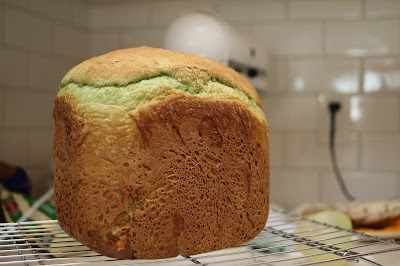
Today in the USA is Martin Luther King, Jr., day. But sometimes these holidays get confusing for a 6-year-old. I asked Jacob the other day if he knew what holiday was coming up. He thought about it for a second, then declared it would be St. Patrick s Day. He was excited because St. Patrick s Day is green. When he realized that it was really MLK Day, he was disappointed. That day isn t green. So I said, Jacob, how about we celebrate pretend St. Patrick s Day on Monday? His face lit up, he got a huge smile, and said, Oh yes! Great idea, dad! Oliver got all excited about it too. I was already planning on us doing some cooking, and thankfully had green food coloring already. So I sort of discarded my plans so each meal could have something green in it. When the boys woke up this morning, I wished each of them Happy Pretend St. Patrick s Day! We all wore green. Jacob put his shirt on backwards so the side with more green would be facing front. For breakfast, our green dish was green crepes with a succotash (based on baby lima beans and corn) filling. The boys were excited to discover that the crepes could be green on one side, and green and a little brown on the other. Jacob was unsure of the succotash idea, but after having a few bites, declared it excellent . After breakfast, we made bread. They loved watching the green food coloring disperse in the water. We checked on how green the dough looked periodically. We watched how it was rising and whether it was staying green. And we checked in on it backing, as the crust turned from green to brown. We discussed green bread over and over. Important questions were asked and answers were attempted. And then, of course, the moment of truth removing the loaf from the pan. The boys jabbered excitedly that there was some green peeking out. While we waited for it to cool, we went out to the creek. The creek is dry this year, so we got to walk in it. Jacob used his stick to make a line behind him. I asked him, Is that a line so we can find our way back? Oh! Uhm. Yes! And then he added arrows so we d know which way to go. Jacob stopped every 20 or so feet to collect pretend train tickets from Oliver and me. Oliver eventually grew tired of this, so Jacob started collecting Oliver s ticket from me. They climbed on some trees, managed to find some mud, drew outlines of train cars in the dirt, and then followed Jacob s line back down the creek bed. They pointed out any green things they saw. Then we went back to the house, took off our warm coats, and cut into the bread. Can you imagine the excitement? I hadn t realized green is a flavor, but it must have been somehow, because those boys absolutely loved this green bread. When we got out the jam, Jacob realized that it was red on the green bread, and that now his bread was Christmas-colored. All sorts of green bread discoveries were made, but the best among them was that if you hold a slice of green bread up to the bright sun, the sun makes it glow green and it looks like a stained-glass window. Sometimes a few drops of food coloring can add a ton of excitement to a day.

Matthew Palmer: When is a guess not a guess?

when it s a prediction . In the 4th January edition of the Guardian Weekly , the front page story, entitled Meet the world s new boomers 1 contained this little gem:

Back in 2006, [PricewaterhouseCoopers] made some forecasts about what the global economy might look like in 2050, and it has now updated the predictions in the light of the financial crisis and its aftermath.
Delightful. They made some forecasts about what the global economy might look like. Given that they clearly didn t include any impact of the GFC in their forecasts, it clearly wasn t a particularly accurate forecast. Y know what an inaccurate prediction is called? Guesswork. Let s call a spade a spade here. I see this all the time, and it s starting to shit me. People making predictions and forecasts and projections hither and yon, and they re almost always complete bollocks, and they never get called on it. I read the Greater Fool blog now and then, and that blog is chock full of examples of people making predictions which have very little chance of being in any way accurate. While Dr Ben Goldacre and others are making inroads into requiring full disclosure in clinical trials, I m not aware of anyone taking a similar stand against charlatans making dodgy-as-hell predictions over and over again, with the sole purpose of getting attention, without any responsibility for the accuracy of those predictions. Is anyone aware of anyone doing work in this area, or do I need to register badpredictions.net and start calling out dodginess?

Russ Allbery: Review: Fantasy & Science Fiction, March/April 2011

Review: Fantasy & Science Fiction, March/April 2011
Editor: Gordon van Gelder
Issue: Volume 120, No. 3 & 4
ISSN: 1095-8258
Pages: 258
Charles de Lint's book review column sticks with the sorts of things he normally reviews: urban and contemporary fantasy and young adult. Predictably, I didn't find that much of interest. But I was happy to see that not all the reviews were positive, and he talked some about how a few books didn't work. I do prefer seeing a mix of positive and negative (or at least critical) reviews. James Sallis's review column focuses entirely on Henry Kuttner and C.L. Moore (by way of reviewing a collection). I'm always happy to see this sort of review. But between that and de Lint's normal subject matter, this issue of F&SF was left without any current science fiction reviews, which was disappointing. Lucius Shepard's movie review column features stunning amounts of whining, even by Shepard's standards. The topic du jour is how indie films aren't indie enough, mixed with large amounts of cane-shaking and decrying of all popular art. I find it entertaining that the F&SF film review column regularly contains exactly the sort of analysis that one expects from literary gatekeepers who are reviewing science fiction and fantasy. Perhaps David Langford should consider adding an "As We See Others" feature to Ansible cataloging the things genre fiction fans say about popular movies. "Scatter My Ashes" by Albert E. Cowdrey: The protagonist of this story is an itinerant author who has been contracted to write a family history (for $100K, which I suspect is a bit of tongue-in-cheek wish fulfillment) and has promptly tumbled into bed with his employer. But he is somewhat serious about the writing as well, and is poking around in family archives and asking relatives about past details. There is a murder (maybe) in the family history, not to mention some supernatural connections. Those familiar with Cowdrey's writing will recognize the mix of historical drama, investigation, and the supernatural. Puzzles are, of course, untangled, not without a bit of physical danger. Experienced fantasy readers will probably guess at some of the explanation long before the protagonist does. Like most Cowdrey, it's reliably entertaining, but I found it a bit thin. (6) "A Pocketful of Faces" by Paul Di Filippo: Here's a bit of science fiction, and another mystery, this time following the basic model of a police procedural. The police in this case are enforcing laws around acceptable use of "faces" in a future world where one can clone someone's appearance from their DNA and then mount it on a programmable android. As you might expect from that setup, the possibilities are lurid, occasionally disgusting, and inclined to give the police nightmares. After some scene-setting, the story kicks in with the discovery of the face of a dead woman who, at least on the surface, no one should have any motive to clone. There were a few elements of the story that were a bit too disgusting for me, but the basic mystery plot was satisfying. I thought the ending was a let-down, however. Di Filippo tries to complicate the story and, I thought, went just a little too far, leaving motives and intent more confusing than illuminating. (6) "The Paper Menagerie" by Ken Liu: Back to fantasy, this time using a small bit of magic to illustrate the emotional conflicts and difficulties of allegiance for second-generation immigrants. Jack is the son of an American farther and a Chinese mother who was a mail-order bride. He's young at the start of the story and struggling with the embarassment and humiliation that he feels at his mother's history and the difficulties he has blending in with other kids, leading to the sort of breathtaking cruelty that comes so easily from teenagers who are too self-focused and haven't yet developed adult empathy. I found this very hard to read. The magic is beautiful, personal, and very badly damaged by the cruelty in ways that can never really be fixed. It's a sharp reminder of the importance of being open-hearted, but it's also a devastating reminder that the lesson is normally learned too late. Not the story to read if you're prone to worrying about how you might have hurt other people. (6) "The Evening and the Morning" by Sheila Finch: This long novella is about a third of the issue and is, for once, straight science fiction, a somewhat rare beast in F&SF these days. It's set in the far future, among humans who are members of the Guild of Xenolinguists and among aliens called the Venatixi, and it's about an expedition back to the long-abandoned planet of Earth. I had a lot of suspension of disbelief problems with the setup here. While Earth has mostly dropped out of memory, there's a startling lack of curiosity about its current condition among the humans. Finch plays some with transportation systems and leaves humanity largely dependent on other races to explain the failure to return to Earth, but I never quite bought it. It was necessary to set up the plot, which is an exploration story with touches of first contact set on an Earth that's become alien to the characters, but it seemed remarkably artificial to me. But, putting that aside, I did get pulled into the story. Its emotional focus is one of decline and senescence, a growing sense of futility, that's halted by exploration, mystery, and analysis. The question of what's happened on Earth is inherently interesting and engaging, and the slow movement of the story provides opportunities to build up to some eerie moments. The problem, continuing a theme for this issue, is the ending. Some of the reader's questions are answered, but most of the answers are old, well-worn paths in science fiction. The emotional arc of the story is decidedly unsatisfying, at least to me. I think I see what Finch was trying to do: there's an attempted undermining of the normal conclusion of this sort of investigation to make a broader point about how to stay engaged in the world. But it lacked triumph and catharsis for me, partly because the revelations that we get are too pedestrian for the build-up they received. It's still an interesting story, but I don't think it entirely worked. (6) "Night Gauntlet" by Walter C. DeBill, Jr., et al.: The full list of authors for this story (Walter C. DeBill, Jr., Richard Gavin, Robert M. Price, W.H. Pugmire, Jeffrey Thomas, and Don Webb) provides one with the first clue that it's gone off the rails. Collaborative storytelling, where each author tries to riff off the work of the previous author while spinning the story in a different direction, is something that I think works much better orally, particularly if you can watch facial expressions while the authors try to stump each other. In written form, it's a recipe for a poorly-told story. That's indeed what we get here. The setup is typical Cthulhu mythos stuff: a strange scientist obsessed with conspiracy theories goes insane, leaving behind an office with a map of linkages between apparently unrelated places. The characters in the story also start going insane for similar reasons, leading up to a typical confrontation with things man was not meant to know, or at least pay attention to. If you like that sort of thing, you may like this story better than I did, but I thought it was shallow and predictable. (3) "Happy Ending 2.0" by James Patrick Kelly: More fantasy, this time of the time travel variety. (I call it fantasy since there's no scientific explanation for the time travel and it plays a pure fantasy role in the story.) That's about as much as I can say without giving away the plot entirely (it's rather short). I can see what Kelly was going for, and I think he was largely successful, but I'm not sure how to react to it. The story felt like it reinforced some rather uncomfortable stereotypes about romantic relationships, and the so-called happy ending struck me as the sort of situation that was going to turn very nasty and very uncomfortable about five or ten pages past where Kelly ended the story. (5) "The Second Kalandar's Tale" by Francis Marion Soty: The main question I have about this story is one that I can't answer without doing more research than I feel like doing right now: how much of this is original to Soty and how much if it is straight from Burton's translation of One Thousand and One Nights. Burton is credited for the story, so I suspect quite a lot of this is from the original. Whether one would be better off just reading the original, or if Soty's retelling adds anything substantial, are good questions that I don't have the background to answer. Taken as a stand-alone story, it's not a bad one. It's a twisting magical adventure involving a djinn, a captive woman, some rather predictable fighting over the woman, and then a subsequent adventure involving physical transformation and a magical battle reminiscent of T.H. White. (Although I have quite likely reversed the order of inspiration if as much of this is straight from Burton as I suspect.) Gender roles, however, are kind of appalling, despite the presence of a stunningly powerful princess, due to the amount of self-sacrifice expected from every woman in the story. Personally, I don't think any of the men in the story are worth anywhere near the amount of loyalty and bravery that the women show. Still, it was reasonably entertaining throughout, in exactly the way that I would expect a One Thousand and One Nights tale to be. Whether there's any point in reading it instead of the original is a question I'll leave to others. (7) "Bodyguard" by Karl Bunker: This is probably the best science fiction of the issue. The first person protagonist is an explorer living with an alien race, partly in order to flee the post-singularity world of uploaded minds and apparent stagnation that Earth has become. It's a personal story that uses his analysis of alien mindsets (and his interaction with his assigned alien bodyguard) to flesh out his own desires, emotional background, and reactions to the world. There are some neat linguistic bits here that I quite enjoyed, although I wish they'd been developed at even more length. (The alien language is more realistic than it might sound; there are some human languages that construct sentences in a vaguely similar way.) It's a sad, elegiac story, but it grew on me. (7) "Botanical Exercises for Curious Girls" by Kali Wallace: One has to count this story as science fiction as well, although for me it had a fantasy tone because the scientific world seems to play by fantasy rules from the perspective of the protagonist. Unpacking that perspective is part of the enjoyment of the story. At the start, she seems to be a disabled girl who is being cared for by a strange succession of nurses who vary by the time of day, but as the story progresses, it becomes clear that something much stranger is going on. There are moments that capture a sense of wonder, reinforced by the persistantly curious and happy narrative voice, but both are undercut by a pervasive sense of danger and dread. This is a light story written about rather dark actions. My biggest complaint with the story is that it doesn't so much end as wander off into the sunset. It set up conflict within a claustrophobic frame, so I can understand the thematic intent of breaking free of that frame, but in the process I felt like the story walked away from all of the questions and structure that it created and ended in a place that felt less alive with potential than formless and oddly pointless. I think I wanted it to stay involved and engaged with the environment it had created. (6) "Ping" by Dixon Wragg: I probably should just skip this, since despite the table of contents billing and the full title introduction, it's not a story. It's a two-line joke. But it's such a bad two-line joke that I had to complain about it. I have no idea why F&SF bothered to reprint it. (1) "The Ifs of Time" by James Stoddard: This certainly fits with the Arabian Nights story in this issue. The timekeeper of a vast and rambling castle (think Gormenghast taken to the extreme) wanders into a story-telling session in a distant part of the castle. The reader gets to listen to four (fairly good) short stories about time, knowledge, and memory, told in four very different genres. All of this does relate to why the timekeeper is there, and the frame story is resolved by the end, but the embedded stories are the best part; each of them is interesting in a different way, and none of them outlast their welcome. This was probably the strongest story of this issue. (7) Rating: 6 out of 10

Eddy Petrișor: (Rsnapshot) backup and security - I see problems

In my previous post I was asking for suggestions for backup solutions that would be open/free software, do backups over the network to a local HDD, be cross platform to allow Windows and Linux clients and not be too CPU/memory hungry (on the server).

Several people suggested rsnapshot, BackupPC, areca-backup, and rsync. Thank you for all your suggestions, you have been a tremendous help. I have decided to give rsnapshot a try since it was suggested to me that it would actually do what is supposed to do for Windows clients, too (which was initially my perceived show stopper for rsnapshot).

Still, when getting to the implementation, I was a little disappointed by the very permissive access that needs to be provided on the client machines, since the backup is initiated from the backup server. Even the so called more secure suggested solutions seem way too permissive for my taste, since losing the control over the backup system means basically giving total access to the data from all client machines, which is quite a big problem in my opinion.

The data-transfer mechanism employed by rsnapshot is simply
  1. S ==(connects and reads all data)==> C
  2. S stores data in the final storage area
Am I the only one seeing a problem with this idea? If the server can connect to all your client machines and read all areas as it pleases, even if you restrict it to some directories, the data is already compromised when the backup server is compromised (think .ssh private keys, files with wireless network passwords and so on; I won't say card information - you don't keep credit/debit card information on your computer, or at least not in plain text, do you?).

What I would consider a better alternative would be a server-initiated dialogue which goes a little like this (S is server, C is client, '=' represent connections via ssh):
  1. S ---(requests backup initiation procedure)---> C
  2. S waits for a defined period of time that C connects back to send (already encrypted) data; if it doesn't arrive, it aborts
  3. S <===(sends encrypted data to be backed up)=== C
  4. S <-(signals the completion of data transfer)-- C
  5. S stores the data in the final storage area
This way, the server can allow access from the clients only in designated areas (even a chroot is possible) from designated clients, access can even be provided only after a port knocking procedure and only during the backup time frame (since the server initiates the negotiation, it can expect only then the knocks, but only then), so the server is quite well secured. The connection to the server can even be done through an unprivileged account, it can even be one account per client machine which can be limited to a scponly shell, if you care for that level of security.

On the other hand, the client information is secure since it can be encrypted directly on the client machine and sent only after encryption, the client machine can decide and control what it sends, while the backup server can only store what the client provides. Also, if the server is compromised, the clients' data and system aren't compromised at all, since the data is on the backup machine, but is encrypted with a key only known on the client (and a backup copy of it can be stored somewhere safe).

I am aware this approach can be problematic for permission (user/group preservation), but it doesn't happen if there is a local <-> remote user mapping or simply the numeric IDs are kept.

I am also aware this means smarter clients and might mean the Windows machine might not be able to implement this completely, but a little more security than "here is all my data" can still be achieved, can't it?

What do other people think? Am I insane or paranoid?

I think I can implement this type of protocol in some scripts (at least one for server and one for clients) and use the backup_script feature of rsnapshot to keep this clean and nice within rsnapshot.

What might prove problematic with this approach is that rsync spedup is lost (might be?) because the copy is done to a temporary directory which, I assume, is empty, so tough luck. Another problem seems to be that every time the backup is done, the client has to encrypt each of the files to backup, which seems to be a real performance penalty, especially if the data to be backed up is quite large.

Is there an encryption layer that does this automatically at file level in the same/similar manner that LUKS does for entire block devices? Having the right file names, but with scrambled/encrypted contents seems to be the ideal solution from this PoV.

Thanks for reading and possible suggestions you might point me to.

P.S.: I just thought of this, if there was an encryption layer implemented with fuse which is mounted in some directory on the client machine, the default rsnapshot mechanism could actually work, and this would mitigate the data accessibility issue and the performance issue since that file system could be contained within a chroot and the encryption/scrambling would be done transparently on the client, so no data is plainly accessible. Does anybody know such a FUSE implementation that does on-the-fly file encryption?

P.P.S.: EncFS does exactly what I want with its --reverse option which is exactly designed for this purpose:
Normally EncFS provides a plaintext view of data on demand. Normally it stores enciphered data and displays plaintext data. With --reverse it takes as source plaintext data and produces enciphered data on-demand. This can be useful for creating remote encrypted backups, where you do not wish to keep the local files unencrypted.
Great!

21 January 2013

Petter Reinholdtsen: First prototype ready making hardware easier to use in Debian

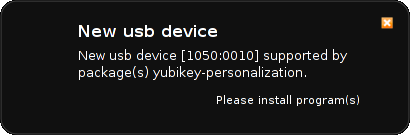
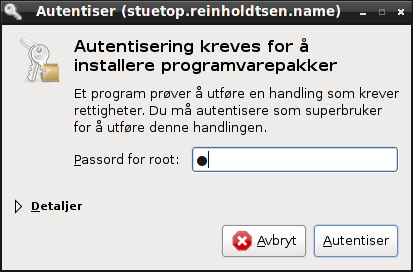
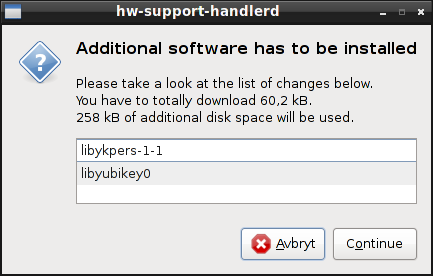
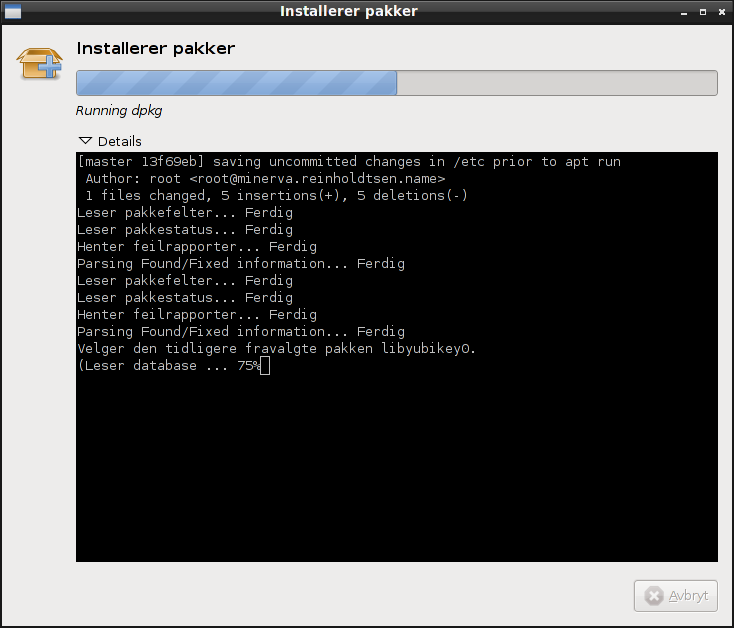
Early this month I set out to try to improve the Debian support for pluggable hardware devices. Now my prototype is working, and it is ready for a larger audience. To test it, fetch the source from the Debian Edu subversion repository, build and install the package. You might have to log out and in again activate the autostart script. The design is simple: I still need to come up with a better name for the system. Here are some screen shots showing the prototype in action. First the notification, then the password request, and finally the request to approve all the dependencies. Sorry for the Norwegian Bokm l GUI.


The prototype still need to be improved with longer timeouts, but is already useful. The database of hardware to package mappings also need more work. It is currently compatible with the Ubuntu way of storing such information in the package control file, but could be changed to use other formats instead or in addition to the current method. I've dropped the use of discover for this mapping, as the modalias approach is more flexible and easier to use on Linux as long as the Linux kernel expose its modalias strings directly. Update 2013-01-21 16:50: Due to popular demand, here is the command required to check out and build the source: Use 'svn checkout svn://svn.debian.org/debian-edu/trunk/src/hw-support-handler/; cd hw-support-handler; debuild'. If you lack debuild, install the devscripts package. Update 2013-01-23 12:00: The project is now renamed to Isenkram and the source moved from the Debian Edu subversion repository to a Debian collab-maint git repository. See build instructions for details.

Raphael Geissert: January's Debian mirrors update

It's been slightly over a month since December's update to http.debian.net. Since then, Debian's mirrors network has grown by 6 more archive mirrors. Many thanks to the Debian sponsors running them!

There are now about 370 archive mirrors serving it over http, an increase of 40 (12%) since April last year. The number of backports mirrors is now at 82, and 25 for archive.debian.org.

On the http.debian.net front there haven't been many changes since last month. Some major changes are in the works, but they didn't make it into January's code update. There were, however, a few issues with one of the hosts during the first couple of days of January. Apologies for the inconveniences it may have caused.

A new version of ftpsync addressing some issues should hopefully be released some time next month. Stay tuned to the debian-mirrors mailing list for a call for testers and probably a survey for mirror administrators.

Russ Allbery: Have some clouds

It's been a long time since I've posted any photographs here (about 15 months, it looks like), so have some clouds. Windswept clouds This also serves as a test for whether the scripts I use to post photographs have been properly converted to Git. (And a test to see if the occasional amateur photograph eating up screen real estate will provoke annoyed mutters from the direction of Planet Debian, although so far no complaints over my even-longer book reviews.) I'm still taking photographs occasionally, although not as much as I was at one point. Too many hobbies and not enough time. Part of why I've been slow in posting them is that I was bad about keeping notes about where I took them and bad about keeping up with sorting through them. So I have large collections of photographs from some days where I don't remember exactly where I was, and where I've not already singled out the ones that are worth sharing. One of the things my hobbies always seem to generate is yet another pile of stuff that's not organized quite to my liking. Maybe some evening I'll feel inspired to do a bit more sorting. This is a long weekend in the US for some of us, myself included, so I get another day in this weekend. Which is good, since I've only gotten to a fraction of what I wanted to get to, although at least I found several hours to play video games today. I have finally converted PGP::Sign to Git, so I have no more personal Subversion repositories, but I forgot how much code I'd written to handle its build-time configuration. All of that desperately needs to be reworked, so it's going to take a bit longer than I expected before I can push out another release.

20 January 2013

Hideki Yamane: digging CVEs

Sometimes I would check security-tracker to find problems that is already fixed but not tagged as so.

Today, I found problems that not in unstable package but not tagged as fixed for Eucalyptus, because it was removed from unstable once but re-introduced to archive again, then data in security-tracker was not updated as well. So update it (CVE-2010-3905 and CVE-2011-0730).

And also found vulnerablity in firebird2.5 was fixed in upstream svn, so pick it and made it as a patch, just report to BTS (for squeeze, too).

For isc-dhcp, it has a vulnerability from BIND9... I've been surprised but dhcp includes bind9 source since 4.2, so BIND9 vulnerability affects isc-dhcp. Pick a diff from bind9 for squeeze security update and made a patch (Bug#698597) .

Gregor Herrmann: RC bugs 2013/03

& again, I was not very active in my RCBW work this week. at least one bug fixed, & another one will be taken care of by the package maintainers.

19 January 2013

Niels Thykier: Wheezy release progress (January)

In December, I wrote a post on the progress of the Wheezy release. Back then, we had 348 RC bugs in testing and today there are about 249 left. A bit of simple math put us at 99 RC bugs fixed since last and an average of about 2.4 RC bugs fixed per day (up from 1.8). Assuming a constant rate, we would be able to release in about 100 days or 3 months (plus 1 week or two) from now. If you want the release earlier than that, fix RC bugs even faster! :) Though, the data we are looking might be inaccurate. We filed a bug against UDD, which claims that #639407 affects Wheezy while it is in fact fixed as far as the BTS is concerned. If UDD is only wrong in this direction, we can hope for a positive surprise when the UDD bug is fixed. On the other hand, we may also be unpleasently surprised if not. While talking about the UDD, I would like to mention a new feature its bug search script. It is now possible to filter based on whether or not a package is unblocked. If you take this into account (and assume that all unblocked packages will migrate in a timely manner), our RC bug count drops to about 219. It also gives us a much better view of how many packages that could actually use an unblock. which is now down to about 61. In case you have been wondering what is up with the removal of RC buggy leaf packages . We have still been looking at those, but for the last couple of times there have been at most one candidate for a given run (obviously not the same package each time). It felt a bit excessive to send an email to debian-devel for just one RC bug.

Petter Reinholdtsen: Thank you Thinkpad X41, for your long and trustworthy service

This Christmas my trusty old laptop died. It died quietly and suddenly in bed. With a quiet whimper, it went completely quiet and black. The power button was no longer able to turn it on. It was a IBM Thinkpad X41, and the best laptop I ever had. Better than both Thinkpads X30, X31, X40, X60, X61 and X61S. Far better than the Compaq I had before that. Now I need to find a replacement. To keep going during Christmas, I moved the one year old SSD disk to my old X40 where it fitted (only one I had left that could use it), but it is not a durable solution. My laptop needs are fairly modest. This is my wishlist from when I got a new one more than 10 years ago. It still holds true.:) You will notice that there are no RAM and CPU requirements in the list. The reason is simply that the specifications on laptops the last 10-15 years have been sufficient for my needs, and I have to look at other features to choose my laptop. But are there still made as robust laptops as my X41? The Thinkpad X60/X61 proved to be less robust, and Thinkpads seem to be heading in the wrong direction since Lenovo took over. But I've been told that X220 and X1 Carbon might still be useful. Perhaps I should rethink my needs, and look for a pad with an external keyboard? I'll have to check the Linux Laptops site for well-supported laptops, or perhaps just buy one preinstalled from one of the vendors listed on the Linux Pre-loaded site.

Russ Allbery: distribrc 1.0

I was just talking to my dad about this script the other day, so now seems like as good of a time as any to finally stick it up with my other publicly released small scripts. distribrc is a little Perl script I wrote a long time back that copies all my dot-files (everything from .Xresources and .screenrc to more obscure stuff like .gitconfig and .perlcriticrc) to all of my accounts. It supports a simple configuration file that specifies locations to copy files to, commands to do the copying, and which set of files to copy to each host, so it's survived my transition from Kerberos rcp to GSS-API authenticated ssh without needing a single change. In fact, when I went to tweak the documentation for this public release, I discovered that it was at version 0.7 and the last commit was in May of 1997. So this is a script that I've been using, probably at least once a month, without a single change, for more than 15 years. I suppose you could call that stable. It at least seemed to warrant a 1.0 version number. The Perl coding style is kind of awful, but hey. At some point I'll probably go through my various scripts and update coding style, and maybe figure out some test suite mechanism, but in the meantime someone else may find it useful. More thorough measures, like using Git to track one's home directory, are probably better, but this script has the advantage of being quite simple and making it very easy to customize exactly what you want to send to each host. You can get it from my miscellaneous scripts page.

Dirk Eddelbuettel: Sing The Truth at Symphony Center

Just back in from an amazing concert at the Chicago Symphony Center. Vocalists Angelique Kidjo, Dianne Reeves and Lizz Wright supported by all-star band of Geri Allen on piano, Romero Lubambo on electric and acoustic guitar, James Genus on electric bass guitar, Munyungo Jackson on percussion and Terri Lyne Carrington on drums (and musical director). The concert alternates between solos and joint pieces with more joy and soul than I heard in a long time. Great evening.

Charles Plessy: Debian-Installer in a Cloud, part 2.

I finally manage to create an image of the Debian Installer automatically, with no key or password transiting on the Cloud or the network, and without using the ec2-api-tools, which are non-Free. Thanks to Eucalyptus for implementing the attribute InstanceInitiatedShutdownBehavior in euca2ools 2.1.2. In brief, I start a micro-instance with an additional volume, and I pass it a script for cloud-init, which will download the Installer on the volume and shut down the instance. Then, I register the volume as a machine image. Those machine images of the Installer are to be preseeded via instance metadata to install Debian on another volume. I am still struggling with the pre-configuration. More details will follow in the next article. In the meantime, here are the commands I a using. On the local computer, start an instance on the Cloud. Until #696595 is fixed and cloud-init is installed by default, I use a Ubuntu image.
HELPER_AMI=ami-7609bb77 # Ubuntu 12.04 LTS Precise amd64 EBS (Asia North-East)
Start the instance with an extra volume of 1 GiB, which will persist after termination (/dev/sdb=:1:false). Pass the script debigen-install-installer-cloud (see below).
HELPER_INSTANCE=$( euca-run-instances \
        --instance-initiated-shutdown-behavior terminate \
        --instance-type t1.micro \
        --block-device-mapping /dev/sdb=:1:false \
        --user-data-file debigen-install-installer-cloud \
        $HELPER_AMI  
        tee /dev/stderr   grep INSTANCE   awk ' print $2 ')
Wait that the boot finished.
while [ ! $(euca-describe-instances $HELPER_INSTANCE   grep INSTANCE   cut -f 6   tee /dev/stderr) = "running" ]
    do sleep 30
done
Get the volume's identifier
TARGET_VOLUME=$( euca-describe-volumes  
        grep $HELPER_INSTANCE   grep '/dev/sdb'  
        tee /dev/stderr   awk ' print $2 ')
Wait that the scripts shuts down the instance.
while [ ! $(euca-describe-instances $HELPER_INSTANCE   grep INSTANCE   cut -f 6   tee /dev/stderr) = "terminated" ]
    do sleep 30
done
Snapshot the volume and register it as a machine image.
PV_KERNEL=aki-44992845 # Boot PV-Grub on hd0 (Asia North-East)
TARGET_SNAPSHOT=$( euca-create-snapshot $TARGET_VOLUME  
        tee /dev/stderr   awk ' print $2 ')
while euca-describe-snapshots $TARGET_SNAPSHOT   grep -q pending ; do sleep 30 ; done
euca-register \
    --name test_di \
    --description test_of_debian_installer \
    --snapshot $TARGET_SNAPSHOT \
    --kernel $PV_KERNEL \
    --architecture x86_64
Here is the script called debigen-install-installer-cloud, used above.
#!/bin/sh -ex    
mke2fs -L debian-installer /dev/xvdb -F
mount LABEL=debian-installer /mnt/
cd /mnt    
ARCH=amd64
DIST=squeeze
DI_VERSION=20110106+squeeze4+b2
MIRROR=jp
BASEURL=http://ftp.$MIRROR.debian.org/debian/dists/$DIST/main/installer-$ARCH/$DI_VERSION/images/netboot/xen
wget $BASEURL/initrd.gz $BASEURL/vmlinuz    
mkdir -p boot/grub    
cat > boot/grub/menu.lst <<__END__
default 0
timeout 3
title  Debian Installer ($DI_VERSION $ARCH)
root   (hd0)
kernel /vmlinuz root=LABEL=debian-installer ro console=hvc0 auto=true priority=critical url=http://169.254.169.254/latest/user-data DEBIAN_FRONTEND=text
initrd /initrd.gz
__END__
sleep 30     
halt

18 January 2013

Russell Coker: Phone Calls and Other Distractions

Harald Welte has written about the distraction of phone calls and how it impacts engineering work [1]. He asks why people feel that they are entitled to interrupt him given the cost to his work. Some years ago while working as a programmer I was discussing such things with a colleague who worked for the consulting part of the same company. He was really surprised when I told him that a phone call at the wrong time would cost me at least 30 minutes work and possibly an hour or more. His work was also quite technical and demanding but the difference between software development (where you need to think about a lot of program state to consider where the problem might be) and consulting (where you have to deal with a smaller number of configuration file options and sometimes getting debugging information to someone like me) is considerable. So the attitudes towards receiving calls also tends to be quite different. Computer work requires more concentration, thought, and knowledge of system state than many (most?) career choices. If someone finds that an unexpected phone call costs them no more than a few minutes work then it s quite reasonable of them to phone other people whenever they feel like it generally by default people think that everyone else is just like them. In terms of managing interruptions to my work, I generally encourage people to email me and that works reasonably well. So I don t have too many problems with distracting phone calls. I used Jabber for a while a few years ago but I didn t reinstall my Jabber server after it became corrupt because of the distraction. I believe that was due to using Jabber in the wrong way. I should have just started a Jabber client when I wasn t doing anything important and then killed it when I started doing some serious coding. Having a Jabber message interrupt me when I m watching a TED talk or reading blogs is no big deal. In fact I could tell everyone who has my phone number that if they see me on Jabber then they can just phone me if they wish while knowing that it won t distract me from anything serious. I wonder if I could configure a Jabber client to only receive messages when a program such as mplayer is running. I have configured my laptop and workstation to never alert me for new mail. If I m not concentrating then I ll be checking my email frequently and if I am concentrating I don t want a distraction. I have configured my phone to give one brief vibration when it gets mail and not make any sound, I will only notice that if I m not concentrating on anything. It s a standard Android feature to associate ring tones with phone numbers, it s a pity that the K9 MUA doesn t allow associating email addresses with notifications. There are some people who s email could usefully trigger an audible alert. There is an K9 feature request from 2009 to allow notifications only when the IMAP flag Flagged is set which would allow the mail server to determine which users are important, but there s no sign that it will be implemented soon. I ve started playing with Google+ recently due to Ingress team interaction being managed through it. Google+ seems quite poor in this regard, it defaults to making a ring tone for lots of different events. Turning that off is easy enough but getting notifications only about things that are important to me seems impossible. I would like to get an audible alert when someone makes a Google+ post with an Ingress code (because they expire quickly and because they only seem to be posted at times when I m not busy) but not get audible alerts about anything else. I m sure that most people who use Google+ would like to have different notifications for various types of event. But the Android client has options for whether there should be vibration and/or noise and for which events get the notifications. No options for different notifications for different events and for treating some community posts differently from others. It seems that the default settings for most programs suit people who never need to spend much time concentrating on a task. It also seems that most programs don t offer configuration options that suit the needs of people who do concentrate a lot but who also sometimes receive important phone calls and email. It s ironic that so many applications are designed in the least optimal way for the type of people who develop applications. The Google+ developers have an excuse as doing what I desire would be quite complex. But there are other programs which should deal with such things in a user friendly manner.

Ian Campbell: Using Valgrind to Debug Xen Toolstacks

What is Valgrind? Valgrind is a framework for building dynamic analysis tools. Several useful tools are included in the Valgrind distribution including tools to check dynamic memory usage (memcheck), a cache profiler (cachegrind), heap profiler (massif) and thread debugger (helgrind) among others. Valgrind also provides a framework which can be used to build other tools. The Valgrind tool which I find most useful and the one which I have most experience with is memcheck. This tool can detect all manner of memory management problems, including use after free, using uninitialized data, memory leaks, double free. Between them these can result in savings of many hours of staring a core dumps and gdb backtraces. How Does memcheck Work? At its core Valgrind is a dynamic binary translation engine, which is used to instrument the code at runtime. In the case of memcheck this is used to track properties of the memory in a process, including aspects such as whether each bit (yes, bit) of memory has been initialized since it was allocated. It also tracks this information as data is loaded into registers, so it can know if a given register is currently tainted with uninitialized data or not. As well as instrumentation through binary translation Valgrind also includes instrumented versions of the C dynamic memory allocation functions which are used to track whether a each bit of memory is currently considered free or allocated, as well as tainting registers when they contain a pointer to memory which has been freed. A large part of memcheck's functionality is built upon Valgrind's ability to determine when memory has been initialized. However although binary translation can be used to instrument when the application itself has initialized some memory it is not currently possible to instrument the behaviour of system calls, in other words Valgrind cannot automatically determine when memory has been initialised e.g. after a read(2) system call. For this reason Valgrind has baked in knowledge about the behaviour of system calls on various platforms. For example lets consider the read(2) system call. The prototype of read(2) is:
    ssize_t read(int fd, void *buf, size_t count);
This system call reads up to count bytes from the file descriptor fd into the memory pointed to by buf and returns the number of bytes read. Here is the code within Valgrind which handles this system call (found in coregrind/m_syswrap/syswrap-generic.c):
PRE(sys_read)
 
   *flags  = SfMayBlock;
   PRINT("sys_read ( %ld, %#lx, %llu )", ARG1, ARG2, (ULong)ARG3);
   PRE_REG_READ3(ssize_t, "read",
                 unsigned int, fd, char *, buf, vki_size_t, count);
   if (!ML_(fd_allowed)(ARG1, "read", tid, False))
      SET_STATUS_Failure( VKI_EBADF );
   else
      PRE_MEM_WRITE( "read(buf)", ARG2, ARG3 );
 
POST(sys_read)
 
   vg_assert(SUCCESS);
   POST_MEM_WRITE( ARG2, RES );
 
These two functions are called before and after the system call respectively. The main piece of functionality is the calls to PRE_MEM_WRITE and POST_MEM_WRITE. In this case PRE_MEM_WRITE is used to check that the memory starting at ARG2 (recall that this is the supplied buffer) and extending for ARG3 bytes (the system calls count argument) consists of allocated memory. After the system call in complete the post function calls POST_MEM_WRITE to indicate to Valgrind that RES bytes of the buffer have know been initialized. The above is a relatively simple case, but the above two hooks must be supplied for each system call on each platform which Valgrind wishes to support. One of the most problematic system calls is the ioctl(2) system call. The ioctl call takes a file descriptor, a request number and a pointer to a per-ioctl argument structure and implements per-device control requests. There are literally dozens of devices many with their own specific ioctls. For this reason a sizable portion of Valgrind code is dedicate to decoding the behaviour of the myriad of potential ioctls and providing pre- and post-call instrumentation for them. Interacting with the Hypervisor from Userspace Under Xen the toolstack is a normal userspace process running in the control domain (typically domain 0). As part of its operation the toolstack needs to communicate with the hypervisor and to do this it uses hypercalls. However a userspace process cannot simply make hypercalls on its own, instead it must request that the OS kernel make the hypercall for it. This prevents just any userspace process making a hypercall, since the kernel will first check the privilege of the process making the request. Under Linux a userspace process makes hypercalls by using the ioctl(2) system call on a special "Privileged Command" (privcmd) device. In this case the toolstack uses the IOCTL_PRIVCMD_HYPERCALL ioctl request which takes a hypercall number and the hypercall arguments as its argument. Other OSes which can be used as a control domain posses similar interfaces. Making memcheck Work With Xen Toolstacks? As might be expected the majority of the work to allow Valgrind to work on Xen toolstack processes was teaching it about the IOCTL_PRIVCMD_HYPERCALL ioctl. Fortunately it was not necessary to teach Valgrind about every hypercall but only about those which are used by toolstacks. This is a smallish subset of all hypercalls including the domctl interfaces and a handful of others. The initial batch of patches cover all of the system calls needed to start new domains, shut them down and migrate them using the XL toolstack. New hypercalls will be added as they are discovered to be missing. Getting and Using This Functionality The initial set of patches were accepted into Valgrind's Subversion repository trunk revision 13081 in October 2012 and are expected to be part of the 3.9.0 release. Until 3.9.0 is released it will be necessary to get this functionality from SVN. Fortunately this is relatively simple and follows the usual autofoo dance. Although the usual caveats regarding running unreleased software apply.
  $ svn co svn://svn.valgrind.org/valgrind/trunk valgrind
  $ cd valgrind
  $ ./autogen.sh
  $ ./configure
  $ make
  $ sudo make install
Once Valgrind is built and installed simply call it passing the command to be debugged as an option:
  # valgrind xl list
  ==16186== Memcheck, a memory error detector
  ==16186== Copyright (C) 2002-2012, and GNU GPL'd, by Julian Seward et al.
  ==16186== Using Valgrind-3.9.0.SVN and LibVEX; rerun with -h for copyright info
  ==16186== Command: xl list
  ==16186== 
  Name                                        ID   Mem VCPUs    State   Time(s)
  Domain-0                                     0   512     4     r-----     332.5
  ==16186== 
  ==16186== HEAP SUMMARY:
  ==16186==     in use at exit: 0 bytes in 0 blocks
  ==16186==   total heap usage: 16 allocs, 16 frees, 93,529 bytes allocated
  ==16186== 
  ==16186== All heap blocks were freed -- no leaks are possible
  ==16186== 
  ==16186== For counts of detected and suppressed errors, rerun with: -v
  ==16186== ERROR SUMMARY: 0 errors from 0 contexts (suppressed: 39 from 6)
Here we see that xl list has no leaks! However if I comment out the call to libxl_dominfo_list_free in tools/libxl/xl_cmdimpl.c:main_list() then instead Valgrind reports:
[...]
  ==16203== HEAP SUMMARY:
  ==16203==     in use at exit: 90,112 bytes in 1 blocks
  ==16203==   total heap usage: 16 allocs, 15 frees, 93,529 bytes allocated
  ==16203== 
  ==16203== LEAK SUMMARY:
  ==16203==    definitely lost: 0 bytes in 0 blocks
  ==16203==    indirectly lost: 0 bytes in 0 blocks
  ==16203==      possibly lost: 90,112 bytes in 1 blocks
  ==16203==    still reachable: 0 bytes in 0 blocks
  ==16203==         suppressed: 0 bytes in 0 blocks
  ==16203== Rerun with --leak-check=full to see details of leaked memory
  ==16203== 
  ==16203== For counts of detected and suppressed errors, rerun with: -v
  ==16203== ERROR SUMMARY: 0 errors from 0 contexts (suppressed: 39 from 6)
[...]
So it has caught the memory leak! Rerunning with the suggests --leak-check=full goes even further and tells me where the leaked memory was allocated:
[...]
  ==16204== 90,112 bytes in 1 blocks are possibly lost in loss record 1 of 1
  ==16204==    at 0x4024480: calloc (vg_replace_malloc.c:593)
  ==16204==    by 0x4050CE4: libxl_list_domain (libxl.c:548)
  ==16204==    by 0x805EEC7: main_list (xl_cmdimpl.c:3931)
  ==16204==    by 0x804D6DD: main (xl.c:285)
[...]
To ease debugging of domain creation I find it useful to use the -F option to xl create to stop xl from forking and daemonising. Most xl subcommands do not daemonize and so need no special treatment. For more information on running Valgrind see the Valgrind Documentation. Conclusion Valgrind is a powerful tool in the arsenal of the C programmer, and can be used to catch a large number of hard to debug and common issues before they happen can save many hours of tedious debugging. The ability to use tools such as this on Xen toolstack processes is of enormous benefit and has already found several bugs in the XL toolstack.

Michael Banck: 18 Jan 2013

What I have been up to over the last couple of years

I have now worked at credativ for four years. A sizable part of that time I spent working with the Munich City Council's LiMux project. The focus of our work is helping them with their LDAP/web-based GOsa user and system installation(based on FAI)/configuration/management system. Personally, I mostly did project management and QA besides occasional coding, bug fixing and on-site consulting.

Contrary to a lot of our other customers, the Munich city council openly acknowledges the work by external companies and lets us talk about it as well. I wrote a lengthy blog post (now available in english) last month about our work. It explains how the LiMux project is using GOsa and FAI and work we did for them.

The project took a long time, but managed to pull off the mass migration over the last two years and reached their goal of 12000 migrated workstation last November. It is now widely regarded as a "success story" by german news sites, and I am glad to have had a small part in it. I really think this was (and still is) an important project, especially after several others backpedalled and Munich remained the last high-profile public sector migration in the german speaking countries.

Besides that, the LiMux project members are really nice people I get along with well both on working hours and during the Munich Debconf11 bid and organizing various BSPs at their office. It is a bit of a shame that not more of their work and customizations are available in Debian, but hopefully this well happen one day. At least our changes to GOsa are up on github.

Next.

Previous.