Search Results: "sto"

2 March 2010

Matt Brubeck: The network is the human being

Nathanael Boehm wrote a nice essay last month called The Future of Employment?, about a disconnect between workers' and employers' views of social networks. (This post is based partly on my comment in the ensuing Hacker News thread.) Boehm wrote:
When I need help with a challenge at work or need to run some ideas past people I don t turn to my co-workers, I look to my network of colleagues beyond the walls of my workplace. Whilst my co-workers might be competent at their job they can t hope to compete with the hundreds of people I have access to through my social networks...
The late Sun Microsystems taught us that the network is the computer. It's true: we still use non-networked computers for specialized tasks, but nobody wants one on their desk it's just so useless compared to one that talks to the entire world. Boehm could have titled his essay The Network is the Employee. There are still tasks that people do in isolation, but the ability to contact a network of peers and experts makes the difference in my job, and many others. Alone together The lone computer programmer in a small business has thousands of colleagues on Stack Overflow, Reddit, and so on. It's a chaotic and messy way to find answers, but it's better than the days when your only choice was to call tech support or smack the box with your fist, whichever seemed more useful. I can't begin to list all the problems I've solved and things I've learned by Googling for others with relevant experiences, and getting help from a different expert for every problem. Decades before the web, computer geeks had virtual communities for on mailing lists, Usenet, and IRC. Now any job in the world has an online forum. Even the night clerk at the gas station has Not Always Right. Teaching has long been a solitary profession. Despite working in a crowded classroom, teachers are isolated; they rarely have colleagues observing or participating directly in their work. This has such an impact that teacher education sometimes includes training in meditation or reflection, to compensate for lack of external feedback. So I'm really curious what happens when teachers start to work together remotely the way programmers do. You will be assimilated Boehm's essay reminded me of a vague sci-fi-like idea I've been kicking around: the first group minds will evolve from the intersection of Mechanical Turk, virtual assistants, social networking, and augmented reality. Starting around the 1990s, it was possible to instantly "know" any fact that was published online. Since then, we've increased the amount of content online, our tools for searching it, and ways of connecting to the network. Today we have instant access to almost any published knowledge, anywhere. The number of people on the net has grown too, and the number of ways to find and talk to them. Most of us can contact dozens of friends at any given moment, plus friends-of-friends, co-workers, fellow members of communites like Hacker News or MetaFilter, and also complete strangers. Along with raw facts, we now have access to vast amounts of human judgement, experience, and skill. One result of this is the "virtual assistant," who provides a service that was once available only to high-powered executives. The new personal assistant can work remotely (often overseas), spread costs by serving many masters, and leverage the internet superpowers listed above. Today their services are targeted at small business owners and the Tim Ferriss crowd, but I'm sure someone soon will start marketing virtual personal assistance to all sorts of other creative workers, teachers, even stay-at-home parents. So, how long before I can simply touch a button to let a remote assistant see what I'm seeing in real-time and help me make transportation plans, translate foreign signs and speech, look up emails related to whatever I'm doing or thinking, or even advise me on what to say? Some of these queries will go to my circle of friends, others to the general public, and some to a personal assistant who is paid well to keep up with my specific needs. And that assistant of course will sub-contract out portions of each job as needed to computer programs, legions of cheap anonymous Turkers, or to his or her own network of assistants. At that point, I'm augmenting my own perception, memory, and judgement with a whole network of brains that I carry around ready to engage with any situation I meet. If nothing else, I hope someone writes a good sci-fi thriller story in which a rogue virtual assistant subtly manipulates the actions of unknowing clients, leading them to some unseen end.

1 March 2010

Diego Escalante Urrelo: GNOMEs in Chile

Update March 1st, 24 UTC: Reynaldo Verdejo is ok, the list is complete! Update March 1st, 16 UTC: Alejandro Vald s, Fabi n Arias, Carlos R os Vera and Germ n P o-Caama o have been in contact with others in Chile. :) Probably by now some of you know or are worried about the situation in Chile. I m not chilean nor in Chile but I ve been following closely due to the considerable number of good friends I have there, most of them related to GNOME.
From The Big Picture (AP Photo/Roberto Candia) Juan Carlos Inostroza (blog down) suggested I publish the list of GNOME/Free Software people in Chile that has reported since the earthquake and are fine, here it goes: Known, found and good: Not know, nor found, we presume good but without cellphones: If you have been in contact with any of them, leave a comment, send a DM in twitter (@diegoe) and etc. List is not complete, I probably forgot someone, please remind me. Will update if I get news from anyone.

28 February 2010

Joachim Breitner: Exploiting sharing in arbtt

My automatic rule-based time tracker (arbtt), which is written in Haskell, collects every minute a data sample consisting mainly of the list of currently open windows (window title and program name). Naturally, this log grows rather large. Since October of last year, I collected 70,000 samples. I already went from a text-based file format to a binary format using Data.Binary, which gave a big performance boost.
But by now, I was afraid that this is not enough. My log file is now 30MB large. Looking at the memory graph of gnome-panel, it is taking up more than half of my memory. When running arbtt-stats, the Haskell run time system reports 569 MB total memory in use and the command finishes after 28.5 seconds. Naturally, the log file is highly redundant: Compressing it with bzip2 shrinks it to 1.6MB. But as I would like to preserve the ability to just append samples at the end, without having to read the file, I chose not just to add bzip2 or gzip compression. Rather, I am now exploiting a very obvious redundancy: Two adjacent samples usually list exactly the same windows, and a focus change only changes a flag. So now, when storing a string that is part of a sample, it will check if this string was already present in the previous sample and, in this case, just store the number of that string (one byte). Only if the string was not present it will write a zero byte and then the string. When reading the sample, the process is reversed. This greatly reduces the file size: It is down to 6.2MB. It also improves the memory consumption, due to Haskell s abilities with regard to sharing: When a reference to a string in a previous sample is read, then only one instance of this string is in memory, even if it occurs several times in the log. This brings the memory consumption down to 264 MB and the runtime to 17 seconds. I released the changes as version 0.4.5.1 to Hackage, Debian and as a Windows installer. The log file is not automatically converted, but new samples will be written in the compressed format. If you want to convert your whole file, you have to stop arbtt-capture, run arbtt-recover, and then move the hopefully noticeable smaller ~/.arbtt/capture.log.recovered to ~/.arbtt/capture.log.
The required code changes were not too big. I somewhat isolated the relevant code in the Data.Binary.StringRef module. Unfortunately, I have to use OverlappingInstances to be able to provide the special instance for String is there a cleaner way (besides the trick used for the Show class)?

Russell Coker: Carpal Tunnel Syndrome

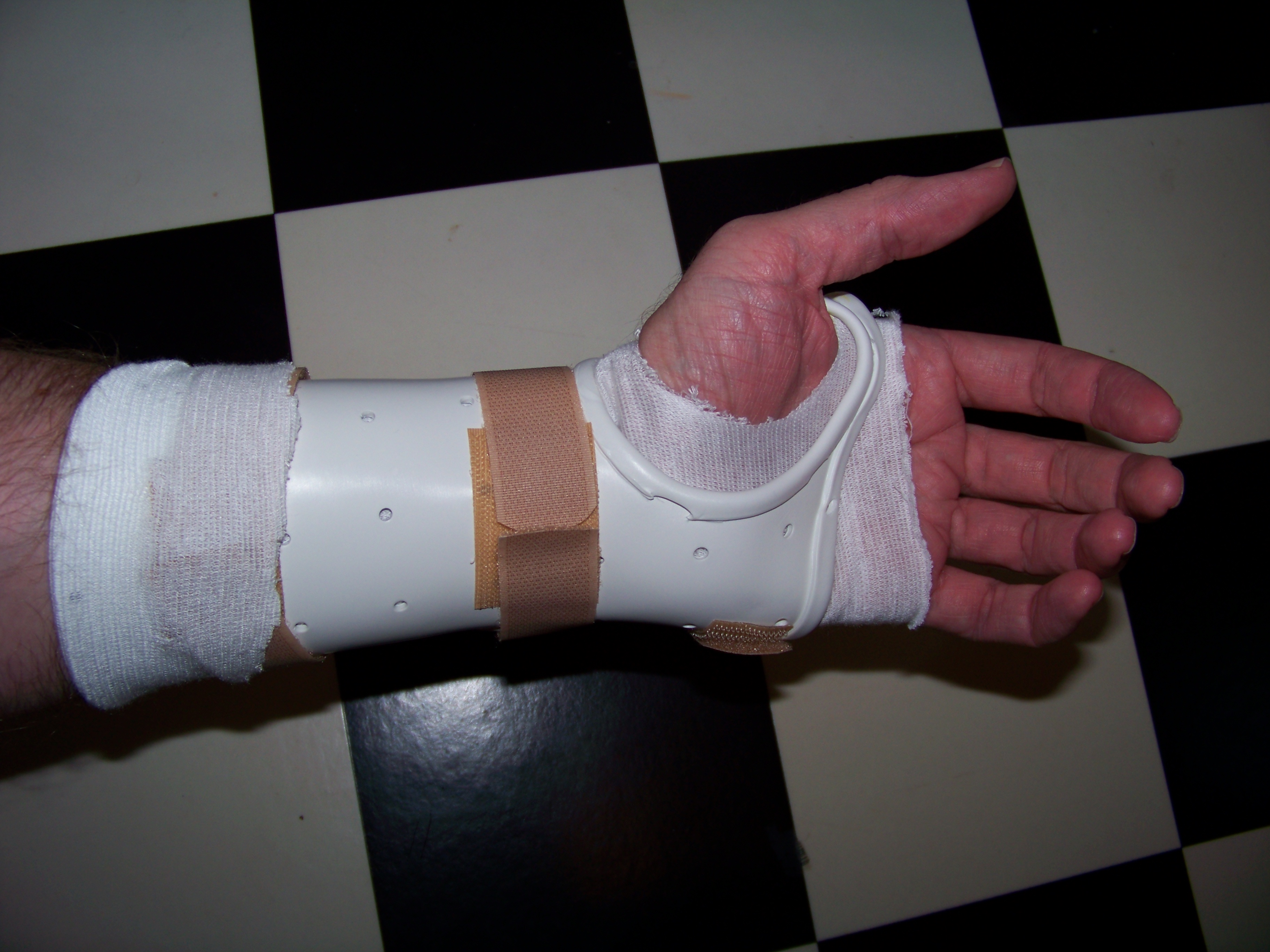
Wrist brace for Carpal Tunnel Syndrome Diagnosis A few weeks ago I was referred to a specialist for the treatment of Carpal Tunnel Syndrome. I first noticed the symptoms in early January, it started happening at night with a partial numbness in the fingers of my left hand. I didn t think much of it at first as it s the expected symptom of sleeping in a position that reduces the blood flow. But when it kept happening with my left hand and never happening with my right and then started getting worse (including happening during the day) I sought medical advice. The doctor asked me to bend my hand down (as if trying to touch my left elbow with the fingers of my left hand). Within about 10 seconds this caused numbness this result from bending one s wrist is a major symptom of CTS. Treatment On Thursday I saw a specialist about this, she agreed with the GP s diagnosis and made a wrist brace for me. She started by cutting off a length of a tube of elastic woven material (similar to a sock) and then cutting a thumb hole, that became the lining. Then to make the hard part she put a sheet of plastic in an electric saucepan (which had water simmering) until it started to melt and then used a spatula to fish it out. The melting temperature of the plastic wasn t that high (it was soft at about 50C when she put it on my arm), it wasn t at all sticky when it was partially melted, and it didn t seem to conduct heat well. After wearing the wrist brace non-stop for a few days I have noticed an improvement already. Hopefully I will make a full recovery in a matter of a month or so, I will probably have to wear a wrist brace when sleeping for the rest of my life, but that s no big deal it s more comfortable to sleep with a wrist brace than a partially numb hand. I ve also been prescribed a set of exercises to help remove scar tissue from the nerves. I haven t done them much yet. In terms of being annoying, the wrist-brace has 3mm diameter holes in a square grid pattern with a 25mm spacing. This doesn t let much air through and in warm weather my arm gets sweaty and starts to itch. I m thinking of drilling some extra holes to alleviate this the part which makes my arm itch doesn t need much mechanical strength. The only task which has been really impeded has been making peanut butter sandwiches, maybe it was making sandwiches not typing that caused CTS? ;) In any case I m not giving up typing but I would consider giving up peanut butter sandwiches. I really hope to avoid the surgical option, it doesn t seem pleasant at all. Other One final thing to note is that Repetitive Strain Injury (RSI) is entirely different. RSI is a non-specific pain associated with repetitive tasks while CTS is a specific problem in one or two nerves where they go through the wrist. RSI apparently tends to reduce the effective strength of the afflicted limb, while milder cases of CTS (such as mine) cause no decrease in strength of course a severe case of CTS results in muscle atrophy due to reduced nerve signals, but I shouldn t ever get that. Many people think that RSI and CTS are essentially the same thing I used to think that until a few weeks ago when I read the Wikipedia pages in preparation to seeing a doctor about it. I want to obtain some of the plastic that was used to make my wrist brace, it could be really handy to have something that convenient for making boxes, containers, and supports for various things among other things it doesn t appear to generate static. The low melting temperature will prevent certain computer uses (the hot air that comes out of a cooling system for a high-end CPU would probably melt it), but it could probably be used to make the case for an Opteron system with careful design. I m guessing that the cost of the plastic is a very small portion of the $150 I paid to the specialist so it shouldn t be that expensive and I m sure it would be even cheaper if it wasn t bought from a medical supply store. If I ever get time to do some work on an Arduino system or something similar then I will definitely try to get some of this plastic for the case. Also the Wikipedia page has a picture of what appears to be a mass-produced wrist brace. I think that it might be improved by having the picture of the custom one that I wear added to the page. I unconditionally license the picture for free use by Wikipedia and others under the CC by attribution license. So if anyone thinks that a picture of my hand would improve Wikipedia then they can make the change.

Russ Allbery: Review: Coders at Work

Review: Coders at Work, by Peter Seibel
Publisher: Apress
Copyright: 2009
ISBN: 1-4302-1948-3
Format: Trade paperback
Pages: 601
Coders at Work is a collection of edited interviews by Peter Seibel (probably best known previously for his book Practical Common Lisp) of an eclectic and excellent collection of fifteen programmers. It opens with an interview with Jamie Zawinski (one of the original Netscape developers) and closes with Donald Knuth. In between, the interview subjects range in programmer generations from Fran Allen (who started at IBM in 1957) and Bernie Cosell (one of the original ARPANET developers) to Brad Fitzpatrick (LiveJournal founder and original developer). Techniques and preferences also range widely, including two people involved in JavaScript development and standardization (Brendan Eich and Douglas Crockford), a functional programming language designer and developer (Simon Peyton Jones), language designers and standardizers such as Guy Steele, and people like Dan Ingalls who have a different experimental approach to programming than the normal application development focus. All of the interviewees are asked roughly the same basic questions, but each discussion goes in different directions. Seibel does an excellent job letting the interview subjects shape the discussion. Two things immediately stood out for me about this book. First, it's huge, and that's not padding. There are just over 600 pages of content here, much of it fascinating. The discussions Seibel has are broad-ranging, covering topics from the best way to learn programming to history and anecdotes of the field. There's some discussion of technique, but primarily at the level of basic approaches and mindset. One typical question is how each programmer organizes their approach to reading code that isn't familiar with them. Each interviewee is also asked for book recommendations, for their debugging techniques, for their opinions on proving code correct, and how they design code. The participants are so different in their backgrounds and approaches that these conversations go in fifteen different directions. This is one of the most compelling and engrossing non-fiction books I've read. Second, the selection of interview subjects, while full of well-known names in the field, is not the usual suspects. While I'm interested in the opinions of people like Larry Wall and Guido van Rossum, I've already heard quite a lot about how they think about programming. That's material that Coders at Work doesn't need to cover, and it doesn't. Many of the interview subjects here are people I'd heard of only vaguely or not at all prior to this book, often because they work in an area of programming that I'm not yet personally familiar with. Those who I had heard of, such as L. Peter Deutsch, I often knew in only one context (Ghostscript in that case) and was unfamiliar with the rest of their work. This gives the book a great exploratory feel and a lot of originality. There is so much good material here that it's hard to give a capsule review. This is a book I'm highly likely to re-read, taking more detailed notes. There's entertaining snarking from Jamie Zawinski and Brendan Eich, fascinating history of the field (including in gender balance) from Fran Allen, and an intriguing interview with Joe Armstrong (creator of Erlang), who seems to have a far different attitude towards languages and libraries than the other interviewees. Every interview is full of gems, bits of insight that I now want to research or play with. A couple of examples come to mind, just to provide a feel of the sort of insights I took out of the book. In the interview with Joshua Bloch, who does a lot of work on library APIs, he mentions that empathy is one of the most important skills for designing an API. You have to be able to put yourself in the shoes of the programmer who's going to use the API and understand how it will feel to them. This came up in the context of a discussion about different types of programmers, and how programmers can be good at different things; the one who can do low-level deep optimization may not have that sense of empathy. Another example: Bernie Cosell talked about how he did debugging, and how he got a reputation for being a fantastic debugger who was able to fix just about anything. He confessed that he often reached a portion of the code that he didn't understand, that seemed too complex and tricky for what it was attempting to accomplish, and rather than trace through it and try to understand it, he just rewrote it. And after rewriting, the bug was often gone. It wasn't really debugging, but at the same time it's close to the more recent concept of refactoring. Several of the interview subjects commented on a subjective feeling of complexity and how when it gets too high that's a warning sign that code may need to be rethought and rewritten. A third example: I was fascinated by the number of interviewees who said that they used printf, assert, and eyeballs to debug rather than using any more advanced debugging tools. The former Lisp developers would often bemoan the primitiveness of tools like gdb, but many of them found that print statements and thinking hard about the code were usually all that's needed. (There was also a lot of discussion about test suites and test-driven development.) The general consensus was that concurrency problems were the hardest to debug; they made up a disproportional number of the responses to Seibel's question about the hardest bug the programmer ever had to track down. I could go on giving similar examples at great length, but apart from the specific bits of wisdom, the strongest impact this book made on me was emotional. Coders at Work is full of people who love programming and love software, and that enthusiasm, both in general and for specific tools and ideas, comes through very clearly. I found it inspiring. I realized while reading this book, and I suspect I'm not alone among programmers in this, that I largely stopped learning how to program a few years back and have been reusing skills that I already have. Reading Coders at Work gave me a strong push towards finding ways to start learning, experimenting, and trying new techniques again. It also filled me with enthusiasm for the process of programming, which immediately helped my productivity on my own coding projects. This is obviously a book whose primary target audience is practicing programmers, and while it doesn't go too far into language theory, I was relying on remembered terms and structure from my master's degree for a few of the interviews. I think it's approachable for anyone who has a working background in programming and a few languages or a CS degree, but it might be a stretch for someone new to the field. But even someone without any programming knowledge at all would get a lot out of the anecdotes and snapshots of the history of software development. Coders at Work is also full of jumping-off points for some additional research on Google or additional reading in other recommended books. I only have one complaint, which I have to mention in passing: for such a large book full of interesting ideas and book recommendations, the index is wholly inadequate. I tried looking up five or six things in it, including the source of some of the book recommendations that are collected in an appendix, and I struck out every time. It's very hard to find something again in 600 pages, and more attention paid to the index would have been greatly appreciated. But, despite that, for people within the target audience, I cannot recommend this book too highly. Not only was it full of useful information, at the level of programming above the code details that's often the hardest to talk about, but it's consistently entertaining and emotionally invigorating and inspiring. It made the rounds of tech blogs when it was first released, to nearly universal approval, and I can only echo that. If you're a practicing programmer, I don't think you'll regret spending a few weeks reading and thinking about this book. Rating: 10 out of 10

Russell Coker: I have a Chocolate Fridge

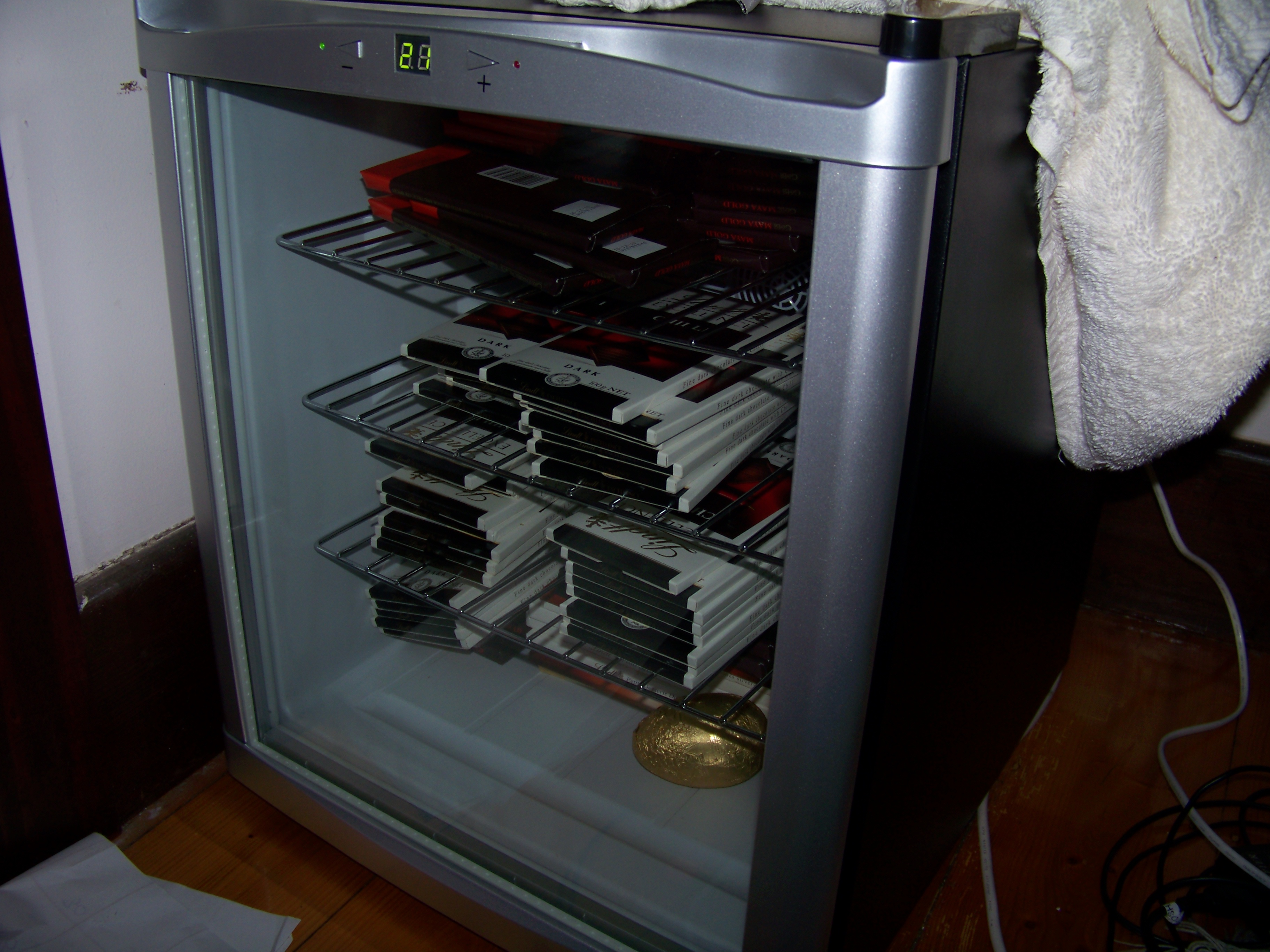
A small fridge full of chocolate
The German supermarket chain Aldi recently had a special deal of a wine-fridge for $99. A wine fridge really isn t that specialised for wine, it is merely a fridge that has a heater and is designed for temperatures in the 11C to 18C range. An good wine fridge will have special wood (or plastic if cheap) holders for wine bottles. A particularly cheap wine fridge (such as the one from Aldi) doesn t even have special holders for wine bottles. But this does however make it more convenient for storing other things. In the hotter days in summer outside temperatures of over 35C are common and it s possible for an uncommonly hot day to be in excess of 45C. My home air-conditioning system is only able to keep the ambient temperature about 10C cooler than the outside temperature if there are a few hot days in a row. According to the Wikipedia page the best chocolate is supposed to have type V crystals which melt at 34C [1]. So if the outside temperature is 45C then the temperature inside my home is almost guaranteed to be hot enough to melt chocolate. If I m not at home (and therefore the air-conditioner is off) during a moderately hot day then it s common to have a temperature of about 30C inside my house. The Wikipedia page also notes that moving chocolate between extremes of temperature can cause an oily texture and that storing chocolate in the fridge can cause a white discoloration. I ve experienced these effects and find that they significantly decrease the enjoyment of chocolate. So now I have a fridge in my computer room set to 16C because according to Wikipedia the ideal temperature range for storing chocolate is from 15C to 17C (the photo was taken shortly after turning it on and it hadn t reached the correct temperature). Every computer room should have a fridge full of chocolate! If my stockpile of chocolate reduces I may even put some wine in the fridge (I could probably fit some now if I organised the chocolate in a better way). But that depends on the supermarkets, if they have a special on Green and Black s Maya Gold organic fair-trade chocolate then my fridge will become full again.

27 February 2010

Jos Parrella: DC11 on BIH!

DebConf 11 will be held in Banja Luka, Bosnia and Herzegovina. Munich, Germany arrived on a close second and our bid, Quito, Ecuador, arrived last, allegedly because some points flipped over since DC 11 was meant to happen in Europe. So, after having three DebConfs hosted in America in the last four years, DebConf 11 will travel to Europe in 2011! Good news for all our fellow DDs and contributors over there. The Banja Luka team managed to get an important support from their Government. They even met with the Prime Minister and got him to sign an offer of full support. I think this becomes dangerous for a DebConf, given that I ve worked and have had mishaps while funding conferences with at least three governments (Ecuador, Venezuela and Brazil) with stronger levels of support (Law-like level) for free software and I know that at least other two governments in the World have unfortunately done this in the past. So we need backup plans and lots of follow-up activities with the stakeholders. However, this agreement sets an important milestone in government support for free and open source software as well as Debian. I ll use it in my Debian slides, and congratulations! IMO, Munich would have made a great host for DC11 in terms of air travel connectivity, at a bigger hit on local costs, but nothing that would differ that much from DC7, though! I don t think I ll be able to make it at this moment to Bosnia (struggling for NYC) and at this point it s premature to think on supporting Quito s again for DC12. People and sponsors get gradually tired, even with spiritual commitment. The DC10 decision meeting was long and lots of things needed to be improved. At that moment I thought the Project learnt useful lessons for future meetings, but we re repeating ourselves now on the DC11 decision meeting. And now, I m just hoping for the best, for the sake of the time and sanity of all us here. Ditch the priority list altogether, increase the stakeholders on the global team, filter bids early in the process and use more technology to improve the information flow before the decision!

Michael Banck: 27 Feb 2010

Debconf11 This evening, the final decision on which city will host Debconf11 next year will be taken. For the last half year, mostly Andreas Barth, Jan-Marek Glogowski and I have been working hard to make the Munich bid as good as possible. One thing we wanted to make clear from the beginning was that we would go for a conference in the city center - not some conference center in some nearby village or in an industrial area far away from where the city life happens. It was not easy, since the german-wide decision, we had to reshuffle venue plans a couple of times. In the end, thanks to Jan-Marek, we managed to get an excellent venue offer. Our bid consits mostly of: The biggest strong points about Munich are, in my opintion: It the end, it seems Banja Luka seems to have the stronger bid, especially due to their 150000 EUR governemnt sponsorship. We will see who wins, I believe we did the best we could.

Biella Coleman: Lazy Web: South Park Scientology Video

update: success, I got a copy. This means by talk will be that much better. Thank you all! So I am giving for the upteeenth time (but I am going to retire it!) my talk on Anonymous and Scientology next week and I have decided that I want to show a clip from the South Park episode on the topic - Trapped in the Closet Season 9, Episode 12 (Original Air Date: 11/16/2005). I made the mistake of buying it on Amazon cuz it is super DRM-FSKCING-ED and I can t play it on Linux and I don t know how to crack it. Anyway I also want to cut it to the relevant part, which is the wonderful history of Scientology. Does anyone have a copy free of DRM? Or point me to where I can find one? This is within the purview of fair use, given that I am a serious academic giving serious attention to this topic :-). Any help or pointers appreciated!

26 February 2010

Frans Pop: Fun with VMware

Until two years or so ago I used VMware Workstation intensively for development and testing of Debian Installer, using one of the licenses generously made available to the D-I team by VMware. It was much faster than Qemu and thus very welcome. But due to increasing problems keeping it working with new kernels on a desktop system running unstable, I switched to VirtualBox (the OSE version), which has the huge advantage of being packaged for Debian and thus automatically follows the Debian kernel packages. That advantage has disappeared somewhat as I'm currently compiling my own kernels I'm currently running 2.6.33 on a Lenny desktop. So far I've been able without too much trouble to find patches for the VirtualBox modules to keep them compatible with new upstream kernels. This week I had reason to try VMware again. The Server edition this time as that has free licenses. The Server concept, where you connect to the management system and virtual machines via a web browser, is quite nice. It means I could install it on a server and keep my laptop nice and responsive. To keep VMware separate from the rest of the system and not mix it with software installed cleanly from Debian packages, I decided to install it in /opt. And that works beautifully. There are only a few bits installed in /etc, but that's OK. I have /etc managed by etckeeper anyway [1]. More challenging was building WMware modules to match my kernel. VMware wants you to run their vmware-config.pl script every time you switch kernels and build the kernel modules on the system where it runs (which requires the kernel headers). I wanted to build the modules as part of my kernel build process, on a totally different machine. The same as I already do for VirtualBox. I save the custom modules in a tarball that has the same uname and package version as the kernel package I build and have a simple script that installs them correctly. I succeeded by hacking the Makefiles (deleting most of their content) and then integrating them in my kernel build wrapper script. The module source provided by VMware built fine with a Debian 2.6.26 kernel, but not with the 2.6.32.9 kernel on my server (of course). But luckily others had already run into the same problems and solved them, so with some searching I found the required patches (first a full updated source for 2.6.29, then patches needed for .31 and for .32). Isn't open source just wonderful? So with that the VMware server started beautifully (well, the init script needed to be told that module names have changed from *.o to *.ko), but I could not connect to it from my laptop using SSL. Connecting without SSL (using an instance of iceweasel running on the server but started remotely from my laptop using X forwarding SSH) worked fine. That turned out to be a known issue too. After applying all the suggested workarounds in my iceweasel configuration (disable TLS 1.0; set cache size to zero; explicitly disable use of proxy for the server) I can now connect reliably to the VMware Server management system. Phew. [1] I had to exclude a fair number of VMware files for etckeeper as they are updated by VMware itself and thus really belong in /var. Example are DCHP status files...

Martin F. Krafft: ACTA leak: no surprises about transparency blockers

The most common criticism of the Anti-Counterfeiting Trade Agreement (ACTA) is the lack of transparency. Before the nations disclose the terms of the agreement under negotiation, we are unable to gain an idea of the big picture, let alone voice our opinions and push for changes. Our politicians don t want us to know. We rely on leaked documents for our information. This is backwards in a world where a state should represent its people. This smells foul to me. There are undoubtedly some good reasons for the treaty, and if we can contain worldwide, large-scale trade of counterfeited goods and medicine, then that would be a net benefit to us all. However, we must not allow certain governments to succomb to the pressure of (commercially-motivated) lobbyists, to extend that pressure onto other nations using trade as a means of pressure, and to slash our freedom as if it were an inconvenient obstacle in their way. Only if the terms under negotiation become publicly available, and the public is given a voice, then we can help our governments in entering an agreement that is in the interest of its people, rather than a threat to us. It is hardly surprising that total capitalist nation USA are the strongest opponents of transparency, because the public might delay or even prevent the treaty. I was also not surprised to see South Korea and Germany in the list of supporters of secrecy either. It is interesting to see that the leaders of Singapore, Belgium, Portugal, and Denmark also seem to believe that these negotiations should be withheld from the public. Does anyone know about Switzerland? I tip my hat to New Zealand, Canada, Australia, Netherlands, Sweden, Finland, Ireland, Hungary, Poland, Estonia, and Austria for their support of transparency.

Andrew McMillan: DAViCal 0.9.8.3 - A return to stability

After a whole bunch of drastic changes, lots of bugfixes, rewriting and refactoring, I released DAViCal 0.9.8 on Christmas day last year. I didn't release it very publicly, because I knew it sucked significantly. In an increasingly fast turnaround I've subsequently released 0.9.8.1 to a somewhat wider audience while I was at the recent Calendaring and Scheduling Consortium meeting in Costa Mesa at the beginning of the month. Earlier this week I released 0.9.8.2 to the more interested of the DAViCal userbase. So finally, yesterday, I released DAViCal 0.9.8.3 to fix the few significant problems that were left with that, and this is the release that I'm telling everyone about, because I believe it should be a good stable platform to people who want to upgrade their production DAViCal servers, or who have been hanging back from using DAViCal until the platform was a little more stable.
<!--break-->
This release marks some significant departures from previous DAViCal. I've decided to walk away from some of the more ancient legacy software I tried to work with in the past (PHP4 & PostgreSQL 7.x), to move to support the most ancient-but-not-superseded legacy Linux release I know of, which is CentOS / RHEL, so DAViCal now has a minimum requirement of PHP 5.1 & PostgreSQL 8.1. The biggest changes to DAViCal are under the covers. It is server software, after all, so the largest changes often are not visible on the surface. What has changed is that the architecture for constructing responses as been refactored into a core object which is used to access any DAV resource in the system. This greatly simplifies the general coding and reduces a fair bit of code duplication which had been happening. Another long overdue change is to get rid of the old arcane & obtuse permissions model, replacing it with something which will be radically faster in installations with more than a few hundred users, as well as being more consistent, easier for people to control, and directly in alignment with the DAV ACL specification. Some of the work here was assisted by NZ Registry Services who gave me a Macbook to help with my compatibility testing. Not all of the changes are under the covers though. The new DAViCal also has a thoroughly revised administrative interface, and over the last couple of releases I've gone through the system trying to uncover all the places which were not properly localisable, too, so if you see DAViCal displaying strings in a language you didn't configure it for, it should be a fixable thing. I'd like to particularly thank Masahiro Mikami for turning around some Japanese translations very quickly which enabled me to quickly and visually see what was not properly translatable. There's still more work to do (there's always more work to do) but a fully translated DAViCal should, I hope, be quite usable by non-English speakers now. The new DAViCal also supports some rather significant extra functionality beyond the CalDAV standard, in particular we can thank Rob 'Cave' Ostensen for providing an implementation of pub/sub event change notifications. This version also supports draft 2 of the proposed WebDAV synchronisation standard - that's still under development, but we expect to track pretty close to released versions of that. Of course with all of this work there are some areas that didn't get changed. I didn't manage to finish an implementation of the scheduling extensions draft, much as I would have liked, but that is going to become very much a focus in the coming couple of months, and I'll be calling it "1.0" when things settle down after we get that done. Other things I will be working on include a ticketing system for providing targeted, controlled access to a specific collection or event, and making a start on CardDAV support for addressbook storage. DAViCal seems to be fitting a need for people, and I know there are several thousand installations around the world, even if I'm not sure where they all are. I know some people are running DAViCal on their 8-way server, where I've no doubt it gurgles along pretty happily, and that there are some people running it on their OpenWRT installation, with some tiny amount of resources - just enough for a family calendar. Traffic on the wiki has increased to several hundred thousand hits per month, perhaps three times what it was a year ago, and I hope that I can continue to provide a valuable and useful piece of infrastructure for that little calendaring corner of your organisation. What heartens me the most in this ongoing experience is the nascent community that appears to be forming around my software, with people writing 'tip sheets' and helping to answer questions on the IRC channel and mailing list. These small contributions made by many people - people whom I have never met, for the most part - are enabling me to put more time into feature development and expansion, and that's what I really love.

Dirk Eddelbuettel: R and Sudoku solvers: Plus ca change...

Christian Robert blogged about a particularly heavy-handed solution to last Sunday's Sudoku puzzle in Le Monde. That had my symapthy as I like evolutionary computing methods, and his chart is rather pretty. From there, this spread on to the REvolutions blogs where David Smith riffed on it, and showed the acual puzzle. That didn't stop things as Christian blogged once more about it, this time welcoming his post-doc Robin Ryder who posts a heavy analysis on all this that is a little much for me at this time of day. But what everybody seems to be forgetting is that R has had a Sudoku solver for years, thanks to the sudoku package by David Brahm and Greg Snow which was first posted four years ago. What comes around, goes around. With that, and about one minute of Emacs editing to get the Le Monde puzzle into the required ascii-art form, all we need to do is this:
R> library(sudoku)
R> s <- readSudoku("/tmp/sudoku.txt")
R> s
      [,1] [,2] [,3] [,4] [,5] [,6] [,7] [,8] [,9]
 [1,]    8    0    0    0    0    1    2    0    0
 [2,]    0    7    5    0    0    0    0    0    0
 [3,]    0    0    0    0    5    0    0    6    4
 [4,]    0    0    7    0    0    0    0    0    6
 [5,]    9    0    0    7    0    0    0    0    0
 [6,]    5    2    0    0    0    9    0    4    7
 [7,]    2    3    1    0    0    0    0    0    0
 [8,]    0    0    6    0    2    0    1    0    9
 [9,]    0    0    0    0    0    0    0    0    0
R> system.time(solveSudoku(s))
      [,1] [,2] [,3] [,4] [,5] [,6] [,7] [,8] [,9]
 [1,]    8    4    9    6    7    1    2    5    3
 [2,]    6    7    5    2    4    3    9    1    8
 [3,]    3    1    2    9    5    8    7    6    4
 [4,]    1    8    7    4    3    2    5    9    6
 [5,]    9    6    4    7    8    5    3    2    1
 [6,]    5    2    3    1    6    9    8    4    7
 [7,]    2    3    1    8    9    4    6    7    5
 [8,]    4    5    6    3    2    7    1    8    9
 [9,]    7    9    8    5    1    6    4    3    2
   user  system elapsed
  5.288   0.004   5.951
R>
That took all of five seconds while my computer was also compiling a particularly resource-hungry C++ package.... Just in case we needed another illustration that it is hard to navigate the riches and wonders that is CRAN...

Eddy Petri&#537;or: How to: git push via ssh; alternative users on the same host

Let's assume you're part of a project X that uses git for version control on a server host.it. Due to historical reasons your login on machine host.it is 'eddyp'. You're also part of another project Y which is hosted on server host.me. In this project you have always used 'eddy' as your ssh login for the git push.

Now, project Y decides to change hosting and moves the repo on server host.it. Since the logins were also migrated, now you have login 'eddyp' for project X and login 'eddy' for project B.

You changed the URI in remote.origin.url, but you are faced with this error when pushing from project Y to server host.it:

Counting objects: 7, done.
Compressing objects: 100% (4/4), done.
Writing objects: 100% (4/4), 476 bytes, done.
Total 4 (delta 2), reused 0 (delta 0)
error: unable to create temporary sha1 filename ./objects/56: Permission denied

fatal: failed to write object
error: unpack failed: unpacker exited with error code


The problem is that you are probably trying to login with 'eddyp' on server host.it from project Y since you ~/.ssh/config contains a 'user eddyp' clause for host host.it.


You can avoid this problem and identify to server host.it with different logins depending on the project via a small nice trick using fake hostnames in ~/.ssh/config:


Host eddyp.host.com
User eddyp
Hostname host.it

Host eddy.host.com
User eddy
Hostname host.it


And setting the remote.origin.url setting accordingly in the repo for project Y and project X:


eddy@projx $ git config remote.origin.url ssh://eddyp.host.it/srv/git/projx.git

eddy@projy $ git config remote.origin.url ssh://eddy.host.it/srv/git/projy.git

25 February 2010

Kees Cook: fun with process scheduling

In an attempt to force an exec to totally stall so I could attach gdb to a process that does a setuid transition without freaking it out (i.e. can t launch sudo gdb ), I briefly played with process priority, scheduling, and CPU affinity (pinning a process to a CPU). So far, the best attempt at stalling the process was to set CPU affinity, set its scheduling policy (IDLE), drop the priority value fully (19), and then run a CPU hog with the same CPU affinity with a very high priority (-20). Staller: sudo schedtool -a 0 -N -n -20 -e /tmp/spin-cpu

Stallee: schedtool -a 0 -D -n 19 -e /usr/bin/sudo -s The hope was to then run sudo gdb /usr/bin/sudo $(pidof sudo) , but it seems that this still isn t enough to make the exec of sudo totally stall while the spin-cpu process is running it certainly executes more slowly, but I want it to stop. I have this feeling like I m missing something obvious about how to accomplish this gdb session sanely. I wonder if I can get gdb to switch targets across a child exec, i.e. run gdb as root on a program that fully drops privs, but then execs sudo. Guess it s time to go read the gdb manual some more

Uwe Hermann: How to setup an encrypted USB-disk software-RAID-1 on Debian GNU/Linux using mdadm and cryptsetup

This is what I set up for backups recently using a cheap USB-enclosure which can house 2 SATA disks and shows them as 2 USB mass-storage devices to my system (using only one USB cable). Without any further introduction, here goes the HOWTO: First, create one big partition on each of the two disks (/dev/sdc and /dev/sdd in my case) of the exact same size. The cfdisk details are omitted here.
  $ cfdisk /dev/sdc
  $ cfdisk /dev/sdd
Then, create a new RAID array using the mdadm utility:
  $ mdadm --create /dev/md0 --level=1 --raid-devices=2 /dev/sdc1 /dev/sdd1
The array is named md0, consists of the two devices (--raid-devices=2) /dev/sdc1 and /dev/sdd1, and it's a RAID-1 array, i.e. data is simply mirrored on both disks so if one of them fails you don't lose data (--level=1). After this has been done the array will be synchronized so that both disks contain the same data (this process will take a long time). You can watch the current status via:
  $ cat /proc/mdstat
  Personalities : [raid1]
  md0 : active raid1 sdd1[1] sdc1[0]
        1465135869 blocks super 1.1 [2/2] [UU]
        [>....................]  resync =  0.0% (70016/1465135869) finish=2440.6min speed=10002K/sec
  unused devices: 
Some more info is also available from mdadm:
  $ mdadm --detail --scan
  ARRAY /dev/md0 metadata=1.01 name=foobar:0 UUID=1234578:1234578:1234578:1234578
  $ mdadm --detail /dev/md0
  /dev/md0:
          Version : 1.01
    Creation Time : Sat Feb  6 23:58:51 2010
       Raid Level : raid1
       Array Size : 1465135869 (1397.26 GiB 1500.30 GB)
    Used Dev Size : 1465135869 (1397.26 GiB 1500.30 GB)
     Raid Devices : 2
    Total Devices : 2
      Persistence : Superblock is persistent
      Update Time : Sun Feb  7 00:03:21 2010
            State : active, resyncing
   Active Devices : 2
  Working Devices : 2
   Failed Devices : 0
    Spare Devices : 0
   Rebuild Status : 0% complete
             Name : foobar:0  (local to host foobar)
             UUID : 1234578:1234578:1234578:1234578
           Events : 1
      Number   Major   Minor   RaidDevice State
         0       8       33        0      active sync   /dev/sdc1
         1       8       49        1      active sync   /dev/sdd1
Next, you'll want to create a big partition on the RAID device (cfdisk details omitted)...
  $ cfdisk /dev/md0
...and then encrypt all the (future) data on the device using dm-crypt+LUKS and cryptsetup:
  $ cryptsetup --verbose --verify-passphrase luksFormat /dev/md0p1
  Enter your desired pasphrase here (twice)
  $ cryptsetup luksOpen /dev/md0p1 myraid
After opening the encrypted container with cryptsetup luksOpen you can create a filesystem on it (ext3 in my case):
  $ mkfs.ext3 -j -m 0 /dev/mapper/myraid
That's about it. In future you can access the RAID data by using the steps below. Starting the RAID and mouting the drive:
  $ mdadm --assemble /dev/md0 /dev/sdc1 /dev/sdd1
  $ cryptsetup luksOpen /dev/md0p1 myraid
  $ mount -t ext3 /dev/mapper/myraid /mnt
Shutting down the RAID:
  $ umount /mnt
  $ cryptsetup luksClose myraid
  $ mdadm --stop /dev/md0
That's all. Performance is shitty due to all the data being shoved out over one USB cable (and USB itself being too slow for these amounts of data), but I don't care too much about that as this setup is meant for backups, not performance-critical stuff.

Ian Wienand: Building a quiet, cool media/house server

After getting sick of having to underclock my existing home server to get it to remain up for any period of time, along with the horrendous noise, I finally found the time and budget to rebuild. My goals were: In the end I went with The case is really awesome. Very easy to access, and the fan is extremley quiet. It very cleverly holds 3 full-size hard-disks; two mounted vertically on either side, and one horizontally in the middle. The final space is for a DVD -- after that it's pretty cramped inside! It makes claims it is a very efficient power supply. It has a very bright blue LED on the front, and the face-plate over the DVD looks nice but the button doesn't quite reach the eject button on my drive, so it's software eject only. All over, definitely recommend. The motherboard is fairly good. One annoying thing is that it only has 3 SATA ports -- I think it's reasonable to want to have a primary drive, two mirrored large disks plus a DVD for a nice little media server. It also has no parallel-IDE, which is reasonable these days. However, if you wanted to install a wireless card you'd be out of luck if you also wanted to put in another SATA card, as it only has one PCI slot. There are plenty of USB ports for a USB wireless card, however. It also comes with two SATA cables, which isn't mentioned anywhere I could see (hopefully this saves you a trip back to Fry's to return your extra cables :). The CPU fan is a little on the loud side, as mentioned in some other forums. It is also located right where the power supply cables come down in this case, making for a fairly tight fit. Here's a lspci for those interested in such things
00:00.0 Host bridge: nVidia Corporation MCP79 Host Bridge (rev b1)
00:00.1 RAM memory: nVidia Corporation MCP79 Memory Controller (rev b1)
00:03.0 ISA bridge: nVidia Corporation MCP79 LPC Bridge (rev b2)
00:03.1 RAM memory: nVidia Corporation MCP79 Memory Controller (rev b1)
00:03.2 SMBus: nVidia Corporation MCP79 SMBus (rev b1)
00:03.3 RAM memory: nVidia Corporation MCP79 Memory Controller (rev b1)
00:03.5 Co-processor: nVidia Corporation MCP79 Co-processor (rev b1)
00:04.0 USB Controller: nVidia Corporation MCP79 OHCI USB 1.1 Controller (rev b1)
00:04.1 USB Controller: nVidia Corporation MCP79 EHCI USB 2.0 Controller (rev b1)
00:06.0 USB Controller: nVidia Corporation MCP79 OHCI USB 1.1 Controller (rev b1)
00:06.1 USB Controller: nVidia Corporation MCP79 EHCI USB 2.0 Controller (rev b1)
00:08.0 Audio device: nVidia Corporation MCP79 High Definition Audio (rev b1)
00:09.0 PCI bridge: nVidia Corporation MCP79 PCI Bridge (rev b1)
00:0b.0 IDE interface: nVidia Corporation MCP79 SATA Controller (rev b1)
00:10.0 PCI bridge: nVidia Corporation MCP79 PCI Express Bridge (rev b1)
00:15.0 PCI bridge: nVidia Corporation MCP79 PCI Express Bridge (rev b1)
01:05.0 RAID bus controller: Silicon Image, Inc. PCI0680 Ultra ATA-133 Host Controller (rev 02)
02:00.0 VGA compatible controller: nVidia Corporation ION VGA (rev b1)
03:00.0 Ethernet controller: Realtek Semiconductor Co., Ltd. RTL8111/8168B PCI Express Gigabit Ethernet controller (rev 03)
I know there are issues with the controller of the Patriot SSD, which would probably worry me for a general purpose machine. However for the primary disk of a server machine I'm not too fussed. The silence is golden and cool-running and low power consumption really helps too. I wouldn't really say it seems that blazing fast. It comes with a handy mount so it fits in a full-size hard-disk slot. Hard to beat for the price. One concession I made to avoid excessive writes was mounting /tmp on tmpfs; this is where it's nice to have 4GB of RAM. Handbrake seems to do a lot of work in /tmp for example. The two green hard-disks (software mirrored) are also inaudible. I'm hoping different brands should at least not fail at the same time. I'm not sure if they're auto-spinning down, but you can't really tell if they're on or not, even under load. Even when running flat-out re-encoding a DVD in the enclosed cabinet with minimal airflow the CPU temperature hasn't gone above 60C; normal CPU temp is around 40C. Performance is adequate -- running PlayOn in a VMware workstation XP VM almost works. It's kind of hard to take photos inside a case, but here's an attempt: <object height="300" width="400"> <param name="flashvars" value="offsite=true&amp;lang=en-us&amp;page_show_url=%2Fphotos%2Fiwienand%2Fsets%2F72157623509152266%2Fshow%2F&amp;page_show_back_url=%2Fphotos%2Fiwienand%2Fsets%2F72157623509152266%2F&amp;set_id=72157623509152266&amp;jump_to="> <param name="movie" value="http://www.flickr.com/apps/slideshow/show.swf?v=71649"> <param name="allowFullScreen" value="true"><embed allowfullscreen="true" flashvars="offsite=true&amp;lang=en-us&amp;page_show_url=%2Fphotos%2Fiwienand%2Fsets%2F72157623509152266%2Fshow%2F&amp;page_show_back_url=%2Fphotos%2Fiwienand%2Fsets%2F72157623509152266%2F&amp;set_id=72157623509152266&amp;jump_to=" height="300" src="http://www.flickr.com/apps/slideshow/show.swf?v=71649" type="application/x-shockwave-flash" width="400"></embed></object> Debian unstable installed without issues (except for some weird bug with the boot hanging for 60 seconds due to the RTL driver). It is also very strange installing from USB to an SSD no noise!

23 February 2010

Tiago Bortoletto Vaz: Creative retaliation


Canada responds to historic Olympic hockey game loss to US: (source)

Russell Coker: Divisive Behavior

Past Sins Sam Varghese wrote an article about Matthew Garrett s LCA talk The Linux community: what is it and how to be a part of it [1]. In page 2 Sam quotes Martin Krafft as asking about how Matthew s behavior had changed between 2004 and the present, Sam cites some references for Matthew s actions in 2005 to demonstrate. I think that this raises the issue of how far back it is reasonable to go in search of evidence of past behavior, something that I think is far more important than the specific details of what Matthew said on mailing lists many years ago and whether he now regrets such email. If someone did something that you consider to be wrong yesterday and did the same thing five years ago you might consider it to be evidence of a pattern of behavior. If someone s statements today don t match their actions yesterday then you should consider it to be evidence of hypocrisy. But if someone did something five years ago which doesn t match their current statements then in many situations it seems more reasonable to consider it as evidence that they have changed their mind. Then of course there is the significance of what was done. Flaming some people excessively on some mailing lists is something that can be easily forgiven and forgotten if Google doesn t keep bringing it up. But as a counter-example I don t think that Hans Reiser will be welcome in any part of the Linux community when he gets out of jail. For the development of the Linux community (and society in general) I think it s best to not tie people to their past minor mistakes. While it is nice when someone apologises for their past actions, the practical benefits of someone just quietly improving their behavior are almost identical. A particular corner case in this regard is the actions of young people, anyone who was born after about 1980 will have had great access to electronic media for their entire life and will have left a trail. Most people do a variety of silly things when they were young, the older members of the Linux community were fortunate enough not to have electronic records remaining where Google could find them. Back to Matthew, I think that if he is to be criticised about such things then evidence that is much more recent than 2005 needs to be used. Cultural Differences Sam quotes Matthew as claiming that the Linux community was largely a Western, English-speaking one, those who participated in it necessarily had to adapt to the norms of this group . I don t believe that there is a single Linux community. There are a number of different communities that are formed around free software, which have significant amounts of overlap. I don t believe that there s any reason why a Chinese or Indian Linux mailing list should conform to the same standards as those of an American list. But there will be a trend towards meme propagation through people who are associated with the Linux communities in multiple countries every time you meet Linux people in another country you are helping to reduce the cultural differences in the Linux community. Someone from China or India who joins a LUG in Australia will have to adapt to some of the norms of Australian behavior in the same way as an Australian who migrates to China or India would have to adapt to some local norms. On page 4 of the discussion Matthew disagrees with Sam s interpretation [2], maybe Matthew s opinions on this matter are closer to mine than the way Sam describes them. Is Division Inherently Bad? I believe that the word divisive is overused. The only way to avoid division is to have everyone agree with the majority, but sometimes the minority will be right. Note that I am using the word minority to refer to any group of people who happen to disagree with the majority, among other things that includes people who vote for a political party that isn t one of the two biggest ones. An entirely separate issue is that of the treatment of minority groups , one of the most divisive events in history was the US civil war it s good that slavery is outlawed but unfortunate that a war was required to gain that result. On page 4 of the discussion Matthew says to Sam Your writing is influenced by members of the Linux community, and in turn it influences the Linux community. The tone of it is entirely relevant to the behavioural standards of the community [2]. If a community can be easily divided then the real problem probably isn t the person who triggered a particular division. Also there is the issue that even if you could get a general agreement that certain issues shouldn t be discussed in certain ways then with the wide range of cultural attitudes and ages of participants you have to expect someone to raise the issue you don t want raised. Of course it s impossible to objectively determine whether a division is productive or not, so it doesn t seem at all viable to have any expectations regarding outsiders not being divisive. Sometimes you just have to deal with the fact that the Internet contains people who disagree with you. It seems to me that the most divisive issues we face involve people who mostly agree on contentious issues. If someone entirely disagrees with you then it s easy to ignore them (if you even have a conversation with them), but if they are someone that you communicate with and they are almost right in your opinion then there s the potential for a big argument. Probably the best way to minimise division in the community is to have the first people who get involved in a dispute take a Rogerian approach [3]. Failing that a good approach is to respond by writing an essay. When an issue is made popular by services such as Twitter that give little explanation then everyone rushes to the barricades. It seems to me that the unreliability of some blogging platforms is part of the cause of the problem in this regard. I ve just given up on writing comments on Blogger, I m not going to write a good comment only to have it eaten by blogger. There are lots of blogs that have problems which discourage the population from writing anything other than a one-sentence response. The Good that can come from Disputes On page 5 of the discussion there is a comment from Anirudh the Indian student who was criticised by Sam (which ended up inspiring part of Matthew s talk and leading to more disputes) [4]. Here is the start: I am the person who wrote the ill thought-out post that drew criticism eight months ago. There has been some discussion about that, so I wish to say something.

I am very grateful to Sam Varghese. I say this with utmost sincerity. Read the rest, it s educational. I m sure that there are others who have had similar learning experiences but who don t want to write about them. I m sure that there have been many disputes which would appear to the casual observer to have resulted in no good at all, but which would actually have resulted in people learning things and amending their behavior. The issue of Age Car rental companies generally don t do business with men who are less than 25 years old. Life insurance policies don t offer reasonable rates to males between the ages of about 16 and 25. This is because the insurance companies have good statistical data on the results of the typical actions of people at various ages and know that young men tend to be at a high risk of earning a Darwin Award. The same combination of hormones and life experience that makes a young man a danger on the road will also tend to make him get involved in flame-wars on the net. If we could figure out how to influence teenagers into being less anti-social then it would be a great achievement. The current young people will become older and more sensible soon enough but will be replaced by a larger number of young people who will do the same things. As things stand I don t expect the next cohort of young people to learn from Anirudh.

Next.

Previous.