Search Results: "tim"

25 January 2013

Steve Kemp: Shame there isn't more competition for self-hosted analytics

Today I've been mostly replanting spider-plants, aloe-vera plants, and shuffling trees around inside my flat. Beyond that I've been updating my trivial dashboard skeleton, which was put together as part of this simple introduction article. (So there is a standalone redis&sinatra-using visualization server) After working on the display I was suddenly reminded that I run a cluster now. That means I have four servers each writing a local Apache logfile, and no central way of viewing all my visitor-data. There are several open source analytic packages such as piwik and openwebanalytics - but they require MySQL & PHP at the back-end. Given that node.js is "teh new shiny" it is a surprise there isn't something out there using that, and web sockets perhaps, to collect visitor data. I found a few toy projects, but nothing that seemed to be a clear winner. Adding some javascript to webpages to submit: Is trivial. The hard part is storing that and visualizing it in a neat way. Making data pretty is something I'm notoriously bad at - unless it is turning numbers into graphs using a good library I'm out of luck most of the time. Anyway I will keep digging. Ideally I'll have a scalable node service that'll receive submissions, bung them in redis, and then show real-time activity in a sexy fashion. I can dream?

Tanguy Ortolo: Do not reCAPTCHA!

A book

You probably know reCAPTCHA already: for the webmasters and the end user, it is an antispam system which asks you to read distorted words in order to prove that you are a human and not a spamming bot. This service has another end: instead of generating its distorted texts, it takes them from printed books to help digitalizing them.The problem In theory, this is an excellent idea, which should help preserving and distributing parts of the human culture. And, in the beginning, it was used in such a way, with reCAPTCHA participating in the Gutenberg project which digitalizes books from the public domain to offer them freely (as in free speech) to everyone. In 2009 however, reCAPTCHA was bought by Google. Now they do not participate in the Gutenberg project any more, instead they are digitalizing stuff from the New York Times and from Google Books. They do not provide much detail about that, but it does not seem that they distribute them in a free way afterwards . To put it boldly: they use people's brain power to digitalize books for their own exploitation monopoly, which is wrong. These books should be made available under a free license. Suggestion Do not help reCAPTCHA. If you are a webmaster, try to use another more ethical system. If you are an end user, and you are facing a reCAPTCHA test, avoid putting the exact answer but try inserting small mistakes (not big ones, which get detected and make you fail the test). And ask Google to free the books they digitalized using your brain. Notes

  1. I may be wrong but I learnt to be suspicious in the context of digital culture. Please Google, if you do publish your books digitalized with reCAPTCHA under a free license, tell me, or rather, tell it to everyone and display it proudly in the reCAPTCHA website.

Josselin Mouette: So(lusOS) I herd U liek mudslingingz?

After this announcement about the future of GNOME in Debian, I received several requests to look at SolusOS and their Consort fork of GNOME. On the paper, this doesn t look like a too bad idea, since they only forked gnome-panel and metacity, the two key components that are no longer maintained upstream. Still, starting a plain fork at the very moment when the former maintainer decided to give the key to anyone who wanted to, looked like a very destructive way of acting. Even if the fork gains momentum (which remains speculative), the amount of effort to rename packages makes you think twice before such a switch. I decided to go talk about it with them on IRC nevertheless. Mind you, they work on a GNOME fork and a Debian derivative, but deliberately use their own IRC server (you ll soon understand why). Just in case you would want to cooperate with SolusOS, you d have to use their infrastructure. It is an euphemism to say that the conversation didn t go well. This could have ended there, but thankfully for your already widening eyes, Ikey (the charming person I had the opportunity to discuss with) made the log public, in an attempt at public shaming that would soon gather his followers, chanting out loud how the revolutionary SolusOS would quickly replace every other Linux distribution. (As a side note, of the hundreds of such claims that were made public in the last 10 years, only one came true, and it was from a billionnaire who hired dozens of developers. Just saying.) Then you can understand why the specific IRC server: it is to K-line people who don t behave with enough deference to Ikey, because kickban is not enough. This log and the claims made in the comments look very ironical, if only for presenting a person working in a team of 10+ on the most popular desktop on one of the most popular desktop distributions, as a beggar. Even more ironical when it is the person who spent the most time on making GNOME Classic available and working nicely for wheezy. So when a dozen kids go chanting that Consort is so much better than GNOME and will replace it, while it just re-does the work I already did, let me at least smile. So what is SolusOS, after all? If you want to see where this story is going, there s a place that tells you: the consortium and consort-panel repositories. Here you will find interesting things: I ve stopped looking there. We re facing an ego issue, but not something that can improve the desktop for our users. In the end, I m sorry for those who genuinely thought we could do better by sharing some maintenance load with SolusOS, but it doesn t look like a big loss anyway.

Craig Small: Off to LCA2013

While I ve been involve in Linux and Debian for many (15 or more) years, I ve only ever been to one major Linux thing in all that time and that was manning some stall for Debian about 10 years ago. Well, let s call it two because next week I m off to the Linux.conf.au 2013 conference. I can t get too terribly excited about the location because its Canberra, yep my (now) home town and about 4 blocks from my workplace; so no exotic locales for me! I m hoping to catch up with some Debian folk while the conference is on. There is at the very least a keysigning party where there are some others from Debian on Wednesday. PS WordPress update broke the visual editing, I hope it looks ok.

Enrico Zini: On praising people, and on success

On praising people, and on success This morning I was pointing out to friends how excellent is mako's post on Aaron Swartz, and I thought it'd be nice if we didn't have to wait for people to die before telling the world how awesome and inspirational they are. Then Russ posted an article about work, success and motivation and I went to tell my friends how awesome and inspirational he is. I, too, see myself as somehow successful, and I, too, don't identify in the usual stereotype of success. I don't want to stop being a craftsman to become a manager, I don't get a high from having power over other people, I don't define my value in terms of my profits. At a glance, people don't see me as successful, until they get to know me better. They they realise that I'm not at all unhappy about my life. I have a job that I like, I write Free Software and it gets used and appreciated, my colleagues are friends, who respect me and my opinion, and I respect them and theirs. I can work from home. In fact, I can work from everywhere as long as I have my laptop with me. I can sustain a long distance relationship because I can work from the house of my partner when I'm visiting. Two days ago I worked from the bar of a farm on top of a hill, because I was on the road, it was close by, and what the hell, it's a wonderful place to be. To me success means that I can care about the quality of my life, that I have the luxury of caring about little things that make my day, of trying to make good ideas sustainable, of working a bit more when I'm on fire, and of working a bit less when there's something wonderful in the world to see, or someone interesting in the world to meet. Russ, the way I read your article, you are questioning what "success" means, and you are spot on. People should be able to define "success" as whatever works for them and pursue it freely. Only then success becomes something that is worth praising when it is achieved. Only then it becomes inspirational. I like how you managed to put into words something that has been for a long time in some corner of my mind and I hadn't yet managed or bothered to bring into the spotlight. You have the insight and the confidence of seeing something in an insightful but non-mainstream way, and say "you know what? That actually makes sense." Sometimes I read your post, nod a lot and realise how important something actually is, how that is actually such an important part of myself. And now that you took it out for me to see it, I can appreciate how valuable it is, and make sure I don't accidentally lose it. Thanks! That's another one I owe you. It's just the kind of thing I shouldn't wait before letting you know.

Johannes Schauer: Bootstrappable Debian - New Milestone

This post is about the port bootstrap build ordering tool (naming suggestions welcome) which was started as a Debian Google Summer of Code project in 2012 and continued to be developed afterwards. Sources are available through gitorious. In the end of November 2012, I managed to put down an approximation algorithm to the feedback arc set problem which allowed to break the dependency graph into a directed acyclic graph with only few removed build dependencies. I wrote about this effort on our mailinglist but didnt mention it here because it was still too much of a proof-of-concept. Later, in January 2013, I mentioned the result of this algorithm in an email wookey and me wrote to debian-devel mailinglist. Many things happened since November 2012:

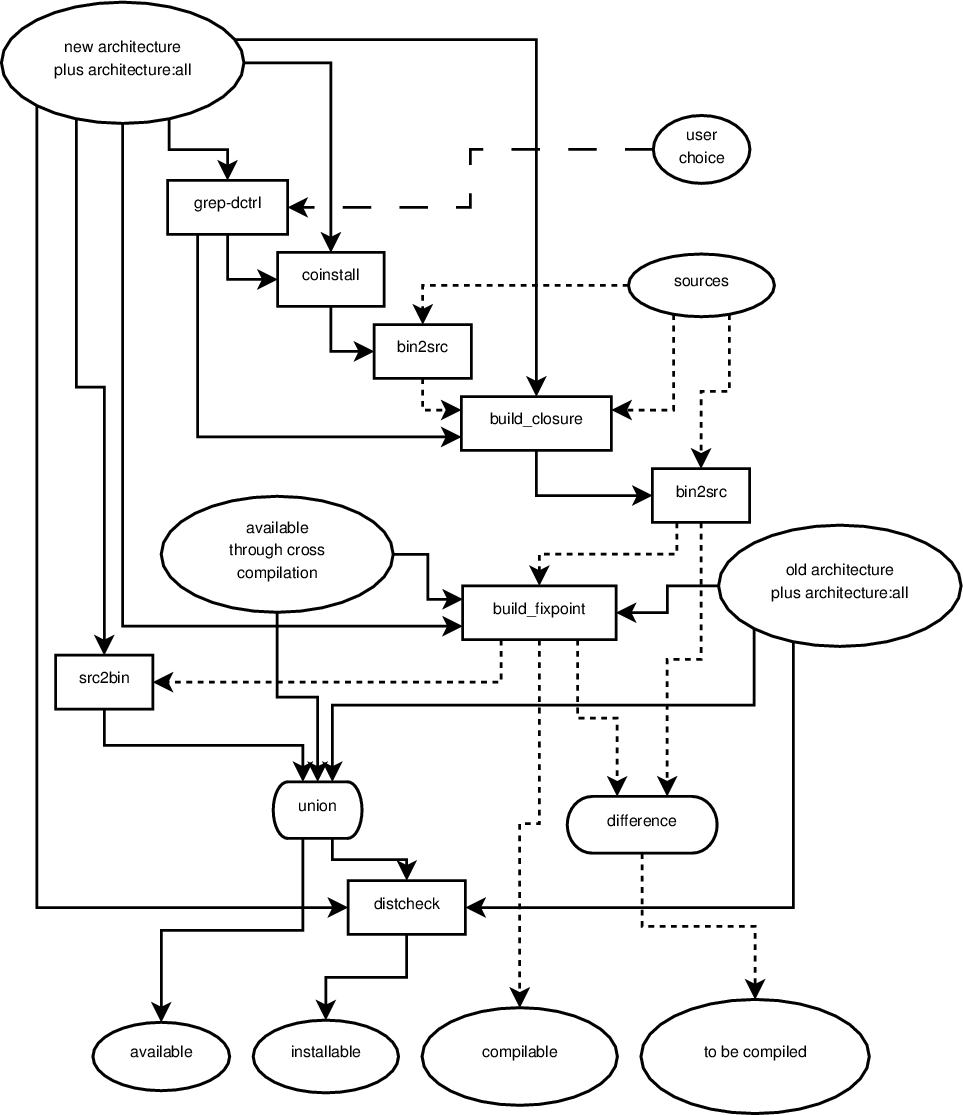
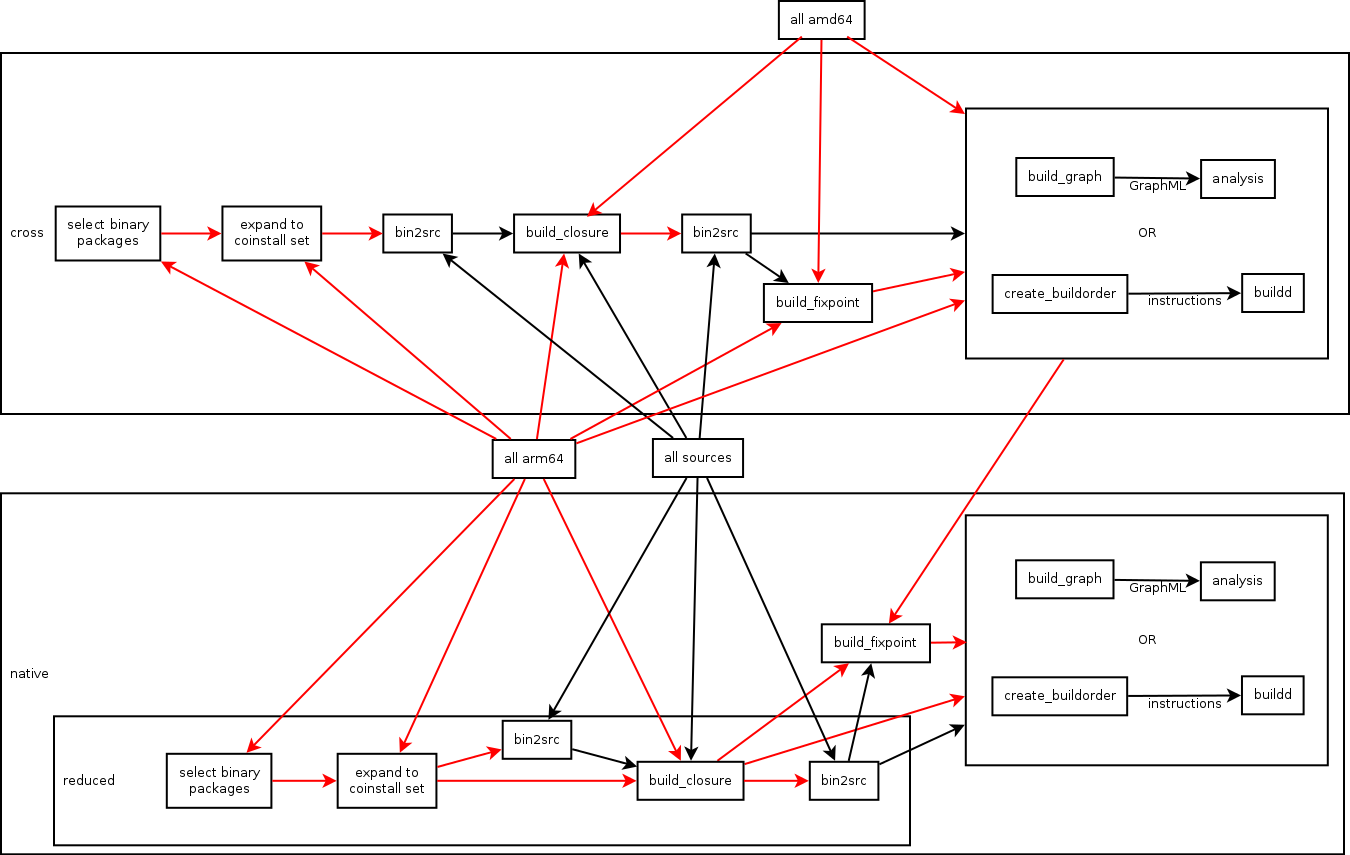
Processing pipeline instead of monolithic tools The tools I developed so far tried to accomplish everything by themselves, reusing functionality implemented in a central library. Therefor, if one wanted to try out even trivial new things, it mostly meant to hack some OCaml code. Pietro Abate suggested to instead develop smaller tools which could work independently of each other, would only execute one algorithm each and could easily be connected together in different ways to achieve different effects. This switch is now done and all functionality from the old tools is moved into a new toolset. The exchange format between the tools is either plain text files in deb822 control format (Packages/Sources files) or a dependency graph. The dependency graph is currently marshalled by OCaml but future versions should work with just passing a GraphML (an XML graph format) representation around. This new way of doing things seems close to the UNIX philosophy (each program does one thing well, data is stored as text, every program is a filter). For example the deb822 control output can easily be manipulated using grep-dctrl(1) and there exist many tools which can read, analyze and manipulate GraphML. It is a big improvement over the old, monolithic tools which did not allow to manipulate any intermediate result by external, existing tools. Currently, a shell script (native.sh) will execute all tools in a meaningful order, connecting them together correctly. The same tools will be used for a future cross.sh but they will be connected differently. I wrote about a first proposal of what the individual tools should do and how they should be connected in this email from which I also linked a confusing overview of the pipeline. This overview has recently been improved to be even more confusing and the current version of the lower half (the native part) now looks like this: native reduced Solid arrows represent a flow of binary packages, dottend arrows represent a flow of source packages, ovals represent a set of packages, boxes with rounded corners represent set operations, rectangular boxes represent filters. There is only one input to a filter, which is the arrow connected to the top of the box. Outgoing arrows from the bottom represent the filtered input. Ingoing arrows to either side are arguments to the filter and control how the filter behaves depending on the algorithm. I will explain this better once the pipeline proved to be less in flux. The pipeline is currently executed like this by native.sh.

Two new ways to break dependency cycles have been discovered So far, we knew of three ways to formally break dependency cycles:
  • remove build dependencies through build profiles
  • find out that the build dependency is only used to build arch:all packages and therefor put it into Build-Depends-Indep
  • cross compile some source packages
Two new methods can be added to the above:

Dependency graph definition changed Back in September when I was visiting irill, Pietro found a flaw in how the dependency graph used to be generated. He supplied a new definition of the dependency graph which does away with the problem he found. After fixing some small issues with his code, I changed all the existing algorithms to use the new graph definition. The old graph is as of today removed from the repository. Thanks to Pietro for supplying the new graph definition - I must still admit that my OCaml foo is not strong enough to have come up with his code.

Added complexity for profile built source packages As mentioned in the introduction, wookey and me addressed the debian-devel list with a proposal on necessary changes for an automated bootstrapping of Debian. During the discussiong, two important things came up which are to be considered by the dependency graph algorithms:
  • profile built source packages may not create all binary packages
  • profile built source packages may need additional build dependencies
Both things make it necessary to alter the dependency graph during the generation of a feedback arc set and feedback vertex set beyond the simple removal of edges. Luckily, the developed approximation algorithms can be extended to support such changes in the graph.

Different feedback arc set algorithms The initially developed feedback arc set algorithm is well suited to discover build dependency edges which should be dropped. It performs far worse when creating the final build order because it only considers edges by itself and not how many edges of a source package can be dropped by profile building it. The adjusted algorithm for generating a build order is more of a feedback vertex set algorithm because instead of greedily finding the edge with most cycles through it, it greedily finds the source package which would break most cycles if it was profile built.

Generating a build order with less profile built source packages After implementing all the features above I now feel more confident to publish the current status of the tools to a wider audience. The following test shows a run of the aforementioned ./native.sh shell script. Its final output is a list of source packages which have to be profile built and a build order. Using the resulting build order, starting from a minimal build system (essential:yes, build-essential and debhelper), all source packages will be compiled which are needed to compile all binary packages in the system. The result will therefor be a list of source and binary packages which fulfill the following property:
  • all binary packages can be built from the available source packages
  • all source packages can be built with the available binary packages
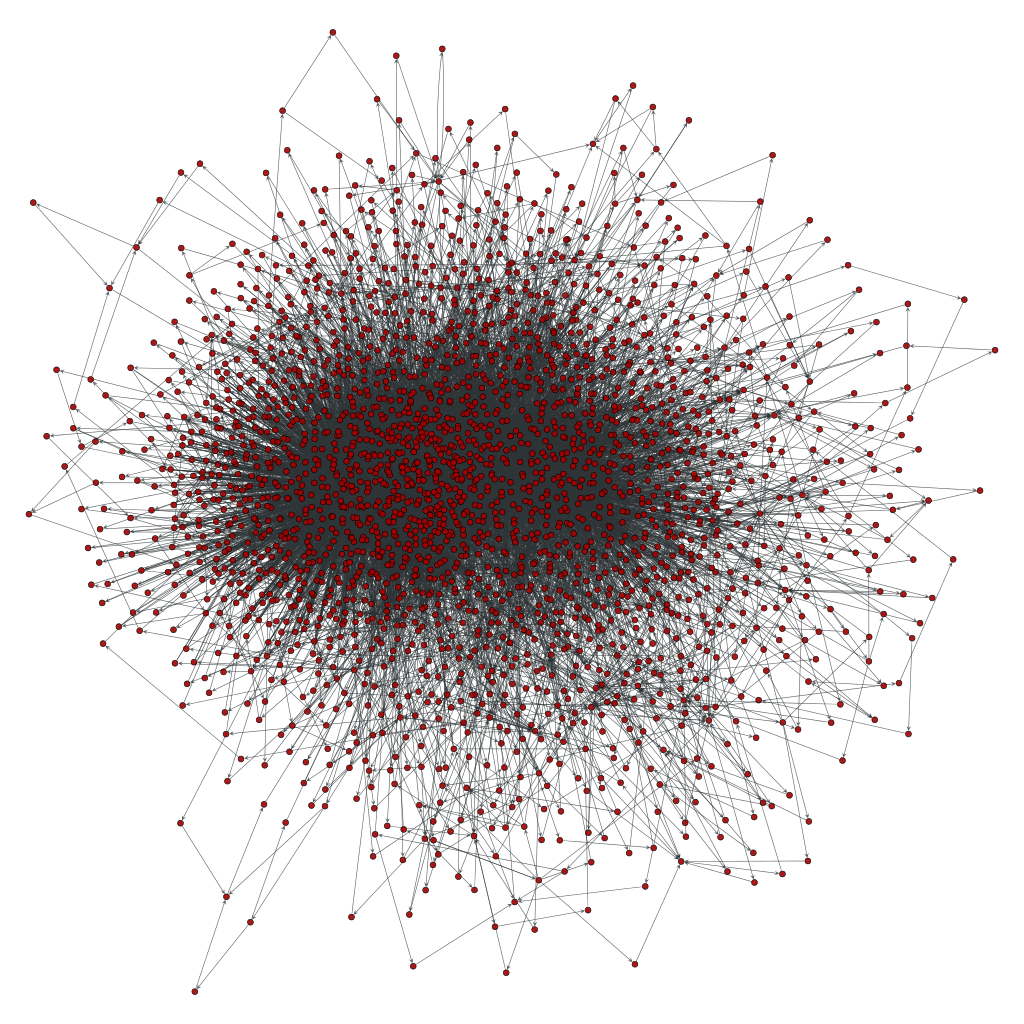
I called this a "reduceded distribution" in earlier posts. The interesting property of this specific selection is, that it contains the biggest problem set of Debian when bootstrapping it: a 900 to 1000 nodes big strongly connected component. Here is a visualization of the problem: hideous mess Source packages do not yet come with build profiles and the cross build situation can not yet be analyzed, so the following assumptions were made: The last point is about 14 build dependencies which were decided to be broken by the feedback arc set algorithm but for which other data sources did not indicate that they are actually breakable. Those 14 are dynamically generated by native.sh. If above assumptions should not be too far from the actual situation, then not more than 73 source packages have to be modified to bootstrap a reduced distribution. This reduced distribution even includes dependency-wise "big" packages like webkit, metacity, iceweasel, network-manager, tracker, gnome-panel, evolution-data-server, kde-runtime, libav and nautilus. By changing one line in native.sh one could easily develop a build order which generates gnome-desktop or really any given (meta-)package selection. All of native.sh takes only 80 seconds to execute on my system (Core i5, 2.5 GHz, singlethreaded). Here is the final build order which creates 2044 binary packages from 613 source packages.
  1. nspr, libio-pty-perl, libmcrypt, unzip, libdbi-perl, cdparanoia, libelf, c-ares, liblocale-gettext-perl, libibverbs, numactl, ilmbase, tbb, check, libogg, libatomic-ops, libnl($), orc($), libaio, tcl8.4, kmod, libgsm, lame, opencore-amr, tcl8.5, exuberant-ctags, mhash, libtext-iconv-perl, libutempter, pciutils, gperf, hspell, recode, tcp-wrappers, fdupes, chrpath, libbsd, zip, procps, wireless-tools, cpufrequtils, ed, libjpeg8, hesiod, pax, less, dietlibc, netkit-telnet, psmisc, docbook-to-man, libhtml-parser-perl, libonig, opensp($), libterm-size-perl, linux86, libxmltok, db-defaults, java-common, sharutils, libgpg-error, hardening-wrapper, cvsps, p11-kit, libyaml, diffstat, m4
  2. openexr, enca, help2man, speex, libvorbis, libid3tag, patch, openjade1.3, openjade, expat, fakeroot, libgcrypt11($), ustr, sysvinit, netcat, libirman, html2text, libmad, pth, clucene-core, libdaemon($), texinfo, popt, net-tools, tar, libsigsegv, gmp, patchutils($), dirac, cunit, bridge-utils, expect, libgc, nettle, elfutils, jade, bison
  3. sed, indent, findutils, fastjar, cpio, chicken, bzip2, aspell, realpath, dctrl-tools, rsync, ctdb, pkg-config($), libarchive, gpgme1.0, exempi, pump, re2c, klibc, gzip, gawk, flex-old, original-awk, mawk, libtasn1-3($), flex($), libtool
  4. libcap2, mksh, readline6, libcdio, libpipeline, libcroco, schroedinger, desktop-file-utils, eina, fribidi, libusb, binfmt-support, silgraphite2.0, atk1.0($), perl, gnutls26($), netcat-openbsd, ossp-uuid, gsl, libnfnetlink, sg3-utils, jbigkit, lua5.1, unixodbc, sqlite, wayland, radvd, open-iscsi, libpcap, linux-atm, gdbm, id3lib3.8.3, vo-aacenc, vo-amrwbenc, fam, faad2, hunspell, dpkg, tslib, libart-lgpl, libidl, dh-exec, giflib, openslp-dfsg, ppl($), xutils-dev, blcr, bc, time, libdatrie, libpthread-stubs, guile-1.8, libev, attr, libsigc++-2.0, pixman, libpng, libssh2, sqlite3, acpica-unix, acl, a52dec
  5. json-c, cloog-ppl, libverto, glibmm2.4, rtmpdump, libdbd-sqlite3-perl, nss, freetds, slang2, libpciaccess, iptables, e2fsprogs, libnetfilter-conntrack, bash, libthai, python2.6($), libice($), libpaper, libfontenc($), libxau, libxdmcp($), openldap($), cyrus-sasl2($), openssl, python2.7($)
  6. psutils, libevent, stunnel4, libnet-ssleay-perl, libffi, readline5, file, libvoikko, gamin, libieee1284, build-essential, libcap-ng($), lcms($), keyutils, libxml2, libxml++2.6, gcc-4.6($), binutils, dbus($), libsm($), libxslt, doxygen($)
  7. liblqr, rarian, xmlto, policykit-1($), libxml-parser-perl, tdb, devscripts, eet, libasyncns, libusbx, icu, linux, libmng, shadow, xmlstarlet, tidy, gavl, flac, dbus-glib($), libxcb, apr, krb5, alsa-lib
  8. usbutils, enchant, neon27, uw-imap, libsndfile, yasm, xcb-util, gconf($), shared-mime-info($), audiofile, ijs($), jbig2dec, libx11($)
  9. esound, freetype, libxkbfile, xvidcore, xcb-util-image, udev($), libxfixes, libxext($), libxt, libxrender
  10. tk8.4, startup-notification, libatasmart, fontconfig, libxp, libdmx, libvdpau, libdrm, libxres, directfb, libxv, libxxf86dga, libxxf86vm, pcsc-lite, libxss, libxcomposite, libxcursor, libxdamage, libxi($), libxinerama, libxrandr, libxmu($), libxpm, libxfont($)
  11. xfonts-utils, libxvmc, xauth, libxtst($), libxaw($)
  12. pmake, corosync, x11-xserver-utils, x11-xkb-utils, coreutils, xft, nas, cairo
  13. libedit, cairomm, tk8.5, openais, pango1.0($)
  14. ocaml, blt, ruby1.8, firebird2.5, heimdal, lvm2($)
  15. cvs($), python-stdlib-extensions, parted, llvm-2.9, ruby1.9.1, findlib, qt4-x11($)
  16. xen, mesa, audit($), avahi($)
  17. x11-utils, xorg-server, freeglut, libva
  18. jasper, tiff3, python3.2($)
  19. openjpeg, qt-assistant-compat, v4l-utils, qca2, jinja2, markupsafe, lcms2, sip4, imlib2, netpbm-free, cracklib2, cups($), postgresql-9.1
  20. py3cairo, pycairo, pam, libgnomecups, gobject-introspection($)
  21. gdk-pixbuf, libgnomeprint, gnome-menus, gsettings-desktop-schemas, pangomm, consolekit, vala-0.16($), colord($), atkmm1.6
  22. libgee, gtk+3.0($), gtk+2.0($)
  23. gtkmm2.4, poppler($), openssh, libglade2, libiodbc2, gcr($), libwmf, systemd($), gcj-4.7, java-atk-wrapper($)
  24. torque, ecj($), vala-0.14, gnome-keyring($), gcc-defaults, gnome-vfs($)
  25. libidn, libgnome-keyring($), openmpi
  26. mpi-defaults, dnsmasq, wget, lynx-cur, ghostscript, curl
  27. fftw3, gnupg, libquvi, xmlrpc-c, raptor, liboauth, groff, fftw, boost1.49, apt
  28. boost-defaults, libsamplerate, cmake, python-apt
  29. qjson, qtzeitgeist, libssh, qimageblitz, pkg-kde-tools, libical, dwarves-dfsg, automoc, attica, yajl, source-highlight, pygobject, pygobject-2, mysql-5.5($)
  30. libdbd-mysql-perl, polkit-qt-1, libdbusmenu-qt, raptor2, dbus-python, apr-util
  31. rasqal, serf, subversion($), apache2
  32. git, redland
  33. xz-utils, util-linux, rpm, man-db, make-dfsg, libvisual, cryptsetup, libgd2, gstreamer0.10
  34. mscgen, texlive-bin
  35. dvipng, luatex
  36. libconfig, transfig, augeas, blas, libcaca, autogen, libdbi, linuxdoc-tools, gdb, gpm
  37. ncurses, python-numpy($), rrdtool, w3m, iproute, gcc-4.7, libtheora($), gcc-4.4
  38. libraw1394, base-passwd, lm-sensors, netcf, eglibc, gst-plugins-base0.10
  39. libiec61883, qtwebkit, libvirt, libdc1394-22, net-snmp, jack-audio-connection-kit($), bluez
  40. redhat-cluster, gvfs($), pulseaudio($)
  41. phonon, libsdl1.2, openjdk-6($)
  42. phonon-backend-gstreamer($), gettext, libbluray, db, swi-prolog, qdbm, swig2.0($)
  43. highlight, libselinux, talloc, libhdate, libftdi, libplist, python-qt4, libprelude, libsemanage, php5
  44. samba, usbmuxd, libvpx, lirc, bsdmainutils, libiptcdata, libgtop2, libgsf, telepathy-glib, libwnck3, libnotify, libunique3, gnome-desktop3, gmime, glib2.0, json-glib, libgnomecanvas, libcanberra, orbit2, udisks, d-conf, libgusb
  45. libgnomeprintui, libimobiledevice, nautilus($), libbonobo, librsvg
  46. evas, wxwidgets2.8, upower, gnome-disk-utility, libgnome
  47. ecore, libbonoboui
  48. libgnomeui
  49. graphviz
  50. exiv2, libexif, lapack, soprano, libnl3, dbus-c++
  51. atlas, libffado, graphicsmagick, libgphoto2, network-manager
  52. pygtk, jackd2, sane-backends, djvulibre
  53. libav($), gpac($), ntrack, python-imaging, imagemagick, dia
  54. x264($), matplotlib, iceweasel
  55. strigi, opencv, libproxy($), ffms2
  56. kde4libs, frei0r, glib-networking
  57. kde-baseapps, kate, libsoup2.4
  58. geoclue, kde-runtime, totem-pl-parser, libgweather, librest, libgdata
  59. webkit
  60. zenity, gnome-online-accounts
  61. metacity, evolution-data-server
  62. gnome-panel
  63. tracker
The final recompilation of profile built source packages is omitted. Source packages marked with a ($) are selected to be profile built. All source packages listed in the same line can be built in parallel as they do not depend upon each other. This order looks convincing as it first compiles a multitude of source packages which have no or only few build dependencies lacking. Later steps allow fewer source packages to be compiled in parallel. The amount of needed build dependencies is highest in the source packages that are built last.

Neil Williams: Hard drive death

My 1Tb laptop drive started misbehaving a few weeks ago, just spending a lot of time spinning when it should have been reading frequently changed files (like the browser cache). I was tempted to blame the browser at that point as no other packages appeared affected.

Wednesday night, a routine package upgrade on unstable brought in a bunch of qt4 updates which I wanted and a virtual box update that I didn't see much point in delaying ... 15 minutes later I couldn't work out why the virtualbox dkms task was still running, spotted it spinning in depmod and found some alarming messages in dmesg about short reads and errors reading from the hard drive. Hmm. The hard drive was out of control at this point, it quickly became apparent that no disc access was going to be possible and I couldn't get to a terminal to kill the current tasks, so I killed the power. The fsck which followed reboot showed more of the errors I'd seen in dmesg and fell back to the manual intervention stage. A few hours of confirming attempts to fix the errors, fsck finally finished. A short amount of usage showed that although fsck had finished, the drive was not happy and was starting to give short reads on other parts of the filesystem, resulting in ~40% of the filesystem appearing to be read-only when the rest was read-write. Somehow, I didn't think this was a welcome feature as the areas affected appeared to be quite random.

The drive in question was a replacement for the original 300Gb drive supplied with the ThinkPad, so a quick bit of switching of drives into a caddy and I could rsync my data off the large drive onto the smaller one. The rsync itself took a lot longer than it should have done because it got lots of short reads too. (Principally in /lib/modules/3.2.0-4/ and in the browser cache directories which had been the original symptom as well as most other places where one could have expected processes to have open files when the drive failed).

Now the 1Tb drive was a pig to fit into the Thinkpad originally because it was too big for the bay but I fitted it anyway. Yes, that was probably a mistake. It certainly meant that in order to fit it I had to not put the drive into the useful caddy provided by Lenovo which makes removal of the drive simple. Indeed the drive was wedged into the bay so tightly that it wasn't going to come out with normal levels of persuasion. This probably contributed to the failure of the drive, so live and learn.

With help from Andy Simpkins (it's always handy to have a hardware engineer on hand at times like this), the keyboard was lifted out, the case was dismantled and just enough room was made to get a screwdriver in behind the sata drive and lever it out of the bay. OK, rebuild laptop, put replacement drive into the caddy (because the smaller capacity drive is also a lot smaller in height than the 1Tb and therefore has plenty of clearance between it and the bay) and move on to the software recovery stage.

Hint: if this happens again, before turning off the broken system for the last time, just remember to download a recent Debian ISO to a USB stick - it saves having to ask someone else or find another machine to do the download. (Thanks Andy...)

OK, so after the usual complaints on reboot that there was no operating system, F12 got the boot order menu up and I was in Debian Installer Rescue Mode. Reinstalling grub failed initially for a few reasons:

  1. I'd deliberately not copied /dev /proc and /sys from the old harddrive but I'd also forgotten to create empty ones on the new drive...
  2. /etc/fstab helpfully referred to / as a UUID which no longer applied, so that had to be edited
  3. grub was confused and couldn't find the root filesystem

A few iterations later, I had a working /dev directory inside the /target chroot, bind mounted from the /dev outside the chroot, I was able to mount proc and sys, so grub was finally happy to reinstall itself and then update the initramfs setup for the new drive.

Reboot, another fsck, all appeared well. I was able to login via the terminal but not in X. Hmmm. Stop xdm, startx manually from the terminal, problems with /tmp/ - permission denied. Oops. Yes, it does help to create /tmp with the right permissions....

The final stage was to complete the dpkg --configure -a from the original failure. I've yet to reinstall the 3.2.0-4 kernel, so I'm back on 3.2.0-3 but that's OK.

So now I'm back on the original drive, albeit temporarily without any swap whatsoever (because I didn't partition the replacement drive to create /dev/sda5 before doing the copy) and now I remember the second reason I wanted to replace the original drive with the 1Tb drive - the original drive is as NOISY as hell. The whole edge of the laptop vibrates constantly, to the point that I can feel the vibration under the keys as I type. It's not that the drive is loose in the bay, it's just a constant vibration.

But, I have kept all my data and I have a usable laptop for the BSP this weekend. I will be looking at an SSD drive to replace this one though and having also found my old Acer laptop with power supply, I can now reference this entry when I transfer the system a second time.

Russ Allbery: The "Why?" of Work

(This is going to be long and rambling. Hopefully at some point I'll be able to distill it into something shorter.) In preparation for a tech leads retreat tomorrow, several of us at work were asked to watch Simon Sinek's TED talk, "How great leaders inspire action". I'll be honest with you: I hated this talk. Sinek lost me right at the start by portraying his idea as the point of commonality among great leaders (don't get me started on survivorship bias; it's a pet peeve) and then compounded the presentation problem with some dubious biology about brain structure. So, after watching it, I ranted a bit about how much I disliked it (to, as it turns out, people who had gotten a lot out of it). (Don't do this, btw. It's nearly always worthwhile to suppress negativity about something someone else enjoyed. I say this to increase the pool of people who can remind me of what I said the next time I forget. Which, if my normal pattern holds, will be about five minutes from now.) Thankfully, I work with tolerant and forgiving people who kindly pointed out the things they saw in the video that I missed, and we ended up having a really good hour and a half discussion, which convinced me that there's an idea under here that's worth talking about. It also helped clarify for me just how much I hate the conventional construction of both leadership and success. This talk is framed around getting other people to do things, which is one of the reasons why I had such a negative reaction to it. It's right there in the title: leaders inspiring action. This feeds into what at least in the United States is an endemic belief that the world consists of leaders and followers, and that the key to success in the world (in business, in politics, in everything else) is to become one of the leaders and accumulate followers (most frequently as customers, since we have a capitalist obsession). This is then defined as success. I think this idea of success is bullshit. Now, that statement requires an immediate qualification. Saying that the societal definition of success is bullshit is a statement from privilege. I have the luxury of saying that because I am successful; I'm in a position where I have a lot of control over my own job, I'm not struggling to make ends meet, and I can spend my time pondering existential questions like how to define success. If I were a little less lucky, success would be whatever put food on the table and kept a roof over my head. I'm making an argument from the top of Maslow's hierarchy. But that is, in a roundabout way, my point: why is defining and constructing success still so hard, and why do we do such a bad job at it, even when we're at the top of the pyramid and able to focus on self-actualization? The context of this talk for my group is pre-work for a discussion about, in Sinek's construction, the "why?" of our group. Why are we here, what is our purpose, and what do we care about? By the mere fact that we are able to ask questions like that, you can correctly surmise that we're already successful. The question, therefore, is what should we do with that success? I normally hear one or more of the following answers, all of which I find unsatisfying or problematic. So, what should I do with success? Or, put another way, since I have the luxury of figuring out a "why?", what's my "why?" This question comes at a good time. As I've mentioned the last couple of days here, I've just come off of two days of the most fun I've had at work in the last several years. I spent about 25 hours total building a log parsing infrastructure that I'm quite fond of, and which may even be useful to other people. And I did that in response to a rather prosaic request: produce a report of user agents by authenticated unique users, rather than by hits, so that we can get an idea of what percentage of our community uses different devices or browsers. This was a problem that I probably could have solved adequately enough for the original request in four hours, maybe less, and then moved on to something else. I spent six times that long on it. That's something I can do because I'm successful: that's the sort of luxury you get when you can define how you want to do your job. So, apparently I have an answer to my question staring me in my face: what I do with success, when I have it, is use that leeway to produce elegant and comprehensive solutions to problems in a way that fully engages me, makes the problem more interesting, and constructs infrastructure that I can reuse for other problems. Huh. That sounds like a "why?" response that's quite common among hackers and software developers. Nothing earth-shattering there... except why is that so rare in a business context? Why isn't it common to answer questions like "what is our group mission statement" with answers like that? This is what I missed in the TED talk, and what the subsequent discussion with my co-workers brought to light for me. I think Sinek was getting at this, but I think he buried the lede. The "why?" should be something that excites you. Something that you're passionate about. Something that you believe in. He says that's because other people will then believe in it too and will buy it from you. I personally don't care about (or, to be honest, have active antipathy towards) that particular outcome, but that's fine; that's not the point. The point is that a "why?" comes from the heart, from something that actually matters, and it creates a motivating and limiting principle. It defines both what you want to do and what you don't want to do. That gives me a personal answer. My "why?" is that I want to build elegant solutions to problems and do work that I find engaging and can be proud of afterwards. I automate common tasks not because I particularly care about being efficient, but because manually doing common tasks is mind-numbing and boring, and I don't like being bored. I write reliable systems not particularly because that helps clients, but primarily because reliable software is more elegant and beautiful and unreliable software offends me. (Being more usable and frustrating for clients is also good; don't get me wrong. It's just not a motive. It's an outcome.) What does that mean for a group mission statement, a group "why?" Usually these exercises produce some sort of distillation of the collective job responsibilities of the people in the group. Our mission is to maintain core infrastructure to let people do their work and to support authentication and authorization services for the university, yadda yadda yadda... this is all true, in its way, but it's also boring. One can work oneself up to caring about things like that, but it requires a lot of effort. But we all have individual "why?" answers, and I bet they look more like my answer than they do like traditional mission statements. If we're in a place where we have the luxury of worrying about self-actualization questions, what gets us up in the morning, what makes it exciting to go into work, is probably some variation on doing interesting and engaging work. But it's probably a different variation for everyone in the group. For example, as you can see from above, I like building things. My happiest moments are when someone gives me a clearly-defined problem statement that fills a real need and then goes away and leaves me in peace to solve it. One thing I've learned is that I'm not very good at coming up with the problem statements myself; I can do it, but usually I end up solving some problem that isn't very important to other people. I love it when my employer can hand me real problems that will make the world better for people, since often they're a lot more interesting (and meaningful) than the problems I come up with on my own. But that's all highly idiosyncratic and is not going to be shared by everyone in my group. I'm an introvert; the "leave me alone" part of that is important. Other people are extroverts; what gets them up in the morning is, in part, engaging with other people. Some people care passionately about UI design. (I also care passionately about UI design, but the UI designs that I'm passionate about are the ones that are natural for my people, who are apparently aliens from another galaxy, so I'm not the person you want doing UI design for things used by humans.) Others might be particularly interested in researching new technology, or coming up with those problem statements, or in smoothly-running production systems, or in metrics and reporting... I don't really know, but I do know that there's no one answer that fits everyone. Which means that none of our individual "why?" responses should become the group "why?". However, I think that leads to an answer, and it's the answer I'm going to advocate for in the meeting tomorrow. I believe the "why?" of our team should be to use the leeway, trust, and credibility that we have because we're successful to try to create an environment in which every individual member of the team can follow their own "why?" responses. In other words, I think the mission of our group should not be about any specific technology, or about any specific set of services, or outcomes. The way we should use our success is to let every member of our team work in a way that lights their fire. That makes them excited to come into work. That lets each of us have as much fun as I had in the past two days. We should have as our goal to create passionate and empowered employees. Nothing more, but nothing less. This is totally not how group mission statements are done. They're always about blending in to some larger overall technological purpose. But I think that's a mistake, and (despite disliking the presentation), I think that's what this TED talk does actually get at. The purpose is the what, or sometimes the how. It's not the why. And the why isn't static; technology is changing fast, and people are using technology in different ways. Any mission statement around technology today is going to be obsolete in short order, and is going to be too narrow. But I think the flip side is that good technological solutions to the problems of the larger organization are outcomes that fall out of having passionate and inspired employees. If people can work in ways that engage and excite them, they will end up solving problems. We're all adults; we know that we're paid to do a job and that job needs to involve solving real problems for the larger organization. All of that is obvious, and therefore none of that belongs in a mission statement. A mission statement should state the inobvious. And while some visionary people can come up with mission statements around technology or around how people use technology that can be a rallying point for a team or organization, I think that's much rarer than people like to think it is. If you stumble across one like that, great, but I think most teams, and certainly our team, would be better served by having the team mission statement be to enable every individual on the team to be passionate about their work. What should our group work on next? Figure out what the university's problems are, line those needs up with the passions of the members of the team, ask the people most excited about each problem how they want to solve that problem, and write down the answers. There's our roadmap and our strategy, all rolled into one.

24 January 2013

Benjamin Mako Hill: Aaron Swartz

I moved to Boston in 2005 at the same time that Aaron Swartz did and we were introduced by a mutual friend. Aaron was one of my first friends in Boston and we became close. When Aaron moved to San Francisco, I moved into his apartment in Somerville where he kept a room for a year or so. Mika and I still live there. His old posters remain on our walls and his old books remain on our shelves. Aaron s brothers Ben and Noah both lived with us and remain close friends. I have spent hours (days?) reading and thinking about Aaron over the last two weeks. It has been disorienting but beautiful to read the descriptions of, and commentaries on, Aaron s life. Although I suspect I may never feel ready, there are several things I want to say about Aaron s death, about Aaron s work, and about what Aaron means to me. 1. Aaron s Death The reaction to Aaron s death has been overwhelming and inspirational. At some point in the near future I plan to join some of the important campaigns already being waged in his name. There are many attempts to understand why Aaron died and many attempts to prevent it from happening to others in the future. Unfortunately, I am familiar with the process of soul-searching and second-guessing that happens when a friend commits suicide. I m sure that every one of his friends has asked themselves, as I have, What could I have done differently? I don t know the answer, but I do know this: Aaron was facing the real risk of losing half his life to prison. But even if one believed that he was only facing the likely loss of ten percent or even one percent of his life I wish that we all, and I wish that I in particular, had reacted with the passion, time, anger, activity, and volume proportional to how we have reacted in the last two weeks when he lost the whole thing. 2. Aaron s Work Of course, Aaron and I worked on related projects and I followed his work. And despite all the incredible things that have been said about Aaron, I feel that Aaron s work was more focused, more ambitious, more transformative, more innovative, and more reckless (in a positive sense) than the outpour online suggests. Although discussion of Aaron has focused his successes, achievements, and victories, the work that inspired me most was not the projects that were most popular or successful. Much of Aaron s work was deeply, and as it turned out overly, ambitious. His best projects were self-conscious attempts to transform knowledge production, organization, and dissemination. Although he moved from project to project, his work was consistently focused on bringing semantic-web concepts and technologies to peer production, to the movement for free culture, and to progressive political activism and on the meta-politics necessary to remove barriers to this work. For example, Aaron created an online collaborative encyclopedia project called the TheInfoNetwork (TIN) several years before Wikipedia was started. I talked to Aaron at length about that project for a research project I am working on. Aaron s work was years ahead of its time; in 2000, TIN embraced more of the Wikimedia Foundation s current goals and principles than Wikipedia did when it was launched. While Wikipedia sought to create a free reference work online, Aaron s effort sought to find out what a reference work online could look like. It turned out to be too ambitious, perhaps, but it taught many, including myself, an enormous amount in that process. When I met Aaron, he was in the process starting a company, Infogami, that was trying to chase many of TIN s goals. Infogami was conceived of as a wiki aware of the structure of data. The model was both simple and profound. Years later, Wikimedia Deutschland s WikiData project is beginning to bring some of these ideas to the mainstream. Infogami merged with Reddit as equal halves of a company with a shared technological foundation based on some of Aaron s other work. But when Reddit took off, Infogami was rarely mentioned, even by Aaron. I think that is too bad. Reddit got traction because it made the most popular stuff more visible; Reddit is popular, fundamentally, because popular things are popular. But popular is not necessary positive. For that reason, Reddit never struck me as either surprising or transformative. But what started as Aaron s half the company, on the other hand, aimed to create a powerful form of democratized information production and dissemination. And although Infogami didn t take off, the ideas and code behind the project found life at the heart of Open Library and will continue to influence and inspire countless other projects. I believe that Infogami s lessons and legacy will undergird a generation of transformative peer production technologies in a way that the Reddit website important as it is will not. 3. What Aaron Means to Me A lot of what has been written about Aaron speaks to his intelligence, his curiosity, his generosity, his ethics and his drive. Although I recognize all these qualities in the Aaron I knew, I ve felt alienated by how abstract some of the discussion of Aaron has been my memories are of particularities.
I remember the time Aaron was hospitalized and I spent two hours on the phone going through my bookshelves arguing with him about the virtues of the books in my library as we tried to decide which books I would bring him. I remember Aaron confronting Peter Singer intellectual founder of the modern animal rights movement at the Boston Vegetarian Food Festival to ask if humans had a moral obligation to stop animals from killing each other. I lurked behind, embarrassed about the question but curious to hear the answer. (Singer sighed and said yes sort of and complemented Aaron on the enormous Marxist commentary he was carrying.) I remember 1-800-INTERNET.com. I remember talking with Aaron about whether being wealthy could be ethical. I argued it could not but Aaron argued uncharacteristically I thought that it could. Aaron told Mika she should slap him if he ever became wealthy. The very next day, it was announced that his company had been acquired and that Aaron was a millionaire. I remember the standing bets I had with Aaron and how he would email me every time news reports favored his claims (but never when they did not). And I remember that I won t hear from him again.
Aaron was a friend and inspiration. I miss him deeply and I am very sad.

Russell Coker: Power Supplies and Wires

For some time I ve been wondering how the wire size for power supplies limits the power. So I ve done some quick calculations to determine if it s a problem. The first type that is of interest are the Inverters that are used to convert 12VDC to 240VAC (mains power) to allow electric devices to be operated in a car. I ve seen some reports from dissatisfied user about Inverters not supplying as much power as expected and I ve had problems with my 150W Inverter not always supplying my Thinkpad (which definitely doesn t draw 150W). The second type is phone chargers as charging a phone in a reasonable amount of time is always a problem. Inverter Rating Fine Print vs Laptop PSU My Thinkpad Power Supply claims Efficiency Level IV which according to the US EPA document describing the efficiency marking protocol for external power supplies [1] means that it is at least 85% efficient when supplying 50W+. The peak output of the PSU is 4.5A at 20V which is 90W peak output, 90/0.85 == 106W power drawn. One would hope that wouldn t be a problem from a 150W PSU. But the fine print on the PSU says that it can provide 110W continuously and 150W for 10 minutes. So according to my calculations I m within 4W of overloading the PSU if my Thinkpad uses full power. It also says that it is designed for 13.8V input. I have no idea how the performance of the Inverter changes as the supply Voltage changes between the 12.6V that a 6 cell lead-acid battery is designed to provide and the 13.8V charge from the car alternator. But I have had occasions when my Inverter stopped working correctly presumably due to being unable to supply as much current as my Thinkpad draws. As an aside I measured the Voltage in my car (with the engine off) at 12.85V from the cigarette lighter socket and 13.02V directly from the battery. I wonder if there is some sort of overload protection on the cigarette lighter which has a side effect of reducing the Voltage. Resistance in wires reduces the Voltage, but all Voltage meters are designed to have a high resistance to prevent that from being an issue. If anyone has an explanation for the 0.17Volt drop then please write a comment! Can a Car Provide 130W from the Cigarette Lighter socket? If the Inverter is also 85% efficient (and it might be less as it has no indication of efficiency on the box) then when supplying 110W it would draw 110/0.85 == 129.4W (I ll round it up to 130W). The power in Watts is equal to the Voltage multiplied by the current in Amps (W=V*I). Therefore I=W/V so if the car battery was at 12.85V then 130W/12.85V == 10.12A will flow. The current that goes through a circuit is equal to the Voltage divided by the resistance (see the Wikipedia page on Ohm s law for more information). This also means that the resistance equals the Voltage divided by the current. 12.85V/10.12A == 1.27 Ohms. Note that this is the resistance of the entire circuit, all the wires going to the battery, the circuitry inside the Inverter, and the internal resistance of the battery. The Inverter s cable is 1M long (2 meters of wire) and each wire is about 3.5mm in diameter including the insulation which means that the copper wire is probably equivalent to a single core conductor that is about 1mm in diameter. According to one of the online guides to resistance [2] wire that is 1.02mm in diameter will have a resistance of 0.02 Ohms per meter which gives a resistance of 0.04 Ohms. 0.04 Ohms is 3% of the total resistance of the circuit which doesn t seem like it will be a real problem. In practice I ve noticed that the connector gets extremely hot when it s in use while the cable doesn t get warm enough to notice. I suspect that the quality of the connector limits the power that is available but I don t have an easy way of measuring this. Inverters that are rated at 300W are designed to attach directly to the battery. An Inverter that is rated at 300W would draw 300W/0.85 == 352W from the battery. That needs 352W/13.02V == 27.04A and therefore a circuit resistance of 13.02V/27.04A == 0.48 Ohms total resistance. I wonder whether dirt on the battery terminals would give a significant portion of that. Phone Charging I ve also been wondering about why mobile phones take so long to charge, and now I ve finally done the calculations. The latest standard for mobile phones is to use USB for charging. The Wikipedia page about USB says that the standard is for USB 2.0 to supply up to 500mA at 5V +-5%. That means 0.5A*5V == 2.5W +- 5%. If we assume that the internal power supply in a phone is also 85% efficient then that means 2.5*0.85 == 2.125W going to the battery. My Samsung Galaxy S3 has a battery which is rated at 7.98Wh. According to the Wikipedia page about Lithium Ion batteries the charge/discharge efficiency is 80% to 90% I ll assume that it s 85% for further calculations. If the battery in the phone is 85% efficient and the phone is doing nothing but charging then the charge time for a regular USB port would be 7.98Wh/0.85/2.125W == 4.42 hours (4 hours 25 minutes) of charge time. That probably means something closer to 5 hours to totally charge the phone while it s running. There are dedicated charging ports for USB which can supply up to 1.5A. The 3rd party charger which came with my phone was rated at 1A and would hopefully be capable of completely charging the phone in less than 3 hours (but in practice isn t). It s interesting to note that MacBooks expose the amount of current drawn from a USB port with a GUI, so it should be possible to measure a phone charge rate by connecting it to a MacBook (which is cheaper than cutting up a phone cable). My old Samsung Galaxy S has a battery which is rated at 5.55Wh, by the same calculations it would take slightly more than 3 hours to charge on a standard USB port or 1.5 hours on my newest USB charger. In practice it has never got anywhere close to that, I presume that the phone is designed to draw less than 500mA. Phone Cable Resistance The charger that came with my Galaxy S has a cable that is about 1.75M long, the cable is flat and measures just over 1mm thick and about 2mm wide. Presumably the wire is equivalent to a single core that s about 0.4mm in diameter thus giving it a resistance of about 0.134 Ohm per meter, or 1.75*2*0.134 == 0.469 Ohm for the cable. The charger is rated at 0.7A. To supply 0.7A at 5V the resistance would be 5V/0.7A == 7.143 Ohm so about 6.6% of the total resistance of the circuit would be in the wire from the charger to the phone. The charger that came with my Galaxy S3 has a round cable that s just over 3mm thick and about 90cm long. If each wire in the cable is equivalent to a solid wire that is 0.912mm in diameter then it would be 0.0264 Ohm per meter of wire or 0.9*2*0.0264 == 0.0475 Ohm. The total circuit resistance would be 5V/1A == 5 Ohm. So 0.0475 Ohm is less than 1% of the circuit resistance. Voltage Drop The Voltage across a part of a circuit is proportional to the resistance (see the Wikipedia page on Series and Parallel Circuits for a good explanation). Basically this means that if 1% of the resistance of a circuit is in the wire then 1% of the Voltage drop will also be in the wire, so if we have a 5V supply with my Galaxy S3 cable then each of the two wires in the cable will have a difference of about 0.025V between the ends and the phone will receive a supply of 4.95V, the difference isn t something that is worth worrying about. But the cable from my Galaxy S has a resistance equivalent to 6.6% of the circuit resistance which means that the theoretical charge time will be 6% longer than it might be or 6% more current will be drawn from the mains than should be needed. Conclusion The charger that came with my Samsung Galaxy S isn t much good. Wasting 6.6% of the power in the wire is unreasonable. Phones keep getting more power hungry and batteries keep getting larger. There are third party phone batteries and external batteries that are charged by USB which have more than twice the capacity of the stock phone batteries this means more than twice the charge time. This problem will keep getting worse. The problem of a phone in active use drawing more power than the charger can provide (and running out of battery while on the charger) seems likely to stay with us. So while an Android phone has the potential to be a great little embedded server it seems that hacking the power supply is going to be a required first step for realising that potential. The decision to make 5V the USB power standard was reasonable at the time as it was the voltage used for most things on the motherboard. The decision to use USB as the phone charging standard was also reasonable, it allows phones to be charged anywhere. The combination of those two decisions isn t good for the user. If a higher Voltage such as 12V was used then 5* the power could be supplied through the same wires at the same level of efficiency. It would be really good if cars came with built in Inverters and supplied 240VAC or 110VAC depending on the region they were manufactured for. It s becoming a fairly common feature to have a cigarette lighter port in the car boot as well as at least two ports inside the car. When a car has three sockets and only one device to actually light cigarettes (which I suspect is only provided to fill an empty socket) it s very obvious that people want to connect random devices. Also having USB charging ports inside the car would be a really good idea (one for each seat would be good for Ingress).

Russ Allbery: Still having a blast

I did not realize how much I was missing this sort of heads-down programming time in my life until the last two days. I think the last time that I had this much fun with my job was when I was learning Java, and even that wasn't quite this much fun since it was a lot of experimentation rather than being directly productive in a language I know well. Here's a short list of modern Perl, Perl techniques, and interesting modules that I'd not had a reason to use before today: I still have tomorrow morning to continue focusing on this and will hopefully finish up the work to feed long time periods of logs into my analysis tool. And, even better, I have a log parsing framework that I really like and that I think will make any number of things easier in the long run. (Also, it has a remarkably thorough test suite. I love test-driven development. Although I haven't written comprehensive tests for the very final front-end piece, since generating sanitized log input to trigger all the cases is too much effort right at the moment.)

Dirk Eddelbuettel: Rcpp reaches 100 dependents on CRAN

With the arrival earlier today of the stochvol package onto the CRAN network for R, our Rcpp project reached a new milestone: 100 packages have either a Depends:, Imports: or LinkingTo: statement on it. The full list will always be at the bottom of the CRAN page for Rcpp; I also manually edit a list on my Rcpp page. But for the record as of today, here is the current list as produced by a little helper script I keep:

 acer                apcluster           auteur             
 bcp                 bfa                 bfp                
 bifactorial         blockcluster        ccaPP              
 cda                 classify            clusteval          
 ConConPiWiFun       EpiContactTrace     fastGHQuad         
 fdaMixed            forecast            fugeR              
 GeneticTools        gMWT                gof                
 gRbase              gRim                growcurves         
 GUTS                jaatha              KernSmoothIRT      
 LaF                 maxent              mets               
 minqa               mirt                mRMRe              
 multmod             mvabund             MVB                
 NetworkAnalysis     ngspatial           oem                
 openair             orQA                parser             
 pbdBASE             pbdDMAT             phom               
 phylobase           planar              psgp               
 quadrupen           Rchemcpp            Rclusterpp         
 RcppArmadillo       RcppBDT             rcppbugs           
 RcppClassic         RcppClassicExamples RcppCNPy           
 RcppDE              RcppEigen           RcppExamples       
 RcppGSL             RcppOctave          RcppRoll           
 RcppSMC             RcppXts             rforensicbatwing   
 rgam                RInside             Rmalschains        
 Rmixmod             robustgam           robustHD           
 rococo              RProtoBuf           RQuantLib          
 RSNNS               RSofia              rugarch            
 RVowpalWabbit       SBSA                sdcMicro           
 sdcTable            simFrame            spacodiR           
 sparseHessianFD     sparseLTSEigen      SpatialTools       
 stochvol            surveillance        survSNP            
 termstrc            tmg                 transmission       
 trustOptim          unmarked            VIM                
 waffect             WideLM              wordcloud          
 zic                
And not to be forgotten is BioConductor which has another 10:
 ddgraph            GeneNetworkBuilder GOSemSim          
 GRENITS            mosaics            mzR               
 pcaMethods         Rdisop             Risa              
 rTANDEM  
As developers of Rcpp, we are both proud and also a little humbled. The packages using Rcpp span everything from bringing new libraries to R, to implementing faster ways of doing things we have before to doing completely new things. It is an exciting time to be using R, and to be connecting R to C++, especially with so many exciting things happening in C++ right now. Follow the Rcpp links for more, and come join us on the Rcpp-devel mailing list to discuss and learn.

23 January 2013

Russ Allbery: Log parsing and infinite streams

I have a problem I have to solve for work that involves correlating Apache access and error logs. Part of WebAuth logs successful authentications to the Apache error log, and I want to correlate User-Agent strings with users so that we can figure out what devices our users are using by percentage of users rather than percentage of hits. The problem, as those who have tried to do this prior to Apache 2.4 know, is that Apache doesn't provide any easy way to correlate access and error log entries (made even more complex because two separate components are involved). I could have just hacked something together, but I've written way too many ad hoc log parsers, and, see, I was reading this book.... The book in question is Mark Jason Dominus's Higher Order Perl. I'm not quite done with it, and will post a full review when I am. I have some problems with it, mostly around the author's choice of example problems. But there is one chapter on infinite streams, and the moment I read that chapter on the train, it struck me as the perfect solution to log parsing problems. I'm not much of a functional programming person (which is where Dominus is drawing most of the material for this book), so I don't know if this terminology is standard or somewhat unique to the book. An infinite stream in this context is basically a variation on an interator that lets you look at the next item without consuming it. The power comes from putting this modified iterator in front of a generator and use it to consume one element at a time, and then compose this with transformation and filtering functions. That gives you all the power of the iterator to store state and lets you process one logical element from the stream at a time, without inverting your flow of control. Dominus provides code in the book for a very nice functional implementation of this that's about as close as you're probably going to get to writing Haskell in Perl. Unfortunately, his publisher decided to write their own free software license, so the license is kind of weird and doesn't explicitly permit redistribution of modified code. It's probably fine, but I didn't feel like dealing with it, and I'm more comfortable with writing object-oriented code at the moment (at least in Perl), so I decided to write an object-oriented version of the same code specific for log parsing. That's what I've been doing since shortly after lunch, and I can't remember the last time I've had this much fun writing code. I have a reasonable first cut at a (fully tested and fully test-driven) log parsing framework built on top of a reasonably generic implementation of the core ideas behind infinite streams. I also used this as an opportunity to experiment with Module::Build, and have discovered that the things I most disliked about it have apparently all been fixed. And I'm also using Perl 5.10 features. (I was tempted to start using some things from 5.12, but I do actually need to run this on Debian stable.) It's rather satisfying to write a thoroughly modern Perl module. There are some definite drawbacks to writing this in an object-oriented fashion. There's rather more machinery and glue that has to be set up, it's probably a bit slower, and it tends to accumulate layers of calls. One of the advantages of the method with standalone functions and a very simple, transparent data structure is that it's easier to eliminate unnecessary call nesting. But I suspect the object-oriented version will do what I want without any difficulties, and if I feel very inspired, I can always fiddle with it later. Maybe I'll eventually use this as a project to experiment with Moose as well. I'm surprised that no one else has done this, but I poked around on CPAN a fair bit and couldn't find anything. This will all show up on CPAN (as Log::Stream) as soon as I've finished enough of it to implement my sample application. And then I'll hopefully find some time to rewrite our metrics system using it, which should simplify it considerably....

22 January 2013

Matthew Garrett: ITWire still has problems with basic accuracy

ITWire ran a story on the 12th of January entitled "Fedora still has problems with secure boot". It ends up discussing two issues with the author's experience with the Fedora installer - that he can't reclaim any free space on existing drives, and that the installer didn't automatically add entries for Windows to the grub menu. These are certainly legitimate issues, and I don't want to suggest that it's reasonable for people to have to manually alter their configuration in order to support dual boot. But they're not issues with Fedora's support for secure boot, despite the enthusiasm with which certain people have jumped on the story. We've received one credible report of a secure boot related problem with Fedora on a couple of Toshiba laptops, which appears (and I want to stress that we're still working on diagnosing it) to be a firmware bug rather than any kind of problem with Fedora.

Mistakes happen in journalism, and sometimes there are differences of opinion. But this story is simply wrong. When asked about it in the comments, the author failed to support his position. When contacted, the editor in chief was willing to add a note saying that I disputed the arguments but was unwilling to remove the incorrect claims. As a result, the internet remains full of links and reposts of an article that unashamedly tells users that the current Linux distribution with the best UEFI hardware support has issues with something it has no issues with.

For reasons that are unclear to me, ITWire seems to have some sort of well regarded status in the Australian technical industry. It seems entirely undeserved.

comment count unavailable comments

Peter Makholm: Installing Linux on MyAudio Tablet Series9

Recently I recieved a MyAudio Tablet Series9 as a gift. From the factory it runs some version of Android, but I already got enough Android devices. Instead I wanted to play a bit with a basic Linux install. This tablet is based on the AllWinner A10 System on a Chip. Some of these instructions might work for other systems based on the same chip set: Step 1: Install the rescue system from http://forum.doozan.com/read.php?6,9396 on a SD-card. You can configure network settings in rescue/interfaces and rescue/wpa_supplicant.conf. Step 2: Boot the rescue system. The MyAudio table will boot from the SD-card if it contains a bootable system, so this is quite easy. The first time you boot the rescue system tries to locate a system.bin file from the tablet. this file contains the hardware configuration and is needed for initializing all the hardware. This means that the screen can t be initialized the first time you boot and will just appear off. Unless the system automatically boots again you need to locate the system.bin yourself from the tablet. It is usually located on /dev/nanda and have names like system.bin, script.bin, or evb.bin. To find the file you can use the log the rescue system places in log/deviceinfo.log on the SD-card during boot. You should now have console access to the tablet and using a USB keyboard you should be able to work in the console. Step 3: Setting up the network Having configured rescue/interfaces and rescue/wpa_supplicant.conf the network ought to work. I am experiencing some problems getting it to connect to my Access Point (using WPA2). Patience works, but you might need to monitor the status with wpa_cli(8) and then run udhcp -i wlan0 when it succeeds. Step 4: Install Debian using the installer at http://forum.doozan.com/read.php?6,8906 This just worked fine Step 5: Getting the touch screen to work. The system.bin file can be decoded with the fexc utility either available on the rescue system (compiled for arm) of from https://github.com/linux-sunxi/sunxi-tools. Finding the ctp_para section we can see that this tablet uses a ft5x touch screen. Adding ft5x_ts to /etc/modules on our installed system will make sure that the correct kernel module gets loaded on boot time. But for some reason the kernel driver and the X11 evdev driver will not talk together. So we need to compile our own kernel patched as described on https://www.miniand.com/forums/forums/development/topics/how-do-i-get-the-lcd-display-and-touch-screen-working-on-an-a10-tablet#post-1225. I have made kernel packages for Debian available at http://hacking.dk/files/linux-image-3.0.57-sun4i+_1.0+nomultitouch_armhf.deb or http://hacking.dk/files/linux-image-3.4.24-sun4i+_1.0+nomultitouch_armhf.deb. Install the kernel package you want and run this as root:
# KERNEL_VERSION=3.4.24-sun4i+
# /usr/bin/mkimage -A arm -O linux -T kernel  -C none -a 0x40008000 -e 0x40008000 -n Linux-$KERNEL_VERSION -d /boot/vmlinuz-$KERNEL_VERSION /boot/uImage
# /usr/bin/mkimage -A arm -O linux -T ramdisk -C gzip -a 0x00000000 -e 0x00000000 -n initramfs-$KERNEL_VERSION -d /boot/initrd.img-$KERNEL_VERSION /boot/uInitrd
After a reboot X11 will respond to the touch screen, but Step 6: Configure the touch screen the pointer does not point where I touch the screen. The transformation between the points are wrong. This is fixed by adding this to your xorg.conf:
Section "InputClass"
    Identifier     "touchscreen"
    MatchProduct   "ft5x_ts"
    Option    "TransformationMatrix" "0 1 0 1 0 0 0 0 1"
    Option    "Calibration" "0 768 0 1024"
EndSection
or more dynamically by running:
$ xinput set-prop ft5x_ts "Coordinate Transformation Matrix" 0 1 0 1 0 0 0 0 1
$ xinput set-prop ft5x_ts "Evdev Axis Calibration" 0 768 0 1024
For more information about the Transformation Matrix, see the X.Org Wiki Step 7: Install a on-screen keyboard. I have not found the perfect keyboard application yet. Currently I am using matchbox-keyboard

Jon Dowland: Sennheiser HD438 Headphones

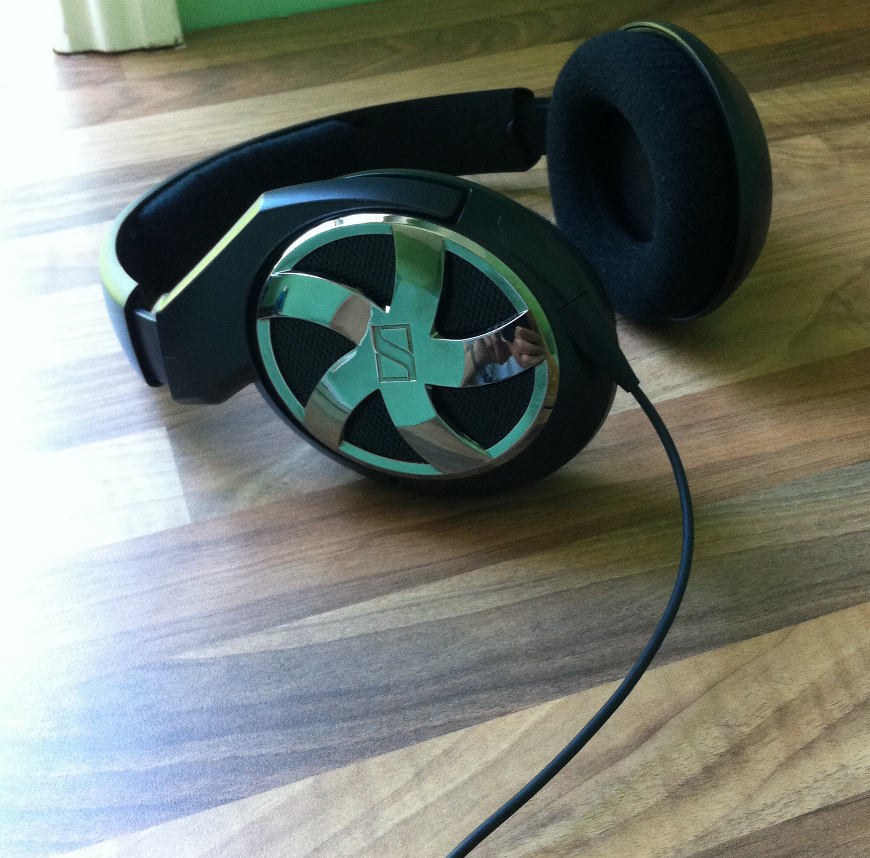
Sennheiser HD438 Sennheiser HD438
Last year whilst shopping for a birthday present for my dad, I took a chance on some ex-display headphones that were on sale at my local Richer Sounds. Up until then the best pair of 'phones I owned were some AKG-512 closed headphones. Otherwise I used a parade of low-end Sennheiser or Sony in-ear buds for listening on the move. The AKGs were a slight upgrade on the in-ear buds, but not much. They were noticeably bassier. Whether that was an improvement or not was up for debate. The Sennheiser HD438s are quite an upgrade on the AKGs. It's the biggest improvement I've ever heard when listening to my music. It's the first time I've ever noticed a significant improvement using different headphones, confirming that my ears are good enough to benefit from better equipment. Until then I simply wasn't sure. This goes to show that my existing equipment is not that great. No surprises there, but my lifestyle at the moment doesn't really have any room in it for anything better. I'm also glad I've amassed a nice music collection and discovered so much that I enjoy listening to before investing in the equipment with which to listen: I've heard new things in all my old favourites these these 'phones. Perhaps I will with a future upgrade, too.

Jon Dowland: FLOS UNIX

I just read this excellent blog post called "Linux Future" which defines a term "FLOS" to describe what the current direction of Linux development appears to be. Specifically, it addresses the divergence from what one might call the "UNIX" philosophy in new core technologies like systemd. I think sticking a new name to define this philosophical direction is a great idea. "FLOS" is something that both proponents and haters can rally around. It acknowledges the move away from the UNIX way of doing things, and doesn't overload a term like Linux, "ownership" of which is claimed by both camps (and others who just want to keep their heads down and get on with things!) The next step, after embracing it, would be to define the strategy and the roadmap. Where is FLOS going? What's the endgame? Perhaps with such a vision we may end up with some technologies which will stand the test of time, like Apple's CoreAudio (10 years old) or Microsoft's win32 API (now 20 years old), rather than the ludicrously high plumbing turnover we endure right now. (Oh my goodness, I finally wrote an actual Linux blog post.)

Jon Dowland: Possible future coding project

Re-implement ikiwiki, or something like it, in go. See how much the language's features and philosophy colour the design. In particular I'm wondering how much the first-class treatment of concurrency might change how you structure things: one thread per page, or hot pages... you'd want to approach it with lots of micro-locks rather than one big lock to rule them all. I can see some future ikiwiki refactoring work being a bit like the Linux Kernel's efforts to get rid of their big kernel lock. See also: Joey's proposed Haskell ikiwiki rewrite. I may be remembering wrong, but I thought he had some beginning code up somewhere. Perhaps I'm conflating it with John Goerzen's one-time OfflineIMAP rewrite, which might also be lost to the sands of time...

Jon Dowland: HD audio and more archiving

Having obtained a respectable set of headphones last year, I started pondering about high definition music. Could I hear the difference between a track mixed at CD quality, 16 bit samples / 44.1kHz sample rate, and the same track mixed at a higher bit or sample rate? A number of artists have made HD audio releases available in a variety of formats, most of which are now obsolete (see: SACD, DVD-Audio) and/or hard to demux to something more modern. However some artists have made digital HD audio releases. The last two Nine Inch Nails records were released in HD and are more readily available.
These releases also had nice per-track embedded art These releases also had nice per-track embedded art
"Ghosts - " had a standard-quality digital release but a high quality Blu-Ray release was also available, commercially. All versions were Creative Commons licensed, so people have legimitely demuxed the Blu Ray release and made it available in other formats. One was uploaded to archive.org, although it sadly lacks precise lineage information: "The Slip" was released in HD audio digitally. However, I noticed that nobody had uploaded the HD release to archive.org, and having developed an interest in archiving, I did: I tried performing some listening tests on my desktop computer, which has an M-Audio "Audiophile" 24/96 PCI sound card. However, in non-blind tests, I failed to distinguish the SD and HD versions of these songs. A friend suggested that despite the card's quoted rates, the signal-to-noise ratio was such that you wouldn't get high enough fidelity to play 24/96 properly. I can only take their word for it My preferred music player can only decode 24/44.1 but I recently learned that my phone, an Apple iPhone, can decode up to 24 bit, 48kHz. I decided to downsample the above two releases in order to try further listening tests on my phone. I uploaded both to archive.org: So far in non-blind tests I have not noticed a particular difference. Whether it's my equipment, my ears, these particular tracks or whether HD audio being audibly better than CD quality is a myth, I am not sure yet. I'm planning to do some proper ABX testing of various lossy codecs and bitrates prior to a major CD ripping exercise, so I may try proper ABX testing of HD audio at the same time. (I'm collecting together past and future log posts about archiving under the tag 'archiving').

Josselin Mouette: GNOME in Debian after wheezy

GNOME 3.4 for Debian wheezy is shaping up quite well. A handful of bugs remain to be fixed, but we are now in a polishing phase, as expected given the freeze status. With upstream introducing heavy changes in new versions, it is time to think of what will happen with GNOME when we introduce version 3.8 in unstable. Namely, there are two categories of changes that have a heavy impact on Debian: Upstream is not hostile to people working on making their modules compatible with these setups (non-3D, non-systemd). However, there is a limit to what the Debian GNOME team can do, and people have to make choices. The consensus in the Debian GNOME team is to focus the extra amount of work we can provide to the fallback code. We are already in touch with other distributions and people who are interested in keeping the differences with upstream GNOME minimal. Our common goal is to be able to provide a GNOME installation for all Linux systems, with or without 3D. However, none of us is willing to spend time on getting GNOME to work without systemd. We will not work actively against it either, but some components will certainly recommend systemd, and the functionality with other init systems will be degraded. So if people want to keep GNOME fully working on non-Linux systems, now is the time to start hacking on the missing pieces for this to work. For the time being, it does not look infeasible although we don t know what jessie will be made of.

Next.

Previous.