Search Results: "ema"

2 March 2007

Andrew Pollock: [opinion] On whacky spare tyre ideas

Russell Coker writes about not carrying spare tyres and relying on roadside assistance companies instead. I had a similar idea a while ago when I had two of my tyres slashed. I was carrying a viable spare, but with two tyres out of action, it didn't do me a lot of good. I got a tow to the nearest tyre place probably within a kilometre, but they had to order in the tyres to match what was already on the car, so I was left without a car for the remainder of the day and some of the next one. I thought it'd be a great business idea to be able to call up for roadside tyre replacement, similar to how you can "holler for a Marshall" when you get a flat battery. Incidentally, I've clearly been living here too long. I had to battle with myself to not write "tire" all the time.

1 March 2007

Paul van Tilburg: Space Efficient Algorithms

Last Tuesday I finished my paper about Space Efficient Algorithms and Histograms that will comprise most of the grade of my last remaining Master course, Advanced Algorithms. While I’ve been mostly enjoying writing this paper, I am glad it is finished for several reasons, one of them being able to do other things than just working on it and another is that it allows me to focus fully on my Master Project which is starting to progress nicely. (More about this later.) FOSDEM 2007 Due to the amount of time I needed to work on the paper, the need to save money (I really would like to go to Debconf7) and that the scheduled talks didn’t seem to interest me that much, I decided to break with tradition and not to go to FOSDEM this year. Just before FOSDEM, however, it seemed that lots of the people I would have liked to meet did go. While that was a pity, I hope to meet them in three months at Debconf7.

Enrico Zini: dpl-platform-keywords

Representative keywords of DPL platforms The DPL platforms are too long and you could use a very, very short executive summary? No problem, I have the technology for it. After the results you can find the kit to build yourself an extractor in the comfort of your home. The results Acquiring the data
for i in 93sam aigarius ajt hertzog sho sjr stratus svenl wouter
do
    wget http://www.debian.org/vote/2007/platforms/$i
done
Tokenizing
#!/bin/sh
for file in "$@"
do
    lynx -dump -stdin < $file   tr -c '[a-zA-Z]' ' '   tr '[A-Z]' '[a-z]'   sed -e 's/ /\n/g'   sed -e '/^$/d' > $file.tok
done
Extracting the most representative keywords
#!/usr/bin/python
import sys, math
def read_tokens(file):
    "Read all the tokens from one file"
    return [ line[:-1] for line in open(file) ]
# Read all the "documents"
docs = [ read_tokens(file) for file in sys.argv[1:] ]
# Aggregate token counts
aggregated =  
for d in docs:
    for t in d:
        if t in aggregated:
            aggregated[t] += 1
        else:
            aggregated[t] = 1
def tfidf(doc, tok):
    "Compute TFIDF score of a token in a document"
    return doc.count(tok) * math.log(float(len(docs)) / aggregated[tok])
# Output the top 5 tokens by TFIDF for every document
for name, doc in zip(sys.argv[1:], docs):
    print name, sorted(set(doc), key=lambda tok: tfidf(doc, tok), reverse=True)[:5]
Errata Jacobo suggests to use lynx -dump -nolist or w3m -dump for a more tokenizer-friendly text expansion.

Russell Coker: Mercedes S class and car safety

The S Class Mercedes has some really interesting safety features, see this 6.8M PDF file for details. If you are interested in technology then you want to read it just to learn about all the cool features - it's got more technology than a Prius!

The S class includes the following features to protect the occupants in the event of a crash:

The following features reduce the risk and/or severity of a crash:

After a crash there are more safety features that can help you:

These features are documented as being available in the latest S Class, I haven't investigated what is available in the cheaper models and I'm not even sure where to find information on the safety features available in older models (a second-hand E class is more in my price range). But if I won the lottery a S class Merc would be high on my list of things to buy!

If you know of other cars that have a similar set of safety features to the S class and cost less then please let me know.

I will probably write a blog post about the BMW safety features in the near future. I couldn't do so immediately because the BMW web site sucks. They have a form for me to fill in contact details so that they can post me a brochure (I want to read it NOW ONLINE). The form doesn't like my postcode and refuses to proceed (it should at least have an option for them to contact me via email or phone).

28 February 2007

Alexander Schmehl: The emanzipation of men - or: How to get your boyfriend to go shopping with you

Dear Ladies, if you'd like your husband / boyfriend to go shopping with you, get your shop to be at least a bit friendly to him. There is nothing wrong, if you need two hours to buy a new blouse. (Actually, I heard some men need some time for shopping, too, so that doesn't even count as "typical feemale".) There is nothing wrong, when your man has nothing to do... beside trying to find your clothes in an other size... or trying to figure out, if that color is apricot or peach, and if it would look good to something of the color pumpkin. What makes such trips horrible is that boutiques are often overheated (Well, that might be a must; they must not be too cold for a women to take her clothes of), narrow (How many clothes stands can you squeeze into a 10m2 shop?) and loud. If you want us to go shopping with you, go to a boutique, where a men can at least have a seat. Possibly with a water cooler nearby. That would make it a lot easier for us. A positive example is Eierund. They have some kind of "men and children area". Children will find comics and can watch movies, and men can read car and computer magazines (or steal the comics from the children). They even have sweet apples and a really comfortable couch. That's how you make your man enjoy going shopping with you! PS: Having a nice girlfriend, who doesn't take that long shopping helps a lot, too.

Ian Murdock: How about a Gmail Contacts API?

Since I’m on a Google kick these last few days, let me ask a question I’ve been kicking around in my head for a long time: When are we going to get an API for our Gmail contacts? Like scads of other people, I use Gmail as my primary mail “client” these days, and that means I want things like email autocomplete to work, which means Gmail has to know about my contacts (or at least their email addresses). Gmail actually has a really slick interface to contact management that I’d happily use as my main address book. Trouble is, it’s not synchronized with anything, most importantly my cell phone, where I also want that address book to be available. So, for now, I have to maintain two address books—one in Gmail (with just the email addresses), and one in my phone (with everything else). Invariably, it takes effort to keep them “synchronized”, and I’m not always successful at doing so. I was hopeful that the new “APIs to integrate with existing infrastructure” introduced in Google Apps Premier would finally address this shortcoming—after all, integration with corporate directories would seem to be a feature high on the “must have” list for any enterprise looking at Google. Alas, the APIs appear to only deal with single sign on and account provisioning, and do not appear to do any sort of deeper directory integration. With an API, Plaxo could presumably synchronize contacts between Gmail and phones (and Outlook etc.), or even better, someone could do over the air synchronization. There have certainly been a wave of interesting products doing similar things using the Google Calendar API. I’ve thought about doing a synchronizer with libgmail, by I’m not sure what would happen (e.g., would I somehow trip the “lockdown in sector 4” alarm, which given my reliance on Gmail, would be pretty darned disruptive). Thoughts? Anyone else in a similar situation?

Andrew Stribblehill: Nearly homeless

Okay, perhaps it’s a little exaggeration to say that I’m nearly homeless, since I have a perfectly nice house in Durham. However, since I’m working in Dublin this is not especially helpful for my weekday accommodation. If any reader has a room they could rent me near Grand Canal Dock, for around 400-450, please get in touch, perhaps by email. I don’t keep cigarettes or pets.

27 February 2007

Edd Dumbill: OpenID and microformats support on XTech site

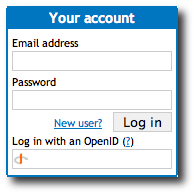
Thanks in no small part to the advocacy of Simon Willison, I've just OpenID-enabled the XTech web site. OpenID log in box on Expectnation Users can now create their accounts using an OpenID, or associate an OpenID with an existing account. A single-sign on solution like OpenID solves an important problem for us, as most people tend to interact with our conference web sites in only one or two time periods each year. While we've gone to the trouble of making retrieving a password easy, there's still the mental burden on the user of setting up the account and noting it down somewhere. As a measure of the impact of this on me personally: I habitually save registration confirmation emails in a certain mail folder. Since 1997 I have collected no fewer than 572 of these, and I'm sure some have been missed! One other cool thing about OpenID is that finally I can get the identity I wish to have. No longer do I have to be a compulsive early adopter of every service just to get the name edd. (Well, as long as said service integrates OpenID of course!) Personal branding is an important attractive aspect of OpenID.ImplementationImplementing OpenID using the Ruby ruby-openid gem was quite straightforward, as was the logical integration into our user models. I've not been the only one following this path recently, as illustrated by this post on Rails OpenID integration from Dan Webb.The harder problem of deploying OpenID lies in making the user interface work well: ultimately that will have a huge influence over its uptake. We've made a decent first go of it in Expectnation, but I'm sure we'll evolve and improve it over time. The main puzzling thing is how obvious to make the OpenID facility, given its relatively small take-up right now. We don't want to confuse normal users too much by using it. Microformats When I did my behind-the-scenes piece on the building of the XTech schedule last week, one feature I didn't discuss was the support for microformats we have in the schedule and on the session pages. If you use a tool such as Operator, you can easily save talk times to your calendar while reading the schedule.
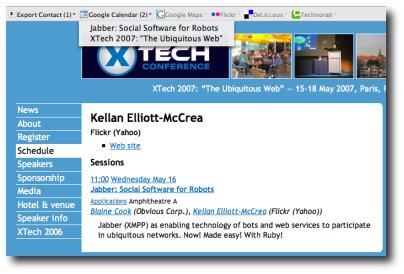
XTech schedule microformats I'm personally a little late to the microformats party. Being a fan of pragmatic RDF, I didn't see much need for microformats right away. However, with tools like Operator I can honestly say that the use of microformats does enhance the XTech schedule.My impressions of microformats (in particular hCalendar and hCard) from using them are mixed. One the plus side, it was very easy to do. On the negative side, I found them restrictive in the sense that for the metadata to be present in the hCalendar object, it needs to be part of the HTML presentation.So, while microformats are meant to be about making human readable data useful for computers, they can have a tail-wagging effect on the human markup. Let me elaborate. In the conference schedule there is a grid overview. For readability here we want to keep the details down to a minimum in each box. There is definitely no need to repeat the date of each presentation when you can see there's a grid per day.But also we want to have microformats available in the page so users can use the grid to pick off talks to add to their calendar. The only details you currently get from the microformat are those you physically include inside the div marked as vevent. This means we can't embed the full details, such as the talk description. It also means I indulge in some dubious markup practices (an empty abbr element) in order to get the date and time into each hCalendar object.It seems to me that this could be ameliorated by more intelligent user agent behaviour. Each of my hCalendar events is given a URL. At the end of that URL is a full description of the event, using microformats. So, as long as I reference the URL in a summary page, the user agent can beetle off and pull down the full information, in much the same sort of way that FOAF uses the rdfs:seeAlso property.So, remove the expectation that microformats provide complete data, and I'm sold.Other schedule features: iCal, Upcoming.org
Of course, we have iCalendar support in the XTech schedule, so you can subscribe conventionally using iCal, Evolution or a similar program. Aaron Straup Cope took the iCalendar, and uploaded each event into Upcoming.org. If you look at the upcoming events tagged xtech07, you see the results of his work.This foreshadows some of the social elements we plan to add to Expectnation itself: indicating your intent to attend a talk, and adding comments to it. As a program chair I'm finding this quite fascinating to watch.

Erich Schubert: Driver woes

I always liked pretending that nowadays, there are no driver issues with Linux (well, except for ATI and NVidia not releasing specifications, so for some of their product there are no good drivers available). Well, thats not entirely true. Just these days, I've been running into some driver issues with my Intel hardware; and Intel recently has been the favourite of Linux developers for actually publishing driver source code under a free license. Some details on the driver issues I had: IPW3945 wireless with WPA on dual core. Apparently, there is some kind of race condition in the dual core setup under load, when two interrupts end up being handled by different CPUs. The WPA path probably is a bit slower, I read that theoretically it should also happen with WEP. The effect is as this: when transferring data quickly, e.g. from a local machine on a WPA encrypted network (such as my parents wireless; basic WPA via the common AVM Fritz!Box), it will drop the connection every minute or so, and take another minute to reconnect. Obviously, that makes the wireless rather useless... This is what the errors looked like:
TKIP: ICV error detected: STA=...
N/A: Michael MIC verification failed for MSDU from ... keyidx=0
wifi0: MSDU decryption/MIC verification failed (SA=... keyidx=0)
TKIP: received packet without ExtIV flag from ...
Upgrading to Kernel 2.6.20 turned these errors into something like Firmware bug detected; reconnect already was a bit faster. Upgrading the firmware past the Debian-packaged (in non-free) version to a newer one change them again (I think the ICV error remained) and made the reconnects even faster; still large transfers don't work reliably with WPA. Another reason I upgraded to 2.6.20 was that the microphone didn't work on my Dell 640m. The upgrade helped here, I now can record from my microphone. Every now and then, my system kind of freezes on resume; it seems that some interrupts (especially the keyboard interrupt) remain disabled... I also tried the newer i810-modesetting driver, that should be able to handle the 1440x900 resolution without the aid of i915resolution (which basically overwrites part of the video BIOS to add the resolution to the supported resolutions list). The screen remained black (with both unstable and experimental versions of the driver). Another reason why I was trying this driver is that the current driver has like a default gamma 1.5 for XV, apparently - all XV using apps playback videos way too bright. Even if they don't have an XV gamma control. Well, on the other hand, thats what Windows users might be exposed to every day. 99% of the time, everything works fine for me, too. It just remains open whether 2.6.18 is actually the right kernel to use for the upcoming release... 2.6.20 improved on some of my issues. On the other hand, yaird failed to make a proper initrd for my computer, because CBC (cipher block chaining, a common choice if you encrypt your harddisk) became a module and wasn't added. There are just so many details to iron out when upgrading the kernel... that would pretty much mean an unfreeze, I guess. :-( If we would release more often, that wouldn't be as essential, but for a release interval of two years, we really should have a kernel with few driver issues. And even if we're going to ship newer kernels with "dot releases" of etch, we'll have to avoid issues such as the CBC-module being unknown to yaird.

26 February 2007

Biella Coleman: Critical Mass in Computing

Social Studies of Science just published an article by on the importance of reaching a critical mass for recruiting women to study computer science. Below is the abstract: The Strength of Numbers
Strategies to Include Women into Computer Science
Vivian Anette Lagesen Vivian Anette Lagesen, Norwegian University of Science and Technology (NTNU), Norway, Vivian.Lagesen@hf.ntnu.no This paper investigates four different inclusion strategies used to recruit women to computer science: achieving a critical mass, educational reform, redefining the gendered symbolism of computer science and changing the content of the discipline. The relationship between and the relative importance of these four strategies are explored by looking at the extensive and successful Women and Computing Initiative (WCI) that was run by the Norwegian University of Science and Technology (NTNU), starting in 1996, to recruit and retain more women in computer science. The findings suggest that a direct effort to increase the relative number of women is the most important strategy. While raising the number of women recruited seems to affect the symbolic perception of computer science, this effect is difficult to achieve through attempts to directly change the symbolic image of the discipline. In addition, a substantial increase in the number of women appears to cause an improvement in their learning environment, probably because minority problems such as too much visibility and unwanted attention became less prominent. Key Words: computer science critical mass gender higher education inclusion

Neil McGovern: UK Government reconfirms commitment to "no software patents"

A while ago I signed up to a petition against software patents on the Prime Minister's e-petitions website.

I received a email today, with the Government's reponse:
The Government remains committed to its policy that no patents should exist for inventions which make advances lying solely in the field of software. Although certain jurisdictions, such as the US, allow more liberal patenting of software-based inventions, these patents cannot be enforced in the UK. [snip]

This was certainly a welcome surprise.

Thijs Kinkhorst: Back from FOSDEM

I've returned from FOSDEM in Brussels. Joost drove Jeroen, Christiaan and myself to Eindhoven where we took the train to Utrecht. FOSDEM has been a success again. The event has grown even bigger, still the FOSDEM team managed to create a good event nonetheless, thanks! Meeting up with the Debian crew again, both the usual suspects and new faces, was one of the highlights. The Debian booth has been popular, with the T-shirts in good demand; on Sunday morning I could only offer people the choice between S and XXL sizes. The Debian room had a diverse selection of interesting talks. Holger introduced Debian-Community.org, which I see as a useful initiative to provide recognition aswell as visibility for what already happens. To the Anonymous who returned me my lost backpack: thanks! I'm now off to sign all those keys.

25 February 2007

Biella Coleman: Lancet, Medicalization in the 21st Century

So I was alerted to this collection of essays in The Lancet on Medicalisation in the 21st century. The line-up of folks are some of my favorite in the field (Nancy Tomes, Nick Rose, Jonathan Metzel) and it is good to see this discussion happening in the medical journal. Sadly it is not open access but if you really want to read them and don’t have access to the journal, just ping me, and I am sure I can make something available.

Biella Coleman: Grave Food vs Flowers

“A plains Indian had just placed food on a new grave, when a whilte man looking on jocularly asked, “Do you expect the dead man to come up and eat that food?” To which the Indian responded, “As soon as your dead come up to smell the flowers you place on their graves” [Story told by anthropologist Margaret Mead, and which I read about this morning (and laughed, seriously) in Taking Laughter Seriously by John Morreal]

Biella Coleman: New(ish) collections on commons, openness and space

In the shade of the commons, to download go here Open Hybrid Space

24 February 2007

Jurij Smakov: Debian kernel configs

For a while now there has been a small but consistent demand for a simple way to obtain the kernel configuration files, used to build official Debian kernel packages. I’ve been working on a solution for that problem, and I think by now it’s working reasonably well to announce it to the world :-) . Ladies and gentlemen, without further ado I bring you the Debian Official Kernel Configuration Files. It works by scanning the archive nightly for new linux-image and linux-modules packages and extracting configs from them. If you have any comments or proposals on how to improve it, feel free to contact me by email.

Christian Perrier: fr: 99.928%, cs: 93.662%, de: 83.009%, sv: 80.372%, vi: 77.949%

Nearly no change today. Le Grand Soir est pour demain (fingers crossed) Today's uploads: mserv, shaper, tftp-hpa. Some work on geneweb as the 5.0 release will happen soon (too late for etch). I'm also doing some work on i18n.debian.net, re-writing some scripts I stupidely lost on the server....

Ian Murdock: You do back up your data regularly, don t you?

Phil Wainewright: “So here is a selection of news stories culled from the past few months that allow us to objectively evaluate what happens when users ‘have total control over things like privacy and security’… […] Would any of those laptop thefts made the headlines had the data been stored in Google Apps? No, of course not, because the data would have remained inaccessible on Google’s servers.” Great points. A little closer to home, how many times have you taken a call from an anguished family member who has just lost their data but who hasn’t heeded your advice to back up said data periodically? While we’re at it, how many times have you not heeded your own advice on the same subject? Could the SaaS providers possibly do any worse than we’ve been doing here? Granted, there needs to be a culture change, one that needs to happen on both sides of the transaction, to make this work. But it will eventually happen, because it Just Makes Sense.

Andrew Stribblehill: Laphroaig quarter-cask

We went to Scotland on a family holiday this week (brave or stupid, answers on a postcard). You would not believe the number of puns you can get from the simple town of Ayr. For example, R: “You should have turned right there!” Me: “Oh well. To Ayr is human.” I shall spare you the rest: if your mind isn’t already overflowing with similar appalling jokes, you’re no friend of mine. Whilst in Ayr, I came across a marvellous whisky shop, Robbie’s Drams, and bought a bottle of Laphroaig quarter-cask and another of Smokehead. This article, or what remains of it, is to describe the Laphroaig quarter-cask whisky. Should you wish to avoid the Flash-animated website, here’s a precis. Tales are told of a time when the business of Laphroaig was carried on less than legally and it was useful to carry away smaller casks when the Excise men were coming than the more conventional full-size casks. Over the past few years, they have tried their best to recreate the whisky that would have been drunk as Laphroaig a couple of centuries ago: quarter-sized casks, slightly higher strength and an older filtration model. The effect of the smaller barrels is to increase the surface area to volume ratio substantially, so more flavour will enter the whisky from the barrel. Thus, they bottle it much younger than their standard ten-year-old offering. To smell it, a sweet smell hits the nose — perhaps toffee apple. On the taste, there is an initial earthy sensation followed quickly by a brief flash of kedgeree, leaving the smoky aftertaste of turmeric at the back of the throat. This is a much more subtle whisky than Laphroaig’s ten-year-old: thinner and less oily, and with a much more delicate, though still substantial, peaty hit. Because it’s not chill-filtered, the whisky becomes delightfully cloudy when water is added. I recommend that you try it both with and without additional water: many of the flavours become more muted with water, but a creamy taste comes to the fore. In summary: if you can get your hands on a bottle or two of this, it’s well worth doing so. An excellent whisky. I should also say that even if you’ve disliked other Laphroaigs in the past, give this a shot. It may just be your way into the other delights from the Laphroaig distillery.

23 February 2007

Biella Coleman: On Mole-patrol

So last year as I entered the job market, I posted less “personal” blog entries and have more or less kept with the tradition except with the occasional post, especially when it concerns my mom. Right when I moved to Canada, I broke with this tradition and wrote a longish entry about my moles which I thought of as a public serive announcement to get people to go on mole patrol, because really, that is the only way to deal with recalcitrant moles. Of course, I am on constant mole-patrol and a day before I left Puerto Rico, as my sister moved her hair away from her neck to pull it back, I noticed a funky looking mole. Now, it was not all that weird but a little weird and I was like, go go go to the dermatologist and check it out. It took a few weeks to get an appointment and then they took it out, bioposied it, and indeed, there was melanoma. Everyone was shocked because, well it is shocking news to get and if anything, I thought the mole would have abnormal cells like mind did. She thankfully was pretty calm throughout the whole process (I attribute it, in part, to the fact that she does not spend too much time on the Internet, where you can arm yourself with a lot of good, but often downright frightening information). A few days ago, after a battery of tests, we found out that the melanoma was very small and contained and they had taken everything out. So for now, we are on the clear but it means constant mole partrol for her and I… Melanoma runs in families and as kids we also ran around on the beach so this issue is not going to go away. But I guess it is good that I had my scare in August, otherwise I would have never given her mole a second thought. I probably would not have made myself stare as I did at her hidden moles, every chance I had. So anyway, again, go to your dermatologist and check your moles. Or at least go on mole patrol. It is well worth the hassle…

Next.

Previous.