Search Results: "cas"

1 September 2007

MJ Ray: Vuelta a Espa a

Eurosport are broadcasting the Vuelta a Espa a at 19 east from today with commentary in English (analogue only) and German. Scheduled times:-
Sat 01.09.2007
16:30-17:30 CET
Sun 02.09.2007
16:00-17:30 CET
Mon 03.09.2007 to Thu 06.09.2007
16:30-17:30 CET
Fri 07.09.2007 to Mon 10.09.2007
16:00-17:30 CET
Tue 11.09.2007
no show (MTB at 08:45)
Wed 12.09.2007
16:00-17:30 CET
Thu 13.09.2007
01:00-01:30 and 15:45-17:30 CET
Fri 14.09.2007 and Sat 15.09.2007
16:00-17:30 CET
TVEi are broadcasting at 13 and 19 east. Scheduled times:-
Sat 01.09.2007
16:40-18:00 CET
Sun 02.09.2007
16:40-18:30 CET
Mon 03.09.2007
16:35-18:00 CET
Tue 04.09.2007 to Sun 09.09.2007
16:40-18:00 CET
I'll post more times next week. I'd bet on a strong showing from Caisse d'Epargne after a relatively quiet TdF. Who would you tip? If you've not got your satellite set yet, some Lidl specials are still available and most Maplin branches have sets. Finding the broadcasts at 19 east is pretty easy in the UK. See my asteFAQ for hints and links. I've still not fixed my dish up properly, yet it gets most 19 east transmissions.

Russell Coker: Hot-swap Storage

I recently had to decommission an old Linux server and replace it with a new machine. When I was about to turn it off I noticed a power cable of the type used for IDE hard drives leaving the Linux server and entering an NT server that was in the same rack! It turned out that a DAT tape drive used for backup had been shipped without a power cable and they had been forced to take power from another machine. Incidentally is this likely to risk hardware damage? So I had to take the NT machine down to fix it. The new cable had arrived so all I had to do was install it. One thing that wasn’t mentioned on the documentation was that the cable was designed to operate as a double-adapter and replace an existing cable. Once the phone support people had explained this (IBM support is really good - they solved the problem well within the SLA) I was able to correctly wire it. However correct wiring in this case meant having a power cable go through the side of the storage bay and a SCSI cable came from the back of the case underneath the cooling fan assembly (something like 16 separate hot-swap fans in one assembly that can be removed for maintenance). The DAT drive took up space that could otherwise have been used for three hot-swap SCSI hard drives. What I would like to know is, why can’t they make hot-swap DAT drives that use the same power and SCSI connectors as the hard drives? I don’t expect a DAT drive to be any more reliable than a hard drive, and when the system backup is mission-critical then down-time is required for a replacement. Not to mention the effort involved in the installation, my fingers are significantly longer than average, I can’t imagine how anyone with average size hands could complete the job! So IBM, congratulations on the great phone support. But please try and make everything hot-swap when designing servers. Also while on the topic, I think that servers should be designed with external DVD drives connected via USB. I really hate it when I’ve got 10 * 2U servers in a rack, my system performance is limited by the number of disks and every single server has space that could be used for at least one disk sitting idle because there is a DVD drive gathering dust. For the IBM 2U servers in question, they could design them with space for 12 disks or 9 disks and one DAT drive which were all hot-swappable if they were smart about it, the current design supports 6 disks or 3 disks and a DAT.

Simon Richter: Me, myself and I

Some people have hinted that while my blog started out with the occasional bit about my life, or at least a personal opinion, during the last months it has all been technical content, and most of it rants about a particularly stupid piece of technology. So, I guess I need to get a life (again). NP: Kylie Minogue - "Disco Down"

31 August 2007

John Goerzen: The Story of One Barn

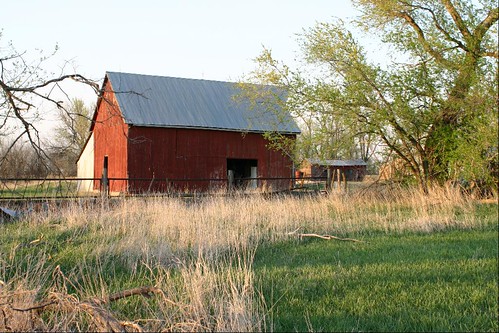
img_2575

About 80 years ago, a Kansas family -- the Janzens -- built this barn.

About 60 years ago, my grandparents moved onto the farm. Their cattle were kept right here. I remember Grandpa's red tractor being parked in the barn.

So many memories have this barn in the background. We had a visit from one of the Janzens that lived here as a child. He had fond memories of this building. My dad and his siblings once played in the deep snow in front of this barn.

Here's one memory from those times:

078.jpg

That's my grandma and grandpa on their 25th anniversary in 1970. It was a working barn back then, so they probably weren't standing right next to it for this picture, if you get my drift. But they were on the yard.

About 25 years ago, Grandma lost her battle with cancer. At some point or another, Grandpa had eased out of farming, so the barn had a lot less activity. I remember exploring his outbuildings when I got bored at family gatherings. And I used to mow the lawn next to it every summer when Grandpa went off to be a cook at a camp. I didn't mind mowing next to the barn. But I always tried to go past one corner of the house as fast as I could, because there were wasp and hornet nests right there.

About 7 years ago, it was time for Grandpa to move off the farm. It was getting to be too much to keep up the old house, the barn, the yard, and deal with things like freezing water pipes and water getting in through the windows. He moved to an independent-living duplex in town. He was always worried about what would happen to the farm. Over the next few years, the farm would sometimes be vacant, sometimes have renters. Some renters did some work on the house, but the barn sat. Grandpa would eventually move into the nursing home because of his Parkinson's.

Two and a half years ago, Grandpa passed away. I shared some memories from Grandpa's place at the funeral.

But what of the house, the farm now? Renters went, and it sat empty. Nothing was in great shape, and the house needed a lot of work. Perhaps the whole place would be leveled and turned back into the prairie that it once was, or used as farmland. Perhaps someone would have an interest someday.

A year and a half ago, Jacob was on the way. Terah and I had occasionally thought of buying Grandpa's place, but we never talked about it seriously. We figured that we better finally decide what we're doing, before we have a baby around, or a child in school. So in April 2006, we went out to the farm and checked it out. The picture at the top of this post is from that visit. Terah and I checked out the house, the barns, the granary, the pasture, and the creek. As we walked past one of the barns, a pigeon flew out. Terah jumped with a shout. I grew up around barns and didn't really notice it. In the big red barn, besides Grandpa's tractor, we found some remnants from years ago: some old bales, corn cobs that raccoons had found long ago, several generations of electric fencers, old appliances.

And we decided to go for it and buy the farm. This was right at a year after Grandpa died.

The family always liked to get together for Easter. What would happen for 2006? Well, they decided to have a picnic out at the farm. It was vacant, and a bit eerie. Yet they knew that we were working on buying the place and moving in. All but one took a last look through the house before our renovations began. The one person who didn't was my great aunt, Grandma's sister. She said, "I haven't been in this house for years. I remember how it looked back then. I don't want to remember how it looks now, run down like this. So I'm not going in. But once you have it all fixed up, THEN I'll go in!"

In June of 2006, we bought the farm.

One month later, we lost this barn, and two other buildings, to a fire at our yard. This is what the beautiful red barn looked like that sad afternoon last year:
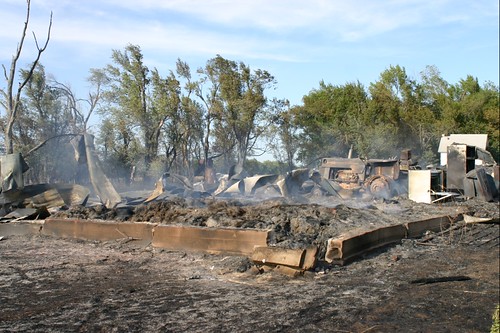
IMG_3630.JPG

As I wrote back then, nobody got hurt, the barn was insured, but "somehow, despite all these things, it still feels like we lost a little bit of Grandpa today."

2006 was a hot, dry summer. We had a patch of debris, then a patch of dirt, where the barn once stood.

7 months ago, Terah, Jacob, and I moved out to the farm. For the first time in 80 years, someone could stand in the farmhouse in the evening, look to the west, and see the colorful Kansas sunset over the pasture; the trees down by the creek; and even the neighbor's barn off in the distance. It was a beautiful sight, but it was also sad; that's not the view we had expected.

But then a surprise. This spring and summer, plants started coming up where none had grown for 80 years. But only where this barn stood -- not where the other two buildings were.

We watched as they grew tall. I'm sure decades of animals hanging out there were well appreciated by the plants.

As they grew, it looked like we might be seeing Terah's favorite flower: wild Kansas sunflowers.

And sure enough, they were.

Last weekend, Terah, Jacob, and I went out to the old barn. I took some pictures of its new appearance.

img_3429.jpg

This one stands where Grandpa's tractor used to be parked.

img_3401.jpg

And here we see a lifetime of flowers, from the old and withering, to the young just about ready to bloom.

img_3462.jpg

At the edge of the sunflowers, there's an old plow next to them. Though you might think it's barn-colored.

img_3411.jpg

Animals continue to be attracted to the area. Here's one of the smaller visitors.

img_3447.jpg

And here's a picture of almost the whole patch, right where the barn used to stand. I still mow right up to it.

I still miss the old barn. But somehow it still seems to be full of surprises and worth exploring. I wonder what next year will bring.

And I wonder if, a few years from now, Jacob will tell his friends about mowing right up to the sunflower patch, going fast to try to avoid any trouble with the bees.

30 August 2007

Steve Kemp: I gotta be cool relax, get hip

Fighting Spam Lots of people get spam and don't want to fight it themselves. Many of those people elect to use a service such as Google Mail, which does an adequate job of filtering most of the time. For people who wish to host their own mailservers, and off-load their anti-spam support to another entity, there are big companies such as MessageLabs. But if you can't/won't pay for somebody else how would you handle it? Right now I run my own mailserver and mostly it rocks. However I also manage a couple of servers for other people, and this mostly means that I have identical configuration(s) scattered across other machines. (Or as I recently discovered "mostly identical" setups scattered across N hosts.) After viewing a recent thread upon the forums of my employers I'm wondering how hard it would be to setup an anti-spam mail host. The idea being that users of domain example.org would continue to run their own mailserver (+optional POP/IMAP server). However this server wouldn't be listed in an MX record. Instead the MX record would point at the antispam server, which would then process and forward the mail on. (I'm assuming that the mailserver at example.org would be firewalled such that it would only accept SMTP connections from the anti-spam host). The only challenges I see would be: The last one is the killer point which makes me wonder if I'm wasting my time on the general case; I don't believe I could persuade people to pay for such a service (on the grounds that I wouldn't!) and if ever a mail were dropped I'd be the first person who would be blamed. And probably rightly so. The simple solution would be to always accept mail - but just tag it. Then you still have the same issue, but you have the excuse that "I still delivered your mail; just tagged wrongly". The downside of that is that the recipient still has to filter the mail; and still eats the bandwidth cost. The main gain is the lack of spam-processing CPU that is eaten locally. Anti-spam, and to a lesser extent anti-virus, topics are very interesting to me, and I'd love to hear any thoughts - or even what you use for yourself. Right now I'm 50/50 on setting up my main mailserver as the proxy for a few domains I have to manage (family, friends) to see how it works, but I'm not quite convinced yet. (Single point of failure == bad. Though centralised configuration == good.)

Miriam Ruiz: Finally Gnash 0.8.1

The 4th and hopefully last alpha version (I expect the next one to be a beta) of Gnash, the GNU’s free Flash player has been released yesterday. There are many important changes, but the most relevant thing you’ll notice is that it’s by far more stable than the previous one. Gnash supports right now the majority of Flash opcodes up to SWF version 7, and a wide sampling of ActionScript 2 classes for SWF version 8.5. The program is still under heavy development and Flash version 9 and ActionScript 3 support are also being worked on. Debian SID has right now one of the latest release candidates for this version, and 0.8.1 will probably be in the repositories soon. As it is expected that in one or two versions it will be able to select between the different possible backends, we’ve decided to have just one package with pre-selected options in the repositories. AGG is probably the most conservative version that will work for everyone, and even though OpenGL might be better for certain graphic cards, we’ve decided to play safe. In any case, I’ve also made some unofficial packages for those who want to try different configurations of Gnash, like, as I said, using an OpenGL backend.

Joachim Breitner: Haskell Syntax Gem

Often when creating text from a program, you encounter this situation: You have a value, e.g. first_name, that might be empty (depending on your programming language, this means undefined, NILL, None, nil or Nothing) or contain a string. In the latter case, you want to surround it by some markup, in the former you want to do nothing. Here is how I d code that in Template::Toolkit:
<table>
[% IF second_name %] <tr><th>Second name</th><td><b>[% second_name %] </b></td></tr> [% END %]
[% IF first_name %] <tr><th>First name</th><td>[% first_name %]</td></tr> [% END %]
</table>
And here in python:
output = "<table>"
if second_name:
output += "<tr><th>Second name</th><td><b>%s</b></td></tr>" % second_name
if first_name:
output += "<tr><th>First name</th><td>%s</td></tr>" % first_name
output += "</table>"
I really don t like entering each variable name twice, when I basically want to do one thing with it.Here is how you can use Haskell s flexible syntax to help you out. First we define a unconditional insert here operator ++!++ and then a conditional one, named ++?++:
(++!++) :: String -> String -> String -> String
pre ++!++ post = \ins -> pre ++ ins ++ post
-- Or more haskell-style:
-- pre ++!++ post = (pre ++).(++ post)

(++?++) :: String -> String -> Maybe String -> String
pre ++?++ post = \ins -> maybe "" (pre ++!++ post) ins
-- Or more haskell-style:
-- pre ++?++ post = maybe "" (pre ++!++ post)
Note that the first line of each function, the type declaration, could be left out as Haskell can figure it out by itself. Also note that these function are not restricted to strings (as lists of characters), but can be used for any kind of list.Now I can write the code up there as:
output = "<table>" ++
         ("<tr><th>Second name</th><td><b>" ++?++ "</b></td></tr>")  second_name ++
         ("<tr><th>First name</th><td>" ++?++ "</td></tr>") first_name ++
         "</table>"
I think that s a nice display of the flexibility of Haskell s syntax, in this case, using symbols for function names and infix application.

Pablo S. Torralba: Shell date and time tricks

One of the things I hate the most when programming is dealing with time and date functions and all the special cases which exists. Even more, I have the feeling I'm walking a path many times walked before, so it becomes one of the most unpleasant tasks for me.

Fortunately, it's true, so many others walked before that path so here are some quick tricks for shell programming using the wonderful date UN*X program:
  1. Converting epoch:
    1. From epoch to anything else: date -d @$epoch_value +FORMAT (where FORMAT is of course as described on date(1), and '@' makes the actual undocummented trick).
    2. From anything else to epoch: date +%s
  2. Calculating times
    1. One day forward: date -d "1 day"
    2. One day backwards: date -d "1 day ago"
    3. Just imagine "1 month", "3 months ago" and the like. Not only google is so friendly with human language ;-)
  3. More format conversion: '-d' option accepts several other formats as input, even with calculations:
    1. date -d "1977-08-19 30 years", yeah! my 30th birthday was on sunday. Thanks date, and it was (as epoch): date -d "1977-08-19 30 years" +%s... 1187474400 :-D
    2. Funny ls:

      ls -l while read perms links user group size d t name
      do
      echo $perms $links $user $group $size $( date -d "$d $t 1 day" ) $name
      done
      You can, of course, change the way date is shown. That's because 'YYYY-MM-DD hh:mm' is also a valid input format for date as it is 'YYYY/MM/DD'.
So '@', '1 day' and 'date' saved me the day.

Update: This features and more are indeed described in the coreutils info manual. Thanks mp for pointing it out.

Enrico Zini: gpl-and-business-faq

GPL and Business FAQ I sometimes happen to be in a dialogue like this:
X: According to GPL, you can sell copies of your software at any price you want, right? Me: Right. X: But your customers can in turn sell copies of your software at any price they want, right? Me: Right. X: So, the only way a GPL developer can make money is by charge for development of their software? Me: Not only for development: also for maintenance, improvements, customisation, installation, training, gadgets, support...
The market is quite big, actually. In fact, one can even make business by selling the software in a box, if one makes a box that people would like to have (for example, including things like useful documentation, a few gadgets, a support contract and a pony). The idea is that the business of selling software alone is a useless extortion that provides no particular benefit to the user (and in many cases, no particular benefits to the developer either). If you put that aside, there is a plethora of ways to charge the customers more, and for things and services that are useful to them and make them happy. Actually, if you develop a GPL software for someone who is then happy about it, they may then pass it on to other people in the same sector. Who then maybe need help with installation, support, maintenance, custom features, training, gadgets and ponies. If your software hits the spot, a niche market can end up growing by itself. The last discussion on this topic then ended up with another question:
X: Ok. But to do a good job you have to be many people at once: for example you sometimes need to be a sysadmin as well as a developer. Me: Yes. Being many people at once is what starting a company is all about.
He complained that answers like these could not be found in the Selling Free Software article of FSF: in the meantime I'll publish them here. The license of this post is GPL. The FSF and any of their regional chapters are welcome to use all or part of this text, with or without modification as they see fit, alone or included in documents that use any license they see fit, even some of the not really free ones they use sometimes, such as the one used by Selling Free Software itself :-P

Enrico Zini: procmailrc-trap

Procmailrc, TRAP and LASTFOLDER I use procmail and lbdb. lbdb is invoked at the beginning of procmailrc harvesting From: addresses from all incoming mail, so that they can later be queried with mutt. It's really neat. However, if it's put at the beginning of procmailrc, it harvests From addresses from spam, too. This causes the ldbd databse to become very big, slow to query, and in some unlucky cases, to return lots of bad results. Problem is, I run the spam filter AFTER I delivered to the mailing lists. The rationale is that mailing lists already do their own spam filtering to some useable level. At least those I'm subscribed to. So, my current procmailrc goes like:
feed a copy through lbdb
filter list 1
filter list 2
...
filter list N for N very big
filter out spam
deliver to inbox
Now, is there a way I could invoke lbdb for every mail except what is caught by the spam filter? A way, I mean, that doesn't involve hooking into each and every of the N list rules an lbdb invocation? Here is the way. In .procmailrc, add:
TRAP=~/bin/scan-nonspam
Then write ~/bin/scan-nonspam:
#!/bin/bash
if [ $ LASTFOLDER:0:4  != 'spam' ]
then
    /usr/bin/lbdb-fetchaddr
fi
exit 0
For reference, this is the documentation of TRAP:
When procmail terminates of its own accord and not because it received a signal, it will execute the contents of this variable. A copy of the mail can be read from stdin. Any output produced by this command will be appended to $LOGFILE. Possible uses for TRAP are: removal of temporary files, logging customised abstracts, etc. See also EXITCODE and LOGABSTRACT.
And this is the documentation of LASTFOLDER:
This variable is assigned to by procmail whenever it is delivering to a folder or program. It always contains the name of the last file (or program) procmail delivered to. If the last delivery was to several directory folders together then $LASTFOLDER will contain the hardlinked filenames as a space separated list.

Theodore Ts'o: On the benevolent dictator model

Recently, Josh Berkus blogged about The Myth of the Benevolent Dictator. In it he complained about people who try to posit that a benevolent dictator was "an unalloyed asset" to their project, and that there were many successful and valid forms project governance other than the singleton project leader. Furthermore, he argues that the best way is to form a community, and then ends by suggesting that people who say "dictatorship good" is really saying "democracy bad", and perhaps the motives of the person using that argument should be questioned.

Given that I was one of the first people (and probably the first person) to use that phrase to describe Linus's governance model, obviously I feet the need to respond to his thoughts on the matter.

First of all, the term "benevolent dictator" comes from an old saying, "the best form of government is the benevolent dictator --- there's only one problem, finding the benevolent dictator"[1]. And in my presentations where I explained the Linux project management model, I was always careful to say that there were other models that were used by other projects, and that it was interesting to study why certain management models worked for some projects but not others.

So by definition, if a project is successful with a single project leader ultimately responsible for making decisions to settle conflicts, then that leader is a "benevolent dictator"; if they aren't successful, then that would be an example of a dictator who wasn't able to be "benevolent", eh? :-)

In all seriousness, though, I agree with Josh when he says that the key part of an open source project being successful is gathering together a healthy community. But let's unpack that a little. In order for a community to be healthy, there needs to be general consensus on the values and cultural norms for that community. So for example, in the case of Debian, which Josh holds up as a successful community, not everyone has the ability to vote; you have to pass a fairly stringent process which tests your technical skills and your willingness to subscribe to Debian's core values as embedded to the Debian Social Contract. People who do not pass the New Membership process do not have the right to vote in Debian, even if they are the most rabid, fanatical users of Debian.

This brings up a key point about governance analogies; they all don't map cleanly into the real world for two closely related and extremely important reasons: (1) No one has a fundamental human right to be a member in some OSS project, and (2) No one is forced to stay in a particular OSS project. These are really two sides of the same coin, and what it means is that, as in Debian, "democracy" does not mean that everyone is entitled to political franchise, or the right to vote, and in a project which has a "benevolent dictator", the powers of the dictator is fundamentally limited by the simple fact that if he is too unreasonable, people are always free to leave or fork the project. These differences are extremely important when trying to reason about "democracy" or "dictatorship" as being good or bad as applied to open source projects.

Democracy is rarely the best way for an open source project to make decisions. For technical issues, you want the right answer, and majority vote isn't necessarily way to resolve a technical issue. As far as policy decisions, if the decision can not be made by consensus, then some percentage of the community will be unhappy with how the decision, and that can cause a huge amount of arguments and dissension. If the community has very clearly expressed values, then the number of times where such votes need to be made will be minimal.

For example, Debian has an explicit declaration of its values and mission in its Debian Social Contract; people who don't agree to the Social Contract aren't allowed to become Debian Developers and thus are not allowed to vote. But, one of the more controversial disputes that have threatened to tear apart Debian is the question of the non-free packages, and that's fundamentally because of an ambiguity in the Social Contract. On the one hand, Debian has declared that it is fundamentally 100% about Free Software, to the extent that it has adopted Richard Stallman's rather petulant request that the Linux operating system be called GNU/Linux (which admittedly is better than Lignux.) On the other hand, the Social Contract also explicitly specifies the existent of the non-free section in the distribution. Over time, this ambiguity have been the source of a lot of highly passionate debate and controversial votes that have satisfied neither the FSF fanatics nor the more Linux-like moderate position tolerating the use of proprietary as well as open source software. I submit that if Debian had either explicitly stated an FSF-centric position, and only accepted members that supported point of view, or explicitly subscribed to a position that users should be able to use whatever software they feel meets their needs, as Ubuntu has, it would avoided many arguments that have threatened to tear apart Debian.

More recently the fact that the Social Contract has been silent about whether or not Debian Developers should be paid or purely be 100% volunteer. This was never an issue in the Linux Kernel community, but for some reason it has been a highly divisive and disruptive issue inside Debian. Democratic votes have not really resolved the conflicts, and in fact some might claim that these votes have if anything hardened various Debian Developers' positions.

Going back to Josh's final point, "Next time you hear the words 'benevolent dictator' you probably want to think about the motives of the person saying it. Because the corollary to 'dictator good' is 'democracy bad', and is that a place you really want to go?", I am quite proud to stand by my convictions that for Open Source Projects, pure democracy is a bad idea. If a projects wants to be technically successful, it needs to be a meritocracy, and chose the best technical decisions; Linus does not decide by abiding with majority vote whether or not a patch should be accepted, and that's as it should be.

Even Debian's "raw democracy" doesn't let any random luser get to vote on who should be the Debian Project Leader. Decisions need to be made by people who are competent to make a valid choice. Even in real life, one could argue that the choice made by Americans, over of which 70% believed that Saddam Hussein was "very likely" or "somewhat likely" to be personally involved with the 9/11 attacks even though there has been absolutely no evidence to support this "gut feeling", made a rather disastrous choice in voting to re-elect George Bush to the presidency. Democracy without sufficient education, literacy, and intellectual curiosity to learn about what is happening in the world can result in truly disastrous choices being made. So certainly, democracy is not a panacea. In the real world, it may be the best choice of many bad choices, given how much people have suffered under military dictatorships. However, in the Open Source world, things are different because people are always free to leave one project and affiliate with another --- not an alternative most people living in dictatorships have historically had. Given these key differences, I think it is clear that for open source projects, democracy is indeed often a bad idea, and that if you if a project has a single person with a strong technical vision and good interpersonal skills, the benevolent dictator model can indeed be a very viable and successful.

Does that mean that other forms of governance can't work? Of course not! The rotating dictatorship used by Perl[2], the core-team-with-strongarm leader used by OpenBSD, the corporate dominated scheme of MySQL, the self-selecting core team model of Samba, all are successful models. I just have to strongly disagree with Josh's claim the single strong leader approach is somehow inferior to "democracy" as if democracy was somehow a magic bullet.


[1] For am early example of this quote, nine years ago, please see this message, where I'm pretty sure I authored the colon prefixed quote, and I know I was using the term "benevolent dictator" much earlier than 1998.

[2] In the early days of Perl, it also used the benevolent dictator model. Larry Wall is a great exemplar of how someone who has a strong vision of what he wanted to accomplish, and was humble and easy to work with, both on-line and in person, can make all the difference in the world for an up-and-coming open source project.

28 August 2007

DebConf team: DebConf Resources (Posted by Joerg Jaspert)

I just setup a DNS entry for panama.mini.debconf.org, on request of David Moreno Garza. He also got a mailing-list for that upcoming mini Debian Conference. Which reminded me to blog about debconf.org resources again, so that more people know/remember that there is something they can use whenever they organize a Debian meeting. If you happen to organize a meeting of Debian Developers / interested Debian people you can chose to use any debconf.org resource you need for it. This currently means:
DNSa name within .debconf.org. Either pointing to your host, if you have one, or see below for hosting.
Current style seems to be $something.mini.debconf.org, but we also have some miniconfX.debconf.org entries, so are pretty open. And in case it doesn’t fit into .debconf.org - there is always .debconf.net without restrictions (as its not really used currently).
Mailing-ListWant a mailing-list?
HostingDon’t have an own server for it? .debconf.org possibly has space for you.
You would manage the content via a svn repository.
CMSConference Management System - AKA pentabarf. Available in future, more info on that point when we finally switched to a version that let’s us easily give access to other people without giving out all personal data. :)
GalleryUse our gallery. Actually - don’t bother asking, just use it, as long as you use it for Debian related event pictures.
Want more? We have a page listing most of our resources, maybe you find something you need. Want something? Mail admins@debconf.org and describe what you want, most possibly we will make it happen. Or try to get one of us admins on IRC, you are looking for one of the nicks Ganneff, mhy, sgran, gwolf or h01ger. No, we do not bite … usually. :)

Joerg Jaspert: UMTS (3G) in Linux - very simple, better than in Windows!

I got my UMTS (3G) card on monday and started to play with it. And from what I could read about the windows software that comes with the card - I am glad to have Linux. After all the only thing I had to figure out was the fact that everything just works and I just have to point my dialup app at the right interface… In Windows you have to install tons of megabytes of bullshit, possibly with ten reboots. Ha. For future reference, mainly for me but possibly others too - lets write down what I have: I got a Vodafone Option card, Model GE0201. It’s one for the new-style ExpressCard Slots, so it ships with an adapter to the older CardBus standard. Inserting the card into its slot (already in the adapter) the following dmesg output appears:
[15930.197929] pccard: CardBus card inserted into slot 0
[15930.198371] PCI: Enabling device 0000:06:00.0 (0000 -> 0002)
[15930.198385] ACPI: PCI Interrupt 0000:06:00.0[A] -> GSI 18 (level,low) -> IRQ 18
[15930.198416] PCI: Setting latency timer of device 0000:06:00.0 to 64
[15930.198424] ohci_hcd 0000:06:00.0: OHCI Host Controller
[15930.198480] ohci_hcd 0000:06:00.0: new USB bus registered, assigned bus number 6
[15930.198507] ohci_hcd 0000:06:00.0: irq 18, io mem 0x8c000000
[15930.764279] usb usb6: configuration #1 chosen from 1 choice
[15930.764308] hub 6-0:1.0: USB hub found
[15930.764320] hub 6-0:1.0: 2 ports detected
[15931.276444] PCI: Enabling device 0000:06:00.2 (0000 -> 0002)
[15931.276460] ACPI: PCI Interrupt 0000:06:00.2[A] -> GSI 18 (level,low) -> IRQ 18
[15931.276827] PCI: Setting latency timer of device 0000:06:00.2 to 64
[15931.276836] ehci_hcd 0000:06:00.2: EHCI Host Controller
[15931.277145] ehci_hcd 0000:06:00.2: new USB bus registered, assigned bus number 7
[15931.299893] ehci_hcd 0000:06:00.2: irq 18, io mem 0x8c001000
[15931.299916] ehci_hcd 0000:06:00.2: USB 2.0 started, EHCI 1.00, driver 10 Dec 2004
[15931.300351] usb usb7: configuration #1 chosen from 1 choice
[15931.300523] hub 7-0:1.0: USB hub found
[15931.300535] hub 7-0:1.0: 2 ports detected
[15934.837567] usb 6-1: new full speed USB device using ohci_hcd and address 2
[15935.033681] usb 6-1: configuration #1 chosen from 1 choice
[15935.036577] option 6-1:1.0: GSM modem (1-port) converter detected
[15935.036751] usb 6-1: GSM modem (1-port) converter now attached to ttyUSB0
[15935.039703] option 6-1:1.1: GSM modem (1-port) converter detected
[15935.039813] usb 6-1: GSM modem (1-port) converter now attached to ttyUSB1
[15935.043067] option 6-1:1.2: GSM modem (1-port) converter detected
[15935.043482] usb 6-1: GSM modem (1-port) converter now attached to ttyUSB2
Inserting the adapter alone already gives the output up to timecode 15931.300535, so it doesn’t seem to be a simple adapter only. I wonder what I get when I use it with random ExpressCard devices. (Not that I have any other than the option card atm). Looks like the card registers 3 GSM modem ports. Only 2 are usable, so don’t try to use ttyUSB1, doesn’t work anyway. In case the system doesn’t like the ports one may need to reload the usbserial module telling it the vendor and product id it should work for, but I did not need to do it. Now, getting online. The actual act is very simple, just let me write down some more detailed text as background info: There are 2 usable “modem” interfaces one can use. I chosed to use ttyUSB0 for internet connections, leaving ttyUSB2 to other apps. Like - getting status information or sending/receiving short messages. The first step one has to do is unlocking the card with your pin. The command for this is AT+CPIN=xxxx, replacing xxxx with the actual pin. (Type it into a minicom if you want). The card will “login” into the mobile system and change its flashing lights from “both lights flash” to “only umts light flashes”. Its also useful to tell your card which net to use for future connections. So type AT+CGDCONT=1,”IP”,”web.vodafone.de” and you did select the Vodafone net. There are a few other AT commands where you can tell the card the preferred way of operation, ie. should it prefer UMTS(3G) or GPRS connections or should it only support one of those:
at_opsys=0,2Only GPRS
at_opsys=1,2Only UMTS(3g)
at_opsys=2,2Prefer GPRS over UMTS(3G)
at_opsys=3,2Prefer UMTS(3G) over GPRS
I did use the 3,2 setting, but there may be situations where you want other settings. Type AT+CSQ to see your current signal strength. After having done all those preparations we want to get connected. Simple. Dial *99***1# and the card will connect. You only need to talk a bit of PPP and you have net. Of course noone wants to do all this by hand, so lets use wvdial for it. Its simple. Take the following config:
[Dialer Defaults]
Init1 = ATZ
Init2 = ATQ0 V1 E1 S0=0 &C1 &D2 +FCLASS=0
Modem Type = Analog Modem
Baud = 460800
New PPPD = yes
Modem = /dev/ttyUSB0
ISDN = 0
[Dialer pin]
Init3 = AT+CPIN=xxxx
[Dialer umts]
Dial Command = ATD
Carrier Check = no
Phone = *99***1#
Password = doesntmatter
Username = noonecares
Stupid Mode = 1
Init4 = AT+CGDCONT=1,"IP","web.vodafone.de"
Dial Attempts = 2
With it you type wvdial pin, wait a second and type wvdial umts and you have a working internet connection. Hit Ctrl-C to disconnect. Yes, thats all thats needed. Plugin card, type wvdial pin && sleep 1 && wvdial umts and have fun. Now, what to do with the second “modem” on the card. You could use it to get status info about your connection, like signal strenght. You could also point wammu/gammu at it and send or receive SMS. Ok, well. Wammu has a little bug currently and doesn’t really like the option card. I mailed its maintainer already and got a patch back, which fixes half of the problem, so full support should be there soon. (Guessing with the time he needed for the initial patch it should be there within days at max… :) ). Trying a KDE app (*shudder* :) ) named kmobiletools one can read SMS without any patch. One can even send SMS. But kmobiletools can’t delete SMS stored on the card.). Finally - testing the stuff in a real life situation: My trip to work, which is about 1.5hours in a german train (ICE). I am impressed, it’s way better than I feared. I was online for the whole trip, about 90% of the time with UMTS (3G), 8-9% GPRS and for 2% the card didn’t had any signal. Which was to be expected, having a multi-kilometre tunnel soon after trip starts. The card never lost its PPP connection and all applications did run fine. The card does have *huge* buffers for data, the 2% nothing did give me a ping time maximum of 150.000 ms but not a single lost package. Thats also what one experiences when the card switches from UMTS to GPRS - ping time goes up for some time until GPRS takes over, then it continues without any trouble and every pending stuff is send. (Except that GPRS ping times are slightly larger, of course). Soooo, summary for me is: It’s worth the money, as I can use it for about 3 hours every day I go to work. Sometimes thats 4 hours, depending on the time I leave work (bad train times). Having a price of about 40EUR per month for a real flat it sounds acceptable for me. PS: The only thing one should never try is to run pccardctl eject. While the kernel tells you it eject a card - you will end up with a zombie process, forever. And also unable to get the card working again, you have to reboot. So - just stop the apps accessing the card and then just unplug it. Sounds bad, but is the working way…

Wouter Verhelst: New hackergochi with Gimp 2.4

As you may have noticed, I've got a new hackergochi. This has two reasons:
  1. I noticed that since a couple of weeks there's a new Gimp in the archive (a release candidate of Gimp 2.4), and I just had to check it out,
  2. The picture of me wearing the cooking costume thing was just way too funny to ignore.
Previously, selecting a head from a picture with a very busy background was almost impossible to do. In my case I had a single-color blue background, but I've helped some people do theirs, and in one extreme case I we had to zoom in to the max and manually follow the lines separating the head from the background. This took a very, very long time -- like a day or so. Gimp 2.4 comes with a selection tool called the "Scissors Select tool" that seems made for creating hackergochis: you click on some line that appears on your picture, and a dot appears. You click on a second point along the same line—a line which may be straight, or which may be curved, or which may be zigzagging—and the tool just follows it. In this particular case, the background was a very busy cabinet. And yet selecting my head against that background was done in less than a minute. Way cool.

26 August 2007

Russell Coker: Never IRC as Root

Ben Fowler blogs about the issues related to running IRC as root. Google searches for (irc client exploit) and (irc client “buffer overflow”) give a number of interesting web pages. Many of the exploits require the user to perform an action that’s slightly unusual, but why take a chance? The advice to not run as root while generally sensible (run everything with minimum privileges as much as possible) is IMHO not very useful in recent times (and probably was never very useful). Generally when a user is worried about system compromise they are not worried about attackers having direct hardware access, the ability to corrupt system files, etc. They are worried that the attacker might read their email and access other personal files. Therefore the instruction should be “don’t run IRC as root or as any account that has access to data which is important to you“. It’s not difficult to start an X-term that runs “exec su - ircuser irc” or “ssh -t ircuser@localhost irc“. Note that the -t option is required for ssh to make it allocate a pty even when receiving a command to run. Note also that in the case of su you need the exec option so that if the irc client is compromised and tries to perform a ioctl(0, TIOCSTI… based attack then it won’t succeed. In any of these methods make sure that X access is not granted. Until we get Security Enhanced X working in a viable manner any process that can display an X window on your screen can own you totally. There are of course relatively safe ways of doing X, I have previously documented how to configure the Xephyr X server (replacement for Xnest) to allow a process with a different security context to safely display a graphical window on your desktop. Generally I recommend not using a graphical X client on an untrusted network (IE anything other than an Intranet IRC server). I prefer to do my IRC in an account that’s not even on a machine that I care about and have it run screen so I can disconnect and re-connect from anywhere in the world. When I first got SE Linux in Debian to be useful (when I could boot and run all programs without problem) I logged on to some IRC channels related to Debian with the security context of root:user_r:user_t. I admit that my actions in this regard could possibly be described as trolling, but I wanted to demonstrate what SE Linux can do. Unfortunately of the many people who told me off for logging in to IRC as root, none of them wanted to hear an explanation of why user_r is safe in this regard. I expect that most of them were running their IRC client in the same Unix account that was used for their email etc (and probably most of them had GPG keys accessible from such an account). Sigh, it’s so easy to run IRC as a different user - in fact it’s probably the easiest of all network client programs to run in such a manner. There’s no reason not to.

Biella Coleman: The problem with presentism

A few days ago, Joe Reagle was telling me about the rise of (sometimes very arcane) policies and bureaucratic imperatives that now characterize Wikipedia. A few days later I stumbled across a few interesting posts on the topic, posts (especially Nick Carr’s) seeping with almost celebratory gloom and doom:
‘But, given human nature, is it really so “incredible” that Wikipedia has evolved as it has? Although writers like Yochai Benkler have presented Wikipedia as an example of how widescale, volunteer-based “social production” on the Internet can exist outside hierarchical management structures, the reality is very different. As Wikipedia has grown, it has developed a bureaucracy that is remarkable not only for the intricacies of its hierarchy but for the breadth and complexity of its rules. The reason Deletionism has triumphed so decisively over Inclusionism is pretty simple: It’s because Deletionism provides a path toward ever more elaborate schemes of rule-making - with no end - and that’s the path that people prefer, at least when they become members of a large group. The development of Wikipedia’s organization provides a benign case study in the political malignancy of crowds.”
It is without question that a problem has arisen in Wikipedia, a problem composed of a thick web and net of rules that can be helpful as guidelines but often are often confusing and clearly work to ensnarl new users. But can we so quickly put blame on so-called human nature? Or is it not a problem of human organization, which as the anthropological and sociological record shows, can take many forms? And is it not just that: a problem begging for a solution instead of an opportunity to declare the fundamental nature of wikipedia (and that of human nature?). Not only may history prove him wrong, other large scale collaborative projects at least prove that solutions can be found to deal with problems of growth and scale. It is as if Carr just wants to see a project like Wikipedia fail, which somehow, this morning hit a raw nerve. What I find exciting about large scale projects of (at times unwieldy) collaboration are not just the explicit outputs of the projects (an encyclopedia or operating system) but the social worlds they create. And there is no inevitable path they *must* follow. These groups have a choice to react to and respond to these sort of problems and enact solutions that will hopefully solve them and allow these projects to change. Debian, a slightly older project than Wikipedia, has gone through many growing pains and there was even a period when the the whole process of integrating new Debian developers was shut down and if my memory serves me correctly, for 2 years! At the time, it could have been possible to say: “This signals the end of Debian” but eventually a solution was found, the New Maintainer process, which while not perfect (what is?) allowed the project to grow and produce a great operating system for years to come. Debian today faces new problems and is working to find solutions. I hope that Wikipedia can and will do the same. And instead of declaring its death, why not wait and see, and offer something a little more constructive and illuminating, than destructive?

Mike Hommey: WebKit in unstable

Thanks to whoever ftp-master who did the review and approval, WebKit is now in unstable. It has not yet been built on all architectures, but several FTBFSes have already shown up : I already fixed the arm issue in our git tree, but am waiting for the last buildds to keep up before uploading a new release, in case some other architecture would fail to build. I’d be very much thankful if some people with alpha, x86_64, ia64, mips, or powerpc machines could do some basic testing with /usr/lib/WebKit/GdkLauncher and /usr/lib/WebKit/QtLauncher and report any problem (BTS preferred). Again, interested people are invited to subscribe to the pkg-webkit-maintainers mailing list.

25 August 2007

Joachim Breitner: TTF-Glyph in pdflatex output

For a project of mine, I had the dire need of getting the Unicode character (U+26B0 COFFIN) in a PDF file created with pdflatex. I could find no latex package that provides this or a similar character, so I had to do it myself.There are some HOWTOs on how to use a TrueType font in pdflatex, but all of them thought that you are trying to use the font for your regular text, not just for the one strange glyph. So based on these, here is what I did:All in all you need to keep the files burial.enc, burial.sty, burial.tfm and t1burial.fd in the directory of your TeX file. I did not check how to install the files globally.If you think this is done horribly wrong, please feel free to tell me how it should be done instead.

Russell Coker: Designing Computers for Small Business

Dell just sent me a letter advertising their new Vostro line “especially for small business“. They say “we listened, then we listened some more” and explain that it’s based on feedback from people in small companies. The problem (which should be familiar to everyone who has ever done any consulting work) is that people don’t ask for what they need! Ask someone what they want in a computer system and the first thing that they will ask for is a fast CPU and a low price, the colour of the box will probably be higher on their priority list than the option of a backup. Dell have proved this by advertising their small business machines by advertising cheap desktop machines for small business use. Here is a list of the features that I consider essential in small business systems (based on my experience working for dozens of small companies):
Reliable operation. Using a relatively inexpensive machine as both a desktop machine and a server for the company network is very common in companies with less than 10 people. The Dell PowerEdge Tower systems are reasonably cheap (as little as $800AU - $100 more than a low-end Vostro in the base configuration, although the Vostro includes a bundled monitor). The PowerEdge machines have ECC RAM as a standard feature (avoids data loss due to memory errors) and can be delivered with hardware RAID support (SATA-2 or SAS) and a variety of backup options. A low-end tower PowerEdge server with 250G of hardware SATA RAID-1, a 160G removable disk for backup, and an extra gigabit-ethernet port costs $2015. Such a machine would do really well as a server for a small company while also being quite good as a desk-side workstation (the cooling fans would probably be louder than on most workstations but the money saved would be worth-while for most small businesses). If Dell was to promote PowerEdge tower machines (maybe under the label “Vostro Servers”) it would be good for customers and should be profitable for them. The next thing that Dell should consider is a laptop with ECC RAM. Many small businesses start out as a sole trader with a laptop. Data loss on such a machine would be catastrophic. At the design stage ECC RAM would not be difficult to add - if there was a company that produced such RAM (I expect that Dell could purchase enough volume to drive the creation of new memory modules). Another laptop issue is the reliability of mass storage. Laptops tend to get dropped and hard drives tend to break when dropped. Lenovo sells a “ThinkPad Serial ATA Hard Drive Bay Adapter” which allows two hard drives in a Thinkpad which could be used for RAID-1 (if you don’t want a built-in DVD drive). I chose to use regular backups instead of buying the extra hardware for RAID-1 but it would be good if other companies offered such options - especially when promoting their products to small businesses (who often don’t do regular backups). Even Lenovo could improve things in regard to their potential RAID-1 support in Thinkpads by promoting this feature (instead of just having the hardware listed as an optional extra with no mention of why you would want it) and offering a default install with RAID-1. Better still would be hot-swap RAID-1 in a laptop (which would be quite easy to do if the expansion bay was changed to use USB as it’s method of connection). Of course RAID-1 only covers you in the case where the drop is only enough to destroy one disk or if it causes partial damage to both disks but doesn’t destroy the same section of data on both disks. The next big thing for laptops will be flash storage. One of the major advantages of flash is that it’s almost impossible to destroy it by dropping it. I would rather have my important data on a flash storage than a hard drive (it also saves electricity and therefore makes the battery last longer). The option of having flash as the primary storage device and a hard drive for files that are larger and less important would be useful to most small businesses. Of course hardly any small business owners will ask for this, they will probably ask for a machine that has a fast CPU. Sometimes when developing a product you have to design something with the features that customers need and get the sales and marketting people to convince the customer of the benefits of the features. Even though the number of people who understand the technology and will jump at the opportunity to buy good things (such as me) is rather small, the number of people who can understand once it’s explained to them is quite significant. I’m sure that if Dell released a new line of computers with the slogan “reliable machines that don’t lose your data” instead of “good-looking new machines” then they would get some interest. After writing this post but before publication time I happened to be speaking to the owner of a small business on the topic of choice of computers for a company such as his. He seemed convinced of the benefits of a better machine to replace his current desktop PC that is running as a server (it’s yet to be seen whether he considers the benefit to be worth the cost). I wonder if Matt Domsch reads my blog…

24 August 2007

Maximilian Attems: linux-2.6 bugs cleanup part 2

Random notes on effective bugs cleanup on a bigger scale:
  • Ignore the subject. In 90% of the cases it is badly formulated and provides no clue.
  • Be on a good mood or don't even start.
  • Use different overviews (bts, mbox, web, reportbug-ng, ..) to not miss the easy stuff right on start.
  • Read the last message first. A please close message on the tail or an upstream nack keeps you from reading the previous ones. Obviously as curious person i often violate that rule.
  • Have prepared standard answers on FAQ: Debian kernel patch acceptance guidelines, report issue to Linux upstream, debug initramfs.
  • Be bold: A big wontfix list won't help anyone. Close right away.
  • In the ping mail directly write To the submitter. A Cc to the bug report makes it more personal.
  • Tag any bug that is against an old version with moreinfo in the ping mail. Gives the submitter a clear indication that this bug needs an update.
  • Sometimes a close acts better as ping, reopen quickly and use the info.
  • Next.

    Previous.