Search Results: "ina"

30 May 2011

Francois Marier: Code reviews with Gerrit and Gitorious

The Mahara project has just moved to mandatory code reviews for every commit that gets applied to core code.

Here is a description of how Gerrit Code Review, the peer-review system used by Android, was retrofitted into our existing git repository on Gitorious.

(If you want to know more about Gerrit, listen to this FLOSS Weekly interview.)

Replacing existing Gitorious committers with a robotThe first thing to do was to log into Gitorious and remove commit rights from everyone in the main repository. Then I created a new maharabot account with a password-less SSH key (stored under /home/gerrit/.ssh/) and made that new account the sole committer.

This is to ensure that nobody pushes to the repository by mistake since all of these changes would be overwritten by Gerrit.

Basic Gerrit installationAfter going through the installation instructions, I logged into the Gerrit admin interface and created a new "mahara" project.

I picked the "merge if necessary" submit action because "cherry-pick" would disable dependency tracking which is quite a handy feature.

Reverse proxy using NginxSince we wanted to offer Gerrit over HTTPS, I decided to run it behind an Nginx proxy. This is the Nginx configuration I ended up with:
server  
listen 443;
server_name reviews.mahara.org;
add_header Strict-Transport-Security max-age=15768000;

ssl on;
ssl_certificate /etc/ssl/certs/reviews.mahara.org.crt;
ssl_certificate_key /etc/ssl/certs/reviews.mahara.org.pem;

ssl_session_timeout 5m;
ssl_session_cache shared:SSL:1m;

ssl_protocols TLSv1;
ssl_ciphers HIGH:!ADH;
ssl_prefer_server_ciphers on;

location /
proxy_pass http://127.0.0.1:8081;
proxy_set_header X-Forwarded-For $remote_addr;
proxy_set_header Host $host;


Things to note:
Mail setupTo enable Gerrit to email reviewers and committers, I installed Postfix and used "reviews.mahara.org" as the "System mail name".

Then I added the following to /home/gerrit/mahara_reviews/etc/gerrit.config:
[user]
email = "gerrit@reviews.mahara.org"
to fix the From address in outgoing emails.

Init script and cronFollowing the installation instructions, I created these symlinks:
ln -s /home/gerrit/mahara_reviews/bin/gerrit.sh /etc/init.d/gerrit
cd /etc/rc2.d && ln -s ../init.d/gerrit S19gerrit
cd /etc/rc3.d && ln -s ../init.d/gerrit S19gerrit
cd /etc/rc4.d && ln -s ../init.d/gerrit S19gerrit
cd /etc/rc5.d && ln -s ../init.d/gerrit S19gerrit
cd /etc/rc0.d && ln -s ../init.d/gerrit K21gerrit
cd /etc/rc1.d && ln -s ../init.d/gerrit K21gerrit
cd /etc/rc6.d && ln -s ../init.d/gerrit K21gerrit
and put the following settings into /etc/default/gerritcodereview:
GERRIT_SITE=/home/gerrit/mahara_reviews
GERRIT_USER=gerrit
GERRIT_WAR=/home/gerrit/gerrit.war
to automatically start and stop Gerrit.

I also added a cron job in /etc/cron.d/gitcleanup to ensure that the built-in git repository doesn't get bloated:
MAILTO=admin@example.com
20 4 * * * gerrit GIT_DIR=/home/gerrit/mahara_reviews/git/mahara.git git gc --quiet

Configuration enhancementsTo allow images in change requests to be displayed inside the browser, I marked them as safe in /home/gerrit/mahara_reviews/etc/gerrit.config:
[mimetype "image/*"]
safe = true

Another thing I did to enhance the review experience was to enable the gitweb repository browser:
apt-get install gitweb

and to make checkouts faster by enabling anonymous Git access:
[gerrit]
canonicalGitUrl = git://reviews.mahara.org/git/
[download]
scheme = ssh
scheme = anon_http
scheme = anon_git

which requires that you have a git daemon running and listening on port 9418:
apt-get install git-daemon-run
ln -s /home/gerrit/mahara_reviews/git/mahara.git /var/cache/git/
touch /home/gerrit/mahara_reviews/git/mahara.git/git-daemon-export-ok

Finally, I included the Mahara branding in the header and footer of each page by providing valid XHTML fragments in /home/gerrit/mahara_reviews/etc/GerritSiteHeader.html and GerritSiteFooter.html.

Initial import and replicationOnce Gerrit was fully working, I performed the initial code import by using my administrator account to push the exiting Gitorious branches to the internal git repository:
git remote add gerrit ssh://username@reviews.mahara.org:29418/mahara
git push gerrit 1.2_STABLE
git push gerrit 1.3_STABLE
git push gerrit master
Note that I had to temporarily disable "Require Change IDs" in the project settings in order to import the old commits which didn't have these.

To replicate the internal Gerrit repository back to Gitorious, I created a new /home/gerrit/mahara_reviews/etc/replication.config file:
[remote "gitorious"]
url = gitorious.org:mahara/$ name .git
push = +refs/heads/*:refs/heads/*
push = +refs/tags/*:refs/tags/*
(The $ name variable is required even when you have a single project.)

Contributor instructionsThis is how developers can get a working checkout of our code now:
git clone git://gitorious.org/mahara/mahara.git
cd mahara
git remote add gerrit ssh://username@reviews.mahara.org:29418/mahara
git fetch gerrit
scp -p -P 29418 reviews.mahara.org:hooks/commit-msg .git/hooks/
and this is how they can submit local changes to Gerrit:
git push gerrit HEAD:refs/for/master

Anybody can submit change requests or comment on them but make sure you do not have the Cookie Pie Firefox extension installed or you will be unable to log into Gerrit.

Jamie McClelland: Testing x509 Certificates

Navigating the openssl suite of subcommands is time consuming. Here's my list of frequently used commands for easy reference: Examining the certificates being offered by a host (replace imap with any service, -starttls imap can be eliminated if you are checking a service that provides tls from the start):
openssl s_client -starttls imap -showcerts -connect chavez.mayfirst.org:imap
Examine a certificate signing request:
openssl req -in /path/to/file.csr -text -verify -noout
Examine a x509 certificate:
openssl x509  -noout -text -purpose -in path/to/file.crt

29 May 2011

Thomas Koch: Is it really that hard?

It's 2011. Computers are here for a couple of decades now, but they still don't help me with the most simple problems. I've been asked once again about a recommendation for a GroupWare and still don't know what to say. This are the simple requirements:

Manage my Mails, Calendar, Contacts, Files, Knowledge (Wiki) and ToDos (including IssueTracker). Let me synchronize these informations with mobile devices and for offline work. Allow collaboration and sharing.

I started professional programming in 2006 with the eGroupWare project, which provides the above functionality more or less, but I still can't recommend it. Neither could I recommend any other system I know of (Tine 2.0, OpenGroupWare, OpenExchange, Horde, Kolab, ...?) since they violate one or more of my secondary requirements:


This kind of software is on the top position on my Things-To-Do-When-I-Have-Time. But on the other hand I know that many have already started such projects and either they did not deliver sufficient functionality or there code base is a PITA.

Yes, I'm ranting once again. But please show me a decent GroupWare and I'll praise you on any occassion!

Or should I make this my project for my bachelor thesis: A Contacts+Mail server/web frontend in Scala using CouchDB, Dovecot? What do you think?

27 May 2011

Joachim Breitner: Conditional Elimination through Code Duplication

My Advanced Compilers course at IIT Bombay under Prof. D. M. Dhamdhere also involved a group project. Our group had the task to pick an existing compiler optimization which works by restructuring the control flow graph of the code, and implement that in LLVM. As we did not quickly find a suitable optimization, I came up with a simple idea by myself. At first, our professor was not really pleased by this move, but after the second presentation or so, when the ideas were more streamlined and we noticed how simple yet possibly widely applicable the transformation is, he allowed us to carry on with it. I concentrated on the theoretical part, writing a paper describing it, while the others in the team implemented parts of it as a pass for the LLVM compiler. The idea is simple: If within one execution of a program the same conditional expression (e.g. a variable debug_enabled) is evaluated several times, then it might be faster to copy the code in between the conditional jumps and thus remember the result without further conditional jumps. Of course this increases the code size, and there is a trade-off, but in some instances the benefits could well be the worth the effort, especially inside tight inner loops. You can read more about it in my paper about CECD, and I m considering uploading it to arxiv.org as well.

Lucas Nussbaum: Packaging tutorial update

This week I finally used my packaging tutorial slides myself, a few days after Phil Hands used them at a UKUUG event. The tutorial is now available as a Debian package (in Debian unstable) named packaging-tutorial, and I ve talked to debian-doc@ about linking it from appropriate places. It s also hosted on collab-maint now, so don t hesitate to contribute. Links :

Dirk Eddelbuettel: JPM Chase Corporate Challenge 2011

As it is the Thursday before the Memorial Day weekend, it was time for the Chicago part of the JP Morgan Chase Corporate Challenge. In all the years that I've run this, conditions were never as bad as today. Windy, marginally wet and just plain cold with temperatures in the low 40s. But then again, it is just 3.5 miles and you do it with a bunch of collegues embedded in a crowd of thousands and you get a few cold ones afterwards. Who'd complain, really? The race went ok -- I didn't go out too fast, maintained pace and was able to accelerate towards the end. My hand-stopped time was 22:58; for the first time we actually had chip timing in this race and my official time appears to be 23:00. Which is still 50+ seconds faster than last year, and a pace of around 6:34 and compares well to the other eight previous times I've run this.

26 May 2011

Tanguy Ortolo: PGP signatures with trust and verification level

Identity checks and trust Saint Peter's key, detail from a stone statue The OpenPGP web of trust is composed of keys linked to each other by two things: With these two pieces of information, GnuPG is able to determine whether or not the key of someone you never met can trusted to belong to its alleged owner. Signatures Signing a key is usually a binary action: either you sign it or you do not sign it. Thus your signature on a key will give other people a rough identity check information and no trust information at all. In fact, the OpenPGP standard does allow to publish precise identity check and trust information on signatures, but unfortunately this is now enabled with GnuPG by default. These features are called certification level and trust signatures.Certification level To indicate how careful you verified someone's identity, run GnuPG with the option --ask-cert-level, or add ask-cert-level to your configuration file .gnupg/gpg.conf. When you make a signature with this option, GnuPG will ask you how carefully you verified the key owner's identity. According to the manpage gpg(1), the available levels are: Trust level You can also indicate how much you trust someone, sign his key with the command tsign instead of sign. GnuPG will then ask you three questions:
  1. how far you trust him to verify other people's keys: marginally or fully (I personally only fully trust people that were trained or challenged by myself or by people I trust even more)
  2. how far you allow him to make trust signatures on your behalf: usually answer 1; answering 3 would allow him to issue trust signature with level 2, thus allowing other people to issue trust signatures on your behalf (this features exists to implement pyramidal certification systems, but can be interesting for signing your own keys when you have several);
  3. if you wish to restrict this signature to a domain: I have no idea of what this means so I give none.
Conclusion Although certification level and trust signatures are not very widely used, thanks to GnuPG's default settings, it allows to publish more information about your signatures, adding value to the web of trust at no cost, which I believe is a good think. Thus I think it is worth doing it. If you want to use these features with the caff wrapper, remember that it has its own GnuPG configuration .caff/gnupghome/gpg.conf. In addition it does not implement trust signatures natively: to use them, you have to abort the automatic signing, which gives you a GnuPG prompt, where you are then able to tsign, then exit to return to caff that will consider your trust signatures. Credits

Dirk Eddelbuettel: RcppArmadillo 0.2.20

Conrad Sanderson is preparing version 2.0.0 of his Armadillo templated C++ library for linear algebra and has released a first public beta version 1.99.2. This has been folded into a new release of the RcppArmadillo wrapper for R based on our Rcpp library. Also added in this version is a new example of a simulation of a vector autoregression process which I had blogged about earlier. The example had been prepared for the Rcpp workshop / class at last month's R/Finance conference, and demonstrates a rather nice speed gain from using Rcpp and RcppArmadillo. The short NEWS file extract follows below.
0.2.20  2011-05-25
    o   Upgraded to Armadillo release 1.99.2 "v2.0 beta 2" (and 1.99.1 before)
          * faster inverse of symmetric matrices
          * faster element access for fixed size matrices
          * faster multiplication of tiny matrices (eg. 4x4)
          * faster compund expressions containing submatrices
          * added handling of arbitrarily sized empty matrices (eg. 5x0)
          * added syl()
          * added strans()
          * added symmatu()/symmatl()
          * added submatrices of submatrices
          * htrans() has been deprecated; use trans() instead
          * trans() now takes the complex conjugate when transposing a
            complex matrix
          * .is_vec() now outputs true for empty matrices
          * most functions with matrix inputs no longer throw exceptions when
            given empty matrices (eg. 5x0)
    o   Added a new subdirectory examples/ seeded with a nice Vector
        Autoregression simulation simulation example by Lance Bachmeier
    o   Rewrote armadillo_version as to no longer require an instance 
        of arma::arma_version, with tanks to Conrad for the suggestion
And courtesy of CRANberries, here is the diff to the previous release.
Diff between RcppArmadillo versions 0.2.19 dated 2011-04-24 and 0.2.20 dated 2011-05-26
 RcppArmadillo-0.2.19/RcppArmadillo/inst/include/armadillo_bits/Col_proto.hpp               only
 RcppArmadillo-0.2.19/RcppArmadillo/inst/include/armadillo_bits/Cube_proto.hpp              only
 RcppArmadillo-0.2.19/RcppArmadillo/inst/include/armadillo_bits/GlueCube_proto.hpp          only
 RcppArmadillo-0.2.19/RcppArmadillo/inst/include/armadillo_bits/Glue_proto.hpp              only
 RcppArmadillo-0.2.19/RcppArmadillo/inst/include/armadillo_bits/Mat_proto.hpp               only
 RcppArmadillo-0.2.19/RcppArmadillo/inst/include/armadillo_bits/OpCube_proto.hpp            only
 RcppArmadillo-0.2.19/RcppArmadillo/inst/include/armadillo_bits/Op_proto.hpp                only
 RcppArmadillo-0.2.19/RcppArmadillo/inst/include/armadillo_bits/Row_proto.hpp               only
 RcppArmadillo-0.2.19/RcppArmadillo/inst/include/armadillo_bits/arma_ostream_proto.hpp      only
 RcppArmadillo-0.2.19/RcppArmadillo/inst/include/armadillo_bits/arrayops_proto.hpp          only
 RcppArmadillo-0.2.19/RcppArmadillo/inst/include/armadillo_bits/atlas_proto.hpp             only
 RcppArmadillo-0.2.19/RcppArmadillo/inst/include/armadillo_bits/auxlib_proto.hpp            only
 RcppArmadillo-0.2.19/RcppArmadillo/inst/include/armadillo_bits/blas_proto.hpp              only
 RcppArmadillo-0.2.19/RcppArmadillo/inst/include/armadillo_bits/diagview_proto.hpp          only
 RcppArmadillo-0.2.19/RcppArmadillo/inst/include/armadillo_bits/diskio_proto.hpp            only
 RcppArmadillo-0.2.19/RcppArmadillo/inst/include/armadillo_bits/eGlueCube_proto.hpp         only
 RcppArmadillo-0.2.19/RcppArmadillo/inst/include/armadillo_bits/eGlue_proto.hpp             only
 RcppArmadillo-0.2.19/RcppArmadillo/inst/include/armadillo_bits/eOpCube_proto.hpp           only
 RcppArmadillo-0.2.19/RcppArmadillo/inst/include/armadillo_bits/eOp_proto.hpp               only
 RcppArmadillo-0.2.19/RcppArmadillo/inst/include/armadillo_bits/eglue_core_proto.hpp        only
 RcppArmadillo-0.2.19/RcppArmadillo/inst/include/armadillo_bits/eop_core_proto.hpp          only
 RcppArmadillo-0.2.19/RcppArmadillo/inst/include/armadillo_bits/field_proto.hpp             only
 RcppArmadillo-0.2.19/RcppArmadillo/inst/include/armadillo_bits/fn_htrans.hpp               only
 RcppArmadillo-0.2.19/RcppArmadillo/inst/include/armadillo_bits/forward_proto.hpp           only
 RcppArmadillo-0.2.19/RcppArmadillo/inst/include/armadillo_bits/glue_conv_proto.hpp         only
 RcppArmadillo-0.2.19/RcppArmadillo/inst/include/armadillo_bits/glue_cor_proto.hpp          only
 RcppArmadillo-0.2.19/RcppArmadillo/inst/include/armadillo_bits/glue_cov_proto.hpp          only
 RcppArmadillo-0.2.19/RcppArmadillo/inst/include/armadillo_bits/glue_cross_proto.hpp        only
 RcppArmadillo-0.2.19/RcppArmadillo/inst/include/armadillo_bits/glue_join_proto.hpp         only
 RcppArmadillo-0.2.19/RcppArmadillo/inst/include/armadillo_bits/glue_kron_proto.hpp         only
 RcppArmadillo-0.2.19/RcppArmadillo/inst/include/armadillo_bits/glue_mixed_proto.hpp        only
 RcppArmadillo-0.2.19/RcppArmadillo/inst/include/armadillo_bits/glue_relational_proto.hpp   only
 RcppArmadillo-0.2.19/RcppArmadillo/inst/include/armadillo_bits/glue_solve_proto.hpp        only
 RcppArmadillo-0.2.19/RcppArmadillo/inst/include/armadillo_bits/glue_times_proto.hpp        only
 RcppArmadillo-0.2.19/RcppArmadillo/inst/include/armadillo_bits/glue_toeplitz_proto.hpp     only
 RcppArmadillo-0.2.19/RcppArmadillo/inst/include/armadillo_bits/injector_proto.hpp          only
 RcppArmadillo-0.2.19/RcppArmadillo/inst/include/armadillo_bits/lapack_proto.hpp            only
 RcppArmadillo-0.2.19/RcppArmadillo/inst/include/armadillo_bits/mtGlueCube_proto.hpp        only
 RcppArmadillo-0.2.19/RcppArmadillo/inst/include/armadillo_bits/mtGlue_proto.hpp            only
 RcppArmadillo-0.2.19/RcppArmadillo/inst/include/armadillo_bits/mtOpCube_proto.hpp          only
 RcppArmadillo-0.2.19/RcppArmadillo/inst/include/armadillo_bits/mtOp_proto.hpp              only
 RcppArmadillo-0.2.19/RcppArmadillo/inst/include/armadillo_bits/op_chol_proto.hpp           only
 RcppArmadillo-0.2.19/RcppArmadillo/inst/include/armadillo_bits/op_cor_proto.hpp            only
 RcppArmadillo-0.2.19/RcppArmadillo/inst/include/armadillo_bits/op_cov_proto.hpp            only
 RcppArmadillo-0.2.19/RcppArmadillo/inst/include/armadillo_bits/op_cumsum_proto.hpp         only
 RcppArmadillo-0.2.19/RcppArmadillo/inst/include/armadillo_bits/op_cx_scalar_proto.hpp      only
 RcppArmadillo-0.2.19/RcppArmadillo/inst/include/armadillo_bits/op_diagmat_proto.hpp        only
 RcppArmadillo-0.2.19/RcppArmadillo/inst/include/armadillo_bits/op_diagvec_proto.hpp        only
 RcppArmadillo-0.2.19/RcppArmadillo/inst/include/armadillo_bits/op_dot_proto.hpp            only
 RcppArmadillo-0.2.19/RcppArmadillo/inst/include/armadillo_bits/op_dotext_proto.hpp         only
 RcppArmadillo-0.2.19/RcppArmadillo/inst/include/armadillo_bits/op_find_proto.hpp           only
 RcppArmadillo-0.2.19/RcppArmadillo/inst/include/armadillo_bits/op_flip_proto.hpp           only
 RcppArmadillo-0.2.19/RcppArmadillo/inst/include/armadillo_bits/op_htrans_proto.hpp         only
 RcppArmadillo-0.2.19/RcppArmadillo/inst/include/armadillo_bits/op_inv_proto.hpp            only
 RcppArmadillo-0.2.19/RcppArmadillo/inst/include/armadillo_bits/op_max_proto.hpp            only
 RcppArmadillo-0.2.19/RcppArmadillo/inst/include/armadillo_bits/op_mean_proto.hpp           only
 RcppArmadillo-0.2.19/RcppArmadillo/inst/include/armadillo_bits/op_median_proto.hpp         only
 RcppArmadillo-0.2.19/RcppArmadillo/inst/include/armadillo_bits/op_min_proto.hpp            only
 RcppArmadillo-0.2.19/RcppArmadillo/inst/include/armadillo_bits/op_misc_proto.hpp           only
 RcppArmadillo-0.2.19/RcppArmadillo/inst/include/armadillo_bits/op_pinv_proto.hpp           only
 RcppArmadillo-0.2.19/RcppArmadillo/inst/include/armadillo_bits/op_princomp_cov_proto.hpp   only
 RcppArmadillo-0.2.19/RcppArmadillo/inst/include/armadillo_bits/op_princomp_proto.hpp       only
 RcppArmadillo-0.2.19/RcppArmadillo/inst/include/armadillo_bits/op_prod_proto.hpp           only
 RcppArmadillo-0.2.19/RcppArmadillo/inst/include/armadillo_bits/op_relational_proto.hpp     only
 RcppArmadillo-0.2.19/RcppArmadillo/inst/include/armadillo_bits/op_repmat_proto.hpp         only
 RcppArmadillo-0.2.19/RcppArmadillo/inst/include/armadillo_bits/op_reshape_proto.hpp        only
 RcppArmadillo-0.2.19/RcppArmadillo/inst/include/armadillo_bits/op_shuffle_proto.hpp        only
 RcppArmadillo-0.2.19/RcppArmadillo/inst/include/armadillo_bits/op_sort_proto.hpp           only
 RcppArmadillo-0.2.19/RcppArmadillo/inst/include/armadillo_bits/op_stddev_proto.hpp         only
 RcppArmadillo-0.2.19/RcppArmadillo/inst/include/armadillo_bits/op_sum_proto.hpp            only
 RcppArmadillo-0.2.19/RcppArmadillo/inst/include/armadillo_bits/op_trans_meat.hpp           only
 RcppArmadillo-0.2.19/RcppArmadillo/inst/include/armadillo_bits/op_trans_proto.hpp          only
 RcppArmadillo-0.2.19/RcppArmadillo/inst/include/armadillo_bits/op_trimat_proto.hpp         only
 RcppArmadillo-0.2.19/RcppArmadillo/inst/include/armadillo_bits/op_var_proto.hpp            only
 RcppArmadillo-0.2.19/RcppArmadillo/inst/include/armadillo_bits/podarray_proto.hpp          only
 RcppArmadillo-0.2.19/RcppArmadillo/inst/include/armadillo_bits/running_stat_proto.hpp      only
 RcppArmadillo-0.2.19/RcppArmadillo/inst/include/armadillo_bits/running_stat_vec_proto.hpp  only
 RcppArmadillo-0.2.19/RcppArmadillo/inst/include/armadillo_bits/subview_cube_proto.hpp      only
 RcppArmadillo-0.2.19/RcppArmadillo/inst/include/armadillo_bits/subview_elem1_proto.hpp     only
 RcppArmadillo-0.2.19/RcppArmadillo/inst/include/armadillo_bits/subview_field_proto.hpp     only
 RcppArmadillo-0.2.19/RcppArmadillo/inst/include/armadillo_bits/subview_proto.hpp           only
 RcppArmadillo-0.2.19/RcppArmadillo/inst/include/armadillo_bits/wall_clock_proto.hpp        only
 RcppArmadillo-0.2.20/RcppArmadillo/ChangeLog                                                  20 
 RcppArmadillo-0.2.20/RcppArmadillo/DESCRIPTION                                                10 
 RcppArmadillo-0.2.20/RcppArmadillo/inst/NEWS                                                  26 
 RcppArmadillo-0.2.20/RcppArmadillo/inst/examples                                           only
 RcppArmadillo-0.2.20/RcppArmadillo/inst/include/RcppArmadillo/Mat_meat.h                       8 
 RcppArmadillo-0.2.20/RcppArmadillo/inst/include/armadillo                                    199 -
 RcppArmadillo-0.2.20/RcppArmadillo/inst/include/armadillo_bits/Col_bones.hpp               only
 RcppArmadillo-0.2.20/RcppArmadillo/inst/include/armadillo_bits/Col_meat.hpp                  519 +++
 RcppArmadillo-0.2.20/RcppArmadillo/inst/include/armadillo_bits/Cube_bones.hpp              only
 RcppArmadillo-0.2.20/RcppArmadillo/inst/include/armadillo_bits/Cube_meat.hpp                  96 
 RcppArmadillo-0.2.20/RcppArmadillo/inst/include/armadillo_bits/GlueCube_bones.hpp          only
 RcppArmadillo-0.2.20/RcppArmadillo/inst/include/armadillo_bits/Glue_bones.hpp              only
 RcppArmadillo-0.2.20/RcppArmadillo/inst/include/armadillo_bits/Mat_bones.hpp               only
 RcppArmadillo-0.2.20/RcppArmadillo/inst/include/armadillo_bits/Mat_meat.hpp                  673 +++-
 RcppArmadillo-0.2.20/RcppArmadillo/inst/include/armadillo_bits/OpCube_bones.hpp            only
 RcppArmadillo-0.2.20/RcppArmadillo/inst/include/armadillo_bits/Op_bones.hpp                only
 RcppArmadillo-0.2.20/RcppArmadillo/inst/include/armadillo_bits/Proxy.hpp                      28 
 RcppArmadillo-0.2.20/RcppArmadillo/inst/include/armadillo_bits/ProxyCube.hpp                  20 
 RcppArmadillo-0.2.20/RcppArmadillo/inst/include/armadillo_bits/Row_bones.hpp               only
 RcppArmadillo-0.2.20/RcppArmadillo/inst/include/armadillo_bits/Row_meat.hpp                  491 +++
 RcppArmadillo-0.2.20/RcppArmadillo/inst/include/armadillo_bits/arma_ostream_bones.hpp      only
 RcppArmadillo-0.2.20/RcppArmadillo/inst/include/armadillo_bits/arma_ostream_meat.hpp          87 
 RcppArmadillo-0.2.20/RcppArmadillo/inst/include/armadillo_bits/arma_static_assert.hpp         31 
 RcppArmadillo-0.2.20/RcppArmadillo/inst/include/armadillo_bits/arma_version.hpp                6 
 RcppArmadillo-0.2.20/RcppArmadillo/inst/include/armadillo_bits/arrayops_bones.hpp          only
 RcppArmadillo-0.2.20/RcppArmadillo/inst/include/armadillo_bits/arrayops_meat.hpp             143 -
 RcppArmadillo-0.2.20/RcppArmadillo/inst/include/armadillo_bits/atlas_bones.hpp             only
 RcppArmadillo-0.2.20/RcppArmadillo/inst/include/armadillo_bits/auxlib_bones.hpp            only
 RcppArmadillo-0.2.20/RcppArmadillo/inst/include/armadillo_bits/auxlib_meat.hpp               772 ++++-
 RcppArmadillo-0.2.20/RcppArmadillo/inst/include/armadillo_bits/blas_bones.hpp              only
 RcppArmadillo-0.2.20/RcppArmadillo/inst/include/armadillo_bits/compiler_setup.hpp             17 
 RcppArmadillo-0.2.20/RcppArmadillo/inst/include/armadillo_bits/debug.hpp                      24 
 RcppArmadillo-0.2.20/RcppArmadillo/inst/include/armadillo_bits/diagmat_proxy.hpp              93 
 RcppArmadillo-0.2.20/RcppArmadillo/inst/include/armadillo_bits/diagview_bones.hpp          only
 RcppArmadillo-0.2.20/RcppArmadillo/inst/include/armadillo_bits/diagview_meat.hpp             128 
 RcppArmadillo-0.2.20/RcppArmadillo/inst/include/armadillo_bits/diskio_bones.hpp            only
 RcppArmadillo-0.2.20/RcppArmadillo/inst/include/armadillo_bits/diskio_meat.hpp               104 
 RcppArmadillo-0.2.20/RcppArmadillo/inst/include/armadillo_bits/eGlueCube_bones.hpp         only
 RcppArmadillo-0.2.20/RcppArmadillo/inst/include/armadillo_bits/eGlueCube_meat.hpp             14 
 RcppArmadillo-0.2.20/RcppArmadillo/inst/include/armadillo_bits/eGlue_bones.hpp             only
 RcppArmadillo-0.2.20/RcppArmadillo/inst/include/armadillo_bits/eGlue_meat.hpp                 14 
 RcppArmadillo-0.2.20/RcppArmadillo/inst/include/armadillo_bits/eOpCube_bones.hpp           only
 RcppArmadillo-0.2.20/RcppArmadillo/inst/include/armadillo_bits/eOp_bones.hpp               only
 RcppArmadillo-0.2.20/RcppArmadillo/inst/include/armadillo_bits/eglue_core_bones.hpp        only
 RcppArmadillo-0.2.20/RcppArmadillo/inst/include/armadillo_bits/eglue_core_meat.hpp           519 ++-
 RcppArmadillo-0.2.20/RcppArmadillo/inst/include/armadillo_bits/eop_core_bones.hpp          only
 RcppArmadillo-0.2.20/RcppArmadillo/inst/include/armadillo_bits/eop_core_meat.hpp             327 +-
 RcppArmadillo-0.2.20/RcppArmadillo/inst/include/armadillo_bits/field_bones.hpp             only
 RcppArmadillo-0.2.20/RcppArmadillo/inst/include/armadillo_bits/fn_accu.hpp                    40 
 RcppArmadillo-0.2.20/RcppArmadillo/inst/include/armadillo_bits/fn_det.hpp                      7 
 RcppArmadillo-0.2.20/RcppArmadillo/inst/include/armadillo_bits/fn_diagmat.hpp                  7 
 RcppArmadillo-0.2.20/RcppArmadillo/inst/include/armadillo_bits/fn_elem.hpp                    62 
 RcppArmadillo-0.2.20/RcppArmadillo/inst/include/armadillo_bits/fn_eye.hpp                  only
 RcppArmadillo-0.2.20/RcppArmadillo/inst/include/armadillo_bits/fn_inv.hpp                     18 
 RcppArmadillo-0.2.20/RcppArmadillo/inst/include/armadillo_bits/fn_log_det.hpp                  8 
 RcppArmadillo-0.2.20/RcppArmadillo/inst/include/armadillo_bits/fn_max.hpp                     38 
 RcppArmadillo-0.2.20/RcppArmadillo/inst/include/armadillo_bits/fn_mean.hpp                    42 
 RcppArmadillo-0.2.20/RcppArmadillo/inst/include/armadillo_bits/fn_median.hpp                  53 
 RcppArmadillo-0.2.20/RcppArmadillo/inst/include/armadillo_bits/fn_min.hpp                     38 
 RcppArmadillo-0.2.20/RcppArmadillo/inst/include/armadillo_bits/fn_ones.hpp                    45 
 RcppArmadillo-0.2.20/RcppArmadillo/inst/include/armadillo_bits/fn_prod.hpp                    20 
 RcppArmadillo-0.2.20/RcppArmadillo/inst/include/armadillo_bits/fn_randn.hpp                   10 
 RcppArmadillo-0.2.20/RcppArmadillo/inst/include/armadillo_bits/fn_randu.hpp                   12 
 RcppArmadillo-0.2.20/RcppArmadillo/inst/include/armadillo_bits/fn_stddev.hpp                  20 
 RcppArmadillo-0.2.20/RcppArmadillo/inst/include/armadillo_bits/fn_strans.hpp               only
 RcppArmadillo-0.2.20/RcppArmadillo/inst/include/armadillo_bits/fn_syl_lyap.hpp             only
 RcppArmadillo-0.2.20/RcppArmadillo/inst/include/armadillo_bits/fn_symmat.hpp               only
 RcppArmadillo-0.2.20/RcppArmadillo/inst/include/armadillo_bits/fn_trans.hpp                   35 
 RcppArmadillo-0.2.20/RcppArmadillo/inst/include/armadillo_bits/fn_var.hpp                     20 
 RcppArmadillo-0.2.20/RcppArmadillo/inst/include/armadillo_bits/fn_zeros.hpp                   12 
 RcppArmadillo-0.2.20/RcppArmadillo/inst/include/armadillo_bits/forward_bones.hpp           only
 RcppArmadillo-0.2.20/RcppArmadillo/inst/include/armadillo_bits/gemm.hpp                      337 --
 RcppArmadillo-0.2.20/RcppArmadillo/inst/include/armadillo_bits/gemm_mixed.hpp                 59 
 RcppArmadillo-0.2.20/RcppArmadillo/inst/include/armadillo_bits/gemv.hpp                      208 +
 RcppArmadillo-0.2.20/RcppArmadillo/inst/include/armadillo_bits/glue_conv_bones.hpp         only
 RcppArmadillo-0.2.20/RcppArmadillo/inst/include/armadillo_bits/glue_conv_meat.hpp             16 
 RcppArmadillo-0.2.20/RcppArmadillo/inst/include/armadillo_bits/glue_cor_bones.hpp          only
 RcppArmadillo-0.2.20/RcppArmadillo/inst/include/armadillo_bits/glue_cor_meat.hpp              12 
 RcppArmadillo-0.2.20/RcppArmadillo/inst/include/armadillo_bits/glue_cov_bones.hpp          only
 RcppArmadillo-0.2.20/RcppArmadillo/inst/include/armadillo_bits/glue_cross_bones.hpp        only
 RcppArmadillo-0.2.20/RcppArmadillo/inst/include/armadillo_bits/glue_cross_meat.hpp            47 
 RcppArmadillo-0.2.20/RcppArmadillo/inst/include/armadillo_bits/glue_join_bones.hpp         only
 RcppArmadillo-0.2.20/RcppArmadillo/inst/include/armadillo_bits/glue_join_meat.hpp             46 
 RcppArmadillo-0.2.20/RcppArmadillo/inst/include/armadillo_bits/glue_kron_bones.hpp         only
 RcppArmadillo-0.2.20/RcppArmadillo/inst/include/armadillo_bits/glue_mixed_bones.hpp        only
 RcppArmadillo-0.2.20/RcppArmadillo/inst/include/armadillo_bits/glue_relational_bones.hpp   only
 RcppArmadillo-0.2.20/RcppArmadillo/inst/include/armadillo_bits/glue_solve_bones.hpp        only
 RcppArmadillo-0.2.20/RcppArmadillo/inst/include/armadillo_bits/glue_times_bones.hpp        only
 RcppArmadillo-0.2.20/RcppArmadillo/inst/include/armadillo_bits/glue_times_meat.hpp           493 +--
 RcppArmadillo-0.2.20/RcppArmadillo/inst/include/armadillo_bits/glue_toeplitz_bones.hpp     only
 RcppArmadillo-0.2.20/RcppArmadillo/inst/include/armadillo_bits/glue_toeplitz_meat.hpp          5 
 RcppArmadillo-0.2.20/RcppArmadillo/inst/include/armadillo_bits/injector_bones.hpp          only
 RcppArmadillo-0.2.20/RcppArmadillo/inst/include/armadillo_bits/lapack_bones.hpp            only
 RcppArmadillo-0.2.20/RcppArmadillo/inst/include/armadillo_bits/mtGlueCube_bones.hpp        only
 RcppArmadillo-0.2.20/RcppArmadillo/inst/include/armadillo_bits/mtGlue_bones.hpp            only
 RcppArmadillo-0.2.20/RcppArmadillo/inst/include/armadillo_bits/mtOpCube_bones.hpp          only
 RcppArmadillo-0.2.20/RcppArmadillo/inst/include/armadillo_bits/mtOp_bones.hpp              only
 RcppArmadillo-0.2.20/RcppArmadillo/inst/include/armadillo_bits/op_chol_bones.hpp           only
 RcppArmadillo-0.2.20/RcppArmadillo/inst/include/armadillo_bits/op_cor_bones.hpp            only
 RcppArmadillo-0.2.20/RcppArmadillo/inst/include/armadillo_bits/op_cor_meat.hpp                14 
 RcppArmadillo-0.2.20/RcppArmadillo/inst/include/armadillo_bits/op_cov_bones.hpp            only
 RcppArmadillo-0.2.20/RcppArmadillo/inst/include/armadillo_bits/op_cumsum_bones.hpp         only
 RcppArmadillo-0.2.20/RcppArmadillo/inst/include/armadillo_bits/op_cumsum_meat.hpp              9 
 RcppArmadillo-0.2.20/RcppArmadillo/inst/include/armadillo_bits/op_cx_scalar_bones.hpp      only
 RcppArmadillo-0.2.20/RcppArmadillo/inst/include/armadillo_bits/op_diagmat_bones.hpp        only
 RcppArmadillo-0.2.20/RcppArmadillo/inst/include/armadillo_bits/op_diagmat_meat.hpp            10 
 RcppArmadillo-0.2.20/RcppArmadillo/inst/include/armadillo_bits/op_diagvec_bones.hpp        only
 RcppArmadillo-0.2.20/RcppArmadillo/inst/include/armadillo_bits/op_dot_bones.hpp            only
 RcppArmadillo-0.2.20/RcppArmadillo/inst/include/armadillo_bits/op_dotext_bones.hpp         only
 RcppArmadillo-0.2.20/RcppArmadillo/inst/include/armadillo_bits/op_find_bones.hpp           only
 RcppArmadillo-0.2.20/RcppArmadillo/inst/include/armadillo_bits/op_flip_bones.hpp           only
 RcppArmadillo-0.2.20/RcppArmadillo/inst/include/armadillo_bits/op_htrans_bones.hpp         only
 RcppArmadillo-0.2.20/RcppArmadillo/inst/include/armadillo_bits/op_htrans_meat.hpp             98 
 RcppArmadillo-0.2.20/RcppArmadillo/inst/include/armadillo_bits/op_inv_bones.hpp            only
 RcppArmadillo-0.2.20/RcppArmadillo/inst/include/armadillo_bits/op_inv_meat.hpp                13 
 RcppArmadillo-0.2.20/RcppArmadillo/inst/include/armadillo_bits/op_max_bones.hpp            only
 RcppArmadillo-0.2.20/RcppArmadillo/inst/include/armadillo_bits/op_max_meat.hpp                57 
 RcppArmadillo-0.2.20/RcppArmadillo/inst/include/armadillo_bits/op_mean_bones.hpp           only
 RcppArmadillo-0.2.20/RcppArmadillo/inst/include/armadillo_bits/op_mean_meat.hpp               34 
 RcppArmadillo-0.2.20/RcppArmadillo/inst/include/armadillo_bits/op_median_bones.hpp         only
 RcppArmadillo-0.2.20/RcppArmadillo/inst/include/armadillo_bits/op_median_meat.hpp            214 -
 RcppArmadillo-0.2.20/RcppArmadillo/inst/include/armadillo_bits/op_min_bones.hpp            only
 RcppArmadillo-0.2.20/RcppArmadillo/inst/include/armadillo_bits/op_min_meat.hpp                33 
 RcppArmadillo-0.2.20/RcppArmadillo/inst/include/armadillo_bits/op_misc_bones.hpp           only
 RcppArmadillo-0.2.20/RcppArmadillo/inst/include/armadillo_bits/op_pinv_bones.hpp           only
 RcppArmadillo-0.2.20/RcppArmadillo/inst/include/armadillo_bits/op_pinv_meat.hpp               10 
 RcppArmadillo-0.2.20/RcppArmadillo/inst/include/armadillo_bits/op_princomp_bones.hpp       only
 RcppArmadillo-0.2.20/RcppArmadillo/inst/include/armadillo_bits/op_princomp_cov_bones.hpp   only
 RcppArmadillo-0.2.20/RcppArmadillo/inst/include/armadillo_bits/op_prod_bones.hpp           only
 RcppArmadillo-0.2.20/RcppArmadillo/inst/include/armadillo_bits/op_prod_meat.hpp               34 
 RcppArmadillo-0.2.20/RcppArmadillo/inst/include/armadillo_bits/op_relational_bones.hpp     only
 RcppArmadillo-0.2.20/RcppArmadillo/inst/include/armadillo_bits/op_repmat_bones.hpp         only
 RcppArmadillo-0.2.20/RcppArmadillo/inst/include/armadillo_bits/op_repmat_meat.hpp             29 
 RcppArmadillo-0.2.20/RcppArmadillo/inst/include/armadillo_bits/op_reshape_bones.hpp        only
 RcppArmadillo-0.2.20/RcppArmadillo/inst/include/armadillo_bits/op_reshape_meat.hpp            32 
 RcppArmadillo-0.2.20/RcppArmadillo/inst/include/armadillo_bits/op_shuffle_bones.hpp        only
 RcppArmadillo-0.2.20/RcppArmadillo/inst/include/armadillo_bits/op_shuffle_meat.hpp            10 
 RcppArmadillo-0.2.20/RcppArmadillo/inst/include/armadillo_bits/op_sort_bones.hpp           only
 RcppArmadillo-0.2.20/RcppArmadillo/inst/include/armadillo_bits/op_stddev_bones.hpp         only
 RcppArmadillo-0.2.20/RcppArmadillo/inst/include/armadillo_bits/op_stddev_meat.hpp             34 
 RcppArmadillo-0.2.20/RcppArmadillo/inst/include/armadillo_bits/op_strans_bones.hpp         only
 RcppArmadillo-0.2.20/RcppArmadillo/inst/include/armadillo_bits/op_strans_meat.hpp          only
 RcppArmadillo-0.2.20/RcppArmadillo/inst/include/armadillo_bits/op_sum_bones.hpp            only
 RcppArmadillo-0.2.20/RcppArmadillo/inst/include/armadillo_bits/op_sum_meat.hpp                38 
 RcppArmadillo-0.2.20/RcppArmadillo/inst/include/armadillo_bits/op_symmat_bones.hpp         only
 RcppArmadillo-0.2.20/RcppArmadillo/inst/include/armadillo_bits/op_symmat_meat.hpp          only
 RcppArmadillo-0.2.20/RcppArmadillo/inst/include/armadillo_bits/op_trimat_bones.hpp         only
 RcppArmadillo-0.2.20/RcppArmadillo/inst/include/armadillo_bits/op_trimat_meat.hpp            190 +
 RcppArmadillo-0.2.20/RcppArmadillo/inst/include/armadillo_bits/op_var_bones.hpp            only
 RcppArmadillo-0.2.20/RcppArmadillo/inst/include/armadillo_bits/op_var_meat.hpp                37 
 RcppArmadillo-0.2.20/RcppArmadillo/inst/include/armadillo_bits/operator_times.hpp             12 
 RcppArmadillo-0.2.20/RcppArmadillo/inst/include/armadillo_bits/podarray_bones.hpp          only
 RcppArmadillo-0.2.20/RcppArmadillo/inst/include/armadillo_bits/podarray_meat.hpp              57 
 RcppArmadillo-0.2.20/RcppArmadillo/inst/include/armadillo_bits/promote_type.hpp               18 
 RcppArmadillo-0.2.20/RcppArmadillo/inst/include/armadillo_bits/running_stat_bones.hpp      only
 RcppArmadillo-0.2.20/RcppArmadillo/inst/include/armadillo_bits/running_stat_meat.hpp           2 
 RcppArmadillo-0.2.20/RcppArmadillo/inst/include/armadillo_bits/running_stat_vec_bones.hpp  only
 RcppArmadillo-0.2.20/RcppArmadillo/inst/include/armadillo_bits/subview_bones.hpp           only
 RcppArmadillo-0.2.20/RcppArmadillo/inst/include/armadillo_bits/subview_cube_bones.hpp      only
 RcppArmadillo-0.2.20/RcppArmadillo/inst/include/armadillo_bits/subview_cube_meat.hpp          50 
 RcppArmadillo-0.2.20/RcppArmadillo/inst/include/armadillo_bits/subview_elem1_bones.hpp     only
 RcppArmadillo-0.2.20/RcppArmadillo/inst/include/armadillo_bits/subview_elem1_meat.hpp         24 
 RcppArmadillo-0.2.20/RcppArmadillo/inst/include/armadillo_bits/subview_field_bones.hpp     only
 RcppArmadillo-0.2.20/RcppArmadillo/inst/include/armadillo_bits/subview_field_meat.hpp         37 
 RcppArmadillo-0.2.20/RcppArmadillo/inst/include/armadillo_bits/subview_meat.hpp             1423 +++++++++-
 RcppArmadillo-0.2.20/RcppArmadillo/inst/include/armadillo_bits/traits.hpp                     69 
 RcppArmadillo-0.2.20/RcppArmadillo/inst/include/armadillo_bits/typedef_u64.hpp             only
 RcppArmadillo-0.2.20/RcppArmadillo/inst/include/armadillo_bits/undefine_conflicts.hpp      only
 RcppArmadillo-0.2.20/RcppArmadillo/inst/include/armadillo_bits/unwrap.hpp                     64 
 RcppArmadillo-0.2.20/RcppArmadillo/inst/include/armadillo_bits/wall_clock_bones.hpp        only
 RcppArmadillo-0.2.20/RcppArmadillo/src/RcppArmadillo.cpp                                      27 
 253 files changed, 6400 insertions(+), 2358 deletions(-)
More information is on the RcppArmadillo page. Questions, comments etc should go to the rcpp-devel mailing list off the R-Forge page.

Dirk Eddelbuettel: R / Finance 2011 presentations

I just sent the text below to the r-sig-finance list:
The organizing committee for the R/Finance 2011 conference is pleased to announce the availability of presentation slides from the 3rd annual R/Finance conference. This year's two-day conference once again attracted over 200 participants from across the globe. Academics, students and industry professionals enjoyed almost 30 talks covering trading, optimization, risk management and more --- all using R! The majority of these presentations are now available for download at:
http://www.RinFinance.com/agenda/
This year we began offering prizes for the best paper submissions. The 2011 recipients are Robert Gramacy (University of Chicago) and David Matteson (Cornell University) who each won USD 1000. Also new was a graduate student travel award: Mikko Niemenmaa (Aalto University) and Cl ment Dunand-Ch tellet ( cole Polytechnique) each received USD 500. With this, the organizing committee would like to thank our lead conference sponsors, the International Center for Futures and Derivatives at UIC and Revolution Analytics, as well as our conference sponsors OneMarketData, RStudio and Lemnica for their continued support. The organising committee would also like to thank all of the presenters and participants for making R/Finance 2011 so successful. We look forward to seeing you in 2012, with the prospective dates of May 17 - 19 to be confirmed. For the organizing committee,
Gib Bassett, Peter Carl, Dirk Eddelbuettel, Brian Peterson,
Dale Rosenthal, Jeffrey Ryan, Joshua Ulrich
Enjoy!

24 May 2011

Russell Coker: Are Assholes Essential to a Free Software Project?

What do Assholes do? Rusty just wrote a post titled If you didn t run code written by assholes, your machine wouldn t boot [1] about some of the anti-social tendencies demonstrated by programmers, including some that are implied to be fairly important. His post seems to imply that there are really great programmers who are anti-social and that we should just put up with it because of their great code. One of the problems with his post is that he doesn t define asshole . Holocaust deniers and all other Nazi supporters seem to clearly by assholes by any definition. People who have silly ideas about medicine and tell others seem to be merely misguided (although my dictionary gives stupid or irritating or ridiculous in the definition of asshole so technically they can meet the criteria). In the comments Rusty states that nuttiness is relative . While that is correct it doesn t seem to have much bearing on whether someone is an asshole. For example I know some very nice people who are utterly convinced by creationism. Is Anyone Essential to Free Software? Most projects have one person or several people in leadership positions, usually there seems to be a combination of project management and lead-programmer positions. Such people are obviously quite important to a project. But we have seen examples of people dying, being employed by Microsoft, retiring, relicensing the source in a bad way, and just losing interest without the project ceasing. It seems clear that in most cases when a project which has a significant amount of use has significant bugs and no maintainer then someone will step in. The cases where no-one takes over the project are often resolved by someone creating a competing project. If no-one takes over an abandoned Free Software project then it s a strong indication that the project wasn t particularly important anyway. I have no doubt that if any bug or missing feature made Linux systems stop booting then someone would fix it quite quickly. In a more general sense it seems that every time someone takes a position in a project that is of wide interest they are displacing someone else who might have done the job. When you volunteer to do significant work for a project you may be displacing someone who is more skillful than you this isn t necessarily a bad thing as there are plenty of other projects to work on, some of which require more skill. Growing More Programmers It seems to me that a large part of becoming a great programmer is facing great challenges. People who could be described as optimistic or arrogant will tend to take on more challenging tasks and therefore learn more. I m sure that there are a lot of people out there who have the potential to be great programmers apart from not taking on the challenging work, this seems to be an unfortunate waste of talent. Given a large enough population if someone leaves a senior position there should be someone else who can obtain the skills needed to take over. One advantage of this for Free Software development is that even if the best person to take on the challenge isn t living in the most convenient continent that won t be an obstacle, while with proprietary software development projects the teams are small and it s common that no-one else is capable of stepping up to a lead position. Another advantage is that when the lead developer leaves there are generally many candidates to replace them, all of whom can start work and be judged on the work that they do. I think that the best claims that can be made regarding essential people are not in regard to technical skill alone but to a combination of technical and people skills. Getting a group of programmers to work together is really hard but it s something that needs to be done for any significant project. Also the larger projects tend not to stand alone, being able to get changes included in other projects requires some skill. Ben Collins-Sussman and Brian Fitzpatrick gave an insightful talk at Google IO 2008 titled How to Protect Your Open Source Project From Poisonous People [2]. The first half of their talk is mostly about people who are misguided or difficult rather than what most people would consider poisonous and the second half is more about people who are actively poisonous and need to be removed. They advocate a community based on Politeness, Respect, Trust, and Humility. They describe in detail how the methods they advocate result in the members of their community being more productive, it seems obvious that those principles will lead to better career growth for people within the community and more friendly people wanting to join. When is being an Asshole OK? I once worked for a company that apparently had a team consisting solely of assholes. Apparently one asshole got promoted to management and after some internal transfers they ended up with all the assholes in the company on one team. I guess that when someone has negative interactions with everyone they won t notice the difference if they are put in a team where everyone is difficult. For a corporate environment that lacks a no jerks hiring policy this is probably a good way of improving productivity overall. I am not aware of any significant Free Software project that was comprised of mostly jerks although I have seen a few with dysfunctional environments that encourage the worst behavior from their members. The smaller Free Software projects have less need for people who can relate to other people. There are many useful Free Software projects which have only one developer, in most cases anyone can take the source code and use it without dealing with the author. But even for a single-developer project an asshole can cause some serious problems. One example I know of concerns a developer who had unclear licenses and started making legal threats in response to a request for a clear license. Another example is of a developer who released code that was designed to not work when one particular user compiled it and redistributed the binaries. Both of them caused some significant amounts of time to be wasted by people who were unfortunate enough to develop systems that interacted with the code in question, and even more time was wasted when some misguided people defended them in the inevitable flame-wars. Even for a project with only one developer it s still better for everyone if that developer isn t an asshole. One comment I ve seen related to this issue suggesting that some types of asshole behavior shouldn t be a problem an example that was cited is a colleague who cheats on a romantic partner. Jeremy Clyman (who is currently doing a Ph.D in Psychology) has written an interesting article about this for Psychology Today [3]. He reviews the movie The Dilemma which deals with someone catching their colleague s wife cheating. Jeremy analyses the psychological issues involved and how they can (among other things) impact the ability for such people to work. I once worked in an office where two married employees were very open about having an affair and we were all apparently expected to lie on their behalf if necessary, it really affected the quality of the working environment. Extreme Assholes There are lots of people involved in Free Software development who are difficult and many who are to some extent assholes. But some of them take being an asshole to the extreme, such as Holocaust deniers (an example which Rusty used). In the comments on his post the Westboro Baptist Church is also mentioned. It is possible to entirely disagree with someone on a contentious issue such as abortion but still be able to get along with them. But when someone supports a hate-based organisation such as the WBC or supports Nazis in any way then there will be many people who just can t tolerate them and no-one should be expected to tolerate such people. I have seen two instances where Free Software developers advocated pro-Nazi positions (one had an archive of neo-Nazi propaganda and the other claimed that Nazis were not responsible for the Holocaust). Neither of the pro-Nazi programmers was evicted for defending Nazis, but both of them ended up leaving the community in adverse ways after causing other damage in the mean time. I don t think it takes any great ability to predict the future to determine that someone who defends Nazis will eventually end up doing something that requires expulsion and drive away users and developers in the mean-time. There is no possibility that someone can support the Nazi or WBC ideology only when not associated with your project, it will affect all aspects of their life. When a Holocaust denier is allowed to be a member of a community it also sends out a message that members of the groups which were persecuted by Nazis aren t particularly welcome in the community. Helping Minor Assholes There are a lot of people who don t have malevolent aims but who unintentionally cause some difficulty (it seems that the truly malicious are a tiny minority). I don t think that excusing the bad things that they do on the basis of writing good code helps them in the long term. Many of the suggestions that Ben Collins-Sussman and Brian Fitzpatrick make seem likely to help people who don t want to be assholes and direct them towards positive involvement in the community. One trend that seems apparent is the non-linear response to certain types of bad behavior. There is often little difference in severity between something that gets almost no attention and something that results in a large and extremely hostile reaction. If someone persists in acting like an asshole for long enough it seems to be inevitable that they will eventually exceed some threshold for what is tolerated and get a very significant negative response. It would be good if things didn t need to get to that stage. I think that the most unfortunate aspect of Rusty s blog post is that most people will probably interpret it as encouragement to write better code as a way of getting a free pass for being an asshole. I know that this isn t what Rusty intended, but most people on the Internet don t know Rusty as well as I do. Conclusion Ben Collins-Sussman and Brian Fitzpatrick seem to have some of the best ideas for how to deal with these issues when you control a project, but most of us aren t in that position. Everyone can advocate better behavior. Extreme assholes need to be removed quickly and without a great debate about their contributions, freedom of speech, or other issues. Since considering this issue I ve been wondering about when one should avoid the lesser assholes and asshole-positive environments. People tend to adapt to their environment, so if you associate with assholes a lot then there s a good chance you will start to become like them. Is

Sam Dunne: GSoC Welcome Package Arrived

This morning I awoke to a FedEx box landing on my head courtesy of my father. I jumped up and took a look at it package I quickly opened it to find myself some goodies and a nice welcome letter Welcome letter Ooooh shiny Shiny things Finally the holy grail ;) See through Just thought I d make everyone jealous of my shiny Google things :P
Now back to work, ~Sam

Russell Coker: Book Company Bankruptcy

In February Borders went bankrupt [1], since then they have been in the slow process of closing down. Now Borders is trying to clear the last of their stock and offering 80% discounts off the marked price. I bought a book by Stephen Baxter and one by Peter F. Hamilton and those appeared to be the last two books worth buying (IMHO) on the almost empty sci-fi shelves, the books were a little tattered but at 80% discount I m not complaining. It s been almost four years since I last bought books, and I still haven t read all the free sci-fi stories and watched all the free sci-fi movies from the net which interest me [2]. So I m not planning to buy many more books unless I see something better than a 50% discount. Paul Wayper writes about the difficulty of buying ebooks [3]. It s ironic that some people have claimed that ebooks were part of the cause of Borders financial troubles given that they really aren t working well, not even for the most dedicated buyers. In related news Kobo (the company that runs the Borders ebook store) has assured customers that they won t lose the books that they own [4]. There are very few situations in which a company needs to assure customers that they won t lose property that they have paid for and received due to a corporate bankruptcy. As further evidence that Digital Restrictions Management (DRM) is a bad thing, Apple have shut down the iFlow Reader [5] so that they can monopolise ebook sales on the iPhone and iPad. This is a good reason to avoid restricted platforms (such as anything from Apple) and encrypted content. It seems to me that Cory Doctorow s scheme for giving copies of his books to libraries is a more effective way of donating in return for a free ebook [6] (which is rather similar to the buy one get one scheme that they used to run for OLPC). Hopefully Charles Stross will end up doing something similar to make Paul Wayper happy.

23 May 2011

Ben Hutchings: Testing new hardware support for Debian 6.0.2

The Debian kernel team regularly backports driver updates to the Linux kernel in stable releases to add support for new hardware, and I've prepared several updates intended for point release 6.0.2. Since the kernel team does not have a large collection of hardware on which to test driver changes, we would appreciate test reports from users. It is important to test not just that new devices are supported properly, but that there are no regressions in support for older devices. Changes I have updated these drivers to the versions found in Linux 2.6.38, modulo driver API changes: I have also cherry-picked some small changes: There are more drivers that I think should be added or updated (see #624794) but they will probably have to wait for release 6.0.3. Packages The source package and binary packages for i386 and amd64 are available on people.debian.org. They can be verified by the checksums in the signed changes file. The current packages are version 2.6.32-35~test1, but there may be further test versions before an official stable update. How to test For network drivers, I suggest the following regression tests:
  1. If the driver tries to load firmware (only required for some chips), does this work once the firmware file(s) are installed?
  2. Can you receive and transmit VLAN-tagged frames after creating a VLAN interface?
  3. Does the interface work after suspend and resume?
  4. Does the interface work after removing the cable for 10 seconds and reinserting it?
  5. Does multicast configuration work? (IPv6 autoconfiguration or mDNS will cover this.)
  6. Can the interface send and receive TCP/IP across a LAN at the same speed, before and after these changes? (Use e.g. netperf to test this, but don't forget to remove the netperf package after use.)
  7. Are any warnings or errors logged by the kernel during the preceding tests?
For storage drivers, unfortunately I don't have a good idea of what tests would be suitable. In any case, please don't test on disks storing valuable data! Please send test reports to the bug reports linked above, stating the driver name, the PCI ID for the device you tested (from lspci -n) and any other device identification that the kernel log (for example, r8169 logs the 'XID' of the device).

Amaya Rodrigo: Monday Cat Blogging


Jazz on the table
Originally uploaded by Amayita.
Jazz on the table

Gregor Herrmann: RC bugs 2011/11 - 2011/20

long time no post about my RC bug fixing activities. & indeed, I haven't been very active during the last weeks. here's a quick update; it includes two NMUs done for the perl 5.12 transition, the rest is just "normal" maintainance work (interesting to see how much stuff can break behind our backs ...). I still hope to find some more time in the future to look at other RC bugs; after all we want to have a not-too-long freeze for wheezy, don't we?

Christian Perrier: 2011 week 20 Debian work

This week, I continued triaging bugs in the samba source package. The result is interesting Many bugs are tagged "moreinfo", most of them being old bugs, many likely to be user error....or something fixed for quite a while. So, I expect the bug count to decrease again. Moreover, I did a call for translations 10 days ago, so about 10 bugs are indeed transaltion updates which will be closed in next upload. Samba upstream also released their 3.6.0rc1 version this week, and 53 hours after the annoucement, it landed in Debian experimental. I pushed tasksel 3.02 in git. Indeed, I upload it quite a while ago and forgot to push the release and tags. I'm not entirely used to git, as it seems..:-) On l10n front, I launched a Smith review for ntfs-3g and launched a call for translations matlab-support (and got thanks from maintainer). Finally, after last week push, the French team completed to translation of package descriptions for the top500 packages in popcon. As a consequence, I moved the target further and we nos have "Popcon600" on the stats page. French now reached rank 3 in the DDTP.

John Goerzen: Baptism

Today I was baptized and joined the Mennonite Church. I imagine this might surprise some of you for various reasons, so let me provide a bit of background. I ve had a lot of people, both in person and in comments responding to my blog post, express surprise with statements I have made. The view of Christianity that many people have is of a group that devalues scientific inquiry and places a lot of emphasis on things like opposition to gay marriage, evolution, and abortion, and enjoys political leaders that say bring it on. While I know some Christians that fall into that mold, there are quite a few that don t as well. Some churches, such as the one we attend, have a surprisingly diverse set of people and yet still function and get along well. Today they accepted me with joy. Nobody was concerned that I started my statement with a reference to ancient Greek philosophy, wound up suggesting that the church ought to make sure to make illegal immigrants, gays and lesbians, and prostitutes feel welcome, and embraced both religion and scientific inquiry, feeling them complimentary. Mennonites practice adult baptism rather than infant baptism. A traditional age for people to be baptized is during high school, though emphasis is placed more on the individual than their age, so it s not unheard-of for someone to do so a bit later in life as I have. Part of the baptism involves the candidate sharing their faith story. These are typically intensely personal, widely varied, heartfelt, and honest. Some people s stories involve struggles with depression, physical disabilities, or the place of religion in their lives, while others reflect little struggle at all. Mine involves letting go of a lot of things, and also seeing some things, such as serious intellectual inquiry or existential questions about God (such as is there a god? ), as a positive rather than a negative feature of a Christian life. But it also involves a recognition and deep respect for those that don t approach things in this way. Though given publicly in a church, baptism testimonies are rarely published or shared more broadly. But I m going to share mine here. I have edited it only very lightly to remove a few local references that wouldn t make sense out of the context of this community. This was delivered in front of a rather different audience than is likely to be reading this post, so if you have questions, do feel free to ask in the comments. But before I begin, I just have to pass along a joke a friend told me: John, you picked quite a day for your baptism the day after the rapture. Baptism Testimony John Goerzen May 22, 2011 Those of you that know me well will probably not be surprised that I will begin my Christian baptism testimony with a story about an ancient Greek philosopher, and also touch on the philosophical nature of truth. These are key parts of my story. As legend goes, Socrates famously said, I know that I know nothing in other words, he believed that nothing could be known with absolute certainty. The Greek Oracle thought to be infallibly wise said that Socrates, the man that thought he knew nothing, was the wisest man in all Athens. An interesting paradox, and one that sheds light on my own religious story. My story involves coming to grips with the understanding that I know very little, that no person can ultimately know much about God, and finding a way to make peace with that situation. Growing up in this community, I thought I knew some things about faith and Christianity. At a certain age, it all seemed so simple. We took the Bible to be literally true. We marveled in Sunday School at how the apostles could sometimes appear so blind. And, modeled both implicitly and explicitly, was this notion: the stronger our faith, the fewer inner questions or doubt we have about the nature of God, the literal accuracy of the entire Bible, or our relationship to God. Those I perceived held up as examples never seemed to question any of these things, and showed outwardly, at least complete certainty about them. Moreover, holding certain intellectual beliefs was key to Christian identity, and even more importantly, to eternal life. This model has quite obviously worked well for many people for many years. The good that has happened, and continues to happen, from people that have that kind of certainty is manifest all around us. And yet, it didn t seem to work out for me. I m not the kind of person that accepts a lot of things at face value. It is helpful to be able to examine and challenge ideas and even more helpful to have other people challenge my ideas. From well before I was in high school, I was questioning some things about the Bible, God, and religion in general. My thoughts ranged from the impact of evolution on religion to the apparently vengeful God of the Old Testament to the very existence of God. In the Christian context, I perceived having these questions as a personal failing, something that I ought to repress. The more I tried to repress them, the more troublesome they became. Why, for instance, should a loving merciful God decide whether to let us into heaven based on whether we hold certain intellectual beliefs? In high school, I participated in the catechism class here at this church, and was frustrated because it didn t tackle deeper meanings or the kinds of questions I had. I wasn t yet able to articulate all my thoughts and questions very well, and I probably had an overactive case of teenage cynicism. As a result, I didn t get baptized like most others my age did. As I learned more about the early history of Judaism and Christianity, I only found more reasons to question the model of faith I thought I had received the one in which Biblical literalism and a divine guarantee of sorts was key. More recently, I gradually became aware that the model of Christianity I had in mind was one of many views. Christians, Mennonites, and even this church are incredibly diverse groups, and in retrospect, I am surprised that it took me so long to realize this. Three major steps led me to baptism. The first step was the realization that, whatever our understanding of the literal accuracy of the Bible, literal truth is often inferior to metaphorical truth. As an example, many of us have read the works of Shakespeare. They are fictional, but the reason they have been revered for so many centuries is that they are true. They teach us things about ourselves and our world in a way that no history book can. By placing such an emphasis on literal truth in the Bible, I was missing out on the message right there for me. By concerning myself with creationism or evolution, I missed out on thinking about what the story in Genesis meant for the Jews, and what it could mean for me. Evolution ceased to be a threat to religion; it became simply a tool for learning about a different sort of truth than we get from religion. N. T. Wright mentions an incident that illustrates this point. A woman attending a religious conference asked the speaker, a prominent theologian, Is it true that the serpent in Genesis actually spoke like you and I speak? The theologian answered, It doesn t matter whether the serpent could speak. What matters is what the serpent said. The second step I took towards being baptized was realizing where the real core of Christianity lies. It s not some debate about Genesis, but rather the death to one s old self, and the rebirth and continual remaking of oneself in the example of Jesus. Given that, a lot of questions seem unimportant or even irrelevant. Good can be expressed in many ways, and if one person achieves a remarkably Christian life via a literal understanding of the Bible, and another via a more metaphorical reading, then it is my place only to affirm both and say that they both got it right. If we say that the task of remaking ourselves is like climbing a mountain, then what matters is not how we are climbing the mountain, but simply that we are climbing it. I used to equate faith with an intellectual belief. I have come to see that was a narrow view. Faith, to me now, is more about vision: do we see the world like Christ did? Where do our loyalties and our trust lie in God or in human institutions? What are our goals in life? We humans have failed to understand God, and probably always will. I too share in that incomplete understanding, but I have come to accept that it is OK. I know enough to know that I want my loyalty to lie in Jesus, to know what kind of vision of the world I want to have, and I have learned to accept that intellectual questions can even be a form of meditation, enlightenment, and prayer. The third step toward baptism was moving past my own shortcomings. For a long time, I thought I didn t believe the right things, didn t believe them strong enough, wasn t certain enough about God, didn t pray enough, didn t read enough, didn t understand enough, didn t love enough and ultimately, that I wasn t good enough. I request baptism today understanding that, despite the various imperfections I still have, and we all have, everyone is good enough and deserving of love and peace. God s love is for everyone. No exceptions! Following Jesus boils down to this: I too must be an agent of love and peace to everyone, without exception. My vision must be centered around the fact that we are to emulate the God that loves the entire world, sinners all, and therefore I should as well. I hope I can show others the kind of love that has been shown me. I hope, too, to share with this congregation and the global church in the vision of love. I hope that we can continually strive to re-focus on Christ s vision. As an example, we all know that many different viewpoints about whether homosexuality is sinful exist in Mennonite Church USA. These opinions are deeply held and personal for many, and have been discussed over and over and over. But ultimately, they aren t terribly relevant to the church s mission. The example of Jesus unites us all: he embraced everyone. He accepted criminals and prostitutes and showed them love and kindness. Our difficult task, which is also my difficult task, is to show this same love to absolutely everyone, regardless of our varying opinions about them and their conduct. The forgotten and repressed of our day perhaps criminals, homeless, Muslims, addicts, gays and lesbians, illegal immigrants, ethnic minorities, and still prostitutes deserve the love of Christ s church and all its members. My hope is that any one of the earth s 7 billion people could step through the doors of our church, or any church, and immediately feel Christ s love, and the unconditional, non-judgmental, welcome and love of Christ s followers, no matter what. This prayer from Ephesians 3 sums up my hope and my vision, for myself and everyone:
I pray that out of his glorious riches he may strengthen you with power through his Spirit in your inner being. I pray that Christ may dwell in your hearts through faith. And I pray that you, being rooted and established in love, may have power, together with all the Lord s people, to grasp how wide and long and high and deep is the love of Christ. And I pray that you will know this love that surpasses knowledge that you may be filled to the measure of all the fullness of God. (3.16-19)

22 May 2011

Christian Perrier: 2011 week 20 Debian work

This week, I continued triaging bugs in the samba source package. The result is interesting Many bugs are tagged "moreinfo", most of them being old bugs, many likely to be user error....or something fixed for quite a while. So, I expect the bug count to decrease again. Moreover, I did a call for translations 10 days ago, so about 10 bugs are indeed transaltion updates which will be closed in next upload. Samba upstream also released their 3.6.0rc1 version this week, and 53 hours after the annoucement, it landed in Debian experimental. I pushed tasksel 3.02 in git. Indeed, I upload it quite a while ago and forgot to push the release and tags. I'm not entirely used to git, as it seems..:-) On l10n front, I launched a Smith review for ntfs-3g and launched a call for translations matlab-support (and got thanks from maintainer). Finally, after last week push, the French team completed to translation of package descriptions for the top500 packages in popcon. As a consequence, I moved the target further and we nos have "Popcon600" on the stats page. French now reached rank 3 in the DDTP.

Christian Perrier: See you in EDI

After my rehearsal from yesterday, I finally booked my flights to Edinburgh for Debconf 7. I'll fly from CDG terminal F on June 15th 16:15 (AF5052) and will fly back to CDG on June 24th 09:05 (AF5051). The return flight is somewhat more expensive than later flights (about 30EUR more) but much more convenient for me. See you in EDI, ladies and gentlemen...

Simon Josefsson: OpenWRT with Huawei E367 and TP-Link TL-WR1043ND

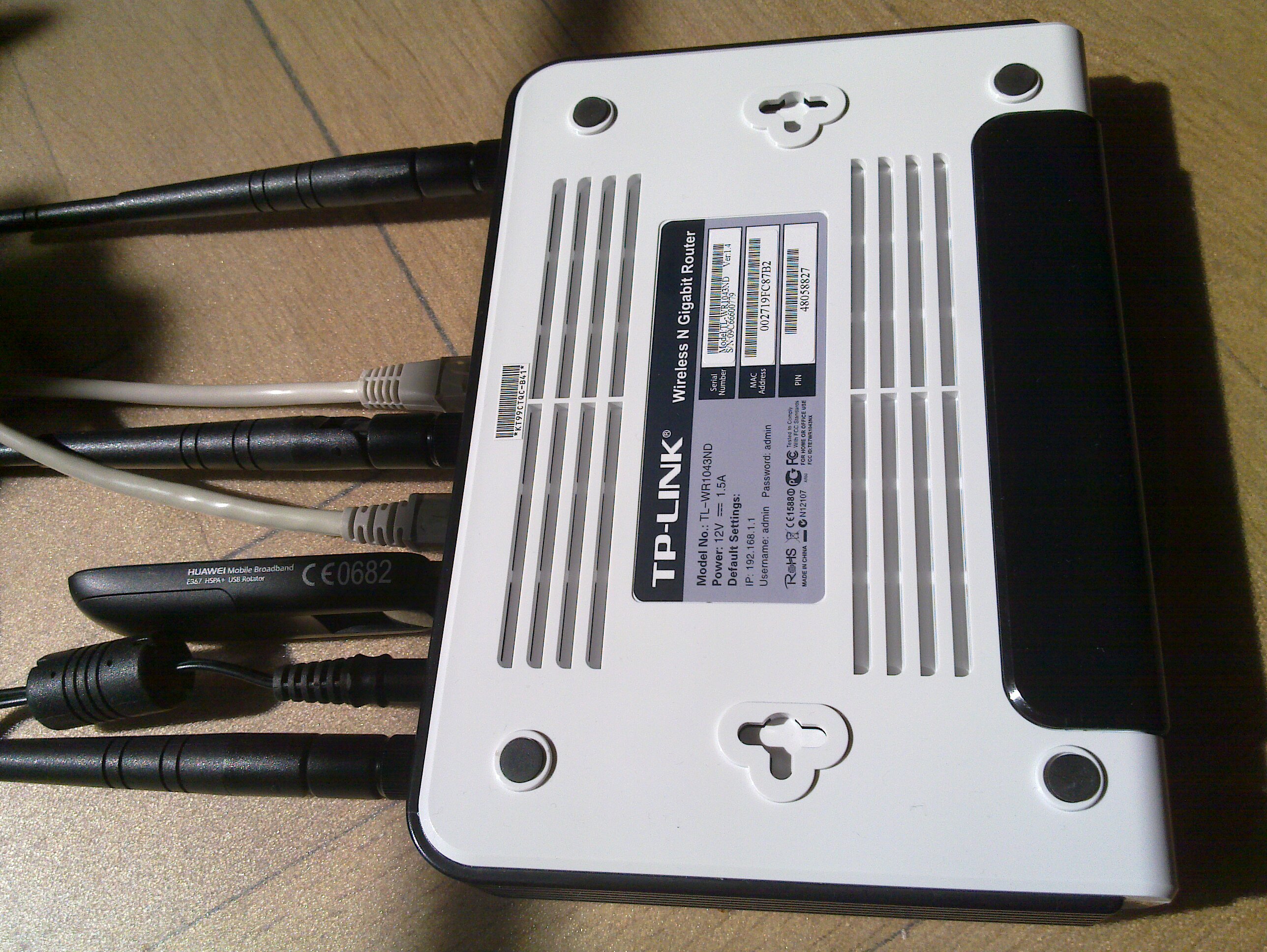
The ability to connect a 3G modem to a wireless router to form a Internet connected ad-hoc network of machines is very powerful. I ve done this many times and have written about it before (e.g., see my OpenWRT writeup page) but I recently did it with modern hardware again. Here I will use the TP-Link TL-WR1043ND wireless router (available here for around $50) together with the Huawei E367 3G UMTS/HSDPA modem. Other wireless routers and modem should work fine. The software is OpenWRT 10.03 although I hope to redo this with LibreWRT eventually. My writeup is mostly focused around what is happening around the prompt, so it is mostly a cut n'paste terminal session with a comment interlined.
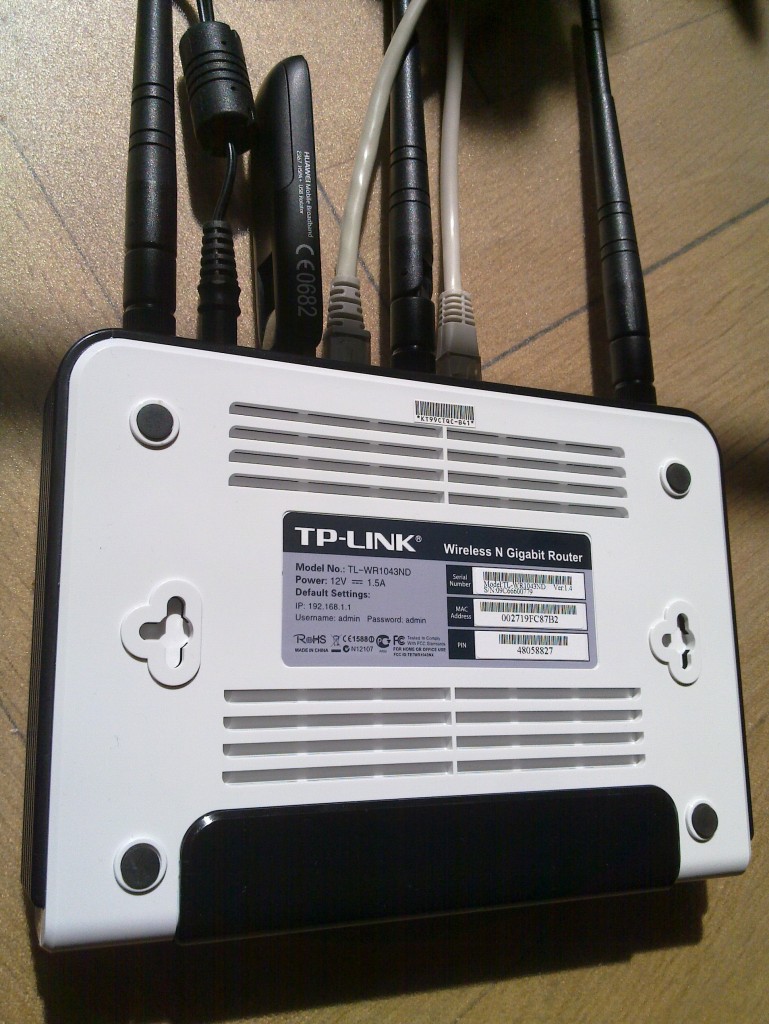
TL-WR1043ND and Huawei 367

Router and modem


The first step is to flash the firmware with OpenWRT. The OpenWRT wiki page for the TL-WR1043ND covers this in detail, and for any other hardware you should find what you need in the OpenWRT wiki. If you have already installed OpenWRT on the TL-WR1043ND, and want to wipe it out and start from scratch (like I did for this writeup) here is how to do it:
root@choco:~# cd /tmp
root@choco:/tmp# wget http://downloads.openwrt.org/backfire/10.03/ar71xx/openwrt-ar71xx-tl-wr1043nd-v1-squashfs-sysupgrade.bin
Connecting to downloads.openwrt.org (78.24.191.177:80)
openwrt-ar71xx-tl-wr 100%  *******************************   2688k 00:00:00 ETA
root@choco:/tmp# md5sum openwrt-ar71xx-tl-wr1043nd-v1-squashfs-sysupgrade.bin
9927973ba5da65d0d52e255397452b87  openwrt-ar71xx-tl-wr1043nd-v1-squashfs-sysupgrade.bin
root@choco:/tmp# mtd -r write /tmp/openwrt-ar71xx-tl-wr1043nd-v1-squashfs-sysupgrade.bin firmware
Unlocking firmware ...
Writing from /tmp/openwrt-ar71xx-tl-wr1043nd-v1-squashfs-sysupgrade.bin to firmware ...
Rebooting ...
The device will reboot automatically when it is done. After say 30 seconds, try to connect to it using the default IPv4 address 192.168.1.1. I have connected the WAN port to the Internet and connect to the router over local network connected to the router s LAN1 input. Let s configure OpenWRT, I m calling the host choco and giving it the IPv4 address 192.168.1.46. I ll also set a good root password to disable telnet, and add some SSH keys to simplify remote login.
jas@latte:~$ telnet 192.168.1.1
Trying 192.168.1.1...
Connected to 192.168.1.1.
Escape character is '^]'.
 === IMPORTANT ============================
  Use 'passwd' to set your login password
  this will disable telnet and enable SSH
 ------------------------------------------
BusyBox v1.15.3 (2010-04-06 03:14:11 CEST) built-in shell (ash)
Enter 'help' for a list of built-in commands.
  _______                     ________        __
          .-----.-----.-----.          .----.    _
     -      _     -__                   _    _ 
  _______    __ _____ __ __ ________ __    ____ 
           __  W I R E L E S S   F R E E D O M
 Backfire (10.03, r20728) --------------------------
  * 1/3 shot Kahlua    In a shot glass, layer Kahlua
  * 1/3 shot Bailey's  on the bottom, then Bailey's,
  * 1/3 shot Vodka     then Vodka.
 ---------------------------------------------------
root@OpenWrt:/# passwd
Changing password for root
New password:
Retype password:
Password for root changed by root
root@OpenWrt:/# sed -i -e 's/OpenWrt/choco/' /etc/config/system
root@OpenWrt:/# sed -i -e 's/192.168.1.1/192.168.1.46/' /etc/config/network
root@OpenWrt:/# cat>/etc/dropbear/authorized_keys
ssh-rsa AAAAB3NzaC1yc2...
^D
root@OpenWrt:/# dropbearkey -y -f /etc/dropbear/dropbear_rsa_host_key
Public key portion is:
ssh-rsa AAAA... root@OpenWrt
Fingerprint: md5 45:fd:62...
root@OpenWrt:/#
You could reboot the machine here to switch from telnet to SSH, but I ll install a bunch of packages while I m at it. Run opkg update to update the package list, and then install the wireless modules for the TL-WR1043ND.
root@OpenWrt:/# opkg update
Downloading http://downloads.openwrt.org/backfire/10.03/ar71xx/packages/Packages.gz.
Inflating http://downloads.openwrt.org/backfire/10.03/ar71xx/packages/Packages.gz.
Updated list of available packages in /var/opkg-lists/packages.
root@OpenWrt:/# opkg install kmod-ath9k wpad-mini
...
Configuring iw.
Configuring kmod-crypto-core.
Configuring kmod-crypto-arc4.
Configuring kmod-crypto-aes.
Configuring wireless-tools.
Configuring kmod-cfg80211.
Configuring kmod-mac80211.
Configuring kmod-ath.
Configuring kmod-ath9k.
Configuring crda.
Configuring wpad-mini.
root@OpenWrt:/#
Next I ll install some packages that will are needed for the modem.
root@OpenWrt:/# opkg install comgt kmod-usb-serial kmod-usb2 kmod-usb-uhci kmod-usb-ohci usb-modeswitch
...
Configuring kmod-nls-base.
Configuring kmod-usb-core.
Configuring chat.
Configuring kmod-usb-ohci.
Configuring kmod-usb2.
Configuring comgt.
Configuring usb-modeswitch.
Configuring kmod-usb-serial.
Configuring kmod-usb-uhci.
root@OpenWrt:/#
Now let s reboot the machine and try to get things to really work.
root@OpenWrt:/# sync
root@OpenWrt:/# reboot
Use SSH to connect to the router, and don t forget the use its new IPv4 address! 3G modems are notoriously known for not acting as a modem directly. Instead they often simulate a CD-ROM that will install device driver software, for inferior operating systems. Fortunately the usb_modeswitch tool fixes the hardware for us. My Huawei E367 start up with the USB vendor/product IDs 0x12d1:0 1446, you normally find this out by looking in /proc/bus/usb/devices. Here is the output on my device:
root@choco:~# cat /proc/bus/usb/devices
...
T:  Bus=01 Lev=01 Prnt=01 Port=00 Cnt=01 Dev#=  2 Spd=480 MxCh= 0
D:  Ver= 2.00 Cls=00(>ifc ) Sub=00 Prot=00 MxPS=64 #Cfgs=  1
P:  Vendor=12d1 ProdID=1446 Rev= 0.00
S:  Manufacturer=Huawei Technologies
S:  Product=HUAWEI Mobile
C:* #Ifs= 2 Cfg#= 1 Atr=c0 MxPwr=500mA
I:* If#= 0 Alt= 0 #EPs= 2 Cls=08(stor.) Sub=06 Prot=50 Driver=(none)
E:  Ad=81(I) Atr=02(Bulk) MxPS= 512 Ivl=0ms
E:  Ad=01(O) Atr=02(Bulk) MxPS= 512 Ivl=0ms
I:* If#= 1 Alt= 0 #EPs= 2 Cls=08(stor.) Sub=06 Prot=50 Driver=(none)
E:  Ad=02(O) Atr=02(Bulk) MxPS= 512 Ivl=0ms
E:  Ad=82(I) Atr=02(Bulk) MxPS= 512 Ivl=0ms
root@choco:~#
This means I have to go find a usb-modeswitch configuration for this device. Fortunately, I found it on my Debian Squeeze box in /etc/usb_modeswitch.d/12d1:1446 (from the usb-modeswitch-data package). There was a slight problem with the file, it didn t specify the correct USB vendor/product ID of the device after it has been switched . My Huawei E367 switches to 12d1:1506, so I add 1506 to the TargetProductList list. Here is the final configuration:
root@choco:~# cat>/etc/usb-modeswitch.conf
EnableLogging=1
DefaultVendor= 0x12d1
DefaultProduct=0x1446
TargetVendor=  0x12d1
TargetProductList="1001,1406,140b,140c,1412,141b,14ac,1506"
CheckSuccess=20
MessageContent="55534243123456780000000000000011062000000100000000000000000000"
root@choco:~#
Now you should be able to run usb_modeswitch to perform the switch :
root@choco:~# usb_modeswitch 
Looking for target devices ...
 No devices in target mode or class found
Looking for default devices ...
 Found default devices (1)
Accessing device 002 on bus 001 ...
Using endpoints 0x01 (out) and 0x81 (in)
Inquiring device details; driver will be detached ...
Looking for active driver ...
 No driver found. Either detached before or never attached
SCSI inquiry data (for identification)
-------------------------
  Vendor String: HUAWEI
   Model String: Mass Storage
Revision String: 2.31
-------------------------
USB description data (for identification)
-------------------------
Manufacturer: Huawei Technologies
     Product: HUAWEI Mobile
  Serial No.: not provided
-------------------------
Setting up communication with interface 0 ...
Trying to send the message to endpoint 0x01 ...
 OK, message successfully sent
Checking for mode switch (max. 20 times, once per second) ...
 Waiting for original device to vanish ...
 Original device can't be accessed anymore. Good.
 Searching for target devices ...
 Searching for target devices ...
 Searching for target devices ...
 Searching for target devices ...
 Searching for target devices ...
 Found correct target device
Mode switch succeeded. Bye.
root@choco:~#
The /proc/bus/usb/devices file will now contain information about the real device:
root@choco:~# cat /proc/bus/usb/devices
...
T:  Bus=01 Lev=01 Prnt=01 Port=00 Cnt=01 Dev#=  3 Spd=480 MxCh= 0
D:  Ver= 2.00 Cls=ef(misc ) Sub=02 Prot=01 MxPS=64 #Cfgs=  1
P:  Vendor=12d1 ProdID=1506 Rev= 0.00
S:  Manufacturer=Huawei Technologies
S:  Product=HUAWEI Mobile
C:* #Ifs= 7 Cfg#= 1 Atr=c0 MxPwr=500mA
A:  FirstIf#= 1 IfCount= 2 Cls=02(comm.) Sub=00 Prot=00
I:* If#= 0 Alt= 0 #EPs= 3 Cls=ff(vend.) Sub=01 Prot=01 Driver=(none)
E:  Ad=81(I) Atr=03(Int.) MxPS=  64 Ivl=2ms
E:  Ad=82(I) Atr=02(Bulk) MxPS= 512 Ivl=0ms
E:  Ad=01(O) Atr=02(Bulk) MxPS= 512 Ivl=4ms
I:* If#= 1 Alt= 0 #EPs= 1 Cls=ff(vend.) Sub=01 Prot=09 Driver=(none)
E:  Ad=83(I) Atr=03(Int.) MxPS=  64 Ivl=2ms
I:* If#= 2 Alt= 0 #EPs= 2 Cls=ff(vend.) Sub=01 Prot=08 Driver=(none)
E:  Ad=84(I) Atr=02(Bulk) MxPS= 512 Ivl=0ms
E:  Ad=02(O) Atr=02(Bulk) MxPS= 512 Ivl=4ms
I:* If#= 3 Alt= 0 #EPs= 2 Cls=ff(vend.) Sub=01 Prot=03 Driver=(none)
E:  Ad=85(I) Atr=02(Bulk) MxPS= 512 Ivl=0ms
E:  Ad=03(O) Atr=02(Bulk) MxPS= 512 Ivl=4ms
I:* If#= 4 Alt= 0 #EPs= 2 Cls=ff(vend.) Sub=01 Prot=02 Driver=(none)
E:  Ad=86(I) Atr=02(Bulk) MxPS= 512 Ivl=0ms
E:  Ad=04(O) Atr=02(Bulk) MxPS= 512 Ivl=4ms
I:* If#= 5 Alt= 0 #EPs= 2 Cls=08(stor.) Sub=06 Prot=50 Driver=(none)
E:  Ad=87(I) Atr=02(Bulk) MxPS= 512 Ivl=0ms
E:  Ad=05(O) Atr=02(Bulk) MxPS= 512 Ivl=0ms
I:* If#= 6 Alt= 0 #EPs= 2 Cls=08(stor.) Sub=06 Prot=50 Driver=(none)
E:  Ad=06(O) Atr=02(Bulk) MxPS= 512 Ivl=0ms
E:  Ad=88(I) Atr=02(Bulk) MxPS= 512 Ivl=0ms
root@choco:~#
Let s put that command in /etc/rc.local so that it will be run on every boot.
root@choco:~# cat /etc/rc.local
# Put your custom commands here that should be executed once
# the system init finished. By default this file does nothing.
/usr/bin/usb_modeswitch
exit 0
root@choco:~#
We are not quite ready, the usbserial module needs to be told which USB vendor/product to use. The /etc/modules.d/60-usb-serial file is used during boot to set the right parameters. You can also run rmmod followed by insmod with the proper parameters to avoid a reboot. You can use the gcom info tool to find some information about the modem. Normally you use /dev/ttyUSB0 but for some reason it does not work for me and instead I had to use /dev/ttyUSB3.
root@choco:~# cat>/etc/modules.d/60-usb-serial
usbserial vendor=0x12d1 product=0x1506 maxSize=4096
root@choco:~# rmmod usbserial
root@choco:~# insmod usbserial vendor=0x12d1 product=0x1506 maxSize=4096
root@choco:~# gcom -d /dev/ttyUSB3 info
##### Wireless WAN Modem Configuration #####
Product text:
====
Manufacturer: huawei
Model: E367
Revision: 11.807.05.00.00
IMEI: 353613040739180
+GCAP: +CGSM,+DS,+ES
OK
====
Manufacturer:           huawei
IMEI and Serial Number: 353613040739180
Manufacturer's Revision:
11.807.05.00.
Hardware Revision:      NOT
Network Locked:         ERROR:
Customisation:          NOT SUPPORT
Band settings:          (NOT)
APN:                    ERROR:
##### END #####
root@choco:~#
Let s configure network and wireless. The configurations files are /etc/config/network and /etc/config/wireless. Edit them using your favorite editor, or vi. I m setting up a PSK2 encrypted WLAN and I have a WDS to connect two wireless routers. Note that you need to use the correct PIN for your SIM card (here I m using 8328) and set the APN correctly (I m using bredband.tre.se ). Reboot after making these changes.
root@choco:~# cat /etc/config/network
config 'interface' 'loopback'
       option 'ifname'   'lo'
       option 'proto'    'static'
       option 'ipaddr'   '127.0.0.1'
       option 'netmask'  '255.0.0.0'
config 'interface' 'lan'
        option 'ifname'   'eth0.1'
        option 'type'     'bridge'
        option 'proto'    'static'
        option 'ipaddr'   '192.168.1.46'
        option 'netmask'  '255.255.255.0'
#config 'interface' 'wan'
#        option 'ifname' 'eth0.2'
#        option 'proto' 'dhcp'
config 'switch'
	option 'name' 'rtl8366rb'
        option 'reset' '1'
        option 'enable_vlan' '1'
config 'switch_vlan'
        option 'device' 'rtl8366rb'
        option 'vlan' '1'
        option 'ports' '1 2 3 4 5t'
config 'switch_vlan'
        option 'device' 'rtl8366rb'
        option 'vlan' '2'
        option 'ports' '0 5t'
config interface wan
        option ifname   ppp0
        option proto    3g
        option device   /dev/ttyUSB0
        option apn      bredband.tre.se
        option pincode  8328
root@choco:~# cat /etc/config/wireless
config wifi-device  radio0
	option type     mac80211
	option channel  5
	option macaddr	00:27:19:fc:87:b2
	option hwmode	11ng
	option htmode	HT20
	list ht_capab	SHORT-GI-40
	list ht_capab	DSSS_CCK-40
config wifi-iface
	option device   radio0
	option network  lan
	option mode     ap
	option ssid     Grisslan
	option encryption psk2
	option key	  notforyoutosee
config wifi-iface
        option device     radio0
        option network    lan
        option mode       wds
        option bssid      00:1F:C6:60:D3:11
        option ssid       GrisslanWDS
        option encryption psk2
        option key        thisisalsosecret
root@choco:~# reboot
root@choco:~#
Once the machine have rebooted, you can bring up the 3G connection by using ifup wan . Look at the log by using logread and tail the log in the background by doing logread -f & .
root@choco:~# ifup wan
Trying to set PIN
PIN set successfully
root@choco:~# logread  tail -20
May 21 13:41:20 choco local2.info chat[2419]: send (ATD*99***1#^M)
May 21 13:41:20 choco local2.info chat[2419]: expect (CONNECT)
May 21 13:41:20 choco local2.info chat[2419]: ^M
May 21 13:41:20 choco local2.info chat[2419]: ATD*99***1#^M^M
May 21 13:41:20 choco local2.info chat[2419]: CONNECT
May 21 13:41:20 choco local2.info chat[2419]:  -- got it
May 21 13:41:20 choco local2.info chat[2419]: send ( ^M)
May 21 13:41:20 choco daemon.info pppd[2412]: Serial connection established.
May 21 13:41:20 choco daemon.info pppd[2412]: Using interface ppp0
May 21 13:41:20 choco daemon.notice pppd[2412]: Connect: ppp0 <--> /dev/ttyUSB0
May 21 13:41:24 choco daemon.warn pppd[2412]: Could not determine remote IP address: defaulting to 10.64.64.64
May 21 13:41:24 choco daemon.notice pppd[2412]: local  IP address 95.209.96.115
May 21 13:41:24 choco daemon.notice pppd[2412]: remote IP address 10.64.64.64
May 21 13:41:24 choco daemon.notice pppd[2412]: primary   DNS address 80.251.201.177
May 21 13:41:24 choco daemon.notice pppd[2412]: secondary DNS address 80.251.201.178
May 21 13:41:24 choco daemon.info dnsmasq[1028]: reading /tmp/resolv.conf.auto
May 21 13:41:24 choco daemon.info dnsmasq[1028]: using nameserver 80.251.201.178#53
May 21 13:41:24 choco daemon.info dnsmasq[1028]: using nameserver 80.251.201.177#53
May 21 13:41:24 choco daemon.info dnsmasq[1028]: using local addresses only for domain lan
May 21 13:41:25 choco user.notice rdate: Synced with ptbtime1.ptb.de
root@choco:~#
Hooray! Or almost so usually the first time you connect, I often get incorrect DNS servers from the server. It shows up like this in the log:
May 21 12:25:04 choco daemon.notice pppd[1157]: primary   DNS address 10.11.12.13
May 21 12:25:04 choco daemon.notice pppd[1157]: secondary DNS address 10.11.12.14
The exact reason why this happens is beyond me. There are patches floating around for pppd, but I haven t tried them. A common workaround is to hardcode static DNS servers (like Google DNS or OpenDNS). I have come up with my own workaround, based on the observation that when the problem has occurred it will not happen again if I disconnect and reconnect. Thus I have written a small script which is invoked whenever an interface is brought up (typically the WAN interface).
# Written by Simon Josefsson May 2011.
root@choco:~# cat> /etc/hotplug.d/iface/01-reconnect-if-dns-is-broken
case "$ ACTION:-ifup " in
    ifup)
	    if grep -q 10.11.12.13 /tmp/resolv.conf.auto; then
		(sleep 30 && ifdown wan && ifup wan) &
	    fi
	    ;;
esac
root@choco:~# chmod +x /etc/hotplug.d/iface/01-reconnect-if-dns-is-broken
root@choco:~#
That s it! If you found this writeup useful, please flattr it.

Next.

Previous.