Search Results: "zed"

22 November 2020

Markus Koschany: My Free Software Activities in October 2020

Welcome to gambaru.de. Here is my monthly report (+ the first week in November) that covers what I have been doing for Debian. If you re interested in Java, Games and LTS topics, this might be interesting for you. Debian Games
Debian Java
pdfsam
Misc Debian LTS This was my 56. month as a paid contributor and I have been paid to work 20,75 hours on Debian LTS, a project started by Rapha l Hertzog. In that time I did the following: ELTS Extended Long Term Support (ELTS) is a project led by Freexian to further extend the lifetime of Debian releases. It is not an official Debian project but all Debian users benefit from it without cost. The current ELTS release is Debian 8 Jessie . This was my 29. month and I have been paid to work 15 hours on ELTS. Thanks for reading and see you next time.

21 November 2020

Giovanni Mascellani: Having fun with signal handlers

As every C and C++ programmer knows far too well, if you dereference a pointer that points outside of the space mapped on your process' memory, you get a segmentation fault and your programs crashes. As far as the language itself is concerned, you don't have a second chance and you cannot know in advance whether that dereferencing operation is going to set a bomb off or not. In technical terms, you are invoking undefined behaviour, and you should never do that: you are responsible for knowing in advance if your pointers are valid, and if they are not you keep the pieces. However, turns out that most actual operating system give you a second chance, although with a lot of fine print attached. So I tried to implement a function that tries to dereference a pointer: if it can, it gives you the value; if it can't, it tells you it couldn't. Again, I stress this should never happen in a real program, except possibly for debugging (or for having fun). The prototype is
word_t peek(word_t *addr, int *success);
The function is basically equivalent to return *addr, except that if addr is not mapped it doesn't crash, and if success is not NULL it is set to 0 or 1 to indicate that addr was not mapped or mapped. If addr was not mapped the return value is meaningless. I won't explain it in detail to leave you some fun. Basically the idea is to install a handler for SIGSEGV: if the address is invalid, the handler is called, which basically fixes everything by advancing a little bit the instruction pointer, in order to skip the faulting instruction. The dereferencing instruction is written as hardcoded Assembly bytes, so that I know exactly how many bytes I need to skip. Of course this is very architecture-dependent: I wrote the i386 and amd64 variants (no x32). And I don't guarantee there are no bugs or subtelties! Another solution would have been to just parse /proc/self/maps before dereferencing and check whether the pointer is in a mapped area, but it would have suffered of a TOCTTOU problem: another thread might have changed the mappings between the time when /proc/self/maps was parsed and when the pointer was dereferenced (also, parsing that file can take a relatively long amount of time). Another less architecture-dependent but still not pure-C approach would have been to establish a setjmp before attempting the dereference and longjmp-ing back from the signal handler (but again you would need to use different setjmp contexts in different threads to exclude race conditions). Have fun! (and again, don't try this in real programs) EDIT I realized I should specify the language for source code highlighting to work decently. Now it's better! EDIT 2 I also realized that my version of peek has problems when there are other threads, because signal actions are per-process, not per-thread (as I initially thought). See the comments for a better version (though not perfect).
#define _GNU_SOURCE
#include <stdint.h>
#include <signal.h>
#include <assert.h>
#include <stdlib.h>
#include <stdio.h>
#include <ucontext.h>
#ifdef __i386__
typedef uint32_t word_t;
#define IP_REG REG_EIP
#define IP_REG_SKIP 3
#define READ_CODE __asm__ __volatile__(".byte 0x8b, 0x03\n"  /* mov (%ebx), %eax */ \
                                       ".byte 0x41\n"        /* inc %ecx */ \
                                       : "=a"(ret), "=c"(tmp) : "b"(addr), "c"(tmp));
#endif
#ifdef __x86_64__
typedef uint64_t word_t;
#define IP_REG REG_RIP
#define IP_REG_SKIP 6
#define READ_CODE __asm__ __volatile__(".byte 0x48, 0x8b, 0x03\n"  /* mov (%rbx), %rax */ \
                                       ".byte 0x48, 0xff, 0xc1\n"  /* inc %rcx */ \
                                       : "=a"(ret), "=c"(tmp) : "b"(addr), "c"(tmp));
#endif
static void segv_action(int sig, siginfo_t *info, void *ucontext)  
    (void) sig;
    (void) info;
    ucontext_t *uctx = (ucontext_t*) ucontext;
    uctx->uc_mcontext.gregs[IP_REG] += IP_REG_SKIP;
 
struct sigaction peek_sigaction =  
    .sa_sigaction = segv_action,
    .sa_flags = SA_SIGINFO,
    .sa_mask = 0,
 ;
word_t peek(word_t *addr, int *success)  
    word_t ret;
    int tmp, res;
    struct sigaction prev_act;
    res = sigaction(SIGSEGV, &peek_sigaction, &prev_act);
    assert(res == 0);
    tmp = 0;
    READ_CODE
    res = sigaction(SIGSEGV, &prev_act, NULL);
    assert(res == 0);
    if (success)  
        *success = tmp;
     
    return ret;
 
int main()  
    int success;
    word_t number = 22;
    word_t value;
    number = 22;
    value = peek(&number, &success);
    printf("%d %d\n", success, value);
    value = peek(NULL, &success);
    printf("%d %d\n", success, value);
    value = peek((word_t*)0x1234, &success);
    printf("%d %d\n", success, value);
    return 0;
 

Michael Stapelberg: Winding down my Debian involvement

This post is hard to write, both in the emotional sense but also in the I would have written a shorter letter, but I didn t have the time sense. Hence, please assume the best of intentions when reading it it is not my intention to make anyone feel bad about their contributions, but rather to provide some insight into why my frustration level ultimately exceeded the threshold. Debian has been in my life for well over 10 years at this point. A few weeks ago, I have visited some old friends at the Z rich Debian meetup after a multi-year period of absence. On my bike ride home, it occurred to me that the topics of our discussions had remarkable overlap with my last visit. We had a discussion about the merits of systemd, which took a detour to respect in open source communities, returned to processes in Debian and eventually culminated in democracies and their theoretical/practical failings. Admittedly, that last one might be a Swiss thing. I say this not to knock on the Debian meetup, but because it prompted me to reflect on what feelings Debian is invoking lately and whether it s still a good fit for me. So I m finally making a decision that I should have made a long time ago: I am winding down my involvement in Debian to a minimum.

What does this mean? Over the coming weeks, I will:
  • transition packages to be team-maintained where it makes sense
  • remove myself from the Uploaders field on packages with other maintainers
  • orphan packages where I am the sole maintainer
I will try to keep up best-effort maintenance of the manpages.debian.org service and the codesearch.debian.net service, but any help would be much appreciated. For all intents and purposes, please treat me as permanently on vacation. I will try to be around for administrative issues (e.g. permission transfers) and questions addressed directly to me, permitted they are easy enough to answer.

Why? When I joined Debian, I was still studying, i.e. I had luxurious amounts of spare time. Now, over 5 years of full time work later, my day job taught me a lot, both about what works in large software engineering projects and how I personally like my computer systems. I am very conscious of how I spend the little spare time that I have these days. The following sections each deal with what I consider a major pain point, in no particular order. Some of them influence each other for example, if changes worked better, we could have a chance at transitioning packages to be more easily machine readable.

Change process in Debian The last few years, my current team at work conducted various smaller and larger refactorings across the entire code base (touching thousands of projects), so we have learnt a lot of valuable lessons about how to effectively do these changes. It irks me that Debian works almost the opposite way in every regard. I appreciate that every organization is different, but I think a lot of my points do actually apply to Debian. In Debian, packages are nudged in the right direction by a document called the Debian Policy, or its programmatic embodiment, lintian. While it is great to have a lint tool (for quick, local/offline feedback), it is even better to not require a lint tool at all. The team conducting the change (e.g. the C++ team introduces a new hardening flag for all packages) should be able to do their work transparent to me. Instead, currently, all packages become lint-unclean, all maintainers need to read up on what the new thing is, how it might break, whether/how it affects them, manually run some tests, and finally decide to opt in. This causes a lot of overhead and manually executed mechanical changes across packages. Notably, the cost of each change is distributed onto the package maintainers in the Debian model. At work, we have found that the opposite works better: if the team behind the change is put in power to do the change for as many users as possible, they can be significantly more efficient at it, which reduces the total cost and time a lot. Of course, exceptions (e.g. a large project abusing a language feature) should still be taken care of by the respective owners, but the important bit is that the default should be the other way around. Debian is lacking tooling for large changes: it is hard to programmatically deal with packages and repositories (see the section below). The closest to sending out a change for review is to open a bug report with an attached patch. I thought the workflow for accepting a change from a bug report was too complicated and started mergebot, but only Guido ever signaled interest in the project. Culturally, reviews and reactions are slow. There are no deadlines. I literally sometimes get emails notifying me that a patch I sent out a few years ago (!!) is now merged. This turns projects from a small number of weeks into many years, which is a huge demotivator for me. Interestingly enough, you can see artifacts of the slow online activity manifest itself in the offline culture as well: I don t want to be discussing systemd s merits 10 years after I first heard about it. Lastly, changes can easily be slowed down significantly by holdouts who refuse to collaborate. My canonical example for this is rsync, whose maintainer refused my patches to make the package use debhelper purely out of personal preference. Granting so much personal freedom to individual maintainers prevents us as a project from raising the abstraction level for building Debian packages, which in turn makes tooling harder. How would things look like in a better world?
  1. As a project, we should strive towards more unification. Uniformity still does not rule out experimentation, it just changes the trade-off from easier experimentation and harder automation to harder experimentation and easier automation.
  2. Our culture needs to shift from this package is my domain, how dare you touch it to a shared sense of ownership, where anyone in the project can easily contribute (reviewed) changes without necessarily even involving individual maintainers.
To learn more about how successful large changes can look like, I recommend my colleague Hyrum Wright s talk Large-Scale Changes at Google: Lessons Learned From 5 Yrs of Mass Migrations .

Fragmented workflow and infrastructure Debian generally seems to prefer decentralized approaches over centralized ones. For example, individual packages are maintained in separate repositories (as opposed to in one repository), each repository can use any SCM (git and svn are common ones) or no SCM at all, and each repository can be hosted on a different site. Of course, what you do in such a repository also varies subtly from team to team, and even within teams. In practice, non-standard hosting options are used rarely enough to not justify their cost, but frequently enough to be a huge pain when trying to automate changes to packages. Instead of using GitLab s API to create a merge request, you have to design an entirely different, more complex system, which deals with intermittently (or permanently!) unreachable repositories and abstracts away differences in patch delivery (bug reports, merge requests, pull requests, email, ). Wildly diverging workflows is not just a temporary problem either. I participated in long discussions about different git workflows during DebConf 13, and gather that there were similar discussions in the meantime. Personally, I cannot keep enough details of the different workflows in my head. Every time I touch a package that works differently than mine, it frustrates me immensely to re-learn aspects of my day-to-day. After noticing workflow fragmentation in the Go packaging team (which I started), I tried fixing this with the workflow changes proposal, but did not succeed in implementing it. The lack of effective automation and slow pace of changes in the surrounding tooling despite my willingness to contribute time and energy killed any motivation I had.

Old infrastructure: package uploads When you want to make a package available in Debian, you upload GPG-signed files via anonymous FTP. There are several batch jobs (the queue daemon, unchecked, dinstall, possibly others) which run on fixed schedules (e.g. dinstall runs at 01:52 UTC, 07:52 UTC, 13:52 UTC and 19:52 UTC). Depending on timing, I estimated that you might wait for over 7 hours (!!) before your package is actually installable. What s worse for me is that feedback to your upload is asynchronous. I like to do one thing, be done with it, move to the next thing. The current setup requires a many-minute wait and costly task switch for no good technical reason. You might think a few minutes aren t a big deal, but when all the time I can spend on Debian per day is measured in minutes, this makes a huge difference in perceived productivity and fun. The last communication I can find about speeding up this process is ganneff s post from 2008. How would things look like in a better world?
  1. Anonymous FTP would be replaced by a web service which ingests my package and returns an authoritative accept or reject decision in its response.
  2. For accepted packages, there would be a status page displaying the build status and when the package will be available via the mirror network.
  3. Packages should be available within a few minutes after the build completed.

Old infrastructure: bug tracker I dread interacting with the Debian bug tracker. debbugs is a piece of software (from 1994) which is only used by Debian and the GNU project these days. Debbugs processes emails, which is to say it is asynchronous and cumbersome to deal with. Despite running on the fastest machines we have available in Debian (or so I was told when the subject last came up), its web interface loads very slowly. Notably, the web interface at bugs.debian.org is read-only. Setting up a working email setup for reportbug(1) or manually dealing with attachments is a rather big hurdle. For reasons I don t understand, every interaction with debbugs results in many different email threads. Aside from the technical implementation, I also can never remember the different ways that Debian uses pseudo-packages for bugs and processes. I need them rarely enough to establish a mental model of how they are set up, or working memory of how they are used, but frequently enough to be annoyed by this. How would things look like in a better world?
  1. Debian would switch from a custom bug tracker to a (any) well-established one.
  2. Debian would offer automation around processes. It is great to have a paper-trail and artifacts of the process in the form of a bug report, but the primary interface should be more convenient (e.g. a web form).

Old infrastructure: mailing list archives It baffles me that in 2019, we still don t have a conveniently browsable threaded archive of mailing list discussions. Email and threading is more widely used in Debian than anywhere else, so this is somewhat ironic. Gmane used to paper over this issue, but Gmane s availability over the last few years has been spotty, to say the least (it is down as I write this). I tried to contribute a threaded list archive, but our listmasters didn t seem to care or want to support the project.

Debian is hard to machine-read While it is obviously possible to deal with Debian packages programmatically, the experience is far from pleasant. Everything seems slow and cumbersome. I have picked just 3 quick examples to illustrate my point. debiman needs help from piuparts in analyzing the alternatives mechanism of each package to display the manpages of e.g. psql(1). This is because maintainer scripts modify the alternatives database by calling shell scripts. Without actually installing a package, you cannot know which changes it does to the alternatives database. pk4 needs to maintain its own cache to look up package metadata based on the package name. Other tools parse the apt database from scratch on every invocation. A proper database format, or at least a binary interchange format, would go a long way. Debian Code Search wants to ingest new packages as quickly as possible. There used to be a fedmsg instance for Debian, but it no longer seems to exist. It is unclear where to get notifications from for new packages, and where best to fetch those packages.

Complicated build stack See my Debian package build tools post. It really bugs me that the sprawl of tools is not seen as a problem by others.

Developer experience pretty painful Most of the points discussed so far deal with the experience in developing Debian, but as I recently described in my post Debugging experience in Debian , the experience when developing using Debian leaves a lot to be desired, too.

I have more ideas At this point, the article is getting pretty long, and hopefully you got a rough idea of my motivation. While I described a number of specific shortcomings above, the final nail in the coffin is actually the lack of a positive outlook. I have more ideas that seem really compelling to me, but, based on how my previous projects have been going, I don t think I can make any of these ideas happen within the Debian project. I intend to publish a few more posts about specific ideas for improving operating systems here. Stay tuned. Lastly, I hope this post inspires someone, ideally a group of people, to improve the developer experience within Debian.

4 November 2020

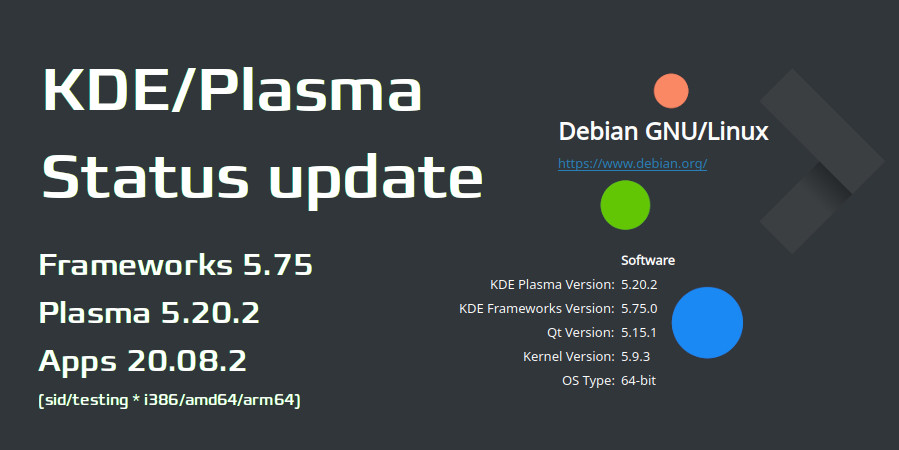
Norbert Preining: Debian KDE/Plasma Status 2020-11-04

About a month worth of updates on KDE/Plasma in Debian has accumulated, so here we go. The highlights are: Plasma 5.19.5 based on Qt 5.15 is in Debian/experimental and hopefully soon in Debian/unstable, and my own builds at OBS have been updated to Plasma 5.20.2, Frameworks 5.75, Apps 20.08.2. Thanks to the dedicated work of the Qt maintainers, Qt 5.15 has finally entered Debian/unstable and we can finally target Plasma 5.20. OBS packages The OBS packages as usual follow the latest release, and currently ship KDE Frameworks 5.75, KDE Apps 20.08.2, and new, Plasma 5.20.2. The package sources are as usual (note the different path for the Plasma packages and the App packages, containing the release version!), for Debian/unstable:
deb https://download.opensuse.org/repositories/home:/npreining:/debian-kde:/frameworks/Debian_Unstable/ ./
deb https://download.opensuse.org/repositories/home:/npreining:/debian-kde:/plasma520/Debian_Unstable/ ./
deb https://download.opensuse.org/repositories/home:/npreining:/debian-kde:/apps2008/Debian_Unstable/ ./
deb https://download.opensuse.org/repositories/home:/npreining:/debian-kde:/other/Debian_Unstable/ ./
and the same with Testing instead of Unstable for Debian/testing. The update to Plasma 5.20 took a bit of time, not only because of the wait for Qt 5.15, but also because I couldn t get it running on my desktop, only in the VM. It turned out that the Plasmoid Event Calendar needed an update, and the old version crashed Plasma ( v68 and below crash in Arch after the Qt 5.15.1 update. ). After I realized that, it was only a question of updating to get Plasma 5.20 running. There are two points I have to mention (and I will fix sooner or later): As usual, let me know your experience! Debian main packages The packages in Debian/experimental are at the most current state, 5.19.5. We have waited with the upload to unstable until the Qt 5.15 transition is over, but hope to upload to unstable rather soon. After the upload is done, we will work on getting 5.20 into unstable. My aim is to get the most recent version of Plasma 5.20 into Debian Bullseye, so we need to do that before the freeze early next year. Let us hope for the best.

3 November 2020

Martin-&#201;ric Racine: Adding IPv6 support to my home LAN

A couple of year ago, I moved into a new flat that comes with RJ45 sockets wired for 10 Gigabit (but currently offering 1 Gigabit) Ethernet.This also meant changing the settings on my router box for my new ISP.I took this opportunity to review my router's other settings too. I'll be blogging about these over the next few posts. Adding IPv6 support to my home LAN I have been following the evolution of IPv6 ever since the KAME project produced the first IPv6 implementation. I have also been keeping track of the IPv4 address depletion. Around the time the IPv6 Day was organized in 2011, I started investigating the situation of IPv6 support at local ISPs. Well, never mind all those rumors about Finland being some high-tech mecca. Back then, no ISP went beyond testing their routers for IPv6 compatibility and producing white papers on what their limited test deployments accomplished. Not that it matters much, in practice. Most IPv6 documentation out there, including Debian's own, still focuses on configuring transitional mechanisms, especially how to connect to a public IPv6 tunnel broker. Relocating to a new flat and rethinking my home network to match gave me an opportunity to revisit the topic. Much to my delight, my current ISP offers native IPv6. This prompted me to go back and read up on IPv6 one more time. One important detail: IPv6 hosts are globally reachable. The implications of this don't immediately spring to mind for someone used to IPv4 network address translation (NAT): Any network service running on an IPv6 host can be reached by anyone anywhere. Contrary to IPv4, there is no division between private and public IP addresses. Whereas a device behind an IPv4 NAT essentially is shielded from the outside world, IPv6 breaks this assumption in more than one way. Not only is the host reachable from anywhere, its default IPv6 address is a mathematical conversion (EUI-64) of the network interface's MAC address, which makes every connection forensically traceable to a unique device. Basically, if you hadn't given much thought to firewalls until now, IPv6 should give you enough goose bumps to get around it. Tightening the configuration of every network service is also an absolute must. For instance, I configured sshd to only listen to private IPv4 addresses. What /etc/network/interfaces might look like on an dual-stack (IPv4 + IPv6) host:
allow-hotplug enp9s0
iface enp9s0 inet dhcp
iface enp9s0 inet6 auto
	privext 2
	dhcp 1
The auto method means that IPv6 will be auto-configured using SLAAC; privext 2 enables IPv6 privacy options and specifies that we prefer connecting via the randomly-generated IPv6 address, rather than the EUI-64 calculated MAC specific address; dhcp 1 enables passive DHCPv6 to fetch additional routing information. The above works for most desktop and laptop configurations. Where things got more complicated is on the router. I decided early on to keep NAT to provide an IPv4 route to the outside world. Now how exactly is IPv6 routing done? Every node along the line must have its own IPv6 address... including the router's LAN interface. This is accomplished using the sample script found in Debian's IPv6 prefix delegation wiki page. I modified mine as follows (the rest of the script is omitted for clarity):
#Both LAN interfaces on my private network are bridged via br0
IA_PD_IFACE="br0"
IA_PD_SERVICES="dnsmasq"
IA_PD_IPV6CALC="/usr/bin/ipv6calc"
Just put the script at the suggested location. We'll need to request a prefix on the router's outside interface to utilize it. This gives us the following interfaces file:
allow-hotplug enp2s4 enp2s8 enp2s9
auto br0
iface enp2s4 inet dhcp
iface enp2s4 inet6 auto
	request_prefix 1
	privext 2
	dhcp 1
iface enp2s8 inet manual
iface enp2s8 inet6 manual
iface enp2s9 inet manual
iface enp2s9 inet6 manual
iface br0 inet static
	bridge_ports enp2s8 enp2s9
	address 10.10.10.254
iface br0 inet6 manual
	bridge_ports enp2s8 enp2s9
	# IPv6 from /etc/dhcp/dhclient-exit-hooks.d/prefix_delegation
The IPv4 NAT and IPv6 Bridge script on my router looks as follows:
#!/bin/sh
PATH="/usr/sbin:/sbin:/usr/bin:/bin"
wan=enp2s4
lan=br0
########################################################################
# IPv4 NAT
iptables -F; iptables -t nat -F; iptables -t mangle -F
iptables -X; iptables -t nat -X; iptables -t mangle -X
iptables -Z; iptables -t nat -Z; iptables -t mangle -Z
iptables -t nat -A POSTROUTING -o $wan -j MASQUERADE
echo 1 > /proc/sys/net/ipv4/ip_forward
########################################################################
# IPv6 bridge
ip6tables -F; ip6tables -X; ip6tables -Z
# Default policy DROP
ip6tables -P FORWARD DROP
# Allow ICMPv6 forwarding
ip6tables -A FORWARD -p ipv6-icmp -j ACCEPT
# Allow established connections
ip6tables -I FORWARD -m state --state RELATED,ESTABLISHED -j ACCEPT
# Accept packets FROM LAN to everywhere
ip6tables -I FORWARD -i $lan -j ACCEPT
echo 1 > /proc/sys/net/ipv6/conf/all/forwarding
echo 1 > /proc/sys/net/ipv6/conf/default/forwarding
# IPv6 propagation via /etc/dhcp/dhclient-exit-hooks.d/prefix_delegation
The above already provided enough IPv6 connectivity to pass the IPv6 test on my desktop inside the LAN. To make things more fun, I enabled DHCPv6 support for my LAN on the router's dnsmasq by adding the last 3 lines to the configuration:
dhcp-hostsfile=/etc/dnsmasq-ethersfile
bind-interfaces
interface=br0
except-interface=enp2s4
no-dhcp-interface=enp2s4
dhcp-range=tag:br0,10.10.10.0,static,infinite
dhcp-range=tag:br0,::1,constructor:br0,ra-names,ra-stateless,infinite
enable-ra
dhcp-option=option6:dns-server,[::],[2606:4700:4700::1111],[2001:4860:4860::8888]
The 5 first lines (included here for emphasis) are extremely important: they ensure that dnsmasq won't provide any IPv4 or IPv6 service to the outside interface (enp2s4) and that DHCP will only be provided for LAN hosts whose MAC address is known. Line 6 shows how dnsmasq's DHCP service syntax differs between IPv4 and IPv6. The rest of my configuration was omitted on purpose. Enabling native IPv6 on my LAN has been an interesting experiment. I'm sure that someone could come up with even better ip6tables rules for the router or for my desktop hosts. Feel free to mention them in the blog's comment.

23 October 2020

Birger Schacht: An Analysis of 5 Million OpenPGP Keys

In July I finished my Bachelor s Degree in IT Security at the University of Applied Sciences in St. Poelten. During the studies I did some elective courses, one of which was about Data Analysis using Python, Pandas and Jupyter Notebooks. I found it very interesting to do calculations on different data sets and to visualize them. Towards the end of the Bachelor I had to find a topic for my Bachelor Thesis and as a long time user of OpenPGP I thought it would be interesting to do an analysis of the collection of OpenPGP keys that are available on the keyservers of the SKS keyserver network. So in June 2019 I fetched a copy of one of the key dumps of the one of the keyservers (some keyserver publish these copies of their key database so people who want to join the SKS keyserver network can do an initial import). At that time the copy of the key database contained 5,499,675 keys and was around 12GB. Using the hockeypuck keyserver software I imported the keys into an PostgreSQL database. Hockeypuck uses a table called keys to store the keys and in there the column doc stores the OpenPGP keys in JSON format (always with a data field containing the original unparsed data). For the thesis I split the analysis in three parts, first looking at the Public Key packets, then analysing the User ID packets and finally studying the Signature Packets. To analyse the respective packets I used SQL to export the data to CSV files and then used the pandas read_csv method to create a dataframe of the values. In a couple of cases I did some parsing before converting to a DataFrame to make the analysis step faster. The parsing was done using the pgpdump python library. Together with my advisor I decided to submit the thesis for a journal, so we revised and compressed the whole paper and the outcome was now

PUBLISHED in the Journal of Wireless Mobile Networks, Ubiquitous Computing, and Dependable Applications (JoWUA). I think the work gives some valuable insight in the development of the use of OpenPGP in the last 30 years. Looking at the public key packets we were able to compare the different public key algorithms and for example visualize how DSA was the most used algorithm until around 2010 when it was replaced by RSA. When looking at the less used algorithms a trend towards ECC based crytography is visible. What we also noticed was an increase of RSA keys with algorithm ID 3 (RSA Sign-Only), which are deprecated. When we took a deeper look at those keys we realized that most of those keys used a specific User ID string in the User ID packets which allowed us to attribute those keys to two software projects both using the Bouncy Castle Java Cryptographic API (resp. the Spongy Castle version for Android). We also stumbled over a tutorial on how to create RSA keys with Bouncycastle which also describes how to create RSA keys with code that produces RSA Sign-Only keys. In one of those projects, this was then fixed. By looking at the User ID packets we did some statistics about the most used email providers used by OpenPGP users. One domain stood out, because it is not the domain of an email provider: tellfinder.com is a domain used in around 45,000 keys. Tellfinder is a Big Data analysis software and the UID of all but two of those keys is TellFinder Page Archiver- Signing Key <support@tellfinder.com>. We also looked at the comments used in OpenPGP User ID fields. In 2013 Daniel Kahn Gillmor published a blog post titled OpenPGP User ID Comments considered harmful in which he pointed out that most of the comments in the User ID field of OpenPGP keys are duplicating information that is already present somewhere in the User ID or the key itself. In our dataset 3,133 comments were exactly the same as the name, 3,346 were the same as the domain and 18,246 comments were similar to the local part of the email address Last but not least we looked at the signature subpackets and the development of some of the preferences (Preferred Symmetric Algorithm, Preferred Hash Algorithm) that are being published using signature packets. Analysing this huge dataset of cryptographic keys of the last 20 to 30 years was very interesting and I learned a lot about the history of PGP resp. OpenPGP and the evolution of cryptography overall. I think it would be interesting to look at even more properties of OpenPGP keys and I also think it would be valuable for the OpenPGP ecosystem if these kinds analysis could be done regularly. An approach like Tor Metrics could lead to interesting findings and could also help to back decisions regarding future developments of the OpenPGP standard.

21 October 2020

Bits from Debian: Debian donation for Peertube development

The Debian project is happy to announce a donation of 10,000 to help Framasoft reach the fourth stretch-goal of its Peertube v3 crowdfunding campaign -- Live Streaming. This year's iteration of the Debian annual conference, DebConf20, had to be held online, and while being a resounding success, it made clear to the project our need to have a permanent live streaming infrastructure for small events held by local Debian groups. As such, Peertube, a FLOSS video hosting platform, seems to be the perfect solution for us. We hope this unconventional gesture from the Debian project will help us make this year somewhat less terrible and give us, and thus humanity, better Free Software tooling to approach the future. Debian thanks the commitment of numerous Debian donors and DebConf sponsors, particularly all those that contributed to DebConf20 online's success (volunteers, speakers and sponsors). Our project also thanks Framasoft and the PeerTube community for developing PeerTube as a free and decentralized video platform. The Framasoft association warmly thanks the Debian Project for its contribution, from its own funds, towards making PeerTube happen. This contribution has a twofold impact. Firstly, it's a strong sign of recognition from an international project - one of the pillars of the Free Software world - towards a small French association which offers tools to liberate users from the clutches of the web's giant monopolies. Secondly, it's a substantial amount of help in these difficult times, supporting the development of a tool which equally belongs to and is useful to everyone. The strength of Debian's gesture proves, once again, that solidarity, mutual aid and collaboration are values which allow our communities to create tools to help us strive towards Utopia.

20 October 2020

Dirk Eddelbuettel: RcppArmadillo 0.10.1.0.0

armadillo image Armadillo is a powerful and expressive C++ template library for linear algebra aiming towards a good balance between speed and ease of use with a syntax deliberately close to a Matlab. RcppArmadillo integrates this library with the R environment and language and is widely used by (currently) 786 other packages on CRAN. A little while ago, Conrad released version 10.1.0 of Armadillo, a a new major release. As before, given his initial heads-up we ran two full reverse-depends checks, and as a consequence contacted four packages authors (two by email, two via PR) about a miniscule required change (as Armadillo now defaults to C++11, an old existing setting of avoiding C++11 lead to an error). Our thanks to those who promptly update their packages truly appreciated. As it turns out, Conrad also softened the error by the time the release ran around. But despite our best efforts, the release was delayed considerably by CRAN. We had made several Windows test builds but luck had it that on the uploaded package CRAN got itself a (completely spurious segfault which can happen on a busy machine building machine things at once). Sadly it took three or four days for CRAN to reply our email. After which it took another number of days for them to ponder the behaviour of a few new deprecated messaged tickled by at the most ten or so (out of 786) packages. Oh well. So here we are, eleven days after I emailed the rcpp-devel list about the new package being on CRAN but possibly delayed (due to that seg.fault). But during all that time the package was of course available via the Rcpp drat. The changes in this release are summarized below as usual and are mostly upstream along with an improved Travis CI setup due to the aforementioned use of the bspm package for binaries at Travis.

Changes in RcppArmadillo version 0.10.1.0.0 (2020-10-09)
  • Upgraded to Armadillo release 10.1.0 (Orchid Ambush)
    • C++11 is now the minimum required C++ standard
    • faster handling of compound expressions by trimatu() and trimatl()
    • faster sparse matrix addition, subtraction and element-wise multiplication
    • expanded sparse submatrix views to handle the non-contiguous form of X.cols(vector_of_column_indices)
    • expanded eigs_sym() and eigs_gen() with optional fine-grained parameters (subspace dimension, number of iterations, eigenvalues closest to specified value)
    • deprecated form of reshape() removed from Cube and SpMat classes
    • ignore and warn on use of the ARMA_DONT_USE_CXX11 macro
  • Switch Travis CI testing to focal and BSPM

Courtesy of my CRANberries, there is a diffstat report relative to previous release. More detailed information is on the RcppArmadillo page. Questions, comments etc should go to the rcpp-devel mailing list off the R-Forge page. If you like this or other open-source work I do, you can now sponsor me at GitHub. For the first year, GitHub will match your contributions.

This post by Dirk Eddelbuettel originated on his Thinking inside the box blog. Please report excessive re-aggregation in third-party for-profit settings.

15 October 2020

Gunnar Wolf: I am who I am and that's all that I am

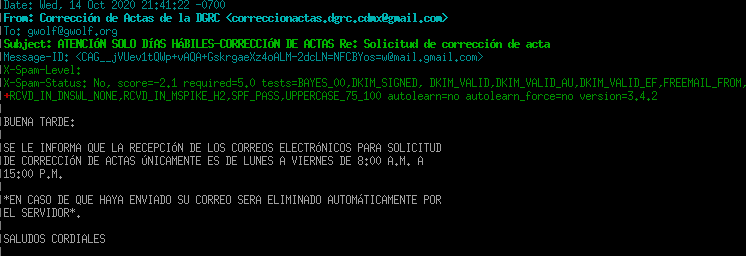
Mexico was one of the first countries in the world to set up a national population registry in the late 1850s, as part of the church-state separation that was for long years one of the national sources of pride. Forty four years ago, when I was born, keeping track of the population was still mostly a manual task. When my parents registered me, my data was stored in page 161 of book 22, year 1976, of the 20th Civil Registration office in Mexico City. Faithful to the legal tradition, everything is handwritten and specified in full. Because, why would they write 1976.04.27 (or even 27 de abril de 1976) when they could spell out d a veintisiete de abril de mil novecientos setenta y seis? Numbers seem to appear only for addresses. So, the State had record of a child being born, and we knew where to look if we came to need this information. But, many years later, a very sensible tecnification happened: all records (after a certain date, I guess) were digitized. Great news! I can now get my birth certificate without moving from my desk, paying a quite reasonable fee (~US$4). What s there not to like? Digitally certified and all! So great! But But Oh, there s a problem. Of course Making sense of the handwriting as you can see is somewhat prone to failure. And I cannot blame anybody for failing to understand the details of my record. So, my mother s first family name is Iszaevich. It was digitized as Iszaerich. Fortunately, they do acknowledge some errors could have made it into the process, and there is a process to report and correct errors. What s there not to like? Oh That they do their best to emulate a public office using online tools. I followed some links in that link to get the address to contact and yesterday night sent them the needed documents. Quite immediately, I got an answer that I must share with the world: Yes, the mailing contact is in the @gmail.com domain. I could care about them not using a @ .gob.mx address, but I ll let it slip. The mail I got says (uppercase and all):
GOOD EVENING,
WE INFORM YOU THAT THE RECEPTION OF E-MAILS FOR REQUESTING
CORRECTIONS IN CERTIFICATES IS ONLY ACTIVE MONDAY THROUGH FRIDAY,
8:00 TO 15:00.
*IN CASE YOU SENT A MAIL OUTSIDE THE WORKING HOURS, IT WILL BE
AUTOMATICALLY DELETED BY THE SERVER*
CORDIAL GREETINGS,
I would only be half-surprised if they were paying the salary of somebody to spend the wee hours of the night receiving and deleting mails from their GMail account.

14 October 2020

Michael Stapelberg: distri: a Linux distribution to research fast package management

Over the last year or so I have worked on a research linux distribution in my spare time. It s not a distribution for researchers (like Scientific Linux), but my personal playground project to research linux distribution development, i.e. try out fresh ideas. This article focuses on the package format and its advantages, but there is more to distri, which I will cover in upcoming blog posts.

Motivation I was a Debian Developer for the 7 years from 2012 to 2019, but using the distribution often left me frustrated, ultimately resulting in me winding down my Debian work. Frequently, I was noticing a large gap between the actual speed of an operation (e.g. doing an update) and the possible speed based on back of the envelope calculations. I wrote more about this in my blog post Package managers are slow . To me, this observation means that either there is potential to optimize the package manager itself (e.g. apt), or what the system does is just too complex. While I remember seeing some low-hanging fruit , through my work on distri, I wanted to explore whether all the complexity we currently have in Linux distributions such as Debian or Fedora is inherent to the problem space. I have completed enough of the experiment to conclude that the complexity is not inherent: I can build a Linux distribution for general-enough purposes which is much less complex than existing ones. Those were low-hanging fruit from a user perspective. I m not saying that fixing them is easy in the technical sense; I know too little about apt s code base to make such a statement.

Key idea: packages are images, not archives One key idea is to switch from using archives to using images for package contents. Common package managers such as dpkg(1) use tar(1) archives with various compression algorithms. distri uses SquashFS images, a comparatively simple file system image format that I happen to be familiar with from my work on the gokrazy Raspberry Pi 3 Go platform. This idea is not novel: AppImage and snappy also use images, but only for individual, self-contained applications. distri however uses images for distribution packages with dependencies. In particular, there is no duplication of shared libraries in distri. A nice side effect of using read-only image files is that applications are immutable and can hence not be broken by accidental (or malicious!) modification.

Key idea: separate hierarchies Package contents are made available under a fully-qualified path. E.g., all files provided by package zsh-amd64-5.6.2-3 are available under /ro/zsh-amd64-5.6.2-3. The mountpoint /ro stands for read-only, which is short yet descriptive. Perhaps surprisingly, building software with custom prefix values of e.g. /ro/zsh-amd64-5.6.2-3 is widely supported, thanks to:
  1. Linux distributions, which build software with prefix set to /usr, whereas FreeBSD (and the autotools default), which build with prefix set to /usr/local.
  2. Enthusiast users in corporate or research environments, who install software into their home directories.
Because using a custom prefix is a common scenario, upstream awareness for prefix-correctness is generally high, and the rarely required patch will be quickly accepted.

Key idea: exchange directories Software packages often exchange data by placing or locating files in well-known directories. Here are just a few examples:
  • gcc(1) locates the libusb(3) headers via /usr/include
  • man(1) locates the nginx(1) manpage via /usr/share/man.
  • zsh(1) locates executable programs via PATH components such as /bin
In distri, these locations are called exchange directories and are provided via FUSE in /ro. Exchange directories come in two different flavors:
  1. global. The exchange directory, e.g. /ro/share, provides the union of the share sub directory of all packages in the package store.
    Global exchange directories are largely used for compatibility, see below.
  2. per-package. Useful for tight coupling: e.g. irssi(1) does not provide any ABI guarantees, so plugins such as irssi-robustirc can declare that they want e.g. /ro/irssi-amd64-1.1.1-1/out/lib/irssi/modules to be a per-package exchange directory and contain files from their lib/irssi/modules.

Search paths sometimes need to be fixed Programs which use exchange directories sometimes use search paths to access multiple exchange directories. In fact, the examples above were taken from gcc(1) s INCLUDEPATH, man(1) s MANPATH and zsh(1) s PATH. These are prominent ones, but more examples are easy to find: zsh(1) loads completion functions from its FPATH. Some search path values are derived from --datadir=/ro/share and require no further attention, but others might derive from e.g. --prefix=/ro/zsh-amd64-5.6.2-3/out and need to be pointed to an exchange directory via a specific command line flag.

FHS compatibility Global exchange directories are used to make distri provide enough of the Filesystem Hierarchy Standard (FHS) that third-party software largely just works. This includes a C development environment. I successfully ran a few programs from their binary packages such as Google Chrome, Spotify, or Microsoft s Visual Studio Code.

Fast package manager I previously wrote about how Linux distribution package managers are too slow. distri s package manager is extremely fast. Its main bottleneck is typically the network link, even at high speed links (I tested with a 100 Gbps link). Its speed comes largely from an architecture which allows the package manager to do less work. Specifically:
  1. Package images can be added atomically to the package store, so we can safely skip fsync(2) . Corruption will be cleaned up automatically, and durability is not important: if an interactive installation is interrupted, the user can just repeat it, as it will be fresh on their mind.
  2. Because all packages are co-installable thanks to separate hierarchies, there are no conflicts at the package store level, and no dependency resolution (an optimization problem requiring SAT solving) is required at all.
    In exchange directories, we resolve conflicts by selecting the package with the highest monotonically increasing distri revision number.
  3. distri proves that we can build a useful Linux distribution entirely without hooks and triggers. Not having to serialize hook execution allows us to download packages into the package store with maximum concurrency.
  4. Because we are using images instead of archives, we do not need to unpack anything. This means installing a package is really just writing its package image and metadata to the package store. Sequential writes are typically the fastest kind of storage usage pattern.
Fast installation also make other use-cases more bearable, such as creating disk images, be it for testing them in qemu(1) , booting them on real hardware from a USB drive, or for cloud providers such as Google Cloud.

Fast package builder Contrary to how distribution package builders are usually implemented, the distri package builder does not actually install any packages into the build environment. Instead, distri makes available a filtered view of the package store (only declared dependencies are available) at /ro in the build environment. This means that even for large dependency trees, setting up a build environment happens in a fraction of a second! Such a low latency really makes a difference in how comfortable it is to iterate on distribution packages.

Package stores In distri, package images are installed from a remote package store into the local system package store /roimg, which backs the /ro mount. A package store is implemented as a directory of package images and their associated metadata files. You can easily make available a package store by using distri export. To provide a mirror for your local network, you can periodically distri update from the package store you want to mirror, and then distri export your local copy. Special tooling (e.g. debmirror in Debian) is not required because distri install is atomic (and update uses install). Producing derivatives is easy: just add your own packages to a copy of the package store. The package store is intentionally kept simple to manage and distribute. Its files could be exchanged via peer-to-peer file systems, or synchronized from an offline medium.

distri s first release distri works well enough to demonstrate the ideas explained above. I have branched this state into branch jackherer, distri s first release code name. This way, I can keep experimenting in the distri repository without breaking your installation. From the branch contents, our autobuilder creates:
  1. disk images, which
  2. a package repository. Installations can pick up new packages with distri update.
  3. documentation for the release.
The project website can be found at https://distr1.org. The website is just the README for now, but we can improve that later. The repository can be found at https://github.com/distr1/distri

Project outlook Right now, distri is mainly a vehicle for my spare-time Linux distribution research. I don t recommend anyone use distri for anything but research, and there are no medium-term plans of that changing. At the very least, please contact me before basing anything serious on distri so that we can talk about limitations and expectations. I expect the distri project to live for as long as I have blog posts to publish, and we ll see what happens afterwards. Note that this is a hobby for me: I will continue to explore, at my own pace, parts that I find interesting. My hope is that established distributions might get a useful idea or two from distri.

There s more to come: subscribe to the distri feed I don t want to make this post too long, but there is much more! Please subscribe to the following URL in your feed reader to get all posts about distri: https://michael.stapelberg.ch/posts/tags/distri/feed.xml Next in my queue are articles about hermetic packages and good package maintainer experience (including declarative packaging).

Feedback or questions? I d love to discuss these ideas in case you re interested! Please send feedback to the distri mailing list so that everyone can participate!

Dirk Eddelbuettel: tidyCpp 0.0.1: New package

A new package arrived on CRAN a few days ago. It offers a few headers files which wrap (parts) of the C API for R, but in a form that may be a little easier to use for C++ programmers. I have always liked how in Rcpp we offer good parts of the standalone R Math library in a namespace R::. While working recently with a particular C routine (for checking non-ASCII characters that will be part of the next version of the dang package which collecting various goodies in one place), I realized there may be value in collecting a few more such wrappers. So I started a few simple ones starting from simple examples. Currently we have five headers defines.h, globals.h, internals.h, math.h, and shield.h. The first four each correpond to an R header file of the same or similar name, and the last one brings a simple yet effective alternative to PROTECT and UNPROTECT from Rcpp (in a slightly simplified way). None of the headers are complete , for internals.h in particular a lot more could be added (as I noticed today when experimenting with another source file that may be converted). All of the headers can be accessed with a simple #include <tidyCpp> (which, following another C++ convention, does not have a .h or .hpp suffix). And a the package ships these headers, packages desiring to use them only need LinkingTo: tidyCpp. As usage examples, we (right now) have four files in the snippets/ directory of the package. Two of these, convolveExample.cpp and dimnamesExample.cpp both illustrate how one could change example code from Writing R Extensions. Then there are also a very simple defineExample.cpp and a shieldExample.cpp illustrating how much easier Shield() is compared to PROTECT and UNPROTECT. Finally, there is a nice vignette discussing the package motivation with two detailed side-by-side before and after examples that are the aforementioned convolution and dimnames examples. Over time, I expect to add more definitions and wrappers. Feedback would be welcome it seems to hit a nerve already as it currently has more stars than commits even though (prior to this post) I had yet to tweet or blog about it. Please post comments and suggestions at the GitHub repo. If you like this or other open-source work I do, you can now sponsor me at GitHub. For the first year, GitHub will match your contributions.

This post by Dirk Eddelbuettel originated on his Thinking inside the box blog. Please report excessive re-aggregation in third-party for-profit settings.

12 October 2020

Markus Koschany: My Free Software Activities in September 2020

Welcome to gambaru.de. Here is my monthly report (+ the first week in October) that covers what I have been doing for Debian. If you re interested in Java, Games and LTS topics, this might be interesting for you. Debian Games
warzone2100
Debian Java
pdfsam
Misc Debian LTS This was my 55. month as a paid contributor and I have been paid to work 31,75 hours on Debian LTS, a project started by Rapha l Hertzog. In that time I did the following: ELTS Extended Long Term Support (ELTS) is a project led by Freexian to further extend the lifetime of Debian releases. It is not an official Debian project but all Debian users benefit from it without cost. The current ELTS release is Debian 8 Jessie . This was my 28. month and I have been paid to work 15 hours on ELTS. Thanks for reading and see you next time.

8 October 2020

Molly de Blanc: COVID and Reflections on Jessica Flanigan

One of the points Flanigan makes in her piece Seat Belt Mandates and Paternalism is that we re conditioned to use seat belts from a very early age. It s a thing we internalize and build into our understanding of the world. People feel bad when they don t wear a seat belt.(1) They re unsettled. They feel unsafe. They feel like they re doing something wrong. Masks have started to fit into this model as well. Not wearing a mask feels wrong. An acquaintance shared a story of crying after realizing they had left the house without a mask. For some people, mask wearing has been deeply internalized. We have regular COVID tests at NYU. Every other week I spit into a tube and then am told whether I am safe or sick. This allows me to hang out with my friends more confident than I would feel otherwise. This allows me to be closer to people than I would be otherwise. It also means that if I got sick, I would know, even if I was asymptomatic. If this happened, I would need to tell my friends. I would trace the places I ve been, the people I ve seen, and admit to them that I got sick. I would feel shame because something I did put me in that position. There were (are?) calls to market mask wearing and COVID protection with the same techniques we use around sex: wear protection, get tested, think before you act, ask consent before touching, be honest and open with the people around you about your risk factors. This is effective, at least among a swath of the population, but COVID has effectively become another STD. It s a socially transmitted disease that we have tabooified into creating shame in people who have it. The problem with this is, of course, that COVID isn t treatable in the same way syphilis and chlamydia are. Still, I would ask whether people don t report, or get tested, or even wear masks, because of shame? In some communities, wearing a mask is a sign that you re sick. It s stigmatizing.(2) I think talking about COVID the way we talk about sex is not the right approach because, in my experience, the ways I learned about sex were everything from factually wrong to deeply harmful. If what we re doing doesn t work, what does? (1) Yes, I know not everyone. (2) Many men who don t wear masks cite it as feeling emasculating, rather than stigmatizing.

7 October 2020

Vincent Fourmond: QSoas quiz #1 : averaging spectra

Here is the first QSoas quiz ! I recently measured several identical spectra in a row to evaluate the noise of the setup, and so I wanted to average all the spectra and also determine the standard deviation in the absorbances. Averaging the spectra can simply be done taking advantage of the average command:
QSoas> load Spectrum*.dat /flags=spectra
QSoas> average flagged:spectra
However, average does not provide means to make standard deviations, it just takes the average of all but the X column. I wanted to add this feature, but I realized there are already at least two distinct ways to do that...

Quiz Your task is to determine the average and standard deviations of the three spectra located there, (Spectrum-1.dat, Spectrum-2.dat and Spectrum-3.dat). There are at least two ways: To help you, I've added the result in Average.dat. The figure below shows a zoom on the data superimposed to the average (bonus points to find how to display this light red area that corresponds to the standard deviation !).
I will post the answer later. In the meantime, feel free to post your own solutions or attempts, hacks, and so on !

About QSoasQSoas is a powerful open source data analysis program that focuses on flexibility and powerful fitting capacities. It is released under the GNU General Public License. It is described in Fourmond, Anal. Chem., 2016, 88 (10), pp 5050 5052. Current version is 2.2. You can download its source code or buy precompiled versions for MacOS and Windows there.

3 October 2020

Dirk Eddelbuettel: pinp 0.0.10: More Tweaks

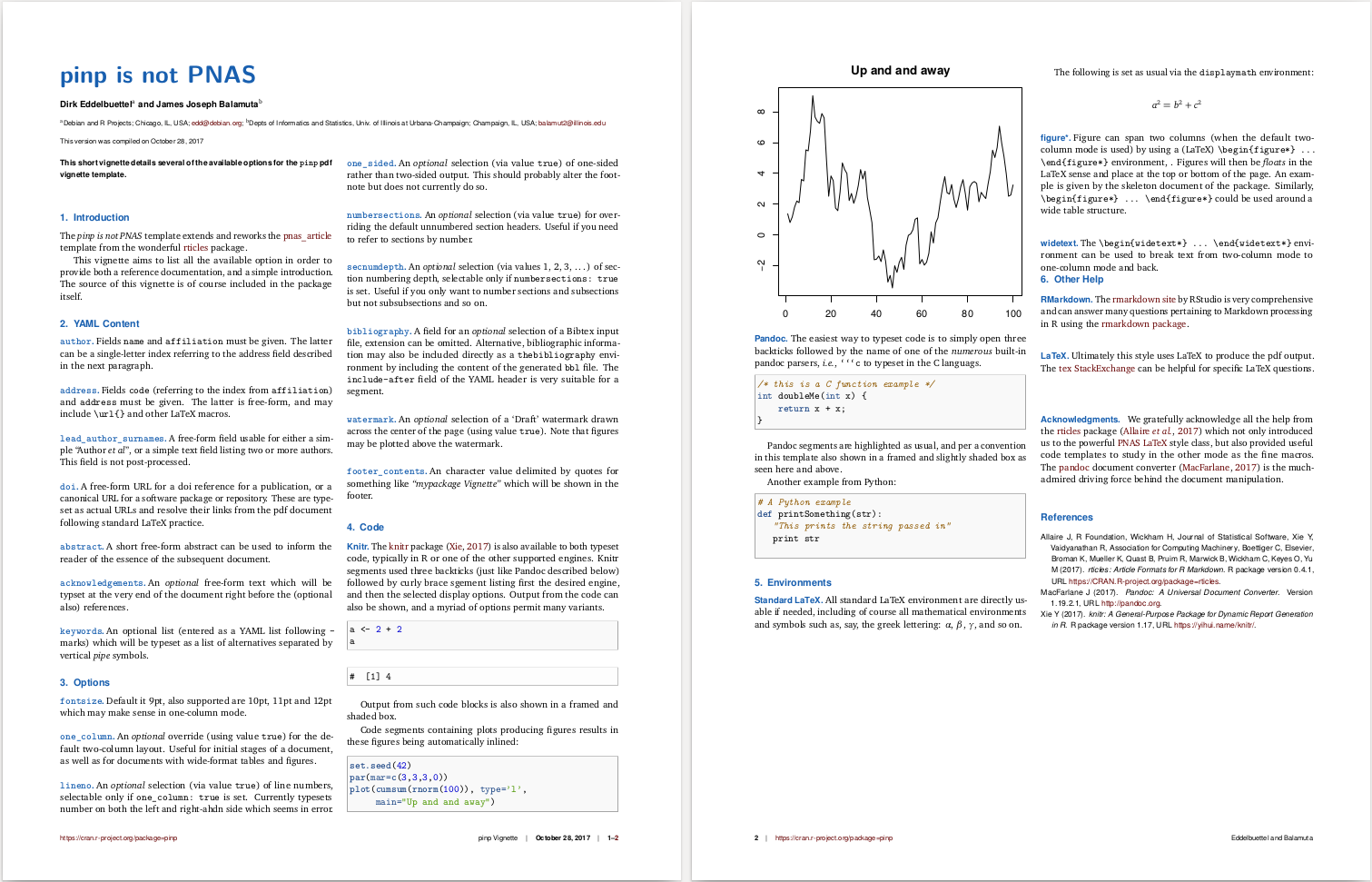
A new version of our pinp package arrived on CRAN two days ago, roughly one year after the previous release. The pinp package allows for snazzier one or two column Markdown-based pdf vignettes, and is now used by a few packages. A screenshot of the package vignette can be seen below. Additional screenshots are at the pinp page. pinp vignette This release adds another option for a customized date YAML variable suitable for e.g. a published at date thanks to Ilya Kashnitsky, has some tweaks to the README.md as well as support for pandoc columns mode (as a small extension of code from the nice repo by Grant McDermott). The NEWS entry for this release follows.

Changes in pinp version 0.0.10 (2020-10-01)
  • New document_date YAML variable to optionally set a 'Published at' or alike date (Ilya Kashnitsky in #85).
  • Small tweaks to README.md (Dirk)
  • Support pandoc columns mode (Dirk in #88)

Courtesy of my CRANberries, there is a comparison to the previous release. More information is on the tint page. For questions or comments use the issue tracker off the GitHub repo. If you like this or other open-source work I do, you can now sponsor me at GitHub. For the first year, GitHub will match your contributions.

This post by Dirk Eddelbuettel originated on his Thinking inside the box blog. Please report excessive re-aggregation in third-party for-profit settings.

Steve Kemp: Writing an assembler.

Recently I've been writing a couple of simple compilers, which take input in a particular format and generate assembly language output. This output can then be piped through gcc to generate a native executable. Public examples include this trivial math compiler and my brainfuck compiler. Of course there's always the nagging thought that relying upon gcc (or nasm) is a bit of a cheat. So I wondered how hard is it to write an assembler? Something that would take assembly-language program and generate a native (ELF) binary? And the answer is "It isn't hard, it is just tedious". I found some code to generate an ELF binary, and after that assembling simple instructions was pretty simple. I remember from my assembly-language days that the encoding of instructions can be pretty much handled by tables, but I've not yet gone into that. (Specifically there are instructions like "add rax, rcx", and the encoding specifies the source/destination registers - with different forms for various sized immediates.) Anyway I hacked up a simple assembler, it can compile a.out from this input:
.hello   DB "Hello, world\n"
.goodbye DB "Goodbye, world\n"
        mov rdx, 13        ;; write this many characters
        mov rcx, hello     ;; starting at the string
        mov rbx, 1         ;; output is STDOUT
        mov rax, 4         ;; sys_write
        int 0x80           ;; syscall
        mov rdx, 15        ;; write this many characters
        mov rcx, goodbye   ;; starting at the string
        mov rax, 4         ;; sys_write
        mov rbx, 1         ;; output is STDOUT
        int 0x80           ;; syscall
        xor rbx, rbx       ;; exit-code is 0
        xor rax, rax       ;; syscall will be 1 - so set to xero, then increase
        inc rax            ;;
        int 0x80           ;; syscall
The obvious omission is support for "JMP", "JMP_NZ", etc. That's painful because jumps are encoded with relative offsets. For the moment if you want to jump:
        push foo     ; "jmp foo" - indirectly.
        ret
:bar
        nop          ; Nothing happens
        mov rbx,33   ; first syscall argument: exit code
        mov rax,1    ; system call number (sys_exit)
        int 0x80     ; call kernel
:foo
        push bar     ; "jmp bar" - indirectly.
        ret
I'll update to add some more instructions, and see if I can use it to handle the output I generate from a couple of other tools. If so that's a win, if not then it was a fun learning experience:

30 September 2020

Utkarsh Gupta: FOSS Activites in September 2020

Here s my (twelfth) monthly update about the activities I ve done in the F/L/OSS world.

Debian
This was my 21st month of contributing to Debian. I became a DM in late March last year and a DD last Christmas! \o/ I ve been busy with my undergraduation stuff but I still squeezed out some time for the regular Debian work. Here are the following things I did in Debian this month:

Uploads and bug fixes:

Other $things:
  • Attended the Debian Ruby team meeting. Logs here.
  • Mentoring for newcomers.
  • FTP Trainee reviewing.
  • Moderation of -project mailing list.
  • Sponsored trace-cmd for Sudip, ruby-asset-sync for Nilesh, and mariadb-mysql-kbs for William.

RuboCop::Packaging - Helping the Debian Ruby team! \o/ This Google Summer of Code, I worked on writing a linter that could flag offenses for lines of code that are very troublesome for Debian maintainers while trying to package and maintain Ruby libraries and applications! Whilst the GSoC period is over, I ve been working on improving that tool and have extended that linter to now auto-correct these offenses by itself! \o/
You can now just use the -A flag and you re done! Boom! The ultimate game-changer! Here s a quick demo for this feature: A few quick updates on RuboCop::Packaging: I ve also spent a considerable amount of time in raising awareness about this and in more general sense, about downstream maintenance.
As a result, I raised a bunch of PRs which got really good response. I got all of the 20 PRs merged upstream, fixing these issues.

Debian (E)LTS
Debian Long Term Support (LTS) is a project to extend the lifetime of all Debian stable releases to (at least) 5 years. Debian LTS is not handled by the Debian security team, but by a separate group of volunteers and companies interested in making it a success. And Debian Extended LTS (ELTS) is its sister project, extending support to the Jessie release (+2 years after LTS support). This was my twelfth month as a Debian LTS and third month as a Debian ELTS paid contributor.
I was assigned 19.75 hours for LTS and 15.00 hours for ELTS and worked on the following things:
(for LTS, I over-worked for 11 hours last month on the survey so only had 8.75 hours this month!)

LTS CVE Fixes and Announcements:

ELTS CVE Fixes and Announcements:
  • Issued ELA 274-1, fixing CVE-2020-11984, for uwsgi.
    For Debian 8 Jessie, these problems have been fixed in version 2.0.7-1+deb8u3.
  • Issued ELA 275-1, fixing CVE-2020-14363, for libx11.
    For Debian 8 Jessie, these problems have been fixed in version 2:1.6.2-3+deb8u4.
  • Issued ELA 278-1, fixing CVE-2020-8184, for ruby-rack.
    For Debian 8 Jessie, these problems have been fixed in version 1.5.2-3+deb8u4.
  • Also worked on updating the version of clamAV from v0.101.5 to v0.102.4.
    This was a bit tricky package to work on since it involved an ABI/API change and was more or less a transition. Super thanks to Emilio for his invaluable help and him taking over the package, finishing, and uploading it in the end.

Other (E)LTS Work:
  • Front-desk duty from 31-08 to 06-09 and from 28-09 onward for both LTS and ELTS.
  • Triaged apache2, cryptsetup, nasm, node-bl, plinth, qemu, rsync, ruby-doorkeeper, and uwsgi.
  • Marked CVE-2020-15094/symfony as not-affected for Stretch.
  • Marked CVE-2020- 9490,11993 /apache2 as ignored for Stretch.
  • Marked CVE-2020-8244/node-bl as no-dsa for Stretch.
  • Marked CVE-2020-24978/nasm as no-dsa for Stretch.
  • Marked CVE-2020-25073/plinth as no-dsa for Stretch.
  • Marked CVE-2020-15094/symfony as not-affected for Jessie.
  • Marked CVE-2020-14382/cryptsetup as not-affected for Jessie.
  • Marked CVE-2020-14387/rsync as not-affected for Jessie.
  • Auto EOL ed ark, collabtive, linux, nasm, node-bl, and thunderbird for Jessie.
  • Use mktemp instead of tempfile in bin/auto-add-end-of-life.sh.
  • Attended the fifth LTS meeting. Logs here.
  • General discussion on LTS private and public mailing list.

Until next time.
:wq for today.

Chris Lamb: Free software activities in September 2020

Here is my monthly update covering what I have been doing in the free software world during September 2020 (previous month):

Reproducible Builds One of the original promises of open source software is that distributed peer review and transparency of process results in enhanced end-user security. However, whilst anyone may inspect the source code of free and open source software for malicious flaws, almost all software today is distributed as pre-compiled binaries. This allows nefarious third-parties to compromise systems by injecting malicious code into ostensibly secure software during the various compilation and distribution processes. The motivation behind the Reproducible Builds effort is to ensure no flaws have been introduced during this compilation process by promising identical results are always generated from a given source, thus allowing multiple third-parties to come to a consensus on whether a build was compromised. The project is proud to be a member project of the Software Freedom Conservancy. Conservancy acts as a corporate umbrella allowing projects to operate as non-profit initiatives without managing their own corporate structure. If you like the work of the Conservancy or the Reproducible Builds project, please consider becoming an official supporter. This month, I:

diffoscope I made the following changes to diffoscope, including preparing and uploading versions 159 and 160 to Debian:

Debian Lintian For Lintian, the static analysis tool for Debian packages, I uploaded versions 2.93.0, 2.94.0, 2.95.0 & 2.96.0 (not counting uploads to the backports repositories), as well as: Debian LTS This month I've worked 18 hours on Debian Long Term Support (LTS) and 12 hours on its sister Extended LTS project. You can find out more about the project via the following video:
Uploads Bugs filed

21 September 2020

Kees Cook: security things in Linux v5.7

Previously: v5.6 Linux v5.7 was released at the end of May. Here s my summary of various security things that caught my attention: arm64 kernel pointer authentication
While the ARMv8.3 CPU Pointer Authentication (PAC) feature landed for userspace already, Kristina Martsenko has now landed PAC support in kernel mode. The current implementation uses PACIASP which protects the saved stack pointer, similar to the existing CONFIG_STACKPROTECTOR feature, only faster. This also paves the way to sign and check pointers stored in the heap, as a way to defeat function pointer overwrites in those memory regions too. Since the behavior is different from the traditional stack protector, Amit Daniel Kachhap added an LKDTM test for PAC as well. BPF LSM
The kernel s Linux Security Module (LSM) API provide a way to write security modules that have traditionally implemented various Mandatory Access Control (MAC) systems like SELinux, AppArmor, etc. The LSM hooks are numerous and no one LSM uses them all, as some hooks are much more specialized (like those used by IMA, Yama, LoadPin, etc). There was not, however, any way to externally attach to these hooks (not even through a regular loadable kernel module) nor build fully dynamic security policy, until KP Singh landed the API for building LSM policy using BPF. With this, it is possible (for a privileged process) to write kernel LSM hooks in BPF, allowing for totally custom security policy (and reporting). execve() deadlock refactoring
There have been a number of long-standing races in the kernel s process launching code where ptrace could deadlock. Fixing these has been attempted several times over the last many years, but Eric W. Biederman and Ernd Edlinger decided to dive in, and successfully landed the a series of refactorings, splitting up the problematic locking and refactoring their uses to remove the deadlocks. While he was at it, Eric also extended the exec_id counter to 64 bits to avoid the possibility of the counter wrapping and allowing an attacker to send arbitrary signals to processes they normally shouldn t be able to. slub freelist obfuscation improvements
After Silvio Cesare observed some weaknesses in the implementation of CONFIG_SLAB_FREELIST_HARDENED s freelist pointer content obfuscation, I improved their bit diffusion, which makes attacks require significantly more memory content exposures to defeat the obfuscation. As part of the conversation, Vitaly Nikolenko pointed out that the freelist pointer s location made it relatively easy to target too (for either disclosures or overwrites), so I moved it away from the edge of the slab, making it harder to reach through small-sized overflows (which usually target the freelist pointer). As it turns out, there were a few assumptions in the kernel about the location of the freelist pointer, which had to also get cleaned up. RISCV page table dumping
Following v5.6 s generic page table dumping work, Zong Li landed the RISCV page dumping code. This means it s much easier to examine the kernel s page table layout when running a debug kernel (built with PTDUMP_DEBUGFS), visible in /sys/kernel/debug/kernel_page_tables. array index bounds checking
This is a pretty large area of work that touches a lot of overlapping elements (and history) in the Linux kernel. The short version is: C is bad at noticing when it uses an array index beyond the bounds of the declared array, and we need to fix that. For example, don t do this:
int foo[5];
...
foo[8] = bar;
The long version gets complicated by the evolution of flexible array structure members, so we ll pause for a moment and skim the surface of this topic. While things like CONFIG_FORTIFY_SOURCE try to catch these kinds of cases in the memcpy() and strcpy() family of functions, it doesn t catch it in open-coded array indexing, as seen in the code above. GCC has a warning (-Warray-bounds) for these cases, but it was disabled by Linus because of all the false positives seen due to fake flexible array members. Before flexible arrays were standardized, GNU C supported zero sized array members. And before that, C code would use a 1-element array. These were all designed so that some structure could be the header in front of some data blob that could be addressable through the last structure member:
/* 1-element array */
struct foo  
    ...
    char contents[1];
 ;
/* GNU C extension: 0-element array */
struct foo  
    ...
    char contents[0];
 ;
/* C standard: flexible array */
struct foo  
    ...
    char contents[];
 ;
instance = kmalloc(sizeof(struct foo) + content_size);
Converting all the zero- and one-element array members to flexible arrays is one of Gustavo A. R. Silva s goals, and hundreds of these changes started landing. Once fixed, -Warray-bounds can be re-enabled. Much more detail can be found in the kernel s deprecation docs. However, that will only catch the visible at compile time cases. For runtime checking, the Undefined Behavior Sanitizer has an option for adding runtime array bounds checking for catching things like this where the compiler cannot perform a static analysis of the index values:
int foo[5];
...
for (i = 0; i < some_argument; i++)  
    ...
    foo[i] = bar;
    ...
 
It was, however, not separate (via kernel Kconfig) until Elena Petrova and I split it out into CONFIG_UBSAN_BOUNDS, which is fast enough for production kernel use. With this enabled, it's now possible to instrument the kernel to catch these conditions, which seem to come up with some regularity in Wi-Fi and Bluetooth drivers for some reason. Since UBSAN (and the other Sanitizers) only WARN() by default, system owners need to set panic_on_warn=1 too if they want to defend against attacks targeting these kinds of flaws. Because of this, and to avoid bloating the kernel image with all the warning messages, I introduced CONFIG_UBSAN_TRAP which effectively turns these conditions into a BUG() without needing additional sysctl settings. Fixing "additive" snprintf() usage
A common idiom in C for building up strings is to use sprintf()'s return value to increment a pointer into a string, and build a string with more sprintf() calls:
/* safe if strlen(foo) + 1 < sizeof(string) */
wrote  = sprintf(string, "Foo: %s\n", foo);
/* overflows if strlen(foo) + strlen(bar) > sizeof(string) */
wrote += sprintf(string + wrote, "Bar: %s\n", bar);
/* writing way beyond the end of "string" now ... */
wrote += sprintf(string + wrote, "Baz: %s\n", baz);
The risk is that if these calls eventually walk off the end of the string buffer, it will start writing into other memory and create some bad situations. Switching these to snprintf() does not, however, make anything safer, since snprintf() returns how much it would have written:
/* safe, assuming available <= sizeof(string), and for this example
 * assume strlen(foo) < sizeof(string) */
wrote  = snprintf(string, available, "Foo: %s\n", foo);
/* if (strlen(bar) > available - wrote), this is still safe since the
 * write into "string" will be truncated, but now "wrote" has been
 * incremented by how much snprintf() *would* have written, so "wrote"
 * is now larger than "available". */
wrote += snprintf(string + wrote, available - wrote, "Bar: %s\n", bar);
/* string + wrote is beyond the end of string, and availabe - wrote wraps
 * around to a giant positive value, making the write effectively 
 * unbounded. */
wrote += snprintf(string + wrote, available - wrote, "Baz: %s\n", baz);
So while the first overflowing call would be safe, the next one would be targeting beyond the end of the array and the size calculation will have wrapped around to a giant limit. Replacing this idiom with scnprintf() solves the issue because it only reports what was actually written. To this end, Takashi Iwai has been landing a bunch scnprintf() fixes. That's it for now! Let me know if there is anything else you think I should mention here. Next up: Linux v5.8.

2020, Kees Cook. This work is licensed under a Creative Commons Attribution-ShareAlike 4.0 License.
CC BY-SA 4.0

Russ Allbery: Review: Lower Ed

Review: Lower Ed, by Tressie McMillan Cottom
Publisher: The New Press
Copyright: 2017
Printing: 2018
ISBN: 1-62097-472-X
Format: Kindle
Pages: 217
Lower Ed (subtitled The Troubling Rise of For-Profit Colleges in the New Economy) is the first book by sociologist Tressie McMillan Cottom. (I previously reviewed her second book, the excellent essay collection Thick.) It is a deep look at the sociology of for-profit higher education in the United States based on interviews with students and executives, analysis of Wall Street filings, tests of the admissions process, and her own personal experiences working for two of the schools. One of the questions that McMillan Cottom tries to answer is why students choose to enroll in these institutions, particularly the newer type of institution funded by federal student loans and notorious for being more expensive and less valuable than non-profit colleges and universities. I was hesitant to read this book because I find for-profit schools depressing. I grew up with the ubiquitous commercials, watched the backlash develop, and have a strongly negative impression of the industry, partly influenced by having worked in traditional non-profit higher education for two decades. The prevailing opinion in my social group is that they're a con job. I was half-expecting a reinforcement of that opinion by example, and I don't like reading infuriating stories about people being defrauded. I need not have worried. This is not that sort of book (nor, in retrospect, do I think McMillan Cottom would approach a topic from that angle). Sociology is broader than reporting. Lower Ed positions for-profit colleges within a larger social structure of education, credentialing, and changes in workplace expectations; takes a deep look at why they are attractive to their students; and humanizes and complicates the motives and incentives of everyone involved, including administrators and employees of for-profit colleges as well as the students. McMillan Cottom does of course talk about the profit motive and the deceptions surrounding that, but the context is less that of fraud that people are unable to see through and more a balancing of the drawbacks of a set of poor choices embedded in institutional failures. One of my metrics for a good non-fiction book is whether it introduces me to a new idea that changes how I analyze the world. Lower Ed does that twice. The first idea is the view of higher education through the lens of risk shifting. It used to be common for employers to hire people without prior job-specific training and do the training in-house, possibly through an apprenticeship structure. More notably, once one was employed by a particular company, the company routinely arranged or provided ongoing training. This went hand-in-hand with a workplace culture of long tenure, internal promotion, attempts to avoid layoffs, and some degree of mutual loyalty. Companies expected to invest significantly in an employee over their career and thus also had an incentive to retain that employee rather than train someone for a competitor. However, from a purely financial perspective, this is a risk and an inefficiency, similar to the risk of carrying a large inventory of parts and components. Companies have responded to investor-driven focus on profits and efficiency by reducing overhead and shifting risk. This leads to the lean supply chain, where no one pays for parts to sit around in warehouses and companies aren't caught with large stockpiles of now-useless components, but which is more sensitive to any disruption (such as from a global pandemic). And, for employment, it leads to a desire to hire pre-trained workers, retain only enough workers to do the current amount of work, and replace them with new workers who already have appropriate training rather than retrain them. The effect of the corporate decision to only hire pre-trained employees is to shift the risk and expense of training from the company to the prospective employee. The individual has to seek out training at their own expense in the hope (not guarantee) that at the conclusion of that training they will get or retain a job. People therefore turn to higher education to both provide that training and to help them decide what type of training will eventually be valuable. This has a long history with certain professional fields (doctors and lawyers, for example), but the requirements for completing training in those fields are relatively clear (a professional license to practice) and the compensation reflects the risk. What's new is the shift of training risk to the individual in more mundane jobs, without any corresponding increase in compensation. This, McMillan Cottom explains, is the background for the growth in demand for higher education in general and the the type of education offered by for-profit colleges in particular. Workers who in previous eras would be trained by their employers are now responsible for their own training. That training is no longer judged by the standards of a specific workplace, but is instead evaluated by a hiring process that expects constant job-shifting. This leads to increased demand by both workers and employers for credentials: some simple-to-check certificate of completion of training that says that this person has the skills to immediately start doing some job. It also leads to a demand for more flexible class hours, since the student is now often someone older with a job and a family to balance. Their ongoing training used to be considered a cost of business and happen during their work hours; now it is something they have to fit around the contours of their life because their employer has shifted that risk to them. The risk-shifting frame makes sense of the "investment" language so common in for-profit education. In this job economy, education as investment is not a weird metaphor for the classic benefits of a liberal arts education: broadened perspective, deeper grounding in philosophy and ethics, or heightened aesthetic appreciation. It's an investment in the literal financial sense; it is money that you spend now in order to get a financial benefit (a job) in the future. People have to invest in their own training because employers are no longer doing so, but still require the outcome of that investment. And, worse, it's primarily a station-keeping investment. Rather than an optional expenditure that could reap greater benefits later, it's a mandatory expenditure to prevent, at best, stagnation in a job paying poverty wages, and at worst the disaster of unemployment. This explains renewed demand for higher education, but why for-profit colleges? We know they cost more and have a worse reputation (and therefore their credentials have less value) than traditional non-profit colleges. Flexible hours and class scheduling explains some of this but not all of it. That leads to the second perspective-shifting idea I got from Lower Ed: for-profit colleges are very good at what they focus time and resources on, and they focus on enrolling students. It is hard to enroll in a university! More precisely, enrolling in a university requires bureaucracy navigation skills, and those skills are class-coded. The people who need them the most are the least likely to have them. Universities do not reach out to you, nor do they guide you through the process. You have to go to them and discover how to apply, something that is often made harder by the confusing state of many university web sites. The language and process is opaque unless other people in your family have experience with universities and can explain it. There might be someone you can reach on the phone to ask questions, but they're highly unlikely to proactively guide you through the remaining steps. It's your responsibility to understand deadlines, timing, and sequence of operations, and if you miss any of the steps (due to, for example, the overscheduled life of someone in need of better education for better job prospects), the penalty in time and sometimes money can be substantial. And admission is just the start; navigating financial aid, which most students will need, is an order of magnitude more daunting. Community colleges are somewhat easier (and certainly cheaper) than universities, but still have similar obstacles (and often even worse web sites). It's easy for people like me, who have long professional expertise with bureaucracies, family experience with higher education, and a support network of people to nag me about deadlines, to underestimate this. But the application experience at a for-profit college is entirely different in ways far more profound than I had realized. McMillan Cottom documents this in detail from her own experience working for two different for-profit colleges and from an experiment where she indicated interest in multiple for-profit colleges and then stopped responding before signing admission paperwork. A for-profit college is fully invested in helping a student both apply and get financial aid, devotes someone to helping them through that process, does not expect them to understand how to navigate bureaucracies or decipher forms on their own, does not punish unexpected delays or missed appointments, and goes to considerable lengths to try to keep anyone from falling out of the process before they are enrolled. They do not expect their students to already have the skills that one learns from working in white-collar jobs or from being surrounded by people who do. They provide the kind of support that an educational institution should provide to people who, by definition, don't understand something and need to learn. Reading about this was infuriating. Obviously, this effort to help people enroll is largely for predatory reasons. For-profit schools make their money off federal loans and they don't get that money unless they can get someone to enroll and fill out financial paperwork (and to some extent keep them enrolled), so admissions is their cash cow and they act accordingly. But that's not why I found it infuriating; that's just predictable capitalism. What I think is inexcusable is that nothing they do is that difficult. We could being doing the same thing for prospective community college students but have made the societal choice not to. We believe that education is valuable, we constantly advocate that people get more job training and higher education, and yet we demand prospective students navigate an unnecessarily baroque and confusing application process with very little help, and then stereotype and blame them for failing to do so. This admission support is not a question of resources. For-profit colleges are funded almost entirely by federally-guaranteed student loans. We are paying them to help people apply. It is, in McMillan Cottom's term, a negative social insurance program. Rather than buffering people against the negative effects of risk-shifting of employers by helping them into the least-expensive and most-effective training programs (non-profit community colleges and universities), we are spending tax dollars to enrich the shareholders of for-profit colleges while underfunding the alternatives. We are choosing to create a gap that routes government support to the institution that provides worse training at higher cost but is very good at helping people apply. It's as if the unemployment system required one to use payday lenders to get one's unemployment check. There is more in this book I want to talk about, but this review is already long enough. Suffice it to say that McMillan Cottom's analysis does not stop with market forces and the admission process, and the parts of her analysis that touch on my own personal experience as someone with a somewhat unusual college path ring very true. Speaking as a former community college student, the discussion of class credit transfer policies and the way that institutional prestige gatekeeping and the desire to push back against low-quality instruction becomes a trap that keeps students in the for-profit system deserves another review this length. So do the implications of risk-shifting and credentialism on the morality of "cheating" on schoolwork. As one would expect from the author of the essay "Thick" about bringing context to sociology, Lower Ed is personal and grounded. McMillan Cottom doesn't shy away from including her own experiences and being explicit about her sources and research. This is backed up by one of the best methodological notes sections I've seen in a book. One of the things I love about McMillan Cottom's writing is that it's solidly academic, not in the sense of being opaque or full of jargon (the text can be a bit dense, but I rarely found it hard to follow), but in the sense of being clear about the sources of knowledge and her methods of extrapolation and analysis. She brings her receipts in a refreshingly concrete way. I do have a few caveats. First, I had trouble following a structure and line of reasoning through the whole book. Each individual point is meticulously argued and supported, but they are not always organized into a clear progression or framework. That made Lower Ed feel at times like a collection of high-quality but somewhat unrelated observations about credentials, higher education, for-profit colleges, their student populations, their business models, and their relationships with non-profit schools. Second, there are some related topics that McMillan Cottom touches on but doesn't expand sufficiently for me to be certain I understood them. One of the big ones is credentialism. This is apparently a hot topic in sociology and is obviously important to this book, but it's referenced somewhat glancingly and was not satisfyingly defined (at least for me). There are a few similar places where I almost but didn't quite follow a line of reasoning because the book structure didn't lay enough foundation. Caveats aside, though, this was meaty, thought-provoking, and eye-opening, and I'm very glad that I read it. This is a topic that I care more about than most people, but if you have watched for-profit colleges with distaste but without deep understanding, I highly recommend Lower Ed. Rating: 8 out of 10

Next.

Previous.