Search Results: "tim"

4 April 2025

Guido G nther: Booting an Android custom kernel on a Pixel 3a for QMI debugging

As you might know I'm not much of an Android user (let alone developer) but in order to figure out how something low level works you sometimes need to peek at how vendor kernels handles this. For that it is often useful to add additional debugging. One such case is QMI communication going on in Qualcomm SOCs. Joel Selvaraj wrote some nice tooling for this. To make use of this a rooted device and a small kernel patch is needed and what would be a no-brainer with Linux Mobile took me a moment to get it to work on Android. Here's the steps I took on a Pixel 3a to first root the device via Magisk, then build the patched kernel and put that into a boot.img to boot it. Flashing the factory image If you still have Android on the device you can skip this step. You can get Android 12 from developers.google.com. I've downloaded sargo-sp2a.220505.008-factory-071e368a.zip. Then put the device into Fastboot mode (Power + Vol-Down), connect it to your PC via USB, unzip/unpack the archive and reflash the phone:
unpack sargo-sp2a.220505.008-factory-071e368a.zip
./flash-all.sh
This wipes your device! I had to run it twice since it would time out on the first run. Note that this unpacked zip contains another zip (image-sargo-sp2a.220505.008.zip) which will become useful below. Enabling USB debugging Now boot Android and enable Developer mode by going to Settings About then touching Build Number (at the very bottom) 7 times. Go back one level, then go to System Developer Options and enable "USB Debugging". Obtaining boot.img There are several ways to get boot.img. If you just flashed Android above then you can fetch boot.img from the already mentioned image-sargo-sp2a.220505.008.zip:
unzip image-sargo-sp2a.220505.008.zip boot.img
If you want to fetch the exact boot.img from your device you can use TWRP (see the very end of this post). Becoming root with Magisk Being able to su via adb will later be useful to fetch kernel logs. For that we first download Magisk as APK. At the time of writing v28.1 is current. Once downloaded we upload the APK and the boot.img from the previous step onto the phone (which needs to have Android booted):
adb push Magisk-v28.1.apk /sdcard/Download
adb push boot.img /sdcard/Download
In Android open the Files app, navigate to /sdcard/Download and install the Magisk APK by opening the APK. We now want to patch boot.img to get su via adb to work (so we can run dmesg). This happens by hitting Install in the Magisk app, then "Select a file to patch". You then select the boot.img we just uploaded. The installation process will create a magisk_patched-<random>.img in /sdcard/Download. We can pull that file via adb back to our PC:
adb pull /sdcard/Download/magisk_patched-28100_3ucVs.img
Then reboot the phone into fastboot (adb reboot bootloader) and flash it (this is optional see below):
fastboot flash boot magisk_patched-28100_3ucVs.img
Now boot the phone again, open the Magisk app, go to SuperUser at the bottom and enable Shell. If you now connect to your phone via adb again and now su should work:
adb shell
su
As noted above if you want to keep your Android installation pristine you don't even need to flash this Magisk enabled boot.img. I've flashed it so I have su access for other operations too. If you don't want to flash it you can still test boot it via:
fastboot boot magisk_patched-28100_3ucVs.img
and then perform the same adb shell su check as above. Building the custom kernel For our QMI debugging to work we need to patch the kernel a bit and place that in boot.img too. So let's build the kernel first. For that we install the necessary tools (which are thankfully packaged in Debian) and fetch the Android kernel sources:
sudo apt install repo android-platform-tools-base kmod ccache build-essential mkbootimg
mkdir aosp-kernel && cd aosp-kernel
repo init -u https://android.googlesource.com/kernel/manifest -b android-msm-bonito-4.9-android12L
repo sync
With that we can apply Joel's kernel patches and also compile in the touch controller driver so we don't need to worry if the modules in the initramfs match the kernel. The kernel sources are in private/msm-google. I've just applied the diffs on top with patch and modified the defconfig and committed the changes. The resulting tree is here. We then build the kernel:
PATH=/usr/sbin:$PATH ./build_bonito.sh
The resulting kernel is at ./out/android-msm-pixel-4.9/private/msm-google/arch/arm64/boot/Image.lz4-dtb. In order to boot that kernel I found it to be the simplest to just replace the kernel in the Magisk patched boot.img as we have that already. In case you have already deleted that for any reason we can always fetch the current boot.img from the phone via TWRP (see below). Preparing a new boot.img To replace the kernel in our Magisk enabled magisk_patched-28100_3ucVs.img from above with the just built kernel we can use mkbootimgfor that. I basically copied the steps we're using when building the boot.img on the Linux Mobile side:
ARGS=$(unpack_bootimg --format mkbootimg --out tmp --boot_img magisk_patched-28100_3ucVs.img)
CLEAN_PARAMS="$(echo "$ ARGS "   sed -e "s/ --cmdline '.*'//" -e "s/ --board '.*'//")"
cp android-kernel/out/android-msm-pixel-4.9/private/msm-google/arch/arm64/boot/Image.lz4-dtb tmp/kernel
mkbootimg -o "boot.patched.img" $ CLEAN_PARAMS  --cmdline "$ ARGS "
This will give you a boot.patched.img with the just built kernel. Boot the new kernel via fastboot We can now boot the new boot.patched.img. No need to flash that onto the device for that:
fastboot boot boot.patched.img
Fetching the kernel logs With that we can fetch the kernel logs with the debug output via adb:
adb shell su -c 'dmesg -t' > dmesg_dump.xml
or already filtering out the QMI commands:
adb shell su -c 'dmesg -t'    grep "@QMI@"   sed -e "s/@QMI@//g" &> sargo_qmi_dump.xml
That's it. You can apply this method for testing out other kernel patches as well. If you want to apply the above to other devices you basically need to make sure you patch the right kernel sources, the other steps should be very similar. In case you just need a rooted boot.img for sargo you can find a patched one here. If this procedure can be improved / streamlined somehow please let me know. Appendix: Fetching boot.img from the phone If, for some reason you lost boot.img somewhere on the way you can always use TWRP to fetch the boot.img currently in use on your phone. First get TWRP for the Pixel 3a. You can boot that directly by putting your device into fastboot mode, then running:
fastboot boot twrp-3.7.1_12-1-sargo.img
Within TWRP select Backup Boot and backup the file. You can then use adb shell to locate the backup in /sdcard/TWRP/BACKUPS/ and pull it:
adb pull /sdcard/TWRP/BACKUPS/97GAY10PWS/2025-04-02--09-24-24_SP2A220505008/boot.emmc.win
You now have the device's boot.img on your PC and can e.g. replace the kernel or make modifications to the initramfs.

Evgeni Golov: naming things is hard

I got a new laptop (a Lenovo Thinkpad X1 Carbon Gen 12, more on that later) and as always with new pets, it needed a name. My naming scheme is roughly "short japanese words that somehow relate to the machine". The current (other) machines at home are (not all really in use): Then, I happen to rent a few servers: I also had machines in the past, that are no longer with me: And also servers from the past: So, what shall I call the new one? It will be "juuni" ( ), which means 12. Creative, huh?

2 April 2025

Dirk Eddelbuettel: nanotime 0.3.12 on CRAN: Maintenance

Another minor update 0.3.12 for our nanotime package is now on CRAN. nanotime relies on the RcppCCTZ package (as well as the RcppDate package for additional C++ operations) and offers efficient high(er) resolution time parsing and formatting up to nanosecond resolution, using the bit64 package for the actual integer64 arithmetic. Initially implemented using the S3 system, it has benefitted greatly from a rigorous refactoring by Leonardo who not only rejigged nanotime internals in S4 but also added new S4 types for periods, intervals and durations. This release responds to recent CRAN nag of also suggesting packages used in demos, makes a small update to the CI script, and improves one version comparison for conditional code. The NEWS snippet below has the fuller details.

Changes in version 0.3.12 (2025-04-02)
  • Update continuous integration to use r-ci action with bootstrap
  • Add ggplot2 to Suggests due to use in demo/ which is now scanned
  • Refine a version comparison for R 4.5.0 to be greater or equal

Thanks to my CRANberries, there is a diffstat report for this release. More details and examples are at the nanotime page; code, issue tickets etc at the GitHub repository and all documentation is provided at the nanotime documentation site.

This post by Dirk Eddelbuettel originated on his Thinking inside the box blog. If you like this or other open-source work I do, you can now sponsor me at GitHub.

1 April 2025

Colin Watson: Free software activity in March 2025

Most of my Debian contributions this month were sponsored by Freexian. You can also support my work directly via Liberapay. OpenSSH Changes in dropbear 2025.87 broke OpenSSH s regression tests. I cherry-picked the fix. I reviewed and merged patches from Luca Boccassi to send and accept the COLORTERM and NO_COLOR environment variables. Python team Following up on last month, I fixed some more uscan errors: I upgraded these packages to new upstream versions: In bookworm-backports, I updated python-django to 3:4.2.19-1. Although Debian s upgrade to python-click 8.2.0 was reverted for the time being, I fixed a number of related problems anyway since we re going to have to deal with it eventually: dh-python dropped its dependency on python3-setuptools in 6.20250306, which was long overdue, but it had quite a bit of fallout; in most cases this was simply a question of adding build-dependencies on python3-setuptools, but in a few cases there was a missing build-dependency on python3-typing-extensions which had previously been pulled in as a dependency of python3-setuptools. I fixed these bugs resulting from this: We agreed to remove python-pytest-flake8. In support of this, I removed unnecessary build-dependencies from pytest-pylint, python-proton-core, python-pyzipper, python-tatsu, python-tatsu-lts, and python-tinycss, and filed #1101178 on eccodes-python and #1101179 on rpmlint. There was a dnspython autopkgtest regression on s390x. I independently tracked that down to a pylsqpack bug and came up with a reduced test case before realizing that Pranav P had already been working on it; we then worked together on it and I uploaded their patch to Debian. I fixed various other build/test failures: I enabled more tests in python-moto and contributed a supporting fix upstream. I sponsored Maximilian Engelhardt to reintroduce zope.sqlalchemy. I fixed various odds and ends of bugs: I contributed a small documentation improvement to pybuild-autopkgtest(1). Rust team I upgraded rust-asn1 to 0.20.0. Science team I finally gave in and joined the Debian Science Team this month, since it often has a lot of overlap with the Python team, and Freexian maintains several packages under it. I fixed a uscan error in hdf5-blosc (maintained by Freexian), and upgraded it to a new upstream version. I fixed python-vispy: missing dependency on numpy abi. Other bits and pieces I fixed debconf should automatically be noninteractive if input is /dev/null. I fixed a build failure with GCC 15 in yubihsm-shell (maintained by Freexian). Prompted by a CI failure in debusine, I submitted a large batch of spelling fixes and some improved static analysis to incus (#1777, #1778) and distrobuilder. After regaining access to the repository, I fixed telegnome: missing app icon in About dialogue and made a new 0.3.7 release.
Michael Ablassmeier: qmpbackup 0.46 - add image fleecing

I ve released qmpbackup 0.46 which now utilizes the image fleecing technique for backup. Usually, during backup, Qemu will use a so called copy-before-write filter so that data for new guest writes is sent to the backup target first, the guest write blocks until this operation is finished. If the backup target is flaky, or becomes unavailable during backup operation, this could lead to high I/O wait times or even complete VM lockups. To fix this, a so called fleecing image is introduced during backup being used as temporary cache for write operations by the guest. This image can be placed on the same storage as the virtual machine disks, so is independent from the backup target performance. The documentation on which steps are required to get this going, using the Qemu QMP protocol is, lets say.. lacking.. The following examples show the general functionality, but should be enhanced to use transactions where possible. All commands are in qmp-shell command format. Lets start with a full backup:
# create a new bitmap
block-dirty-bitmap-add node=disk1 name=bitmap persistent=true
# add the fleece image to the virtual machine (same size as original disk required)
blockdev-add driver=qcow2 node-name=fleecie file= "driver":"file","filename":"/tmp/fleece.qcow2" 
# add the backup target file to the virtual machine
blockdev-add driver=qcow2 node-name=backup-target-file file= "driver":"file","filename":"/tmp/backup.qcow2" 
# enable the copy-before-writer for the first disk attached, utilizing the fleece image
blockdev-add driver=copy-before-write node-name=cbw file=disk1 target=fleecie
# "blockdev-replace": make the copy-before-writer filter the major device (use "query-block" to get path parameter value, qdev node)
qom-set path=/machine/unattached/device[20] property=drive value=cbw
# add the snapshot-access filter backing the copy-before-writer
blockdev-add driver=snapshot-access file=cbw node-name=snapshot-backup-source
# create a full backup
blockdev-backup device=snapshot-backup-source target=backup-target-file sync=full job-id=test
[ wait until block job finishes]
# remove the snapshot access filter from the virtual machine
blockdev-del node-name=snapshot-backup-source
# switch back to the regular disk
qom-set path=/machine/unattached/device[20] property=drive value=node-disk1
# remove the copy-before-writer
blockdev-del node-name=cbw
# remove the backup-target-file
blockdev-del node-name=backup-target-file
# detach the fleecing image
blockdev-del node-name=fleecie
After this process, the temporary fleecing image can be deleted/recreated. Now lets go for a incremental backup:
# add the fleecing and backup target image, like before
blockdev-add driver=qcow2 node-name=fleecie file= "driver":"file","filename":"/tmp/fleece.qcow2" 
blockdev-add driver=qcow2 node-name=backup-target-file file= "driver":"file","filename":"/tmp/backup-incremental.qcow2" 
# add the copy-before-write filter, but utilize the bitmap created during full backup
blockdev-add driver=copy-before-write node-name=cbw file=disk1 target=fleecie bitmap= "node":"disk1","name":"bitmap" 
# switch device to the copy-before-write filter
qom-set path=/machine/unattached/device[20] property=drive value=cbw
# add the snapshot-access filter
blockdev-add driver=snapshot-access file=cbw node-name=snapshot-backup-source
# merge the bitmap created during full backup to the snapshot-access device so
# the backup operation can access it. (you better use an transaction here)
block-dirty-bitmap-add node=snapshot-backup-source name=bitmap
block-dirty-bitmap-merge node=snapshot-backup-source target=bitmap bitmaps=[ "node":"disk1","name":"bitmap" ]
# create incremental backup (you better use an transaction here)
blockdev-backup device=snapshot-backup-source target=backup-target-file job-id=test sync=incremental bitmap=bitmap
 [ wait until backup has finished ]
 [ cleanup like before ]
# clear the dirty bitmap (you better use an transaction here)
block-dirty-bitmap-clear node=disk1 name=bitmap
Or, use a simple reproducer by directly passing qmp commands via stdio:
#!/usr/bin/bash
qemu-img create -f raw disk 1M
qemu-img create -f raw fleece 1M
qemu-img create -f raw backup 1M
qemu-system-x86_64 -drive node-name=disk,file=disk,format=file -qmp stdio -nographic -nodefaults <<EOF
 "execute": "qmp_capabilities" 
 "execute": "block-dirty-bitmap-add", "arguments":  "node": "disk", "name": "bitmap" 
 "execute": "blockdev-add", "arguments":  "node-name": "fleece", "driver": "file", "filename": "fleece" 
 "execute": "blockdev-add", "arguments":  "node-name": "backup", "driver": "file", "filename": "backup" 
 "execute": "blockdev-add", "arguments":  "node-name": "cbw", "driver": "copy-before-write", "file": "disk", "target": "fleece", "bitmap":  "node": "disk", "name": "bitmap" 
 "execute": "query-block" 
 "execute": "qom-set", "arguments":  "path": "/machine/unattached/device[4]", "property": "drive", "value": "cbw" 
 "execute": "blockdev-add", "arguments":  "node-name": "snapshot", "driver": "snapshot-access", "file": "cbw" 
 "execute": "block-dirty-bitmap-add", "arguments":  "node": "snapshot", "name": "tbitmap" 
 "execute": "block-dirty-bitmap-merge", "arguments":  "node": "snapshot", "target": "tbitmap", "bitmaps": [ "node": "disk", "name": "bitmap" ] 
[..]
 "execute": "quit" 
EOF

31 March 2025

Simon Josefsson: On Binary Distribution Rebuilds

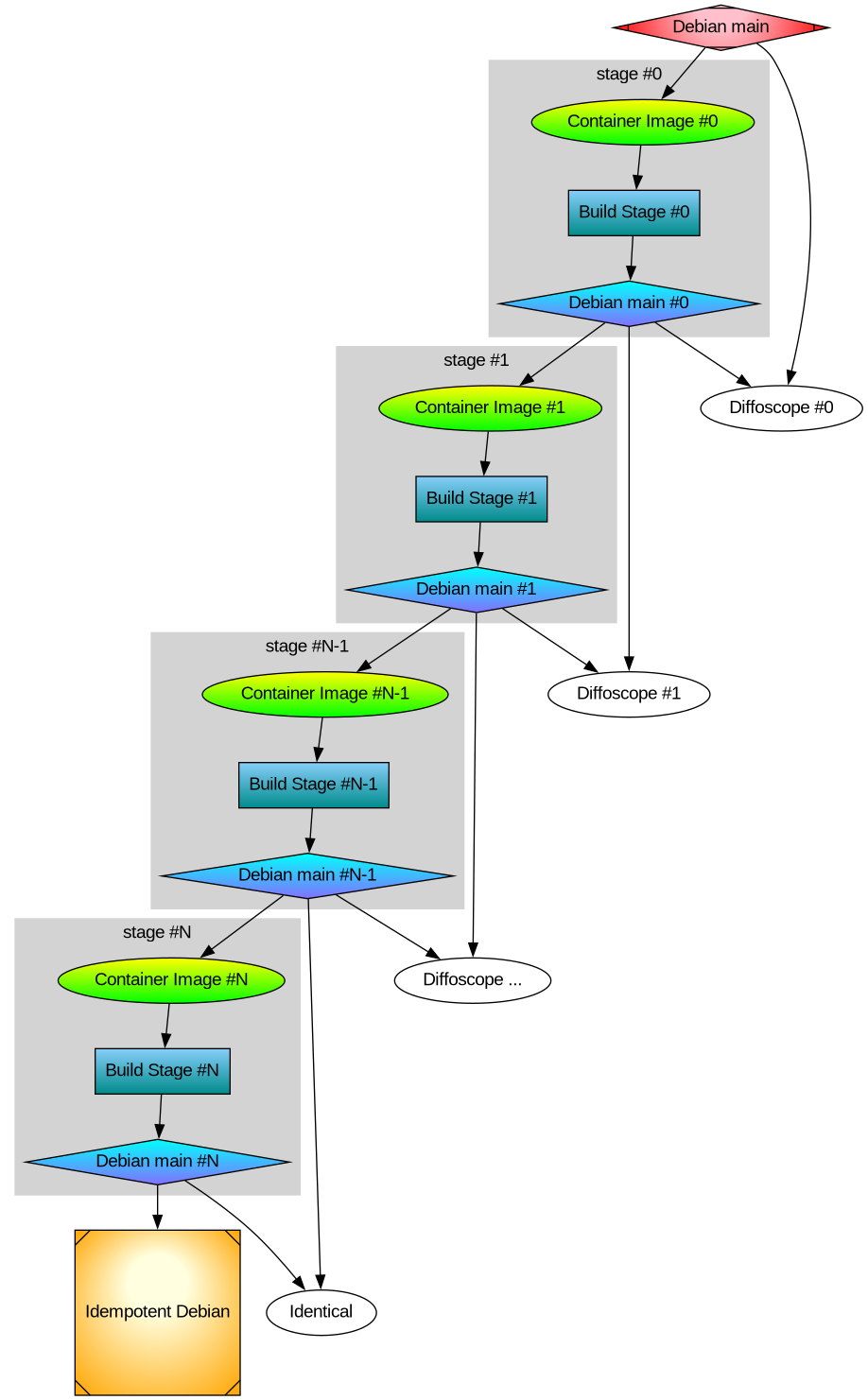
I rebuilt (the top-50 popcon) Debian and Ubuntu packages, on amd64 and arm64, and compared the results a couple of months ago. Since then the Reproduce.Debian.net effort has been launched. Unlike my small experiment, that effort is a full-scale rebuild with more architectures. Their goal is to reproduce what is published in the Debian archive. One differences between these two approaches are the build inputs: The Reproduce Debian effort use the same build inputs which were used to build the published packages. I m using the latest version of published packages for the rebuild. What does that difference imply? I believe reproduce.debian.net will be able to reproduce more of the packages in the archive. If you build a C program using one version of GCC you will get some binary output; and if you use a later GCC version you are likely to end up with a different binary output. This is a good thing: we want GCC to evolve and produce better output over time. However it means in order to reproduce the binaries we publish and use, we need to rebuild them using whatever build dependencies were used to prepare those binaries. The conclusion is that we need to use the old GCC to rebuild the program, and this appears to be the Reproduce.Debian.Net approach. It would be a huge success if the Reproduce.Debian.net effort were to reach 100% reproducibility, and this seems to be within reach. However I argue that we need go further than that. Being able to rebuild the packages reproducible using older binary packages only begs the question: can we rebuild those older packages? I fear attempting to do so ultimately leads to a need to rebuild 20+ year old packages, with a non-negligible amount of them being illegal to distribute or are unable to build anymore due to bit-rot. We won t solve the Trusting Trust concern if our rebuild effort assumes some initial binary blob that we can no longer build from source code. I ve made an illustration of the effort I m thinking of, to reach something that is stronger than reproducible rebuilds. I am calling this concept a Idempotent Rebuild, which is an old concept that I believe is the same as John Gilmore has described many years ago.
The illustration shows how the Debian main archive is used as input to rebuild another stage #0 archive. This stage #0 archive can be compared with diffoscope to the main archive, and all differences are things that would be nice to resolve. The packages in the stage #0 archive is used to prepare a new container image with build tools, and the stage #0 archive is used as input to rebuild another version of itself, called the stage #1 archive. The differences between stage #0 and stage #1 are also useful to analyse and resolve. This process can be repeated many times. I believe it would be a useful property if this process terminated at some point, where the stage #N archive was identical to the stage #N-1 archive. If this would happen, I label the output archive as an Idempotent Rebuild of the distribution. How big is N today? The simplest assumption is that it is infinity. Any build timestamp embedded into binary packages will change on every iteration. This will cause the process to never terminate. Fixing embedded timestamps is something that the Reproduce.Debian.Net effort will also run into, and will have to resolve. What other causes for differences could there be? It is easy to see that generally if some output is not deterministic, such as the sort order of assembler object code in binaries, then the output will be different. Trivial instances of this problem will be caught by the reproduce.debian.net effort as well. Could there be higher order chains that lead to infinite N? It is easy to imagine the existence of these, but I don t know how they would look like in practice. An ideal would be if we could get down to N=1. Is that technically possible? Compare building GCC, it performs an initial stage 0 build using the system compiler to produce a stage 1 intermediate, which is used to build itself again to stage 2. Stage 1 and 2 is compared, and on success (identical binaries), the compilation succeeds. Here N=2. But this is performed using some unknown system compiler that is normally different from the GCC version being built. When rebuilding a binary distribution, you start with the same source versions. So it seems N=1 could be possible. I m unhappy to not be able to report any further technical progress now. The next step in this effort is to publish the stage #0 build artifacts in a repository, so they can be used to build stage #1. I already showed that stage #0 was around ~30% reproducible compared to the official binaries, but I didn t save the artifacts in a reusable repository. Since the official binaries were not built using the latest versions, it is to be expected that the reproducibility number is low. But what happens at stage #1? The percentage should go up: we are now compare the rebuilds with an earlier rebuild, using the same build inputs. I m eager to see this materialize, and hope to eventually make progress on this. However to build stage #1 I believe I need to rebuild a much larger number packages in stage #0, it could be roughly similar to the build-essentials-depends package set. I believe the ultimate end goal of Idempotent Rebuilds is to be able to re-bootstrap a binary distribution like Debian from some other bootstrappable environment like Guix. In parallel to working on a achieving the 100% Idempotent Rebuild of Debian, we can setup a Guix environment that build Debian packages using Guix binaries. These builds ought to eventually converge to the same Debian binary packages, or there is something deeply problematic happening. This approach to re-bootstrap a binary distribution like Debian seems simpler than rebuilding all binaries going back to the beginning of time for that distribution. What do you think? PS. I fear that Debian main may have already went into a state where it is not able to rebuild itself at all anymore: the presence and assumption of non-free firmware and non-Debian signed binaries may have already corrupted the ability for Debian main to rebuild itself. To be able to complete the idempotent and bootstrapped rebuild of Debian, this needs to be worked out.

30 March 2025

Dirk Eddelbuettel: RcppZiggurat 0.1.8 on CRAN: Build Refinements

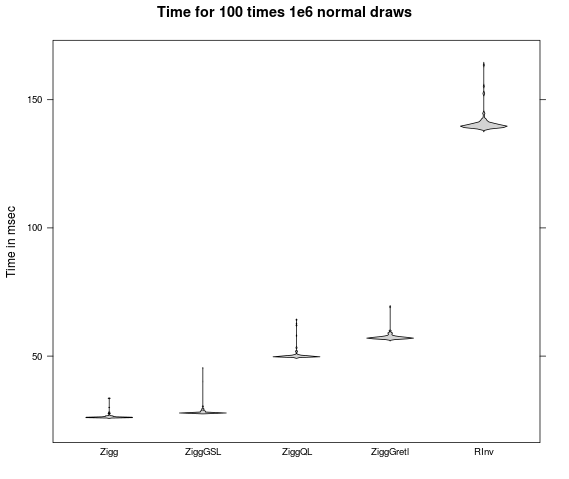
ziggurats A new release 0.1.8 of RcppZiggurat is now on the CRAN network for R, following up on the 0.1.7 release last week which was the first release in four and a half years. The RcppZiggurat package updates the code for the Ziggurat generator by Marsaglia and others which provides very fast draws from a Normal (or Exponential) distribution. The package provides a simple C++ wrapper class for the generator improving on the very basic macros, and permits comparison among several existing Ziggurat implementations. This can be seen in the figure where Ziggurat from this package dominates accessing the implementations from the GSL, QuantLib and Gretl all of which are still way faster than the default Normal generator in R (which is of course of higher code complexity). This release switches the vignette to the standard trick of premaking it as a pdf and including it in a short Sweave document that imports it via pdfpages; this minimizes build-time dependencies on other TeXLive components. It also incorporates a change contributed by Tomas to rely on the system build of the GSL on Windows as well if Rtools 42 or later is found. No other changes. The NEWS file entry below lists all changes.

Changes in version 0.1.8 (2025-03-30)
  • The vignette is now premade and rendered as Rnw via pdfpage to minimize the need for TeXLive package at build / install time (Dirk)
  • Windows builds now use the GNU GSL when Rtools is 42 or later (Tomas Kalibera in #25)

Courtesy of my CRANberries, there is a diffstat report relative to previous release. More detailed information is on the Rcppziggurat page or the GitHub repository.

This post by Dirk Eddelbuettel originated on his Thinking inside the box blog. If you like this or other open-source work I do, you can sponsor me at GitHub.

Utkarsh Gupta: FOSS Activites in March 2025

Here s my 66th monthly but brief update about the activities I ve done in the F/L/OSS world.

Debian
This was my 75th month of actively contributing to Debian. I became a DM in late March 2019 and a DD on Christmas 19! \o/ There s a bunch of things I do, both, technical and non-technical. Here s what I did:
  • Updating Rails to v7.2.2.1 for Trixie.
  • Updating Redmine to v6.0.4 for Trixie.
  • Kickstarting the bursary team for DC25.
  • Mentoring for newcomers.
  • Moderation of -project mailing list.

Ubuntu
This was my 50th month of actively contributing to Ubuntu. Now that I joined Canonical to work on Ubuntu full-time, there s a bunch of things I do! \o/ I mostly worked on different things, I guess. I was too lazy to maintain a list of things I worked on so there s no concrete list atm. Maybe I ll get back to this section later or will start to list stuff from the fall, as I was doing before. :D

Debian (E)LTS
Debian Long Term Support (LTS) is a project to extend the lifetime of all Debian stable releases to (at least) 5 years. Debian LTS is not handled by the Debian security team, but by a separate group of volunteers and companies interested in making it a success. And Debian Extended LTS (ELTS) is its sister project, extending support to the stretch and jessie release (+2 years after LTS support). This was my 66th month as a Debian LTS and 53rd month as a Debian ELTS paid contributor.
I worked for 15.00 hours for LTS and 7.50 hours for ELTS. I did the following things:
  • [ELTS] Worked on backporting patches for adminer.
  • [E/LTS] Working on the musl fixes for bullseye. Taking it forward from where it was left off by Chris.
    • Co-ordiating with Santiago to see how to best get the reproducer to test the update.
    • Plan is to reproduce it myself but then reach out to Adrian if that doesn t work out.
    • Also makes sense to upload to LTS first, let it settle there, and then look at ELTS.
  • [LTS] Attended the LTS meeting on IRC. Summary here.
  • [stable] Co-ordinated with the Security team to fix rails in bookworm via 2:6.1.7.10+dfsg-1~deb12u1.
    • Fixes: CVE-2023-28362, CVE-2023-38037, CVE-2024-26144, CVE-2024-28103, CVE-2024-41128, CVE-2024-47887, CVE-2024-47888, CVE-2024-47889, and CVE-2024-54133.
    • Released as DSA 5881-1.
  • [stable] Co-ordinated with the Security team to fix ruby-rack in bookworm via 2.2.13-1~deb12u1.
    • Fixes: CVE-2025-27610, CVE-2025-27111, and CVE-2025-25184.
    • Released as DSA 5886-1.
  • [stable] Partly co-ordinated with the Security team to fix ruby-saml in bookworm.

Until next time.
:wq for today.

Russ Allbery: Review: Cascade Failure

Review: Cascade Failure, by L.M. Sagas
Series: Ambit's Run #1
Publisher: Tor
Copyright: 2024
ISBN: 1-250-87126-3
Format: Kindle
Pages: 407
Cascade Failure is a far-future science fiction adventure with a small helping of cyberpunk vibes. It is the first of a (so far) two-book series, and was the author's first novel. The Ambit is an old and small Guild ship, not much to look at, but it holds a couple of surprises. One is its captain, Eoan, who is an AI with a deep and insatiable curiosity that has driven them and their ship farther and farther out into the Spiral. The other is its surprisingly competent crew: a battle-scarred veteran named Saint who handles the fighting, and a talented engineer named Nash who does literally everything else. The novel opens with them taking on supplies at Aron Outpost. A supposed Guild deserter named Jalsen wanders into the ship looking for work. An AI ship with a found-family crew is normally my catnip, so I wanted to love this book. Alas, I did not. There were parts I liked. Nash is great: snarky, competent, and direct. Eoan is a bit distant and slightly more simplistic of a character than I was expecting, but I appreciated the way Sagas put them firmly in charge of the ship and departed from the conventional AI character presentation. Once the plot starts in earnest (more on that in a moment), we meet Anke, the computer hacker, whose charming anxiety reaction is a complete inability to stop talking and who adds some needed depth to the character interactions. There's plenty of action, a plot that makes at least some sense, and a few moments that almost achieved the emotional payoff the author was attempting. Unfortunately, most of the story focuses on Saint and Jal, and both of them are irritatingly dense cliches. The moment Jal wanders onto the Ambit in the first chapter, the reader is informed that Jal, Saint, and Eoan have a history. The crew of the Ambit spent a year looking for Jal and aren't letting go of him now that they've found him. Jal, on the other hand, clearly blames Saint for something and is not inclined to trust him. Okay, fine, a bit generic of a setup but the writing moved right along and I was curious enough. It then takes a full 180 pages before the reader finds out what the hell is going on with Saint and Jal. Predictably, it's a stupid misunderstanding that could have been cleared up with one conversation in the second chapter. Cascade Failure does not contain a romance (and to the extent that it hints at one, it's a sapphic romance), but I swear Saint and Jal are both the male protagonist from a certain type of stereotypical heterosexual romance novel. They're both the brooding man with the past, who is too hurt to trust anyone and assumes the worst because he's unable to use his words or ask an open question and then listen to the answer. The first half of this book is them being sullen at each other at great length while both of them feel miserable. Jal keeps doing weird and suspicious things to resolve a problem that would have been far more easily resolved by the rest of the crew if he would offer any explanation at all. It's not even suspenseful; we've read about this character enough times to know that he'll turn out to have a heart of gold and everything will be a misunderstanding. I found it tedious. Maybe people who like slow burn romances with this character type will have a less negative reaction. The real plot starts at about the time Saint and Jal finally get their shit sorted out. It turns out to have almost nothing to do with either of them. The environmental control systems of worlds are suddenly failing (hence the book title), and Anke, the late-arriving computer programmer and terraforming specialist, has a rather wild theory about what's happening. This leads to a lot of action, some decent twists, and a plot that felt very cyberpunk to me, although unfortunately it culminates in an absurdly-cliched action climax. This book is an action movie that desperately wants to make you feel all the feels, and it worked about as well as that typically works in action movies for me. Jaded cynicism and an inability to communicate are not the ways to get me to have an emotional reaction to a book, and Jal (once he finally starts talking) is so ridiculously earnest that it's like reading the adventures of a Labrador puppy. There was enough going on that it kept me reading, but not enough for the story to feel satisfying. I needed a twist, some depth, way more Nash and Anke and way less of the men, something. Everyone is going to compare this book to Firefly, but Firefly had better banter, created more complex character interactions due to the larger and more varied crew, and played the cynical mercenary for laughs instead of straight, all of which suited me better. This is not a bad book, particularly once it gets past the halfway point, but it's not that memorable either, at least for me. If you're looking for a space adventure with heavy action hero and military SF vibes that wants to be about Big Feelings but gets there in mostly obvious ways, you could do worse. If you're looking for a found-family starship crew story more like Becky Chambers, I think you'll find this one a bit too shallow and obvious. Not really recommended, although there's nothing that wrong with it and I'm sure other people's experience will differ. Followed by Gravity Lost, which I'm unlikely to read. Rating: 6 out of 10

29 March 2025

Dirk Eddelbuettel: tinythemes 0.0.3 at CRAN: Nags

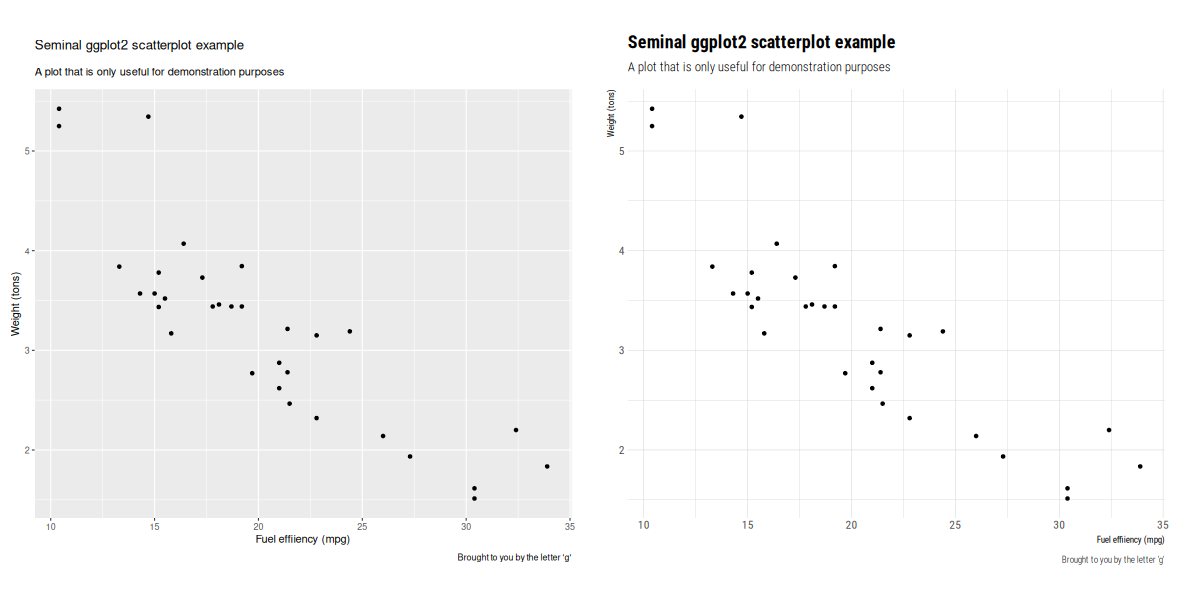
tinythemes demo A second maintenance release of our still young-ish package tinythemes arrived on CRAN today. tinythemes provides the theme_ipsum_rc() function from hrbrthemes by Bob Rudis in a zero (added) dependency way. A simple example is (also available as a demo inside the package) contrasts the default style (on the left) with the one added by this package (on the right): This version responds solely to things CRAN now nags about. As these are all package quality improvement we generally oblige happily (and generally fix in the respective package repo when we notice). I am currently on a quest to get most/all of my nags down so new releases are sometimes the way to go even when not under a deadline gun (as with other releases this week). The full set of changes since the last release (a little over a year ago) follows.

Changes in tinythemes version 0.0.3 (2025-03-29)
  • Updated a badge URL in README.md
  • Updated manual pages with proper anchor links
  • Rewrote one example without pipe to not require minimum R version

Courtesy of my CRANberries, there is a diffstat report relative to previous release. More detailed information is on the repo where comments and suggestions are welcome.

This post by Dirk Eddelbuettel originated on his Thinking inside the box blog. If you like this or other open-source work I do, you can sponsor me at GitHub.

Petter Reinholdtsen: Theora 1.2.0 released

Following the 1.2.0beta1 release two weeks ago, a final 1.2.0 release of theora was wrapped up today. This new release is tagged in the Xiph gitlab theora instance and you can fetch it from the Theora home page as soon as someone with access find time to update the web pages. In the mean time (automatically removed after 14 days) the release tarball is also available as a git build artifact from CI build of the release tag. The list of changes since The 1.2.0beta release from the CHANGES file in the tarball look like this:
libtheora 1.2.0 (2025 March 29)
  • Bumped minor SONAME versions as oc_comment_unpack() implementation changed.
  • Added example wrapper script encoder_example_ffmpeg (#1601 #2336).
  • Improve comment handling on platforms where malloc(0) return NULL (#2304).
  • Added pragma in example code to quiet clang op precedenca warnings.
  • Adjusted encoder_example help text.
  • Adjusted README, CHANGES, pkg-config and spec files to better reflect current release (#2331 #2328).
  • Corrected english typos in source and build system.
  • Switched http links to https in doc and comments where relevant. Did not touch RFC drafts.
As usual, if you use Bitcoin and want to show your support of my activities, please send Bitcoin donations to my address 15oWEoG9dUPovwmUL9KWAnYRtNJEkP1u1b.

28 March 2025

Dirk Eddelbuettel: RcppArmadillo 14.4.1-1 on CRAN: Small Upstream Fix

armadillo image Armadillo is a powerful and expressive C++ template library for linear algebra and scientific computing. It aims towards a good balance between speed and ease of use, has a syntax deliberately close to Matlab, and is useful for algorithm development directly in C++, or quick conversion of research code into production environments. RcppArmadillo integrates this library with the R environment and language and is widely used by (currently) 1236 other packages on CRAN, downloaded 39 million times (per the partial logs from the cloud mirrors of CRAN), and the CSDA paper (preprint / vignette) by Conrad and myself has been cited 620 times according to Google Scholar. This release brings a small upstream bug fix to the two FFTW3-interfacing functions, something not likely to hit many CRAN packages. The changes since the last and fairly recent CRAN release are summarised below.

Changes in RcppArmadillo version 14.4.1-1 (2025-03-27)
  • Upgraded to Armadillo release 14.4.1 (Filtered Espresso)
    • Fix for fft() and ifft() when using FFTW3 in multi-threaded contexts (such as OpenMP)

Courtesy of my CRANberries, there is a diffstat report relative to previous release. More detailed information is on the RcppArmadillo page. Questions, comments etc should go to the rcpp-devel mailing list off the Rcpp R-Forge page.

This post by Dirk Eddelbuettel originated on his Thinking inside the box blog. If you like this or other open-source work I do, you can sponsor me at GitHub.

John Goerzen: Why You Should (Still) Use Signal As Much As Possible

As I write this in March 2025, there is a lot of confusion about Signal messenger due to the recent news of people using Signal in government, and subsequent leaks. The short version is: there was no problem with Signal here. People were using it because they understood it to be secure, not the other way around. Both the government and the Electronic Frontier Foundation recommend people use Signal. This is an unusual alliance, and in the case of the government, was prompted because it understood other countries had a persistent attack against American telephone companies and SMS traffic. So let s dive in. I ll cover some basics of what security is, what happened in this situation, and why Signal is a good idea. This post isn t for programmers that work with cryptography every day. Rather, I hope it can make some of these concepts accessible to everyone else.

What makes communications secure? When most people are talking about secure communications, they mean some combination of these properties:
  1. Privacy - nobody except the intended recipient can decode a message.
  2. Authentication - guarantees that the person you are chatting with really is the intended recipient.
  3. Ephemerality - preventing a record of the communication from being stored. That is, making it more like a conversation around the table than a written email.
  4. Anonymity - keeping your set of contacts to yourself and even obfuscating the fact that communications are occurring.
If you think about it, most people care the most about the first two. In fact, authentication is a key part of privacy. There is an attack known as man in the middle in which somebody pretends to be the intended recipient. The interceptor reads the messages, and then passes them on to the real intended recipient. So we can t really have privacy without authentication. I ll have more to say about these later. For now, let s discuss attack scenarios.

What compromises security? There are a number of ways that security can be compromised. Let s think through some of them:

Communications infrastructure snooping Let s say you used no encryption at all, and connected to public WiFi in a coffee shop to send your message. Who all could potentially see it?
  • The owner of the coffee shop s WiFi
  • The coffee shop s Internet provider
  • The recipient s Internet provider
  • Any Internet providers along the network between the sender and the recipient
  • Any government or institution that can compel any of the above to hand over copies of the traffic
  • Any hackers that compromise any of the above systems
Back in the early days of the Internet, most traffic had no encryption. People were careful about putting their credit cards into webpages and emails because they knew it was easy to intercept them. We have been on a decades-long evolution towards more pervasive encryption, which is a good thing. Text messages (SMS) follow a similar path to the above scenario, and are unencrypted. We know that all of the above are ways people s texts can be compromised; for instance, governments can issue search warrants to obtain copies of texts, and China is believed to have a persistent hack into western telcos. SMS fails all four of our attributes of secure communication above (privacy, authentication, ephemerality, and anonymity). Also, think about what information is collected from SMS and by who. Texts you send could be retained in your phone, the recipient s phone, your phone company, their phone company, and so forth. They might also live in cloud backups of your devices. You only have control over your own phone s retention. So defenses against this involve things like:
  • Strong end-to-end encryption, so no intermediate party even the people that make the app can snoop on it.
  • Using strong authentication of your peers
  • Taking steps to prevent even app developers from being able to see your contact list or communication history
You may see some other apps saying they use strong encryption or use the Signal protocol. But while they may do that for some or all of your message content, they may still upload your contact list, history, location, etc. to a central location where it is still vulnerable to these kinds of attacks. When you think about anonymity, think about it like this: if you send a letter to a friend every week, every postal carrier that transports it even if they never open it or attempt to peak inside will be able to read the envelope and know that you communicate on a certain schedule with that friend. The same can be said of SMS, email, or most encrypted chat operators. Signal s design prevents it from retaining even this information, though nation-states or ISPs might still be able to notice patterns (every time you send something via Signal, your contact receives something from Signal a few milliseconds later). It is very difficult to provide perfect anonymity from well-funded adversaries, even if you can provide very good privacy.

Device compromise Let s say you use an app with strong end-to-end encryption. This takes away some of the easiest ways someone could get to your messages. But it doesn t take away all of them. What if somebody stole your phone? Perhaps the phone has a password, but if an attacker pulled out the storage unit, could they access your messages without a password? Or maybe they somehow trick or compel you into revealing your password. Now what? An even simpler attack doesn t require them to steal your device at all. All they need is a few minutes with it to steal your SIM card. Now they can receive any texts sent to your number - whether from your bank or your friend. Yikes, right? Signal stores your data in an encrypted form on your device. It can protect it in various ways. One of the most important protections is ephemerality - it can automatically delete your old texts. A text that is securely erased can never fall into the wrong hands if the device is compromised later. An actively-compromised phone, though, could still give up secrets. For instance, what if a malicious keyboard app sent every keypress to an adversary? Signal is only as secure as the phone it runs on but still, it protects against a wide variety of attacks.

Untrustworthy communication partner Perhaps you are sending sensitive information to a contact, but that person doesn t want to keep it in confidence. There is very little you can do about that technologically; with pretty much any tool out there, nothing stops them from taking a picture of your messages and handing the picture off.

Environmental compromise Perhaps your device is secure, but a hidden camera still captures what s on your screen. You can take some steps against things like this, of course.

Human error Sometimes humans make mistakes. For instance, the reason a reporter got copies of messages recently was because a participant in a group chat accidentally added him (presumably that participant meant to add someone else and just selected the wrong name). Phishing attacks can trick people into revealing passwords or other sensitive data. Humans are, quite often, the weakest link in the chain.

Protecting yourself So how can you protect yourself against these attacks? Let s consider:
  • Use a secure app like Signal that uses strong end-to-end encryption where even the provider can t access your messages
  • Keep your software and phone up-to-date
  • Be careful about phishing attacks and who you add to chat rooms
  • Be aware of your surroundings; don t send sensitive messages where people might be looking over your shoulder with their eyes or cameras
There are other methods besides Signal. For instance, you could install GnuPG (GPG) on a laptop that has no WiFi card or any other way to connect it to the Internet. You could always type your messages on that laptop, encrypt them, copy the encrypted text to a floppy disk (or USB device), take that USB drive to your Internet computer, and send the encrypted message by email or something. It would be exceptionally difficult to break the privacy of messages in that case (though anonymity would be mostly lost). Even if someone got the password to your secure laptop, it wouldn t do them any good unless they physically broke into your house or something. In some ways, it is probably safer than Signal. (For more on this, see my article How gapped is your air?) But, that approach is hard to use. Many people aren t familiar with GnuPG. You don t have the convenience of sending a quick text message from anywhere. Security that is hard to use most often simply isn t used. That is, you and your friends will probably just revert back to using insecure SMS instead of this GnuPG approach because SMS is so much easier. Signal strikes a unique balance of providing very good security while also being practical, easy, and useful. For most people, it is the most secure option available. Signal is also open source; you don t have to trust that it is as secure as it says, because you can inspect it for yourself. Also, while it s not federated, I previously addressed that.

Government use If you are a government, particularly one that is highly consequential to the world, you can imagine that you are a huge target. Other nations are likely spending billions of dollars to compromise your communications. Signal itself might be secure, but if some other government can add spyware to your phones, or conduct a successful phishing attack, you can still have your communications compromised. I have no direct knowledge, but I think it is generally understood that the US government maintains communications networks that are entirely separate from the Internet and can only be accessed from secure physical locations and secure rooms. These can be even more secure than the average person using Signal because they can protect against things like environmental compromise, human error, and so forth. The scandal in March of 2025 happened because government employees were using Signal rather than official government tools for sensitive information, had taken advantage of Signal s ephemerality (laws require records to be kept), and through apparent human error had directly shared this information with a reporter. Presumably a reporter would have lacked access to the restricted communications networks in the first place, so that wouldn t have been possible. This doesn t mean that Signal is bad. It just means that somebody that can spend billions of dollars on security can be more secure than you. Signal is still a great tool for people, and in many cases defeats even those that can spend lots of dollars trying to defeat it. And remember - to use those restricted networks, you have to go to specific rooms in specific buildings. They are still not as convenient as what you carry around in your pocket.

Conclusion Signal is practical security. Do you want phone companies reading your messages? How about Facebook or X? Have those companies demonstrated that they are completely trustworthy throughout their entire history? I say no. So, go install Signal. It s the best, most practical tool we have.
This post is also available on my website, where it may be periodically updated.

26 March 2025

Dirk Eddelbuettel: RcppRedis 0.2.5 on CRAN: Fix Bashism in Configure, Maintenance

A new minor release 0.2.5 of our RcppRedis package arrived on CRAN today. RcppRedis is one of several packages connecting R to the fabulous Redis in-memory datastructure store (and much more). RcppRedis does not pretend to be feature complete, but it may do some things faster than the other interfaces, and also offers an optional coupling with MessagePack binary (de)serialization via RcppMsgPack. The package has been deployed in production as a risk / monitoring tool on a trading floor for several years. It also supports pub/sub dissemination of streaming market data as per this earlier example. Given the changes around Redis, it is worth stressing that the package works just as well with valkey and uses only hiredis which remains proper open source. This update is again somewhat mechanical as a few maintenance things bubbled up in since the last release in the summer of 2023. As with other packages, continuous integration was updated a few times as were URLs and badges, and we update the use of our RApiSerialize. And, just as we did today and yesterday with littler, RQuantLib and RDieHarder, this addresses a nag from CRAN about implicit bash dependency in configure.ac (which we fixed in January as for the other packages but are under deadline now). Last but not least the newly-added extension of forbidden symbols in static libraries revealed that yes indeed I had forgotten to set -DNDEBUG when building the embedded hiredis in fallback mode and I now also converted its four uses of sprintf to snprintf so we are clean there too. The detailed changes list follows.

Changes in version 0.2.5 (2025-03-26)
  • The continuous integration setup was updated several times
  • Badges and URLs in README.md have been updated
  • An updated interface from RApiSerialize is now used, and a versioned dependency on version 0.1.4 or later has been added
  • The DESCRIPTION file now uses Authors@R
  • Two possible bashisms have been converted in configure.ac
  • The (fallback if needed) build of libhiredis.a now sets -DNDEBUG, four uses of sprintf converted to snprintf

Courtesy of my CRANberries, there is also a diffstat report for this this release. More information is on the RcppRedis page and at the repository and its issue tracker.

This post by Dirk Eddelbuettel originated on his Thinking inside the box blog. If you like this or other open-source work I do, you can sponsor me at GitHub.

25 March 2025

Dirk Eddelbuettel: littler 0.3.21 on CRAN: Lots Moar Features!

max-heap image The twentysecond release of littler as a CRAN package landed on CRAN just now, following in the now nineteen year history (!!) as a (initially non-CRAN) package started by Jeff in 2006, and joined by me a few weeks later. littler is the first command-line interface for R as it predates Rscript. It allows for piping as well for shebang scripting via #!, uses command-line arguments more consistently and still starts faster. It also always loaded the methods package which Rscript only began to do in recent years. littler lives on Linux and Unix, has its difficulties on macOS due to some-braindeadedness there (who ever thought case-insensitive filesystems as a default were a good idea?) and simply does not exist on Windows (yet the build system could be extended see RInside for an existence proof, and volunteers are welcome!). See the FAQ vignette on how to add it to your PATH. A few examples are highlighted at the Github repo:, as well as in the examples vignette. This release, the first is almost exactly one year, brings enhancements to six scripts as well as three new ones. The new ones crup.r offers CRan UPloads from the command-line, deadliners.r lists CRAN package by CRAN deadline, and wb.r uploads to win-builder (replacing an older shell script of mine). Among the updated ones, kitten.r now creates more complete DESCRIPTION files in the packages it makes, and several scripts support additional options. A number of changes were made to packaging as well, some of which were contributed by Jon and Michael which is of course always greatly appreciated. The trigger for the release was, just like for RQuantLib earlier today, a CRAN nag on bashisms half of which actually false here it was in a comment only. Oh well. The full change description follows.

Changes in littler version 0.3.21 (2025-03-24)
  • Changes in examples scripts
    • Usage text for ciw.r is improved, new options were added (Dirk)
    • The noble release is supported by r2u.r (Dirk)
    • The installRub.r script has additional options (Dirk)
    • The ttlt.r script has a new load_package argument (Dirk)
    • A new script deadliners.r showing CRAN packages 'under deadline' has been added, and then refined (Dirk)
    • The kitten.r script can now use whoami and argument githubuser on the different *kitten helpers it calls (Dirk)
    • A new script wb.r can upload to win-builder (Dirk)
    • A new script crup.r can upload a CRAN submission (Dirk)
    • In rcc.r, the return from rcmdcheck is now explicitly printed (Dirk)
    • In r2u.r the dry-run option is passed to the build command (Dirk)
  • Changes in package
    • Regular updates to badges, continuous integration, DESCRIPTION and configure.ac (Dirk)
    • Errant osVersion return value are handled more robustly (Michael Chirico in #121)
    • The current run-time path is available via variable LITTLER_SCRIPT_PATH (Jon Clayden in #122)
    • The cleanup script remove macOS debug symbols (Jon Clayden in #123)

My CRANberries service provides a comparison to the previous release. Full details for the littler release are provided as usual at the ChangeLog page, and also on the package docs website. The code is available via the GitHub repo, from tarballs and now of course also from its CRAN page and via install.packages("littler"). Binary packages are available directly in Debian as well as (in a day or two) Ubuntu binaries at CRAN thanks to the tireless Michael Rutter. Comments and suggestions are welcome at the GitHub repo.

This post by Dirk Eddelbuettel originated on his Thinking inside the box blog. If you like this or other open-source work I do, you can sponsor me at GitHub.

Otto Kek l inen: Debian Salsa CI in Google Summer of Code 2025

Featured image of post Debian Salsa CI in Google Summer of Code 2025Are you a student aspiring to participate in the Google Summer of Code 2025? Would you like to improve the continuous integration pipeline used at salsa.debian.org, the Debian GitLab instance, to help improve the quality of tens of thousands of software packages in Debian? This summer 2025, I and Emmanuel Arias will be participating as mentors in the GSoC program. We are available to mentor students who propose and develop improvements to the Salsa CI pipeline, as we are members of the Debian team that maintains it. A post by Santiago Ruano Rinc n in the GitLab blog explains what Salsa CI is and its short history since inception in 2018. At the time of the article in fall 2023 there were 9000+ source packages in Debian using Salsa CI. Now in 2025 there are over 27,000 source packages in Debian using it, and since summer 2024 some Ubuntu developers have started using it for enhanced quality assurance of packaging changes before uploading new package revisions to Ubuntu. Personally, I have been using Salsa CI since its inception, and contributing as a team member since 2019. See my blog post about GitLab CI for MariaDB in Debian for a description of an advanced and extensive use case. Helping Salsa CI is a great way to make a global impact, as it will help avoid regressions and improve the quality of Debian packages. The benefits reach far beyond just Debian, as it will also help hundreds of Debian derivatives, such as Ubuntu, Linux Mint, Tails, Purism PureOS, Pop!_OS, Zorin OS, Raspberry Pi OS, a large portion of Docker containers, and even the Windows Subsystem for Linux.

Improving Salsa CI: more features, robustness, speed While Salsa CI with contributions from 71 people is already quite mature and capable, there are many ideas floating around about how it could be further extended. For example, Salsa CI issue #147 describes various static analyzers and linters that may be generally useful. Issue #411 proposes using libfaketime to run autopkgtest on arbitrary future dates to test for failures caused by date assumptions, such as the Y2038 issue. There are also ideas about making Salsa CI more robust and code easier to reuse by refactoring some of the yaml scripts into independent scripts in #230, which could make it easier to run Salsa CI locally as suggested in #169. There are also ideas about improving the Salsa CI s own CI to avoid regressions from pipeline changes in #318. The CI system is also better when it s faster, and some speed improvement ideas have been noted in #412. Improvements don t have to be limited to changes in the pipeline itself. A useful project would also be to update more Debian packages to use Salsa CI, and ensure they adopt it in an optimal way as noted in #416. It would also be nice to have a dashboard with statistics about all public Salsa CI pipeline runs as suggested in #413. These and more ideas can be found in the issue list by filtering for tags Newcomer, Nice-To-Have or Accepting MRs. A Google Summer of Code proposal does not have to be limited to these existing ideas. Participants are also welcome to propose completely novel ideas!

Good time to also learn Debian packaging Anyone working with Debian team should also take the opportunity to learn Debian packaging, and contribute to the packaging or maintenance of 1-2 packages in parallel to improving the Salsa CI. All Salsa CI team members are also Debian Developers who can mentor and sponsor uploads to Debian. Maintaining a few packages is a great way to eat your own cooking and experience Salsa CI from the user perspective, and likely to make you better at Salsa CI development.

Apply now! The contributor applications opened yesterday on March 24, so to participate act now! If you are an eligible student and want to attend, head over to summerofcode.withgoogle.com to learn more. There are over a thousand participating organizations, with Debian, GitLab and MariaDB being some examples. Within these organizations there may be multiple subteams and projects to choose from. The full list of participating Debian projects can be found in the Debian wiki. If you are interested in GSoC for Salsa CI specifically, feel free to
  1. Reach out to me and Emmanuel by email at otto@ and eamanu@ (debian.org).
  2. Sign up at salsa.debian.org for an account (note it takes a few days due to manual vetting and approval process)
  3. Read the project README, STRUCTURE and CONTRIBUTING to get a developer s overview
  4. Participate in issue discussions at https://salsa.debian.org/salsa-ci-team/pipeline/-/issues/
Note that you don t have to wait for GSoC to officially start to contribute. In fact, it may be useful to start immediately by submitting a Merge Request to do some small contribution, just to learn the process and to get more familiar with how everything works, and the team maintaining Salsa CI. Looking forward to seeing new contributors!

24 March 2025

Jonathan McDowell: Who pays the cost of progress in software?

I am told, by friends who have spent time at Google, about the reason Google Reader finally disappeared. Apparently it had become a 20% Project for those who still cared about it internally, and there was some major change happening to one of it upstream dependencies that was either going to cause a significant amount of work rearchitecting Reader to cope, or create additional ongoing maintenance burden. It was no longer viable to support it as a side project, so it had to go. This was a consequence of an internal culture at Google where service owners are able to make changes that can break downstream users, and the downstream users are the ones who have to adapt. My experience at Meta goes the other way. If you own a service or other dependency and you want to make a change that will break things for the users, it s on you to do the migration, or at the very least provide significant assistance to those who own the code. You don t just get to drop your new release and expect others to clean up; doing that tends to lead to changes being reverted. The culture flows the other way; if you break it, you fix it (nothing is someone else s problem). There are pluses and minuses to both approaches. Users having to drive the changes to things they own stops them from blocking progress. Service/code owners having to drive the changes avoids the situation where a wildly used component drops a new release that causes a lot of high priority work for folk in order to adapt. I started thinking about this in the context of Debian a while back, and a few incidents since have resulted in my feeling that we re closer to the Google model than the Meta model. Anyone can upload a new version of their package to unstable, and that might end up breaking all the users of it. It s not quite as extreme as rolling out a new service, because it s unstable that gets affected (the clue is in the name, I really wish more people would realise that), but it can still result in release critical bugs for lots other Debian contributors. A good example of this are toolchain changes. Major updates to GCC and friends regularly result in FTBFS issues in lots of packages. Now in this instance the maintainer is usually diligent about a heads up before the default changes, but it s still a whole bunch of work for other maintainers to adapt (see the list of FTBFS bugs for GCC 15 for instance - these are important, but not serious yet). Worse is when a dependency changes and hasn t managed to catch everyone who might be affected, so by the time it s discovered it s release critical, because at least one package no longer builds in unstable. Commercial organisations try to avoid this with a decent CI/CD setup that either vendors all dependencies, or tracks changes to them and tries rebuilds before allowing things to land. This is one of the instances where a monorepo can really shine; if everything you need is in there, it s easier to track the interconnections between different components. Debian doesn t have a CI/CD system that runs for every upload, allowing us to track exact causes of regressions. Instead we have Lucas, who does a tremendous job of running archive wide rebuilds to make sure we can still build everything. Unfortunately that means I am often unfairly grumpy at him; my heart sinks when I see a bug come in with his name attached, because it often means one of my packages has a new RC bug where I m going to have to figure out what changed elsewhere to cause it. However he s just (very usefully) surfacing an issue someone else created, rather than actually being the cause of the problem. I don t know if I have a point to this post. I think it s probably that I wish folk in Free Software would try and be mindful of the incompatible changes they might introducing, and the toil they create for other volunteer developers, often not directly visible to the person making the change. The approach done by the Debian toolchain maintainers strikes me as a good balance; they do a bunch of work up front to try and flag all the places that might need to make changes, far enough in advance of the breaking change actually landing. However they don t then allow a tardy developer to block progress.

Simon Josefsson: Reproducible Software Releases

Around a year ago I discussed two concerns with software release archives (tarball artifacts) that could be improved to increase confidence in the supply-chain security of software releases. Repeating the goals for simplicity: While implementing these ideas for a small project was accomplished within weeks see my announcement of Libntlm version 1.8 adressing this in complex projects uncovered concerns with tools that had to be addressed, and things stalled for many months pending that work. I had the notion that these two goals were easy and shouldn t be hard to accomplish. I still believe that, but have had to realize that improving tooling to support these goals takes time. It seems clear that these concepts are not universally agreed on and implemented generally. I m now happy to recap some of the work that led to releases of libtasn1 v4.20.0, inetutils v2.6, libidn2 v2.3.8, libidn v1.43. These releases all achieve these goals. I am working on a bunch of more projects to support these ideas too. What have the obstacles so far been to make this happen? It may help others who are in the same process of addressing these concerns to have a high-level introduction to the issues I encountered. Source code for projects above are available and anyone can look at the solutions to learn how the problems are addressed. First let s look at the problems we need to solve to make git-archive style tarballs usable:

Version Handling To build usable binaries from a minimal tarballs, it need to know which version number it is. Traditionally this information was stored inside configure.ac in git. However I use gnulib s git-version-gen to infer the version number from the git tag or git commit instead. The git tag information is not available in a git-archive tarball. My solution to this was to make use of the export-subst feature of the .gitattributes file. I store the file .tarball-version-git in git containing the magic cookie like this:
$Format:%(describe)$
With this, git-archive will replace with a useful version identifier on export, see the libtasn1 patch to achieve this. To make use of this information, the git-version-gen script was enhanced to read this information, see the gnulib patch. This is invoked by ./configure to figure out which version number the package is for.

Translations We want translations to be included in the minimal source tarball for it to be buildable. Traditionally these files are retrieved by the maintainer from the Translation project when running ./bootstrap, however there are two problems with this. The first one is that there is no strong authentication or versioning information on this data, the tools just download and place whatever wget downloaded into your source tree (printf-style injection attack anyone?). We could improve this (e.g., publish GnuPG signed translations messages with clear versioning), however I did not work on that further. The reason is that I want to support offline builds of packages. Downloading random things from the Internet during builds does not work when building a Debian package, for example. The translation project could solve this by making a monthly tarball with their translations available, for distributors to pick up and provide as a separate package that could be used as a build dependency. However that is not how these tools and projects are designed. Instead I reverted back to storing translations in git, something that I did for most projects back when I was using CVS 20 years ago. Hooking this into ./bootstrap and gettext workflow can be tricky (ideas for improvement most welcome!), but I used a simple approach to store all directly downloaded po/*.po files directly as po/*.po.in and make the ./bootstrap tool move them in place, see the libidn2 commit followed by the actual make update-po commit with all the translations where one essential step is:
# Prime po/*.po from fall-back copy stored in git.
for poin in po/*.po.in; do
    po=$(echo $poin   sed 's/.in//')
    test -f $po   cp -v $poin $po
done
ls po/*.po   sed 's .*/ ; s \.po$ ' > po/LINGUAS

Fetching vendor files like gnulib Most build dependencies are in the shape of You need a C compiler . However some come in the shape of source-code files intended to be vendored , and gnulib is a huge repository of such files. The latter is a problem when building from a minimal git archive. It is possible to consider translation files as a class of vendor files, since they need to be copied verbatim into the project build directory for things to work. The same goes for *.m4 macros from the GNU Autoconf Archive. However I m not confident that the solution for all vendor files must be the same. For translation files and for Autoconf Archive macros, I have decided to put these files into git and merge them manually occasionally. For gnulib files, in some projects like OATH Toolkit I also store all gnulib files in git which effectively resolve this concern. (Incidentally, the reason for doing so was originally that running ./bootstrap took forever since there is five gnulib instances used, which is no longer the case since gnulib-tool was rewritten in Python.) For most projects, however, I rely on ./bootstrap to fetch a gnulib git clone when building. I like this model, however it doesn t work offline. One way to resolve this is to make the gnulib git repository available for offline use, and I ve made some effort to make this happen via a Gnulib Git Bundle and have explained how to implement this approach for Debian packaging. I don t think that is sufficient as a generic solution though, it is mostly applicable to building old releases that uses old gnulib files. It won t work when building from CI/CD pipelines, for example, where I have settled to use a crude way of fetching and unpacking a particular gnulib snapshot, see this Libntlm patch. This is much faster than working with git submodules and cloning gnulib during ./bootstrap. Essentially this is doing:
GNULIB_REVISION=$(. bootstrap.conf >&2; echo $GNULIB_REVISION)
wget -nv https://gitlab.com/libidn/gnulib-mirror/-/archive/$GNULIB_REVISION/gnulib-mirror-$GNULIB_REVISION.tar.gz
gzip -cd gnulib-mirror-$GNULIB_REVISION.tar.gz   tar xf -
rm -fv gnulib-mirror-$GNULIB_REVISION.tar.gz
export GNULIB_SRCDIR=$PWD/gnulib-mirror-$GNULIB_REVISION
./bootstrap --no-git
./configure
make

Test the git-archive tarball This goes without saying, but if you don t test that building from a git-archive style tarball works, you are likely to regress at some point. Use CI/CD techniques to continuously test that a minimal git-archive tarball leads to a usable build.

Mission Accomplished So that wasn t hard, was it? You should now be able to publish a minimal git-archive tarball and users should be able to build your project from it. I recommend naming these archives as PROJECT-vX.Y.Z-src.tar.gz replacing PROJECT with your project name and X.Y.Z with your version number. The archive should have only one sub-directory named PROJECT-vX.Y.Z/ containing all the source-code files. This differentiate it against traditional PROJECT-X.Y.Z.tar.gz tarballs in that it embeds the git tag (which typically starts with v) and contains a wildcard-friendly -src substring. Alas there is no consistency around this naming pattern, and GitLab, GitHub, Codeberg etc all seem to use their own slightly incompatible variant. Let s go on to see what is needed to achieve reproducible make dist source tarballs. This is the release artifact that most users use, and they often contain lots of generated files and vendor files. These files are included to make it easy to build for the user. What are the challenges to make these reproducible?

Build dependencies causing different generated content The first part is to realize that if you use tool X with version A to generate a file that goes into the tarball, version B of that tool may produce different outputs. This is a generic concern and it cannot be solved. We want our build tools to evolve and produce better outputs over time. What can be addressed is to avoid needless differences. For example, many tools store timestamps and versioning information in the generated files. This causes needless differences, which makes audits harder. I have worked on some of these, like Autoconf Archive timestamps but solving all of these examples will take a long time, and some upstream are reluctant to incorporate these changes. My approach meanwhile is to build things using similar environments, and compare the outputs for differences. I ve found that the various closely related forks of GNU/Linux distributions are useful for this. Trisquel 11 is based on Ubuntu 22.04, and building my projects using both and comparing the differences only give me the relevant differences to improve. This can be extended to compare AlmaLinux with RockyLinux (for both versions 8 and 9), Devuan 5 against Debian 12, PureOS 10 with Debian 11, and so on.

Timestamps Sometimes tools store timestamps in files in a way that is harder to fix. Two notable examples of this are *.po translation files and Texinfo manuals. For translation files, I have resolved this by making sure the files use a predictable POT-Creation-Date timestamp, and I set it to the modification timestamps of the NEWS file in the repository (which I set to the git commit of the latest commit elsewhere) like this:
dist-hook: po-CreationDate-to-mtime-NEWS
.PHONY: po-CreationDate-to-mtime-NEWS
po-CreationDate-to-mtime-NEWS: mtime-NEWS-to-git-HEAD
  $(AM_V_GEN)for p in $(distdir)/po/*.po $(distdir)/po/$(PACKAGE).pot; do \
    if test -f "$$p"; then \
      $(SED) -e 's,POT-Creation-Date: .*\\n",POT-Creation-Date: '"$$(env LC_ALL=C TZ=UTC0 stat --format=%y $(srcdir)/NEWS   cut -c1-16,31-)"'\\n",' < $$p > $$p.tmp && \
      if cmp $$p $$p.tmp > /dev/null; then \
        rm -f $$p.tmp; \
      else \
        mv $$p.tmp $$p; \
      fi \
    fi \
  done
Similarily, I set a predictable modification time of the texinfo source file like this:
dist-hook: mtime-NEWS-to-git-HEAD
.PHONY: mtime-NEWS-to-git-HEAD
mtime-NEWS-to-git-HEAD:
  $(AM_V_GEN)if test -e $(srcdir)/.git \
                && command -v git > /dev/null; then \
    touch -m -t "$$(git log -1 --format=%cd \
      --date=format-local:%Y%m%d%H%M.%S)" $(srcdir)/NEWS; \
  fi
However I ve realized that this needs to happen earlier and probably has to be run during ./configure time, because the doc/version.texi file is generated on first build before running make dist and for some reason the file is not rebuilt at release time. The Automake texinfo integration is a bit inflexible about providing hooks to extend the dependency tracking. The method to address these differences isn t really important, and they change over time depending on preferences. What is important is that the differences are eliminated.

ChangeLog Traditionally ChangeLog files were manually prepared, and still is for some projects. I maintain git2cl but recently I ve settled with gnulib s gitlog-to-changelog because doing so avoids another build dependency (although the output formatting is different and arguable worse for my git commit style). So the ChangeLog files are generated from git history. This means a shallow clone will not produce the same ChangeLog file depending on how deep it was cloned. For Libntlm I simply disabled use of generated ChangeLog because I wanted to support an even more extreme form of reproducibility: I wanted to be able to reproduce the full make dist source archives from a minimal git-archive source archive. However for other projects I ve settled with a middle ground. I realized that for git describe to produce reproducible outputs, the shallow clone needs to include the last release tag. So it felt acceptable to assume that the clone is not minimal, but instead has some but not all of the history. I settled with the following recipe to produce ChangeLog's covering all changes since the last release.
dist-hook: gen-ChangeLog
.PHONY: gen-ChangeLog
gen-ChangeLog:
  $(AM_V_GEN)if test -e $(srcdir)/.git; then			\
    LC_ALL=en_US.UTF-8 TZ=UTC0					\
    $(top_srcdir)/build-aux/gitlog-to-changelog			\
       --srcdir=$(srcdir) --					\
       v$(PREV_VERSION)~.. > $(distdir)/cl-t &&			\
         printf '\n\nSee the source repo for older entries\n'	\
         >> $(distdir)/cl-t &&					\
         rm -f $(distdir)/ChangeLog &&				\
         mv $(distdir)/cl-t $(distdir)/ChangeLog;  		\
  fi
I m undecided about the usefulness of generated ChangeLog files within make dist archives. Before we have stable and secure archival of git repositories widely implemented, I can see some utility of this in case we lose all copies of the upstream git repositories. I can sympathize with the concept of ChangeLog files died when we started to generate them from git logs: the files no longer serve any purpose, and we can ask people to go look at the git log instead of reading these generated non-source files.

Long-term reproducible trusted build environment Distributions comes and goes, and old releases of them goes out of support and often stops working. Which build environment should I chose to build the official release archives? To my knowledge only Guix offers a reliable way to re-create an older build environment (guix gime-machine) that have bootstrappable properties for additional confidence. However I had two difficult problems here. The first one was that I needed Guix container images that were usable in GitLab CI/CD Pipelines, and this side-tracked me for a while. The second one delayed my effort for many months, and I was inclined to give up. Libidn distribute a C# implementation. Some of the C# source code files included in the release tarball are generated. By what? You guess it, by a C# program, with the source code included in the distribution. This means nobody could reproduce the source tarball of Libidn without trusting someone elses C# compiler binaries, which were built from binaries of earlier releases, chaining back into something that nobody ever attempts to build any more and likely fail to build due to bit-rot. I had two basic choices, either remove the C# implementation from Libidn (which may be a good idea for other reasons, since the C and C# are unrelated implementations) or build the source tarball on some binary-only distribution like Trisquel. Neither felt appealing to me, but a late christmas gift of a reproducible Mono came to Guix that resolve this.

Embedded images in Texinfo manual For Libidn one section of the manual has an image illustrating some concepts. The PNG, PDF and EPS outputs were generated via fig2dev from a *.fig file (hello 1985!) that I had stored in git. Over time, I had also started to store the generated outputs because of build issues. At some point, it was possible to post-process the PDF outputs with grep to remove some timestamps, however with compression this is no longer possible and actually the grep command I used resulted in a 0-byte output file. So my embedded binaries in git was no longer reproducible. I first set out to fix this by post-processing things properly, however I then realized that the *.fig file is not really easy to work with in a modern world. I wanted to create an image from some text-file description of the image. Eventually, via the Guix manual on guix graph, I came to re-discover the graphviz language and tool called dot (hello 1993!). All well then? Oh no, the PDF output embeds timestamps. Binary editing of PDF s no longer work through simple grep, remember? I was back where I started, and after some (soul- and web-) searching I discovered that Ghostscript (hello 1988!) pdfmarks could be used to modify things here. Cooperating with automake s texinfo rules related to make dist proved once again a worthy challenge, and eventually I ended up with a Makefile.am snippet to build images that could be condensed into:
info_TEXINFOS = libidn.texi
libidn_TEXINFOS += libidn-components.png
imagesdir = $(infodir)
images_DATA = libidn-components.png
EXTRA_DIST += components.dot
DISTCLEANFILES = \
  libidn-components.eps libidn-components.png libidn-components.pdf
libidn-components.eps: $(srcdir)/components.dot
  $(AM_V_GEN)$(DOT) -Nfontsize=9 -Teps < $< > $@.tmp
  $(AM_V_at)! grep %%CreationDate $@.tmp
  $(AM_V_at)mv $@.tmp $@
libidn-components.pdf: $(srcdir)/components.dot
  $(AM_V_GEN)$(DOT) -Nfontsize=9 -Tpdf < $< > $@.tmp
# A simple sed on CreationDate is no longer possible due to compression.
# 'exiftool -CreateDate' is alternative to 'gs', but adds ~4kb to file.
# Ghostscript add <1kb.  Why can't 'dot' avoid setting CreationDate?
  $(AM_V_at)printf '[ /ModDate ()\n  /CreationDate ()\n  /DOCINFO pdfmark\n' > pdfmarks
  $(AM_V_at)$(GS) -q -dBATCH -dNOPAUSE -sDEVICE=pdfwrite -sOutputFile=$@.tmp2 $@.tmp pdfmarks
  $(AM_V_at)rm -f $@.tmp pdfmarks
  $(AM_V_at)mv $@.tmp2 $@
libidn-components.png: $(srcdir)/components.dot
  $(AM_V_GEN)$(DOT) -Nfontsize=9 -Tpng < $< > $@.tmp
  $(AM_V_at)mv $@.tmp $@
pdf-recursive: libidn-components.pdf
dvi-recursive: libidn-components.eps
ps-recursive: libidn-components.eps
info-recursive: $(top_srcdir)/.version libidn-components.png
Surely this can be improved, but I m not yet certain in what way is the best one forward. I like having a text representation as the source of the image. I m sad that the new image size is ~48kb compared to the old image size of ~1kb. I tried using exiftool -CreateDate as an alternative to GhostScript, but using it to remove the timestamp added ~4kb to the file size and naturally I was appalled by this ignorance of impending doom.

Test reproducibility of tarball Again, you need to continuously test the properties you desire. This means building your project twice using different environments and comparing the results. I ve settled with a small GitLab CI/CD pipeline job that perform bit-by-bit comparison of generated make dist archives. It also perform bit-by-bit comparison of generated git-archive artifacts. See the Libidn2 .gitlab-ci.yml 0-compare job which essentially is:
0-compare:
  image: alpine:latest
  stage: repro
  needs: [ B-AlmaLinux8, B-AlmaLinux9, B-RockyLinux8, B-RockyLinux9, B-Trisquel11, B-Ubuntu2204, B-PureOS10, B-Debian11, B-Devuan5, B-Debian12, B-gcc, B-clang, B-Guix, R-Guix, R-Debian12, R-Ubuntu2404, S-Trisquel10, S-Ubuntu2004 ]
  script:
  - cd out
  - sha256sum */*.tar.* */*/*.tar.*   sort   grep    -- -src.tar.
  - sha256sum */*.tar.* */*/*.tar.*   sort   grep -v -- -src.tar.
  - sha256sum */*.tar.* */*/*.tar.*   sort   uniq -c -w64   sort -rn
  - sha256sum */*.tar.* */*/*.tar.*   grep    -- -src.tar.   sort   uniq -c -w64   grep -v '^      1 '
  - sha256sum */*.tar.* */*/*.tar.*   grep -v -- -src.tar.   sort   uniq -c -w64   grep -v '^      1 '
# Confirm modern git-archive tarball reproducibility
  - cmp b-almalinux8/src/*.tar.gz b-almalinux9/src/*.tar.gz
  - cmp b-almalinux8/src/*.tar.gz b-rockylinux8/src/*.tar.gz
  - cmp b-almalinux8/src/*.tar.gz b-rockylinux9/src/*.tar.gz
  - cmp b-almalinux8/src/*.tar.gz b-debian12/src/*.tar.gz
  - cmp b-almalinux8/src/*.tar.gz b-devuan5/src/*.tar.gz
  - cmp b-almalinux8/src/*.tar.gz r-guix/src/*.tar.gz
  - cmp b-almalinux8/src/*.tar.gz r-debian12/src/*.tar.gz
  - cmp b-almalinux8/src/*.tar.gz r-ubuntu2404/src/*v2.*.tar.gz
# Confirm old git-archive (export-subst but long git describe) tarball reproducibility
  - cmp b-trisquel11/src/*.tar.gz b-ubuntu2204/src/*.tar.gz
# Confirm really old git-archive (no export-subst) tarball reproducibility
  - cmp b-debian11/src/*.tar.gz b-pureos10/src/*.tar.gz
# Confirm 'make dist' generated tarball reproducibility
  - cmp b-almalinux8/*.tar.gz b-rockylinux8/*.tar.gz
  - cmp b-almalinux9/*.tar.gz b-rockylinux9/*.tar.gz
  - cmp b-pureos10/*.tar.gz b-debian11/*.tar.gz
  - cmp b-devuan5/*.tar.gz b-debian12/*.tar.gz
  - cmp b-trisquel11/*.tar.gz b-ubuntu2204/*.tar.gz
  - cmp b-guix/*.tar.gz r-guix/*.tar.gz
# Confirm 'make dist' from git-archive tarball reproducibility
  - cmp s-trisquel10/*.tar.gz s-ubuntu2004/*.tar.gz
Notice that I discovered that git archive outputs differ over time too, which is natural but a bit of a nuisance. The output of the job is illuminating in the way that all SHA256 checksums of generated tarballs are included, for example the libidn2 v2.3.8 job log:
$ sha256sum */*.tar.* */*/*.tar.*   sort   grep -v -- -src.tar.
368488b6cc8697a0a937b9eb307a014396dd17d3feba3881e6911d549732a293  b-trisquel11/libidn2-2.3.8.tar.gz
368488b6cc8697a0a937b9eb307a014396dd17d3feba3881e6911d549732a293  b-ubuntu2204/libidn2-2.3.8.tar.gz
59db2d045fdc5639c98592d236403daa24d33d7c8db0986686b2a3056dfe0ded  b-debian11/libidn2-2.3.8.tar.gz
59db2d045fdc5639c98592d236403daa24d33d7c8db0986686b2a3056dfe0ded  b-pureos10/libidn2-2.3.8.tar.gz
5bd521d5ecd75f4b0ab0fc6d95d444944ef44a84cad859c9fb01363d3ce48bb8  s-trisquel10/libidn2-2.3.8.tar.gz
5bd521d5ecd75f4b0ab0fc6d95d444944ef44a84cad859c9fb01363d3ce48bb8  s-ubuntu2004/libidn2-2.3.8.tar.gz
7f1dcdea3772a34b7a9f22d6ae6361cdcbe5513e3b6485d40100b8565c9b961a  b-almalinux8/libidn2-2.3.8.tar.gz
7f1dcdea3772a34b7a9f22d6ae6361cdcbe5513e3b6485d40100b8565c9b961a  b-rockylinux8/libidn2-2.3.8.tar.gz
8031278157ce43b5813f36cf8dd6baf0d9a7f88324ced796765dcd5cd96ccc06  b-clang/libidn2-2.3.8.tar.gz
8031278157ce43b5813f36cf8dd6baf0d9a7f88324ced796765dcd5cd96ccc06  b-debian12/libidn2-2.3.8.tar.gz
8031278157ce43b5813f36cf8dd6baf0d9a7f88324ced796765dcd5cd96ccc06  b-devuan5/libidn2-2.3.8.tar.gz
8031278157ce43b5813f36cf8dd6baf0d9a7f88324ced796765dcd5cd96ccc06  b-gcc/libidn2-2.3.8.tar.gz
8031278157ce43b5813f36cf8dd6baf0d9a7f88324ced796765dcd5cd96ccc06  r-debian12/libidn2-2.3.8.tar.gz
acf5cbb295e0693e4394a56c71600421059f9c9bf45ccf8a7e305c995630b32b  r-ubuntu2404/libidn2-2.3.8.tar.gz
cbdb75c38100e9267670b916f41878b6dbc35f9c6cbe60d50f458b40df64fcf1  b-almalinux9/libidn2-2.3.8.tar.gz
cbdb75c38100e9267670b916f41878b6dbc35f9c6cbe60d50f458b40df64fcf1  b-rockylinux9/libidn2-2.3.8.tar.gz
f557911bf6171621e1f72ff35f5b1825bb35b52ed45325dcdee931e5d3c0787a  b-guix/libidn2-2.3.8.tar.gz
f557911bf6171621e1f72ff35f5b1825bb35b52ed45325dcdee931e5d3c0787a  r-guix/libidn2-2.3.8.tar.gz
I m sure I have forgotten or suppressed some challenges (sprinkling LANG=C TZ=UTC0 helps) related to these goals, but my hope is that this discussion of solutions will inspire you to implement these concepts for your software project too. Please share your thoughts and additional insights in a comment below. Enjoy Happy Hacking in the course of practicing this!

22 March 2025

Dirk Eddelbuettel: RcppZiggurat 0.1.7 on CRAN: New Generators, Many Updates

ziggurats A new release 0.1.7 of RcppZiggurat is now on the CRAN network for R. This marks the first release in four and a half years. The RcppZiggurat package updates the code for the Ziggurat generator by Marsaglia and others which provides very fast draws from a Normal distribution. The package provides a simple C++ wrapper class for the generator improving on the very basic macros, and permits comparison among several existing Ziggurat implementations. This can be seen in the figure where Ziggurat from this package dominates accessing the implementations from the GSL, QuantLib and Gretl all of which are still way faster than the default Normal generator in R (which is of course of higher code complexity). This release brings a number of changes. Notably, based on the work we did with the new package zigg (more on that in a second), we now also expose the Exponential generator, and the underlying Uniform generator. Otherwise many aspects of the package have been refreshed: updated builds, updated links, updated CI processes, more use of DOIs and more. The other big news is zigg which should now be the preference for deployment of Ziggurat due to its much lighter-weight and zero-dependency setup. The NEWS file entry below lists all changes.

Changes in version 0.1.7 (2025-03-22)
  • The CI setup was updated to use run.sh from r-ci (Dirk).
  • The windows build was updated to GSL 2.7, and UCRT support was added (Jeroen in #16).
  • Manual pages now use JSS DOIs for references per CRAN request
  • README.md links and badges have been updated
  • Continuous integration actions have been updated several times
  • The DESCRIPTION file now uses Authors@R as mandated
  • Use of multiple cores is eased via a new helper function reflecting option mc.core or architecture defaults, used in tests
  • An inline function has been added to avoid a compiler nag
  • Support for exponential RNG draws zrexp has been added, the internal uniform generator is now also exposed via zruni
  • The vignette bibliography has been updated, and switched to DOIs
  • New package zigg is now mentioned in DESCRIPTION and vignette

Courtesy of my CRANberries, there is a diffstat report relative to previous release. More detailed information is on the Rcppziggurat page or the GitHub repository.

This post by Dirk Eddelbuettel originated on his Thinking inside the box blog. If you like this or other open-source work I do, you can sponsor me at GitHub.

Luke Faraone: I'm running for the OSI board... maybe

The Open Source Initiative has two classes of board seats: Affiliate seats, and Individual Member seats. In the upcoming election, each affiliate can nominate a candidate, and each affiliate can cast a vote for the Affiliate candidates, but there's only 1 Affiliate seat available. I initially expressed interest in being nominated as an Affiliate candidate via Debian. But since Bradley Kuhn is also running for an Affiliate seat with a similar platform to me, especially with regards to the OSAID, I decided to run as part of an aligned "ticket" as an Individual Member to avoid contention for the 1 Affiliate seat.Bradley and I discussed running on a similar ticket around 8/9pm Pacific, and I submitted my candidacy around 9pm PT on 17 February. I was dismayed when I received the following mail from Nick Vidal:
Dear Luke,

Thank you for your interest in the OSI Board of Directors election. Unfortunately, we are unable to accept your application as it was submitted after the official deadline of Monday Feb 17 at 11:59 pm UTC. To ensure a fair process, we must adhere to the deadline for all candidates.

We appreciate your enthusiasm and encourage you to stay engaged with OSI s mission. We hope you ll consider applying in the future or contributing in other meaningful ways.

Best regards,
OSI Election Teams
Nowhere on the "OSI s board of directors in 2025: details about the elections" page do they list a timezone for closure of nominations; they simply list Monday 17 February. The OSI's contact address is in California, so it seems arbitrary and capricious to retroactively define all of these processes as being governed by UTC.I was not able to participate in the "potential board director" info sessions accordingly, but people who attended heard that the importance of accommodating differing TZ's was discussed during the info session, and that OSI representatives mentioned they try to accommodate TZ's of everyone. This seems in sharp contrast with the above policy. I urge the OSI to reconsider this policy and allow me to stand for an Individual seat in the current cycle. Upd, N.B.: to people writing about this, I use they/them pronouns

Next.

Previous.