Search Results: "tats"

29 March 2010

Dominique Dumont: V1.0: To release or not to release ?

Hello As the author of Config::Model, I ve often pondered whether my project was mature enough to be released as 1.0. After all, every time I seriously use it, I find new bugs or need to make it easier to use or even add some new features. So I thought that my software was not good enough for V1.0. Then again, all other software have the same issues: fix bugs, improve usage and follow user requirements. Then, I ve realized that wondering about software quality is not the right question. Sure, you need a decent quality level for 1.0. But the more important is not there. The most important is the compatibility pledge. Do I pledge to keep backward compatibility so people can rely on me and my software? Will I do my utmost to preserve the work done by others ? In fact, that s what I ve been doing for several months now, all the changes I ve made are backward compatible (even if warnings are issued) and people have a smooth migration path. So, yesterday, I ve released Config::Model V1.001. Ta-da ! :-D

27 March 2010

Dominique Dumont: Big Thanks to Xorg dev and X Strike Force

Hello My PC at home is not personal, my wife and my kids all have their personal account. They are used to open a new Xorg session to log on and we all often use CTRL-ALT-F7, F8 and so on to switch from one session to another. We somehow got used to the wait required to switch from one session to another. Recently I ve upgraded to kernel 2.6.32-4 with KMS enabled and, wow ! the switch is much faster now. That s great. Even better, XV video is now working in all sessions. No need to log off and log on to first session to get video and games working. So I think it s time to say a big thank you to all developers involved in Xorg , radeon , kernel and debian kernel team. Thanks a bunch guys :-)

26 March 2010

Benjamin Drung: How to get units consistent across all applications?

We have a units policy in Ubuntu, which we have to implement in lucid+1 (Ubuntu 10.10). Correcting all applications to conform to this policy is not an easy task. The first attempt to patch glib, which provides the g_format_size_for_display() function, failed. We need a library that can handle input and output formatted sizes. Take transmission as example: I want to set the bandwidth limit in the same unit as it displays me the limit. We have to introduce a set of new functions. Should I create a new library (named libbyteunits or similar) or add a bunch of new functions to glib (as replacement for g_format_size_for_display)? Is glib the right place for ten or more functions handling units? Pros for a separate library: Cons: I like to hear as many opinions as possible. Please let me also know, if you are glib developer, a g_format_size_for_display() using developer, a developer, or a user.

25 March 2010

Benjamin Drung: A bug in my mobile phone

I own a Samsung SGH-X160. It s just a mobile phone for telephoning and writing SMS messages. I was sitting in a train last weekend and wanted to add a note to my task list in T9, but the phone didn t know Eclipse. I wanted to add Eclipse to the dictionary, but instead the phone crashed (rebooted). I tried it multiple times and it s reproducible: Grab your SGH-X160, add a new task (Aufgabenliste -> Optionen -> Neu), type 3254, T9 will suggest Eckh, press zero to toggle T9 s suggestion until it gives you the option to add the word to the dictionary, press adding (Zuf gen), correct the word to Eclipse, press OK. Your phone will go blank and then present you the boot splash for a half minute. I want to file a bug and grab the source code to fix this bug. Oh, that is not possible, because the OS on the mobile phone is not free (libre) software.

24 March 2010

Benjamin Drung: Eclipse 3.5.2-1 in Debian unstable

We, the Debian Orbital Alignment Team (DOA team), have released eclipse 3.5.2-1 to Debian unstable today after nearly seven month of work and 612 commit to our git repository. Many thanks to our hero Niels Thykier (222 commits). Without him we wouldn t have eclipse in Debian now. Thanks to Pablo Duboue, Adnan Hodzic, and Adrian Perez for their work on the Debian package. Last but not least, I want to thank Alexander Kurtakov and Andrew Overholt for eclipse-build, which we use to build eclipse. You should have modern hardware, if you want to build eclipse. It will need three gigabytes free disk space, two gigabytes memory, and at least 12 minutes to build, but it can need hours (on old hardware or if you have not enough memory). Update: Four days later we released 3.5.2-2 to Debian unstable. Today eclipse 3.5.2-2 was synced to Ubuntu 10.04 (lucid).

21 March 2010

Robert Collins: LibrePlanet 2010 day 3

Free network services A discussion session led by Bradley Kuhn, Mako & Matt Lee : Libre.fm encouraged last.fm to write an API so they didn t need to screen scrape; outcome of the network services story still unknown netbooks without local productivity apps might now work, most users of network office apps are using them because of collaboration. We have a replacement for twitter status.net, distributed system, but nothing like facebook [yet?]. Bradley says like the original GNU problem, just start writing secure peer to peer network services to offer the things that are currently proprietary. There is perhaps a lack of an architectural vision for replacing these proprietary things: folk are asking how we will replace the cloud aspects of facebook etc tagging photos and other stuff around the web, while not using hosted-by-other-people-services. I stopped at this point to switch sessions the rooms were not in sync session time wise. Mentoring in free software Leslie Hawthorne: Projector not working, so Leslie carried on a discussion carried on from the previous talk about the use of sexual themes in promoting projects/talk content and the like. This is almost certainly best covered by watching the video. A few themes from it though: We then got Leslies actual talk. Sadly I missed the start of it I was outside organising security guards because we had (and boy it was ironic) a very loud, confrontational guy at the front who was replying to every statement and the tone in the room had gotten to the point that a fight was brewing. From where I got back: Chris Ball, Hanna Wallach, Erinn Clark and Denise Paolucci Recruiting/retaining women in free software projects. Not a unique problem to women things that make it better for women can also increase the recruitment and retention of men. Make a lack of diversity a bug; provide onramps small easy bugs in the bug tracker (tagged as such), have a dedicated womens sub project and permit [well behaved :) ] men in there helps build connections into the rest of the project. Make it clear that mistakes are ok. On retention recognise first patches, first commits in newsletters and the like. Call out big things or long wanted features by the person that helped. Regular discussion of patches and fixes rather than just the changelog. CMU did a study on undergrad women participation in CS : Lack of confidence preceeds lack of interest/partipation . Engagement with what they are doing is a key thing too. Women are consistently undervaluing their worth to the free software community . Its the personal touch that seems to make a huge difference . More projects should do a code of conduct kudos to Ubuntu for doing it Chris Ball. I found the mentoring and women-in-free-software talks to have extremely similar themes which is perhaps confirmation or something but it wasn t surprising to me. They were both really good talks though! And thats my coverage of LibrePlanet I m catching a plane after lunch :( . Its a good low-key conference, and well put together.

20 March 2010

Robert Collins: LibrePlanet 2010 Day 2

John Gilmore keynote What do we do next, having produced a free software system for our computers? Perhaps we should aim at Windows? Wine + an extended ndiswrapper to run other hardware drivers + a better system administration interface/resources/manuals. However that means knowing a lot about windows internals something that open source developers don t seem to want to do. We shouldn t just carry on tweaking its not inspiring; whats our stretch goal? Discussion followed reactos, continue integrating software and people with a goal of achieving really close integration: software as human rights issue! Desktop paradigm needs to be replaced : need to move away from a document based desktop to a device based desktop. Concern about the goal of running binary drivers for hardware: encourages manufacturers to sell hardware w/out specs; we shouldn t encourage the idea that that is ok. Lots of concern about cloning, lots of concern about what will bring more freedom to users, and what it will take to have a compelling vision to inspire 50000 free software hackers. Free software in cars lots of safety issues in .e.g brake controllers, accelerators. Eben Moglen We re at the inflection point of free software because any large scale global projects these days are not feasible without free software. Claims that doing something that scales from tiny to huge environment requires us A claim I would (sadly) dispute. Lots of incoming and remaining challenges. Entirely clear that the patent systems relationship to technology is pathological and dangerous that I agree with! Patent muggings are a problem patent holders are unhappy with patents granted to other people :) . Patent pools are helping slowly as they grow. Companies which don t care about the freedom aspect of GPLv3 are adopting it because of the patent protection aspects. Patent system is at the head of the list of causes-of-bad-things affecting free software. SFLC is building coalitions outside the core community to protect the interests of the free software community. We are starting to be taken for granted at the high end of mgmt in companies that build on free software. We face a problem in the erosion of privacy. We need to build a stack, running on commodity hardware that runs federated services rather than folk needing centralised services. Marina Zhurakhinskaya on GNOME Shell: Integrates old and new ideas in an overall comprehensive design. Marina ran through the various goals of the shell growing with users, being delightful, starting simply so new users are not overwhelmed. The activities screen looks pretty nice ;) The workspace rearrangement UI is really good. The notifications thing is interesting; you can respond to a chat message in-line in the notification. Richard Stallman on Software as a Service he presented verbally the case made in the paper. Some key quotes All your data on a server is equivalent to total spyware I think this is a worst-case analogy; it suggests that you can never trust another party: kindof a sad state of paranoia to assume that all network servers are always out to get you all the time. And I have to ask should we get rid of Savannah then (because all the data is stored there) the argument for why Savannah is not SaaS is not convincing: its just file storage, so what makes it different to e.g. Ubuntu One? If there is a server and only a little bit of it is SaaS, perhaps just say don t worry about it because that little bit is often the hardest bit to replace. Lets write systems for collaborative word process that don t involve a central server abiword w/the sharing plugin ? :) RMS seems to be claiming that someone else sysadmining a server for you is better than someone else sysadmining a time-shared server for you: I don t actually see the difference, unless you re also asserting that you ll always have root over your own machine . The argument seems very fuzzy and unclear to me as to why there is really a greater risk in particular when there is a commercial relationship with the operator (as opposed to, say, an advertising supported relationship).

19 March 2010

Robert Collins: LibrePlanet GNU Hackers Meetup

GNU Hackers meetups are a face to face meeting to balance the online collaboration that GNU maintainers and contributors do all the time. These are a recent (since 2007) thing, and are having a positive effect within GNU and the FSF. The LibrePlanet 2010 GNU Hackers meetup runs concurrent with the first day of LibrePlanet. We started with some project updates: Felipe Sanches presented his list of things that should be on the high priority project list: lunch John Eaton on Octave. John compared the octave contributors 30 or so over the years, and never more than 2 at a time. The Proprietary product Matlab that Octave is very similar to has 2000 staff working at the company producing it. Users seem to expect the two products to be equivalent, and are disappointed that Octave is less capable, and that the community is not as able to do the sort of support that a commercial organisation might have done. Octave would like to gain some more developers and be able to educe users more effectively convert more to become developers. Rob Myers, the chief GNU webmaster gave a description of his role: The webmasters deal with adding new content, dealing with mail to webmaster@, which can be queries for the GNU project, random questions about CDs, and an endless flood of spam. The webmasters project is run as a free software project the site is in CVS (yes CVS), visible on Savannah. Templates could be made nicer and perhaps move to a CMS. Aubrey Jaffer on cross platform. There is a thing called Water which is meant to replace all the different languages used in web apps generates html, css, alters the DOM, does what you d do with javascript. So there is a Water -> backend translator that outputs Java for servers, C# for windows, and so on. (I think, this wasn t entirely clear). He went on to talk about many of the internals of a thing called Schlep which is used as a compiler to get scheme code running in C/C#/Java so as to make it available to Water backends in different environments. Matt Lee spoke about GNU FM GNU FM is a free last.fm site. The site is running at http://libre.fm/. 24ish devs, but stalle after 6 months whats next? Matt has started GNU Social to build a communication framework for GNU projects to talk to each other e.g. for each GNU FM site to communicate on the back end, with a particular focus on doing social functionality groups, friendships, personal info. The wiki page needs ideas! GNU advisory board discussion too much to capture, but focused GNU wide issues things like how projects get contributors, contributions, coordination. Teams were a big discussion point, bug trackers how to coordinate teams followed up of that, and there is s GNU Source Release Collection project to do coordinated releases of GNU software that are all known to work together.

17 March 2010

Robert Collins: LCA 2010 videos are showing up

Not all the videos are there yet, but they are starting to show up . Yay. See http://mirror.internode.on.net/pub/linux.conf.au/2010/index.html or your local LA mirror.

14 March 2010

Marco Túlio Gontijo e Silva: Another interesting code using Template Haskell

While writing the post about performance, I got interested in Template Haskell, specially in the $(lift) construction. Investigating a little bit about it, I got to the following code:
 -# LANGUAGE TemplateHaskell #- 
import Language.Haskell.TH.Syntax
import X
main :: IO ()
main = print $(lift $ x)
With X.hs:
module X where
import System.IO.Unsafe
x :: Int
x = read $ unsafePerformIO $ putStr "Number: " >> getLine
The result was a surprise to me. It asked for the number in compilation time.
$ ghc --make main
[2 of 2] Compiling Main             ( main.hs, main.o )
Loading package ghc-prim ... linking ... done.
Loading package integer-gmp ... linking ... done.
Loading package base ... linking ... done.
Loading package array-0.3.0.0 ... linking ... done.
Loading package containers-0.3.0.0 ... linking ... done.
Loading package pretty-1.0.1.1 ... linking ... done.
Loading package template-haskell ... linking ... done.
Number: 5
Linking main ...
marcot@zezinho:~/codigo/haskell$ ./main
5

13 March 2010

Marco Túlio Gontijo e Silva: Performance of IORef

I ve tried to see how slower can ghc be compared to gcc in compiling a simple
imperative program. I ve written this small test program in C:
/* loop.c */
#include 
int
main(int argc, char **argv)
 
    int i, j, k, t = 0;
    for(i = 0; i < 1000; i++)
        for(j = 0; j < 1000; j++)
            for(k = 0; k < 1000; k++)
                if(i * i + j * j + k * k % 7 == 0)
                    t++;
    printf("%d\n", t);
    return 0;
 
And a similar version in imperative Haskell, being as similar as possible to
the original C code:
-- loop.hs
import Control.Applicative
import Control.Monad
import Data.IORef
main :: IO ()
main
  = do
    i <- int
    j <- int
    k <- int
    t <- int
    for (i =: 0) (i <: 1000) (inc i)
      $ for (j =: 0) (j <: 1000) (inc j)
        $ for (k =: 0) (k <: 1000) (inc k)
          $ do
            i_ <- readIORef i
            j_ <- readIORef j
            k_  a -> IO ()
(=:) = writeIORef
( IORef a -> a -> IO Bool
i <: v = (< v)  readIORef i
inc :: Enum a => IORef a -> IO ()
inc i = modifyIORef i succ
for :: IO () -> IO Bool -> IO () -> IO () -> IO ()
for preface condition step code
  = preface >> for_ condition step code
for_ :: IO Bool -> IO () -> IO () -> IO ()
for_ condition step code
  = condition >>= flip when (code >> step >> for_ condition step code)
A functional version:
-- functional.hs
main :: IO ()
main
  = print
    $ length
      [i
          i <- [0 :: Int .. 999]
          , j <- [0 .. 999]
          , k <- [0 .. 999]
          , i * i + j * j + k * k  mod  7 == 0]
And a version using Template Haskell.
 -# LANGUAGE TemplateHaskell #- 
import Language.Haskell.TH.Syntax
main :: IO ()
main
  = print
    $ $(lift $ length
      [i
          i <- [0 :: Int .. 999]
          , j <- [0 .. 999]
          , k <- [0 .. 999]
          , i * i + j * j + k * k  mod  7 == 0])
The results:
$ time gcc -O3 -o loop -Wall loop.c
real    0m0.256s
user    0m0.148s
sys     0m0.040s
$ time ./loop
143
real    0m13.652s
user    0m11.629s
sys     0m0.052s
$ time ghc --make -O3 loop.hs
real    0m0.209s
user    0m0.160s
sys     0m0.020s
$ time ./loop
143
real    3m46.834s
user    3m24.313s
sys     0m0.712s
$ time ghc --make -O3 functional.hs
[1 of 1] Compiling Main             ( functional.hs, functional.o )
Linking functional ...
real    0m1.420s
user    0m1.016s
sys     0m0.220s
$ time ./functional
143
real    1m29.057s
user    1m25.809s
sys     0m0.224s
$ time ghc --make -O3 th.hs
[1 of 1] Compiling Main             ( th.hs, th.o )
Loading package ghc-prim ... linking ... done.
Loading package integer-gmp ... linking ... done.
Loading package base ... linking ... done.
Loading package array-0.3.0.0 ... linking ... done.
Loading package containers-0.3.0.0 ... linking ... done.
Loading package pretty-1.0.1.1 ... linking ... done.
Loading package template-haskell ... linking ... done.
real    90m54.226s
user    87m32.024s
sys     0m14.785s
marcot@zezinho:~/codigo/haskell$ time ./th
143
real    0m0.005s
user    0m0.000s
sys     0m0.004s
The time to build the code with TH is not the best, but the execution time
surely is. Maybe we could use this technic to improve the execution time of all
of the codes, interpreting a part of the code in build time automaticly,
without user indication. The results in a table:
Version Build time (s) Execution time (s)
C 0.256 13.652
Imperative Haskell (IORefs) 0.209 136.834
Functional Haskell 1.420 89.057
Template Haskell 5454.226 0.005

11 March 2010

Carl Chenet: New-York style Pizzas Yummy!

I m eager to be there already. Will be my first Debconf and NYC just rocks.

Kartik Mistry: Debconf 10

* Unfortunately (with apologies to GIMP)

Jaldhar Vyas: 7DRL Challenge - day 4-5

So I've got combat, I've got basic potions that restore health and I've got items such as weapons or shields which can affect your combat stats. Try as I might, I cannot get ncurses to give me a yellow background for some unfathomable reason. It just comes out brown no matter what. Ironically, in the next Konsole over, I have the alpine ncurses-based mua taunting me with a yellow background. I'll look in its source (yay open source!) to see how its done sometime but for now brown will have to do. C++ is proving a joy to work with as always. Ok It's probably just me; I use it so infrequently, I keep having to relearn how to do multiple inheritance and abstract base classes each time. I am rather proud of figuring out how to access class members from a signal handler without having to look it up. Now if I can quickly tie up some loose ends, I can spend the last two days maybe making the dungeon generation more roguelike.

8 March 2010

Marco T&uacute;lio Gontijo e Silva: Micro BSP

I and Rafael Cunha de Almeida got together today with the purpose of closing as much RC-bugs in Debian as we could. I must say it was better than what I d expect. We started with #570348 . This bug was introduce with an upload that tried to fix #569586 which, in turn, was related to a change in libc6. It would be easy to introduce an ifdef in the code but, as we tried to read and understand the code, we didn t see the need of the function that was causing the problem. It seems to make the same thing as alphasort from dirent.h, with the disadavantage that it was not locale-sensitive. So we removed the customized alphasort and made it use the library one. Then we headed to the strange #504947. As the maintainer didn t seem satisfied with the new patch system introduced by the last NMU, we simply made a patch that removes the patch system and applies the patch directly in .diff.gz. Hope it helps. Searching for another thing to work, we noticed that #571791 was not happening in my box, and asked if anyone could reproduce it. So we found #571748. The first thing about this bug we noticed is that its package causes a division by 0 error in popcon, which made us report a bug about it. We thought that this was a sign that the package was not widely used. Anyway, we decided to fix this bug, which was very fun indeed! After a lot of trials, some succesful, some not, we got to a very simple and nice patch, which was submitted. We also submited other bugs to the same package, that we found while using it. It s a cool package, you should try it out to avoid that division by 0 in popcon.

3 March 2010

Andreas Barth: Changes in wanna-build

During recent weeks, not only sbuild and buildd were changed, but also wanna-build. Many changes were small and don't have direct impact, but will ease our life in future. This includes a bunch of code cleanups. Most changes were done by Kurt Roeckx and me, but as usual Marc Brockschmidt and Philipp Kern were also involved. This round of changes was started with redoing our priority calculation. Up to now, any package had a fixed place in the list, and our list was built from top to bottom as far as buildd power was available (putting aside manual intervention by setting build-priority by admins). That meant of course that some packages could be stalled if buildd time isn't enough anymore, like currently on mipsen. (The queue order was determined by the following sort options: build-priority, (>= standard?), already built in the past, priority, section, name, and the first difference decided list order.) Now, of course >= standard packages are still built first, but waiting days increase priority so that old extra packages could be built before young optional package (in other words, they shouldn't stall. The new formula is about: required: 50, important: 40, standard: 30, optional: 5 [priority] + libs: 4, devel: 2 [section] + contrib: -20, non-free: -40 [component] + out-of-date: 20 [notes] + max(6, waitingdays) * 2 + manual priorities, and packages are ordered by this number, then by waitingdays, then by name.) While adding code to add bonus for long-waiting packages, we stumbled across the fact that there were non-C dates in the database stored, which in turn means that export of the database stopped to work. For fixing that we replaced the last change field in the database by an postgres now() on insert, and converted that field to an date field (instead of freetext). Which in turn broke mkstats and a few more things, which are fixed as of now. While doing that, we also introduced the format option, which allows to do queries like:
wanna-build --format='%t %u: %p/%v% +b B%B' -A mipsel --list=building
which gives output like:
2010-03-03 15:24:38.642988 buildd_mipsel-mayer: cracklib2/2.8.16-1
2010-03-03 15:30:00.341313 buildd_mipsel-rem: liblouisxml/2.1.0-1+b1
Of course, there are even better possibilities what one could do with that. :) More changes are pending, like the injector for log files was changed so that we record building times in the database. This will allow us to include build time on at least a few buildds, so that large packages cannot so easily stall all buildds completely anymore. So, more to come ...

2 March 2010

Colin Watson: debhelper statistics

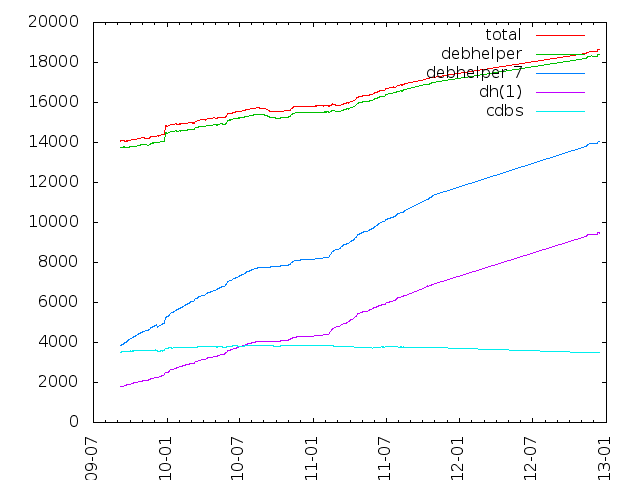
I don't know if anyone else has been tracking this recently, but a while back I got curious about the relative proportions of dh(1) and CDBS in the archive, and started running some daily analysis on the Lintian lab. Apologies for my poor graphing abilities, but the graph is here (occasionally updated): Although dh is still a bit behind CDBS, the steady upward trend is quite striking - it looks set to break 20% soon, up from under 13% in September - compared with CDBS which has been sitting within half a percentage point of 25% the whole time. Incidentally, was that an ftpmaster trying to sign his name in the graph over Christmas or something? :-)
Julian Andres Klode: Google Street View in Germany

I wonder why the federal minister for consumer protection (hopefully a good enough translation for Verbraucherschutzministerin ) Ilse Aigner has concerns about Street View, because those concerns are completely unrelated to protecting the consumer, because the consumer is the one viewing the images in the browser, and not the person being photographed. I have no reason to believe that Google Street View is illegal, I see no difference between a photo taken by a company and a photo taken by a single person. If Google Street View were illegal, distribution of every picture taken in the public would have to be considered illegal as well. And creating laws limiting the height at which the camera is placed to e.g. 1.8 meters sounds like discriminating against persons who are e.g. 1.85 meters ( You re too tall, you re not allowed to take a picture ). More information about this topic can be found on e.g. http://www.spiegel.de/international/germany/0,1518,676616,00.html.
Filed under: General

28 February 2010

Joachim Breitner: Exploiting sharing in arbtt

My automatic rule-based time tracker (arbtt), which is written in Haskell, collects every minute a data sample consisting mainly of the list of currently open windows (window title and program name). Naturally, this log grows rather large. Since October of last year, I collected 70,000 samples. I already went from a text-based file format to a binary format using Data.Binary, which gave a big performance boost.
But by now, I was afraid that this is not enough. My log file is now 30MB large. Looking at the memory graph of gnome-panel, it is taking up more than half of my memory. When running arbtt-stats, the Haskell run time system reports 569 MB total memory in use and the command finishes after 28.5 seconds. Naturally, the log file is highly redundant: Compressing it with bzip2 shrinks it to 1.6MB. But as I would like to preserve the ability to just append samples at the end, without having to read the file, I chose not just to add bzip2 or gzip compression. Rather, I am now exploiting a very obvious redundancy: Two adjacent samples usually list exactly the same windows, and a focus change only changes a flag. So now, when storing a string that is part of a sample, it will check if this string was already present in the previous sample and, in this case, just store the number of that string (one byte). Only if the string was not present it will write a zero byte and then the string. When reading the sample, the process is reversed. This greatly reduces the file size: It is down to 6.2MB. It also improves the memory consumption, due to Haskell s abilities with regard to sharing: When a reference to a string in a previous sample is read, then only one instance of this string is in memory, even if it occurs several times in the log. This brings the memory consumption down to 264 MB and the runtime to 17 seconds. I released the changes as version 0.4.5.1 to Hackage, Debian and as a Windows installer. The log file is not automatically converted, but new samples will be written in the compressed format. If you want to convert your whole file, you have to stop arbtt-capture, run arbtt-recover, and then move the hopefully noticeable smaller ~/.arbtt/capture.log.recovered to ~/.arbtt/capture.log.
The required code changes were not too big. I somewhat isolated the relevant code in the Data.Binary.StringRef module. Unfortunately, I have to use OverlappingInstances to be able to provide the special instance for String is there a cleaner way (besides the trick used for the Show class)?

23 February 2010

Tiago Bortoletto Vaz: Creative retaliation


Canada responds to historic Olympic hockey game loss to US: (source)

Next.

Previous.
