Search Results: "sto"

11 November 2024

Gunnar Wolf: Why academics under-share research data - A social relational theory

This post is a review for Computing Reviews for Why academics under-share research data - A social relational theory , a article published in Journal of the Association for Information Science and Technology
As an academic, I have cheered for and welcomed the open access (OA) mandates that, slowly but steadily, have been accepted in one way or another throughout academia. It is now often accepted that public funds means public research. Many of our universities or funding bodies will demand that, with varying intensities sometimes they demand research to be published in an OA venue, sometimes a mandate will only prefer it. Lately, some journals and funder bodies have expanded this mandate toward open science, requiring not only research outputs (that is, articles and books) to be published openly but for the data backing the results to be made public as well. As a person who has been involved with free software promotion since the mid 1990s, it was natural for me to join the OA movement and to celebrate when various universities adopt such mandates. Now, what happens after a university or funder body adopts such a mandate? Many individual academics cheer, as it is the right thing to do. However, the authors observe that this is not really followed thoroughly by academics. What can be observed, rather, is the slow pace or feet dragging of academics when they are compelled to comply with OA mandates, or even an outright refusal to do so. If OA and open science are close to the ethos of academia, why aren t more academics enthusiastically sharing the data used for their research? This paper finds a subversive practice embodied in the refusal to comply with such mandates, and explores an hypothesis based on Karl Marx s productive worker theory and Pierre Bourdieu s ideas of symbolic capital. The paper explains that academics, as productive workers, become targets for exploitation: given that it s not only the academics sharing ethos, but private industry s push for data collection and industry-aligned research, they adapt to technological changes and jump through all kinds of hurdles to create more products, in a result that can be understood as a neoliberal productivity measurement strategy. Neoliberalism assumes that mechanisms that produce more profit for academic institutions will result in better research; it also leads to the disempowerment of academics as a class, although they are rewarded as individuals due to the specific value they produce. The authors continue by explaining how open science mandates seem to ignore the historical ways of collaboration in different scientific fields, and exploring different angles of how and why data can be seen as under-shared, failing to comply with different aspects of said mandates. This paper, built on the social sciences tradition, is clearly a controversial work that can spark interesting discussions. While it does not specifically touch on computing, it is relevant to Computing Reviews readers due to the relatively high percentage of academics among us.

Vincent Bernat: Customize Caddy's plugins with Nix

Caddy is an open-source web server written in Go. It handles TLS certificates automatically and comes with a simple configuration syntax. Users can extend its functionality through plugins1 to add features like rate limiting, caching, and Docker integration. While Caddy is available in Nixpkgs, adding extra plugins is not simple.2 The compilation process needs Internet access, which Nix denies during build to ensure reproducibility. When trying to build the following derivation using xcaddy, a tool for building Caddy with plugins, it fails with this error: dial tcp: lookup proxy.golang.org on [::1]:53: connection refused.
  pkgs  :
pkgs.stdenv.mkDerivation  
  name = "caddy-with-xcaddy";
  nativeBuildInputs = with pkgs; [ go xcaddy cacert ];
  unpackPhase = "true";
  buildPhase =
    ''
      xcaddy build --with github.com/caddy-dns/powerdns@v1.0.1
    '';
  installPhase = ''
    mkdir -p $out/bin
    cp caddy $out/bin
  '';
 
Fixed-output derivations are an exception to this rule and get network access during build. They need to specify their output hash. For example, the fetchurl function produces a fixed-output derivation:
  stdenv, fetchurl  :
stdenv.mkDerivation rec  
  pname = "hello";
  version = "2.12.1";
  src = fetchurl  
    url = "mirror://gnu/hello/hello-$ version .tar.gz";
    hash = "sha256-jZkUKv2SV28wsM18tCqNxoCZmLxdYH2Idh9RLibH2yA=";
   ;
 
To create a fixed-output derivation, you need to set the outputHash attribute. The example below shows how to output Caddy s source code, with some plugin enabled, as a fixed-output derivation using xcaddy and go mod vendor.
pkgs.stdenvNoCC.mkDerivation rec  
  pname = "caddy-src-with-xcaddy";
  version = "2.8.4";
  nativeBuildInputs = with pkgs; [ go xcaddy cacert ];
  unpackPhase = "true";
  buildPhase =
    ''
      export GOCACHE=$TMPDIR/go-cache
      export GOPATH="$TMPDIR/go"
      XCADDY_SKIP_BUILD=1 TMPDIR="$PWD" \
        xcaddy build v$ version  --with github.com/caddy-dns/powerdns@v1.0.1
      (cd buildenv* && go mod vendor)
    '';
  installPhase = ''
    mv buildenv* $out
  '';
  outputHash = "sha256-F/jqR4iEsklJFycTjSaW8B/V3iTGqqGOzwYBUXxRKrc=";
  outputHashAlgo = "sha256";
  outputHashMode = "recursive";
 
With a fixed-output derivation, it is up to us to ensure the output is always the same: You can use this derivation to override the src attribute in pkgs.caddy:
pkgs.caddy.overrideAttrs (prev:  
  src = pkgs.stdenvNoCC.mkDerivation   /* ... */  ;
  vendorHash = null;
  subPackages = [ "." ];
 );
Check out the complete example in the GitHub repository. To integrate into a Flake, add github:vincentbernat/caddy-nix as an overlay:
 
  inputs =  
    nixpkgs.url = "nixpkgs";
    flake-utils.url = "github:numtide/flake-utils";
    caddy.url = "github:vincentbernat/caddy-nix";
   ;
  outputs =   self, nixpkgs, flake-utils, caddy  :
    flake-utils.lib.eachDefaultSystem (system:
      let
        pkgs = import nixpkgs  
          inherit system;
          overlays = [ caddy.overlays.default ];
         ;
      in
       
        packages =  
          default = pkgs.caddy.withPlugins  
            plugins = [ "github.com/caddy-dns/powerdns@v1.0.1" ];
            hash = "sha256-F/jqR4iEsklJFycTjSaW8B/V3iTGqqGOzwYBUXxRKrc=";
           ;
         ;
       );
 

Update (2024-11) This flake won t work with Nixpkgs 24.05 or older because it relies on this commit to properly override the vendorHash attribute.


  1. This article uses the term plugins, though Caddy documentation also refers to them as modules since they are implemented as Go modules.
  2. This is a feature request since quite some time. A proposed solution has been rejected. The one described in this article is a bit different and I have proposed it in another pull request.
  3. This is not perfect: if the source code produced by xcaddy changes, the hash would change and the build would fail.

10 November 2024

Reproducible Builds: Reproducible Builds in October 2024

Welcome to the October 2024 report from the Reproducible Builds project. Our reports attempt to outline what we ve been up to over the past month, highlighting news items from elsewhere in tech where they are related. As ever, if you are interested in contributing to the project, please visit our Contribute page on our website. Table of contents:
  1. Beyond bitwise equality for Reproducible Builds?
  2. Two Ways to Trustworthy at SeaGL 2024
  3. Number of cores affected Android compiler output
  4. On our mailing list
  5. diffoscope
  6. IzzyOnDroid passed 25% reproducible apps
  7. Distribution work
  8. Website updates
  9. Reproducibility testing framework
  10. Supply-chain security at Open Source Summit EU
  11. Upstream patches

Beyond bitwise equality for Reproducible Builds? Jens Dietrich, Tim White, of Victoria University of Wellington, New Zealand along with Behnaz Hassanshahi and Paddy Krishnan of Oracle Labs Australia published a paper entitled Levels of Binary Equivalence for the Comparison of Binaries from Alternative Builds :
The availability of multiple binaries built from the same sources creates new challenges and opportunities, and raises questions such as: Does build A confirm the integrity of build B? or Can build A reveal a compromised build B? . To answer such questions requires a notion of equivalence between binaries. We demonstrate that the obvious approach based on bitwise equality has significant shortcomings in practice, and that there is value in opting for alternative notions. We conceptualise this by introducing levels of equivalence, inspired by clone detection types.
A PDF of the paper is freely available.

Two Ways to Trustworthy at SeaGL 2024 On Friday 8th November, Vagrant Cascadian will present a talk entitled Two Ways to Trustworthy at SeaGL in Seattle, WA. Founded in 2013, SeaGL is a free, grassroots technical summit dedicated to spreading awareness and knowledge about free source software, hardware and culture. Vagrant s talk:
[ ] delves into how two project[s] approaches fundamental security features through Reproducible Builds, Bootstrappable Builds, code auditability, etc. to improve trustworthiness, allowing independent verification; trustworthy projects require little to no trust. Exploring the challenges that each project faces due to very different technical architectures, but also contextually relevant social structure, adoption patterns, and organizational history should provide a good backdrop to understand how different approaches to security might evolve, with real-world merits and downsides.

Number of cores affected Android compiler output Fay Stegerman wrote that the cause of the Android toolchain bug from September s report that she reported to the Android issue tracker has been found and the bug has been fixed.
the D8 Java to DEX compiler (part of the Android toolchain) eliminated a redundant field load if running the class s static initialiser was known to be free of side effects, which ended up accidentally depending on the sharding of the input, which is dependent on the number of CPU cores used during the build.
To make it easier to understand the bug and the patch, Fay also made a small example to illustrate when and why the optimisation involved is valid.

On our mailing list On our mailing list this month:

diffoscope diffoscope is our in-depth and content-aware diff utility that can locate and diagnose reproducibility issues. This month, Chris Lamb made the following changes, including preparing and uploading versions 279, 280, 281 and 282 to Debian:
  • Ignore errors when listing .ar archives (#1085257). [ ]
  • Don t try and test with systemd-ukify in the Debian stable distribution. [ ]
  • Drop Depends on the deprecated python3-pkg-resources (#1083362). [ ]
In addition, Jelle van der Waa added support for Unified Kernel Image (UKI) files. [ ][ ][ ] Furthermore, Vagrant Cascadian updated diffoscope in GNU Guix to version 282. [ ][ ]

IzzyOnDroid passed 25% reproducible apps The IzzyOnDroid project has reached a good milestone by reaching over 25% of the ~1,200 Android apps provided by their repository (of official APKs built by the original application developers) having been confirmed to be reproducible by a rebuilder.

Distribution work In Debian this month:
  • Holger Levsen uploaded devscripts version 2.24.2, including many changes to the debootsnap, debrebuild and reproducible-check scripts. This is the first time that debrebuild actually works (using sbuild s unshare backend). As part of this, Holger also fixed an issue in the reproducible-check script where a typo in the code led to incorrect results [ ]
  • Recently, a news entry was added to snapshot.debian.org s homepage, describing the recent changes that made the system stable again:
    The new server has no problems keeping up with importing the full archives on every update, as each run finishes comfortably in time before it s time to run again. [While] the new server is the one doing all the importing of updated archives, the HTTP interface is being served by both the new server and one of the VM s at LeaseWeb.
    The entry list a number of specific updates surrounding the API endpoints and rate limiting.
  • Lastly, 12 reviews of Debian packages were added, 3 were updated and 18 were removed this month adding to our knowledge about identified issues.
Elsewhere in distribution news, Zbigniew J drzejewski-Szmek performed another rebuild of Fedora 42 packages, with the headline result being that 91% of the packages are reproducible. Zbigniew also reported a reproducibility problem with QImage. Finally, in openSUSE, Bernhard M. Wiedemann published another report for that distribution.

Website updates There were an enormous number of improvements made to our website this month, including:
  • Alba Herrerias:
    • Improve consistency across distribution-specific guides. [ ]
    • Fix a number of links on the Contribute page. [ ]
  • Chris Lamb:
  • hulkoba
  • James Addison:
    • Huge and significant work on a (as-yet-merged) quickstart guide to be linked from the homepage [ ][ ][ ][ ][ ]
    • On the homepage, link directly to the Projects subpage. [ ]
    • Relocate dependency-drift notes to the Volatile inputs page. [ ]
  • Ninette Adhikari:
    • Add a brand new Success stories page that highlights the success stories of Reproducible Builds, showcasing real-world examples of projects shipping with verifiable, reproducible builds . [ ][ ][ ][ ][ ][ ]
  • Pol Dellaiera:
    • Update the website s README page for building the website under NixOS. [ ][ ][ ][ ][ ]
    • Add a new academic paper citation. [ ]
Lastly, Holger Levsen filed an extensive issue detailing a request to create an overview of recommendations and standards in relation to reproducible builds.

Reproducibility testing framework The Reproducible Builds project operates a comprehensive testing framework running primarily at tests.reproducible-builds.org in order to check packages and other artifacts for reproducibility. In October, a number of changes were made by Holger Levsen, including:
  • Add a basic index.html for rebuilderd. [ ]
  • Update the nginx.conf configuration file for rebuilderd. [ ]
  • Document how to use a rescue system for Infomaniak s OpenStack cloud. [ ]
  • Update usage info for two particular nodes. [ ]
  • Fix up a version skew check to fix the name of the riscv64 architecture. [ ]
  • Update the rebuilderd-related TODO. [ ]
In addition, Mattia Rizzolo added a new IP address for the inos5 node [ ] and Vagrant Cascadian brought 4 virt nodes back online [ ].

Supply-chain security at Open Source Summit EU The Open Source Summit EU took place recently, and covered plenty of topics related to supply-chain security, including:

Upstream patches The Reproducible Builds project detects, dissects and attempts to fix as many currently-unreproducible packages as possible. We endeavour to send all of our patches upstream where appropriate. This month, we wrote a large number of such patches, including:

Finally, If you are interested in contributing to the Reproducible Builds project, please visit our Contribute page on our website. However, you can get in touch with us via:

9 November 2024

Jonathan Dowland: Progressively enhancing CGI apps with htmx

I was interested in learning about htmx, so I used it to improve the experience of posting comments on my blog. It seems much of modern web development is structured around having a JavaScript program on the front-end (browser) which exchanges data encoded in JSON asynchronously with the back-end servers. htmx uses a novel (or throwback) approach: it asynchronously fetches snippets of HTML from the back-end, and splices the results into the live page. For example, a htmx-powered button may request a URI on the server, receive HTML in response, and then the button itself would be replaced by the resulting HTML, within the page. I experimented with incorporating it into an existing, old-school CGI web app: IkiWiki, which I became a co-maintainer of this year, and powers my blog. Throughout this project I referred to the excellent book Server-Driven Web Apps with htmx. Comment posting workflow I really value blog comments, but the UX for posting them on my blog was a bit clunky. It went like this:
  1. you load a given page (such as this blog post), which is a static HTML document. There's a link to add a comment to the page.
  2. The link loads a new page which is generated dynamically and served back to you via CGI. This contains a HTML form for you to write your comment.
  3. The form submits to the server via HTTP POST. IkiWiki validates the form content. Various static pages (in particular the one you started on, in Step 1) are regenerated.
  4. the server response to the request in (3) is a HTTP 302 redirect, instructing the browser to go back to the page in Step 1.
First step: fetching a comment form First, I wanted the "add a comment" link to present the edit box in the current page. This step was easiest: add four attributes to the "comment on this page" anchor tag:
hx-get="<CGI ENDPOINT GOES HERE>"
suppresses the normal behaviour of the tag, so clicking on it doesn't load a new page.
issues an asynchronous HTTP GET to the CGI end-point, which returns the full HTML document for the comment edit form
hx-select=".editcomment form"
extract the edit-comment form from within that document
hx-swap=beforeend and hx-target=".addcomment"
append (courtesy of beforeend) the form into the source page after the "add comment" anchor tag (.addcomment)
Now, clicking "comment on this page" loads in the edit-comment box below it without moving you away from the source page. All that without writing any new code! Second step: handling previews
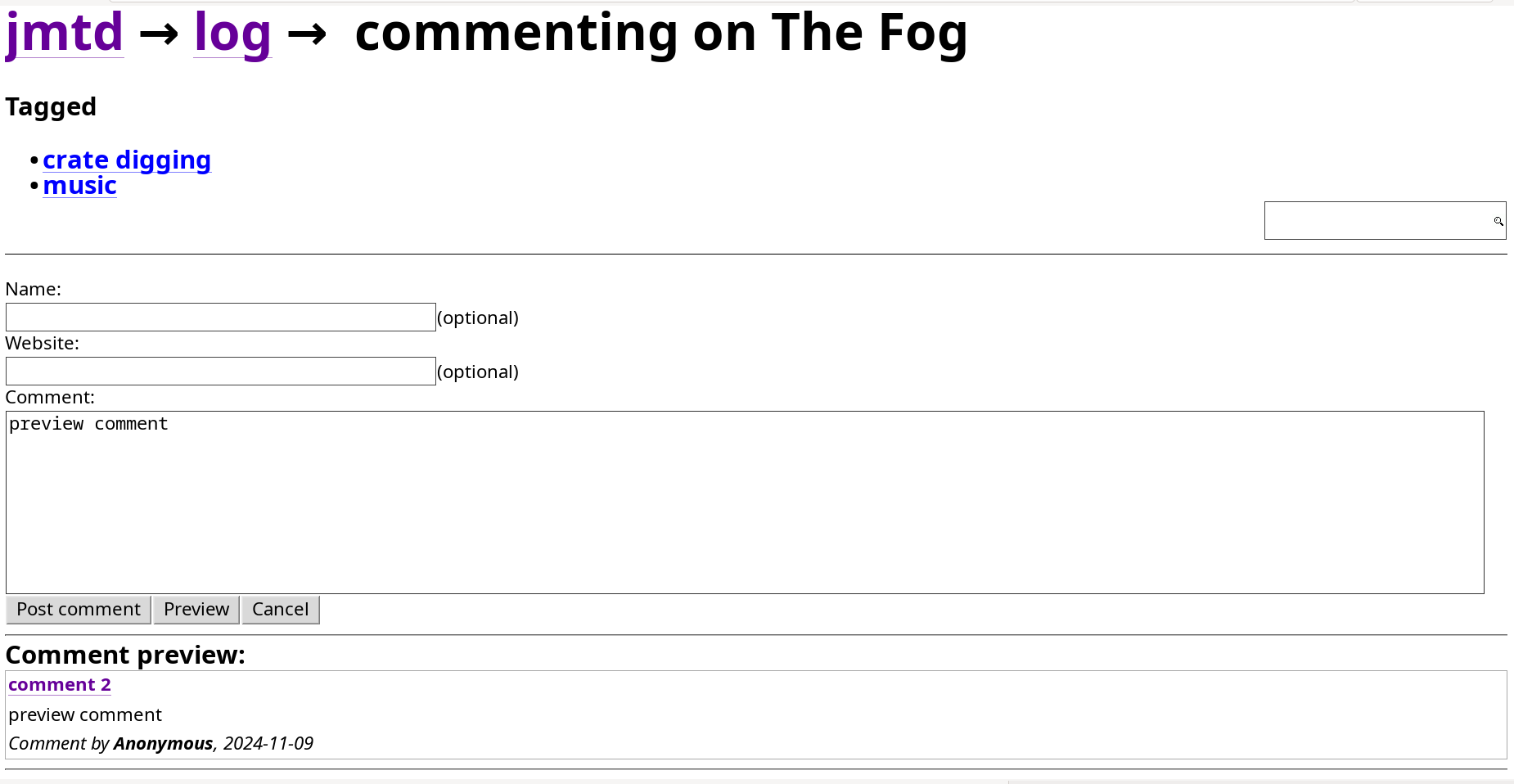
The old Preview Comment page The old Preview Comment page
In the traditional workflow, clicking on "Preview" loaded a new page containing the edit form (but not the original page or any existing comments) with a rendering of the comment-in-progress below it. I wasn't originally interested in supporting the "Preview" feature, but I needed to for reasons I'll explain later. Rather than load new pages, I wanted "Preview" to insert a rendering of the comment-in-progress being inserted into the current page's list of comments, marked up to indicate that it's a preview. IkiWiki provides some templates which you can override to customise your site. I've long overridden page.tmpl, the template used for all pages. I needed to add a new empty div tag in order to have a "hook" to target with the previewed comment. The rest of this was achieved with htmx attributes on the "Preview" button, similar to in the last step: hx-post to define a target URI when you click the button (and specify HTTP POST); hx-select to filter the resulting HTML and extract the comment; hx-target to specify where to insert it. Now, clicking "Preview" does not leave the current page, but fetches a rendering of your comment-in-progress, and splices it into the comment list, appropriately marked up to be clear it's a preview. Third step: handling submitted comments IkiWiki is highly configurable, and many different things could happen once you post a comment. On my personal blog, all comments are held for moderation before they are published. The page you were served after submitting a comment was rather bare-bones, a status message "Your comment will be posted after moderator review", without the original page content or comments. I wanted your comment to appear in the page immediately, albeit marked up to indicate it was awaiting review. Since the traditional workflow didn't render or present your comment to you, I had to cheat. handling moderated comments
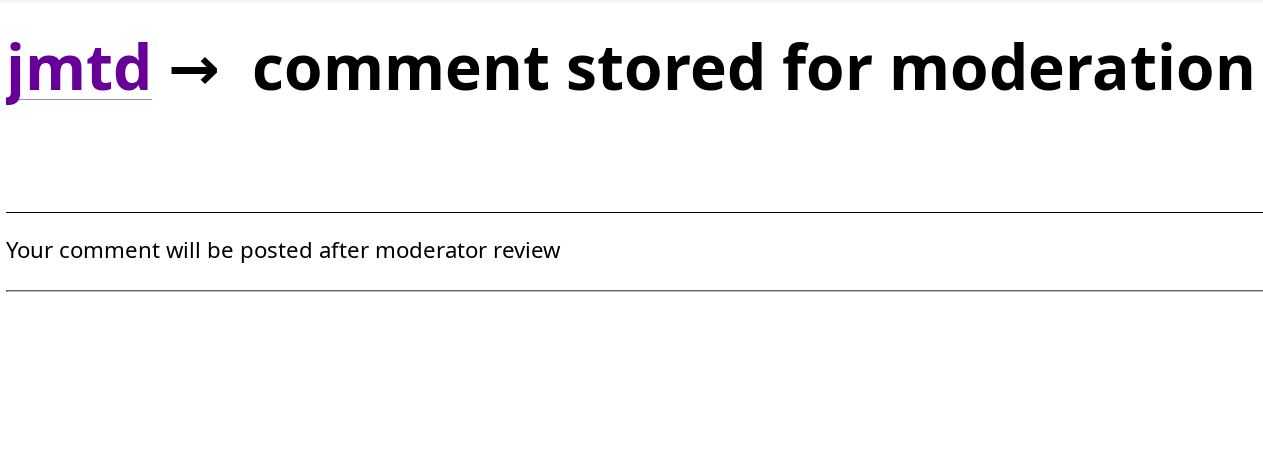
Moderation message upon submitting a comment Moderation message upon submitting a comment
One of my goals with this project was not to modify IkiWiki itself. I had to break this rule for moderated comments. When returning the "comment is moderated" page, IkiWiki uses HTTP status code 200, the same as for other scenarios. I wrote a tiny patch to return HTTP 202 (Accepted, but not processed) instead. I now have to write some actual JavaScript. htmx emits the htmx:beforeSwap event after an AJAX call returns, but before the corresponding swap is performed. I wrote a function that is triggered on this event, filters for HTTP 202 responses, triggers the "Preview" button, and then alters the result to indicate a moderated, rather than previewed, comment. (That's why I bothered to implement previews). You can read the full function here: jon.js. Summary I've done barely any front-end web development for years and I found working with htmx to be an enjoyable experience. You can leave a comment on this very blog post if you want to see it in action. I couldn't resist adding an easter egg: Brownie points if you can figure out what it is. Adding htmx to an existing CGI-based website let me improve one of the workflows in a gracefully-degrading way (without JavaScript, the old method will continue to work fine) without modifying the existing application itself (well, almost) and without having to write very much code of my own at all: nearly all of the configuration was declarative.

8 November 2024

Thomas Lange: Using NIS (Network Information Service) in 2024

The topic of this posting already tells you that an old Unix guy tells stories about old techniques. I'm a happy NIS (formerly YP) user since 30+ years. I started using it with SunOS 4.0, later using it with Solaris and with Linux since 1999. In the past, a colleague wasn't happyly using NIS+ when he couldn't log in as root after a short time because of some well known bugs and wrong configs. NIS+ was also much slower than my NIS setup. I know organisations using NIS for more than 80.000 user accounts in 2024. I know the security implications of NIS but I can live with them, because I manage all computers in the network that have access to the NIS maps. And NIS on Linux offers to use shadow maps, which are only accessible to the root account. My users are forced to use very long passwords. Unfortunately NIS support for the PAM modules was removed in Debian in pam 1.4.0-13, which means Debian 12 (bookworm) is lacking NIS support in PAM, but otherwise it is still supported. This only affects changing the NIS password via passwd. You can still authenticate users and use other NIS maps. But yppasswd is deprecated and you should not use it! If you use yppasswd it may generate a new password hash by using the old DES crypt algorithm, which is very weak and only uses the first 8 chars in your password. Do not use yppasswd any more! yppasswd only detects DES, MD5, SHA256 and SHA512 hashes, but for me and some colleagues it only creates weak DES hashes after a password change. yescrypt hashes which are the default in Debian 12 are not supported at all. The solution is to use the plain passwd program. On the NIS master, you should setup your NIS configuration to use /etc/shadow and /etc/passwd even if your other NIS maps are in /var/yp/src or similar. Make sure to have these lines in your /var/yp/Makefile:
PASSWD      = /etc/passwd
SHADOW      = /etc/shadow
Call make once, and it will generate the shadow and passwd map. You may want to set the variable MINUID which defines which entries are not put into the NIS maps. On all NIS clients you still need the entries (for passwd, shadow, group,...) that point to the nis service. E.g.:
passwd:         files nis systemd
group:          files nis systemd
shadow:         files nis
You can remove all occurences of "nis" in your /etc/pam.d/common-password file. Then you can use the plain passwd program to change your password on the NIS master. But this does not call make in /var/yp for updating the NIS shadow map. Let's use inotify(7) for that. First, create a small shell script /usr/local/sbin/shadow-change:
#! /bin/sh
PATH=/usr/sbin:/usr/bin
# only watch the /etc/shadow file
if [ "$2" != "shadow" ]; then
  exit 0
fi
cd /var/yp   exit 3
sleep 2
make
Then install the package incron.
# apt install incron
# echo root >> /etc/incron.allow
# incrontab -e
Add this line:
/etc    IN_MOVED_TO     /usr/local/sbin/shadow-change $@ $# $%
It's not possible to use IN_MODIFY or watch other events on /etc/shadow directly, because the passwd command creates a /etc/nshadow file, deletes /etc/shadow and then moves nshadow to shadow. inotify on a file does not work after the file was removed. You can see the logs from incrond by using:
# journalctl _COMM=incrond
e.g.
Oct 01 12:21:56 kueppers incrond[6588]: starting service (version 0.5.12, built on Jan 27 2023 23:08:49)
Oct 01 13:43:55 kueppers incrond[6589]: table for user root created, loading
Oct 01 13:45:42 kueppers incrond[6589]: PATH (/etc) FILE (shadow) EVENT (IN_MOVED_TO)
Oct 01 13:45:42 kueppers incrond[6589]: (root) CMD ( /usr/local/sbin/shadow-change /etc shadow IN_MOVED_TO)
I've disabled the execution of yppasswd using dpkg-divert
# dpkg-divert --local --rename --divert /usr/bin/yppasswd-disable /usr/bin/yppasswd
chmod a-rwx /usr/bin/yppasswd-disable
Do not forget to limit the access to the shadow.byname map in ypserv.conf and general access to NIS in ypserv.securenets. I've also discovered the package pamtester, which is a nice package for testing your pam configs.

Freexian Collaborators: Debian Contributions: October s report (by Anupa Ann Joseph)

Debian Contributions: 2024-10 Contributing to Debian is part of Freexian s mission. This article covers the latest achievements of Freexian and their collaborators. All of this is made possible by organizations subscribing to our Long Term Support contracts and consulting services.

rebootstrap, by Helmut Grohne After significant changes earlier this year, the state of architecture cross bootstrap is normalizing again. More and more architectures manage to complete rebootstrap testing successfully again. Here are two examples of what kind of issues the bootstrap testing identifies. At some point, libpng1.6 would fail to cross build on musl architectures whereas it would succeed on other ones failing to locate zlib. Adding --debug-find to the cmake invocation eventually revealed that it would fail to search in /usr/lib/<triplet>, which is the default library path. This turned out to be a bug in cmake assuming that all linux systems use glibc. libpng1.6 also gained a baseline violation for powerpc and ppc64 by enabling the use of AltiVec there. The newt package would fail to cross build for many 32-bit architectures whereas it would succeed for armel and armhf due to -Wincompatible-pointer-types. It turns out that this flag was turned into -Werror and it was compiling with a warning earlier. The actual problem is a difference in signedness between wchar_t and FriBidChar (aka uint32_t) and actually affects native building on i386.

Miscellaneous contributions
  • Helmut sent 35 patches for cross build failures.
  • Stefano Rivera uploaded the Python 3.13.0 final release.
  • Stefano continued to rebuild Python packages with C extensions using Python 3.13, to catch compatibility issues before the 3.13-add transition starts.
  • Stefano uploaded new versions of a handful of Python packages, including: dh-python, objgraph, python-mitogen, python-truststore, and python-virtualenv.
  • Stefano packaged a new release of mkdocs-macros-plugin, which required packaging a new Python package for Debian, python-super-collections (now in NEW review).
  • Stefano helped the mini-DebConf Online Brazil get video infrastructure up and running for the event. Unfortunately, Debian s online-DebConf setup has bitrotted over the last couple of years, and it eventually required new temporary Jitsi and Jibri instances.
  • Colin Watson fixed a number of autopkgtest failures to get ansible back into testing.
  • Colin fixed an ssh client failure in certain cases when using GSS-API key exchange, and added an integration test to ensure this doesn t regress in future.
  • Colin worked on the Python 3.13 transition, fixing problems related to it in 15 packages. This included upstream work in a number of packages (postgresfixture, python-asyncssh, python-wadllib).
  • Colin upgraded 41 Python packages to new upstream versions.
  • Carles improved po-debconf-manager: now it can create merge requests to Salsa automatically (created 17, new batch coming this month), imported almost all the packages with debconf translation templates whose VCS is Salsa (currently 449 imported), added statistics per package and language, improved command line interface options. Performed user support fixing different issues. Also prepared an abstract for the talk at MiniDebConf Toulouse.
  • Santiago Ruano Rinc n continued the organization work for the DebConf 25 conference, to be held in Brest, France. Part of the work relates to the initial edits of the sponsoring brochure. Thanks to Benjamin Somers who finalized the French and English versions.
  • Rapha l forwarded a couple of zim and hamster bugs to the upstream developers, and tried to diagnose a delayed startup of gdm on his laptop (cf #1085633).
  • On behalf of the Debian Publicity Team, Anupa interviewed 7 women from the Debian community, old and new contributors. The interview was published in Bits from Debian.

4 November 2024

Ravi Dwivedi: Asante Kenya for a Good Time

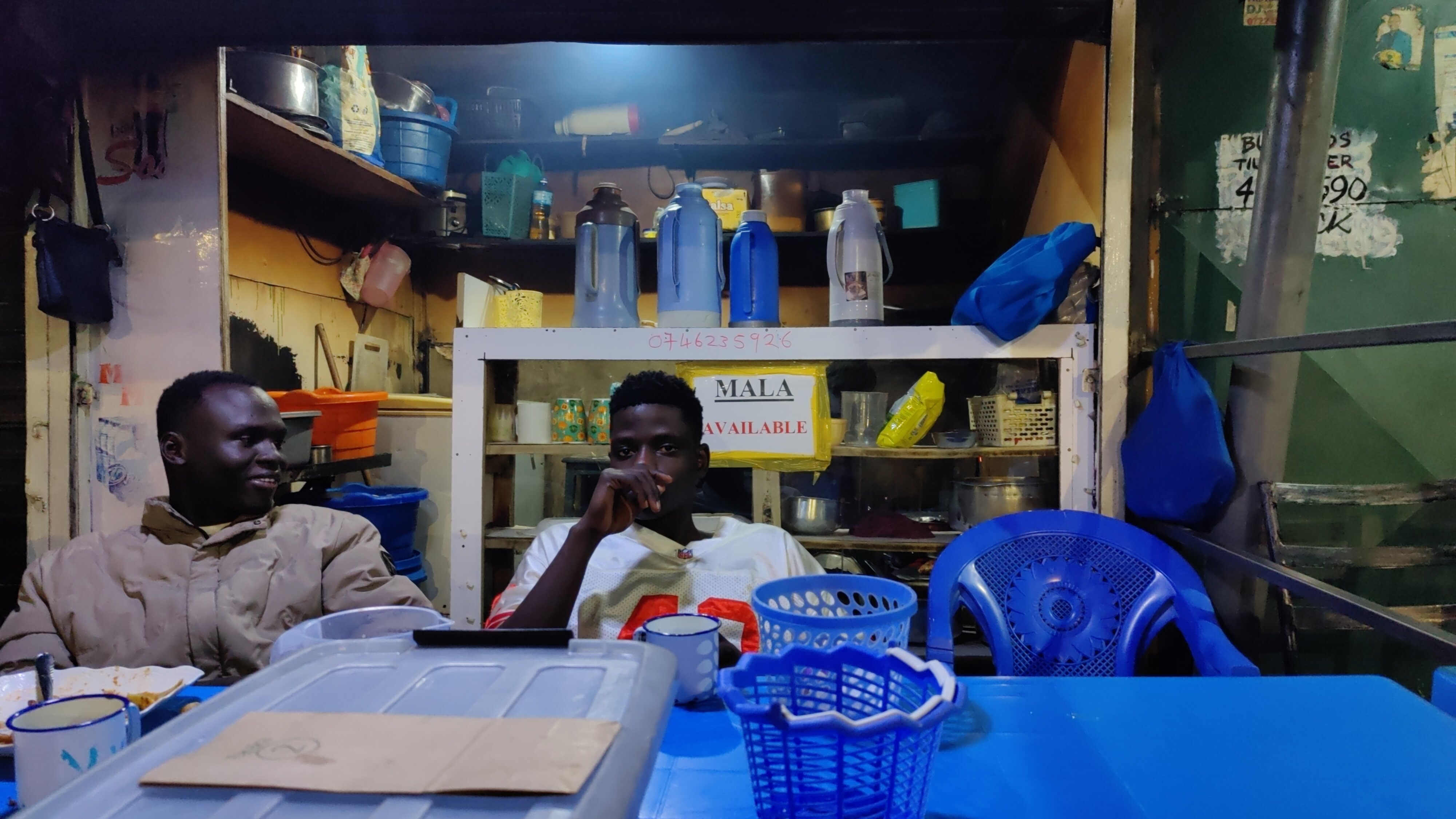
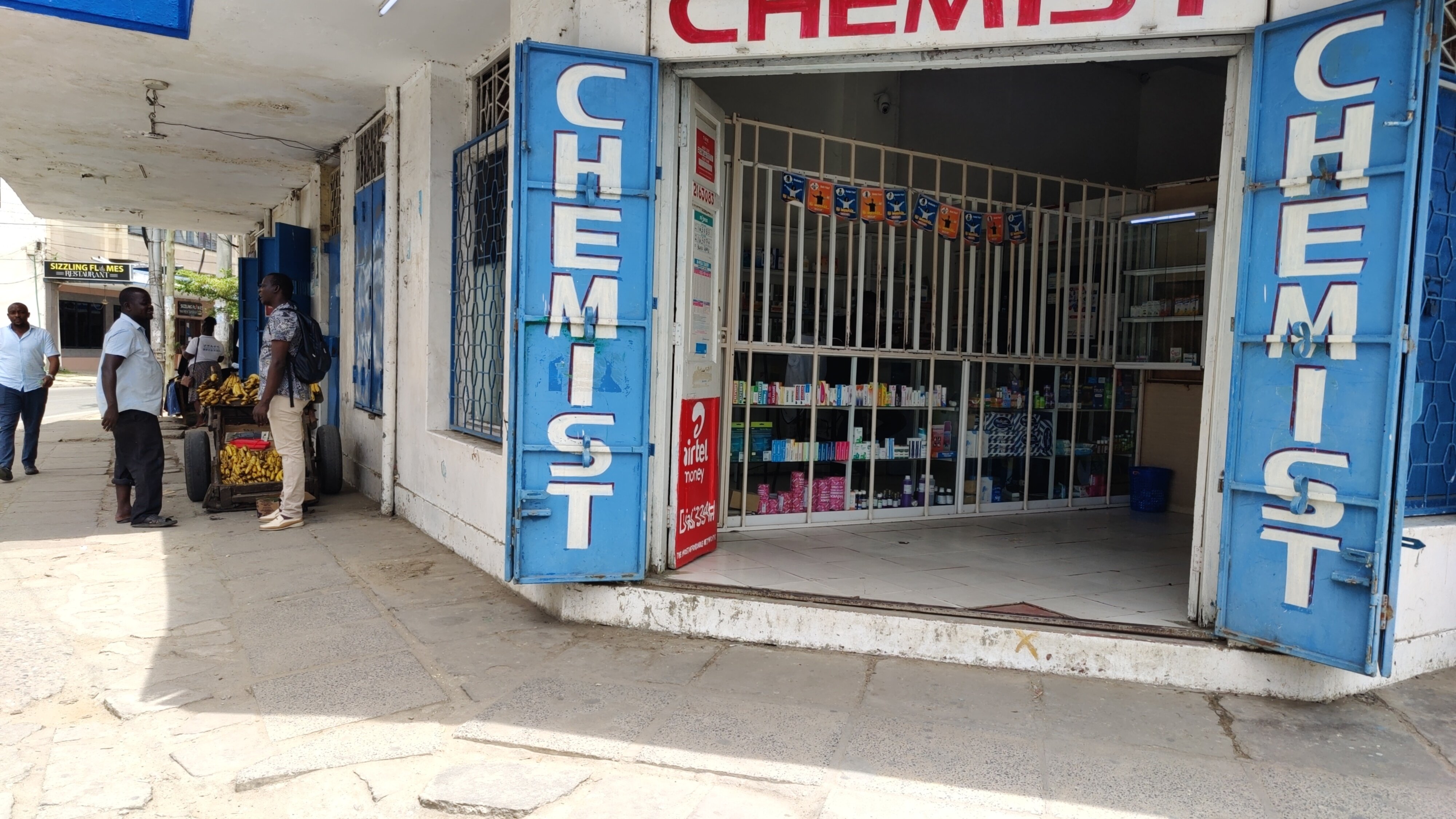
In September of this year, I visited Kenya to attend the State of the Map conference. I spent six nights in the capital Nairobi, two nights in Mombasa, and one night on a train. I was very happy with the visa process being smooth and quick. Furthermore, I stayed at the Nairobi Transit Hotel with other attendees, with Ibtehal from Bangladesh as my roommate. One of the memorable moments was the time I spent at a local coffee shop nearby. We used to go there at midnight, despite the grating in the shops suggesting such adventures were unsafe. Fortunately, nothing bad happened, and we were rewarded with a fun time with the locals.
The coffee shop Ibtehal and me used to visit during the midnight
Grating at a chemist shop in Mombasa, Kenya
The country lies on the equator, which might give the impression of extremely hot temperatures. However, Nairobi was on the cooler side (10 25 degrees Celsius), and I found myself needing a hoodie, which I bought the next day. It also served as a nice souvenir, as it had an outline of the African map printed on it. I also bought a Safaricom SIM card for 100 shillings and recharged it with 1000 shillings for 8 GB internet with 5G speeds and 400 minutes talk time.

A visit to Nairobi s Historic Cricket Ground On this trip, I got a unique souvenir that can t be purchased from the market a cricket jersey worn in an ODI match by a player. The story goes as follows: I was roaming around the market with my friend Benson from Nairobi to buy a Kenyan cricket jersey for myself, but we couldn t find any. So, Benson had the idea of visiting the Nairobi Gymkhana Club, which used to be Kenya s main cricket ground. It has hosted some historic matches, including the 2003 World Cup match in which Kenya beat the mighty Sri Lankans and the record for the fastest ODI century by Shahid Afridi in just 37 balls in 1996. Although entry to the club was exclusively for members, I was warmly welcomed by the staff. Upon reaching the cricket ground, I met some Indian players who played in Kenyan leagues, as well as Lucas Oluoch and Dominic Wesonga, who have represented Kenya in ODIs. When I expressed interest in getting a jersey, Dominic agreed to send me pictures of his jersey. I liked his jersey and collected it from him. I gave him 2000 shillings, an amount suggested by those Indian players.
Me with players at the Nairobi Gymkhana Club
Cricket pitch at the Nairobi Gymkhana Club
A view of the cricket ground inside the Nairobi Gymkhana Club
Scoreboard at the Nairobi Gymkhana cricket ground

Giraffe Center in Nairobi Kenya is known for its safaris and has no shortage of national parks. In fact, Nairobi is the only capital in the world with a national park. I decided not to visit one, as most of them were expensive and offered multi-day tours, and I didn t want to spend that much time in the wildlife. Instead, I went to the Giraffe Center in Nairobi with Pragya and Rabina. The ticket cost 1500 Kenyan shillings (1000 Indian rupees). In Kenya, matatus - shared vans, usually decorated with portraits of famous people and play rap songs - are the most popular means of public transport. Reaching the Giraffe Center from our hotel required taking five matatus, which cost a total of 150 shillings, and a 2 km walk. The journey back was 90 shillings, suggesting that we didn t find the most efficient route to get there. At the Giraffe Center, we fed giraffes and took photos.
A matatu with a Notorious BIG portrait.
Inside the Giraffe Center

Train ride from Nairobi to Mombasa I took a train from Nairobi to Mombasa. The train is known as the SGR Train, where SGR refers to Standard Gauge Railway. The journey was around 500 km. M-Pesa was the only way to make payment for pre-booking the train ticket, and I didn t have an M-Pesa account. Pragya s friend Mary helped facilitate the payment. I booked a second-class ticket, which cost 1500 shillings (1000 Indian rupees). The train was scheduled to depart from Nairobi at 08:00 hours in the morning and arrive in Mombasa at 14:00 hours. The security check at the station required scanning our bags and having them sniffed by sniffer dogs. I also fell victim to a scam by a security official who offered to help me get my ticket printed, only to later ask me to get him some coffee, which I politely declined. Before boarding the train, I was treated to some stunning views at the Nairobi Terminus station. It was a seating train, but I wished it were a sleeper train, as I was sleep-deprived. The train was neat and clean, with good toilets. The train reached Mombasa on time at around 14:00 hours.
SGR train at Nairobi Terminus.
Interior of the SGR train

Arrival in Mombasa
Mombasa Terminus station.
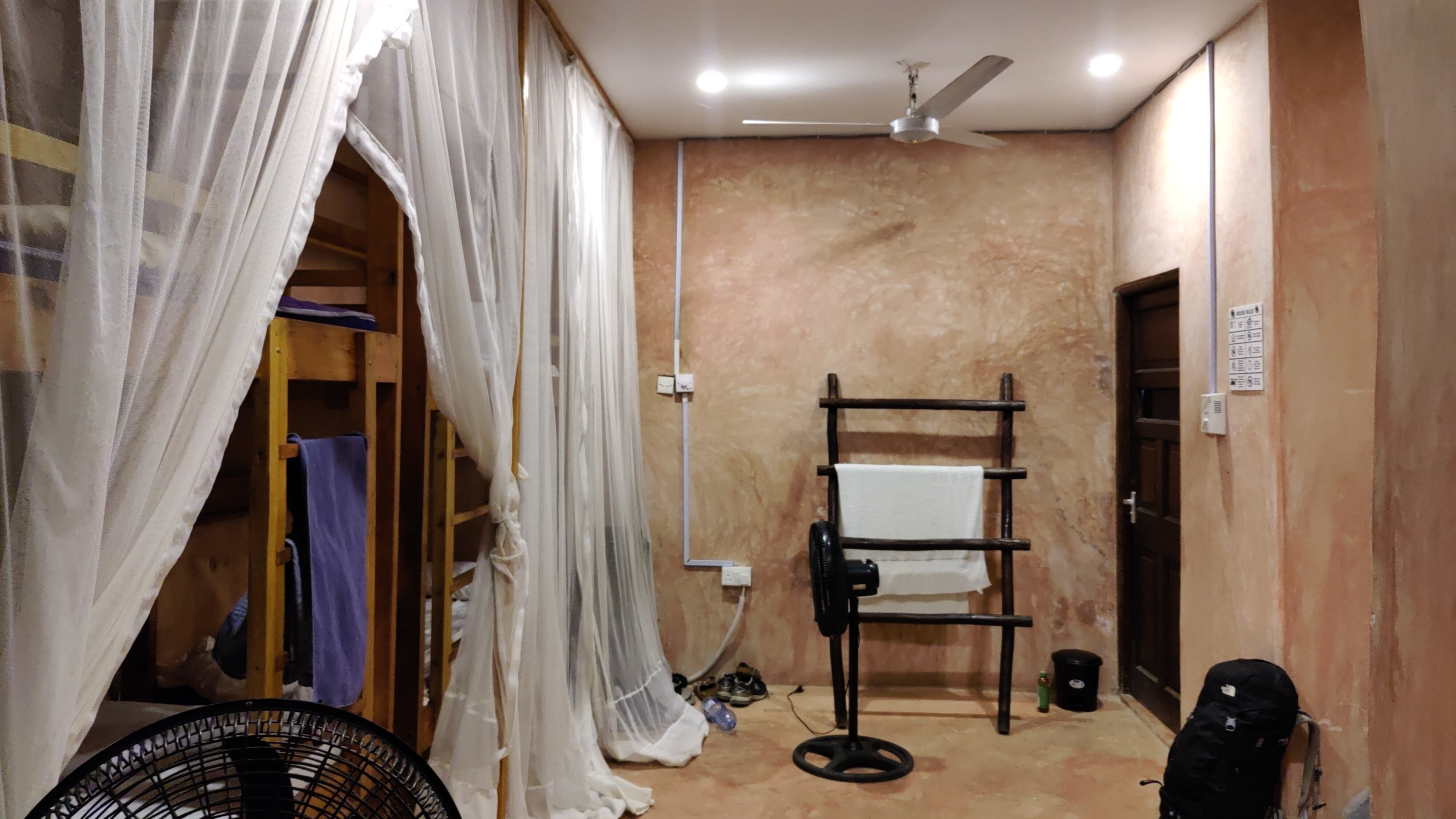
Mombasa was a bit hotter than Nairobi, with temperatures reaching around 30 degrees Celsius. However, that s not too hot for me, as I am used to higher temperatures in India. I had booked a hostel in the Old Town and was searching for a hitchhike from the Mombasa Terminus station. After trying for more than half an hour, I took a matatu that dropped me 3 km from my hostel for 200 shillings (140 Indian rupees). I tried to hitchhike again but couldn t find a ride. I think I know why I couldn t get a ride in both the cases. In the first case, the Mombasa Terminus was in an isolated place, so most of the vehicles were taxis or matatus while any noncommercial cars were there to pick up friends and family. If the station were in the middle of the city, there would be many more car/truck drivers passing by, thus increasing my possibilities of getting a ride. In the second case, my hostel was at the end of the city, and nobody was going towards that side. In fact, many drivers told me they would love to give me a ride, but they were going in some other direction. Finally, I took a tuktuk for 70 shillings to reach my hostel, Tulia Backpackers. It was 11 USD (1400 shillings) for one night. The balcony gave a nice view of the Indian Ocean. The rooms had fans, but there was no air conditioning. Each bed also had mosquito nets. The place was walking distance of the famous Fort Jesus. Mombasa has had more Islamic influence compared to Nairobi and also has many Hindu temples.
The balcony at Tulia Backpackers Hostel had a nice view of the ocean.
A room inside the hostel with fans and mosquito nets on the beds

Visiting White Sandy Beaches and Getting a Hitchhike Visiting Nyali beach marked my first time ever at a white sand beach. It was like 10 km from the hostel. The next day, I visited Diani Beach, which was 30 km from the hostel. Going to Diani Beach required crossing a river, for which there s a free ferry service every few minutes, followed by taking a matatu to Ukunda and then a tuk-tuk. The journey gave me a glimpse of the beautiful countryside of Kenya.
Nyali beach is a white sand beach
This is the ferry service for crossing the river.
During my return from Diani Beach to the hostel, I was successful in hitchhiking. However, it was only a 4 km ride and not sufficient to reach Ukunda, so I tried to get another ride. When a truck stopped for me, I asked for a ride to Ukunda. Later, I learned that they were going in the same direction as me, so I got off within walking distance from my hostel. The ride was around 30 km. I also learned the difference between a truck ride and a matatu or car ride. For instance, matatus and cars are much faster and cooler due to air conditioning, while trucks tend to be warmer because they lack it. Further, the truck was stopped at many checkpoints by the police for inspections as it carried goods, which is not the case with matatus. Anyways, it was a nice experience, and I am grateful for the ride. I had a nice conversation with the truck drivers about Indian movies and my experiences in Kenya.
Diani beach is a popular beach in Kenya. It is a white sand beach.
Selfie with truck drivers who gave me the free ride

Back to Nairobi I took the SGR train from Mombasa back to Nairobi. This time I took the night train, which departs at 22:00 hours, reaching Nairobi at around 04:00 in the morning. I could not sleep comfortably since the train only had seater seats. I had booked the Zarita Hotel in Nairobi and had already confirmed if they allowed early morning check-in. Usually, hotels have a fixed checkout time, say 11:00 in the morning, and you are not allowed to stay beyond that regardless of the time you checked in. But this hotel checked me in for 24 hours. Here, I paid in US dollars, and the cost was 12 USD.

Almost Got Stuck in Kenya Two days before my scheduled flight from Nairobi back to India, I heard the news that the airports in Kenya were closed due to the strikes. Rabina and Pragya had their flight back to Nepal canceled that day, which left them stuck in Nairobi for two additional days. I called Sahil in India and found out during the conversation that the strike was called off in the evening. It was a big relief for me, and I was fortunate to be able to fly back to India without any changes to my plans.
Newspapers at a stand in Kenya covering news on the airport closure

Experience with locals I had no problems communicating with Kenyans, as everyone I met knew English to an extent that could easily surpass that of big cities in India. Additionally, I learned a few words from Kenya s most popular local language, Swahili, such as Asante, meaning thank you, Jambo for hello, and Karibu for welcome. Knowing a few words in the local language went a long way. I am not sure what s up with haggling in Kenya. It wasn t easy to bring the price of souvenirs down. I bought a fridge magnet for 200 shillings, which was the quoted price. On the other hand, it was much easier to bargain with taxis/tuktuks/motorbikes. I stayed at three hotels/hostels in Kenya. None of them had air conditioners. Two of the places were in Nairobi, and they didn t even have fans in the rooms, while the one in Mombasa had only fans. All of them had good Wi-Fi, except Tulia where the internet overall was a bit shaky. My experience with the hotel staff was great. For instance, we requested that the Nairobi Transit Hotel cancel the included breakfast in order to reduce the room costs, but later realized that it was not a good idea. The hotel allowed us to revert and even offered one of our missing breakfasts during dinner. The staff at Tulia Backpackers in Mombasa facilitated the ticket payment for my train from Mombasa to Nairobi. One of the staff members also gave me a lift to the place where I could catch a matatu to Nyali Beach. They even added an extra tea bag to my tea when I requested it to be stronger.

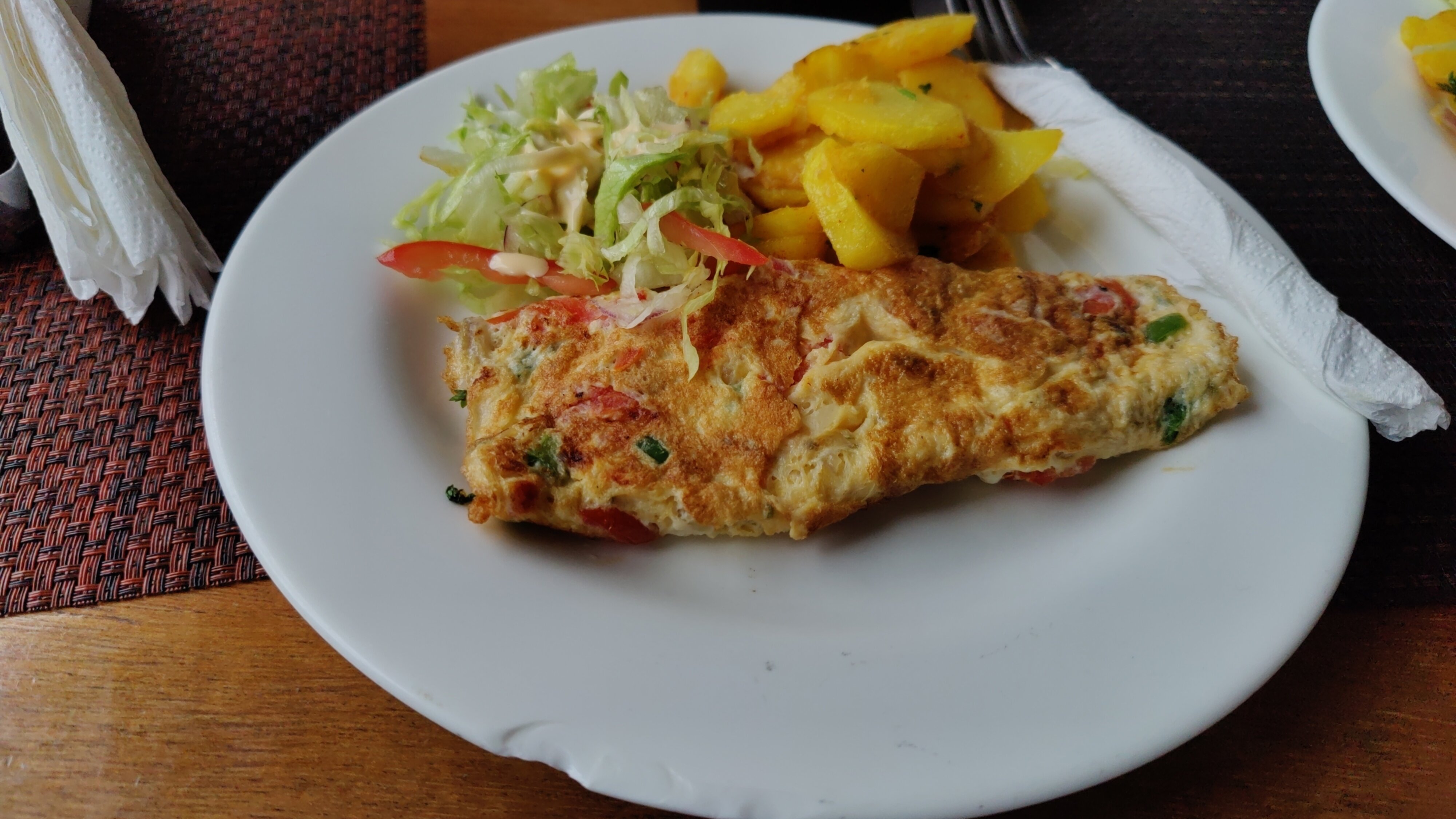
Food At the Nairobi Transit Hotel, a Spanish omelet with tea was served for breakfast. I noticed that Spanish omelette appeared on the menus of many restaurants, suggesting that it is popular in Kenya. This was my first time having this dish. The milk tea in Kenya, referred to by locals as white tea, is lighter than Indian tea (they don t put a lot of tea leaves).
Spanish Omelette served in breakfast at Nairobi Transit Hotel
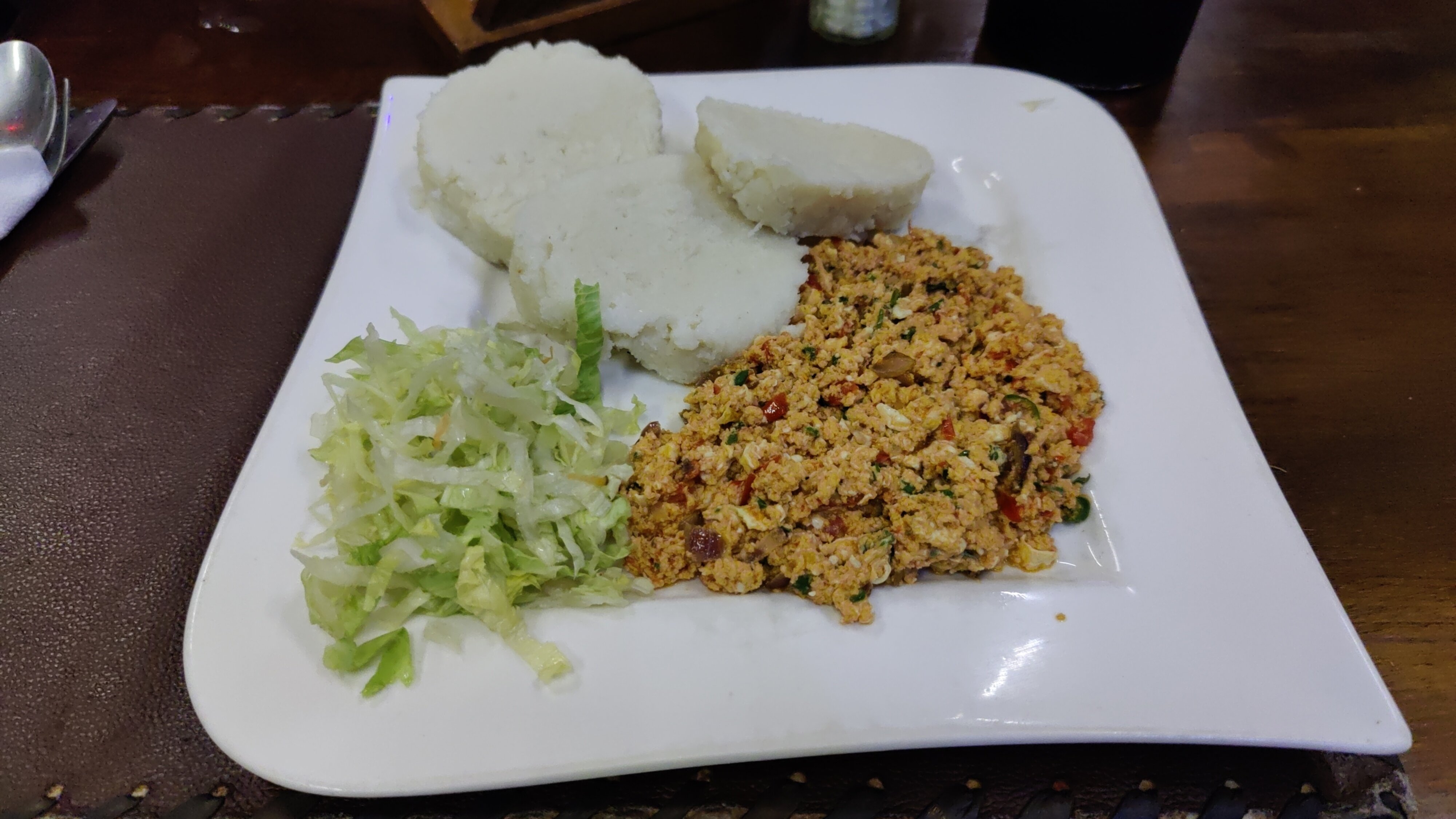
I also sampled ugali with eggs. In Mombasa, I visited an Indian restaurant called New Chetna and had a buffet thali there twice.
Ugali with eggs.

Tips for Exchanging Money In Kenya, I exchanged my money at forex shops a couple of times. I received good exchange rates for bills larger than 50 USD. For instance, 1 USD on xe.com was 129 shillings, and I got 128.3 shillings per USD (a total of 12,830 shillings) for two 50 USD notes at an exchange in Nairobi, while 127 shillings, which was the highest rate at the banks. On the other hand, for smaller bills such as a one US dollar note, I would have got 125 shillings. A passport was the only document required for the exchange, and they also provided a receipt. A good piece of advice for travelers is to keep 50 USD or larger bills for exchanging into the local currency while saving the smaller US dollar bills for accommodation, as many hotels and hostels accept payment in US dollars (in addition to Kenyan shillings).

Missed Malindi and Lamu There were more places on my to-visit list in Kenya. But I simply didn t have time to cover them, as I don t like rushing through places, especially in a foreign country where there is a chance of me underestimating the amount of time it takes during transit. I would have liked to visit at least one of Kilifi, Watamu or Malindi beaches. Further, Lamu seemed like a unique place to visit as it has no cars or motorized transport; the only options for transport are boats and donkeys. That s it for now. Meet you in the next one :)

Sven Hoexter: Google CloudDNS HTTPS Records with ipv6hint

I naively provisioned an HTTPS record at Google CloudDNS like this via terraform:
resource "google_dns_record_set" "testv6"  
    name         = "testv6.some-domain.example."
    managed_zone = "some-domain-example"
    type         = "HTTPS"
    ttl          = 3600
    rrdatas      = ["1 . alpn=\"h2\" ipv4hint=\"198.51.100.1\" ipv6hint=\"2001:DB8::1\""]
 
This results in a permanent diff because the Google CloudDNS API seems to parse the record content, and stores the ipv6hint expanded (removing the :: notation) and in all lowercase as 2001:db8:0:0:0:0:0:1. Thus to fix the permanent diff we've to use it like this:
resource "google_dns_record_set" "testv6"  
    name = "testv6.some-domain.example."
    managed_zone = "some-domain-example"
    type = "HTTPS"
    ttl = 3600
    rrdatas = ["1 . alpn=\"h2\" ipv4hint=\"198.51.100.1\" ipv6hint=\"2001:db8:0:0:0:0:0:1\""]
 
Guess I should be glad that they already support HTTPS records natively, and not bicker too much about the implementation details.

2 November 2024

Russell Coker: More About the Yoga Gen3

Two months ago I bought a Thinkpad X1 Yoga Gen3 [1]. I m still very happy with it, the screen is a great improvement over the FullHD screen on my previous Thinkpad. I have yet to discover what s the best resolution to have on a laptop if price isn t an issue, but it s at least 1440p for a 14 display, that s 210DPI. The latest Thinkpad X1 Yoga is the 7th gen and has up to 3840*2400 resolution on the internal display for 323DPI. Apple apparently uses the term Retina Display to mean something in the range of 250DPI to 300DPI, so my current laptop is below Retina while the most expensive new Thinkpads are above it. I did some tests on external displays and found that this Thinkpad along with a Dell Latitude of the same form factor and about the same age can only handle one 4K display on a Thunderbolt dock and one on HDMI. On Reddit u/Carlioso1234 pointed out this specs page which says it supports a maximum of 3 displays including the built in TFT [2]. The Thunderbolt/USB-C connection has a maximum resolution of 5120*2880 and the HDMI port has a maximum of 4K. The latest Yoga can support four displays total which means 2*5K over Thunderbolt and one 4K over HDMI. It would be nice if someone made a 8000*2880 ultrawide display that looked like 2*5K displays when connected via Thunderbolt. It would also be nice if someone made a 32 5K display, currently they all seem to be 27 and I ve found that even for 4K resolution 32 is better than 27 . With the typical configuration of Linux and the BIOS the Yoga Gen3 will have it s touch screen stop working after suspend. I have confirmed this for stylus use but as the finger-touch functionality is broken I couldn t confirm that. On r/thinkpad u/p9k told me how to fix this problem [3]. I had to set the BIOS to Win 10 Sleep aka Hybrid sleep and then put the following in /etc/systemd/system/thinkpad-wakeup-config.service :
# https://www.reddit.com/r/thinkpad/comments/1blpy20/comment/kw7se2l/?context=3
[Unit]
Description=Workarounds for sleep wakeup source for Thinkpad X1 Yoga 3
After=sysinit.target
After=systemd-modules-load.service
[Service]
Type=oneshot
ExecStart=/bin/sh -c "echo 'enabled' > /sys/devices/platform/i8042/serio0/power/wakeup"
ExecStart=/bin/sh -c "echo 'enabled' > /sys/devices/platform/i8042/serio1/power/wakeup"
ExecStart=/bin/sh -c "echo 'LID' > /proc/acpi/wakeup"
[Install]
WantedBy=multi-user.target
Now it works fine, for stylus at least. I still get kernel error messages like the following which don t seem to cause problems:
wacom 0003:056A:5146.0005: wacom_idleprox_timeout: tool appears to be hung in-prox. forcing it out.
When it wasn t working I got the above but also kernel error messages like:
wacom 0003:056A:5146.0005: wacom_wac_queue_insert: kfifo has filled, starting to drop events
This change affected the way suspend etc operate. Now when I connect the laptop to power it will leave suspend mode. I ve configured KDE to suspend when the lid is closed and there s no monitor connected.

Russell Coker: Moving Between Devices

I previously wrote about the possibility of transferring work between devices as an alternative to convergence (using a phone or tablet as a desktop) [1]. This idea has been implemented in some commercial products already. MrWhosTheBoss made a good YouTube video reviewing recent Huawei products [2]. At 2:50 in that video he shows how you can link a phone and tablet, control one from the other, drag and drop of running apps and files between phone and tablet, mirror the screen between devices, etc. He describes playing a video on one device and having it appear on the other, I hope that it actually launches a new instance of the player app as the Google Chromecast failed in the market due to remote display being laggy. At 7:30 in that video he starts talking about the features that are available when you have multiple Huawei devices, starting with the ability to move a Bluetooth pairing for earphones to a different device. At 16:25 he shows what Huawei is doing to get apps going including allowing apk files to be downloaded and creating what they call Quick Apps which are instances of a web browser configured to just use one web site and make it look like a discrete app, we need something like this for FOSS phone distributions does anyone know of a browser that s good for it? Another thing that we need is to have an easy way of transferring open web pages between systems. Chrome allows sending pages between systems but it s proprietary, limited to Chrome only, and also takes an unreasonable amount of time. KDEConnect allows sharing clipboard contents which can be used to send URLs that can then be pasted into a browser, but the process of copy URL, send via KDEConnect, and paste into other device is unreasonably slow. The design of Chrome with a Send to your devices menu option from the tab bar is OK. But ideally we need a Send to device for all tabs of a window as well, we need it to run from free software and support using your own server not someone else s server (AKA the cloud ). Some of the KDEConnect functionality but using a server rather than direct connection over the same Wifi network (or LAN if bridged to Wifi) would be good. What else do we need?

Russell Coker: What is a Workstation?

I recently had someone describe a Mac Mini as a workstation , which I strongly disagree with. The Wikipedia page for Workstation [1] says that it s a type of computer designed for scientific or technical use, for a single user, and would commonly run a multi-user OS. The Mac Mini runs a multi-user OS and is designed for a single user. The issue is whether it is for scientific or technical use . A Mac Mini is a nice little graphical system which could be used for CAD and other engineering work. But I believe that the low capabilities of the system and lack of expansion options make it less of a workstation. The latest versions of the Mac Mini (to be officially launched next week) have up to 64G of RAM and up to 8T of storage. That is quite decent compute power for a small device. For comparison the HP ML 110 Gen9 workstation I m currently using was released in 2021 and has 256G of RAM and has 4 * 3.5 SAS bays so I could easily put a few 4TB NVMe devices and some hard drives larger than 10TB. The HP Z640 workstation I have was released in 2014 and has 128G of RAM and 4*2.5 SATA drive bays and 2*3.5 SATA drive bays. Previously I had a Dell PowerEdge T320 which was released in 2012 and had 96G of RAM and 8*3.5 SAS bays. In CPU and GPU power the recent Mac Minis will compare well to my latest workstations. But they compare poorly to workstations from as much as 12 years ago for RAM and storage. Which is more important depends on the task, if you have to do calculations on 80G of data with lots of scans through the entire data set then a system with 64G of RAM will perform very poorly and a system with 96G and a CPU less than half as fast will perform better. A Dell PowerEdge T320 from 2012 fully loaded with 192G of RAM will outperform a modern Mac Mini on many tasks due to this and the T420 supported up to 384G. Another issue is generic expansion options. I expect a workstation to have a number of PCIe slots free for GPUs and other devices. The T320 I used to use had a PCIe power cable for a power hungry GPU and I think all the T320 and T420 models with high power PSUs supported that. I think that a usable definition of a workstation is a system having a feature set that is typical of servers (ECC RAM, lots of storage for RAID, maybe hot-swap storage devices, maybe redundant PSUs, and lots of expansion options) while also being suitable for running on a desktop or under a desk. The Mac Mini is nice for running on a desk but that s the only workstation criteria it fits. I think that ECC RAM should be a mandatory criteria and any system without it isn t a workstation. That excludes most Apple hardware. The Mac Mini is more of a thin-client than a workstation. My main workstation with ECC RAM could run 3 VMs that each have more RAM than the largest Mac Mini that will be sold next week. If 32G of non-ECC RAM is considered enough for a workstation then you could get an Android phone that counts as a workstation and it will probably cost less than a Mac Mini.

1 November 2024

Colin Watson: Free software activity in October 2024

Almost all of my Debian contributions this month were sponsored by Freexian. You can also support my work directly via Liberapay. Ansible I noticed that Ansible had fallen out of Debian testing due to autopkgtest failures. This seemed like a problem worth fixing: in common with many other people, we use Ansible for configuration management at Freexian, and it probably wouldn t make our sysadmins too happy if they upgraded to trixie after its release and found that Ansible was gone. The problems here were really just slogging through test failures in both the ansible-core and ansible packages, but their test suites are large and take a while to run so this took some time. I was able to contribute a few small fixes to various upstreams in the process: This should now get back into testing tomorrow. OpenSSH Martin- ric Racine reported that ssh-audit didn t list the ext-info-s feature as being available in Debian s OpenSSH 9.2 packaging in bookworm, contrary to what OpenSSH upstream said on their specifications page at the time. I spent some time looking into this and realized that upstream was mistakenly saying that implementations of ext-info-c and ext-info-s were added at the same time, while in fact ext-info-s was added rather later. ssh-audit now has clearer output, and the OpenSSH maintainers have corrected their specifications page. I looked into a report of an ssh failure in certain cases when using GSS-API key exchange (which is a Debian patch). Once again, having integration tests was a huge win here: the affected scenario is quite a fiddly one, but I was able to set it up in the test, and thereby make sure it doesn t regress in future. It still took me a couple of hours to get all the details right, but in the past this sort of thing took me much longer with a much lower degree of confidence that the fix was correct. On upstream s advice, I cherry-picked some key exchange fixes needed for big-endian architectures. Python team I packaged python-evalidate, needed for a new upstream version of buildbot. The Python 3.13 transition rolls on. I fixed problems related to it in htmlmin, humanfriendly, postgresfixture (contributed upstream), pylint, python-asyncssh (contributed upstream), python-oauthlib, python3-simpletal, quodlibet, zope.exceptions, and zope.interface. A trickier Python 3.13 issue involved the cgi module. Years ago I ported zope.publisher to the multipart module because cgi.FieldStorage was broken in some situations, and as a result I got a recommendation into Python s dead batteries PEP 594. Unfortunately there turns out to be a name conflict between multipart and python-multipart on PyPI; python-multipart upstream has been working to disentangle this, though we still need to work out what to do in Debian. All the same, I needed to fix python-wadllib and multipart seemed like the best fit; I contributed a port upstream and temporarily copied multipart into Debian s python-wadllib source package to allow its tests to pass. I ll come back and fix this properly once we sort out the multipart vs. python-multipart packaging. tzdata moved some timezone definitions to tzdata-legacy, which has broken a number of packages. I added tzdata-legacy build-dependencies to alembic and python-icalendar to deal with this in those packages, though there are still some other instances of this left. I tracked down an nltk regression that caused build failures in many other packages. I fixed Rust crate versioning issues in pydantic-core, python-bcrypt, and python-maturin (mostly fixed by Peter Michael Green and Jelmer Vernoo , but it needed a little extra work). I fixed other build failures in entrypoints, mayavi2, python-pyvmomi (mostly fixed by Alexandre Detiste, but it needed a little extra work), and python-testing.postgresql (ditto). I fixed python3-simpletal to tolerate future versions of dh-python that will drop their dependency on python3-setuptools. I fixed broken symlinks in python-treq. I removed (build-)depends on python3-pkg-resources from alembic, autopep8, buildbot, celery, flufl.enum, flufl.lock, python-public, python-wadllib (contributed upstream), pyvisa, routes, vulture, and zodbpickle (contributed upstream). I upgraded astroid, asyncpg (fixing a Python 3.13 failure and a build failure), buildbot (noticing an upstream test bug in the process), dnsdiag, frozenlist, netmiko (fixing a Python 3.13 failure), psycopg3, pydantic-settings, pylint, python-asyncssh, python-bleach, python-btrees, python-cytoolz, python-django-pgtrigger, python-django-test-migrations, python-gssapi, python-icalendar, python-json-log-formatter, python-pgbouncer, python-pkginfo, python-plumbum, python-stdlib-list, python-tokenize-rt, python-treq (fixing a Python 3.13 failure), python-typeguard, python-webargs (fixing a build failure), pyupgrade, pyvisa, pyvisa-py (fixing a Python 3.13 failure), toolz, twisted, vulture, waitress (fixing CVE-2024-49768 and CVE-2024-49769), wtf-peewee, wtforms, zodbpickle, zope.exceptions, zope.interface, zope.proxy, zope.security, and zope.testrunner to new upstream versions. I tried to fix a regression in python-scruffy, but I need testing feedback. I requested removal of python-testing.mysqld.

Russ Allbery: Review: Overdue and Returns

Review: Overdue and Returns, by Mark Lawrence
Publisher: Mark Lawrence
Copyright: June 2023
Copyright: February 2024
ASIN: B0C9N51M6Y
ASIN: B0CTYNQGBX
Format: Kindle
Pages: 99
Overdue is a stand-alone novelette in the Library Trilogy universe. Returns is a collection of two stories, the novelette "Returns" and the short story "About Pain." All of them together are about the length of a novella, so I'm combining them into a single review. These are ancillary stories in the same universe as the novels, but not necessarily in the same timeline. (Trying to fit "About Pain" into the novel timeline will give you a headache and I am choosing to read it as author's fan fiction.) I'm guessing they're part of the new fad for releasing short fiction on Amazon to tide readers over and maintain interest between books in a series, a fad about which I have mixed feelings. Given the total lack of publisher metadata in either the stories or on Amazon, I'm assuming they were self-published even though the novels are published by Ace, but I don't know that for certain. There are spoilers for The Book That Wouldn't Burn, so don't read these before that novel. There are no spoilers for The Book That Broke the World, and I don't think the reading order would matter. I found all three of these stories irritating and thuddingly trite. "Returns" is probably the best of the lot in terms of quality of storytelling, but I intensely dislike the structural implications of the nature of the book at its center and am therefore hoping that it's non-canonical. I would not waste your time with these even if you are enjoying the novels. "Overdue": Three owners of the same bookstore at different points in time have encounters with an albino man named Yute who is on a quest. One of the owners is trying to write a book, one of them is older, depressed, and closed off, and one of them has regular conversations with her sister's ghost. The nature of the relationship between the three is too much of a spoiler, but it involves similar shenanigans as The Book That Wouldn't Burn. Lawrence uses my least favorite resolution of benign ghost stories. The story tries very hard to sell it as a good thing, but I thought it was cruel and prefer fantasy that rejects both branches of that dilemma. Other than that, it was fine, I guess, although the moral was delivered with all of the subtlety of the last two minutes of a Saturday morning cartoon. (5) "Returns": Livira returns a book deep inside the library and finds that she can decipher it, which leads her to a story about Yute going on a trip to recover another library book. This had a lot of great Yute lines, plus I always like seeing Livira in exploration mode. The book itself is paradoxical in a causality-destroying way, which is handwaved away as literal magic. I liked this one the best of the three stories, but I hope the world-building of the main series does not go in this direction and I'm a little afraid it might. (6) "About Pain": A man named Holden runs into a woman named Clovis at the gym while carrying a book titled Catcher that his dog found and that he's returning to the library. I thoroughly enjoy Clovis and was happy to read a few more scenes about her. Other than that, this was fine, I guess, although it is a story designed to deliver a point and that point is one that appears in every discussion of classics and re-reading that has ever happened on the Internet. Also, I know I'm being grumpy, but Lawrence's puns with authors and character names are chapter-epigraph amusing but not short-story-length funny. Yes, yes, his name is Holden, we get it. (5) Rating: 5 out of 10

Taavi V n nen: Custom domains on the Wikimedia Cloud VPS web proxy

The shared web proxy used on Wikimedia Cloud VPS now has technical support for using arbitrary domains (and not just wmcloud.org subdomains) in proxy names. I think this is a good example of how software slowly evolves over time as new requirements emerge, with each new addition building on top of the previous ones. According to the edit history on Wikitech, the web proxy service has its origins in 2012, although the current idea where you create a proxy and map it to a specific instance and port was only introduced a year later. (Before that, it just directly mapped the subdomain to the VPS instance with the same name). There were some smaller changes in the coming years like the migration to acme-chief for TLS certificate management, but the overall logic stayed very similar until 2020 when the wmcloud.org domain was introduced. That was implemented by adding a config option listing all possible domains, so future domain additions would be as simple as adding the new domain to that list in the configuration. Then the changes start becoming more frequent:

30 October 2024

Russell Coker: Links October 2024

Dacid Brin wrote an interesting article about AI ecosystems and how humans might work with machines on creative projects [1]. Also he s right about influencers being like funghi. Cory Doctorow wrote an interesting post about DRM, coalitions, and cheating [2]. It seems that people like me who want trusted computing to secure their own computers don t fit well in any of the coalitions. The CHERI capability system for using extra hardware to validate jump addresses is an interesting advance in computer science [3]. The lecture is froim the seL4 Summit, this sort of advance in security goes well with a formally proven microkernel. I hope that this becomes a checkbox when ordering a custom RISC-V design. Bunnie wrote an insightful blog post about how the Mossad might have gone about implementing the exploding pager attack [4]. I guess we will see a lot more of this in future, it seems easy to do. Interesting blog post about Control Flow Integrity in the V8 engine of Chrome [5]. Interesting blog post about the new mseal() syscall which can be used by CFI among other things [6]. This is the Linux kernel documentation about the Control-flow Enforcement Technology (CET) Shadow Stack [7]. Unfortunately not enabled in Debian/Unstable yet. ARM added support for Branch Target Identification in version 8.5 of the architecture [8]. The CEO of Automatic has taken his dispute with WPEngine to an epic level, this video catalogues it, I wonder what is wrong with him [9]. NuShell is an interesting development in shell technology which runs on Linux and Windows [10]. Interesting article about making a computer game without coding using ML [11]. I doubt that it would be a good game, but maybe educational for kids. Krebs has an insightful article about location tracking by phones which is surprisingly accurate [12]. He has provided information on how to opt out of some of it on Android, but we need legislative action! Interesting YouTube video about how to make a 20kW microwave oven and what it can do [13]. Don t do this at home, or anywhere else! The Void editor is an interesting project, a fork of VSCode that supports DIRECT connections to LLM systems where you don t have their server acting as a middle-man and potentially snooping [14].

28 October 2024

Sven Hoexter: GKE version 1.31.1-gke.1678000+ is a baddy

Just a "warn your brothers" for people foolish enough to use GKE and run on the Rapid release channel. Update from version 1.31.1-gke.1146000 to 1.31.1-gke.1678000 is causing trouble whenever NetworkPolicy resources and a readinessProbe (or health check) are configured. As a workaround we started to remove the NetworkPolicy resources. E.g. when kustomize is involved with a patch like this:
- patch:  -
    $patch: delete
    apiVersion: "networking.k8s.io/v1"
    kind: NetworkPolicy
    metadata:
        name: dummy
  target:
    kind: NetworkPolicy
We tried to update to the latest version - right now 1.31.1-gke.2008000 - which did not change anything. Behaviour is pretty much erratic, sometimes it still works and sometimes the traffic is denied. It also seems that there is some relevant fix in 1.31.1-gke.1678000 because that is now the oldest release of 1.31.1 which I can find in the regular and rapid release channels. The last known good version 1.31.1-gke.1146000 is not available to try a downgrade.

Thomas Lange: 30.000 FAIme jobs created in 7 years

The number of FAIme jobs has reached 30.000. Yeah!
At the end of this November the FAIme web service for building customized ISOs turns 7 years old. It had reached 10.000 jobs in March 2021 and 20.000 jobs were reached in June 2023. A nice increase of the usage. Here are some statistics for the jobs processed in 2024: Type of jobs
3% cloud image
11% live ISO
86% install ISO
Distribution
2% bullseye
8% trixie
12% ubuntu 24.04
78% bookworm
Misc Execution Times The cloud and live ISOs need more time for their creation because the FAIme server needs to unpack and install all packages. For the install ISO the packages are only downloaded. The amount of software packages also affects the build time. Every ISO is build in a VM on an old 6-core E5-1650 v2. Times given are calculated from the jobs of the past two weeks.
Job type Avg Max
install no desktop 1 min 2 min
install GNOME 2 min 5 min
The times for Ubuntu without and with desktop are one minute higher than those mentioned above.
Job type Avg Max
live no desktop 4 min 6 min
live GNOME 8 min 11 min
The times for cloud images are similar to live images. A New Feature For a few weeks now, the system has been showing the number of jobs ahead of you in the queue when you submit a job that cannot be processed immediately. The Next Milestone At the end of this years the FAI project will be 25 years old. If you have a success story of your FAI usage to share please post it to the linux-fai mailing list or send it to me. Do you know the FAI questionnaire ? A lot of reports are already available. Here's an overview what happened in the past 20 years in the FAI project. About FAIme FAIme is the service for building your own customized ISO via a web interface. You can create an installation or live ISO or a cloud image. Several Debian releases can be selected and also Ubuntu server or Ubuntu desktop installation ISOs can be customized. Multiple options are available like selecting a desktop and the language, adding your own package list, choosing a partition layout, adding a user, choosing a backports kernel, adding a postinst script and some more.

27 October 2024

Enrico Zini: Typing decorators for class members with optional arguments

This looks straightforward and is far from it. I expect tool support will improve in the future. Meanwhile, this blog post serves as a step by step explanation for what is going on in code that I'm about to push to my team.
Let's take this relatively straightforward python code. It has a function printing an int, and a decorator that makes it argument optional, taking it from a global default if missing:
from unittest import mock
default = 42
def with_default(f):
    def wrapped(self, value=None):
        if value is None:
            value = default
        return f(self, value)
    return wrapped
class Fiddle:
    @with_default
    def print(self, value):
        print("Answer:", value)
fiddle = Fiddle()
fiddle.print(12)
fiddle.print()
def mocked(self, value=None):
    print("Mocked answer:", value)
with mock.patch.object(Fiddle, "print", autospec=True, side_effect=mocked):
    fiddle.print(12)
    fiddle.print()
It works nicely as expected:
$ python3 test0.py
Answer: 12
Answer: 42
Mocked answer: 12
Mocked answer: None
It lacks functools.wraps and typing, though. Let's add them. Adding functools.wraps Adding a simple @functools.wraps, mock unexpectedly stops working:
# python3 test1.py
Answer: 12
Answer: 42
Mocked answer: 12
Traceback (most recent call last):
  File "/home/enrico/lavori/freexian/tt/test1.py", line 42, in <module>
    fiddle.print()
  File "<string>", line 2, in print
  File "/usr/lib/python3.11/unittest/mock.py", line 186, in checksig
    sig.bind(*args, **kwargs)
  File "/usr/lib/python3.11/inspect.py", line 3211, in bind
    return self._bind(args, kwargs)
           ^^^^^^^^^^^^^^^^^^^^^^^^
  File "/usr/lib/python3.11/inspect.py", line 3126, in _bind
    raise TypeError(msg) from None
TypeError: missing a required argument: 'value'
This is the new code, with explanations and a fix:
# Introduce functools
import functools
from unittest import mock
default = 42
def with_default(f):
    @functools.wraps(f)
    def wrapped(self, value=None):
        if value is None:
            value = default
        return f(self, value)
    # Fix:
    # del wrapped.__wrapped__
    return wrapped
class Fiddle:
    @with_default
    def print(self, value):
        assert value is not None
        print("Answer:", value)
fiddle = Fiddle()
fiddle.print(12)
fiddle.print()
def mocked(self, value=None):
    print("Mocked answer:", value)
with mock.patch.object(Fiddle, "print", autospec=True, side_effect=mocked):
    fiddle.print(12)
    # mock's autospec uses inspect.getsignature, which follows __wrapped__ set
    # by functools.wraps, which points to a wrong signature: the idea that
    # value is optional is now lost
    fiddle.print()
Adding typing For simplicity, from now on let's change Fiddle.print to match its wrapped signature:
      # Give up with making value not optional, to simplify things :(
      def print(self, value: int   None = None) -> None:
          assert value is not None
          print("Answer:", value)
Typing with ParamSpec
# Introduce typing, try with ParamSpec
import functools
from typing import TYPE_CHECKING, ParamSpec, Callable
from unittest import mock
default = 42
P = ParamSpec("P")
def with_default(f: Callable[P, None]) -> Callable[P, None]:
    # Using ParamSpec we forward arguments, but we cannot use them!
    @functools.wraps(f)
    def wrapped(self, value: int   None = None) -> None:
        if value is None:
            value = default
        return f(self, value)
    return wrapped
class Fiddle:
    @with_default
    def print(self, value: int   None = None) -> None:
        assert value is not None
        print("Answer:", value)
mypy complains inside the wrapper, because while we forward arguments we don't constrain them, so we can't be sure there is a value in there:
test2.py:17: error: Argument 2 has incompatible type "int"; expected "P.args"  [arg-type]
test2.py:19: error: Incompatible return value type (got "_Wrapped[P, None, [Any, int   None], None]", expected "Callable[P, None]")  [return-value]
test2.py:19: note: "_Wrapped[P, None, [Any, int   None], None].__call__" has type "Callable[[Arg(Any, 'self'), DefaultArg(int   None, 'value')], None]"
Typing with Callable We can use explicit Callable argument lists:
# Introduce typing, try with Callable
import functools
from typing import TYPE_CHECKING, Callable, TypeVar
from unittest import mock
default = 42
A = TypeVar("A")
# Callable cannot represent the fact that the argument is optional, so now mypy
# complains if we try to omit it
def with_default(f: Callable[[A, int   None], None]) -> Callable[[A, int   None], None]:
    @functools.wraps(f)
    def wrapped(self: A, value: int   None = None) -> None:
        if value is None:
            value = default
        return f(self, value)
    return wrapped
class Fiddle:
    @with_default
    def print(self, value: int   None = None) -> None:
        assert value is not None
        print("Answer:", value)
if TYPE_CHECKING:
    reveal_type(Fiddle.print)
fiddle = Fiddle()
fiddle.print(12)
# !! Too few arguments for "print" of "Fiddle"  [call-arg]
fiddle.print()
def mocked(self, value=None):
    print("Mocked answer:", value)
with mock.patch.object(Fiddle, "print", autospec=True, side_effect=mocked):
    fiddle.print(12)
    fiddle.print()
Now mypy complains when we try to omit the optional argument, because Callable cannot represent optional arguments:
test3.py:32: note: Revealed type is "def (test3.Fiddle, Union[builtins.int, None])"
test3.py:37: error: Too few arguments for "print" of "Fiddle"  [call-arg]
test3.py:46: error: Too few arguments for "print" of "Fiddle"  [call-arg]
typing's documentation says:
Callable cannot express complex signatures such as functions that take a variadic number of arguments, overloaded functions, or functions that have keyword-only parameters. However, these signatures can be expressed by defining a Protocol class with a call() method:
Let's do that! Typing with Protocol, take 1
# Introduce typing, try with Protocol
import functools
from typing import TYPE_CHECKING, Protocol, TypeVar, Generic, cast
from unittest import mock
default = 42
A = TypeVar("A", contravariant=True)
class Printer(Protocol, Generic[A]):
    def __call__(_, self: A, value: int   None = None) -> None:
        ...
def with_default(f: Printer[A]) -> Printer[A]:
    @functools.wraps(f)
    def wrapped(self: A, value: int   None = None) -> None:
        if value is None:
            value = default
        return f(self, value)
    return cast(Printer, wrapped)
class Fiddle:
    # function has a __get__ method to generated bound versions of itself
    # the Printer protocol does not define it, so mypy is now unable to type
    # the bound method correctly
    @with_default
    def print(self, value: int   None = None) -> None:
        assert value is not None
        print("Answer:", value)
if TYPE_CHECKING:
    reveal_type(Fiddle.print)
fiddle = Fiddle()
# !! Argument 1 to "__call__" of "Printer" has incompatible type "int"; expected "Fiddle"
fiddle.print(12)
fiddle.print()
def mocked(self, value=None):
    print("Mocked answer:", value)
with mock.patch.object(Fiddle, "print", autospec=True, side_effect=mocked):
    fiddle.print(12)
    fiddle.print()
New mypy complaints:
test4.py:41: error: Argument 1 to "__call__" of "Printer" has incompatible type "int"; expected "Fiddle"  [arg-type]
test4.py:42: error: Missing positional argument "self" in call to "__call__" of "Printer"  [call-arg]
test4.py:50: error: Argument 1 to "__call__" of "Printer" has incompatible type "int"; expected "Fiddle"  [arg-type]
test4.py:51: error: Missing positional argument "self" in call to "__call__" of "Printer"  [call-arg]
What happens with class methods, is that the function object has a __get__ method that generates a bound versions of itself. Our Printer protocol does not define it, so mypy is now unable to type the bound method correctly. Typing with Protocol, take 2 So... we add the function descriptor methos to our Protocol! A lot of this is taken from this discussion.
# Introduce typing, try with Protocol, harder!
import functools
from typing import TYPE_CHECKING, Protocol, TypeVar, Generic, cast, overload, Union
from unittest import mock
default = 42
A = TypeVar("A", contravariant=True)
# We now produce typing for the whole function descriptor protocol
#
# See https://github.com/python/typing/discussions/1040
class BoundPrinter(Protocol):
    """Protocol typing for bound printer methods."""
    def __call__(_, value: int   None = None) -> None:
        """Bound signature."""
class Printer(Protocol, Generic[A]):
    """Protocol typing for printer methods."""
    # noqa annotations are overrides for flake8 being confused, giving either D418:
    # Function/ Method decorated with @overload shouldn't contain a docstring
    # or D105:
    # Missing docstring in magic method
    #
    # F841 is for vulture being confused:
    #   unused variable 'objtype' (100% confidence)
    @overload
    def __get__(  # noqa: D105
        self, obj: A, objtype: type[A]   None = None  # noqa: F841
    ) -> BoundPrinter:
        ...
    @overload
    def __get__(  # noqa: D105
        self, obj: None, objtype: type[A]   None = None  # noqa: F841
    ) -> "Printer[A]":
        ...
    def __get__(
        self, obj: A   None, objtype: type[A]   None = None  # noqa: F841
    ) -> Union[BoundPrinter, "Printer[A]"]:
        """Implement function descriptor protocol for class methods."""
    def __call__(_, self: A, value: int   None = None) -> None:
        """Unbound signature."""
def with_default(f: Printer[A]) -> Printer[A]:
    @functools.wraps(f)
    def wrapped(self: A, value: int   None = None) -> None:
        if value is None:
            value = default
        return f(self, value)
    return cast(Printer, wrapped)
class Fiddle:
    # function has a __get__ method to generated bound versions of itself
    # the Printer protocol does not define it, so mypy is now unable to type
    # the bound method correctly
    @with_default
    def print(self, value: int   None = None) -> None:
        assert value is not None
        print("Answer:", value)
fiddle = Fiddle()
fiddle.print(12)
fiddle.print()
def mocked(self, value=None):
    print("Mocked answer:", value)
with mock.patch.object(Fiddle, "print", autospec=True, side_effect=mocked):
    fiddle.print(12)
    fiddle.print()
It works! It's typed! And mypy is happy!

26 October 2024

Russell Coker: The CUPS Vulnerability

The Announcement Late last month there was an announcement of a severity 9.9 vulnerability allowing remote code execution that affects all GNU/Linux systems (plus others) [1]. For something to affect all Linux systems that would have to be either a kernel issue or a sshd issue. The announcement included complaints about the lack of response of vendors and And YES: I LOVE hyping the sh1t out of this stuff because apparently sensationalism is the only language that forces these people to fix . He seems to have a different experience to me of reporting bugs, I have had plenty of success getting bugs fixed without hyping them. I just report the bug, wait a while, and it gets fixed. I have reported potential security bugs without even bothering to try and prove that they were exploitable (any situation where you can make a program crash is potentially exploitable), I just report it and it gets fixed. I was very dubious about his ability to determine how serious a bug is and to accurately report it so this wasn t a situation where I was waiting for it to be disclosed to discover if it affected me. I was quite confident that my systems wouldn t be at any risk. Analysis Not All Linux Systems Run CUPS When it was published my opinion was proven to be correct, it turned out to be a series of CUPS bugs [2]. To describe that as all GNU/Linux systems (plus others) seems like a vast overstatement, maybe a good thing to say if you want to be a TikTok influencer but not if you want to be known for computer security work. For the Debian distribution the cups-browsed package (which seems to be the main exploitable one) is recommended by cups-daemon, as I have my Debian systems configured to not install recommended packages by default that means that it wasn t installed on any of my systems. Also the vast majority of my systems don t do printing and therefore don t have any part of CUPS installed. CUPS vs NAT The next issue is that in Australia most home ISPs don t have IPv6 enabled and CUPS doesn t do the things needed to allow receiving connections from the outside world via NAT with IPv4. If inbound port 631 is blocked on both TCP and USP as is the default on Australian home Internet or if there is a correctly configured firewall in place then the network is safe from attack. There is a feature called uPnP port forwarding [3] to allow server programs to ask a router to send inbound connections to them, this is apparently usually turned off by default in router configuration. If it is enabled then there are Debian packages of software to manage this, the miniupnpc package has the client (which can request NAT changes on the router) [4]. That package is not installed on any of my systems and for my home network I don t use a router that runs uPnP. The only program I knowingly run that uses uPnP is Warzone2100 and as I don t play network games that doesn t happen. Also as an aside in version 4.4.2-1 of warzone2100 in Debian and Ubuntu I made it use Bubblewrap to run the game in a container. So a Remote Code Execution bug in Warzone 2100 won t be an immediate win for an attacker (exploits via X11 or Wayland are another issue). MAC Systems Debian has had AppArmor enabled by default since Buster was released in 2019 [5]. There are claims that AppArmor will stop this exploit from doing anything bad. To check SE Linux access I first use the semanage fcontext command to check the context of the binary, cupsd_exec_t means that the daemon runs as cupsd_t. Then I checked what file access is granted with the sesearch program, mostly just access to temporary files, cupsd config files, the faillog, the Kerberos cache files (not used on the Kerberos client systems I run), Samba run files (might be a possibility of exploiting something there), and the security_t used for interfacing with kernel security infrastructure. I then checked the access to the security class and found that it is permitted to check contexts and access-vectors not access that can be harmful. The next test was to use sesearch to discover what capabilities are granted, which unfortunately includes the sys_admin capability, that is a capability that allows many sysadmin tasks that could be harmful (I just checked the Fedora source and Fedora 42 has the same access). Whether the sys_admin capability can be used to do bad things with the limited access cupsd_t has to device nodes etc is not clear. But this access is undesirable. So the SE Linux policy in Debian and Fedora will stop cupsd_t from writing SETUID programs that can be used by random users for root access and stop it from writing to /etc/shadow etc. But the sys_admin capability might allow it to do hostile things and I have already uploaded a changed policy to Debian/Unstable to remove that. The sys_rawio capability also looked concerning but it s apparently needed to probe for USB printers and as the domain has no access to block devices it is otherwise harmless. Below are the commands I used to discover what the policy allows and the output from them.
# semanage fcontext -l grep bin/cups-browsed
/usr/bin/cups-browsed                              regular file       system_u:object_r:cupsd_exec_t:s0 
# sesearch -A -s cupsd_t -c file -p write
allow cupsd_t cupsd_interface_t:file   append create execute execute_no_trans getattr ioctl link lock map open read rename setattr unlink write  ;
allow cupsd_t cupsd_lock_t:file   append create getattr ioctl link lock open read rename setattr unlink write  ;
allow cupsd_t cupsd_log_t:file   append create getattr ioctl link lock open read rename setattr unlink write  ;
allow cupsd_t cupsd_runtime_t:file   append create getattr ioctl link lock open read rename setattr unlink write  ;
allow cupsd_t cupsd_rw_etc_t:file   append create getattr ioctl link lock open read rename setattr unlink write  ;
allow cupsd_t cupsd_t:file   append create getattr ioctl link lock open read rename setattr unlink write  ;
allow cupsd_t cupsd_tmp_t:file   append create getattr ioctl link lock open read rename setattr unlink write  ;
allow cupsd_t faillog_t:file   append getattr ioctl lock open read write  ;
allow cupsd_t init_tmpfs_t:file   append getattr ioctl lock read write  ;
allow cupsd_t krb5_host_rcache_t:file   append create getattr ioctl link lock open read rename setattr unlink write  ; [ allow_kerberos ]:True
allow cupsd_t print_spool_t:file   append create getattr ioctl link lock open read relabelfrom relabelto rename setattr unlink write  ;
allow cupsd_t samba_var_t:file   append getattr ioctl lock open read write  ;
allow cupsd_t security_t:file   append getattr ioctl lock open read write  ;
allow cupsd_t security_t:file   append getattr ioctl lock open read write  ; [ allow_kerberos ]:True
allow cupsd_t usbfs_t:file   append getattr ioctl lock open read write  ;
# sesearch -A -s cupsd_t -c security
allow cupsd_t security_t:security check_context; [ allow_kerberos ]:True
allow cupsd_t security_t:security   check_context compute_av  ;
# sesearch -A -s cupsd_t -c capability
allow cupsd_t cupsd_t:capability net_bind_service; [ allow_ypbind ]:True
allow cupsd_t cupsd_t:capability   audit_write chown dac_override dac_read_search fowner fsetid ipc_lock kill net_bind_service setgid setuid sys_admin sys_rawio sys_resource sys_tty_config  ;
# sesearch -A -s cupsd_t -c capability2
allow cupsd_t cupsd_t:capability2   block_suspend wake_alarm  ;
# sesearch -A -s cupsd_t -c blk_file
Conclusion This is an example of how not to handle security issues. Some degree of promotion is acceptable but this is very excessive and will result in people not taking security announcements seriously in future. I wonder if this is even a good career move by the researcher in question, will enough people believe that they actually did something good in this that it outweighs the number of people who think it s misleading at best?

25 October 2024

Jonathan Dowland: Behringer Model-D (synths I didn't buy)

Whilst researching what synth to buy, I learned of the Behringer1 Model-D2: a 2018 clone of the 1970 Moog Minimoog, in a desktop form factor.
Behringer Model-D Behringer Model-D
In common with the original Minimoog, it's a monophonic analogue synth, featuring three audible oscillators3 , Moog's famous 12-ladder filter and a basic envelope generator. The model-d has lost the keyboard from the original and added some patch points for the different stages, enabling some slight re-routing of the audio components.
1970 Moog Minimoog 1970 Moog Minimoog
Since I was focussing on more fundamental, back-to-basics instruments, this was very appealing to me. I'm very curious to find out what's so compelling about the famous Moog sound. The relative lack of features feels like an advantage: less to master. The additional patch points makes it a little more flexible and offer a potential gateway into the world of modular synthesis. The Model-D is also very affordable: about 200 GBP. I'll never own a real Moog. For this to work, I would need to supplement it with some other equipment. I'd need a keyboard (or press the Micron into service as a controller); I would want some way of recording and overdubbing (same as with any synth). There are no post-mix effects on the Model-D, such as delay, reverb or chorus, so I may also want something to add those. What stopped me was partly the realisation that there was little chance that a perennial beginner, such as I, could eek anything novel out of a synthesiser design that's 54 years old. Perhaps that shouldn't matter, but it gave me pause. Whilst the Model-D has patch points, I don't have anything to connect to them, and I'm firmly wanting to avoid the Modular Synthesis money pit. The lack of effects, and polyphony could make it hard to live-sculpt a tone. I started characterizing the Model-D as the "heart" choice, but it seemed wise to instead go for a "head" choice. Maybe another day!

  1. There's a whole other blog post of material I could write about Behringer and their clones of classic synths, some long out of production, and others, not so much. But, I decided to skip on that for now.
  2. taken from the fact that the Minimoog was a productised version of Moog's fourth internal prototype, the model D.
  3. 2 oscillators is more common in modern synths

Next.

Previous.