Armadillo is a powerful
and expressive C++ template library for linear algebra and scientific
computing. It aims towards a good balance between speed and ease of use,
has a syntax deliberately close to Matlab, and is useful for algorithm
development directly in C++, or quick conversion of research code into
production environments. RcppArmadillo
integrates this library with the R environment and language and is
widely used by (currently) 1119 other packages on CRAN, downloaded 32.5 million
times (per the partial logs from the cloud mirrors of CRAN), and the CSDA paper (preprint
/ vignette) by Conrad and myself has been cited 575 times according
to Google Scholar.
This release brings a new (stable) upstream (minor) release Armadillo
12.8.0 prepared by Conrad
two days ago. We, as usual, prepared a release candidate which we tested
against the over 1100 CRAN packages using RcppArmadillo.
This found no issues, which was confirmed by CRAN once we uploaded and so it
arrived as a new release today in a fully automated fashion.
We also made a small change that had been prepared by GitHub issue
#400: a few internal header files that were cluttering the top-level
of the include directory have been moved to internal directories. The
standard header is of course unaffected, and the set of full / light /
lighter / lightest headers (matching we did a while back in Rcpp) also continue to work as one
expects. This change was also tested in a full reverse-dependency check
in January but had not been released to CRAN yet.
The set of changes since the last CRAN release follows.
Courtesy of my CRANberries, there is a diffstat report relative to previous release. More detailed information is on the RcppArmadillo page. Questions, comments etc should go to the rcpp-devel mailing list off the Rcpp R-Forge page. If you like this or other open-source work I do, you can sponsor me at GitHub.Changes in RcppArmadillo version 0.12.8.0.0 (2024-02-06)
- Upgraded to Armadillo release 12.8.0 (Cortisol Injector)
- Faster detection of symmetric expressions by
pinv()andrank()- Expanded
shift()to handle sparse matrices- Expanded
conv_tofor more flexible conversions between sparse and dense matrices- Added
cbrt()- More compact representation of integers when saving matrices in CSV format
- Five non-user facing top-level include files have been removed (#432 closing #400 and building on #395 and #396)
This post by Dirk Eddelbuettel originated on his Thinking inside the box blog. Please report excessive re-aggregation in third-party for-profit settings.
Welcome to the January 2024 report from the Reproducible Builds project. In these reports we outline the most important things that we have been up to over the past month. If you are interested in contributing to the project, please visit our Contribute page on our website.
Our exploit path resulted in the ability to upload malicious PyTorch releases to GitHub, upload releases to [Amazon Web Services], potentially add code to the main repository branch, backdoor PyTorch dependencies the list goes on. In short, it was bad. Quite bad.The attack pivoted on PyTorch s use of self-hosted runners as well as submitting a pull request to address a trivial typo in the project s
README file to gain access to repository secrets and API keys that could subsequently be used for malicious purposes.
On our mailing list this month, long-time Reproducible Builds developer kpcyrd announced a new tool designed to forensically analyse Arch Linux filesystem images.
Called archlinux-userland-fs-cmp, the tool is supposed to be used from a rescue image (any Linux) with an Arch install mounted to, [for example], /mnt. Crucially, however, at no point is any file from the mounted filesystem eval d or otherwise executed. Parsers are written in a memory safe language.
More information about the tool can be found on their announcement message, as well as on the tool s homepage. A GIF of the tool in action is also available.
SOURCE_DATE_EPOCH code?
Chris Lamb started a thread on our mailing list summarising some potential problems with the source code snippet the Reproducible Builds project has been using to parse the SOURCE_DATE_EPOCH environment variable:
I m not 100% sure who originally wrote this code, but it was probably sometime in the ~2015 era, and it must be in a huge number of codebases by now. Anyway, Alejandro Colomar was working on the shadow security tool and pinged me regarding some potential issues with the code. You can see this conversation here.Chris ends his message with a request that those with intimate or low-level knowledge of
time_t, C types, overflows and the various parsing libraries in the C standard library (etc.) contribute with further info.
In Debian this month, Roland Clobus posted another detailed update of the status of reproducible ISO images on our mailing list. In particular, Roland helpfully summarised that all major desktops build reproducibly with bullseye, bookworm, trixie and sid provided they are built for a second time within the same DAK run (i.e. [within] 6 hours) . Additionally 7 of the 8 bookworm images from the official download link build reproducibly at any later time.
In addition to this, three reviews of Debian packages were added, 17 were updated and 15 were removed this month adding to our knowledge about identified issues.
Elsewhere, Bernhard posted another monthly update for his work elsewhere in openSUSE.
There were made a number of improvements to our website, including Bernhard M. Wiedemann fixing a number of typos of the term nondeterministic . [ ] and Jan Zerebecki adding a substantial and highly welcome section to our page about SOURCE_DATE_EPOCH to document its interaction with distribution rebuilds. [ ].
diffoscope is our in-depth and content-aware diff utility that can locate and diagnose reproducibility issues. This month, Chris Lamb made a number of changes such as uploading versions 254 and 255 to Debian but focusing on triaging and/or merging code from other contributors. This included adding support for comparing eXtensible ARchive (.XAR/.PKG) files courtesy of Seth Michael Larson [ ][ ], as well considerable work from Vekhir in order to fix compatibility between various and subtle incompatible versions of the progressbar libraries in Python [ ][ ][ ][ ]. Thanks!
The Reproducible Builds project operates a comprehensive testing framework (available at tests.reproducible-builds.org) in order to check packages and other artifacts for reproducibility. In January, a number of changes were made by Holger Levsen:
arm64 architecture workers from 24 to 16. [ ]arm64 nodes when they hit an OOM (out of memory) state. [ ]real_year variable to 2024 [ ] and bump various copyright years as well [ ].iptables tool everywhere, else our custom rc.local script fails. [ ]/srv/workspace/pbuilder directory on boot. [ ]chroot-installation jobs to a maximum of 4 concurrent runs. [ ][ ]armhf architecture test infrastructure. This provided the incentive to replace the UPS batteries and consolidate infrastructure to reduce future UPS load. [ ]
Elsewhere in our infrastructure, however, Holger Levsen also adjusted the email configuration for @reproducible-builds.org to deal with a new SMTP email attack. [ ]
cython (nondeterminstic path issue)deluge (issue with modification time of .egg file)gap-ferret, gap-semigroups & gap-simpcomp (nondeterministic config.log file)grpc (filesystem ordering issue )hub (random)kubernetes1.22 & kubernetes1.23 (sort-related issue)kubernetes1.24 & kubernetes1.25 (go -trimpath vs random issue)libjcat (drop test files with random bytes)luajit (Use new d option for deterministic bytecode output)meson [ ][ ] (sort the results from Python filesystem call)python-rjsmin (drop GCC instrumentation artifacts)qt6-virtualkeyboard+others (bug parallelism/race)SoapySDR (parallelism-related issue)systemd (sorting problem)warewulf (CPIO modification time issue, etc.)guake ( Schroedinger file due to race condition)qhelpgenerator-qt5 (timezone localization; fix also merged upstream for QT6)sphinx (search index doctitle sorting)mm-common package in Debian this was quickly fixed, however. [ ]
#reproducible-builds on irc.oftc.net.
rb-general@lists.reproducible-builds.org

I have been working on the rather massive Apparmor bug https://bugs.launchpad.net/ubuntu/+source/apparmor/+bug/2046844 with testing the fixes from the ppa and writing profiles for the various KDE packages affected ( pretty much anything that uses webengine ) and making progress there.
My next order of business staging Frameworks 5.114 with guidance from our super awesome Rik Mills that has been doing most of the heavy lifting in Kubuntu for many years now. So thank you for that Rik
I will also start on our big transition to the Calamaras Installer! I do have experience here, so I expect it will be a smooth one.
I am so excited for the future of Kubuntu and the exciting things to come! With that said, the Kubuntu funding is community donation driven. There is enough to pay me part time for a couple contracts, but it will run out and a full-time contract would be super awesome. I am reaching out to anyone enjoying Kubuntu and want to help with the future of Kubuntu to please consider a donation! We are working on more donation options, but for now you can donate through paypal at https://kubuntu.org/donate/ Thank you!!!!!
A new minor release 0.4.21 of RQuantLib
arrived at CRAN this afternoon,
and has already been uploaded to Debian as well.
QuantLib is a rather
comprehensice free/open-source library for quantitative
finance. RQuantLib
connects (some parts of) it to the R environment and language, and has
been part of CRAN for more than
twenty years (!!) as it was one of the first packages I uploaded
there.
This release of RQuantLib
benefits from some kind attention that Jeroen has been paying to how we
build (especially at CRAN) on
both macOS and Windows. So the build processes are a little better now,
and no internal code changed. QuantLib 1.33 built unchanged.
Courtesy of my CRANberries, there is also a diffstat report for the this release. As always, more detailed information is on the RQuantLib page. Questions, comments etc should go to the rquantlib-devel mailing list. Issue tickets can be filed at the GitHub repo. If you like this or other open-source work I do, you can now sponsor me at GitHub.Changes in RQuantLib version 0.4.21 (2024-02-01)
This post by Dirk Eddelbuettel originated on his Thinking inside the box blog. Please report excessive re-aggregation in third-party for-profit settings.
Leonardo and I are happy to
announce the release of a very minor maintenance release 0.1.2 of our dtts package
which has been on CRAN for a
little under two years now.
dtts
builds upon our nanotime
package as well as the beloved data.table to bring
high-performance and high-resolution indexing at the
nanosecond level to data frames. dtts aims to
offers the time-series indexing versatility of xts (and zoo) to the immense
power of data.table while
supporting highest nanosecond resolution.
This release follows yesterday s long-awaited release of data.table version 1.5.0 which had
been some time in the making as the first new major.minor release since
Matt drifted into being less active and the forefront. The release also
renamed the one C-level API accessor to data.table (which was added, if
memory serves, by Leonardo
with our use in mind). So we have to catch up to the renamed identifier;
this release does that, and adds a versioned imports statement on data.table.
The short list of changes follows.
Courtesy of my CRANberries, there is also a report with diffstat for this release. Questions, comments, issue tickets can be brought to the GitHub repo. If you like this or other open-source work I do, you can now sponsor me at GitHub.Changes in version 0.1.2 (2024-01-31)
- Update the one exported C-level identifier from data.table following its 1.5.0 release and a renaming
- Routine continuous integration updates
This post by Dirk Eddelbuettel originated on his Thinking inside the box blog. Please report excessive re-aggregation in third-party for-profit settings.
pkgng. It was
retired in favor of octavia around 2016.
Roughly 10 years later (2024-01-24), I found it in a drawer and, to my
surprised, it booted. After wrangling with a RS-232 USB adapter,
a null modem cable, and bit rates, I even logged in:
comBIOS ver. 1.33 20070103 Copyright (C) 2000-2007 Soekris Engineering.
net5501
0512 Mbyte Memory CPU Geode LX 500 Mhz
Pri Mas WDC WD800VE-00HDT0 LBA Xlt 1024-255-63 78 Gbyte
Slot Vend Dev ClassRev Cmd Stat CL LT HT Base1 Base2 Int
-------------------------------------------------------------------
0:01:2 1022 2082 10100000 0006 0220 08 00 00 A0000000 00000000 10
0:06:0 1106 3053 02000096 0117 0210 08 40 00 0000E101 A0004000 11
0:07:0 1106 3053 02000096 0117 0210 08 40 00 0000E201 A0004100 05
0:08:0 1106 3053 02000096 0117 0210 08 40 00 0000E301 A0004200 09
0:09:0 1106 3053 02000096 0117 0210 08 40 00 0000E401 A0004300 12
0:20:0 1022 2090 06010003 0009 02A0 08 40 80 00006001 00006101
0:20:2 1022 209A 01018001 0005 02A0 08 00 00 00000000 00000000
0:21:0 1022 2094 0C031002 0006 0230 08 00 80 A0005000 00000000 15
0:21:1 1022 2095 0C032002 0006 0230 08 00 00 A0006000 00000000 15
4 Seconds to automatic boot. Press Ctrl-P for entering Monitor.
______
____ __ ___ ___
Welcome to FreeBSD! __ '__/ _ \/ _ \
__ __/ __/
1. Boot FreeBSD [default] _ _ \___ \___
2. Boot FreeBSD with ACPI enabled ____ _____ _____
3. Boot FreeBSD in Safe Mode _ \ / ____ __ \
4. Boot FreeBSD in single user mode _) (___
5. Boot FreeBSD with verbose logging _ < \___ \
6. Escape to loader prompt _) ____) __
7. Reboot
____/ _____/ _____/
Select option, [Enter] for default
or [Space] to pause timer 5
Copyright (c) 1992-2013 The FreeBSD Project.
Copyright (c) 1979, 1980, 1983, 1986, 1988, 1989, 1991, 1992, 1993, 1994
The Regents of the University of California. All rights reserved.
FreeBSD is a registered trademark of The FreeBSD Foundation.
FreeBSD 8.4-RELEASE-p12 #5: Fri Jun 6 02:43:23 EDT 2014
root@roadkiller.anarc.at:/usr/obj/usr/src/sys/ROADKILL i386
gcc version 4.2.2 20070831 prerelease [FreeBSD]
Timecounter "i8254" frequency 1193182 Hz quality 0
CPU: Geode(TM) Integrated Processor by AMD PCS (499.90-MHz 586-class CPU)
Origin = "AuthenticAMD" Id = 0x5a2 Family = 5 Model = a Stepping = 2
Features=0x88a93d<FPU,DE,PSE,TSC,MSR,CX8,SEP,PGE,CMOV,CLFLUSH,MMX>
AMD Features=0xc0400000<MMX+,3DNow!+,3DNow!>
real memory = 536870912 (512 MB)
avail memory = 506445824 (482 MB)
kbd1 at kbdmux0
K6-family MTRR support enabled (2 registers)
ACPI Error: A valid RSDP was not found (20101013/tbxfroot-309)
ACPI: Table initialisation failed: AE_NOT_FOUND
ACPI: Try disabling either ACPI or apic support.
cryptosoft0: <software crypto> on motherboard
pcib0 pcibus 0 on motherboard
pci0: <PCI bus> on pcib0
Geode LX: Soekris net5501 comBIOS ver. 1.33 20070103 Copyright (C) 2000-2007
pci0: <encrypt/decrypt, entertainment crypto> at device 1.2 (no driver attached)
vr0: <VIA VT6105M Rhine III 10/100BaseTX> port 0xe100-0xe1ff mem 0xa0004000-0xa00040ff irq 11 at device 6.0 on pci0
vr0: Quirks: 0x2
vr0: Revision: 0x96
miibus0: <MII bus> on vr0
ukphy0: <Generic IEEE 802.3u media interface> PHY 1 on miibus0
ukphy0: none, 10baseT, 10baseT-FDX, 100baseTX, 100baseTX-FDX, auto, auto-flow
vr0: Ethernet address: 00:00:24:cc:93:44
vr0: [ITHREAD]
vr1: <VIA VT6105M Rhine III 10/100BaseTX> port 0xe200-0xe2ff mem 0xa0004100-0xa00041ff irq 5 at device 7.0 on pci0
vr1: Quirks: 0x2
vr1: Revision: 0x96
miibus1: <MII bus> on vr1
ukphy1: <Generic IEEE 802.3u media interface> PHY 1 on miibus1
ukphy1: none, 10baseT, 10baseT-FDX, 100baseTX, 100baseTX-FDX, auto, auto-flow
vr1: Ethernet address: 00:00:24:cc:93:45
vr1: [ITHREAD]
vr2: <VIA VT6105M Rhine III 10/100BaseTX> port 0xe300-0xe3ff mem 0xa0004200-0xa00042ff irq 9 at device 8.0 on pci0
vr2: Quirks: 0x2
vr2: Revision: 0x96
miibus2: <MII bus> on vr2
ukphy2: <Generic IEEE 802.3u media interface> PHY 1 on miibus2
ukphy2: none, 10baseT, 10baseT-FDX, 100baseTX, 100baseTX-FDX, auto, auto-flow
vr2: Ethernet address: 00:00:24:cc:93:46
vr2: [ITHREAD]
vr3: <VIA VT6105M Rhine III 10/100BaseTX> port 0xe400-0xe4ff mem 0xa0004300-0xa00043ff irq 12 at device 9.0 on pci0
vr3: Quirks: 0x2
vr3: Revision: 0x96
miibus3: <MII bus> on vr3
ukphy3: <Generic IEEE 802.3u media interface> PHY 1 on miibus3
ukphy3: none, 10baseT, 10baseT-FDX, 100baseTX, 100baseTX-FDX, auto, auto-flow
vr3: Ethernet address: 00:00:24:cc:93:47
vr3: [ITHREAD]
isab0: <PCI-ISA bridge> at device 20.0 on pci0
isa0: <ISA bus> on isab0
atapci0: <AMD CS5536 UDMA100 controller> port 0x1f0-0x1f7,0x3f6,0x170-0x177,0x376,0xe000-0xe00f at device 20.2 on pci0
ata0: <ATA channel> at channel 0 on atapci0
ata0: [ITHREAD]
ata1: <ATA channel> at channel 1 on atapci0
ata1: [ITHREAD]
ohci0: <OHCI (generic) USB controller> mem 0xa0005000-0xa0005fff irq 15 at device 21.0 on pci0
ohci0: [ITHREAD]
usbus0 on ohci0
ehci0: <AMD CS5536 (Geode) USB 2.0 controller> mem 0xa0006000-0xa0006fff irq 15 at device 21.1 on pci0
ehci0: [ITHREAD]
usbus1: EHCI version 1.0
usbus1 on ehci0
cpu0 on motherboard
pmtimer0 on isa0
orm0: <ISA Option ROM> at iomem 0xc8000-0xd27ff pnpid ORM0000 on isa0
atkbdc0: <Keyboard controller (i8042)> at port 0x60,0x64 on isa0
atkbd0: <AT Keyboard> irq 1 on atkbdc0
kbd0 at atkbd0
atkbd0: [GIANT-LOCKED]
atkbd0: [ITHREAD]
atrtc0: <AT Real Time Clock> at port 0x70 irq 8 on isa0
ppc0: parallel port not found.
uart0: <16550 or compatible> at port 0x3f8-0x3ff irq 4 flags 0x10 on isa0
uart0: [FILTER]
uart0: console (19200,n,8,1)
uart1: <16550 or compatible> at port 0x2f8-0x2ff irq 3 on isa0
uart1: [FILTER]
Timecounter "TSC" frequency 499903982 Hz quality 800
Timecounters tick every 1.000 msec
IPsec: Initialized Security Association Processing.
usbus0: 12Mbps Full Speed USB v1.0
usbus1: 480Mbps High Speed USB v2.0
ad0: 76319MB <WDC WD800VE-00HDT0 09.07D09> at ata0-master UDMA100
ugen0.1: <AMD> at usbus0
uhub0: <AMD OHCI root HUB, class 9/0, rev 1.00/1.00, addr 1> on usbus0
ugen1.1: <AMD> at usbus1
uhub1: <AMD EHCI root HUB, class 9/0, rev 2.00/1.00, addr 1> on usbus1
GEOM: ad0s1: geometry does not match label (255h,63s != 16h,63s).
uhub0: 4 ports with 4 removable, self powered
Root mount waiting for: usbus1
uhub1: 4 ports with 4 removable, self powered
Trying to mount root from ufs:/dev/ad0s1a
The last log rotation is from 2016:
[root@roadkiller /var/log]# stat /var/log/wtmp
65 61783 -rw-r--r-- 1 root wheel 208219 1056 "Nov 1 05:00:01 2016" "Jan 18 22:29:16 2017" "Jan 18 22:29:16 2017" "Nov 1 05:00:01 2016" 16384 4 0 /var/log/wtmp
Interestingly, I switched between eicat and teksavvy on December
11th. Which year? Who knows!
Dec 11 16:38:40 roadkiller mpd: [eicatL0] LCP: authorization successful
Dec 11 16:41:15 roadkiller mpd: [teksavvyL0] LCP: authorization successful
Never realized those good old logs had a "oh dear forgot the year"
issue (that's something like Y2K except just "Y", I guess).
That was probably 2015, because the log dates from 2017, and the last
entry is from November of the year after the above:
[root@roadkiller /var/log]# stat mpd.log
65 47113 -rw-r--r-- 1 root wheel 193008 71939195 "Jan 18 22:39:18 2017" "Jan 18 22:39:59 2017" "Jan 18 22:39:59 2017" "Apr 2 10:41:37 2013" 16384 140640 0 mpd.log
It looks like the system was installed in 2010:
[root@roadkiller /var/log]# stat /
63 2 drwxr-xr-x 21 root wheel 2120 512 "Jan 18 22:34:43 2017" "Jan 18 22:28:12 2017" "Jan 18 22:28:12 2017" "Jul 18 22:25:00 2010" 16384 4 0 /
... so it lived for about 6 years, but still works after almost 14
years, which I find utterly amazing.
Another amazing thing is that there's tuptime installed on that
server! That is a software I thought I discovered later and then
sponsored in Debian, but turns out I was already using it then!
[root@roadkiller /var]# tuptime
System startups: 19 since 21:20:16 11/07/15
System shutdowns: 0 ok - 18 bad
System uptime: 85.93 % - 1 year, 11 days, 10 hours, 3 minutes and 36 seconds
System downtime: 14.07 % - 61 days, 15 hours, 22 minutes and 45 seconds
System life: 1 year, 73 days, 1 hour, 26 minutes and 20 seconds
Largest uptime: 122 days, 9 hours, 17 minutes and 6 seconds from 08:17:56 02/02/16
Shortest uptime: 5 minutes and 4 seconds from 21:55:00 01/18/17
Average uptime: 19 days, 19 hours, 28 minutes and 37 seconds
Largest downtime: 57 days, 1 hour, 9 minutes and 59 seconds from 20:45:01 11/22/16
Shortest downtime: -1 years, 364 days, 23 hours, 58 minutes and 12 seconds from 22:30:01 01/18/17
Average downtime: 3 days, 5 hours, 51 minutes and 43 seconds
Current uptime: 18 minutes and 23 seconds since 22:28:13 01/18/17
Actual up/down times:
[root@roadkiller /var]# tuptime -t
No. Startup Date Uptime Shutdown Date End Downtime
1 21:20:16 11/07/15 1 day, 0 hours, 40 minutes and 12 seconds 22:00:28 11/08/15 BAD 2 minutes and 37 seconds
2 22:03:05 11/08/15 1 day, 9 hours, 41 minutes and 57 seconds 07:45:02 11/10/15 BAD 3 minutes and 24 seconds
3 07:48:26 11/10/15 20 days, 2 hours, 41 minutes and 34 seconds 10:30:00 11/30/15 BAD 4 hours, 50 minutes and 21 seconds
4 15:20:21 11/30/15 19 minutes and 40 seconds 15:40:01 11/30/15 BAD 6 minutes and 5 seconds
5 15:46:06 11/30/15 53 minutes and 55 seconds 16:40:01 11/30/15 BAD 1 hour, 1 minute and 38 seconds
6 17:41:39 11/30/15 6 days, 16 hours, 3 minutes and 22 seconds 09:45:01 12/07/15 BAD 4 days, 6 hours, 53 minutes and 11 seconds
7 16:38:12 12/11/15 50 days, 17 hours, 56 minutes and 49 seconds 10:35:01 01/31/16 BAD 10 minutes and 52 seconds
8 10:45:53 01/31/16 1 day, 21 hours, 28 minutes and 16 seconds 08:14:09 02/02/16 BAD 3 minutes and 48 seconds
9 08:17:56 02/02/16 122 days, 9 hours, 17 minutes and 6 seconds 18:35:02 06/03/16 BAD 10 minutes and 16 seconds
10 18:45:18 06/03/16 29 days, 17 hours, 14 minutes and 43 seconds 12:00:01 07/03/16 BAD 12 minutes and 34 seconds
11 12:12:35 07/03/16 31 days, 17 hours, 17 minutes and 26 seconds 05:30:01 08/04/16 BAD 14 minutes and 25 seconds
12 05:44:26 08/04/16 15 days, 1 hour, 55 minutes and 35 seconds 07:40:01 08/19/16 BAD 6 minutes and 51 seconds
13 07:46:52 08/19/16 7 days, 5 hours, 23 minutes and 10 seconds 13:10:02 08/26/16 BAD 3 minutes and 45 seconds
14 13:13:47 08/26/16 27 days, 21 hours, 36 minutes and 14 seconds 10:50:01 09/23/16 BAD 2 minutes and 14 seconds
15 10:52:15 09/23/16 60 days, 10 hours, 52 minutes and 46 seconds 20:45:01 11/22/16 BAD 57 days, 1 hour, 9 minutes and 59 seconds
16 21:55:00 01/18/17 5 minutes and 4 seconds 22:00:04 01/18/17 BAD 11 minutes and 15 seconds
17 22:11:19 01/18/17 8 minutes and 42 seconds 22:20:01 01/18/17 BAD 1 minute and 20 seconds
18 22:21:21 01/18/17 8 minutes and 40 seconds 22:30:01 01/18/17 BAD -1 years, 364 days, 23 hours, 58 minutes and 12 seconds
19 22:28:13 01/18/17 20 minutes and 17 seconds
The last few entries are actually the tests I'm running now, it seems
this machine thinks we're now on 2017-01-18 at ~22:00, while we're
actually 2024-01-24 at ~12:00 local:
Wed Jan 18 23:05:38 EST 2017
FreeBSD/i386 (roadkiller.anarc.at) (ttyu0)
login: root
Password:
Jan 18 23:07:10 roadkiller login: ROOT LOGIN (root) ON ttyu0
Last login: Wed Jan 18 22:29:16 on ttyu0
Copyright (c) 1992-2013 The FreeBSD Project.
Copyright (c) 1979, 1980, 1983, 1986, 1988, 1989, 1991, 1992, 1993, 1994
The Regents of the University of California. All rights reserved.
FreeBSD 8.4-RELEASE-p12 (ROADKILL) #5: Fri Jun 6 02:43:23 EDT 2014
Reminders:
* commit stuff in /etc
* reload firewall (in screen!):
pfctl -f /etc/pf.conf ; sleep 1
* vim + syn on makes pf.conf more readable
* monitoring the PPPoE uplink:
tail -f /var/log/mpd.log
Current problems:
* sometimes pf doesn't start properly on boot, if pppoe failed to come up, use
this to resume:
/etc/rc.d/pf start
it will kill your shell, but fix NAT (2012-08-10)
* babel fails to start on boot (2013-06-15):
babeld -D -g 33123 tap0 vr3
* DNS often fails, tried messing with unbound.conf (2014-10-05) and updating
named.root (2016-01-28) and performance tweaks (ee63689)
* asterisk and mpd4 are deprecated and should be uninstalled when we're sure
their replacements (voipms + ata and mpd5) are working (2015-01-13)
* if IPv6 fails, it's because netblocks are not being routed upstream. DHCPcd
should do this, but doesn't start properly, use this to resume (2015-12-21):
/usr/local/sbin/dhcpcd -6 --persistent --background --timeout 0 -C resolv.conf ng0
This machine is doomed to be replaced with the new omnia router, Indiegogo
campaign should ship in april 2016: http://igg.me/at/turris-omnia/x
(I really like the motd I left myself there. In theory, I guess this
could just start connecting to the internet again if I still had the
same PPPoE/ADSL link I had almost a decade ago; obviously, I do
not.)
Not sure how the system figured the 2017 time: the onboard clock
itself believes we're in 1980, so clearly the CMOS battery has
(understandably) failed:
> ?
comBIOS Monitor Commands
boot [drive][:partition] INT19 Boot
reboot cold boot
download download a file using XMODEM/CRC
flashupdate update flash BIOS with downloaded file
time [HH:MM:SS] show or set time
date [YYYY/MM/DD] show or set date
d[b w d] [adr] dump memory bytes/words/dwords
e[b w d] adr value [...] enter bytes/words/dwords
i[b w d] port input from 8/16/32-bit port
o[b w d] port value output to 8/16/32-bit port
run adr execute code at adr
cmosread [adr] read CMOS RAM data
cmoswrite adr byte [...] write CMOS RAM data
cmoschecksum update CMOS RAM Checksum
set parameter=value set system parameter to value
show [parameter] show one or all system parameters
?/help show this help
> show
ConSpeed = 19200
ConLock = Enabled
ConMute = Disabled
BIOSentry = Enabled
PCIROMS = Enabled
PXEBoot = Enabled
FLASH = Primary
BootDelay = 5
FastBoot = Disabled
BootPartition = Disabled
BootDrive = 80 81 F0 FF
ShowPCI = Enabled
Reset = Hard
CpuSpeed = Default
> time
Current Date and Time is: 1980/01/01 00:56:47
Another bit of archeology: I had documented various outages with my
ISP... back in 2003!
[root@roadkiller ~/bin]# cat ppp_stats/downtimes.txt
11/03/2003 18:24:49 218
12/03/2003 09:10:49 118
12/03/2003 10:05:57 680
12/03/2003 10:14:50 106
12/03/2003 10:16:53 6
12/03/2003 10:35:28 146
12/03/2003 10:57:26 393
12/03/2003 11:16:35 5
12/03/2003 11:16:54 11
13/03/2003 06:15:57 18928
13/03/2003 09:43:36 9730
13/03/2003 10:47:10 23
13/03/2003 10:58:35 5
16/03/2003 01:32:36 338
16/03/2003 02:00:33 120
16/03/2003 11:14:31 14007
19/03/2003 00:56:27 11179
19/03/2003 00:56:43 5
19/03/2003 00:56:53 0
19/03/2003 00:56:55 1
19/03/2003 00:57:09 1
19/03/2003 00:57:10 1
19/03/2003 00:57:24 1
19/03/2003 00:57:25 1
19/03/2003 00:57:39 1
19/03/2003 00:57:40 1
19/03/2003 00:57:44 3
19/03/2003 00:57:53 0
19/03/2003 00:57:55 0
19/03/2003 00:58:08 0
19/03/2003 00:58:10 0
19/03/2003 00:58:23 0
19/03/2003 00:58:25 0
19/03/2003 00:58:39 1
19/03/2003 00:58:42 2
19/03/2003 00:58:58 5
19/03/2003 00:59:35 2
19/03/2003 00:59:47 3
19/03/2003 01:00:34 3
19/03/2003 01:00:39 0
19/03/2003 01:00:54 0
19/03/2003 01:01:11 2
19/03/2003 01:01:25 1
19/03/2003 01:01:48 1
19/03/2003 01:02:03 1
19/03/2003 01:02:10 2
19/03/2003 01:02:20 3
19/03/2003 01:02:44 3
19/03/2003 01:03:45 3
19/03/2003 01:04:39 2
19/03/2003 01:05:40 2
19/03/2003 01:06:35 2
19/03/2003 01:07:36 2
19/03/2003 01:08:31 2
19/03/2003 01:08:38 2
19/03/2003 01:10:07 3
19/03/2003 01:11:05 2
19/03/2003 01:12:03 3
19/03/2003 01:13:01 3
19/03/2003 01:13:58 2
19/03/2003 01:14:59 5
19/03/2003 01:15:54 2
19/03/2003 01:16:55 2
19/03/2003 01:17:50 2
19/03/2003 01:18:51 3
19/03/2003 01:19:46 2
19/03/2003 01:20:46 2
19/03/2003 01:21:42 3
19/03/2003 01:22:42 3
19/03/2003 01:23:37 2
19/03/2003 01:24:38 3
19/03/2003 01:25:33 2
19/03/2003 01:26:33 2
19/03/2003 01:27:30 3
19/03/2003 01:28:55 2
19/03/2003 01:29:56 2
19/03/2003 01:30:50 2
19/03/2003 01:31:42 3
19/03/2003 01:32:36 3
19/03/2003 01:33:27 2
19/03/2003 01:34:21 2
19/03/2003 01:35:22 2
19/03/2003 01:36:17 3
19/03/2003 01:37:18 2
19/03/2003 01:38:13 3
19/03/2003 01:39:39 2
19/03/2003 01:40:39 2
19/03/2003 01:41:35 3
19/03/2003 01:42:35 3
19/03/2003 01:43:31 3
19/03/2003 01:44:31 3
19/03/2003 01:45:53 3
19/03/2003 01:46:48 3
19/03/2003 01:47:48 2
19/03/2003 01:48:44 3
19/03/2003 01:49:44 2
19/03/2003 01:50:40 3
19/03/2003 01:51:39 1
19/03/2003 11:04:33 19
19/03/2003 18:39:36 2833
19/03/2003 18:54:05 825
19/03/2003 19:04:00 454
19/03/2003 19:08:11 210
19/03/2003 19:41:44 272
19/03/2003 21:18:41 208
24/03/2003 04:51:16 6
27/03/2003 04:51:20 5
30/03/2003 04:51:25 5
31/03/2003 08:30:31 255
03/04/2003 08:30:36 5
06/04/2003 01:16:00 621
06/04/2003 22:18:08 17
06/04/2003 22:32:44 13
09/04/2003 22:33:12 28
12/04/2003 22:33:17 6
15/04/2003 22:33:22 5
17/04/2003 15:03:43 18
20/04/2003 15:03:48 5
23/04/2003 15:04:04 16
23/04/2003 21:08:30 339
23/04/2003 21:18:08 13
23/04/2003 23:34:20 253
26/04/2003 23:34:45 25
29/04/2003 23:34:49 5
02/05/2003 13:10:01 185
05/05/2003 13:10:06 5
08/05/2003 13:10:11 5
09/05/2003 14:00:36 63928
09/05/2003 16:58:52 2
11/05/2003 23:08:48 2
14/05/2003 23:08:53 6
17/05/2003 23:08:58 5
20/05/2003 23:09:03 5
23/05/2003 23:09:08 5
26/05/2003 23:09:14 5
29/05/2003 23:00:10 3
29/05/2003 23:03:01 10
01/06/2003 23:03:05 4
04/06/2003 23:03:10 5
07/06/2003 23:03:38 28
10/06/2003 23:03:50 12
13/06/2003 23:03:55 6
14/06/2003 07:42:20 3
14/06/2003 14:37:08 3
15/06/2003 20:08:34 3
18/06/2003 20:08:39 6
21/06/2003 20:08:45 6
22/06/2003 03:05:19 138
22/06/2003 04:06:28 3
25/06/2003 04:06:58 31
28/06/2003 04:07:02 4
01/07/2003 04:07:06 4
04/07/2003 04:07:11 5
07/07/2003 04:07:16 5
12/07/2003 04:55:20 6
12/07/2003 19:09:51 1158
12/07/2003 22:14:49 8025
15/07/2003 22:14:54 6
16/07/2003 05:43:06 18
19/07/2003 05:43:12 6
22/07/2003 05:43:17 5
23/07/2003 18:18:55 183
23/07/2003 18:19:55 9
23/07/2003 18:29:15 158
23/07/2003 19:48:44 4604
23/07/2003 20:16:27 3
23/07/2003 20:37:29 1079
23/07/2003 20:43:12 342
23/07/2003 22:25:51 6158
Fascinating.
I suspect the (IDE!) hard drive might be failing as I saw two new
files created in /var that I didn't remember seeing before:
-rw-r--r-- 1 root wheel 0 Jan 18 22:55 3@T3
-rw-r--r-- 1 root wheel 0 Jan 18 22:55 DY5
So I shutdown the machine, possibly for the last time:
Waiting (max 60 seconds) for system process bufdaemon' to stop...done
Waiting (max 60 seconds) for system process syncer' to stop...
Syncing disks, vnodes remaining...3 3 0 1 1 0 0 done
All buffers synced.
Uptime: 36m43s
usbus0: Controller shutdown
uhub0: at usbus0, port 1, addr 1 (disconnected)
usbus0: Controller shutdown complete
usbus1: Controller shutdown
uhub1: at usbus1, port 1, addr 1 (disconnected)
usbus1: Controller shutdown complete
The operating system has halted.
Please press any key to reboot.
I'll finally note this was the last FreeBSD server I personally
operated. I also used FreeBSD to setup the core routers at
Koumbit but those were replaced with Debian recently as
well.
Thanks Soekris, that was some sturdy hardware. Hopefully this new
Protectli router will live up to that "decade
plus" challenge.
Not sure what the fate of this device will be: I'll bring it to the
next Montreal Debian & Stuff to see if anyone's interested,
contact me if you can't show up and want this thing.
If you ve perused the ActivityPub feed of certificates whose keys are known to be compromised, and clicked on the Show More button to see the name of the certificate issuer, you may have noticed that some issuers seem to come up again and again.
This might make sense after all, if a CA is issuing a large volume of certificates, they ll be seen more often in a list of compromised certificates.
In an attempt to see if there is anything that we can learn from this data, though, I did a bit of digging, and came up with some illuminating results.
/C=BE/O=GlobalSign nv-sa/CN=AlphaSSL CA - SHA256 - G4 /C=GB/ST=Greater Manchester/L=Salford/O=Sectigo Limited/CN=Sectigo RSA Domain Validation Secure Server CA /C=GB/ST=Greater Manchester/L=Salford/O=Sectigo Limited/CN=Sectigo RSA Organization Validation Secure Server CA /C=US/ST=Arizona/L=Scottsdale/O=GoDaddy.com, Inc./OU=http://certs.godaddy.com/repository//CN=Go Daddy Secure Certificate Authority - G2 /C=US/ST=Arizona/L=Scottsdale/O=Starfield Technologies, Inc./OU=http://certs.starfieldtech.com/repository//CN=Starfield Secure Certificate Authority - G2 /C=AT/O=ZeroSSL/CN=ZeroSSL RSA Domain Secure Site CA /C=BE/O=GlobalSign nv-sa/CN=GlobalSign GCC R3 DV TLS CA 2020Rather than try to work with raw issuers (because, as Andrew Ayer says, The SSL Certificate Issuer Field is a Lie), I mapped these issuers to the organisations that manage them, and summed the counts for those grouped issuers together.
Insert obligatory "not THAT data" comment here
| Issuer | Compromised Count |
|---|---|
| Sectigo | 170 |
| ISRG (Let's Encrypt) | 161 |
| GoDaddy | 141 |
| DigiCert | 81 |
| GlobalSign | 46 |
| Entrust | 3 |
| SSL.com | 1 |
| Issuer | Issuance Volume | Compromised Count | Compromise Rate |
|---|---|---|---|
| Sectigo | 88,323,068 | 170 | 1 in 519,547 |
| ISRG (Let's Encrypt) | 315,476,402 | 161 | 1 in 1,959,480 |
| GoDaddy | 56,121,429 | 141 | 1 in 398,024 |
| DigiCert | 144,713,475 | 81 | 1 in 1,786,586 |
| GlobalSign | 1,438,485 | 46 | 1 in 31,271 |
| Entrust | 23,166 | 3 | 1 in 7,722 |
| SSL.com | 171,816 | 1 | 1 in 171,816 |
| Issuer | Issuance Volume | Compromised Count | Compromise Rate |
|---|---|---|---|
| Entrust | 23,166 | 3 | 1 in 7,722 |
| GlobalSign | 1,438,485 | 46 | 1 in 31,271 |
| SSL.com | 171,816 | 1 | 1 in 171,816 |
| GoDaddy | 56,121,429 | 141 | 1 in 398,024 |
| Sectigo | 88,323,068 | 170 | 1 in 519,547 |
| DigiCert | 144,713,475 | 81 | 1 in 1,786,586 |
| ISRG (Let's Encrypt) | 315,476,402 | 161 | 1 in 1,959,480 |
If you don't know who Professor Julius Sumner Miller is, I highly recommend finding out

SELECT SUM(sub.NUM_ISSUED[2] - sub.NUM_EXPIRED[2])
FROM (
SELECT ca.name, max(coalesce(coalesce(nullif(trim(cc.SUBORDINATE_CA_OWNER), ''), nullif(trim(cc.CA_OWNER), '')), cc.INCLUDED_CERTIFICATE_OWNER)) as OWNER,
ca.NUM_ISSUED, ca.NUM_EXPIRED
FROM ccadb_certificate cc, ca_certificate cac, ca
WHERE cc.CERTIFICATE_ID = cac.CERTIFICATE_ID
AND cac.CA_ID = ca.ID
GROUP BY ca.ID
) sub
WHERE sub.name ILIKE '%Amazon%' OR sub.name ILIKE '%CloudFlare%' AND sub.owner = 'DigiCert';
The number I get from running that query is 104,316,112, which should be subtracted from DigiCert s total issuance figures to get a more accurate view of what DigiCert s regular customers do with their private keys.
When I do this, the compromise rates table, sorted by the compromise rate, looks like this:
| Issuer | Issuance Volume | Compromised Count | Compromise Rate |
|---|---|---|---|
| Entrust | 23,166 | 3 | 1 in 7,722 |
| GlobalSign | 1,438,485 | 46 | 1 in 31,271 |
| SSL.com | 171,816 | 1 | 1 in 171,816 |
| GoDaddy | 56,121,429 | 141 | 1 in 398,024 |
| "Regular" DigiCert | 40,397,363 | 81 | 1 in 498,732 |
| Sectigo | 88,323,068 | 170 | 1 in 519,547 |
| All DigiCert | 144,713,475 | 81 | 1 in 1,786,586 |
| ISRG (Let's Encrypt) | 315,476,402 | 161 | 1 in 1,959,480 |
The less humans have to do with certificate issuance, the less likely they are to compromise that certificate by exposing the private key. While it may not be surprising, it is nice to have some empirical evidence to back up the common wisdom. Fully-managed TLS providers, such as CloudFlare, AWS Certificate Manager, and whatever Azure s thing is called, is the platonic ideal of this principle: never give humans any opportunity to expose a private key. I m not saying you should use one of these providers, but the security approach they have adopted appears to be the optimal one, and should be emulated universally. The ACME protocol is the next best, in that there are a variety of standardised tools widely available that allow humans to take themselves out of the loop, but it s still possible for humans to handle (and mistakenly expose) key material if they try hard enough. Legacy issuance methods, which either cannot be automated, or require custom, per-provider automation to be developed, appear to be at least four times less helpful to the goal of avoiding compromise of the private key associated with a certificate.
No thanks, Bender, I'm busy tonight
| Publisher: | Angry Robot |
| Copyright: | 2022 |
| ISBN: | 0-85766-967-2 |
| Format: | Kindle |
| Pages: | 458 |
blockdev-backup QMP commands instead of the soon to be deprecated
drive-backup.--compress option: target QCOW files data can be compressed.--speed-limit option to limit backup speed throughput.--include-raw option so attached raw devices can be backed up
too.copy to allow backing up virtual machines with
older qcow image formats, that are not supporting persistent bitmaps.So these "simple" files have way too many combinations of how they can be interpreted. I figured it would be helpful if debputy could highlight these difference, so I added support for those as well. Accordingly, debian/install is tagged with multiple tags including dh-executable-config and dh-glob-after-execute. Then, I added a datatable of these tags, so it would be easy for people to look up what they meant. Ok, this seems like a closed deal, right...?
- Will the debhelper use filearray, filedoublearray or none of them to read the file? This topic has about 2 bits of entropy.
- Will the config file be executed if it is marked executable assuming you are using the right compat level? If it is executable, does dh-exec allow renaming for this file? This topic adds 1 or 2 bit of entropy depending on the context.
- Will the config file be subject to glob expansions? This topic sounds like a boolean but is a complicated mess. The globs can be handled either by debhelper as it parses the file for you. In this case, the globs are applied to every token. However, this is not what dh_install does. Here the last token on each line is supposed to be a directory and therefore not subject to globs. Therefore, dh_install does the globbing itself afterwards but only on part of the tokens. So that is about 2 bits of entropy more. Actually, it gets worse...
- If the file is executed, debhelper will refuse to expand globs in the output of the command, which was a deliberate design choice by the original debhelper maintainer took when he introduced the feature in debhelper/8.9.12. Except, dh_install feature interacts with the design choice and does enable glob expansion in the tool output, because it does so manually after its filedoublearray call.
You can help yourself and others to better results by using the declarative way rather than using debian/rules, which is the bane of all introspection!
- When determining which commands are relevant, using Build-Depends: dh-sequence-foo is much more reliable than configuring it via the Turing complete configuration we call debian/rules.
- When debhelper commands use NOOP promise hints, dh_assistant can "see" the config files listed those hints, meaning the file will at least be detected. For new introspectable hint and the debputy plugin, it is probably better to wait until the dust settles a bit before adding any of those.
Inspired by a Mastodon
post by Fran oise Conil,
who investigated the current popularity of build backends used in
pyproject.toml files, I wanted to investigate how the popularity of build
backends used in pyproject.toml files evolved over the years since the
introduction of PEP-0517 in 2015.
Getting the data
Tom Forbes provides a huge
dataset that contains information
about every file within every release uploaded to PyPI. To
get the current dataset, we can use:
curl -L --remote-name-all $(curl -L "https://github.com/pypi-data/data/raw/main/links/dataset.txt")
describe select * from '*.parquet';
column_name column_type null
varchar varchar varchar
project_name VARCHAR YES
project_version VARCHAR YES
project_release VARCHAR YES
uploaded_on TIMESTAMP YES
path VARCHAR YES
archive_path VARCHAR YES
size UBIGINT YES
hash BLOB YES
skip_reason VARCHAR YES
lines UBIGINT YES
repository UINTEGER YES
11 rows 6 columns
pyproject.toml
files that are in the project s root directory. Since we ll still have to
download the actual files, we need to get the path and the repository to
construct the corresponding URL to the mirror that contains all files in a
bunch of huge git repositories. Some files are not available on the mirrors; to
skip these, we only take files where the skip_reason is empty. We also care
about the timestamp of the upload (uploaded_on) and the hash to avoid
processing identical files twice:
select
path,
hash,
uploaded_on,
repository
from '*.parquet'
where
skip_reason == '' and
lower(string_split(path, '/')[-1]) == 'pyproject.toml' and
len(string_split(path, '/')) == 5
order by uploaded_on desc
repository and path, we can now construct an URL from which we
can fetch the actual file for further processing:
url = f"https://raw.githubusercontent.com/pypi-data/pypi-mirror- repository /code/ path "
pyproject.toml files and parse them to read
the build-backend into a dictionary mapping the file-hash to the build
backend. Downloads on GitHub are rate-limited, so downloading 1.2M files
will take a couple of days. By skipping files with a hash we ve already
processed, we can avoid downloading the same file more than once, cutting the
required downloads by circa 50%.
Results
Assuming the data is complete and my analysis is sound, these are the findings:
There is a surprising amount of build backends in use, but the overall amount
of uploads per build backend decreases quickly, with a long tail of single
uploads:
>>> results.backend.value_counts()
backend
setuptools 701550
poetry 380830
hatchling 56917
flit 36223
pdm 11437
maturin 9796
jupyter 1707
mesonpy 625
scikit 556
...
postry 1
tree 1
setuptoos 1
neuron 1
avalon 1
maturimaturinn 1
jsonpath 1
ha 1
pyo3 1
Name: count, Length: 73, dtype: int64
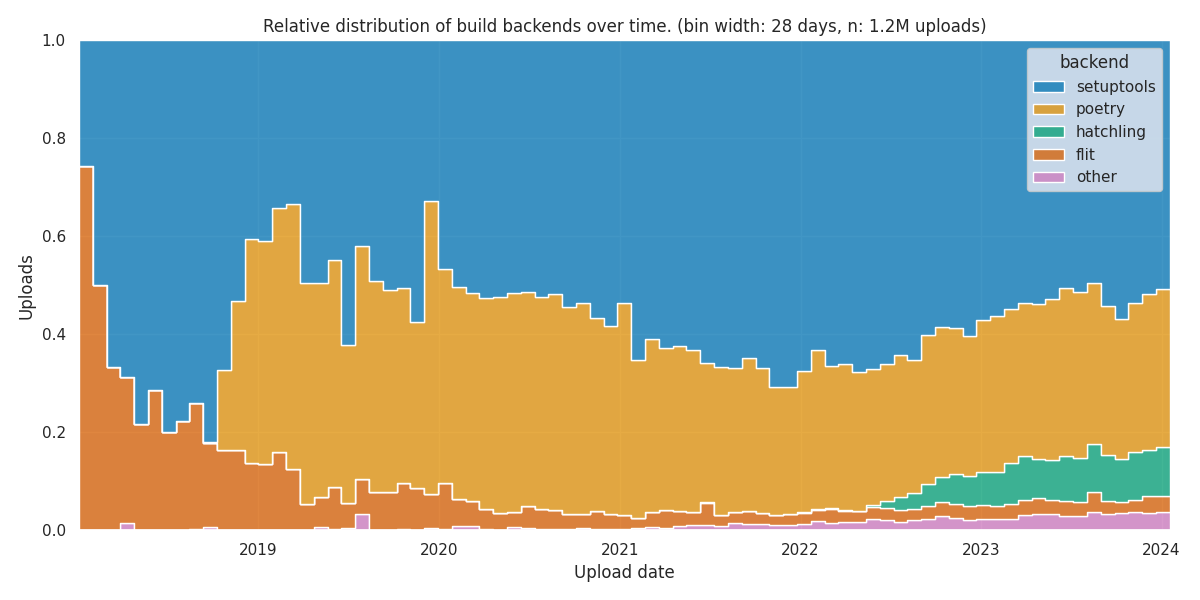
Looking at the right side of the plot, we see the current distribution. It
confirms Fran oise s findings about the current popularity of build
backends:
pyproject.toml files. During that early
period, Flit started as the most popular build backend, but was eventually
displaced by Setuptools and Poetry.
Between 2020 and 2020, the overall usage of pyproject.toml files increased
significantly. By the end of 2022, the share of Setuptools peaked at 70%.
After 2020, other build backends experienced a gradual rise in popularity.
Amongh these, Hatch emerged as a notable contender, steadily gaining
traction and ultimately stabilizing at 10%.
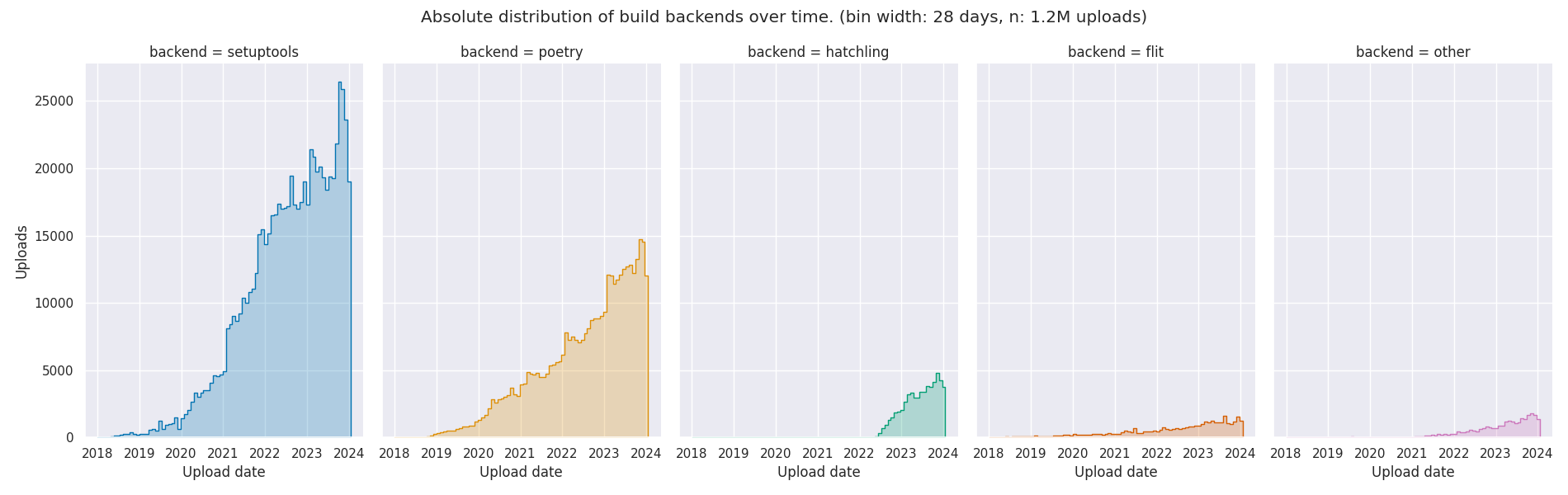
We can also look into the absolute distribution of build backends over time:
The plot shows that Setuptools has the strongest growth trajectory, surpassing
all other build backends. Poetry and Hatch are growing at a comparable rate,
but since Hatch started roughly 4 years after Poetry, it s lagging behind in
popularity. Despite not being among the most widely used backends anymore, Flit
maintains a steady and consistent growth pattern, indicating its enduring
relevance in the Python packaging landscape.
The script for downloading and analyzing the data can be found in my GitHub
repository. It contains the results of the duckb query (so you
don t have to download the full dataset) and the pickled dictionary, mapping
the file hashes to the build backends, saving you days for downloading and
analyzing the pyproject.toml files yourself.
![]() |
| Linux kernel getting a livepatch whilst running a marathon. Generated with AI. |
After more than one a year, a new minor FAI version is available, but
it includes some interesting new features.
Here a the items from the NEWS file:
fai (6.2) unstable; urgency=low
hz.tools will be tagged
#hztools.
cos and sin of the multiplied phase (in the range of 0 to tau), assuming
the transmitter is emitting a carrier wave at a static amplitude and all
clocks are in perfect sync.
let observed_phases: Vec<Complex> = antennas
.iter()
.map( antenna
let distance = (antenna - tx).magnitude();
let distance = distance - (distance as i64 as f64);
((distance / wavelength) * TAU)
)
.map( phase Complex(phase.cos(), phase.sin()))
.collect();
let beamformed_phases: Vec<Complex> = ...;
let magnitude = beamformed_phases
.iter()
.zip(observed_phases.iter())
.map( (beamformed, observed) observed * beamformed)
.reduce( acc, el acc + el)
.unwrap()
.abs();
(x, y, z) point at
(azimuth, elevation, magnitude). The color attached two that point is
based on its distance from (0, 0, 0). I opted to use the
Life Aquatic
table for this one.
After this process is complete, I have a
point cloud of
((x, y, z), (r, g, b)) points. I wrote a small program using
kiss3d to render point cloud using tons of
small spheres, and write out the frames to a set of PNGs, which get compiled
into a GIF.
Now for the fun part, let s take a look at some radiation patterns!
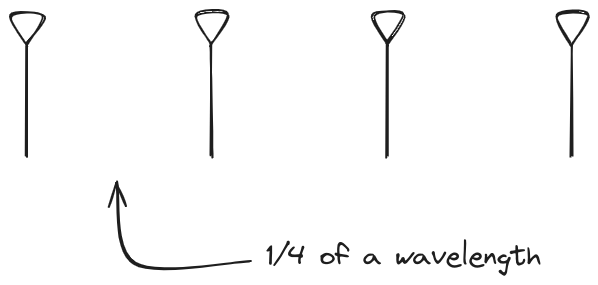
y and z axis, and separated by some
offset in the x axis. This configuration can sweep 180 degrees (not
the full 360), but can t be steared in elevation at all.
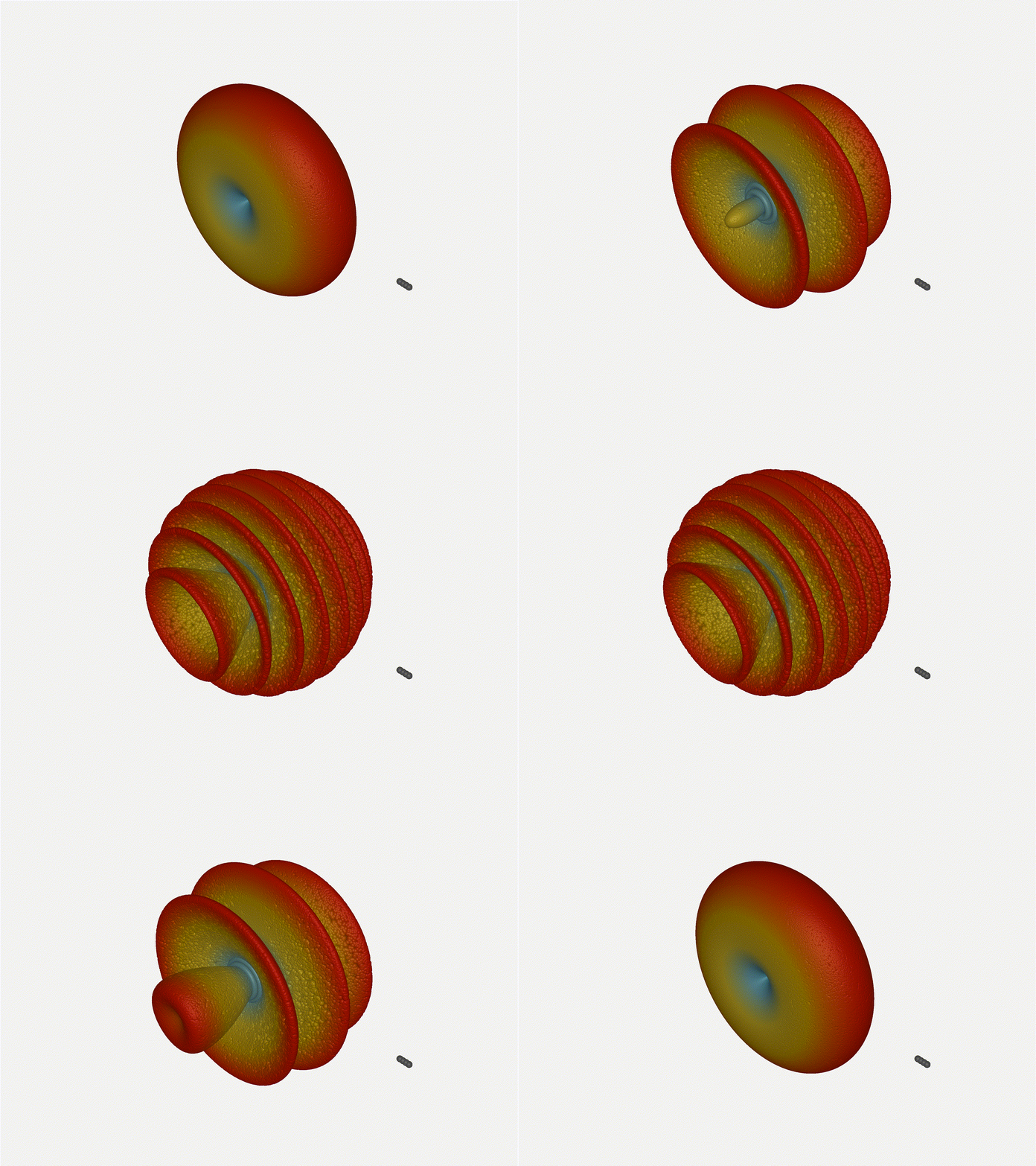
Let s take a look at what this looks like for a well constructed
1x4 phased array:
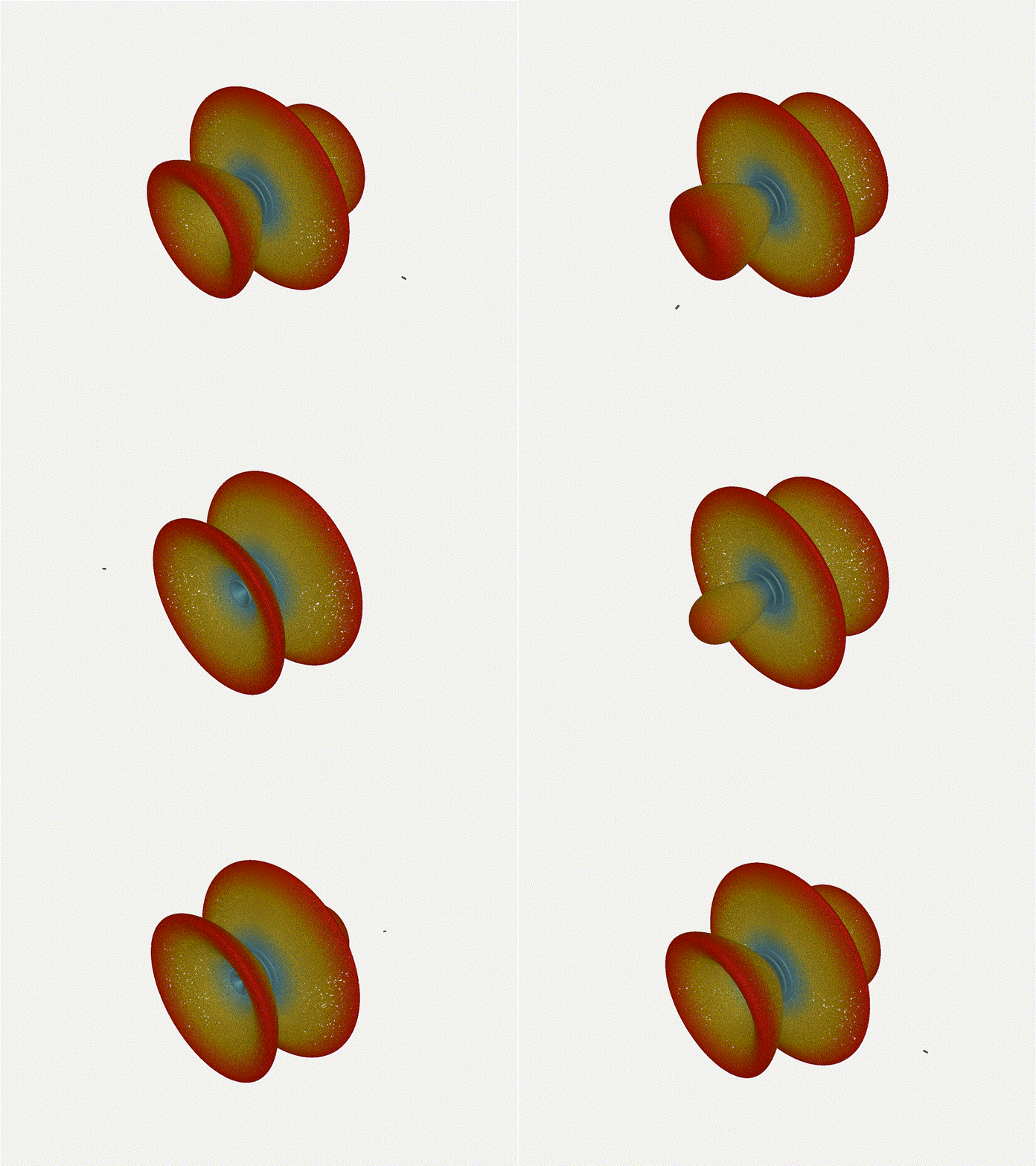
And now let s take a look at the renders as we play with the configuration of
this array and make sure things look right. Our initial quarter-wavelength
spacing is very effective and has some outstanding performance characteristics.
Let s check to see that everything looks right as a first test.
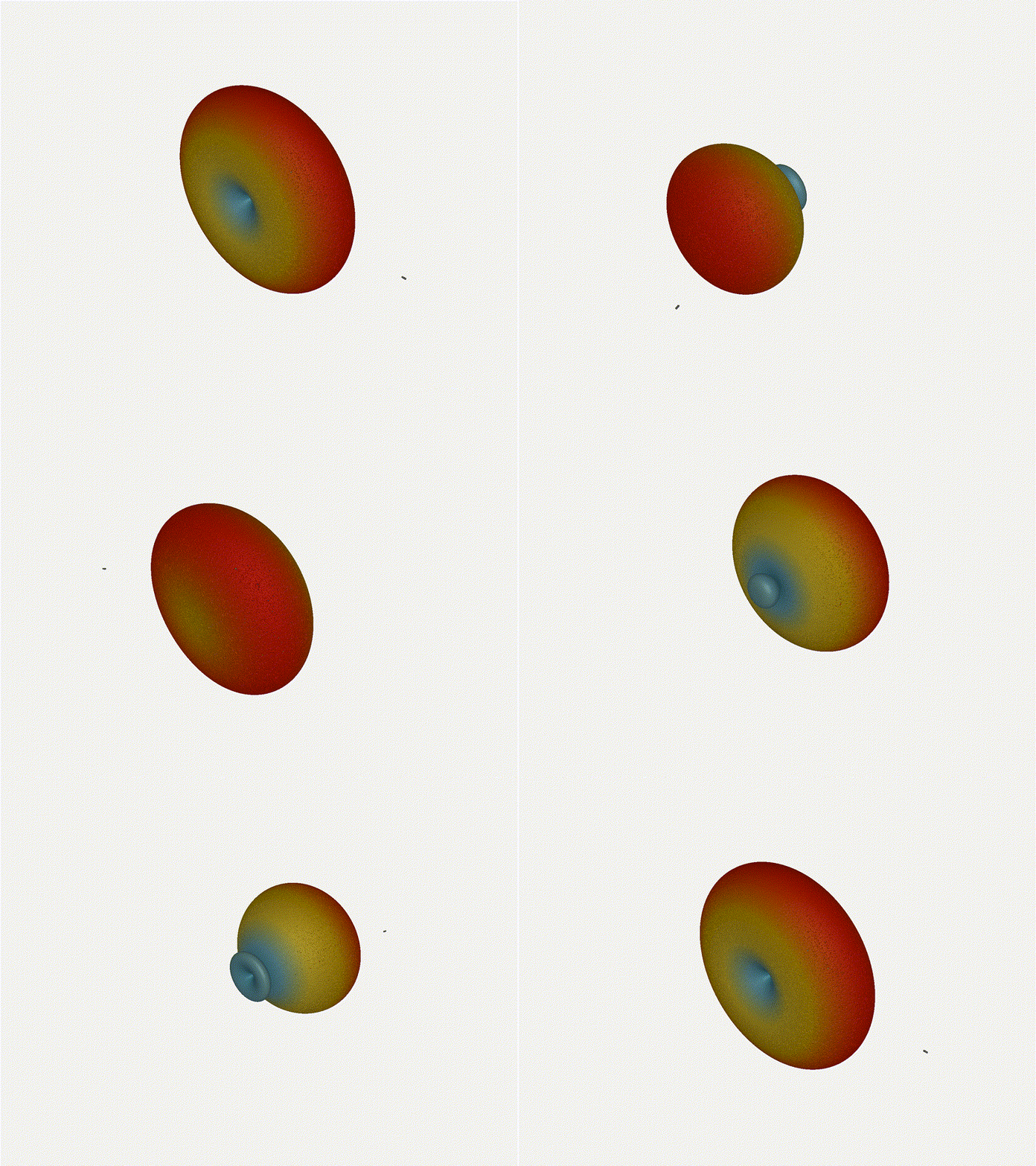
Nice. Looks perfect. When pointing forward at (0, 0), we d expect to see a
torus, which we do. As we sweep between 0 and 360, astute observers will notice
the pattern is mirrored along the axis of the antennas, when the beam is facing
forward to 0 degrees, it ll also receive at 180 degrees just as strong. There s
a small sidelobe that forms when it s configured along the array, but
it also becomes the most directional, and the sidelobes remain fairly small.
The main lobe is a lot more narrow (not a bad thing!), but some significant
sidelobes have formed (not ideal). This can cause a lot of confusion when doing
things that require a lot of directional resolution unless they re compensated
for.
Very cool. As the spacing becomes longer in relation to the operating frequency,
we can see the sidelobes start to form out of the end of the antenna system.
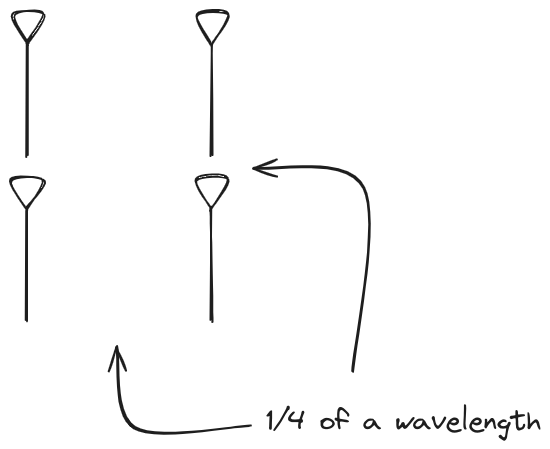
z axis, and separated by a fixed offset
in either the x or y axis by their neighbor, forming a square when
viewed along the x/y axis.
Let s take a look at what this looks like for a well constructed
2x2 phased array:
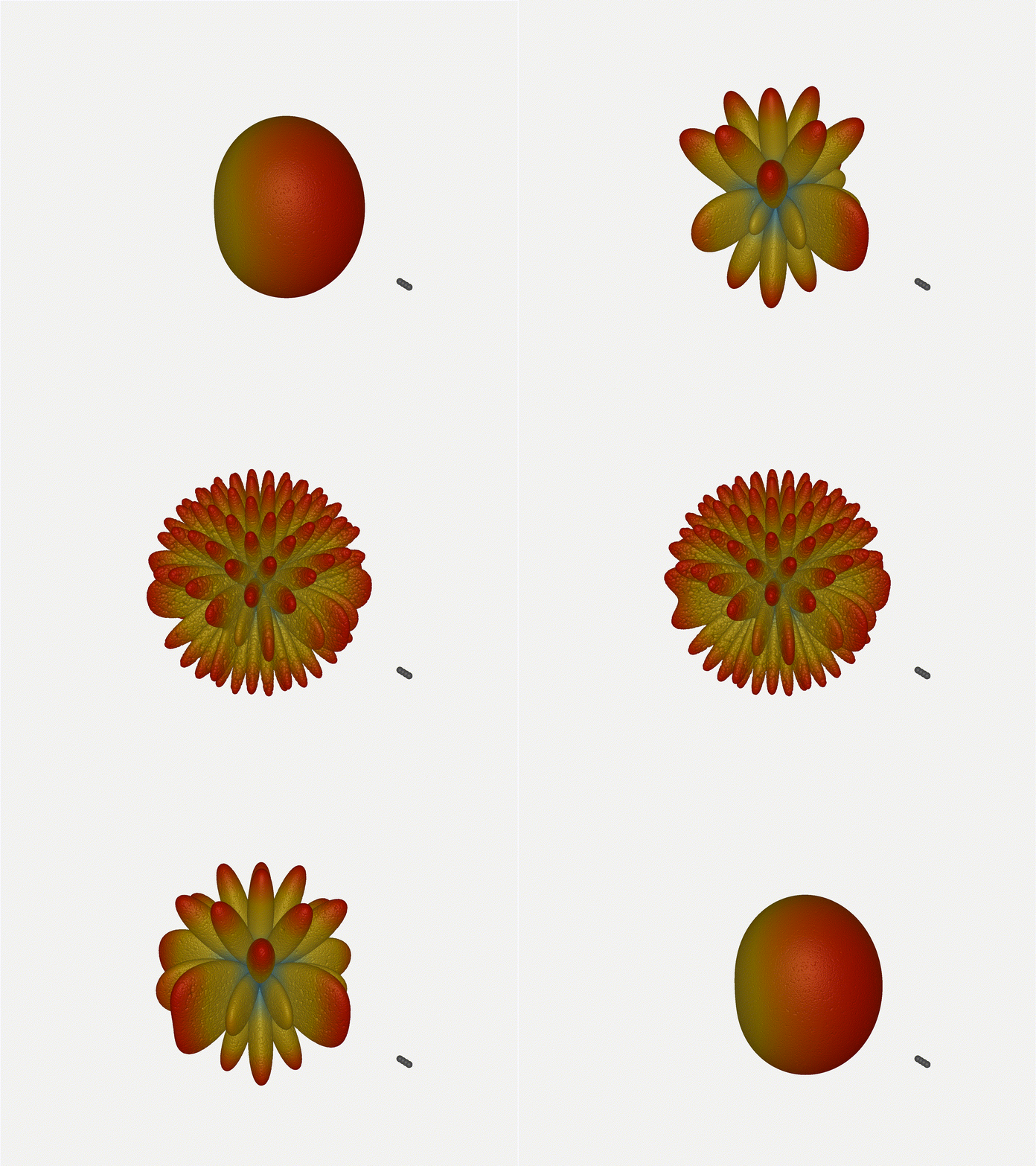
Let s do the same as above and take a look at the renders as we play with the
configuration of this array and see what things look like. This configuration
should suppress the sidelobes and give us good performance, and even give us
some amount of control in elevation while we re at it.

Sweet. Heck yeah. The array is quite directional in the configured direction,
and can even sweep a little bit in elevation, a definite improvement
from the 1x4 above.
Mesmerising. This is my favorate render. The sidelobes are very fun to
watch come in and out of existence. It looks absolutely other-worldly.
Very very cool. The sidelobes wind up turning the very blobby cardioid into
an electromagnetic dog toy. I think we ve proven to ourselves that using
a phased array much outside its designed frequency of operation seems like
a real bad idea.
manifest-version: "0.1"
installations:
- install:
source: foo
dest-dir: usr/bin
"manifest-version": "0.1",
"installations": [
"install":
"source": "foo",
"dest-dir": "usr/bin",
]
So beyond me being unsatisfied with the current situation, it was also clear to me that I needed to come up with a better solution if I wanted externally provided plugins for debputy. To put a bit more perspective on what I expected from the end result:
- Most plugins would probably throw KeyError: X or ValueError style errors for quite a while. Worst case, they would end on my table because the user would have a hard time telling where debputy ends and where the plugins starts. "Best" case, I would teach debputy to say "This poor error message was brought to you by plugin foo. Go complain to them". Either way, it would be a bad user experience.
- This even assumes plugin providers would actually bother writing manifest parsing code. If it is that difficult, then just providing a custom file in debian might tempt plugin providers and that would undermine the idea of having the manifest be the sole input for debputy.
- It had to cover as many parsing errors as possible. An error case this code would handle for you, would be an error where I could ensure it sufficient degree of detail and context for the user.
- It should be type-safe / provide typing support such that IDEs/mypy could help you when you work on the parsed result.
- It had to support "normalization" of the input, such as
# User provides
- install: "foo"
# Which is normalized into:
- install:
source: "foo"
4) It must be simple to tell debputy what input you expected.
# User provides
- install: "foo"
# Which is normalized into:
- install:
source: "foo"
# Example input matching this typed dict.
#
# "source": ["foo"]
# "into": ["pkg"]
#
class InstallExamplesTargetFormat(TypedDict):
# Which source files to install (dest-dir is fixed)
sources: List[str]
# Which package(s) that should have these files installed.
into: NotRequired[List[str]]
# Example input matching this typed dict.
#
# "source": "foo"
# "into": "pkg"
#
#
class InstallExamplesManifestFormat(TypedDict):
# Note that sources here is split into source (str) vs. sources (List[str])
sources: NotRequired[List[str]]
source: NotRequired[str]
# We allow the user to write into: foo in addition to into: [foo]
into: Union[str, List[str]]
FullInstallExamplesManifestFormat = Union[
InstallExamplesManifestFormat,
List[str],
str,
]
def _handler(
normalized_form: InstallExamplesTargetFormat,
) -> InstallRule:
... # Do something with the normalized form and return an InstallRule.
concept_debputy_api.add_install_rule(
keyword="install-examples",
target_form=InstallExamplesTargetFormat,
manifest_form=FullInstallExamplesManifestFormat,
handler=_handler,
)
This prototype did not take a long (I remember it being within a day) and worked surprisingly well though with some poor error messages here and there. Now came the first challenge, adding the manifest format schema plus relevant normalization rules. The very first normalization I did was transforming into: Union[str, List[str]] into into: List[str]. At that time, source was not a separate attribute. Instead, sources was a Union[str, List[str]], so it was the only normalization I needed for all my use-cases at the time. There are two problems when writing a normalization. First is determining what the "source" type is, what the target type is and how they relate. The second is providing a runtime rule for normalizing from the manifest format into the target format. Keeping it simple, the runtime normalizer for Union[str, List[str]] -> List[str] was written as:
- Read TypedDict.__required_attributes__ and TypedDict.__optional_attributes__ to determine which attributes where present and which were required. This was used for reporting errors when the input did not match.
- Read the types of the provided TypedDict, strip the Required / NotRequired markers and use basic isinstance checks based on the resulting type for str and List[str]. Again, used for reporting errors when the input did not match.
def normalize_into_list(x: Union[str, List[str]]) -> List[str]:
return x if isinstance(x, list) else [x]
# Map from
class InstallExamplesManifestFormat(TypedDict):
# Note that sources here is split into source (str) vs. sources (List[str])
sources: NotRequired[List[str]]
source: NotRequired[str]
# We allow the user to write into: foo in addition to into: [foo]
into: Union[str, List[str]]
# ... into
class InstallExamplesTargetFormat(TypedDict):
# Which source files to install (dest-dir is fixed)
sources: List[str]
# Which package(s) that should have these files installed.
into: NotRequired[List[str]]
While working on all of this type introspection for Python, I had noted the Annotated[X, ...] type. It is basically a fake type that enables you to attach metadata into the type system. A very random example:
- How will the parser generator understand that source should be normalized and then mapped into sources?
- Once that is solved, the parser generator has to understand that while source and sources are declared as NotRequired, they are part of a exactly one of rule (since sources in the target form is Required). This mainly came down to extra book keeping and an extra layer of validation once the previous step is solved.
# For all intents and purposes, foo is a string despite all the Annotated stuff.
foo: Annotated[str, "hello world"] = "my string here"
# Map from
#
# "source": "foo" # (or "sources": ["foo"])
# "into": "pkg"
#
class InstallExamplesManifestFormat(TypedDict):
# Note that sources here is split into source (str) vs. sources (List[str])
sources: NotRequired[List[str]]
source: NotRequired[
Annotated[
str,
DebputyParseHint.target_attribute("sources")
]
]
# We allow the user to write into: foo in addition to into: [foo]
into: Union[str, List[str]]
# ... into
#
# "source": ["foo"]
# "into": ["pkg"]
#
class InstallExamplesTargetFormat(TypedDict):
# Which source files to install (dest-dir is fixed)
sources: List[str]
# Which package(s) that should have these files installed.
into: NotRequired[List[str]]
It was not super difficult given the existing infrastructure, but it did take some hours of coding and debugging. Additionally, I added a parse hint to support making the into conditional based on whether it was a single binary package. With this done, you could now write something like:
- Conversion table where the parser generator can tell that BinaryPackage requires an input of str and a callback to map from str to BinaryPackage. (That is probably lie. I think the conversion table came later, but honestly I do remember and I am not digging into the git history for this one)
- At runtime, said callback needed access to the list of known packages, so it could resolve the provided string.
# Map from
class InstallExamplesManifestFormat(TypedDict):
# Note that sources here is split into source (str) vs. sources (List[str])
sources: NotRequired[List[str]]
source: NotRequired[
Annotated[
str,
DebputyParseHint.target_attribute("sources")
]
]
# We allow the user to write into: foo in addition to into: [foo]
into: Union[BinaryPackage, List[BinaryPackage]]
# ... into
class InstallExamplesTargetFormat(TypedDict):
# Which source files to install (dest-dir is fixed)
sources: List[str]
# Which package(s) that should have these files installed.
into: NotRequired[
Annotated[
List[BinaryPackage],
DebputyParseHint.required_when_multi_binary()
]
]
In this way everybody wins. Yes, writing this parser generator code was more enjoyable than writing the ad-hoc manual parsers it replaced. :)
- The parser engine handles most of the error reporting meaning users get most of the errors in a standard format without the plugin provider having to spend any effort on it. There will be some effort in more complex cases. But the common cases are done for you.
- It is easy to provide flexibility to users while avoiding having to write code to normalize the user input into a simplified programmer oriented format.
- The parser handles mapping from basic types into higher forms for you. These days, we have high level types like FileSystemMode (either an octal or a symbolic mode), different kind of file system matches depending on whether globs should be performed, etc. These types includes their own validation and parsing rules that debputy handles for you.
- Introspection and support for providing online reference documentation. Also, debputy checks that the provided attribute documentation covers all the attributes in the manifest form. If you add a new attribute, debputy will remind you if you forget to document it as well. :)
Now that I m freelancing, I need to
actually track my time, which is something I ve had the luxury of not having
to do before. That meant something of a rethink of the way I ve been
keeping track of my to-do list. Up to now that was a combination of things
like the bug lists for the projects I m working on at the moment, whatever
task tracking system Canonical was using at the moment (Jira when I left),
and a giant flat text file in which I recorded logbook-style notes of what
I d done each day plus a few extra notes at the bottom to remind myself of
particularly urgent tasks. I could have started manually adding times to
each logbook entry, but ugh, let s not.
In general, I had the following goals (which were a bit reminiscent of my
address book):
vim-based
versions of Org mode in the past I ve found they haven t really fitted my
brain very well.
Taskwarrior and Timewarrior
One of the other Freexian collaborators mentioned
Taskwarrior and
Timewarrior, so I had a look at those.
The basic idea of Taskwarrior is that you have a task command that tracks
each task as a blob of JSON and provides subcommands to let you add, modify,
and remove tasks with a minimum of friction. task add adds a task, and
you can add metadata like project:Personal (I always make sure every task
has a project, for ease of filtering). Just running task shows you a task
list sorted by Taskwarrior s idea of urgency, with an ID for each task, and
there are various other reports with different filtering and verbosity.
task <id> annotate lets you attach more information to a task. task <id>
done marks it as done. So far so good, so a redacted version of my to-do
list looks like this:
$ task ls
ID A Project Tags Description
17 Freexian Add Incus support to autopkgtest [2]
7 Columbiform Figure out Lloyds online banking [1]
2 Debian Fix troffcvt for groff 1.23.0 [1]
11 Personal Replace living room curtain rail
task all project:Personal and
it d show me both pending and completed tasks in that project, and that all
the data was stored in ~/.task - though I have to say that there are
enough reporting bells and whistles that I haven t needed to poke around
manually. In combination with the regular backups that I do anyway (you do
too, right?), this gave me enough confidence to abandon my previous
text-file logbook approach.
Next was time tracking. Timewarrior integrates with Taskwarrior, albeit in
an only semi-packaged way, and
it was easy enough to set that up. Now I can do:
$ task 25 start
Starting task 00a9516f 'Write blog post about task tracking'.
Started 1 task.
Note: '"Write blog post about task tracking"' is a new tag.
Tracking Columbiform "Write blog post about task tracking"
Started 2024-01-10T11:28:38
Current 38
Total 0:00:00
You have more urgent tasks.
Project 'Columbiform' is 25% complete (3 of 4 tasks remaining).
task active to find the ID, then task
<id> stop. Timewarrior does the tedious stopwatch business for me, and I
can manually enter times if I forget to start/stop a task. Then the really
useful bit: I can do something like timew summary :month <name-of-client>
and it tells me how much to bill that client for this month. Perfect.
I also started using VIT to simplify
the day-to-day flow a little, which means I m normally just using one or two
keystrokes rather than typing longer commands. That isn t really necessary
from my point of view, but it does save some time.
Android integration
I left Android integration for a bit later since it wasn t essential. When
I got round to it, I have to say that it felt a bit clumsy, but it did
eventually work.
The first step was to set up a
taskserver. Most
of the setup procedure was OK, but I wanted to use Let s Encrypt to minimize
the amount of messing around with CAs I had to do. Getting this to work
involved hitting things with sticks a bit, and there s still a local CA
involved for client certificates. What I ended up with was a certbot
setup with the webroot authenticator and a custom deploy hook as follows
(with cert_name replaced by a DNS name in my house domain):
#! /bin/sh
set -eu
cert_name=taskd.example.org
found=false
for domain in $RENEWED_DOMAINS; do
case "$domain" in
$cert_name)
found=:
;;
esac
done
$found exit 0
install -m 644 "/etc/letsencrypt/live/$cert_name/fullchain.pem" \
/var/lib/taskd/pki/fullchain.pem
install -m 640 -g Debian-taskd "/etc/letsencrypt/live/$cert_name/privkey.pem" \
/var/lib/taskd/pki/privkey.pem
systemctl restart taskd.service
/etc/taskd/config (server.crl.pem and
ca.cert.pem were generated using the documented taskserver setup procedure):
server.key=/var/lib/taskd/pki/privkey.pem
server.cert=/var/lib/taskd/pki/fullchain.pem
server.crl=/var/lib/taskd/pki/server.crl.pem
ca.cert=/var/lib/taskd/pki/ca.cert.pem
taskd.ca on my laptop to
/usr/share/ca-certificates/mozilla/ISRG_Root_X1.crt and otherwise follow
the client setup instructions, run task sync init to get things started,
and then task sync every so often to sync changes between my laptop and
the taskserver.
I used TaskWarrior
Mobile
as the client. I have to say I wouldn t want to use that client as my
primary task tracking interface: the setup procedure is clunky even beyond
the necessity of copying a client certificate around, it expects you to give
it a .taskrc rather than having a proper settings interface for that, and
it only seems to let you add a task if you specify a due date for it. It
also lacks Timewarrior integration, so I can only really use it when I don t
care about time tracking, e.g. personal tasks. But that s really all I
need, so it meets my minimum requirements.
Next?
Considering this is literally the first thing I tried, I have to say I m
pretty happy with it. There are a bunch of optional extras I haven t tried
yet, but in general it kind of has the vim nature for me: if I need
something it s very likely to exist or easy enough to build, but the
features I don t use don t get in my way.
I wouldn t recommend any of this to somebody who didn t already spend most
of their time in a terminal - but I do. I m glad people have gone to all
the effort to build this so I didn t have to.
ffmpeg -ss 0:5:59.600 -to 0:6:11.150 -i Downloads/Yes.Prime.Minister.S02E03-1254485068289.mp4 tmp/tragic.gif
ffmpeg -ss 0:5:59.600 -to 0:6:11.150 -i Downloads/Yes.Prime.Minister.S02E03-1254485068289.mp4 \
-vf "subtitles=tmp/sub.srt:force_style='Fontsize=60'" tmp/tragic_with_subtitle.gif
And this sub.srt file:
1
00:00:10,000 --> 00:00:12,000
Tragic.
I believe, one needs to install the libavfilter-extra variant to burn the subtitle in the GIF.
Some
space
to
hide
the
GIFs.
The Premier Minister just learned, that his predecessor, who was about to publish embarassing memories, died of a sudden heart attack:
I can t actually think of a meme with this GIF, that the internal Next.