Search Results: "pini"

15 September 2009

Mike Hommey: Would you like iceweasel 3.0 and 3.5 to be co-installable ?

Hi lazyweb, I m wondering if there a lot of demand for such a feature, being to be able to install 2 (or more) major releases of iceweasel on the same computer. If there is a strong demand, I may consider allowing it. Please reply in the comments on this blog with your feelings, for or against the implementation of this co-installability. Thanks. PS: you may also forward this query to other sites and send people back here to leave their opinion.

12 September 2009

C.J. Adams-Collier: Well, that was an eventful day!

*whew* I did a bunch of things yesterday. We took our kinderg rtner to her first Friday at her new school (and were about 10 minutes tardy. oops). We then took our toddler to a nearby playground with swings and slides and let her expend some energy. After she had been sufficiently exercised, we walked back home, stopping at a coffee shop on the way. The baristo (you call male baristas baristos, right? :) ) recognized my MC Frontalot shirt and asked whether I had caught him the previous weekend at PAX. Unfortunately, I have not attended PAX since 2006, but I *did* purchase the tee directly from The Front himself ;) When we got home, I worked a bit on an English Language parser implementation and then went to the University of Washington to meet with Emily Bender about getting in to the Professional Master s program in Computational Linguistics. It all looks good, and I even got the good news that the GRE is no longer required! After the meeting, I headed home and poked at the parser for a little while longer. I then picked Scarlet up from after-school care and brought her home. I then hopped in the car and drove toward Bellevue to meet up with Monty while he s in town. I over-estimated the amount of time traffic would steal on my way to Bellevue, and had an extra hour to blow. So I dropped by building 41 and shot the IronPython bull with Dino. It turns out he s got an android phone, too. I told him it was possible to put a debian chroot on it and that he should even be able to apt-get install ironpython to his phone soon ;) We talked briefly about the CodePlex Foundation and Sam Ramji s departure from The Evil Empire. Dino seems skeptical about the project. I don t have enough information to have much of an opinion. However, it sounds like some folks I trust are involved, so I m hopeful. I left MS just in time to make it to the wrong address at the specified time. My phone had just enough juice to call Monty to get the right address and then use the navigation system to find my way there. I wasn t able to make reservations at the place we intended to go for dinner until 8:15, so we went to the Barnes & Noble for a bit. They only had one NLP book in stock and the examples are all in Python. I should learn that language one of these days As we were leaving the Pacific Place, Monty mentioned to me that he is on the advisory board for the CodePlex Foundation, and that they have been responsive enough to his input that they changed the Mission statement, at his recommendation, just one day before the Foundation was publicized. He feels that this is a very good direction for Microsoft to be heading. My brother Chris was kind enough to watch the kids while we went out to dinner. Quick note: he recently graduated from UW with a BA in Electrical Engineering and is looking for work using his acquired knowledge, in case anyone needs one of those ;) We met up with my wife, Hannah and our friends, Mike & Cynthia at our place. Monty graciously avoided mentioning the terrible state in which our apartment has recently found itself. The kids were super cute and polite and said hi/bye. Over dinner we discussed building an android app (Monty has one, too ;) ) to automate the process of creating bounties for apps and getting folks to implement them. We also talked about MySQL and MariaDB, of course. Hannah and I recalled my time working for MySQL, Inc. on the MaxDB project and some subtle cultural differences we noticed while traveling. It was interesting getting the inside scoop about the Sun acquisition and some of the recent goings-on in the MySQL/Sun/Oracle world. I wasn t aware, for instance, that the EU is balking on the merger because of monopoly concerns.
<script>//<script language="javascript" src="http://reddit.com/button.js?t=1"></script>

10 September 2009

Pablo Lorenzzoni: Code testing coverage

I like building tests for my code. That is not an old habit, it s just something I ve been developing in the recent months or some few years. No, I am not doing TDD (although that doesn t sound like a bad idea): I just build tests after I code as a safeguard to be sure I haven t broken anything. I suspect there are more programmers like myself than those using tests as part of a TDD (BDD, SDD, etc) approach, but that is just an opinion. Well I just recently became found of code coverage estimates and tools, and rcov is such a nice tool that sometimes I just find myself building tests just to please it. I also suspect there are at least a bunch of people that do the same. Here are the results of the test coverage of one of my projects:

spectra@rohan:~/work/xmpp4r-observable$ rake rcov
(in /home/spectra/work/xmpp4r-observable)
rm -r coverage
Loaded suite /usr/bin/rcov
Started
........................
Finished in 70.995814 seconds.
24 tests, 97 assertions, 0 failures, 0 errors
+----------------------------------------------------+-------+-------+--------+
                   File                                Lines    LOC     COV    
+----------------------------------------------------+-------+-------+--------+
 lib/xmpp4r-observable.rb                                648     414    61.4%  
 lib/thread_store.rb                                      58      39    87.2%  
 lib/observable_thing.rb                                 187     118    91.5%  
+----------------------------------------------------+-------+-------+--------+
 Total                                                   893     571    69.4%  
+----------------------------------------------------+-------+-------+--------+
69.4%   3 file(s)   893 Lines   571 LOC
spectra@rohan:~/work/xmpp4r-observable$
Sure it s tempting to get more of lib/xmpp4r-observable.rb covered, isn t it?

30 August 2009

Tiago Bortoletto Vaz: Vibration Reduction matters


I ve just bought the cheap Nikkor 18-55mm VR lens for my Nikon D50. According to KenRockwell.com, this lens does the job very well. Actually I was looking for the amazing 18-200mm VR, but noted it s too expensive for me. At least here in Brazil it costs 5x more than that 18-55mm. The question is: once I already own a basic Nikkor 18-55mm which came with the camera, is that worth upgrading to another 18-55mm only because of this Vibration Reduction feature? Well I was not sure really about that. I just trusted Ken Rockwell s opinion and decided to give it a try. So, checking the result below you may guess whether I m happy or not :) These pictures were taken in f11, 55mm, 1/4 sec, no post-edition. I did my best to get them as much sharpness as possible. For a 100 shots sampling from Ken Rockwell look for the Vibration Reduction at 55mm table here.
Nikkor 18-55mm non-VR

Nikkor 18-55mm non-VR

Nikkor 18-55mm VR

Nikkor 18-55mm VR

Nikkor 18-55mm non-VR detail

Nikkor 18-55mm non-VR detail

Nikkor 18-55mm VR detail

Nikkor 18-55mm VR detail

Posted in english

Aigars Mahinovs: Debconf9 photos and banter

A bit more than a week after Debconf9 ended here is a post summarising what I remember about it for myself to look back to later, for others that were there for a good memory, for those that were not there for insight and for organisers of future Debconfs to improve. Let s start with something most people know I took photos, a lot of photos. The main photo naturally was the Debconf9 group photo (also http://tr.im/dc9group and an annotated version). Please look for people that are missing their IRC nicknames. I have uploaded the best of my photos on Flickr and all good photos in full resolution on the Gallery site. All of these photos are licensed CC-BY 2.0 or 3.0 or GPL v2 or v3 (your choice). Now about the organisation. The place reasonably easy to get to but not particularly fast or cheap from airport to the venue it took 1 hour in metro, 3 hours in a bus or train and a half an hour walk (or 5 minutes in a taxi) for the sum of 22 and 4.5 hours or 27 and 4 hours one way. While we all accept the time waisted in airports, getting from the airport to the venue should be easier and cheaper than this. While it was crazy hot outside (38-40 C) there was great air conditioning everywhere, so we did not feel the heat most of the time (except if you walked from bus/train to the venue or did the climb during the day trip). Having air conditioning in the room was a godsend I do not think I would be able to sleep otherwise. Also free water from a drinking fountain where you could also refill your water bottle was a great touch. The rooms were great two beds, air conditioning, bathroom, shower, desks and closets where one could unpack their things. And we did not have to move to other rooms in the middle, it allowed us to unpack and feel comfortable instead of living out of the suitcase the whole time. I m not sure if it will be possible for future Debconfs to get rooms with only two beds, but I think that even with 4 people per room would have been fine, provided that there are enough bathrooms/showers, enough space to unpack everyone s clothes, enough sockets to charge some stuff overnight and enough WiFi coverage in rooms to get some late emails without going to the hacklab. Which brings me to Internet and hacklabs. I must say that Internet was great this year it was fast enough not be a major problem, it was almost everywhere (a bit more signal in the sleeping rooms would be better), it was up and running from day one of the Debcamp and it was stable through (I think there was one or two interruptions). It would be nice to see people write a blog entry about how exactly it was done. As far as I know it was very helpful to have several kilometres of CAT5 cable, several large switches and a huge amount of identical WiFi routers all flashed with OpenWRT (and then some more smaller routers also flashed with OpenWRT to plug some holes). I heard there were two Internet connections joined together and a complex firewall/transparent proxy/traffic shaper and also a local Debian mirror that was DNS-redirecting people to it from all the regular Debian mirrors people use at home. The hacklabs were also nice when the Debcamp started the second hacklab was lacking most tables and chairs, but when those arrived there was plenty of space. Other common issues such as access to a free switch port for people without wireless and access to power sockets were also handled well and fast. It was very nice that organisers always had a few spare power strips or a spare patch cable at hand. This year there was a siesta break in the proceedings. While it was in line with local traditions (take a several hour break during the hottest hours), it did not do much for the secondary stated reason to get out and see the surrounding, because half of the attraction of getting out (shops and bars) were all closed during the same siesta time. IMHO we should have used the great aircon of the venue and continued the talks from mid day to 18:00 (when the siesta ends) and then make a break until dinner so that we could go out and enjoy shops and bars and historic places during a cooler time of day. If there is a break in proceedings, then it should be at the time when people are most likely to enjoy the surroundings. I doun t know the schedules in NY, but if the museums close at 18:00, then there should be a break during the day to allow people to get to those museums. Food was there and it was there every day, but it was not particularly great. Aside from typical problems with vegetarians and vegans (even salads had pieces of meat in them), I did not find the food to be compelling most of the time. I do not like fish and there was a lot of fish. Mostly it was good fish and sometimes it was so well done that even I enjoyed eating it, but other times it was full of fish bones and/or tasteless. Too often the dinner consisted of a salad, a deep-fried piece of meat and spoonful of dry fries. It would not kill them to put more fries on the plate and have some kind of sauce for them. One thing that was great in food were the fruit deserts apples, oranges, peaches and nectarines were fresh and juicy and then there were melons! I typically hate melons because the ones I can get in shops in Latvia are dry and bitter, but the melons here were bursting with sweet juice heavenly stuff. In the future it would be nice if the food selection and amounts per portion could be checked and agreed upon with the caterer in advance. Also the timing should be adjusted it is too early to end breakfast at 10:00, especially with dinner starting at 21:30 there is way too little time to socialize with other people after dinner and then to get a decent sleep. Talks can start at 10:00, but breakfast should go up to 11! I did like the water bottles and wine jugs on the tables and the beer being served as part of the food that was a nice touch that many people enjoyed. The daytrip was a nice distraction in the middle of the conference a trip to a swimming pool made from a river bed blocked by a damn with an optional hike up a mountain to a spectacular cascade of natural water pools and slides that a river has carved in the solid rock or the mountain valley. Most people did the hike it was steep and hot and rocky, but the payout (the water fun) was there at the end, and it was great! Wonderful warm water and unexpectedly deep pools that both locals and us jumped into from rocks of differing heights. I am more of a climber than a jumper so instead of jumping off a cliff, I spidermanned up the cliff up from the water. I did not have any safety, but if I did fall I would have fallen into the water, so felt almost safe :) After the hike, the jumps and a hike back downhill we went into the buses and joined up with the people relaxing in the pool or in the bar right next to it. And after an hour or two later the day trip was over. While this was fun I would have preferred if after the hike we would have gone to some castle or other tourist attraction for more of a trip experience than sitting by a pool chatting. Formal dinner was another traditional thing that we did this year. We walked over to a restaurant overlooking the city, sat down at many different tables occupying most of the place and then the waiters brought us plates with bits of food. Each plate was basically a set of 4 snacks for 4 people a plate of cheese, a plate of ham cuts, a plate of steamed vegetables and a plate of grilled meat. After that was coffee and desert. In my opinion the grilled meat was overcooked, the vegetables were passable, 1 of 5 cheeses was great (the local soft speciality) while other were ok and the ham cuts were ok. Desert was average. In all I was neither impressed by the food nor filled by it. There was also entertainment a singer with two dancers. They ware way too loud, so loud in fact that police came and shut the performance down, I did get a few interesting photos but otherwise I did not like them. They came to our venue the next night to continue the performance, luckily it was in an isolated patio and did not disturb people sleeping. Wine and cheese party on the other hand was simply great this year there was a huge selection of wine and cheese as we were in the right part of the world for that. There were 7 tables full of cheese, wine and bread and also some extra stuff such as a barrel of peanuts and some great tea from Taiwan. People were walking around for hours eating cheese, cleaning the taste off with bread and wine, chatting and doing it all over again at another table. I left the patio at around 2am and there were still several dozen people around chatting, eating, drinking wine and tea. I m not sure how to get an event of similar size in NY as it is not allowed for travellers to bring cheese into US, only commercial import with an appropriate licence is allowed. I also have my praise for the video team, but I ll hold on to that and the feedback about the talks until I see the recordings of talks that I missed, so I can also recommend the must see recordings. All in all it was a great event meeting all the great Debian people again, coding some stuff, having fun and talking about the future of Debian in a more relaxed atmosphere than an IRC chat room. Debconf 9 was great, see you all next year at Debconf 10 in New York!

7 June 2009

Martin-&#201;ric Racine: When can we have a balanced and meaningful debate on immigration?

This question keeps on popping up in many recent newspaper articles, on discussion boards and in seminars debating immigration issues in Finland. At the core of the question is a general impression that, between the enthusiastic supporters of multiculturalism and the pessimistic nationalist rednecks, very little constructive discussion is possible in Finland. At one end, humanitarian help organizations, as well as politicians from the Green Party and the Swedish Folk Party, keep on taking excessively generous initiatives towards refugees and asylum seekers, all while labeling their detractors as racists. At the other end, nationalist candidates in the National Coalition Party and True Finns Party keep on painting every immigrant as a refugee who is abusing social security and label their detractors as turning Finland into the easiest country to abuse social security, at the Finnish taxpayer's expense. In between, candidates from the Christian Democrats and Center Party spread equally among these two camps. Meanwhile, while the Left is currently avoiding discussions on this topic, Social Democrats have previously shown that they tend to side with the nationalists in labeling all immigrants as social security abusing refugees. One interesting point is that, no matter at which end of the political spectrum one looks, the whole Finnish immigration debate keeps on focusing exclusively on refugees and asylum seekers, despite the fact that migrant workers and foreign spouses of Finnish nationals make up for a good 70% of the foreign population residing on Finnish soil. This recalcitrance to discuss immigration from any other perspective than refugees is rather painfully noticeable. Some recent examples: What's remarkable about all these examples is how public opinion is so persistently hardwired into thinking that all foreigners living in Finland came here as refugees from 3rd-world countries whose culture is radically different from Finland's and that they all became perpetually unemployed, forever living off social security, to the point that even politicians who ought to know better go along with it. When will we be able to have a balanced and meaningful debate on immigration, you ask? The day both multicultural hippies and nationalist rednecks will have been kicked off the podium. Of course, it would also help if the refugees themselves stopped monopolizing the podium, whenever the opinion of immigrants is solicited. Then again, perhaps these 3 groups benefit so much from the current status quo that they'd rather not see the day when others can participate in this debate on equal footing with them, so that a balanced and meaningful debate can finally take place?

6 June 2009

Russell Coker: Actually You Do Care

A reasonably common feature in Internet debates is that of one party claiming to not care about the issue. Statements such as I haven t got time to debate this or I m not interested are used to try and disclaim any interest in the topic. Such claims are silly and rather amusing. Outside the Internet it does make sense to say I don t care because interactions are between small numbers of people. Telling a tele-marketer that you don t care about their product is part of the process of getting them to stop calling you. But it doesn t make sense in interactions between large numbers of people. If there are 100 people on a mailing list then there will be a variety of opinions about any issue, but one thing you can count on is that the majority of people on the list are not interested in whether any individual cares about an issue. If there was a general desire to discover how many people cared about a topic of discussion then the way to determine this would be via an online poll. In almost every situation individuals saying I don t care in email just isn t a scalable solution. The only exception is when someone in a leadership position is asked for an opinion, in such a case a response is expected and if the leader actually doesn t care then saying so and letting other methods be used to resolve the dispute makes sense. One common case where an I don t care message is seen is at the end of a long and heated discussion. After a discussion has gone on for a while (well beyond the point where it was obvious that no-one was going to change their position) one party might claim to not care or not have the time to debate the issue. But of course if they didn t care at all or had no time then they wouldn t have written any messages on the topic. If they had a limit to their time or care factor then they would probably have stated their opinion once and maybe written a single follow-up post clarifying the first one. Anyone who has written 6+ messages or a total of 1000+ words on a topic obviously cares and obviously has time. In such cases it seems that claiming to not care or not have time is a final desperate attempt at getting the last post on a topic by someone who subscribes to the last post wins school of online debating. Another common case is when someone makes a point that is decisively refuted. The Internet is filled with people who can t handle criticism and who can never leave any critical email without a reply. In such a situation claiming to not care is a way that such a person can protect their fragile ego even if the point is indefensible. One of the variations on this theme is to claim to be an expert who doesn t care enough to educate people on mailing lists (or even provide a couple of URLs that reference what they need to know). As a hint, if you are going to claim to be an expert while making statements that disagree with notable experts in the field in question (professors at prestigious universities, Nobel laureates, or people who have demonstrated great practical success) then you really need to demonstrate your expertise and cite references. While generally it s the scope of the Internet that makes the I don t care argument silly, it also doesn t make sense in interactions via electronic media such as private email where a sender can be ignored. If you don t care about a private email in reply to one of your messages then what you will do is simply delete it. Replying and saying I don t care merely demonstrates that you do care, invites another reply, and shows that you have a fragile ego to protect. My general practice when dealing with such people is to send one reply to every message that they send me, such people typically demonstrate how much they care by sending me more than a dozen messages explaining in detail how much they don t care. Another variation on the theme of private correspondence is people who write blog comments that are obviously inappropriate and will not pass moderation. Someone who polls my blog to see if their comment has been approved and then writes an abusive comment when they discover that they fell well short of my comment quality standards obviously cares about having their comment published. To then claim to not care about whether their comment was approved is obviously a lie. Google is almost entirely filled with things that I don t care about. I demonstrate the fact that I don t care about them by not commenting.

29 May 2009

Russell Coker: Links May 2009

An interesting opinion post in the NY Times describes the research on early education and how it can affect IQ [1]. Among other things children from poor families who are adopted into upper middle-class families tend to end up with higher IQ scores. The article notes that half the population in 1917 would be regarded as mentally retarded by today s standards - finally we have an explanation for WW1! Two Dominos employees tarnish the brand s image with a prank video on Youtube [2]. The next obvious step is for activists to seek jobs at such companies for the purpose of influencing companies. The animal rights protesters outside KFC stores haven t achieved much, but if they worked for KFC and made some nasty videos they would really encourage a change of action. I predict that chain stores will be spending a lot more on security and background checks for their employees in the near future. Cory Doctorow has written an amusing article titled Big Entertainment Wants to Party Like It s 1996 about how the entertainment industry is killing itself by conducting back-room negotiations about new copyright laws [3]. Nate Silver gave a TED talk about racism in elections [4]. The most interesting point was demonstrating statistically that people who don t meet people of other races tend to be more racist. It seems to me that the use of the X-Face: header in email and the use of HackerGotchi in Planets can help reduce the level of racism on the Internet. Cory Doctorow writes about his Geeky writing [5]. His idea for an organised system for donating books to libraries will hopefully be fully implemented soon - it should be easy to do and the incremental costs will decrease as the scope increases. Cory Doctorow writes about the perverse laws that protect criticism of copyright works but stifle praise [6]. In a similar note he has documented a plan for trademark and copyright holders to allow fans to create derivitive works while preserving the original rights AND sharing the profits [7]. So if Cory s idea became popular someone who wanted to create some art work based on a Coke bottle (which is trademarked) could pay the Coca-Cola company a reasonable rate, include an appropriate disclaimer, and things would work out well for everyone. Also this would allow small artists to develop new products that could be used by the large companies (I m sure that anyone who legally released an artwork that turned out to be an effective advert for Coke would receive a lucrative job offer). Bruce Schneier s blog has an interesting article about the poor quality of software used for breath alcohol detectors [8]. It s a great concern that innocent people are being punished due to bad software, but it s only a small part of the problems with the legal system. Mary Roach gave a TED talk 10 Things You Didn t Know About Orgasm [9]. Not as insightful as the usual TED talk, but strange and interesting.

28 May 2009

Sandro Tosi: Update on the Matplotlib book

Some people asked me how's the book writing is going. Ah you're right, it's a loooong time I didn't say anything of the progress, and here it is.

I've just turned the half of the book: about 10 days ago I've sent the 5th chapter (out of 10) and up to now I've covered this (high-level) contents by chapter:

  1. installation & setup
  2. first contact with mpl
  3. some more stuff (like graph types)
  4. OO style and some advanced things
  5. GTK embedding
6th (and current) chapter is about Qt, so even KDE guys will be happy :)

I found several problems when working with GUI design programs: both Glade and Qt Designer made me scream a lot; but probably it's just me that I'm not so used to GUIs :)

Other arguments will be: Wx, web, real use cases.

In particular for the last part (real cases) I'd like to hear some proposals from you. I've already got something in mind, but users opinion will help me direct my work better.

Sorry, I've got to "drop/reduce" the science chapter (it was superseded by the real use-cases one) since I don't think this is the right place for it. Of course, a couple of "science examples" might come into the mentioned chapter, but your proposals have to be at a low-medium level.

27 May 2009

Biella Coleman: Liberated and..

With more vacation time, longer (paid) maternity leave, and decent and affordable child care, I am sure this scenario would be different.

Biella Coleman: Liberated and..

With more vacation time, longer (paid) maternity leave, and decent and affordable child care, I am sure this scenario would be different.

20 May 2009

Martin F. Krafft: Five days to free Aung San Suu Kyi

In Myanmar, Aung San Suu Kyi and 2 000 monks and activists are being detained, as the miltary junta in the country presses new, ridiculous charges against Suu Kyi a few days before the end of her house arrest. Suu Kyi, recipient of the Nobel Peace Prize and proponent of democracy, is leader of the opposition and the greatest threat to the junta s grasp on power. Given the inhumane conditions imposed upon the Burmese, and the ruthless slaughter of those who do not play by the military s rules, it is not hard to imagine that she would win any fair election, as soon as she would get a chance to run. However, if the junta are successful in pushing charges Suu Kyi is accused of breaching the house arrest after an American man sneaked into her house uninvitedly she could be locked up until after the elections in 2010, effectively disarming the threat she poses to the military regime. She is threatened to be kept in the notorious Insein Prison without medical care. As she is suffering from serious illness, this puts her life at risk. I do not usually campaign for political topics, but I ve been to Myanmar and this issue touches me deeply. The people in Myanmar need our support. Even though the 2007 Burmese anti-government protests seriously weakened the military and brought hope to the lives of millions that have been oppressed for years, the events quickly vanished from the media and allowed the junta to regain control. We must not let that happen again. It is of utmost importance to show our support and not look away. One way of doing so is by increasing visibility. If you care, please write to your newspapers, publish on your blog, and do everything else you can to raise awareness. Another way to help the Burmese people is through signing the avaaz.org petition to UN Secretary General Ban Ki-moon. Best to do all of the above! Unfortunately, avaaz.org force-subscribes everyone who signs a petition to their newsletter, which may well not be what you want. However, please do not let it stop you from signing the petition. You can later unsubscribe from the (infrequent) newsletter. I have informed the staff members of this concern. If you would like to voice your opinion too, write to info t avaaz dot org and encourage them to make the newsletter subscription optional. But make sure to also sign the petition, please.

17 May 2009

Gunnar Wolf: Politicians time once again

It is time for stupid, empty politicians slogans once again in my dear country. And, as always, while we had lively, controversial presidential elections three years ago (and I won't rant this time on why so many Mexicans still believe the current president can only be called a de facto president), the mid-term elections... Fail to get any attention and cause only bored reactions. I am writing today mostly because I stumbled upon Francisco's post on why the Mexican Ecologist Green Party (PVEM) campaign does not impress him. As many, many other people with strong political opinions I know, I will go to the voting booth next July 5th, as I have done every time since I was of age - But I will most probably void my ballot, as I have found nobody worth my vote. And even if I am (and have always been) a leftist person, none of the four so-called leftist parties inspire the smallest bit of confidence. But hell, even the rightist or centrist parties fail to inspire confidence to their voters - After the 2006 electoral fiasco, we got a political system nobody believes in. And all analysts seem to concur that we moved from the most complete presidential regime to an utter partidocracy, where all of the (strong enough) parties cover each other's back not to lose the respective privileges (largely, money, but also law-making faculties and influence, which of course translates to impunity). Worth a very special mention is the crown jewel of political clowns in Mexico - PVEM, the Mexican Ecologist Green Party. A party that gets the gold medal for the most corrupt in our country (which is no small feat). A party where the National Party Presidents to date have only been father and son. And it is alarming because it is the only party apparently gathering more voters than they had before. But also, because of its utter pragmatism and lack of respect for anything they might once have stood for. I still remember on the 1994 elections, the first time they participated in general elections, their slogan was don't vote for a politician Vote for an ecologist... Little did the society know by then they were worse off than our oft-hated politicians. Can you imagine a so-called ecologist party that is expelled of the Global Greens as its behaviour is completely antithetical to anything a green party stands for? A party that promotes reinstating the death penalty (which was abolished from our Constitution, after decades of not being applied, less than a decade ago)? Or they say that, if a given medicine is not available at the Social Security hospitals, the government should pay the citizen so he can go and buy it at a drug store? (of course, if a needed medicine is not available at the Social Security it is most probably because the government is underfunded, not because the lazy administrators don't want to buy the medicines. And yes, with those two retrograde, stupid and -thankfully- completely unfeasible promises they have doubled their probable voters outcome in the past couple of months. The campaigns are only officially starting now. They are all really pathetic. A voter turnout of ~30% is expected. But yes, I am a politized person and just cannot help inviting everybody who has the right to go and vote. If there is somebody worth voting for in your district, please vote for him/her. However... Together with many people I admire, together with many of my friends, together with the people who still believe it is possible to make something out of this forsaken country's politic system... I invite you to void your ballots. Hopefully they will be enough so they must be heard this time.

14 May 2009

Julian Andres Klode: PHP, MySQL, PostgreSQL, etc.


Well, I m currently writing a PHP and SQL application at school, so here are some of my thoughts on the problems I encounter. PHP is crap Many PHP applications are low quality applications. The problem is that PHP makes it hard for developers to write good applications. PHP developers tend to use many global variables, global code, and not many classes or functions. And when writing applications for the web, PHP makes it easy to mix PHP and HTML, in my opinion even too easy. Well-written applications follow some basic rules. First, separate your code into functions and classes, and (2) split your code over multiple files. And there is one rule which is especially important for non-commandline applications: (3) seperate logic and presentation. This means if you write a web application, use a template engine. PHP error and exception handling is also an interesting topic. The problem here lies in the distinction between the both. In my opinion, there should only be one way to handle such stuff: Using exceptions. Exceptions are a very widespread way to program today, and are used in languages like Java and Python for cases where PHP uses errors. The concept of PHP s errors results in code like @do_something or die("blah"); being written in libraries which is a problem as it clearly violates rule (3) I wrote above, because there is no way to catch this die() error. Furthemore, PHP has no clear concept of namespaces in the current stable versions (< 5.3). PHP 5.3 finally gets namespaces, but using a backslash character, which looks really bad and makes everyone think of eithers Windows systems or escape characters. There are even more problems with PHP. From time to time, PHP just crashes with a segmentation fault. MySQL vs. PostgreSQL MySQL seems to have many problems with checking data, which can confuse me. It got better in MySQL 5 with the introduction of the new sql_modes like STRICT_ALL_TABLES and TRADITIONAL. And using storage engines like InnoDB also allows you to take advantage of stuff like foreign keys and transactions. But MySQL is still problematic. For example, in an application I wrote I had multiple entries identified by a numeric id (an INTEGER). One day, I wanted to check whether my error handling was OK and requested an entry with the invalid ID 1X , which resulted in SELECT * from A where id='1X';. Now I expected to get an error or at least no result, but MySQL happily proceeded with the query and returned the entry with the ID 1. I tried the same thing on PostgreSQL and got an error message that 1X is not integer, as I expected it. As another example, when I run the same PHP application using PDO on a MySQL database and a PostgreSQL database, I always get strings from the MySQL database whereas I get integers from PostgreSQL if the columns are integers. Another thing which PostgreSQL does better than MySQL is password encryption. MySQL only provides access to the standard crypt() function and by default only generates DES passwords. It allows other methods to be used (although not all are available everywhere and therefore not documented), but it provides no way to create a salt for them, which makes them not very useful. PostgreSQL in contrast provides less encryption methods but it provides the gen_salt() function which can be used to generate salts for blowfish encryption (gen_salt('bf')). Another problem is that MySQL simply ignores references when they are added to the column definition instead of a separate FOREIGN KEY . Because MySQL gives no errors when a feature like REFERENCES is not supported, developers may think that the feature is supported and write code using this feature just to realize later that what they wrote does not what they want. And you can t write AGPL applications using MySQL client libraries, because MySQL is GPL-2 which is incompatible with the AGPL. You might think that the FOSS License Exception helps here, but this only lists (among others) the GPL-3. Or am I wrong? But PostgreSQL has other problems, at least when it comes to the performance of the information_schema.columns view. This may be related to the fact that PostgreSQL has > 1000 rows whereas MySQL only has 250. And PostgreSQL may be a bit harder to configure. Final words All in all, PHP and MySQL are not the best choices for writing applications. They are to tolerant, and do not treat errors in an acceptable way by aborting the current action. I can get around some problems in PHP by using error handlers which raise exceptions and setting error_reporting to E_ALL, but in fact this should be the default. MySQL problems can be solved to a large extend by setting sql_mode to TRADTIONAL and using InnoDB databases, which should in my opinion be the default and not an option. My recommendation is to use PostgreSQL servers and for the applications: use frameworks (if you are allowed to, which may not be always the case [e.g. when you are learning SQL, using a ORM is clearly the wrong way]), document your code, separate your code into classes and functions, and make sure you are not using to many global variables. And use a SCM to track your changes. Posted in General

10 May 2009

Ond&#345;ej &#268;ert&iacute;k: My experience with running an opensource project

Nir Aides, the author of the excellent winpdb debugger, sent me the following email on September 21, 2008, so I asked him if I can copy his email and reply in form of a blog post (so that other people can comment and join the discussion) and he agreed. It took me almost a year to reply, but I made it. :)

Hi Ondrej,

How are you?

I am about to publish a new free software project, a new simple PHP framework, and I am interested in your advice.

You started SymPy and were able to make other people join you and develop it with you.
How did you do it?
How did it happen?
Did you actively call for other people or they spontaneously showed interest and joined you?
Are the other major contributor people who were your friends before you started the project?
Did you need to create or manage the project in a particular way to make it attractive to other people?
Are there things you are aware of that promote collaboration or demote it?

I was never successful in doing the same with Winpdb, which while it became reasonably popular, no one has ever joined me to develop it, except for a notable tutorial contribution by Chris Lasher which was developed independently.

Now with the new project, I am wondering what are my chances of making other people try it and take it on. On the one hand it is a new and fresh code base in an interesting field, on the other hand, why would anyone bother to spend their energy on this new project when they have Symfony or Drupal?

What do you think?

BTW, Ohloh believes you have a median of 19,000 lines of changed code per month since the start of their log. Can this be true? Is this humanly possible? According to it SymPy has over 1,000,000 lines of code? I can't understand these numbers. Winpdb has about 25,000 lines after 3 years of development. And from my experience 1,000,000 lines of code projects need about 20-50 full time developers to work on for 2-5 years which is about 40-250 man years. And as if this is not enough you are listed as owner in a dozen other projects in Google code and have enough time to become an awarded scientist. How is this possible?

http://www.ohloh.net/p/sympy/contributors/

BTW2, do you still use Winpdb? If you find yourself using it less, can you say what are the reasons, or what it would take to make it more useful?

BTW3, How is SymPy doing?

Cheers,
Nir


So my most honest answer how to run a successful opensource project is: I don't know.

But nevertheless I tried to summarize some of my ideas and experience and some guidelines that I try to follow, maybe it will be useful to you Nir, or anyone else.

First of all, there has to be a public mailinglist (easily accessible), public bug tracker, nice webpage, easy to find downloads, frequent releases (once a month is good, but in the worst case at least 4 times a year) and a set of guidelines to follow in order to contribute. So that's a must, if the project doesn't have the above, it's almost impossible to become successful. However, that is just a start, just a playground. There are still many projects that have the above and yet they totally fail to attract developers.

So I think the most important principle is that I always think how to employ other people in what I do. If I have some plan in my head how to do something, e.g. how to move some things forward, I always create exact steps and put it to issues, or our mailinglist, so that each step can be done by someone who is completely new to sympy. So I try to look at things from other people's perspective and think -- ok, I quite like this SymPy project and I'd like to get this done (for example a new release, or something fixed, or implemented), but I have no idea how to start and what exactly needs to be done.

So what I try to do if someone comes to our list and asks for something, is that I create a new issue for it and think how I would fix it if I had time. Then write the necessary steps in the issue and invite the submitter to fix it and I offer help with explaining anything and guiding. Now there are two things that can happen. Either the submitter has time and a will to go forward and in this case he starts wrestling with it and whenever he has some code or a question, I need to find time, review it and offer some way out. Or the submitter is too busy, in which case the instructions simply rest in the issues and the next time someone asks for the feature, the instructions are already there. I don't have estimates how frequent either case is.

When I am working on something myself, I try not to code privately, but also put up issues first and put the steps needed in the issues, so that it's easy for other people to join in.

In general, the most precious value for me is the fact that someone else had to sit down at his computer and wrote the patch. So I do everything possible to get new (or more) people interested in the development. Some people think that only super programmers can do a decent job and it's useless to invest time in people that may just have started with Python. They are wrong. Among the SymPy developers (around 65 people total have contributed patches so far at the time of writing this post), we have all kinds of people. We have people from high school, we have a retired US army engineer, we have physicists, mathematicians, biologists, engineers, teachers, or just hobbyists, who do it for fun. Unfortunately, we do not have many women (I think no patch that made it into sympy was contributed by a woman, but I may be wrong), so if anyone has any ideas how to get more women involved, let me know (I know we have several women fans, so that's a good start:). We have people whose first open source project they ever contributed to was sympy and people who are new to Python.

Many times the first patch that a new potential developer submits is not perfect, usually it's faster for me to write it myself, than to help with the first patch, however my rule is to always help the submitter do that. Sometimes he sends a second patch, or a third, and usually it needs less and less work on my side and it already pays off, because he is then able to fix things himself, if he discovers a bug and sympy has just won a one more contributor.

So I came to the conclusion that all that is needed is an enthusiasm. You don't even have to know Python (as you can learn all these things on the way) and you can still do useful things for us and really spare our time.

To answer another question from Nir's email, SymPy has about 130000 lines of code and another about 20000 lines of tests, so I think those stats are wrong. Also the changed lines of code is in my opinion wrong, we usually have about 250 new patches per release (this depends how often we release and other things).

Yes, I am involved in couple other projects, e.g. Debian, Sage, ipython, scipy, hpfem.org (and couple more), basically everything that has to do with numeric simulation and Python, but my activity there varies. The most time consuming thing in the last couple years was definitely school, I was finishing my master in Theoretical Physics in Prague and then moved to the Nevada/Reno and I just finished my first semester here at PhD in Chemical Physics, and sometimes it was just crazy, e.g. I finished teaching at 7pm and instead of going home and sleep, I stayed in my office, fixed 10 sympy issues that were holding off a release, finished at 1am, went home (by bike, since I don't have a car yet), slept couple hours and then did just school again for a week, other people reviewed the issues in the meantime, and then I made the release (instead of sleeping again). In the last semester it was not unusual that I got home at 1am every week day, then slept most of Saturday to catch up, on Sunday I did some laundry and shopping, and the rest of time I did grading and homeworks for all my classes and teaching, no time for anything else (e.g. no friends, no girls, no rest, no hobby, no opensource stuff, nothing). So sometimes one has to work pretty hard to get through it, but fortunately it's behind me finally, if all goes well, I should be just doing research from now on and have a real life too. Also I am sorry I didn't manage to reply sooner. :)

To answer the other questions:
Are the other major contributor people who were your friends before you started the project?
No, not a single major contributor was my friend before I started the project. Every single one of them become a developer using the procedure I described above, e.g. first showed on the list or in the issues, and maybe even the very first patch was not a high quality one (and if I was stupid and arrogant, or didn't see the big potential, I would just ignore them). But when given a chance, they became extremely good developers and sympy would simply just not be here without them.

Did you actively call for other people or they spontaneously showed interest and joined you?
I very much encourage everyone to contribute, but the initial interest must be in them, e.g. they at least have to show around the mailinglist/issues, so that I know about them. But once I know they are interested in some issue, yes, I try to invite them to fix it, with my help.

One observation I made is that I have to always think in the spirit "how to earn new money, not how to spare the money I already have", e.g. when applied to sympy, how to get new developers, how to develop the new great things etc. Even if I am super busy as I was, I still have to think this way. Once I start thinking how to conserve and preserve what we already have, I am done, finished and that's the road to hell.

If I am open, positive, full of energy, I can see people joining me and we can do great things together. It probably sounds obvious, but it was not for me, when for example some people I worked with, started their own projects, when I got busy, and started to compete, instead of helping sympy out. And I felt betrayed, after so much work that I invested into it and started to become protective. And then I realised that's wrong. I can never stop other people do what they want to do. If they want to have their own project, they will have it. If they don't want to help sympy out, they won't (and what is more important, there is nothing wrong with either of that). It's that simple and being protective only makes things worse.

There is also a question of the license that you use for the project, e.g. one should basically only choose between BSD (maybe also MIT or Apache), LGPL and GPL (there are also several versions of the GPL licenses). Unfortunately the fact is, that there are people who will never contribute a code under a permissive BSD license (because it's not protecting their work enough) and there are also other people who really want to code to be BSD (or other permissive license) so they can sell it and they don't need to consult with lawyers what they are or aren't allowed to do and also so that they can combine it with any other code (opensource or not). It also depends if one wants to combine (and distribute) other codes together. So choosing a license is also important. I believe that for sympy BSD is the best and for other projects (like Sage) GPL is the best and one has to decide on a case by case basis. For Winpdb, I would make it BSD too, since you can get more people using it.

To conclude, SymPy is a little more than 2 years old, and it has been a great ride so far and more things are coming, e.g. this summer we have 5 Google Summer of Code students and people are starting it to use in their research and we plan to use it in our codes at our group here in Reno too, so things look promising. I am really glad, we managed to build such a community, so that when I am busy, as I was the last semester, other people help out with patches, reviews and other things, so that the project doesn't stall and when I got rid of my school duties now, we can move things forward a lot.

So maybe you can get inspired by some of the ideas above. I am also interested in any discussion about this (feel free to post a comment below, or send me an email, or just write to a sympy list about what you think).

6 May 2009

Wouter Verhelst: Star Trek

So, as a birthday present to me, I just returned from watching the new movie. Since the official release date is only in two days (but movies are traditionally released on wednesdays in Belgium, so they moved it ahead over here), and since this was in fact the first time it was shown, I guess there's not that many people who've seen it yet. So I won't disclose too many details. I can say that it's an interesting movie. Funny, exciting, and with an unexpected ending. Hrm. Well, no, that's not exactly true; the buildup to the ending starts pretty much halfway in the movie. However, you wouldn't expect it before seeing it, that's for sure. Best joke in the whole movie, in my opinion: Pavel Andrejevitch "wictor, wictor" Checkov trying to authenticate to the computer. "Access code unknown". grin.

3 May 2009

Daniel Burrows: aptitude-gtk status, a visual tour

As some of you may know, Arthur Liu did the initial work on a GTK+ interface for aptitude last summer as part of the Google Summer of Code program. Since that program ended, I've been working to complete the GTK+ interface, along with some unrelated but similarly large changes to other parts of aptitude. It's been a while since I've written anything about aptitude-gtk, though, mostly because I set it aside for a few months to improve the dependency solver. While I'll probably be doing more work on the backend over the summer, I also hope to get the GTK+ interface to a point where I can feel comfortable including it in a stable release of aptitude. There are two things that I want to be in place for the GTK+ interface before I release it:
  1. The interface should be functionally complete, meaning that you should be able to do anything you can do in the other interfaces.
  2. The interface should be reasonably straightforward to use and nice to look at. This is a never-ending task, but there are some pieces of the current interface that are particularly ugly or awkward that I'd like to fix before release.
I've gone through the major areas of the current UI and marked them up with notes about things that I think need to be done. This isn't a definitive or exhaustive list, but it should give some idea of where aptitude is and where it's going.
Dashboard Tab annotated dashboard tab The first thing you see when you start aptitude is the dashboard. This is a display that gives you immediate access to some of the most common things you'll want to do: searching for a package, viewing the available upgrades, and upgrading as many packages as aptitude can figure out how to upgrade without removing anything. This is one of the most complete parts of the interface, but there are a few minor aesthetic things that I'd like to take care of. [UPDATE] Michael Johnson writes:
I agree with most of the notes on this screen. However, I'd like to see the Selected Package changelog stay. I often look more than one upgrade back. The summary doesn't show more than what's being upgraded. However, I do like the idea of package description tab. The search box should definately always be available. I found it annoying when I had to click back to a different tab to get it. One thing I definately miss from the console version of aptitude is the list of recommended and suggested packages. I don't let aptitude auto-install recommended packages, but I like to know what they are.

Packages tab annotated packages tab This is the view that's shown after you search for a package by name, keyword, or by other criteria. It's also fairly complete, but there are more things that could be added (mostly enhancements). Related to this is the dialog box for editing which columns are visible: annotated visible columns editor
Dependency solver tab annotated dependency solver tab The dependency solver got a lot of love in the 0.5.2.1 release, and it's now basically functional. There are some minor layout issues to be fixed, and if I have time I'd like to add more ways of controlling the resolver's behavior.
Package information tab annotated package information tab The package information page is probably the weakest part of the GTK+ aptitude interface; it wouldn't be too much of a stretch to say that this tab is holding back a stable release of aptitude-gtk. The big problem I have with it is that I feel that the information tab should open up with an overview of the status of the package. What version is installed, what's available, what archive is it in, who's the maintainer, how big is it, etc. Instead, aptitude-gtk currently shows you a big tree of all the package's dependencies. While that's useful, it should be something the user chooses from. I also find this tab to be visually unappealing, but I'm not entirely sure how to fix that. [UPDATE] Gunnar Wolf writes:
As you have mentioned in your blog post (quote this mail if you so wish) that you want to make the package information screen "sexier": I think it would be natural to integrate screenshots (from http://screenshots.debian.net/) into it. Of course, it would be worth measuring whether it imposes too high a load into that system (maybe it should only get a screenshot if the user explicitly asks for it) - but surely would be a net win.
I think this is a great idea and I'm definitely planning to incorporate this feature. [UPDATE] Michael Johnson writes:
One of the things I really like about aptitude-gtk over console-aptitude is how obvious it makes some things. The version display on this tab is one of those things. Maybe it could be more obvious, I don't know. I agree, the dependency list is not the most important thing. And it's missing the reverse dependencies. I use that more than the dependencies. As far as the actual display of the list, I can't think of anything besides a tree. Although the current implementation does feel quite clunky. What I'd more like to see first is the list of files in the package. But I can see how other people would have different priorties. So it should be really easy to change the default view.

Preferences tab vast gaping hole where the preferences tab should be One of the reasons that it is a stretch to say that the information tab is holding aptitude-gtk back is the preferences tab, which is a huge pile of not-yet-implemented-ness. In fact, it's not even designed, let alone implemented. Releasing a GUI program with no way to alter the settings strikes me as ... silly.
Preview tab annotated The preview tab is a bit weaker than the packages tab, in my opinion, but much stronger than the information tab. Like the information tab, I find it visually unappealing, but I'm not entirely sure how to improve it. I'm currently leaning towards the paned browser idea. [UPDATE] Michael Johnson writes:
I've never been comfortable using this tab. It never made much sense to me. I think the last one or two times I used aptitude-gtk it started making sense, but that seems to be too long a time. I think it's the mass of text at each top level entry. The console version has brief descriptions with more info in the details pane when the entry is selected. Perhaps healthy use of tool tips or an info pane would help with this. The paned browser idea sounds promising. I think it will be easier for new users to follow. And it provides a natural way to provide more information on what each section is about.

That's all folks!

2 May 2009

Russell Coker: Too Stupid to be a Judge

Bruce Schneier has written about the foolish actions of Justice Antonin Scalia [1]. Antonin made some comments opposing the need for greater privacy protection, most people could get away with doing that, but when a Supreme Court Justice does so it gets some attention. In response to this Fordham University law professor Joel Reidenberg assigned his class a project to discover private information on Antonin using public sources. The class produced a dossier of such information which was then offered to Antonin [2], but which was not published. Now anyone who knows anything about how the world works would just accept this. Among other things Antonin now knows what is publicly available and can take steps to remove some public data according to his own desires. But being apparently unaware of the Streisand effect [3] Antonin went on to say the following: It is not a rare phenomenon that what is legal may also be quite irresponsible. That appears in the First Amendment context all the time. What can be said often should not be said. Prof. Reidenberg s exercise is an example of perfectly legal, abominably poor judgment. Since he was not teaching a course in judgment, I presume he felt no responsibility to display any. This is of course essentially issuing a challenge to the entire Internet to discover the information that the Fordham students discovered. Of course doing so would not be fun unless it was published. The meme of 2009 has yet to be defined, it might be discovering and widely publishing personal information about Antonin. Already one of the comments in Bruce Schneier s blog suggests that activists should do such research on all senior figures in the US government to encourage them to take privacy more seriously. I expect that the first reaction of the legislative branch to such practices would be to enact special laws to protect their own privacy while still allowing large corporations (the organisations that pay for the election campaigns) to do whatever they want to ordinary people. It s an interesting situation, I predict that Antonin will regard this as one of the biggest mistakes he s ever made. I m sure that there are many more LULZ to come from this.

1 May 2009

Simon McVittie: Implementing D-Bus clients with telepathy-glib (and telepathy-qt4)

(The much-delayed part 2 in an ongoing series: shiny things in telepathy-glib) Over a year ago I explained my first major round of work on telepathy-glib, with which it could be used to implement D-Bus services. I started to write this post shortly after, but then got distracted by a bee or something; recent discussion about having a D-Bus binding in GLib has finally prompted me to finish it. The second major round of work on telepathy-glib dealt with implementing client code, and went sufficiently well that telepathy-qt4 (currently under development) uses essentially the same model. Again, while telepathy-glib is intended for Telepathy implementors, I think TpProxy's ideas are generically useful, particularly for "large" D-Bus APIs.
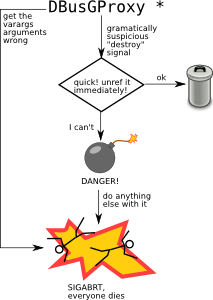
Some background: dbus-glib and libtelepathy
GObject-CRITICAL: Assertion failed: proxy->convenient
The life-cycle of a DBusGProxy (PD clipart credit: karderio and Andy)
The API provided by dbus-glib for client code is, er, rather less than ideal. The basic object is DBusGProxy, which has a few problems. There's one per interface, rather than one per object; this leads to a maze of twisty GObjects, all suspiciously similar. Our old client library, libtelepathy, got round this by subclassing DBusGProxy to make helper objects called TpChan, TpConn etc., which were simultaneously the proxy for the "main" interface (Channel, Connection etc.), and a factory for proxies for the other interfaces (like Channel.Type.Text and Channel.Interface.Password). This still wasn't ideal, but it was a start. If you use a DBusGProxy in any way after it has emitted the destroy signal, this is considered to be invalid use of the API, and dbus-glib asserts all over the place. We'd rather it didn't do that - remote objects becoming invalid is a fact of life, and if you don't immediately discard all your references to those objects, remote operations on them should just give you a runtime error. You have to be prepared to handle such runtime errors already, because any IPC call can fail at any time. The main API for calling methods uses varargs and is rather subtle. Notably, the calling convention for variant parameters (of D-Bus signature 'v') is not consistent with the calling convention for any other container. For any other container, for instance a GPtrArray *, you pass in a GPtrArray ** pointing to a GPtrArray * variable containing NULL; on success, a pointer to a new GPtrArray is written into that variable. For variant parameters, though, you must pass in a GValue * pointing to a zero-filled GValue, and the result will be written into that GValue. dbus-binding-tool generates thin wrappers around this method-calling API which provide type-safety, although they can't directly specify a non-default timeout. As for signals, before binding to a signal, you have to tell dbus-glib about its signature. This tells dbus-glib how it should push the signal arguments onto the C stack (in GObject terminology: how it should marshal them), to match the signature of the signal-handler function. The documentation claims that this isn't necessary for objects supporting the Introspect method, but that's untrue - on the other hand, if the documented behaviour actually happened, I would consider this to be a critical bug in dbus-glib, since it would enable remote objects to crash dbus-glib clients (by causing signal arguments to be pushed onto the stack in a way that does not match the signature of the signal handler). Of course, the signal-adding function takes varargs, and has to be called exactly once per signal per object. If you don't, dbus-glib asserts when you connect to the signal; if you call it twice, dbus-glib asserts anyway.

TpProxy TpProxy is a GObject subclass vaguely inspired by Python's dbus.proxy.ProxyObject. It isn't a subclass of DBusGProxy, which lets us encapsulate dbus-glib almost completely - in fact, all the references to DBusGProxy are in a separate header, proxy-subclass.h, only used by subclasses of TpProxy (as opposed to normal library API users). TpProxy instances are per-remote-object (per-object-path) like in dbus-python, rather than per-interface like in dbus-glib or QtDBus. As explained below, I believe that this is the most natural object mapping for D-Bus interfaces; in practice it tends to lead to clearer code for us, since one remote object often maps nicely to one UI element (of course, if your objects only have one interface, this approach is no better or worse than dbus-glib's). TpProxy provides support for the following common D-Bus things:
  • Calling methods
  • Connecting to signals
  • Objects becoming invalid
  • Objects with optional interfaces
  • Extensibility
It doesn't currently provide any particular help with Properties - the Properties interface is just another interface as far as we're concerned. We find that, in practice, that's not a problem (even though we use D-Bus properties extensively). In telepathy-qt4 we basically reinvented TpProxy in C++, as Tp::DBusProxy. I've put in some comments below illustrating how the general ideas we used in TpProxy translate into a different object mapping.

Calling methods Method calls on TpProxy are done through auto-generated wrapper functions, much like DBusGProxy. These look something like this:
typedef void (*tp_cli_channel_callback_for_close) (TpChannel *proxy,
    /* any 'out' arguments would go here - Close() doesn't have any */
    const GError *error, gpointer user_data,
    GObject *weak_object);
TpProxyPendingCall *tp_cli_channel_call_close (TpChannel *proxy,
    gint timeout_ms,
    /* any 'in' arguments would go here - Close() doesn't have any */
    tp_cli_channel_callback_for_close callback,
    gpointer user_data,
    GDestroyNotify destroy,
    GObject *weak_object);
Methods for some interfaces, like DBus.Properties, are available on TpProxy itself; others, like Telepathy's Channel.anything, are only available on a particular subclass, like TpChannel. Things to note here:
  • It's an asynchronous call with a callback. General design principle: "this is IPC, get over it". We don't try to hide the fact that IPC is taking place by doing pseudo-blocking calls.
  • The timeout is explicit (although you can always pass -1 to let libdbus pick a "reasonable" default for you). This is because the remote service might not respond, and API users should be at least vaguely aware of this: "this is IPC, get over it".
  • The callback isn't a GCallback; it has an explicit signature, for some semblance of type-safety (it's not much, but it's better than nothing).
  • The callback takes a GError, because any IPC call can fail for any reason.
  • A TpProxyPendingCall * is returned. This is a pointer to an object that only exists until just after the callback is called (so you can ignore it if you don't want it), with a method you can call to cancel the method call (with hindsight this is not ideal, and if I was writing this API now, I'd use gio's GCancellable). "Cancel" is perhaps slightly misleading: the method call still takes place (it was already in libdbus's outgoing queue) but the result gets ignored and the callback isn't called. This is mostly so you an object can forget all the calls it was busy making at the time that the results become irrelevant (e.g. the object is destroyed).
  • There is an extra weak_object argument, which is weakly referenced and is passed to the callback: in practice, most users of telepathy-glib use this as well as or instead of user_data. If the weak_object runs out of references, the callback is automatically cancelled, which means that in practice, explicit cancellation is almost never needed.
  • The generated code has as its first argument a suitable subclass of TpProxy, in this case TpChannel (we tell the code generator about subclasses).
  • You can't see it in the API, but the TpProxy gains an extra ref while a method call is in progress, so you never have to worry about what happens if the proxy gets unreffed during a method call.
  • There's an explicit destructor for the user_data, which is called even if you "cancel" the method call.
In telepathy-qt4, these methods are on small generated helper classes similar to dbus-python's dbus.Interface, one per interface (we provide accessors for them on the non-generated DBusProxy subclass). Instead of using callbacks, we return a temporary QObject per call, which emits a Qt signal on success or failure (that's how all async calls in QtDBus work).

Connecting to signals Similarly, signals have some generated functions:
typedef void (*tp_cli_channel_signal_callback_closed) (TpChannel *proxy,
    /* any arguments would go here - Closed doesn't have any */
    gpointer user_data, GObject *weak_object);
TpProxySignalConnection *tp_cli_channel_connect_to_closed (TpChannel *proxy,
    tp_cli_channel_signal_callback_closed callback,
    gpointer user_data,
    GDestroyNotify destroy,
    GObject *weak_object,
    GError **error);
API notes for these:
  • The callback doesn't take a GError any more, because signals can't fail; the weak_object and the user_data are the same as for method calls
  • This isn't actually a GObject signal at all: those aren't particularly typesafe, and lack namespacing. This might not be very binding-friendly, we haven't tried doing that yet... it might be worth introducing a signal with details, like in dbus-glib, for which these functions are "C bindings".
  • The returned TpProxySignalConnection lets you disconnect from the signal, just like the TpProxyPendingCall above; it can safely be ignored
  • Similarly, if the weak_object dies, then the signal automatically disconnects
  • It is possible for connecting to a signal to fail: this happens if the proxy doesn't actually have the requested interface. If this happens, it's graceful, not a crash. In practice, the flow of code is almost always such that error can safely be NULL because the interfaces are already known.
In telepathy-qt4 the per-interface generated helper classes emit Qt signals. In many cases, we end up proxying these signals by responding to them in the hand-written Tp::DBusProxy subclass by emitting a different signal, in order to give them a nicer representation.

Becoming invalid This is IPC, and any error can happen to you at any time. We found that it was useful to have a general concept of "this object is no longer useful", so we introduced the concept of an object becoming invalidated. The invalidation reason is stored on the object as a GError. If this GError is NULL (as it is initially), then the object is still expected to be valid; if it's non-NULL, the remote object has vanished and the local proxy no longer works. There are several ways a TpProxy can become invalid:
  • its bus name falls off the bus (the process exited or crashed)
  • application-specific reasons (usually triggered by a D-Bus signal in a subclass, like the Telepathy Channel's Closed signal)
  • the GObject gets disposed
Method calls on an invalidated object always fail, with the invalidation reason as the error. This means that calling a method on a TpProxy should never crash your process. The method's callback has to be prepared to handle an error in any case, because this is Sparta^WIPC, so there's no loss in giving it another error. Connecting to signals on an invalidated object always fails, and any existing signal connections are disconnected when it becomes invalidated. This means that if a new remote object appears, and it happens to have the same object path, bus name etc. as the old one, you won't get its signals. A TpProxy can either be bound to a unique bus name or a well-known bus name. In the equivalent code in telepathy-qt4, we call this "stateful" or "stateless" - these names don't capture the intention perfectly, but they're the best we could come up with. A proxy for a stateful API like Telepathy's Channel should always bind to a unique name - when the unique name falls off the bus, the TpProxy becomes invalidated automatically, representing the fact that the Channel you had no longer exists, and nothing can be a perfect replacement for it (the VoIP call has already been terminated, you've already left the chatroom, or whatever - if you make another Channel, that's e.g. a distinct VoIP call). A proxy for a stateless API like Telepathy's ConnectionManager, where an exiting process can disappear, be service-activated again, and still have exactly the same API, should bind to the well-known name. Proxies for well-known names aren't invalidated when the process exits. Qt doesn't have a natural equivalent for GError, so the invalidation reasons in telepathy-qt4 are just a pair of strings, the namespaced name and the message - basically a libdbus DBusError. The principle is the same, though.

Optional interfaces As mentioned above, TpProxy instances are per-remote-object (per-object-path) like in dbus-python, rather than per-interface like in dbus-glib or QtDBus. I believe that this is the most natural object mapping for the D-Bus object model, because the D-Bus interfaces on a remote object can behave like any of these:
  • classes and subclasses (Telepathy.Channel.Type.Text is a Telepathy.Channel)
  • shared interfaces (some Telepathy.Channel objects, of many Types, implement Telepathy.Channel.Interface.Group; any D-Bus object can implement DBus.Properties)
  • optional features (some Telepathy.Channel.Type.Text objects implement Telepathy.Channel.Interface.ChatStates, some do not)
  • discoverable extensions (some Telepathy.Channel.Type.Text objects implement Telepathy.Channel.Interface.Messages, which is more or less Text 2.0)
The way in which interfaces are discovered is also variable. The "classic" D-Bus way to discover interfaces would be to call Introspect. Telepathy services still support that style of introspection, but we don't use it for anything beyond d-feet:
  • Introspect returns a blob of XML, which you have to parse into something useful; if it was in a D-Bus data structure, you'd already have some sensible data structure.
  • Finding out more information about the supported interfaces than their names isn't very useful: in a static language like C you already need to know the methods, signals, properties and their signatures in order to write and compile your code, and in a dynamic language like Python consumers of Introspect end up being remotely crashable by services with unexpected method signatures (this is one of dbus-python's big mistakes in my opinion).
  • If a method that you want to call turns out to be missing, the worst that can happen (in a competently written service) is that it fails with a D-Bus error - and you have to handle D-Bus errors anyway, because this is IPC and anything could fail.
  • Static bindings like dbus-glib have poor support for removing interfaces for which C code exists at runtime, whereas Telepathy needs features like an IM connection that might or might not support avatars (we don't get to find out until we've successfully connected to the server).
Instead, our older interfaces have a method on the "base class" (Channel, Connection etc.) called GetInterfaces, which just returns an array of strings. Newer interfaces (like Account), and older interfaces that have been ported (like Channel), have a property called Interfaces which is, again, an array of strings - this lets us combine the download of the interfaces list with downloading other basic information in a GetAll call. To cater for all these ways to use interfaces, the TpProxy base class has very basic support for interface discovery - you can ask it whether it supports an interface, and you can tell it that it does, in fact, support an interface. Asking which interfaces are supported is directly useful for library users; it's also used as a check by the generated method-call and signal-connection stubs, which return a canned error (Telepathy.Error.NotImplemented in Telepathy's case) if the object isn't known to have the interface. Telling TpProxy that it does support an interface is intended for use by subclasses, and might have been protected if we were writing C++: what happens in practice is that a concrete subclass like TpChannel knows how to discover the fully supported interfaces for this particular object, does so, and calls methods on the TpProxy to tell it which interfaces can work.

Extensibility The API stubs used by TpProxy to call methods and bind to signals are generated from XML documents containing an augmented form of D-Bus introspection data. These XML documents contain various Telepathy-specific extensions, but none of the extensions are language-specific - telepathy-glib, telepathy-python and telepathy-qt4 all operate from exactly the same XML specification. telepathy-qt4's different object-mapping did require us to tighten up some rules that were previously only conventions, but even so, the format is the same. I think this is vitally important - it just doesn't scale to have one set of language-specific annotations in a D-Bus API for each language that will have bindings. One thing that we make heavy use of is what I call "Ugly_Case", which is camel-case with underscores at word boundaries. This gives us a simple, unambiguous and foolproof rule to use in code generators whenever we generate any of the popular conventions for identifiers:
  • CamelCase: delete underscores
  • javaCamelCase: force everything before the first underscore to lower case, then delete underscores
  • lower_case: force everything to lower case, retain underscores
  • UPPER_CASE: force everything to upper case, retain underscores
dbus-glib, by contrast, applies a complex and subtly buggy algorithm to the CamelCase D-Bus names, which results in our SendDTMF method being mapped into GLib as send_dt_mf, and requires that telepathy-glib's Python reimplementation of dbus-binding-tool uses a bug-for-bug compatible implementation (we ended up reimplementing dbus-binding-tool in order to generate the TpProxy-based bindings). Our code generation tools are still rather ad-hoc, because so is our spec format, but for draft interfaces it's possible to copy them into individual projects and use them to generate additional methods for TpProxy or any subclass. This is how we implement unfinished APIs like geolocation in Empathy, for instance. The Interfaces or GetInterfaces hook described above is entirely usable for these extension interfaces, and in fact that's how they're set up. In telepathy-qt4, the generated method stubs are genuine C++ methods, so we can't just append methods to an existing class: this is why we have one helper class per interface, so individual clients can generate a helper class for their particular version of an unfinished API, and instantiate an object of this class attached to a particular Tp::DBusProxy. When an interface becomes stable, it can be added to the set of interfaces for which code is generated in telepathy-glib or telepathy-qt4, at which point any client or service that was already using the final draft of that interface can easily be ported to the library version using sed (the API remains the same).

Becoming ready The concept of being "ready" does not directly exist in TpProxy, but is implemented in TpChannel, TpConnection and TpConnectionManager. The idea is that a freshly created proxy object isn't really fully usable yet - you have to connect to basic signals and recover the initial state of the remote object, as well as checking which extension interfaces are supported. In many well-designed D-Bus APIs you can do this initial setup with a few signal connections and a DBus.Properties.GetAll call. After doing that initial setup (which has to be done asynchronously, because it's IPC), the TpProxy subclass has a local cache of the remote object's state (not necessarily in the same format as the representation on the bus), which can be accessed synchronously at any time, and will be updated in response to change-notification signals. TpChannel and subclasses like it have explicit support for checking for readiness, and having a callback called when the object is ready or invalidated (whichever happens first). The "ready" property also supports the GObject notify signal. telepathy-qt4 took this concept and ran with it - there is library support for objects that can become ready, including a mixin. If I had as much time to work on telepathy-glib as I wish I had, this would be one of the first telepathy-qt4 features to be added to telepathy-glib.

Features becoming ready Going beyond that, in an extensible framework like Telepathy it's probable that not every client understands (or wants to understand) every feature of every object, so it's highly inefficient for every proxy object to subscribe to all the change notification signals and cache all the remote state on the off-chance that the library user wants them. In the API for TpContact (which is not actually a TpProxy for various reasons) we introduced the concept of optional features; telepathy-qt4 extended this idea throughout the library. The idea is that each library user knows which of the optional features are "interesting" to it, and makes a single asynchronous call (which expands into a series of D-Bus calls inside the library) to download the state for core functionality plus all of the selected features, and subscribe to change notification for all of those. This is another telepathy-qt4 thing that telepathy-glib still needs to catch up with; until someone works out how to make the clone() syscall apply to programmers, I fear all libraries are doomed to lag behind how their designers want them to look :-) (license: CC-BY-3.0 / LGPL-2.1+)

21 April 2009

Clint Adams: bug democracy

I don't know what votes are in a bug tracking system, but it's almost enough to distract me from sharing my opinion about Seb Ruiz, whoever he is.

Next.

Previous.


