Search Results: "nion"

20 December 2012

Patrick Matth i: Squeeze or Wheezy for new projects?

Hi, I am interested in your opionions! If you would setup today an new server for a (business) project, would you use Debian Squeeze or Wheezy? Personal and already in most business cases we have decided for Wheezy, because the pros are: The cons: What is your (business) opionion about it?

18 December 2012

Russ Allbery: Review: Liars and Outliers

Review: Liars and Outliers, by Bruce Schneier
Publisher: John Wiley
Copyright: 2012
ISBN: 1-118-14330-2
Format: Hardcover
Pages: 285
One of the perils of buying a book written by a blogger one reads regularly is that the book may be little more than a rehashing of their blog, with insufficient original material to warrant the time investment. Sometimes it's still nice to support them financially, but it may not make sense to read the book. I've been following Schneier's blog for years (as should anyone with an interest in security), including through the entire process of writing Liars and Outliers, and was a bit worried that might be the case here. Thankfully, I can reassure any other worried potential readers that is not the case. This is substantial new material establishing a firm framework for thinking about incentives and controls in any society or organization. Liars and Outliers talks about security mechanisms, but it's not, at its core, a book about security. Rather, it's a book about incentives, order, and how order is established. It's a comprehensive reductionist analysis of how societies create predictability and compliance to allow us to trust other people who we have never met before and will never meet again. It's a unique (at least in my experience) combination of anthropology, sociology, security analysis, and political science. Schneier cuts across fields in an idiosyncratic but illuminating way that reminded me of (on an entirely separate topic) Jane Jacobs. This is not a prescriptive book, nor is a collection of answers, solutions, or even deep analysis of particular problems. Rather, it's an attempt to construct a general framework for analyzing societal dilemmas: conflicts between individual desires and social good, how those conflicts are resolved, and how societies can weigh the scales and influence the statistical outcomes. The closest Schneier comes to telling the reader how to solve problems is a checklist, at the end of the book, for designing effective societal pressures. Its primary contribution is vocabulary and structure. It also passes one of my litmus tests for any book about human behavior: Schneier complicates, broadens, deepens, and expands understanding, and points out complex interactions and complex feedback in effects we're inclined to consider simple, rather than simplifying or eliminating human complexity. One point I found refreshing about this book is that Schneier is scrupulous in refusing to define either society or individuals as good or bad, to the point of carefully defining terminology used in all of the social dilemmas. Following societal rules is called compliance; not following those rules is called defection. In some cases, defection is morally correct (Schneier's most frequent example is in the civil rights struggles of the 1960s in the United States). In all cases, social pressures are tools, which can be used to encourage compliance with moral or immoral systems, and which are deployed by totalitarian dictatorships and utopian communes alike. Schneier explicitly puts out of scope for this book the questions of how societal goals should be determined, how they change, and whether any given societal rule or interest is moral or immoral. He focuses, rather, only on the mechanisms, with a primary goal of informing and deepening debates over how best to encourage behavior that societies want to encourage and discourage behavior societies want to discourage. He also emphasizes discourage, as opposed to eliminate. Early on, Schneier shows some of the results of game theory, as well as basic common sense, that indicate that no healthy society can totally eliminate defection. Not only would that stifle valuable and important reform, such as changes in civil rights, but the degree of pressure required is immense. Defectors are natural and will always exist, and are sometimes valuable and necessary. Rather, the goal of a society is to reduce defectors to a level where most people can ignore their existence most of the time, a state that leads to the level of risk and trust required to have a functioning and healthy society. The word society, similarly, is intentionally broad, and can refer to just about any collection of people, from a circle of friends to a corporation, institution, or country. However, as Schneier points out early in the book, small societies rarely need much in the way of formal pressure and appear almost magically self-governing. That's the first property that he disassembles, resulting in a general classification of societal pressures into four categories: moral, reputational, institutional, and security systems. The last is an odd category that's partly orthagonal to the other three. Moral pressure is internalized conscience: the normal tendency of nearly everyone to follow their own moral code, a code that's at least partly constructed and certainly heavily influenced by the surrounding society. Reputational pressure is, in a sense, externalized morality: it's the informal reactions of others around one to one's past actions. Included in reputational pressure is shunning of every kind, from cutting off a friendship to boycotts against corporations, but it also includes confrontation from another member of one's society, the more subtle effects of our individual desires to be liked and respected, and all the various aspects of "face", honor, and respect within a community. Small communities are frequently self-governing, in Schneier's model, because they're small enough that moral and reputational pressures are sufficient and no other pressures are required. We're so used to applying moral and reputational pressure to other humans almost unconsciously that we sometimes don't even notice its existence, leading to that "magical" self-governing property. But Schneier puts pressures in a sequence: pressures that work extremely well with small groups often don't scale. Moral pressure works best with small groups and reputational pressure with somewhat larger groups, but when societies scale beyond the limits of reputational pressure when, for example, one frequently interacts with people whose reputations are unknown to you and whose subsequent opinion of you will not be relevant institutional pressure is required to force compliance. Institutional pressure is the sort of pressure that we all tend to think of first when we look for ways to enforce rules: laws, policies, contracts, and other codes of behavior that carry with them formal punishments and some enforcement mechanism. But even in societies so large that institutional pressures are frequently required, such as whole countries, moral and reputational pressures still exist and are extremely important. One of Schneier's most interesting points is his analysis of how institutional pressures can paradoxically undermine reputational and moral pressures, resulting in more defection than if the institutional pressure hadn't existed. This is just the basic framework of Schneier's analysis, hopefully giving you a feel for the structure of the book. He goes much deeper into the complicated interactions between the various levels of pressure, and then dives into an extensive look at competing societal dilemmas: cases where there is more than one society in play simultaneously, possibly demanding contradictory actions. Liars and Outliers also includes a wonderful analysis of organizational entities within the same framework, including their much-different reactions to moral, reputational, and institutional pressures. One of the most cogent analyses of the difficulties of regulating both corporations and governmental institutions falls out of that analysis, once one looks at them in light of Schneier's basic framework. Pressures quickly become complex and multi-layered, and human reactions to pressures are frequently counter-intuitive. Schneier draws extensively on game theory to show that some counter-intuitive responses are actually emergent properties of logical analysis of the situation, but that others are more uniquely human and have little or nothing to do with a mathematical cost-benefit analysis. I haven't even mentioned his discussion of security systems, and how they can extend moral, reputational, and institutional pressures, as well as add a new type of pressure (making a defecting action impossible) that scales even better than institutional pressures. Liars and Outliers has all of the supporting infrastructure you would expect in a scholarly book: notes, extensive references, and a good index. I suspect it will end up being used as at least additional reading in college classes. The notes are, unfortunately, end notes, making the full context of the book much harder to read than was necessary, but at least Schneier does separate the notes from the references so that one doesn't chase notes for further explanation and find a simple citation. As with any book like this, one always wishes it could end in a simple prescription to fix everything, but of course it doesn't. But that's also a measure of a good scholarly work. Human and organizational motivations are complex and tricky, and any framework for analyzing them needs to be able to represent that complexity. Schneier here has constructed a very powerful one, one that I started using in discussions before I'd even finished the book. Perhaps the most valuable contribution of Liars and Outliers to public discussion is clear terminology and categories, which can be of great help in finding the core components of a problem. Liars and Outliers can be slow going, particularly early on when Schneier is still defining terms and setting up the background of his analysis. One can get a bit tired of the analysis matrices of societal dilemmas. But stick with it through the groundwork, since the analyses of competing societal dilemmas and of the impact of societal pressures on organizations are exceptional. Highly recommended, particularly for anyone who is designing or implementing societal pressures: managers, political activists, or anyone in a security-related field. Rating: 8 out of 10

13 December 2012

Andrea Veri: The future is Cloudy

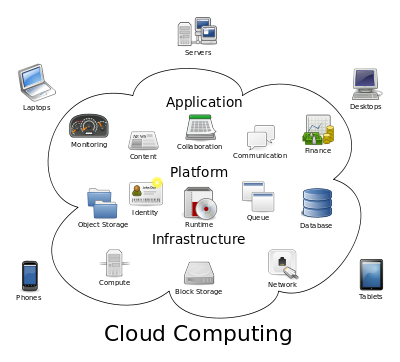
Have you ever heard someone talking extensively about Cloud Computing or generally Clouds? and have you ever noticed the fact many people (even the ones who present themselves as experts) don t really understand what a Cloud is at all? That happened to me multiple times and one of the most common misunderstandings is many see the Cloud as something being on the internet. Many companies add a little logo representing a cloud on their frontpage and without a single change on their infrastructure (but surely with a price increment) they start calling their products as being on the Cloud. Given the lack of knowledge about this specific topic people tend to buy the product presented as being on the Cloud without understanding what they really bought. But what Cloud Computing really means? it took several years and more than fifteen drafts to the National Institute of Standards and Technology s (NIST) to find a definition. The final accepted proposal:

Cloud computing is a model for enabling ubiquitous, convenient, on-demand network access to a shared pool of configurable computing resources (e.g., networks, servers, storage, applications and services) that can be rapidly provisioned and released with minimal management effort or service provider interaction.

The above definition requires a few more clarifications specifically when it comes to understand where should we focus on while checking for a Cloud Computing solution. A few key points:
  1. On-demand self-service: every consumer will be able to unilaterally provision multiple computing capabilities like server time, storage, bandwidth, dedicated RAM or CPU without requiring any sort of human interaction from their respective Cloud providers.
  2. Rapid elasticity and scalability: all the computing capabilities outlined above can be elastically provisioned and released depending on how much demand my company will have in a specific period of time. Suppose the X company is launching a new product today and it expects a very large number of customers. The X company will add more resources to their Cloud for the very first days (where they suppose the load to be very high) and then it ll scale the resources back as they were before. Elasticity and scalability permit the X company to improve and enhance their infrastructure when they need it with an huge saving in monetary terms.
  3. Broad network access: capabilities are available over the network and accessed through standard mechanisms that promote use by heterogeneous thin or thick client platforms (e.g., mobile phones, tablets, laptops, and workstations).
  4. Measured service: Cloud systems allow maximum transparency between the provider and the consumer, the usage of all the resources is monitored, controlled, and reported. The consumer knows how much will spend, when and in how long.
  5. Resource pooling: each provider s computing resources are pooled to serve multiple consumers at the same time. The consumer has no control or knownledge over the exact location of the provided resources but may be able to specify location at a higher level of abstraction (e.g., country, state, or datacenter).
  6. Resources price: when buying a Cloud service make sure the cost for two units of RAM, storage, CPU, bandwidth, server time is exactly the double of the price of one unit of the same capability. An example, if a provider offers you one hour of bandwitdh for 1 Euro, the price of two hours will have to be 2 Euros.
Another common error I usually hear is people feeling Cloud Computing just as a place to put their files online as a backup or for sharing them with co-workers and friends. That is just one of the available Cloud features , specifically the Cloud Storage , where typical examples are companies like Dropbox, Spideroak, Google Drive, iCloud and so on. But let s make a little note about the other three features :
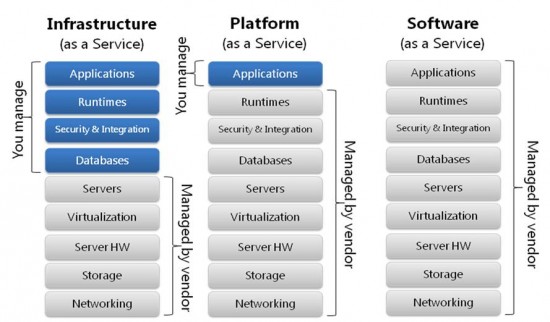
  1. Infrastructure as a Service (IaaS): the capability provided to the consumer is to provision processing, storage, networks, and other fundamental computing resources where the consumer is able to deploy and run arbitrary software, which can include operating systems and applications. In this specific case the consumer has still no control or management over the underlying Cloud infrastructure but has control over operating systems, storage, and deployed applications. A customer will be able to add and destroy virtual machines (VMs), install an operating system on them based on custom kickstart files and eventually manage selected networking components like firewalls, hosted domains, accounts.
  2. Platform as a Service (PaaS). the capability provided to the consumer is to deploy onto the cloud infrastructure consumer-created or acquired applications created using programming languages, libraries, services, and tools (like Mysql + PHP + PhpMyAdmin or Ruby on Rails) supported by the provider. In this specific case the consumer has still no control or management over the Cloud infrastructure itself (servers, OSs, storage, bandiwitdh etc.) but has control over the deployed applications and configuration settings for the application-hosting environment.
  3. Software as a Service (SaaS): the capability provided to the consumer is to use the provider s applications running on a Cloud infrastructure. The applications are accessible through various client devices, such as a browser, a mobile phone or a program interface. The consumer doesn t not manage nor control the Cloud infrastructure (servers, OSs, storage, bandwidth, etc.) that allows the applications to run. Even the provided applications aren t customizable by the consumer, which should rely on limited configuration settings.
The Cloud Computing technology is reasonably the future but can we trust Cloud providers? Are we sure that no one will ever have access to our files except us? and what about governments interested in acquiring a specific customer data hosted on the Cloud? I always suggest to read deeply both the Privacy Policy and Terms of Use of a certain service before signing in especially when it comes to choose a Cloud storage provider. Many providers have the same aspect, they seem to provide the same resources, the same amount of storage for the same price but legally they may present different problems, and that is the case of Spideroak vs Dropbox. Quoting from the Dropbox s Privacy Policy:
Compliance with Laws and Law Enforcement Requests; Protection of DropBox s Rights. We may disclose to parties outside Dropbox files stored in your Dropbox and information about you that we collect when we have a good faith belief that disclosure is reasonably necessary to (a) comply with a law, regulation or compulsory legal request; (b) protect the safety of any person from death or serious bodily injury; (c) prevent fraud or abuse of DropBox or its users; or (d) to protect Dropbox s property rights. If we provide your Dropbox files to a law enforcement agency as set forth above, we will remove Dropbox s encryption from the files before providing them to law enforcement. However, Dropbox will not be able to decrypt any files that you encrypted prior to storing them on Dropbox.
It s evident that Dropbox employees can access your data or be forced by legal process to turn over your data unencrypted. On the other side, Spideroak on its latest update to its Privacy Policy states that data stored on their Cloud is encrypted and inaccessible without user s key, which is stored locally on user s computers. And what about the latest research paper, titled Cloud Computing in Higher Education and Research Institutions and the USA Patriot Act written by the legal experts of the University of Amsterdam s Institute for Information Law stating the anti-terror Patriot Act could be theoretically used by U.S. law enforcement to bypass strict European privacy laws to acquire citizen data within the European Union without their consensus? The only requirement for the data acquisition is the provider being an U.S company or an European company conducting systematic business in the U.S. For example an Italian company storing their documents (protected by the European privacy laws and under the general Italian jurisdiction) on a provider based in Europe but conducting systematic business in the United States, could be forced by U.S. law enforcement to transfer data to the U.S. territory for inspection by law enforcement agencies. Does someone really care about the privacy of companies, consumers and users at all? or better does privacy exists at all for the millions of the people that connect to the internet every day?

6 December 2012

James Bromberger: Official Debian Images on Amazon Web Services EC2

Please Note: this article is written from my personal perspective as a Debian Developer, and is not the opinion or expression of my employer.
Amazon Web Service s EC2 offers customers a number of Operating Systems to run. There are many Linux Distributions available, however for all this time, there has never been an Official Debian Image or Amazon Machine Image (AMI), created by Debian. For some Debian users this has not been an issue as there are several solutions of creating your own personal AMI. However for the AWS Users who wanted to run a recognised image, it has been a little confusing at times; several Debian AIMs have been made available by other customers, but the source of those images has not been Debian . In October 2012 the AWS Marketplace engaged in discussions with the Debian Project Leader, Stefano Zacchiroli. A group of Debian Developers and the wider community formed to generated a set of AMIs using Anders Ingemann s ec2debian-build-ami script. These AMIs are published in the AWS Marketplace, and you can find the listing here: No fees are collected for Debian for the use of these images via the AWS Marketplace; they are listed here for your convenience. This is the same AMI that you may generate yourself, but this one has been put together by Debian Developers. If you plan to use this AMI, I suggest you read http://wiki.debian.org/Cloud/AmazonEC2Image, and more explicity, SSH as the user admin and then sudo -i to root. Additional details Anders Ingemann and others maintain a GitHub project called ec2debian-build-ami which generates a Debian AMI. This script supports several desired features, an was also updated to add in some new requirements. This means the generated image supports: Debian Stable (Squeeze; 6.0.6 at this point in time) does not contain the cloud-init package, and neither does Debian Testing (Wheezy). A fresh AWS account (ID 379101102735) was used for the initial generation of this image. Any Debian Developer who would like access is welcome to contact me. Minimal charges for the resource utilisation of this account (storage, some EC2 instances for testing) are being absorbed by Amazon for this. Co-ordination of this effort is held on the debian-cloud mailing list. The current Debian stable is 6.0.6 Squeeze , and we re in deep freeze for the Wheezy release. Squeeze has a Xen kernel that works on the Parallel Virtual Machine (PVM) EC2 instance, and hence this is what we support on EC2. (HVM images are a next phase, being headed up by Yasuhiro Akarki <ar@d.o>). Marketplace Listing The process of listing in the AWS Marketplace was conducted as follows: This image went out on the 19th of November 2012. Additional documentation was put into the Wiki at: http://wiki.debian.org/Cloud/AmazonEC2Image/Squeeze A CloudFormation template may help you launch a Debian instance by containing a mapping to the relevent AMI in the region you re using: see the wiki link above. What s Next The goal is to continue stable releases as they come out. Further work is happening to support generation of Wheezy images, and HVM (which may all collapse into one effort with a Linux 3.x kernel in Wheezy). If you re a Debian Developer and would like a login to the AWS account we ve been using, then please drop me a line. Further work to improve this process has come from Marcin Kulisz, who is starting to package ec2debian-build-ami into a Debian: this will complete the circle of the entire stack being in main (one day)! Thanks goes to Stefano, Anders, Charles, and everyone who contributed to this effort. Resources

3 December 2012

Jon Dowland: Wheezy problems

I've recently replaced my laptop's HDD as the S.M.A.R.T. data suggested a potential failure. I took the opportunity to try out beta4 of debian-installer and to install a pure wheezy system. Prior to this I've been running a mostly wheezy system with some bits from sid or experimental. I've got quite a few notes about bugs I've hit in the installer, most of which I still need to file, but perhaps the most problematic appears to be known as #661789. Unless I'm reading this wrong, it would appear this show-stopper bug makes booting on an EFI system impossible without some workarounds, it's been a known problem for 9 months, and d-i beta4's images opt for EFI booting where possible. After the 8th install run I must admit I started getting angry that someone was wasting my time. Perhaps this is covered in some install notes somewhere. Anyway, I got an install working eventually (with legacy BIOS boot mode). and have been running wheezy for the last week. I've just now had a string of problems which were a fairly typical experience for me running a mixed system. Whenever I hit a problem, particularly in the GNOME3 stack, my first response was to check "am I running the latest version of the packages?" inevitably not and so I got around my problems via a reboot or something similarly drastic; updated the packages and left things. Until the next time. Just now, the following things happened: I've experienced all of the above (except for the PAM thing) more than once over the last 12 months or so since I blogged about moving to GNOME3. Now I'm running a pure wheezy system, at this point in the freeze the relevant packages are likely to be more stable. So, not running the latest version is no longer a reason to avoid fixing the problem. Time for me to start proper analysis! Debian is now in deep freeze. I've heard it said a few times that we are coming to the end of that process. Based on my experiences, in my humble opinion, we've got some work to do before we're release worthy.

Erich Schubert: ResearchGate Spam

Update Dec 2012: ResearchGate still keeps on sending me their spam. Most of the colleagues I had that tried out RG now deleted their account there, apparently, so the invitation mails become fewer. Please do not try to push this link on Wikipedia just because you are also annoyed by their emails. My blog is not a "reliable source" by Wikipedia standards. It solely reflects my personal view of that web site, not journalistic or scientific research. The reason why I call ResearchGate spam is the weasel words they use to trick authors into sending the invitation spam. Here's the text coming with the checkbox you need to uncheck (from the ResearchGate "blog")
Add my co-authors that are already using ResearchGate as contacts and invite those who are not yet members.
See how it is worded so it sounds much more like "link my colleagues that are already on researchgate" instead of "send invitation emails to my colleagues"? It deliberately avoids the mentioning of "email", too. And according to the researchgate news post, this is hidden in "Edit Settings", too (I never bothered to try it -- I do not see any benefit to me in their offers, so why should I?). Original post below:
If you are in science, you probably already received a couple of copies of the ResearchGate spam. They are trying to build a "Facebook for scienctists", and so far, their main strategy seems to be aggressive inivitation spam. So far, I've received around 5 of their "inivitations", which essentially sound like "Claim your papers now!" (without actually getting any benefit). When I asked my colleagues about these invitations none actually meant to invite me! This is why I consider this behaviour of ResearchGate to be spam. Plus, at least one of these messages was a reminder, not triggered by user interaction. Right now, they claim to have 1.9 million users. They also claim "20% interact at least once a month". However, they have around 4000 Twitter followers and Facebook fans, and their top topics on their network are at like 10000-50000 users. That is probably a much more real user count estimation: 4k-40k. And these "20%" that interact, might just be those 20% the site grew in this timeframe and that happened to click on the sign up link. For a "social networking" site, these numbers are pointless anyway. That is probably even less than MySpace. Because I do not see any benefit in their offers! Before going on an extremely aggressive marketing campaign like this, they really should consider to actually have something to offer... And the science community is a lot about not wasting their time. It is a dangerous game that ResearchGate is playing here. It may appeal to their techies and investors to artificially inflate their user numbers in the millions. But if you pay for the user numbers with your reputation, that is a bad deal! Once you have the reputation as being a spammer (and mind it, every scientist I've talked to so far complained about the spam and "I clicked on it only to make it stop sending me emails") it's hard to be taken serious again. The scientific community is a lot about reputation, and ResearchGate is screwing up badly on this. In particular, according to researchgate founder on quora, the invitations are opt-out on "claiming" a paper. Sorry, this is wrong. Don't make users annoy other users by sending them unwanted invitations to a worthless service! And after all, there are alternatives such as Academia and Mendeley that do offer much more benefit. (I do not use these either, though. In my opinion, they also do not offer enough benefit to bother going to their website. I've mentioned the inaccuracy of Mendeleys data - and the lack of an option to get them corrected - before in an earlier blog post. Don't rely on Mendeley as citation manager! Their citation data is unreviewed. I'm considering to send ResearchGate (they're Berlin based, but there maybe also is a US office you could direct this to) a cease and desist letter, denying them to store personal information on me, and to use my name on their websites to promote their "services". They may have visions of a more connected and more collaborative science, but they actually don't have new solutions. You can't solve everything by creating yet another web forum and "web2.0izing" everything. Although many of the web 2.0 bubble boys don't want to hear it: you won't solve world hunger and AIDS by doing another website. And there is a life outside the web.

28 November 2012

Dirk Eddelbuettel: Rcpp 0.10.1

A the new Rcpp release 0.10.1 arrived this morning on CRAN (as already has Windows binaries) and in Debian. This is a follow-up to the recent 0.10.0 release which extends the exciting new Rcpp-attributes and Rcpp-sugar work further, and as in a number of other areas as detailed below in the NEWS sections. This release brings an change to some of the binary interfaces. If you have packages using Rcpp, you will most likely have to reinstall them from source. Some change were made to const correctness as well as other aspects, and it seems that we have temporarily broken the excellent RcppEigen and RcppOctave packages. We are looking into this, and are sorry about the bug. The complete NEWS entry for 0.10.1 is below; more details are in the ChangeLog file in the package and on the Rcpp Changelog page.
Changes in Rcpp version 0.10.1 (2012-11-26)
  • Changes in Rcpp sugar:
    • New functions: setdiff, union_, intersect setequal, in, min, max, range, match, table, duplicated
    • New function: clamp which combines pmin and pmax, e.g. clamp( a, x, b) is the same as pmax( b, pmin(x, a) )
    • New function: self_match which implements something similar to match( x, unique( x ) )
  • Changes in Rcpp API:
    • The Vector template class (hence NumericVector ...) get the is_na and the get_na static methods.
    • New helper class no_init that can be used to create a vector without initializing its data, e.g. : IntegerVector out = no_init(n) ;
    • New exception constructor requiring only a message; stop function to throw an exception
    • DataFrame gains a nrows method
  • Changes in Rcpp attributes:
    • Ability to embed R code chunks (via specially formatted block comments) in C++ source files.
    • Allow specification of argument defaults for exported functions.
    • New scheme for more flexible mixing of generated and user composed C++ headers.
    • Print warning if no export attributes are found in source file.
    • Updated vignette with additional documentation on exposing C++ interfaces from packages and signaling errors.
  • Changes in Rcpp modules:
    • Enclose .External invocations in BEGIN_RCPP/END_RCPP
  • Changes in R code :
    • New function areMacrosDefined
    • Additions to Rcpp.package.skeleton:
      • attributes parameter to generate a version of rcpp_hello_world that uses Rcpp::export.
      • cpp_files parameter to provide a list of C++ files to include the in the src directory of the package.
  • Miscellaneous changes:
    • New example 'pi simulation' using R and C++ via Rcpp attributes
Thanks to CRANberries, you can also look at a diff to the previous release 0.10.0. As always, even fuller details are on the Rcpp Changelog page and the Rcpp page which also leads to the downloads, the browseable doxygen docs and zip files of doxygen output for the standard formats. A local directory has source and documentation too. Questions, comments etc should go to the rcpp-devel mailing list off the R-Forge page

21 November 2012

Axel Beckert: Suggestions for the GNOME Team

Thanks to Erich Schubert s blog posting on Planet Debian I became aware of the 2012 GNOME User Survey at Phoronix. Like back in 2006 I still use some GNOME applications, so I do consider myself as GNOME user in the widest sense and hence I filled out that survey. Additionally I have to live with GNOME 3 as a system administrator of workstations, and that s some kind of usage, too. ;-) The last question in the survey was Do you have any comments or suggestions for the GNOME team? Sure I have. And since I tried to give constructive feedback instead of only ranting, here s my answer to that question as I submitted it in the survey, too, just spiced up with some hyperlinks and highlighting:
Don t try to change the users. Give the users more possibilities to change GNOME if they don t agree with your own preferences and decisions. (The trend to castrate the user was already starting with GNOME 2 and GNOME 3 made that worse IMHO.) If you really think that you need less configurability because some non-power-users are confused or challenged by too many choices, then please give the other users at least the chance to enable more configuration options. A very good example in that hindsight was Kazehakase (RIP) who offered several user interfaces (novice, intermediate and power user or such). The popular text-mode web browser Lynx does the same, too, btw. GNOME lost me mostly with the change to GNOME 2. The switch from Galeon 1.2 to 1.3/2.0 was horrible and the later switch to Epiphany made things even worse on the browser side. My short trip to GNOME as desktop environment ended with moving back to FVWM (configurable without tons of clicking, especially after moving to some other computer) and for the browser I moved on to Kazehakase back then. Nowadays I m living very well with Awesome and Ratpoison as window managers, Conkeror as web browser (which are all very configurable) and a few selected GNOME applications like Liferea (luckily still quite configurable despite I miss Gecko s about:config since the switch to WebKit), GUCharmap and Gnumeric. For people switching from Windows I nowadays recommend XFCE or maybe LXDE on low-end computers. I likely would recommend GNOME 2, too, if it still would exist. With regards to MATE I m skeptical about its persistance and future, but I m glad it exists as it solves a lot of problems and brings in just a few new ones. Cinnamon as well as SolusOS are based on the current GNOME libraries and are very likely the more persistent projects, but also very likely have the very same multi-head issues we re all barfing about at work with Ubuntu Precise. (Heck, am I glad that I use Awesome at work, too, and all four screens work perfectly as they did with FVWM before.)
Thanks to Dirk Deimeke for his (German written) pointer to Marcus Moeller s interview with Ikey Doherty (in German, too) about his Debian-/GNOME-based distribution SolusOS.

18 November 2012

Sven Mueller: Ingress

As some may have noticed, Google launched something that is unusual for the company: A game. A mobile alternate reality game, to be precise. See allthingsd article for a bit more information. In my opinion this game is most interesting to people who are mildly interested in geo-caching. You spend most of the gaming time either looking for the right portals (geo-location that is an interesting place for one reason or another, many located at sculptures, murals or (more scarcely) interesting local businesses), or trying to solve the puzzles that appear in the game itself or on http://www.nianticproject.com/. I was one of the beta testers and really enjoy the game, especially in areas with more players. As the game is most fun when people coordinate a bit, I started a google group for the munich area for one of the two teams (the enlightenment), but I will only let people enter that group who can be verified to be on that team. On a side note: I still have a few invites to the game left, so if you are interested, please leave a comment and enter your gmail.com email address (you need a Google account to play anyway) while doing so. I will send out invites in the order I received the requests (which I admit might not always be the same in which they were submitted. First come first serve and no guarantee to get an invitation though. Your email address you enter when commenting isn t shown to anyone and I don t share them with anyone but the game (and thus Google). EDIT: So short time went past, but I already ran out of invites (note that I didn t approve comments that really only were like please send me an invite , but still did sent one out). Feel free to still ask me for an invite, I will send some out as I get new ones, but this might take anything between a few days and some weeks. PS: For the lucky ones who got invites: You don t strictly need to do the training offered when you start the game for the first time, but I strongly encourage you to do so.
PPS: I m opening my group to any enlightened players in Germany. I will share some useful information about some game details there in the near future (nothing company confidential of course, just information anyone can gather in the game or from the published information). EDIT: As noted before, I don t have any more invites to give away. As I still get like 4 requests for invites per day, and now have more than 30 unfulfilled requests pending (with no new invites to give in sight), I m now disabling comments. Disclaimer: I work for Google since a few months ago, but this post solely represents my own opinions and hasn t been endorsed by Google in any way.

13 November 2012

Erich Schubert: Migrating from GNOME3 to XFCE

I have been a GNOME fan for years. I actually liked the switch from 1.x to 2.x, and at some point switched to 3.x when it became somewhat usable. At some point, I even started some small Gnome projects, one even was uploaded to the Gnome repositories. But I didn't have much time for my Linux hobby anymore back then.
However, I am now switching to XFCE. And for all I can tell, I am about the last one to make that switch. Everybody I know hates the new Gnome.
My reason is not emotional. It's simple: I have systems that don't work well with OpenGL, and thus don't work well with Gnome shell. Up to now, I can live fine with "Fallback mode" (aka: Gnome classic). It works really good for me, and does exactly what I need. But it has been all over the media: Gnome 3.8 will drop 'fallback' mode.
Now the choice is obvious: instead of switching to shell, I go to XFCE. Which is much closer to the original Gnome experience, and very productivity oriented.
There are tons of rants on GNOME 3 (for one of the most detailed ones, see Gnome rotting in threes, going through various issues). Something must be very wrong about what they are doing to receive this many sh*tstorms all the time. Every project receives some. I've even received a share of the Gnome 2 storms when Galeon (an early Gnome browser) made the move and started dropping some of the hard-to-explain and barely used options that would break with every other Mozilla release. And Mozilla embedding was a major pain these days. Yet, for every feature there would be some user somewhere that loved it, and as Debian maintainer of Galeon, I got to see all the complaints (and at the same time was well aware of the bugs caused by the feature overload).
Yet with Gnome 3, things are IMHO a lot different. In Gnome 2, it was a lot about making things more usable as they are, a bit cleaner and more efficient. With Gnome 3, it seems to be about experimenting with new stuff. Which is why it keeps on breaking APIs all the time. For example themeing GTK 3 is constantly broken; most of the themes available just don't work. Similar Gnome Shell extensions - most of them work with exactly one version of Gnome Shell (doesn't this indicate the author has abandoned Gnome shell?).
But the one thing that was really sticking out was when my I updated the PC of my dad. Apart from some glitches, he could not even shutdown his PC with Gnome-shell. Because you needed to press the Alt button to actually get a shutdown option.
This is indicative of where Gnome is heading: something undefined inbetween of PCs, tablets, media centers and mobile phones. They just decided that users don't need to shutdown anymore, so they could as well drop that option.
But the worst thing about the current state of GNOME is: They happily live with it. They don't care that they are losing users by the dozens. Because to them, these are just "complainers". Of cousre there is some truth in "Complainers gonna complain and haters gonna hate". But what Gnome is receiving is way above average. At some point, they should listen. 200 posts long comment chains from dozens of peopls on LWN are not just your average "complaints". It's an indicator that a key user base is unhappy with the software. In 2010 GNOME 2 had 45% market share in the LinuxQuestions poll, XFCE had 15%. In 2011, GNOME 3 had 19%, and XFCE jumped to 28%. And I wouldn't be surprised if GNOME 3 shell (not counting fallback mode) would clock at less than 10% in 2012 - despite being default.
Don't get me wrong: there is a lot on Gnome that I really like. But as they decided to drop my preferred UI, I am of course looking for alternatives. In particular, as I can get lots of the Gnome 3 benefits with XFCE. There is a lot in the Gnome ecosystem that I value, and that IMHO is driving Linux forward. Network-manager, Poppler, Pulseaudio, Clutter just to name a few. Usually, the stuff that is modular is really good. And in fact I have been a happy user of the "fallback" mode, too. Yet, the overall "desktop" Gnome 3 goals are in my opinion targeting the wrong user group. Gnome might need to target linux developers more again, to keep a healthy development community around. Frequently triggering sh*tstorms by high-profile people such as Linux Torvalds is not going to strengthen the community. There is nothing wrong in the FL/OSS community to encourage people to use XFCE. But these are developers that Gnome might need at some point.
On a backend / technical level (away from the Shell/UI stuff that most of the rants are about), my main concern about the Gnome future is GTK3. GTK2 was a good toolkit for cross-platform development. GTK3 as of now is not, but is largely a Linux/Unix only toolkit - in particular, because there apparently is no up to date Win32 port. With GTK 3.4 it was said that they are now working on Windows - but as of GTK 3.6 they are still nowhere to be found. So if you want to develop cross-platform, as of now, you better stay away from GTK 3. If this doesn't change soon, GTK might sooner or later lose the API battle to more portable libraries.

4 November 2012

Wouter Verhelst: Windows usability: followup.

Yesterday, I posted a blog post containing a list of issues with Windows, in response to a similar list for Linux, which has received quite some response; I've seen people +1 it on google+, and I've received a number of replies on the blog post itself. One of these replies was by the author of the original list; and as expected, he totally and utterly failed to see the point. He also has the audacity to claim I haven't installed Linux yet what?!? The last time I used anything other than Linux on my personal machine for any real work was on Windows 98. And no, that was not because I was too cheap to buy the latest and greatest. I have used Windows in some cases since then, but never on my own hardware. First of all, I should note that the list which I posted was only semi-serious (with tongue in cheek); the fact that it refers to Windows as the operating system which "attempts to replace Linux as the major operating system" should have been a pretty big clue to that effect. Like the original list that it was a reply to, my list contains things that are only true in a particular context (e.g., the one about requiring recent hardware), it contains things that don't matter for the large majority of Windows users (e.g., the point about focus-follows-mouse) but that are major arguments for why I don't use Windows, it contains things that are so alien to what most of us are used to that even most Linux users don't use it, while on the other hand some swear by it (like the SELinux argument), and it contains some things that a seasoned Windows user will call bullshit on but that are real actual problems for the non-seasoned Windows user that I am (such as the mouse argument). It also contains some actual facts, like the statement about most crashes being a direct result of faulty drivers that's pulled directly from a scientific study on the subject conducted by Microsoft, together with some independent researchers. Like the original list, I don't expect this list to change anything for the better, precisely because it is flawed in exactly the same way. But whether the items on that list were right or wrong isn't the point. This is: Nobody (except nutcases) ever said Linux is perfect, or that it's useful for everyone; and while the issues Artem lists may be bugs or may be design flaws or any of a number of other things that could be real problems, the fact is that creating a long "list of issues" isn't going to solve anything. If you find that there are problems with Linux, you basically have three options: fix the problem, get someone to fix it for you, or stop using Linux. Really. Rather than better or worse, Linux is different. It will have its own set of problems, and it will have its own set of advantages. Some of the design decisions cause problems, but also have serious advantages, and focussing on only these problems (the existence of which I'm not denying) isn't very helpful. A good example is the library model: under Linux, libraries are typically installed in a system-wide location, and use a SONAME which is (part of) the filename of that library and which defines the binary interface exported by that library. In contrary to the situation under Windows, Linux libraries also must use position-independent code. The result is a more robust library model. The downside to that model, however, is that when you install older applications that require older SONAME versions of a particular library, getting those older versions may be a challenge. While in theory, installing an older version of a library is not going to cause any problem if the SONAME is different, in practice you'll often find that you'll need to go to (unsupported) older packages from older versions of the distribution, which may not install due to missing or conflicting dependencies, or which may expect data files in a different format in the same location that newer versions of the same library do, or which may have any number of other issues. When that happens, the solution is to either use an older version of the distribution in a chroot or some such, or to patch and/or compile the needed libraries yourself, and install them alongside the newer version of the same library. That's perfectly possible, after all, precisely because of the SONAME. Another good example is the development model: where Windows has a central authority (Microsoft) which defines what it is to be "Windows" and what is and isn't part of that, the same simply isn't true about Linux. Yes, Linus defines what the official Linux kernel has, but he doesn't have any say about the user interface, the boot process, or any number of other things; other people make decisions there. As a result, in effect, who decides what it means to be a "Linux system" is, really, you, the user. If you believe that the Linux user space is completely wrong, you can just change it to something else entirely; and that's precisely what Google did when they created Android. Since there's no central authority making decisions about what will and won't go into the system, this means that inevitably, at any given time, there will be many competing options for many subsystems. Usually this will be an advantage; e.g., the competition between KDE and Gnome benefits both. Sometimes, however, the competing options are so confusingly interwoven that even those who should know the system inside out can't make heads or tails of it, and debugging issues then becomes quite a challenge. Unfortunately, the Linux sound subsystem is currently an example of the latter. I'm not saying that all the items in Artem's list are invalid; a minority are, in fact, actual problems for a majority of Linux users. Most however, are personal opinions, issues affecting only a small minority of Linux users, or, as above, things where he only talks about the downsides of a design decision that also has major advantages. As an example of something in the second category: it's easy, for example, to list hundreds if not thousands of issues relating to particular pieces of hardware that don't work under Linux, simply because the manufacturer doesn't provide any information, and the people developing drivers for Linux have to reverse engineer how everything works. If you're a bit careful in what you buy, however much like MacOS users need to be careful, too then using Linux isn't an issue. My Lenovo Thinkpad X220, for instance, has no parts that don't work; and this includes things like a docking station, and the fact that my (9-cell) battery life is over fourteen hours, which (I believe) is more than on the same laptop with the same battery under Windows. So how is making a list of issues useful? The answer to that is simply, not at all. If you want to help, don't look for other people's problems; we can all do that. Instead, try to look for solutions to these problems. That's not always easy, and in many cases requires that you first understand why something is done in a particular way. If you don't want to spend time doing that, that's perfectly fine; but then don't expect that open source developers (who are already strapped for time, usually) will suddenly jump up and fix the problems you think are most important, as opposed to what they think should be worked on most urgently. After all, most Open Source developers have their own sets of priorities what they think requires most work, and that's what they'll work on not what's shown in a particular list by someone they don't know and have no reason to respect, somewhere on the Internet. Finally, I'd like to note that any statement which claims that Linux isn't "ready" to be used on the desktop, when hundreds of thousands (if not millions) of people are using it in exactly that way for their day-to-day work, is insulting these people's intelligence. Since that includes me, it's also insulting my intelligence. And I don't like to have my intelligence insulted...

2 November 2012

Bastian Venthur: Introducing The Art of Asking

Since October 2011 my flatmate and I where quite busy realizing a little pet project of ours called The Art of Asking. The ultimate goal is to visualize the world s opinion in an intuitive fashion and make it easy for everyone to play around with the data. The idea behind The Art of Asking is that users submit interesting questions which are answered by users around the world. But instead of showing only the boring result, we want to provide interesting insights and statistics about the answers given. For now the users can see the results of the question visualized by geographical regions. For example on the page for the question How are you today? you can see the interactive map with the pie chart. The map shows the average/dominating answer for each continent encoded by color, and the pie chart the distribution of the different answers for that region. If you move the mouse over a continent the pie chart updates and shows the distribution of answers for that continent. You can also click to zoom into the map to see the same for countries and regions. This allows you to investigate how the answers are distributed around the world. This is already quite nice and fancy to play around with, but of course we want much more. Right now we re working on a feature which will users allow to combine two arbitrary questions and see how the answers are related. This doesn t sound like much, but it is very addictive to crawl through the list of questions and find interesting correlations. Here is a little plot how it could look like (the data is from the actual data base of answers). For each possible combination of answers it shows the percentage of people who answered in that combination. Of course those plots only make sense when enough users answered for both questions you want to compare which is right now not very often the case, so I guess we ll roll out that feature sometime later when we have more data. But we have lots of ideas and are working on further ways to investigate the answers. Obviously one low hanging fruit for example would be the distribution of the answers over time. We ve been working for over a year now on this project in our spare time and we built it more or less from scratch. I wrote a small WSGI framework in Python and on top of that the WSGI application which runs the site. We use MongoDB for the storage of the data, uWSGI and nginx for the server, Jinja2 and Bootstrap for the HTML and D3.js for the visualization of the data, where Maci did a wonderful job realizing the interactive map and charts. We re running this site since July 2012 now and are already quite satisfied with the number of users, and the quality of the questions. But of course we could always use more (especially more answers). So if you want to try it out, go to theartofasking.com and fill out the blank spots on the map! We re happy about every answer and question we can get and are eager to hear your suggestions.

27 October 2012

Russ Allbery: Review: Devil Take the Hindmost

Review: Devil Take the Hindmost, by Edward Chancellor
Publisher: Plume
Copyright: 1999
Printing: June 2000
ISBN: 0-452-28180-6
Format: Trade paperback
Pages: 349
Subtitled A History of Financial Speculation, Devil Take the Hindmost is exactly that: a history, with chapters on notable speculative bubbles or surges going back to the 1630s. The first significant bubble described is, of course, the notorious tulip speculation in Holland, but Chancellor is more thorough than any previous history I've read. There are chapters on the early stock market schemes, the South Sea bubble, 1820s emerging markets, the railway mania of 1845, the Gilded Age, the late 1970s and early 1980s, and the Japanese real estate bubble of the 1980s, as well as the mandatory look at the stock market crash of 1929. Each is thorough and detailed; indeed, perhaps slightly too detailed, as the clear narrative picture can occasionally groan under the weight of names and capsule biographies. The first thing one should realize about this book is that, despite the apparent currency of the topic, it was written in 1999. That means it predates both the subprime real estate collapse and the dot.com boom, as well as some more minor but possibly relevant events such as the Enron electricity market manipulation. Japan is the most recent bubble that Chancellor can cover; one can only speculate as to what he would make of the 2008 financial crash. The other focus to be aware of is the omission of sovereign debt. Chancellor is exclusively focused on private markets, usually stock markets, and (apart from the chapter on Japan) Western markets, mostly in the US and the UK. Governments play a role in some of the early speculative bubbles (most notably the South Sea bubble), but Chancellor's topic is private speculative frenzies, not the risks and effects of government borrowing. Interrogation of the role of government is mostly limited to cursory discussions of the impact of regulation, mostly in the negative. More on that in a moment. This is a history as opposed to either a polemic or a prescription. Chancellor does not set out to explain how to curb financial speculation. Insofar as he expresses an opinion on it, he presents speculation as a force of unbridled freedom in natural tension with regulation and financial conservatism and sees a cyclical pattern of speculative frenzy, collapse, retrenchment, and then renewed speculation. Speculation, as presented here, is more akin to a force of nature than, as seen in most other books on the topic, a phenomenon of greed that should be limited or prevented. Indeed, Chancellor seems skeptical of the entire project of preventing or limiting speculation, and presents considerable reason for the reader to become skeptical as well. The history he presents is one of speculative manias adapting to and circumventing every control that governments and markets have attempted to place on them. When certain practices are outlawed (and some modern complex financial practices have surprisingly long histories), people just find loopholes or alternative approaches through which to accomplish the same thing. Or the speculative mania takes an unexpected new form. Nor do the manias seem to be decreasing in severity as more regulation, custom, and restrictions attempt to blunt them. Even without adding the financial collapse of 2008, the impacts of the speculative frenzies documented here seem, if anything, to be growing. This is, therefore, a relatively straightforward history, but it's an entertaining one, filling in details that I'd not previously been aware of. The complexity of financial schemes as early as the 1600s was particularly eye-opening. There's a tendency to believe that complex derivative schemes are an artifact of modern financial markets, but they've been a part of speculation for as long as Chancellor goes back. Computers may have added layers to the mathematics, but they haven't added as much to the legal strategems and levels of indirection as one might think. Chancellor emphasizes that throughout: speculation involves a lot of complexity, not necessarily to deceive but to construct situations in which it's in the interest (at least short term) of all involved parties to continue and escalate the speculation. While Chancellor doesn't provide much encouragement to the reader hoping to find ways to curb speculation, he does show some commonalities that provide a bit of a handle on how speculation starts. The one that lept out at me was leverage. Every speculative bubble documented in Devil Take the Hindmost involves borrowing money to reinvest. The mechanism keeps changing, from straightforward loans during the tulip craze to much more complex constructions in modern finance, primarily in response to regulation that attempted to reduce leverage but only banned one specific technique. But whatever method is used, at the bottom is always some scheme for purchasing an asset using debt, magnifying both positive and negative price swings. Some variation of buying stocks on margin is particularly common; Chancellor documents how it was reinvented despite the limits on straight margin purchases instituted after the Great Depression. There is no recommendation here for any regulatory or legal action, but it's obvious from the repetition of history that limiting leverage would be the place to focus attention. I enjoyed this history, but it can be dry, and at times is a bit overstuffed with names, unimportant details, and microbiographies. It's also unfortunate that Chancellor missed two of the most significant (and two very different) speculative bubbles through the timing of his work. It would have been interesting to see them through the lens of his history. What we have is still worth reading, but also somewhat frustrating in Chancellor's refusal to draw or at least underline general conclusions. Devil Take the Hindmost is long on history but short on analysis, and while I appreciate the historian's focus in a source of data, it left me somewhat unsatisfied. Rating: 6 out of 10

25 October 2012

Pietro Abate: lesson learned making a cargo kilt

This entry is not really about computers, technology, or other work-related topics, but more about a hard-hack that I wanted to try for a while. How to make a kilt !!! After a bit of duck-ducking, I decided to follow this excellent tutorial. At first sight the entire process seems a bit long, but you will realize that after the first read, that everything boils down to 3 steps: measure, fold and pin, sew. For the measure part, I've the impression that the formula that is given in the instructable (waist/3*8+1) is a bit short for my comfort and taste. This is the size for the internal apron, the folded part that goes all around your left hip, back, and right hip, and the front apron. My suggestion would be to make the inner apron a bit longer then the front apron. This way the kilt will feel in my opinion more comfortable and it will envelop you body completely. For the fold and pin part, you just need a bit of patience and a ruler. Put the pins parallel to the folding as in the instructable and not perpendicular. This will help you later when sewing everything. The sewing ... If you know how to use a sewing machine, this is going to be a piece of cake. Otherwise, well, I spent more time troubleshooting the machine then sewing the kilt. I've broken few needles in the process and learned how to thread the machine with my eyes blindfolded. Not to mention that you have to learn how to disassemble this machines in a thousand parts to understand how the thread got stuck. It was fun. A lesson that I've learned is that a sewing machine works much better in the morning than late at night when you are tired and sleepy. Really ! Other then that, it was a fun experience. Maybe I'll make another one to commit this skill to mind. Maybe I'll run a kilt making workshop at the next debconf :) PA250002.JPG PA250003.JPG
AttachmentSize
PA250002.JPG134.19 KB
PA250003.JPG131.11 KB

22 October 2012

Petter Reinholdtsen: Amazon steal books from customer and throw out her out without any explanation

A blog post from Martin Bekkelund today tell the story of how Amazon erased the books from a customer's kindle, locked the account and refuse to tell the customer why. If a real book store did this to a customer, it would be called breaking into private property and theft. The story has spread around the net today. A bit more background information is available in Norwegian from digi.no. It is no surprise that digital restriction mechanisms (DRM) are used this way, as it has been warned about such abuse since DRM was introduced many years back. And Amazon proved in 2009 that it was willing to break into customers equipment and remove the books people had bought, when it removed the book 1984 by George Orwell from all the customers who had bought it. From the official comments, it even sounded like Amazon would never do that again. And here we are, three years later. And thought this action is against Norwegian regulations and law, it is according to the terms of use as written by Amazon, and it is hard to hold Amazon accountable to Norwegian laws. It is just yet another example of unacceptable terms of use on the web, and how they are used to remove customer rights. Luckily for electronic books, there are alternatives without unacceptable terms. For example Project Gutenberg (about 40,000 books), Project Runenberg (1,652 books) and The Internet Archive (3,641,797 books) have heaps of books without DRM, which can read by anyone and shared with anyone. Update 2012-10-23: This story broke in the morning on Monday. In the evening after the story had spread all across the Internet, Amazon restored the account of the user, as reported by digi.no and NRK. Apparently public pressure work. The story from Martin have seen several twitter messages per minute the last 24 hours, which is quite a lot, and is still drawing a lot of attention. But even when the account is restored, the fundamental problem still exist. I recommend reading two opinions from Simon Phipps and Glen Moody if you want to learn more about the fundamentals and more details about the original story.

Erich Schubert: Changing Gnome 3 colors

One thing that many people dislike about Gnome 3, in my opinion is that the authors/maintainers impose a lot of decisions on you. They are in fact not really hard coded, but I found documentation to be really inaccessble on how to change them.
For example colors. I found it extremely badly documented on how to customize GTK colors. And at the same time, a lot of the themes do not work reliably across different Gnome versions. For example the unico engine in Debian experimental is currently incompatible with the main GTK version there (and even worse, GTK does not realize this and refuse to load the incompatible engine). A lot of the themes you can get on gnome-look.org for example use unico. So it's pretty easy to get stuck with a non-working GTK 3, this really should not happen that easily. (I do not blame the Debian maintainers to not have worked around this using package conflicts yet - it's in experimental after all. But upstream should know when they are breaking APIs!)
For my work on the ELKI data mining framework I do a lot of work in Eclipse. And here GTK3 really is annoying, in particular the default theme. Next to unusable, actually, as code documentation tooltips show up black-on-black.
Recently, Gnome seems to be mostly driven by a mix of design and visual motivation. Gnome shell is a good example. No classic Linux user I've met likes it, even my dad immediately asked me how to get the classic panels back. It is only the designers that seem to love it. I'm concerned that they are totally off on their audience, they seem to target the mac OSX users instead of the Linux users. This is a pity, and probably much more a reason why Gnome so far does not succeed on the Desktop: it keeps on forgetting the users it already has. They by now seem to move to XFCE and LXDE because neither the KDE nor the Gnome crowd care about classic Linux users in the hunt for copying OSX & Co.
Anyway, enough ranting. Here is a simple workaround -- that hopefully is more stable across GTK/Gnome versions than all those themes out there -- that just slightly adjusts the default theme:
$ gsettings set \
org.gnome.desktop.interface gtk-color-scheme '
os_chrome_fg_color:black;
os_chrome_bg_color:#FED;
os_chrome_selected_fg_color:black;
os_chrome_selected_bg_color:#f5a089;
selected_fg_color:white;
selected_bg_color:#c50039;
theme_selected_fg_color:black;
theme_selected_bg_color:#c50039;
tooltip_fg_color:black;
tooltip_bg_color:#FFC;
'
This will turn your panel from a designer-hip black back to a regular grayish work panel. If you are working a lot with Eclipse, you'll love the last two options. That part makes the tooltips readable again! Isn't that great? Instead of caring about what is the latest hipster colors, we now have readable tooltips for developers again instead of all that fancy-schmanzy designer orgasms!
Alternatively, you can use dconf-editor to set and edit the value. The tricky part was to find out which variables to set. The (undocumented?) os_chrome stuff seems to be responsible for the panel. Feel free to change the colors to whatever you prefer!
GTK is quite customizable. And the gsettings mechanism actually is quite nice for this. It just seems to be really badly documented. The Adwaita theme in particular seems to have quite some hard-coded relationships also for the colors. And I havn't found a way (without doing a complete new theme) to just reduce padding, for example. In particular, as there probably are a hundred of CSS parameters that one would need to override to get it into everywhere (and with the next Gnome, there will be again two dozen to add?)
Above method just seems to be the best way to tweak the looks. At least the colors, since that is all that you can do this way. If you want to customize more, you probably have to do a complete theme. At which point, you probably have to redo this at every new version. And to pick on Miguel de Icaza: the kernel APIs are extremely stable, in particular compared to the mess that Gnome has been across versions. And at every new iteration, they manage to offend a lot of their existing users (and end up looking more and more like Apple - maybe we should copy more from where we are good at, instead of copying OSX and .NET?).

20 October 2012

Vincent Bernat: Network lab with KVM

To experiment with network stuff, I was using UML-based network labs. Many alternatives exist, like GNS3, Netkit, Marionnet or Cloonix. All of them are great viable solutions but I still prefer to stick to my minimal home-made solution with UML virtual machines. Here is why: The use of UML had some drawbacks: However, UML features HostFS, a filesystem providing access to any part of the host filesystem. This is the killer feature which allows me to not use any virtual disk image and to get access to my home directory right from the guest. I discovered recently that KVM provided 9P, a similar filesystem on top of VirtIO, the paravirtualized IO framework.

Setting up the lab The setup of the lab is done with a single self-contained shell file. The layout is similar to what I have done with UML. I will only highlight here the most interesting steps.

Booting KVM with a minimal kernel My initial goal was to experiment with Nicolas Dichtel s IPv6 ECMP patch. Therefore, I needed to configure a custom kernel. I have started from make defconfig, removed everything that was not necessary, added what I needed for my lab (mostly network stuff) and added the appropriate options for VirtIO drivers:
CONFIG_NET_9P_VIRTIO=y
CONFIG_VIRTIO_BLK=y
CONFIG_VIRTIO_NET=y
CONFIG_VIRTIO_CONSOLE=y
CONFIG_HW_RANDOM_VIRTIO=y
CONFIG_VIRTIO=y
CONFIG_VIRTIO_RING=y
CONFIG_VIRTIO_PCI=y
CONFIG_VIRTIO_BALLOON=y
CONFIG_VIRTIO_MMIO=y
No modules. Grab the complete configuration if you want to have a look. From here, you can start your kernel with the following command ($LINUX is the appropriate bzImage):
kvm \
  -m 256m \
  -display none \
  -nodefconfig -no-user-config -nodefaults \
  \
  -chardev stdio,id=charserial0,signal=off \
  -device isa-serial,chardev=charserial0,id=serial0 \
  \
  -chardev socket,id=con0,path=$TMP/vm-$name-console.pipe,server,nowait \
  -mon chardev=con0,mode=readline,default \
  \
  -kernel $LINUX \
  -append "init=/bin/sh console=ttyS0"
Of course, since there is no disk to boot from, the kernel will panic when trying to mount the root filesystem. KVM is configured to not display video output (-display none). A serial port is defined and uses stdio as a backend1. The kernel is configured to use this serial port as a console (console=ttyS0). A VirtIO console could have been used instead but it seems this is not possible to make it work early in the boot process. The KVM monitor is setup to listen on an Unix socket. It is possible to connect to it with socat UNIX:$TMP/vm-$name-console.pipe -.

Initial ramdisk UPDATED: I was initially unable to mount the host filesystem as the root filesystem for the guest directly by the kernel. In a comment, Josh Triplett told me to use /dev/root as the mount tag to solve this problem. I keep using an initrd in this post but the lab on Github has been updated to not use one. Here is how to build a small initial ramdisk:
# Setup initrd
setup_initrd()  
    info "Build initrd"
    DESTDIR=$TMP/initrd
    mkdir -p $DESTDIR
    # Setup busybox
    copy_exec $($WHICH busybox) /bin/busybox
    for applet in $($ DESTDIR /bin/busybox --list); do
        ln -s busybox $ DESTDIR /bin/$ applet 
    done
    # Setup init
    cp $PROGNAME $ DESTDIR /init
    cd "$ DESTDIR " && find .   \
       cpio --quiet -R 0:0 -o -H newc   \
       gzip > $TMP/initrd.gz
 
The copy_exec function is stolen from the initramfs-tools package in Debian. It will ensure that the appropriate libraries are also copied. Another solution would have been to use a static busybox. The setup script is copied as /init in the initial ramdisk. It will detect it has been invoked as such. If it was omitted, a shell would be spawned instead. Remove the cp call if you want to experiment manually. The flag -initrd allows KVM to use this initial ramdisk.

Root filesystem Let s mount our root filesystem using 9P. This is quite easy. First KVM needs to be configured to export the host filesystem to the guest:
kvm \
  $ PREVIOUS_ARGS  \
  -fsdev local,security_model=passthrough,id=fsdev-root,path=$ ROOT ,readonly \
  -device virtio-9p-pci,id=fs-root,fsdev=fsdev-root,mount_tag=rootshare
$ ROOT can either be / or any directory containing a complete filesystem. Mounting it from the guest is quite easy:
mkdir -p /target/ro
mount -t 9p rootshare /target/ro -o trans=virtio,version=9p2000.u
You should find a complete root filesystem inside /target/ro. I have used version=9p2000.u instead of version=9p2000.L because the later does not allow a program to mount() a host mount point2. Now, you have a read-only root filesystem (because you don t want to mess with your existing root filesystem and moreover, you did not run this lab as root, did you?). Let s use an union filesystem. Debian comes with AUFS while Ubuntu and OpenWRT have migrated to overlayfs. I was previously using AUFS but got errors on some specific cases. It is still not clear which one will end up in the kernel. So, let s try overlayfs. I didn t find any patchset ready to be applied on top of my kernel tree. I was working with David Miller s net-next tree. Here is how I have applied the overlayfs patch on top of it:
$ git remote add torvalds git://git.kernel.org/pub/scm/linux/kernel/git/torvalds/linux-2.6.git
$ git fetch torvalds
$ git remote add overlayfs git://git.kernel.org/pub/scm/linux/kernel/git/mszeredi/vfs.git
$ git fetch overlayfs
$ git merge-base overlayfs.v15 v3.6
4cbe5a555fa58a79b6ecbb6c531b8bab0650778d
$ git checkout -b net-next+overlayfs
$ git cherry-pick 4cbe5a555fa58a79b6ecbb6c531b8bab0650778d..overlayfs.v15
Don t forget to enable CONFIG_OVERLAYFS_FS in .config. Here is how I configured the whole root filesystem:
info "Setup overlayfs"
mkdir /target
mkdir /target/ro
mkdir /target/rw
mkdir /target/overlay
# Version 9p2000.u allows to access /dev, /sys and mount new
# partitions over them. This is not the case for 9p2000.L.
mount -t 9p        rootshare /target/ro      -o trans=virtio,version=9p2000.u
mount -t tmpfs     tmpfs     /target/rw      -o rw
mount -t overlayfs overlayfs /target/overlay -o lowerdir=/target/ro,upperdir=/target/rw
mount -n -t proc  proc /target/overlay/proc
mount -n -t sysfs sys  /target/overlay/sys
info "Mount home directory on /root"
mount -t 9p homeshare /target/overlay/root -o trans=virtio,version=9p2000.L,access=0,rw
info "Mount lab directory on /lab"
mkdir /target/overlay/lab
mount -t 9p labshare /target/overlay/lab -o trans=virtio,version=9p2000.L,access=0,rw
info "Chroot"
export STATE=1
cp "$PROGNAME" /target/overlay
exec chroot /target/overlay "$PROGNAME"
You have to export your $ HOME and the lab directory from host:
kvm \
  $ PREVIOUS_ARGS  \
  -fsdev local,security_model=passthrough,id=fsdev-root,path=$ ROOT ,readonly \
  -device virtio-9p-pci,id=fs-root,fsdev=fsdev-root,mount_tag=rootshare \
  -fsdev local,security_model=none,id=fsdev-home,path=$ HOME  \
  -device virtio-9p-pci,id=fs-home,fsdev=fsdev-home,mount_tag=homeshare \
  -fsdev local,security_model=none,id=fsdev-lab,path=$(dirname "$PROGNAME") \
  -device virtio-9p-pci,id=fs-lab,fsdev=fsdev-lab,mount_tag=labshare

Network You know what is missing from our network lab? Network setup. For each LAN that I will need, I spawn a VDE switch:
# Setup a VDE switch
setup_switch()  
    info "Setup switch $1"
    screen -t "sw-$1" \
        start-stop-daemon --make-pidfile --pidfile "$TMP/switch-$1.pid" \
        --start --startas $($WHICH vde_switch) -- \
        --sock "$TMP/switch-$1.sock"
    screen -X select 0
 
To attach an interface to the newly created LAN, I use:
mac=$(echo $name-$net   sha1sum   \
            awk ' print "52:54:" substr($1,0,2) ":" substr($1, 2, 2) ":" substr($1, 4, 2) ":" substr($1, 6, 2) ')
kvm \
  $ PREVIOUS_ARGS  \
  -net nic,model=virtio,macaddr=$mac,vlan=$net \
  -net vde,sock=$TMP/switch-$net.sock,vlan=$net
The use of a VDE switch allows me to run the lab as a non-root user. It is possible to give Internet access to each VM, either by using -net user flag or using slirpvde on a special switch. I prefer the latest solution since it will allow the VM to speak to each others.

Debugging This lab was mostly done to debug both the kernel and Quagga. Each of them can be debugged remotely.

Kernel debugging While the kernel features KGDB, its own debugger, compatible with GDB, it is easier to use the remote GDB server built inside KVM.
kvm \
  $ PREVIOUS_ARGS  \
  -gdb unix:$TMP/vm-$name-gdb.pipe,server,nowait
To connect to the remote GDB server from the host, first locate the vmlinux file at the root of the source tree and run GDB on it. The kernel has to be compiled with CONFIG_DEBUG_INFO=y to get the appropriate debugging symbols. Then, use socat with the Unix socket to attach to the remote debugger:
$ gdb vmlinux
GNU gdb (GDB) 7.4.1-debian
Reading symbols from /home/bernat/src/linux/vmlinux...done.
(gdb) target remote   socat UNIX:$TMP/vm-$name-gdb.pipe -
Remote debugging using   socat UNIX:/tmp/tmp.W36qWnrCEj/vm-r1-gdb.pipe -
native_safe_halt () at /home/bernat/src/linux/arch/x86/include/asm/irqflags.h:50
50   
(gdb)
You can now set breakpoints and resume the execution of the kernel. It is easier to debug the kernel if optimizations are not enabled. However, it is not possible to disable them globally. You can however disable them for some files. For example, to debug net/ipv6/route.c, just add CFLAGS_route.o = -O0 to net/ipv6/Makefile, remove net/ipv6/route.o and type make.

Userland debugging To debug a program inside KVM, you can just use gdb as usual. Your $HOME directory is available and it should be therefore straightforward. However, if you want to perform some remote debugging, that s quite easy. Add a new serial port to KVM:
kvm \
  $ PREVIOUS_ARGS  \
  -chardev socket,id=charserial1,path=$TMP/vm-$name-serial.pipe,server,nowait \
  -device isa-serial,chardev=charserial1,id=serial1
Starts gdbserver in the guest:
$ libtool execute gdbserver /dev/ttyS1 zebra/zebra
Process /root/code/orange/quagga/build/zebra/.libs/lt-zebra created; pid = 800
Remote debugging using /dev/ttyS1
And from the host, you can attach to the remote process:
$ libtool execute gdb zebra/zebra
GNU gdb (GDB) 7.4.1-debian
Reading symbols from /home/bernat/code/orange/quagga/build/zebra/.libs/lt-zebra...done.
(gdb) target remote   socat UNIX:/tmp/tmp.W36qWnrCEj/vm-r1-serial.pipe
Remote debugging using   socat UNIX:/tmp/tmp.W36qWnrCEj/vm-r1-serial.pipe
Reading symbols from /lib64/ld-linux-x86-64.so.2...(no debugging symbols found)...done.
Loaded symbols for /lib64/ld-linux-x86-64.so.2
0x00007ffff7dddaf0 in ?? () from /lib64/ld-linux-x86-64.so.2
(gdb)

Demo For a demo, have a look at the following video (it is also available as an Ogg Theora video).
<iframe frameborder="0" height="270" src="http://www.dailymotion.com/embed/video/xuglsg" width="480"></iframe>

  1. stdio is configured such that signals are not enabled. KVM won t stop when receiving SIGINT. This is important for the usage we want to have.
  2. Therefore, it is not possible to mound a fresh /proc on top of the existing one. I have searched a bit but didn t find why. Any comments on this is welcome.

19 October 2012

Lior Kaplan: LibreOffice conference 2012 (day 2)

I ve started the morning with the easy hacks for non developers talks, which for my opinion lacked some code related tasks that even non developers can do like fixing translation problems in the source (in the English strings), fixing some simple logic bugs which doesn t require reading complex code (e.g. traversing records and first/last special cases). The other options mentioned in the talk aren t less important, but I think people shouldn t be afraid reading/touching the code to some level even with very limited coding skills. Later I ve used Rene s 3.7/master builds for Debian to verify two RTL bugs (fdo#43210, fdo#44925) fixed by the Motah guys from Saudi Arabia. After the verification, I pushed the changes to the 3.6 branch (should appear in 3.6.4).
Katya, which I ve met in the last conference, told me see watched my talked remotely, and took interest in RTL ui forcing right alignment to non aligned text. While reproducing the bug on her computer we were able to narrow the problem a bit, to be related to the locale and not only to the RTL interface. Till the end of the day she d identified the problem in the odp file and I hope a fix will be available by tomorrow. Jan (kendy) had a good progress with fdo#44657 (RTL problem #1). Checking the fix is quite confusing, and we had to use two laptops to understand and compare the right and desired behavior. Hopefully this problem will end soon, which will make coming to the conference worthwhile (as for the RTL status and efforts). Later I started working on moving the RTL status page from a wiki in Hebrew to the TDF wiki RTL Bugs page in English . By this I hope to get more visibility to the current status, and as a base to collaboration, let others help with RTL more easily. During one of the breaks I heard Lionel encourages someone to do builds on his own, and I decided that after avoiding this tasks for two years, it s about time. By the evening I got a build running according to the native build guide in the wiki (which took half the night on my laptop). There are still a few things to learn how to do with this build, but I how to now be more active in testing things without waiting for official Debian builds (which are quite hard when Debian is frozen). Thanks to Lionel for the encouragement. http://cgit.freedesktop.org/libreoffice/core/commit/?id=a662d6d8c00f5a1cff724db51b0914aab36e201b
Filed under: LibreOffice

Martin F. Krafft: Configuration management

Puppet I've really had it with Puppet. I used to be able to put up with all its downsides
  • Non-Unix approach to everything (own transport, self-made PKI, non-intuitive configuration language, a faint attempt at versioning (bitbucket), and much much more )
  • Ruby
  • Abysmal slowness
  • Lack of basic functionality (e.g. replace a line of text)
  • Host management and configuration programming intertwined, lack of a high-level approach to defining functionality
  • Horrific error messages
  • Catastrophic upgrade paths
  • Did I mention Ruby and its speed?
  • Lack of IPv6 support
  • [I could keep going ]
but now that my fourth attempt to upgrade my complex configuration from version 0.25.5 to version 2.7 failed due to a myriad of completely incomprehensible errors ("err: Could not run Puppet configuration client: interning empty string") and many hours were lost in trying to hunt these down using binary searches, I am giving up. Bye bye Puppet.

An alternative But I need an alternative. I want a system that is capable of handling a large number of hosts, but not so complex that one wouldn't put it to use for half a dozen machines. The configuration management system I want looks about as follows: It
  • makes use of existing infrastructure (e.g. SSH transport and public keys, Unix toolchain, Debian package management and debconf)
  • interacts with the package management system (Debian only in my case)
  • can provision files whose contents might depend on context, particular machine data and conditionals. There should be a unified templating approach for static and dynamic files, with the ability to override the source of data (e.g. a default template used unless a template exists for a class of machine, or a specific hostname)
  • can edit files on the target machine in a flexible and robust manner
  • can remove files
  • can run commands when files change
  • can reference data from other machines (e.g. obtain the certificate fingerprint of each hosts that define me as their SMTP smarthost)
  • can control running services (i.e. enable init.d scripts, check that a process is running
  • is written in a sensible language
  • is modular and easily extensible, ideally using a well-known language (e.g. Python!)
  • allows to specify infrastructure with tags ("all webservers", "all machines in Zurich", "machines that are in Munich and receive mail"), but with the ability to override every parameter for a specific host
  • should just do configuration management, and not try to take away jobs from monitoring software
  • logs changes per-machine and collects data about applied configurations in a central location
  • is configured using flat files that are human-readable so that the configuration may be stored in Git (e.g. YAML, not XML)
  • can be configured using scripts in a flexible way
Since for me, Ruby is a downside of Puppet, I won't look at Chef, but from this page, I gleaned a couple of links: Ansible, Quattor, Salt, and bcfg2 (which uses XML though). And of course, there remains the ephemeral cfengine.

cfengine I haven't used cfengine since 2002, but I am not convinced it's worth a new look because it seems to be an academic project with gigantic complexity and a whole vernacular to its own. There is no doubt that it is a powerful solution, and the most mature of all of them, but it's far away from the Unix-like simplicity that I've come to love in almost 20 years of Debian. Do correct me if I am wrong.

Ansible Ansible looks interesting. It seems rather bottom-up, first introducing a way to remotely execute commands on hosts, which you can then later extend/automate to manage the host configurations. It uses SSH for transport, and its reason-to-be made me want to look at it. My ventures into the Ansible domain are not over yet, but I've put them on hold. First of all, it's not yet packaged for Debian (Ubuntu-PPA packages work on Debian squeeze and wheezy). Second, I was put off a bit by its gratuitous use of the shell to run commands, as well as other design decisions. Check this out: there are modules for the remote execution of commands, namely "shell", "command", and "raw". The shell modules should be self-explanatory; the command module provides some idempotency, such as not running the command if a file exists (or not). To do this, it creates a Python script in /tmp on the target and then executes that like so:
$SHELL -c /tmp/ansible/ansible-1350291485.22-74945524909437/command

Correct me if I am wrong, but there is zero need for this shell indirection. My attempts at finding an answer on IRC were met by user "daniel_hozac" with a reason along the lines of "it's needed, believe me", and on the mailing list, I am told that only the shell can execute a script by parsing the interpreter line at the top of the module. Finally, the raw execution module also executes using the shell And there a few other design decisions that I can't quite explain, around the command-line switch --sudo see the aforementioned message In short: running a command like
ansible -v arnold.madduck.net -a "/usr/bin/apt-get update" --sudo

does not invoke apt-get with sudo, as one might like; it invokes the shell that runs the Python script that runs the command. Effectively therefore, you need to allow sudo shell execution, and for proper automation, this has to be possible without a password. And then you might just as well allow root logins again. The author seems to think that "core behaviour" is that sudo allows all execution and that limiting the commands to run is not a use-case that Ansible will support. Apparently, I was the first to ever suggest this. There are always ways around (e.g. skip --sudo and just use sudo as the command, simply ignore the useless shell invocation and trust that your machine can handle it, but when such design decisions remain incomprehensible and get defended by the project people, then I am hesitant to invest more time on principle.

Salt Finally, I've looked at Salt, which is what I've spent most time on so far. From the discussions I started on host targeting and data collection, it soon became apparent that Salt is very thin and flexible, and that the user community is accomodating. Unfortunately, Salt does not use SSH, but at least it reuses existing functionality (ZeroMQ). As opposed to the push/pull model, Salt "minions" interestingly maintain a persistent connection to the server (which is not yet very stable), and while non-root usage is still not unproblematic, at least there has already been work done in this direction. I think I will investigate Salt more as it does look like it can do what I want. The YAML-based syntax does seem a bit brittle, but it's the best I've found so far. NP: The Pineapple Thief: Someone Here is Missing

18 October 2012

Petter Reinholdtsen: The fight for freedom and privacy

Civil liberties and privacy in the western world are going down the drain, and it is hard to fight against it. I try to do my best, but time is limited. I hope you do your best too. A few years ago I came across a marvellous drawing by Clay Bennett visualising some of what is going on.
They who can give up essential liberty to obtain a little temporary safety, deserve neither liberty nor safety. - Benjamin Franklin
Do you feel safe at the airport? I do not. Do you feel safe when you see a surveillance camera? I do not. Do you feel safe when you leave electronic traces of your behaviour and opinions? I do not. I just remember the Panopticom, and can not help help to think that we are slowly transforming our society to a huge Panopticom on our own.

Next.

Previous.