Search Results: "jam"

16 September 2009

Benjamin Mako Hill: San Francisco

This last week, I gave a couple talks at OSCON including a fun talk on Antifeatures I hope to give a few in some form a more times in the next year. After a weekend bike tour, the plan is to stick around San Francisco for another week. If you are around and want to get together to talk wikis, free software, or free culture, to have a keysigning, or to share a drink, please don't hesitate to get in contact.

Benjamin Mako Hill: Ubuntu Books

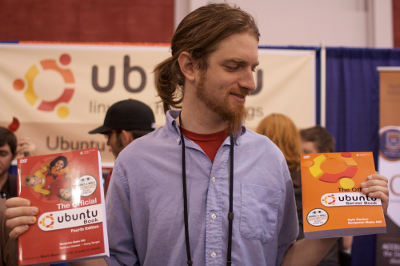
/copyrighteous/images/ubuntu_books_2009.png As I am attempting to focus on writing projects that are more scholarly and academic on the one hand (i.e., work for my day job at MIT) and more geared toward communicating free software principles toward wider audiences on the other (e.g., Revealing Errors), I have little choice but to back away from technical writing. However, this last month has seen the culmination of a bunch of work that I've done previously: two book projects that have been ongoing for the last couple years or more have finally hit the shelves! The first is the fourth edition (!) of the bestselling Official Ubuntu Book. Much to my happiness, the book continues to do extremely well and continues to receive solid reviews. This edition brings the book up to date for Jaunty/9.04 and adds a few pieces here and there. Although I was less active in this update than I have been in the past, Corey Burger continued his great work and Matthew Helmke of Ubuntu Forums fame stepped up to take a leading role. As I plan to retreat into a more purely advisory role for the next edition of this book, I'm thrilled to know that the project will remain in such capable hands. I'm also thrilled that this edition of the book, like all previous editions, is released as a free cultural work under CC BY-SA For years, I have heard people say that although they like the Official Ubuntu Book, it was a little too focused on desktops and on beginners for their tastes. The newly released Official Ubuntu Server Book is designed to address those concerns by providing an expanded guide to more "advanced" topics and is targeted at system administrators trying to get to know Ubuntu. Kyle Rankin planned and produced most of this book but I was thrilled to help poke it in places, chime in during the planning process, and to contribute a few chapters. Kyle is a knowledgeable sysadmin and has done wonderful job with the book. I only wish I could take more credit. The publisher has promised me that, at the very least, my chapters will be distributed under CC BY-SA. Many barriers to the adoption of free software are technical and a good book can, and often does, make a big difference. I enjoy being able to help address that problem. I also truly enjoy technical writing. I find it satisfying to share something I know well with others and it is great to know that I've helped someone with their problems. I'll assure I'll be able to do things here and there, I'll miss technical writing as I attempt "cut back."

Benjamin Mako Hill: Election Season

Two organizations I care deeply about are having elections this month. The first is the Wikimedia Foundation who is electing three community representatives to their board of directors. The second is Ubuntu who will soon be electing a new Community Council. The Wikimedia Foundation is perhaps the most important organization working on issues related to free culture. Wikimedia elections are currently ongoing and will close on August 10th. Editors who have more than 600 edits to their name across all Wikimedia wikis and 50 edits in 2009 made before July 1st are eligible to vote. The vast majority of eligible contributors to Wikimedia projects have not voted in previous elections. Ubuntu will be electing all members in a new --- larger --- Community Council. I have been a member of the council since it was created and I will be standing for election once again --- the last time I plan to do so. Work in setting up the election is being finalized and all Ubuntu Members will be able to vote in the election. Both Wikimedia and Ubuntu are struggling to find the right relationship between the communities who produce most of the value at the heart of their projects and the organizations and leadership structures that try to support and, from time to time, direct it. Ubuntu and Wikimedia are very different. What's at state at these elections is different too. But both elections are are extremely important and at pivotal times in their communities' growth. Both elections will have an important impact on the process of creating new organizational forms. My message in regards to both elections is also the same: If you are eligible to vote, please do. No governance system I've seen has as healthy and close relationship to the community it serves as it should. Wikimedia and Ubuntu are not exceptions. The result is a strange, and unhealthy, relationship between governance systems and the organizations at the heart of our community-driven projects and the communities themselves. We can all do better. There are not enough opportunities for community members to help push this balance in a better direction. These elections are one. I urge everyone who can to vote and to become involved.

Benjamin Mako Hill: Long Bike Rides

On recent weekends, I've been going on long bike rides. I like to keep going until the people I meet no longer know exactly where the place I left from is. The fact that one place is outside another place's inhabitant's mental map seems like a good sign that two places are far enough away from each other.

Benjamin Mako Hill: Order Without Law

Order Without Law is a fantastic book by Robert Ellickson published in 1991. In a way, the book is an in-depth case study of the irrelevance of law. Subtitled, "how neighbors settle disputes," Ellickson shows how people solve complicated problems in an archetypal area of liability law without knowledge of the law. Ellickson shows that even when people know exactly what the law says, they often ignore it in favor of community norms and, in his examples, models of "neighborliness." Specifically, the book is about how neighbors in northern California settle disputes related to damage caused by roaming cattle, how neighbors construct and share costs of fences, and how, although the law is frequently debated in relation to classifying land as either open or closed to free grazing, the law tends to take a back seat to unwritten norms in the way that problems are actually solved. There is order and a shared understanding of rules in Ellickson's account; it just has very little to do with the law. As part of his description, Ellickson goes into some detail about the types of damage that cattle cause. For example, Ellickson describes how bulls, will often break down barbed wire fences and go on rampages impregnating heifers, eating vast amounts of food, and destroying crops and equipment. When I was on a long bike trip through northern California a few weeks ago, I was sitting under a tree waiting for my cyling partner to catch up. A giant black bull nearby noticed me. Shorting, mooing, and shaking ribbons of slobber from its mouth, it lumbered toward me. Only a rather weak-looking barbed wire fence separated us. All I could think about was Order Without Law.

9 September 2009

Benjamin Mako Hill: Chrome OS and Autonomy

On Luis Villa's urging, I wrote up a short response to this article on "why Google Chrome OS will turn GNU/Linux into a desktop winner." I've posted my article over at Autonomo.us where it seemed most important.

31 August 2009

Andrew Cater: Madly dysfunctional family barbeque

At Steve's house in Cambridge. First Debian party I'd been to. House full of people I knew only from email, some very old friends. Wires and leads filling the front room floor - laptops _everywhere_ . [My netbook died with nasty ACPI errors - since fixed/worked around - it was practically the one place in the world where I could yell for an ACPI expert and folk knew what I was talking about :) ]

I wish I'd taken a camera - I was there for 1/2 hour before I realised I was only about three feet from a large TV which then became the focus for competitive Wii Fit archery :) Thirty second rule on sofa space - if you left for more than about 30 seconds you had to sit on the floor when you got back (I jammed myself onto a corner of the sofa once I realised I'd barely get through the crush :) )
[Forget students in a mini / UK telephone box - how many DDs can you fit into a very narrow kitchen :) ]

It's a huge, dysfunctional family with its own rules, geeky humour and in-jokes but it's MINE - it's the people I want to hang out with and, as perverse as it sounds, just being there gave me a whole new reaffirmed sense of identity and a large amount of determination to carry on "wasting my time with Linux" and Debian

Thanks to those who signed my key for me (and Noodles who didn't sign but gave a very intelligent rationale as to why he couldn't at the moment :) )
Thanks to Steve for quintessentially being and being the perfect host - and I hope to be back next year. And the food was excellent - chilli popcorn comes highly recommended :)

7 June 2009

Benjamin Mako Hill: Berlin

After a week at the International Open and User Innovation Workshop 2009 in Hamburg, I'm in Berlin again this week. I've got nothing concrete planned other than spending most of my days hacking on a few projects. Let me know if you're around and would like to meet up. I'll post more about my travel and talks schedule this summer as things firm up in the next couple weeks.

5 June 2009

David Moreno: @debianproject is now @debian!

Thanks to Jamie, who used to have the name registered and now handed it over, Twitter Debian's Twitter username is now @debian (go follow Jamie now!). If you were already following @debianproject, nothing will change. Having @debian on Twitter is actually kind of awesome!

19 May 2009

Benjamin Mako Hill: Spelling

When he was my adviser at the MIT Media Lab, I used to feel bad that I had trouble spelling Chris Csikszentmih lyi's name. As this screenshot from Chris' Dopplr page shows, I am apparently in good company. /copyrighteous/images/csik_dopplr.png

James Morrison: Running home

I've been running home from work on mondays for the last couple months. I started with the direct 3.5 mile route home. Now each week I vary my route a bit, last night I took Geary most of the way west. However, while running I was thinking I should find as many hills to take on the way home with only a small amount of back tracking. Well this 5.3 mile run looks to be a good approximation. Anyone up for a run next monday evening?

12 May 2009

James Morrison: Sita Sings the Blues

Sita sings the blues is playing at the red vic. I went to see it tonight, it was really cool. There are 4 styles of animation and the narration is a lot of fun. The narration style is 3 people sitting around chatting trying to remember a story. The really cool part is most of the music is recordings of Annette Hanshaw from the 20s.

My part in tonight was using 2 rolls of dimes to pay to get into the movie :) That's two rolls of dimes now back in circulation.

11 May 2009

James Morrison: Same Cities

On thursday I went out to see Loquat, The Greycoats, and Head like a kite. Head like a kite was a lot of fun, they had a dancing panda and foam heads (the ones you put whigs on) to throw around the audience. The strange part of the night was that I met Mark Johnson again. Mark was someone who knew a bunch of the same people as me in secondary school, then we both did co-op Math/CS degrees at UWaterloo, and since leaving school have both lived in the bay area. I didn't know Mark was in SF until this week, well, now we've met again, four years later.

Random thought:
Why are Canadians more patriotic when they are away from Canada? I saw a guy with a flag on his ipod shuffle while running yesterday.

8 May 2009

Antti-Juhani Kaijanaho: Star Trek

It is curious to see that the eleventh movie in a series is the first to bear the series name with no adornment. It is apt, however: Star Trek is a clear attempt at rebooting the universe and basically forgetting most of the decades-heavy baggage. It seems to me that the reboot was fairly well done, too. The movie opens with the birth of James Tiberius Kirk, and follows his development into the Captain of the Enterprise. Along the way, we also see the growth of Spock from adolescence into Kirk s trusted sidekick and also into well. Despite the fact that the action plot macguffins are time travel and planet-killer weaponry, it is mainly a story of personal vengeance, personal tragedy, and personal growth. Curiously enough, although Kirk gets a lot of screen time, it is really the personal story of Spock. Besides Kirk and Spock, we also get to meet reimagined versions of Uhura (I like!), McCoy, Sulu, Chekov and Scott. And Christopher Pike, the first Captain of the Enterprise. The appearance of Leonard Nimoy as the pre-reboot Spock merits a special mention and a special thanks. I overheard someone say in the theatre, after the movie ended, that the movie was a ripoff and had nothing to do with anything that had gone before. I respectfully disagree. The old Star Trek continuum had been weighed down by all the history into being a 600-pound elderly man who is unable to leave the couch on his own. This movie provided a clearn reboot, ripping out most of the baggage, retaining the essence of classic Star Trek and giving a healthy, new platform for good new stories. One just hopes Paramount is wise enough not to foul it up again. It was worth it, I thought.

5 May 2009

Jan Hauke Rahm: Avelsieve 1.9.8

Today the SquirrelMail plugin avelsieve happened to be released with version 1.9.8. Thanks and kudos to Alexandros who after so long time still was in the mood to put things together. The new features promise to be amazing: a new user interface, much code rewriting, and an entirely new SPAM handling. Unfortunately after installing it my SquirrelMail installation went badly down somehow. While everything alse is delivered properly by apache2, SquirrelMail now runs into one timeout after another. I need to figure out what s actually going on there. The error.log is quiet so far Anyways, for all you people who are looking forward to see this new fancy and shiny version in sid, I have to ask for patience. I think the package is ready but before testing no uploading! Until then you can (if you re brave) test the package by installing it from http://downloads.jhr-online.de/avelsieve_1.9.8-1_all.deb And all you others just have a look at the changelog that s probably (hopefully) hitting sid in a few days:
  * New upstream release
     + A large part of the code has been rewritten.
     + A new-style SPAM rule has been implemented.
     + A new, global Whitelist rule has been implemented, for
       the SPAM rules to take advantage of.
     + New, "Custom Sieve Code" rule has been implemented; this allows users
       to enter directly Sieve code snippets as a rule. (experimental)
     + Miscellaneous code movement and restructuring.
     + UI: The "Add New Rule" buttons are now links, and are displayed
       both at the top and at the bottom of the rule table.
     + UI: Major rework in the UI of both the Rules Table and the Add New
       Rule / Edit Rule pages.
     + UI: If a vacation rule is active, then display a notice in the
       rules table page and upon logging in to Squirrelmail, that reminds
       the user.
     + UI: Vacation options have been aligned properly; text has been
       changed accordingly.
     + Sieve: Vacation Subject is now supported.
     + New functionality: "Insert New Rule Here"
     + New functionality: "Move Rule to Position" (requires Javascript)
     + Avelsieve now highly recommends the use of javascript_libs plugin
       for some visual effects / UI improvements.
     + UI: Added new icons and used different ones, to improve usability.
       Icons are provided by Mark James' famfamfam.com.
     + UI: Added new icon "theme" based also on famfamfam.com. This theme
       is the default from now on.
     + UI: Removed unnecessary text / clutter from rules table page.
     + UI: The notify action options have been aligned in a table.
     + Added an LDAP Sieve storage backend, compatible with Sun Messaging
       Server's Sieve features.
     + The DO_Sieve_* backends should have a separate retrieve() method
       for retrieving the raw Sieve script. Currently, only the Managesieve
       backend has it.

4 May 2009

James Morrison: I love resharing

Today I found something that bubble shared on Google reader. It was AWESOME. So I shared it. The second best part of my day, besides finding the item was seeing two other friends share the same thing. This is why the internet was built!

Also, climbing was good today. Trisha seems to improve much faster than me. 5-6 - 5-10B in one day. I have now finished only one 5-10A.

22 April 2009

Russell Coker: Links April 2009

P. W. Singer gave an interesting TED talk about the use of robots in war [1]. He briefly covered some of the ethical and social issues related to robot soldiers as well as showing many pictures of existing robots. Since November 2007 there has been a request for Google Gears to support Iceweasel (the Debian name for Firefox due to trademark issues)[2]. Apparently supporting this different name is not easy for the Google people. If you visit the Google Gears Terms and Conditions page [3] then it will work with Iceweasel on the i386 platform - but not for AMD64 (or at least not my Debian/Lenny AMD64 system). Charles Moore gave a disturbing TED talk about the Great Pacific Garbage Patch [4]. Pollution in the oceans from waste plastic is worse than I realised. Ressuka documented how to solve the Time went backwards problem on Xen DomUs [5]. Run echo jiffies > /sys/devices/system/clocksource/clocksource0/current_clocksource or use clocksource=jiffies in your DomU kernel boot parameter list. Nassim Taleb [6] has written Ten principles for a Black Swan-proof world [7], this is in regard to the current US financial crisis. It s worth noting that he made a significant amount of money due to successfully predicting some aspects of the crisis. James Duncan Davidson has some good advice for speakers based on his experience in filming presentations [8]. Some of the ones that were not obvious to me were:
Take off your name-tag - it doesn t look good
Stay in the part of the stage with the best light

12 April 2009

Benjamin Mako Hill: AttachCheck Revved

I finally got around to pushing out a new version of AttachCheck --- a trivial little program I wrote several years ago that tries to prevent people from having to send followup emails with subjects that include phrases like, "REALLY attached this time," by asking you for confirmation when you send an email that says you've attached something when it looks like you haven't. The release fixes a single bug that affected a few users --- thanks to Iain Murray who sent the patch in and apologies to him and others for taking a while to push it out. There's very little to AttachCheck and, if I remember correctly, it was the very first program I wrote in Python. I'm only mentioning this revision because it's been quite a few years since I last mentioned the program and, while the script doesn't do much, it continues to save me a little embarrassment and effort every other week or so.

Andrew Pollock: [debian] Grappling with Git, episode 1

At work, we have a bit of a vested interest in the Puppet and Facter packages that are in Debian, because we ultimately consume them in Ubuntu. We noticed that what was in Debian unstable was lagging a bit behind what was released upstream, and when one of my co-workers tried getting in contact with the Debian developers that were maintaining the Puppet package and got no response, I got involved. I got in touch with Micah Anderson and got myself and Nigel Kersten added to the Alioth project for Puppet. Despite Jamie Wilkinson being listed as the maintainer of the facter package in Debian, he claimed this was news to him, and Matt Palmer, who was listed as an uploader, didn't really claim much knowledge of maintaining the package either, so we took that as blessing to take over that package as well. This is where the fun begins. I've been meaning to try out Git ever since Debconf 7, where all the cool kids were using it and raving about it. I've been meaning to make the Debian DHCP package collaboratively-maintained, and use Git for the revision control, but I haven't quite gotten off my good intentions and done it yet. Part of the problem is not knowing exactly what workflow I should use, and suffering from paralysis by analysis, reluctant to experiment, because I don't want to go down the wrong path. Anyway, this is about Puppet, not DHCP. The Puppet package, as it turns out, is already maintained in Git on Alioth, so the problem here was more one of figuring out what the current workflow was, and trying to follow it. This is where Nigel came in. Conveniently, the upstream Puppet development is done in Git also, and Nigel is a contributor to Puppet upstream, so he had some Git-fu. So between the instructions on how to get started with Git on Alioth and what he knew, we could start fumbling around. It seems like the Alioth Git repository was also tracking the upstream Puppet repository, as there were commits in the Alioth one by Luke Kanies, and we didn't really imagine that he was doing Debian-specific stuff. Here's what we ended up doing to try and get what was in the Alioth repository up to the upstream version 0.24.8 of Puppet:
git clone ssh://apollock@git.debian.org/git/pkg-puppet/puppet.git
This part was fairly straight forward. Clone what's in Alioth locally.
git remote add reductive git://reductivelabs.com/puppet
git remote update
git fetch --tags reductive
Next, we added a remote branch that tracked upstream. We called it "reductive", and we updated it. The bit that took some fiddling with was fetching the tags. Nigel later figured out that tags are inherently private to a repository, and normally stay that way. So if I have a local clone of say the upstream Puppet repository, I can tag it to my heart's content, and normally those tags would stay in my local repository, because they're probably only meaningful to me.
git checkout -b upstream/0.24.8 0.24.8
This bit took a bit of work to arrive at as well. What we wanted to do was create a new branch called upstream/0.24.8, which was at what was tagged 0.24.8 in the reductive repository. Nigel pondered what would happen if you already had a tag or a branch called "0.24.8" before you added the remote repository. This is also why we had to fetch the tags from the remote repository, so we had something to check out.
git checkout master
git merge upstream/0.24.8
Next, we switched back to the master branch and merged the contents of our local upstream/0.24.8 branch that we just created. This now got the Puppet source in the master branch up to what was released as version 0.24.8. (and this is better than just running uupdate?) We did some fiddling with the debian/control file and debian/changelog and fixed up a few things that Lintian was bitching about, and were done. I'd set up a sid chroot with cowdancer previously, and had to do some faffing around with git-buildpackage to convince it to use pbuilder. I ended up using
git-buildpackage --git-builder="pdebuild --debbuildopts '-i\.git -I.git' --basepath /var/cache/pbuilder/base-unstable.cow"
So now we've got most of what we want to ship checked into Git on Alioth. I have no idea if we've done it "right", I suspect we may have done something wrong by operating on the master branch. Looking at the revision history in the Git repository on Alioth, it looks like previously things have been done a few different ways. I certainly want to write up a definitive workflow once we've figured one out. We haven't uploaded the new package to unstable yet, because we're still trying to give it a modicum of testing, and we'd like to sort out the Facter package as well. The Facter package was a more greenfield exercise, as while there was already a Git repository on Alioth for it, it was empty. So Nigel had to do some futzing around to get it checked in the right way to make git-buildpackage want to build it. He did this by himself, so I'm not sure exactly what he did. I've since discovered that it's probably lacking some dependencies it needs, so that'll need to get fixed before it gets uploaded. I look forward to reading blog posts from the smart people who actually know how to use Git properly, telling me how we should have done it. I'm still very interested in coming up with a proper workflow for preparing packages and committing the changes, and for doing code review.

11 April 2009

Benjamin Mako Hill: American Gothic and the Free Culture Imperative

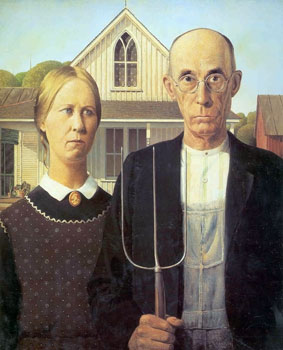
About a year ago, I read American Gothic by Steven Biel and the book has left a surprising lasting impression on me. The book describes the background, history, and life of "American Gothic: America's most famous painting" by Grant Wood. Even if you don't recognize the name "American Gothic", you are likely to recognize the picture or the scene. The book is a serious and -- as far as I can tell -- reasonably comprehensive treatment of the subject that is interesting, insightful at points, and a breeze to read. Thumbnail of the American Gothic Painting Of course, the book is not actually about the painting that hangs in the Art Institute of Chicago -- although it will certainly teach you more than you probably ever wanted to know about that painting, its subjects, its settings, etc. The book is really the story of how that paining has been received, understood, and used. Nearly half of the book focuses on examples of people who have remixed, reworked, reimagined, and reproduced the painting in myriad forms, formats, settings, and ways. The book contains scores of photographs of celebrities posing in American Gothic style settings, dozens of political cartoons based on the paintings, images of talk shows, magazine covers, Broadway plays, product advertisements, toys, gifts, kitch, and more, done up in recognizeable representations of the basic American Gothic form. There is a very incomplete of references to American Gothic in popular culture at Wikipedia that can give a tiny taste of what is out there. The last chapter of the book is devoted to these "parodies" and there's some brief talk of issues around copyright and control of the image. Wood's sister Nan was the owner of the copyright for much of the second half of the twentieth century and is also the woman in the painting. She famously charged several makers of more lurid take-offs with defamation and successfully blocked a number of remixes. In 1988, Nan transferred ownership to the Visual Artists and Galleries Association (VAGA) which will hold the copyright until 2025. VAGA also claims "rights of publicity" in Nan's image which will last until 2060. VAGA takes a very expansive view of its copyright claims and argues that it has both veto power and royalty rights to any recognizably similar work. For example, VAGA does not want the American Gothic image used in alcohol advertisements and has successfully had such ads pulled. Biel's book contains no reference to the amount of money made from licensing the work but one can only conclude that it must be massive. VAGA blocked a plan by Iowa to use the picture on the back of the Iowa state quarter due to licensing disagreements; instead Iowa used a different Wood painting that was clearly in the public domain. What struck me most about Biel's book is related to just how deeply ingrained in American culture the American Gothic image has become. The book cites simple surveys that show that almost every American recognizes the painting (although only a small fraction know the painting's name or who painted it). The thousands of parodies that the book documents are testament to the fact that the painting has become a way of representing something essential about American culture and its values. But in a strange way, the painting's popularity and incessant reuse has also made it part of the culture that it so effectively captured. We can think of culture as a set of shared values and references that help us related to each other and to communicate. Just like idioms in language, culture helps us communicate more effectively, certainly, but also lets us communicate messages that would not be communicable otherwise. When Out Magazine, Coors, or any of several dozen others replace the figures in American Gothic with a gay or lesbian couple, they are succinctly sending a message about homosexual relationships and American traditional values that could not be made any other way. In this way, American Gothic -- both the painting and Biel's book -- represent a strong argument for free culture. If American Society has infused American Gothic with so much value, how can it be fair to let one person or organization own it? Are they not owning an essential mode through which a society can relate, experience, and communicate? I can't help but conclude that it shouldn't matter if VAGA does not like alcohol, advertisements, homosexuality, or wants to make a some money every time someone makes a cartoon parody. These are trivial concerns next to the importance of our society's need to communicate about these issues. If doing so requires the use of a shared cultural reference in VAGA's painting, I find it hard to justify VAGA's position of control. We need to be able to reproduce and reimagine American Gothic because it has become part of us. It's a striking example of the way that art becomes culture and the reason that truly free culture is the only appropriate response. We can't afford to let our experience of the world and each other -- to let ourselves at a very fundamental level -- be owned and controlled.

Next.

Previous.