Search Results: "hug"

20 March 2014

Bits from Debian: Debian Project Leader elections 2014

It's again that time of the year for the Debian Project: the elections of its Project Leader! Starting on March 31st, and during the following two weeks, the Debian Developers will vote to choose the person who will guide the project for one year. Among this year's candidates there is the current DPL, Lucas Nussbaum, who admits that "the workload involved in being the DPL is just huge," and motivates his nomination with the need for stability in the project in this release cycle, especially after the difficult decision about the default init system. In his platform, Lucas speaks of technical and social steps to improve the project: from reproducible builds for a more secure archive to a renewed effort to run Debian on new platforms (especially smartphone and tablets); from a more welcoming approach to prospective contributors to an easier collaboration with organizations. The only other candidate left after Gergely Nagy withdrew his nomination, is former Release Manager Neil McGovern. Neil's platform focuses mainly on the need to "ensure that we cater to our users, and there's millions of them. From those running the latest software in unstable, to people who simply want a rock solid core release." In his opinion "the size of Debian is increasing, and will reach a point where we're unable to guarantee basic compatibility with other packages, or the length of time it takes to do so becomes exponentially longer, unless something changes." To fix this problem, Neil proposes the implementation of PPAs (Personal Package Archives), the modernisation of the current build and infrastructure system as well as generally supporting the various teams. The campaigning period will last until March 30th: the candidates are already engaged in debates and discussions on the debian-vote mailing list where they'll reply to questions from users and contributors.

19 March 2014

Andrew Pollock: [life] Day 50, Kindergarten, appointments central, cleaning, meetings and meltdowns

Today was a very busy day for me. First up, I had my chiropractic adjustment. Then I had my half-yearly dental checkup. Then I got stuck into cleaning the house. Fortunately I'd done a bit the afternoon before, otherwise I'd never have gotten it done before my massage. I'm starting to seriously consider getting a cleaner. I can make much better use of the limited time I get than cleaning the house. Zoe's Kindergarten has a Parent Advisory Group or something like that, which meets monthly. I wasn't able to attend the first one, but the second one was today, about an hour before pickup, so I grabbed a quick lunch after my massage and biked over to Kindergarten early. The meeting wasn't particularly interesting. The majority of it revolved around fund raising. At pickup time, Zoe was fast asleep again, and had another massive meltdown when I woke her up. It took forever to get her out. She wanted to give Megan a hug, but Megan had long gone. Then, rather fortuitously, Megan's Dad texted me to tell me they were in the playground on the neighbouring school grounds, so I managed to use that as an incentive to get Zoe moving. I didn't know until today, but at the foothill of the neighbouring primary school, there's some play equipment. A few of the Kindergarten kids seem to have a play over there after Kindergarten. Megan and Zoe played there for a bit before it was time to go. Once we got home, we unpacked and then walked down to the Hawthorne Garage to get some vegetables, and then, after buying some milk from the corner store and another grumpy meltdown, I figured a quiet afternoon was in order, so Zoe watched a DVD for a bit while I prepared dinner. I'd bumped into the mother of Zoe's friends Eva and Layla from her old day care while I was at the dentist in the morning, and arranged for her to drop by to pick up a copy of the photos I'd taken at their 4th birthday party. I'd hoped that she'd bring the girls with her, and had told Zoe they'd be dropping by, but unfortunately she came on the way to picking them up from day care, so Zoe was a bit disappointed. We did arrange to have them over for dinner next Friday, so I'm sure that will be very exciting. After that, we had dinner, and a fairly uneventful bedtime. It's hot again, so I hope that doesn't mess with her sleep.

14 March 2014

Richard Hartmann: Git prize: Outstanding Contribution to Open Source/Linux/Free Software

In February, Linux Magazine contacted me, asking if I would be willing to accept the Linux New Media Award 2014 in the main category "Outstanding Contribution to Open Source/Linux/Free Software" on behalf of the Git community due to my involvement with evangelizing and vcsh. Needless to say, I was thrilled. I managed to poke Junio via someone at Google and he agreed. We also reached out within the German Git community and two maintainers of git submodule, Jens Lehmann and Heiko Voigt, joined in as well. While we didn't manage to hammer out interoperability issues of vcsh and git submodule due to time constraints and too much beer, we are planning to follow up on that. Git beat OpenStack, Python, and Ubuntu by a huge margin; sadly I don't have exact numbers (yet). More details and a rather crummy photo can be found in Linux Magazine's article. A video of the whole thing will uploaded to this page soonish. If it appears that we kept our "speech" very short, that was deliberate after the somewhat prolonged speeches beforehand ;) The aftershow event was nice even though the DJ refused to turn down the music down to tolerable levels; his reaction to people moving father away, and asking him to turn down the volume a bit, was to turn it up... Anyway, given the mix of people present during the award ceremony, very interesting discussions ensued. While I failed to convert Klaus Knopper to zsh and git, at least there's a chance that Cornelius Schuhmacher will start using vcsh and maybe even push for a separation of configuration and state in KDE. The most interesting tidbits of the evening were shared by Abhisek Devkota of cyanogenmod fame. Without spilling any secrets it's safe to say that the future of cyanogenmod is looking extremely bright and that there are surprises in the works which will have quite the impact. Last but not least, here's the physical prize: Glass trophy held by your's truly

3 March 2014

Richard Hartmann: Facial recognition

Dear crazyweb, while there seem to be good GUI tools to enable facial recognition with FLOSS, they all fall short of my requirements. And while there seem to be a lot of research projects with open code, they seem to be lacking in the "usable in real life" department. It seems as if there should be something to scratch that itch, but I couldn't find it... Thus, my wishlist for facial recognition software I will gladly follow up with a workflow blog post assuming I end up with useful feedback.

Rog rio Brito: More completed MOOCs

This weekend I received my 17th certification (or Statement of Accomplishment) for MOOCs. In particular, this last MOOC that I took was Creative, Serious and Playful Science of Android Apps, offered by Lawrence Angrave of University of Illinois at Urbana-Champaign. While I certainly knew that the course was an Introduction to Programming, the reasons I took it were twofold:
  1. For the "novelty" (for me, at least) of writing some Android Apps
  2. To reacquaint myself with Java, which I have not touched since 1999, when I wrote a compiler, in the ages of JDK 1.0 being transitioned to JDK 1.1.
I think that the time the course took (and which I invested in) was really well spent. In fact, I learned some nice things which I would not have touched otherwise. For instance, I made the conscious effort to use an IDE (Eclipse), despite being a person that would do most of the things inside Emacs and compile the programs with command-line tools. Despite being huge, Eclipse has some really nice features and the auto-completion is amazing. Since Java is so strongly typed and Eclipse knows Java pretty well, it almost completely writes your programs for you. :) Of course, my interest also made me want to streamline the build process and use the command line tools (with ant, another tool that was "alien" to me, having used makefiles for everything that I needed). The use of Eclipse (and the Android development environment in general) in my Debian unstable computers was not without problems, but after spending more time trying to fix Eclipse than really doing the homework (and pulling the little hair that I still have left), one really helpful post nailed it. (Yes, I had to remove other packages like gimp, but such is life). While playing with the Android side of things, I put one badly written (and not really "android-ish") app in a github repository (which I think is aptly named "Toy Android Apps"), which served me the purpose of learning some Android-specific concepts. But the course was helpful not only to get in touch with the tools (Eclipse, ant, running Android virtual machines with the help of kvm), but also on the Java side. I lost a bit of the prejudice against it (even though I still think it is a verbose language, especially when compared to, say Python), and I, also intend to contribute to one apache project or another that have low-hanging fruits. Actually, I have signed their Contributor License Agreement and I even had my first patch accepted! Aside: Well, sadly SVN doesn't support different committer and author fields like git does and it seems that doing many small commits may not be the Apache way of doing things but the important part of all this is that the code is there and there is so much more to be done. Aside #2: After a lot of time spent converting the repository to git (which is, after all, what I use), I put a mirror of Apache's the commons graph project.

26 February 2014

Neil McGovern: Valve reveal Portal 2 Linux beta, sponsor DebConf14, public issue tracking, oh my!

Valve have announced the availability of Portal 2 beta for Linux! It s exciting to see such a fantastic game coming to the platform. Luckily, some developers can get it for free :) Interestingly, there s also a public bug tracker, which also hosts the public bug tracker for a number of their linux engagements, and also quite a bit of code for things like voglperf, steam-runtime, halflife and the source-sdk. Additionally, Valve s logo also now appears as a gold sponsor for DebConf14, in Portland. A huge thanks I think to Valve for putting in the effort!

23 February 2014

Paul Tagliamonte: Debile + Docker = love

I ve spent a bit of time this saturday Dockerizing Debile s slave / workers (for those who don t know about Debile yet, there are a few posts where I explain it) Many thanks to Tianon Gravi for his work in helping me out :) I created two images to test - the base image for any slave (paultag/debile-slave-base, and a preconfigured image for our test master server. This includes a script to preconfigure the slave worker (OpenPGP keys, username, password) that are passed to it via a tarball generated by debile-remote. Hopefully this makes deploying debile slaves easier :) I was able to do a test build of about 300 packages with the dockerized slave, and I think it s a huge step forward. Onward!

17 February 2014

Paul Wise: Join the Process Identifier Preservation Society today!

Process Identifiers (PIDs) are a scarce resource. On Linux they are only 15 bits by default. The Process Identifier Preservation Society (PIPS) aims to reduce abuse and wastage of the PID space. To join the society please read the following advice.

Common issues Several languages generally allow you to run all your code in one process. Some of the code that you might want to incorporate or use is not available in the form of ELF libraries or language specific libraries but only in the form of ELF binaries or interpreted scripts. As a result using additional PID space is sometimes unavoidable. Many languages have multiple methods of starting external processes and usually some of them waste PID space by running commands in a shell. You can avoid those methods or use the exec builtin to preserve the shell PID. It might be tempting to explicitly use shell in languages that don't allow implicit shell use but that just wastes extra PIDs. Several languages allow you to fork one process into two, this uses an extra PID and is to be avoided unless necessary.

Shell Programs written in the shell languages use a lot of PIDs. Even shells that have a lot of shell builtins (like busybox sh) appear to use the PID space by forking a child process. To join PIPS you should just stop writing programs in shell or use as many builtins as possible and use exec to preserve PIDs.

Init Several init systems are written in or use shell extensively and thus eat huge bowls of PIDs for breakfast. To join the PIPS you should switch away from sysvinit, openrc, init=/bin/sh etc.

C/C++ The common issues section applies to the C/C++ language. To join PIPS you should rewrite your code to use fork()+exec(), g_spawn*() or libpipeline instead of the g_spawn_command_line*(), system() and popen() functions.

Perl The common issues section applies to the Perl language. To join PIPS you should rewrite your code to avoid backticks and only pass arrays to the system(), open(), open2(), open3() functions.

PHP The common issues section applies to the PHP language. To join PIPS you should rewrite your code to use pcntl_exec() instead of backticks, exec(), system(), passthru(), shell_exec(), popen() and proc_open(). Apparently pcntl_exec() is disabled by default on Debian and pcntl_* are often unavailable so you should just not spawn processes. You could also just drop PHP already.

Python The common issues section applies to the Python language. To join PIPS you should rewrite your code to use the subprocess module and avoid passing shell=True to the subprocess.Popen() function. The os.system(), os.popen() functions and the commands module all run their commands in a shell, wasting PID space. The popen2 module requires passing arrays instead of strings in order to avoid the command being run in a shell.

Java The common issues section applies to the Java language. To join PIPS you should rewrite your code to use ProcessBuilder or only pass arrays of strings to Runtime.getRuntime().exec().

Haskell The common issues section applies to the Haskell language. To join PIPS you should only ever pass a RawCommand to createProcess and never use the shell, system, runCommand or runInteractiveCommand functions from the System.Process and System.Cmd libraries.

OCaml The common issues section applies to the OCaml language. To join PIPS you should rewrite your code to use fork+exec or the create_process* wrappers instead of system, open_process, open_process_in, open_process_out and open_process_full.

Go Go allows running external processes but doesn't allow you to waste PID space by running commands in shell. Avoid explicitly running the shell though.

Rust Rust allows running external processes but doesn't allow you to waste PID space by running commands in shell. Avoid explicitly running the shell though.

Erlang The common issues section applies to the Erlang language. To join PIPS you should rewrite your code to use erlang:open_port( spawn_executable, ... , ...) instead of os:cmd or the other options to erlang:open_port.

Node.js The common issues section applies to the Node.js language. To join PIPS you should rewrite your code to use the child_process.execFile() function (or other child_process functions) instead of child_process.exec().

Julia Julia allows running external processes but doesn't allow you to waste PID space by running commands in shell. It emulates a lot of shell features instead. Avoid explicitly running the shell though.

Dart The common issues section applies to the Dart language. To join PIPS simply do not enable the runInShell parameter of the Process object.

PS Let me know if I missed something in one of these languages. You should also do most of the above to avoid shell metacharacter injection attacks that usually allow arbitrary code execution. Dear language authors, don't allow running external processes in shell, kthxbye!

16 February 2014

Siri Reiter: Conference Communication Design Building Blocks

As an introvert I like - well, I need to - spend time alone. I get my best ideas on my own. But when I truly thrive is when I am connected with others, cocreating. For the last couple of weeks it's been difficult for me to work on the visual design for the MiniDebConf in Barcelona next month. There have been practical reasons, but the real reason was that I was feeling stuck and overwhelmed. Sharing my uncomfortable feelings with my boyfriend finally made me able to see that I have been feeling alone, and feeling that I had to prove myself with my work. I felt disconnected from the people in Debian I want to cooperate with. I'd really benefit from sharing my thoughts and ideas more with others. The unpleasant feeling of "stuckness" dissolved when I said out loud what they were about, and ideas for changing my state appeared. Now I've started hanging out on the irc-channel more, I've asked for help in finding stuff in the huge pile of info, rules and previous examples and experiences at debian.org and my decision to blog and share more is strengthened. Finally the work has begun. Conferences are about meeting up and getting connected. Listening to somebody trying to enlighten you on a subject. Getting inspired. And so my idea of using speech bubbles as a visual identity koncept for the conference has everything to do with my own experience of connection and disconnection. Release, early, release often, I cannot say that I have done that. We really need the peoposals to be ready now. Thankfully I'll have time in the following days to get feedback and finish. I really hope people will accept the idea, but I'm expecting a debate.

12 February 2014

Don Armstrong: Working with Org-mode: Committing Changes Everywhere

I'm a huge fan of Org-mode, and I keep all of my org-mode files in git repositories which are under myrepos control. However, because I often make lots of changes to my agenda and notes, I hate having to manually visit each individual project and make changes to it. [And it's also annoying when I forget to commit a specific change and then have to try to get my laptop and desktop back into sync.] Luckily, myrepos can easily run a command in parallel in all of the repositories! The following "update_org_files" command will update all of my org-file containing repositories in parallel:
#!/bin/bash
ORG_GREP='-e .org$ -e .org_archive$ -e .org_done$'
if [ "x$1" == "xdoit" ]; then
    if git status --porcelain -z   grep -z '^ M'   grep -zq $ORG_GREP; then
        git status --porcelain -z   grep -z '^ M'   grep -z $ORG_GREP   \
            sed -z 's/^ M//g'   \
            xargs -0 git commit -m'update org files'
        git push;
    fi; 
else
    emacsclient -n -e '(org-save-all-org-buffers)' >/dev/null 2>&1
    mr -d ~ -j5 run update_org_files doit;
fi;
An updated version of this lives in my git repository

10 February 2014

Andrew Pollock: [life] Day 13, early start, Kindergarten and messing around with a hot glue gun

I had an early start today. I set my alarm for 5:30am, and finally got going a bit after 6am, and knocked out a 10km run. It was my first 10km in about a month. It wasn't pretty, but I was looking for accomplishment, not achievement. Sarah's doing a work training course that had an early start, so she asked me if she could drop Zoe to me early and have me take care of Kindergarten drop off for her. Zoe arrived at around 8am, and I put some sunscreen on her and we jumped on the bike. I had one of the smoothest drop offs I've had since we've been back in Australia. Megan was already there, and after we got settled, the two girls started building with some large wooden blocks, and Zoe pretty much gave me a hug and a kiss and sent me on my way. She didn't require any handing off to a teacher, wasn't clingy or anything. It was wonderful to see. Today was supposed to be my Debian day, but I've got something like 3 tax returns to do for two different countries, so I got stuck into collating records instead. After lunch I allowed myself to get sidetracked with trying to figure out the Google Drive API, because I'm trying to directly scan documents to Google Drive. Then it was time to do the Kindergarten pick up. Both girls were fast asleep when I got there. I tried rousing Zoe without much success, so I went to try and wake up Megan. She was also pretty heavily sleeping, so I left her with one of the teachers to try and wake her up and returned to Zoe. She took a lot of work to wake up, but woke up happy. I was expecting a couple of packages today, and the first one was being delivered by Australia Post as we got home, so that was pretty good timing. The second one was delivered while we were home, so that worked out pretty well. For this afternoon's activity with the girls, I thought we'd make peg dolls. I've been stockpiling craft materials for almost as long as I've been back in Australia. I bought the big IKEA EXPEDIT 5 x 5 shelf, and have the bottom two rows set up as Zoe-accessible craft materials, reminiscent of the "bin wall" that the TechShop had. I've been getting stuff from Riot!, but I've also found that there's lots of good stuff to be had for cheap from Overflow. So today's activity I think came from Riot! It was your bog standard wooden clothes pin, but the kit included a conical wooden "sleeve" that I guess was supposed to be a "dress". I thought I'd take things to the next level by hot-gluing a styrofoam ball on the top of the peg, and then hot-gluing eyes and a pom-pom nose on. The girls decided on their own to glue orange cellophane for hair, and got me to draw on eyebrows and a mouth. I had a couple of sheets of felt, so I cut holes in the middle of them and used the conical wooden sleeve to hold the felt dress in place. Pipe cleaners made the arms and they were finished. The girls seemed to enjoy making and playing with them. It was the first time I've used the hot glue gun, and I wasn't sure how it was going to go. I explained to the girls that the tip was hot and to stay away from it, and let them use it under close supervision. Unfortunately Zoe learned the hard way that the glue is also very hot after it's been applied to the surface that it's going to be used on. Hot glue was definitely the way to go for a quick project where we didn't want to be sitting around waiting for PVA glue to dry. After that, the girls watched a DVD for a little while and then Megan's Dad arrived to pick her up. I started dinner a bit late, I should have started it while the girls were watching TV, so we didn't sit down to eat until later than usual. Bedtime went pretty smoothly, but also ran a bit late. Here's hoping Zoe sleeps well tonight.

8 February 2014

Sam Hartman: IETF Takes on Challenge of Internet Monitoring

At IETF 88, we held a plenary discussion of how we could harden the Internet against ongoing monitoring and survalence. There were no significant surprises in what people said about monitoring. So, we had an opportunity to focus on what the IETF as a standards organization responsible for technical standards that drive the Internet can do about this problem. I think we made amazing progress. The IETF works by consensus. We discuss issues, and see if there s some position that can gain a rough consensus of the participants in the discussion. After a couple of hours of discussion, Russ Housley asked several consensus questions. The sense of the room is that we should treat these incidents of monitoring as an attack and include them in the threats we try and counter with security features in our protocols. The room believes that encryption, even without authentication has value in fighting these attacks. There was support for the idea of end-to-end encryption is valuable even when there are middle boxes. IETF decisions made in meetings are confirmed on public mailing lists, so the sense of the room is not final. Also, note that I did not capture the exact wording of the questions that were posed. This is huge. There is very strong organizational agreement that we re going to take work in this space as seriously. Now that we ve decided pervasive monitoring is an attack, anyone can ask how a proposed protocol (or change to a protocol) counters that attack. If it doesn t handle the attack and there is a way to address the attack, then we will be in a stronger position arguing the threat could be addressed. In addition, the commitment to encryption providing value without authentication will be useful in providing privacy and minimizing fingerprinting by passive attackers. The IETF is only one part of the solution. We can work on the standards that describe how systems interact. However, implementations, policy makers, operators and users will also play a role in securing the Internet against pervasive attacks.

6 February 2014

Andrew Pollock: [life] Day 10, Playgroup again

I was bracing myself for a rough night, but Zoe slept through until almost 6am. Today was playgroup again, so we just took a slow start to the day and headed out on the bike a bit after 9am. There was a mix of new faces and people from last week. I packed a lunchbox this time instead of relying on the snack collection in my "Dad Bag" backpack. We worked on trying to approach other girls to get them to play. Unfortunately they're all that little bit younger and more shy, so we haven't had a huge success. Zoe's been pretty happy just playing with the various toys and playing with me. Parachute time was a big hit again. I think there were about 25 adults there (I was the only Dad this week), with many with multiple children. The youngest baby I saw was a 7 week old. Zoe had been asking me what a honeydew was, so after Playgroup we dropped by the Hawthorne Garage and grabbed half a honeydew and a couple of tomatoes and I made some fritters for lunch with leftover corned beef from dinner the other night. Zoe wasn't too impressed with them. I think she didn't like the diced tomato. She declared that the honeydew was just like rockmelon. We read a story in the hammock and she went down pretty easily for nap after that. I'd just started doing the dishes when my mate Steve gave me a call. He was in the area, and he dropped in. That worked out well, because I'd been meaning to pick his brain about my little electronics project. We geeked it up for a bit. Zoe's mini lab coat arrived in the mail, and when she finally woke up after 3pm, I asked her if she wanted to go out to Bunnings to get a pair of kids-sized safety glasses, but she said she wanted to do something "fun" instead. When I asked her what she wanted to do, she initially wanted to go to Wet and Wild, but that's an all day outing and we're going next Wednesday, so she settled on going to Colmslie pool again instead. So we quickly got organised and jumped on the bike and biked over to the pool. We started out in the kid's play area, which had a couple of small slides and some fountains and whatnot, and then we gravitated over to the 50 metre pool, where Zoe practised her diving for a bit and generally quite confidently navigated the 1.5m deep end of the pool. It was good, because at least I could just stand up instead of tread water while she practised diving in off the blocks. We had a post-swim ice cream and biked home, and then I whipped up dinner and it was bathtime and bedtime. I'm going to have to start tracking my weekly kilometres with Zoe on the bike, because I think it'll be a reasonable distance.

3 February 2014

Wouter Verhelst: Waking up

Today is the monday after FOSDEM 2014, and I'm slowly waking up. Being in charge of the video team, and after having spent a whole week preparing followed by a whole weekend stressing about, today is a day of slowly waking up from hibernation and returning gear to various rental companies. At FOSDEM 2013, we had recorded five rooms. Even though we did lose a few talks, I felt pretty good about the whole thing, and I think we did pretty well then. It had been my plan to increase the number of rooms to be recorded from 5 to a reasonably higher number say, 10 or so but someone convinced me to do all of them. I'll readily admit I was afraid. Scratch that, I was terrified. Petrified, that we wouldn't be able to pull it off. For previous editions, we'd kept the number conservative, since video work is a high-risk business: if something goes wrong with volunteers work (say, the heralding volunteer doesn't show up), you find a replacement, or you have a staff member introduce a speaker, and the show will go on. Not so with video work: if something minor goes wrong, you will most likely lose content. If something minor goes wrong in one devroom, I'll deal with it. If something minor goes wrong in 20% of devrooms, that's 4 to 5 devrooms, and I can't deal with it. Moreover, finding enough volunteers to manage the video for five rooms was a challenge last year; I couldn't even begin to imagine how to do so for 22 of them. We did work out a way that didn't seem too far-fetched, and that might work: why not look for volunteers from the devrooms themselves? But then, they couldn't be expected to have the required experience, so we'd have to do a lot of handholding. The week before FOSDEM, four of us sat down in an office in Mechelen, and started preparing. We had a lot to do; and when you do, more jobs keep being added to the pile; TODO lists tend to grow longer, not shorter. Installing servers, testing cameras, setting twinpact dipswitches, configuring laptops. Changing a few tests in the config management system, and having to go over the laptops again. Buying extra gear. Buying yet more extra gear, several times. Buying cardboard boxes when it appeared that the plastic foldable ones we'd ordered wouldn't make it in time, and unloading the pallet of them when it did, after all, so we could load them into the van with all of the other gear. Laminating instruction sheets. Receiving shipments of rented gear. Calling another supplier last minute when one of our other suppliers had contacted us to let us know one of their cameras that they'd promised us had broken down, and couldn't be repaired in time. Calling that last-minute supplier again when we found out that some of the cameras we'd rented could do HDV only (and not DV), and we needed to find more than the ones we'd already asked for. Discovering that his cameras were of the same problematic model and so also couldn't be used. The feeling of relief when he called me a few hours later and told me he'd managed to scrounge up enough cameras to help us out after all. And then it was time to go to the ULB and start setting up everything. On friday, we had a little bit of help, but did have to do most of it ourselves. After setting up everything in every room and testing as much as possible within the time constraints that we had, we picked up the most expensive bits of the gear, brought it down to a safe place, and went home. On saturday and sunday, for me it was mostly a matter of handing out gear to various devrooms, running around to fix various issues, and then in the evening receiving boxes back, using a checklist to ensure everything expected was in the box (and that things not needed would remain in the room, or be sent back). It was exhausting, to the extent that on saturday afternoon, I had to take a bit of time off so I could go and rest. I think it's safe to say that something like this hasn't been done before. FOSDEM is a huge conference; most conferences with multiple rooms don't have more somewhere between 5 and 10 of them. The fact that we have so many more, and the fact that we record all of them, puts FOSDEM video work in a class of its own, to the extent that the professional cameramen I talked to in order to get the right cameras would incredulously ask "what do you need that for?" when I gave them the numbers we needed. As such, I didn't expect, nor was aiming for, perfection. Unfortunately, with video work it is close to impossible to attain perfection; I have told multiple people during the event that I would be happy if we reached 85% of talks recorded at acceptable quality; and though it is much too soon to say for certain, my gut feeling tells m that we've probably achieved that. One thing we hadn't planned for was streaming. During the past three years, FOSDEM enlisted the help and sponsorship of flumotion to get streaming going. Unfortunately, that did not work out this year; and since we already had far too much on our plates with everything else, we decided to forego streaming and focus on recording, only. A few days before the event, however, Steinar Gunderson took it upon himself to fix that. While we couldn't support him a great deal, we could give him access to the secondary laptops (which weren't otherwise doing much anyway) on which he could then do his thing. This was mostly transparent to us; we did communicate to some extent (e.g., when a machine that had been down had fixed and was working again), but he mostly did his thing while we did ours. Full details, for those who want it, in the linked blog post. Today, then, I spent most of my time handling hardware: waiting for other members of FOSDEM to drive the van up to my office; waiting for the laptop rental company to retrieve most of the laptops; waiting for two of the camera rental companies to retrieve their cameras and tripods; driving over to the final camera rental company to return their cameras and tripods; and finally, driving up to the ULB to retrieve the last laptops who had been copying files all night. As I write this, some video files have already been uploaded to the FOSDEM video archive. However, these are extremely low-quality renditions of video snippets that need to be reviewed; they are not ready yet for public consumption. When those files exist, expect an announcement through the main FOSDEM website.

31 January 2014

Daniel Pocock: If you thought systemd proponents were bad....

Just imagine for a moment if something like the iPhone App Store approval process was applied to every application for a domain name. Delays and unexplained rejections killing many great ideas before they even get off the ground. In the worse cases, like that of Greg Hughes, the great firewall of the app store has been used to quash ideas that it appears Apple may have been planning to compete with or copy. If domain applicants had to go through such a process or if other core technologies fell into a rut like that then it would throw Charles Darwin's long established theory of evolution out the window and society would end up eating each other. Once companies had established their position and were happily making money they would do everything possible to stomp out any innovation that may undermine them. This is exactly the kind of non-evolution that has plagued the telecoms sector for many years now. You don't have to look past the price of a simple SMS to see the truth of this situation. Your 160 bytes can cost anywhere between $US0.10 - $US0.50 throughout the western world, even on a network that is otherwise charging maybe $10 per 1MiB (the equivalent of 6,000 text messages) when roaming. One of the compelling features of free software is that it empowers innovation and efficiency. Telecoms executives may argue that by charging you these extortionate fees, they are keeping spam out of your phone. Think again: technologies like XMPP and SIP are doing that even more effectively and without any price to pay. Software for managing buddy lists and algorithms for spam detection put those telecoms executives out of a job. If SIP, XMPP or both become dominant, evolution may succeed yet. Despite having these great technologies available for messaging and multimedia communications and despite having a range of free software success stories in products such as Firefox or whole distributions like Fedora, Debian and its derivatives like Ubuntu, non-free communications solutions like Skype and Viber continue to run rampant in the voice and video domain. As it turns out, this is a very dangerous area for the free software community to neglect. How many people know somebody who tried running Linux but went back to a proprietary solution so they could use a non-free softphone? In these cases, it is not the phone software itself that appeals to the user: it is the people that software lets them communicate with, their friends, family, professional community and beyond. For people who don't truly perceive the benefits of free software or those who don't have the confidence or experience to defend those benefits, the power of Metcalfe's law hits them like a tsunami and violently sweeps away all the rest of the free software they had started to use. While Skype is currently available for some distributions of Linux, it is not free software: amongst other things, there is no published source code and no independent review of the code has been possible. Leveraging the power of Metcalfe's law, the publisher of that software gains significant power over those who choose to install it. Any day now, they could even use it to offer users a one-click "free trial" upgrade to some "Windows Lite" or install other components that obstruct effective upgrades to newer versions of the free operating system. To make an analogy, the potential for dirty tricks in this area is far more scary than the things systemd proponents have been accused of. For those with an interest in solving these problems or at least giving free real-time communications software a try, On the init system issue itself Note: the reference to systemd is not itself an opinion for or against any particular init system in Debian nor is it a suggestion that any one side is badder than any other.

Andrew Pollock: [life] Day 4, Brazilian jiu jitsu, Science Friday and the Lunar New Year

I want Zoe to do one "extra curricular" activity per term this year. Something dance-related, something gymnastics-related and maybe some other form of sport (I'm thinking soccer). My girlfriend and I were wandering through Westfield Carindale on Saturday, and we happened upon a guy from Infinity Martial Arts touting his wares. I thought I'd suss it out, and they had an introductory offer where the sign-up fee and uniform fee were significantly reduced, and they had a pretty flexible timetable. They were just starting up their East Brisbane location, and the close proximity to home along with the reduced price sealed the deal. Long-term, I'd like for Zoe to learn Tae Kwon Do, for self-defense, but BJJ seemed as good as anything to get her introduced to the idea of martial arts. The class for 2-4 year olds was billed as "Fun and Fitness 4 Kids" so it's really a combination of listening to the instructor, some basic gymnastics-style stuff and a little bit of martial arts. We biked over this morning (going up Hawthorne Road is a slog) and got there in about 15 minutes via the direct route. It's in the upstairs of a gym in the middle of an industrial area, but it was pretty easily accessible by bike. They're still waiting on some of the equipment, so the space was a little spartan. It was just Zoe and I and a mother of two not quite 2 year old twin girls taking a trial class. First up, we got her uniform, and she looked so cute. There were pants and a jacket and a belt. I'm going to have to video the instructor tying up the belt next week so I can learn how to do it the right way. The class started with the kids standing on these flat coloured circles ("mushrooms") and effectively playing "Simon Says" ("instructor says") without being caught out. It was a pretty sneaky way of doing a bunch of warm up exercises like rotating the knees and ankles. Zoe did very well, but there were a few that she just point blank refused to do. Next the instructor set up a bunch of "stations" around the room. The first station involved me crouching in a fetal position with a football and Zoe had to try and tip me over to get the football. That was a load of fun. The next station was a few steps and foam-filled vinyl ramp, and Zoe just had to do a somersault down that. The next station was pretty much the same but taller, and Zoe had to do a "sausage roll" on her side down that. The next station was just a small exercise ball and Zoe had to do some "donkey kicks" on it. The final station involved me waving a couple of cut-off pool noodles at arm's length, and Zoe had to run in covering her head and give me a bear hug. We did a few rotations of these stations. It was heaps of fun. Next, the instructor got a whole bunch of ball pit balls of different colours, and scattered them over the floor, and put a basket at each end of the room. The kids were then instructed to retrieve specific colours as fast as possible. Zoe started out trying to get as many as possible in her arms before returning to the basket, but the idea was to do it one ball at a time. A lot of running back and forth. Finally, we did some actual BJJ (I think). It was called the "sleeping crocodile hold" or something like that. I had to lie on my back, and Zoe had to sneak up to me from my side and grapple me with one arm behind my head and the other around my waist and a knee in my side. I have no interest in Zoe learning mixed martial arts, but this class was so much fun. I was feeling a bit tired this morning before we headed out, but by the end of it I was so pumped. It was just the right combination of daddy/daughter rough and tumble, with a bit of gymnastics and following instruction. I'm pretty certain Zoe enjoyed it. I liked that the instructor stopped for a water break between each activity, so the kids were kept well hydrated throughout. We took the "scenic route" home, because we had no particular time constraints. It was more like 25 minutes and involved the Norman Park Greenway. I was so glad we went that way. It was a beautiful ride that I didn't know existed. Very indirect, it involved going through Woolloongabba, Coorparoo and Norman Park, around the back of Coorparoo State High School along the side of Norman Creek. It was semi-wetland conditions.The only part that was a bit annoying was where Norman Avenue met Wynnum Road. It was quite steep and the green light didn't last very long. I had wanted to do story time at Bulimba Library at 10:30am on Fridays, but I'd rather bike home via the Norman Park Greenway instead, because it's a nice ride. I've since decided that I'll just use the story time at the library during wet weather, when we'd be driving to BJJ anyway, and be able to make it to the library in time after class. I've also got to figure out where I'm going to fit doing some Science into the schedule. Fridays are going to be busy I think. I managed to get Zoe down for a nap by a bit after 12:30pm today. She was pretty knackered after the class (as was I from biking home) so I let her watch a bit of TV while I prepared lunch. She was funny, she saw how sweaty I was when we got home, and suggested I take a shower while she watch some TV. I was a bit unprepared for my first Science Friday, though. I'd been considering going to the Sir Thomas Brisbane Planetarium after BJJ, but I discovered it's closed until February 7 for maintenance and an upgrade, so that cunning plan was thwarted. I used her nap time to order 365 Science Experiments and 50 Dangerous Things (you Should Let Your Children Do). I should get plenty of inspiration out of those two. After she woke up, we did the old "vinegar and sodium bicarbonate" trick as our science experiment. I've finally got a use for my Google Labs Founders' Award lab coat. I need to try and find some child-sized safety glasses. The adult ones barely stay on her little nose. After that, we went for a walk to our local toy store to see if they sold child-sized safety glasses (they didn't) and then Zoe watched a little bit of TV and then we walked to the CityCat to go to Teneriffe to catch a bus to Chinatown. I couldn't have timed it better if I tried. Just as we got to Chinatown, they started doing a thing with the Chinese dragons, and I hoisted Zoe up on my shoulders so she could watch. I wasn't sure how she was going to take it, with all the noise from the drums and the dragons themselves, but she was enthralled. We watched other acts and then my girlfriend joined us, and we went to a Chinese restaurant for dinner. I bought Zoe these training chopsticks a while ago, and she's taken to them like a duck to water. I brought them with us so she could use them at the restaurant, and she ate the biggest dinner I've ever seen her eat. After dinner, we caught the tail end of a procession and had some ice cream. We were starting to leave, and there was another dragon, and Zoe was brave enough to go and touch it on her own, for good luck. We then made our way back to the bus. By the time the bus arrived and got us back to Teneriffe, and a CityCat finally arrived, it was very late, but Zoe was pretty good the whole time. It was probably the latest night she's ever had with me while we've been out on the go, and she only got a bit ratty once we were home. It didn't help that she'd forgotten that she'd put Cowie in a cupboard this morning and we burned some more time tracking her down. Today was a fantastic (and very full) day. I enjoyed it a lot, and I think Zoe did too. Fortunately, Fridays won't always be this full on.

27 January 2014

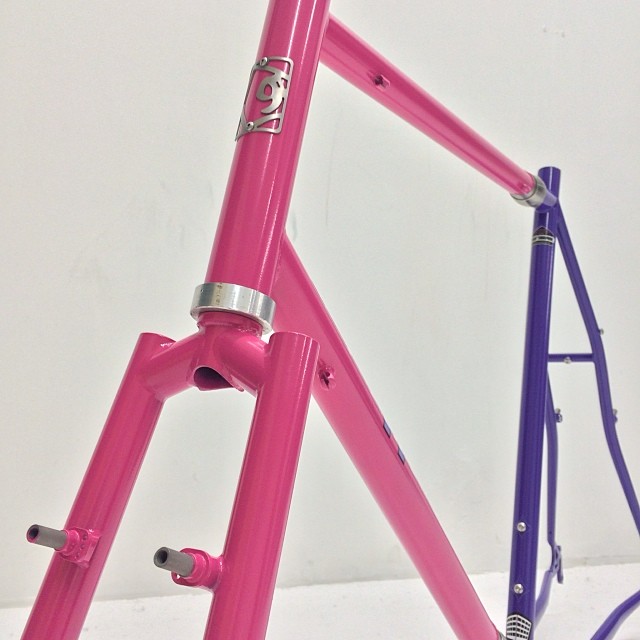
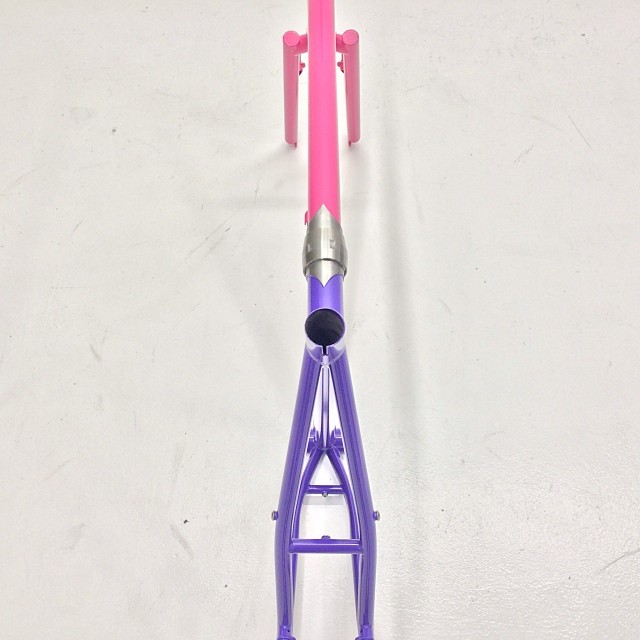
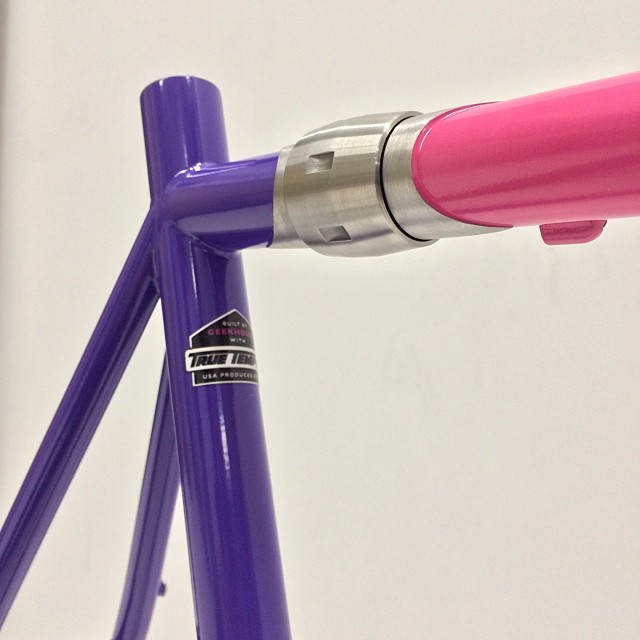
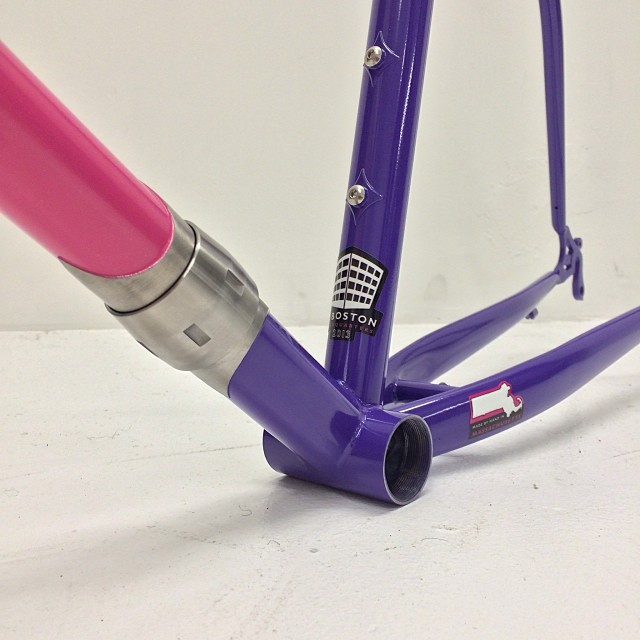
Benjamin Mako Hill: My Geekhouse Bike Frame

In 2011, Mika and I bought in big at the Boston Red Bones party s charity raffle supporting MassBike and NEMBA and came out huge. I won $500 off a custom frame at Geekouse Bikes. For years, Mika and I have been planning to do the Tour d Afrique route (Capetown to Cairo), unsupported, on bike. People that do this type of ride sometimes use an expedition touring frame. I worked with Marty Walsh at Geekhouse to design a bike based on this idea. The concept was a rugged steel touring frame, built for my body and comfortable over long distances, with two quirks:
  1. It s designed for 26 inch mountain bike wheels and mountain bike components to ensure that the bike is repairable with parts from the kinds of cheap mountain bikes that can be found almost everywhere in the world.
  2. It includes S&S torque couplers that let me split the frame in half to travel with the bike as standard luggage.
As our pan-Africa trip kept getting pushed back, so did the need for the bike. Last week, I finally picked up the finished bike from Marty s shop in Boston. It is gorgeous. I absolutely love it. Picture of Geekhouse frame (1)Picture of Geekhouse frame (2)Picture of Geekhouse frame (4) Picture of Geekhouse frame (3) I m looking forward to building up the bicycle over the next couple months and I ll post more pictures when it s finished. I am blown away by Marty s craftsmanship and attention to detail. I am psyched that his donation made this bike possible and that I was able to get the frame while helping cycling in Massachusetts!

25 January 2014

Russell Coker: Links January 2014

Fast Coexist has an interesting article about the art that Simon Beck creates by walking in snow [1]. If you are an artist you can create art in any way, even by walking in patterns in the snow. Russ Altman gave an interesting TED talk about using DNA testing before prescribing drugs [2]. I was surprised by the amount of variation in effects of codeine based on genetics, presumably many other drugs have a similar range. Helen Epstein wrote an interesting article about Dr. Sara Josephine Baker who revolutionised child care and saved the lives of a huge number of children [3]. Her tenacity is inspiring. Also it s interesting to note that the US Republican party was awful even before the Southern Strategy . The part about some doctors opposing child care because it s the will of God for children to die and keep them in employment is chilling. Jonathan Weiler wrote an insightful article about the problems with American journalism in defending the government [4]. He criticises the media for paying more attention to policing decorum than to content. Tobias Buckell wrote an interesting post about the so-called socialised health-care in the US [5]. He suggests that Ronald Reagan socialised health-care by preventing hospitals from dumping dying people on the street. I guess if doing nothing for people until they have a medical emergency counts as socialised health-care then the US has it. Kelvin Thomson MP made some insightful comments about climate change, the recent heat-wave in Australia, and renewable energy [6]. Iwan Baan gave an interesting TED talk about ways that people have built cheap homes in unexpected places [7], lots of good pictures. Racialicious has an interesting article by Arturo R. Garc a about research into the effects of concussion and the way the NFL in the US tried to prevent Dr. Bennet Omalu publicising the results of his research [8]. Stani (Jan Schmidt) wrote an interesting post about how they won a competition to design a commemerative Dutch 5 Euro coin [9]. The coin design is really good (a candidate for the geekiest coin ever), I want one! Seriously if anyone knows how to get one at a reasonable price (IE close to face value for circulated or not unreasonably expensive for uncirculated) then please let me know. When writing about Edward Snowden, Nathan says Imagine how great a country would be if if it were governed entirely by people who Dick Cheney would call Traitor [10]. That s so right, that might make the US a country I d be prepared to live in. Andrew Solomon gave an interesting TED talk Love No Matter What about raising different children [11]. Aditi Shankardass gave an interesting TED talk about using an ECG to analyse people diagnosed wit severe Autism and other developmental disorders [12]. Apparently some severe cases of Autism have a root cause that can be treated with anti-seizure medication. George Monbiot wrote an insightful article about the way that Bono and Bob Geldoff promote G8 government intervention in Africa and steal air-time that might be given to allow Africans to represent themselves in public debates [13]. Daniel Pocock wrote an informative article about racism in Australian politics and how it is bad for job-seekers and the economy (in addition to being horribly wrong) [14]. Aeon Magazine has an interesting article by Anne Buchanan about the difference between scientists and farmers [15]. She has some interesting points about the way that the lack of general knowledge impacts research, but misses the point that in most fields of study there is a huge problem of people not knowing about recent developments in their own field. I don t think it s a pipe dream to be well educated in humanities and science, but I guess that depends on the definition of well educated . Brian Cox gave an interesting TED talk titled Why We Need the Explorers about the benefits of scientific research [16]. Yupu Zhang, Abhishek Rajimwale, Andrea C. Arpaci-Dusseau, and Remzi H. Arpaci-Dusseau from the University of Wisconsin-Madison wrote an interesting paper about ZFS corruption in the face of disk and memory errors [17]. One thing to note is that turning off atime can reduce the probability of a memory error leading to corrupt data being written to disk, run zfs set atime=off tank to fix this. The comedian Solomon Georgio celebrated Martin Luther King day by tweeting I love you to racists [18]. It s an interesting approach and appears to have worked well.

22 January 2014

Erich Schubert: The init wars

The init wars have recently caught a lot of media attention (e.g. heise, prolinux, phoronix). However, one detail that is often overlooked: Debian is debating over the default, while all of them are already supported to a large extend, actually. Most likely, at least two of them will be made mandatory to support IMHO.
The discussion seems to be quite heated, with lots of people trying to evangelize for their preferred system. This actually only highlights that we need to support more than one, as Debian has always been about choice. This may mean some extra work for the debian-installer developers, because choosing the init system at install time (instead of switching later) will be much easier. More often than not, when switching from one init system to another you will have to perform a hard reset.
If you want to learn about the options, please go to the formal discussion page, which does a good job at presenting the positions in a neutral way.
Here is my subjective view of the init systems:
  • SysV init is the current default, and thus deserves to be mentioned first. It is slow, because it is based on a huge series of shell scripts. It can often be fragile, but at the same time it is very transparent. For a UNIX system administrator, SysV init is probably the preferred choice. You only reboot your servers every year anyway.
  • upstart seems to be a typical Canonical project. It solves a great deal of problems, but apparently isn't good enough at it for everybody, and they fail at including anyone in their efforts. Other examples of these fails include Unity and Mir, where they also announced the project as-is, instead of trying to get other supporters on board early (AFAICT). The key problem to widespread upstart acceptance seems to be the Canonical Contributor License Agreement that many would-be contributors are unwilling to accept. The only alternative would be to fork upstart completely, to make it independent of Canonical. (Note that upstart nevertheless is GPL, which is why it can be used by Debian just fine. The CLA only makes getting patches and enhancements included in the official version hard.)
  • systemd is the rising star in the init world. It probably has the best set of features, and it has started to incorporate/replace a number of existing projects such as ConsoleKit. I.e. it not only manages services, but also user sessions. It can be loosely tied to the GNOME project which has started to rely on it more and more (much to the unhappyness of Canonical, who used to be a key player for GNOME; note that officially, GNOME chose to not depend on systemd, yet I see this as the only reliable combination to get a complete GNOME system running, and since "systemd can eventually replace gnome-session" I foresee this tie to become closer). As the main drawback, systemd as is will (apparently) only work with the Linux kernel, whereas Debian has to also support kFreeBSD, NetBSD, Hurd and the OpenSolaris kernels (some aren't officially supported by Debian, but by separate projects).
So my take: I believe the only reasonable default is systemd. It has the most active development community and widest set of features. But as it cannot support all architectures, we need mandatory support for an alternative init system, probably SysV. Getting both working reliably will be a pain, in particular since more and more projects (e.g. GNOME) tie themselves closely to systemd, and would then become Linux-only or require major patches.
I have tried only systemd on a number of machines, and unfortunately I cannot report it as "prime time ready" yet. You do have the occasional upgrade problems and incompatibilities, as it is quite invasive. From screensavers activating during movies to double suspends, to being unable to shutdown my system when logged in (systemd would treat the login manager as separate session, and not being the sole user it would not allow me to shut down), I have seen quite a lot of annoyances happen. This is an obvious consequence of the active development on systemd. This means that we should make the decision early, because we will need a lot of time to resolve all these bugs for the release.
There are more disruptions coming on the way. Nobody seems to have talked about kDBUS yet, the integration of an IPC mechanism like DBUS into the Linux kernel. It IMHO has a good chance of making it into the Linux kernel rather soon, and I wouldn't be surprised if it became mandatory for systemd soon after. Which then implies that only a recent kernel (say, mid-2014) version might be fully supported by systemd soon.
I would also like to see less GNOME influence in systemd. I have pretty much given up on the GNOME community, which is moving into a UI direction that I hate: they seem to only care about tablet and mobile phones for dumb users, and slowly turn GNOME into an android UI; selling black background as major UI improvements. I feel that the key GNOME development community does not care about developers and desktop users like me anymore (but dream of being the next Android), and therefore I have abandoned GNOME and switched to XFCE.
I don't give upstart much of a chance. Of course there are some Debian developers already involved in its development (employed by Canonical), so this will cause some frustration. But so far, upstart is largely an Ubuntu-only solution. And just like Mir, I don't see much future in it; instead I foresee Ubuntu going systemd within a few years, because it will want to get all the latest GNOME features. Ubuntu relies on GNOME, and apparently GNOME already has chosen systemd over upstart (even though this is "officially" denied).
Sticking with SysV is obviously the easiest choice, but it does not make a lot of sense to me technically. It's okay for servers, but more and more desktop applications will start to rely on systemd. For legacy reasons, I would however like to retain good SysV support for at least 5-10 more years.

But what is the real problem? After all, this is a long overdue decision.
  • There is too much advocacy and evangelism, from either side. The CTTE isn't really left alone to do a technical decision, but instead the main factors have become of political nature, unfortunately. You have all kinds of companies (such as Spotify) weigh in on the debate, too.
  • The tone has become quite aggressive and emotional, unfortunately. I can already foresee some comments on this blog post "you are a liar, because GNOME is now spelled Gnome!!1!".
  • Media attention. This upcoming decision has been picked up by various Linux media already, increasing the pressure on everybody.
  • Last but not least, the impact will be major. Debian is one of the largest distributions, last but not least used by Ubuntu and Steam, amongst others. Debian preferring one over the other will be a slap in somebodys face, unfortunately.
So how to solve it? Let the CTTE do their discussions, and stop flooding them with mails trying to influence them. There has been so much influencing going on, it may even backfire. I'm confident they will find a reasonable decision, or they'll decide to poll all the DDs. If you want to influence the outcome provide patches to anything that doesn't yet fully support your init system of choice! I'm sure there are hundreds of packages which do neither have upstart nor systemd support yet (as is, I currently have 27 init.d scripts launched by systemd, for example). IMHO, nothing is more convincing than have things just work, and of course, contributing code. We are in open source development, and the one thing that gets you sympathy in the community is to contribute code to someone elses project. For example, contribute full integrated power-management support into XFCE, if you include power management functionality.
As is, I have apparently 7 packages installed with upstart support, and 25 with systemd support. So either, everybody is crazy about systemd, or they have the better record of getting their scripts accepted upstream. (Note that this straw poll is biased - with systemd, the benefits of not using "legacy" init.d script may just be larger).

Gunnar Wolf: Finally: A student once again

Formally, today is my first day as a student on a formal, scholarized institution Basically for the first time in almost twenty years! Yes, those that know me know that I aspire to live the life of academia. I have worked at public universities for almost all of my adult life (between 1997 and 1999 I worked at a local ISP and at a private school), and have had a minor academic position ( T cnico Acad mico ) for almost ten years. And not having a proper degree limited me from pursuing anything further. Then, in early 2010 I presented the written exam. By late 2010, the corresponding oral exam. That allowed me to get my formal diploma in December 2010. By the end of 2011, I requested to be a teacher in the Engineering Faculty of UNAM, and started teaching Operating Systems a year ago, in January 2012. So, a good advance in the last few years... But I know that if I just sit here, I won't be able to advance my position towards really entering the Sacred Halls of Academia. And there are some rituals I have to comply with. One of those rituals is... Devoting some long time to studying under the formal structures. Ok, so I'm finally a postgraduate student I have enrolled in Especialidad en Seguridad Inform tica y Tecnolog as de la Informaci n, a short (one year) postgraduate program in ESIME Culhuac n, of Instituto Polit cnico Nacional (a small campus of Mexico's second-largest university). Some friends have asked me, why am I starting with a Specialization and not a Masters degree. Some simple reasons: Just as when I went to Tijuana in 2010 to do my written exam, once I got and started with the paperwork, I didn't want to let it go If I postpone it, I will probably lose the push to do it by May-July, when the Masters admission process starts. Also, this specialization can be linked with the masters degree on the same topic given at the same campus. This program is one year long, and the masters two But having them both takes 2.5 years. So, not such a bad deal after all. And finally, because, after such a long time without being scholarized, I fear not having an easy time getting to grips with the discipline. I can commit to overworking myself for a year If it's too much for me, I'll just stay with that degree and give up. I expect to like it and continue... But it's also a safe bet :-) Now, there has to be a downside to picking up this path: Of course, my free time will be harshly reduced. I have reduced my Debian involvement in the last year, as I devoted a huge chunk of my time to teaching and book-writing... This year... We shall see what happens. I can for now only confirm what I have said publicly but inside our team only: I have requested to my peers and to our DPL to step down as a DebConf chair. I love organizing DebConf, but I don't want to be formally committed to a position I just cannot fulfill as I did when I started with it. As for package maintenance, by far most of my packges are team maintained, and those that are not are relatively easy to keep track of. And of course, I'll keep an eye on my keyring-maint duties as well Will even try to link that work with what I do at school! Anyway, lets see what comes now!

Next.

Previous.