Search Results: "evo"

9 April 2014

Thorsten Glaser: Heartbleed vs. Startcom / StartSSL

First of all, good news, MirBSD is not vulnerable to The Heartbleed Bug due to my deliberate choice to stick to an older OpenSSL version. My inquiry (in various places) as to what precisely could leak when a vulnerable client connected to a n n-vulnerable server has yet to be answered, though we can assume private key material is safe. Now the bad news: while the CA I use and a CA I don t use offer free rekeying (in general), a CA I also use occasionally refuses to do that. The ugly: they will not even revoke the certificates, so any attacker who gained your key, for example when you have been using a certificate of theirs on a Debian system, will be able to use it (e.g. to MITM your visitors traffic) unless you shell over lots of unreasonable money per certificate. (Someone wrote they got the fee waived, but others don t, nor do I. (There s also a great Twitter discussion-thingy about this involving Zugschlus, but I won t link Twitter because they are not accessible to Lynx users like me and other Planet Debian authors.)
I ve been using GoDaddy privately for a while, paid for a wildcard certificate for *.mirbsd.org, and later also at work. I ve stopped using it privately due to current lack of money. Occasionally, for n n-wildcard gratis SSL certificates for HTTP servers. Startcom s StartSSL certificates are unusable for real SSL as used in SMTP STARTTLS anyway, so usage isn t much.
Now I ve got a dilemma here. I ve created a CA myself, to use with MirBSD infrastructure and things like that X.509 certificates for my hosts (especially so I can use them for SMTP) and possibly personal friends (whose PGP key I ve signed with maximum trust after the usual verification) but am using a StartSSL certificate for www.mirbsd.org as my GoDaddy wildcard certificate expires in a week or so (due to the aforementioned monetary issues), and I d rather not pay for a limited certificate only supporting a single vhost. There is absolutely no issue with that certificate and key (only ever generated and used on MirBSD, only using it in Apache mod_ssl). Then, there s this soon-to-be tax-exempt non-profit society of public utility I m working with, whose server runs Debian, and which is affected, but has been using a StartSSL certificate for a while. Neither the society nor I can afford to pay for revocation, and we do not see any possible justification for this especially in the face of CVE-2014-0160. I expect a rekey keeping the current validity end date, and would accept a revocation even if I were unable to get a new certificate, since even were we to get a certificate for the society s domain from someplace else, an attacker could still MITM us with the previous one from Startcom. The problem here is: I d really love to see (all of!) Startcom dropped from the global list of trustworthy CAs, but then I d not know from where to get a cert for MirBSD; Globalsign is not an option because I will not limit SSL compatibility to a level needed to pass their quality test possibly GoDaddy, ISTR they offer a free year to Open Source projects no idea about one for the society but it would solve the problem of not getting the certificates revoked. For everyone. I am giving Startcom time until Friday after $dayjob (for me); after that, I ll be kicking them off MirBSD s CA bundle and will be lobbying for Debian and Mozilla to do the same. Any other ideas of how to deal with that? I d probably pay 5 for a usable certificate accepted by people (including old systems, such as MSIE 5.0 on Win2k and the likes) without questioning most of the time, I only serve public content anyway and just use SSL to make the NSA s job more difficult (and even when not I m not dealing with any payment information, just the occasional login protected area). By the way, is there any way to access the information that is behind a current-day link to groups.google.com with Lynx or Pine? I can t help but praise GMane for their NNTP interface. ObFunfact: just when I was finished writing this wlog entry, I got a new eMail Special offer just for you. from GoDaddy. Sadly, no offer for a 5 SSL certificate, just the usual 20-35% off coupon code.

7 April 2014

Russ Allbery: Review: Fantasy & Science Fiction, September/October 2011

Review: Fantasy & Science Fiction, September/October 2011
Editor: Gordon van Gelder
Issue: Volume 121, No. 3 & 4
ISSN: 1095-8258
Pages: 258
Another review of a magazine that I finished quite some time ago. Apologies for any inaccuracies or lack of depth in the reviews. There wasn't much in Charles de Lint's reviews in this issue that interested me, but Michelle West covers a great selection of books. Two of them (The Wise Man's Fear and The Quantum Thief) are already on my to-read list; the third, The Postmortal, sounded interesting and would go on my list to purchase if I didn't already have so many good books I've not read. Otherwise, this issue is short on non-fiction. The only other essay entry is a film review from Kathi Maio, which is the typical whining about all things film that F&SF publishes. "Rutger and Baby Do Jotenheim" by Esther M. Friesner: Baby is a former pole dancer with a toy poodle named Mister Snickers, which warns you right away that this story is going to involve a few over-the-top caricatures and more use of the word "piddle" than one might ideally want. Rutger is a mythology professor who tolerates her for the standard reasons in this sort of pairing. They're travelling across country to Baby's sister's wedding when their car breaks down in Minnesota, prompting an encounter with frost giants. As you might expect, this is a sort of fractured fairy tale, except based on Norse mythology instead of the more typical Grimm fare. The fun is in watching these two apparent incompetents (but with enough knowledge of mythology to clue in the reader) reproduce the confrontation between Thor and Utgard-Loki. The fight with old age is particularly entertaining. If you've read any of Friesner's other stories, you know what to expect: not much in the way of deeper meaning, but lots of fun playing with stereotypes and an optimistic, funny outcome. Good stuff. (7) "The Man Inside Black Betty" by Sarah Langan: This story comes with a mouthful of a subtitle: "Is Nicholas Wellington the World's Best Hope?" It's also a story that purports to be written by a fictional character, in this case one Saurub Ramesh (with Langan credited as having done "research"). It's told in the style of first-person journalism, relating the thoughts and impressions of Ramesh as he interviews Nicholas Wellington. The topic is Black Betty: a black hole above Long Island Sound. Wellington is a scientific genius and iconoclast with radical theories of black holes that contradict how the government has been attempting to deal with Black Betty, unsuccessfully. The structure here was well-handled, reminding me a lot of a Michael Lewis article during the financial collapse. Langan has a good feel for how journalism of this type mixes personalities, politics, and facts. But it's all setup and no story. We get some world building, and then it's over, with no resolution except pessimism. Meh. (4) "A Borrowed Heart" by Deborah J. Ross: Ross starts with the trappings of urban fantasy transplanted into a Victorian world: supernatural creatures about, a protagonist who is a high-class prostitute, and sex and a sucubus by the second page. It evolves from there into a family drama and an investigation, always giving the reader the impression that a vampire will jump out at any moment. But the ending caught me entirely by surprise and was far more effective due to its departure from the expected path. Well done. (7) "Bright Moment" by Daniel Marcus: The conflict between terraforming and appreciation for the universe as we find it is an old story pattern in science fiction, and Marcus doesn't add much here. I think the story would have been stronger if he'd found a way to write the same plot with a pure appeal to environmental beauty without the typical stakes-raising. But he does sprinkle the story with a few interesting bits, including a pod marriage and a futuristic version of extreme sports as a way of communing with nature. (6) "The Corpse Painter's Masterpiece" by M. Rickert: This is typical of my reaction to a Rickert story: shading a bit too much towards horror for me, a bit too cryptic, well-written but not really my thing. It's about a corpse painter who does the work of an informal mortician, improving the appearance of bodies for their funerals, and the sheriff who brings him all the dead bodies. It takes an odd macabre twist, and I have no idea what to make of the ending. (4) "Aisle 1047" by Jon Armstrong: Armstrong is best known for a couple of novels, Grey and Yarn, which entangle their stories in the future of marketing and commerce. One may be unsurprised, then, that this short story is on similar themes, with the intensity turned up to the parody point. Tiffan3 is a department-store saleswoman, spouting corporate slogans and advertising copy while trying to push customers towards particular products. The story follows the escalation into an all-out brand war, fought with the bubbly short-cut propaganda of a thirty-second commercial. For me, it fell awkwardly between two stools: it's a little too over-the-top and in love with its own bizarre alternate world to be effective satire, but the world is more depressing than funny and the advertising copy is grating. More of a curiosity than a successful story, I think. (5) "Anise" by Chris DeVito: Stories that undermine body integrity and focus on the fascinated horror of violation of physical boundaries aren't generally my thing, so take that into account in this review. Anise's husband died, but that's not as much of a problem as it used to be. Medical science can resurrect people via a sort of permanent, full-body life support system, making them more cyborg than human. "Anise" is about the social consequences of this technology in a world where a growing number of people have a much different relationship with their body than the typical living person today. It's a disturbing story that is deeply concerned with the physical: sex, blood, physical intimacy in various different forms, and a twisted type of psychological abuse. I think fans of horror will like this more than I did, although it's not precisely horror. It looks at the way one's perception of self and others can change by passing through a profound physical transformation. (5) "Spider Hill" by Donald Mead: I liked this story a lot better. It's about witchcraft and farm magic, about family secrets, and a sort of coming-of-age story (for a girl rather than a boy, for once). The main character is resourceful, determined, but also empathetic and aware of the impact of her actions, which made her more fun to read about. I doubt I'll remember this for too long, but when skimming through it again for a review, I had fond memories of it. (6) "Where Have All the Young Men Gone?" by Albert E. Cowdrey: Cowdrey in his paranormal investigation mode, which I like better than his horror mode. For once, the protagonist isn't even a lower-class or backwoods character. Instead, he's a military historian travelling in Austria who runs across a local ghost story. This is a fairly straightforward ghost investigation that follows a familiar path (albeit to an unusual final destination), but Cowdrey is a good story-teller and I liked the protagonist. (7) "Overtaken" by Karl Bunker: This is the sort of story that delivers its moral with the force of a hammer. It's not subtle. But if you're in the right mood for that, it's one of the better stories of its type. It's about a long-journey starship, crew in hibernation, that's overtaken by a far newer and faster mechanized ship from Earth that's attempting to re-establish contact with the old ships. The story is a conversation between the ship AIs. Save this one until you're in the mood for an old-fashioned defense of humanity. (8) "Time and Tide" by Alan Peter Ryan: Another pseudo-horror story, although I think it's better classified as a haunting. A wardrobe recalls a traumatic drowning in the childhood of the protagonist. As these things tend to do in stories like this, reality and memory start blurring and the wardrobe takes on a malevolent role. Not my sort of thing. (3) "What We Found" by Geoff Ryman: Any new Geoff Ryman story is something to celebrate. This is a haunting story on the boundaries between the scientific method and tribal superstition, deeply entangled with the question of how one recovers from national and familial trauma. How can we avoid passing the evils and madness of one generation down to the next? Much of the story is about family trauma, told with Ryman's exceptional grasp of character, but the science is entangled in an ingenious way that I won't spoil. As with Air, this is in no way science fiction. The science here would have fascinating and rather scary implications for our world, but clearly is not how science actually works. But as an insight into politics, and into healing, I found it a startlingly effective metaphor. I loved every bit of this. By far the best story of the issue. (9) Rating: 7 out of 10

6 April 2014

Stefano Zacchiroli: historical overview of debian source code

moar, and moar, and moar debsources stats A while ago I've announced the availability of several stats about Debian source code on http://sources.debian.net. Since then the statistical basis of those stats has increased a lot, and now includes all Debian historical releases, from hamm (July 1998) onward. This allows to appreciate macro-level evolution trends in Free Software, over a period of more than 15 years, through the eyes of a distro that sits at the nice intersection of the eldest, largest, and most reputed distros. To get there I've added support for sticky suites to the plumbing layer of debsources, and then injected historical releases from http://archive.debian.org. The injection process took about a week (without any sort of parallelism, pretty slow disks, and computing sha256 checksums, ctags, and sloccount on all source files) and has been an "interesting" experience. When you go back decades in technology time, bit rot is just around the corner, and I've found my share while injecting archive.d.o into sources.d.n. In both cases the respective maintainers (Guillem and Ganneff, kudos) have been positive about and helpful in improving the situation, despite the low impact of the bugs I've found on the average user. That's quite important for the long-term preservation of digital information in general, and for the perennity of access to Free Software in the specific case of Debian. While we are it, I'm now maintaining a list of bugs affecting sources.d.n but belonging to other packages, in case you fancy helping out but are not a Python hacker. Interestingly enough, quite a bit of those bugs are related to the fact that tools debsources uses (e.g. ctags, sloccount) are also starting to show their age. You might wander why buzz, rex, and bo are still missing from sources.d.n. That's in fact for similar reasons. Before hamm Debian didn't have complete archive coverage in terms of Sources indexes and .dsc files. Given that debsources rely on both to extract source packages, it first needs to grow an additional abstraction layer that can cope with their absence. It's SMOP, and planned. And now let's have fun with ctags bombs. Yours truly,
Stefano Indiana Zacchiroli
(credits: KiBi, #debian-ftp)

3 April 2014

Gunnar Wolf: DrupalCamp Mexico City: April 23-25

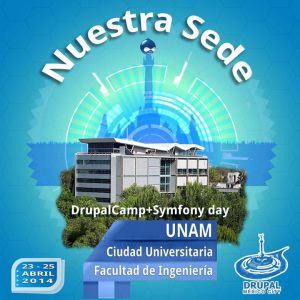
We are organizing a DrupalCamp in Mexico City! DrupalCamp Mexico City logo As a Drupal user, I have so far attended two DrupalCamps (one in Guadalajara, Mexico, and one in Guatemala, Guatemala). They are as Free Software conferences usually are great, informal settings where many like-minded users and developers meet and exchange all kinds of contacts, information, and have a good time. Torre de Ingenier a Torre de Ingenier a, UNAM This year, I am a (minor) part of the organizing team. DrupalCamp will be held in Torre de Ingenier a, UNAM Just by Facultad de Ingenier a, where I teach. A modern, beautiful building in Ciudad Universitaria. Talks, tracks So, who is this for? You can go look at the accepted sessions, you will find there is a lot of ground. Starting from the very introduction to how Drupal is structured and some tips on how to work with it (delivered by yours truly), through workflows for specific needs, to strong development-oriented talks. The talks are structured along four tracks: "Training", "Theming", "Development", "Business" and "SymfonyDay". "SymfonyDay"? Yes. Drupal is a fast-evolving Free Software project. Most users are currently using versions 6 and 7, which are as different between each other as day and night... But the upcoming Drupal 8 brings even greater changes. One of the most interesting changes I can see is that Drupal will now be based on a full MVC framework, Symfony. One of the days of our DrupalCamp will be devoted to Symfony (dubbed the Symfony Day). ...And... Again, just look at the list of talks. You will find a great amount of speakers interested in coming here. Not just from Mexico City. Not just from Mexico. Not just from Latin America. I must say I am personally impressed. Sponsors! Of course, as with any volunteer-run conferences: We are still looking for sponsors. We believe being a DrupalCamp sponsor will greatly increase your brand visibility in the community you want to work with. There are still a lot of expenses to cover to make this into all that we want. And surely, you want to be a part of this great project. There are many sponsor levels Surely you can be part of it!
AttachmentSize
drupalcampmx.png57.81 KB
torre_ing.jpg90.22 KB
torre_ing_mini.jpg21.64 KB

1 April 2014

Thorsten Glaser: Sorry about the MediaWiki-related breakage in wheezy

I would like to publicly apologise for the inconvenience caused by my recent updates to the mediawiki and mediawiki-extensions source packages in Debian wheezy (stable-security). As for reasons I m doing Mediawiki-related work at my dayjob, as part of FusionForge/Evolvis development, and try to upstream as much as I can. Our production environment is a Debian wheezy-based system with a selection of newer packages, including MediaWiki from sid (although I also have a test system running sid, so my uploads to Debian are generally better tested). I haven t had experience with stable-security uploads before, and made small oversights (and did not run the full series of tests on the final , permitted-to-upload, version, only beforehand) which led to the problems. The situation was a bit complicated by the need to update the two packages in lockstep, to fight an RC bug file/symlink conflict, which was hard enough to do in sid already, plus the desire to fix other possibly-RC bugs at the same time. I also got no external review, although I cannot blame anyone since I never asked anyone explicitly, so I accept this as my fault. The issues with the updates are: My unfamiliarity with some of the packaging concepts used here, combined with this being something I do during $dayjob (which can limit the time I can invest, although I m doing much more work on Mediawiki in Debian than I thought I could do on the job), can cause some of those oversights. I guess I also should install a vanilla wheezy environment somewhere for testing I do not normally do stable uploads (jmw did them before), so I was not prepared for that. And, while here: thanks to the Debian Security Team for putting up with me (also in this week s FusionForge issue), and thanks to Mediawiki upstream for agreeing to support releases shipped in Debian stable for longer support, so we can easily do stable-security updates.

Bits from Debian: Debian Project elects Javier Merino Cacho as Project Leader

This post was an April Fools' Day joke. Alt Red Nose DPL In accordance with its constitution, the Debian Project has just elected Javier Merino Cacho as Debian Project Leader. More than 80% of voters put him as their first choice (or equal first) on their ballot papers. Javier's large majority over his opponents shows how his inspiring vision for the future of the Debian project is largely shared by the other developers. Lucas Nussbaum and Neil McGovern also gained a lot of support from Debian project members, both coming many votes ahead of the None of the above ballot choice. Javier has been a Debian Developer since February 2012 and, among other packages, works on keeping the mercurial package under control, as mercury is very poisonous for trouts. After it was announced that he had won this year's election, Javier said: I'm flattered by the trust that Debian members have put in me. One of the main points in my platform is to remove the "Debian is old and boring" image. In order to change that, my first action as DPL is to encourage all Debian Project Members to wear a clown red nose in public. Among others, the main points from his platform are mainly related to improve the communication style in mailing lists through an innovative filter called aponygisator, to make Debian less "old and boring", as well as solve technical issues among developers with barehanded fights. Betting on the fights will be not only allowed but encouraged for fundraising reasons. Javier also contemplated the use of misleading talk titles such as The use of cannabis in contemporary ages: a practical approach and Real Madrid vs Barcelona to lure new users and contributors to Debian events. Javier's platform was collaboratively written by a team of communication experts and high profile Debian contributors during the last DebConf. It has since evolved thanks to the help of many other contributors.

Russ Allbery: Review: Asimov's, September 2011

Review: Asimov's Science Fiction, September 2011
Editor: Sheila Williams
Issue: Volume 35, No. 9
ISSN: 1065-2698
Pages: 112
Due to various other life priorities, it's been quite a while since I read this magazine. Let's see if I can remember the contents well enough to review it properly. The editorial this issue was about the Readers' Awards. Vaguely interesting, but Williams didn't have much to add beyond announcing the winners. I'm very happy to see Rusch's "Becoming One with the Ghosts" win best novella, though. The Silverberg column was more interesting: some musings and pop history about the Japanese convention of a retired emperor and how that fit into national politics. Di Filippo's book review column is all about short story collections, continuing the trend of Di Filippo mostly being interested in things I don't care about. "The Observation Post" by Allen M. Steele: A bit of alternate history set during the Cuban Missile Crisis, but with airships. The protagonist was a radioman aboard a blimp that was patrolling the ocean for Russian vessels sailing to Cuba. A storm forces them down on an island, resulting in an encounter with some claimed tourists who may be Russian spies. The SFnal twist is unlikely to come as much surprise to an experienced reader, and the barb at the end of the story suffers from the same problem. I appreciate the ethical dilemma, but I've also seen it in lots of stories and have a hard time getting fully invested in another version of it. But the story is otherwise competently written. (6) "D.O.C.S." by Neal Barrett, Jr.: Everyone has an author or two that they just don't get. Barrett is one of mine, although this story is a bit less surreal than most of his. I'm fairly sure it's an odd twist on the "death panel" conspiracy theory given a fantastic twist, but it's not entirely forthright about what's going on. Possibly of more interest to those who like Barrett better. (5) "Danilo" by Carol Emshwiller: Emshwiller's stories are always distinctive and not quite like anyone else's, involving odd outsiders and their attempts to make sense of their world. This one involves, as is common, an out-of-the-way village. Lewella claims that she's going to be married to a stranger from the north. No one believes her, although they give her bridal gifts anyway, and then one day she takes her gifts and leaves. The protagonist follows her, to look after her. The rest of the story walks the boundary that Emshwiller often walks, leaving the reader unsure whether the characters are in touch with some deeper reality or insane and suffering, but the ending is even more ambiguous than normal and, at least for me, entirely unsatisfying. (4) "Shadow Angel" by Erick Melton: This is another retread of an old SF idea. This time, it's that piloting through hyperspace involves alternate modes of consciousness and has profound effects on the pilot. The risk of this sort of story is that it turns hallucinatory and a bit incoherent, and I think that happened here. I like the world-building; the glimmers of future politics and trade and the way he weaves alternate timelines into the story caught my interest. But the story wasn't quite coherent enough (although part of this may be reviewing it quite some time after I originally read it). Promising, but not clear, and without quite enough agency for the protagonist. (6) "The Odor of Sanctity" by Ian Creasey: I found this story more memorable. The conceit is that a future society has developed technology that allows the capture and replay of scents, which has created a huge market for special scent experiences and the triggering of memories. The story is set in the Philippines and revolves around a Catholic priest who takes the mission to the poor seriously. He's dying, and several people wonder if it is possible to capture the mythical odor of scantity: the sweet scent said to follow the death of a saint rather than the normal odor of human death. Creasey handles this idea well, blending postulated future technology, the practical and cynical world of the poor streets, and a balance between mystical belief and practical skepticism. Nothing in the story is that surprising, but I was happy with the eventual resolution. (7) "Grandma Said" by R. Neube: This story's protagonist is a cleanser on a frontier planet made extremely dangerous by a virulent alien fungus. It is almost always fatal and very difficult to eradicate. Vic's job is to completely sanitize anything that had been in contact with a victim and maintain the other rules of strict quarantine required to keep the fungal infection from spreading uncontrolled. Nuebe weaves world-building together with Vic's background and adds a twist in the form of deeply unhealthy responses to the constant stress of living near death. Well told, if a bit disturbing. (7) "Stalker" by Robert Reed: Reed has a knack for fascinating and disturbing stories, and this is an excellent example of the type. The protagonist is a manufactured companion who is completely devoted to its owner. Their commercial name is Adorers, but everyone calls them Stalkers. In this case, the protagonist's owner is a serial rapist and murderer; given that, and given how good Reed is at writing these sorts of stories, you can probably imagine how chilling it is. As usual, there is a sharp barb in the ending, and not the one I was expecting. Good if you can handle the graphic violence and disturbing subject material. (7) "Burning Bibles" by Alan Wall: This is an interesting twist on the spy thriller. A three-letter agency in charge of investigating possible terrorist plots becomes suspicious after a warehouse of Bibles burns in mysterious circumstances. The agent they send in is a deaf-mute with special powers of intuition. This prompted some eye-rolling, and there's a lot of magic disability powers here to annoy, but it's played mostly straight after that introduction. The rest is a fairly conventional spy story, despite special empathic powers, but it's one I enjoyed and thought was fairly well-written. (7) Rating: 6 out of 10

31 March 2014

Laura Arjona: MiniDebConf Barcelona 2014

Wow, I cannot believe it has already been 2 weeks from MiniDebConf Barcelona.
It has been the first Debian event (and free software conference) that I have attended in person, and I took the opportunity to get more involved, giving a talk about translations together with Francesca Ciceri, and two lightning talks about two free software projects that I use and love and I d like to see them packaged for Debian: Pump.io and GNU MediaGoblin (videos coming soon). I also somehow-promoted Keysigning during the conference (well, in fact, I just sent some two emails to the mailing list before, and printed stickers with May I sign your key? slogan so we could keysign easily in the freetime between talks). The people I ve met some people in person, who I was following in the Debian mailing lists and identi.ca for long time (years, in some cases \o/). It has been amazing to meet Francesca Ciceri and Enrico Zini, since their blogposts and vision about Debian diversity skills have influenced very much in my involvement in Debian. It has been very important to me to be able to say THANK YOU to Tiago from the Debian video team (sorry Holger, I couldn t manage to meet you face to face), because I have learned so many things watching videos from Debconfs! Videos helped me to feel that I m part of the community, even when I cannot attend to the events, by following the streaming and being able to recognize the faces of the people and the work they do in Debian. I ve met many Debian Women, of course. I m so fan of all of them! I m enjoying a welcoming and diverse community thanks to many of them that worked since many years ago to make Debian what it is now, and faced bitter moments too. I cannot say that I engaged in many deep conversations (well, maybe some 2 or 3, and me mostly listening), but the most important thing that I keep from them was simply being there , watching and listening, enjoying the voices of the experience like Ana and Miriam, and the freshness and joy of Tassia, Solveig and Elena, for example. I ve tried to be welcoming too, I m not a newbie anymore as new people come to the group :) New projects (and renewing forces for other) Debian contributors I wanted to get more involved in the Debian contributors project and it has been a perfect opportunity to understand better all what I had read and watched about it before going to Barcelona. My plan is, apart of doing promotion as with all the projects that I use and love, to try to get translator work credited via Debian Contributors. That means to hack the l10n bot that now gathers info from the mailing lists to build the coordination pages for translators. It shouldn t be difficult to make it send that info to contributors.debian.org site, but I ll try to understand how it works and propose an elegant patch. No idea about Perl, btw, but anyway, it s a good excuse to start learning. Mediagoblin and pump.io packaging I m not sure I can help on this, but I ll keep an eye in the evolution of the Debian packaging of GNU MediaGoblin and the Pumpiverse software. I ll give moral support, at least, to the people actually working on that :) Website and Publicity team After Solveig s talk about bug triaging I ve been thinking about some bugs that I reviewed in the Website and Publicity team, and I think I should make a new round on the pending bugs to close them if they don t apply anymore, or to try to push a bit more towards a solution, if I can. Tails website translation Tails is a Debian derivative preconfigured to work out-of-the-box with privacy and anonymity features, since uses the Tor network for all the outgoing and ingoing connections.
Solveig proposed me to join the Spanish translators team at Tails. I just joined the translators mailing list, in order to help translating the Tails website into Spanish (the software is already translated, under the Tor Project). This is a new challenge from the translation point of view, since they work with PO files. And now, what? Well, first, I ll try to clean a bit my TODO list, mainly about translations, and other things not related to Debian. From now on until summer, I ll keep an eye and a hand on all the projects in which I am involved, and also I ll try to keep on engaging with the community via pump.io, the mailing lists, and IRC channels. Next summer, if I can put in order my GPG keys (long story), I ll try to join the Debian New Member process. If not, I ll try to get new keys and some signs, and then I ll apply. OTOH, thanks to the end of Windows XP support, it seems that some people are willing to migrate to any GNU/Linux distribution, and of course I m recommending Debian. Expect some blog posts about these migrations (wow, I should migrate some servers that still run Squeeze too ) and my new role of Debian help desk at job, if finally some people decide to migrate. I have gathered Debian stickers to proudly give to anyone that installs Debian in their computer!
Filed under: Events, My experiences and opinion, Videos Tagged: Communities, Contributing to libre software, Debian, English, Free Software, libre software, MediaGoblin, Moving into free software, pump.io, translations

Russ Allbery: Review: Sundiver

Review: Sundiver, by David Brin
Series: Uplift #1
Publisher: Bantam
Copyright: February 1980
Printing: September 1995
ISBN: 0-553-26982-8
Format: Mass market
Pages: 340
Sundiver is the first book of Brin's Uplift series, which I think it's fair to say are the books that made his reputation as an author. It's less well-known than the later sequels Startide Rising and The Uplift War for reasons that I'll get into in a moment. This was a re-read; I've read the first Uplift series before (and Startide Rising separately before that), but not in many years, and I wanted to re-read them and review them. I haven't finished doing that yet, several months after I re-read Sundiver, largely because this book wasn't as enjoyable as I remembered. The Uplift series is set in a heavily populated galaxy with a multitude of alien races. It follows the SF alien life pattern where the galaxy was well-populated and fully developed long before humans discovered it. The Earth is a relatively obscure backwater, and humans are expected to adopt to and follow the rules and restrictions that the other races had long-since established. This primarily means a complex and very formal system of caste and patronage: species brought to sapience by the technology of their patrons are expected to serve their patron races for millennia, and one's status in the galaxy is determined by the length of those patronage chains and the number of species one has fostered in turn. As is typical for stories of this sort, humans break the rules in unexpected ways. They have no known patrons, having apparently evolved sapience entirely on their own (although the galactic races are quite dubious of this theory). And they have uplifted two species to sapience (chimpanzees and dolphins) before their discovery by the rest of galactic civilization, although in fairly primitive ways and not properly by galactic standards. Set against this background, Sundiver is a science fiction puzzle story of a fairly old style. The protagonist, Jacob Demwa, is a scientific investigator who retired after a tragedy that killed his love. He's recruited out of that retirement and into this plot by an alien who is sympathetic to humans. A human exploration mission into the chromosphere of the Sun, treated as ridiculous by most of the galactics since the shared Library Institute certainly contains more information about stars than human technology could possibly uncover, has found strange and apparently sapient creatures living there: flocks of cattle-like creatures that are apparently being herded. There is no reference to such star-dwellers in the Library, which raises the possibility that humans have discovered something novel. That would be quite a coup against the galactics. But after the destruction of one of the solar exploration ships, it starts looking like these creatures are hostile. Jacob reminded me of a mix between a Larry Niven short story protagonist, working through the practical impact of a physics puzzle, and Isaac Asimov's Elijah Baley. What exactly is going on, both scientifically and politically, remains unclear for nearly the entire book. Both Jacob and the reader are constantly forming and then discarding hypotheses as events overtake them. The stakes are more interesting than a lot of science fiction novels: rather than survival or war, the stakes are prestige, influence, and status, with subtle but possibly vital effects on what position humans will take among the other species of the galaxy. All this sounds promising, and is why I remembered this book fondly. Unfortunately, re-reading it was a disappointing experience on several fronts. First, the characterization varies between trite and stereotyped. The aliens suffer from the standard alien characterization problem: each of them is an exemplar of their species, and all of the aliens feel like archetypes. While there are some twists in the inter-alien politics, one never gets a sense of the aliens as varied and complex societies in their own right. The humans are more varied, but that primarily means varieties of irritating. The worst is Peter LaRoque, a journalist who is set up as a villain of the story, and who is such an unremitting and over-the-top stereotype of everything possibly bad about journalists (and French people) that every scene containing him felt like someone scraping fingernails on a chalkboard. The other characters are a bit better, but not by much. Jacob himself has a bizarre, semi-mystical psychological problem from trauma that seems to give his amoral subconscious a life of its own. Brin appears to be setting this up to have major plot significance, but it never made any sense to me, didn't matter much in the end, and seems to mostly be an excuse for Jacob's hypercompetence. Sundiver's treatment of female characters also annoyed me enough to be worth a mention. The primary female character, Helene, is clearly intended to be a strong character with her own agency (she's both station commander and a starship captain), and Brin makes a lot of the humans switching to different words than male and female as a sign of a more egalitarian future. But this all feels skin-deep. The inevitable romance is all about Helene's attractiveness and ability to listen to Jacob, her logic is described as unscientific, and I got more and more annoyed by her portrayal as the book went along. She's not entirely without agency in the story, but she's much closer to a damsel in distress than the independent character Brin appeared to be trying for. It's hard to shake the feeling that she's being persistently belittled by the story. But this is a scientific puzzle story more than a mystery; characterization would be nice, but isn't strictly required. On re-read, the part of Sundiver that annoyed me the most was how much of a letdown the plot resolution was. I'm going to avoid any specific spoilers here, but I found the ending of both quite disappointing and a sign of the major problem with this series as a whole. The setup over-promises and Brin fails to deliver, a pattern that will repeat itself in this series. We get tantalizing hints of a new solar species, of revelations about the past of humanity, of deep galactic politics, and of vast knowledge contained in the Library that humans don't yet have access to. We get superficial archetypes for characters, politics that seem more like the bickering of children, plot twists that persistently take the story in more mundane and less interesting directions, and a sense of wonder, or lack thereof, that feels more like a Scooby Doo story than what I expect from science fiction. Some of the plot twists are unexpected and almost add some interest to the story, but don't make enough sense in the context of the story to be satisfying. And, of course, there's an climactic action sequence involving physical combat, as is required of all good Star Trek (original series) episodes. (I was waiting for Jacob's shirt to fall off.) The problem I have always had with Brin as a writer is that his ideas are far better than his ability to write characters and plots. In the hands of a better author, the Uplift universe background has so much potential. And I think Brin is a better author a few years later; my recollection is that both Startide Rising and The Uplift War do a better job of delivering on their promises. But Sundiver is deservedly forgettable. The good ideas rarely go anywhere beyond the obvious, the characters are irritating and often don't make sense, and the story is disappointing. I can't say I'm sorry to have read it, since my memory edited it down into a much better story, but I can only recommend it as background for later, better books. Rating: 4 out of 10

29 March 2014

Dirk Eddelbuettel: R / Finance 2014 Open for Registration

The annoucement below just went to the R-SIG-Finance list. More information is as usual at the R / Finance page:
Now open for registrations: R / Finance 2014: Applied Finance with R
May 16 and 17, 2014
Chicago, IL, USA
The registration for R/Finance 2014 -- which will take place May 16 and 17 in Chicago -- is now open! Building on the success of the previous conferences in 2009, 2010, 2011, 2012 and 2013, we expect around 300 attendees from around the world. R users from industry, academia, and government will joining 30+ presenters covering all areas of finance with R. We are very excited about the four keynotes by Bill Cleveland, Alexios Ghalanos, Bob McDonald and Luke Tierney. The main agenda (currently) includes sixteen full presentations and twenty-one shorter "lightning talks". We are also excited to offer four optional pre-conference seminars on Friday morning. To celebrate the sixth year of the conference in style, the dinner will be returning to The Terrace of the Trump Hotel. Overlooking the Chicago River and skyline, it is a perfect venue to continue conversations while dining and drinking. More details of the agenda are available at:
http://www.RinFinance.com/agenda/
Registration information is available at
http://www.RinFinance.com/register/
and can also be directly accessed by going to
http://www.regonline.com/RFinance2014
We would to thank our 2014 Sponsors for the continued support enabling us to host such an exciting conference:
International Center for Futures and Derivatives at UIC Revolution Analytics
MS-Computational Finance at University of Washington OneMarketData
RStudio
On behalf of the committee and sponsors, we look forward to seeing you in Chicago!
Gib Bassett, Peter Carl, Dirk Eddelbuettel, Brian Peterson,
Dale Rosenthal, Jeffrey Ryan, Joshua Ulrich
See you in Chicago in May!

This post by Dirk Eddelbuettel originated on his Thinking inside the box blog. Please report excessive re-aggregation in third-party for-profit settings.

27 March 2014

Aigars Mahinovs: Photo migration from Flickr to Google Plus

I've been with Flickr since 2005 now, posting a lot of my photos there, so that other poeple from the events, that I usually take photos of, could enjoy them. But lately I've become annoyed with it. It is very slow to uplaod to and even worse to get photos out of it - there is no large shiny button to Download a set of photos, like I noticed in G+. So I decided to try and copy my photos over. I am not abandoning or deleting my Flickr account yet, but we'll see. The process was not as simple as I hoped. There is this FlickrToGpluss website tool. It would have been perfect .. if it worked. In that tool you simply log in to both services, check which albums you want to migrate over and at what photo size and that's it - the service will do the migration directly on their servers. It actually feeds Google the URLs of the Flickr photos so the photos don't even go trought the service itself, only metadata does. Unfortunately I hit a couple snags - first of all the migration stopped progressing a few days and ~20 Gb into the process (out of ~40 Gb). And for the photos that were migrated their titles were empty and their file names were set to Flickr descriptions. Among other things that meant that when you downloaded the album as a zip file with all the photots (which was the feature that I was doing this whole thing for) you got photos in almost random order - namely in the order of their sorted titles. Ugh. So I canceled that migration (by revoking priviledges to that app on G+, there is no other way to see or modify progress there) and sat down to make a manual-ish solution. First, I had to get my photos out of Flickr. For that I took Offlickr and ran it in set mode:
./Offlickr.py -i 98848866@N00 -p -s -c 32
The "98848866@N00" is my Flickr ID which I got from this nice service, then -p to download photos (and not just metadata), -s to download all sets and -c 32 to do the download in 32 parallel threads. An important thing to do is to take all you photos that are not in a set in Flickr and add them to a new 'nonset" so that those photos are also picked up here, there is an option under Organize to select all non-set photos. It worked great, but there were a couple tiny issues:
  1. There is a bug in Offlickr that it does not honor pages in Flickr sets, so it only downloads first 500 images in each set, fix for that is in that bug;
  2. It also wanted Python2.6 for some reason, but worked fine with Python2.7
  3. With that number of threads sometimes Flickr actually failed to respond with the photo, serving a 500 error page instead. Offlickr does not check return code and happily daves that HTML page as the photo. To work around that I simply deleted the HTML errors and then ran the same Offlickr command again so that it re-downloads the missing files. Had to repeat that a few times to get all of them:
ack-grep -l -R "504 Gateway Time-out" dst/   xargs rm
After all that I had my photos, all 40 Gb of them on my computer. Should I upload them to G+ now? Not yet! See the photos all had lost their original file names. It turns out Flickr simply throws that little nugget of information away. It is nowhere to be found, neither in metadata or the UI or the Exif of the photos. Also some of my photos had clever descriptions that I did not want to loose or re-enter in G+ and also geolocation information. Flickr does not embed that info into the Exif of the image, instead it is provided separately - Offlickr saves that as an XML file next to each image. So I wrote a simple and hacky script to re-embed that info. It did 3 things:
  1. Embed title of the photo into the Description EXIF tag, so that G+ automatically picks it up as title of the photo;
  2. Embed the GEO location information into the proper EXIF tags, so that G+ picks that up automatically;
  3. Create a new file name based on original picture taken datetime and EXIF Canon FileNumber field (if such exists), so that all photos in an album are sequential.
It uses exiftool for the actual heavy lifting. After all that was finished I tested the result by uploading a few images to G+ and testing that their title is being set correctly, that they have a sane file name and that geo information works. After that I just uploaded them all. I tried figuring out the G+ API (they actually have it) but I was unable to pass the tutorial, so I abandoned it and simply uploaded the photos of each set int their own tab via a browser. That took a few hours. But that is much faster that with Flickr. Like 4 MB/s versus 0.5 MB/s faster. And here is the result. So far I kind of like it. We'll see how it goes after a year or so. Now on to an even more fun problem - I now have ~40 Gb of photos from Flickr/G+ and ~100 Gb of photos locally. Those sets partially intersect. I know for a fact that there are photos in Flickr set that are not in my local set and it is pretty obvoious that there are some the other way round. Now I need to find them. Oh and I cann't use simple hashes, because Exif has changed and so have the file names for most of them. And not to forget that I often take a burst of 3-4 pictures, so there are bound to be a some near-duplicate photos in each set too. This shall be fun :)

Andrew Pollock: [life] Day 58: Playgroup, rain and errands

My yoga teacher was out sick this morning. I had grand plans of instead biking to the pool and going for a swim, but when my alarm went off, and the weather outside was grey and miserable, having an extra half an hour lie in seemed more attractive. I think I made the right choice, because I felt like a million bucks today. I did all of the preparation to bake a batch of carrot and kale muffins before Zoe arrived, and we baked a batch as soon as she arrived and had them out of the oven in time to drive to Playgroup. I was expecting a larger crowd today on account of the wet weather, but it turned out quite the opposite. That said, Zoe still had a good time. There's really no other kids her age though, so it's still winding up as a "play with Dad in a different environment". My ABN came through yesterday, so after Playgroup we walked to the bank to give it to them and sort out a business credit card. Zoe was super well behaved while I did that, so we grabbed a fresh hot cross bun from Brumby's across the street afterwards. I needed some more stamps, so I figured we could just walk down to the post office down the other end of Oxford Street while we were there. That was slow going, but Zoe was enjoying walking with her umbrella in the rain. We got to the post office, and I discovered that postage is going up to 70 cents next week, and they couldn't sell be 70 cent stamps yet, and buying 60 cent stamps would be pointless after Monday, so I left empty handed. Zoe was eyeing off the umbrellas they had for sale in the post office. No sooner had we walked out of the post office and Zoe managed to walk all over her umbrella and totally destroy it. If I hadn't seen it happen, I'd have said she did it deliberately to get a new umbrella, but it really was an accident, so we had to turn around and buy one of the umbrellas from the post office. We made our way back down Oxford Street, and stopped in the boutique toy shop there. Zoe was particularly enthralled by the musical jewelery boxes, and really wanted one. I negotiated with her for it to be a birthday present, and got it gift wrapped. She seemed fine with the idea of not being able to have it until her birthday. We then made our way back to the car and drove home for a rather late lunch. I'm glad Zoe had the hot cross bun after the bank to keep her going, as she didn't seem to mind the late lunch at all. I made fritters with some left over corned beef, and then after we'd had lunch I thought we might as well get out of the house. Zoe's Kindergarten has a working bee on Saturday (I'm expecting it'll get canceled due to the wet weather, though). Incidentally, I have no idea where the "bee" in "working bee" comes from. Megan's Dad is Welsh, and I was lost for words when it came to explaining what a working bee was. Anyway, I wanted to get some gardening gloves, so we went to Bunnings. I managed to find some cute little kids ones as well, so Zoe can help. After Bunnings, we went to the pet shop to get some more cat litter. The pet shop seems to be a great source of entertainment for Zoe. She absolutely loved playing around with the hutches they had on display, and checking out all the fish, and the aquarium accessories. We eventually made it out of the pet shop, and we went around to the adjacent shopping mall in search of some craft supplies at some of the cheap shops there. It turns out the cheap shops are also a great source of entertainment. By the time we were done there, it was time to get home so Sarah could pick Zoe up, so we headed home. There was enough time for Zoe to watch a little bit of TV before Sarah arrived. So despite the weather, and no real plan for the day, we managed to completely fill the day, and Zoe had a great time. She seemed no worse for wear for powering through without a nap. There was a few small tantrums at Bunnings, but that mostly revolved around her tipping over her miniature shopping trolley.

26 March 2014

Russell Coker: The Aspie Accent

I am often asked about my accent . The most common guess is that it s a British accent, while I lived in London for about a year I don t think that my accent changed much during that time (people have commented on the way I speak since I was in primary school). Also there isn t a British accent anyway, the Wikipedia page of Regional Accents of English has the first three sections devoted to accents in the island of Britain (and Northern Ireland is part of the United Kingdom which people often mean when they sat Britain ). The Received Pronounciation is the main BBC accent and the accent that is most associated with Britain/England/the UK (which are three different things even though most people don t know it) and I don t think that I sound like that at all. I ve had various other guesses, the Netherlands (where I lived for a few years but mostly spoke to other foreigners), New Zealand (which I ve visited a couple of times for conferences), Denmark (the closest I got was attending a conference in Sweden), and probably others I can t remember. If I actually had developed an accent from another country then it would probably be from the US. The amount of time I ve spent watching Hollywood movies and watching US TV shows greatly exceeds the amount of time I ve spent listening to people from all other countries. The fact that among all the people who wanted to try and guess where my accent supposedly originated none have ever included the US seems like strong evidence to suggest that I don t have any sort of accent that really derives from another country. Also I have never had someone mistake me for being a resident of their own country based on accent which seems like clear evidence that all claims about me having a foreign accent are bogus. Autism forums such as WrongPlanet.net [1] always turn up plenty of results for a search on accent . In such discussions it seems that a British accent is most common mistake and there are often theories raised about why that is often related to speaking in a formal or precise way or by using a large vocabulary. Also in such discussions the list of countries that people supposedly have accents from is very inclusive, it seems that any country that the listener has heard of but doesn t know that well is a good candidate. The fact that Aspies from outside the US are rarely regarded as having an American accent could be due to the fact that Hollywood has made most of the world population aware of what most American accents sound like. Also if I really had some sort of accent from another country then probably someone would comment on that when I m outside Australia. When I m travelling people tend to recognise my accent as Australian, while it doesn t please me when someone thinks that I sound like Crocodile Dundee (as happened in the Netherlands) it might not be entirely inaccurate. This is Annoying The way the issue of accent is raised is generally in the form of people asking where I m from, it seems to imply that they don t think I belong in Australia because of the way I speak. It s particularly annoying when people seem unable to realise that they are being obnoxious after the first wrong guess. When I reply no to the first are you from $COUNTRY question and don t offer any further commentary it s not an invitation to play 20 questions regarding where I m supposedly from, it s actually an indication that I m not interested in a conversation on that topic. A Social Skills 101 course would include teaching people that when someone uses one-word answers to your questions it usually means that they either don t like your questions or don t want to talk to you. Social Skills vs Status The combination of persistence and misreading a social situation which are involved when someone interrogates me about my supposed accent are both parts of the diagnostic criteria for Autism. But I generally don t get questions about my accent in situations where there are many Aspies (IE anything related to the Free Software community). I think that this is because my interactions with people in the Free Software community are based around work (with HR rules against being a jerk) and community events where no-one would doubt that I belong. I mostly get questions about my accent from random middle-class white people who feel entitled to query other people about their status who I meet in situations where there is nothing restraining them from being a jerk. For example random people I meet on public transport.

21 March 2014

Sylvestre Ledru: Rebuild of Debian using Clang 3.4

Using the AWS donation, David Suarez and myself have been able to rebuild the whole archive with Clang 3.4.
The rebuild has been done January 10th but, with my new job, I did not find the time to publish the result.
Releases after releases, the results are getting better and better. Currently, 2193 packages in the archive are failing to build from source.
That is roughly the same number of build failures as with the precedent rebuild with Clang 3.3.
However, this is good news for two reasons:
* the number of new packages in Debian increased (18854 at time of the 3.3 release, 21204 for the 3.4)
* clang 3.4 has more checks and error detections. I also started to update clang to make it closer to gcc. For example, I transformed wrong usage of -O (> 6) error to be treated as regular warning. However, a critical bug has emerged during this release. When using -D_FORTIFY_SOURCE=2 (which is the case of many Debian packages), the binaries produced freeze (infinity loop in the ASM). This has been reported upstream as bug 16821 and concerns about 150 packages (including Firefox, gcc, LLVM, etc). Hopefully, this will be fixed in 3.5 (this is unlikely for 3.4.1). About the new build failures, now, Clang triggers an error (or warning + -Werror) on: * Wrong usage of the default argument (should be done in the definition)
16 occurrences * Usage of C++11 feature without the appropriate argument
7 occurrences * Unused static const declaration
5 occurrences * Recursive template instantiation exceeded
4 occurrences * Defitinion of a builtin function
3 occurrences * Read-only variable is not assignable
2 occurrences By the way, I proposed a Google Summer of Code Project to work faster on a support of Debian built by Clang. As requirements, I asked students to fix some bugs, they already did a great job.

20 March 2014

Laura Arjona: Hello, world! I m a Debian contributor

My blog is included now in Planet Debian, so this post is to say hello :) And what can be better to explain who I am, that saying that I am a Debian Contributor? What does Debian Contributor mean? There are lots of tasks that people accomplish to make Debian better, and Debian Contributor is a new hat to credit any participation in the Debian Project, of any kind (even if the contributor is not a full-member of Debian). The idea was started and promoted by Enrico Zini. In less than one year, a website with a list of Debian Contributors, data source schemes and much more pieces have been designed. The site is working, and evolving, according to a roadmap. There are some working data sources already, some other proof of concept , pending to adopt or refine. There are much more kind of contributions that still have no data source created. Everybody can help on that! An example: my contributions I m listed now as wiki editor (at least, I edit once a month when doing my spam fighting tasks), website committer (I upload translations to the Spanish part of the website), and publicity (I ve sent some news to Debian Project News from time to time). Having your name in a list may seem a small thing, but happiness is made of small things!! The website committers data source is one of the proof of concepts and it s not being updated recently. I hope that somebody in the www team takes care of that oh wait, I m part of the www team I m part of the Spam Fighting Force too, but the data source tracks the spam reports reviewers, and I don t do that, I only report spam. That s why I m not there (yet). I m also a translator, member of the Spanish team. Translators are already credited in the translation coordination pages (for example this one), but we want to include them in the main list of Debian Contributors too. That means modifying the bot that tracks the mailing lists. I have joined the i18n team and I hope I can understand how it works and try to propose the required changes. If in the meanwhile, other person comes with the solution, the better! I have given a talk (and two lightning talks) in the last MiniDebConf Barcelona 2014. Most of the speakers in Debian events are available via the Debconf website, for example: http://penta.debconf.org/dc13_schedule/speakers.en.html I m sure a data source can be created somehow! More examples of data sources As I said, these are only examples (it s not about crediting my contributions, but everybody s). So if you explore the already managed data sources, you can find the Debian Sysadmin and Security teams, package maintainers, package uploaders to FTP sites, committers to several source code repositories of Debian-related software, people helping mentoring other people in Debian, people helping in the New Member process, people subtitling talks But we need more!! Please have a look at DcSiteDevel where you can learn how to create a data source and the tools for extracting information in an easy way. If each Debian Team cares of their own data source (which allows to credit their members) it is a sustainable way and also improves those Team s visibility (and new contributions, probably!). Identity management The last updates to Debian Contributors project are about identity management. Right now the site only shows data of contributors having a @debian.org account or an account in Alioth (the Debian software forge, used for many subprojects). It also uses the email field to merge contributions made in areas where you login with other kind of user (e.g. the wiki). This is a great step towards crediting people that are not full Debian members (yet), if they want their names to appear in the Debian Contributors list (they can opt-out too, or show/hide each contribution separately). So, what next? There is a Roadmap and a TODO list. But nobody as individual can know all the roles and actual work in the Debian project. It s better that each team cares about how to send their contribution info to the site. There are some mining tools available to extract for example names of committers in source code repositories, or senders in mailing lists. Not much code is required. Please think about it and join the wave of making Debian diversity skills more visible!
Filed under: Interesting sites, My experiences and opinion, Uncategorized Tagged: Communities, Contributing to libre software, data mining, Debian, Developer motivations, English, libre software, Project Management, statistics, translations

19 March 2014

Andrew Pollock: [life] Day 50, Kindergarten, appointments central, cleaning, meetings and meltdowns

Today was a very busy day for me. First up, I had my chiropractic adjustment. Then I had my half-yearly dental checkup. Then I got stuck into cleaning the house. Fortunately I'd done a bit the afternoon before, otherwise I'd never have gotten it done before my massage. I'm starting to seriously consider getting a cleaner. I can make much better use of the limited time I get than cleaning the house. Zoe's Kindergarten has a Parent Advisory Group or something like that, which meets monthly. I wasn't able to attend the first one, but the second one was today, about an hour before pickup, so I grabbed a quick lunch after my massage and biked over to Kindergarten early. The meeting wasn't particularly interesting. The majority of it revolved around fund raising. At pickup time, Zoe was fast asleep again, and had another massive meltdown when I woke her up. It took forever to get her out. She wanted to give Megan a hug, but Megan had long gone. Then, rather fortuitously, Megan's Dad texted me to tell me they were in the playground on the neighbouring school grounds, so I managed to use that as an incentive to get Zoe moving. I didn't know until today, but at the foothill of the neighbouring primary school, there's some play equipment. A few of the Kindergarten kids seem to have a play over there after Kindergarten. Megan and Zoe played there for a bit before it was time to go. Once we got home, we unpacked and then walked down to the Hawthorne Garage to get some vegetables, and then, after buying some milk from the corner store and another grumpy meltdown, I figured a quiet afternoon was in order, so Zoe watched a DVD for a bit while I prepared dinner. I'd bumped into the mother of Zoe's friends Eva and Layla from her old day care while I was at the dentist in the morning, and arranged for her to drop by to pick up a copy of the photos I'd taken at their 4th birthday party. I'd hoped that she'd bring the girls with her, and had told Zoe they'd be dropping by, but unfortunately she came on the way to picking them up from day care, so Zoe was a bit disappointed. We did arrange to have them over for dinner next Friday, so I'm sure that will be very exciting. After that, we had dinner, and a fairly uneventful bedtime. It's hot again, so I hope that doesn't mess with her sleep.

8 March 2014

Russell Coker: Less Work

I previously wrote about the idea of a Basic Income for Australia [1], that post was mainly to show how it could be introduced with little real change. That is not because I don t think that we need real changes, but because we should consider the various changes separately as much as possible. In terms of how society works I think that we need to move from the current model where most people are expected to work most of the time and the people who don t work are treated badly to encourage them to work for low wages. I think that we should aim as a society to have less time spent doing paid work which means more people working part time (maybe 6 months a year, 3 or 4 days a week, or other ways of doing less than 40 hours a week * ~45 weeks) and more people who aren t doing paid work. The idea of 100% employment is the cause of many jokes about the Soviet Union. I don t know how much truth is behind the jokes about needless work being done to fulfill Soviet plans, but regardless of the accuracy I think we should take such things as an idea of what not to do in our society. The Broken Window Fallacy is an example of the Soviet production problem in supposedly capitalist societies. Here are some of my ideas for decreasing the amount of needless work without decreasing anyone s quality of life in fact most of these make things better for most people. The War on Drugs The easiest way to reduce needless employees is to end the war on drugs . During the course of the war the drug use has steadily increased and the amount of law enforcement energy devoted to it has also increased. Some estimates claim that 50% of law enforcement is devoted to it. Also some of the hospital budget is related to drug use. I think that we should allow adults to consume any drug that they wish (not just tobacco, alcohol, caffeine, and other popular drugs) and apply the same laws regarding product quality to all of them. That will reduce the violence related to drugs, reduce the health impact (it s usually poor quality control that causes medical problems), and allow law enforcement to concentrate on crimes that hurt other people. Treating drug addiction as a medical problem has been shown to be the most effective way of reducing drug use, reducing violent crime, and reducing the health impact of drug use. Other Crime Issues Gary Slutkin s TED talk about treating violence as a contagious disease has some interesting ideas for reducing violence in the community [2]. Implementing those ideas on a wide scale seems to have the potential for reducing law enforcement and medical work. Generally I think we should aim to have as few laws as possible. Whenever adults want to do things that don t hurt other people they should be permitted to do so. There should also be an aim for laws to be consistent and easy to understand. Ideally there would be a single database with all laws in some form of hypertext (maybe some type of Wiki) so that any citizen can discover all implications of the laws that affect them. Health More money should be spent on preventing people getting sick. One problem we have in recent times is silly people refusing to get their children vaccinated because they take medical advice from a playboy model instead of doctors. I think that as a society we need to do more to protect children from stupid things that their parents do and that reducing the amount of medical work is the least of the reasons for doing so. Another problem is the quality of food. The big supermarket chains are pushing prices down which reduces food quality. The excessive use of anti-biotics is a serious threat to world health that is driven by the low price of meat. Robots Rodney Brooks gave an interesting TED talk about robotics [2]. He showed how robots can be programmed/trained and talked about the factory workers who want their children to do anything other than factory work. Work that can be done by robots should be done by robots so that people can do better things. Travel One problem that we have in Australia is rent-seeking companies being permitted to establish toll roads. To make such toll roads profitable (which is guaranteed by corrupt politicians) they close roads that might be used to bypass the toll roads. This creates needless traffic congestion (wasted work time driving). Also running toll roads involves employing people to collect the tolls and take legal action against people who don t pay. I believe that toll roads shouldn t exist, this will reduce the number of needless workers and make everything more efficient. Also as a matter of principle I believe that the government should own and control every monopoly in the country. Currently in Australia most adults own cars, this involves a lot of work in car maintenance. Even when not being used a car needs to be maintained for safety. When people drive to work instead of using public transport their travel time counts as work. While time spent on a train, tram, or bus isn t leisure time it s a lesser degree of work than driving a car. You can read a book, play phone games, or do other recreational activities when on public transport. Car sharing companies are taking off in urban areas, this allows some people to avoid owning a car and some families to own fewer cars. We also need more government investment in public transport including more routes, greater passenger capacity, and more service late at night. We also need to encourage companies not to have employees working from 9 to 5 to reduce the peak demand for public transport. A short term tax incentive would do some good in this regard, if companies were to encourage their employees to work different hours for a year then it might change the norms for work enough to permanently break the 9-5 concept. I believe that all land-based mass public transport (buses, trams, and trains) should be free. That would remove the need to pay people to collect fares and fine people who don t have tickets, and also remove the work time involved in buying tickets. Not requiring tickets would also decrease the time needed to get on and off public transport which would improve the speed of public transport and reduce disruption to traffic. One simulation of traffic in New York City showed that collecting fares on buses slowed down traffic enough to impose costs on all workers that were greater than the fares collected so it would be cheaper overall for people in NYC to have free buses paid by the government. I don t think that Melbourne has congestion similar to NYC and even Sydney might not have the same economic issues. But I still think that we should have free transport for the convenience of everyone. Google has been doing some interesting research into cars that are driven by computer, their prototypes have been shown to work well in practice but have not been approved for real use. Trains and trams are easier to drive because there is no steering so it seems that they would be good options for the first implementation of computer driven public transport. Robot trams would allow more regular service late at night and thus make the network more useful. Stop Buying Rubbish A significant waste of resources is the commercial events of Christmas, Valentine s day, and Easter. A lot of marketing money is spent to encourage people to buy rubbish for other people in celebration of such events. I think that Christmas presents for children are a good thing and that even the trivial things (crackers and party hats) are OK, but adults don t need it. Valentine s day is OK for people who are in relationships, but coercing single people to rush to find someone so that they aren t single on that day is bad for everyone. Most Easter and Valentine s chocolate is rubbish, cheap and nasty chocolate in fancy wrappings. Buy a small quantity of good chocolate instead of a large quantity of rubbish. There s a big market for knick-nacks for adults outside of those holidays too. Stands at trade shows usually give away junk to delegates, some of it has enough value to be taken home but really it s mostly rubbish. If you can t sell your stuff without giving away freebies then giving away plastic toys or cheap chocolate isn t going to make it sell. Any Other Ideas? Does anyone have other ideas about how to reduce the amount of work required to sustain our society? Suggestions for improvements that suit other countries are welcome too, while I m mostly thinking about Australia while writing this I m interested in ways of making things better all around the world.

28 February 2014

Michael Prokop: State of the art Debian/wheezy deployments with GRUB and LVM/SW-RAID/Crypto

Moving from Lilo to GRUB, using LVM as default, etc throughout the last years it was time to evaluate how well LVM works without a separate boot partition, possibly also on top of Software RAID. Big disks are asking for partitioning with GPT, just UEFI isn t my default yet, so I m still defaulting to Legacy BIOS for Debian/wheezy (I expect this to change for Debian/jessie and according hardware approaching at my customers). So what we have and want in this demonstration setup: System used for installation:
root@grml ~ # grml-version
grml64-full 2013.09 Release Codename Hefeknuddler [2013-09-27]
Partition setup:
root@grml ~ # parted /dev/sda
GNU Parted 2.3
Using /dev/sda
Welcome to GNU Parted! Type 'help' to view a list of commands.
(parted) mklabel gpt
(parted) mkpart primary 2048s 4095s
(parted) set 1 bios_grub on
(parted) name 1 "BIOS Boot Partition"
(parted) mkpart primary 4096s 100%
(parted) set 2 raid on
(parted) name 2 "SW-RAID / Linux"
(parted) quit
Information: You may need to update /etc/fstab.
Clone partition layout from sda to all the other disks:
root@grml ~ # for f in  b,c,d  ; sgdisk -R=/dev/sd$f /dev/sda
The operation has completed successfully.
Make sure each disk has its unique UUID:
root@grml ~ # for f in  b,c,d  ; sgdisk -G /dev/sd$f
The operation has completed successfully.
SW-RAID setup:
root@grml ~ # mdadm --create /dev/md0 --verbose --level=raid5 --raid-devices=4 /dev/sd a,b,c,d 2
mdadm: layout defaults to left-symmetric
mdadm: chunk size defaults to 512K
mdadm: size set to 1465004544K
mdadm: Defaulting to version 1.2 metadata
mdadm: array /dev/md0 started.
root@grml ~ #
SW-RAID speedup (system dependent, YMMV):
root@grml ~ # cat /sys/block/md0/md/stripe_cache_size
256
root@grml ~ # echo 16384 > /sys/block/md0/md/stripe_cache_size # 16MB
root@grml ~ # blockdev --getra /dev/md0
6144
root@grml ~ # blockdev --setra 65536 /dev/md0 # 32 MB
root@grml ~ # sysctl dev.raid.speed_limit_max
dev.raid.speed_limit_max = 200000
root@grml ~ # sysctl -w dev.raid.speed_limit_max=9999999999
dev.raid.speed_limit_max = 9999999999
root@grml ~ # sysctl dev.raid.speed_limit_min
dev.raid.speed_limit_min = 1000
root@grml ~ # sysctl -w dev.raid.speed_limit_min=100000
dev.raid.speed_limit_min = 100000
LVM setup:
root@grml ~ # pvcreate /dev/md0
  Physical volume "/dev/md0" successfully created
root@grml ~ # vgcreate homesrv /dev/md0
  Volume group "homesrv" successfully created
root@grml ~ # lvcreate -n rootfs -L4G homesrv
  Logical volume "rootfs" created
root@grml ~ # lvcreate -n bootfs -L1G homesrv
  Logical volume "bootfs" created
Check partition setup + alignment:
root@grml ~ # parted -s /dev/sda print
Model: ATA WDC WD15EADS-00P (scsi)
Disk /dev/sda: 1500GB
Sector size (logical/physical): 512B/512B
Partition Table: gpt
Number  Start   End     Size    File system  Name                 Flags
 1      1049kB  2097kB  1049kB               BIOS Boot Partition  bios_grub
 2      2097kB  1500GB  1500GB               SW-RAID / Linux      raid
root@grml ~ # parted -s /dev/sda unit s print
Model: ATA WDC WD15EADS-00P (scsi)
Disk /dev/sda: 2930277168s
Sector size (logical/physical): 512B/512B
Partition Table: gpt
Number  Start  End          Size         File system  Name                 Flags
 1      2048s  4095s        2048s                     BIOS Boot Partition  bios_grub
 2      4096s  2930276351s  2930272256s               SW-RAID / Linux      raid
root@grml ~ # gdisk -l /dev/sda
GPT fdisk (gdisk) version 0.8.5
Partition table scan:
  MBR: protective
  BSD: not present
  APM: not present
  GPT: present
Found valid GPT with protective MBR; using GPT.
Disk /dev/sda: 2930277168 sectors, 1.4 TiB
Logical sector size: 512 bytes
Disk identifier (GUID): 212E463A-A4E3-428B-B7E5-8D5785141564
Partition table holds up to 128 entries
First usable sector is 34, last usable sector is 2930277134
Partitions will be aligned on 2048-sector boundaries
Total free space is 2797 sectors (1.4 MiB)
Number  Start (sector)    End (sector)  Size       Code  Name
   1            2048            4095   1024.0 KiB  EF02  BIOS Boot Partition
   2            4096      2930276351   1.4 TiB     FD00  SW-RAID / Linux
root@grml ~ # mdadm -E /dev/sda2
/dev/sda3:
          Magic : a92b4efc
        Version : 1.2
    Feature Map : 0x0
     Array UUID : 7ed3b741:0774d529:d5a71c1f:cf942f0a
           Name : grml:0  (local to host grml)
  Creation Time : Fri Jan 31 15:26:12 2014
     Raid Level : raid5
   Raid Devices : 4
 Avail Dev Size : 2928060416 (1396.21 GiB 1499.17 GB)
     Array Size : 4392089088 (4188.62 GiB 4497.50 GB)
  Used Dev Size : 2928059392 (1396.21 GiB 1499.17 GB)
    Data Offset : 262144 sectors
   Super Offset : 8 sectors
          State : clean
    Device UUID : c1e4213b:81822fd1:260df456:2c9926fb
    Update Time : Mon Feb  3 09:41:48 2014
       Checksum : b8af8f6 - correct
         Events : 72
         Layout : left-symmetric
     chunk size : 512k
   Device Role : Active device 0
   Array State : AAAA ('A' == active, '.' == missing)
root@grml ~ # pvs -o +pe_start
  PV         VG      Fmt  Attr PSize PFree 1st PE
  /dev/md0   homesrv lvm2 a--  4.09t 4.09t   1.50m
root@grml ~ # pvs --units s -o +pe_start
  PV         VG      Fmt  Attr PSize       PFree       1st PE
  /dev/md0   homesrv lvm2 a--  8784175104S 8773689344S   3072S
root@grml ~ # pvs -o +pe_start
  PV         VG      Fmt  Attr PSize PFree 1st PE
  /dev/md0   homesrv lvm2 a--  4.09t 4.09t   1.50m
root@grml ~ # pvs --units s -o +pe_start
  PV         VG      Fmt  Attr PSize       PFree       1st PE
  /dev/md0   homesrv lvm2 a--  8784175104S 8773689344S   3072S
root@grml ~ # vgs -o +pe_start
  VG      #PV #LV #SN Attr   VSize VFree 1st PE
  homesrv   1   2   0 wz--n- 4.09t 4.09t   1.50m
root@grml ~ # vgs --units s -o +pe_start
  VG      #PV #LV #SN Attr   VSize       VFree       1st PE
  homesrv   1   2   0 wz--n- 8784175104S 8773689344S   3072S
Cryptsetup:
root@grml ~ # echo cryptsetup >> /etc/debootstrap/packages
root@grml ~ # cryptsetup luksFormat -c aes-xts-plain64 -s 256 /dev/mapper/homesrv-rootfs
WARNING!
========
This will overwrite data on /dev/mapper/homesrv-rootfs irrevocably.
Are you sure? (Type uppercase yes): YES
Enter passphrase:
Verify passphrase:
root@grml ~ # cryptsetup luksOpen /dev/mapper/homesrv-rootfs cryptorootfs
Enter passphrase for /dev/mapper/homesrv-rootfs:
Filesystems:
root@grml ~ # mkfs.ext4 /dev/mapper/cryptorootfs
mke2fs 1.42.8 (20-Jun-2013)
Filesystem label=
OS type: Linux
Block size=4096 (log=2)
Fragment size=4096 (log=2)
Stride=128 blocks, Stripe width=384 blocks
262144 inodes, 1048192 blocks
52409 blocks (5.00%) reserved for the super user
First data block=0
Maximum filesystem blocks=1073741824
32 block groups
32768 blocks per group, 32768 fragments per group
8192 inodes per group
Superblock backups stored on blocks:
        32768, 98304, 163840, 229376, 294912, 819200, 884736
Allocating group tables: done
Writing inode tables: done
Creating journal (16384 blocks): done
Writing superblocks and filesystem accounting information: done
root@grml ~ # mkfs.ext4 /dev/mapper/homesrv-bootfs
mke2fs 1.42.8 (20-Jun-2013)
Filesystem label=
OS type: Linux
Block size=4096 (log=2)
Fragment size=4096 (log=2)
Stride=128 blocks, Stripe width=384 blocks
65536 inodes, 262144 blocks
13107 blocks (5.00%) reserved for the super user
First data block=0
Maximum filesystem blocks=268435456
8 block groups
32768 blocks per group, 32768 fragments per group
8192 inodes per group
Superblock backups stored on blocks:
        32768, 98304, 163840, 229376
Allocating group tables: done
Writing inode tables: done
Creating journal (8192 blocks): done
Writing superblocks and filesystem accounting information: done
Install Debian/wheezy:
root@grml ~ # mount /dev/mapper/cryptorootfs /media
root@grml ~ # mkdir /media/boot
root@grml ~ # mount /dev/mapper/homesrv-bootfs /media/boot
root@grml ~ # grml-debootstrap --target /media --password YOUR_PASSWORD --hostname YOUR_HOSTNAME
 * grml-debootstrap [0.57] - Please recheck configuration before execution:
   Target:          /media
   Install grub:    no
   Using release:   wheezy
   Using hostname:  YOUR_HOSTNAME
   Using mirror:    http://http.debian.net/debian
   Using arch:      amd64
   Important! Continuing will delete all data from /media!
 * Is this ok for you? [y/N] y
[...]
Enable grml-rescueboot (to have easy access to rescue ISO via GRUB):
root@grml ~ # mkdir /media/boot/grml
root@grml ~ # wget -O /media/boot/grml/grml64-full_$(date +%Y.%m.%d).iso http://daily.grml.org/grml64-full_testing/latest/grml64-full_testing_latest.iso
root@grml ~ # grml-chroot /media apt-get -y install grml-rescueboot
[NOTE: We're installing a daily ISO for grml-rescueboot here because the 2013.09 Grml release doesn't work for this LVM/SW-RAID setup while newer ISOs are working fine already. The upcoming Grml stable release is supposed to work just fine, so you will be able to choose http://download.grml.org/grml64-full_2014.XX.iso by then. :)] Install GRUB on all disks and adjust crypttab, fstab + initramfs:
root@grml ~ # grml-chroot /media /bin/bash
(grml)root@grml:/# for f in  a,b,c,d  ; do grub-install /dev/sd$f ; done
(grml)root@grml:/# update-grub
(grml)root@grml:/# echo "cryptorootfs /dev/mapper/homesrv-rootfs none luks" > /etc/crypttab
(grml)root@grml:/# echo "/dev/mapper/cryptorootfs / auto defaults,errors=remount-ro 0   1" > /etc/fstab
(grml)root@grml:/# echo "/dev/mapper/homesrv-bootfs /boot auto defaults 0 0" >> /etc/fstab
(grml)root@grml:/# update-initramfs -k all -u
(grml)root@grml:/# exit
Clean unmounted/removal for reboot:
root@grml ~ # umount /media/boot
root@grml ~ # umount /media/
root@grml ~ # cryptsetup luksClose cryptorootfs
root@grml ~ # dmsetup remove homesrv-bootfs
root@grml ~ # dmsetup remove homesrv-rootfs
NOTE: On a previous hardware installation I had to install GRUB 2.00-22 from Debian/unstable to get GRUB working.
Some metadata from different mdadm and LVM experiments seems to have been left and confused GRUB 1.99-27+deb7u2 from Debian/wheezy (I wasn t able to reproduce this issue in my VM demo/test setup).
Just in cause you might experience the following error message, try GRUB >=2.00-22:
  # grub-install --recheck /dev/sda
  error: unknown LVM metadata header.
  error: unknown LVM metadata header.
  /usr/sbin/grub-probe: error: cannot find a GRUB drive for /dev/mapper/cryptorootfs.  Check your device.map.
  Auto-detection of a filesystem of /dev/mapper/cryptorootfs failed.
  Try with --recheck.
  If the problem persists please report this together with the output of "/usr/sbin/grub-probe --device-map="/boot/grub/device.map"
  --target=fs -v /boot/grub" to <bug-grub@gnu.org>

27 February 2014

Lucas Nussbaum: self-hosting my calendar, follow-up

Following my blog post on the topic, I played a bit with various options. But let s explain my use case (which might be quite specific). I need to deal with three main sources of events: Additionally, I follow some ICS feeds for some colleagues and other events.
I tend to access my calendar mostly on my computer, and sometimes on my N900 phone. None of the web interfaces I looked at enabled me to (1) manage different calendars hosted on different CalDav servers; (2) subscribe to ICS feeds; (3) provide a CalDav interface to synchronize my phone. I ended up using a radicale instance for my personal calendar, which was extremely easy to set up. It s unfortunately a bit slow when there are many events (1600 since 2010 in my case), so I ended up importing only future events, and I will probably have to cleanup from time to time. I switched to using IceDove with the Lightning add-on to manage all my calendars and ICS feeds. It s unfortunately slower and less user-friendly than Google Calendar, but I ll live with it. On my N900, I used syncevolution to synchronize my various CalDav calendars. It works fine, but understanding how to configure it is rather tricky due to the number of concepts involved (templates, databases, servers, contexts, ). The synchronization is quite slow (several minutes for the 400-events Zimbra calendar), but works. I also wanted a way to export my calendars to colleagues (both in a free/busy version, and in a full information version). I quickly hacked something using ruby-agcaldav (which is not packaged in Debian, and required quite a few dependencies, but it was easy to generate packages for all of them using gem2deb the situation with other languages did not look better).
The resulting script is:
require 'agcaldav'
require 'date'
cal = AgCalDAV::Client.new(:uri => 'LABCALDAVSERVER', :user => 'xx', :password => "xx")
ev = cal.find_events(:start => '2014-02-01', :end => '2200-01-01') cal = AgCalDAV::Client.new(:uri => 'RADICALESERVER', :user => 'xx', :password => "xx")
ev2 = cal.find_events(:start => '2014-02-01', :end => '2200-01-01') limit = (Time::now - 7*86400).to_datetime # create new empty calendars
ncpriv = Icalendar::Calendar.new
ncpub = Icalendar::Calendar.new (ev + ev2).each do e
next if e.end < limit # drop old events to keep the calendar small # build event for the free/busy calendar
pe = Icalendar::Event.new
pe.start = e.start
pe.end = e.end
pe.klass = "PRIVATE"
pe.transp = e.transp
ncpriv.add(pe) # build event for the calendar with event information
pube = Icalendar::Event.new
pube.start = e.start
pube.end = e.end
pube.transp = e.transp
if not e.klass == "PRIVATE"
pube.summary = e.summary
pube.location = e.location
end
ncpub.add(pube)
end # export free/busy calendar
fd = File::new('xx.ics', 'w')
fd.puts ncpriv.to_ical
fd.close
# export calendar with event information
fd = File::new('yy-Zeeh9bie.ics', 'w')
fd.puts ncpub.to_ical
fd.close
So, mostly everything works. The only thing that doesn't is that I haven't found a way to subscribe to an ICS feed on my N900. Any ideas?

25 February 2014

Andrew Pollock: [life] Day 28, Kindergarten, Taxes and a smattering of appointments

Today was yet another busy day. Zoe seems to have taken to waking up at around 5:30am instead of her normal 6:00am (or a bit later when I'm really lucky). Not sure what that's all about. I did get her to go back to bed until about 6:55am, and then she was happy to just come and snuggle in bed with me for a bit instead of play games on her Nexus 7. After that we had a leisurely start to day, making porridge with strawberries in the Thermomix, and then biked to Kindergarten. Somehow it still managed to be 8:45am by the time we got there. I was expecting it would be closer to 8:30am. Drop off looked like it was going to be clingy, but then she just waved me off, so that was nice. I had an appointment at the podiatrist at 11:40am, and that was back near Kindergarten, but further away from home, so I had this grand plan of cycling over there, and then twiddling my thumbs for a bit before Kindergarten pickup. That left me with only a couple of hours at home to work on my taxes before I had to leave again. I managed to make those couple of hours productive though, so that was good. I biked to the podiatrist, had my appointment, and then it was 1pm and I still needed lunch, so I decided to grab some at a cafe near the Kindergarten. I chilled out there for a while catching up on social media on my phone, and then headed over to the Kindergarten, but was still quite early, so I just hung out on one of the couches they have out by the front door, out of sight of the kids. The Kindergarten has an A-frame whiteboard out the front that they use to broadcast messages to parents at drop off and pick up time. One of the teachers came out to write something on it while I was sitting out there, and another parent reacted rather negatively to it as it was being written, so I had to go see it for myself. Apparently a child had a suspected gastro bug (he'd thrown up a couple of times). It was interesting observing the reactions of a few mothers as they trickled in for pick up. It's been a while since a gastro bug has gone through the household, so I guess the news didn't evoke a particularly powerful reaction in me. I'm going with the "suspected" and that hopefully Zoe didn't come into contact with patient zero. I guess time will tell. I certainly hope she doesn't come down with anything between now and Sunday, with all the travel we're doing. I had an accident report to sign today. Apparently a large wooden block hit Zoe in the head while they were packing up a tower they'd made. She had a bit of a lump on her head, but otherwise seemed fine. Zoe had a nap today, of unknown length, but woke up naturally as I entered the room. She took a fair while to get going though, and was grumpy and uncooperative getting on the bike. I ended up having to do it the "hard way" and we had a fabulous ride back with her doing a tired cry all the way. All the way until we passed a playground, when she snapped out of it and declared she wanted to have a play. I'd booked myself in for a haircut at 3pm, and a make up swim class at 4:45pm (to cover our absence this Saturday due to our Melbourne trip) so playing in the playground seemed like the perfect way to fill the gap. It was even on the way to swim class. So after I had my haircut, we popped home, grabbed her swim gear, and biked back to the playground for a bit. Then we went to swim class. This was her third one at her new level, and her progress continues to go very well. It's really exciting watching her. Zoe took her time leaving the pool, so we didn't get home until after 5:30pm and I hadn't started dinner yet. I whipped it up while Zoe watched some TV, and I managed to recoup all of the lost time after dinner and still get Zoe to bed at a reasonable hour. Bedtime itself went nice and smoothly. I used the canned goodnight video I asked Sarah to make for the first time tonight, and it was well received and I think defused any potential issues. I'm hoping she'll sleep well tonight, as her mosquito bites don't seem to be actively giving her trouble any more.

Next.

Previous.