Search Results: "bab"

21 November 2021

Junichi Uekawa: Tax related software.

Tax related software. Tax related work in Japan is defined to be exclusive for licensed Tax Accountants. I wondered what it means for Tax related software and I was uncomfortable what it means to make one, or even if was elibible for a fine. I've looked up and the national tax agency had a FAQ entry. 2 which stated that making and selling software for tax filing is allowed for non-Tax Accountants. So if they say so, maybe it's safe for me to write and distribute tax related software. One caveat is that tax related software is only applicable in individual countries but since it's something I care about and use every year, it's probably ok.

19 November 2021

Gunnar Wolf: For our millionth bug, bookworms eat raspberries alive

I guess you already heard, right? The Debian Bug Tracking System has hit a big milestone! We just passed our one millionth bug report! (and yes, that s a cause for celebration; bug reporting is probably the best way for the system to grow and improve) So, to celebrate, I want to announce I have nudged our unofficial Raspberry Pi images build scripts to now also build images for our upcoming Debian release, Debian 12 Bookworm (image above: A bookworm learns about raspberries in various stages of testing. Image sources: Transformers Wiki, CC BY-SA and Sam Saunders at Flickr, CC BY-SA) So Get em while they are fresh! https://raspi.debian.net/! And enjoy the following (non-book)worm-on-a-raspberry picture from Wikimedia Commons: Oh, FWIW The site still shows images for Buster. You will notice they are no longer being autobuilt (why spend CPU time in something that s no longer going to change significatively?). The Bookworm images are not yet tested; as soon as I can test them, I will drop the Buster ones.

Mike Gabriel: Improbability of a million, lintian thinks...

An interesting mindset overcome by reality... Also, lintian does not differentiate between between 100.000 and 1.000.000.
W: ayatana-indicator-display: improbable-bug-number-in-closes 1000143
N: 
N:   The most recent changelog closes a low-numbered bug number. While this is distantly possible, it's more likely a typo or
N:   a placeholder value that mistakenly wasn't filled in.
N: 
N:   Visibility: warning
N:   Show-Always: no
N:   Check: debian/changelog
N: 
N:
\_( )_/ light+love
Mike

17 November 2021

Raphaël Hertzog: Freexian s report about Debian Long Term Support, October 2021

A Debian LTS logo
Every month we review the work funded by Freexian s Debian LTS offering. Please find the report for October below. Debian project funding We re looking forward to receiving more projects from various Debian teams! Learn more about the rationale behind this initiative in this article. Debian LTS contributors In October 12 contributors were paid to work on Debian LTS, their reports are available below. Evolution of the situation In October we released 34 DLAs.

Also, we would like to remark once again that we are constantly looking for new contributors. Please contact Jeremiah if you are interested! The security tracker currently lists 37 packages with a known CVE and the dla-needed.txt file has 22 packages needing an update. Thanks to our sponsors Sponsors that joined recently are in bold.

9 November 2021

Joachim Breitner: How to audit an Internet Computer canister

I was recently called upon by Origyn to audit the source code of some of their Internet Computer canisters ( canisters are services or smart contracts on the Internet Computer), which were written in the Motoko programming language. Both the application model of the Internet Computer as well as Motoko bring with them their own particular pitfalls and possible sources for bugs. So given that I was involved in the creation of both, they reached out to me. In the course of that audit work I collected a list of things to watch out for, and general advice around them. Origyn generously allowed me to share that list here, in the hope that it will be helpful to the wider community.

Inter-canister calls The Internet Computer system provides inter-canister communication that follows the actor model: Inter-canister calls are implemented via two asynchronous messages, one to initiate the call, and one to return the response. Canisters process messages atomically (and roll back upon certain error conditions), but not complete calls. This makes programming with inter-canister calls error-prone. Possible common sources for bugs, vulnerabilities or simply unexpected behavior are:
  • Reading global state before issuing an inter-canister call, and assuming it to still hold when the call comes back.
  • Changing global state before issuing an inter-canister call, changing it again in the response handler, but assuming nothing else changes the state in between (reentrancy).
  • Changing global state before issuing an inter-canister call, and not handling failures correctly, e.g. when the code handling the callback rolls backs.
If you find such pattern in your code, you should analyze if a malicious party can trigger them, and assess the severity that effect These issues apply to all canisters, and are not Motoko-specific.

Rollbacks Even in the absence of inter-canister calls the behavior of rollbacks can be surprising. In particular, rejecting (i.e. throw) does not rollback state changes done before, while trapping (e.g. Debug.trap, assert , out of cycle conditions) does. Therefore, one should check all public update call entry points for unwanted state changes or unwanted rollbacks. In particular, look for methods (or rather, messages, i.e. the code between commit points) where a state change is followed by a throw. This issues apply to all canisters, and are not Motoko-specific, although other CDKs may not turn exceptions into rejects (which don t roll back).

Talking to malicious canisters Talking to untrustworthy canisters can be risky, for the following (likely incomplete) reasons:
  • The other canister can withhold a response. Although the bidirectional messaging paradigm of the Internet Computer was designed to guarantee a response eventually, the other party can busy-loop for as long as they are willing to pay for before responding. Worse, there are ways to deadlock a canister.
  • The other canister can respond with invalidly encoded Candid. This will cause a Motoko-implemented canister to trap in the reply handler, with no easy way to recover. Other CDKs may give you better ways to handle invalid Candid, but even then you will have to worry about Candid cycle bombs that will cause your reply handler to trap.
Many canisters do not even do inter-canister calls, or only call other trustwothy canisters. For the others, the impact of this needs to be carefully assessed.

Canister upgrade: overview For most services it is crucial that canisters can be upgraded reliably. This can be broken down into the following aspects:
  1. Can the canister be upgraded at all?
  2. Will the canister upgrade retain all data?
  3. Can the canister be upgraded promptly?
  4. Is three a recovery plan for when upgrading is not possible?

Canister upgradeability A canister that traps, for whatever reason, in its canister_preupgrade system method is no longer upgradeable. This is a major risk. The canister_preupgrade method of a Motoko canister consists of the developer-written code in any system func preupgrade() block, followed by the system-generated code that serializes the content of any stable var into a binary format, and then copies that to stable memory. Since the Motoko-internal serialization code will first serialize into a scratch space in the main heap, and then copy that to stable memory, canisters with more than 2GB of live data will likely be unupgradeable. But this is unlikely the first limit: The system imposes an instruction limit on upgrading a canister (spanning both canister_preupgrade and canister_postupgrade). This limit is a subnet configuration value, and sepearate (and likely higher) than the normal per-message limit, and not easily determined. If the canister s live data becomes too large to be serialized within this limit, the canister becomes non-upgradeable. This risk cannot be eliminated completely, as long as Motoko and Stable Variables are used. It can be mitigated by appropriate load testing: Install a canister, fill it up with live data, and exercise the upgrade. If this succeeds with a live data set exceeding the expected amount of data by a margin, this risk is probably acceptable. Bonus points for adding functionality that will prevent the canister s live data to increase above a certain size. If this testing is to be done on a local replica, extra care needs to be taken to make sure the local replica actually performs instruction counting and has the same resource limits as the production subnet. An alternative mitigation is to avoid canister_pre_upgrade as much as possible. This means no use of stable var (or restricted to small, fixed-size configuration data). All other data could be
  • mirrored off the canister (possibly off chain), and manually re-hydrated after an upgrade.
  • stored in stable memory manually, during each update call, using the ExperimentalStableMemory API. While this matches what high-assurance Rust canisters (e.g. the Internet Identity) do, This requires manual binary encoding of the data, and is marked experimental, so I cannot recommend this at the moment.
  • not put into a Motoko canister until Motoko has a scalable solution for stable variable (for example keeping them in stable memory permanently, with smart caching in main memory, and thus obliterating the need for pre-upgrade code.)

Data retention on upgrades Obviously, all live data ought to be retained during upgrades. Motoko automatically ensures this for stable var data. But often canisters want to work with their data in a different format (e.g. in objects that are not shared and thus cannot be put in stable vars, such as HashMap or Buffer objects), and thus may follow following idiom:
stable var fooStable =  ;
var foo = fooFromStable(fooStable);
system func preupgrade()   fooStable := fooToStable(foo);  )
system func postupgrade()   fooStable := (empty);  )
In this case, it is important to check that
  • All non-stable global vars, or global lets with mutable values, have a stable companion.
  • The assignments to foo and fooStable are not forgotten.
  • The fooToStable and fooFromStable form bijections.
An example would be HashMaps stored as arrays via Iter.toArray( .entries()) and HashMap.fromIter( .vals()). It is worth pointiong out that a code view will only look at a single version of the code, but cannot check whether code changes will preserve data on upgrade. This can easily go wrong if the names and types of stable variables are changed in incompatible way. The upgrade may fail loudly in this cases, but in bad cases, the upgrade may even succeed, losing data along the way. This risk needs to be mitigated by thorough testing, and possibly backups (see below).

Prompt upgrades Motoko and Rust canisters cannot be safely upgraded when they are still waiting for responses to inter-canister calls (the callback would eventually reach the new instance, and because of infelicities of the IC s System API, could possibly call arbitrary internal functions). Therefore, the canister needs to be stopped before upgrading, and started again. If the inter-canister calls take a long time, this mean that upgrading may take a long time, which may be undesirable. Again, this risk is reduced if all calls are made to trustworthy canisters, and elevated when possibly untrustworthy canisters are called, directly or indirectly.

Backup and recovery Because of the above risk around upgrades it is advisable to have a disaster recovery strategy. This could involve off-chain backups of all relevant data, so that it is possible to reinstall (not upgrade) the canister and re-upload all data. Note that reinstall has the same issue as upgrade described above in prompt upgrades : It ought to be stopped first to be safe. Note that the instruction limit for messages, as well as the message size limit, limit the amount of data returned. If the canister needs to hold more data than that, the backup query method might have to return chunks or deltas, with all the extra complexity that entails, e.g. state changes between downloading chunks. If large data load testing is performed (as Irecommend anyways to test upgradeability), one can test whether the backup query method works within the resource limits.

Time is not strictly monotonic The timestamps for current time that the Internet Computer provides to its canisters is guaranteed to be monotonic, but not strictly monotonic. It can return the same values, even in the same messages, as long as they are processed in the same block. It should therefore not be used to detect happens-before relations. Instead of using and comparing time stamps to check whether Y has been performed after X happened last, introduce an explicit var y_done : Bool state, which is set to False by X and then to True by Y. When things become more complex, it will be easier to model that state via an enumeration with speaking tag names, and update this state machine along the way. Another solution to this problem is to introduce a var v : Nat counter that you bump in every update method, and after each await. Now v is your canister s state counter, and can be used like a timestamp in many ways. While we are talking about time: The system time (typically) changes across an await. So if you do let now = Time.now() and then await, the value in now may no longer be what you want.

Wrapping arithmetic The Nat64 data type, and the other fixed-width numeric types provide opt-in wrapping arithmetic (e.g. +%, fromIntWrap). Unless explicitly required by the current application, this should be avoided, as usually a too large or negatie value is a serious, unrecoverable logic error, and trapping is the best one can do.

Cycle balance drain attacks Because of the IC s canister pays model, all canisters are prone to DoS attacks by draining their cycle balance, and this risk needs to be taken into account. The most elementary mitigation strategy is to monitor the cycle balance of canisters and keep it far from the (configurable) freezing threshold. On the raw IC-level, further mitigation strategies are possible:
  • If all update calls are authenticated, perform this authentication as quickly as possible, possibly before decoding the caller s argument. This way, a cycle drain attack by an unauthenticated attacker is less effective (but still possible).
  • Additionally, implementing the canister_inspect_message system method allows the above checks to be performed before the message even is accepted by the Internet Computer. But it does not defend against inter-canister messages and is therefore not a complete solution.
  • If an attack from an authenticated user (e.g. a stakeholder) is to be expected, the above methods are not effective, and an effective defense might require relatively involved additional program logic (e.g. per-caller statistics) to detect such an attack, and react (e.g. rate-limiting).
  • Such defenses are pointless if there is only a single method where they do not apply (e.g. an unauthenticated user registration method). If the application is inherently attackable this way, it is not worth the bother to raise defenses for other methods.
Related: A justification why the Internet Identity does not use canister_inspect_message) A motoko-implemented canister currently cannot perform most of these defenses: Argument decoding happens unconditionally before any user code that may reject a message based on the caller, and canister_inspect_message is not supported. Furthermore, Candid decoding is not very cycle defensive, and one should assume that it is possible to construct Candid messages that require many instructions to decode, even for simple argument type signatures. The conclusion for the audited canisters is to rely on monitoring to keep the cycle blance up, even during an attack, if the expense can be born, and maybe pray for IC-level DoS protections to kick in.

Large data attacks Another DoS attack vector exists if public methods allow untrustworthy users to send data of unlimited size that is persisted in the canister memory. Because of the translation of async-await code into multiple message handlers, this applies not only to data that is obviously stored in global state, but also local data that is live across an await point. The effectiveness of such attacks is limited by the Internet Computer s message size limit, which is in the order of a few megabytes, but many of those also add up. The problem becomes much worse if a method has an argument type that allows a Candid space bomb: It is possible to encode very large vectors with all values null in Candid, so if any method has an argument of type [Null] or [?t], a small message will expand to a large value in the Motoko heap. Other types to watch out:
  • Nat and Int: This is an unbounded natural number, and thus can be arbitrarily large. The Motoko representation will however not be much larger than the Candid encoding (so this does not qualify as a space bomb).
It is still advisable to check if the number is reasonable in size before storing it or doing an await. For example, when it denotes an index in an array, throw early if it exceeds the size of the array; if it denotes a token amount to transfer, check it against the available balance, if it denotes time, check it against reasonable bounds.
  • Principal: A Principal is effectively a Blob. The Interface specification says that principals are at most 29 bytes in length, but the Motoko Candid decoder does not check that currently (fixed in the next version of Motoko). Until then, a Principal passed as an argument can be large (the principal in msg.caller is system-provided and thus safe). If you cannot wait for the fix to reach you, manually check the size of the princial (via Principal.toBlob) before doing the await.

Shadowing of msg or caller Don t use the same name for the message context of the enclosing actor and the methods of the canister: It is dangerous to write shared(msg) actor, because now msg is in scope across all public methods. As long as these also use public shared(msg) func , and thus shadow the outer msg, it is correct, but it if one accidentially omits or mis-types the msg, no compiler error would occur, but suddenly msg.caller would now be the original controller, likely defeating an important authorization step. Instead, write shared(init_msg) actor or shared( caller = controller ) actor to avoid using msg.

Conclusion If you write a serious canister, whether in Motoko or not, it is worth to go through the code and watch out for these patterns. Or better, have someone else review your code, as it may be hard to spot issues in your own code. Unfortunately, such a list is never complete, and there are surely more ways to screw up your code in addition to all the non-IC-specific ways in which code can be wrong. Still, things get done out there, so best of luck!

8 November 2021

Russell Coker: Installing NextCloud

NextCloud and OwnCloud History Some time ago I tried OwnCloud, it wasn t a positive experience for me. Since that time I ve got a server with a much faster CPU, a faster Internet connection, and the NextCloud code is newer and running on a newer version of PHP, I didn t make good notes so I m not sure which factors were most responsible for having a better experience this time. According to the NextCloud Wikipedia page [1] the fork of NextCloud from the OpenCloud base happened in 2016 so it s obviously been a while since I tried it, it was probably long before 2016. Recently the BBC published an interesting article on Turnover contagion which is when one resignation can trigger many more [2] which is interesting to read in the context of OwnCloud losing critical staff failing after one key developer resigned. I mentioned OwnCloud in a 2012 blog post about Liberty and Mobile Phones [3], since then I haven t done well at achieving those goals. A few days ago I decided to try NextCloud and found it a much better experience than I recall OwnCloud being in the past. Installation I installed OwnCloud on an Oracle Cloud ARM VM (see my previous blog post about the Oracle Cloud Free Tier [4]). This CloudCone article on installing NextCloud on Debian 10 (Buster) covers the basics well [5]. Here is the NextCloud URL for downloading the PHP files (a large ZIP archive) [6]. You have to extract to where Apache is configured to have it s webroot and then run chown -R www-data nextcloud/lib/private/Log nextcloud/config nextcloud/apps (or if you use php-fpm then chown it to the user for that). NextCloud recommend having all of the NextCloud files owned by www-data, but that s just a bad idea, allowing it to rewrite some of it s program files is bad, allowing it to rewrite all of them is worse. For my installation I used the Apache modiles macro, rewrite, ssl, php7.4, and headers (this is more about how I configure Apache than about NextCloud). Also I edited /etc/php/7.4/apache2/php.ini and changed memory_limit to 512M (the default of 128M is not enough). I m currently only testing it, for a production use I would use php-fpm and run it under it s own UID so that it can t interact with other PHP apps. After that it was just a matter of visiting the configuration URL and giving it the details of the database etc. After setting it up the command php -d memory_limit=512M occ app:install richdocumentscode_arm64 when run from the root of the OwnCloud installation installs the Cloudera components for editing LibreOffice documents in OwnCloud, this is the command for ARM64 architecture, I presume the command for other architectures is similar. Conclusion OwnCloud is very usable, it has a decent feature set built in and the option to download modules such as the components for editing LibreOffice files on the web is useful. But I am hesitant to install things that require the sort of access it requires. I think it would be better if there was a documented and supported way of installing things and then locking them down so that at runtime it can only write to data files not any program files or configuration files. It would also be better if it was packaged for Debian and had the Debian update process for security fixes. I can imagine many people installing it, forgetting to update it, and ending up with insecure systems.

5 November 2021

Jonathan Dowland: 25 things I would like to 3D print

Last year I started collecting ideas of things I would like to 3D print one day, on Twitter. Twitter is fundamentally ephemeral, so I'll collect it here instead. I got up to 14 items on Twitter, and now I'm up to 25. I don't own a 3D printer, but I have access to one at the work office. Perhaps this list is my subconcious trying to convince me to buy one. What am I missing? What else should I be thinking of printing? Let me know!
  1. Some kind of 45 leaning prong to dry bottles and flasks on
  2. A tea tray and coasters
  3. a replacement prop arm/foot for my computer keyboard (something like this but for the Lenovo Ultranav)
  4. some attempted representation of Borges Library of Babel, a la @jwz The Library of Babel, again
  5. an exploration of the geometry of Susanna Clarke s Piranesi
  6. further iterations of my castle
  7. Small tins to keep loose-leaf tea in
  8. Who am I kidding, bound to be a map from DOOM. E1M1 perhaps, or something more regular (MAP07? E2M8?) See also this amazing print of Quake 3: Arena's "Camping Grounds"
  9. replacement bits for kids toy sets, e.g. a bolt with long shank from Early Learning Centre Build It Deluxe Set, without all 4 of which you can't build much of anything
  10. A stand for a decorative Christmas bauble (kid's hand print on it) A roll of cellotape works pretty well in the mean time
  11. DIY bits-and-bobs sorter/storage (nuts and bolts etc)
  12. A space ship from Elite/Frontier. Probably a Cobra mk3 or maybe a Viper mk2. In a glow-in-the-dark PLA which i d overpaint with gunmetal except for the fuselage
  13. A watch stand/holder/storage thing Except it would look nicer in wood (And I m more inclined to get rid of all but one watch instead)
  14. Little tabbed 7 dividers for vinyl records, with A-Z cut into the tabs 12 ones might be a stretch (something like this)
  15. A low-profile custom trackpoint cover like the ones by SaotoTech (e.g.)
  16. A vinyl record. (Not sure that any 3D printer I would have access to would have the necessary resolution. I haven't done any research yet.)
  17. A free-standing inclined vinyl record display stand (e.g.)
  18. A "Settlers of Catan" set. I've got the travel edition which is great but it would be nicer to have a larger-sized set. There are some things I really like about the travel set that the full-size set lacks; so designing and printing a larger set myself could incorporate them. Also I don't feel inclined to buy the full-size set for 50 or so to end up with essentially the same game I already bought. No doubt I'd spent at least that much in PLA.
  19. Little kids trinkets. Pacman ghosts, that sort-of thing. Whatever my daughters come up with next.
  20. Lego storage/sorters.
  21. Some kind of lenticular picture. Perhaps a gift or Christmas card combined in one.
  22. A bracket to install a Gotek drive in my Amiga 500 (e.g.). I've managed without but the fit isn't great.
  23. An attempt at using the 3D printer for 2D drawing. I would never get the same kind of quality results you can get from a proper plotter, but still Take a look at some proper plotter art!
  24. Garden decorations. I like the idea of porous geometric shapes that you can plant mosses or ferns into, but also things which might be taken over and "used" by nature in ways I hadn't thought of.
  25. Floor plans / 3D plans of my house (including variations if I remodelled)

31 October 2021

Joachim Breitner: A mostly allocation-free optional type

The Motoko programming language has a built-in data type for optional values, named ?t with values null and ?v (for v : t); this is the equivalent of Haskell s Maybe, Ocaml s option or Rust s Option. In this post, I explain how Motoko represents such optional values (almost) without allocation. I neither claim nor expect that any of this is novel; I just hope it s interesting.

Uniform representation The Motoko programming language, designed by Andreas Rossberg and implemented by a pretty cool team at DFINITY is a high-level language with strict semantics and a strong, structural, equi-recursive type system that compiles down to WebAssembly. Because the type system supports polymorphism, it represents all values uniformly. Simplified for the purpose of this blog post, they are always pointers into a heap object where the first word of the heap object, the heap tag, contains information about the value:
 
  tag    
 
The tag is something like array, int64, blob, variant, record, , and it has two purposes:
  • The garbage collector uses it to understand what kind of object it is looking at, so that it can move it around and follow pointers therein. Variable size objects such as arrays include the object size in a subsequent word of the heap object.
  • Some types have values that may have different shapes on the heap. For example, the ropes used in our text representation can either be a plain blob, or a concatenation node of two blobs. For these types, the tag of the heap object is inspected.

The optional type, naively The optional type (?t) is another example of such a type: Its values can either be null, or ?v for some value v of type t, and the primitive operations on this type are the two introduction forms, an analysis function, and a projection for non-null values:
null : () -> ?t
some : t -> ?t
is_some : ?t -> bool
project : ?t -> t     // must only be used if is_some holds
It is natural to use the heap tag to distinguish the two kind of values:
  • The null value is a simple one-word heap object with just a tag that says that this is null:
     
      null  
     
  • The other values are represented by a two-word object: The tag some, indicating that it is a ?v, and then the payload, which is the pointer that represents the value v:
     
      some   payload  
     
With this, the four operations can be implemented as follows:
def null():
  ptr <- alloc(1)
  ptr[0] = NULL_TAG
  return ptr
def some(v):
  ptr <- alloc(2)
  ptr[0] = SOME_TAG
  ptr[1] = v
  return ptr
def is_some(p):
  return p[0] == SOME_TAG
def project(p):
  return p[1]
The problem with this implementation is that null() and some(v) both allocate memory. This is bad if they are used very often, and very liberally, and this is the case in Motoko: For example the iterators used for the for (x in e) construct have type
type Iter<T> =   next : () -> ?T  
and would unavoidably allocate a few words on each iteration. Can we avoid this?

Static values It is quite simple to avoid this for for null: Just statically create a single null value and use it every time:
static_null = [NULL_TAG]
def null():
  return static_null
This way, at least null() doesn t allocate. But we gain more: Now every null value is represented by the same pointer, and since the pointer points to static memory, it does not change even with a moving garbage collector, so we can speed up is_some:
def is_some(p):
  return p != static_null
This is not a very surprising change so far, and most compilers out there can and will do at least the static allocation of such singleton constructors. For example, in Haskell, there is only a single empty list ([]) and a single Nothing value in your program, as you can see in my videos exploring the Haskell heap. But can we get rid of the allocation in some(v) too?

Unwrapped optional values If we don t want to allocate in some(v), what can we do? How about simply
def some(v):
  return v
That does not allocate! But it is also broken. At type ??Int, the values null, ?null and ??null are distinct values, but here this breaks. Or, more formally, the following laws should hold for our four primitive operations:
  1. is_some(null()) = false
  2. v. is_some(some(v)) = true
  3. p. project(some(p)) = p
But with the new definition of some, we d get is_some(some(null())) = false. Not good! But note that we only have a problem if we are wrapping a value that is null or some(v). So maybe take the shortcut only then, and write the following:
def some(v):
  if v == static_null   v[0] == SOME_TAG:
    ptr <- alloc(2)
    ptr[0] = SOME_TAG
    ptr[1] = v
    return ptr
  else:
    return v
The definition of is_some can stay as it is: It is still the case that all null values are represented by static_null. But the some values are now no longer all of the same shape, so we have to change project():
def project(p):
  if p[0] == SOME_TAG:
    return p[1]
  else:
    return p
Now things fall into place: A value ?v can, in many cases, be represented the same way as v, and no allocation is needed. Only when v is null or ?null or ??null or ???null etc. we need to use the some heap object, and thus have to allocate. In fact, it doesn t cost much to avoid allocation even for ?null:
static_some_null = [SOME_TAG, static_null]
def some(v):
  if v == static_null:
    return static_some_null
  else if v[0] == SOME_TAG:
    ptr <- alloc(2)
    ptr[0] = SOME_TAG
    ptr[1] = v
    return ptr
  else:
    return v
So unless one nests the ? type two levels deep, there is no allocation whatsoever, and the only cost is a bit more branching in some and project. That wasn t hard, but quite rewarding, as one can now use idioms like the iterator shown above with greater ease.

Examples The following tables shows the representation of various values before and after. Here [ ] is a pointed-to dynamically allocated heap object, a statically allocated heap object, N = NULL_TAG and S = SOME_TAG.
type value before after
Null null N N
?Int null N N
?Int ?23 [S,23] 23
??Int null N N
??Int ?null [S, N ] S, N
??Int ??23 [S,[S,23]] 23
???Int null N N
???Int ?null [S, N ] S, N
???Int ??null [S,[S, N ]] [S, S, N ]
???Int ???23 [S,[S,[S,23]]] 23

Concluding remarks
  • If you know what parametric polymorphism is, and wonder how this encoding can work in a language that has that, note that this representation is on the low-level of the untyped run-time value representation: We don t need to know the type of v in some(v), merely its heap representation.
  • The uniform representation in Motoko is a bit more involved: The pointers are tagged (by subtracting 1) and some scalar values are represented directly in place (shifted left by 1 bit). But this is luckily orthogonal to what I showed here.
  • Could Haskell do this for its Maybe type? Not so easily:
    • The Maybe type is not built-in, but rather a standard library-defined algebraic data type. But the compiler could feasible detect that this is option-like?
    • Haskell is lazy, so at runtime, the type Maybe could be Nothing, or Just v, or, and this is crucial, a yet to be evaluated expression, also called a thunk. And one definitely needs to distinguish between a thunk t :: Maybe a that may evaluate to Nothing, and a value Just t :: Maybe a that definitely is Just, but contains a value, which may be a thunk.
    Something like this may work for a strict Maybe type or unlifted sums like (# (# #) a #), but may clash with other ticks in GHC, such as pointer tagging.
  • As I said above, I don t expect this to be novel, and I am happy to add references to prior art here.
  • Given that a heap object with tag SOME_TAG now always encodes a tower ? null for n>0, one could try to optimize that even more by just storing the n:
     
      some    n   
     
    But that seems unadvisable: It is only a win if you have deep towers, which is probably rare. Worse, now the project function would have to return such a heap object with n decremented, so now projection might have to allocate, which goes against the cost model expected by the programmer.
  • If you rather want to see code than blog posts, feel free to check out Motoko PR #2115.
  • Does this kind of stuff excite you? Motoko is open source, so your contributions may be welcome!

26 October 2021

Russell Coker: Links October 2021

Bloomburg has an insightful article about Juniper, the NSA, and the compromise of Netscreen [1]. It was worse than we previously thought and the Chinese government was involved. Haaretz has an amusing story about security issues at a credit card company based on a series of major WTFs [2]. They used WhatsApp for communicating with customers (despite the lack of support from Facebook for issues like account compromise), stored it on a phone (they should have used a desktop PC), didn t lock the phone down (should have been in a locked case and bolted down like any other financial security device), and allowed it to get stolen. Fortunately the thief was only after a free phone not the financial data stored on it. David Brin wrote an insightful blog post Should facts and successes matter in economics? Or politics? [3] which is part of his series about challenging conservatives to bet on their policies. Vice has an interesting article about a normal-looking USB-C to Lightning cable that intercepts data transfer and sends it out via an embedded Wifi AP [4]. Getting that into such a small space is an impressive engineering feat. The vendor already has a YSB-A to lightning cable with such features for $120 [5]. That s too expensive to just leave them lying around and hope that someone with interesting data finds them, but it s also quite cheap for a targeted attack. Interesting article about tracking people via Bluetooth MAC address or device name [6]. Most of the research is based on a man riding a bike around Norway and passively sniffing Bluetooth transmissions. You can buy commercial devices that can receive Bluetooth from 1Km away. A recent version of Bluetooth has random Mac addresses but that still allows tracking by device name which for many people is their own name. Cory Doctorow has a good summary of the ways that Facebook is rotten [7]. It s worse than you think. In 2019 almost all Facebook s top Christian pages were run by foreign troll farms [8]. This is partly due to Christians being gullible, but Facebook is also to blame for this. Cornell has an interesting article about using CRISPR to identify the gender of chicken eggs before they hatch [9]. This means that instead of killing roosters hatched from eggs for egg production they can just put those eggs for eating and save some money. Another option would be to genetically engineer more sexual dimorphism into chickens as the real problem is that hens for laying eggs are too thin to be good for eating so if you could have a breed of chicken with thin hens and fat cocks then all eggs could be hatched and the chickens used. The article claims that this is an ethical benefit of not killing baby roosters, but really it s about saving 50 cents per egg. Umair Haque wrote an insightful article about why everything will get more expensive as the externalities dating back to the industrial revolution have to be paid for [9]. Alexei Navalny (the jailed Russian opposition politician who Putin tried to murder) wrote an insightful article about why corruption is at the root of most world problems and how to solve it [10]. Cory Doctorow wrote an insightful article about breaking in to the writing industry which can apply to starting in most careers [11]. The main point is that people who have established careers have knowledge about starting a career that s at best outdated and at most totally irrelevant. Learning from people who are at most one step ahead of you is probably best. Peter Wehner wrote an insightful article for The Atlantic about the way churches in the US are breaking apart due to political issues [12]. Similar things appear to be happening in Australia for the same reason, conservative fear based politics which directly opposes everything in the Bible about Jesus is taking over churches. On the positive side this should destroy churches and the way churches are currently going they should be destroyed. The Guardian has an article about the incidence of reinfection with Covid19 [13]. The current expectation is that people who aren t vaccinated will probably get it about every 16 months if it becomes endemic (as it has in the US and will do in Australia if conservatives have their way). If the mortality rate is 2% each time then an unvaccinated person could expect a 15% chance of dying over the course of 10 years if there is no cumulative damage. However if damage to the heart and lungs accumulates over multiple courses of the disease then the probability of death over 10 years could be a lot higher. Psyche has an interesting article by Professor Jan-Willem van Prooijeni about the way that conspiracy theories bypass rationality [14]. The way that entertaining stories bypass rationality is particularly concerning given the way Facebook and other social media are driven by clickbait.

19 October 2021

Rapha&#235;l Hertzog: Freexian s report about Debian Long Term Support, September 2021

A Debian LTS logo
Like each month, have a look at the work funded by Freexian s Debian LTS offering. Debian project funding Folks from the LTS team, along with members of the Debian Android Tools team and Phil Morrel, have proposed work on the Java build tool, gradle, which is currently blocked due to the need to build with a plugin not available in Debian. The LTS team reviewed the project submission and it has been approved. After approval we ve created a Request for Bids which is active now. You ll hear more about this through official Debian channels, but in the meantime, if you feel you can help with this project, please submit a bid. Thanks! This September, Freexian set aside 2550 EUR to fund Debian projects. We re looking forward to receive more projects from various Debian teams! Learn more about the rationale behind this initiative in this article. Debian LTS contributors In September, 15 contributors have been paid to work on Debian LTS, their reports are available: Evolution of the situation In September we released 30 DLAs. September was also the second month of Jeremiah coordinating LTS contributors. Also, we would like say that we are always looking for new contributors to LTS. Please contact Jeremiah if you are interested! The security tracker currently lists 33 packages with a known CVE and the dla-needed.txt file has 26 packages needing an update. Thanks to our sponsors Sponsors that joined recently are in bold.

17 October 2021

Russ Allbery: pam-krb5 4.11

The primary change in this release of my Kerberos PAM module is support for calling pam_end with PAM_DATA_SILENT. I had not known that the intent of this flag was to signal that only process resources were being cleaned up and external resources should not be (in part because an older version of the man page doesn't make this clear). This flag is used when a proces forks with an open PAM library handle and wants to clean it up in the child process. In previous versions, this would delete the user's ticket cache, which is not the desired behavior. This version correctly leaves the ticket cache alone. The implementation required some improvements to the PAM testing framework to support this case as well. The other significant change in this release is that the build system no longer attempts to guess the correct PAM module installation path and instead documents that to install the module in a Linux system PAM module path, you will probably need to set --libdir explicitly. The logic used to decide between Debian and Red Hat multiarch paths broke in the presence of Debian usrmerge systems and was incredibly fragile even before that, so I've now dropped it completely. You can get the latest version from the pam-krb5 distribution page.

6 October 2021

Matthew Palmer: Discovering AWS IAM accounts

Let s say you re someone who happens to discover an AWS account number, and would like to take a stab at guessing what IAM users might be valid in that account. Tricky problem, right? Not with this One Weird Trick! In your own AWS account, create a KMS key and try to reference an ARN representing an IAM user in the other account as the principal. If the policy is accepted by PutKeyPolicy, then that IAM account exists, and if the error says Policy contains a statement with one or more invalid principals then the user doesn t exist. As an example, say you want to guess at IAM users in AWS account 111111111111. Then make sure this statement is in your key policy:
 
  "Sid": "Test existence of user",
  "Effect": "Allow",
  "Principal":  
    "AWS": "arn:aws:iam::111111111111:user/bob"
   ,
  "Action": "kms:DescribeKey",
  "Resource": "*"
 
If that policy is accepted, then the account has an IAM user named bob. Otherwise, the user doesn t exist. Scripting this is left as an exercise for the reader. Sadly, wildcards aren t accepted in the username portion of the ARN, otherwise you could do some funky searching with ...:user/a*, ...:user/b*, etc. You can t have everything; where would you put it all? I did mention this to AWS as an account enumeration risk. They re of the opinion that it s a good thing you can know what users exist in random other AWS accounts. I guess that means this is a technique you can put in your toolbox safe in the knowledge it ll work forever. Given this is intended behaviour, I assume you don t need to use a key policy for this, but that s where I stumbled over it. Also, you can probably use it to enumerate roles and anything else that can be a principal, but since I don t see as much use for that, I didn t bother exploring it. There you are, then. If you ever need to guess at IAM users in another AWS account, now you can!

4 October 2021

Rapha&#235;l Hertzog: Freexian s report about Debian Long Term Support, August 2021

A Debian LTS logo
Like each month, have a look at the work funded by Freexian s Debian LTS offering. Debian project funding In August, we put aside 2460 EUR to fund Debian projects. We received a new project proposal that got approved and there s an associated bid request if you feel like proposing yourself to implement this project. We re looking forward to receive more projects from various Debian teams! Learn more about the rationale behind this initiative in this article. Debian LTS contributors In August, 14 contributors have been paid to work on Debian LTS, their reports are available: Evolution of the situation In August we released 30 DLAs.

This is the first month of Jeremiah coordinating LTS contributors. We would like to thank Holger Levsen for his work on this role up to now.

Also, we would like to remark once again that we are constantly looking for new contributors. Please contact Jeremiah if you are interested! The security tracker currently lists 73 packages with a known CVE and the dla-needed.txt file has 29 packages needing an update. Thanks to our sponsors Sponsors that joined recently are in bold.

Paul Wise: FLOSS Activities September 2021

Focus This month I didn't have any particular focus. I just worked on issues in my info bubble.

Changes

Issues

Review

Administration
  • Debian BTS: reopened bugs closed by a spammer
  • Debian wiki: unblock IP addresses, approve accounts

Communication
  • Respond to queries from Debian users and contributors on the mailing lists and IRC

Sponsors The purple-discord/harmony/pyemd/librecaptcha/esprima-python work was sponsored by my employer. All other work was done on a volunteer basis.

3 October 2021

Louis-Philippe V ronneau: ANC is not for me

Active noise cancellation (ANC) has been all the rage lately in the headphones and in-ear monitors market. It seems after Apple got heavily praised for their AirPods Pro, every somewhat serious electronics manufacturer released their own design incorporating this technology. The first headphones with ANC I remember trying on (in the early 2010s) were the Bose QuietComfort 15. Although the concept did work (they indeed cancelled some sounds), they weren't amazing and did a great job of convincing me ANC was some weird fad for people who flew often. The Sony WH-1000X M3 folded in their case As the years passed, chip size decreased, battery capacity improved and machine learning blossomed truly a perfect storm for the wireless ANC headphones market. I had mostly stayed a sceptic of this tech until recently a kind friend offered to let me try a pair of Sony WH-1000X M3. Having tested them thoroughly, I have to say I'm really tempted to buy them from him, as they truly are fantastic headphones1. They are very light, comfortable, work without a proprietary app and sound very good with the ANC on2 if a little bass-heavy for my taste3. The ANC itself is truly astounding and is leaps and bounds beyond what was available five years ago. It still isn't perfect and doesn't cancel ALL sounds, but transforms the low hum of the subway I find myself sitting in too often these days into a light *swoosh*. When you turn the ANC on, HVAC simply disappears. Most impressive to me is the way they completely cancel the dreaded sound of your footsteps resonating in your headphones when you walk with them. My old pair of Senheiser HD 280 Pro, with aftermarket sheepskin earpads I won't be keeping them though. Whilst I really like what Sony has achieved here, I've grown to understand ANC simply isn't for me. Some of the drawbacks of ANC somewhat bother me: the ear pressure it creates is tolerable, but is an additional energy drain over long periods of time and eventually gives me headaches. I've also found ANC accentuates the motion sickness I suffer from, probably because it messes up with some part of the inner ear balance system. Most of all, I found that it didn't provide noticeable improvements over good passive noise cancellation solutions, at least in terms of how high I have to turn the volume up to hear music or podcasts clearly. The human brain works in mysterious ways and it seems ANC cancelling a class of noises (low hums, constant noises, etc.) makes other noises so much more noticeable. People talking or bursty high pitched noises bothered me much more with ANC on than without. So for now, I'll keep using my trusty Senheiser HD 280 Pro4 at work and good in-ear monitors with Comply foam tips on the go.

  1. This blog post certainly doesn't aim to be a comprehensive review of these headphones. See Zeos' review if you want something more in-depth.
  2. As most ANC headphones, they don't sound as good when used passively through the 3.5mm port, but that's just a testament of how a great job Sony did of tuning the DSP.
  3. Easily fixed using an EQ.
  4. Retrofitted with aftermarket sheepskin earpads, they provide more than 32db of passive noise reduction.

1 October 2021

Russell Coker: Getting Started With Kali

Kali is a Debian based distribution aimed at penetration testing. I haven t felt a need to use it in the past because Debian has packages for all the scanning tools I regularly use, and all the rest are free software that can be obtained separately. But I recently decided to try it. Here s the URL to get Kali [1]. For a VM you can get VMWare or VirtualBox images, I chose VMWare as it s the most popular image format and also a much smaller download (2.7G vs 4G). For unknown reasons the torrent for it didn t work (might be a problem with my torrent client). The download link for it was extremely slow in Australia, so I downloaded it to a system in Germany and then copied it from there. I don t want to use either VMWare or VirtualBox because I find KVM/Qemu sufficient to do everything I want and they are in the Main section of Debian, so I needed to convert the image files. Some of the documentation on converting image formats to use with QEMU/KVM says to use a program called kvm-img which doesn t seem to exist, I used qemu-img from the qemu-utils package in Debian/Bullseye. The man page qemu-img(1) doesn t list the types of output format supported by the -O option and the examples returned by a web search show using -O qcow2 . It turns out that the following command will convert the image to raw format which is the format I prefer. I use BTRFS for storing all my VM images and that does all the copy-on-write I need.
qemu-img convert Kali-Linux-2021.3-vmware-amd64.vmdk ../kali
After converting it the file was 500M smaller than the VMWare files (10.2 vs 10.7G). Probably the Kali distribution file could be reduced in size by converting it to raw and then back to VMWare format. The Kali VMWare image is compressed with 7zip which has a good compression ratio, I waited almost 90 minutes for zstd to compress it with -19 and the result was 12% larger than the 7zip file. VMWare apparently likes to use an emulated SCSI controller, I spent some time trying to get that going in KVM. Apparently recent versions of QEMU changed the way this works and therefore older web pages aren t helpful. Also allegedly the SCSI emulation is buggy and unreliable (but I didn t manage to get it going so can t be sure). It turns out that the VM is configured to work with the virtio interface, the initramfs.conf has the configuration option MODULES=most which makes it boot on all common configurations (good work by the initramfs-tools maintainers). The image works well with the Spice display interface, so it doesn t capture my mouse, the window for the VM works the same way as other windows on my desktop and doesn t capture the mouse cursor. I don t know if this level of Spice integration is in Debian now, last time I tested it didn t work that way. I also downloaded Metasploitable [2] which is a VM image designed to be full of security flaws for testing the tools that are in Kali. Again it worked nicely after converting from VMWare to raw format. One thing to note about Metasploitable is that you must not make it available on the public Internet. My home network has NAT for IPv4 but all systems get public IPv6 addresses. It s usually nice that those things just work on VMs but not for this. So I added an iptables command to block IPv6 to /etc/rc.local. Conclusion Installing VMs for both these distributions was quite easy. Most of my time was spent downloading from a slow server, trying to get SCSI emulation working, working out how to convert image files, and testing different compression options. The time spent doing stuff once I knew what to do was very small. Kali has zsh as the default shell, it s quite nice. I ve been happy with bash for decades, but I might end up trying zsh out on other machines.

28 September 2021

Jonathan McDowell: Adding Zigbee to my home automation

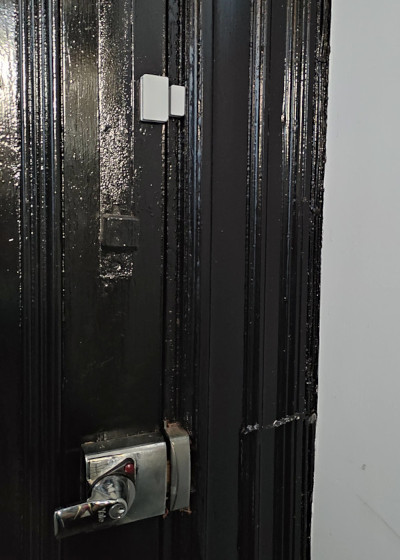
SonOff Zigbee Door Sensor My home automation setup has been fairly static recently; it does what we need and generally works fine. One area I think could be better is controlling it; we have access Home Assistant on our phones, and the Alexa downstairs can control things, but there are no smart assistants upstairs and sometimes it would be nice to just push a button to turn on the light rather than having to get my phone out. Thanks to the fact the UK generally doesn t have neutral wire in wall switches that means looking at something battery powered. Which means wifi based devices are a poor choice, and it s necessary to look at something lower power like Zigbee or Z-Wave. Zigbee seems like the better choice; it s a more open standard and there are generally more devices easily available from what I ve seen (e.g. Philips Hue and IKEA TR DFRI). So I bought a couple of Xiaomi Mi Smart Home Wireless Switches, and a CC2530 module and then ignored it for the best part of a year. Finally I got around to flashing the Z-Stack firmware that Koen Kanters kindly provides. (Insert rant about hardware manufacturers that require pay-for tool chains. The CC2530 is even worse because it s 8051 based, so SDCC should be able to compile for it, but the TI Zigbee libraries are only available in a format suitable for IAR s embedded workbench.) Flashing the CC2530 is a bit of faff. I ended up using the CCLib fork by Stephan Hadinger which supports the ESP8266. The nice thing about the CC2530 module is it has 2.54mm pitch pins so nice and easy to jumper up. It then needs a USB/serial dongle to connect it up to a suitable machine, where I ran Zigbee2MQTT. This scares me a bit, because it s a bunch of node.js pulling in a chunk of stuff off npm. On the flip side, it Just Works and I was able to pair the Xiaomi button with the device and see MQTT messages that I could then use with Home Assistant. So of course I tore down that setup and went and ordered a CC2531 (the variant with USB as part of the chip). The idea here was my test setup was upstairs with my laptop, and I wanted something hooked up in a more permanent fashion. Once the CC2531 arrived I got distracted writing support for the Desk Viking to support CCLib (and modified it a bit for Python3 and some speed ups). I flashed the dongle up with the Z-Stack Home 1.2 (default) firmware, and plugged it into the house server. At this point I more closely investigated what Home Assistant had to offer in terms of Zigbee integration. It turns out the ZHA integration has support for the ZNP protocol that the TI devices speak (I m reasonably sure it didn t when I first looked some time ago), so that seemed like a better option than adding the MQTT layer in the middle. I hit some complexity passing the dongle (which turns up as /dev/ttyACM0) through to the Home Assistant container. First I needed an override file in /etc/systemd/nspawn/hass.nspawn:
[Files]
Bind=/dev/ttyACM0:/dev/zigbee
[Network]
VirtualEthernet=true
(I m not clear why the VirtualEthernet needed to exist; without it networking broke entirely but I couldn t see why it worked with no override file.) A udev rule on the host to change the ownership of the device file so the root user and dialout group in the container could see it was also necessary, so into /etc/udev/rules.d/70-persistent-serial.rules went:
# Zigbee for HASS
SUBSYSTEM=="tty", ATTRS idVendor =="0451", ATTRS idProduct =="16a8", SYMLINK+="zigbee", \
	MODE="660", OWNER="1321926676", GROUP="1321926676"
In the container itself I had to switch PrivateDevices=true to PrivateDevices=false in the home-assistant.service file (which took me a while to figure out; yay for locking things down and then needing to use those locked down things). Finally I added the hass user to the dialout group. At that point I was able to go and add the integration with Home Assistant, and add the button as a new device. Excellent. I did find I needed a newer version of Home Assistant to get support for the button, however. I was still on 2021.1.5 due to upstream dropping support for Python 3.7 and not being prepared to upgrade to Debian 11 until it was actually released, so the version of zha-quirks didn t have the correct info. Upgrading to Home Assistant 2021.8.7 sorted that out. There was another slight problem. Range. Really I want to use the button upstairs. The server is downstairs, and most of my internal walls are brick. The solution turned out to be a TR DFRI socket, which replaced the existing ESP8266 wifi socket controlling the stair lights. That was close enough to the server to have a decent signal, and it acts as a Zigbee router so provides a strong enough signal for devices upstairs. The normal approach seems to be to have a lot of Zigbee light bulbs, but I have mostly kept overhead lights as uncontrolled - we don t use them day to day and it provides a nice fallback if the home automation has issues. Of course installing Zigbee for a single button would seem to be a bit pointless. So I ordered up a Sonoff door sensor to put on the front door (much smaller than expected - those white boxes on the door are it in the picture above). And I have a 4 gang wireless switch ordered to go on the landing wall upstairs. Now I ve got a Zigbee setup there are a few more things I m thinking of adding, where wifi isn t an option due to the need for battery operation (monitoring the external gas meter springs to mind). The CC2530 probably isn t suitable for my needs, as I ll need to write some custom code to handle the bits I want, but there do seem to be some ARM based devices which might well prove suitable

22 September 2021

Ian Jackson: Tricky compatibility issue - Rust's io::ErrorKind

This post is about some changes recently made to Rust's ErrorKind, which aims to categorise OS errors in a portable way. Audiences for this post Background and context Error handling principles Handling different errors differently is often important (although, sadly, often neglected). For example, if a program tries to read its default configuration file, and gets a "file not found" error, it can proceed with its default configuration, knowing that the user hasn't provided a specific config. If it gets some other error, it should probably complain and quit, printing the message from the error (and the filename). Otherwise, if the network fileserver is down (say), the program might erroneously run with the default configuration and do something entirely wrong. Rust's portability aims The Rust programming language tries to make it straightforward to write portable code. Portable error handling is always a bit tricky. One of Rust's facilities in this area is std::io::ErrorKind which is an enum which tries to categorise (and, sometimes, enumerate) OS errors. The idea is that a program can check the error kind, and handle the error accordingly. That these ErrorKinds are part of the Rust standard library means that to get this right, you don't need to delve down and get the actual underlying operating system error number, and write separate code for each platform you want to support. You can check whether the error is ErrorKind::NotFound (or whatever). Because ErrorKind is so important in many Rust APIs, some code which isn't really doing an OS call can still have to provide an ErrorKind. For this purpose, Rust provides a special category ErrorKind::Other, which doesn't correspond to any particular OS error. Rust's stability aims and approach Another thing Rust tries to do is keep existing code working. More specifically, Rust tries to:
  1. Avoid making changes which would contradict the previously-published documentation of Rust's language and features.
  2. Tell you if you accidentally rely on properties which are not part of the published documentation.
By and large, this has been very successful. It means that if you write code now, and it compiles and runs cleanly, it is quite likely that it will continue work properly in the future, even as the language and ecosystem evolves. This blog post is about a case where Rust failed to do (2), above, and, sadly, it turned out that several people had accidentally relied on something the Rust project definitely intended to change. Furthermore, it was something which needed to change. And the new (corrected) way of using the API is not so obvious. Rust enums, as relevant to io::ErrorKind (Very briefly:) When you have a value which is an io::ErrorKind, you can compare it with specific values:
    if error.kind() == ErrorKind::NotFound   ...
  
But in Rust it's more usual to write something like this (which you can read like a switch statement):
    match error.kind()  
      ErrorKind::NotFound => use_default_configuration(),
      _ => panic!("could not read config file  :  ", &file, &error),
     
  
Here _ means "anything else". Rust insists that match statements are exhaustive, meaning that each one covers all the possibilities. So if you left out the line with the _, it wouldn't compile. Rust enums can also be marked non_exhaustive, which is a declaration by the API designer that they plan to add more kinds. This has been done for ErrorKind, so the _ is mandatory, even if you write out all the possibilities that exist right now: this ensures that if new ErrorKinds appear, they won't stop your code compiling. Improving the error categorisation The set of error categories stabilised in Rust 1.0 was too small. It missed many important kinds of error. This makes writing error-handling code awkward. In any case, we expect to add new error categories occasionally. I set about trying to improve this by proposing new ErrorKinds. This obviously needed considerable community review, which is why it took about 9 months. The trouble with Other and tests Rust has to assign an ErrorKind to every OS error, even ones it doesn't really know about. Until recently, it mapped all errors it didn't understand to ErrorKind::Other - reusing the category for "not an OS error at all". Serious people who write serious code like to have serious tests. In particular, testing error conditions is really important. For example, you might want to test your program's handling of disk full, to make sure it didn't crash, or corrupt files. You would set up some contraption that would simulate a full disk. And then, in your tests, you might check that the error was correct. But until very recently (still now, in Stable Rust), there was no ErrorKind::StorageFull. You would get ErrorKind::Other. If you were diligent you would dig out the OS error code (and check for ENOSPC on Unix, corresponding Windows errors, etc.). But that's tiresome. The more obvious thing to do is to check that the kind is Other. Obvious but wrong. ErrorKind is non_exhaustive, implying that more error kinds will appears, and, naturally, these would more finely categorise previously-Other OS errors. Unfortunately, the documentation note
Errors that are Other now may move to a different or a new ErrorKind variant in the future.
was only added in May 2020. So the wrongness of the "obvious" approach was, itself, not very obvious. And even with that docs note, there was no compiler warning or anything. The unfortunate result is that there is a body of code out there in the world which might break any time an error that was previously Other becomes properly categorised. Furthermore, there was nothing stopping new people writing new obvious-but-wrong code. Chosen solution: Uncategorized The Rust developers wanted an engineered safeguard against the bug of assuming that a particular error shows up as Other. They chose the following solution: There is now a new ErrorKind::Uncategorized which is now used for all OS errors for which there isn't a more specific categorisation. The fallback translation of unknown errors was changed from Other to Uncategorised. This is de jure justified by the fact that this enum has always been marked non_exhaustive. But in practice because this bug wasn't previously detected, there is such code in the wild. That code now breaks (usually, in the form of failing test cases). Usually when Rust starts to detect a particular programming error, it is reported as a new warning, which doesn't break anything. But that's not possible here, because this is a behavioural change. The new ErrorKind::Uncategorized is marked unstable. This makes it impossible to write code on Stable Rust which insists that an error comes out as Uncategorized. So, one cannot now write code that will break when new ErrorKinds are added. That's the intended effect. The downside is that this does break old code, and, worse, it is not as clear as it should be what the fixed code looks like. Alternatives considered and rejected by the Rust developers Not adding more ErrorKinds This was not tenable. The existing set is already too small, and error categorisation is in any case expected to improve over time. Just adding ErrorKinds as had been done before This would mean occasionally breaking test cases (or, possibly, production code) when an error that was previously Other becomes categorised. The broken code would have been "obvious", but de jure wrong, just as it is now, So this option amounts to expecting this broken code to continue to be written and continuing to break it occasionally. Somehow using Rust's Edition system The Rust language has a system to allow language evolution, where code declares its Edition (2015, 2018, 2021). Code from multiple editions can be combined, so that the ecosystem can upgrade gradually. It's not clear how this could be used for ErrorKind, though. Errors have to be passed between code with different editions. If those different editions had different categorisations, the resulting programs would have incoherent and broken error handling. Also some of the schemes for making this change would mean that new ErrorKinds could only be stabilised about once every 3 years, which is far too slow. How to fix code broken by this change Most main-line error handling code already has a fallback case for unknown errors. Simply replacing any occurrence of Other with _ is right. How to fix thorough tests The tricky problem is tests. Typically, a thorough test case wants to check that the error is "precisely as expected" (as far as the test can tell). Now that unknown errors come out as an unstable Uncategorized variant that's not so easy. If the test is expecting an error that is currently not categorised, you want to write code that says "if the error is any of the recognised kinds, call it a test failure". What does "any of the recognised kinds" mean here ? It doesn't meany any of the kinds recognised by the version of the Rust stdlib that is actually in use. That set might get bigger. When the test is compiled and run later, perhaps years later, the error in this test case might indeed be categorised. What you actually mean is "the error must not be any of the kinds which existed when the test was written". IMO therefore the right solution for such a test case is to cut and paste the current list of stable ErrorKinds into your code. This will seem wrong at first glance, because the list in your code and in Rust can get out of step. But when they do get out of step you want your version, not the stdlib's. So freezing the list at a point in time is precisely right. You probably only want to maintain one copy of this list, so put it somewhere central in your codebase's test support machinery. Periodically, you can update the list deliberately - and fix any resulting test failures. Unfortunately this approach is not suggested by the documentation. In theory you could work all this out yourself from first principles, given even the situation prior to May 2020, but it seems unlikely that many people have done so. In particular, cutting and pasting the list of recognised errors would seem very unnatural. Conclusions This was not an easy problem to solve well. I think Rust has done a plausible job given the various constraints, and the result is technically good. It is a shame that this change to make the error handling stability more correct caused the most trouble for the most careful people who write the most thorough tests. I also think the docs could be improved.
edited shortly after posting, and again 2021-09-22 16:11 UTC, to fix HTML slips


comment count unavailable comments

20 September 2021

Holger Levsen: 20210920-Debian-Reunion-Hamburg-2021

Debian Reunion Hamburg 2021, we still have free beds We still have some free slots and beds available for the "Debian Reunion Hamburg 2021" taking place in Hamburg at the venue of the 2018 & 2019 MiniDebConfs from Monday, Sep 27 2021 until Friday Oct 1 2021, with Sunday, Sep 26 2021 as arrival day. So again, Debian people will meet in Hamburg. The exact format is less defined and structured than previous years, probably we will just be hacking from Monday to Wednesday, have talks on Thursday and a nice day trip on Friday. Please read https://wiki.debian.org/DebianEvents/de/2021/DebianReunionHamburg and if you intend to attend, please register there. If additionally you would like to stay on site (in a single room or shared with one another person), please mail me. I'm looking forward to this event, even though (or maybe also because) it will be much smaller than last years. I suppose this will lead to more personal interactions and more intense hacking, though of course it is to be seen how this works out exactly!

14 September 2021

Sven Hoexter: PV - Monitoring Envertech Microinverter via envertecportal.com

Some time ago I looked briefly at an Envertech data logger for small scale photovoltaic setups. Turned out that PV inverter are kinda unreliable, and you really have to monitor them to notice downtimes and defects. Since my pal shot for a quick win I've cobbled together another Python script to query the portal at www.envertecportal.com, and report back if the generated power is down to 0. The script is currently run on a vserver via cron and reports back via the system MTA. So yeah, you need to have something like that already at hand. Script and Configuration You've to provide your PV systems location with latitude and longitude so the script can calculate (via python3-suntime) the sunrise and sunset times. At the location we deal with we expect to generate some power at least from sunrise + 1h to sunet - 1h. That is tunable via the configuration option toleranceSeconds. Retrieving the stationId is a bit ugly because it's not provided via any API, instead it's rendered serverside into the website. So I just logged in on the portal and picked it up by looking into the page source. www.envertecportal.com API I guess this is some classic in the IoT land, but neither the documentation provided on the portal frontpage as docx, nor the API docs at port 8090 are complete and correct. The few bits I gathered via the Firefox Web Developer Tools are:
  1. Login https://www.envertecportal.com/apiaccount/login - POST, sent userName and pwd containing your login name and password. The response JSON is very explicit if your login was not successful and why.
  2. Store the session cookie called ASP.NET_SessionId for use on all subsequent requests.
  3. Retrieve station info https://www.envertecportal.com/ApiStations/getStationInfo - POST, sent ASP.NET_SessionId and stationId with the ID of the station. Returns a JSON with an object named Data. The field Power contains the currently generated power as a float with two digits (e.g. 0.01).
  4. Logout https://www.envertecportal.com/apiAccount/Logout - POST, sent ASP.NET_SessionId.
Some Surprises There were a few surprises, maybe they help others dealing with an Envertech setup.
  1. The portal truncates passwords at 16 chars.
  2. The "Forget Password?" function mails you back the password in plain text (that's how I learned about 1.).
  3. The login API endpoint reporting the exact reason why the login failed is somewhat out of fashion. Though this one is probably not a credential stuffing target because there is no money to make, so don't care.
  4. The data logger reports the data to www.envertecportal.com at port 10013.
  5. There is some checksuming done on the reported data, but the system is not replay safe. So you can sent it any valid data string at a later time and get wrong data recorded.
  6. People at forum.fhem.de decoded some values but could not figure out the checksuming so far.

Next.

Previous.