Search Results: "angel"

10 July 2012

Arnaud Quette: Definitive solution to IPMI over LAN with Dell iDrac Express

I have this bunch of Dell R610, with iDrac6 Express management cards. I used these, among other things, for developing IPMI support in NUT and working on Infrastructure & Cloud power management. But that's the topic of another post (still, if you're interested in, check this and that). The thing is that this "IPMI" monitoring development has been limited to local support (Ie, power supplies can't be monitored remotely by the nut-ipmipsu driver), due to an issue : any attempt to enable IPMI access over the network was miserably failing! Well, these attempts were limited to a couple of 15 minutes runs, without plain motivation, almost a year ago. The various firmwares were up to date (iDrac 1.70, ...) , everything was running and configured fine, locally. But still... no IPMI available through the network! Looking on the Net, I've learned that many Dell customers with iDrac Express cards, were having the same issue. Dell support seems to have replaced tons of motherboards! There, I switched to other things, and time has passed.... A good year later (last week), I decided that it was time to get back on this. And I've found the solution there Incredible: this was due to a 'bug' in the Broadcom NetXtreme II LoM (LAN on Motherboad) firmware! I've not had time to dig this issue in depth, but here is a base explanation, for what it's worth: Some LoM initial self tests are failing. Thus, the LoM are not switched to the managed mode, and can't actually be available for BMC management (thus no IPMI over the network). In my case, the tests were wrongly failing at 'A07', a test which tries to establish a Gigabit connection! Strangely, all these servers are connected on a Gb switch! Not a fully satisfactory answer, but that said, there is a solution, and I've not much time to pour into this investigation (comments may always change my mind though!). So here is a comprehensive procedure to fix this, from your Linux system, and using FreeDOS:
$ mkfs.msdos /dev/sdX1
Note: 'X' is to be replaced by the exact name of your USB key. An hint: call 'tail -f /var/log/syslog" and unplug / replug your USB key. You will see some entries like "...sdb Attached SCSI removable disk". So, there, it's "sdb".
$ qemu -boot a -fda balder10.img -hda /dev/sdX A:\> sys c: A:\> xcopy /E /N a: c:
Note that you will need "root" privileges.
$ qemu -hda /dev/sdX
$ unzip Bcom_LAN_14.2.x_DOSUtilities_A03.exe
c:\ uxdiag -t abcd mfw 1
For what it's worth (again), I just hope that it will be useful to others... I will now prepare another post using using FreeIPMI to manage your servers, the GNU way... cheers,
-- Arno Thanks to Jordi Clariana, his enlightening post, Daniel for this one, Aur lien was motivating me again in solving this iDrac Express issue and Al Chu (FreeIPMI project leader) for all his invaluable help on IPMI.

9 July 2012

John Goerzen: Decisions on Listening to Music

A couple of days ago, I commented about my thoughts on finding a better way to listen to music, and asked for suggestions. I ve checked out the avenues suggested, and here are my thoughts so far. Streaming service: Spotify Of the streaming service offerings, Spotify seems the most compelling. It has both Linux and Android clients. The Linux client is unofficial and a bit buggy, but serviceable. The service is fairly nice, and the serendipity of listening to radio of tracks like any track or artist I may pick is an incredible feature. It will mean a different mindset; rather than carefully choosing what I buy, I have a vast catalog at my fingertips. I d have to give up some control, but might be better off for it. Spotify can play local files, but sadly lacks support for FLAC that most of my collection is in. A little work with the shell, and I had a quick multi-core FLAC to MP3 conversion done. It can also identify local files and match them up with its catalog, but it does a somewhat poor job of it, despite the fact that my files are tagged by Musicbrainz. There are also a fair number of albums in my collection (from Magnatune and from local artists) that aren t in Spotify s catalog and probably never will be. I may wind up using git-annex or something like it to sync them between PCs. Surprisingly, it doesn t have any kind of web-based player available. It has a lot of features, but many of them are under-documented. Subsonic / Supersonic The idea of being able to stream music anywhere certainly has appeal, and the idea of streaming that music from my own machine my own collection is quite the appealing one. Subsonic seems to be the standard that people recommend for this. It has a web-based player that works well, as well as mobile clients for various platforms. The Android mobile client is particularly well-regarded and is probably the best one here, aside from Spotify. The playlists work well, as expected, and generally it has the appearance of a well-rounded system. There is a lot of flexibility in bitrates; maximum bitrates can be set per-user and per-client. It, of course, transcodes on the fly. My chief gripe about Subsonic is that it has no true album/artist/genre browser. Its main browser is mostly a filesystem browser. I have used clients that show album/artist/genre panes or sortable lists, based on tags, for so long that my filesystem organization is rather different centered around bitrate of rip, origin, etc. It is not very easy to navigate my collection in that way. The search feature can search artist and album, and this can partially make up for it. But there is simply no way to see a list of all artists in the collection. The server is written in Java, and takes up 362MB at startup. That s, I guess, decent for a Java server, but doesn t make me pleased as I d be running it on lower-end hardware. Supersonic is a git-maintained actively synced subsonic fork which removes the license cost (the source is GPL3 anyhow so that wasn t a big deal). Ampache Often mentioned in the same breath as Subsonic, this is yet another frequent suggestion for streaming your own collection. Its primary player is web-based, like Subsonic. It has full artist/genre browsers, and adds tag cloud and various other options as well by default, it loaded the tag cloud with my genre tags, which was a nice touch. The search feature is a little less robust, as it simply searches anywhere and returns a list of all matching tracks, rather than listing matching albums and artists before going into the list of all tracks. But that is somewhat of a minor nit. Ampache s web-based player, liks Subsonic s, uses Flash, but the implementation is really quite awkward. You can t simply click a play button and have playback start. Rather, you must add things to the playlist (queue), a frame on the web interface. Then, you must click play in THAT frame, which launches a new window for the player and transfers its contents to it. You thus have two separate running playlists. And if you think you can just add to the playlist of the player window, think again; you can only replace it. It is simply not possible to add a track to the end of that list without losing your existing place. This makes the usefulness of the web-based player rather, well, low. Playlist functionality in Ampache is rather odd. You can have playlists, but if you want to add a track to a saved playlist, first you have to clear you current playlist, then add the track to it, then save it to the existing playlist. Frontends for Ampache exist in banshee and in amarok. Banshee s is broken, and simply silently fails to do anything. Unless you look in the console, in which case you ll see a .NET backtrace. Banshee has had these mysterious errors for me for years. The Amarok plugin is so basic that you can browse by artist but not by album, and is almost unusable. There is also a rhythmbox plugin in Debian, but it is apparently for an old version of Rhythmbox and no longer works. The best frontend is a dedicated Ampache frontend called Viridian. It has a nice interface, provides features such as taskbar integration, and generally works pretty well. The only thing it s bad at is playlists, and here it s even worse than the web interface. It doesn t support modifying the server-side playlists at all. And accessing one is an annoying load playlist operation, that replaces your current play queue (also called the playlist ) with its contents by default. Several Android clients exist for Ampache, though it seems only one has seen any updates since 2010. mpd This is an interesting program, as it is designed more to provide multiple points of control for a single player than it is to stream a single collection to multiple devices. Nevertheless, I tested its HTTP and icecast stream modules. (It can also stream with PulseAudio, but PulseAudio causes devious breakage on my workstation, so I refuse to bother.) This could be made to work reasonably well on my LAN using the gmpc client. There are several Android clients as well, though none of them integrate as well as Subsonic or Spotify. Most seem focused on controlling a remote player. The ones that do stream do so with some hiccups, and don t integrate controls with the lock screen. gmpc is a reasonable control program and, combined with mplayer, makes a decent player. It can browse the database every way I d want to. It doesn t let me right-click on tracks to add them to playlists, but I can use copy/paste to do so, or add them to the play queue and from there to a playlist. It s annoying, but not completely unworkable. But here s the real concern. mpd has no provision whatsoever for any sort of encryption such as SSL. If I want to be listening to my music collection from on the road, I don t really wish to open up a streaming music service for the entire Internet. Nor do I really want to mess with SSH tunnels and the like, which are cumbersome on Android (and can be in general). This is pretty much a fatal flaw to me. Google Music An interesting service, but ultimately one I don t see the point for in my situation where I already have my music on a PC that is always on. It would probably accommodate my entire collection free, but how many weeks would it take me to get it there? And how would it stay in sync? It simply doesn t offer me any compelling advantage over streaming direct from my PC, so I don t see much need to bother with it. Others I briefly considered Streeme (poor mobile support), Audiogalaxy (no Linux support), Jinzora (appears dead), and Sockso (no mobile support). I also briefly considered other streaming services such as Pandora, Slacker, rdio, etc., but based on reviews didn t think that they were worth bothering with. Conclusions I m left mainly considering Spotify and Subsonic. For right now, I m going to try Spotify and see where that leads me, but may wind up getting back to Subsonic if I can t find tracks I want with Spotify.

6 July 2012

John Goerzen: How to listen to music?

This seems like a simple question: how do you listen to music? But in a way, I think I ve fallen behind the times. I ve enjoyed listening to digital music for years, since well before MP3 even existed (MIDI files could be comfortably downloaded over dialup; some of you may even remember MOD files). Anyhow, a few years ago, I digitized my entire CD collection, ripping it to FLAC and encoding to high-bitrate MP3 for storage on my 160GB iPod. Since, I ve purchased some music from DRM-free MP3 retailers, and even FLAC files from Magnatune, but at this point I basically say that I have enough music. I have only rarely bought anything new in the last couple of years. I have used Musicbrainz Picard to enforce consistent tagging across almost my entire collection. I am usually in front of a Linux machine. I run mt-daapd on my fileserver, so I can stream music from it to any other machine in the house. However, this has a lot of drawbacks. It is generally impossible to create or modify persistent playlists with this protocol. I can t modify metadata. I can t assign ratings. Though perhaps I don t need to. There are a lot of online services I could think of: Pandora, Spotify, Rdio, Slacker. Plus, of course, the upload your music to the cloud services such as Google and Amazon. Have people tried these? I m hesitant to use a service where I pay a monthly fee, unless I wind up owning the music in a DRM-free fashion. And I m a little nervous about the privacy implications of uploading a vast amount of music to the cloud. There are some items in my collection that I am certain are not available on any of those others, but for the most part I m willing to take what is out there if it meets my tastes. My tastes, by the way, typically run to classical and opera but also can go towards middle eastern or certain new age music (though I m very picky about that, since I don t care for most new age stuff I hear.) But these are huge categories; sometimes I d like to hear some load and noisy classical (say, Beethoven s Ninth conclusion, some Wagner, Verdi arias, etc.) And other times, something more contemplative (a Mozert concerto) or even quiet (a nice sonata) meet my mood. I have playlists for these on my iPod Classic a bit of a problem, since I don t use that device much anymore except in the car, and it takes a LOT of time to categorize things into these playlists. (An opera or a symphony could have parts in various styles and various levels of energy, for instance.) I keep a small manually-managed subset on my Android phone, which works fine. A recommendation engine for things like this could be useful, if it works well. My requirements, basically: I want something that will play the same music on my Linux machines. I want to be able to have playlists kept in sync across my machines. And I don t want a monthly fee. Ideally, the software will work on Android as well, and provide similar features there. Anything that requires Windows is a non-starter. I ve considered NFS mounts, but that s a bit annoying when the laptop disconnects from the network or when it s not at home. What are your thoughts? Ideas?

4 July 2012

Dirk Eddelbuettel: RcppBDT 0.2.0

A new release of the RcppBDT package appeared on CRAN earlier today. RcppBDT uses Rcpp, and in particular the nifty Rcpp modules feature of wrapping C++ code for R just by declaring the (class or function) interfaces. It uses this to bring in some useful functions from Boost Date.Time to R so that one can do things like
R> library(RcppBDT)
R> sapply(2012:2016, function(year)
+         format(getNthDayOfWeek(first, Mon, Sep, year)))
[1] "2012-09-03" "2013-09-02" "2014-09-01" "2015-09-07" "2016-09-05"
R> 
to compute the next five Labor Day dates in the US, given the year and the first Monday of September requirement. More examples are e.g. on the earlier blog post announcing version 0.1.0. Changes are mostly internal. R 2.15.1 brough a better / easier way to load such 'modules' into R, and Rcpp 0.9.13 allows us to use this. So RcppBDT continues to be useful as an example package for Rcpp modules. I also streamlines the interface a little: identifiers are now directly accessible in the package's NAMESPACE rather than just via the an instantiated object. I also added a NEWS file, using the .Rd format so that we can import the marked-up text:
News for Package RcppBDT Changes in version 0.2.0 (2012-07-02)
  • The core module, which wraps what in C++ is boost::gregorian::date, is now exposed as an Rcpp module bdtDate. As all example and demos operated off a (package-global) variable 'bdt', no user visible change was needed outside of the code instantiating at package load.
  • Updated package instantiation to the new facilities offered by the current versions R 2.15.1 and Rcpp 0.9.13 which make Rcpp module initialization easier and more streamlined.
Changes in version 0.1.0 (2011-01-17)
  • First CRAN upload (and see ChangeLog for more granular details) bug fix in svm cross validation
Courtesy of CRANberries, there is also a diffstat report for 0.2.0 relative to 0.1.0. As always, feedback is welcome and the rcpp-devel mailing list off the R-Forge page for Rcpp is the best place to start a discussion.

2 July 2012

Raphaël Hertzog: My Debian Activities in June 2012

This is my monthly summary of my Debian related activities. If you re among the people who made a donation to support my work (168.12 , thanks everybody!), then you can learn how I spent your money. Otherwise it s just an interesting status update on my various projects. Dpkg This month, I resumed my work on dpkg. I concentrated my efforts on some polishing of the 3.0 (quilt) format. With the latest version (1.16.6 which was uploaded to unstable shortly before the freeze), dpkg-source restores the source tree in a clean state after a failed patch application (#652970), doesn t overwrite the patch header from the pre-existing automatic patch, updates automatically debian/source/include-binaries during dpkg-source commit, and supports a new no-unapply-patches option for those who dislike the auto-unapplication at the end of the process when the patches were not applied at the start. I wanted to go further and offer a new feature that could insert the automatic patch at the bottom of the quilt series but I have been short on time to complete this feature. I just managed to factorize all the quilt handling in a dedicated Perl module (Dpkg::Source::Quilt) to have cleaner code in the module handling the source format (Dpkg::Source::Package::V3::quilt). For those who wonder, this feature is meant primarily for the X Strike Force team which maintains packages in Git and are doings lots of upstream cherry-picks (to fix regressions, etc.). But they also use quilt on top of that tree to keep some lasting Debian specific changes. With the 1.0 format, the automatic diff is a bit messy but at least it gets smaller automatically when a new upstream release gets out, there s nothing to clean out. I d like them to be able to use 3.0 (quilt) while keeping their workflow. I m leaning towards allowing --auto-commit=first:cherry-picks that would name the automatic patch cherry-picks and put it in the first position in the quilt series. (Opinions welcome on that feature, BTW) Packaging There s been quite some packaging in this last month before the freeze: While doing all this packaging work, I found 2 possible improvements that I filed as bug reports: Debian France Booth at Solutions Linux From June 19th to June 21th, I manned the Debian France booth at Solutions Linux together with Carl Chenet, Tanguy Ortolo and other members of the association. We answered lots of questions, sold all t-shirts and umbrellas that Carl imported from Germany and Switzerland (we really need to get our own merchandising stuff produced in France!), got people to join the association. We also presented a printed copy of the Debian Administrator s Handbook and of the corresponding French book. You can see Carl, me and Tanguy on this picture (click on it to see a bigger picture, thanks to S bastien Dubois of Evolix for this one!):
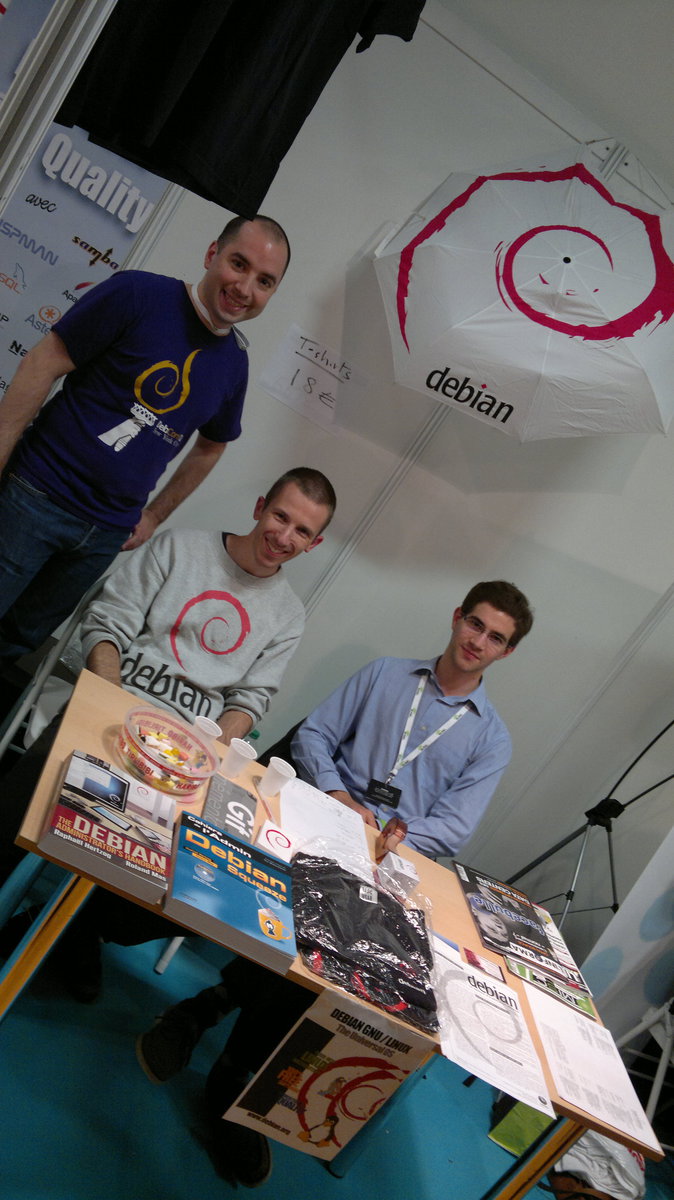
I know lots of people are preparing for Debconf but I decided to not attend this year, the price of the air plane ticket was a bit too hefty for me and it was also in partial conflict with our family vacations. I thought about attending the Libre Software Meeting instead but alas I won t go there either (but Roland Mas will be there!), I have too much work to complete before my own vacation in 2 weeks. Thanks See you next month for a new summary of my activities.

2 comments Liked this article? Click here. My blog is Flattr-enabled.

29 June 2012

Dirk Eddelbuettel: Rcpp 0.9.13

The bug-fix in version 0.9.12 of Rcpp turned out to be incomplete, so a new version 0.9.13 is now on CRAN and will get to Debian shortly. The Rcpp::Enviroment constructor is now properly fixed (using the global environment as a default value). As well, a new #define was created to detect the clang++ compiler before/after version 3.0.0 as one exceptions header changed location. Unit tests files were also once more updated. The complete NEWS entry for 0.9.13 is below; more details are in the ChangeLog file in the package and on the Rcpp Changelog page.
0.9.13  2012-06-28
    o   Truly corrected Rcpp::Environment class by having default constructor
        use the global environment, and removing the default argument of
        global environment from the SEXP constructor
    o   Added tests for clang++ version to include bits/exception_defines.h
        for versions 3.0 or higher (similar to g++ 4.6.0 or later), needed to
        include one particular exceptions header
    o   Made more regression tests conditional on the RunAllRcppTests to come
        closer to the CRAN mandate of running tests in sixty seconds
    o   Updated unit test wrapper tests/doRUnit.R as well as unitTests/runTests.R
Thanks to CRANberries, you can also look at a diff to the previous release 0.9.12. As always, even fuller details are on the Rcpp Changelog page and the Rcpp page which also leads to the downloads, the browseable doxygen docs and zip files of doxygen output for the standard formats. A local directory has source and documentation too. Questions, comments etc should go to the rcpp-devel mailing list off the R-Forge page

28 June 2012

Sylvain Le Gall: OASIS 0.3.0 release

Logo OASIS small OASIS is a tool to integrate a configure, build and install system in your OCaml project. It helps to create standard entry points in your build system and allows external tools to analyse your project easily. It is the building brick of OASIS-DB, a CPAN for OCaml. This release takes almost 18 months to complete. This is too long and I will talk in another blog post on the way I am trying to improve this right now (esp. using continuous integration). This new release fixes a small bug (1 line) that prevents setup.ml to run with OCaml 4.00. If you have projects that was generated with a former release consider upgrading to OASIS 0.3.0. There are several big new stuff that comes with this release. It now supports Pack: field for libraries which allows to pack your library using -for-pack and so on. We are also compiling .cmxs (dynlink object for native) by default and we publish them in the META file. This feature was implemented in order to get more libraries to provide .cmxs and to help project like Ocsigen to take advantage of this. If you want to get rid of this at configure time, you can use ./configure --override native_dynlink false. We introduce two new default flags: --enable-tests and --disable-docs for configure. These are implicit flags that define if we will run Test sections or compile Document sections. They are especially useful to reduce the number of dependencies, because dependencies of Test will be excluded by default. We recommend to set Build$: flag(tests) to any Library or Executable sections that are only useful for tests. This allows you to really cut down the number of dependencies. The last change I want to introduce is about the old setup-dev subcommand which is now deprecated. It has been replaced by 2 different update schemes. I am pretty excited by this feature which in fact comes from OASIS user (esp. Lwt project). The former scheme was to have a big 'setup.ml' that always call the command oasis to update. This was complex and not very useful. We now have 2 mode: dynamic and weak. dynamic allow you to have a small setup.ml and to keep your VCS history clean but you need to install OASIS. weak need a big setup.ml but only need to call the command oasis if someone change something in _oasis. This mode is targeted to project that wants to be able to checkout from VCS an OCaml project without installing OASIS. The difference generated by weak mode doesn't pollute too much the VCS history because most the time they make sense. For example, you upgrade your package version number in _oasis and it produces a change with 6 lines where the version number changes in every META, setup.ml files and so on. This version has been tested on: You can download it here or use your favorite package manager: Debian (UPDATE: pending upload)
$ apt-get install -t experimental oasis
GODI
$ godi_console perform -build apps-oasis
odb.ml
$ ocaml odb.ml oasis
Here is the complete changelog: EXTREMLY IMPORTANT changes (read this) PACKAGES uploaded to oasis-db will be automatically "derived" before OCaml 4.00 release (i.e. oUnit v1.1.1 will be regenerated with this new version as oUnit v1.1.1~oasis1). PACKAGES not uploaded to oasis-db need to be regenerated. In order not to break 3rd party tools that consider a tarball constant, I recommend to create a new version. Thanks to INRIA OCaml team for synchronizing with us on this point. Major changes: You can now have the following example:
     ...
     Executable test_exec
       Install: false
       Build$: flag(tests)
       MainIs: testExec.ml
       BuildDepends: oUnit
     
     Test main
       Command: $test_exec
       TestTools: test_exec
     ...
The Run$: flag(tests) is implicit for the section Test main. The default value is false for tests. If all the executable for test are flagged correctly (Build$: flag(tests)), you'll get rid of the dependency on oUnit. It works the same for documentation, however the default is true. (Closes: #866) In order to allow interdependent flags, we transform back lazy values into unit -> string functions. This allows to change a flag value on the command line and to update all the dependent values. (Closes: #827, #938) It defines different ways to manage the auto-update of setup.ml: The choice between weak and dynamic depends on your need with regard to VCS and to the presence of oasis. The weak allow to checkout the project from VCS and be able to work on it, without the need of installing 'oasis' as long as you don't change the file _oasis. But it clutter your VCS history with changes to the build system each time you change something in _oasis. The 'dynamic' mode gives you no VCS history pollution but makes mandatory to have installed oasis libraries. Avoid copying executable to their real name. It helps to call ocamlbuild a single time for the whole build rather than calling it n time (n = number of executable sections) and copying resulting exec. This speeds up the build process because ocamlbuild doesn't have to compute/scan dependencies each time. The drawback is that you have to use $foo when you want to call Executable foo, because $foo will be '_build/.../main.byte'. For example:
CCOpt: -DEXTERNAL_EXP10 -L/sw/lib "-framework vecLib"
Will be parsed correctly and outputed according to target OS. In order to ease building oasis, we have minimize the number of dependencies. You only need to install ocamlmod, ocamlify and ocaml-data-notation for a standard build without tests. Dependencies on pcre, extlib and ocamlgraph has been dropped. The remaining dependencies are hidden behind a flag tests. OASIS now produces .cmxs file by default and add them to META. Now a META looks like:
     ...
     archive(byte) = "oasis.cma"
     archive(byte, plugin) = "oasis.cma"
     archive(native) = "oasis.cmxa"
     archive(native, plugin) = "oasis.cmxs"
     ...
This will ultimately help to generate automatically .cmxs for all oasis enabled projects. We hope that this new feature will improve dynamic linking use in OCaml (esp. for project like Ocsigen). Other changes Thanks to Anil Madhavapeddy, Pierre Chambart, Christophe Troestler, Jeremie Dimino, Ronan Le Hy, Yaron Minsky and Till Varoquaux for their help with this release. Also thanks to all the testers of the numerous release candidates. This was a long work and each time a tester has downloaded oasis has helped me to know that I was working for someone.

26 June 2012

Dirk Eddelbuettel: Rcpp 0.9.12

A bug-fix release 0.9.12 of Rcpp arrived earlier today on CRAN and is now in Debian too. This fixes a minor snafu with the Rcpp::Enviroment constructor following a small change made for 0.9.11. It also reduces the number of unit tests running by default as CRAN was complaining that it took too long to run the checks. I am not impressed---tests are for running, not skipping. Lastly, the cleanup needed to be extended to another directory. The complete NEWS entry for 0.9.12 is below; more details are in the ChangeLog file in the package and on the Rcpp Changelog page.
0.9.12  2012-06-23
    o   Corrected Rcpp::Environment class by removing (empty) ctor following
        rev3592 (on May 2) where default argument for ctor was moved
    o   Unit testing now supports argument --allTests to impose that all
        tests are executed; otherwise some expensive tests are skipped. This
        is arguably not the right thing to do, but CRAN maintainers insist 
        on faster tests.
    o   The cleanup script now also considers inst/unitTests/testRcppClass/src 
Thanks to CRANberries, you can also look at a diff to the previous release 0.9.11. As always, even fuller details are on the Rcpp Changelog page and the Rcpp page which also leads to the downloads, the browseable doxygen docs and zip files of doxygen output for the standard formats. A local directory has source and documentation too. Questions, comments etc should go to the rcpp-devel mailing list off the R-Forge page

23 June 2012

Dirk Eddelbuettel: Rcpp 0.9.11

Release 0.9.11 of Rcpp arrived on CRAN this morning and in Debian later today. This is a somewhat incremental release with a few internal improvements and few new features. One interesting new development has been contributed by John Chambers who is extending 'Rcpp modules' into 'Rcpp classes' which allows R code to modify and extend C++ classes loaded via Rcpp modules; see help(setRcppClass) for more. This also lead to some changes in the code for loading modules which however requires the brand-new R version 2.15.1 released today as well. The complete NEWS entry for 0.9.11 is below; more details are in the ChangeLog file in the package and on the Rcpp Changelog page.
0.9.11  2012-06-22
    o   New member function for vectors (and lists etc) containsElementNamed() 
        which returns a boolean indicating if the given element name is present
    o   Updated the Rcpp.package.skeleton() support for Rcpp modules by
        carrying functions already present from the corresponding unit test
        which was also slightly expanded; and added more comments to the code 
    o   Rcpp modules can now be loaded via loadRcppModules() from .onLoad(),
        or via loadModule("moduleName") from any R file 
    o   Extended functionality to let R modify C++ clases imported via modules
        documented in help(setRcppClass)
    o   Support compilation in Cygwin thanks to a patch by Dario Buttari
    o   Extensions to the Rcpp-FAQ and the Rcpp-modules vignettes
    o   The minium version of R is now 2.15.1 which is required for some of
        the Rcpp modules support 
Thanks to CRANberries, you can also look at a diff to the previous release 0.9.10. As always, even fuller details are on the Rcpp Changelog page and the Rcpp page which also leads to the downloads, the browseable doxygen docs and zip files of doxygen output for the standard formats. A local directory has source and documentation too. Questions, comments etc should go to the rcpp-devel mailing list off the R-Forge page

21 June 2012

John Goerzen: I introduced my 5-year-old and 2-year-old to startx and xmonad. They re DELIGHTED!

Two years ago, Jacob (then 3) and I built his first computer together. I installed Debian on it, but never put a GUI on the thing. It s command-line, and has provided lots of enjoyment off and on over the last couple of years. I ve written extensively about what our boys like to do, and the delight they have at learning things on the command line. The looks of shock I get from people when I explain, as if it s perfectly natural, that my child has been able to log in by himself to a Linux shell since age 3, are amusing and astounding. Especially considering that it is really not that hard. Instead of learning how to run an Xbox, he s learned how to run bash. I like that. Lately, Jacob (now 5) hasn t been spending much time with it. He isn t really at a stage where he wants to push his limits too far, I think, but yet also gets bored with the familiar. So I thought it was time to introduce a GUI in a limited fashion, perhaps to let him download photos and video from his Vtech toy camera (that takes real low-res photos and videos which can be downloaded over a USB1 link). He s familiar with the concept, at least somewhat, having seen GUIs on Terah s computer (Gnome 2) and mine (xfce4 + xmonad). So last night, Oliver (age 2) and I went down to the basement on a mouse-finding expedition. Sure enough, I had an old PS/2 mouse down there that would work fine. The boys both helped string it through the desk up on our play room, and were tremendously excited to see the red light underneath it when the computer came on. Barely able to contain the excitement, really. A bit like I remember being when I got my first mouse (at a bit of an older age, I suppose.) I helped him them in as root for the very first time. (Jacob typed root , and I typed the password, and provided the explanation for why we were telling the computer we were root .) Jacob and Oliver alternated typing bits of some apt-get command lines. Then while we waited for software to download, I had to answer repeated questions of how soon will the mouse work? and what does install mean? Finally it was there, and I told Jacob to type startx. I intentionally did not install a display manager; more on that later. He pressed Enter, the screen went blank for about 5 seconds, and then X appeared. Excited can t begin to describe how they acted. They took turns playing with the mouse. They loved how the trash can icon (I started with XFCE) showed trash IN the trash can. But they are just learning the mouse, and there s a lot about a typical GUI that is unfriendly to someone that isn t yet proficient with a mouse. The close buttons are disappointingly small, things can be too easily dragged on and off the panel and menus. When I sat down to think about it, the typical GUI design does not present a very good it always works the same interface that would be good for a child. And then it occurred to me: the perfect GUI for a child would be simply xmonad (a tiling window manager that can be controlled almost entirely by keyboard and has no need for mouse movements in most cases.) No desktop environment, no file manager in the root window. Just a window manager in the classic X way. Of course! So after the boys were in bed, I installed xmonad. I gave Jacob s account a simple .xsession that starts a terminal and xmonad. Today, Jacob informed me that he wanted his computer to look just like yours. Playing right into my hands, that was! But when he excitedly typed startx, he said it wasn t just like mine. Uh oh. Turns out he wanted the same wallpaper as my computer uses. Whew. We found it, I figured out that xli(1) loads it in the root window, and so I added a third line to .xsession. More delight unlocked! Jacob mastered the basics of xmonad really quickly. Alt-Shift-C to close a window. Alt-Shift-Q to quit back to the big black screen . Alt-Shift-Enter to get a terminal window. We launched thunar (the XFCE file manager) and plugged in his camera. He had a good deal of fun looking at photos and videos from it. But then I dropped the true highlight of the day for him: I offered to install Tuxpaint for him. That s probably his favorite program of all time. He watched impatiently as apt-get counted down 1m30s for tuxpaint and its libraries. Then we launched it, and he wanted to skip supper so he could keep playing Tuxpaint on my VERY OWN COMPUTER! I d been debating how to introduce GUIs for a very long time. It has not escaped my attention that children that used Commodores or TRS-80s or DOS knew a lot more about how their computers worked, on average, than those of the same age that use Windows or MacOS. I didn t want our boys to skip an entire phase of learning how their technology works. I am pleased with this solution; they still run commands to launch things, yet get to play with more than text-based programs. At bedtime, Jacob asked me, very seriously: Dad, how do I start tuxpaint again? First you log in and type startx. Then you can use the mouse. Jacob nods, a contemplative look on his face.. Then, I continue, you type tuxpaint in the terminal, and it comes right up. Jacob nodded very seriously a second time, as if committing this very important information to long-term memory. Then gave a single excited clap, yelled Great! , and dashed off.

20 June 2012

Michal Čihař: Rome in May

Finally I've found time to look back at vacation in Rome and post some pictures. It has been great time there and I've really enjoyed that. I would like to thank to Luigi Gangitano for showing us some interesting places in the city. And now back to pictures: Monumento a Vittorio Emanuale Spanish Steps Piramide Via Appia Antica Villa del Quintilli Castel Sant' Angello Arco di Constantino Colloseum

Filed under: English Photography Travelling 0 comments Flattr this!

15 June 2012

John Goerzen: Windows & a dying hard disk: Solving with Linux

Today, my workstation sent me this email:
The following warning/error was logged by the smartd daemon:
Device: /dev/sda [SAT], 1 Currently unreadable (pending) sectors
and then a little later, this one:
The following warning/error was logged by the smartd daemon:
Device: /dev/sda [SAT], 1 Offline uncorrectable sectors
From the hard disk s SMART data, this is a clue that the drive is failing or will soon. Sigh. Incidentally, if smartmontools isn t installed on your machine, whether it s a laptop, desktop, or server, it should be. Although most of you know I run Linux on the metal on my machines almost exclusively, I do maintain a small drive with a Windows installation that I boot into every few months for various reasons. This is that drive. The drive is non-redundant (no RAID), and although it is backed up, the backup is made via backuppc from the NTFS filesystem mounted on Linux, and is a partial backup backing up certain data, not the OS. There are, of course, bare metal Windows backup solutions, but I generally don t want to back up Windows from within Windows on this machine. Restoring Windows isn t quite as simple as an mkfs, an untar, and a grub-install, either. So my first thought is: immediately save whatever of the drive I can. So I ran apt-get install gddrescue to install the GNU ddrescue tool. ddrescue is somewhat similar to dd, but deals much more intelligently with bad blocks on the drive. It will try to read them repeatedly, with decreasing block sizes, in an effort to get every last good byte off the disk that it can. If it ultimately fails to get certain bytes read, it will write placeholder data to the output file in place of the missing data, so that the output file maintains proper size and alignment. It also saves a log file that notes what it found (see info ddrescue for more on that.) So I created an LVM volume for the purpose (not enough free space on /home, and didn t want to have to shrink it somehow later), and ran:
ddrescue /dev/sda /mnt/sdasave.ddrescue /mnt/sdasave.logfile
Then I went to dinner. When I got back, I discovered there were 1 or 2 bad sectors, about halfway through the disk, but everything else was fine. So now, the question became: did I lose any data? If so, what? I needed to know if I had to revert to a backup for anything or not. To answer THAT question, first I had to figure out the offset of the bad spots on the disk. That s not too hard; the logfile gives it to me:
# Rescue Logfile. Created by GNU ddrescue version 1.15
# Command line: ddrescue /dev/sda /mnt/sdasave.ddrescue sdasave.logfile
# current_pos  current_status
0x3BBB8BFC00     +
#      pos        size  status
0x00000000  0x3BBB8BF000  +
0x3BBB8BF000  0x00001000  -
0x3BBB8C0000  0x38B5346000  +
what we see is that the bad sector starts at byte 0x3BBB8BF000 (256549580800 decimal) and extends for 0 1000 bytes (4096 decimal). Both the drive and NTFS use 512-byte sectors. So dividing by 512, we get sector 501073400 501073407 (4096 bytes is 8 sectors). As a check, I ran grep sector /var/log/kern.log and turned up a bunch of lines like this: Jun 14 21:39:11 hephaestus kernel: [35346.929957] end_request: I/O error, dev sda, sector 501073404 Which is within my calculated range. But this is an absolute sector on the disk. We need the sector within the partition, so for that, we have to enlist fdisk to make that calculation. fdisk shows, among other things:
Units = sectors of 1 * 512 = 512 bytes
Sector size (logical/physical): 512 bytes / 512 bytes
   Device Boot      Start         End      Blocks   Id  System
/dev/sda1   *        2048   976771071   488384512    7  HPFS/NTFS/exFAT
So the Windows partition starts at disk sector 2048. Let s just confirm that. If I use dd if=/dev/sda1 bs=512 count=1 hd head, I see a line beginning with .R.NTFS . Exactly the same as with dd if=/dev/sda bs=512 count=1 skip=2048 hd head, so I read the partition table information correctly. Subtract offset of 2048 from the earlier values, and I get relative sectors 501071352-501071359. That s enough to get some solid info from the filesystem via ntfscluster, part of Debian s ntfs-3g package. I pass -s to it, and ignoring some irrelevant stuff, get my answer:
ntfscluster -s 501071352-501071359 /dev/sda1
Inode 190604 /System Volume Information/ b4816feb-b609-11e1-a908-50e549b934f7 3808876b-c176-4e48-b7ae-04046e6cc752 /$DATA
I even reran it with a much larger sector range, just to be absolutely sure I had wiggle room in case calculations had an off-by-one error or something somewhere. This is really great news, because the file in question is pretty much useless I believe it s a system restore point, which I won t be needing anyhow. So at this point, all that remains is to reinstall this on a different drive. For that, I could just use my ddrescue image. I thought I would take a second image, just to be very extra careful, and use that; I used:
partclone.ntfs --rescue -c -s /dev/sda1 -o sda1.partclone
although ntfsclone would work just as well. This captures only the partition; I ll need the partition table as well, and perhaps also the space between the partition table and the first partition. I could capture it separately with dd, but it s already in the ddrescue image, so there s no need. (GRUB is installed on this drive, but there is no Linux filesystem on it, so it may well exceed the size of the MBR). Note that for Linux ext[234] filesystems, debugfs can provide the same (and more) info as I got from ntfscluster. I happen to have a drive of the right size sitting here, which I was about to install in a different machine. So a wipe and a swap and a restore later, and I should be good to go. This scenario is commonplace enough that I thought I d post how I dealt with it, in case anyone else ever has hard drive issues.

14 June 2012

John Goerzen: How to debugging Linux failure to resume from suspend?

I m running a computer with a Gigabyte Z68A-D3H-B3 motherboard, and have never been able to get it to properly resume from suspend to RAM in Linux. It has worked fine on the rare occasion I ve tried it in Windows 7. My somewhat limited usual for debugging aren t particularly helpful. The system appears to suspend perfectly fine. It just doesn t resume. To be more precise, when I push the button to resume, the power comes up (fans whir, HDD spins up, etc.) but nothing happens. The USB keyboard and mouse don t respond, Caps Lock doesn t toggle any LEDs, it doesn t respond on the wired LAN, and the display stays off. Although it s a desktop, I d really like to save power on this thing by suspending it when it s not in use. There s no sense in wasting power I don t need to be consuming. I ve tried what I used to try on laptops. I tried running in single-user mode, without X, or even the kernel modules for video acceleration loaded. I tried unloading whatever hardware modules I thought I could without completely destabilizing the system. I updated the BIOS to the latest release. I tried various combinations of video tweaks. I tried using s2ram from uswsusp instead of pm-suspend. Nothing made any difference. They all behaved exactly the same. Googling showed a lot of resources for people that had trouble getting their machines to go to sleep. And also for people whose machines would wake up but just wouldn t re-activate the display. But precious little for people with my particular symptoms. What s a good place to start looking to fix something like this? Some details CPU is Core i5-2400. Kernel is wheezy s 3.2.0-2-amd64, though this problem has persisted as long as I ve had this machine, which was running squeeze at install time. Video is NVidia GeForce GTX 560 (GF114). Hard drives are SATA, Ethernet is integrated RTL8111/8168B. Userland is up-to-date amd64 wheezy.

8 June 2012

Lars Wirzenius: Obnam 1.0 (backup software); a story in many words

tl;dr: Version 1.0 of Obnam, my snapshotting, de-duplicating, encrypting backup program is released. See the end of this announcement for the details. Where we see the hero in his formative years; parental influence From the very beginning, my computing life has involved backups. In 1984, when I was 14, my father was an independent telecommunications consultant, which meant he needed a personal computer for writing reports. He bought a Luxor ABC-802, a Swedish computer with a Z80 microprocessor and two floppy drives. My father also taught me how to use it. When I needed to save files, he gave me not one, but two floppies, and explained that I should store my files one one, and then copy them to the other one every now and then. Later on, over the years, I've made backups from a hard disk (30 megabytes!) to a stack of floppies, to a tape drive installed into a floppy interface (400 megabytes!), to a DAT drive, and various other media. It was always a bit tedious. The start of the quest; lengthy justification for NIH In 2004, I decided to do a full backup, by burning a copy of all my files onto CD-R disks. It took me most of the day. Afterwards, I sat admiring the large stack of disks, and realized that I would not ever do that again. I'm too lazy for that. That I had done it once was an aberration in the space-time continuum. Switching to DVD-Rs instead CD-Rs would reduce to the number of disks to burn, but not enough: it would still take a stack of them. I needed something much better. I had a little experience with tape drives, and that was enough to convince me that I didn't want them. Tape drives are expensive hardware, and the tapes also cost money. If the drive goes bad, you have to get a compatible one, or all your backups are toast. The price per gigabyte was coming down fast for hard drives, and it was clear that they were about to be very competitive with tapes for price. I looked for backup programs that I could use for disk based backups. rsync, of course, was the obvious choice, but there were others. I ended up doing what many geeks do: I wrote my own wrapper around rsync. There's hundred, possibly thousands, of such wrappers around the Internet. I also got the idea that doing a startup to provide online backup space would be a really cool thing. However, I didn't really do anything about that until 2007. More on that later. The rsync wrapper script I wrote used hardlinked directory trees to provide a backup history, though not in the smart way that backuppc does it. The hardlinks were wonderful, because they were cheap, and provided de-duplication. They were also quite cumbersome, when I needed to move my backups to a new disk the first time. It turned out that a lot of tools deal very badly with directory trees with large numbers of hardlinks. I also decided I wanted encrypted backups. This led me to find duplicity, which is a nice program that does encrypted backups, but I had issues with some of its limitations. To fix those limitations, I would have had to re-design and possibly re-implement the entire program. The biggest limitation was that it treated backups as full backup, plus a sequence of incremental backups, which were deltas against the previous backup. Delta based incrementals make sense for tape drives. You run a full backup once, then incremental deltas for every day. When enough time has passed since the full backup, you do a new full backup, and then future incrementals are based on that. Repeat forever. I decided that this makes no sense for disk based backups. If I already have backed up a file, there's no point in making me backup it again, since it's already there on the same hard disk. It makes even less sense for online backups, since doing a new full backup would require me to transmit all the data all over again, even though it's already on the server. The first battle I could not find a program that did what I wanted to do, and like every good NIHolic, I started writing my own. After various aborted attempts, I started for real in 2006. Here is the first commit message:
revno: 1
committer: Lars Wirzenius <liw@iki.fi>
branch nick: wibbr
timestamp: Wed 2006-09-06 18:35:52 +0300
message:
  Initial commit.
wibbr was the placeholder name for Obnam until we came up with something better. We was myself and Richard Braakman, who was going to be doing the backup startup with me. We eventually founded the company near the end of 2006, and started doing business in 2007. However, we did not do very much business, and ran out of money in September 2007. We ended the backup startup experiment. That's when I took a job with Canonical, and Obnam became a hobby project of mine: I still wanted a good backup tool. In September 2007, Obnam was working, but it was not very good. For example, it was quite slow and wasteful of backup space. That version of Obnam used deltas, based on the rsync algorithm, to backup only changes. It did not require the user to do full and incremental backups manually, but essentially created an endless sequence of incrementals. It was possible to remove any generation, and Obnam would manage the deltas as necessary, keeping the ones needed for the remaining generations, and removing the rest. Obnam made it look as if each generation was independent of each other. The wasteful part was the way in which metadata about files was stored: each generation stored the full list of filenames and their permissions and other inode fields. This turned out to be bigger than my daily delta. The lost years; getting lost in the forest For the next two years, I did a little work on Obnam, but I did not make progress very fast. I changed the way metadata was stored, for example, but I picked another bad way of doing it: the new way was essentially building a tree of directory and file nodes, and any unchanged subtrees were shared between generations. This reduced the space overhead per generation, but made it quite slow to look up the metadata for any one file. The final battle; finding cows in the forest In 2009 I decided to leave Canonical and after that, my Obnam hobby picked up in speed again. Below is a table of the number of commits per year, from the very first commit (bzr log -n0 awk '/timestamp:/ print $3 ' sed 's/-.*//' uniq -c awk ' print $2, $1 ' tac):
2006 466
2007 353
2008 402
2009 467
2010 616
2011 790
2012 282
During most of 2010 and 2011 I was unemployed, and happily hacking Obnam, while moving to another country twice. I don't recommend that as a way to hack on hobby projects, but it worked for me. After Canonical, I decided to tackle the way Obnam stores data from a new angle. Richard told me about the copy-on-write (or COW) B-trees that btrfs uses, originally designed by Ohad Rodeh (see his paper for details), and I started reading about that. It turned out that they're pretty ideal for backups: each B-tree stores data about one generation. To start a new generation, you clone the previous generation's B-tree, and make any modifications you need. I implemented the B-tree library myself, in Python. I wanted something that was flexible about how and where I stored data, which the btrfs implementation did not seem to give me. (Also, I worship at the altar of NIH.) With the B-trees, doing file deltas from the previous generation no longer made any sense. I realized that it was, in any case, a better idea to store file data in chunks, and re-use chunks in different generations as needed. This makes it much easier to manage changes to files: with deltas, you need to keep a long chain of deltas and apply many deltas to reconstruct a particular version. With lists of chunks, you just get the chunks you need. The spin-off franchise; lost in a maze of dependencies, all alike In the process of developing Obnam, I have split off a number of helper programs and libraries: I have found it convenient to keep these split off, since I've been able to use them in other projects as well. However, it turns out that those installing Obnam don't like this: it would probably make sense to have a fat release with Obnam and all dependencies, but I haven't bothered to do that yet. The blurb; readers advised about blatant marketing The strong points of Obnam are, I think: Backups may be stored on local hard disks (e.g., USB drives), any locally mounted network file shares (NFS, SMB, almost anything with remotely Posix-like semantics), or on any SFTP server you have access to. What's not so strong is backing up online over SFTP, particularly with long round trip times to the server, or many small files to back up. That performance is Obnam's weakest part. I hope to fix that in the future, but I don't want to delay 1.0 for it. The big news; readers sighing in relief I am now ready to release version 1.0 of Obnam. Finally. It's been a long project, much longer than I expected, and much longer than was really sensible. However, it's ready now. It's not bug free, and it's not as fast as I would like, but it's time to declare it ready for general use. If nothing else, this will get more people to use it, and they'll find the remaining problems faster than I can do on my own. I have packaged Obnam for Debian, and it is in unstable, and will hopefully get into wheezy before the Debian freeze. I provide packages built for squeeze on my own repository, see the download page. The changes in the 1.0 release compared to the previous one: The future; not including winning lottery numbers I expect to get a flurry of bug reports in the near future as new people try Obnam. It will take a bit of effort dealing with that. Help is, of course, welcome! After that, I expect to be mainly working on Obnam performance for the foreseeable future. There may also be a FUSE filesystem interface for restoring from backups, and a continous backup version of Obnam. Plus other features, too. I make no promises about how fast new features and optimizations will happen: Obnam is a hobby project for me, and I work on it only in my free time. Also, I have a bunch of things that are on hold until I get Obnam into shape, and I may decide to do one of those things before the next big Obnam push. Where; the trail of an errant hacker I've developed Obnam in a number of physical locations, and I thought it might be interesting to list them: Espoo, Helsinki, Vantaa, Kotka, Raahe, Oulu, Tampere, Cambridge, Boston, Plymouth, London, Los Angeles, Auckland, Wellington, Christchurch, Portland, New York, Edinburgh, Manchester, San Giorgio di Piano. I've also hacked on Obnam in trains, on planes, and once on a ship, but only for a few minutes on the ship before I got seasick. Thank you; sincerely SEE ALSO

6 June 2012

Tim Retout: NMUs on the go

Today, as an experiment, I attempted to fix a Debian bug while on the train to work. I use a 3G card from Three.co.uk in my Lenovo Thinkpad x121e, and my commute is from Southampton Central to Fleet (changing at Winchester) - just under an hour. 3G coverage is not 100%, but tends to be better around the major stops. Thoughts: firstly, part of me is amazed that this is possible. Secondly, there could be a case for a local Debian mirror on my laptop. Otherwise, an interesting experimental extension to UDD would be "Required bandwidth" - the sum of the recursive build-dependencies plus the upload size of the diff/binaries.

3 June 2012

Jordi Mallach: GNOME 3.4 in wheezy

Users of Debian sid will have noticed: the final (and interesting) bits of GNOME 3.4 have landed and if all looks as good as it does now, they should migrate to wheezy in about a week. 3.2 3.4 hasn't been as complicated as the previous horrible transition, but still had some complications due to Cogl/Clutter incompatibilities. Other than that, our major problem has been manpower, but this isn't new for many other Debian teams. We've also seen new incarnations of Linux-only technology is now mandatory which makes our lives a bit more miserable due to kfreebsd-* and hurd-i386, but for now we've still been able to dodge it. It seems wheezy+1 will be fun in that regard though, and we might need to take drastic approaches. If all goes well and the current lot (GNOME Shell, Control Center, Settings daemon, Mutter...) transitions without additional problems, we should be wrapping up our transitions for wheezy with Evolution and friends (currently sitting in experimental), and hopefully GDM 3.4. As we get many questions regarding the status of GDM in Debian, let's add a short note on this. Packaging GDM, at least in its current upstream form, is not a matter of unpacking a new tarball and editing debian/changelog. When Joss works on a new major version, the amount of tweaking to break away from stuff that works on other distros but is not so simple in Debian is outstanding (see, for example, the current unfinished work for GDM 3.2 in our SVN repo). In our case, to handle our GDM defaults, we even need changes to the underlying configuration system, dconf. This evidently takes some effort to do, and unfortunately our GDM expert has had little time for Debian lately, but we're confident we'll end up with a GDM in wheezy that is on par with Debian standards. We are, as always, reachable at #debian-gnome in the OFTC IRC network. Have fun!

2 June 2012

Petter Reinholdtsen: Debian Edu interview: Mike Gabriel

Back in 2010, Mike Gabriel showed up on the Debian Edu and Skolelinux mailing list. He quickly proved to be a valuable developer, and thanks to his tireless effort we now have Kerberos integrated into the Debian Edu Squeeze version. Who are you, and how do you spend your days? My name is Mike Gabriel, I am 38 years old and live near Kiel, Schleswig-Holstein, Germany. I live together with a wonderful partner (Angela Fu ) and two own children and two bonus children (contributed by Angela). During the day I am part-time employed as a system administrator and part-time working as an IT consultant. The consultancy work touches free software topics wherever and whenever possible. During the nights I am a free software developer. In the gaps I also train in becoming an osteopath. Starting in 2010 we (Andreas Buchholz, Angela Fu , Mike Gabriel) have set up a free software project in the area of Kiel that aims at introducing free software into schools. The project's name is "IT-Zukunft Schule" (IT future for schools). The project links IT skills with communication skills. How did you get in contact with the Skolelinux/Debian Edu project? While preparing our own customised Linux distribution for "IT-Zukunft Schule" we were repeatedly asked if we really wanted to reinvent the wheel. What schools really need is already available, people said. From this impulse we started evaluating other Linux distributions that target being used for school networks. At the end we short-listed two approaches and compared them: a commercial Linux distribution developed by a company in Bremen, Germany, and Skolelinux / Debian Edu. Between 12/2010 and 03/2011 we went to several events and met people being responsible for marketing and development of either of the distributions. Skolelinux / Debian Edu was by far much more convincing compared to the other product that got short-listed beforehand--across the full spectrum. What was most attractive for me personally: the perspective of collaboration within the developmental branch of the Debian Edu project itself. In parallel with this, we talked to many local and not-so-local people. People teaching at schools, headmasters, politicians, data protection experts, other IT professionals. We came to two conclusions: First, a technical conclusion: What schools need is available in bits and pieces here and there, and none of the solutions really fit by 100%. Any school we have seen has a very individual IT setup whereas most of each school's requirements could mapped by a standard IT solution. The requirement to this IT solution is flexibility and customisability, so that individual adaptations here and there are possible. In terms of re-distributing and rolling out such a standardised IT system for schools (a system that is still to some degree customisable) there is still a lot of work to do here locally. Debian Edu / Skolelinux has been our choice as the starting point. Second, a holistic conclusion: What schools need does not exist at all (or we missed it so far). There are several technical solutions for handling IT at schools that tend to make a good impression. What has been missing completely here in Germany, though, is the enrolment of people into using IT and teaching with IT. "IT-Zukunft Schule" tries to provide an approach for this. Only some schools have some sort of a media concept which explains, defines and gives guidance on how to use IT in class. Most schools in Northern Germany do not have an IT service provider, the school's IT equipment is managed by one or (if the school is lucky) two (admin) teachers, most of the workload these admin teachers get done in there spare time. We were surprised that only a very few admin teachers were networked with colleagues from other schools. Basically, every school here around has its individual approach of providing IT equipment to teachers and students and the exchange of ideas has been quasi non-existent until 2010/2011. Quite some (non-admin) teachers try to avoid using IT technology in class as a learning medium completely. Several reasons for this avoidance do exist. We discovered that no-one has ever taken a closer look at this social part of IT management in schools, so far. On our quest journey for a technical IT solution for schools, we discussed this issue with several teachers, headmasters, politicians, other IT professionals and they all confirmed: a holistic approach of considering IT management at schools, an approach that includes the people in place, will be new and probably a gain for all. What do you see as the advantages of Skolelinux/Debian Edu? There is a list of advantages: international context, openness to any kind of contributions, do-ocracy policy, the closeness to Debian, the different installation scenarios possible (from stand-alone workstation to complex multi-server sites), the transparency within project communication, honest communication within the group of developers, etc. What do you see as the disadvantages of Skolelinux/Debian Edu? Every coin has two sides: Technically: BTS issue #311188, tricky upgradability of a Debian Edu main server, network client installations on top of a plain vanilla Debian installation should become possible sometime in the near future, one could think about splitting the very complex package debian-edu-config into several portions (to make it easier for new developers to contribute). Another issue I see is that we (as Debian Edu developers) should find out more about the network of people who do the marketing for Debian Edu / Skolelinux. There is a very active group in Germany promoting Skolelinux on the bigger Linux Days within Germany. Are there other groups like that in other countries? How can we bring these marketing people together (marketing group A with group B and all of them with the group of Debian Edu developers)? During the last meeting of the German Skolelinux group, I got the impression of people there being rather disconnected from the development department of Debian Edu / Skolelinux. Which free software do you use daily? For my daily business, I do not use commercial software at all. For normal stuff I use Iceweasel/Firefox, Libreoffice.org. For serious text writing I prefer LaTeX. I use gimp, inkscape, scribus for more artistic tasks. I run virtual machines in KVM and Virtualbox. I am one of the upstream developers of X2Go. In 2010 I started the development of a Python based X2Go Client, called PyHoca-GUI. PyHoca-GUI has brought forth a Python X2Go Client API that currently is being integrated in Ubuntu's software center. For communications I have my own Kolab server running using Horde as web-based groupware client. For IRC I love to use irssi, for Jabber I have several clients that I use, mostly pidgin, though. I am also the Debian maintainer of Coccinella, a Jabber-based interactive whiteboard. My favourite terminal emulator is KDE's Yakuake. Which strategy do you believe is the right one to use to get schools to use free software? Communicate, communicate, communicate. Enrol people, enrol people, enrol people.

31 May 2012

Dominique Dumont: cme fix dpkg now track and display changes

Hello I ve released Config::Model 2.018 which is now able to track the changes done with cme to your configuration data. Thw GUI now features a new menu entry File -> show unsaved change that will give you a list of the changes done since running the command or since the last save (whichever occured last). For instance: This feature is also available in non-graphic mode. As an example, let s refresh the lcdproc package:
$ cme fix dpkg
Fixing...
Reading package lists... Done
Building dependency tree       
Reading state information... Done
Warning in 'control source Standards-Version' value '3.9.2': Current standards version is 3.9.3
Warning in 'copyright Format' value 'http://dep.debian.net/deps/dep5/': Format does not match the recommended URL for DEP-5
Changes:
- control source Standards-Version: '3.9.2' -> '3.9.3' # applied fix
- copyright Format: 'http://dep.debian.net/deps/dep5/' -> 'http://www.debian.org/doc/packaging-manuals/copyright-format/1.0/' # applied fix
The Changes list can be reused to update the changelog, but the author does not dare injecting this directly in debian/changelog Let s check the resulting changes:
$ git diff
diff --git a/debian/control b/debian/control
index 11a5b8a..2b81192 100644
--- a/debian/control
+++ b/debian/control
@@ -20,7 +20,7 @@ Build-Depends: autoconf,
                libxosd-dev,
                pkg-config,
                texinfo
-Standards-Version: 3.9.2
+Standards-Version: 3.9.3
 Vcs-Browser: http://git.debian.org/?p=collab-maint/lcdproc.git;a=summary
 Vcs-Git: git://git.debian.org/collab-maint/lcdproc.git
 Homepage: http://www.lcdproc.org/
diff --git a/debian/copyright b/debian/copyright
index 6cea444..4b48619 100644
--- a/debian/copyright
+++ b/debian/copyright
@@ -1,4 +1,4 @@
-Format: http://dep.debian.net/deps/dep5/
+Format: http://www.debian.org/doc/packaging-manuals/copyright-format/1.0/
 Upstream-Name: lcdproc
 Upstream-Contact: William W. Ferrell 
 Source: http://www.lcdproc.org/
domi@ylum:~/debian-dev/lcdproc-stuff/lcdproc$ 
Last but not least, this track and display changes features is also available for other models, like OpenSsh, lcdproc, multistrap All the best
Tagged: Config::Model, dpkg, Perl

Paul Tagliamonte: my sbuilder setup (sb)

I ve expanded a bit on my idea (that is, the sbuilder wrapper to help aid with managing more then one sbuild chroot), and it got out of hand very quickly. It s gone from one small shell script to a set of 8, and growing. Quickly. Until I spin these off into their own repo, they ll be in my dot-bin Before getting too far, please relize this is only how I m using sbuild. There are many other (more) sane configurations that you can (and should) use. This was not made to be useful for anyone other then me :) I ve added the ability to use unionfs-fuse, set up a way to login interactively and a script to create new chroots without having them register as a global schroot. Firstly, forgive me for my sins. This is all a huge hack, but it s use isn t the worst thing in the world. As of the time of this writing, I now have a gcc and clang chroot for each of stable, testing and unstable. Now the big question how do you use this. Rather, this is more of a how do I use sbuilder :) Firstly, I ve created a file for each schroot set that I m using. Here s my /etc/schroot/chroot.d/sid.
[sid]
type=directory
description=Debian sid/amd64 autobuilder
directory=/var/sbuild/sid
groups=root,sbuild
root-groups=root,sbuild
script-config=sbuild/config
It s very similar to the one that sbuilder-createchroot creates. If you re just looking for aufs / unionfs support, keep in mind schroot has some great support. check man 5 schroot.conf. Next, create a dist.d directory in /var/sbuild such as /var/sbuild/sid.d. In the future, this might get automagically created by the sb-create script. For now, it just expects that exists. The arguments for all the sb* commands is always in the order of variant, dist. variant defaults to generic , which I ve set as an alias to the generic chroot, and the dist defaults to sid . At some point, I ll change the default to be the last UNRELEASED entry in the changelog. So, to create a new chroot to become your clang chroot, you may choose to invoke it as sb-create clang, or more explicitly sb-create clang sid. To create a new chroot to become your stable / gcc chroot, you may create it with sb-create gcc stable. After you have a chroot, you can start to use the sb or sbo scripts. sbo is just a wrapper around the sb script that sets an envvar to tell the sb-prehook and sb-posthook to set up the unionfs overlay. The unionfs overlay routine replaces the dist symbolic link (such as /var/sbuild/testing) with a folder, and mounts the real chroot (such as /var/sbuild/testing.d/testing-gcc) under the unionfs divert point (which is something like /var/sbuild/testing.overlay.d/testing-gcc). This lets us make sure the chroot is never affected by a routine build, even if it s designed to trash a chroot (unless, of course, it uses any number of ways to get outside the chroot and trash the pristine directory this is to prevent mistakes, not malicious scripts). By the way, for those interested, there s a small issue with what I m describing it s very subtle. Basically, there s a few assumptions made by how schroot operates, and handles sessions . Since it ll keep stuff mounted if the session is still active, it makes purging all this a real pain. The magic behind the scripts is in the sb-endsessions routine which will properly end all the schroot sessions for that dist, and since we have our own high-level locking system, we shouldn t have a situation where this kills off another build. The code (which might have issues) looks like:
SESSIONS= schroot --all-sessions -l   grep "^session:$DIST-" 
for session in $SESSIONS; do
    echo "W: Ending session $session"
    schroot -e -c $session
done
By backing of schroot s mounts, we can do our mounting / removing without worrying about klobbering schroot. Now, there s also the case of wanting to interactively log into a chroot. For that, there s sb-login and sb-maint, both take the usual variant / dist arguments. sb-login logs in as the current user, and sb-maint logs in as the root user. Eventually, I ll be adding some scripts to upgrade all the build chroots for a dist at once.

30 May 2012

Thomas Goirand: New release of MLMMJ (version 1.2.18.0) uploaded in Debian

MLMMJ stands for Mailing List Manager Made Joyful. To me, it s the best mailing list manager available. Not only its written in C (no slow interpreted language here ), but also it is easy and very convenient to setup. No hack is needed to make it run on a multi-domain environment, and no need to run a special subdomain for your lists (yes, I m thinking about you, silly Mailman ). If you didn t know, MLMMJ is used to handle relatively high traffic lists: all mailing lists for Gentoo are using MLMMJ for example. MLMMJ 1.2.18.0 has just been release upstream, few days ago (on the 29 of may). It s with a great pleasure that I packaged (and uploaded to SID) the latest version, and wrote the changelog, where I wrote that 6 Debian specific patches (out of 8) could be removed! One of the funny changes are the renaming of the mlmmj-recieve into mlmmj-receive as it always should have been (with a symlink to keep backward compatibility), and the removal of the .sh extension to the mlmmj-make-ml (which was patched in Debian to be kept policy compliant: that s one of the removed patches ). Even if I did a few quick functional tests before uploading, I d be happy to get some feedback before Wheezy is out, so please test and eventually bug-report!

Next.

Previous.