Search Results: "ah"

25 March 2020

Raphaël Hertzog: Freexian s report about Debian Long Term Support, February 2020

A Debian LTS logo Like each month, here comes a report about the work of paid contributors to Debian LTS. Individual reports In February, 226 work hours have been dispatched among 14 paid contributors. Their reports are available: Evolution of the situation February began as rather calm month and the fact that more contributors have given back unused hours is an indicator of this calmness and also an indicator that contributing to LTS has become more of a routine now, which is good. In the second half of February Holger Levsen (from LTS) and Salvatore Bonaccorso (from the Debian Security Team) met at SnowCamp in Italy and discussed tensions and possible improvements from and for Debian LTS. The security tracker currently lists 25 packages with a known CVE and the dla-needed.txt file has 21 packages needing an update. Thanks to our sponsors New sponsors are in bold.

No comment Liked this article? Click here. My blog is Flattr-enabled.

24 March 2020

Anisa Kuci: Outreachy post 5 - Final report

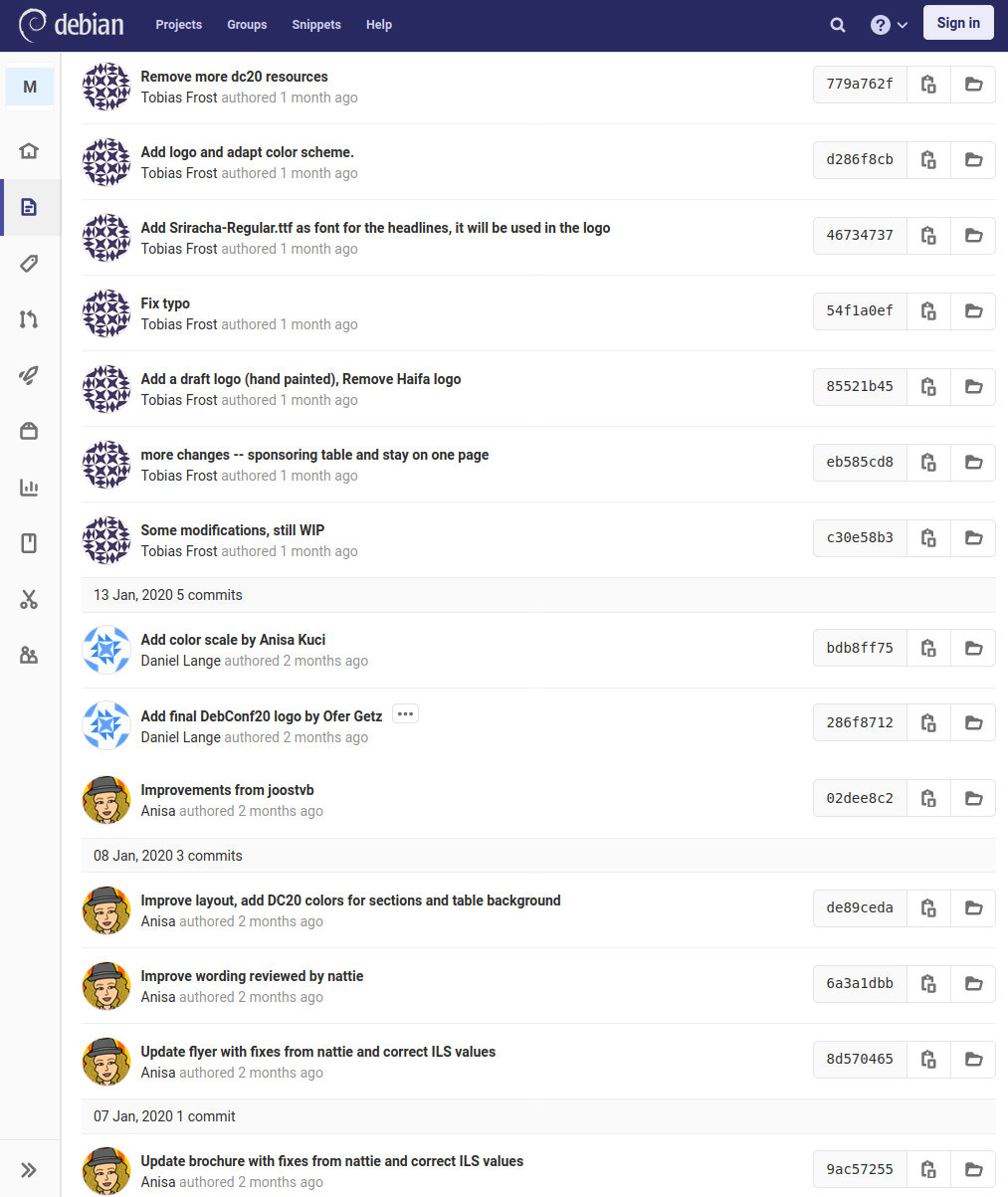
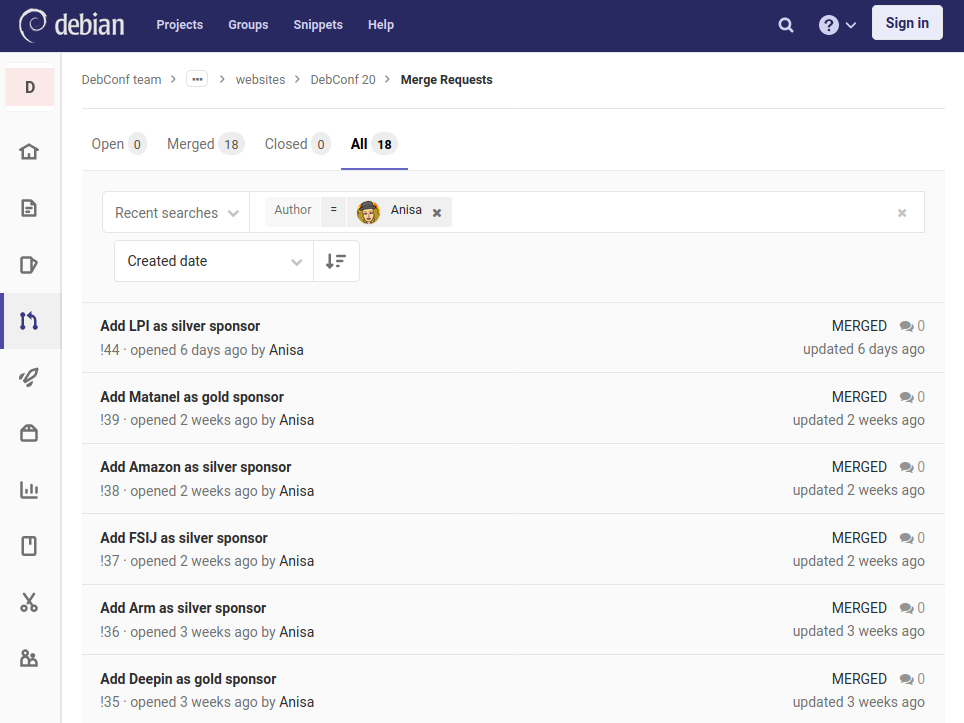
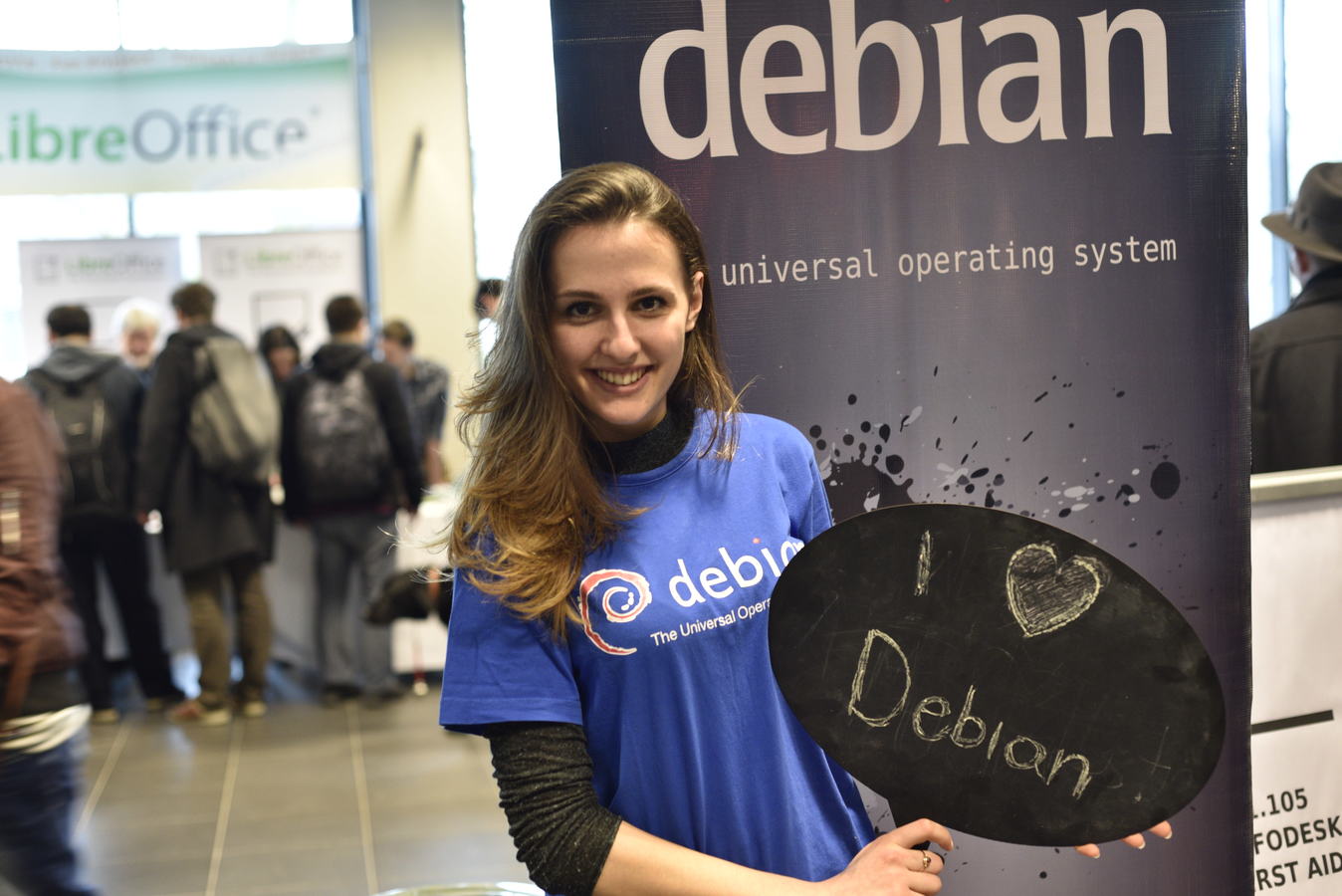
This is my last Outreachy blogpost, as my internship unfortunately has come to an end. It was a blast! Through the Outreachy internship I gained a lot of valuable knowledge and even though I dont know what the future will bring, I am more confident about myself, my skills in fundraising and my technical abilities now. During the contribution phase I did quite a lot of research so I could come up with relevant information to add on the Debian wiki as part of the contribution phase tasks. This was helpful for me to build a more deep understanding of the Debian project, the DebConf conferences and the general style of working within Debian. During this phase I completed most of the tasks given and got onto the mailing lists and IRC channels which are public. This was quite an intense experience by itself as it was like digging into a new job but in a competitive situation as other applicants, of course, were also putting in their best to get one of the 50 Outreachy internships (two in Debian) that were available. When I got selected I also got access to the sponsors@debconf.org email address and the private git repos as they would be needed for me to work on fundraising. I was also provided with an @debconf.org email address that is the one I use for sponsors communication. I learned what makes communication look professional and how to think of the recipient when formulating emails, sending replies or creating marketing messages. As the internship continued I started to learn how the DebConf organizing structure works, with a particular attention on the fundraising team. I have also quickly been given the responsibility to reach out to 100 potential sponsors and combine learning and working experience very nicely. I was given responsibility of working on the fundraising material (flyer and brochure) for DebConf20, so using LaTeX I updated the files in order to remove the translation system, I added the Israeli currency and the visual design chosen from a public logo proposal contest that is held for each DebConf. My creative side could also be put to good use as the team trusted me with selecting the images for the brochure and making sure that the usage rights granted and attribution are all compliant to Free Software/Creative Commons licences. I have continuously maintained those materials and was very happy that long term team members even asked me to approve changes they proposed on the fundraising material. The MiniDebConf team for Regensburg have taken the files I created and made them into their fundraising material (brochure, flyer) which is great to see. MiniDebConf Regensburg commits I have profited so much from other people s work, so I am very happy if community members can build on mine. Afterall sharing is caring! Through the Outreachy travel stipend I was able to attend FOSDEM 2020 and besides meeting many friends from the community and having a fundraising meeting with a sponsor, I was able to also support distributing the DebConf20 fundraising material both in electronic form and as printed versions. During the Outreachy internship I did two communication waves to potential sponsors and maintained the daily communication with them. I followed the documentation that was already available in the Debian wiki guiding me through the process of invoicing sponsors through the organizations that Debian collaborates with. As I have been in frequent contact with the sponsors, I have continuously updated the DebConf20 website with sponsor logos and links through git files, improving web pages on the wafer system and doing 18 merge requests in total. DebConf20 website merge requests I completed six email templates for the DebConf sponsor communication campaigns. While two of them have already been very useful, I hope my other proposals will be the ones used for the next waves of sponsors contacting. I committed them to the sponsors git repo so they can be easily accessible and well documented for other DebConf teams or can be recycled for smaller Debian events. Unfortunately, due to the insecurity about travel around the Corona virus pandemic, the third wave of communication, originally scheduled for the end of my internship in March, has been held. I have committed to the team to do this once the travel restrictions have been lifted and we know that DebConf20 can proceed as planned for August 2020. So yeah, I am definitely going to stay around and continue to help with DebConf fundraising! DebConf has been held for two decades and it also has a generic website, so I also updated the static sponsors page on the main website as it is the first landing page for everyone especially for people who are not necessarily insiders in Debian or DebConf. I have completed a Python tutorial, got the general understanding of the programming language and made some smaller contributions to improve existing tools in the fundraising team based on the learning. The internship was also focused on documentation, so during the whole internship I have kept notes in order to be able to improve existing documentation and I have also written new material, especially on the tasks that I have been working on more closely: Every DebConf has a new team every year, in a new country, so I hope this documentation I have worked on will be useful as a jump-starter for them to organize and finance their events. I would like to take a moment to thank again my mentors Daniel and Karina for all their support, it has been great working with them. Having them as an example, I have learned a lot. Also warm thanks to the DebConf global and local teams which have been very welcoming and always supportive during my internship. So, as you might already know, if you have read my other Outreachy blog posts, this has been a great experience for me! Outreachy provides an awesome opportunity that would not be available if it was not for the generous sponsors and volunteers making such a program for people from underrepresented groups in the FLOSS community. I really encourage people from these groups to find the confidence within themselves and apply for Outreachy! I love Debian

18 March 2020

Antoine Beaupr : How can I trust this git repository?

Join me in the rabbit hole of git repository verification, and how we could improve it.

Problem statement As part of my work on automating install procedures at Tor, I ended up doing things like:
git clone REPO
./REPO/bootstrap.sh
... something eerily similar to the infamous curl pipe bash method which I often decry. As a short-term workaround, I relied on the SHA-1 checksum of the repository to make sure I have the right code, by running this both on a "trusted" (ie. "local") repository and the remote, then visually comparing the output:
$ git show-ref master
9f9a9d70dd1f1e84dec69a12ebc536c1f05aed1c refs/heads/master
One problem with this approach is that SHA-1 is now considered as flawed as MD5 so it can't be used as an authentication mechanism anymore. It's also fundamentally difficult to compare hashes for humans. The other flaw with comparing local and remote checksums is that we assume we trust the local repository. But how can I trust that repository? I can either:
  1. audit all the code present and all the changes done to it after
  2. or trust someone else to do so
The first option here is not practical in most cases. In this specific use case, I have audited the source code -- I'm the author, even -- what I need is to transfer that code over to another server. (Note that I am replacing those procedures with Fabric, which makes this use case moot for now as the trust path narrows to "trust the SSH server" which I already had anyways. But it's still important for my fellow Tor developers who worry about trusting the git server, especially now that we're moving to GitLab.) But anyways, in most cases, I do need to trust some other fellow developer I collaborate with. To do this, I would need to trust the entire chain between me and them:
  1. the git client
  2. the operating system
  3. the hardware
  4. the network (HTTPS and the CA cartel, specifically)
  5. then the hosting provider (and that hardware/software stack)
  6. and then backwards all the way back to that other person's computer
I want to shorten that chain as much as possible, make it "peer to peer", so to speak. Concretely, it would eliminate the hosting provider and the network, as attackers.

OpenPGP verification My first reaction is (perhaps perversely) to "use OpenPGP" for this. I figured that if I sign every commit, then I can just check the latest commit and see if the signature is good. The first problem here is that this is surprisingly hard. Let's pick some arbitrary commit I did recently:
commit b3c538898b0ed4e31da27fc9ca22cb55e1de0000
Author: Antoine Beaupr  <anarcat@debian.org>
Date:   Mon Mar 16 14:37:28 2020 -0400
    fix test autoloading
    pytest only looks for file names matching  test  by default. We inline
    tests inside the source code directly, so hijack that.
diff --git a/fabric_tpa/pytest.ini b/fabric_tpa/pytest.ini
new file mode 100644
index 0000000..71004ea
--- /dev/null
+++ b/fabric_tpa/pytest.ini
@@ -0,0 +1,3 @@
+[pytest]
+# we inline tests directly in the source code
+python_files = *.py
That's the output of git log -p in my local repository. I signed that commit, yet git log is not telling me anything special. To check the signature, I need something special: --show-signature, which looks like this:
commit b3c538898b0ed4e31da27fc9ca22cb55e1de0000
gpg: Signature faite le lun 16 mar 2020 14:37:53 EDT
gpg:                avec la clef RSA 7B164204D096723B019635AB3EA1DDDDB261D97B
gpg: Bonne signature de  Antoine Beaupr  <anarcat@orangeseeds.org>  [ultime]
gpg:                 alias  Antoine Beaupr  <anarcat@torproject.org>  [ultime]
gpg:                 alias  Antoine Beaupr  <anarcat@anarc.at>  [ultime]
gpg:                 alias  Antoine Beaupr  <anarcat@koumbit.org>  [ultime]
gpg:                 alias  Antoine Beaupr  <anarcat@debian.org>  [ultime]
Author: Antoine Beaupr  <anarcat@debian.org>
Date:   Mon Mar 16 14:37:28 2020 -0400
    fix test autoloading
    pytest only looks for file names matching  test  by default. We inline
    tests inside the source code directly, so hijack that.
Can you tell if this is a valid signature? If you speak a little french, maybe you can! But even if you would, you are unlikely to see that output on your own computer. What you would see instead is:
commit b3c538898b0ed4e31da27fc9ca22cb55e1de0000
gpg: Signature made Mon Mar 16 14:37:53 2020 EDT
gpg:                using RSA key 7B164204D096723B019635AB3EA1DDDDB261D97B
gpg: Can't check signature: No public key
Author: Antoine Beaupr  <anarcat@debian.org>
Date:   Mon Mar 16 14:37:28 2020 -0400
    fix test autoloading
    pytest only looks for file names matching  test  by default. We inline
    tests inside the source code directly, so hijack that.
Important part: Can't check signature: No public key. No public key. Because of course you would see that. Why would you have my key lying around, unless you're me. Or, to put it another way, why would that server I'm installing from scratch have a copy of my OpenPGP certificate? Because I'm a Debian developer, my key is actually part of the 800 keys in the debian-keyring package, signed by the APT repositories. So I have a trust path. But that won't work for someone who is not a Debian developer. It will also stop working when my key expires in that repository, as it already has on Debian buster (current stable). So I can't assume I have a trust path there either. One could work with a trusted keyring like we do in the Tor and Debian project, and only work inside that project, that said. But I still feel uncomfortable with those commands. Both git log and git show will happily succeed (return code 0 in the shell) even though the signature verification failed on the commits. Same with git pull and git merge, which will happily push your branch ahead even if the remote has unsigned or badly signed commits. To actually verify commits (or tags), you need the git verify-commit (or git verify-tag) command, which seems to do the right thing:
$ LANG=C.UTF-8 git verify-commit b3c538898b0ed4e31da27fc9ca22cb55e1de0000
gpg: Signature made Mon Mar 16 14:37:53 2020 EDT
gpg:                using RSA key 7B164204D096723B019635AB3EA1DDDDB261D97B
gpg: Can't check signature: No public key
[1]$
At least it fails with some error code (1, above). But it's not flexible: I can't use it to verify that a "trusted" developer (say one that is in a trusted keyring) signed a given commit. Also, it is not clear what a failure means. Is a signature by an expired certificate okay? What if the key is signed by some random key in my personal keyring? Why should that be trusted?

Worrying about git and GnuPG In general, I'm worried about git's implementation of OpenPGP signatures. There has been numerous cases of interoperability problems with GnuPG specifically that led to security, like EFAIL or SigSpoof. It would be surprising if such a vulnerability did not exist in git. Even if git did everything "just right" (which I have myself found impossible to do when writing code that talks with GnuPG), what does it actually verify? The commit's SHA-1 checksum? The tree's checksum? The entire archive as a zip file? I would bet it signs the commit's SHA-1 sum, but I just don't know, on the top of my head, and neither do git-commit or git-verify-commit say exactly what is happening. I had an interesting conversation with a fellow Debian developer (dkg) about this and we had to admit those limitations:
<anarcat> i'd like to integrate pgp signing into tor's coding practices more, but so far, my approach has been "sign commits" and the verify step was "TBD" <dkg> that's the main reason i've been reluctant to sign git commits. i haven't heard anyone offer a better subsequent step. if torproject could outline something useful, then i'd be less averse to the practice. i'm also pretty sad that git remains stuck on sha1, esp. given the recent demonstrations. all the fancy strong signatures you can make in git won't matter if the underlying git repo gets changed out from under the signature due to sha1's weakness
In other words, even if git implements the arcane GnuPG dialect just so, and would allow us to setup the trust chain just right, and would give us meaningful and workable error messages, it still would fail because it's still stuck in SHA-1. There is work underway to fix that, but in February 2020, Jonathan Corbet described that work as being in a "relatively unstable state", which is hardly something I would like to trust to verify code. Also, when you clone a fresh new repository, you might get an entirely different repository, with a different root and set of commits. The concept of "validity" of a commit, in itself, is hard to establish in this case, because an hostile server could put you backwards in time, on a different branch, or even on an entirely different repository. Git will warn you about a different repository root with warning: no common commits but that's easy to miss. And complete branch switches, rebases and resets from upstream are hardly more noticeable: only a tiny plus sign (+) instead of a star (*) will tell you that a reset happened, along with a warning (forced update) on the same line. Miss those and your git history can be compromised.

Possible ways forward I don't consider the current implementation of OpenPGP signatures in git to be sufficient. Maybe, eventually, it will mature away from SHA-1 and the interface will be more reasonable, but I don't see that happening in the short term. So what do we do?

git evtag The git-evtag extension is a replacement for git tag -s. It's not designed to sign commits (it only verifies tags) but at least it uses a stronger algorithm (SHA-512) to checksum the tree, and will include everything in that tree, including blobs. If that sounds expensive to you, don't worry too much: it takes about 5 seconds to tag the Linux kernel, according to the author. Unfortunately, that checksum is then signed with GnuPG, in a manner similar to git itself, in that it exposes GnuPG output (which can be confusing) and is likely similarly vulnerable to mis-implementation of the GnuPG dialect as git itself. It also does not allow you to specify a keyring to verify against, so you need to trust GnuPG to make sense of the garbage that lives in your personal keyring (and, trust me, it doesn't). And besides, git-evtag is fundamentally the same as signed git tags: checksum everything and sign with GnuPG. The difference is it uses SHA-512 instead of SHA-1, but that's something git will eventually fix itself anyways.

kernel patch attestations The kernel also faces this problem. Linus Torvalds signs the releases with GnuPG, but patches fly all over mailing list without any form of verification apart from clear-text email. So Konstantin Ryabitsev has proposed a new protocol to sign git patches which uses SHA256 to checksum the patch metadata, commit message and the patch itself, and then sign that with GnuPG. It's unclear to me what this solves, if anything, at all. As dkg argues, it would seem better to add OpenPGP support to git-send-email and teach git tools to recognize that (e.g. git-am) at least if you're going to keep using OpenPGP anyways. And furthermore, it doesn't resolve the problems associated with verifying a full archive either, as it only attests "patches".

jcat Unhappy with the current state of affairs, the author of fwupd (Richard Hughes) wrote his own protocol as well, called jcat, which provides signed "catalog files" similar to the ones provided in Microsoft windows. It consists of a "gzip-compressed JSON catalog files, which can be used to store GPG, PKCS-7 and SHA-256 checksums for each file". So yes, it is yet again another wrapper to GnuPG, probably with all the flaws detailed above, on top of being a niche implementation, disconnected from git.

The Update Framework One more thing dkg correctly identified is:
<dkg> anarcat: even if you could do exactly what you describe, there are still some interesting wrinkles that i think would be problems for you. the big one: "git repo's latest commits" is a loophole big enough to drive a truck through. if your adversary controls that repo, then they get to decide which commits to include in the repo. (since every git repo is a view into the same git repo, just some have more commits than others)
In other words, unless you have a repository that has frequent commits (either because of activity or by a bot generating fake commits), you have to rely on the central server to decide what "the latest version" is. This is the kind of problems that binary package distribution systems like APT and TUF solve correctly. Unfortunately, those don't apply to source code distribution, at least not in git form: TUF only deals with "repositories" and binary packages, and APT only deals with binary packages and source tarballs. That said, there's actually no reason why git could not support the TUF specification. Maybe TUF could be the solution to ensure end-to-end cryptographic integrity of the source code itself. OpenPGP-signed tarballs are nice, and signed git tags can be useful, but from my experience, a lot of OpenPGP (or, more accurately, GnuPG) derived tools are brittle and do not offer clear guarantees, and definitely not to the level that TUF tries to address. This would require changes on the git servers and clients, but I think it would be worth it.

Other Projects

OpenBSD There are other tools trying to do parts of what GnuPG is doing, for example minisign and OpenBSD's signify. But they do not integrate with git at all right now. Although I did find a hack] to use signify with git, it's kind of gross...

Golang Unsurprisingly, this is a problem everyone is trying to solve. Golang is planning on hosting a notary which would leverage a "certificate-transparency-style tamper-proof log" which would be ran by Google (see the spec for details). But that doesn't resolve the "evil server" attack, if we treat Google as an adversary (and we should).

Python Python had OpenPGP going for a while on PyPI, but it's unclear if it ever did anything at all. Now the plan seems to be to use TUF but my hunch is that the complexity of the specification is keeping that from moving ahead.

Docker Docker and the container ecosystem has, in theory, moved to TUF in the form of Notary, "a project that allows anyone to have trust over arbitrary collections of data". In practice however, in my somewhat limited experience, setting up TUF and image verification in Docker is far from trivial.

Android and iOS Even in what is possibly one of the strongest models (at least in terms of user friendliness), mobile phones are surprisingly unclear about those kind of questions. I had to ask if Android had end-to-end authentication and I am still not clear on the answer. I have no idea of what iOS does.

Conclusion One of the core problems with everything here is the common usability aspect of cryptography, and specifically the usability of verification procedures. We have become pretty good at encryption. The harder part (and a requirement for proper encryption) is verification. It seems that problem still remains unsolved, in terms of usability. Even Signal, widely considered to be a success in terms of adoption and usability, doesn't properly solve that problem, as users regularly ignore "The security number has changed" warnings... So, even though they deserve a lot of credit in other areas, it seems unlikely that hardcore C hackers (e.g. git and kernel developers) will be able to resolve that problem without at least a little bit of help. And TUF seems like the state of the art specification around here, it would seem wise to start adopting it in the git community as well. Update: git 2.26 introduced a new gpg.minTrustLevel to "tell various signature verification codepaths the required minimum trust level", presumably to control how Git will treat keys in your keyrings, assuming the "trust database" is valid and up to date. For an interesting narrative of how "normal" (without PGP) git verification can fail, see also A Git Horror Story: Repository Integrity With Signed Commits.

11 March 2020

Axel Beckert: Backup over Tor with BackupPC

I have a Raspberry Pi at my parents home. They have internet access via some ISP using Carrier Grade NAT (CGN). Hence their home router is not reachable via IPv4 from the outside, they do have IPv6 and the devices can also be made accessible via IPv6 via the local router. Did that, was able to access my Raspberry Pi over IPv6 and SSH from the outside. So doing backup of that Raspberry Pi with BackupPC from the outside was a walk in the park. Unfortunately the IPv6 prefix seems to change occasionally and the router only allows to configure explicit IPv6 addresses in firewall rules so after a prefix change the configured rules no more match the devices IPv6 addresses. Meh. So there were multiple possibilities to work around these restrictions and access a devices behind the router: Enabling a Tor Hidden Service for port 22 is a no-brainer and was done most quickly (actually it already was in place as I already suspected that an IPv6 prefix change might happen) and I so far was too lazy to replace it with something more proper. But my backup was relying on direct SSH access via IPv6. So I needed to get that working over Tor, too. Here s what was needed for the host named sherpa (named after the Fiberfab Sherpa) to be backed up via Tor: That s it basically. Of course you also need to have the SSH public host key in the .ssh/known_hosts file also for the .onion hostname. And the Tor Hidden Service needs to be configured on the target device. But that s left as exercise for the reader. There s a lot of documentation about that on the internet, including slides and video recordings of talks and live demos I gave about this topic in German. Ah, and in case you might think that s unfair and misuse of the resources of the Tor Project: No, I explicitly asked and they said more or less any additional traffic helps to make it more difficult to analyse Tor traffic or to track Tor users and is hence welcome. Addendum: The last direct full backup of that Raspberry Pi (5.5 GB) took around 32 minutes. The first full backup over Tor (8.7 GB) took 341 minutes. Seems much slower, but there might be other factors as well: Most backups which ran last night were running at only 0.85 MB/s to 1 MB/s, probably because too many backups were running in parallel after a recent backup server downtime with file system check the backup server was probably the bottleneck. The backup of the Raspberry Pi over Tor ran at 0.42 MB/s, so about half the speed of the other backups. (Will probably add some more notes if I have more statistics over time.)

Antoine Beaupr : Font changes

I have worked a bit on the fonts I use recently. From the main font I use every day in my text editor and terminals to this very website, I did a major and (hopefully) thoughtful overhaul of my typography, in the hope of making things easier to use and, to be honest, just prettier.

Editor and Terminal: Fira mono This all started when I found out about the Jetbrains Mono font. I found the idea of ligatures fascinating: the result is truly beautiful. So I do what I often do (sometimes to the despair of some fellow Debian members) and filed a RFP to document my research. As it turns out, Jetbrains Mono is not free enough to be packaged in Debian, because it requires proprietary tools to build. I nevertheless figured I could try another font so I looked at other monospace alternatives. I found the following packages in debian: Those are also "programmer fonts" that caught my interest but somehow didn't land in Debian yet: Because Fira code had ligatures, i ended up giving it a shot. I really like the originality of the font. See, for example, how the @ sign looks when compared to my previous font, Liberation Mono:
A dark terminal window showing the prompt '[SIGPIPE]anarcat@angela:~(master)$' in the Liberation Mono font Liberation Mono
A dark terminal window showing the prompt '[SIGPIPE]anarcat@angela:~(master)$' in the Fira mono font Fira Mono
Interestingly, a colleague (thanks ahf!) pointed me to the Practical Typography post "Ligatures in programming fonts: hell no", which makes the very convincing argument that ligatures are downright dangerous to programming environment. In my experiences with the fonts, it was also not always giving the result I would expect. I also remembered that the Emacs Haskell mode would have this tendency of inserting crazy syntactic sugar like this in source code without being asked, which I found extremely frustrating. Besides, Emacs doesn't support ligatures, unless you count such horrendous hacks which hack at the display time. That's because Emacs' display layer is not based on a modern rendering library like Pango but some scary legacy code that very few people understand. On top of the complexity of the codebase, there is also resistance in including a modern font. So I ended up using Fira mono everywhere I use fixed-width fonts, even though it's not packaged in Debian. That involves the following configuration in my .Xresources (no, I haven't switched to Wayland):
! font settings
Emacs*font: Fira mono
rofi*font: Fira mono 12
! Symbola is to get emojis to display correctly, apt install fonts-symbola
!URxvt*font: xft:Monospace,xft:Symbola
URxvt*font: xft:Fira mono,xft:Symbola
I also dropped this script in ~/.local/share/fonts/download.sh, for lack of a better way, to download all the fonts I'm interested in:
#!/bin/sh
set -e
set -u
wget --no-clobber --continue https://practicaltypography.com/fonts/charter.zip
unzip -u charter.zip
wget --no-clobber --continue https://github.com/adobe-fonts/source-serif-pro/releases/download/3.001R/source-serif-pro-3.001R.zip
unzip -u source-serif-pro-3.001R.zip
wget --no-clobber --continue https://github.com/adobe-fonts/source-sans-pro/releases/download/3.006R/source-sans-pro-3.006R.zip
unzip -u source-sans-pro-3.006R.zip
wget --no-clobber --continue https://github.com/adobe-fonts/source-code-pro/releases/download/2.030R-ro%2F1.050R-it/source-code-pro-2.030R-ro-1.050R-it.zip
unzip -u source-code-pro-2.030R-ro-1.050R-it.zip
wget --no-clobber --continue -O Fira-4.202.zip https://github.com/mozilla/Fira/archive/4.202.zip   true
unzip -u Fira-4.202.zip
Update: I forgot to mention one motivation behind this was to work around a change in the freetype interpreter, discussed in bug 866685 and my upgrades documentation.

Website: Charter That "hell no" article got me interested in the Practical Typography web book, which I read over the weekend. It was an eye opener and I realized I had already some of those concepts implanted; in fact it's probably after reading the Typography in ten minutes guide that I ended up trying Fira sans a few years ago. I have removed that font since then, however, after realising it was taking up an order of magnitude more bandwidth space than the actual page content. I really loved the book, so much that I actually bought it. I liked the concept of it, the look, and the fact that it's a living document. There's a lot of typography work I would need to do on this site to catchup with the recommendations from Matthew Butterick. Switching fonts is only one part of this, but it's something I was excited to work on. So I sat down and reviewed the free fonts Butterick recommends and tried out a few. I ended up settling on Charter, a relatively old (in terms of computing) font designed by Matthew Carter (of Verdana fame) in 1987. Charter really looks great and is surprisingly small. While a single version of Fira varies between 96KiB (Fira Sans Condensed) and 308KiB (Fira Sans Medium Italic), Charter is only 28KiB! While it's still about as large as most of my articles, I found it was a better compromise and decided to make the jump. This site is now in Serif, which is a huge change for me. The change was done with the following CSS:
h1, h2, h3, h4, h5, body  
    /* 
     * Charter: Butterick's favorite, freely available, found on https://practicaltypography.com/free-fonts.html
     * Palatino: Mac OS
     * Palatino Linotype: Windows
     * Noto serif: Android, packaged in Debian
     * Liberation serif: Linux fallback
     * Serif: fallback
     */
    font-family: Charter, Palatino, "Palatino Linotype", "Noto serif", "Liberation serif", serif;
    /* Charter is available from https://practicaltypography.com/charter.html under the liberal Bitstream license */
 
I have also decided to outline headings by making them slanted, using the beautiful italic version of Charter:
h1, h2, h3, h4, h5  
    font-style: italic;
 
I also made the point size larger, if the display is large enough:
/* enlarge body point size for charter for larger displays */
@media (min-device-width: 750px)  
    body  
        font-size: 20px;
        line-height: 1.3; /* default in FF is ~1.48 */
     
 
Modern display (including fonts) have a much higher resolution and the point size on my website was really getting too small to be readable. This, in turn, required a change to the max-width:
#content  
    /* about 2.5 alphabets with charter */
    max-width: 35em;
 
I have kept the footers and "UI" elements in sans-serif though, and kept those aligned on operating system defaults or "system fonts":
/* some hacking at typefaces to get some fresh zest in here
 * fallbacks from:
 * https://en.wikipedia.org/wiki/List_of_typefaces_included_with_Microsoft_Windows
 * https://en.wikipedia.org/wiki/List_of_typefaces_included_with_macOS
 */
.navbar, .footer  
    /*
     * Avenir: Mac, quite different but should still be pretty
     * Gill sans: Mac, Windows, somewhat similar to Avenir (indulge me)
     * Noto sans: Android, packaged in Debian
     * Open sans: Texlive extras AKA Linux, packaged in Debian
     * Fira sans: Mozilla's Firefox OS
     * Liberation sans: Linux fallback
     * Helvetica: general fallback
     * Sans-serif: fallback
     */
    font-family: Avenir, "Gill sans", "Noto sans", "Open sans", "Fira sans", "Liberation sans", Helvetica, sans-serif;
    /* Fira is available from https://github.com/mozilla/Fira/ under the SIL Open Font License */
    /* alternatively, just use system fonts for "controls" instead:
    font-family: -apple-system, BlinkMacSystemFont, "Segoe UI", "Roboto", "Oxygen", "Ubuntu", "Cantarell", "Fira Sans", "Droid Sans", "Helvetica Neue", sans-serif;
    gitlab uses: -apple-system, BlinkMacSystemFont, "Segoe UI", Roboto, "Noto Sans", Ubuntu, Cantarell, "Helvetica Neue", sans-serif, "Apple Color Emoji", "Segoe UI Emoji", "Segoe UI Symbol", "Noto Color Emoji"
    */
 
I've only done some preliminary testing of how this will look like. Although I tested on a few devices (my phone, e-book tablet, an iPad, and of course my laptop), I fully expect things to break on your device. Do let me know if things look better or worse. For future comparison, my site is well indexed in the Internet Wayback Machine and can be used to look at the site before the change. For example, compare the previous article here with its earlier style. The changes to the theme are of course available in my custom ikiwiki bootstrap theme (see in particular commits 0bca0fb7 and d1901fb8), as usual. Enjoy, and let me know what you think! PS: I considered just setting the Charter font in CSS and not adding it as a @font-face. I'm still considering that option and might do so if the performance cost is too big. The Fira mono font is actually set like this for the preformatted sections of the site, but because it's more common (and it's too big) I haven't added it as a font-face. You might want to download the font locally to benefit from the full experience as well. PPS: As it turns out, an earlier version of this post featured exactly that: a non-webfont version of Charter, which works fine if you have a good Charter font available. But it looks absolutely terrible if, like many Linux users, you have the nasty bitmap font shipped with xfonts-100dpi and xfonts-75dpi. So I fixed the webfont and it's unlikely this site will be able to load reasonably well in Linux until those packages are removed or bitmap font rendering is disabled.

7 March 2020

Matthias Klumpp: Introducing the MetaInfo Creator

This year s FOSDEM conference was a lot of fun one of the things I always enjoy most about this particular conference (besides having some of the outstanding food you can get in Brussels and meeting with friends from the free software world) is the ability to meet a large range of new people who I wouldn t usually have interacted with, or getting people from different communities together who otherwise would not meet in person as each bigger project has their own conference (for example, the amount of VideoLAN people is much lower at GUADEC and Akademy compared to FOSDEM). It s also really neat to have GNOME and KDE developers within reach at the same place, as I care about both desktops a lot. An unexpected issue This blog post however is not about that. It s about what I learned when talking to people there about AppStream, and the outcome of that. Especially when talking to application authors but also to people who deal with larger software repositories, it became apparent that many app authors don t really want to deal with the extra effort of writing metadata at all. This was a bit of a surprise to me, as I thought that there would be a strong interest for application authors to make their apps look as good as possible in software catalogs. A bit less surprising was the fact that people apparently don t enjoy reading a large specification, reading a long-ish intro guide with lots of dos and don ts or basically reading any longer text at all before being able to create an AppStream MetaInfo/AppData file describing their software. Another common problem seems to be that people don t immediately know what a reverse-DNS ID is, the format AppStream uses for uniquely identifying each software component. So naturally, people either have to read about it again (bah, reading!  ) or make something up, which occasionally is wrong and not the actual component-ID their software component should have. The MetaInfo Creator It was actually suggested to me twice that what people really would like to have is a simple tool to put together a MetaInfo file for their software. Basically a simple form with a few questions which produces the final file. I always considered this a nice to have, but not essential feature, but now I was convinced that this actually has a priority attached to it. So, instead of jumping into my favourite editor and writing a bunch of C code to create this make MetaInfo file form as part of appstreamcli, this time I decided to try what the cool kids are doing and make a web application that runs in your browser and creates all metadata there. So, behold the MetaInfo Creator! If you click this link, you will end up at an Angular-based web application that will let you generate MetaInfo/AppData files for a few component-types simply by answering a set of questions. The intent was to make this tool as easy to use as possible for someone who basically doesn t know anything about AppStream at all. Therefore, the tool will: For the Meson feature, the tool simply can not generate a use this and be done script, as each Meson snippet needs to be adjusted for the individual project. So this option is disabled by default, but when enabled, a few simple Meson snippets will be produced which can be easily adjusted to the project they should be part of. The tool currently does not generate any release information for a MetaInfo file at all, This may be added in future. The initial goal was to have people create any MetaInfo file in the first place, having projects also ship release details would be the icing on the cake. I hope people find this project useful and use it to create better MetaInfo files, so distribution repositories and Flatpak repos look better in software centers. Also, since MetaInfo files can be used to create an inventory of software and to install missing stuff as-needed, having more of them will help to build smarter software managers, create smaller OS base installations and introspect what software bundles are made of easily. I welcome contributions to the MetaInfo Creator! You can find its source code on GitHub. This is my first web application ever, the first time I wrote TypeScript and the first time I used Angular, so I d bet a veteran developer more familiar with these tools will cringe at what I produced. So, scratch that itch and submit a PR!  Also, if you want to create a form for a new component type, please submit a patch as well. C developer s experience notes for Angular, TypeScript, NodeJS This section is just to ramble a bit about random things I found interesting as a developer who mostly works with C/C++ and Python and stepped into the web-application developer s world for the first time. For a project like this, I would usually have gone with my default way of developing something for the web: Creating a Flask-based application in Python. I really love Python and Flask, but of course using them would have meant that all processing would have had to be done on the server. One the one hand I could have used libappstream that way to create the XML, format it and validate it, but on the other hand I would have had to host the Python app on my own server, find a place at Purism/Debian/GNOME/KDE or get it housed at Freedesktop somehow (which would have taken a while to arrange) and I really wanted to have a permanent location for this application immediately. Additionally, I didn t want people to send the details of new unpublished software to my server. TypeScript I must say that I really like TypeScript as a language compared to JavaScript. It is not really revolutionary (I looked into Dart and other ways to compile $stuff to JavaScript first), but it removes just enough JavaScript weirdness to be pleasant to use. At the same time, since TS is a superset of JS, JavaScript code is valid TypeScript code, so you can integrate with existing JS code easily. Picking TS up took me much less than an hour, and most of its features you learn organically when working on a project. The optional type-safety is a blessing and actually helped me a few times to find an issue. It being so close to JS is both a strength and weakness: On the one hand you have all the JS oddities in the language (implicit type conversion is really weird sometimes) and have to basically refrain from using them or count on the linter to spot them, but on the other hand you can immediately use the massive amount of JavaScript code available on the web. Angular The Angular web framework took a few hours to pick up there are a lot of concepts to understand. But ultimately, it s manageable and pretty nice to use. When working at the system level, a lot of complexity is in understanding how the CPU is processing data, managing memory and using the low-level APIs the operating system provides. With the web application stuff, a lot of the complexity for me was in learning about all the moving parts the system is comprised of, what their names are, what they are, and what works with which. And that is not a flat learning curve at all. As C developer, you need to know how the computer works to be efficient, as web developer you need to know a bunch of different tools really well to be productive. One thing I am still a bit puzzled about is the amount of duplicated HTML templates my project has. I haven t found a way to reuse template blocks in multiple components with Angular, like I would with Jinja2. The documentation suggests this feature does not exist, but maybe I simply can t find it or there is a completely different way to achieve the same result. NPM Ecosystem The MetaInfo Creator application ultimately doesn t do much. But according to GitHub, it has 985 (!!!) dependencies in NPM/NodeJS. And that is the bare minimum! I only added one dependency myself to it. I feel really uneasy about this, as I prefer the Python approach of having a rich standard library instead of billions of small modules scattered across the web. If there is a bug in one of the standard library functions, I can submit a patch to Python where some core developer is there to review it. In NodeJS, I imagine fixing some module is much harder. That being said though, using npm is actually pretty nice there is a module available for most things, and adding a new dependency is easy. NPM will also manage all the details of your dependency chain, GitHub will warn about security issues in modules you depend on, etc. So, from a usability perspective, there isn t much to complain about (unlike with Python, where creating or using a module ends up as a fight the system event way too often and the question which random file do I need to create now to achieve what I want? always exists. Fortunately, Poetry made this a bit more pleasant for me recently). So, tl;dr for this section: The web application development excursion was actually a lot of fun, and I may make more of those in future, now that I learned more about how to write web applications. Ultimately though, I enjoy the lower-level software development and backend development a bit more. Summary Check out the MetaInfo Creator and its source code, if you want to create MetaInfo files for a GUI application, console application, addon or service component quickly.


6 March 2020

Reproducible Builds: Reproducible Builds in February 2020

Welcome to the February 2020 report from the Reproducible Builds project. One of the original promises of open source software is that distributed peer review and transparency of process results in enhanced end-user security. However, whilst anyone may inspect the source code of free and open source software for malicious flaws, almost all software today is distributed as pre-compiled binaries. This allows nefarious third-parties to compromise systems by injecting malicious code into ostensibly secure software during the various compilation and distribution processes. The motivation behind the reproducible builds effort is to provide the ability to demonstrate these binaries originated from a particular, trusted, source release: if identical results are generated from a given source in all circumstances, reproducible builds provides the means for multiple third-parties to reach a consensus on whether a build was compromised via distributed checksum validation or some other scheme. In this month s report, we cover:

If you are interested in contributing to the project, please visit our Contribute page on our website.

Media coverage & upstream news Omar Navarro Leija, a PhD student at the University Of Pennsylvania, published a paper entitled Reproducible Containers that describes in detail the workings of a new user-space container tool called DetTrace:
All computation that occurs inside a DetTrace container is a pure function of the initial filesystem state of the container. Reproducible containers can be used for a variety of purposes, including replication for fault-tolerance, reproducible software builds and reproducible data analytics. We use DetTrace to achieve, in an automatic fashion, reproducibility for 12,130 Debian package builds, containing over 800 million lines of code, as well as bioinformatics and machine learning workflows.
There was also considerable discussion on our mailing list regarding this research and a presentation based on the paper will occur at the ASPLOS 2020 conference between March 16th 20th in Lausanne, Switzerland. The many virtues of Reproducible Builds were touted as benefits for software compliance in a talk at FOSDEM 2020, debating whether the Careful Inventory of Licensing Bill of Materials Have Impact of FOSS License Compliance which pitted Jeff McAffer and Carol Smith against Bradley Kuhn and Max Sills. (~47 minutes in). Nobuyoshi Nakada updated the canonical implementation of the Ruby programming language a change such that filesystem globs (ie. calls to list the contents of filesystem directories) will henceforth be sorted in ascending order. Without this change, the underlying nondeterministic ordering of the filesystem is exposed to the language which often results in an unreproducible build. Vagrant Cascadian reported on our mailing list regarding a quick reproducible test for the GNU Guix distribution, which resulted in 81.9% of packages registering as reproducible in his installation:
$ guix challenge --verbose --diff=diffoscope ...
2,463 store items were analyzed:
  - 2,016 (81.9%) were identical
  - 37 (1.5%) differed
  - 410 (16.6%) were inconclusive
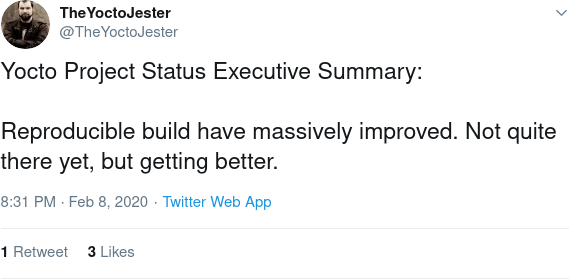
Jeremiah Orians announced on our mailing list the release of a number of tools related to cross-compilation such as M2-Planet and mescc-tools-seed. This project attemps a full bootstrap of a cross-platform compiler for the C programming language (written in C itself) from hex, the ultimate goal being able to demonstrate fully-bootstrapped compiler from hex to the GCC GNU Compiler Collection. This has many implications in and around Ken Thompson s Trusting Trust attack outlined in Thompson s 1983 Turing Award Lecture. Twitter user @TheYoctoJester posted an executive summary of reproducible builds in the Yocto Project: Finally, Reddit user tofflos posted to the /r/Java subreddit asking about how to achieve reproducible builds with Maven and Chris Lamb noticed that the Linux kernel documentation about reproducible builds of it is available on the kernel.org homepages in an attractive HTML format.

Distribution work

Debian Chris Lamb created a merge request for the core debian-installer package to allow all arguments and options from sources.list files (such as [check-valid-until=no] , etc.) in order that we can test the reproducibility of the installer images on the Reproducible Builds own testing infrastructure. (#13) Thorsten Glaser followed-up to a bug filed against the dpkg-source component that was originally filed in late 2015 that claims that the build tool does not respect permissions when unpacking tarballs if the umask is set to 0002. Matthew Garrett posted to the debian-devel mailing list on the topic of Producing verifiable initramfs images as part of a wider conversation on being able to trust the entire software stack on our computers. 59 reviews of Debian packages were added, 30 were updated and 42 were removed this month adding to our knowledge about identified issues. Many issue types were noticed and categorised by Chris Lamb, including:

openSUSE In openSUSE, Bernhard M. Wiedemann published his monthly Reproducible Builds status update as well as provided the following patches:

Software development

diffoscope diffoscope is our in-depth and content-aware diff-like utility that can locate and diagnose reproducibility issues. It is run countless times a day on our testing infrastructure and is essential for identifying fixes and causes of nondeterministic behaviour. Chris Lamb made the following changes this month, including uploading version 137 to Debian:
  • The sng image utility appears to return with an exit code of 1 if there are even minor errors in the file. (#950806)
  • Also extract classes2.dex, classes3.dex from .apk files extracted by apktool. (#88)
  • No need to use str.format if we are just returning the string. [ ]
  • Add generalised support for ignoring returncodes [ ] and move special-casing of returncodes in zip to use Command.VALID_RETURNCODES. [ ]

Other tools disorderfs is our FUSE-based filesystem that deliberately introduces non-determinism into directory system calls in order to flush out reproducibility issues. This month, Vagrant Cascadian updated the Vcs-Git to specify the debian packaging branch. [ ] reprotest is our end-user tool to build same source code twice in widely differing environments and then checks the binaries produced by each build for any differences. This month, versions 0.7.13 and 0.7.14 were uploaded to Debian unstable by Holger Levsen after Vagrant Cascadian added support for GNU Guix [ ].

Project documentation & website There was more work performed on our documentation and website this month. Bernhard M. Wiedemann added a Java Gradle Build Tool snippet to the SOURCE_DATE_EPOCH documentation [ ] and normalised various terms to unreproducible [ ]. Chris Lamb added a Meson.build example [ ] and improved the documentation for the CMake [ ] to the SOURCE_DATE_EPOCH documentation, replaced anyone can with anyone may as, well, not everyone has the resources, skills, time or funding to actually do what it refers to [ ] and improved the pre-processing for our report generation [ ][ ][ ][ ] etc. In addition, Holger Levsen updated our news page to improve the list of reports [ ], added an explicit mention of the weekly news time span [ ] and reverted sorting of news entries to have latest on top [ ] and Mattia Rizzolo added Codethink as a non-fiscal sponsor [ ] and lastly Tianon Gravi added a Docker Images link underneath the Debian project on our Projects page [ ].

Upstream patches The Reproducible Builds project detects, dissects and attempts to fix as many currently-unreproducible packages as possible. We endeavour to send all of our patches upstream where appropriate. This month, we wrote a large number of such patches, including: Vagrant Cascadian submitted patches via the Debian bug tracking system targeting the packages the Civil Infrastructure Platform has identified via the CIP and CIP build depends package sets:

Testing framework We operate a fully-featured and comprehensive Jenkins-based testing framework that powers tests.reproducible-builds.org. This month, the following changes were made by Holger Levsen: In addition, Mattia Rizzolo added an Apache web server redirect for buildinfos.debian.net [ ] and reverted the reshuffling of arm64 architecture builders [ ]. The usual build node maintenance was performed by Holger Levsen, Mattia Rizzolo [ ][ ] and Vagrant Cascadian.

Getting in touch If you are interested in contributing to the Reproducible Builds project, please visit our Contribute page on our website. However, you can get in touch with us via:

This month s report was written by Bernhard M. Wiedemann, Chris Lamb and Holger Levsen. It was subsequently reviewed by a bunch of Reproducible Builds folks on IRC and the mailing list.

4 March 2020

Noah Meyerhans: Daily VM image builds are available from the cloud team

Did you know that the cloud team generates daily images for buster, bullseye, and sid? They re available for download from cdimage.debian.org and are published to Amazon EC2 and Microsoft Azure. This is done both to exercise our image generation infrastructure, and also to facilitate testing of the actual images and distribution in general. I ve often found it convenient to have easy access to a clean, up-to-date, disposable virtual machine, and you might too. Please note that these images are intended for testing purposes, and older ones may be removed at any time in order to free up various resources. You should not hardcode references to specific images in any tools or configuration. If you re downloading an image for local use, you ll probably want one of the nocloud images. They have an empty root password (the security ramifications of this should be obvious, so please be careful!), and don t rely on any cloud service for configuration. You can use the qcow2 images with QEMU on any Linux system, or retrieve the raw images for use with another VMM. If you want to use the images on Amazon EC2, you can identify the latest nightly build using the AWS CLI as follows:
# Select the most recent bullseye image for arm64 instance types:
$ aws ec2 describe-images --owner 903794441882 \
--region us-east-1 --output json \
--query "Images[?Architecture=='arm64']   [?starts_with(Name, 'debian-11-')]   max_by([], &Name)"
 
"Architecture": "arm64",
"CreationDate": "2020-03-04T05:31:12.000Z",
"ImageId": "ami-056a2fe946ef98607",
"ImageLocation": "903794441882/debian-11-arm64-daily-20200304-189",
"ImageType": "machine",
"Public": true,
"OwnerId": "903794441882",
"State": "available",
"BlockDeviceMappings": [
 
"DeviceName": "/dev/xvda",
"Ebs":  
"Encrypted": false,
"DeleteOnTermination": true,
"SnapshotId": "snap-0d7a569b159964d87",
"VolumeSize": 8,
"VolumeType": "gp2"
 
 
],
"Description": "Debian 11 (daily build 20200304-189)",
"EnaSupport": true,
"Hypervisor": "xen",
"Name": "debian-11-arm64-daily-20200304-189",
"RootDeviceName": "/dev/xvda",
"RootDeviceType": "ebs",
"SriovNetSupport": "simple",
"VirtualizationType": "hvm"
 
# Similarly, select the most recent sid amd64 AMI:
$ aws ec2 describe-images --owner 903794441882 \
--region us-east-1 --output json \
--query "Images[?Architecture=='x86_64']   [?starts_with(Name, 'debian-sid-')]   max_by([], &Name)"
 
"Architecture": "x86_64",
"CreationDate": "2020-03-04T05:13:58.000Z",
"ImageId": "ami-00ec9272298ca9059",
"ImageLocation": "903794441882/debian-sid-amd64-daily-20200304-189",
"ImageType": "machine",
"Public": true,
"OwnerId": "903794441882",
"State": "available",
"BlockDeviceMappings": [
 
"DeviceName": "/dev/xvda",
"Ebs":  
"Encrypted": false,
"DeleteOnTermination": true,
"SnapshotId": "snap-07c3fad3ff835248a",
"VolumeSize": 8,
"VolumeType": "gp2"
 
 
],
"Description": "Debian sid (daily build 20200304-189)",
"EnaSupport": true,
"Hypervisor": "xen",
"Name": "debian-sid-amd64-daily-20200304-189",
"RootDeviceName": "/dev/xvda",
"RootDeviceType": "ebs",
"SriovNetSupport": "simple",
"VirtualizationType": "hvm"
 
If you re using Microsoft Azure images, you can inspect the images with az vm image list and az vm image show, as follows:
$ az vm image list -o table --publisher debian --offer debian-sid-daily --location westeurope --all   sort -k 5   tail
debian-sid-daily Debian sid-gen2 Debian:debian-sid-daily:sid-gen2:0.20200228.184 0.20200228.184
debian-sid-daily Debian sid Debian:debian-sid-daily:sid:0.20200229.185 0.20200229.185
debian-sid-daily Debian sid-gen2 Debian:debian-sid-daily:sid-gen2:0.20200229.185 0.20200229.185
debian-sid-daily Debian sid Debian:debian-sid-daily:sid:0.20200301.186 0.20200301.186
debian-sid-daily Debian sid-gen2 Debian:debian-sid-daily:sid-gen2:0.20200301.186 0.20200301.186
debian-sid-daily Debian sid Debian:debian-sid-daily:sid:0.20200302.187 0.20200302.187
debian-sid-daily Debian sid-gen2 Debian:debian-sid-daily:sid-gen2:0.20200302.187 0.20200302.187
debian-sid-daily Debian sid Debian:debian-sid-daily:sid:0.20200303.188 0.20200303.188
debian-sid-daily Debian sid-gen2 Debian:debian-sid-daily:sid-gen2:0.20200303.188 0.20200303.188
Offer Publisher Sku Urn Version
$ az vm image show --location westeurope --urn debian:debian-sid-daily:sid:latest
 
"automaticOsUpgradeProperties":  
"automaticOsUpgradeSupported": false
 ,
"dataDiskImages": [],
"hyperVgeneration": "V1",
"id": "/Subscriptions/428325bd-cc87-41f1-b0d8-8caf8bb80b6b/Providers/Microsoft.Compute/Locations/westeurope/Publishers/debian/ArtifactTypes/VMImage/Offers/debian-sid-daily/Skus/sid/Versions/0.20200303.188",
"location": "westeurope",
"name": "0.20200303.188",
"osDiskImage":  
"operatingSystem": "Linux",
"sizeInBytes": 32212255232,
"sizeInGb": 30
 ,
"plan": null,
"tags": null
 
More information about cloud computing with Debian is available on the wiki.

2 March 2020

Noah Meyerhans: Buster in the AWS Marketplace

When buster was first released back in early July of last year, the cloud team was in the process of setting up some new accounts with AWS to be used for AMI publication. For various reasons, the accounts we used for pre-buster releases were considered unsuitable for use long term, and the buster release was considered to be a good logical point to make the switch. Unfortunately, issues within the bureaucracy of both SPI/Debian and AWS delayed the complete switch to the new accounts. We have been publishing buster AMIs using a new account since September of 2019, but we have not been able to list them with the AWS Marketplace. This has reduced the visibility and discoverability of the AMIs and lead to numerous questions on the mailing lists and other forums. I m happy to announce today that the issues blocking Marketplace publication have finally been resolved, and buster is officially available in the AWS Marketplace. Please use it, please leave us ratings and reviews in the Marketplace, and most importantly, please feel welcome to contribute to the Debian cloud team. As always, if you d rather get the latest details from the Debian wiki, they re available, or you can query the AWS API directly, e.g. using the awscli command as follows:
$ aws ec2 describe-images --owner 136693071363 \
--region us-east-1 --output json \
--query "Images[?Architecture=='arm64']   [?starts_with(Name, 'debian-10-')]   max_by([], &Name)"
 
"Architecture": "arm64",
"CreationDate": "2020-02-10T19:04:55.000Z",
"ImageId": "ami-031d1abcdcbbfbd8f",
"ImageLocation": "136693071363/debian-10-arm64-20200210-166",
"ImageType": "machine",
"Public": true,
"OwnerId": "136693071363",
"State": "available",
"BlockDeviceMappings": [
 
"DeviceName": "/dev/xvda",
"Ebs":  
"Encrypted": false,
"DeleteOnTermination": true,
"SnapshotId": "snap-0d8459c1e3fe12486",
"VolumeSize": 8,
"VolumeType": "gp2"
 
 
],
"Description": "Debian 10 (20200210-166)",
"EnaSupport": true,
"Hypervisor": "xen",
"Name": "debian-10-arm64-20200210-166",
"RootDeviceName": "/dev/xvda",
"RootDeviceType": "ebs",
"SriovNetSupport": "simple",
"VirtualizationType": "hvm"
 
Hopefully this helps reduce some of the confusion around the availability of the buster AMIs. Next up, GovCloud!

1 March 2020

Paul Wise: FLOSS Activities February 2020

Changes

Issues

Review

Administration
  • Debian wiki: deploy changes, unblock IP addresses, approve new accounts, auto-approve email domains

Communication

Sponsors The apt-offline backport and purple-discord uploads were sponsored by my employer. All other work was done on a volunteer basis.

23 November 2017

Sean Whitton: Using Propellor to provision your Debian development laptop

sbuild is a tool used by those maintaining packages in Debian, and derived distributions such as Ubuntu. When used correctly, it can catch a lot of categories of bugs before packages are uploaded. It does this by building the package in a clean environment, and then running the package through the Lintian, piuparts, adequate and autopkgtest tools. However, configuring sbuild so that it makes use of all of these tools is cumbersome. In response to this complexity, I wrote a module for the Propellor configuration management system to prepare a system such that a user can just go ahead and run the sbuild(1) command. This module is useful on one s development laptop if you need to reinstall your OS, you don t have to look up the instructions for setting up sbuild again. But it s also useful on throwaway build boxes. I can instruct propellor to provision a new virtual machine to build packages with sbuild, and all the different tools mentioned above will be connected together for me. I just uploaded Propellor version 5.1.0 to Debian unstable. The version overhauls the API and internals of the Sbuild module to take better advantage of Propellor s design. I won t get into those details in this post. What I d like to do is demonstrate how you can set up sbuild on your own machines, using Propellor. Getting started with Propellor apt-get install propellor, and then propellor --init. You ll be offered two setups, options A and B. I suggest starting with option B. If you never use Propellor for anything other than provisioning sbuild, you can stick with option B. If this tutorial makes you want to check out more features of Propellor, you might consider switching to option A and importing your old configuration. Open ~/.propellor/config.hs. You will see something like this:
-- The hosts propellor knows about.
hosts :: [Host]
hosts =
        [ mybox
        ]
-- An example host.
mybox :: Host
mybox = host "mybox.example.com" $ props
        & osDebian Unstable X86_64
        & Apt.stdSourcesList
        & Apt.unattendedUpgrades
        & Apt.installed ["etckeeper"]
        & Apt.installed ["ssh"]
        & User.hasSomePassword (User "root")
        & File.dirExists "/var/www"
        & Cron.runPropellor (Cron.Times "30 * * * *")
You ll want to customise this so that it reflects your computer. My laptop is called iris, so I might replace the above with this:
-- The hosts propellor knows about.
hosts :: [Host]
hosts =
        [ iris
        ]
-- My laptop.
iris :: Host
iris = host "iris.silentflame.com" $ props
        & osDebian Testing X86_64
The list of lines beginning with & are the properties of the host iris. Here, I ve removed all properties except the osDebian property, which informs propellor that iris runs Debian testing and has the amd64 architecture. The effect of this is that Propellor will not try to change anything about iris. In this tutorial, we are not going to let Propellor configure anything about iris other than setting up sbuild. (The osDebian property is a pure info property, which means that it tells Propellor information about the host to which other properties might refer, but it doesn t itself change anything about iris.) Telling Propellor to configure sbuild First, add to the import lines at the top of config.hs the lines:
import qualified Propellor.Property.Sbuild as Sbuild
import qualified Propellor.Property.Schroot as Schroot
to enable use of the Sbuild module. Here is the full config for iris, which I ll go through line-by-line:
-- The hosts propellor knows about.
hosts :: [Host]
hosts =
        [ iris
        ]
-- My laptop.
iris :: Host
iris = host "iris.silentflame.com" $ props
        & osDebian Testing X86_64
        & Apt.useLocalCacher
        & sidSchrootBuilt
        & Sbuild.usableBy (User "spwhitton")
        & Schroot.overlaysInTmpfs
        & Cron.runPropellor (Cron.Times "30 * * * *")
  where
        sidSchrootBuilt = Sbuild.built Sbuild.UseCcache $ props
                & osDebian Unstable X86_64
                & Sbuild.update  period  Daily
                & Sbuild.useHostProxy iris
Running Propellor to configure your laptop propellor iris.silentflame.com. In this configuration, you don t need to worry about whether the hostname iris.silentflame.com actually resolves to your laptop. However, it must be possible to ssh root@localhost. This should be enough that spwhitton can:
$ sbuild -A --run-lintian --run-autopkgtest --run-piuparts foo.dsc
Further configuration It is easy to add new schroots; for example, for building backports:
        ...
        & stretchSchrootBuilt
        ...
  where
        ...
        stretchSchrootBuilt = Sbuild.built Sbuild.UseCcache $ props
                & osDebian (Stable "stretch") X86_64
                & Sbuild.update  period  Daily
                & Sbuild.useHostProxy iris
You can also add additional properties to configure your chroot. Perhaps on your LAN you need sbuild to install packages via https, and you already have an apt cacher available. You can replace the apt-cacher-ng configuration like this:
  where
        sidSchrootBuilt = Sbuild.built Sbuild.UseCcache $ props
                & osDebian Unstable X86_64
                & Sbuild.update  period  Daily
                & Apt.mirror "https://foo.mirror/debian/"
                & Apt.installed ["apt-transport-https"]
Thanks Thanks to Propellor s author, Joey Hess, for help navigating Propellor s type system while performing the overhaul included in version 5.1.0. Also for a conversation at DebConf17 which enabled this work by clearing some misconceptions of mine.

22 November 2017

Norbert Preining: Kobo firmware 4.6.10075 mega update (KSM, nickel patch, ssh, fonts)

A new firmware for the Kobo ebook reader came out and I adjusted the mega update pack to use it. According to the comments in the firmware thread it is working faster than previous releases. The most incredible change though is the update from wpa_supplicant 0.7.1 (around 2010) to 2.7-devel (current). Wow. Kobo Logo For details and warning please consult the previous post. Download Mark6 Kobo GloHD firmware: Kobo 4.6.9995 for GloHD Mega update: Kobo-4.6.10075-combined/Mark6/KoboRoot.tgz Mark5 Aura firmware: Kobo 4.6.9995 for Aura Mega update: Kobo-4.6.10075-combined/Mark5/KoboRoot.tgz Mark4 Kobo Glo, Aura HD firmware: Kobo 4.6.9995 for Glo and AuraHD Mega update: Kobo-4.6.10075-combined/Mark4/KoboRoot.tgz Enjoy.

20 November 2017

Reproducible builds folks: Reproducible Builds: Weekly report #133

Here's what happened in the Reproducible Builds effort between Sunday November 5 and Saturday November 11 2017: Upcoming events On November 17th Chris Lamb will present at Open Compliance Summit, Yokohama, Japan on how reproducible builds ensures the long-term sustainability of technology infrastructure. We plan to hold an assembly at 34C3 - hope to see you there! LEDE CI tests Thanks to the work of lynxis, Mattia and h01ger, we're now testing all LEDE packages in our setup. This is our first result for the ar71xx target: "502 (100.0%) out of 502 built images and 4932 (94.8%) out of 5200 built packages were reproducible in our test setup." - see below for details how this was achieved. Bootstrapping and Diverse Double Compilation As a follow-up of a discussion on bootstrapping compilers we had on the Berlin summit, Bernhard and Ximin worked on a Proof of Concept for Diverse Double Compilation of tinycc (aka tcc). Ximin Luo did a successful diverse-double compilation of tinycc git HEAD using gcc-7.2.0, clang-4.0.1, icc-18.0.0 and pgcc-17.10-0 (pgcc needs to triple-compile it). More variations are planned for the future, with the eventual aim to reproduce the same binaries cross-distro, and extend it to test GCC itself. Packages reviewed and fixed, and bugs filed Patches filed upstream: Patches filed in Debian: Patches filed in OpenSUSE: Reviews of unreproducible packages 73 package reviews have been added, 88 have been updated and 40 have been removed in this week, adding to our knowledge about identified issues. 4 issue types have been updated: Weekly QA work During our reproducibility testing, FTBFS bugs have been detected and reported by: diffoscope development Mattia Rizzolo uploaded version 88~bpo9+1 to stretch-backports. reprotest development reproducible-website development theunreproduciblepackage development tests.reproducible-builds.org in detail Misc. This week's edition was written by Ximin Luo, Bernhard M. Wiedemann, Chris Lamb and Holger Levsen & reviewed by a bunch of Reproducible Builds folks on IRC & the mailing lists.

10 November 2017

Wouter Verhelst: SReview 0.1

This morning I uploaded version 0.1 of SReview, my video review and transcoding system, to Debian experimental. There's still some work to be done before it'll be perfectly easy to use by anyone, but I do think I've reached the point by now where it should have basic usability by now. Quick HOWTO for how to use it: There's still some bits of the above list that I want to make easier to do, and there's still some things that shouldn't be strictly necessary, but all in all, I think SReview has now reached a certain level of maturity that means I felt confident doing its first upload to Debian. Did you try it out? Let me know what you think!

5 November 2017

Russ Allbery: Review: Sweep in Peace

Review: Sweep in Peace, by Ilona Andrews
Series: Innkeeper Chronicles #2
Publisher: NYLA
Copyright: 2015
ISBN: 1-943772-32-0
Format: Kindle
Pages: 302
This is the sequel to Clean Sweep. You could pick up the background as you go along, but the character relationships benefit from reading the series in order. Dina's inn is doing a bit better, but it still desperately needs guests. That means she's not really in a position to say no when an Arbitrator shows up at her door and asks her to host a peace summit. Lucky for the Arbitrator, since every other inn on Earth did say no. Nexus has been the site of a viciously bloody conflict between the vampires, the Hope-Crushing Horde, and the Merchants of Baha-char for years. All sides have despaired of finding any form of peace. The vampires and the Horde have both deeply entrenched themselves in a cycle of revenge. The Merchants have the most strategic position and an apparently unstoppable warrior. The situation is hopeless; by far the most likely outcome will be open warfare inside the inn, which would destroy its rating and probably Dina's future as an innkeeper. Dina will need all of her power and caution just to stop that; peace seems beyond any possibility, but thankfully isn't her problem. Maybe the Arbitrator can work some miracle if she can just keep everyone alive. And well fed. Which is another problem. She has enough emergency money for the food, but somehow cook for forty people from four different species while keeping them all from killing each other? Not a chance. She's going to have to hire someone somehow, someone good, even though she can't afford to pay. Sweep in Peace takes this series farther out of urban fantasy territory and farther into science fiction, and also ups the stakes (and the quality of the plot) a notch. We get three moderately interesting alien species with only slight trappings of fantasy, a wonderful alien chef who seems destined to become a regular in the series, and a legitimately tricky political situation. The politics and motives aren't going to win any awards for deep and subtle characterization, but that isn't what the book is going for. It's trying to throw enough challenges at Dina to let her best characteristics shine, and it does that rather well. The inn continues to be wonderful, although I hope it becomes more of a character in its own right as the series continues. Dina's reshaping of it for guests, and her skill at figuring out the rooms her guests would enjoy, is my favorite part of these books. She cares about making rooms match the personality of her guests, and I love books that give the character a profession that matters to them even if it's unrelated to the plot. I do wish Andrews would find a few other ways for Dina to use her powers for combat beyond tentacles and burying people in floors, but that's mostly a quibble. You should still not expect great literature. I guessed the big plot twist several chapters before it happened, and the resolution is, well, not how these sorts of political situations resolve in the real world. But there is not a stupid love affair, there are several interesting characters, and one of the recurring characters gets pretty solid and somewhat unusual characterization. And despite taking the plot in a more serious direction, Sweep in Peace retains its generally lighthearted tone and firm conviction in Dina's ability to handle just about anything. Also, the chef is wonderful. One note: Partway into the book, I started getting that "oh, this is a crossover" feeling (well-honed by years of reading comic books). As near as I can tell from a bit of research, Andrews pulled in some of their characters from the Edge series. This was a bit awkward, in the "who are these people and why do they seem to have more backstory than any of the other supporting characters" cross-over sort of way, but the characters that were pulled in were rather intriguing. I might have to go read the Edge books now. Anyway, if you liked Clean Sweep, this is better in pretty much every way. Recommended. Followed by One Fell Sweep. Rating: 8 out of 10

4 November 2017

Louis-Philippe V ronneau: Migrating my website to Pelican

After too much time lying to myself, telling myself things like "I'll just add this neat feature I want on my blog next week", I've finally made the big jump, ditched django and migrated my website to Pelican. I'm going to the Cambridge Mini-Debconf at the end of the month for the Debconf Videoteam Autumn sprint and I've taken the task of making daily sprint reports for the team. That in return means I have to publish my blog on Planet Debian. My old website not having feeds made this a little hard and this perfect storm gave me the energy to make the migration happen. Anyway, django was fun. Building a (crappy) custom blogging engine with it taught me some rough basics, but honestly I don't know why I ever thought it was a good idea. Don't get me wrong: django is great and should definitely be used for large and complicated websites. My blog just ain't one. Migrating to Pelican was pretty easy since it also uses Jinja2 templates and generates content from Mardown. The hardest part was actually bending it to replicate the weird and specific behavior I wanted it to have. So yeah, woooo, I migrated to Pelican. Who cares, right? Well, if you are amongst the very, very few people who read the blog posts I mainly write for myself, you'll be please to know that: Here's a bonus picture of a Pelican from Wikimedia, just for the sake of it: A pelican

2 November 2017

Steinar H. Gunderson: Introducing Narabu, part 5: Encoding

Narabu is a new intraframe video codec. You probably want to read part 1, part 2, part 3 and part 4 first. At this point, we've basically caught up with where I am, so thing are less set in stone. However, let's look at what qualitatively differentiates encoding from decoding; unlike in interframe video codecs (where you need to do motion vector search and stuff), encoding and decoding are very much mirror images of each other, so we can intuitively expect them to be relatively similar in performance. The procedure is DCT, quantization, entropy coding, and that's it. One important difference is in the entropy coding. Since our rANS encoding is non-adaptive (a choice made largely for simplicity, but also because our streams are so short) works by first signaling a distribution and then encoding each coefficient using that distribution. However, we don't know that distribution until we've DCT-ed all blocks in the picture, so we can't just DCT each block and entropy code the coefficients on-the-fly. There are a few ways to deal with this: As you can see, tons of possible strategies here. For simplicity, I've ended up with the former, although this could very well be changed at some point. There are some interesting subproblems, though: First of all, we need to decide the data type of this temporary array. The DCT tends to concentrate energy into fewer coefficients (which is a great property for compression!), so even after quantization, some of them will get quite large. This means we cannot store them in an 8-bit texture; however, even the bigger ones are very rarely bigger than 10 bits (including a sign bit), so using 16-bit textures wastes precious memory bandwidth. I ended up slicing the coefficients by horizontal index and then pairing them up (so that we generate pairs 0+7, 1+6, 2+5 and 3+4 for the first line of the 8x8 DCT block, 8+15, 9+14, 10+13 and 11+12 for the next line, etc.). This allows us to pack two coefficients into a 16-bit texture, for an average of 8 bits per coefficient, which is what we want. It makes for some slightly fiddly clamping and bit-packing since we are packing signed values, but nothing really bad. Second, and perhaps surprisingly enough, counting efficiently is nontrivial. We want a histogram over what coefficients are used the more often, ie., for each coefficient, we want something like ++counts[dist][coeff] (recall we have four distinct distributions). However, since we're in a massively parallel algorithm, this add needs to be atomic, and since values like e.g. 0 are super-common, all of our GPU cores will end up fighting over the cache line containing counts[dist][0]. This is not fast. Think 10 ms/frame not fast. Local memory to the rescue again; all modern GPUs have fast atomic adds to local memory (basically integrating adders into the cache, as I understand it, although I might have misunderstood here). This means we just make a suitably large local group, build up our sub-histogram in local memory and then add all nonzero buckets (atomically) to the global histogram. This improved performance dramatically, to the point where it was well below 0.1 ms/frame. However, our histogram is still a bit raw; it sums to 1280x720 = 921,600 values, but we want an approximation that sums to exactly 4096 (12 bits), with some additional constraints (like no nonzero coefficients). Charles Bloom has an exposition of a nearly optimal algorithm, although it took me a while to understand it. The basic idea is: Make a good approximation by multiplying each frequency by 4096/921600 (rounding intelligently). This will give you something that very nearly rounds to 4096 either above or below, e.g. 4101. For each step you're above or below the total (five in this case), find the best single coefficient to adjust (most entropy gain, or least loss); Bloom is using a heap, but on the GPU, each core is slow but we have many of them, so it's better just to try all 256 possibilities in parallel and have a simple voting scheme through local memory to find the best one. And then finally, we want a cumulative distribution function, but that is simple through a parallel prefix sum on the 256 elements. And then finally, we can take our DCT coefficients and the finished rANS distribution, and write the data! We'll have to leave some headroom for the streams (I've allowed 1 kB for each, which should be ample except for adversarial data and we'll probably solve that just by truncating the writes and accepting the corruption), but we'll compact them when we write to disk. Of course, the Achilles heel here is performance. Where decoding 720p (luma only) on my GTX 950 took 0,4 ms or so, encoding is 1,2 ms or so, which is just too slow. Remember that 4:2:2 is twice that, and we want multiple streams, so 2,4 ms per frame is eating too much. I don't really know why it's so slow; the DCT isn't bad, the histogram counting is fast, it's just the rANS shader that's slow for some reason I don't understand, and also haven't had the time to really dive deeply into. Of course, a faster GPU would be faster, but I don't think I can reasonably demand that people get a 1080 just to encode a few video streams. Due to this, I haven't really worked out the last few kinks. In particular, I haven't implemented DC coefficient prediction (it needs to be done before tallying up the histograms, so it can be a bit tricky to do efficiently, although perhaps local memory will help again to send data between neighboring DCT blocks). And I also haven't properly done bounds checking in the encoder or decoder, but it should hopefully be simple as long as we're willing to accept that evil input decodes into garbage instead of flagging errors explicitly. It also depends on a GLSL extension that my Haswell laptop doesn't have to get 64-bit divides when precalculating the rANS tables; I've got some code to simulate 64-bit divides using 32-bit, but it doesn't work yet. The code as it currently stands is in this Git repository; you can consider it licensed under GPLv3. It's really not very user-friendly at this point, though, and rather rough around the edges. Next time, we'll wrap up with some performance numbers. Unless I magically get more spare time in the meantime and/or some epiphany about how to make the encoder faster. :-)

1 November 2017

James McCoy: Monthly FLOSS activity - 2017/10 edition

Debian subversion vim
libvterm
pangoterm
vim-gnupg
neovim
vim

31 October 2017

Paul Wise: FLOSS Activities October 2017

Changes

Issues

Review

Administration
  • Debian: respond to mail debug request, redirect hardware access seeker to guest account, redirect hardware donors to porters, redirect interview seeker to DPL, reboot system with dead service
  • Debian mentors: security updates, reboot
  • Debian wiki: upgrade search db format, remove incorrect bans, whitelist email addresses, disable accounts with bouncing email, update email for accounts with bouncing email
  • Debian website: remove need for a website rebuild
  • Openmoko: restart web server, set web server process limits, install monitoring tool

Sponsors The talloc/cmocka uploads and the remmina issue were sponsored by my employer. All other work was done on a volunteer basis.

Norbert Preining: Debian/TeX Live 2017.20171031-1

Halloween is here, time to upload a new set of scary packages of TeX Live. About a month has passed, so there is the usual big stream up updates. There was actually an intermediate release to get out some urgent fixes, but I never reported the news here. So here are the accumulated changes and updates. My favorite this time is wallcalendar, a great class to design all kind of calendars, it looks really well done. I immediately will start putting one together. On the font side there is the new addition coelacanth. To quote from the README: Coelacanth is inspired by the classic Centaur type design of Bruce Rogers, described by some as the most beautiful typeface ever designed. It aims to be a professional quality type family for general book typesetting. And indeed it is beautiful! Other noteworthy addition is the Spark font that allows creating sparklines in the running text with LaTeX. Enjoy. New packages algobox, amscls-doc, beilstein, bib2gls, coelacanth, crossreftools, dejavu-otf, dijkstra, ducksay, dynkin-diagrams, eqnnumwarn, fetchcls, fixjfm, glossaries-finnish, hagenberg-thesis, hecthese, ifxptex, isopt, istgame, ku-template, limecv, mensa-tex, musicography, na-position, notestex, outlining, pdfreview, spark-otf, spark-otf-fonts, theatre, unitn-bimrep, upzhkinsoku, wallcalendar, xltabular. Updated packages acmart, amsmath, animate, arabluatex, arara, babel, babel-french, bangorexam, baskervillef, beebe, biblatex-philosophy, biblatex-source-division, bibletext, bidi, bxjaprnind, bxjscls, bxpapersize, bytefield, classicthesis, cochineal, complexity, cooking-units, curves, datetime2-german, dccpaper, doclicense, docsurvey, eledmac, epstopdf, eqparbox, esami, etoc, fbb, fei, fithesis, fmtcount, fnspe, fonts-tlwg, fontspec, genealogytree, glossaries, glossaries-extra, hecthese, hepthesis, hvfloat, ifplatform, ifptex, inconsolata, jfmutil, jsclasses, ketcindy, knowledge, koma-script, l3build, l3experimental, l3kernel, l3packages, langsci, latex2man, latexbug, lato, leadsheets, libertinust1math, listofitems, luatexja, luatexko, luatodonotes, lwarp, markdown, mcf2graph, media9, newtx, novel, numspell, ocgx2, overpic, philokalia, phonenumbers, platex, poemscol, pst-exa, pst-geometrictools, pst-ovl, pst-plot, pst-pulley, pst-tools, pst-vehicle, pst2pdf, pstool, pstricks, pstricks-add, pxchfon, pxjahyper, quran, randomlist, rec-thy, reledmac, robustindex, scratch, skrapport, spectralsequences, tcolorbox, tetex, tex4ht, texcount, texdoc, tikzducks, tikzsymbols, toptesi, translation-biblatex-de, unicode-math, updmap-map, uplatex, widetable, xcharter, xepersian, xetexko, xetexref, xsim, zhlipsum.

Next.

Previous.