Search Results: "mak"

26 February 2011

Rog rio Brito: My problems with Chromium

Given that Chromium/Chrome is used more and more (as became apparent with the discussion of including it in Debian's squeeze), I decided to give it some tries, mainly Giuseppe Iuculano's version. I occasionally install Chromium from Fabien Tassin's daily builds. And, to be honest, I have also contributed a good amount (about 400) of translated strings to the Brazilian Portuguese part of Chromium. As a matter of fact, I have even done some "activism" and incentivated other people to create their accounts on Launchpad and help with the projects. But I always come back to Iceweasel/Firefox, especially with Mike Hommey's frequently updated repository. What are my reasons for staying with Iceweasel, and not with Chromium? I would be satisfied if any of the above were fixed or better documented, but it seems that some of those are, at best, going to wait a long time.

Joey Hess: infrastructure update

I'm surprised to be on the porch hearing rushing water. I tend to think of up here as high and mostly dry, but not this time of year. Yesterday was such a soaking rain, very annoying at the time as I did chores and drove out from town. Now there are two little creeks here. That's a sound I've missed.. Pity that all the water is going to waste. I discovered the reason the large cistern is not filling up is simply because the pipe into it is not connected to the feeder pipe in the spring. It seems like a complete shambles really, with layer upon layer of pipes, all broken. I will have to wait until the water is down to dig and find out what's going on, and fix it. In the last of the evening light today I got the house's two battery banks finally combined into one bank. I had planned this out long ago, and bought one long cable I'd need, so was surprised to find I needed two long cables. Had to slide batteries around like a big sokoban puzzle, and swap several cables to make it work. While I was away I'd charged up the bank that had gone unused most of the winter. So they were near equalized and the combination seems to have gone ok. I got through the lean part of the year with only half the batteries; there never seemed to be a good time to combine them. It remains to be seen if the solar panels can keep my increased capacity filled. I hope this was only an early taste of spring. Would be nice to have some more icy weather so I can put off dealing with refrigeration a little while longer. I have my eye on a 12v/propane fridge.

25 February 2011

Lucas Nussbaum: Debian is changing

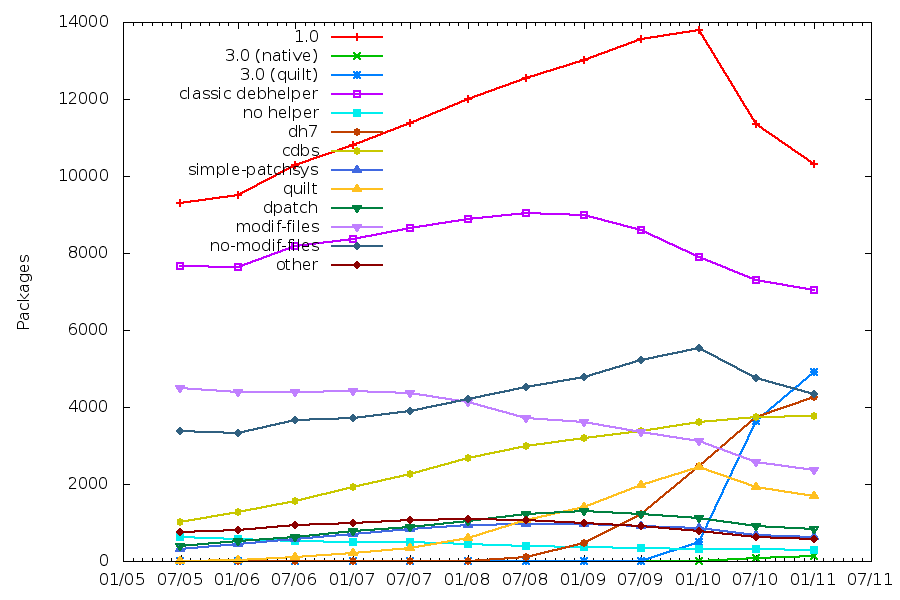
I ve been playing with snapshot.d.o, which is a fantastic resource to look at how Debian has been changing over the years.
Below are some preliminary results about various aspects of source packages: format, packaging helpers, and patch systems.
For clarification: Random comments: If you have other ideas of things to investigate using snapshot.d.o, don t hesitate to ask in comments.

Patrick Schoenfeld: Let me introduce DPKG::Log and dpkg-report

We have customers, which require a report about what we've done during maintenance windows. Usually this includes a report about upgrades, newly installed packages etc. and obviously everything we've done apart from that.
Till now we've prepared them manually. For a greater bunch of systems this is a big PITA, because to be somehow useful you have to collect the data for all systems and after that, prepare a report where you have:

Its also error-prone because humans make mistakes.

Perl to the rescue!
At least the part about generating a report about installed/upgraded/removed packages could be automated, because dpkg writes a well-formed logfile in /var/log/dpkg.log. But I noticed that there appearently is no library specialised at parsing that file. Its not a big deal, because the format of that file is really simple, but a proper library would be nice anyway.
And so I wrote such a library.
It basically takes a logfile, reads it line by line and stores each line parameterized into a generic object.

Its features include:

Based on that, I wrote another library DPKG::Log::Analyse, which takes a log, parses it with DPKG::Log and then extracts the more relevant information such as installed packages, upgraded packages, removed packages etc.

This, in turn, features:
- Info about newly installed packages
- Info about removed packages
- Info about upgraded packages
- Info about packages which got installed and removed again
- Info about packages which stayed halfinstalled or halfconfigured at the end of the logfile (or defined reporting period)


These libraries are already uploaded to CPAN and packaged for Debian.
They passed the NEW queue very quickly and are therefore available for Sid:

http://packages.debian.org/sid/libdpkg-log-perl

As an example use (and for my own use case, as stated above), I wrote dpkg-report, which uses the module and a Template::Toolkit based template to generate a report about what happened in the given logfile.
It currently misses some documentation, but it works somehow like this:

Report for a single host over the full log:
dpkg-report

Report for a single host for the last two days:
dpkg-report --last-two-days

Report for multiple hosts (and logfiles):
The script expects that each log file has the name <systemname>.dpkg.log so that it can guess the hostname from the system and can grab all such log files from a directory if a directory is specified as log-file arguments:</systemname>

dpkg-report --log-file /path/to/logs

This will generate a report about all systems without any merging.

Report for multiple hosts with merging:
dpkg-report --log-file /path/to/logs --merge

This will do the following:
A (fictive) report could look some what like this:

dpkg-Report for all:
------------------------
Newly Installed:
abc
Removed:
foo
Upgraded:
bar (0.99-12 - 1.00-1)

dpkg-Report for test*:
------------------------
Newly Installed:
blub

dpkg-Report for test1:
------------------------
Upgraded:
baz (1.0.0-1 -> 1.0.0-2)

dpkg-Report for test2:
------------------------
Upgraded:
zab (0.9.7 -> 0.9.8)

Currently this report generator is only included in the source package or in the git(hub) repository of the library. I wonder if it makes sense to let the source package build another binary package for it.
But its only a 238 lines perl script with a dependency on the perl library so I'm unsure if it warrants a new binary package. What do others think?

24 February 2011

Pau Garcia i Quiles: Applied for Debian Maintainer, FLOSS workflow works

I have been packaging for Debian for a few years now. My first serious package was Wt back in 2007, but I had been backporting for Ubuntu for at least 2 years already, which means I have been doing .deb packaging for about 5 years (!). Last week I decided it was about time stop nagging my sponsors (Vincent Bernat, Thomas Girard and Sune Vuorela) every time I wanted to update the packages I maintain (witty, ace and libmsn), and I finally started the Debian New Maintainer process. The main reason I had not applied for Debian Maintainer yet was it requires some bureaucracy and, well, I d rather spend my time coding or packaging than doing paperwork :-) I sent my Declaration of Intent and soon after, Thomas and Vincent replied and supported my application with very very nice and kind words. Thank you, guys! I m flattered! :roll: Had I known I would be buttered up so much, I would have certainly applied a long time ago! :-D But you know what is the best part of this? It shows how open source projects take advantage of all the tools and communications channels we have (IRC, mailing lists, sprints, conferences, etc), and make distributed development work very well: here we have a 900-developers project in which two French guys are praising an Spanish guy they have never, ever met face-to-face (only e-mail, occasional IRC, and the most important of all: code review). Meritocracy at its full extent. Have you ever seen that in a traditional 100,000 workers company with hundreds of developers working in a single project?

Steve Kemp: I like languages

One of the reasons I like Scotland is the fun that Scottish people have with language. I'm going to use two examples to illustrate my point: The last one is particularly fun when you use questions such as "How no?" - meaning roughly "Why not?". Languages, and idioms, vary wildly in different parts of the world, even when you restrict yourself to English-speaking languages. I'll not even get started on Accents. The UK is tiny compared to many other countries, yet we have a wide array of accents - Australia, by contrast is huge, but I can think of only two accents across the country. (Rationally I expect that there are many accents in different parts of Australia, and I'm merely ignorant.) In conclusion languages are fun, and some places this is more evident than in others. I will most likely contintue to say "The shop is open from 9 while 4" rather than the more typical "From 9 til 4" - I'm allowed to do that, having grown up in Yorkshire!

(PS. PHP still sucks - Even if you post it upon a PHP-powered blog. ;)
ObQuote: "People take you for granted, you know. We gotta make people miss you." - Hancock

23 February 2011

Thomas Koch: I've been young - I needed the money

Yesterday I had my last day at $company and today is my first day in freedom. I'll write about my future plans in another blog post. Here I just want to express the joy I had yesterday afternoon when I did:
CODE:
aptitude purge php5

I've started using PHP in 2006 and used it almost exclusively until the end of 2009. I believe I've learned most of what one can learn about PHP in this time. In 2010 I started to work in Java and only started to understand how limited PHP is.
I know that java is far from perfect. So I don't stop there and already started to learn Scala and looking forward to learn other languages too. But Java is for sure a better answer then PHP, regardless what the question was.
There are many reasons, why you should not, never, for no project ever use PHP. I'll only tell you my personal top reasons:
I once advocated PHP as a serious plattform and even gave three talks about PHP. I feel ashamed of this now and apologize. Please forgive me. It's not worth arguing about this post. Its just to make me feel less guilty about my foolishness in the past.

Pietro Abate: More on Xen 4.0 setup on squeeze

After the upgrade of last week, I didn't have any major problems : xen 4 seems pretty stable and does its job well. One problem I encountered the other day was about the dom0 balloning. By default, xen sets dom0_min_mem to 196Mb and balloning set to true. This is all and good untill you try to use too much memory for your VMs, squeezing dom0 to its minimum amount of memory and causing all sort of problems. On the xen wiki, they reccomend as best practice to reserve a minimum of 512Mb to dom0 for its operations. This is done but setting dom0_mem=512M on the grub command line and the adjusting enable-dom0-ballooning to no and dom0-min-mem accordingly to the amount of memory you choose. On debian, you can set the grub command line once for all just by adding in /etc/default/group the conf variable
GRUB_CMDLINE_XEN="dom0_mem=512M"
Another small problem is related to the reboot sequence. Since I'm using lvm on aoe, the default shutdown sequence (network down first, lvm later) is not going to work for me. As I've few lvm volumes on aoe and others on the physical disk, the proper solution to this problem is to write a custom shutdown script for the aoe lvm volumes and make it run before deconfiguring the network interfaces. In the mean time, to avoid the kernel hanging there forever, I've added these lines to in /etc/syscntl.d/panic.conf
# Reboot 5 seconds after panic
kernel.panic = 5

# Panic if a hung task was found
kernel.hung_task_panic = 1

# Setup timeout for hung task to 300 seconds
kernel.hung_task_timeout_secs = 120
This will instruct the kernel to panic and then reboot if there a task will not respond for more then 120 seconds.

Joachim Breitner: Goodbye server4you

My server, which is among other things hosting this weblog, is a dedicated server originally hosted by the German webhoster webperoni. It was a bargain at that time, and still a good price, and I was satisfied with webperoni s performance and reliability. Unfortunately, they were taken over by another web hosting company, best known for their server4you brand. They moved my server to a different data center and continued to run it there. Unfortunately, server4you was less reliable and less flexible than my original hoster: For example, when one sector on the hard drive turned bad, they were not able to put in a new drive in my system, let me mirror the content, and then remove the old drive. In another, even worse, instance, my second IP address, which I bought from webperoni, was given to another customer. When I finally noticed and complained, they refunded me the charges that I paid for the IP. But understandably, I wanted to get away from that hoster. The contract is automatically prolonged for one year if not canceled in time, and I missed the deadline last year. This year, I finally got around to rent a slightly better and slightly more expensive server from Hetzner, which whom I already made good experience. I would have preferred to switch when I am back from India, but server4you would not even let me prolong the contract by just two months only a whole year or nothing. So they got nothing, and I started to work on the move yesterday. At first I set off installing the new system from scratch, setting up all the various services and copying over data and configuration. But quickly, I gave up and moved the system by completely by copying programs, configuration and data from the old server. The new system has its root partition on a LVM share on software RAID, and now uses grub2 to boot. I had a hard time to get it booting, and a hard time to debug the issues without access to the physical console. I finally understood the problem by running kvm -hda /dev/sda -hdb /dev/sdb -curses from the recovery system and observing that the initial ramdisk is having problems finding the root partition. The problem was that I thought addressing partitions via file system labels is the way to go now and manually added root=LABEL=root to the Linux command line in /etc/default/grub. But then the initial ramdisk would not activate the logical volume. If I had just left it to the grub package, which inserted root=/dev/mapper/vg-root, everything would work fine. The new IP address (88.198.48.143) has not propagated throughout the Internet yet. Running the following command for a variety of ports on the old machine (80.86.81.20) makes sure nobody notices:
port=443
iptables -t nat -A POSTROUTING -p tcp --dst 88.198.48.143 --dport $port -j SNAT --to-source 80.86.81.20
iptables -t nat -A PREROUTING -p tcp --dst 80.86.81.20 --dport $port -j DNAT --to-destination 88.198.48.143:$port
The only question remaining is: What to do with the old server for the remaining six weeks? I am considering to erase the system, set up a plain Debian system and run a tor/freenet/whatelse node at full speed.

Neil Williams: cross-building, multiarch and binutils

At the Emdebian ARM sprint, cross-building experiments on a Multi-Arch base are going fairly well. It is looking like the hacks in dpkg-cross may finally be avoidable, possibly before Wheezy gets released. Elsewhere, debhelper has been updated to allow dh_strip and other tools to work directly with the binutils package from the cross-building toolchain and not to need binutils-multiarch any more. dpkg-cross has been updated to only Suggest binutils-multiarch, which makes room for more architectures to be covered by binutils-multiarch (which, therefore, will be getting quite a lot bigger quite soon).

Cross-building in Debian is therefore entering a period of transition and the old ways of dpkg-cross - and the tools it has spawned like apt-cross, xapt, pdebuild-cross and others - will be gradually side-lined and finally rendered obsolete. Like all transitions, there will be breakage, there will be pain, there will be things which don't cross-build now and which have no prospect of being fixed until the transition is deeply entrenched. There are packages which used to cross-build and which will stop cross-building and, again, won't be fixable for months. Sadly, Squeeze released with cross-building breakage too, due to changes within apt during the release freeze. A Lenny chroot is possibly the best place to do cross-building for now.

This is a major transition. It WILL break things. Badly and often.
What's more, just because we decide to implement stuff using one method now does not mean that the same method will even exist in a month or two.

In other words, if you've got a working cross-build chroot or installation currently and you absolutely need it to continue working leave it alone.

Don't go changing real packages to use the changes we're trying out!

If you enjoy fixing stuff, don't mind pain and fancy risking your system as I've been doing (unlinking /etc/, deleting /lib64 on amd64 or forcing package installation such that no shared libraries are accessible any longer) then you are:
  1. insane
  2. welcome to join the work

Check out the current state of things via the #emdebian channel on oftc.net and the very risky Emdebian multiarch SVN experiments along with the even more risky Emdebian Multiarch Mirror, courtesy of Steve McIntyre and Phil Hands.

The README in SVN is very clear - DON'T INSTALL THESE OUTSIDE A CHROOT and even if you do, don't come crying to me when it breaks your entire system (even when used inside a chroot).

No warranty, no guarantees, no promises, none of this is fit for any purpose whatsoever and we'll say when we finally have something which might actually be useful.

Russell Coker: Virgin Mobile CRM Upgrade Failure

I ve recently got a new Xperia X10 Android phone for my with with Virgin mobile, it s generally been working OK although I am having some issues [1], I ll write another blog post soon about other problems I ve discovered with the phone and how I ve solved some of the previous ones.I upgraded my wife s phone first because I can t be without Nagios SMS messages if things don t work. So now that things are generally working I want to get myself an Xperia through Virgin (and have my wife s phone get the Nagios SMS in the mean-time). But since last Friday the entire Virgin sales infrastructure has apparently been down. It started with just declining my attempts to purchase a new phone on a separate account, but when I decided to add a second phone to my wife s account the web site told me that they are upgrading their CRM system and it should be fixed on the 22nd of Feb (yesterday). The web site is now saying that I should check back in 2 hours for an update , it s been saying that for a couple of days now.So for most of a week potential Virgin customers have been turned away. It could be that Virgin stores are processing sales on paper, but they offer some significant discounts for web sales the plan I want is a $39 per month plan and I ll get 3 months free for buying on the web. I m not about to visit a store and lose $117! I m sure that many people are losing confidence in Virgin and taking their business elsewhere. I have only just installed the 3G Watchdog free Android app that monitors bandwidth use and automatically turns off 3G when the quota is reached. For the first few days of using the phone which were more data intensive than usual I had no monitoring and no way of using the Virgin web site to discover how much was used. If Virgin bill me extra for data use I ll complain and demand that they alter the bill.This is even worse for pre-paid customers who can t add credit to their account while this happens!Virgin state that they are upgrading the hardware, operating system and database our platform uses to ensure that we can service our Members even better for years to come [2]. I wonder how people get themselves into such a mess. I guess they didn t have a decent test environment to allow testing the upgrade process before doing it on the live data, I can understand a routine small upgrade going wrong and corrupting data in a way that takes some time to resolve. But when everything is upgraded then everything should be tested, and tested before going live! One thing that Virgin could do to regain some credibility is to publish what went wrong and what they learned from it. I would be much more happy to trust my personal data and my business critical phone to a company that learns from it s mistakes and publishes plans on how they do better than one that just does PR.According to Whirlpool they did the same thing on the 25th of January, so they have had two outages of their billing/CRM system in two months! [3]. The Whirlpool thread has discussion about last month s down-time and this month s down-time.On the up-side, Whirlpool user Kevin JD is a Virgin representative who advised customers to send email to telesales@virginmobile.com.au with a contact phone number if they have any issues. It s good to see a company engaging with it s customers.Update: An hour after emailing the URL to this post to Virgin I got a call from a service representative. It wasn t a very productive call as I already knew that their servers are down and they can t do anything. But it s good to know that they are very enthusiastic about making things better. One useful thing that I learned is that my wife s service is probably on a pro-rated bandwidth quota. As she got the phone in the middle of the month we can only do 100M of data transfer not 200M before the end of the month, by my rough calculations I ve downloaded well over 50M of data (maybe as much as 100M) from the Android marketplace. So it might be necessary to negotiate about the bill as soon as their CRM system works.

21 February 2011

David Paleino: Code::Blocks is now in Debian!

After almost six years from the original ITP bug #304570, we finally have Code::Blocks in Debian. Enjoy it, and please report any bug you might find. Also, this is a complex package, so if anyone wants to step up as co-maintainer, or maybe make a "Debian Code::Blocks Team", I'm all for it!

Michal &#268;iha&#345;: German-Czech dictionary for Debian

Okay, I finally decided it's about time to make Debian package out of German-Czech dictionary for which I'm providing builds for StarDict. Daily snapshots are (as usual) available in my Debian repository and the monthly builds will be uploaded to Debian (once it passes NEW queue). The dictionary currently lists only few words, but I hope it will improve in near future.

Filed under: Debian English Stardict 0 comments Flattr this!

Stefano Zacchiroli: Squeeze, Debian, and the FSF

Short version: Dear FSF, thanks for your appreciation of Debian Squeeze achievements in getting rid of non-free firmware blobs. We still disagree on the overall freeness assessment of Debian, but I'm positive that steps like this one can further future collaboration, in the interest of both projects. Long version follows.
Historically, the relationships among Debian and the FSF have gone through mixed fortune (and that's quite an euphemism). On the one hand, Debian is committed to 100% Free Software, is an open project explicitly inspired by "the spirit of GNU", has been sponsored by FSF in its infancy, and properly calls itself "GNU/Linux" (or even "GNU/kFreeBSD"). On the other hand, Debian is the project who considers the GNU FDL license to be only conditionally free and which is not considered to be an entirely Free system according to FSF.
So much for the history corner. As a long time member of the Debian Project, as well as an FSF(E) fellow, I've always felt a bit sad about this state of affairs. Not because the two projects should have aligned goals; they clearly focus on different aspects of the quest for a Free (Software) world. Not even because they should agree on how to build a Free distribution: history has shown that FSF technical positions do not always get along with Debian's more "pragmatic" style, as embodied by point 5 of the Social Contract. Rather, my sadness is rooted in the belief that not getting along have encouraged duplication of efforts which could have been easily avoided (e.g. multiple distributions concurrently freeing up kernels). Furthermore, I'm more and more convinced that Debian nowadays enjoys a rather privileged position among Free Software vendors. Indeed, even though GNU/Linux distributions have reached a popularity we didn't dare to imagine 15 years ago or so, most distributions are under the direct or indirect control of commercial vendors. Those commercial vendors play a very important role in the promotion of Free Software. For instance, they are structured in ways that enable them to seal OEM deals with hardware manufacturers to sell computers with GNU/Linux pre-installed. Commercial vendors, by their own nature, are also in general better at marketing than non-commercial vendors. On the flip side however, commercial vendors are not yet relevant enough to drive proprietary drivers out of the market and, as a consequence, cannot yet afford not to support hardware which need such proprietary bits to work. Among mainstream GNU/Linux distributions[1] Debian is one of the very few vendors if not the only one that is both very relevant and, thanks to its independence, can afford taking Free Software's side: no commercial urgency can force Debian to negotiate on that. That is quite an asset to be used in the promotion of Free Software, especially to a public that is interested in and willing to understand what Free Software really is about. Such an "aware" public is on the rise as of lately, together with the general awareness increase of risks entailed by living a digital life, when that life is not under our control (think, as an example, at how often the "Facebook privacy debate" has hit mainstream medias in the last year). The "aware" public is the natural target of both Debian and the FSF. Dividing it would not serve well the cause of Free Software. With all that in mind, last August I took the chance of being on the "right" side of the Atlantic Ocean for DebConf10, to discuss possible venues of collaboration among Debian and the FSF. I sat down and discussed at length with John Sullivan, who I happen to know for his Debian involvement, in his capacities of FSF representative and operations manager. We discussed various topics, with the intention of bringing them up to the respective communities[2]. Then, inevitably, we ended up talking about the overall freeness of Debian and his exclusion from FSF listing of Free systems. (FSF is of course entitled to such judgements, pretty much as Debian is entitled to its own judgements on FSF licenses. Nevertheless those judgements contribute to dividing our public and might lead to wasteful duplication of efforts, where Free Software could better be served by collaboration.) The main ground for exclusion from that list used to be the compromises Debian has made in the past about non-free firmware blobs. But, as I pointed out back in August, those compromises would have been gone starting with Squeeze, making that argument moot. Today 6 months later I'm delighted to cheer at FSF's decision to publicly recognize the achievements Debian has delivered with Squeeze.
Thanks! It's a nice gesture that I've very much appreciated. I'm confident steps like this one will help future collaboration if, on both sides, we will be able to spot actual venues for collaboration. Needlessly to say, I still disagree with the overall FSF assessment of Debian non-freeness. Apparently, it still stands on the basis that Debian also provides a repository of nonfree software [ ] [which] is not part of the Debian system. [ ] but users would be hard-pressed to make a distinction and that people can readily learn about software available through it by browsing Debian's online package database. I respect the principle of non advertising non-free software and I even agree that it is a good principle. But unfortunately it's also a very blurry principle on which, in my opinion, Debian actually scores very well. No non-free software is offered to users by Debian; it's just for users that really want to have non-free software (or need to, in order to run a Free OS on their computers), that Debian tries to stay out of their way. For the "aware" public discussed above, I think it's much better to draw the line where software freedom ends and use that line to explain what does crossing it entails, than locking them up pretending non-free software do not exist. But fair enough: for the time being, I guess, we will need to agree to disagree on this one. Getting a little bit closer in the occasion of the Squeeze release is still an important step forward. It's up to each of us now to seek out initiatives which attract the interest of both projects and that can benefit from synergies.
[1] Sorry, I've no decent definition of "mainstream distribution" to offer, besides folklore and well-established distribution review sites. (Heck, I don't even have a decent definition of "well-established distribution review site" to offer!).
[2] which hasn't happened yet, due to the proverbial amount of available spare time.

Lucas Nussbaum: Debian Spring Cleanup

We have many orphaned packages in Debian. Those are packages that no longer have a maintainer willing to care for them. They are a problem for several reasons. Often, there have better alternatives (that s often why the maintainer gave up maintenance), but users keep installing them because they show up in apt-cache search. Or, they might be broken, without anybody noticing because they only have a few users. Also, developers need to take them into account. They might slow down transitions, have RC bugs that need fixing, etc. So, there are good reasons to remove some of the orphaned packages from the Debian archive. Not all of them. But those that have been orphaned for a long time without anybody stepping up to take over the maintenance, have very few users according to popcon, etc. Removing some of them also makes it easier to expose the ones that should really find an adopter. Also, that removal is not final. The good reason to do this now is that we are at the beginning of a release cycle, and that it will be easy to reintroduce packages that are really needed during the next two years. Also, packages (both source and binaries) are still available on snapshot.debian.org, so users can still install them from there, and re-uploading them to Debian is very easy if someone wants to adopt them. So, how do I proceed? I use bapase, and go through specific sets of packages (using a custom version of bapase to restrict the list to those packages). For example, orphaned packages that have a popcon lower than 50, have been orphaned for more than 500 days, and whose orphaning bugs have not been modified in the last 100 days. Then, I read the bug log, and decide if there s a reason to keep the package. If there s not, I request the removal. As of today, there are 471 orphaned packages in Debian. The goal is not to get down to zero, but it s certainly possible to get down to 200 or 250. How can you help? Start from the list, and find some easy targets. You can take a look at bug #483252 if you want to re-use my template. Also, one thing that is currently missing in the process is that orphaned packages that have reverse-dependencies should not be removed without removing their dependencies (if appropriate). An easy and efficient way to know if a given package has reverse (build-)?dependencies would be great, so I could integrate this info into bapase and exclude those packages from the list, or mark them somehow.

Cyril Brulebois: Debian XSF News #6

Enough news to release another Debian XSF News issue, after less than a week. Enough writing for now, I m getting new mails in xorg-announce@.

Steve Langasek: How you can help with multiarch today

Paul Wise called attention recently to the fact that there's renewed activity around multiarch in the face of the squeeze release. Although I fervently wish we could have gotten multiarch support into squeeze, it's better late than never; and real progress is being made now, thanks mostly to the efforts of wonderful package management experts like Raphael Hertzog, Guillem Jover, and David Kalnischkies. Don't believe it's finally coming? Here's some output from my amd64 multiarch chroot:
$ dpkg -l '*:i386'
Desired=Unknown/Install/Remove/Purge/Hold
  Status=Not/Inst/Conf-files/Unpacked/halF-conf/Half-inst/trig-aWait/Trig-pend
 / Err?=(none)/Reinst-required (Status,Err: uppercase=bad)
 / Name           Version        Description
+++-==============-==============-============================================
ii  gcc-4.5-base   4.5.2-3ubuntu2 The GNU Compiler Collection (base package)
ii  libc6          2.13-0ubuntu1+ Embedded GNU C Library: Shared libraries
ii  libdb4.8       4.8.30-5multia Berkeley v4.8 Database Libraries [runtime]
ii  libgcc1        1:4.5.2-3ubunt GCC support library
in  libpam-modules <none>         (no description available)
ii  libpam0g       1.1.2-2ubuntu1 Pluggable Authentication Modules library
ii  libselinux1    2.0.96-1multia SELinux runtime shared libraries
ii  libstdc++6     4.5.2-3ubuntu2 The GNU Standard C++ Library v3
iU  libuuid1       2.17.2-9.1ubun Universally Unique ID library
ii  selinux-utils  2.0.96-1multia SELinux utility programs
ii  zlib1g         1:1.2.3.4.dfsg compression library - runtime
If you're as excited about this making its way into Debian as I am, you might be wondering what you can do to help. That's great, because I'd love to tell you! Perhaps you happen to maintain a package that provides executables; and perhaps other packages depend on your package exclusively to use those executables; and perhaps some of those packages depending on your package are shared libraries. If all of the above is true, please consider declaring this package to be Multi-Arch: foreign as defined here. Note: it is very important that you not use this on any package that will provide architecture-dependent interfaces to its reverse-dependencies. So if you're shipping both shared libraries and executables in the same binary package, don't do this. But if your package does fit this description, this is one part of multiarch that you can safely start implementing today. This will go a long way towards getting the system ready to handle multiarch libraries when they land. My own efforts to help with getting Multi-Arch: foreign packages documented in the archive are trackable here.

20 February 2011

Gregor Herrmann: RC bugs 2011/03 - 2011/07

squeeze is released but this doesn't mean the end of the ordinary RC bug; old ones are still around, & new ones keep floating in.

as a short reminder to take the occasional look at the RC bug list I'm again posting what I've done in the last weeks. as you can see no NMUs but only work on packages I have a relation to, & often only uploading packages prepared by others (yeah teamwork!).

Evgeni Golov: Desktop in a shell

People are using computers, everywhere, really! ;)
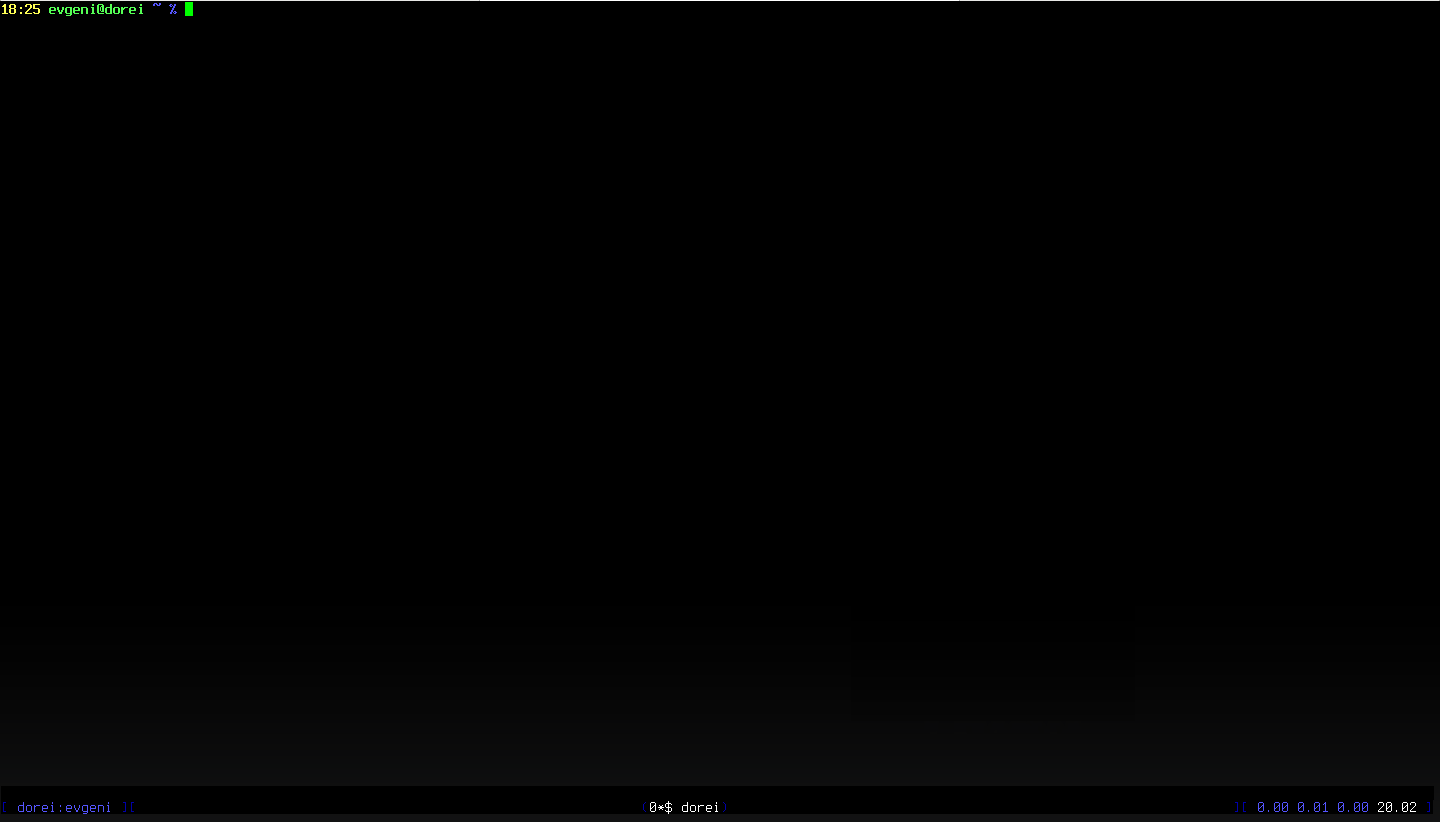
As you might guess correctly, so do I.Basically, I am using three computers: my laptop (ThinkPad X201s, awesome machine, but pabs told me not to post any more adverts for ThinkPads on Planet Debian *g*), my smartphone (Motorola Milestone, yes, that counts as a computer) and random_pc (for random as in my girlfriends or some other trusted (!!!) friends computer).
My laptop is running Debian GNU/Linux unstable with Xfce4.6, my smartphone is running Android 2.2.1 Froyo, my girlfriend has Ubuntu with GNOME, a friend runs Debian unstable with GNOME, another one Arch Linux with KDE4 and so on. And on all these machines I want be able to work, which means I have to read mail and rss, chat via IRC, JabberXMPP and ICQ, have a look at my to-do list, ssh into different machines, write some code, tweet and dent etc.In the following series of posts I will describe how I can handle about 90% of my work on every (trusted) computer out there, using ssh, screen, mutt, irssi, BitlBee, newsbeuter etc.As I am describing the setup as a Desktop in a shell , let s start with a login- and desktop/window-manager: ssh+screen.sshObviously, you need a machine to ssh into it, where the Desktop will live on. For me, that s my home router/fileserver/vm-server dorei, running Debian GNU/Linux LennySqueeze with OpenSSH as a kind of login manager ;)Yes, my user is allowed to login with a password instead of a public key. And well, that s all for the login-manager, no extra configuration needed.screenAfter logging in, I start my window-manager with screen -rd, -r for reattach a running screen session, -d for detach it if it is already attached somewhere else. Or I can start a new session by just typing screen. Inside the screen I have multiple windows (one can create new ones with ^A c) with all the needed software running. I can switch windows by pressing ^A N, N being the number of the window, ^A n for the next window, ^A p for the previous one or ^A ^a for the last one. Or I can get a window-list with ^A w. If needed, I can rename windows with ^A A, followed by the new name. That should be enough for almost everyone. Let s just add a window-list to the bottom (as you might have seen on GNOME, Xfce, KDE and even Windows ;) by adding the following to the ~/.screenrc:
caption always " "                    # clear line before hardstatus
hardstatus alwayslastline "% = kb [ % B %H:$USER % b ][ %=% w %?%-Lw%?% b (% W %n*%f %t%?(%u)%?% b )% w %?%+Lw%?%?%= % b ][% B  %l % B % W %d.%0m % b ]"
You get the current host- and username, the machine load and the date for free ;)Even if it is possible, I do not have any autostart like stuff in my .screenrc as the machine is running stable and I start the screen and the apps inside maybe once a year after a reboot.screenrcMy .screenrc looks like this:
# detach on hangup
  autodetach on
# don't display the copyright page
  startup_message off
# set scrollback to 2000 lines, default 100
  defscrollback 2000
# set silencewait to 15 seconds, default 30
  silencewait 15
# new shells should be started as login-shells
  shell -$SHELL
# make a fancy statusline
  caption always " "                    # clear line before hardstatus
  hardstatus alwayslastline "% = kb [ % B %H:$USER % b ][ %=% w %?%-Lw%?% b (% W %n*%f %t%?(%u)%?% b )% w %?%+Lw%?%?%= % b ][% B  %l % B % W %d.%0m % b ]"
# make higlighting bold, black on blue background
  sorendition +b bk
# some fixes, no I do not know where they come from :)
  termcap  xterm hs@:cs=\E[%i%d;%dr:im=\E[4h:ei=\E[4l
  terminfo xterm hs@:cs=\E[%i%p1%d;%p2%dr:im=\E[4h:ei=\E[4l
  termcapinfo  xterm Z0=\E[?3h:Z1=\E[?3l:is=\E[r\E[m\E[2J\E[H\E[?7h\E[?1;4;6l
  termcapinfo xterm* OL=100
  termcapinfo xterm 'VR=\E[?5h:VN=\E[?5l'
  termcapinfo xterm 'k1=\E[11~:k2=\E[12~:k3=\E[13~:k4=\E[14~'
  termcapinfo xterm 'kh=\EOH:kI=\E[2~:kD=\E[3~:kH=\EOF:kP=\E[5~:kN=\E[6~'
  termcapinfo xterm 'hs:ts=\E]2;:fs=\007:ds=\E]2;screen\007'
  termcapinfo xterm 'vi=\E[?25l:ve=\E[34h\E[?25h:vs=\E[34l'
  termcapinfo xterm 'XC=K%,%\E(B,[\304,\\\\\326,]\334, \344, \366, \374,~\337'
  termcapinfo xterm* be
  termcapinfo xterm xterms xs ti@:te=\E[2J
  termcapinfo wy75-42 xo:hs@
  termcapinfo wy* CS=\E[?1h:CE=\E[?1l:vi=\E[?25l:ve=\E[?25h:VR=\E[?5h:VN=\E[?5l:cb=\E[1K:CD=\E[1J
  termcapinfo  hp700 'Z0=\E[?3h:Z1=\E[?3l:hs:ts=\E[62"p\E[0$~\E[2$~\E[1$ :fs=\E[0 \E[61"p:ds=\E[62"p\E[1$~\E[61"p:ic@'
  termcap  vt100* ms:AL=\E[%dL:DL=\E[%dM:UP=\E[%dA:DO=\E[%dB:LE=\E[%dD:RI=\E[%dC
  terminfo vt100* ms:AL=\E[%p1%dL:DL=\E[%p1%dM:UP=\E[%p1%dA:DO=\E[%p1%dB:LE=\E[%p1%dD:RI=\E[%p1%dC
  termcapinfo linux C8
# some bindings
  bind k
  bind ^k
  bind .
  bind ^\
  bind \\
  bind ^h
  bind h
  bind 'w' windowlist -b
  bind 'W' windows
  bind 'K' kill
  bind 'I' login on
  bind 'O' login off
  bind ' ' history
  bind = resize =
  bind + resize +3
  bind - resize -3
# Mutt demands this
# http://wiki.mutt.org/?MuttFaq/Appearance
 defbce on
 term screen-bce
That s all for my screen setup. The obvious, boring screenshot follows:See you next time, when I will present my mutt setup here.

Joey Hess: the fate of the orphans

(Non-Debian readers can stop reading now, I'm talking about so-called "orphaned packages" and not anything of real-world importance.) In 2008 I stopped maintaining non-native packages in Debian. At the time I maintained a fair amount of stuff. It's interesting to see what happened to it after I gave it up, partly because some of the results seem so random and partly because some of what has happened seems to point at weaknesses in Debian. First, the success stories. More than half of my packages are now being maintained by others: xaos, longrun, fbreader, liblinebreak, analog, xgalaga, znc, sysnews, metastore, bsdgames, uqm, oneko, kobodeluxe, archivemail, unclutter I still use much of this stuff, some only occasionally, and other daily, and am glad it's being kept alive. (It's surprising that someone still care about longrun.) I was unhappy to have to NMU procmeter3 just before the release of Debian 6.0 to fix a trivial to debug RC bug that almost got it removed from the release. I hope that was just a bump in its road. Also, splitvt is now maintained again after being orphaned a long time. I'm not sure if it makes sense to keep it in Debian, since screen can do the same thing, and it has a security history, but someone wants to, so that's fine. Two packages are left on life support. I'm surprised nobody wants to maintain grepmail, unless we're all using notmuch or mairix now? And dgen is the best Sega emulator I know of. Several games were not picked up by the games team, despite them showing some interest originally, and were removed: xtris, xjewel, xemeraldia, xbl Of those, xemeraldia in particular is a lot of fun, I'm surprised nobody cared to keep it. Also, the nestra Nintendo emulator was shipped with squeeze, but now is removed as it never got a maintainer. I don't know if there is a better NES emulator in Debian. The intercal programming language was removed. Surprising. Debian does at least still have clc-intercal for all our pressing Intercal needs. Finally, sparkline-php was removed today despite never having had any bugs, needing no maintenance, and being a suggests of ikiwiki, which is now more buggy (broken relationships, outdated docs) and less featureful in Debian.

Next.

Previous.