Search Results: "ina"

18 June 2011

Guillaume Mazoyer: Status report Jigsaw num. 2 for GSoC 2011

code.pngMy internship is now finished, this means that I will be able to work on my GSoC project a lot more than the previous weeks. I hope to make some good progress in the next days.

This last 2 weeks, I was still studying how Jigsaw works. Even if there is no progress on the Jigsaw packaging I have done some packages that will help later.

I ve spend a lot of time trying to package JT Harness and JTReg.
I ve successfully built JT Harness using CDBS but I ve finally rewritten the package using only debhelper and javahelper. Javahelper was really useful to build JAR files, move them to the right directory, put the Javadoc in the right place as well as the examples. The Debian directory of JT Harness can be found on the Java team SVN.

svn co svn+ssh://$ SVN_USER @svn.debian.org/svn/pkg-java/trunk/libjtharness-java

The source package of jtharness build 2 binary packages: libjtharness-java and libjtharness-java-doc. You can see that by looking at the control file in the debian directory. There are some interesting files in this package, let s take a look at them.

First of all, some of the source files needed to be patched for the package to build. So to accomplish this, there is a couple of patches in debian/patches : To generate these patches, I ve used the edit-patch command which is a really awesome tool. This command uses a temporary shell where we can edit files we want to patch. When the job is done, CTRL + D terminates the temporary shell and the patch is generated.

There are 4 interesting files which are used to build the binary packages and put the files in the right directories. These files are: Of course rules is the most important one. This file tells us how packages are built. A good thing is that rules is quite simple in the jtharness case.

#!/usr/bin/make -f
JAVA_HOME = /usr/lib/jvm/default-java

override_dh_auto_build:
ant -f build/build.xml

%:
dh $@ --with javahelper


We just tell where Java is and to use javahelper ( with javahelper). Overriding dh_auto_build is interesting because since the JT Harness uses Ant as build system we need to give to Ant where the build.xml file is. By default Ant is searching it in the current directory but in jtharness the file is in the build directory. Since the Ant build file is correctly written, the build generates JAR files, Javadoc and examples code. And libjtharness-java* files are here to put the generated things in the right places.
The job of libjtharness-java.jlibs is to tell where to find the JAR libraries. In this case, the intesresting JAR files were javatest.jar and jt-junit.jar . So in the .jlibs file we just give where those files are after being built.
The job of libjtharness-java-doc.javadoc is to tell where the Javadoc is and where to put it. So there is only one line that says the generated Javadoc is in jar-build/javadoc and put it in /usr/share/doc/libjtharness-java/api .
And finally, libjtharness-java-doc.install is used to move the examples. The syntax is same as libjtharness-java-doc.javadoc .

The JT Harness package can be found in Sid now thanks to Sylvestre Ledru who uploaded it for me. So the ITP bug that I created is now closed.

Building the package for jtreg is quite similar. In fact, it probably easier but I m still facing a problem. jtharness is just a library, jtreg does have main classes and generate some binaries. The difficulty here is to generate the man pages for the 2 generated binaries: jtdiff and jtreg. These 2 files are shell scripts which just use jtreg.jar with the correct parameters.

I tried several tools to generate the man pages of each script. Sadly, I can t find a way that does not causes any problems.
My first choice was to use help2man. This tool looked like to be perfect for the job. But I couldn t find how to launch the scripts correctly. The scripts needs jtreg.jar but they also need javatest.jar from the libjtharness-java package. The classpath cannot be set correctly due how the scripts are written. So to use help2man I ll probably have to patch and completely rewrite jtdiff.sh and jtreg.sh in the sources.
My second choice was to use txt2man. During the build of jtreg there is a usage.txt file which is generated and which can be used as a man page. txt2man can take this text file and output a man page based on the text. I thought it was working but when building the package, lintian threw some warnings about syntax errors in the man pages.

W: jtreg: manpage-has-bad-whatis-entry usr/share/man/man1/jtdiff.1.gz
W: jtreg: manpage-has-errors-from-man usr/share/man/man1/jtdiff.1.gz 292: warning [p 4, 3.3i]: cannot adjust line


Finally, few days ago I decided to try rst2man. This tool looks cool and easy to use. But the text that I have to convert into a man page is not a reStructured text so it cannot without patching the usage.txt file for example. I was going to do it but there is no such file in the sources of jtreg. Actually this file is generated during the build but the text had to come from somewhere. And it was from two properties files in the source code.
I m still looking for a good solution to generate the man pages. If someone has any idea just let me know ;-)

The debian packaging of jtreg is not in the Java team SVN yet because of the man pages problem. I opened an ITP bug so people know that someone is working on jtreg.

My goal for the next two weeks is to finish the jtreg package, understand how jpkg (which is supposed to create Debian packages) works in Jigsaw and write more examples using the modular JVM.

17 June 2011

Cyril Brulebois: mesa: a disturbance in the Force!

Things aren t exactly going as smoothly as expected. Here are some explanations. First collateral damage: non-free fglrx and nvidia drivers. We have to admit we didn t think of those when we moved libGL.so.1 (and friends) from /usr/lib to /usr/lib/<triplet> (that s the move we call adding multiarch support ). In the mesa 7.10.3-2 upload, some Breaks statements were added to prevent users from installing new mesa packages if they still have old (without multiarch support) fglrx or nvidia packages. Solution: Sticking to the mesa packages in testing is the way to go until fixed fglrx and nvidia packages are uploaded. Second collateral damage: xserver-xorg-core in testing. The plan was to rebuild the server in unstable against the new mesa libraries, so that it would look into the new /usr/lib/<triplet> directory for mesa drivers. Since no source changes were needed, we went for a binNMU as explained in the previous blog post. That s the usual way to deal with libraries, and does the job very nicely. But that failed in this special case, for the following reasons:
  1. The server only has libgl1-mesa-dri in Recommends, so there s no hard dependency here.
  2. Usually, rebuilding a package against a new library means getting a dependency on the new library (typically because the binary compatibility has been broken, so the SONAME got bumped, meaning one depends on libfoo42 instead of libfoo41). And that means going in testing at the same time as the new library.
But in this case, rebuilding against the new library just means having a different search path somewhere in libglx.so. So the rebuilt package (2:1.10.2-1+b1) happily reached testing, which still contains the old mesa packages, which ship their files in the old /usr/lib path! Solution: Stick to 2:1.10.2-1 packages (snapshot.debian.org to the rescue), or wait a bit and get fixed packages. To get fixed packages, two things were needed:
  1. Getting the server package fixed in unstable: that means adding Breaks against old (pre-multiarch) mesa packages, as seen in 2:1.10.2-2. This will ensure that new server package built against new mesa will not be co-installable with old mesa packages, and both mesa and the server should migrate together to testing.
  2. Getting the server built again within testing, so that it gets built against old mesa, so that both mesa and the server in testing remains without multiarch until the packages in unstable are ready to migrate together.
While taking care of that second step, it was discovered that many buildds are still lacking a testing chroot, so there might be some delay until the server is rebuilt in testing (as 2:1.10.2-1+wheezy1). Eager users can use the time travel machine mentioned above to get stuff working again sooner. (As far as I can tell, the last problematic combination which would remain would be 2:1.10.2-1+wheezy1 server with new mesa, but we ll make sure we update the Breaks in the new mesa to make sure that it can t happen. Since it s not as urgent as getting the server in testing fixed, it s only queued for mesa 7.10.3-3 for now.)

Sam Dunne: DPKG - Declarative Diversaions - Report 2

DECLARATIVE DIVERSIONS ====================== REPORT 2 This is the second report for declarative diversions for debian as part of Google Summer of Code. My first report was just a design draft but I have since been advised to structure it differently. So in this report I will talk about what I have done to date with the project and what my plans for the immediate future are. For the first while in this project I spent a lot of time with my mentor planning out what we were going to do and we discussed it with everyone who is involved with dpkg to get feedback. I quickly got a great deal of feedback and produced my first design draft. After which I got even more feedback and produced my second design draft. This week is the first week I have spent coding. So far I have coded a parser which works quite well for what we need. I spent the later part of this week integrating it into the existing codebase. But so far everything is looking extremely promising. My plans for the immediate future are to release a third design draft based on feedback from my existing code and to finalise the main part of the work. I believe this will be achieved by the next report date (1st of July) as well as a lot of basic functionality for the project. Anyone who wishes to discuss the project with me can either mail me through the mailing list, catch me on IRC (SCD[Eire]) or email me at sam.dunne101@gmail.com My blog: http://blog.sam-dunne.com My Github: https://github.com/samdunne/dpkg-diversions My code is located in /lib/dpkg/test in the gsoc-testing branch of my code Until next time, ~Sam

Timo Jyrinki: Kernel Mode-Setting (KMS) on Neo FreeRunner + Debian

Edit Aug 18th: video available (ogv, also on youtube)

Forget AMD, Intel, NVIDIA! Thomas White's incredible work with Neo FreeRunner's puny graphics dec...accelerator, Smedia Glamo 3362 is starting to bear fruits. Not listening to such comments as the chip will never be used anywhere else and why not spend your time doing something more relevant , he has chosen to actually do what he likes and sees as an interesting challenge. And that's often the spirit of free software, so I don't really agree with the naysayers.

The camera shot on the right, running KMS-enabled X.org driver for the glamo chip on my Debian installation (visible software matchbox-window-manager, fbpanel, zhone), is a bit optimistic looking since Zhone happens to draw correctly. A lot of the drawing is not yet synced correctly, which shows as all text and images in eg. GTK applications being garbled. But as little as two days ago one couldn't yet much launch applications without X crashing, so the newest commits by Thomas were a big step forwards. I'm using Debian, and he's not, so I try to find time to help in debugging even though I really can't much help with the driver code.

The driver is not just one piece of code, but consists of a kernel drm driver (direct rendering manager) using GEM, libdrm support for the kernel driver and finally the X.org driver supporting these other components and offering buzz-words like DRI2. There is also a beginning of a Mesa 3D driver, though it is so far just a skeleton driver since the 2D/KMS/EXA/DRM parts are what should be done first before dwelling into the OpenGL realm.

Openmoko the company is basically nowadays just producing new Neo FreeRunners to resellers, but the community of the so far only Free phone is thriving. The final (Openmoko produced, from where gta02-core continues) version of the phone, with the famous buzzing problem fixed, appeared on store shelves some time ago, offering better out-of-the-box phone functionality in addition to all the mini computer features. It was also offered to Debconf visitors on discount.

It's not only cool to have kernel mode-setting, though it is indeed very cool as well. The reason for much sorrow in the whole OM project has been the graphics chip, and some of the problems with the chip are only finally solvable with the kernel doing the mode-setting. So it's both a very modern thing to use KMS, but there are also clear potential benefits of having accurate control over this very sensitive piece of silicon. The current non-KMS X.org driver for example busy loops in order to try to feed the chip at a correct pace, causing CPU usage every time there is any drawing going on.

This is somehow reminding me about getting the best out of 8-bit computers and other hardware with some specific limitations. The glamo chip is very limited in some ways, but also capable in some other ways like theoretically offering MPEG-4 decoding, OpenGL ES 3D support. It's a mixed bag of things, and I can very well imagine it's indeed an interesting challenge to work on it, if you just have the skills (I don't) and nerves (proper debugging tools help).

It's so nerdy to drool over lines in the X.org log, but I just can help it:
X.Org X Server 1.6.3
Release Date: 2009-7-31
X Protocol Version 11, Revision 0
Build Operating System: Linux 2.6.28 armv5tel Debian
Current Operating System: Linux neo 2.6.29-GTA02_mydrm #2 PREEMPT Mon Aug 17 18:24:39 EEST 2009 armv4tl
...
II) Using KMS!
...
(WW) Glamo(0): EXA hardware acceleration initialising
(II) EXA(0): Driver allocated offscreen pixmaps
(II) EXA(0): Driver registered support for the following operations:
(II) Solid
(II) Copy
(II) Glamo(0): Initialized EXA acceleration
...
(II) Glamo(0): RandR 1.2 enabled, ignore the following RandR disabled message.
...
(II) Glamo(0): [glamo-dri] Name of DRM device is '/dev/dri/card0'
(WW) Glamo(0): [DRI2] Version 1 API (broken front buffer rendering)
(II) Glamo(0): [DRI2] Setup complete
...
(II) AIGLX: enabled GLX_MESA_copy_sub_buffer
(II) AIGLX: Loaded and initialized /usr/lib/dri/glamo_dri.so
(II) GLX: Initialized DRI2 GL provider for screen 0
(II) Glamo(0): Adding framebuffer....!
(II) Glamo(0): 8 480 640 16 16 960
(II) Glamo(0): rootPixmap = 0x1d0a00
(II) Glamo(0): Done

Timo Jyrinki: Ubuntu 10.04 LTS release fest in Tampere, Finland

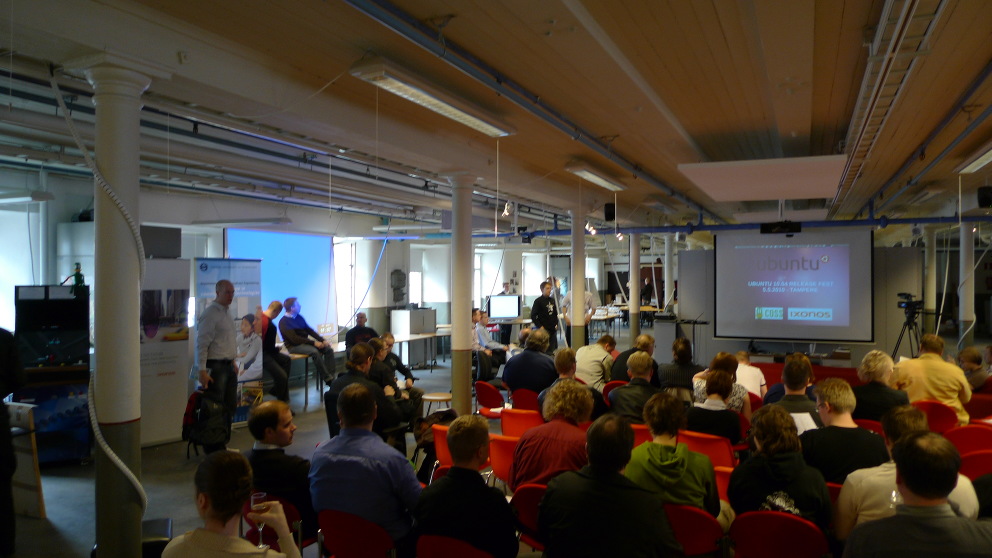
The main release party in Finland was held at Tampere, Finland and organized by Ixonos Plc and COSS. It was a great success, as proven by the almost 200 participants and great speakers.

The first sessions were mostly about the basics of Ubuntu and its roots in Debian and elsewhere. Then Tuure Vartiainen from Tampere University of Technology shared with us the release from the official Finnish mirror perspective (fi.archive.ubuntu.com, fi.releases.ubuntu.com, ...). 10.04 LTS release date was very hectic and the transfer speeds were not constantly optimal, but quite good anyway. For 10.10 they hope to up the network connectivity to 10G. I also took the opportunity to thank him later personally for the Ubuntu Finnish Remix mirroring which was arranged right before the release as well.

The next-to-final session was about Ubuntu for senior people with brief demoing of how Ubuntu UI can be customized. To give a little different perspective to usage of Ubuntu, the final speaker was a theater director and dramatist Jotaarkka Pennanen from Interactive Film Productions. Blender among else was praised.

In addition to speakers, we had 300 Ubuntu Finnish Remix CD:s, Ubuntu posters, Free Software Foundation Europe flyers, COSS flyers et cetera. After the main program there was a dinner and some wine offered to participants, which was a great social ending to the event.

Now a few photos follow. Unfortunately they are from before the event actually began, so others have probably more crowded photos and photos of the speakers themselves.


Timo Jyrinki: Ubuntu 10.04 and 3G modems usb-modeswitch or not?

I'm writing a blog entry instead of just replying to myself on a mailing list, since this subject might be interesting to a largish portion of the community. Most people assume things just magically work out by themselves and then after a release wonder why it wasn't so.

So, I raised a question on ubuntu-devel-discuss mailing list about whether usb-modeswitch should be included in the default Ubuntu 10.04 LTS installation instead of it only being in the universe repository. Reason was simply that firstly, I've read some general wonderings from the community about why it isn't already so. Secondly, without it my 3G modem (Huawei E1552) was first not functional, but right after installing usb-modeswitch package Network Manager worked smoothly with it.

Since I didn't get much discussion going on besides some statements that it doesn't work for everybody and even has caused extra problems for some others (in 9.10), I asked for a small round of comments on the subject on IRC. The channels are logged so I believe I can quote those a bit.

Colin Watson said among else:
"surely we just want the kernel to DTRT [do the right thing] by default ... this is the upstream trend ... it already DTRT for quite a few devices"
"I'd be very concerned about advertising that it's the Way to get things to work, and thus undermining getting things fixed in the kernel"
"I agree that usb-modeswitch is often a way to get otherwise non-working hardware to work ... I'm just not very convinced it's a real properly supportable option"
"but I'm just another user from this point of view, albeit one who ended up in quite a few discussions with various appropriate upstreams last time round :)"
Later on Paul Sladen continued a bit, among else:
"usb-modeswitch is a very long-winded way of sending a single usb-mass-storage command to the device's first profile"
"grep -hr MessageContent usb_modeswitch.d/ sort -n uniq -c sort -rn shows the level of duplication in the configuration files"
"...I do like that it is done in userspace though, as so easy to disable if you wanted something else".
Meanwhile I also IM:d a bit with Antti Kaijanm ki from whom I probably originally coined the idea of following whether usb-modeswitch is integrated into Ubuntu or not. He mainly said that he doubts the feasibility of updating kernel's USB storage quirks in a stable release, compared to having stable release upgrades about the usb-modeswitch-data udev rules. He also proposed discussing maintainability and usability by distros with the Debian maintainer and upstream, although it sounds like Colin might have had some talks already.

So there we are now. Apparently at this point it is hoped that as many quirks as possible are inserted in the kernel, see for example drivers/usb/storage/unusual_devs.h in the kernel. But if you have concerns about if 10.04 LTS will be kept up-to-date regarding 3G modems and want to somehow participate in bringing usb-modeswitch into Ubuntu default installation or simply discuss how to handle the kernel SRUs properly, it's time to stand up and do something.

Should there perhaps be a process with which the usb-modeswitch developers would get the information they are gathering more easily to the upstream kernel _and_ (older) distribution kernels? Is this simply a case of being easier to address an issue with a "hackish" approach, or is the usb-modeswitch actually the right way to go?

Note that I'm no expert in this area, I simply become interested in various subject from time to time :)

-Timo, going to figure out a kernel quirk for his 3G modem

16 June 2011

Rapha&#235;l Hertzog: Installing GNOME 3 on Debian 6.0 Squeeze? No, sorry

Ever since I blogged about the status of GNOME 3 in Debian experimental, my web logs show that many people are looking for ways to try out GNOME 3 with Debian Squeeze. No GNOME 3 for Debian 6.0 Don t hold your breath, it s highly unlikely that anyone of the Debian GNOME team will prepare backports of GNOME 3 for Debian 6.0 Squeeze. It s already difficult enough to do everything right in unstable with a solid upgrade path from the current versions in Squeeze But if you are brave enough to want to install GNOME 3 with Debian 6.0 on your machine then I would suggest that you re the kind of person who should run Debian testing instead (or even Debian unstable, it s not so horrible). That s what most people who like to run recent versions of software do. How to run Debian testing You re convinced and want to run Debian testing? It s really easy, just edit your /etc/apt/sources.list and replace stable with testing . A complete file could look like this:


# Main repository
deb http://ftp.debian.org/debian testing main contrib non-free
deb-src http://ftp.debian.org/debian testing main contrib non-free
# Security updates
deb http://security.debian.org/debian-security testing main contrib non-free
Now you should be able to run apt-get dist-upgrade and end up with a testing system. How to install GNOME 3 on Debian testing aka wheezy If you want to try GNOME 3 before it has landed in testing, you ll have to add unstable and experimental to your sources.list:
deb http://ftp.debian.org/debian unstable main contrib non-free
deb http://ftp.debian.org/debian experimental main contrib non-free
You should not install GNOME 3 from experimental if you re not ready to deal with some problems and glitches. Beware: once you upgraded to GNOME 3 it will be next to impossible to go back to GNOME 2.32 (you can try it, but it s not officially supported by Debian).
To avoid upgrading all your packages to unstable, you will tell APT to prefer testing with the APT::Default-Release directive:
# cat >/etc/apt/apt.conf.d/local <<END
APT::Default-Release "testing";
END
To allow APT to upgrade the GNOME packages to unstable/experimental, you will also install the following pinning file as /etc/apt/preferences.d/gnome:
Package: *gnome* libglib2.0* *vte* *pulse* *peas* libgtk* *gjs* *gconf* *gstreamer* alacarte *brasero* cheese ekiga empathy* gdm3 gcalctool baobab *gucharmap* gvfs* hamster-applet *nautilus* seahorse* sound-juicer *totem* remmina vino gksu xdg-user-dirs-gtk dmz-cursor-theme eog epiphany* evince* *evolution* file-roller gedit* metacity *mutter* yelp* rhythmbox* banshee* system-config-printer transmission-* tomboy network-manager* libnm-* update-notifier shotwell liferea *software-properties* libunique-3.0-0 libseed-gtk3-0 libnotify* libpanel-applet-4-0 libgdata11 libcamel* libcanberra* libchamplain* libebackend* libebook* libecal* libedata* libegroupwise* libevent* gir1.2-* libxklavier16 python-gmenu libgdict-1.0-6 libgdu-gtk0
Pin: release experimental
Pin-Priority: 990
Package: *gnome* libglib2.0* *vte* *pulse* *peas* libgtk* *gjs* *gconf* *gstreamer* alacarte *brasero* cheese ekiga empathy* gdm3 gcalctool baobab *gucharmap* gvfs* hamster-applet *nautilus* seahorse* sound-juicer *totem* remmina vino gksu xdg-user-dirs-gtk dmz-cursor-theme eog epiphany* evince* *evolution* file-roller gedit* metacity *mutter* yelp* rhythmbox* banshee* system-config-printer transmission-* tomboy network-manager* libnm-* update-notifier shotwell liferea *software-properties* libunique-3.0-0 libseed-gtk3-0 libnotify* libpanel-applet-4-0 libgdata11 libcamel* libcanberra* libchamplain* libebackend* libebook* libecal* libedata* libegroupwise* libevent* gir1.2-* libxklavier16 python-gmenu libgdict-1.0-6 libgdu-gtk0
Pin: release unstable
Pin-Priority: 990
Package: *
Pin: release experimental
Pin-Priority: 150
Note that I used Pin-Priority: 990 this time (while I used 500 in the article explaining how to install GNOME 3 on top of unstable), that s because you want these packages to have the same priority than those of testing, and they have a priority of 990 instead of 500 due to the APT::Default-Release setting. You re done, your next dist-upgrade should install GNOME 3. It will pull a bunch of packages from unstable too but that s expected since the packages required by GNOME 3 are spread between unstable and experimental.
If you want to read more articles like this one, click here to subscribe to my free newsletter. You can also follow me on Identi.ca, Twitter and Facebook.

13 comments Liked this article? Click here. My blog is Flattr-enabled.

15 June 2011

Sandro Tosi: Read multiple variables from stdin in a bash script

I procrastinated to look up this for such a long time.. today was enough. What I want to achieve is reading a line from stdin and split it among several variables, naively I'd do:

$ echo "A BB CCC" read a b c
$ echo $a $b $c


(no output.) As well explained here the above code doesn't work, but this one does:

$ read a b c < <(echo "A BB CCC")
$ echo $a $b $c
A BB CCC

as a hint, <(cmds) is called process substitution.

Christian Perrier: So, what happened with Kikithon?

I mentioned this briefly yesterday, but now I'll try to summarize the story of a great surprise and a big moment for me. All this started when my wife Elizabeth and my son Jean-Baptiste wanted to do something special for my 50th birthday. So, it indeed all started months ago, probably early March or something (I don't yet have all the details). Jean-Baptiste described this well on the web site, so I won't go again into details, but basically, this was about getting birthday wishes from my "free software family" in, as you might guess, as many languages as possible. Elizabeth brought the original idea and JB helped her by setting up the website and collecting e-mail addresses of people I usually work with: he grabbed addresses from PO files on Debian website, plus some in his own set of GPG signatures and here we go. And then he started poking dozens of you folks in order to get your wishes for this birthday. Gradually, contributions accumulated on the website, with many challenges for them: be sure to get as many people as possible, poking and re-poking all those FLOSS people who keep forgetting things... It seems that poking people is something that's probably in the Perrier's genes! And they were doing all this without me noticing. As usually in Debian, releasing on time is a no-no. So, it quickly turned out that having everything ready by April 2nd wouldn't be possible. So, their new goal was offering this to me on Pentecost Sunday, which was yesterday. And...here comes the gift. Aha, this looks like a photo album. Could it be a "50 years of Christian" album? But, EH, why is that pic of me, with the red Debconf5 tee-shirt (that features a world map) and a "bubulle" sign, in front of the book? But, EH EH EH, what the .... are doing these word by H0lger, then Fil, then Joey doing on the following pages? And only then, OMG, I discover the real gift they prepared. 106, often bilingual, wishes from 110 people (some were couples!). 18 postcards (one made of wood). 45 languages. One postcard with wishes from nearly every distro representatives at LinuxTag 2011. Dozens of photos from my friends all around the world. All this in a wonderful album. I can't tell what I said. Anyway, JB was shooting a video, so...we'll see. OK, I didn't cry...but it wasn't that far and emotion was really really intense. Guys, ladies, gentlemen, friends....it took me a while to realize what you contributed to. It took me the entire afternoon to realize the investment put by Elizabeth and JB (and JB's sisters support) into this. Yes, as many of you wrote, I have an awesome family and they really know how to share their love. I also have an awesome virtual family all around the world. Your words are wholeheartedly appreciated and some were indeed much much much appreciated. Of course, I'll have the book in Banja Luka so that you can see the result. I know (because JB and Elizabeth told me) that many of you were really awaiting to see how it would be received (yes, that includes you, in Germany, who I visited in early May!!!). Again, thank you so much for this incredible gift. Thank you Holger Levsen, Phil Hands, Joey Hess, Lior Kaplan, Martin Michlmayr, Alberto Gonzalez Iniesta, Kenshi "best friend" Muto, Praveen Arimbrathodiyil, Felipe Augusto van de Wiel, Ana Carolina Comandulli (5 postcards!), Stefano Zacchiroli (1st contribution received by JB, of course), Gunnar Wolf, Enriiiiiico Zini, Clytie Siddall, Frans Pop (by way of Clytie), Tenzin Dendup, Otavio Salvador, Neil McGovern, Konstantinos Margaritis, Luk Claes, Jonas Smedegaard, Pema Geyleg, Meike "sp tzle queen" Reichle, Alexander Reichle-Schmehl, Torsten Werner, "nette BSD" folks, CentOS Ralph and Brian, Fedora people, SUSE's Jan, Ubuntu's Lucia Tamara, Skolelinux' Paul, Rapha l Hertzog, Lars Wirzenius, Andrew McMillan (revenge in September!), Yasa Giridhar Appaji Nag (now I know my name in Telugu), Amaya Rodrigo, St phane Glondu, Martin Krafft, Jon "maddog" Hall (and God save the queen), Eddy Petri or, Daniel Nylander, Aiet Kolkhi, Andreas "die Katze geht in die K che, wunderbar" Tille, Paul "lets bend the elbow" Wise, Jordi "half-marathon in Banja Luka" Mallach, Steve "as ever-young as I am" Langasek, Obey Arthur Liu, YAMANE Hideki, Jaldhar H. Vyas, Vikram Vincent, Margarita "Bronx cross-country queen" Manterola, Patty Langasek, Aigars Mahinovs (finding a pic *with* you on it is tricky!), Thepittak Karoonboonyanan, Javier "nobody expects the Spanish inquisition" Fern ndez-Sanguino, Varun Hiremath, Moray Allan, David Moreno Garza, Ralf "marathon-man" Treinen, Arief S Fitrianto, Penny Leach, Adam D. Barrat, Wolfgang Martin Borgert, Christine "the mentee overtakes the mentor" Spang, Arjuna Rao Chevala, Gerfried "my best contradictor" Fuchs, Stefano Canepa, Samuel Thibault, Eloy "first samba maintainer" Par s, Josip Rodin, Daniel Kahn Gillmor, Steve McIntyre, Guntupalli Karunakar, Jano Gulja , Karolina Kali , Ben Hutchings, Matej Kova i , Khoem Sokhem, Lisandro "I have the longest name in this list" Dami n Nicanor P rez-Meyer, Amanpreet Singh Alam, H ctor Or n, Hans Nordhaugn, Ivan Mas r, Dr. Tirumurti Vasudevan, John "yes, Kansas is as flat as you can imagine" Goerzen, Jean-Baptiste "Piwet" Perrier, Elizabeth "I love you" Perrier, Peter Eisentraut, Jesus "enemy by nature" Climent, Peter Palfrader, Vasudev Kamath, Miroslav "Chicky" Ku e, Mart n Ferrari, Ollivier Robert, Jure uhalev, Yunqiang Su, Jonathan McDowell, Sampada Nakhare, Nayan Nakhare, Dirk "rendez-vous for Chicago marathon" Eddelbuettel, Elian Myftiu, Tim Retout, Giuseppe Sacco, Changwoo Ryu, Pedro Ribeoro, Miguel "oh no, not him again" Figueiredo, Ana Guerrero, Aur lien Jarno, Kumar Appaiah, Arangel Angov, Faidon Liambotis, Mehdi Dogguy, Andrew Lee, Russ Allbery, Bj rn Steensrud, Mathieu Parent, Davide Viti, Steinar H. Gunderson, Kurt Gramlich, Vanja Cvelbar, Adam Conrad, Armi Be irovi , Nattie Mayer-Hutchings, Joerg "dis shuld be REJECTed" Jaspert and Luca Capello. Let's say it gain:
14 June 2011

Tim Retout: HMRC data

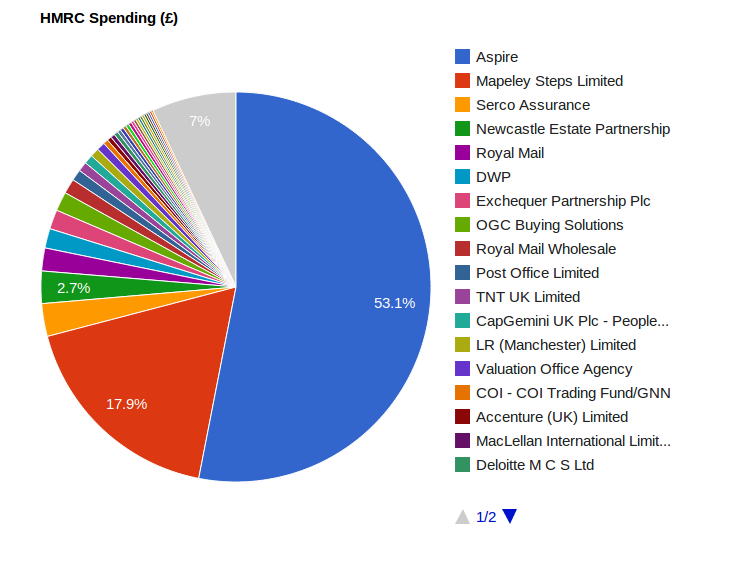
The UK government publishes lots of spending data now. Let's do cool stuff! HMRC spending pie chart ScraperWiki is one of these new-fangled cloud services, hosting code that scrapes websites. You can throw some python (or ruby, or php) together to download all the CSV files for a department. Google Refine is like a spreadsheet on crack, with features ideal for cleaning up messy data sets. I saw it for the first time at OpenTech 2011 a few weeks ago in London. You can take the government data, clean up the worst typos, and integrate it into the scraperwiki scraper. For bonus marks, throw in a bit of jQuery and Google Charts, and create a dynamically generated pie chart, or maybe a word cloud. There must be more imaginative ways to visualize this... email me if you have any ideas! They interviewed me last week - I must say, that's the first time that's happened, but I'm very flattered. None of the above would exist without the work done by @DataMinerUK et. al., so thank you, everyone.

Christian Perrier: 2011 week 23 Debian work

Quiet week, indeed. I spent part of the week-end of 4-5 June to re-setup my server at home after receiving the new box from my ISP (Free). This box can no longer be configured as an Ethernet bridge but only as a router. As a consequence, my home box no longer has my public IP on one of its Ethernet interfaces, which changes several details in the local configuration. The result is finally an hopefully safer setup, as the box now filters everything but port 22, 25, 80, 443, 993, 2317 (geneweb) while the server has similar filters in its iptables. Two firewalls instead of one. I did some bug cleaning on samba, again. The bug count should lower again in upcoming releases, but we probably reached a point where it can't go further down. Half of these are reported upstream. I should maybe check with them if they're considered fixed, pointless or just ignored as of now..:-) On Wednesday 8th, I released a samba 3.6.0rc2 package less than 12 hours after upstream published it. Yet another broken record..but it was easy as the package was completely straightforward. During the week, the French team worked on several DDTP translations now that the DDTSS is repaired (and apparently much more stable). I also sent an update for devscripts mannpages French translation. I will resume activity on l10n NMU. It's now time to think about it. Letting things pile up without nagging maintainers just leads to l10n stats slowly decreasing. We're aiming at 100% for debconf translation for 7 languages, so the wheezy freeze time will be difficult. Better start now. The most difficult part is having maintainers understand that, yes, we should care THAT early in the release process. The most complete language as of now (Russian) is already missing nearly 100 strings in about 12 packages (those that changed/introduced tempaltes recently). I have to prod these maintainers now.

13 June 2011

Jonathan Wiltshire: StartSSL: finally, a trustworthy certifier*

Matt Brown writes about StartCom, the Israeli issuer providing basic SSL certificates for nothing. In fact I ve been using StartSSL certificates for about three years now, but I get them issued to Level 2 verification which incurs a fee. (It s more expensive now than when I was first validated, but still good value.) StartCom are the only issuer I ve ever dealt with who work like this. They validate the individual, using: This makes me trust them far more than other issuers, who don t bother with any meaningful validation at all. Their approach is to establish identity, then allow you to: Although this doesn t make up for trust (the presence of an SSL certificate doesn t guarantee the data you send is safe upon arrival) it does make me much happier to see a CA taking proper verification measures instead of just handing out certificates at random and it s much cheaper for me too, being verified once and then issuing as many certificates as I need. Highly recommended. *that is, more trustworthy
Comments
StartSSL: finally, a trustworthy certifier* is a post from: jwiltshire.org.uk Flattr

Christian Perrier: So, what happened with Kikithon?

I mentioned this briefly yesterday, but now I'll try to summarize the story of a great surprise and a big moment for me. All this started when my wife Elizabeth and my son Jean-Baptiste wanted to do something special for my 50th birthday. So, it indeed all started months ago, probably early March or something (I don't yet have all the details). Jean-Baptiste described this well on the web site, so I won't go again into details, but basically, this was about getting birthday wishes from my "free software family" in, as you might guess, as many languages as possible. Elizabeth brought the original idea and JB helped her by setting up the website and collecting e-mail addresses of people I usually work with: he grabbed addresses from PO files on Debian website, plus some in his own set of GPG signatures and here we go. And then he started poking dozens of you folks in order to get your wishes for this birthday. Gradually, contributions accumulated on the website, with many challenges for them: be sure to get as many people as possible, poking and re-poking all those FLOSS people who keep forgetting things... It seems that poking people is something that's probably in the Perrier's genes! And they were doing all this without me noticing. As usually in Debian, releasing on time is a no-no. So, it quickly turned out that having everything ready by April 2nd wouldn't be possible. So, their new goal was offering this to me on Pentecost Sunday, which was yesterday. And...here comes the gift. Aha, this looks like a photo album. Could it be a "50 years of Christian" album? But, EH, why is that pic of me, with the red Debconf5 tee-shirt (that features a world map) and a "bubulle" sign, in front of the book? But, EH EH EH, what the .... are doing these word by H0lger, then Fil, then Joey doing on the following pages? And only then, OMG, I discover the real gift they prepared. 106, often bilingual, wishes from 110 people (some were couples!). 18 postcards (one made of wood). 45 languages. One postcard with wishes from nearly every distro representatives at LinuxTag 2011. Dozens of photos from my friends all around the world. All this in a wonderful album. I can't tell what I said. Anyway, JB was shooting a video, so...we'll see. OK, I didn't cry...but it wasn't that far and emotion was really really intense. Guys, ladies, gentlemen, friends....it took me a while to realize what you contributed to. It took me the entire afternoon to realize the investment put by Elizabeth and JB (and JB's sisters support) into this. Yes, as many of you wrote, I have an awesome family and they really know how to share their love. I also have an awesome virtual family all around the world. Your words are wholeheartedly appreciated and some were indeed much much much appreciated. Of course, I'll have the book in Banja Luka so that you can see the result. I know (because JB and Elizabeth told me) that many of you were really awaiting to see how it would be received (yes, that includes you, in Germany, who I visited in early May!!!). Again, thank you so much for this incredible gift. Thank you Holger Levsen, Phil Hands, Joey Hess, Lior Kaplan, Martin Michlmayr, Alberto Gonzalez Iniesta, Kenshi "best friend" Muto, Praveen Arimbrathodiyil, Felipe Augusto van de Wiel, Ana Carolina Comandulli (5 postcards!), Stefano Zacchiroli (1st contribution received by JB, of course), Gunnar Wolf, Enriiiiiico Zini, Clytie Siddall, Frans Pop (by way of Clytie), Tenzin Dendup, Otavio Salvador, Neil McGovern, Konstantinos Margaritis, Luk Claes, Jonas Smedegaard, Pema Geyleg, Meike "sp tzle queen" Reichle, Alexander Reichle-Schmehl, Torsten Werner, "nette BSD" folks, CentOS Ralph and Brian, Fedora people, SUSE's Jan, Ubuntu's Lucia Tamara, Skolelinux' Paul, Rapha l Hertzog, Lars Wirzenius, Andrew McMillan (revenge in September!), Yasa Giridhar Appaji Nag (now I know my name in Telugu), Amaya Rodrigo, St phane Glondu, Martin Krafft, Jon "maddog" Hall (and God save the queen), Eddy Petri or, Daniel Nylander, Aiet Kolkhi, Andreas "die Katze geht in die K che, wunderbar" Tille, Paul "lets bend the elbow" Wise, Jordi "half-marathon in Banja Luka" Mallach, Steve "as ever-young as I am" Langasek, Obey Arthur Liu, YAMANE Hideki, Jaldhar H. Vyas, Vikram Vincent, Margarita "Bronx cross-country queen" Manterola, Patty Langasek, Aigars Mahinovs (finding a pic *with* you on it is tricky!), Thepittak Karoonboonyanan, Javier "nobody expects the Spanish inquisition" Fern ndez-Sanguino, Varun Hiremath, Moray Allan, David Moreno Garza, Ralf "marathon-man" Treinen, Arief S Fitrianto, Penny Leach, Adam D. Barrat, Wolfgang Martin Borgert, Christine "the mentee overtakes the mentor" Spang, Arjuna Rao Chevala, Gerfried "my best contradictor" Fuchs, Stefano Canepa, Samuel Thibault, Eloy "first samba maintainer" Par s, Josip Rodin, Daniel Kahn Gillmor, Steve McIntyre, Guntupalli Karunakar, Jano Gulja , Karolina Kali , Ben Hutchings, Matej Kova i , Khoem Sokhem, Lisandro "I have the longest name in this list" Dami n Nicanor P rez-Meyer, Amanpreet Singh Alam, H ctor Or n, Hans Nordhaugn, Ivan Mas r, Dr. Tirumurti Vasudevan, John "yes, Kansas is as flat as you can imagine" Goerzen, Jean-Baptiste "Piwet" Perrier, Elizabeth "I love you" Perrier, Peter Eisentraut, Jesus "enemy by nature" Climent, Peter Palfrader, Vasudev Kamath, Miroslav "Chicky" Ku e, Mart n Ferrari, Ollivier Robert, Jure uhalev, Yunqiang Su, Jonathan McDowell, Sampada Nakhare, Nayan Nakhare, Dirk "rendez-vous for Chicago marathon" Eddelbuettel, Elian Myftiu, Tim Retout, Giuseppe Sacco, Changwoo Ryu, Pedro Ribeoro, Miguel "oh no, not him again" Figueiredo, Ana Guerrero, Aur lien Jarno, Kumar Appaiah, Arangel Angov, Faidon Liambotis, Mehdi Dogguy, Andrew Lee, Russ Allbery, Bj rn Steensrud, Mathieu Parent, Davide Viti, Steinar H. Gunderson, Kurt Gramlich, Vanja Cvelbar, Adam Conrad, Armi Be irovi , Nattie Mayer-Hutchings, Joerg "dis shuld be REJECTed" Jaspert and Luca Capello. Let's say it gain:

Maximilian Attems: Easy way to void() your Debian support

Craig Small gives a very bad advice on his recent post Debian Linux on HP DV6-6023TX. As soon as one loads such a binary graphics driver your Linux kernel is marked as tainted. Due to be running a proprietary module your box may behave strangely and is certainly not debuggable. Be aware that in such a case you are no longer running a free and open OS. What he actually wants is a very recent 3.0 linux image from experimental and to google for vga switcheroo, which leads to the following commit with explanations for /sys/kernel/debug/vgaswitcheroo/switch: vga_switcheroo: initial implementation (v15).

Ren&#233; Mayorga: I think I can said that I ll go to DebConf11

Well, I booked my plane tickets on March, but there was some $JOB related problems, since the company where I work is facing a merge(and I was pretty sure that I will finish being unemployed), so I was really sad that I ll have to drop my plans and loose some money, but so far everything looks ok, I m lucky and the government did not approve the merge and asked for more bureaucratic documents, this give us one year more, so I can finally say that I ll go to DebConf11 :) This year I m planning to came a bit early and stay at least two days on DebCamp, my work plan is to work on pkg-boinc s long TODO list, I m really happy since I missed DebConf10, long time without see some Debian friends faces :)

Joachim Breitner: 401 page family book published

Over the course of the last five years, some relatives of me and I have been working on a family book which lists all descendants of my grandgrandgrandgrandfather Isaak Riehm, born 1799, and his wife Charlotte. My task was everything related to maintaining the data, running the infrastructure and generating the final book. In the end, we have collected biographical details, often with the person s live story, of 703 descendants, 285 partners and 416 parents-in-law. Together with an extensive preface the book now has a respectable size of 401 pages, includes 144 pictures and maps and over 200 copies have been printed and sold through the family.

The book cover
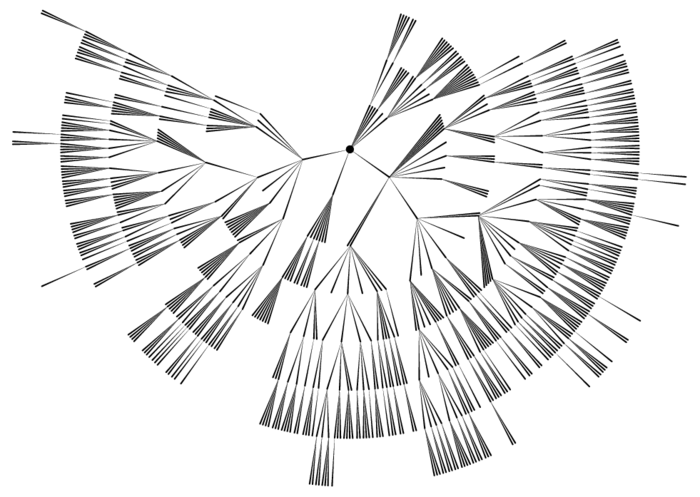
Although I do not think that the details of the lives of my family is very interesting for the general public, or even suitable for general release, I do want to show the fruit of our work. Therefore, I have created a stripped-down on-line version that only covers the first four generations. I bundled the book body with the cover and the end sheets into one complete PDF file (caution, large: 54MB, and of course in German). Some nifty embellishments of the book that I especially like are the abstract looking descendant fan in the front-end and back-end sheets, the separating bars between the persons which indicate the livespan of that person between 1799 and 2011 and the maps of the birth places and Isaak s travel destinations in the preface. Now to the technical details: Naturally, I used only Free Software in the genesis of the work (The cover is an exception, as it was not created by me). The most important is definitely gramps, a free genealogy system that held all our data. It is written in python and extensible with plug-ins, so I was able to create a custom report that takes the data relevant for us, filters for people who have agreed to appear in the book, and then generate LaTeX code that typesets the book, ready to be printed. I learned a great deal of LaTeX for this project, which uses over 30 different packages and required me to create a font of my own (which, as a side product, lead to a publication in the Linux-Magazin). For the maps I found the Generic Mapping Tools (GMT) and the freely available data for that of great use. I still had to manually collect the coordinates for all the places I wanted to show up in the map. Here, I relied mostly on Wikipedia. The fan which appears in the end sheets is laid out using a Haskell program (naturally, I have to use Haskell somewhere).
The front-end sheet
Of course, generating the book is only one side of the story; first, the data has to be collected and edited. For that, I wrote a plug-in to gramps that creates forms for each person. These forms contain the current known data and are used to correct and extend our knowledge. One variant of the form, created using LaTeX, was printed and mailed by snail-mail around the country and beyond, for those who are not reachable by mail. The other variant is an HTML form, hosted on a password-protected web site. Changes to that form cause the server to send an e-mail with a description of the changes (and only the changes, not the fields that are left untouched) to the mailing list of our team. There, the changes can be reviewed, e.g. for spelling and stylistic issues, and finally I copy n pasted them into gramps. These parts are implemented in python as well. Since genealogical data is never complete or up-to-date, I have set up a password-protected mediawiki based web site for the book where we collect corrections and additions to the data in the book. We have never anticipated that it would be so much work and that it would take us so long to finish this project, but we pulled it through and we are very happy with the result. Also, the reception has been very good and it was definitely a success. At this point I d like to express my gratitude to the hundreds of Free Software developers out there whose code we used and without whom it would not have been possible publish the book in the current form at all! Update: Due to some requests, I am making the code that I wrote available. You can download the tarball. Note that the code is a big mess and will not be usable right away. I guess if you can get the code to run and actually adjust to your needs, then you can as well write it yourself. Nevertheless it might be useful as inspiration or reference.

12 June 2011

Neil Williams: Ideas for TDeb packages

This is a follow-up on TDebs with some detail of how existing packages can be adapted to support TDebs.

$ cat debian/package-tdeb.tdeb

[gettextdir] po
[gettextname] package
[po4apodir] doc/po
[po4amandir] doc/package/man/
[po4acommand] po4a-build


What's happening then? Well, the first thing to take into account is that a lot of the values for these settings will be dictated by upstream, which is why it is necessary for maintainers to add this information as a support file in debian/. I tried determining all this information automatically but the script got far too long and still was far from complete.
Other changes
The (currently unsupported in Debian) XC-Package-Type: tdeb option is used in debian/control to mark a new or existing package as a TDeb. To use an existing package, it must comply with the rules for a TDeb including that it must be Architecture: all. The other rules centre around build issues. If any of the files in the existing package would require execution of any part of the normal build process of the package, these would have to be moved out of the package before that package could be a TDeb. The reason is that TDeb generation by translators needs to not require a full build environment for every individual package and must not risk modifying package contents in ways which are related to the build environment. So, unchanged images and other architecture-independent files are OK, any files which need build-dependencies are a problem. I don't know how many packages there are out there with such files. If you have a -data or -common package which contains translated data and that package also includes architecture-independent files, I'd be interested in knowing the name of the packages involved. If those packages also include files which are generated or modified within the package build, I'll be particularly interested in knowing about those source packages.
debconf
The most common use of TDebs during a release cycle is probably going to be debconf template updates by Christian and these are handled without needing a listing in the .tdeb file.
Other formats
I'm looking at QtLinguist support and it should be fairly straightforward using the .tdeb file arrangement.

Once that's done (in a branch, please - these can't be uploaded yet), the package can be tested with the soon-to-be-uploaded emdebian-tdeb package. The old content has been moved into the emdebian-grip-server package and the dependencies of the old version stripped back. The package contains two scripts dpkg-gentdeb and dh_gentdeb which I hope to get included into the respective packages in time for Wheezy. The idea will be that build systems (dh7, CDBS, debhelper-plain etc.) includes a call to the relevant script. (dh_ is just a wrapper around dpkg- in this case). This would allow maintainers to create the first TDeb, get that through NEW and then the fun starts. Once the translation mechanism is set up, I would like a nominated person (likely to be Christian if he agrees) to co-ordinate translation updates for particular packages to allow for a single upload including updates for many translations. This would be package_version+t1_all.tdeb and an appropriate .diff.gz or debian.tar.gz. No binary upload, no impact on testing migrations.

This is mostly theory right now but the scripts do exist in Emdebian SVN.

Still more testing to do but I hope to upload these scripts to unstable in the next few days.

Steve McIntyre: How to not embarrass yourself with missing attachments in mutt

I keep on seeing people sending messages saying "see attached file" or similar in their emails, but then forgetting to actually attach the file. I used to do it myself lots, but then with the help of some ideas I found on the net I wrote the following script to use with mutt. To use it, use the setting "set sendmail=" to point at it.
#!/bin/bash
#
# mutt-sendmail
# helper script to reduce embarrassment with mutt :-)
#
# Copyright 2011 Steve McIntyre <steve>
# GPL v2
###
# save msg in file to re-use it for multiple tests
###
TMPFILE= mktemp -p ~/tmp -t mutt.XXXXXX    exit 2
cat > $TMPFILE
## Attachment keywords that the message body will be searched for:
KEYWORDS='attach patch'
## Define test for multipart message.
function multipart  
    grep -q '^Content-Type: multipart' "$TMPFILE"
 
## Define test for keyword search.
function word-attach  
    grep -v '^>' "$TMPFILE"   grep -v "^X-attached:"   grep -E -i -q "$KEYWORDS"
 
## Header override.
function header-override  
    grep -i -E "^X-attached: *none *$" "$TMPFILE"
 
###
# FINAL DECISION:
# chain series of functions, use !   && for logic connections,
###
if multipart   ! word-attach   header-override; then
    formail -I bcc < $TMPFILE   /usr/lib/sendmail -oi -oem "$@"
    status=$?
else
    echo "No file was attached but a search of the message text suggests there"
    echo "should be one.  Add a header \"X-attached: none\" to override this"
    echo "check if no attachment is intended."
    status=1
fi
rm -f $TMPFILE
exit $status

Christian Perrier: Developers per country (June 2011) - 3rd take

See comments at the end about this 3rd version This is time again for yet another bubulle game: counting the number of developers per country. I already published such analysis in 2010 and 2009. So, here we are with the June 2011 version, sorted by the ratio of *active* developers per million population for each country.
Act: number of active developers
Dev: total number of developers
A/M: number of active devels per million pop.
D/M: number of devels per million pop.
2009: rank in 2009
2010: rank in 2010
June 2011: rank now
Code Name Population Act Dev Dev Act/Million Dev/Million 2009 2010 June 2011
fi Finland 5374781 21 31 3,91 5,77 1 1 1
ch Switzerland 7866500 21 26 2,67 3,31 2 2 2
mq Martinique 397730 1 1 2,51 2,51

3
no Norway 4964500 12 15 2,42 3,02 5 4 4
nz New Zealand 4393500 10 15 2,28 3,41 4 3 5
ie Ireland 4470700 10 13 2,24 2,91 13 9 6
se Sweden 9354462 19 35 2,03 3,74 3 6 7
lu Luxemburg 511840 1 1 1,95 1,95 8 5 8
de Germany 81802000 155 221 1,89 2,7 7 7 9
at Austria 8404252 15 25 1,78 2,97 6 8 10
fr France 63136180 91 119 1,44 1,88 12 12 11
au Australia 22632213 31 57 1,37 2,52 9 10 12
be Belgium 11007020 15 17 1,36 1,54 10 11 13
uk United-Kingdom 62008048 67 106 1,08 1,71 14 14 14
nl Netherlands 16674600 18 37 1,08 2,22 11 13 15
dk Denmark 5564219 6 10 1,08 1,8 17 17 16
ca Canada 34480000 27 57 0,78 1,65 15 15 17
hr Croatia 4429078 3 3 0,68 0,68 20 18 18
es Spain 46030109 31 51 0,67 1,11 16 16 19
lt Lithuania 3225346 2 2 0,62 0,62 28 19 20
cz Czech Rep 10540748 6 6 0,57 0,57 21 20 21
it Italy 60605053 33 47 0,54 0,78 23 22 22
bg Bulgaria 7351254 4 4 0,54 0,54 25 23 23
il Israel 7602400 4 6 0,53 0,79 24 24 24
us USA 308745538 162 364 0,52 1,18 19 21 25
hu Hungary 9979000 5 11 0,5 1,1 18 25 26
lv Latvia 2245357 1 1 0,45 0,45 26 26 27
uy Uruguay 3494382 1 2 0,29 0,57 22 27 28
jp Japan 127960000 33 46 0,26 0,36 30 28 29
pl Poland 38186860 9 13 0,24 0,34 29 29 30
cr Costa Rica 4253897 1 1 0,24 0,24 31 30 31
pt Portugal 10647763 2 4 0,19 0,38 27 32 32
sk Slovakia 5429763 1 1 0,18 0,18 32 31 33
gr Greece 11305118 2 3 0,18 0,27 33 38 34
ar Argentina 40091359 7 9 0,17 0,22 34 33 35
sv El Salvador 6134000 1 1 0,16 0,16

36
tw Taiwan 23061689 3 3 0,13 0,13 37 34 37
br Brazil 190732694 20 21 0,1 0,11 36 35 38
by Belarus 9648533 1 1 0,1 0,1 35 36 39
mg Madagascar 20653556 2 2 0,1 0,1 44 37 40
cu Cuba 11239363 1 1 0,09 0,09
38 41
kr South Korea 48758000 4 6 0,08 0,12 39 39 42
ec Ecuador 14790608 1 1 0,07 0,07
40 43
cl Chile 17224200 1 2 0,06 0,12 42 41 44
ro Romania 21466174 1 2 0,05 0,09 45 43 45
co Colombia 45925397 2 3 0,04 0,07 41 44 46
ru Russia 142905200 6 7 0,04 0,05 43 42 47
za South Africa 49991300 2 9 0,04 0,18 38 48 48
my Malaysia 27565821 1 1 0,04 0,04

49
ve Venezuela 29105632 1 1 0,03 0,03 40 45 50
pe Peru 29496000 1 1 0,03 0,03 46 46 51
tr Turkey 73722988 2 2 0,03 0,03 47 47 52
mx Mexico 112322757 2 2 0,02 0,02 49 49 53
th Thailand 63878267 1 2 0,02 0,03 50 50 54
eg Egypt 80085862 1 3 0,01 0,04 51 51 55
in India 1210193422 8 8 0,01 0,01 52 52 56
cn China 1339724852 7 11 0,01 0,01 53 53 57
ua Ukraine 45888000 0 0 0 0 48 53 58


896 1450 61,79%


A few interesting facts: v2 comment: This is the second version of this blog post. I have been pointed that the population I was using for "Ireland" is indeed the population of the entire island, so Republic of Ireland (Eire) plus Northern Ireland (Ulster). We may guess that people listing "IE" as their country are citizens of the Republic of Ireland, so the population to use is that of this part of the island. As a consequence, Ireland is bumped up to 6th rank instead of 9th. v3 comment: Doh. Since I'm doing this survey, I was always adding people using "sv" as country to Sweden. This is a quite common mistake and it was happening in the past. But now, there is only ONE developer who uses "sv" as country, this is Rene Mayorga and he definitely lives in El Salvador, not Sweden. As a consequence, Sweden lost one developer (but keeps its rank) and El Salvador now appears at rank 36. It is not a "new" country as Rene is DD for quite some time.

11 June 2011

Dirk Eddelbuettel: United Sounds of America: New York

Last night was the kick-off concert in a series the Chicago Symphony has been preparing (and pushing) for the last little while: United Sounds of America: A Journey through Musical Roots. Five concerts featuring New York (last night), Chicago/Route 66 (tonight), New Orleans (tomorrow), Detroit (next Friday) and Austin (next Saturday). The New York evening was organized by pianist Bill Charlap (wikipedia) who also headlined and MC-ed the first set. Covering the birth of Jazz until early post-war bebop in chronological fashion, it was a pretty decent jazz set with a very nice band featuring Kenny Washington (dr), Peter Washington (b), Jeremy Pelt (tp), Jimmy Greene (ts) and Ken Peplowski (cl) --- and local favourite Kurt Elling (wikipedia) who was simply outstanding with the classic songbook material. Having seen him live once before a few years ago, I happened to listen a lot to Elling of late, following the random find of this stream from a live concert in February as well as his two most recent records, the Grammy-winning Dedicated to You (which retakes the wonderful Coltrane/Hartman album from 1963) and the simply amazing very recent The Gate (which you should go and buy right now). And I was not disappointed. He has a great four-octave-spanning baritone voice and great stage presence. The second set was dedicated to post-war folk and singer/songwriter material and organized by Suzanne Vega. That was neat too, if somewhat different in format and more like your standard (rock-ish) concert. Vega brought her own band featuring Gerry Leonard (g), Mike Visceglia (b), Graham Hawthorne (dr) along with guest appearances by Tom Paxton (g, vocals) and Richard Julian (g, vocals). Somehow Vega seems a little trapped in her own success in the 1980s and rehashed a lot of old hits. Nothing wrong that per se as it is good material (more on that below). Only during three encores did she provide new material which was ... excellent. So maybe some rebalancing towards new stuff was neat. Also nice was the additiona of four string players from the Chicago Symphony which had joined the band for a Simon and Garfunkel's song The Boxer. Oh, and of course seeing Vega perform Tom's Diner was nice, especially in such a fast and rocking version, even enhanced by the those strings. Just a few months ago I had gone over the passage from the original a-capella version of Tom's Diner to the various beat-box remixes which were then remixed by Vega in various live performances (e.g. videos of a capella, rockish, another rockish and beatboxish versions). Good fun, and it is nice to see she is playing along and enjoying it as well. All told, a really nice iniative by the CSO. If you're in Chicagoland, go and see some of the remaining shows.

Next.

Previous.