Search Results: "gt"

13 March 2016

Amaya Rodrigo:


, , , , , .

, , , , , , , , , , , , , , , , , , .
, .
, , , .
, , - . , , . . , , , , , .
, . , , . , , , , .
:

. , , .
, , , . , , , , , , .
, , , .
</div></p>

Amaya Rodrigo:


. , , . - . .

, , , , , , , , , , , , .


. . . ( ), . .
.
- .
- .
. - .37/39.
. - . .6
18.01.2016
! 18.01.2016
09.10.2015

13.01.2015

11.03.2016
, , , , ?
11.03.2016
. " / . . - 1.6
11.03.2016
. 8 . . . . .
</div></p>

Amaya Rodrigo:


. , , . - . .

, , , , , , , , , , , , .


. . . ( ), . .
.
- .
- .
. - .37/39.
. - . .6
18.01.2016
! 18.01.2016
09.10.2015

13.01.2015

11.03.2016
, , , , ?
11.03.2016
. " / . . - 1.6
11.03.2016
. 8 . . . . .
</div></p>

Andreas Metzler: How to put on one's hardboots, when ligaments are damaged

I have finally managed to do (a little bit of) snowboarding again this weekend. Previously I had failed early, when trying to pull on my hard-boots. I had (partially) torn some ligament in the ankle joint in February and am generally fine now, but exactly this movement still caused pain. What worked was to
  1. take the liner out of the boot,
  2. pull on the liner,
  3. step into the outer shell.

Antoine Beaupr : State of Mapping on the Debian Desktop

TL;DR: Mapbox Studio classic is not as good as Tilemill, Mapbox studio is very promising, but you still need to signup for access, and kosmtik seems to be working right now. Use kosmtik and help getting it in Debian.

The requirement I have been following the development of fascinating tools from the Development seed people, now seemingly all focused on the Mapbox brand. They created what seemed to me a revolutionary desktop tool called Tilemill. Tilemill allowed you to create custom map stylesheets on your desktop to outline specific areas or patterns or "things". My interest was to create outdoor maps - OSM has pretty good biking maps, but no generic outdoor tiles out there (I need stuff for skiing, canoeing, biking)... Mapbox has Mapbox outdoors but that's a paid plan as well. Oh and there's a place to download Garmin data files especially made for outdoors as well, and that could be loaded in Qmapshack, but they don't have coverage in Canada at all. Besides, I would like to print maps, I know, crazy... So I have been looking forward to seeing Tilemill packaged in Debian given how annoying it is to maintain Node apps (period). Unfortunately, by the time Debian people figured out all the Node dependencies, the Tilemill project stopped and has been stalled since 2012. It seems the Mapbox people have now been working on other products, and in the meantime, the community, scratching their heads, just switched to other projects.

Overview of alternatives I wrote this long post to the Debian bugtrackers to try to untangle all of this, but figured this would be interesting to a wider community than the narrow group of people working on Javascript packages, so I figured I would send this on Debian planet. So Here's a summary of what happened so far, after Tilemill development stopped. Hang on to your tiles boys and girls, there's a lot going on!

Mapbox Studio classic Mapbox people have released a new product in September 2014 named Mapbox studio classic. The code is still freely available and seems to be a fork of tilemill. Mapbox classic still has releases on github, last one is from November 2015. It looks like Mapbox studio classic has some sort of Mapbox.com lock-in, and there are certainly new copyright issues, if only with the bundled fonts, but it could probably be packaged after addressing those issues. There is an ITP for Mapbox Studio classic as well.

Mapbox Studio Then there's Mapbox Studio, which is a full rewrite of Mapbox Studio classic. You need to "signup" somehow to get access, even though parts of the code are free, namely the Mapbox GL studio project. It is an interesting project because it aims to make all this stuff happen in a web browser, which means it "should" work everywhere. Unfortunately for us, it means it doesn't work anywhere without a signup form, so that's out for me at least. There is an [ITP for Mapbox-studio][] yet it is unclear to me what that one means because the source code to Mapbox-studio doesn't seem to be available, as far as i can tell (and the ITP doesn't say either). That is actually the ITP for Mapbox studio classic.

Kosmtik The Openstreetmap-carto developers have mostly switched to kosmtik instead of Mapbox. Kosmtik is another Node desktop app that seems fairly lightweight and mostly based on plugins. Ross has an ITP for kosmtik. The package is waiting on other node dependencies to be uploaded (yes, again).

The future of Tilemill And there's still this RFP for tilemill, which should probably be closed now because the project seems dead and plenty of alternatives exist. I wonder if node some dependencies that were packaged for Tilemill actually now need to be removed from Debian, because they have become useless leaf packages... I am leaving the Tilemill RFP open for someone to clean that up.

CartoCSS Oh, and finally one could mention another Mapbox project, Carto, a command line CSS tools that implements some sort of standard CSS language that all those tools end up using to talk to Mapnik, more or less. There are no RFPs for that.

Bits from Debian: Debian selected to participate in the Google Summer of Code

GSoC 2016 logo For the tenth time running, Debian has been selected as a mentoring organization for the Google Summer of Code (Debian-specific program page), an internship program open to university students aged 18 and up. Our team of amazing mentors has cooked up an exciting list of projects this year, and we would be glad to have you on board with Debian for one of those summer internships. The student application period will open on March 14 (and close on March 25), but feel free to subscribe to our mailing list and get in touch with our mentors. You can also catch us on our IRC channel #debian-soc.

Ingo Juergensmann: Letsencrypt: challenging challenges solved

A few weeks ago I was wondering in Letsencrypt: challenging challenges about how to setup Letsencrypt when a domain is spread across several virtual machines (VM). One of the possible solutions would be to consolidate everything on one single VM, which is nothing I would like to do. The second option would need to generate the Letsencrypt certs on the webserver and copy over the certs to the appropriate VM on a regular basis or event driven. The third option is to use a network share - and this is what I'm using right now. So, my setup is as following after I solved the GlusterFS issue with rpcbind binding to all interfaces, although it has been configured to only listen to certain interfaces (solution was: simply remove all NFS related stuff): On Dom0 (or the host machine) I run GlusterFS as a server on a small 1 GB LVM as part of a replicate with the VM that will do the actual Letsencrypt work:
Volume Name: le
Type: Replicate
Status: Started
Number of Bricks: 1 x 2 = 2
Transport-type: tcp
Bricks:
Brick1: 192.168.x.254:/srv/gfs/le
Brick2: 192.168.x.1:/srv/gfs/le
This is to ensure that on reboot of the machine every other VM using Letsencrypt certs can mount the GlusterFS share, because the host machine will be there for sure whereas the other VM generating the certs with the letsencrypt.sh script might still be booting. And when the GlusterFS share is missing services will not start on the other VMs because of the missing certs, of course. So, the replica on the virtualization host (Dom0) is only acting as some kind of always-being-available network share, because, well, the other VM will not always be there... for example during a kernel update when a reboot is required. The same setup is on my mailserver, acting as the second GlusterFS brick of that replica drive. The mailserver hosts the bind9 nameserver as well and I might do something that new domains with Letsencrypt certs get added to my DNSSEC setup as well. Of course, when the letsencrypt.sh script creates or updates the certs, it needs the certs being mounted in that configured location, so I needed to add a line to /etc/fstab:
192.168.x.254:/le /etc/letsencrypt.sh/certs glusterfs noexec,nodev,_netdev 0 0
Basically the same needs to be done on the other VMs where you want to use the certs as well, but you may want to mount the share as read-only there. The next step was a little more tricky. When letsencrypt.sh generates new certs, Letsencrypt will contact the webserver for that domain to respond to the ACME challenge. This requires that on each VM you want to use letsencrypt you have to run a webserver. Well, actually at least that there is somewhere a webserver that can answer these requests for that specific domain... Now, the setup of the webserver (Apache in my case) is like this: I'm using the Apache macro module to make it more easy, so I generated two small configs in /etc/apache/conf-available and enabled them bei a2enconf: letsencrypt-proxy.conf to do some setup for proxying the ACME challenges to a common website called acme.example.org. And then letsencrypt-sslredir.conf to setup SSL redirection when everything is in place and the domain can be switched over to HTTPS-only. letsencrypt-proxy.conf:
<Macro le_proxy>
ProxyRequests Off
<Proxy *>
Order deny,allow
Allow from all
</Proxy>
ProxyPass /.well-known/acme-challenge/ http://acme.windfluechter.net/
ProxyPassReverse / http://% HTTP_HOST /.well-known/acme-challenge/
</Macro>
letsencrypt-sslredir.conf:
<Macro le_sslredir>
RewriteEngine on
RewriteCond % HTTPS !=on
RewriteRule . https://% HTTP_HOST % REQUEST_URI [L]
</Macro>
So, after all the setup of a virtual host for Apache looks like this:
<Macro example.org>
(lots of setup stuff)
</Macro>
<VirtualHost 31.172.31.x:443 [2a01:a700:4629:x::1]:443>
Header always set Strict-Transport-Security "max-age=31556926; includeSubDomains"
SSLEngine on
# letsencrypt certs:
SSLCertificateFile /etc/letsencrypt.sh/certs/example.org/fullchain.pem
SSLCertificateKeyFile /etc/letsencrypt.sh/certs/example.org/privkey.pem
SSLHonorCipherOrder On
Use example.org
Use le_proxy
</VirtualHost>
<VirtualHost 31.172.31.x:80 [2a01:a700:4629:x::1]:80>
Use example.org
Use le_proxy
Use le_sslredir
</VirtualHost>
le_sslredir is only needed when you are sure that you want all traffic being redirected to HTTPS. For example when your blog is listed on planet.debian.org or other Planets you might want to omit this from your HTTP config because bug #813313 is not yet solved. In the end, when creating a new Letsencrypt cert, you need to add the le_proxy macro to your website, add the domain to letsencrypt.sh config in /etc/letsencrypt.sh/domains.txt and then the scripts will request a new cert from Letsencrypt, handling the ACME challenge stuff via the URL redirection in le_proxy being redirected to your acme.exmaple.org site and finally writes your new cert to the GlusterFS share. From that share you can then use the new cert on all needed VMs, be it your mailserver, webserver or XMPP/SIP server VMs. At least this works for me.
Kategorie:

12 March 2016

Daniel Pocock: Google Summer of Code opportunities for ham radio and SDR

I've started preparing some ideas for Google Summer of Code projects I'd be willing to help mentor this year and one of them is for ham radio, with a focus on software defined radio (SDR). Can you help? If you can help as a co-mentor or simply help refer students for this project please get in touch with me. Ander the terms of the program students are paid a $US 5,500 stipend by Google and source code is fully published under a genuine free software license . Details about the project and how students can apply Students applying for this project are invited to submit two applications, one under the GNU Radio project and another under the Debian Project. The aim of this project is to make ready-to-run solutions for ham radio enthusiasts. The typical use case is a ham who has a spare computer in his shack, he should be able to boot the computer from DVD or USB stick using the Debian Ham Radio Live Blend or the GNU Radio Live SDR and have a functional transceiver within a few minutes. A student may not be able to do everything required for this project in one summer. We are looking for a student who can make any incremental improvement to bring us closer to this goal. Here are some of the tasks that may be involved:
  • survey the existing GNU Radio samples for ham radio, many are listed on the HamRadio page of the GNU Radio wiki.
  • design user interface improvements for the samples to make them more intuitive to new users and traditional radio operators. Consider how they can interact with Hardware such as a VFO tuning knob, PTT microphone switch and even a morse key.
  • look through the other packages in the Debian Ham Radio metapackage list and consider how they could interact with GNU Radio. In particular, we are interested in the use of message bus solutions, such as ZeroMQ or D-Bus - for example, GNU Radio could send alerts on the bus when incoming signals exceed the squelch threshold. GNU Radio could also receive events over a message bus, for example, patching GPredict to send Doppler shift information.
  • developing and packaging libraries needed to process digital voice transmissions
  • look at how one or more of the samples can be deployed as a Debian package so users can just install the package and have a working radio
Prerequisites The following experience is highly desirable:
  • ham radio license
  • GNU/Linux skills (Debian or Ubuntu or another distribution like Fedora)
  • use of version control systems (Git)
  • C++ or Python or both
Mentor(s)
  • Daniel Pocock (VK3TQR/M0GLR/HB9FZT)
Application process To apply
  • please introduce yourself on both the GNU Radio mailing list and the Debian Hams mailing list
  • Fill in the formal application for both GNU Radio and Debian
  • Pick some items from the list above or feel free to suggest another piece of work relevant to this theme. Give us a detailed, week-by-week plan for completing the task over the summer.
  • find at least one other member of the GNU Radio or Debian community who is willing to be a co-mentor on the project. Please try communicating with us over IRC or email and give us examples of your existing work on Github or elsewhere.

Bits from Debian: Debian is looking for three interns in the Outreachy Program

Outreachy logo As part of its diversity outreach initiatives, Debian will be participating in the upcoming 12th round (May - August 2016) of Outreachy, an internship program open worldwide to women (cis and trans), trans men and genderqueer people, as well as nationals and residents of the United States of any gender who are Black/African American, Hispanic/Latin@, American Indian, Alaska Native, Native Hawaiian, or Pacific Islander. Thanks to the generosity of our donors, and specifically of our sponsor Intel who has given us funds specifically for one intern, Debian will be able to welcome three interns this round. Applications for the program are open until March 22nd, so don't wait up! Debian has a lot of interesting internship opportunities this year. More info about the program is available on the Debian specific program page, as well as on the official website. Feel free to contact the outreach team and mentors on our mailing list or IRC channel #debian-soc in irc.oftc.net If you want Debian to keep participating in such programs, and expand its outreach efforts, you can donate to one of the organizations supporting the Debian project, or volunteer some time by participating in discussions on our mailing list.

Simon Richter: 8192!

So, finally I've also joined the club. 2048 board with 8192 tile

Lars Wirzenius: Not-platform for Debian project leader elections 2016

After some serious thinking, I've decided not to nominate myself in the Debian project leader elections for 2016. While I was doing that, I wrote the beginnings of a platform, below. I'm publishing it to have a record of what I was thinking, in case I change my mind in the future, and perhaps it can inspire other other people to do something I would like to happen. Why not run? I don't think I want to deal with the stress. I already have more than enough stress in my life, from work. I enjoy my obscurity in Debian. It allows me to go away for long periods of time, and to ignore any discussions, topics, and people that annoy or frustrate me, if I don't happen to want to tackle them at any one time. I couldn't do that if I was DPL. NOT a platform for Debian project leader election, 2016 Apart from what the Debian constitution formally specifies, I find that the important duties of the Debian project leader are: I do not feel it is the job of the DPL to set goals for the project, technical or otherwise, any more than any other member of the project. Such goals tend to best come from enthusiastic individual developer who want something and are willing to work on it. The DPL should enable such developers, and make sure they have what they need to do the work. My plan, if elected
  1. Keep Debian running. Debian can run for a long time effectively on autopilot, even if the DPL vanishes, but not indefinitely. At minimum, the DPL should delegate the secretary and technical committee members, and decide on how money should be spent. I will make sure this minimum level is achieved.
  2. While I have no technical goals to set for the project, I have an organisational one. I believe it is time for the project to form a social committee whose mandate is to step in and help resolve conflicts in their early stages, before they grow big enough that the DPL, the tech-ctte, listmasters, or the DAM needs to involved. See below for more details on this. If I am elected, I will do my best to get a social committee started, and I will assume that any vote for me is also a vote for a social committee.
Social committee (Note: It's been suggested that this is a silly name, but I haven't had time to come up with anything better. I already rejected "nanny patrol".) We are a big project now. Despite our reputation, we are a remarkably calm project, but there are still occasional conflicts, and some of them spill out into our big mailing lists. We are not very good, as a project, in handling such situations. It is not a new idea, but I think its time has come, and I propose that we form a new committee, a social committee, whose job is to help de-escalate conflict situations while they are still small conflicts, to avoid them growing into big problems, and to help resolve big conflicts if they still happen. This is something the DPL has always been doing. People write to the DPL to ask for mediation, or other help, when they can't resolve a situation by themselves. We also have the technical committee, listmasters, GRs, and the expulsion process defined by the DAM. These are mostly heavy-weight tools and by the time it's time to consider their use, it's already too late to find a good solution. Having the DPL do this alone puts too much pressure on one person. We've learnt that important tasks should generally be handled by teams rather than just one person. Thus, I would like us to have a social committee that: About me I've been a Debian developer since 1996. I've been retired twice, while I spent large amounts of time on other things. I haven't been a member of any important team in Debian, but I've been around long enough that I know many people, and have a reasonable understanding of how the projects works.

11 March 2016

Steinar H. Gunderson: Agon and the Candidates tournament

The situation where Agon (the designated organizer of the Chess World Championship, and also the Candidates tournament, the prequalifier to said WC) is trying to claim exclusive rights of the broadcasting of the moves (not just the video) is turning bizarre. First of all, they have readily acknowledged they have no basis in copyright to do so; chess moves, once played, are facts and cannot be limited. They try to jump through some hoops with a New York-specific doctrine (even though the Candidates, unlike the World Championship, is played in Moscow) about hot news , but their main weapon seems to be that they simply will throw out anyone from the hall who tries to report on the moves, and then try to give them only to those that promise not to give them on. This leads to the previously unheard-of situation where you need to register and accept their terms just to get to watch the games in your browser. You have to wonder what they will be doing about the World Championship, which is broadcast unencrypted on Norwegian television (previous editions also with no geoblock). Needless to say, this wasn't practically possible to hold together. All the big sites (like Chessdom, ChessBomb and Chess24) had coverage as if nothing had happened. Move sourcing is a bit of a murky business where nobody really wants to say where they get the moves from (although it's pretty clear that for many tournaments, the tournament organizers will simply come to one or more of the big players with an URL they can poll at will, containing the games in the standard PGN format), and this was no exception ChessBomb went to the unusual move of asking their viewers to download Tor and crowdsource the moves, while Chessdom and Chess24 appeared to do no such thing. In fact, unlike Chessdom and ChessBomb, Chess24 didn't seem to say a thing about the controversy, possibly because they now found themselves on the other side of the fence from Norway Chess 2015, where they themselves had exclusive rights to the PGN in a similar controversy although it would seem from a tweet that they were perfectly okay with people just re-broadcasting from their site if they paid for a (quite expensive) premium membership, and didn't come up with any similar legal acrobatics to try to scare other sites. However, their ToS were less clear on the issue, and they didn't respond to requests for clarification at the time, so I guess all of this just continues to be on some sort of gentleman's agreement among the bigger players. (ChessBomb also provides PGNs for premium members for the tournaments they serve, but they expressly prohibit rebroadcast. They claim that for the tournaments they host, which is a small minority, they provide free PGNs for all.) Agon, predictably, sent out angry letters where they threatened to sue the sites in question, although it's not clear at all to me what exactly they would sue for. Nobody seemed to care, except one entity TWIC, which normally has live PGNs from most tournaments, announced they would not be broadcasting from the Candidats tournament. This isn't that unexpected, as TWIC (which is pretty much a one-man project anyway) mainly is about archival, where they publish weekly dumps of all top-level games played that week. This didn't affect a lot of sites, though, as TWIC's live PGNs are often not what you'd want to base a top-caliber site on (they usually lack clock information, and moves are often delayed by half a minute or so). I run a hobby chess relay/analysis site myself (mainly focusing on the games of Magnus Carlsen), though, so I've used TWIC a fair bit in the past, and if I were to cover the Candidates tournament (I don't plan to do so, given Agon's behavior, although I plan to cover the World Championship itself), I might have been hit by this. So, that was the background. The strange part started when worldchess.com, Agon's broadcasting site, promptly went down during the first round of the Candidates tournament today Agon blamed DDoS, which I'm sure is true, but it's unclear exactly how strong the DDoS was, and if they did anything at all to deal with it other than to simply wait it out. But this lead to the crazy situation where the self-declared monopolist was the only big player not broadcasting the tournament in some form. And now, in the trully bizarre move, World Chess is publishing a detailed rebuttal of Agon's arguments, explaining how it is bad for chess, not juridically sound, and also morally wrong. Yes, you read that right; Agon's broadcast site is carrying an op-ed saying Agon is wrong. You at least have to give them credit for not trying to censor their columinst when he says something they don't agree with. Oh, and if you want those PGNs? I will, at least for the time being, be pushing them out live on http://pgn.sesse.net/. I have not gone into any agreement with Agon, and they're hosted in Norway, far from any New York-specific doctrines. So feel free to relay from them, although I would of course be happy to know if you do.

Alessio Treglia: We need creativity: which one?

A constant demand for creativity is raising from every corner of the Western world, from any business sector or professional activity, by individual or communities. This term is used everywhere, even in advertising to attract the attention of consumers: as a thirsty wanderer lost in the desert sand, the need for creativity seems to be the source of an oasis of salvation. albaJulien Ries anthropological research showed us that, already more than two million years ago, Homo Habilis looks like Symbolicus, with aesthetic sensibility, sense of symmetry and consciousness of creativity. Gilbert Durand confirms that the specific activity of man, the identity card of Homo Sapiens, is the symbolic activity, an essential part of his creativity. Then, man is creative at the moment when his first activates his imaginative feature. So we can ask ourselves, how did we miss the creativity of man, of which so much we feel the need, or at least where is it hiding now? But above all which kind of creativity are we talking about? <Read More >


Matthew Garrett: I stayed in a hotel with Android lightswitches and it was just as bad as you'd imagine

I'm in London for Kubecon right now, and the hotel I'm staying at has decided that light switches are unfashionable and replaced them with a series of Android tablets.
A tablet displaying the text UK_bathroom isn't responding. Do you want to close it?
One was embedded in the wall, but the two next to the bed had convenient looking ethernet cables plugged into the wall. So.

I managed to borrow a couple of USB ethernet adapters, set up a transparent bridge (brctl addbr br0; brctl addif br0 enp0s20f0u1; brctl addif br0 enp0s20f0u2; ifconfig br0 up) and then stuck my laptop between the tablet and the wall. tcpdump -i br0 showed traffic, and wireshark revealed that it was Modbus over TCP. Modbus is a pretty trivial protocol, and notably has no authentication whatsoever. tcpdump showed that traffic was being sent to 172.16.207.14, and pymodbus let me start controlling my lights, turning the TV on and off and even making my curtains open and close. What fun!

And then I noticed something. My room number is 714. The IP address I was communicating with was 172.16.207.14. They wouldn't, would they?

I mean yes obviously they would.

It's basically as bad as it could be - once I'd figured out the gateway, I could access the control systems on every floor and query other rooms to figure out whether the lights were on or not, which strongly implies that I could control them as well. Jesus Molina talked about doing this kind of thing a couple of years ago, so it's not some kind of one-off - instead, hotels are happily deploying systems with no meaningful security, and the outcome of sending a constant stream of "Set room lights to full" and "Open curtain" commands at 3AM seems fairly predictable.

We're doomed.

(edited: this previously claimed I could only access systems on my own floor, but it turns out that each floor is a separate broadcast domain and I just needed to set a gateway to access the others)

(further edit: I'm deliberately not naming the hotel. They were receptive to my feedback and promised to do something about the issue.)

comment count unavailable comments

Dirk Eddelbuettel: Rcpp now used by 600 CRAN packages

600 Rcpp packages Earlier this morning, Rcpp reached another milestone: 600 packages on CRAN now depend on it (as measured by Depends, Imports and LinkingTo declarations). The graph is on the left depicts the growth of Rcpp usage over time. Rcpp cleared 300 packages in November 2014. It passed 400 packages in June of last year (when I only tweeted about it) and then 500 packages in late October. The chart now extends to the very beginning as I manually compiled some more data from the CRANberries checked with crandb. Then next part uses manually saved entries, and the final and largest part of the data set was generated semi-automatically via a short script appending updates to a small file-based backend. A list of user package is kept on this page. Also displayed in the graph is the relative proportion of CRAN packages using Rcpp. The four per-cent hurdle was cleared just before useR! 2014 where I showed a similar graph (as two distinct graphs) in my invited talk. We passed five percent in December of 2014, six percent last July, seven percent just before Christmas and now stands at 7.31 percent, or a little less than one in thirteen R packages. 600 user packages is truly humbling, a staggering number and a big responsibility. We continue to try our best try to keep Rcpp as performant and reliable as it has been so that the next set of packages can rely on it---just like these 600 do. So with that a very big Thank You! to all users and contributors of Rcpp for help, suggestions, bug reports, documentation or, of course, code.

This post by Dirk Eddelbuettel originated on his Thinking inside the box blog. Please report excessive re-aggregation in third-party for-profit settings.

Wouter Verhelst: File not found on exec

cat hello.c
#include <stdio.h>
int main(void)  
    printf("Hello World!\n");
    return 0;
 
A simple, standard, C program. Compiling and running it shouldn't produce any surprises... except when it does.
./hello
bash: ./hello: No such file or directory
The first time I got that, it was quite confusing. So, strace to the rescue -- I thought. But nope:
strace ./hello
execve("./hello", ["./hello"], [/* 14 vars */]) = -1 ENOENT (No such file or directory)
(output trimmed) No luck there. What's going on? No, it's not some race condition whereby the file is being removed. A simple ls -l will show it's there, and that it's executable. So what? When I first encountered this, I was at a loss. Eventually, after searching for several hours, I figured it out and filed it under "surprising things with an easy fix". And didn't think of it anymore for a while, because once you understand what's going on, it's not that complicated. But I recently realized that it's not that obvious, and I've met several people who were at a loss when encountering this, and who didn't figure it out. So, here goes: If you tell the kernel to run some application (i.e., if you run one of the exec system calls), it will open the binary and try to figure out what kind of application it's dealing with. It may be a script with a shebang line (in which case the kernel calls the appropriate interpreter), or it may be an ELF binary, or whatever. If it is an ELF binary, the kernel checks if the architecture of the binary matches the CPU we're running on. If that's the case, it will just execute the instructions in the binary. If it's not an ELF binary, or if the architecture doesn't match, it will fall back on some other mechanism (e.g., the binfmt_misc subsystem could have some emulator set up to run binaries for the architecture in question, or may have been set up to run java on jar files, etc). Eventually, if all else fails, the kernel will return an error:
./hello: cannot execute binary file: Exec format error
"Exec format error" is the error message for ENOEXEC, the error code which the kernel returns if it determines that it cannot run the given binary. This makes it fairly obvious what's wrong, and why. Now assume the kernel is biarch -- that is, it runs on an architecture which can run binaries for two CPU ISAs; e.g., this may be the case for an x86-64 machine, where the CPU can run binaries for that architecture as well as binaries for the i386 architecture (and its 32-bit decendants) without emulation. If the kernel has the option to run 32-bit x86 binaries enabled at compile time (which most binary distributions do, these days), then running i386 ELF binaries is possible, in theory. As far as the kernel is concerned, at least. So, the kernel maps the i386 binary into memory, and jumps to the binary's entry point. And here is where it gets interesting: When the binary in question uses shared libraries, the kernel not only needs to open this binary itself, but also the runtime dynamic linker (RTDL). It is then the job of the RTDL to map the shared libraries into memory for the process to use, before jumping to its code. But what if the RTDL isn't installed? Well, then the kernel won't find it. The RTDL is just this file, so that means it will produce an ENOENT error code -- the error message for which is "No such file or directory". And there you have it. The solution is simple, and the explanation too; but still, even so, it can be a bit baffling: the system tells you "the file isn't there", without telling you which file it's missing. Since you passed it only one file, it's reasonable for you to believe the missing file is the binary you're asking the system to execute. But usually, that's not the problem: the problem is that the file containing the RTDL is not installed, which is just a result of you not having enabled multiarch. Solution:
dpkg --add-architecture <target architecture>
apt update
apt install libc6:<target architecture>
Obviously you might need to add some more libraries, too, but that's not usually a problem.

Wouter Verhelst: Welcome Back!

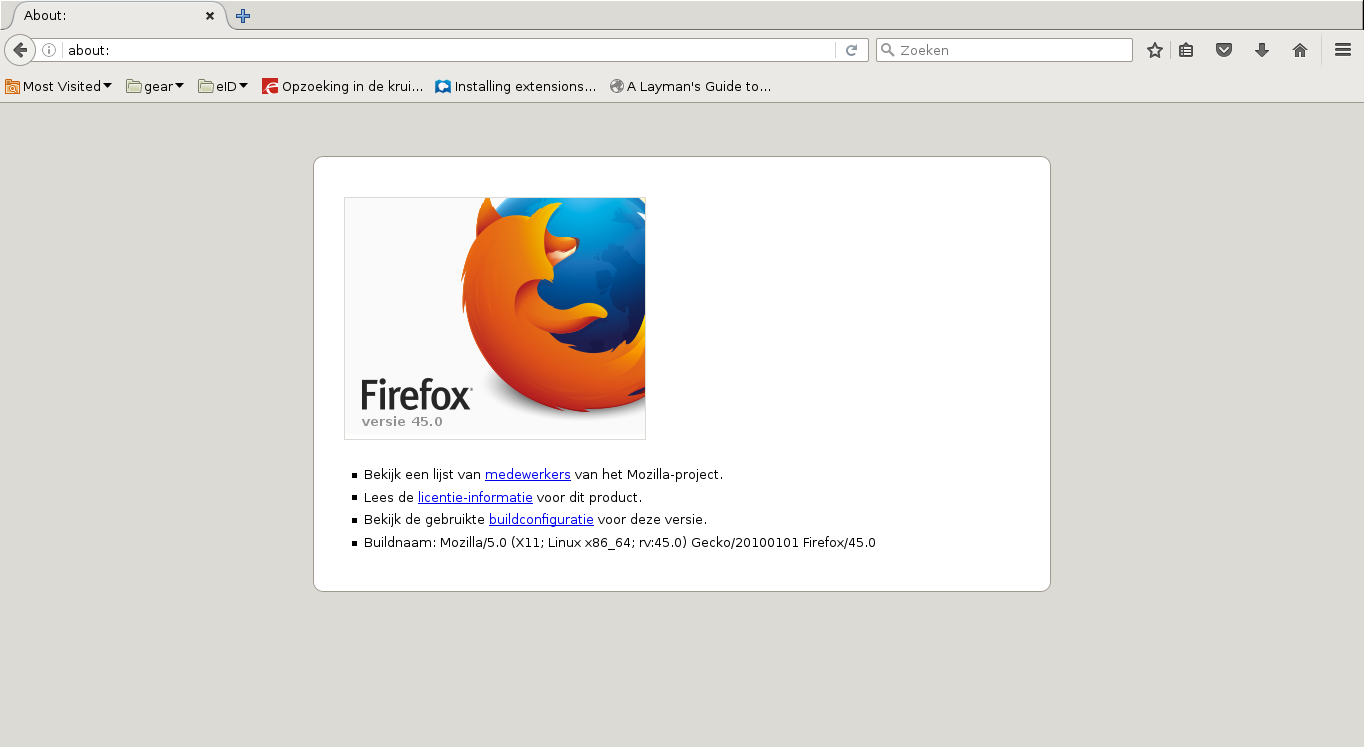
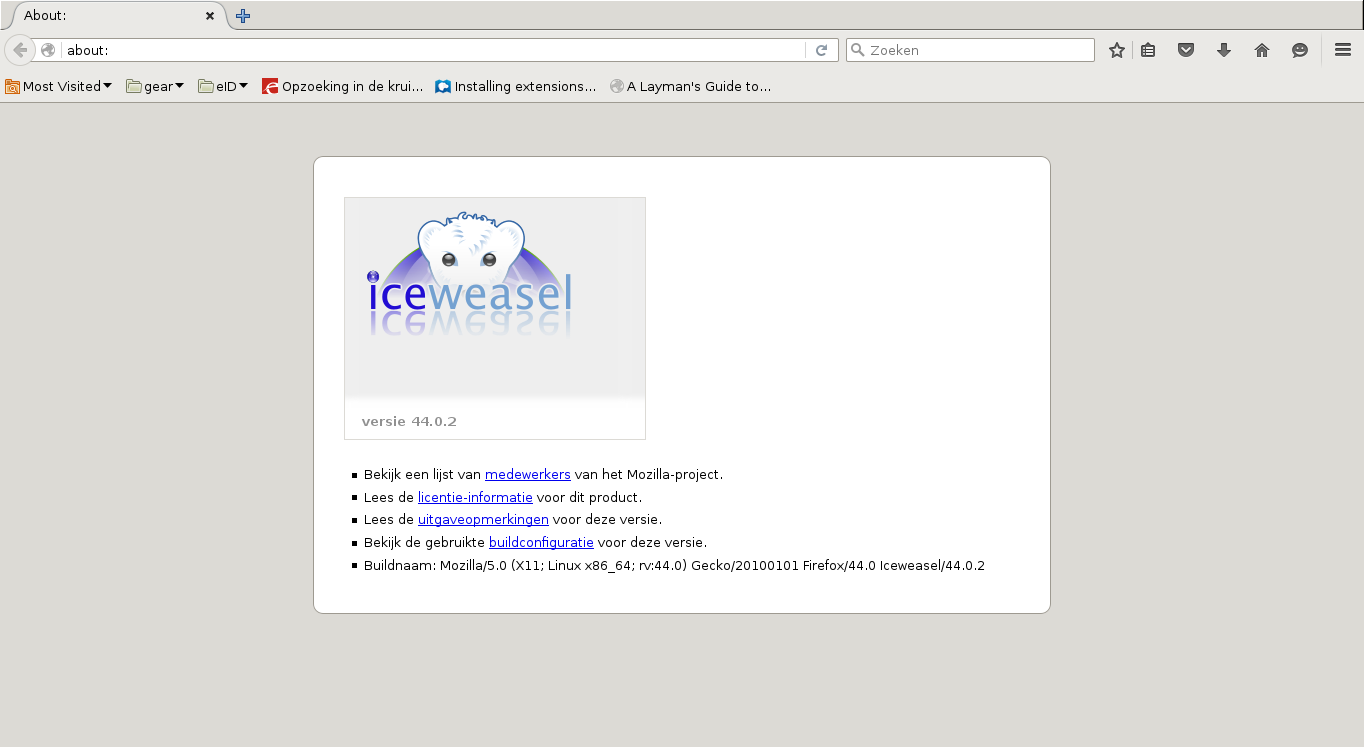
Before this bug: screenshot of Iceweasel after: screenshot of Firefox Whee!

Rapha&#235;l Hertzog: Freexian s report about Debian Long Term Support, February 2016

A Debian LTS logoLike each month, here comes a report about the work of paid contributors to Debian LTS. Individual reports In February, 112.50 work hours have been dispatched among 11 paid contributors. Their reports are available: Evolution of the situation The number of sponsored hours continued to decrease a little bit. It s not worrisome yet but we should try to get back to a positive slope if we want to be able to do an outstanding job for wheezy LTS. On the positive side, TOSHIBA renewed their platinum sponsorship for another 6 months at least and we have some contacts for new sponsors, though they are far from being concluded yet. We are now in transition between squeeze LTS and wheezy LTS. The paid contributors are helping the security team by fixing packages that were fixed in squeeze already but that are still outstanding in wheezy. They are also taking generic measures to prepare wheezy LTS (for example to ensure all packages work with OpenJDK 7.x since support for 6.x will be dropped in the LTS period). Thanks to our sponsors New sponsors are in bold (none this month).

No comment Liked this article? Click here. My blog is Flattr-enabled.

10 March 2016

Junichi Uekawa: I noticed that libfuse maintainer has changed last year.

I noticed that libfuse maintainer has changed last year. mail from new maintainer Niklaus. No change on libfuse, yet, I guess.

Lunar: Reproducible builds: week 45 in Stretch cycle

What happened in the reproducible builds effort between February 28th and March 5th:

Toolchain fixes
  • Antonio Terceiro uploaded gem2deb/0.27 that forces generated gemspecs to use the date from debian/changelog.
  • Antonio Terceiro uploaded gem2deb/0.28 that forces generated gemspecs to have their contains file lists sorted.
  • Robert Luberda uploaded ispell/3.4.00-5 which make builds of hashes reproducible.
  • C dric Boutillier uploaded ruby-ronn/0.7.3-4 which will make the output locale agnostic. Original patch by Chris Lamb.
  • Markus Koschany uploaded spring/101.0+dfsg-1. Fixed by Alexandre Detiste.
Ximin Luo resubmitted the patch adding the --clamp-mtime option to Tar on Savannah's bug tracker. Lunar rebased our experimental dpkg on top of the current master branch. Changes in the test infrastructure are required before uploading a new version to our experimental repository. Reiner Herrmann rebased our custom texlive-bin against the latest uploaded version.

Packages fixed The following 77 packages have become reproducible due to changes in their build dependencies: asciidoctor, atig, fuel-astute, jekyll, libphone-ui-shr, linkchecker, maven-plugin-testing, node-iscroll, origami-pdf, plexus-digest, pry, python-avro, python-odf, rails, ruby-actionpack-xml-parser, ruby-active-model-serializers, ruby-activerecord-session-store, ruby-api-pagination, ruby-babosa, ruby-carrierwave, ruby-classifier-reborn, ruby-compass, ruby-concurrent, ruby-configurate, ruby-crack, ruby-css-parser, ruby-cucumber-rails, ruby-delorean, ruby-encryptor, ruby-fakeweb, ruby-flexmock, ruby-fog-vsphere, ruby-gemojione, ruby-git, ruby-grack, ruby-htmlentities, ruby-jekyll-feed, ruby-json-schema, ruby-listen, ruby-markerb, ruby-mathml, ruby-mini-magick, ruby-net-telnet, ruby-omniauth-azure-oauth2, ruby-omniauth-saml, ruby-org, ruby-origin, ruby-prawn, ruby-pygments.rb, ruby-raemon, ruby-rails-deprecated-sanitizer, ruby-raindrops, ruby-rbpdf, ruby-rbvmomi, ruby-recaptcha, ruby-ref, ruby-responders, ruby-rjb, ruby-rspec-rails, ruby-rspec, ruby-rufus-scheduler, ruby-sass-rails, ruby-sass, ruby-sentry-raven, ruby-sequel-pg, ruby-sequel, ruby-settingslogic, ruby-shoulda-matchers, ruby-slack-notifier, ruby-symboltable, ruby-timers, ruby-zip, ticgit, tmuxinator, vagrant, wagon, yard. The following packages became reproducible after getting fixed: Some uploads fixed some reproducibility issues, but not all of them: Patches submitted which have not made their way to the archive yet:
  • #816209 on elog by Reiner Herrmann: use printf instead of echo which is shell-independent.
  • #816214 on python-pip by Reiner Herrmann: removes timestamp from generated Python scripts.
  • #816230 on rows by Reiner Herrmann: tell grep to always treat the input as text.
  • #816232 on eficas by Reiner Herrmann: use printf instead of echo which is shell-independent.
Florent Daigniere and bancfc reported that linux-grsec was currently built with GRKERNSEC_RANDSTRUCT which will prevent reproducible builds with the current packaging.

tests.reproducible-builds.org pbuilder has been updated to the last version to be able to support Build-Depends-Arch and Build-Conflicts-Arch. (Mattia Rizzolo, h01ger) New package sets have been added for Subgraph OS, which is based on Debian Stretch: packages and build dependencies. (h01ger) Two new armhf build nodes have been added (thanks Vagrant Cascadian) and integrated in our Jenkins setup with 8 new armhf builder jobs. (h01ger)

strip-nondeterminism development strip-nondeterminism version 0.016-1 was released on Sunday 28th. It will now normalize the POT-Creation-Date field in GNU Gettext .mo files. (Reiner Herrmann) Several improvements to the packages metadata have also been made. (h01ger, Ben Finney)

Package reviews 185 reviews have been removed, 91 added and 33 updated in the previous week. New issue: fileorder_in_gemspec_files_list. 43 FTBFS bugs were reported by Chris Lamb, Martin Michlmayr, and gregor herrmann.

Misc. After merging the patch from Dhiru Kholia adding support for SOURCE_DATE_EPOCH in rpm, Florian Festi opened a discussion on the rpm-ecosystem mailing list about reproducible builds. On March 4th, Lunar gave an overview of the general reproducible builds effort at the Internet Freedom Festival in Valencia.

Next.
Previous.