Tanguy Ortolo: One archiver to rule them all: bsdtar
% bsdtar -tf crap.rar % bsdtar -xf crap.rar % bsdtar --format zip -cf stuff.zip stuffToo bad it does not have a
-a option to
automatically select the archive format as GNU tar
does.
% bsdtar -tf crap.rar % bsdtar -xf crap.rar % bsdtar --format zip -cf stuff.zip stuffToo bad it does not have a
-a option to
automatically select the archive format as GNU tar
does.
The constitution of the debian operating system project says things like consistent with the consensus of the opinions of the Developers at various points but doesn t say how strong a consensus or how the project will test for consensus. I think those were mistakes, breaking a couple of the conditions for consensus.
Wikipedia s understanding of consensus is even worse. Wikipedia seems to treat consensus as a synonym for unanimity. Its testing methods allow an infinite loop to form where the casual observer can t differentiate between a controversial proposal and consensus. I think those were mistakes.
These famous-but-imperfect implementations frequently lead to misdirected rants which seem to misunderstand consensus as requiring perpetual bikeshedding. Apache s implementation is rather better and it may surprise you to learn that our co-op is mostly run by consensus.
There are two key differences which I feel makes consensus work for us: we ve set limits beforehand on some decisions where we need to act fast where not making a decision would usually be the same as making a bad decision and our methods of testing for consensus are better. We test for consensus with secret-at-vote-time-but-published-after straw polls, or using Crowd Wise by email.
I summarise Crowd Wise as follows: gather all ideas plus option 0 (do nothing) if possible, carry out a de Borda (preference) voting round 1, merge/amend/consolidate ideas, voting round 2 if needed. It does still work better if participants put their ego aside a little and co-operate, but it does put limits on non-co-operators.
Anyway, as described in Xana/ xana2/ bamamba/ Why Russ is wrong, debian isn t exactly using consensus much at the moment, anyway. Should we try to fix its bugs? Do you know other projects where consensus is working?
[ post made mainly for those poor souls who don't yet follow Planet Debian, but do follow me ]
Earlier today, Roland Mas threw an idea towards whoever had too much free time: Implement a valid QR code construction that would become an interesting pattern when interpreted in Conway's Game of Life.
But, as Jurij Smakov promptly showed, there is only one flaw in Roland's request: The need for too much free time. Jurij replied within ~4hr with a arbitrary string to QR code converter that allows said code to be seeded into a Game of Life interpreter.
Jurij: You get all the geek points I had in store for this month.
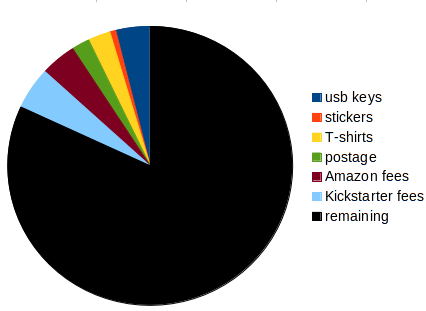
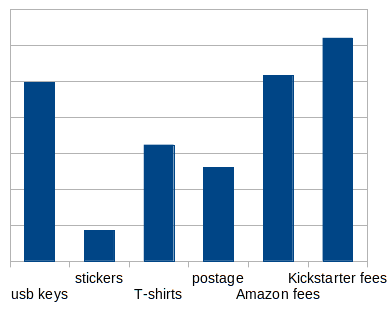
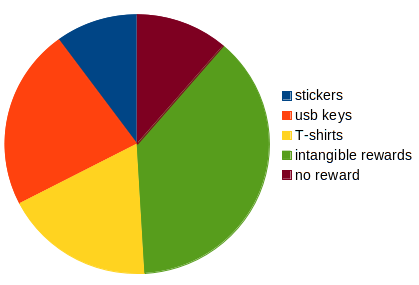
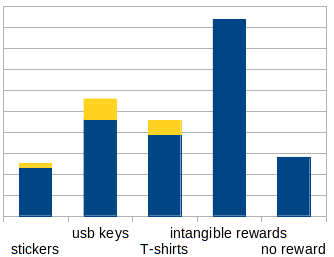
I finished delivering all my
Kickstarter rewards at the end of
the year. This is an overview of how that went, both financially and in
general.
![]() |
![]() |
![]() |
![]() |
![]() |
The USB keys were my favorite reward. I got them from
USB Memory Direct, who gave me quite a
nice deal. I was very happy that I was able to send them a SVG file
of my artwork, so I didn't need to worry about lacking resolution for the
laser engraving. And it came out looking great.
The best part was when their sales guy Mike actually did a minor alteration
of the artwork, to better fit on the key, when I, being overloaded with
Kickstarter stuff asked him too. A bit above and beyond.
There was an issue with their Chinese manufacturer's quality control of the
16 gb drives, but they were willing to send me replacement for all the ones
I found problems with.
Config file
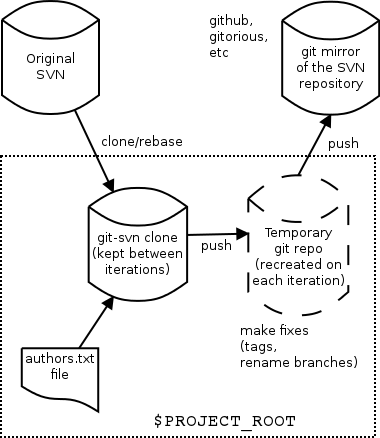
Here is a sample config file for the script, it mirrors the rather complicated reSIProcate repository with 10,000 commits:
PROJECT_ROOT=/home/daniel/svn-mirror/resiprocate AUTHORS_FILE=$ PROJECT_ROOT /authors.txt SVN_REPO=https://svn.resiprocate.org/rep/resiprocate SVN_LAYOUT="--trunk=main --branches=branches --tags=tags" GIT_REPO=git@github.com:resiprocate/resiprocate.gitOf particular note here:
git init --bare .#!/bin/bash
set -e
if [ ! $# -eq 1 ];
then
echo "Usage:"
echo "$0 <config-file>"
exit 1
fi
CONFIG_FILE="$1"
. "$ CONFIG_FILE " exit 1
SVN_CLONE="$ PROJECT_ROOT /svn-clone"
GIT_BARE="$ PROJECT_ROOT /git-bare-tmp"
if [ ! -d "$ PROJECT_ROOT " ];
then
mkdir -p "$ PROJECT_ROOT "
fi
cd "$ PROJECT_ROOT "
if [ ! -d "$ SVN_CLONE " ];
then
git svn clone \
"$ SVN_REPO " \
-A "$ AUTHORS_FILE " \
$ SVN_LAYOUT \
"$ SVN_CLONE "
cd "$ SVN_CLONE "
else
cd "$ SVN_CLONE "
git remote rm bare echo "failed to delete remote:bare, proceeding anyway"
git svn rebase \
--fetch-all \
-A "$ AUTHORS_FILE "
fi
git remote add bare "$ GIT_BARE "
git config remote.bare.push 'refs/remotes/*:refs/heads/*'
if [ -d "$ GIT_BARE " ];
then
rm -rf "$ GIT_BARE "
fi
mkdir -p "$ GIT_BARE "
cd "$ GIT_BARE "
git init --bare .
git symbolic-ref HEAD refs/heads/trunk
cd "$ SVN_CLONE "
git push bare
cd "$ GIT_BARE "
git branch -m trunk master
git for-each-ref --format='%(refname)' refs/heads/tags \
cut -d / -f 4 \
while read ref;
do
git tag "$ref" "refs/heads/tags/$ref"
git branch -D "tags/$ref"
done
git remote add origin "$ GIT_REPO "
git config branch.master.remote origin
git config branch.master.merge refs/heads/master
git push --tags origin master
git push --all
rm -rf "$ GIT_BARE "
</config-file>| Attachment | Size |
|---|---|
| 32.65 KB |
authors.txt
Config file
Here is a sample config file for the script, it mirrors the rather complicated reSIProcate repository with 10,000 commits:
PROJECT_ROOT=/home/daniel/svn-mirror/resiprocate AUTHORS_FILE=$ PROJECT_ROOT /authors.txt SVN_REPO=https://svn.resiprocate.org/rep/resiprocate SVN_LAYOUT="--trunk=main --branches=branches --tags=tags" GIT_REPO=git@github.com:resiprocate/resiprocate.gitOf particular note here:
git init --bare .#!/bin/bash
set -e
if [ ! $# -eq 1 ];
then
echo "Usage:"
echo "$0 <config-file>"
exit 1
fi
CONFIG_FILE="$1"
. "$ CONFIG_FILE " exit 1
SVN_CLONE="$ PROJECT_ROOT /svn-clone"
GIT_BARE="$ PROJECT_ROOT /git-bare-tmp"
if [ ! -d "$ PROJECT_ROOT " ];
then
mkdir -p "$ PROJECT_ROOT "
fi
cd "$ PROJECT_ROOT "
if [ ! -d "$ SVN_CLONE " ];
then
git svn clone \
"$ SVN_REPO " \
-A "$ AUTHORS_FILE " \
$ SVN_LAYOUT \
"$ SVN_CLONE "
cd "$ SVN_CLONE "
else
cd "$ SVN_CLONE "
git remote rm bare echo "failed to delete remote:bare, proceeding anyway"
git svn rebase \
--fetch-all \
-A "$ AUTHORS_FILE "
fi
git remote add bare "$ GIT_BARE "
git config remote.bare.push 'refs/remotes/*:refs/heads/*'
if [ -d "$ GIT_BARE " ];
then
rm -rf "$ GIT_BARE "
fi
mkdir -p "$ GIT_BARE "
cd "$ GIT_BARE "
git init --bare .
git symbolic-ref HEAD refs/heads/trunk
cd "$ SVN_CLONE "
git push bare
cd "$ GIT_BARE "
git branch -m trunk master
git for-each-ref --format='%(refname)' refs/heads/tags \
cut -d / -f 4 \
while read ref;
do
git tag "$ref" "refs/heads/tags/$ref"
git branch -D "tags/$ref"
done
git remote add origin "$ GIT_REPO "
git config branch.master.remote origin
git config branch.master.merge refs/heads/master
git push --tags origin master
git push --all
rm -rf "$ GIT_BARE "
</config-file>| Attachment | Size |
|---|---|
| 32.65 KB |
I just released umockdev 0.2.
The big new feature of this release is support for evdev ioctls. I. e. you can now record what e. g. X.org is doing to touchpads, touch screens, etc.:
$ umockdev-record /dev/input/event15 > /tmp/touchpad.umockdev # umockdev-record -i /tmp/touchpad.ioctl /dev/input/event15 -- Xorg -logfile /dev/nulland load that back into a testbed with X.org using the dummy driver:
cat <<EOF > xorg-dummy.conf
Section "Device"
Identifier "test"
Driver "dummy"
EndSection
EOF
$ umockdev-run -l /tmp/touchpad.umockdev -i /dev/input/event15=/tmp/touchpad.ioctl -- \
Xorg -config xorg-dummy.conf -logfile /tmp/X.log :5
Then e. g. DISPLAY=:5 xinput will recognize the simulated device. Note that Xvfb won t work as that does not use udev for device discovery, but only adds the XTest virtual devices and nothing else, so you need to use the real X.org with the dummy driver to run this as a normal user.
This enables easier debugging of new kinds of input devices, as well as writing tests for handling multiple touchscreens/monitors, integration tests of Wacom devices, and so on.
This release now also works with older automakes and Vala 0.16, so that you can use this from Ubuntu 12.04 LTS. The daily PPA now also has packages for that.
Attention: This version does not work any more with recorded ioctl files from version 0.1.
More detailled list of changes:
A few weeks ago, a new version of lldpd, a 802.1AB (aka LLDP)
implementation for various Unices, has been released.
LLDP is an industry standard protocol designed to supplant
proprietary Link-Layer protocols such as EDP or CDP. The goal of LLDP
is to provide an inter-vendor compatible mechanism to deliver
Link-Layer notifications to adjacent network devices.
In short, LLDP allows you to know exactly on which port is a server
(and reciprocally). To illustrate its use, I have made a xkcd-like strip:
If you would like more information about lldpd, please have a look
at its new dedicated website. This blog post is an insight of
various technical changes that have affected lldpd since its
latest major release one year ago. Lots of C stuff ahead!
.dist-version and use this file
if it exists. This allows one to rebuild ./configure from the
published tarball without losing the version. This also handles
Thorsten Glaser s critic.CHANGELOG in DISTCLEANFILES variable.configure.ac, I was previously using a static version number that
I had to increase when releasing:
AC_INIT([lldpd], [0.5.7], [bernat@luffy.cx])
AC_INIT([lldpd], [m4_esyscmd_s([git describe --tags --always --match [0-9]* 2> /dev/null date +%F])], [bernat@luffy.cx])
0.7.1
for example). If it is not, you get the nearest one, the number of
commits since it and part of the current hash (0.7.1-29-g2909519 for example).
The drawback of this approach is that if you rebuild configure
from the released tarball, you don t have the git tree and the version
will be a date. Just don t do that.
automake):
dist_doc_DATA = README.md NEWS ChangeLog .PHONY: $(distdir)/ChangeLog dist-hook: $(distdir)/ChangeLog $(distdir)/ChangeLog: $(AM_V_GEN)if test -d $(top_srcdir)/.git; then \ prev=$$(git describe --tags --always --match [0-9]* 2> /dev/null) ; \ for tag in $$(git tag grep -E '^[0-9]+(\.[0-9]+) 1, $$' sort -rn); do \ if [ x"$$prev" = x ]; then prev=$$tag ; fi ; \ if [ x"$$prev" = x"$$tag" ]; then continue; fi ; \ echo "$$prev [$$(git log $$prev -1 --pretty=format:'%ai')]:" ; \ echo "" ; \ git log --pretty=' - [%h] %s (%an)' $$tag..$$prev ; \ echo "" ; \ prev=$$tag ; \ done > $@ ; \ else \ touch $@ ; \ fi ChangeLog: touch $@
NEWS file with important changes.
struct netlink_req req; struct iovec iov; struct sockaddr_nl peer; struct msghdr rtnl_msg; memset(&req, 0, sizeof(req)); memset(&iov, 0, sizeof(iov)); memset(&peer, 0, sizeof(peer)); memset(&rtnl_msg, 0, sizeof(rtnl_msg)); req.hdr.nlmsg_len = NLMSG_LENGTH(sizeof(struct rtgenmsg)); req.hdr.nlmsg_type = RTM_GETLINK; req.hdr.nlmsg_flags = NLM_F_REQUEST NLM_F_DUMP; req.hdr.nlmsg_seq = 1; req.hdr.nlmsg_pid = getpid(); req.gen.rtgen_family = AF_PACKET; iov.iov_base = &req; iov.iov_len = req.hdr.nlmsg_len; peer.nl_family = AF_NETLINK; rtnl_msg.msg_iov = &iov; rtnl_msg.msg_iovlen = 1; rtnl_msg.msg_name = &peer; rtnl_msg.msg_namelen = sizeof(struct sockaddr_nl);
struct netlink_req req = .hdr = .nlmsg_len = NLMSG_LENGTH(sizeof(struct rtgenmsg)), .nlmsg_type = RTM_GETLINK, .nlmsg_flags = NLM_F_REQUEST NLM_F_DUMP, .nlmsg_seq = 1, .nlmsg_pid = getpid() , .gen = .rtgen_family = AF_PACKET ; struct iovec iov = .iov_base = &req, .iov_len = req.hdr.nlmsg_len ; struct sockaddr_nl peer = .nl_family = AF_NETLINK ; struct msghdr rtnl_msg = .msg_iov = &iov, .msg_iovlen = 1, .msg_name = &peer, .msg_namelen = sizeof(struct sockaddr_nl) ;
printf() calls
to determine where the problem was. This was clearly
suboptimal. Therefore, I have added many log_debug() calls with the
ability to filter out some of them. For example, to debug interface
discovery, one can run lldpd with lldpd -ddd -D interface.
Moreover, I have added colors when logging to a terminal. This may
seem pointless but it is now far easier to spot warning messages from
debug ones.
select()-based event loop. It
worked but I didn t want to grow a full-featured event loop inside
lldpd. Therefore, I switched to libevent.
The minimal required version of libevent is 2.0.5. A convenient way
to check the changes in API is to use Upstream Tracker, a website
tracking API and ABI changes for various libraries. This version of
libevent is not available in many stable distributions. For example,
Debian Squeeze or Ubuntu Lucid only have
1.4.13. I am also trying to keep compatibility with very old
distributions, like RHEL 2, which does not have a packaged libevent
at all.
For some users, it may be a burden to compile additional
libraries. Therefore, I have included libevent source code in
lldpd source tree (as a git submodule) and I am only using it if no
suitable system libevent is available.
Have a look at m4/libevent.m4 and
src/daemon/Makefile.am to see how this is done.
lldpctl is a client querying lldpd to display discovered
neighbors. The communication is done through an Unix socket. Each
structure to be serialized over this socket should be described with a
string. For example:
#define STRUCT_LLDPD_DOT3_MACPHY "(bbww)" struct lldpd_dot3_macphy u_int8_t autoneg_support; u_int8_t autoneg_enabled; u_int16_t autoneg_advertised; u_int16_t mau_type; ;
struct lldpd_chassis TAILQ_ENTRY(lldpd_chassis) c_entries; u_int16_t c_index; u_int8_t c_protocol; u_int8_t c_id_subtype; char *c_id; int c_id_len; char *c_name; char *c_descr; u_int16_t c_cap_available; u_int16_t c_cap_enabled; u_int16_t c_ttl; TAILQ_HEAD(, lldpd_mgmt) c_mgmt; ; MARSHAL_BEGIN(lldpd_chassis) MARSHAL_TQE (lldpd_chassis, c_entries) MARSHAL_FSTR (lldpd_chassis, c_id, c_id_len) MARSHAL_STR (lldpd_chassis, c_name) MARSHAL_STR (lldpd_chassis, c_descr) MARSHAL_SUBTQ(lldpd_chassis, lldpd_mgmt, c_mgmt) MARSHAL_END;
memcpy()1. I think there is still
room for improvement. It should be possible to add annotations inside
the structure and avoid some duplication. Or maybe, using a
C parser? Or using the AST output from LLVM?
lldpctl. Thanks to a contribution from Andreas
Hofmeister, the output can be requested to be formatted as an XML document.liblldpctl, with a stable and well-defined API. lldpctl is now
using it. I have followed those directions2:
lldpctl_). No pollution of the global namespace.NULL, all functions returning integers are
returning -1).NULL,
accept integer input as string, provide easy iterators, lldpctl_atom_t. From an atom, you can extract
some properties as integers, strings, buffers or other atoms. The list
of ports is an atom. A port in this list is also an atom. The list of
VLAN present on this port is an atom, as well as each VLAN in this
list. The VLAN name is a NULL-terminated string living in the scope
of an atom. Accessing a property is done by a handful of functions,
like lldpctl_atom_get_str(), using a specific key. For example, here
is how to display the list of VLAN assuming you have one port as an atom:
vlans = lldpctl_atom_get(port, lldpctl_k_port_vlans); lldpctl_atom_foreach(vlans, vlan) vid = lldpctl_atom_get_int(vlan, lldpctl_k_vlan_id)); name = lldpctl_atom_get_str(vlan, lldpctl_k_vlan_name)); if (vid && name) printf("VLAN %d: %s\n", vid, name); lldpctl_atom_dec_ref(vlans);
lldpd.
Ultimately, the library will also enable the full configuration of
lldpd. Currently, many aspects can only be configured through
command-line flags. The use of the library does not replace
lldpctl which will still be available and be the primary client of
the library.
lldpd: I am trying to keep it small. It
was already possible to configure lldpd through
lldpctl. Locations, network policies and power policies were the
three items that could be configured this way. So, the next step was
to enable lldpctl to read a configuration file, parse it and send
the result to lldpd. As a bonus, why not provide a full CLI
accepting the same statements with inline help and completion?
struct cmd_node *commands_new( struct cmd_node *, const char *, const char *, int(*validate)(struct cmd_env*, void *), int(*execute)(struct lldpctl_conn_t*, struct writer*, struct cmd_env*, void *), void *);
foo only once, for
example). The execution function can add the current token as a value
in the environment but it can also pop the current position in the
tree to resume walk from a previous node.
As an example, see how nodes for configuration of a coordinate-based
location are registered:
/* Our root node */ struct cmd_node *configure_medloc_coord = commands_new( configure_medlocation, "coordinate", "MED location coordinate configuration", NULL, NULL, NULL); /* The exit node. The validate function will check if we have both latitude and longitude. */ commands_new(configure_medloc_coord, NEWLINE, "Configure MED location coordinates", cmd_check_env, cmd_medlocation_coordinate, "latitude,longitude"); /* Store latitude. Once stored, we pop two positions to go back to the "root" node. The user can only enter latitude once. */ commands_new( commands_new( configure_medloc_coord, "latitude", "Specify latitude", cmd_check_no_env, NULL, "latitude"), NULL, "Latitude as xx.yyyyN or xx.yyyyS", NULL, cmd_store_env_value_and_pop2, "latitude"); /* Same thing for longitude */ commands_new( commands_new( configure_medloc_coord, "longitude", "Specify longitude", cmd_check_no_env, NULL, "longitude"), NULL, "Longitude as xx.yyyyE or xx.yyyyW", NULL, cmd_store_env_value_and_pop2, "longitude");
libedit).libedit).libeditline).readline(), addhistory(),rl_insert_text(),rl_forced_update_display(),rl_bind_key()rl_line_buffer and rl_point.libedit libraries have a noop for
rl_bind_key(). Therefore, completion and online help is not
available with them. I have noticed that most BSD come with GNU
Readline library preinstalled, so it could be considered as a system
library. Nonetheless, linking with libedit to avoid licensing issues
is possible and help can be obtained by prefixing the command with
help.
getifaddrs(). lldpd is now using directly Netlink on
Linux. This is not a big change since the GNU C Library already uses
it to implement getifaddrs() and additional information, like VLAN,
are still retrieved through ioctl() or sysfs. However, lldpd
now gets notified when a change happens and update all interfaces in
the next second.
Like many other projects, I have written my own Netlink implementation
instead of using libnl, a nice collection of libraries providing
everything you need to query the kernel through Netlink, including
some advanced bits. Why?
getifaddrs() to get the list of interfaces,bpf(4) to attach to an interface to receive and send packets,PF_ROUTE socket to be notified when a change happens.ioctl() to retrieve VLAN, bridging and bonding
bits but they are quite similar. The code was usually adapted from
ifconfig.c.
The BSD ports have the same functionalities than the Linux port,
except for NetBSD which lacks support for LLDP-MED inventory since I
didn t find a simple way to retrieve DMI related information.
They also offer greater security by filtering packets sent. Moreover,
OpenBSD allows to lock the filters set on the socket:
/* Install write filter (optional) */ if (ioctl(fd, BIOCSETWF, (caddr_t)&fprog) < 0) rc = errno; log_info("privsep", "unable to setup write BPF filter for %s", name); goto end; /* Lock interface */ if (ioctl(fd, BIOCLOCK, (caddr_t)&enable) < 0) rc = errno; log_info("privsep", "unable to lock BPF interface %s", name); goto end;
SIGSTOP
signal. upstart will detect this, resume lldpd with SIGCONT and
assume it is ready. The code to support upstart is therefore quite
simple. Instead of calling daemon(), do this:
const char *upstartjob = getenv("UPSTART_JOB"); if (!(upstartjob && !strcmp(upstartjob, "lldpd"))) return 0; log_debug("main", "running with upstart, don't fork but stop"); raise(SIGSTOP);
# lldpd - LLDP daemon description "LLDP daemon" start on net-device-up IFACE=lo stop on runlevel [06] expect stop respawn script . /etc/default/lldpd exec lldpd $DAEMON_ARGS end script
READY=1 to the socket when it is ready. With
the provided library, this is just a matter of calling
sd_notify("READY=1\n"). Since sd_notify() has less than 30 lines
of code, I have rewritten it to avoid an external dependency. The
appropriate unit file is:
[Unit] Description=LLDP daemon Documentation=man:lldpd(8) [Service] Type=notify NotifyAccess=main EnvironmentFile=-/etc/default/lldpd ExecStart=/usr/sbin/lldpd $DAEMON_ARGS Restart=on-failure [Install] WantedBy=multi-user.target
linux/if_bonding.h) to the use of kernel-only types. Those headers
have a difficult history. They were first shipped with the C library
but were rarely synced and almost always outdated. They were then
extracted from kernel version with almost no change and lagged behind
the kernel version used by the released distribution4.
Today, the problem is acknowledged and is being solved by both the
distributions which extract the headers from the packaged kernel and
by kernel developers with a
separation of kernel-only headers from user-space API headers. However,
we still need to handle legacy.
A good case is linux/ethtool.h:
u8, u16 types which are kernel-only types. To work
around this issue, type munging can be setup.SPEED_10000. In this case, you
either define the missing bits and find yourself with a long copy
of the original header interleaved with #ifdef or conditionally
use each symbol. The latest solution is a burden by itself but it
also hinders some functionalities that can be available in the
running kernel.u_int16_t and u_int8_t types is
a left-over of the previous serializer where the size of
all members was important.
libedit
native API. The API is also cleaner, does not have a
global state and has a better documentation. All the
implementations are also BSD licensed.
DRI3000 Even Better Direct Rendering
This all started with the presentation that Eric Anholt and I did at
the 2012 X developers conference, and subsequently wrote about in my
DRI-Next posting. That discussion sketched out the goals of
changing the existing DRI2-based direct rendering infrastructure.
Last month, I gave a more detailed presentation at
Linux.conf.au 2013 (the best free software conference in the world). That presentation was
recorded, so you can watch it online.
Or, you can read Nathan Willis summary at lwn.net.
That presentation contained a lot more details about the specific
techniques that will be used to implement the new system, in
particular it included some initial indications of what kind of
performance benefits the overall system might be able to produce.
I sat down today and wrote down an initial
protocol definition for two new extensions (because two extensions are
always better than one). Together, these are designed to provide complete
support for direct rendering APIs like OpenGL and offer a better
alternative to DRI2.
The DRI3 extension
Dave Airlie and Eric Anholt refused to let me call either actual
extension DRI3000, so the new direct rendering extension is called
DRI3. It uses POSIX file descriptor passing to share kernel objects
between the X server and the application. DRI3 is a very small
extension in three requests:
Packages for Debian GNU/Linux are already in the experimental catalog. It will be made available in Debian unstable and backports as soon as the freeze is lifted for the wheezy release.
dynalogin is a distributed solution for one-time-password/token based two-factor authentication on Linux/UNIX based operating systems. It supports PAM (pam_dynalogin) and also has native client code for C/C++ and PHP applications. It is free, open source software, so users can ascertain for themselves that it is genuinely secure and reliable for their needs. dynalogin is licensed under GPL terms.
dynalogin works with various soft-tokens, including the dynalogin token for Android and the Google Authenticator for various mobile devices. HOTP and TOTP-based hardware tokens can also be used.
Many thanks to Simon Josefsson and the OATH toolkit project which provides the underlying authentication algorithms for dynalogin
dynalogin can be integrated with the SimpleID OpenID provider to provide a turn-key solution for web-based single-sign-on, intranets and extranets. All the necessary components are conveniently packaged in Debian and Ubuntu.
Open question to enthusiasts, theoretical computing scientists and
mathematicians of all sorts: is it possible to construct a valid
QR-code that leads to
interesting results when used as an initial configuration for the
Game of Life?
The rules:
Running a gpart scan on my SW-RAID5 did gave me some results:hahn-rescue:~# mount /dev/vg/sys /mnt mount: you must specify the filesystem type Feb 19 07:50:02 hahn-rescue kernel: [748288.740949] XFS (dm-0): bad magic number Feb 19 07:50:02 hahn-rescue kernel: [748288.741009] XFS (dm-0): SB validate failed
These is not the complete lists of VM as a comparison to the output of lvs shows:hahn-rescue:~# gpart /dev/md3 Begin scan... Possible partition(SGI XFS filesystem), size(20470mb), offset(5120mb) Possible partition(SGI XFS filesystem), size(51175mb), offset(28160mb) Possible partition(SGI XFS filesystem), size(1048476mb), offset(117760mb) Possible partition(SGI XFS filesystem), size(204787mb), offset(1168640mb) Possible partition(SGI XFS filesystem), size(204787mb), offset(1418240mb) Possible partition(SGI XFS filesystem), size(1048476mb), offset(1626112mb) *** Fatal error: dev(/dev/md3): seek failure.
Please notice that /dev/lv/storage1 is my HW-RAID where I stored the images of /dev/vg/-LVs to run xfs_repair and such on. Anyway, the sizes of the recognized XFS partitions by gpart is mostly correct, but some a missing and xfs_repair can not do anything good on the backup images on storage1. Everything ends up in /lost+found, because the blocks seem to be mixed up somehow. What I figured out is, that my old RAID5 device was in metaformat=1.2 whereas the new one is in format 0.9. My best guess is now to recreate the RAID5 device with format 1.2, do a vgcfgrestore on that and have (hopefully!) a working LVM with working LVs back that I can then mount again. If there's anything else I might be able to try, dear Lazyweb, please tell me. Please see the attached config files/tarballs for a complete overview. Side note: except for AmigaSeagateElite3, which is a dd image of an old Amiga SCSI disk, I should have a fairly complete backup on my second backup location, so there's not much lost, but I would be a real timesaver when I would be able to recover the lost LVs. Both systems are behind DSL/cable and have a limit of 10 Mbps upstream. It would take weeks to transfer the data and sending an USB disk would be faster.hahn-rescue:~# lvs LV VG Attr LSize Pool Origin Data% Move Log Copy% Convert storage1 lv -wi-ao-- 1.00t AmigaSeagateElite3 vg -wi-a--- 3.00g audio vg -wi-a--- 70.00g backup vg -wi-a--- 1.00t data vg -wi-a--- 50.00g hochzeit vg -wi-a--- 40.00g home vg -wi-a--- 5.00g pics vg -wi-a--- 200.00g sys vg -wi-a--- 20.00g video vg -wi-a--- 100.00g windata vg -wi-a--- 100.00g
| Attachment | Size |
|---|---|
| 954 bytes | |
| 14.7 KB |
A new Rcpp master class is scheduled for March 9 in New York. The format will an updated version of the one-day
workshops I have given at the University of Rochester in 2010, in San Franciso in 2011 (organised by
Revolution Analytics) and at the UseR! conference in 2012.
The style will be hands-on, with numerous concrete examples and solid coverage of most aspects of
Rcpp and related packages. As before, about six hours of
instruction, split into four sessions of around ninety minutes focussing (loosely) on motivation/intro, core parts,
extensions and applications. This should leave ample time for informal discussions and Q+A---as well as for lunch and
coffee breaks---for a total of eight hours in the classroom.
This is being put together in New York with the help of Jared Lander,
and we will have some technical assistance from RStudio in order to use their EC2
farm for exercises with Rcpp.
Registrations details are available here;
information about other Rcpp events is also available.
Feel free to contact me or Jared at our usual email addresses with questions.
Hello, World!
There are details coming out soon with regards to GSoC:2013, so all this is without any official hat of any sort on.
However, I had an idea, and I was wondering if there were people interested in mentoring it.
For a long time, I ve wanted a Debian android application one that will use API calls to fetch PTS info, BTS info, and intercept bug URLs to display Debian related information on the native interface.
It d also be neat to set a profile (e.g. my emails) and get notifications when things happen that I care about.
Anyone know how to code for android and interested in GSoC?
There are actually lots of people I admire in Debian. I tried to name a few
without thinking, but I wasn't thinking so I lost count as soon as I ran out of
fingers. I know however that many enjoy to stay out of the spotlight and keep
their fun focused on a few specific things. I am one of those myself.
Oh dear, FOSDEM was too short, can I have

DebConf soon?
In the meantime, let's have some fun with the DPL campaign.
Next.