Search Results: "sto"

15 April 2010

Bernd Zeimetz: gimp-plugin-registry package updated

Yesterday I finally found the time to update gimp-plugin-registry, the (hopefully!) largest and best collection of plugins for The GIMP. As usual here comes a short summary of the changes: Hope you like my work, suggestions and bug reports are welcome as usual!

Gustavo Noronha Silva: WebKit2 and WebKitGTK+

So you ve seen people talking about WebKit2, perhaps have seen someone claiming it drops support for Linux , and you ve been wondering what the hell that means for WebKitGTK+. Well, welcome to the preemptive Q&A section with WebKitGTK+ maintainers =D. Let s first explore some history so we can better understand what exactly is going on. What exactly is WebKit2? Currently, when we say WebKit we really mean one of the ports that are built on top of WebCore using the WebKit layer. WebCore is the part that does all of the hard Web-related work, WebKit an API layer that exposes WebCore functionality in a coherent way, so that the platform-specific ports can expose a public API layer for their applications to use, which is usually also called WebKit . This WebKit layer was designed by Apple to build the Mac, and Windows ports it maintains, and was later released as Free Software so that other ports, such as the GTK+, Qt, EFL ports could be built on top of it, instead of having to do all the heavy lifting from WebCore directly.

Current WebKit model WebKit2 is nothing more than the second version of that interface, with a whole lot of changes on what you can expect from it, and on how it interacts with WebCore, and the platform-specific API and UI. First of all, the first WebKit was not API stable, and that interface was usually not made public by the various ports - they only exposed their platform-specific APIs. WebKit2 is being designed to provide a stable, cross-platform, C-based, non-blocking public API. This is huge. It will allow cross-platform code to be written without having to consider language, and port differences for basic functionality. The second big change is the API will be made fully non-blocking. Currently most things you do are asynchronous already, but some of them may be completed in a synchronous ways (like, loading a string into WebKit instead of an URI). This is important for responsiveness, and is also a very important need for what comes next: process splitting. WebKit2 will bring into WebKit proper the concept of splitting the UI process from the Web process, similar to what Chromium has. It also much more awesome than what Chrome has for a large number of reasons, including, but not limited to:

  1. It s being contributed directly to the WebKit project, in a cross-platform way that lets ports such as WebKitGTK+ take advantage of it, instead of being shipped directly into Safari, like Google does with Chrome;
  2. The process separation goes bellow the API layer, meaning that all complexity involved in managing the process separation is handled by the library, and hopefully none of it leaks to the application using it; that means that applications like Devhelp and Yelp will be able to take advantage of this without having to make their lives more complicated;
There s a much better diagram in WebKit2 s wiki page, but here goes a simplified version that demonstrates what I m talking about:
WebKit2 model
What WebKit2 is not? WebKit2 is NOT a rewrite of the whole WebKit stack. Webcore will continue mostly unchanged, and all ports currently building on top of it will keep working. It is also not a fork - the code lives in the same tree as the current version of WebKit, which will allow us to progressively move towards using this new, improved layer. WebKit2 is not Apple-only, and it is not dropping Linux support. Initial builds of the code that is being landed will likely show up building on Linux in the near future (specially because us porters are already eager to play with it). What happens to WebKitGTK+? In the near future, nothing special. We will continue working towards making it feature-complete, more stable, faster, and rocking on it as always. We will, though, start working out how we can best take advantage of WebKit2 in order to provide an even more awesome library for the G world. What this means is you can expect us to have a library that will provide a nice GTK+ widget, just like we have today, with a GObject-based API, like we have today, but that is built on top of this new WebKit2 infrastructure, taking advantage of the process-splitting, and the bigger focus on not blocking the UI thread. This should give us a platform that is more stable, and faster and more responsive than what we already have today. The API is bound to change, of course, but the WebKit2 version of WebKitGTK+ will be a separate, parallel-installable library, and we will keep supporting the WebKit1 version while we work on making the new one at least as good as the current one. This is long term we re talking here. We ll likely see WebKitGTK+ 1.4, and 1.6 come to life before we are satisfied enough with WebKitGTK+2. We hope this clears some of the doubts up, and lightens your hearts! The WebKitGTK+ maintainers.

Biella Coleman: Cultural Cornucopia

Today all across America, many are experiencing a soft form of hell, anxiety, and constant cursing for it is tax day. Thankfully last night I squared those away (more or less). Today is also the last day to register forDebconf sponsored registration. Even if there is a chance you can t make it, it is worth filling out the form just in case. For those spending a little extra time in NYC or planning on sneaking out to take a whirl in the city, here are some more fun options. NYC is known to be a cultural cornucopia of sorts and one reason are the many museums. I just found a twitter list listing those museums with a feed. Probably one of my favorite museums is located in the far north of Manhattan, the Cloisters. It is a haven, an oasis with small beautiful gardens, as well large stone rooms and buildings filled with medieval art, tapestry, and manuscripts. If you need to get away from people, chatter, and computers, this might be a good place to visit. Museums are easy enough to find but there are other spots in NYC that may be a little harder to spot. If you want to hit Chinatown for dim sum, I would recommend Jing Fong, which is mind blowing largely because of its LARGE (like there are escalators that take you up) room, which gets pretty darn packed on the weekend. If you want something that involves not just food but involves sweat, water, food, sun, hot rocks, body scrubs, funny looking pink, orange and blue uniforms and all in a cross-cultural context, then Spa Castle is the place to go to. Just check out the website and you will see what I am talking about. It s family friendly, has a cornucopia of saunas (filled with jade, gold, ice, Tibetan bricks), some decent Korean food, among many other attractions. In general is one of the best deals in NY.

14 April 2010

Joey Hess: git reflex

snapshot.debian.org launched
with all Debian packages produced in the past 5 years
6.5 terabytes first Wikipedia database dump in 4.5 years
5.6 terabytes (32 gigabytes compressed) My reflex on seeing both of these was to think about putting them into git repositories. For snapshot.debian.org, injecting source packages into git repositories is easy with git-import-dsc (and it can also use pristine-tar to make the original tarballs accessible with a miminal overhead). I hope the snapshot.debian.org admins find time & space to do that, because being able to easily access git annotate data spanning 5 years for any package in the archive would be very useful. To produce a usable git repository from the Wikipedia dump would probably involve writing a custom git-fast-import that processed the huge xml dump, and chunked it up into individual files, and commits changing those files. Frankly, I do prefer wikis that store data in git in that format natively and don't have multi-month dump procedures. ;) How big would the git repos be? My SWAG is well under 1 terabyte for snapshot.debian.org, and between 30 and 300 gigabytes for the wikipedia data.

Andrew Pollock: [opinion] Queensland and daylight saving: the epic battle continues

I see that Queensland is making noises about daylight saving again. I personally quite like daylight saving. I think it works great in California. I remember when it was trialed in Queensland, and I enjoyed it when I lived in Canberra. I can't remember who told me why the farmers object to it so much, (no, it's not that they're worried about their curtains fading), but it was an interesting explanation: Farmers work the land, from sunrise to sunset, not the clock. The pub, however still closes at the same time. If they're now knocking off work an hour later, but the pub still closes at the same time, that's an hour less drinking. No idea how accurate that explanation is, but it makes for a good story. Anyway, the point of this post is to say that I think the idea of carving the state into two timezones is insane. It should be all or nothing.

13 April 2010

Guido G?nther: Simple git data provider for Zeitgeist

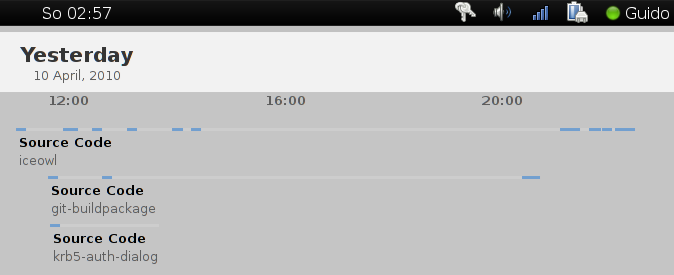
gnome-activity-journal recently entered Debian and it could become a great tool to keep track of hacking activities. The underlying zeitgeist can log these and other events and make the information available via DBus. I couldn't find a data provider that feeds the information about Git commits to it so I wrote a simple post commit hook. This way one can easily see when one worked on a source repository: gnome-activity-journal Now is there a nice way to store additional information like current branch or commit message along with that?

11 April 2010

John Goerzen: Final comments on our trip to Europe

I wrote a lot about our trip to Europe here, and I had a few more comments to share. I had a great time there. It was fun to stay with people, and it was also fun to explore cities on our own. I am eager to be able to go back. Communication
I ll admit I wasn t sure how I d do there. I speak only a little German, and no Czech at all. I have never been in a situation in which I don t speak the dominant language, and this is probably typical for Americans. (I m not going to count the few exceptions of eating at small Mexican restaurants in the USA where the staff speaks little English, as it s not really the same experience to be in that situation for an hour or two.) I was most apprehensive about our time in Berlin and Prague. In those cities, we didn t know anyone. And, although I speak a little German, I speak no Czech at all. In the end, though, it all worked out fine. I never saw anyone get frustrated with us for our lack of language knowledge, and we also never got rattled. With patience and a bit of ingenuity, we figured things out in every different situation. I feel a sense of accomplishment from that, and I think it s left me more ready to travel in the future. And, I d also have to say, that was one of the most interesting lessons of the trip: how two people that don t share a common language can still communicate. It might be slow, but it s also rewarding and easier than I might ever have thought. I remember particularly buying a couple of fragile carved wood souvenirs at the Zeidler Holzkunst (wood art) shop in the Altes Rathaus in Leipzig (Seiffener Volkskunsterzeugnisse was on the window). The shopkeeper spoke no English. We were interested in some rather fragile items, and I wanted to ask her if she could pack it in a box. I didn t know the German words for pack or box . So after a couple seconds thought, I realized I knew how to tell her, in German, that we re from America. And then I asked, Can you? (in German) and gestured for a square box, figuring maybe she d put it together that we d need to pack it well to take it home with us. Success. She quickly produced a box, and asked if that s what we wanted. A few minutes later, a bit of pointing towards the glass case communicated what we wanted to buy. It took a little longer than it would have from someone that spoke English, but this was more rewarding in the end. The train station in Prague was another challenge. It didn t have nearly as much English signage as other train stations we d been in. We did a little wondering around, and some educated guesses, and a brief English conversation in a bank, we eventually found an ATM, a place to change the big bills for smaller ones, and a Metro ticket shop that was open. Clothes Many Americans, and American travel books, suggest not wearing jeans and tennis shoes in Europe. Many commented that people dressed more formally in Europe. That advice appeared to be rather wrong, especially in L beck, where it appeared that many people dressed less formally than in the USA. As we went south and east, we saw fewer jeans, but still they were rather common. Our biggest blunder here was probably the shoes that we brought for Terah. She brought some shoes that looked nice, but weren t very good for walking. She wound up with some painful blisters on her feet, and wished she had just brought her regular tennis shoes. Luggage and Packing We try to travel light when we can. All of our luggage for the entire trip fit into two carryon-size suitcases, though we sometimes separated some items out into a backpack for ease of use in airports/airplanes. This worked out about right. We did laundry once in Germany so we didn t have to pack enough clothes for the entire trip. As far as electronics go, we brought along an international GSM phone from onesimcard.com, my Droid (which could use Wifi but not GSM), Terah s iPod Touch, a GPS, my digital camera, and a laptop. That also was about right. We used the Droid to call back to Indiana to check on the boys, using SIP over WiFi for free calling via Google Voice. The laptop is a small one, so didn t add a lot of weight or bulk. It was nice to have to check out maps and Facebook. The GPS was somewhat less useful than I had anticipated. I had pre-loaded it with street-level maps of most of Europe, and also put on it points in Berlin that had been suggested to us. The transit maps were really more useful most places, especially when combined with a detailed street-level map. In Berlin, though, the detail on the street-level map from our hotel was somewhat lacking, so the GPS came in handy. It was also nice to quickly be able to see where the nearest S-Bahn and U-Bahn stops were, then cross-referencing with our transit map to figure out how to get where we wanted to go. One night in Leipzig, after a concert at the Gewandhaus, we made a couple of wrong turns on our way to a tram stop. The GPS would have saved us 15 minutes of walking had we brought it along, but we figured it out with our street map and it wasn t really a problem. Rick Steves is a big advocate of money belts when traveling. These are a belt with a zippered pouch, and are worn under your pants (though over your shirt, if it s tucked in). The idea is that it s hard to pickpocket. He suggests having a days worth of cash in a front pocket, and passports and larger bills in the money belt. We brought one but never used it. I kept small cash in my pocket, and we kept passports and my wallet (with larger bills) in Terah s purse, which was on a strap around her neck, zippered shut, and held under her arm. We had no problems. I tend not to keep my wallet in my back pocket even when traveling in the USA. Also, the hotels we stayed in had safes, and the residences were of course plenty safe, so we had no problem leaving valuables there. I brought only a single lens for my Digital Rebel XTi, a 28mm fixed lens that is small and light. That was just fine, and I was happy to have a fixed lens for photography in dark churches. Also, I wouldn t have wanted to carry around a bulky zoom lens all over. We sometimes took the camera with us, and sometimes not. In Berlin in particular, we just left it in the hotel room. I figured (correctly) that there would be plenty of photos on Flickr of the sites we were visiting, and we could just enjoy the time a little better if we weren t worrying about a camera too. But I was glad to have it along. Transportation The transportation systems in the cities we visited felt more, well, balanced than they often are in the USA. It s not that there weren t busy car-filled avenues, but more that there were also quiet shopping streets where cars were banned. Cars often seemed to be more of an option than a necessity, and not always the best option at that. Public transportation was common, as were pedestrian routes and bicycle lanes. The only American city I ve visited that felt even close to this approach was Portland, OR. I wish we adopted it more often here. I also admire the German intercity rail service, operated by Deutsche Bahn. You can get all over the country pretty quickly. The trains we rode on were quiet, smooth, and timely. I wish we had that kind of service in more parts of the USA.

Gunnar Wolf: Lets all get running

There is no clear reason, but for many months already, I have almost given up running Which is a shame, as I enjoy it so much. And yes, I can talk a lot about why not, but outside of one seemingly stupid point there is really no reason. And yes, I have taken on cycling, although on a very different fashion: Cycling is by far not as good as an exercise as running Yes, cycling for ~1h on average 3 times a week has kept my body from becoming sedentary again, but I do feel some increased clumsiness and a undeniable weight gain that I don't want to allow. I said there is one seemingly stupid point: Shoes. My running shoes are around two year old, and they are an important factor on me not running. Why? Because they started giving me blisters at ~5Km. And my shoe size is beyond what is considered as normal by Mexican standards European 44-45 (US 10 -11). Shoe-shopping is always frustrating and very off-putting for me, as instead of what most people do (go to one store, ask for their favorite n pairs on their size, test them on, pay, be happy), I follow almost the opposite process (go to n stores, ask for whatever they have on my size, test it on, pray, pay). Of course, for some people, entering many stores and checking what's offered at each is a thrill by itself. For me, that sounds as thrilling as visiting the dentist for an endodontic treatment. Oh, and to make things even better, I am quite low on cash. Scarcity economics explain that if a given good is hard to find, it will probably be more expensive. So, while many people in Mexico buy ~US$30 shoes, I often get to pay ~US$90. Fun, hah? Anyway, I had a short semi-vacation to Argentina. I decided to kill this excuse, and went shoe-shopping. Fearsome memories sprang in my mind when the first store said they didn't have anything right for me. But they pointed to a second store, one block away, where I found (I was even able to choose between several models!) a nice pair of Olimpikus. In 2008, I was routinely running slightly over 10Km. Today I went out to get back the feeling, and made a not-so-great-but-still-satisfying 4Km. And upon arriving back home, I read Christian's chronicle on his Paris Marathon run Well, only 10% of what my fellow DD achieved But I am definitively back on track. I expect to make some time to get a run, at least three times a week, trying to push my limit at least back to the nice spot I was at two years ago.

Kumar Appaiah: I'm going to Debconf 10

So, I will be at DebConf10 from 4th August onwards. The prime purpose of my visit is to meet all Debian developers, so I don't think the delayed attendance should matter much.Customary banner: I'm going to DebConf10!See you all there!Tags: debconf, debconf10, debian

Gunnar Wolf: Snails flying by

Snails flying by
Snail mail has become a despised media. While I still held long conversations at a distance written with ink on paper, with latency measured in weeks and not in milliseconds, that's basically history now. Snail mail is where invoices are received. Ocassionally, a joyous invitation finds its way into my mailbox But its regular use has been almost completely abandoned. Which probably makes it more striking and more of a surprise to receive a very short note of a good friend living far away just stating a very warm greeting. (of course, the paper was not GPG-signed, but I'll have to believe it was sent by him ;-) ) (Oh, about the title: The card is a print of Don Nisbett's Fly By , which recreates Ilwaco, Washington's panorama)

Andrew Pollock: [life] I (apparently) have obstructive sleep apnea

A while ago now, Sarah commented that one night when she's woken up in the middle of the night, that she'd observed me stop breathing for a while in my sleep. She wanted me to go see the sleep doctors that she'd seen (she was diagnosed with obstructive sleep apnea a couple of years ago). So I eventually packed myself off to the Stanford Sleep Disorders Clinic, which is at Stanford's shiny new outpatient centre in Redwood City. They took a look at me, and declared I had a crowded mouth, and a narrow airway, and asked me to do a sleep study. I did the sleep study in the middle of January. That was "interesting". I had a ton of wires glued to me, and needless to say, I didn't sleep particularly well, but apparently I slept enough for them to be able to diagnose me. A couple of weeks later, I got a letter with the results. I had a Respiratory Disturbance Index of 16.6. The letter from the clinic defined RDI as including "events of 10 seconds or more with cessation of airflow or discernable reduction in airflow associated with arousal or oxygen desaturation of 3% or more". I had one obstructive sleep apnea event, and 119 obstructive hypopnea events during the sleep study. At one point my O2 saturation dropped to 89%, but it was very briefly. The overall average was 96%. A month ago I did another sleep study, this time while I was hooked up to a CPAP machine, and they fiddled with the pressure. I was fairly exhausted that night, and slept like a log. Based on the results of the second sleep study, I've been prescribed an auto PAP machine with a pressure ranging between 13 to 15 cm of water pressure (whatever that means). I got the machine, a ResMed S8 AutoSet II a week ago last Friday. It's slightly more advanced than the CPAP machine that Sarah uses, in that it'll adjust its pressure within the range it is set to, as it deems necessary throughout the night. It also backs off the pressure when you exhale, like Sarah's does. I'm not particularly thrilled to be sleeping with this thing on my face. The first night I used it, I slept fine. Something like from 10:30pm until 6am. Subsequently, I keep waking up at precisely 3:30am for some reason, and it's hard to get back to sleep with it on, so I take it off. A few nights, some sort of mask leakage alarm has gone off at some random point in the night. I haven't been in any state to try and diagnose what's going on when that happens, so I just take off the mask and turn the whole thing off. I was curious as to whether I'd notice some sort of life-changing difference between using it and not using it, like Sarah does, but so far, I can't say I've noticed any discernable difference. I also haven't gone a night without using it yet. Getting a properly fitting mask was a bit of a challenge. I spent ages at the durable medical equipment supplier trying on different sorts of masks. The one I've currently got still leaves a bit of a red mark across the bridge of my nose. I can take it back in the first 30 days, and get refitted, so I might still be doing that.

Christian Perrier: [life] Paris marathon 2010~bubulle-1 ACCEPTED

Upload accepted by organisers. Upload time has been 3h49'29" (my watch says 27", eh!). That was a good one, really (actually, I can compare to only 3 as it was my fourth marathon after Paris and Cologne 2009, plus the unofficial Rambouillet Forest marathon I ran alone 6 weeks after Paris 2009). For marathoners around, here are the chronometric data. Please note that GPS watches tend to overestimate the distance, mostly because of the jerky way one runs in mass events, as well as geometric considerations related to the imprecision of GPS (imprecision may be lateral and thus the line recorded by the watch is often less straight than the real one). For instance, according to my watch, Paris marathon was 42.63km long, so an overestimate by nearly 500meters. As a consequence, the recorded speed of 5'23"/km should be corrected to 5'25". So, times below should be increased by 2 seconds. As a conclusion, even though I can improve the pace and avoid going too fast in the first 25km, I'm very happy as I avoided nearly collapsing as I did last year (with sometimes over 7'00/km and a few walks). Going back home was OK and I had no cramps and I still haven't any. This is also what one gets when preparing well. My only regret is that I didn't run over 30km since, indeed, Cologne Marathon! That made the difference in the last 12 kilometers, obviously. Having spent the winter on many half-marathons (either alone, or a few officials) clearly improved my "performance" up to 25km. For the next marathon (a marathoner always thinks about the next one), I need to have 1 or 2 long trainings a few weeks before. Now, I have to find out which one will be the next one... and I wish good luck to my friend No l K the, who is preparing the Mainz marathon for May 9th as well as Dirk who's certainly preparing another one. Guys, rendez-vous is of course for Debconf10 in NYC. We won't run a marathon for sur, but how about an half one? :-)

9 April 2010

Ingo Juergensmann: Syncing N97

We now have year 2010 but sometimes it still feels like living in the Stone Age of Computing. There's a smartphone, let's call it N97, with Symbian on it. Then there are a bunch of client computers such as a Debian workstation/homeserver running Sid, a Laptop running OS X with iCal and a Windows XP machine at work. Every machine itself (well, with the exception of the XP machine) is a nice piece of hard- and software offering a bunch of possibilities: you can manage your calendars, contacts and tasks.

The difficulty arise when you want to sync those calendars, contacts and tasks between all of the different machines.

There are several ways to address this task:

  1. WebDAV:
    Setting up a WebDAV is no rocket science and you can easily sync your calendars easily with Sunbird or Thunderbird/Lightning for example. But that leaves the N97 ouf of syncing. The N97 can be synced with iSync on OS X, but iCal is not able to work on a single calendar. You can either export a calendar to a remote WebDAV or subscribe it. iCal ignores changes done in other clients and will overwrite those.


  2. CalDAV 1:
    CalDAV (calendarserver) does require some more configuration before you can use it properly, but when done, it should be capable of syncing calendars, resources, tasks and such. Using CalDAV should work aorund the limitations of WebDAV as mentioned above. The calendars can be synced to CalDAV from iCal by creating a remote account and you can sync with iSync via Bluetooth. But you will need a local calendar in iCal, because you can't use iSync to sync your smartphone to your CalDAV remote calendar in iCal.

    iSync unable to use CalDAV for syncing


    Additionally there are problems when you delete an event from your CalDAV calendar on your smartphone. iSync will report an error like this:

    Freitag, 9. April 2010 21:45
    [Nokia N97]
    Changes of Events in writeprotected calendar on this phone are not permitted. These changes were ignored: test, 04/09/2010 23:00


    Deleting events in your local iCal calendar, however, is working well. In the end this result is not encouraging as I need the CalDAV calendars being in sync.
    Syncing with Sunbird on OS X doesn't work either. Maybe it would with DAViCal as server frontend?


  3. CalDAV 2:
    Because syncing via iSync doesn't work as expected it would be a decent solution if the N97 could sync directly to CalDAV. Unfortunately it can't, although there seems some progress with Symbian there. If that is already integrated into v21.0.102 of N97 firmware, it would nice if someone could point me to how configure the N97 properly.


  4. SyncML:
    Maybe another option would be to use some sort of SyncML server in order to sync calendars and stuff between those machines, but I don't know how OS X will work with that approach. Again, hints are welcome!


Syncing calendars and other stuff really seems to be painful. Using a third party webservice such as .Mac or Google Calendar is no option at all. I don't want to give private data out of my hands and control. So, a self hosted service is needed.
Dear lazyweb, is there a solution available for my problem? I hope so...

Christian Perrier: [life] Once you run a marathon...

...you want to run many. Everybody told me so. Which is why I was warned when I ran my first one year ago in Paris, I knew I would run other. So, on Sunday will be my fourth one and my second Paris Marathon. So, after 4h10mins in Paris (april 2009), 4h12 in Rambouillet Forest (all alone in full autonomy mode) and 4h00'49" in Cologne, my target this time is 3h50. Weather is announced to be perfect, my physical condition is AFAIK good, the motivation is very high....my only fear is that I registred in the "4h target" group (because, back in November, I wasn't expecting the results I got in February/March in half-marathons). As many people overestimate their target, I expect to be passing hundreds of runners during the first 5 kilometers, which is not the best way to start....but, hey, Paris streets are wide enough (except Place de la Bastille, my nightmare....I hope organizers solved the jam problem there). Of course, I kinda hope seeing fellow Paris DD's waving giant Debian swirls, including our wanabee-DPL.....but let's stop dreaming. And running in a sunny day all across Paris and along river Seine, will be great again even without Zack. I'll also be missing Ralf and No l who ran it last year: Ralf is unfortunately suffering from knee problems and No l is preparing for Mainz marathon (target: 3h??). Anyway, more news on Sunday afternoon....and let's enjoy a full rest tomorrow!

David Welton: US Exports: "The Cloud"?

An Economist special report in last week's print edition talks about how the US will need focus more on savings and exports:

A special report on America's economy: Time to rebalance I've been thinking about that for a while too, especially after the dollar's recent weakness, although it has been strengthening some, lately, apparently due to the state of Greece's finances... I think that the computing industry is, in general, well poised to take advantage of that. For instance, what could be easier to export than computing power or "Software as a Service"? All it takes is a few minutes for someone in Europe to sign up to a US-based service with a credit card. For instance, compare Linode's prices and good service with most of their European competitors (gandi.net for instance, who are good people, and you have to love that they put "no bullshit" right on their front page). Not that they don't have good service in Europe, but it's very difficult to compete on price with the dollar being significantly cheaper. With the dollar where it is right now, gandi is almost, but not quite, competitive with Linode. If you don't include taxes. If the dollar weakens again, though, things could easily tilt far in Linode's favor. Besides a weak dollar, I think it will be important for companies in a position to do so in the US to focus on "the rest of the world". The US is a big, populous country where it's very easy to forget about far-off lands. Compare my home town of Eugene, Oregon to where I live in Padova. Google Maps says that it takes 7+ hours to drive to Vancouver, Canada (which, to tell the truth, isn't all that foreign in that they speak English with an accent much closer to mine than say, Alabama or Maine). Going south, Google says it's 15+ hours just to San Diego, although I think that's optimistic myself, given traffic in California. From Padova, I can be in France in 5 hours, according to Google, 3 hours to Switzerland, 4 to Innsbruck, in Austria, less than 3 hours to the capital of Slovenia, Ljubljana, and around 3 hours to Croatia, too. And if you wanted to throw in another country, the Republic of San Marino is also less than 3 hours away, according to Google's driving time estimates. You could probably live your entire life in a place like Eugene and never really deal much with foreigners, whereas here, nearby borders are both a historic and an ever-present fact. The outcome of this is that, to some degree, people in the US have traditionally focused their businesses "inwards" until they got to a certain size. Which is, of course, a natural thing to do when you have such a big, homogenous market to deal with before you even start thinking about foreign languages, different laws, exchange rates and all the hassle those things entail. However, if exchange rates hold steady or favor the US further, and internal spending remains weaker, it appears as if it may be sensible for companies to invest some time and energy to attract clients in "the rest of the world". "Cloud" (anyone got a better term? this one's awfully vague, but I want to encompass both "computing power" like Linode or Amazon's EC2, as well as "software as a service") companies likely will have a much easier time of things: for many services, it's easy to just keep running things in the US for a while, and worry about having physical or legal infrastructure abroad later. Your service might not be quite as snappy as it may be with a local server, but it'll do, if it performs a useful function. Compare that with a more traditional business where you might have to do something like open a factory abroad, or at the very least figure out the details of how to ship physical products abroad and sell them, and do so in a way that you're somewhat insured against the large array of things that could go wrong between sending your products on their merry way, and someone buying them in Oslo, Lisbon or Prague. Since this barrier to entry is lower, it makes more sense to climb over it earlier on. As an example, Linode recently did a deal to provide VPS services from a London data center, to make their service more attractive to European customers. However, they still don't appear have marketing materials translated into various languages, and presumably they don't have support staff capable of speaking languages like Chinese, German or Russian either (well, at least not in an official capacity). This isn't to pick on them; they may have considered those things and found them too much of an expense/distraction/hassle for the time being - they certainly know their business better than I do - and that they simply are content to make do with English. Other businesses, however, may decide that a local touch is important to attracting clients. What do you need to look at to make your service more attractive to people in other countries? In no particular order:

There's certainly no lack of work there, but on the other hand, it's possible to do almost all of it from wherever you happen to be located, rather than spending lots of money and time flying around to remote corners of the globe, as is still common practice in many industries.

8 April 2010

Stefano Zacchiroli: RC bugs of the week - issue 26

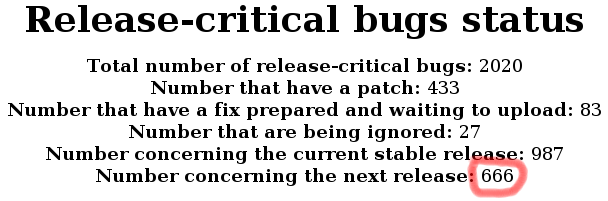
RCBW - #26 RC bug count: 666 It is getting down, even though the current number is scary. My personal RC bug count is not so mystical and as low as 205 RC bugs to go, which is quite encouraging. Without any further ado, here are this week squashes: Random points:

John Goerzen: Face to Face With Destruction

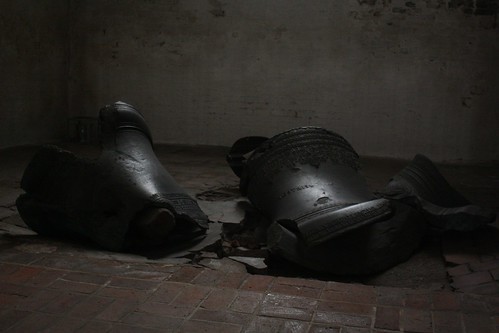
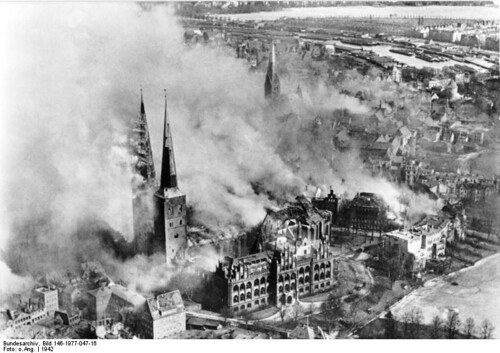
IMG_2641 Seeing these church bells in L beck wasn t easy for me. They melted and fell to the ground after an air raid in 1942, and have been left exactly as they fell. I wasn t alive in 1942, and even my parents hadn t yet been born. My grandfather was relocated by the American government because he refused to fight in the military for religious reasons. And yet, I still felt a sense of embarrassment, being an American standing there in Germany next to those bells. My country* did things like this. Why? Even if there s a war on, and whatever the other side may be doing, do we really have to bomb all their churches? Then, we went to the Dom (cathedral). It has a small gallery of photos of the destruction in 1942, and how it took 40 years to restore (though some original works are simply irreplaceable.) Burning L beck Cathedral after an air raid in 1942 I had just been walking through the beautiful Dom, and then saw pictures like that. It was very sad. I imagined the people in 1942, seeing the smoking remains of so many buildings that had been important to the town for centuries. Places where, no doubt, some of them worshiped, and their parents and grandparents had too. I imagined my sadness if a country bombed one of the churches that my ancestors helped start or build. I felt ashamed of what the democracy in which I live (and its allies) did to the Dom, to Marienkirche, and to the other churches and civilians there. Then, a few days ago, Wikileaks posted a video from an American helicopter in which our soldiers begged Come on, let us shoot! at people, most or all of which were completely unarmed. They killed a bunch of people. Then a van came to try to get the wounded to the hospital. Then the soldiers in helicopter killed those people, and wounded some children. Even if they thought their lives were in danger, I d expect to hear some quiet sadness at what they thought was a regrettable need to use force. Instead, you d hear them cheering whenever they killed someone, as if they had just won a round on some video game. They killed civilians, and considered it a fun experience and a mission accomplished. There was no sadness for knocking a man to the ground, leaving him writhing. Just jokes. There was no more care for human life here than there was 60 years ago. It saddens me that every year we celebrate our military on independence day celebrating its ability to kill, not its ability to feed. I wish that we could rather celebrate the times Americans have saved lives, whether in Berlin or in Port-au-Prince, or helped to topple dictatorships. Military power shouldn t be our first choice so often. L beck wasn t attacked for any strategic purpose; the British did it to destroy the morale of the enemy civil population , as the Americans did in Dresden or the Germans in London. In other words, those bells fell to the ground for no reason other than that they were German. People lost their lives for the same reason in Germany and in London. The British had no reason to believe that those civilians meant them any harm, that they were anything but caught between two strong powers. And the same held true in Iraq. When we went to Berlin, we walked through the replica of Checkpoint Charlie, with the big sign announcing that you are leaving the American sector. There is little positive to be said about the Cold War, but there is something the British and American military did of which I am not the least ashamed: the Berlin Airlift. Although I didn t see it, I feel a sense of the USA having been a force for good when I read about the Berlin Airlift Monument at Tempelhof, which has the names of the 70 British and American men that lost their lives in the airlift (due to accidents), above the inscription They gave their lives for the freedom of Berlin. That s the spirit I wish we d see more often in the world today: people giving their lives not just for their own security, but for strangers in need on a different continent. We Americans have been, compared to many countries in Europe, relatively sheltered from the ravages of war in our own midst. I wish that more of us would have the opportunity to gaze at fallen church bells, to wonder through a magnificent old church and then to see photos of it on fire, or to see a monument to our soldiers in a far away land. Perhaps then we could better learn from history, and see firsthand that some of our most positive contributions to the world have come in the form of coal and candy bars instead of incendiary devices. A small post script Many historic buildings or locations we saw in Germany had plaques on their exterior with a brief history, often in German and in English. I was interested to note that some (though not all) of these plaques had language such as destroyed by fire in 1942 , with no mention that the cause of the fire was a bombing. I was even more interested to note that same sort of description at several sites in Prague Castle, mentioning that the original building was lost in the fire of 1142. It was only on the third or fourth building in the Castle that we learned that the fire of 1142 was caused by a military siege of Prague Castle. * I know it was the British at L beck, but the Americans did similar things elsewhere. I also acknowledge that, at a macro level at least, the Berlin Airlift wasn t purely an altruistic act, as there were geopolitical factors in play. But I am speaking of the actions of the airmen here, who took on considerable risk to help others.

7 April 2010

Biella Coleman: Nameless, Freak, Phreak

So I tend to focus on the cultural present but during grad school it was hammered into my brain that to understand the contemporary moment, history matters, a lot.. The problem with hacking and related activities is that the history is a bit sparse and fragmented. Recently I have been working on a piece that examines some of the aesthetics similarities between phrakers, underground hackers, and trollers and it sort of hit me that I had no idea when the term phreak or freak came into being. So I dropped a note to Phil Lapsely who is writing (finally) a proper history of phreaking and he was thoughtful enough to pen down a genealogy of the term.

Next.

Previous.