Search Results: "ron"

13 July 2008

Christian Perrier: Churro as production server

'churro' is the name of the Debian i18n server (i18n.debian.net), hosted by the Extremadura region in Merida (IIRC). That server was setup back in september 2006, during the first Extremadura i18n meeting. Since then, a lot of hidden work happened on it, mostly moving all scripts that build statistics pages from Debian localization data, for instance the Central Debian translation statistics. Thomas Huriaux, then Nicolas Fran ois, have been the people building all this, with the help of Felipe Augusto van de Wiel for the system administration. Churro for instance has neat statistics pages, built by Nicolas Fran ois. These would just need to be packaged with nice web pages to give a great website for stats junkies(See that example showing how Swedish decreased over time, then revived recently....or that other one showing German reaching the 100% Grail). The DDTP also uses churro as server which is an important brick for having translated package descriptions (which is now an achieved lenny release goal). And now, since this week-end, I think we can say that Pootle is partly in production. The Pootle server is now hooked directly to the VCS of some parts of Debian-Installer related packages (including the core D-I itself) and, since last night, I am not the only one using it...:-) That small bit:
Author: pootle-guest
Date: Sun Jul 13 20:48:15 2008
New Revision: 54294
Log:
Commit from Debian/Pootle l10n server by user pi. 413 of 413 messages translated (0 fuzzy).
Modified:
   trunk/packages/po/sublevel3/eu.po
... indeed shows that Piarres Beobide Ega a, the Basque team coordinator, just committed an update to D-I SVN, through Pootle. We're still working on organizing all that scattered stuff, to finally turn churro into the central point for Debian localization and internationalization work but I think that the i18n team can really be proud of the achieved work, already. PS: as churro turned out to be hard to pronounce for German mouths, please note that it is also called 'spaetzle' :-)

Matthew Garrett: My trip to Istanbul by Matthew Garrett aged 28 and 4/365ths

Saturday

Arrive at Heathrow. Richard gets to be my special lounge buddy - we later discover Bastien sitting outside looking like a lost puppy. Flight is delayed by a mere hour, so we get to the hotel with little trouble and check in. Dinner with Luis and co on pillows on the street. This becomes a recurring theme. Drinking is involved. This also becomes a recurring theme. People complain about my shortcut finding skills.

Sunday

See beautiful things. Thankful to finally get to see buildings older than my old college. Dinner under some bridge with Red Hat folks where we discover the joys of the "special price". People once more complain about my shortcut finding skills. Suspect pillows are involved, but hazy recollections.

Monday

Arrive at the university by taxi. More to the point, arrive at the university by taxi without taking a 30km detour. Dinner with Canonical people, then a party in some overpriced bar on the top of a very big hill. Discover that taxi drivers in Istanbul either have no fucking clue where anything in the entire world is, or that driving tourists to bizarre locations is a national pastime. Avoid this fate and arrive home at something like 4AM.

Tuesday

Corporate whoring continues with dinner with Collabora people (delayed by two and a half hours because Christian values getting sweaty with other men over eating, or something), followed by more drinks on the pillows. Am vindicated when it turns out that my route back to the hotel would in fact be the shortest possible route back if people didn't keep insisting on making random left turns when we're almost there.

Wednesday

Fascinating (and increasingly drunken) discussion of the neurobiological aspects of colour spaces with Pippin precedes drinks on the roof of the university. Narrowly prevent Luis' attempt to leave the foundation open to flagrant copyright violation suits. More pillows.

Thursday

Wake up with a twisted ankle and a broken laptop. I had a good birthday, it seems. Collabora host a party on a boat. Miraculously, nobody falls off the boat. We head back to the pillows while others trudge up the hill to Taksim. Aaron wins the inaugural Aaron Bockover award for services to the GNOME community.

Friday

Dinner with Novell, demonstrating my even-handedness when it comes to accepting corporate favours. Miguel reveals his true nature as a Microsoft shill by admitting to owning an XBox. I advise him to raise his free software credentials by getting a Freerunner - as a bonus it'll crash whenever anyone tries to call him, preventing Microsoft from whispering more sweet nothings in his ear. A foolproof plan. Party paid for by Google. Ear bleedingly loud. Some drinking involved. Return to bizarro deviant pillows where we are treated to the spectacle of child labour. Spend some time wondering why Planet Fedora is discussing upskirt photos and decide that hating the entire human race is probably the best option.

Saturday

Turns out that while the Grand Bazaar is effectively just a shopping centre, it's a fucking giant shopping centre that sells nothing I can find any excuse to want. Wander over to Asia for dinner. Conversation with Lennart about using cgroups as a mechanism for providing application latency requirements and how the current lack of standardisation of mountpoints and exposure of irritating implementation details makes it almost impossible to use them for anything. Fascinating diversion into how to deal with getting a SIGBUS when your mmap()ed soundcard gets hotswapped, including deciding that the easiest way of getting a reliable indication of your current process maps is by, erm, parsing /proc/self/maps. Final pillows trip. Emotional farewells (by which I mean more drinking)

Sunday

Airport. Plane. Train. Home. Transfer hard drive into laptop with working screen. Discover that productivity not actually enhanced by having more than a 300x200 pixel area of functionality. Decide to write libelous article about previous week instead.

Christian Perrier: In Bruges

Good movie. Two great irish actors (Colin Farrell and Brendan Gleeson), a wonderful fuckin' city which is just like a fairy tale and a quite crazy story. A few hilarious moments, the best of which for me being that sentence (transcript from my understanding): "Bruges is not too crowded. Would it be elsewhere than in Belgium, it would be overcrowded". And the film even features the two actors facing 'The Last Judgement' by Hyeronymus Bosch, a triptych where I remember spending more than one full hour just watching, in Groeningue Museum (if you happen to go in Bruges, go there!).

Wouter Verhelst: New toy

While all of Belgium is buzzing over the fact that now the iPhone is being sold here, in compliance with the law against coupled sales (i.e., not simlocked), I couldn't care less. Instead, I bought me something far more useful than a cell phone that wants to be a PDA. (occasionally, the poem is one of the better-known poems by expressionist poet Paul van Ostaijen, my favourite in the Dutch language) This is a Hanlin V3 e-book reader. I found that I was reading way too much text on the 'net, some non-fiction, but recently also fiction, to comfortably do so. I could print, but that's not very good for the environment. I could read some of it on my YP-T10, but not all of it. Hence, the ebookreader. This thing has an e-paper screen, meaning that it does not require power usage to retain an image on the screen, and that the quality of the display is much, much better than anything an LCD screen could hope to offer. Even from an angle: After having it for about two days, I must say I'm quite happy with it. Reading text on this device is way, way more comfortable than trying to read anything on my laptop, or something similar. Having said that, there are a few quirks with it, which I hope future firmware-updates will fix: These are mere annoyances, however. It's an ebook reader, not a webbrowser; I can live with that. And while the zoom function in the PDF files is not perfect, it mostly does the job. And the positioning of the buttons is probably something that will be different for each and every person. I've found that just plain files are most easily read; the device does a decent job of auto-detecting headers and applying some basic markup; and if it gets confused, fidgeting with the text file until it gets it right is not too hard. In addition, the device comes with much more settings to apply to markup on text files than it does for either of PDF or HTML; e.g., one can change the zoom level in more settings, the line spacing, and a few more things. Additionally, the device also comes with an MP3 player, but I don't really plan on using it. First, I don't like MP3 files; second, the device has not much battery—only 950mAh, which is enough for weeks because of the low power-usage of the screen—and using it for MP3 decoding is a waste of battery; and finally, I have a perfectly good portable media player, so I see no point in trying to use this device for that particular purpose. But, well, I guess some people will like it. All in all, I do like the device. The attention to detail in the packaging is... heh. It even comes with a screwdriver to load the battery...

Russell Coker: New SE Linux Policy for Lenny

I have just uploaded new SE Linux policy packages for Debian/Unstable which will go into Lenny (provided that the FTP masters approve the new packages in time). The big change is that there are no longer separate packages for strict and targeted policies. There is now a package named selinux-policy-default which has the features of both strict and targeted. When you install it you get the features of targeted. If you want the strict features then you need to run the following commands as root: semanage login -m -s user_u __default__
semanage login -m -s root root Then you can logout and login and you get the main benefit of the strict policy (users being constrained). IE you can convert from targeted to strict without a reboot! The above only changes the access for user login sessions (and cron jobs). To fully convert to the strict policy you need to remove the unconfined module with the command “semodule -r unconfined“, currently that results in a system that doesn’t boot - I’m working on this and will have it fixed before Lenny. Also it’s possible to have some users unconfined and some restricted in the way that strict policy always did. When running in the full strict configuration you need to run the command “newrole -r sysadm_r” immediately after logging in as root. When you login you default to staff_r which doesn’t give you the access needed to perform routine sys-admin tasks. Due to the change in the function of the policy packages (in terms of not having a strict package) it made sense to revise the naming (Fedora 9 has a package named selinux-policy-targeted which also provides the strict configuration - I don’t want to do that and don’t have as much legacy as Fedora). This is why I decided to not have package names that include the word “policy” twice. Of course all policy packages get new names, but the ones that matter needed new names anyway. Another new feature is the package selinux-policy-mls, as the name suggests this implements Multi Level Security [1]. I don’t expect that the MLS policy will boot in enforcing mode in a regular configuration at this time (you could probably hack it to boot in permissive mode and switch to enforcing mode just before it starts networking). I uploaded it in this state so that people can start testing it (there is a lot of testing that you can do in permissive mode) and so that it can get added to the package list in time for Lenny. I expect that I’ll have it booting shortly (it should not be much more difficult than getting the strict configuration booting). In terms of the use of MLS, I don’t expect that anyone will want to pay the money needed for LSPP [2] certification. NB The wikipedia page about LSPP really needs some work. I believe that the main benefit for having MLS in Debian is for the use of students. I periodically get requests from students for advice on how to get a job related to military computer security. Probably the best advice I can offer is to visit the career section of an agency from your government that works on computer security issues, for US readers the NSA careers page is here [3]. The second best advice I can offer is to work on MLS support in your favourite free OS. Not only will you learn about technology that is used in military systems but you will also learn a lot about how your OS works as MLS breaks things. ;) Finally I’d like to thank Manoj for all his work. For a while I didn’t have time to do much work on SE Linux and he did a lot of good work. Recently he seems to have been busy on other things and I’ve had a little more time so I’m taking over some of it.

Eric Dorland: Conferencing

So first the bad news is that I'm not coming to DebConf this year. There are a few reasons for this. It's fairly far and expensive. I thought the lineup of talks was pretty similar to the last two years. And perhaps most fundamentally, I don't want to go somewhere cold (well, cool) in the summertime. I think this may be a Canadian thing, but I love summer time and I don't want to squander any of my warm days. So have a good time folks, I'll miss you and I'm certainly going to make the effort to be there next year. And lets hope DebConf 10 is in Montr al :)

I will however be heading to OLS for the first time. Which is ironic because I used to live 2 hours from Ottawa and never went. Now I live several more hours away and now I've decided to go. Irony is fun.

I'm also thinking of attending HOPE here in New York. I'm not really sure what to expect. The talks seem really eclectic, which is cool, but makes it hard to figure out what to go to. Suggestions welcome!

12 July 2008

Kapil Paranjape: Balaram on Institutional Archives

Subbiah Arunachalam forwarded a link to an interview of Professor P. Balaram regarding Open Archives. (Balaram is currently the director of the Indian Institute of Science, Bangalore so he is in a position to influence national policy in such matters). I broadly agreed with his views and I posted a comment which I am reproducing here. Primarily, there are differences between different disciplines. The quotes below are from the interview.
If I publish a paper in Nature, for example, it can be made freely available in my institute's repository after six months. Some journals let archived papers be made available immediately.
... and again later ...
But many publishers have no problem with the open archives approach, even if some still require a delay.
In our discussions with Elsevier we were assured that the policy of that publisher is to allow authors to use institutional repositories at any time (but see the caveats below).
One issue that is yet to be resolved, however, is copyright. I argue that we should be permitted to put in the repository the full text article as it appears in a journal.
There is a difference between "full text" and "as it appears in the journal". If the journal has put in any effort at all into re-formatting your text/images in order to get it to conform with their journal standard, then the copyright for that re-formatting work (usually a combination of manual labour and software) belongs to the journal. For example, Elsevier insists that you do not put the PDF (or other) image file of the exact form of the journal publication in your institute repository. I personally find this quite acceptable since papers in the Mathematical Sciences are perfectly readable in the form in which the authors submit them to the journal. However, re-creating a distributable PDF or other online form of one's paper may be far more difficult in other disciplines --- I have no idea.
For this, countries such as India should have a law specifying that the copyright for articles published with publicly-funded research always vests with the authors and their institutions.
One need not wait for copyright law to change. The directors of each of the research institutes can insist that every paper sent for publication should be made available in the form of a research report with the institute library. By extension, the electronic form of this report would be in the institutional repository. One way to ensure compliance is to only allow reports that are available in the institute library to be used for evaluation (for promotions and the like). The scientists would then refrain from giving up all copyright to their publishers. In my (limited) experience, publishers will not object to authors retaining the right to make copies as long as such copies are not independently sold. Unfortunately, scientists as "the silent compliant mob" does not fit with my experience. In all matters which relate to science administration (and publications are at the centre of that), scientists are by-and-large "status quo"-ists. It will need a strong push from those at the top of the ladder to change the status quo. Professor P. Balaram is certainly one of those at "the top of the ladder" so I would like to see more action to match his words! Update: Fixed the URL thanks to Abhishek Dasgupta. Also clarified the last sentence.

Petr Rockai: fast forward

Lucy left for England yesterday (OK, now it’s two days ago — last Friday). That means that I have unusual amount of free time at my hands, and yet even more things that could be done with it. But I suppose it’s time to update this little blog. It’s probably pointless to enumerate what happened, or what changed. Everything is fine and smooth over here — the wrinkles get worked out over time (with Lucy, without Lucy). Hobbies still take time and I still haven’t given up. My latest determination is to get myself a bassoon for next Christmas. (Now, that will be a year since we got Lucy a Marigaux 901, used, in great condition for a great price, lo and behold, on Austrian ebay. World is so weird sometimes…) And in the land of [LVM], I have finally started the process to merge code to improve LVM’s behaviour in presence of failed storage hardware (physical volumes gone missing). In the land of Adept, well… first things first. FOSSCamp I have visited Prague for the latest Ubuntu- (well, Canonical-) organised event, the FOSSCamp. I have met Johnatan (KUbuntu), Seli (KWin), Lidya (Amarok), Robert (Konsole), Jos (Strigi) and Inge (KOffice). See also Johnatan’s Blog (including a real blurry picture). So back to Adept — I had some hacking time over there in Prague, and I have almost brought Installer and Updater back to life for Adept 3. I unfortunately didn’t have as much time for it since then — but my current free time situation does open up some possibilities. First and foremost, I should really make a text interface to the underlying libraries for myself, maybe with fancy colourful UI, hopefully one that is comfortably close enough to apt-get and still offers advantages. Hmmmm… Intermezzo 1 Now zoom out and zoom in somewhere else, enough of coding matters. Our research group at the University had a (tool) paper accepted for ATVA 2008, meaning that I am not unlikely to visit Seoul, South Korea in October. Another piece of distant world to visit. FOSDEM Now, that reminds me… Since the last time, I have also been in Belgium — to visit FOSDEM — meeting Alasdair (of LVM) and Bart and Pino of Krita and Okular, respectively… although unfortunately, I didn’t spend nearly enough time with Pino… At least we have spend a day walking around Ghent with Bart (and Lucy, who visited Belgium with me, also having friends of her own there). Moreover, I have spent a lot of mostly productive time with Alasdair, discussing LVM2. And Belgium is nice and pretty, although I didn’t really get around to taste any beer. Maybe next time. And Antwerps were nice, too. Photos? Someday. LinuxTag And after that, I have visited Berlin again, for LinuxTag as usual — plus the accompanying LVM discussions, with Milan, Kabi and Mikul (Blek) of the Czech part of the team, and Heinz, John and of course Alasdair for the rest of the world… Also as usual, we walked around, had dinners, discussed non-work stuff, etc… a good event all in all. At LinuxTag, I have briefly seen Lidya again, as well as Ossi (whom I nearly didn’t recognise…) and Aaron who (for a change) didn’t recognise me (but to be fair, I didn’t quite stop by to chat and he’s been busy…) and Sebas, cordial as ever (and always a pleasure to meet)… reminds me of Paris two years ago, too. Intermezzo 2 Less than a month ago, I have finished my first semester of master’s study — two or three more to go (I have completed bachelor’s the semester before). Yes, I am a bachelor of computer science, or something like that, anyway, now. Or so I hope. I did not attend the whatever ceremony and I don’t really have the diploma (or maybe I do, but gods know where it is…). A short note on Debian with best intentions I am now sponsoring Trent Buck’s ?darcs packages, contributing a little on the go (making me wish that alpha buildd would make a little more progress…). With Enrico, we have uploaded new versions of wibble and libept, both of which I think make both of us fairly happy. (Although we again managed to hit a way strange compiler issue (only manifested on arm… what have I done that the gods punish me so?), as documented in Debian bug 487406…) I have packaged dzen2 and taken over haskell-mode (I am losing track of my own packages again — I really need to set up reliable watch files so I don’t miss out too many releases… apparently neither has new upstream versions, so I can sleep peacefully for a little longer). Intermezzo 3 I am not going to DebConf nor Akademy this year. That makes me a little sad, but it’s all my own fault (and laziness). Next time folks, next time. I haven’t seen K vin in aeons and he probably removed me from his memory by now… No matter, I’ll try a little harder next year, promise (oh, how many have I made to date?). Finale Nothing grandiose, just best wishes to everyone, I have to land in bed now it seems, as I am ever so sleepy. (Just So Stories, anyone?) There I go.

11 July 2008

Adam Jensen: 11 Jul 2008

Yesterday, 10 July, was the due date for the second milestone of my work on DebGraph. I am happy to report that we are roughly two weeks ahead of schedule, so meeting this milestone was not a cause for worry. We now have support for the following graph operators: The next milestone includes the development of a high-level language (or integration with an existing extension language) that streamlines the construction of complex queries using the operators listed above. We can build arbitrarily complex queries using the C++ operators, but dealing with the static typing and compiler toolchain can be very clunky. As such, I have spent the past week working on Lua bindings for DebGraph, which will enable us to query the graph of Debian packages from a clean, dynamically typed language. Lua has a powerful C API that exposes the Lua stack and lets us move DebGraph information to and from the Lua interpreter. I'm writing documentation that outlines how to use DebGraph from both C++ and Lua in order to make this work accessible to more folks. Sneak peak
As an example, we can utilize the FindCycles operator in Lua as follows:
libdg = package.loadlib("./libdebgraph.so",
"luaopen_libdebgraph")
libdg()
LoadPackages('cache')
-- 'g' is the main graph of unstable binary-arm packages
cycles = FindCycles(g)
print("Found " .. #fc .. " cycles")
for comp_key,comp in pairs(cycles) do
    comp_nodes = ""
    for node_key,node in pairs(comp) do
        prop = GetProperty(node, "Package")
        comp_nodes = comp_nodes .. prop .. " "
    end
    print("* " .. comp_nodes)
end
The above Lua script produces the following result:
reading cache/unstable/main/binary-arm/Packages
Found 61 cycles
* debconf-english debconf-i18n debconf
* perl-modules perl 
* cdebconf fontconfig-config fontconfig gsfonts-x11
libcairo2 libfontconfig1 libgtk2.0-0 libpango1.0-0
libpango1.0-common libxft2 ucf x11-utils xutils
[...]
These are the package names in the strongly connected components, shown in alphabetical order. There is still a lot of work to do before the Lua binding will achieve feature parity with the core library, but we have now laid the foundation (and a brick or two).

10 July 2008

Andrew Pollock: [tech] What is a good RAID reconstruction speed?

I'm in the process of converting my poor-man's SAN from IDE disks attached to the host by IDE-USB adapters to SATA disks attached by eSATA to SATA cables. I had some spare time tonight, so I thought I'd prepare the new RAID-10 on brutus. The intent is to then take the 4-port USB 2.0 card out of minotaur during a lull in recordings on Saturday, and put it in brutus as well, and do a giant pvmove, then put the 4-port eSATA card back in minotaur with the new disks attached. So I've got the 4-port eSATA card (a Silicon Image SiI 3124) in brutus, and I've built the RAID-10 with mdadm and it's busily reconstructing. I'm getting a reconstruction speed of around 60Mb per second (/proc/mdstat says 60254K/sec right now). I have no idea if that's good, bad, or indifferent. I do know that output of hdparm -tT is very nice by comparison:

apollock@brutus:~$ sudo hdparm -tT /dev/sda
/dev/sda:
 Timing cached reads:   260 MB in  2.01 seconds = 129.06 MB/sec
 Timing buffered disk reads:  222 MB in  3.01 seconds =  73.77 MB/sec
compared to
apollock@minotaur:~$ sudo hdparm -tT /dev/sda
/dev/sda:
 Timing cached reads:   162 MB in  2.02 seconds =  80.20 MB/sec
 Timing buffered disk reads:   48 MB in  3.04 seconds =  15.78 MB/sec
Those times are with a reconstruction running on brutus and a recording being written to the array on minotaur, so not the most controlled benchmarking environment. If I can sit on my hands long enough, I'll try some benchmarks from the MythTV machine, comparing the performance of the SAN before and after switching disks.

Erich Schubert: Thesis done!

Yay! I just handed in my Diploma thesis in Computer Science (approx. Masters degree). It will still be some weeks until it has been graded, the dean has signed the diploma etc., but I'm pretty much done.The topic of my thesis is

Statistical Approaches for Robustifying Correlation Clustering Algorithms
so my field of research is Data Mining, in particular Data Clustering and Outlier Detection. My particular contribution is to improve the accuracy of PCA results in the presence of noise.Some ideas of the thesis are also just being published at the 20th International Conference on Scientific and Statistical Database Management (SSDBM) July 9-11, 2008, Hong Kong, China and the associated proceedings (Springer LNCS volume 5069):
Hans-Peter Kriegel, Peer Kröger, Erich Schubert and Arthur Zimek. A General Framework for Increasing the Robustness of PCA-based Correlation Clustering Algorithms
Other related publications will follow (an outlier detection method using parts of my thesis will be submitted to a journal soon, too). And in case the first name on that list rings a bell: he did some major contributions to multi-dimensional data structures such as the R*-Tree, X-Tree and Buddy Tree, and has since been very active in data mining.I'll be giving a short talk at the graduate seminar next week, and I'll probably publish the slides on my web page. But they will only be a short excerpt of my work due to time limitations of the talk.So basically, I'm jobless now! :-)I still have plenty of related ideas to continue research, and my advisor asked me if I'd like to continue with a PhD degree (so you can assume the grade of the thesis won't be too bad). However, the university is always short on open positions, and I don't know if I'll be able to get one (a research proposal is pending). Therefore, I'm looking for a position that allows be to pursue data mining and/or clustering research. Part time jobs are fine if they are well enough paid, although it of course would be best if the job would just include related research. If the job is located outside of Munich, a contact to a local university with a strong data mining research group is needed. (In Munich I obviously already have contacts to a strong research group.)As you might figure from me posting on Planet Debian, Planet GNOME and similar, I'm fairly experienced in OpenSource and Linux (something like 19 years of programming experience, 13 years of Linux experience). So I'm not just a fresh graduate, but a doer when it comes to coding. (Which is partially why I'd prefer a job outside of the university!)Anyone with interesting job offers (Google Munich anyone? I've been trying to get a back channel contact with you for weeks), please just drop me an email at erich AT debian DOT org.P.S. No, that doesn't mean I'm only looking for jobs in the data mining field. It would just be more convenient.

9 July 2008

David Welton: Google, Android, and the case of the missing communication

Like many people, I participated in the Google Android contest this spring, and like most of them, I didn't win, but I did enjoy working with the platform, and am very excited about the idea of an open source mobile platform that's relatively powerful. From the outset, due to the lack of actual source code for a lot of the system, there have been "doubters" about what Google is really up to. I'm not one of them, and am largely ok with their reasons for holding back: I buy their reasoning that the long term benefits of a strong, properly QA'ed launch probably outweigh the possibility of failure that might come from the press and the public at large that doesn't care much about software freedom seeing phones come out with half-baked, early implementations. I think most of us working with Android were ok with that strategy, and the ones who weren't self-selected out of the platform, most likely. However, lately Google has made something of a mess of their communications regarding Android. The problem stems from the fact that they gave an updated version of the SDK only to the winners of the competition, which for a lot of people felt like a bit of a slap in the face: they helped popularize the platform by participating in the contest and writing applications for it, and in return got excluded from the upgrade path. Personally, it's not really any skin off my nose, as I'm sanguine about the Hecl port proceeding apace when the new SDK is public, but I can see that if you were, say, a company porting your app to the platform and now are left behind the competition winners, you might be a bit irritated. The biggest mistake they've made though, is a big lack of communication regarding this business. As I said, I don't really have that much skin in the game, and if they explained in a convincing way why they needed to do things that way, they would go a long ways to allaying the frustrations felt by many. I'm not much of a believer in conspiracy theories and plots, especially where companies are concerned. Inept bumbling is a far more likely explanation in most cases, including this one. What is odd, though, is that Google has a lot of people who "get it". I met Dan Morrill at the Munich Android event, and he definitely gets it. He writes about his frustrations as a developer advocate and all the crazy things people say. Well, one way to reduce the number of batty internet theories (eliminating them is clearly impossible due to the alien mind control rays) is to consistently communicate quality information about what's really going on, something that has been lacking with regards to the SDK question. Here's another Google employee who understands this need to communicate, and apparently does so despite being worried about being "slapped for talking publicy about all this": http://groups.google.com/group/android-developers/msg/244edfad99870c63
But the root of the problem is certainly not licensing but that there hasn't been a new public SDK release since M5, while at the same time a small group of people received updated versions privately. I really don't know precisely why this happened; but I'm sure it has more to do with logistics and reducing the burden of support while we shift priorities (to shipping real devices) rather than politics or any will of our part to "hurt the community" (come one guys, we are not that stupid... !) While others in the team may disagree, I think it was very very unfortunate; some of us are trying to prepare a new SDK release, but it's a lot harder than I can comment on here, so don't hold your breath because it might not happen that soon.
This explains things in part, but still leaves us in the dark, and leaves me with the feeling that someone in power, somewhere at Google, despite his or her clued in colleagues, really doesn't get it with regards to open source. I'm still unconcerned about the Android source code: I think we'll see it, but to be a true open source project, Android will need an open community as well, not one where decisions are taken exclusively at Google, and not even communicated to the development community at large. All in all, this mistake is more molehill than mountain, but however you look at it, in terms of open source, it is a step backwards.

Josselin Mouette: Securing use of GPG passphrases

Russel, GUI front-ends to GnuPG, at least the default one in the GNOME installation, can of course store passphrases and other sensitive information in a secure manner. Or, to be more precise, they could if the trivial fix to #472629 was applied by the PAM maintainers.

8 July 2008

Jonny Lamb: debexpo

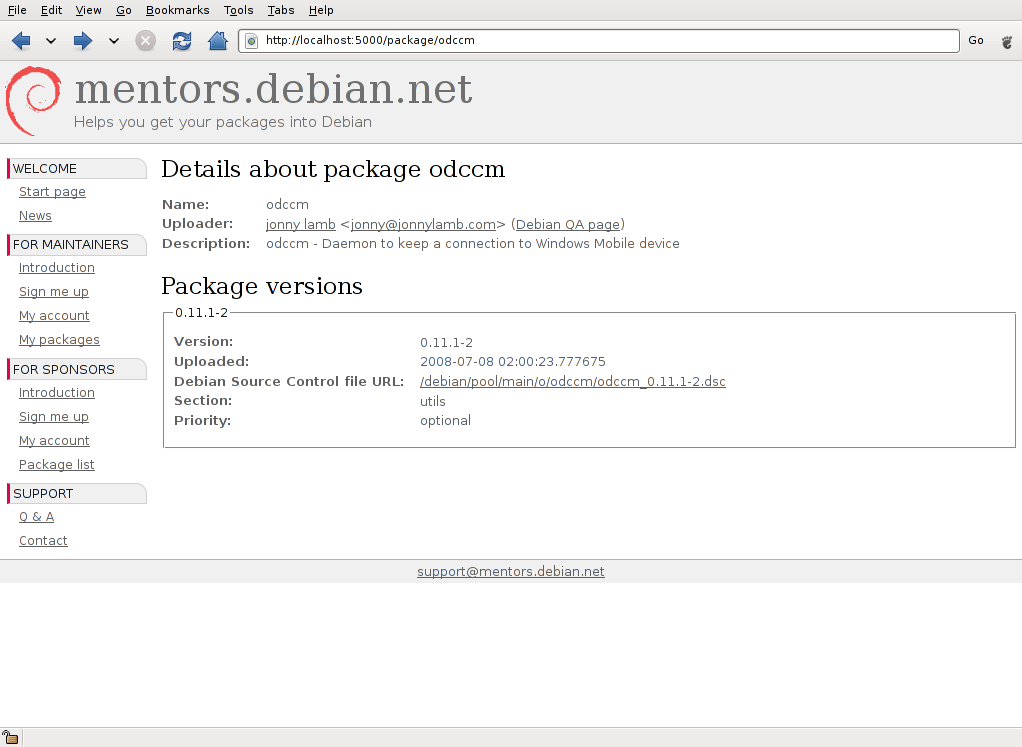
debexpo (Debian package exposition) is a web application that allows one to run a user-friendly public Debian package repository with social interaction that one may be used to from social networking sites. debexpo will be the basis for the mentors.debian.net site but will be useful for others as well. debexpo is the project I am working on for this year’s Summer of Code for Debian under the watch of Christoph Haas debexpo is more than just a web application though. It was based on suggestions by you, and therefore it has some nifty features: Development can be tracked through its Trac instance: http://debexpo.workaround.org/, where I invite you to submit tickets or even submit patches! Its Git repository is public: http://debexpo.workaround.org/debexpo.git (and mirrored here). Last but not least, the there is also a low-traffic mailing list. I invite you to try it out, and report bugs. Posting to the list is a great way to get in contact. There is little visible eye-candy in your browser to show for the work so far as nearly all the work so far has gone into the backend. A sneak peek at what it looks like at the moment is available though: As you can see, the theme is somewhat familiar. Hopefully, as the SoC program nears an end, this will be fixed. Oh, and hello: this is my first post to Planet Debian.

Russ Allbery: WebAuth and LDAP

Andreas, WebAuth really only requires that you use a Kerberos infrastructure for all of the web servers involved. It doesn't actually require that the user accounts be in Kerberos. That's the default, and the way verification is done by the WebKDC module, but the WebLogin front-end can also choose to do account verification itself and tell the WebKDC to trust it. There is currently code in there to do this for the REMOTE_USER case but nothing specifically to do an LDAP modification. However, it should be a relatively straightforward modification to login.fcgi, and I'd certainly take a patch that made it a hook. WebAuth still may not quite be what you want, but I wanted to throw the option out there. Another thing you could look at is Shibboleth, which does the whole web single sign-on thing without assuming any particular authentication system. (You have to protect a URL on the IdP with the authentication system of our choice.) The SP is packaged for Debian but the IdP isn't, and the configuration syntax and the documentation are fairly horrible, but it works and has a lot of fancy features.

David Moreno Garza: Updates

Julien Danjou: Moving back to Paris

It's now official, we're leaving Lille with my girlfriend and will move back to Paris in around 10 days. That means a new home, but I keep the same job. :-) I'll live again in the 14th arrondissement in a 2 room flat which is about 52 m . My DSL connection should already be up, even though I don't have the flat keys: (too) perfect timing. :-)

Wouter Verhelst: Christian,

One word: V.E.R.A. (as in, 'dict -d vera')

Christoph Berg: Packages up for adoption

(Advertisment) I have several packages to give away: If you are interested in taking any of these, please contact me. The first three have open RC-bugs that need some attention, they have been orphaned for some weeks, with no takers. endeavour and avscan are already on the way to RM, if you are interested in these, speak up now. Thanks :)

7 July 2008

Cameron Dale: blog software updated

I updated ikiwiki, the software used to generate this blog, to the version in backports (2.50 from 1.50). I tried very hard to not spam any aggregators, as the new version uses a different link format. Hopefully I succeeded, apologies if I didn't.

Next.

Previous.