Search Results: "mak"

3 March 2011

Kai Wasserb ch: Extending Chronicle

This little blog is created/compiled with Chronicle, coded by Steve Kemp, and one of the cool features is that you can specify a command run before/after your blog gets compiled from the input files. This presents us with one problem and a lot of opportunities. First to the problem: the singular "a command" (from the manual page) might not be enough. Maybe you want to run more than one command. This can be achieved by creating a directory for the commands you want to run before the compilation and one for the commands you want to run after the chronicle run. Then you create a small shell script one directory above and call that from chronicle, the script for the post-run might look like:
#!/bin/sh
set -e
WORKDIR=" dirname $ 0  /post"
find $ WORKDIR  -name "*.sh" -exec " " ";"
This script makes the assumption, that the scripts to run have a .sh suffix and are in a subdirectory named "post". But you can surely adapt this to your needs. Now to one of the oppurtunities this offers: you can now, for example, create static pages, which share the general visual appearance with your blog entries but don't show up in the tags or archive system. I'm using this to generate an imprint for this blog. The script to generate the imprint looks like:
#!/bin/sh
set -e
OUTPUT_PATH= grep output $ HOME /.chroniclerc   cut -d= -f2   tr -d [:blank:] 
sed -ne'/<\?xml version/,/blosxomFirstDayDiv/  /blosxomFirstDayDiv/b;p ' \
        $ OUTPUT_PATH /index.html > $ HOME /tmp/imprint.html
cat  dirname $ 0  /imprint.data >> $ HOME /tmp/imprint.html
echo -e "\n" >> $ HOME /tmp/imprint.html
sed -ne'/imprint_match/,$p' $ OUTPUT_PATH /index.html >> $ HOME /tmp/imprint.html
mv $ HOME /tmp/imprint.html $ OUTPUT_PATH /imprint.html
There are again some assumptions made here, which you'd need to adopt to your setup: Now you have a very powerful system to modify/extend your chronicle-generated blog. I hope you enjoy it as much as I do! A little P.S.: you might want to use version 4.5, as 4.4 had a nasty encoding bug.

Rapha&#235;l Hertzog: People behind Debian: Christian Perrier, translation coordinator

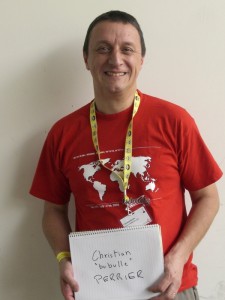
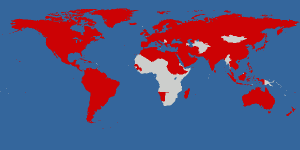
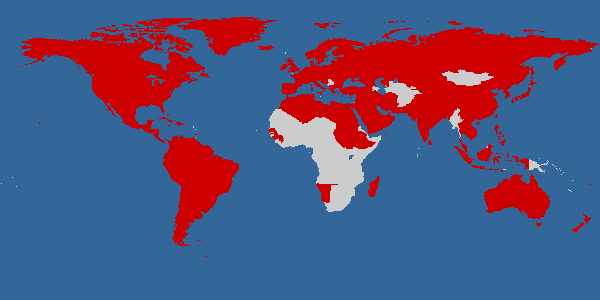
Christian is a figure of Debian, not only because of the tremendous coordination work that he does within the translation project, but also because he s very involved at the social level. He s probably in the top 5 of the persons who attended most often the Debian conference. Christian is a friend (thanks for hosting me so many times when I come to Paris for Debian related events) and I m glad that he accepted to be interviewed. He likes to speak and that shows in the length of his answers :-) but you ll be traveling the world while reading him. My questions are in bold, the rest is by Christian. Who are you? I am a French citizen (which is easy to guess unless you correct my usual mistakes in what follows). I m immensely proud of being married for nearly 26 years with Elizabeth (who deserves a statue from Debian for being so patient with my passion and my dedication to the project). I m also the proud father of 3 wonderful kids , aged 19 to 23. I work as team manager in the Networks and Computers Division of Onera the French Aerospace lab , a public research institute about Aeronautics, Space and Defense. My team provides computer management services for research divisions of Onera, with a specific focus put on individual computing. I entered the world of free software as one of the very first users of Linux in France. Back in the early 1990 s, I happened (though the BBS users communities) to be a friend of several early adopters of Linux and/or BSD386/FreeBSD/NetBSD in France. More specifically, I discovered Linux thanks with my friend Ren Cougnenc (all my free software talks are dedicated to Ren , who passed away in 1996). You re not a programmer, not even a packager. How did you come to Debian? I m definitely not a programmer and I never studied computing (I graduated in Materials Science and worked in that area for a few years after my PhD). However, my daily work always involved computing (I redesigned the creep testing laboratory and its acquisition system all by myself during my thesis research work). An my hobbies often involved playing with home computers, always trying to learn about something new. So, first learning about a new operating system then trying to figure out how to become involved in its development was quite a logical choice. Debian is my distro of choice since it exists. I used Slackware on work machines for a while, but my home server, kheops, first ran Debian 1.1 when I stopped running a BBS on an MS-DOS machine to host a news server. That was back in October 1996. I then happened to be a user, and more specifically a user of genealogy software, also participating very actively in Usenet from this home computer and server, that was running this Debian thing. So, progressively, I joined mailing lists and, being a passionate person, I tried to figure out how I could bring my own little contribution to all this. This is why I became a packager (yes, I am one!) by taking over the geneweb package, which I was using to publish my genealogy research. I applied as DD in January 2001, then got my account in July 2001. My first upload to the Debian archive occurred on August 22nd 2001: that was of course geneweb, which I still maintain. Quite quickly, I became involved in the work on French localization. I have always been a strong supporter of localized software (I even translated a few BBS software back in the early 90 s) as one of the way to bring the power and richness of free software to more users. Localization work lead me to work on the early version of Debian Installer, during those 2003-2005 years where the development of D-I was an incredibly motivating and challenging task, lead by Joey Hess and his inspiring ideas. From user to contributor to leader, I suddenly discovered, around 2004, that I became the coordinator of D-I i18n (internationalization) without even noticing :-) You re the main translation coordinator in Debian. What plans and goals have you set for Debian Wheezy? As always: paint the world in red. Indeed, this is my goal for years. I would like our favorite distro to be able to be used by anyone in the world, whether she speaks English, Northern Sami, Wolof, Uyghur or Secwepemcts n. As a matter of symbol, I use the installer for this. My stance is that one should be able to even install Debian in one s own language. So, for about 7 years, I use D-I as a way to attract new localization contributors. This progress is represented on this page where the world is gradually painted in red as long as the installer supports more languages release after release. The map above tries to illustrate this by painting in red countries when the most spoken language in the country is supported in Debian Installer. However, that map does not give enough reward to many great efforts made to support very different kind of languages. Not only various national languages, but also very different ones: all regional languages of Spain, many of the most spoken languages in India, minority languages such as Uyghur for which an effort is starting, Northern Sami because it is taught in a few schools in Norway, etc., etc. Still, the map gives a good idea of what I would like to see better supported: languages from Africa, several languages in Central Asia. And, as a very very personal goal, I m eagerly waiting for support of Tibetan in Debian Installer, the same way we support its sister language, Dzongkha from Bhutan. For this to happen, we have to make contribution to localization as easy as possible. The very distributed nature of Debian development makes this a challenge, as material to translate (D-I components, debconf screens, native packages, packages descriptions, website, documentation) is very widely spread. A goal, for years, is to set a centralized place where translators could work easily without even knowing about SVN/GIT/BZR or having to report bugs to send their work. The point, however, would be to have this without making compromises on translation quality. So, with peer review, use of thesaurus and translation memory and all such techniques. Tools for this exist: we, for instance, worked with the developers of Pootle to help making it able to cope with the huge amount of material in Debian (think about packages descriptions translations). However, as of now, the glue between such tools and the raw material (that often lies in packages) didn t come. So, currently, translation work in Debian requires a great knowledge of how things are organized, where is the material, how it can be possible to make contribution reach packages, etc. And, as I m technically unable to fulfill the goal of building the infrastructure, I m fulfilling that role of spreading out the knowledge. This is how I can define my coordinator role. Ubuntu uses a web-based tool to make it easy to contribute translations directly in Launchpad. At some point you asked Canonical to make it free software. Launchpad has been freed in the mean time. Have you (re)considered using it? Why not? After all, it more or less fills in the needs I just described. I still don t really figure out how we could have all Debian material gathered in Rosetta/Launchpad .and also how Debian packagers could easily get localized material back from the framework without changing their development processes. I have always tried to stay neutral wrt Ubuntu. As many people now in Debian, I feel like we have reached a good way to achieve our mutual development. When it comes at localization work, the early days where the everything in Rosetta and translates who wants stanza did a lot of harm to several upstream localization projects is, I think, way over. Many people who currently contribute to D-I localization were indeed sent to me by Ubuntu contributors .and by localizing D-I, apt, debconf, package descriptions, etc., they re doing translation work for Ubuntu as well as for Debian. Let s say I m a Debian user and I want to help translate Debian in my language. I can spend 1 hour per week on this activity. What should I do to start? Several language teams use Debian mailing lists to coordinate their work. If you re lucky enough to be a speaker of one of these languages, try joining debian-l10n-<yourlanguage> and follow what s happening there. Don t try to immediately jump in some translation work. First, participate to peer reviews: comment on others translations. Learn about the team s processes, jargon and habits. Then, progressively, start working on a few translations: you may want to start with translations of debconf templates: they are short, often easy to do. That s perfect if you have few time. If no language team exists for your language, try joining debian-i18n and ask about existing effort for your language. I may be able to point you to individuals working on Debian translations (very often along with other free software translation efforts). If I am not, then you have just been named coordinator for your language :-) I may even ask you if you want to work on translating the Debian Installer. What s the biggest problem of Debian? We have no problems, we only have solutions :-) We are maybe facing a growth problem for a few years. Despite the increased welcoming aspects of our processes (Debian Maintainers), Debian is having hard times in growing. The overall number of active contributors is probably stagnating for quite a while. I m still amazed, however, to see how we can cope with that and still be able to release over the years. So, after all, this is maybe not a problem :-) Many people would point communication problems here. I don t. I think that communication inside the Debian project is working fairly well now. Our famous flame wars do of course still happen from time to time, but what large free software project doesn t have flame wars? In many areas, we indeed improved communication very significantly. I want to take as an example the way the release of squeeze has been managed. I think that the release team did, even more this time, a very significant and visible effort to communicate with the entire project. And the release of squeeze has been a great success in that matter. So, there s nearly nothing that frustrates me in Debian. Even when a random developer breaks my beloved 100% completeness of French translations, I m not frustrated for more than 2 minutes. You re known in the Debian community as the organizer of the Cheese & Wine Party during DebConf. Can you tell us what this is about? This is an interesting story about how things build themselves in Debian. It all started in July 2005, before DebConf 5 in Helsinki. Denis Barbier, Nicolas Fran ois and myself agreed to bring at Debconf a few pieces of French cheese as well as 1 or 2 bottles of French wine and share them with some friends. Thus, we settled an informal meeting in the French room where we invited some fellows: from memory, Benjamin Mako Hill, Hannah Wallach, Matt Zimmermann and Moray Allan. All of us fond of smelly cheese, great wine plus some extra p t home-made by Denis in Toulouse. It finally happened that, by word of mouth, a few dozens of other people slowly joined in that French room and turned the whole thing into an improvized party that more or less lasted for the entire night. The tradition was later firmly settled in 2006, first in Debconf 6 in Mexico where I challenged the French DDs to bring as many great cheese as possible, then during the Debian i18n meeting in Extremadura (Sept 2006) where we reached the highest amount of cheese per participant ever. I think that the Creofonte building in Casar de C ceres hasn t fully recovered from it and is still smelling cheese 5 years after. This party later became a real tradition for DebConf, growing over and over each year. I see it as a wonderful way to illustrate the diversity we have in Debian, as well as the mutual enrichment we always felt during DebConfs. My only regret about it is that it became so big over the years that organizing it is always a challenge and I more and more feel pressure to make it successful. However, over the years, I always found incredible help by DebConf participants (including my own son, last year a moment of sharing which we will both remember for years, i think). And, really, in 2010, standing up on a chair, shouting (because the microphone wasn t working) to thank everybody, was the most emotional moment I had at Debconf 10. Is there someone in Debian that you admire for their contributions? So many people. So, just like it happens in many awards ceremonies, I will be very verbose to thank people, sorry in advance for this. The name that comes first is Joey Hess. Joey is someone who has a unique way to perceive what improvements are good for Debian and a very precise and meticulous way to design these improvements. Think about debconf. It is designed for so long now and still reaching its very specific goal. So well designed that it is the entire basis for Joey s other achievement: designing D-I. Moreover, I not only admire Joey for his technical work, but also for his interaction with others. He is not he loudest person around, he doesn t have to .just giving his point in discussion and, guess what? Most of the time, he s right. Someone I would like to name here, also, is Colin Watson. Colin is also someone I worked with for years (the D-I effect, again ) and, here again, the very clever way he works on technical improvements as well as his very friendly way to interact with others just make it. And, how about you, Rapha l? :-) I m really admirative of the way you work on promoting technical work on Debian. Your natural ability to explain things (as good in English as it is in French) and your motivation to share your knowledge are a great benefit for the project. Not to mention the technical achievements you made with Guillem on dpkg of course! Another person I d like to name here is Steve Langasek. We both maintain samba packages for years and collaboration with him has always been a pleasure. Just like Colin, Steve is IMHO a model to follow when it comes at people who work for Canonical while continuing their involvment in Debian. And, indeed, Steve is so patient with my mistakes and stupid questions in samba packaging that he deserves a statue. We re now reaching the end of the year where Stefano Zacchiroli was the Debian Project Leader. And, no offense intended to people who were DPL before him (all of them being people I consider to be friends of mine), I think he did the best term ever. Zack is wonderful in sharing his enthusiasm about Debian and has a unique way to do it. Up to the very end of his term, he has always been working on various aspects of the project and my only hope is that he ll run again (however, I would very well understand that he wants to go back to his hacking activities!). Hat off, Zack!I again have several other people to name in this Bubulle hall of Fame : Don Armstrong, for his constant work on improving Debian BTS, Margarita Manterola as one of the best successes of Debian Women (and the most geeky honeymoon ever), Denis Barbier and Nicolas Fran ois because i18n need really skilled people, Cyril Brulebois and Julien Cristau who kept X.org packaging alive in lenny and squeeze, Otavio Salvador who never gave up on D-I even when we were so few to care about it. I would like to make a special mention for Frans Pop. His loss in 2010 has been a shock for many of us, and particularly me. Frans and I had a similar history in Debian, both mostly working on so-called non technical duties. Frans has been the best release manager for D-I (no offense intended, at all, to Joey or Otavio .I know that both of them share this feeling with me). His very high involvment in his work and the very meticulous way he was doing it lead to great achievements in the installer. The Installation Guide work was also a model and indeed a great example of non technical work that requires as many skills as more classical technical work. So, and even though he was sometimes so picky and, I have to admit, annoying, that explains why I m still feeling sad and, in some way, guilty about Frans loss. One of my goals for wheezy is indeed to complete some things Frans left unachieved. I just found one in bug #564441: I will make this work reach the archive, benefit our users and I know that Frans would have liked that.

Thank you to Christian for the time spent answering my questions. I hope you enjoyed reading his answers as I did. Subscribe to my newsletter to get my monthly summary of the Debian/Ubuntu news and to not miss further interviews. You can also follow along on Identi.ca, Twitter and Facebook.

7 comments Liked this article? Click here. My blog is Flattr-enabled.
2 March 2011

Craig Small: JFFNMS 0.9.0 release candidate 1 out

The next version of jffnms is nearing completion and is now at Release Candidate 1. Version 0.9.0 has a major amount of work in cleaning up and securing the code. The majority of the work has been in the complete re-write of the engines that do the polling, autodiscovery and consolidation. The parent/child communication has changed as has the way the processes are forked. On the front-end, the requirement to register globals has finally been removed, with the code explicitly specifying and sanitising the variables it requires. This will make it easier to debug problems and make the application webservers more secure. Finally there is better support for High Capacity interface counters and some support for IPv6, meaning you can see how slow ipv6.google.com is from your place. JFFNMS 0.9.0rc1 is available from SourceForge at https://sourceforge.net/projects/jffnms/files/jffnms%20RC/

Jonathan Wiltshire: Privacy specialists should hire security specialists

I was interested to hear about a company here in the UK called ALLOW Ltd., offering marketing database management under a we ll get you off lists, then pay you to go back on at your pleasure basis. That sounds a fair deal to me, so I decided to sign up for it.
Our technology is built using some of the best and most secure tools in the industry. We have partnered with infrastructure providers who handle some of the most sensitive data in the UK (such as medical and financial records). Both the digital and physical security measures we have implemented are amongst the strongest available anywhere. This includes full encryption of all data at all times, full implementation of secure socket layers, security certificates and physical restriction of access to the data, our servers and our offices. Our systems have been fully penetration tested (that means we ve asked people to try and break in).
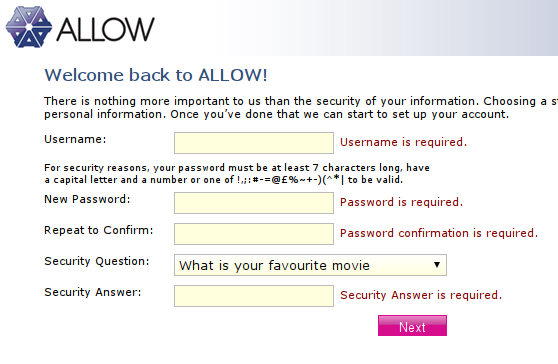
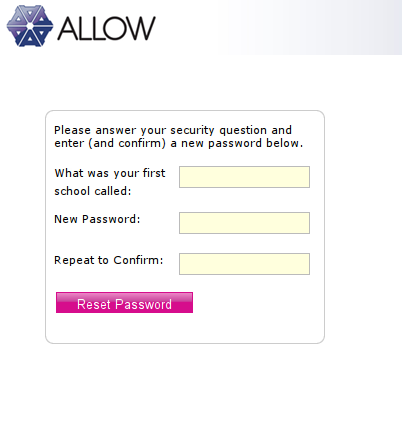
(There are other suitable assertions in various places they even have a set of principles about safeguarding data.) Unfortunately, this promise is rather undermined in several ways after noticing the first couple, I did a little digging to see what else was exploitable. Here s the final part of the joining process, where you choose a username and password combination: The text I ve cropped too eagerly says Choosing a secure password is an essential part of protecting your personal information , or thereabouts. I duly chose a complex password that fitted the requirements, and to my surprise it was rejected. I tried another, and it was rejected; then a third and a fourth. By trial and error I worked out what was going on: 1. The password must contain only the listed special characters, not just include one of them. That s a bit of a problem, because even assuming a basic ASCII set, 15 characters are unavailable to users; 80 are left, so that s about a 15% fall in the available combinations*. Not a good start. More concerning is the presence of a security question field. It s used for resetting the password in the event losing it, but this technique for recovery has long been ridiculed the shared secret is often common knowledge amongst friends, and sometimes (as in this case) the available questions are fairly easy for an attacker to find the answer to in public records or solicit from the victim without arousing much suspicion: 2. The security questions available include First pet s name and worse, First school name . It s pretty pointless enforcing stringent password requirements, and then bypassing them with something so susceptible to a dictionary attack. I was pleased to find that failing to log in to an account more than a few times results in a temporary lockout, which should deter casual brute force attacks. But I wanted to know how that security question would be used, so I forgot my password and followed the links to reset it. Here s the form: Actually the first form, not shown here, initially just asks for a username, giving an error message if it isn t registered, and here s another problem: 3. The password reset process confirms the existence, or non-existence, of a given username half the credentials required to log in to any visitor. I d be prepared to take a bet that most users will choose What was the name of your first school? as a security question. The first pet you have is often at such a young age you can t remember it clearly; the name of the street you grew up on might change a couple of times if you moved house. But first school I attended? I ll never forget that, so it makes most sense to use as a backup password . It s also the best one for an attacker to try and find out from public sources. But that aside, as you can see the password is not generated at random and communicated to the real account holder out-of-band, in the manner of many other sites. Instead: 4. A new password is immediately set to a value already known by the attacker. Once inside, an attacker can also change the security question or answer, or both, so you can t even regain your account by telephoning the company unless you can convince them you re genuine, in which case the security question was a total waste of time anyway. I awarded some marks for notifying the user by email that the password has been changed, but immediately docked them again because bingo! You re now a victim of identity theft! Let s assume you ve been locked out, the security question has been changed and you want your account back. ALLOW don t let you telephone them; you either have to dig around and find an address to send an email, which we all know can be intercepted, or (and you re encouraged to) contact them through a form on the site. You ll probably include some personal details, because you want to convince them of your real identity; indeed, two of the options on the form are I ve got a question and Something doesn t work . I sent my findings through this very form, under the latter heading, and to my surprise: 5. Despite promises of full encryption of all data at all times, full implementation of secure socket layers , the contact form is transmitted to ALLOW in the clear, with no protection whatsoever. So now anyone listening in your connection knows all about you too: your ISP, any of the peers along the route, the deep packet inspection advertisers if your ISP is less than reputable, and the neighbour who connects to your wireless and slips you a fiver every month for the privilege. Nice work, privacy specialists. (For the record: * please feel free to correct my maths. It was never my strongest subject.
Comments
Privacy specialists should hire security specialists is a post from: jwiltshire.org.uk Flattr

Joachim Breitner: Tor exit node shut down by server4you

As mentioned earlier this week, I changed the server for my hoster from server4you to Hetzner. Because the contract for my old server is still running until the 14th of April, I thought I can make some good use of it by running an Tor exit node on it. Tor, The onion router is a world-wide network of server to anonymize network connections, and used for example by freedom-loving people in repressive countries, or by Facebook users in repressively proxied university networks Naturally, such a system is also used by people with lesser motives, and after nearly one week of running the server, some complaints were reaching server4you a honeynet supposedly detected botnet activity from my IP address, another company hired by Paramount Pictures claimed that someone downloaded Iron Man 2 over BitTorrent via my server. These were forwarded to my by server4you, demanding an explanation. I explained that I am running a Tor node, that such things are unavailable, and that neither I nor server4you is going to be held responsible. Nevertheless, they insist that I should stop whatever I am doing (I am not sure if they really understood what tor is), and when I said that I won t, they decided to unilaterally and immediately end my contract by tomorrow. Thus a powerful exit node that might have made life better for Tor users is doing to disappear again. They will not reimburse the advance fee that I had paid in advance and made a non-specific threat about further claims they might have. So server4you was, at least in my case, not only an unreliable and inflexible provider, they also prefer to cut off their customer s server just because of two complaints by third parties. I conclude that this is not a hoster that you should trust important services to. And I am not a unique case: There are reports of similar server shut-downs by server4you (in German).

Michal &#268;iha&#345;: OpenID in phpMyAdmin

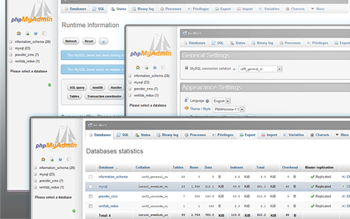
Well not really. The simple reason is that it does not make sense without further integration with other services. However if you want to deploy such solution, you can now base on example script, I've just pushed to our git repository. It is definitely meant only as example, major reason being storing MySQL user names and passwords in clear text in the PHP script.

Filed under: English Phpmyadmin 0 comments Flattr this!

Maximilian Attems: Cross distribution collaboration on longterm 2.6.32 linux-2.6

I'll collect here links to the various linux-2.6 distribution trees based on the longterm release 2.6.32. I won't go into details of bigger external patches (grsec, openvz, rt, xen, ..), which in consequence also aligned themselves on 2.6.32. Important bug fixes usually are connected to some bug report, which may be publicly viewable. So from the patch and changelog entry one can usually assume if a certain patch satisfies the stable criteria and forward it for 2.6.32 longterm inclusion (+ other branches where it might apply). If the patch applies and compiles fine with the Debian tree one can assume that the patch will be fine for upstream 2.6.32 as Debian with small exceptions mostly follows the longterm release: 2.6.32 branch of Debian linux-2.6 (Comment: This is currently only a svn mirror but this bug is worked on for next release). The canonical 2.6.32 linux-2.6 longterm repository is of course on kernel.org maintained by gregkh. Opensuse publishes it's kernel-source on gitorious including all branches and the especially interesting SLE11-SP1 2.6.32 branch. Fedora was following till late Autumn 2.6.32 and the F12 branch has the relevant patches. Ubuntu released 10.04 with 2.6.32 as in a collaborative decision they also based their drm on 2.6.33 (same story as in Debian, thus particularly relevant for us). Oracle had a 2.6.32 that was maintained until Sept 2010 or such. It is already bad that kernel source in Red Hat doesn't really follow upstream 2.6.32 longterm release itself. For 2.6.18 of course no such option existed, but for 2.6.32 this policy already shows a certain snobbery. Red Hat 6.0 Beta at least shipped kernel-2.6.32-37.el6.src.rpm with broken out patches - since then no patch series or git tree to be seen from RH. This strange move got since picked by lwn - RH "obfuscated" kernel source.

Sandro Tosi: MySQL master/slave chain

Have you ever needed to create a MySQL databases replication chain like A->B->C where B is slave of A and master of C? Me neither, until yesterday.

Since it took us about an afternoon to make it works (along with our DBAs, so we're not alone ;)) let's share some knowledge.

A very brief recap of how MySQL replication works:

  1. slave I/O thread connects to the master, gets the new information from the binlog files and stores them in the relay log;
  2. slave SQL thread reads the relay log and applies the changes to the slave database, without changing the slave binlog files.
That said, B replicates correctly from A, but C is unable to replicate from B because B doesn't change its binlog files with updates coming from A, because there's no changes done directly on B.

In order to make the chain works, you need to add the parameter log-slave-updates on B configuration: that will reply the changes from relay log to binlog, and so C will see the changes it needs to correctly replicate.

PS: mysqldump --master-data (executed on the slave server against the master) would help you set up the correct information for replication.

Adrian von Bidder: Open Letter to Gianugo Rabellino

Dear Mr. Rabellino, Actions speak louder than words. So stop giving interviews and do your homework. Release documentation without license and patent threats surrounding them (how about all protocols related to Sharepoint and Exchange?) Support stuff like Ogg Theora in HTML 5 for IE and the OpenDocument format in MS Office. Admit that you just bought the OOXML standard and that you can't even implement it yourself. Hand over your patent portfolio to the Open Invention Network. Use your cash reserves to buy Nvidia and then release a proper driver for their GPUs (obviously, I'm talking about a driver for the X window system under appropriate licenses, not a Windows driver.) If you ever are challenged that Microsoft should do something like this, don't come up with lame excuses like I would like to do this but the company won't let me. Either you can move your company or admit defeat and resign instead of pretending to care about relationship to the Free Software communitites. Your company has a long, long history and needs to make good on it. Talking won't change any of this. Being forced to take some (very small) steps towards openness by court decisions won't change any of this. Probably, even being a model citizen for 5 years won't change much because people have long memories, but hey, you worked hard to get this reputation.

1 March 2011

Michal &#268;iha&#345;: phpMyAdmin has new theme

Following results of theme survey, I've changed default theme of phpMyAdmin to pmahomme: pmahomme theme I'm sure this new attractive look will improve user experience of upcoming 3.4 release. You can expect beta release with new theme soon and then we will hopefully smoothly continue through one (or more) release candidates to final release. While making this theme default one, we've also offered team membership to Mike Homm and I'm quite confident this will be valuable addition to the team. Mike, welcome on board!

Filed under: English Phpmyadmin 0 comments Flattr this!

Daniel Kahn Gillmor: Turning my back on the IEEE

I used to maintain a membership with IEEE. I no longer do. The latest nonsense to come from them is a change for the worse in their copyright assignment policy, which i thought was already problematic. Other engineering societies (IETF, USENIX, etc) continue to do socially relevant, useful work without attempting to control copyright of work contributed to them. This just makes IEEE look like a power- and money-hungry organization, rather than a force for positive advancement of technology. For shame, IEEE. I will not consider reinstating my membership unless the organization changes their copyright assignment and publication policy to better reflect the spirit of scientific inquiry and technological advancement they should stand for.Tags: freedom, ieee, policy

Michal &#268;iha&#345;: phpMyAdmin translation status

Another week is over and it's time to look again at state of translations for phpMyAdmin 3.4. Compared to last week, there one three translations at 100%, so we now have 12 translations at 100%: But there are still lot of translations which would need some love: You can help make translation to your language better!

Filed under: English Phpmyadmin 0 comments Flattr this!

Rapha&#235;l Hertzog: 5 Free Software To Support With Flattr

Flattr FOSS LogoAnother month and thus another issue of Flattr FOSS. Time flies but Flattr s usage seems to remain relatively strong. I was fearing that people get bored after some time but that does not seem be to the case, my Flattr income does not really drop (it doesn t take off either ;-) ). I get a bit less for dpkg than at the start but a bit more for my blog. Enough babbling, let s go straight to the 5 projects to flattr this month:
  1. Linux Mint (Flattr link) is a Linux distribution based on Debian and Ubuntu that targets home desktop users. I have never tried it (I m too much of an hardcore Debianer) but I ve read several good reviews saying that it works well out of the box with good multimedia support. If you try it out, be sure to pick Linux Mint Debian Edition (LMDE). :-)
  2. Network Block Device (NBD) user-space support tools (Flattr link) is the set of tools to setup a block device whose content is really on a remote server. It requires support of NBD in the kernel of course. The user space tools are maintained by Debian developer Wouter Verhelst.
  3. Tahoe LAFS (Flattr link) is a filesystem that implements a cloud storage. The data are distributed across multiple servers in such a way that it can continue to work even if one of the servers fails.
  4. Gajim (Flattr link) is a full featured and easy to use Jabber client. If you don t need support of multiple instant messaging protocols, this Jabber client might be a good fit for you.
  5. Aur lien Gateau (Flattr link) is a KDE developer who takes one day per week off his work to work on KDE. He seeks support from the community to compensate for the loss of revenue. Much like me, he has a support page with a complete history of the amount of donations received. I can only sympathize with people who try to live true to their passion good luck Aur lien!
This article is part of the Flattr FOSS project.

5 comments Liked this article? Click here. My blog is Flattr-enabled.
28 February 2011

Matthew Garrett: Further adventures in mobile Linux

I picked up a couple of cheap Linux devices at the weekend. First of all, a $99 Android tablet from CVS, made by Craig. It's a generic RK2818 device and of course it's lacking any kind of GPL offer in the documentation. As far as I know the only company that's released any Rockchip source so far has been Archos, and even then they haven't released the tools you need to actually build an image - they seem to be floating around the internet anyway. But it's straightforward to get it to run the Android market, and it runs Shortyz quite well, so fit for purpose from my point of view. I am, obviously, attempting to contact Craig to find out how they're going to satisfy their obligations but haven't got past their bizarre text-to-speech based support menu system that dumps you to answerphone after 5 minutes of being on hold. Next attempt will involve pressing more buttons.

The other one was a Sharper Image Literati e-reader, $49 from Macy's (on clearance, obviously). This one's interesting by virtue of not being an Android device. Instead it's got a fairly recognisable Busybox-based Linux environment that's even got udev and dbus running. It brings up a framebuffer and just dumps a QTE-based reader (from Kobo) onto it. Other than being woefully underpowered and slow, it actually seems very competent. There seem to be several versions of the hardware - the one I got has an ARM SoC from SiRF on it. SiRF make GPS chipsets, and it turns out that their Atlas 5 platform is actually intended for Linux-based GPS units. The embedded world always seems to find a way. What surprised me more is that it's probably the most polished looking Linux I've bought for under $300. No bizarre kernel spew. echo mem >/sys/power/state works. Standard backlight interface.

Oh, and no source. Obviously. But an interesting device regardless.

(comment count unavailable Comments Comment on this)

Kai Wasserb ch: On the unofficial wine-unstable packages on dev.carbon-project.org

I've been building unofficial wine-unstable packages for some time now and the amount of people apparently using them has become noticable (not only traffic-wise). Thus the amount of questions send to me has also risen quite a bit. In this post I try to address most of the questions in the hope it'll help people understand my motives for building these packages and potential pit falls for users. First of all: I'll stop building those packages as soon as Debian has a for my purposes recent enough version in the archives. This is expected to happen soon as most/all of the blocking issues should be sorted out now/soon. See e.g. #557783 for some insight into the problems. It might happen after updated packages are in Debian, that I'll build one version or the other occasionally to test a certain patch or version. The bottom line of this is: don't rely on me to provide always the latest packages. (This, by the way, is also explanation enough to the question, whether I'm going to build the "official" (I consider only those entering Debian's archives official) Debian packages for upstream (WineHQ).) Another question, which is seen every now and then in my inbox, is, whether I could add patch xyz to the packages. The answer is no. I maintain those packages for myself and if you want to use them, you're welcome. If you need another patch applied, just download the source package and add the patch with quilt to the series. When a certain version/build doesn't work for you, you can ask me for help, but please don't expect me to handle "doesn't work" reports like I would handle bug reports for my packages. The wine-unstable packages are for myself and if they work for me, that's all I aim for. Before spreading the word about my packages, make sure, you and those who read your post/message/whatever about my packages understand, that it is generally a very bad idea to install third-party packages, even though I'm a Debian Developer. Make also sure everybody understands that only the source package is signed with my key. Please don't download all packages (binary and source), unless you really need all of them. Please pick the ones, you need and just download them. Even though this might sound like begging, which I'm not, it'd be nice, if you could consider donating (via PayPal) something, to help cover the traffic costs. The traffic for just the wine-unstable packages has risen dramatically in the last few months. Thanks! Now, I hope I've answered most questions, if not, feel free to contact me.

Russell Coker: Links February 2011

Australia s Department of Finance has mandated that the MS-Office document format should be the standard document format for all agencies [1]. Paul Wayper notes the fact that MS doesn t plan to support it s own standards and suggests ODF, also known as ISO/IEC standard 26300:2006. [2].Psychology Today has an interesting blog post by Marnia Robinson about scientific reasons for avoiding porn addiction [3]. Her post links to a number of other posts on the topic on Psychology Today.Psychology Today has an interesting post by Noam Shpancer titled What Doesn t Kill You Makes You Weaker [4]. It seems to me that the belief to the contrary is due to people rationalising bad things that happened to them, it s not all bad as it made me stronger .Psychology Today has an interesting article by Noam Shpancer about the soldier as hero myth [5]. He argues that soldiers are really just employees, the risk to American soldiers in war zones really isn t that great and that they are just pawns to the military-industrial complex.Anders Ynnerman gave an interesting TED talk about visualising medical data which includes many startling 3D pictures of humans and animals that are being scanned [6]. He describes how this is useful in forensic analysis by the police and in better understanding biological processes.Margarita Manterola gave an interesting Debconf talk titled Making Debian Rule, again , she has some interesting ideas for improving Debian [7]. She is most focussed on social problems and the questions and comments had some interesting ideas. The Center for Non-Violent Communication [8] was mentioned in the questions, apparently their success includes teaching better communication skills to violent criminals, so it seems that they can help with some big problems.Benjamin Mako Hill wrote an interesting article about the ratio of writers to readers on Wikipedia [9]. While he makes some good points I m wondering about the measure of an editor , there have been few months where I have made 5 edits, so I guess I m just a reader. I probably should take more care in logging in when I make changes though, I ve made more than a few small changes from random systems (client sites, Internet cafes, etc) without bothering to login. This would mess up the stats a bit.The Reid Report has an interesting article about Bush being limited in his international travel due to the fact that he has admitted being a war criminal [10].Understanding Prejudice is an interesting article that summarises a lot of psychological research [11]. It gives many ideas for anyone who wants to reduce prejudice.Robin Harris wrote an interesting ZD Net article about vibrations and the impact on disk performance [12]. Apparently it s very common to be able to get more performance from drive arrays if you dampen vibration, previously I believed that unless you had extreme vibration to cause catastrophic problems then nothing would go wrong. But it seems that even smaller amounts of vibration can cause a 30% performance loss or worse! There is work in progress on vibration-damping racks.In a story published in The Australian about the NSW ambulance service being shut down due to a virus, Professor Caelli cites SE Linux as an example of a technology to make computers more virus resistant [13]. Professor Caelli also states that there should be a legal requirement to have backup systems for computers that have such grave consequences if they crash.Sinclair Community College is offering a new class Fundamentals of Linux Security , it includes SE Linux [14].Slate has an interesting article about Pickpockets [15]. Apparently they are becoming extinct in the US as law enforcement has prevented the Fagins from training younger people, and it s only in Eastern Europe that the skills base remains.

27 February 2011

Adnan Hodzic: What s the best Xperia X10 custom ROM?

Everybody hates Xperia When I first got Sony Ericsson Xperia X10 it was running on Android Donut (1.6), my frustrations followed soon after mostly because it was greatly lagging with release of Android 2.1. Finally official 2.1 was released, but troubles didn t stop there, because everybody was waiting for multi-touch support I could go on like this for a very long time. However, to sum it up Sony has no plans of updating X10 anymore, they are releasing brand new phone (Arc) and they are hoping people will pay money to get it after X10 horrors. Even tho 2.1 isn t that old, (31.4% of overall Android users is using it on it), Sony changed its UI to make it look better, but all they actually did is make it look pretty bad + made it abnormally slow. Xperia ROMs From hardware aspect, it s a pretty awesome phone, but from software aspect it waste of nerves. It s obvious that Sony needs to hire more Linux people, because as it seems they have no idea what they are doing. There are of course, 2.2 Froyo and 2.3 Gingerbread straight from Google ROMs, but to be honest phone is only half usable with those. The feeling I get when using these is plain awkward. All these ROMs are stuck on 2.6.29, since as it seems Sony did a very good job protecting its bootloader, what I suggest is to use these for strictly development purposes, and have them dual boot with your working 2.1 2.2.1 Froyo (beta)
http://forum.xda-developers.com/showthread.php?t=917956 Gingerbread 2.3.1 (alpha)
http://forum.xda-developers.com/showthread.php?t=931934 So what is the best ROM? Out of all the ones I tried (and I tried many) it s definitely: kX10 Custom 2.1 SE ROM R2B001
http://forum.xda-developers.com/showthread.php?t=913610 My main argument on what this is the best ROM is because, everything is working, and it s working fast. Author stripped it to the minimum, and what I definitely suggest is that you go with the R2B001 Lite because the Full version comes with too much apps. with it, kinda making this great ROM feel bit bloated. I made a video for you to experience its speed: <iframe allowfullscreen="allowfullscreen" frameborder="0" height="390" src="http://www.youtube.com/embed/8xe0hUx2k28?rel=0" title="YouTube video player" width="480"></iframe> Modifications:
  • 2.1 Generic Firmware (2.1.A.0.435), Rooted with xRecovery, JIT v2, SuperUser, and busybox installed;
  • SuperCircle Battery / Reboot option mod;
  • Ubuntu system fonts with Emoji support (display only)
  • All APKs zipaligned / All non-essential system APKs moved to /data/app for easy uninstall and apps2sd support
build.prop Modifications
  • windowsmgr.max_events_per_sec=260 Makes scrolling smoother
  • wifi.supplicant_scan_interval=180 Slows down the WiFi scan to every 3 minutes, saves battery
  • dalvik.vm.heapsize=26m Optimal heapsize for most X10s
  • mot.proximity.delay=100 Makes the screen off/on proximity sensor more responsive
Surprisingly I m getting much lower score Quadrant score, but also getting a much higher Linpack score: benchmark results of hacked Stock SE 2.1 ROM (2.0.2.A.0.24 root + JIT) Even though, the phone s much much faster. A couple of screenshots, including Linpack/Quadrant benchmark results. Nexus S This is how I m planning to live my remaining days on this phone, if it wasn t for this ROM, I would ve crashed my X10 long time ago. In meantime I m eagerly waiting to put my hands on Nexus S, whose official release we re still waiting for in Europe Thinking Google, please hurry up Smile

Dominique Dumont: How to clean up dependencies with version in Debian packages

Hello Now that Squeeze is out, a lot of cleanup is going in Debian packages. One of them is getting rid of unnecessary dependencies with minimal versions in packages. I.e. getting rid if unnecessary versions like perl (>= 5.8.1).
Because Lenny was shipped with Perl 5.10, requiring Perl with version greater than 5.8 is not necessary and needlessly loads dependencies resolvers. In other words, you re not only doing this cleanup to make your source package lighter, you re doing it also for your users so that package upgrade go faster. Anyway, checking these versioned in a real PITA. So I ve enhanced Dpkg control model in Config::Model to take care of this check. To check your package, install libconfig-model-perl (from Sid), go in your package directory and run this command: config-edit -application dpkg -ui none This command will check your control file, your copyright file and may issue warnings or errors. Some warnings like the versioned dependencies can be fixed automatically with this command: config-edit -application dpkg -ui none -apply-fixes -save Be sure to archive your files before running this command to check what s been done by -apply-fixes options. For more information on using config-edit, please read Using config-model wiki page. All the best

Kai Wasserb ch: KVIrc in Debian

As one of the Co-Maintainers of KVIrc, I'd like to give you a short outlook on what is planned for KVIrc in Debian in the near future or at least in the Wheezy release cycle. Apart from what is listed above, we, the Debian Maintainers of KVIrc, strive to improve its packaging constantly.

26 February 2011

Neil Williams: Why software patents differ from pharmaceutical patents

I was going to make this a comment against Ritesh Raj Sarraf's post about patents and pharmaceuticals but the comment got way too long.

The basic problem is that patents on pharmaceuticals cannot be directly compared to patents on software and the explanation gets a bit involved. It's worse than apples and oranges, it's more like comparing an algorithm to a piece of DNA.

Patented pharmaceuticals must declare the precise chemical formula of the molecule (and a whole lot else besides) before the molecule can be brought to market but the company holding the patent is legally prevented from protecting themselves against slightly different molecules which are blatantly based on the protected molecule. All modification results in a new patentable product, legally separated from the original.

Therefore, the first company to patent a molecule from a new class is instantly joined in the field by other companies who are (obviously) watching the research news channels very carefully. (In their shoes, you would do the same or you go bust.) These companies simply add a flourine ion or change a hydrogen to a hydroxl group or any other number of minor, apparently inconsequential, changes. Changes which, in software, would be deemed a derivative work and would be roughly equivalent to changing a single local variable from a 16bit integer to a 32bit integer in a single function in a single file in the entire codebase. i.e. a trivial bug fix or even a typo.

A molecule with a couple of hundred atoms can have a change affecting one atom and be a completely new patentable item without any risk of the other company being sued for patent infringement, plagiarism, copyright violation (there is no copyright) or any other barrier. It's common to find that molecule foo is joined on the market by a desoxyfoo and a flourofoo etc. with a chlorofoo just around the corner, within months of the class-leader being launched. It can't be compared to software - effectively, every new release gets a new patent which covers the entirety of everything contained in that release, even if 99.999999999% of it is precisely the same as is covered under other several other patents held by extremely litigious competitors.

Modification is simply not prohibited - copying without making any changes whatsoever to the active molecule is prohibited. Changes to the inactive ingredients will be prosecuted - changes to the active ingredient will not. Comparing this with software is likely to drive you insane.

For example, the mere process of packaging an upstream release for a distribution would be patent infringement in pharmaceutical terms - UNLESS you deliberately patch the original source to make an utterly trivial and apparently pointless change. At that point, the upstream completely disown your entire release and you would have to fix every bug yourself - without the original upstream even telling you whether they fixed the same bug themselves, because they aren't ABLE to modify the upstream code without starting a whole new project and they won't tell you why or how they changed things. There is no such thing as an alpha-release of a molecule. Every release is final and no subsequent modification is possible - unless it only affects the inactive ingredients, e.g. by adding a slow release coating. These changes can affect the way that the molecule acts on the test subject / patient but must not change the active ingredient itself in any identifiable way. So the upstream can make a new wrapper (new packaging) but nobody else is allowed to do so until the patent expires. Once the patent expires, every one and their dog is allowed to make identical copies of the active ingredient in their own inactive packaging and these are called generics. Generics still need testing to ensure that the active ingredient truly is the same and that the generic behaves in the same way as the original but this process is cheaper than making a change to the active molecule.

A changed active molecule is an entirely new substance, it gets a new patent and it needs to go through largely the same amount of testing as the patented original but the new company still gets a head start on what the molecule is likely to do and what side-effects (by now noticeable with the class-leader product which is in large scale trials or even on the market) would be harmful to the future usefulness of their new, derivative, molecule. The new company simply jumps onto the bandwagon shouting "I want a piece of that action!" and there is absolutely nothing the original company can do about it, except try to show that their original molecule is better than the new competitors and to try and build a substantial market share before everyone switches to the new derivative. (Prescribers are human and tend therefore to be lazy, so unless there's a reason to change, the class leader will still have substantial share even after several derivatives exist.)

It's an arms race - each company tries to create as many of these potential "me-too" variants as possible in-house, put as many as can be (financially) supported through trials, keep pursuing those which don't have prohibitive side-effects / problems in tests and hope that, at the end, one of their versions will actually turn out to have better effectiveness or fewer side-effects. If not, they just have to market one as "as-effective-and-no-more-harmful-but-CHEAPER-than" the class leader. The majority of "me-too" molecules come under this category - even if the company concerned would try to point to infinitesimal differences in trial data to pretend otherwise. All this with the knowledge that the very hour that the patent expires, a dozen generic manufacturers will flood the market with copies which do not need to recover the massive costs of the original research and are therefore massively cheaper.

How much cheaper? patented molecules may cost 30 for 28 doses on Monday and one generic may cost 3p for 500, another may cost 40p for 10,000 on Tuesday, the day after the patent expiry. Generic houses only need to cover the actual costs of manufacture, not the costs of the original patent etc. and by the time the patent expires, the efforts of the patent holder to generate market share mean that economies of scale become evident. The absolute cheapest isn't necessarily the one who gets the contract either, these things all have expiry dates and all 10,000 have to be sold / supplied from a single location within that date to actually deliver the full savings. So then you get satellite generics who buy in quantities of a few million and pack down into 56 or less so that the total purchased quantity can sit on many shelves instead of just one. It's the same tablet in the end, with the same markings too. All that differs is the marking on the foil and the colour of the cardboard. (Oh and the same foil and colour cardboard can contain tablets with different markings from different manufacturers from one batch to the next, all within the branding of the same repackaging company.)

The original patent-holding company also has an interest in generating their own "me-too" derivatives, sometimes marketed under the name of a company which turns out to be solely owned by the parent of the original company. It can get horribly recursive.
Sometimes, the derivative from the sibling company hits the market before the "true" competitor from a different company - simply because all companies try to have many molecules in development at any one time (because most changed molecules fail in testing) and sometimes they get lucky and come up with two v.similar molecules and have to do something to justify the cost of developing both. That can turn out to be a poisoned chalice rather than two golden geese.

Sometimes, the company fails to get enough variants through testing and the company then gets bought out by a rival - who then gains their research and continues experimenting with other derivative molecules based on the ones already tested and dismissed. The limiting factor is the money.

At this point, I must now declare my cards. I used to be a pharmacist and although I am still entitled to call myself the holder of a Batchelor of Sciences degree in Pharmaceutical Sciences I am most definitely no longer a pharmacist. I therefore defer to my still-registered colleagues in case I've messed up any of the detail here. The above cannot be declared as the opinion of a pharmacist. I am an ex-pharmacist who voluntarily chose to resign his registration to take up full time work as a software developer rather than pay the exorbitant costs of maintaining such registration and all the "proof-of-competency" requirements which such registration requires.

Finally, before you ask, I am very happy to be an ex-pharmacist - my erstwhile colleagues have my ongoing sympathy but no matter how much some of them may beg, they all know that I will not be rejoining them on that side of the dispensary bench if I've got any choice in the matter.

Software is just better. It's all just recycled electrons.

Next.

Previous.