Daniel Pocock: Giving up democracy to get it back

Do services like Facebook and Twitter really help worthwhile participation in democracy, or are they the most sinister and efficient mechanism ever invented to control people while giving the illusion that they empower us?
Over the last few years, groups on the left and right of the political spectrum have spoken more and more loudly about the problems in the European Union. Some advocate breaking up the EU, while behind the scenes milking it for every handout they can get. Others seek to reform it from within.
 Most recently, former Greek finance minister Yanis Varoufakis has announced plans to found a movement (not a political party) that claims to "democratise" the EU by 2025. Ironically, one of his first steps has been to create a web site directing supporters to Facebook and Twitter. A groundbreaking effort to put citizens back in charge? Or further entangling activism in the false hope of platforms that are run for profit by their Silicon Valley overlords? A Greek tragedy indeed, in the classical sense.
Varoufakis rails against authoritarian establishment figures who don't put the citizens' interests first. Ironically, big data and the cloud are a far bigger threat than Brussels. The privacy and independence of each citizen is fundamental to a healthy democracy. Companies like Facebook are obliged - by law and by contract - to service the needs of their shareholders and advertisers paying to study and influence the poor user. If "Facebook privacy" settings were actually credible, who would want to buy their shares any more?
Facebook is more akin to an activism placebo: people sitting in their armchair clicking to "Like" whales or trees are having hardly any impact at all. Maintaining democracy requires a sufficient number of people to be actively involved, whether it is raising funds for worthwhile causes, scrutinizing the work of our public institutions or even writing blogs like this. Keeping them busy on Facebook and Twitter renders them impotent in the real world (but please feel free to alert your friends with a tweet)
Big data is one of the areas that requires the greatest scrutiny. Many of the professionals working in the field are actually selling out their own friends and neighbours, their own families and even themselves. The general public and the policy makers who claim to represent us are oblivious or reckless about the consequences of this all-you-can-eat feeding frenzy on humanity.
Pretending to be democratic is all part of the illusion. Facebook's recent announcement to deviate from their real-name policy is about as effective as using sunscreen to treat HIV. By subjecting themselves to the laws of Facebook, activists have simply given Facebook more status and power.
Data means power. Those who are accumulating it from us, collecting billions of tiny details about our behavior, every hour of every day, are fortifying a position of great strength with which they can personalize messages to condition anybody, anywhere, to think the way they want us to. Does that sound like the route to democracy?
I would encourage Mr Varoufakis to get up to speed with Free Software and come down to Zurich next week to hear Richard Stallman explain it the day before launching his DiEM25 project in Berlin.
Will the DiEM25 movement invite participation from experts on big data and digital freedom and make these issues a core element of their promised manifesto? Is there any credible way they can achieve their goal of democracy by 2025 without addressing such issues head-on?
Or put that the other way around: what will be left of democracy in 2025 if big data continues to run rampant? Will it be as distant as the gods of Greek mythology?
Still not convinced? Read about Amazon secretly removing George Orwell's 1984 and Animal Farm from Kindles while people were reading them, Apple filtering the availability of apps with a pro-Life bias and Facebook using algorithms to identify homosexual users.
Most recently, former Greek finance minister Yanis Varoufakis has announced plans to found a movement (not a political party) that claims to "democratise" the EU by 2025. Ironically, one of his first steps has been to create a web site directing supporters to Facebook and Twitter. A groundbreaking effort to put citizens back in charge? Or further entangling activism in the false hope of platforms that are run for profit by their Silicon Valley overlords? A Greek tragedy indeed, in the classical sense.
Varoufakis rails against authoritarian establishment figures who don't put the citizens' interests first. Ironically, big data and the cloud are a far bigger threat than Brussels. The privacy and independence of each citizen is fundamental to a healthy democracy. Companies like Facebook are obliged - by law and by contract - to service the needs of their shareholders and advertisers paying to study and influence the poor user. If "Facebook privacy" settings were actually credible, who would want to buy their shares any more?
Facebook is more akin to an activism placebo: people sitting in their armchair clicking to "Like" whales or trees are having hardly any impact at all. Maintaining democracy requires a sufficient number of people to be actively involved, whether it is raising funds for worthwhile causes, scrutinizing the work of our public institutions or even writing blogs like this. Keeping them busy on Facebook and Twitter renders them impotent in the real world (but please feel free to alert your friends with a tweet)
Big data is one of the areas that requires the greatest scrutiny. Many of the professionals working in the field are actually selling out their own friends and neighbours, their own families and even themselves. The general public and the policy makers who claim to represent us are oblivious or reckless about the consequences of this all-you-can-eat feeding frenzy on humanity.
Pretending to be democratic is all part of the illusion. Facebook's recent announcement to deviate from their real-name policy is about as effective as using sunscreen to treat HIV. By subjecting themselves to the laws of Facebook, activists have simply given Facebook more status and power.
Data means power. Those who are accumulating it from us, collecting billions of tiny details about our behavior, every hour of every day, are fortifying a position of great strength with which they can personalize messages to condition anybody, anywhere, to think the way they want us to. Does that sound like the route to democracy?
I would encourage Mr Varoufakis to get up to speed with Free Software and come down to Zurich next week to hear Richard Stallman explain it the day before launching his DiEM25 project in Berlin.
Will the DiEM25 movement invite participation from experts on big data and digital freedom and make these issues a core element of their promised manifesto? Is there any credible way they can achieve their goal of democracy by 2025 without addressing such issues head-on?
Or put that the other way around: what will be left of democracy in 2025 if big data continues to run rampant? Will it be as distant as the gods of Greek mythology?
Still not convinced? Read about Amazon secretly removing George Orwell's 1984 and Animal Farm from Kindles while people were reading them, Apple filtering the availability of apps with a pro-Life bias and Facebook using algorithms to identify homosexual users.
 With the announcement of the
 In January I carried over 10 hours from December and was assigned
another 15 hours of work by
 I've not really spent much time on

 Yesterday, I pushed out version 2.11.18 of the Geode X.Org driver. This is the driver used by the OLPC XO-1 and by a plethora of low-power desktops, micro notebooks and thin clients. This release mostly includes maintenance fixes of all sorts. Of noticeable interest is a fix for the long-standing issue that switching between X and a VT would result in a blank screen (this should probably be cherry-picked for distributions running earlier releases of this driver). Many thanks to Connor Behan for the fix!
 A while back, after a firefox upgrade, it and only it showed a
different cursor theme: basically double the size, and (IMHO)
uglier. Searched for a while, but couldn't figure what makes firefox
special, except that it is a GTK application.
After another round of dist-upgrades, now everything except xterms
were showing the big cursors. This annoyed me to no end as I don't
use a high-DPI display, the new cursors are just too damn big. Only to
find out two things:
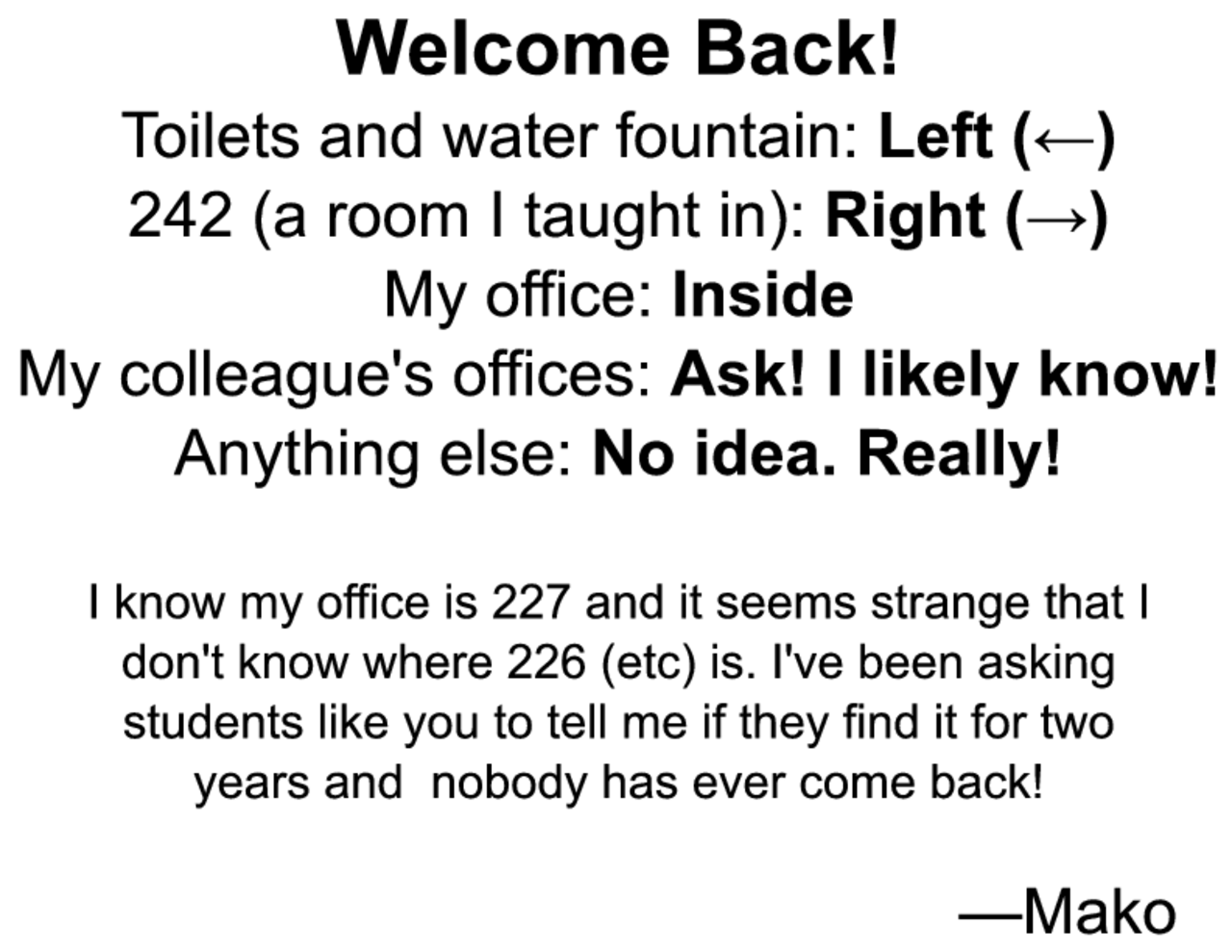
 My office door is on the second floor in front the major staircase in my building. I work with my door open so that my colleagues and my students know when I m in. The only time I consider deviating from this policy is the first week of the quarter when I m faced with a stream of students, usually lost on their way to class and that, embarrassingly, I am usually unable to help.
I made this poster so that these conversations can, in a way, continue even when I am not in the office.
 I haven't written much yet about what I've been up to at work. Right now, I'm
making changes to the sources of a set of Docker images. The changes I'm making
should not result in any changes to the actual images: it's just a
re-organisation of the way in which they are built.
I've been using the
 Just a quick reply to Rhonda about Moby. You can t introduce him without telling about
 Today is one of these moods. And sometimes one needs certain artists/music to foster it. Music is powerful. There are certain bands I know that I have to stay away from when feeling down to not get too deep into it. Knowing that already helps a lot. The following is an artist that is not completely in that area, but he got powerful songs and powerful messages nevertheless; and there was this situation today that one of his songs came to my mind. That's the reason why I present you today