Search Results: "ron"

23 July 2008

Pablo Lorenzzoni: The new Brazilian Internet surveillance

Here I am writing today to tell something that might not be known outside Brazil at least, I haven t read much in English about it the attempt to turn the Internet into a government surveillance device. This story goes back to 2006 (and even back), when we first successfully blocked the approval of a bill that would, in effect, turn the Brazilian Internet into a giant Big Brother. This bill was introduced by Senator Eduardo Azeredo as a replacement to a series of other similar bills that were attempted before and was followed by a strong resistance by civil organizations, one of those being ASL, of which I am proud of being one of the founders. By that time we ended having it postponed for more debate. It happened that the bill made a come back last weeks, and was pushed into approval by a subcommittee of the Senate (one that was suppose to deal with the constitutionality of bills) and now is heading to the Chamber of Deputies for appreciation. Apart from the first debates back in 2006, nothing happened between then and the approval. The bill have changed a little bit, but not much as to change its effects. In Brazil, we have two legislative houses, Federal Senate and Chamber of Deputies. If a Law Project is proposed by one, is revised by the other. So we have already lost 50% of the fight. Ronaldo Lemos, professor of Funda o Get lio Vargas (think about a Brazilian version of Harvard Law School ) have already stated how dangerous such a Law can be, once approved. In his own words: The wording of the law is too broad, and can be applied in several cases. The interpretation of what is a crime or not will be done by a criminal judge, who is used to deal with homicides and not with technology . Since its approval in Senate, several people have been putting together a resistance. Central to it is a Petition, hosted at Petition Online, that already holds 64-thousand signatures. One of the writers of that petition, Andr Lemos, a university professor and researcher, have said that the regular user will have the feeling of being watched, and not knowing if what he s doing in legal or not: For instance, if I disseminate a virus without knowing, will I be arrested? Can I exchange my files in P2P networks (my pictures, my musics, my text files) without asking for permission? How will the ISPs interpretate these exchanges? Can I copy a part of a text from a blog and paste it into mine? This law creates a feeling of insecurity and generalized fear . FGV s Center for Society and Technology have published an analysis of the Law Project, and have spotted a lot of problems in it. For instance: Thinking of how I can help, after sending an email to every Deputy whose email address I was able to get, I decided to translate the law into English (I also uploaded a version with indentation, since it s pretty hard to understand the whole law without it, if you re not used to), so the World can be made aware of what s going on in Brazil. I also just sent an email with it to EFF, asking for their help. Not that I think they can do much, but they surely will know one or two strings to pull in order to put more pressure on the Brazilian government. I also hope that, once this post reaches Planet Debian, even more people become aware of the issue. In a sense, this is an appeal for all the Freedom Culture lovers out there to take any actions they can to help us prevent this Law Project to become a Law. (In time, I d like to thank Alexandre Oliva, who revised the translation). Update (2008-07-23 11:50): Steve Langasek also revised the translation of the Law Project and I ve made a cherry-pick merge , which resulted in the version currently linked in the text above. Older version of the plain and the indented documents are still available. Thanks Steve!

22 July 2008

Michal Čihař: Phone synchronisation, finally

One of long standing things on my todo list was to make synchronisation work from my cell phone (Sony-Ericsson K750i) to some PIM application on Linux side (as a GNOME user Evolution is the natural choice). I tried it several times but it never actually worked. Today I gave it yet another try and I finally succeeded on first attempt :-). As a first step I just wanted to make a backup of all things. Gammu can do it quite well and it's the tool I trust for this purpose:
gammu backup /tmp/phonebook.vcf
gammu backup /tmp/calendar.vcs
Now it's time to play with OpenSync. We will use setup guide and SyncML guide as a starting point. As I had in past problems with both sides - both phone and Evolution failed with some random errors, I wanted to go step by step. So I started with setting up phone to files synchronisation:
msynctool --addgroup file2phone
msynctool --addmember file2phone file-sync
msynctool --addmember file2phone syncml-obex-client
Now we need to configure file storage, just tell it where it should store the data:
msynctool --configure file2phone 1
And change path in your editor to something like:
<?xml version="1.0"?>
<config>
  <!-- directory path for file-sync -->
  <path>/home/foo/phone-backup/</path>
  <!-- should care of subdirectories (TRUE or FALSE) -->
  <recursive>FALSE</recursive>
</config>
Now the more tricky part comes, we need to set up phone end:
msynctool --configure file2phone 2
Fortunately we can use example from the SyncML guide and just fill in Bluetooth address (you can get it using hcitool scan) and channel (sdptool browse 00:b0:0b:fa:ce:00):
<?xml version="1.0"?>
<config>
  <bluetooth_address>00:b0:0b:fa:ce:00</bluetooth_address>
  <bluetooth_channel>7</bluetooth_channel>
  <identifier>Sony Ericss</identifier>
  <version>1</version>
  <wbxml>1</wbxml>
  <username></username>
  <password></password>
  <type>2</type>
  <usestringtable>0</usestringtable>
  <onlyreplace>0</onlyreplace>
  <onlyLocaltime>0</onlyLocaltime>
  <recvLimit>0</recvLimit>
  <maxObjSize>0</maxObjSize>
  <contact_db>Contacts</contact_db>
  <calendar_db>Agenda</calendar_db>
  <note_db>Notes</note_db>
</config>
And now we should be able to synchronise whole phonebook from phone to selected directory:
msynctool --sync file2phone
Okay, this works, let's try more complicated thing - include Evolution in the chain. The steps are the same, config file for phone is the same, Evolution plugin has sane defaults you usually don't have to touch:
msynctool --addgroup phone2evo
msynctool --addmember phone2evo evo2-sync
msynctool --addmember phone2evo syncml-obex-client
msynctool --configure phone2evo 1
msynctool --configure phone2evo 2
But now comes the tricky thing - Sony-Ericsson phones usually have something broken around notes (or it is broken in OpenSync, I don't care, simply synchronisation fails without this step) and we have to avoid synchronisation of them. This can be done by changing filter file in group we've created above (usually in file ~/.opensync-0.22/group2/filter.conf):
<?xml version="1.0"?>
<filter>
  <note/>
</filter>
And finally we can start the synchronisation and it should work:
msynctool --sync phone2evo
You can also GUI multisync0.90 to do the configuration and start synchronisation, but it is not much different, you also still have to edit XML files.

MJ Ray: LugRadio Live Event Review


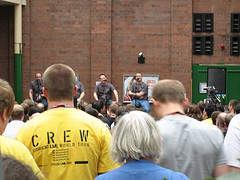
LUGRadioLive 2008 by sheilaellen (cc-by-2.0) This weekend, I learnt lots of things while at LugRadio Live in Wolverhampton. One thing was the surprising delay between posting something on this site and it actually appearing in the feed on my mobile phone. Another is that I can’t post to my new blog hosting from my mobile phone, which I’ll debug Real Soon Now. So, this is a bit later than when I first wrote it and it’s now one post instead of seven or so… Thanks to some unexplained delay travelling through Birmingham, I walked into LugRadio Live during the Introduction. The venue was generally pretty good, but the stage obstructed the entrance the acoustics in the atrium only seemed to work for the four gents. No idea what they said: I got past the stage into the audience and it finished almost immediately. For the first talk session, I went to see Rufus Pollock of Open Knowledge Foundation introduce a plan for the Comprehensive Knowledge Archive Network. Seems like a good idea. I’ve tons of questions, but I can’t quite get them into words, I don’t know when I’ll have time for this and I’m not sure they really matter anyway. I think I’ll mention CKAN to some librarians anyway and see what they make of it. I expected Emma Jane Hogbin’s “Form an orderly queue, ladies” to start an argument with the usual chix silliness but I was pleasantly surprised by how reasonable the advice was. In fact, the speaker also criticised the “chix” movements, although it appeared she participates in some women-only clubs, so not a 100% win for equality there. Sadly, much of the talk has been overshadowed in my mind by the memory of a giant furry racoon walking in unexpectedly, so I’ll probably grab the video of the LRL-USA version sometime soon. James Hooker’s talk titled “Taming the dragons — entrepreneurship and VCs” launched venturex as described on his own site already (along with more talk descriptions). It was an interesting demo, but it requires hackers to sell some votes in their companies to Venture Capitalists, which I believe is a bad thing for free software developers to do. We need to look more at a form of social entrepreneurism.</soapbox> I tried to ask a question, but the terrible atrium acoustics did funny things with my not-so-good hearing and I lost my way somewhat. At the end of that talk, I got chatting to an interesting web developer from Leicester who also forsook The Gong-a-Thong Lightbulb Talk Extravaganza and headed up to the Lightning Stage for Robert Collins and the Bzr talk. As well as some glimpses of how it’s changed since forking from tla, it was interesting to see a real (imperfect) demo and a non-Emacs version control GUI. The web interface for casual users to submit patches sounded very interesting and I also learned that some people pronounce “svn” like “Sven”. Most things that Robert thought were benefits sounded like drawbacks to me, so I’ll stay with git for now. Steve Lamb’s Green IT talk was the last presentation I saw. This talk really disappointed me because it seemed to be skewed towards the corporate governance nonsense instead of seeing Green IT as a vital pragmatic step, mentioning points I’d seen put more clearly elsewhere, as well as advertising Vista virtualisation and some panoramic webcam from Microsoft (who employ him) that doesn’t work with any free software, according to a deserved verbal shoe-ing in the Q+A. Only thing I remember that seems useful: charging from USB is more efficient than using wallwarts. Is that right? Finally, the main event: LugRadio Live and Unleashed. It opened with the shock announcement that LRL will continue into 2009, as announced elsewhere already. The rest of the madness will presumably appear online shortly and I don’t remember it well enough to do it justice… A tech conference crossed with a rocking gig by the strangest boyband ever, with a cheerleading racoon and some very cool people. I’ll try to be at LRL 2009. Will you be there? Were you at LRL this last weekend?

21 July 2008

Clint Adams:

This is the night of second-hand thoughts. Oh, the shame. I'm gonna do this in mostly-chronological order. Mostly. I vaguely remember the first great meal I had in Paris. I got off the plane, went through immigration and customs, hopped on the RER, got out and dragged my suitcase to Le Chat Gripp . I walked through the door in my T-shirt and jeans, and said well, I don't remember what I said, but I ended up getting a table and ordering the tasting menu. I don't remember very much about the food, but I remember that the waiter had to wake me up between courses. I've kinda had a thing for tasting menus ever since. Tonight I made a reservation at a fine dining establishment that was advertised as having a couple of tasting menus. I wasn't going to commit myself to a tasting menu, but there was a good chance I would find it irresistable. I timed my departure pretty well, and after walking the 2.5 miles to the restaurant, I was only a couple minutes early. Now the funny thing about this is I did not happen to notice that I had entered Molecular Gastronomy Hut. The signs outside did not say Molecular Gastronomy Hut, neither in cuneiform, hieroglyphs, nor any language I could read. The menu did not advertise the fact that this was Molecular Gastronomy Hut. Had I known that this was Molecular Gastronomy Hut, I would have not ordered the tasting menu, especially since I was not hungry and should probably have not even eaten a whole course. Had I known that the wine pairings would only include two reds, I wouldn't have ordered those either. Normally I expect wine pairings to include a white. It's the thing to do; it adds contrast. You drink it and get it over with and then you enjoy the rest of your meal. This had at least three whites and one ros . Mother of God. For the moment, though, I had no foreknowledge of the wines, and was was entranced by the knives, which were twisted such that if the handle was lying flat on the table, the blade stood vertically. Not only was this incredibly distracting, it seemed to have some practical value; if there were foodstuffs on your knife, they would remain elevated and not touch the tablecloth. Anyway, the food comes out, course by course, wine by wine. I wonder if Richard from Top Chef is hiding back in the kitchen. There are random foams and gastriques lying conspicuously on my plates. My second course had a lemon sorbet sitting on top of various types of vegetable matter. My third course involved arthropods. Ever wonder what to pair with fried arthropod? That's right, ros . My fourth course was actually tasty, much to my surprise. It was a pumpkin flower cappuccino. It is hubris to call it cappuccino, but they did and I am going to maintain the tradition. It tasted like warm infused buttery goodness, even though I was picking insect legs out of my mouth while drinking it. You may or may not be surprised to learn that the lemon sorbet made a reappearance in a later course. The waiter recommended mixing it with the other ingredients. Tom Colicchio was hiding in the back of my head asking why, if it was meant to be mixed, wouldn't they serve it mixed. I am forced to agree. The only other thing worth having was the cheese plate. It was populated with cheese I had never had before, and fruit concoctions to go with each. Most of the cheese were nothing special, but one was orgasmic. No, I'm not going to tell you what it was. Oh, all right, it was the middle one. One hundred fifty-six courses later, I was asked if I wanted any coffee. I didn't really want caffeine, but as I didn't want to sabotage the experience, I acquiesced and consented to an espresso. I'm not sure how I was understood, as by this time I had stopped speaking the local language and was presently shouting about bacon-burger dogs, the Huxtables, and Freebird. Then after coffee and being ignored, I asked for the check. Surprise, surprise: there was an additional dessert course to go. Didn't I look foolish? The bill came out to about half the country's GDP. The last time I had seen that many digits was when a bunch of hipsters tried to calculate while spaz-dancing to Fischerspooner and playing Space Channel Five. I wondered how it must feel for one of those guys who decides to order all kinds of extravagant room service in a luxury hotel right before committing suicide. After I paid, which seemed to confuse them a bit, they offered to call me a cab. I refused politely several times. I don't like cabs to begin with, aside from the whole plutocrat-fatcat I-might-as-well-get-a-maid-and-a-butler-and-a-valet feel to them, and the practical aspects of the drivers being douchebags. I had just spent a ridiculous amount of money on food that wasn't worth it, and I saw no reason to add insult to injury by paying for a taxi. It could probably have been $10 or $15 more. Mother of Christ. So I walked. It was only four or so miles to my bed, and I passed the time by singing songs of cormorants and racial disharmony and seventeen-year-old prostitutes and the time the Rescue Rangers got sentenced to maximum-security prison. All in all it was a terribly unpleasant contrast to the happy song about alfajores I was singing before dinner. Mmm alfajores.

Martin Michlmayr: Daily installer image available for QNAP TS-109, TS-209 and TS-409

Daily installer images are now available for the QNAP TS-109, TS-209 and TS-409. This means that complete installations of Debian testing are possible now. You can consider the daily image as a beta release of RC1 of the debian-installer for Debian lenny. It should only be used by experienced users and only if you can make a serial console in case something goes wrong. As the name suggests, the daily images change on a daily basis and they install Debian testing which also changes on a daily basis (although testing should be fairly stable since we're close to the freeze of testing in preparation for the release of Debian lenny). If you install Debian with these installer images, please send an installation report to debian-boot send an email to me so I can let you know in case there are any important news you should be aware of. There is a web site now with complete installation instructions and other information about Debian on QNAP Turbo Station. If you have any questions or suggestions, please let me know.

Matthew Garrett: The fallacy of the completely inclusive community

Emma Jane Hogbin gave a presentation on the gender gap in free software at Lugradio Live this weekend. One of the central messages was that a great deal of how to avoid putting women off computing can be distilled down to "Don't be a dick". This ties in well with Mako's restatement of the Ubuntu code of conduct as "Be excellent to each other" (a wonderful phrasing which demonstrates that Bill and Ted's Excellent Adventure is the most philosophically worthwhile film that Keanu Reeves has ever appeared in, and certainly not The fucking Matrix) and led to my 5 minute rant on why I hate the Linux community slightly later in the day, but does leave a certain problem. What standards are used to define whether given behaviour is dickish or not? The comments here show that there's disagreement even within a single sub-community of the larger free software world. Ben suggests that the reaction to perceived inappropriate behaviour is perhaps even more discouraging than the original behaviour, suggesting that bitching about things that offend you is dickish behaviour in and of itself. How do we decide whether someone is being a dick or helping the community? Is lack of tolerance a form of exclusionary behaviour?

This topic is actually one of the issues discussed in the Geek Social Fallacies, but here's a nice easy example. Would tolerating planet posts encouraging the eradication of the Jewish population be inclusive or exclusive? I suspect that most people would agree that it wouldn't be acceptable behaviour, which leads us to the next question. Why? There's two obvious arguments here. The first is that at a community level we have some form of rough moral consensus that advocating genocide is Just Wrong, and so criticising Nazis is obviously the right thing to do. The second argument is more pragmatic than philosophical - alienating millions of people in order to avoid alienating hate groups could be considered to reduce our potential contributor base in an unfortunate way.

I'm a fan of the second argument. The example I gave is emotive and relatively recent history has resulted in people tending to be pretty uniform in considering genocide to be a bad thing, but many other cases aren't clear cut. What I consider to be objectification of women is seen by others as appreciation of natural beauty. What I think of as sexist jokes are perceived by others as acceptable humour. When I advocate intolerance of certain behaviour, people are going to see me not having enough tolerance. So we end up in a situation where people make the "We should all just get along and be tolerant of each other" argument, which sounds fine but is fundamentally flawed in one significant way.

Advocating tolerance excludes the intolerant.

The reason people fail to see this is that it doesn't sound like a flaw. If you ask people whether we need to support intolerance, the immediate answer is probably no. But by advocating exclusion of intolerance, you're excluding all those who have good reasons to be intolerant. You're excluding the women who don't want to feel that the community sees them as a pair of breasts attached to some legs. You're excluding the ethnic groups who would prefer to avoid racist slurs or ethnic stereotyping. Telling anti-fascism protestors that they're being intolerant isn't likely to endear you to them. Advocating tolerance is telling the intolerant that they're wrong and should just deal with whatever it is that makes them unhappy.

So, ironically, tolerating certain types of intolerance is probably required in order to avoid alienating many potential contributors. That means some way of deciding what kinds of behaviour are acceptable and which are unacceptable. In the absence of either pre-existing community consensus or some philosophical breakthrough that allows unambiguous determination of the "rightness" of a given action, I'm going to suggest that we look at it from a pragmatic viewpoint. How many potential contributors do we discourage by criticising a certain type of behaviour? How many do we discourage by tolerating it?

The fallacy of the completely inclusive community is the idea that it includes everyone. The reality is that a certain level of social exclusion is required in order to include a wider range of people. So don't criticise people purely for criticising someone else's behaviour - make an argument for why that behaviour benefits the community. And when you see behaviour that you think discourages others, call people on it. Even if nobody's behaviour changes as a result, you're sending a signal that not everyone in the community agrees. Sometimes all people want is to know that there'll be some people on their side.

But, above all, try not to be a dick.

20 July 2008

Francois Marier: Logging kernel messages over the network using netconsole

I recently had to setup netconsole in order to diagnose some grsecurity-related suspend/resume problems. The idea is to have the broken machine send its kernel messages to a remote machine via the network.
As a prerequisite, the local machine (the one sending the console messages) must have the following kernel options turned on:(The first and last ones are required in order to be able to configure netconsole after boot, through the configfs interface.)The remote machine should be told (using netcat) to listen on a specific UDP port (64001 in this example):
netcat -l -p 64001 -u -s 192.168.1.1 2>&1 tee /root/netconsole.log
Then, running this script on the local machine will turn netconsole on (don't forget to customize the appropriate parameters for your environment):
#!/bin/sh
modprobe configfs
umount /sys/kernel/config 2> /dev/null
mount -t configfs none /sys/kernel/config
modprobe netconsole
mkdir /sys/kernel/config/netconsole/hostname
echo "xx:xx:xx:xx:xx:xx" > /sys/kernel/config/netconsole/hostname/remote_mac
echo 192.168.1.1 > /sys/kernel/config/netconsole/hostname/remote_ip
echo 64001 > /sys/kernel/config/netconsole/hostname/remote_port
echo 192.168.1.2 > /sys/kernel/config/netconsole/hostname/local_ip
echo 64001 > /sys/kernel/config/netconsole/hostname/local_port
echo eth1 > /sys/kernel/config/netconsole/hostname/dev_name
echo 1 > /sys/kernel/config/netconsole/hostname/enabled
dmesg -n 8
That's all you need to start seeing messages on the remote machine's screen.
Interested readers may want to look at other ways to configure and use netconsole.

19 July 2008

Luciano Bello: Exploiting DSA-1571: How to break PFS in SSL with EDH

( I love acronyms :-D )

At this point, all of you should know and see how the H D Moore s toys work. Those toys attack SSH public-key authentication using clone keys and online brute force.

Furthermore, many of you know that there are other effects produced by a biased PRNG besides this one.

Strangely, I could not find more of those toys exploiting these aspects. So, I would like to show you a Wireshark patch which attacks Perfect Forward Secrecy (PFS) provided by Ephemeral Diffie Hellman (EDH).
Introduction to EDHLet s put it in plain words (if you know what we are talking about, ignore this and jump to the next heading):
In an insecure communications channel the parties agree a common key to cipher their dialog. This is what happens in SSL (in most of the cases, depending on the cipher suite):
The exploit If an eavesdropper can explore the complete private key space (the all possible numbers for Xc or Xs), he/she will be able to get access to the shared secret. With it all the communication can be deciphered. That s what this patch can do.

A Wireshark with this patch and a list of possible private keys will try to brute force the share secret. If one of the parties is using the vulnerable OpenSSL package the communication is totally insecure and will be decrypted.


The patch was submitted in order to be committed on the Wireshark trunk. There you can find the patch against the on-develop source revision 25765.
Issues that can be improvedWe (the other developers and myself) detected few things to be improved. But we will do nothing for them. So, if you want to contribute with some code, start from these items and submit the patches to the Wireshark s bugzilla:CreditsPaolo Abeni <paolo.abeni at email.it>
Luciano Bello <luciano at debian.org>
Maximiliano Bertacchini <mbertacchini at citefa.gov.ar>

This work was partially supported by Si6 Labs at CITEFA, Argentina.

UPDATE Jul. 21st: See more and updated info here, especially this.

Luciano Bello: Exploiting DSA-1571: How to break PFS in SSL with EDH

( I love acronyms :-D )

At this point, all of you should know and see how the H D Moore s toys work. Those toys attack SSH public-key authentication using clone keys and online brute force.

Furthermore, many of you know that there are other effects produced by a biased PRNG besides this one.

Strangely, I could not find more of those toys exploiting these aspects. So, I would like to show you a Wireshark patch which attacks Perfect Forward Secrecy (PFS) provided by Ephemeral Diffie Hellman (EDH).
Introduction to EDHLet s put it in plain words (if you know what we are talking about, ignore this and jump to the next tittle):
In an insecure communications channel the parties agree a common key to cipher their dialog. This is what happens in SSL (in most of the cases, depending on the cipher suite):
The exploit If an eavesdropper can explore the complete private key space (the all possible numbers for Xc or Xs), he/she will be able to get access to the share secret. With it all the communication can be deciphered. That s what this patch can do.

A Wireshark with this patch and a list of possible private keys will try to brute force the share secret. If one of the parties is using the vulnerable OpenSSL package the communication is totally insecure and will be decrypted.


The patch was submitted in order to be committed on the Wireshark trunk. There you can find the patch against the on-develop source revision 25765.
Issues that can be improvedWe (the other developers and myself) detected few things to be improved. But we will do nothing for them. So, If you want to contribute with some code, start from these items and submit the patches to the Wireshark s bugzilla:CreditsPaolo Abeni <paolo.abeni at email.it>
Luciano Bello <luciano at debian.org>
Maximiliano Bertacchini <mbertacchini at citefa.gov.ar>

This work was partially supported by Si6 Labs at CITEFA, Argentina.

17 July 2008

Russell Coker: Pollution and Servers

There is a lot of interest in making organisations “green” nowadays. One issue is how to make the IT industry green. People are talking about buying “offsets” for CO2 production, but the concern is that some of the offset schemes are fraudulent. Of course the best thing to do is to minimise the use of dirty power as much as possible. Of course the first thing to do is to pay for “green power” (if available) and if possible install solar PV systems on building roofs. While the roof space of a modern server room would only supply a small amount of the electricity needed (maybe less than needed to power the cooling) every little bit helps. The roof space of an office building can supply a significant portion of the electricity needs, two years ago Google started work on instralling Solar PV panels on the roof of the “Googleplex” [1] with the aim of supplying 30% of the building’s power needs. For desktop machines a significant amount of power can be saved if they are turned off overnight. For typical office work the desktop machines should be idle most of the time, so if the machine is turned off outside business hours then it will use something close to 45/168 of the power that it might otherwise use. Of course this requires that the OS support hibernation (which isn’t supported well enough in Linux for me to want to use it) or that applications can be easily stopped and restarted so that the system can be booted every morning. One particular corner case is that instant-messaging systems need to be server based with an architecture that supports storing messages on the server (as Jabber does [2]) rather than requiring that users stay connected (as IRC does). Of course there are a variety of programs to proxy the IRC protocol and using screen on a server to maintain a persistent IRC presence is popular among technical users (for a while I used that at a client site so that I could hibernate the PowerMac I had on my desktop when I left the office). It seems that most recent machines have BIOS support for booting at a pre-set time. This would allow the sys-admin to configure the desktop machines to boot at 8:00AM on every day that the office is open. That way most employees will arrive at work to find that their computer is already booted up and waiting for them. We have to keep in mind the fact that when comparing the minimum pay (about $13 per hour in Australia) with the typical electricity costs ($0.14 per KWh - which means that a desktop computer might use $0.14 of electricity per day) there is no chance of saving money if employee time is wasted. While companies are prepared to lose some money in the process of going green, they want to minimise that loss as much as possible. The LessWatts.org project dedicated to saving energy on Linux systems reports that Gigabit Ethernet uses about 2W more power than 100baseT on the same adapter [3]. It seems most likely that similar savings can be achieved from other operating systems and also from other network hardware. So I expect that using 100baseT speed would not only save about 2W at the desktop end, but it would also save about 2W at the switch in the server-room and maybe 1W in cooling as well. If you have a 1RU switch with 24 Gig-E ports then that could save 48W if the entire switch ran at 100baseT speed, compared to a modern 1RU server which might take a minimum of 200W that isn’t very significant. The choice of server is going to be quite critical to power use, it seems that all vendors are producing machines that consume less power (if only so that they can get more servers installed without adding more air-conditioning), so some effort in assessing power use before purchase could produce some good savings. When it comes time to decommission old servers it is a good idea to measure the power use and decommission the most power hungry ones first whenever convenient. I am not running any P4 systems 24*7 but have a bunch of P3 systems running as servers, this saves me about 40W per machine. It’s usually the case that the idle power is a significant portion of the maximum power use. In the small amount of testing I’ve done I’ve never been able to find a case where idle power was less than 50% of the maximum power - of course if I spun-down a large number of disks when idling this might not be the case. So if you can use one virtual server that’s mostly busy instead of a number of mostly idle servers then you can save significant amounts of power. Before I started using Xen I had quite a number of test and development machines and often left some running idle for weeks (if I was interrupted in the middle of a debugging session it might take some time to get back to it). Now if one of my Xen DomU’s doesn’t get used for a few weeks it uses little electricity that wouldn’t otherwise be used. It is also possible to suspend Xen DomU’s to disk when they are not being used, but I haven’t tried going that far. Xen has a reputation for preventing the use of power saving features in hardware. For a workstation this may be a problem, but for a server that is actually getting used most of the time it should not be an issue. KVM development is apparently making good progress, and KVM does not suffer from any such problems. Of course the down-side to KVM is that it requires an AMD64 (or Intel clone) system with hardware virtualisation, and such systems often aren’t the most energy efficient. A P3 system running Xen will use significantly less power than a Pentium-D running KVM - server consolidation on a P3 server really saves power! I am unsure of the energy benefits of thin-client computing. I suspect that thin clients can save some energy as the clients take ~30W instead of ~100W so even if a server for a dozen users takes 400W there will still be a net benefit. One of my clients does a lot of thin-client work so I’ll have to measure the electricity use of their systems. Disks take a significant amount of power. For a desktop system they can be hibernated at times (an office machine can be configured such that the disks can spin-down during a lunch break). This can save 7W per disk (the exact amount depends on the type of disk and the efficiency of the PSU - (see the Compaq SFF P3 results and the HP/Compaq Celeron 2.4GHz on my computer power use page [4]). Network booting of diskless workstations could save 7W for the disk (and also reduce the noise which makes the users happy) but would drive the need for Gigabit Ethernet which then wastes 4W per machine (2W at each end of the Ethernet cable). Recently I’ve been reading about the NetApp devices [5]. By all accounts the advanced features of the NetApp devices (which includes their algorithms for the use of NVRAM as write-back cache and the filesystem journaling which allows most writes to be full stripes of the RAID) allow them to deliver performance that is significantly greater than a basic RAID array with a typical filesystem. It seems to me that there is the possibility of using a small number of disks in a NetApp device to replace a larger number of disks that are directly connected to hosts. Therefore use of NetApp devices could save electricity. Tele-commuting has the potential to save significant amounts of energy in employee travel. A good instant-messaging system such as Jabber could assist tele-commuters (it seems that a Jabber server is required for saving energy in a modern corporate environment). Have I missed any ways that sys-admins can be involved in saving energy use in a corporation? Update: Albert pointed out that SSD (Solid State Disks) can save some power. They also reduce the noise of the machine both by removing one moving part and by reducing heat (and therefore operation of the cooling fan). They are smaller than hard disks, but are large enough for an OS to boot from (some companies deliberately only use a small portion of the hard drives in desktop machines to save space on backup tapes). It’s strange that I forgot to mention this as I’m about to buy a laptop with SSD.

Gunnar Wolf: Kept silent for a week...

Last week (July 7-13) was basically hell on Earth, for me and for the group that somehow got the name Cabras locas, of which I am part since I joined the National Pedagogical University, where I worked full-time 2003-2005.
It was, yes, the first of my officially three weeks of Summer holiday at IIEc-UNAM, so no problems here. So, why hell on Earth? Because we were in charge basically of anything related with information flow, retrieval and manipulation at the 11th International Congress on Mathematical Education, in Monterrey.
What we thought would basically be one or two days of hard work followed by six days of relaxed vacations (we had even planned to have an internal seminar, showing off the shiny stuff each of us is working on) became... A mind-boggling eight day experience where we worked over 12 hours a day on being human replacements for Google, SQL engines, full-text parsers, report generators, printer watchdogs, and in general lines, just a bunch of unhappy firemen, ready to be called off for whatever task was necessary.
We did have, of course, several calm periods every now and then. We even had to learn how to look busy while doing something compeltely unrelated (that would explain, for example, a couple of low-hanging bugs I fixed for Debian, or some dozens of lines of code I could get off my head).
But my advice for whoever reads this: Don't trust people with long database-handling experience. Specially when they insist that hand-capturing a thousand registers is preferrable (i.e. less error-prone) than parsing three separate databases and discarding duplicates. And, of course, specially when this person is your boss, which is enough of an argument to have it his way.

Thijs Kinkhorst: FEE error on Nikon DSLR - fixed

Recently my Nikon D70s, when using a new Sigma lens, displayed the following error in the aperture display: fEE. As it took me some time to find out the cause and fix it, I'll explain it here perhaps for the benefit of others. What does it mean? Some lenses require that the aperture is set to smallest when they are connected to the body (the largest f-number; this is usually coloured orange). fEE is indicated when the lens is connected wrongly and the camera refuses to operate until the lens is reconnected. lensbody If like me you still get the fEE even though you've connected the lens correctly, then obviously something is broken. The camera "knows" whether the aperture ring is set to the right value due to a notch on the lens (rightmost picture) and a switch on the body ("EE Servo Coupling Post", left picture). In my case the switch on the body had broken off. You can of course send your camera in for repair, but for me it was easily repaired by sticking a hairpin in the switch. A little piece of plastic and some superglue could work as well.

MJ Ray: Batting Against Three Strikes through the Back Door

One of the reasons that I didn’t post much last week was that I was contacting some of my MEPs as part of the Telecom Packet Action in order to help defend cooperative software distribution and use. This is a bit longer than my usual posts and no software is announced below, but I’m posting it here in the hope that more people will take part in this campaign that affects every EU internet user. In short, some MEPs that I remember from the Software Patent campaign proposed amendments that would enable the unpopular three-strikes regime, where internet users could be disconnected and fined if they had three allegations of copyright infringement made (not necessarily proved AIUI) against them, and ISPs could be required to block legal peer-to-peer cooperative distribution systems like BitTorrent. ISPs would also have to distribute official advice about proper internet use and I remember how good that often is. Note that three-strikes wasn’t explicit in the amendments, but there did appear to be loopholes which could be used to allow it, such as only prohibiting technical feature requirements. For longer descriptions, see articles by La Quadrature du Net (Squaring the Net) and The Open Rights Group. The UK Independence Party MEPs replied quickly that they would vote against, mainly because of the source of the legislation. I don’t completely agree with that, but at least UKIP does what it says on the tin. Neil Parish MEP of the Conservatives sent me back a reply which referred to unknown numbering (H1, K1 and so on) and generally seemed like a mish-mash of replies that other people had received. I replied with questions about several aspects, including asking where his numbering came from, and I’ve not seen an answer yet. I’ll email him again in a few days because it’s been over a week. I was really annoyed by the reported complaints by Malcolm Harbour (Conservatives lead MEP on this issue) about how voters have reacted to these amendments, where he called it “scaremongering” amongst other things. No mongering was required - those amendments are damn scary. See comments from a media solicitor at the end of a BBC report:-
“The amendment will cause several problems, firstly, many broadband users routinely transfer large files which are encrypted. “Many of these are acting quite legitimately and in order to determine whether or not such large files are or are not the produce of illicit file sharing the ISP will have to carry out an unprecedented degree of analysis of its customers’ traffic. “Furthermore, computers are frequently shared - within offices, within homes, within educational institutions and inadvertently, where wrong-doers “piggy back” on an inadequately secured Wi-Fi connection. “All this raises the spectre of people losing internet access - for reasons which are no fault of their own.”
The main thing that these actions over the last few years have taught me is the broken state of European Union decision-making. I know I’m sometimes dissatisfied with problems in local and civil democracy, but the EU is a good idea whose democracy and accountability seems broken on a massive scale. There are just too many disconnects, as far as the ordinary voter can see. We put things in to elections and consultations and get bizarre law-making like this. If we act to correct the bizarre law-making, some MEPs start criticising us quite severely. And what kind of stupid representative system allows the representatives to repeatedly blame the voters but still be safely elected because of their high position on their party’s list? I’d love a simple, reformist constitution that’s simple enough for people to actually understand, approve in referendums and participate in the EU effectively. I doubt it will happen in my lifetime, though.

Lior Kaplan: Hosting Debian people in Israel


This week was the third time this year I got to host people from Debian in Israel. I find it very interesting to meet people from the project in a totaly different environment from the usuall confrences. Having a relax talk (and maybe some good food) is a better way to know people than the quick talks I’m used to from more formal meeting. And having the chance to show them a city or the country is of course something I can’t do abroad (: So, if you’re in the area - let me know. I can’t provide a place to crash, but can still help… p.s. The invetation is open to any free software related people… don’t be shy.

16 July 2008

Russell Coker: Xen and EeePC

I’ve been considering the possibility of using Xen on an ASUS EeePC as a mobile test platform for an Internet service. While the real service uses some heavy hardware it seems that a small laptop could simulate it when running with a small data set (only a few dozen accounts) and everything tuned for small amounts of RAM (small buffers for database servers etc). According to the wikipedia page about the EeePC [1] the 70x and 900 versions of the EeePC use a Celeron-M CPU. According to Wikipedia that is based on the Pentium-M (which lacks PAE support and therefore can’t run Xen). The Fedora Tutorial about the EeePC has a copy of the /proc/cpuinfo data from an EeePC [2] which shows that the model in question (which is not specified) lacks PAE. Are there any 70x or 90x variants that have PAE? Intel sometimes dramatically varies the features within a range of CPUs… The 901 version and the 1000 series use an Intel “Atom” CPU. According to discussion on the Gentoo Forums some Atom CPUs have the “lm” flag (64bit) but no “vmx” flag for virtualisation [3] (which means that they can run Xen paravirtualised but no KVM or hardware virtualisation for Xen), it also has PAE. This is more than adequate. According to the Wikipedia page the Atom comes in both 32bit and 64bit variants [4]. Hopefully the 901 version and the 1000 series EeePC will have the 64bit version. The 90x versions have support for up to 4G of RAM but the 1000 series is only listed as supporting 2G, hopefully that will be 4G or more (although I wouldn’t be surprised if Intel had a chipset supporting only 4G of address space and PCI reservations limiting the machine to 3G). But even 3G will be enough for a mobile test/development platform which should make it easier to debug some problems remotely. The 901 is available in Australia for just under $700. It’s a little more expensive than previous EeePC variants ($500 is a magic number below which things can be purchased with significantly less consideration), but it still might be something that one of my clients will pay for. The prime aim is to be a mobile sys-admin platform that can be carried anywhere, running a Xen simulation of the target network is an added bonus. Any suggestions for other laptops that should be considered will be welcome. It needs to be light (1.14Kg for a 901 EeePC is more than I desire), small (a reduced display size is not a problem), and not overly expensive ($700 is more than desired). Update: JB HiFi is selling the 1000H model [5]. The 1000H has an 80G hard disk and weighs 1.45Kg. The extra 210g and slightly larger size are a down-side, as is the extra ~$50 in price. A comment was made that OpenVZ could be used. If that avoids the need for PAE then a 702 series would do the job (with some USB flash devices as extras). The 702 is a mere 920g. Update: This ZDNET review shows that the 901 can only handle 2G of RAM and has an Atom CPU that is only 32bit [6].

Chris Lamb: Nouveau nVidia drivers now available in Debian experimental

You can now try the “Nouveau” free software nVidia video drivers from Debian experimental. If you would like to try them: Editing your xorg.conf may be as simple as the replacing nvidia or nv with nouveau; nouveau won’t be chosen automatically over nv yet. If your xorg.conf has collected a lot of cruft over the years, see this wiki page for some pointers on what you can remove. For the status of the drivers with your particular card, please see upstream’s compatibility matrix. My experience has been positive; I have been using them for about two months on my dual-head 8600GT (NV50) setup with only a few small issues and a generally superior Gnometris experience. Some notes: Many thanks to:

15 July 2008

David Welton: Misquoted

Well, to be charitable, it was a bit late and so perhaps what I said came out wrong, but in this article: http://www.theregister.co.uk/2008/07/14/android_developer_unrest/ I'm quoted as saying the problem is with "upper management", which I don't really believe to be the case, going by snippets of conversations and things I've read. Frankly, at this point in time, I have no idea why Google can't talk about Android. Also, I had several other positive things to say to the reporter, but I guess the 'focus' of the piece was about the problems that Android is currently experiencing. Notwithstanding the recent weirdness, I'm quite happy that someone with a lot of money and muscle is going to be backing an open source mobile phone system, and hope that the current troubles are merely a small speed bump.

14 July 2008

Joey Hess: awesome

After many years with ion, I've switched to using the Awesome window manager. This took three tries; the latest try seems to have stuck. I wish I had a good analogy to explain to my nontechnical readers what changing to a new window manager is about. One way to think about it is that it's like driving a car down the road, and suddenly swapping the steering wheel and brakes out for a tiller and gear shifter. And having to downshift for braking until you learn that the brakes moved to the turn indicator lever. By trial and error. But that's really only part of it. Another way to look at it is adopting a new philosophy. Or, in some cases a cult. (In some cases, with crazy cult leaders.) Whether they use Windows or a Mac, or Linux, most computer users are members of a big established religion, with some implicit assumptions, like "thy windows shall be overlapping, like papers on the desktop, and thou shalt move them with thy mouse". So, changing to a new window manager is a process of being dumped into a different environment, where nothing works like you've come to expect, and trying to construct a mental model that you can use to make sense of it. But it's also a process of modifying that environment to behave the way you like. And when done whole-heartedly, this doesn't just mean trying to make it like the environment you were used to before. It means trying to absorb the underlying philosopy of the window manager, and think up new ways of doing things, inspired by that philosopy, and modify the environment to allow doing those things. So ideally, "I switched to a new window manager" doesh't mean "my screen has some different widgets on it now". It means "I'm looking at the screen with new eyes."

Neil Williams: State of play in Emdebian ARM

Autobuilder Summary:
138 packages built successfully. 19 packages failed to cross build. 2 packages are tagged for a manual upload. (Dependency issues - rather than break the archive, these packages will not be uploaded until relevant dependencies have been fixed and uploaded.)
Stats
87% built OK
12% failed
Notes:
  1. All these packages built previously and fail at the latest versions in Debian Sid. Many could be upstream errors. All exist in Emdebian at
    previous versions (only 1 failure is known to contain bugs in the current versions in Emdebian and this only affects GUI installations. Two other GUI packages contains bugs but build OK.).
  2. Some of the packages in the repository (including some of the failures) are not used in *any* of the default emsandbox configurations. Two need to be removed from the repository completely.
  3. Some fixes are waiting for updates in Debian, either new uploads migrating to mirrors or pending fixes awaiting upload by me. (Probably tomorrow.)
  4. The history of each package is now available via the Emdebian Autobuilder Report. The package name links to the history of previous build attempts for this package. The version string links to the repository data for the current version in Emdebian. The result of the build links to the build log.
  5. A comparison with Debian unstable is constantly updated.
  6. 254 source packages exist in Emdebian but only 137 are currently built by the autobuilder. The rest will be built when new versions are uploaded to Debian (in some cases, that won't be until after Lenny). If I get time, I'll add build logs for these packages.
  7. The repository contains a fair number of packages that we don't currently use. This is a reflection of the problems of determining the "path" through the dependencies when starting at the bottom (glibc uClibc etc.). Bear this in mind when considering new architectures and new package sets. The process involves a lot of trial and error, particularly as cross-building potentially alters the dependency path at each iteration.

Problems
  1. libselinux and libsepol have just been uploaded with a bug fix that is needed for e2fsprogs and file cross-builds, amongst others. Waiting
    for the ARM mirror to receive the new builds, hopefully tomorrow.
  2. gtk+2.0 fails to cross-build because the patches now try to build the udeb which comes up against a bug in dpkg-cross. I'll be uploading the new version (including a couple of other bug fixes) tonight. (Final testing currently in progress.). The Gtk package also needs some work to run /usr/lib/libgtk2.0-0/update-gdkpixbuf-loaders so that the icons can be read in the GUI.
  3. pango1.0 also needs a fix to update the pango modules. This is usually done at build time but it means running a cross-built binary. It is a minor task and not CPU intensive so I plan to do this in postinst. Without this fix, no text is rendered in the GUI, only empty glyphs.
  4. xfonts-base is way too large still. More work is needed here to optimise just what is meant by the 'fixed' font for X, precisely which font files can be removed, which might be needed outside C or English locales etc.
  5. Other packages not currently cross-building include: (NOTE: Some of these build logs are VERY large.)
    • adduser - needs to be removed from the repository, it is perl and we implement it via busybox.
    • cups cupsys - /usr/include/pthread.h:653: warning: '__regparm__' attribute directive ignored.
    • gcc-4.2 - needs to be removed from the repository, it no longer builds libgcc1 which was the main reason for cross-building it.
    • glib2.0 - more generated content: /bin/sh: line 2: /usr/bin/glib-genmarshal: No such file or directory
    • gnomevfs - hasn't built for ages and isn't usable anyway due to dependency issues. Currently preventing the use of gpe-filemanager. Due to be replaced by GIO in Debian.
    • libusb - build failure, so far resistant to usual fixes.
    • ncurses - build failure - uses gcc in wide char support build.
    • ntp - build failure - assembly error. authkeys.c:445: error: invalid 'asm': invalid operand for code 'w'
    • pcre3 - build failure - apparently simply unresolved symbols resistant to usual fixes.

    • slang2 - possibly needs a patch update, tries to build -pic archives and then fails.
    • xorg-server - build failure: make[4]: *** No rule to make target -L/usr/arm-linux-gnu/lib', needed by Xprt'. Stop.


Of the problems above, only problems 2, 3 and 4 (gtk, pango and xfonts-base) are "critical" as these are the only ones where the current packages are sufficiently broken that the new version is essential before Emdebian can make a "release" of a series of three root filesystems for ARM. Sizes are still larger than desired - a fix for that requires changes in glibc which I hope to investigate during DebConf.

Any help on the above issues is appreciated.

Problem-solving:
$ emsource -c $package
$ cd /path/to/$package
$ emdebuild

If you have SVN access, use 'emdebuild --svn-only' to commit your changes (even if your changes don't solve all the problems).

Without SVN access, post the result of 'svn diff ../emdebian*' to this list (or 'svn diff ../debian*' if you have added a patch for the upstream code to debian/patches/).

Platforms:
All the above is based solely on Emdebian ARM for balloon3:
Linux balloon 2.6.25.2-pxa270 #1 Sun May 18 22:38:11 BST 2008 armv5tel unknown
balloon3 in CUED case
http://balloonboard.org/gallery/300/balloon3-0v1-fpga.jpg

AFAICT no other ARM platforms have been tested. :-(

I have a few fixes for the balloon3-config package that also needs an update in Emdebian - I've had some feedback from the touchscreen driver
upstream that we might be trying to use the wrong device (/dev/input/mice is the wrong target for the symlink, we can set whatever device we want in /etc/X11/xorg.conf and the driver will use that in preference to /dev/event0). As this is device-specific, /etc/X11/xorg.conf will be put into balloon3-config which is available via Emdebian SVN.

Simon Richter: It's all in my head now

I've spent four hours listening to muzak yesterday. Apparently, antitrust legislation prohibits T-Online from getting better access to T-Com's ticket system than their competitors. Of course that means "none at all". I do however, disagree with their corollary that it is the customer's duty to call T-Com and tell them what is wrong. On a Sunday evening. After a lightning strike. With a Windows update breaking PPPoE for ZoneAlarm users. Seriously, get your processes straight.

Next.

Previous.