Search Results: "mak"

12 March 2011

Joey Hess: JEST results

Four months ago I opted out of daylight savings time. How did it work out? Tomorrow I will be in sync with everyone else. That might take some getting used to. I plan to keep my timezone setting, and will be doing this again next winter.

Julien Blache: forked-daapd: v0.13

forked-daapd v0.13 is available! This release has been in the making for a long time, got delayed for a lot of reasons and had its content changed a few times along the way. Nonetheless, it s here now and if all goes to plan at least a couple releases should appear in the coming months, say before the summer. In this release: Thanks to all the contributors that sent bugs and patches for this release! I know development doesn t go quite as fast as some would like, but keep in mind that I m doing this in whatever free time I have and that the public git tree doesn t tell the whole story. There are several parallel feature branches you don t get to see, for instance. Hopefully 0.14 will appear in a few weeks. Tarballs available at http://alioth.debian.org/~jblache/forked-daapd/ ; GPG signatures made with my Debian key F5D65169.

Russell Coker: Climate Action Now Rally Melbourne 12th March

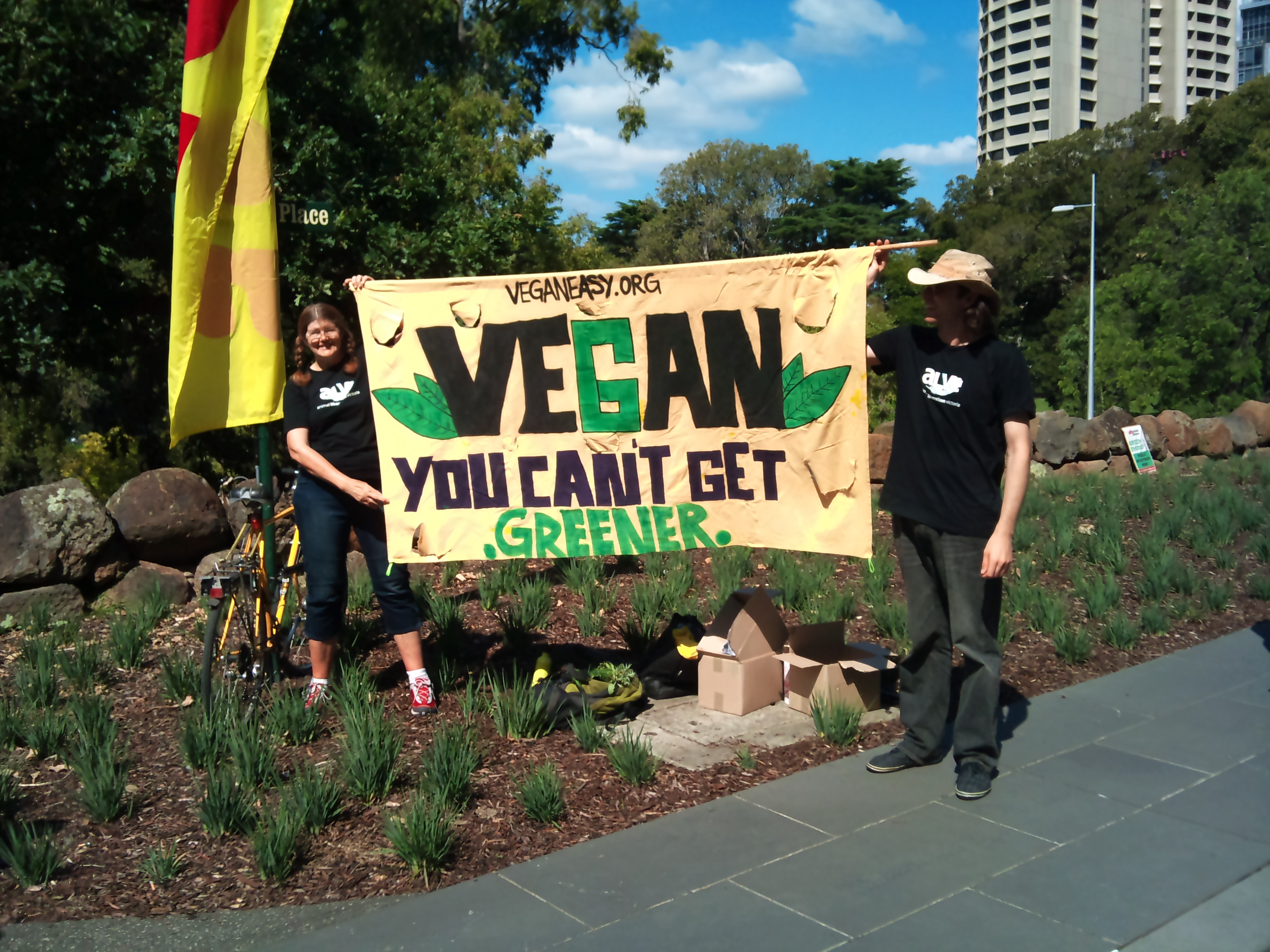
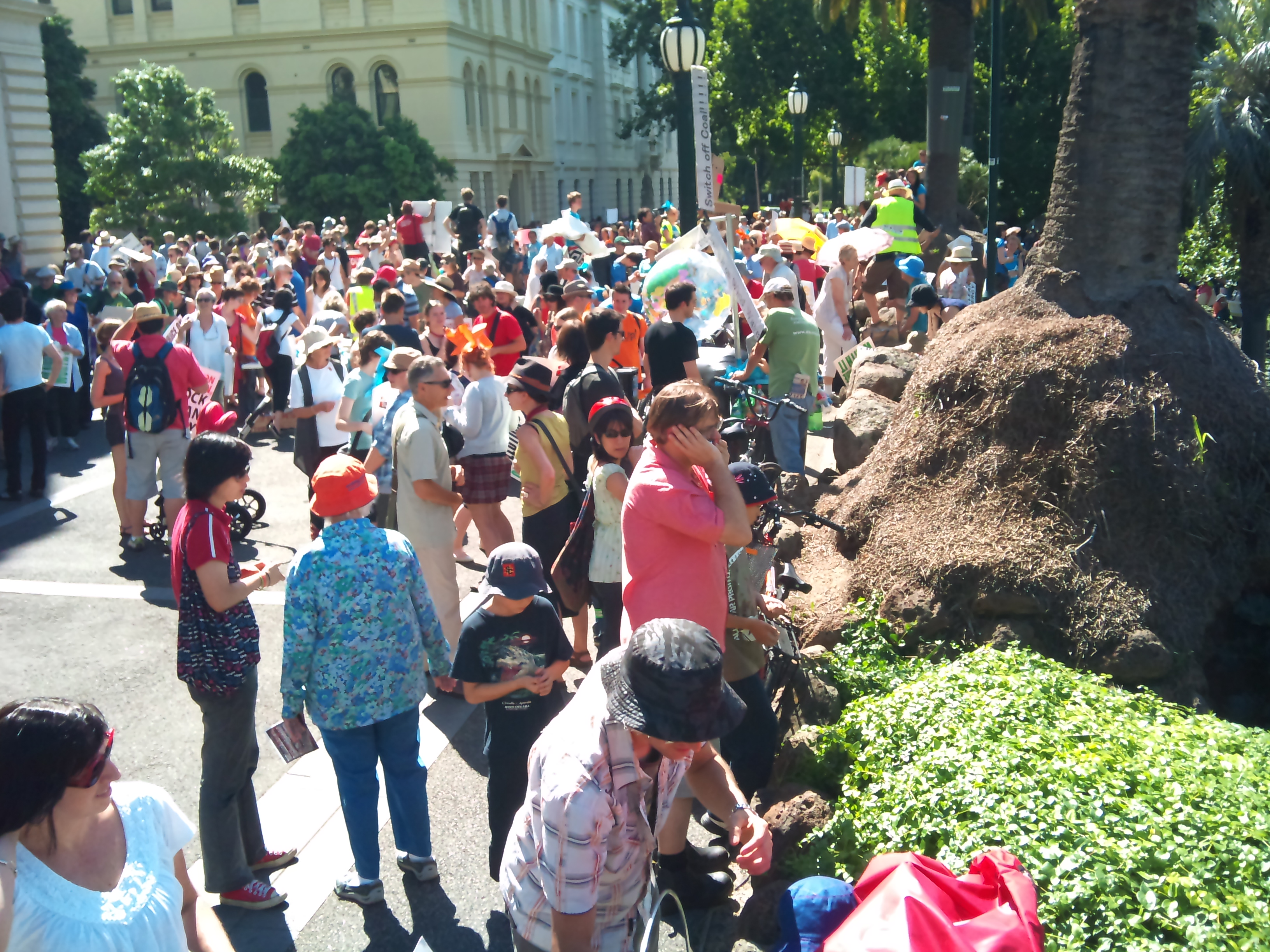
This morning I attended the Climate Action Now rally to support a pollution tax [1]. The event was well attended, my personal estimate of the number of people there was there there was definitely more than 3,000 people, and maybe as many as 8,000 or more.I spoke to an employee of the APS who was on guard duty, he described the event as big and said that they don t usually have events that are so well attended. He gave a personal estimate of 5,000 people. While he wasn t speaking on behalf of the APS he was presumably more skillful at making such estimations than most people. I expect that he also gave a conservative estimate, so it could have been a lot more than that.There were some people using comedy to make political points. Below is a picture of the carbon monster, what you can t see is the man who was handing out coal BBQ fuel for people to feed the monster, children appeared to enjoy that! Also there were three people dressed as Gollum representing the Liberal party (the Australian conservative party), I was unable to get all three in one picture.Carbon monster with sign saying feed me carbonTwo people dressed as Gollum with Liberal Party badges advocating that we die tax-free and that the Liberal party is for famine, fire, and floodSome vegans had a banner supporting the VeganEasy.org site [2]. Being vegetarian can make a significant impact on human environmental impact including on the amount of electricity used (from coal or other sources).Vegans waving a banner for VeganEasy.orgHere are pictures taken looking East over the main part of the rally, looking North towards the building at 3 Treasury place from the other side of the road, looking South over the lawns where people who didn t like being crowded gathered, and looking West over part of the main crowd. The picture looking South shows another view of the Carbon Monster and his accomplice with a sign haven t you had enough dear? .Looking East over the main rallyLooking North towards the building across Treasury PlaceLooking south over the lawnLooking west over the crowdWhen I first arrived there were two main sections to the rally. They weren t discrete (there was no empty space between them) but they acted separately because there was no PA system that could make enough noise to be heard in both sections. At one stage the West section was chanting while there were speeches in the East section. Below is a picture looking out over the West section as people had just turned to go home. This area was entirely packed when I first arrived.The rally was really a family event. There were some grey-haired people wearing t-shirts explaining that they wanted to create a better world for their grand-children and there were also some young children. At the end of the event some children used cardboard signs as toboggans to slide down a steep grassy bank near the main rally area recycling!!! I deliberately chose my photos to try and avoid including children, but even so you can see a few in the background of some of them.

11 March 2011

Marc 'Zugschlus' Haber: What are interface labels for

Dear Lazyweb, for a long time I have been using iproute2 s label feature to assign arbitrary labels to IP addresses configured on Interfaces:
40: int152@dotqa: <BROADCAST,MULTICAST,UP,LOWER_UP> mtu 1500 qdisc noqueue state UP
link/ether 00:25:b3:01:e5:6c brd ff:ff:ff:ff:ff:ff
inet 10.1.152.254/24 brd 10.1.152.255 scope global int152:98fe8
Recently, this has shown to at least confuse both isc-dhcp-relay (#617258) and dhcp-helper (#617264). As I have never seen interfaces labels used outside my firewalls (which happen to use ifupdown-scripts-zg2 (Debian PTS)) and ifupdown s rather twisted handling of multiple IP addresses per interface (using Alias Interfaces), I d like to know whether my usage is a legitimate one and whether there are other uses for interface labels. At the moment, I m tempted to remove label support from ifupdown-scripts-zg2 in the next release, or to make it optional. Please comment if you have an opinion.

Eddy Petri&#537;or: HOWTO: Making Windows usable and avoiding accidental sending of mails in Microsoft Outlook

I've changed jobs recently and after 5 years of not having to work with a Windows system I am having all sorts of adaptation-to-Windows problems at the new job.

First I just had to have the usual X-mouse behaviour and so I installed True X-Mouse Gizmo for Windows. This provides focus under mouse, middle click paste after select (not perfect, but it works), right click to push to bottom the window.

Second I had to have a virtual desktop, so I installed Microsoft's Virtual Desktop Manager from the PowerToys page. I tried another virtual desktop manager before using MSVDM, but I found it too clumsy so I switched to MSVDM which I knew from way back when I used Windows the last time. Good, now I can have my applications organised the way I am used to.

UPDATE:
I gave up on MSVDM in favour of Virtual Dimension since I wasn't able to send a particular window to the intended desktop unless I had in the taskbar all apps visible (Shared Desktop option). I might try other suggestions (Virtual Dimension does not have a way to send a window directly to a specific desktop, but just to the neighbours of the current one.)


Third, I had to make Caps Lock work as Ctrl. I just can't go back to an inferior setup. I found information on this page and ended up at this page from where I got a zip file with various registry keys which allow the deactivation of caps, or turning it into another Ctrl.

Fourth, I am used to write with diacritics in Romanian with the secondary layout of the standard (SR 13392:2004), so I rushed to Cristian Secar 's page for the keyboard driver since on XP the Romanian layout is retarded (some history in which some arbitrary German guy decided y and z had to be switched on Romanian keyboards and some other similarly weird stuff). Since the installation, my keyboard behaves according to this layout:


Things started to look well, but I soon was reminded that Outlook is an idiotic mailer since it doesn't require a confirmation on send, not even if you didn't set a subject. And this is problematic since sending the mail is done via Alt+S, so if the current layer is NOT Romanian, when I want to type (s with a comma below), a fairly common character in Romanian words, you end up looking like an idiot on the recipient side since they receive an incomplete mail. Remember, no confirmation AND no default spell checking before send. Yay!

At my second such accidental mail sending (of which the last two were sent to the same person), I decided to see if this can't be fixed. I initially looked for changing the short cut, but I couldn't find it (I might be inept at finding things in Windows, remember, I haven't touched Windows systems in the last 5 years) but I found another workaround and decided it's good enough to share with other people that might hit the problem.

Just setup a delay rule following these steps.
1. Go to Tools....Rules Wizard
2. Click 'New' Rule
3. Select "Check messages after sending"
4. Click Next on "Which conditions you want to Check?" dialog.
5. Press yes to "This Rule will be applied to every message" message box
6. In the "What do you want to do with message?" dialog, Select "Defer delivery by a number of minutes"
7. Select your favourite number of minutes.... I usually select 2 mins.
8. Select Finish. and close the Rules Wizard.

Now everytime you send an email it will sit in your outbox
for specified number of minutes. If you ever wanted to change it, delete it etc, You have sufficient time to do it :)


I used 3 minutes for the delay. At least now I can prevent looking retarded in front of people... more than necessary :D .


Oh, and Windows' clock display is retarded. It shows, by default, the hour and minutes, but there's no way to change that in a sane way. If you want the date, you must hover over the clock and it shows it, but the day of week is missing. Great job! You can see that information, too, but you have to drag the toolbar to be 2 or even 3 rows high (here it requires 2, but I've seen people saying they needed 3) to get that information, too. Great! One has to choose between wasting desktop real estate and having access to useful information. Or you could install an independent application for the clock... retarded. I am not making this shit up.

I hope this helped.

9 March 2011

Wouter Verhelst: NBD in d-i

Success! It only took, erm,
wouter@celtic:~/debian/debian-installer-wouter/partman-nbd/debian$ cat changelog 
partman-nbd (0.1) UNRELEASED; urgency=low
  * Initial release.
 -- Wouter Verhelst <wouter>  Fri, 28 Dec 2007 11:45:43 +0100
just over three years, but I've finally gotten it to work. More or less. That is to say, I have a VM currently running which is finishing up an installation. It hasn't completed yet, but it's gotten past the critical point now and I'm hopeful that a reboot test will be successful. If it is, I'll need to make sure that the updates that I've done on the live installer to massage it into running are committed to packages too, and then I'm all set. Looks like you'll be able to install wheezy on a system without hard disk. How's that for 'Universal operating system'?

Rog rio Brito: (Some) Solutions with Chromium

In my previous post, I was pointing out some of my frustrations with Chromium/Chrome. A very kind reader, Timo Juhani Lindfors, gave me answers to many of the problems that I pointed out and got me straight on some issues:
  • I can disable full zoom in Iceweasel (i.e., I only want to zoom the text, not the images). According to Chromium's project BTS, it seems that this will be a WONTFIX bug, despite many people asking for it (and it having a lot of duplicates).
Timo told me that there is an extension called "Font Size Increase" (ID: ombpcpigmndepfckcifdblemkabaoihk) that adds a button on the side of the URL bar that you can click to increase the size of the text, without affecting the size of the images. Highly recommended. Not that I need this one as much as "Font Size Increase", but there is also a "Font Size Decrease" (ID: mpajngnpcmjjeoflljdjpnehcfaldcia) that, as the name implies, decreases the size of the text. It is nice to have this one when you clicked on the button to increase the size of the font one or two times too many.
  • In Iceweasel, I have a way (without resorting to many extensions or hackish solutions) to use the equivalent of Firefox's "View > Page Style > No Style" (i.e., to ignore any CSS sheet that the document author may have specified on the page).
Timo also told me that there is a very cool extension called "Chrome Page Style" (ID: ddpkgkegfklikkmfmneldonhldahhacb) that allows you to alternate between stylesheets provided by the page (see Joey Hess's ikiwiki's CSS Market for an example of that). It also has the possibility of disabling all the CSS'es that a page may have, which, in many cases around the web actually improves the readability of the pages, for many "fancy" things detract from readability, especially if you have poor eyesight. Although I had said that I didn't want to resort to extensions, this was a simple solution enough that made me consider revisit my requirements. I do, though, wonder why some frequently used extensions are not built into the programs from stock.
  • In Iceweasel, I can press Ctrl+Q and make the damn browser quit, instead of me having to use the mouse/trackpad/pointing device. This is probably a lack of my understanding on how to associate key bindings to Chromium, but the problem still stands.
Of course, Timo also set me straight and told me about Ctrl+Shift+Q for that purpose, which I had missed completely.
  • Similarly, when there is only one tab open, pressing Ctrl+W in Chromium does not close the tab (say, presenting me a blank tab or the list of most visited sites), nor it closes the application.
As a poor writing of my part, Ctrl+W does close the tabs. But when there is only one tab present, it doesn't close the window. I'm OK with that, since I now know the way to close the window. Thanks again Timo. Oh, and one point that may not be known by many is that using about:flags in Chrome does something analogue to Firefox's about:config (even with the warning). And tweaking with it you can try to see if you can enable hardware acceleration of some parts of your pages, as present in newer releases of Chromium. So, there I am: way more satisfied than with earlier with Chromium, but still having Firefox/Iceweasel as my primary browser. Good to have two usable browsers now.

8 March 2011

Michal &#268;iha&#345;: phpMyAdmin translation status

Another week is over and it's time to spam^W look again at state of translations for phpMyAdmin 3.4. There are no changes to list of complete translations, so we still have 12 translations at 100%: There are still lot of translations which would need some love: And I'm really happy to see progress of some exotic languages (at least for me) such as Urdu. You can help make translation to your language better! If your language is missing just let me know (either in comments or by email).

Filed under: English Phpmyadmin 2 comments Flattr this!

Kai Wasserb ch: KDE4 with multiple displays

This is kind of an "Dear Lazyweb" entry: I'm looking for a way to make a KDE4 control bar span more than one display. Just consider two displays next to each other, configured with RandR to form one big desktop. I haven't found a way to have the control bar span both screens. Sure I can add another control bar to the second but that's not what I want. And while at it: is there a way to hid the toolbox thingy of the desktop activity in the upper right corner (at least once, because having it on two displays sitting next to each other doesn't make that much sense)? Just to make sure: the displays are not in clone mode, but create a large desktop spanning two displays. The Squeeze version of KDE is used. So, if you know how to do this or have a pointer to some article, please let me know.

7 March 2011

Ritesh Raj Sarraf: Microsoft, Nokia and Qt

Nokia has announced that it is selling off its Qt business. This needed to happen given the change in the company's strategy. Microsoft is a software vendor providing Mobile OS, with Nokia being one of its consumers. For Nokia, to have a tier 1 alliance with Microsoft, it would have been important for the company to show positive gesture. With this move, Microsoft and Nokia will strengthen their partnership. This move will focus on tighter integration in between the 2 company's portfolios. Nokia mentioned in the announcement that it'd further continue Qt core development. I don't see what value that has to bring to the company. It either has to do with the company making some money with whatever IP it acquired in Trolltech, or else, it'd be just a phased wise approach in selling off the Qt business. Also it could be Nokia's Plan B, in case the Micro-Noki team fails to build the ecosystem that it is aspiring for. As for Qt, we'll have to see. Given that it is GPL, we don't have too much to worry (hopefully).

Kai Wasserb ch: On building from Source

I've received a few requests to help with failing builds in the past, mainly for packages I maintain (either officially or unofficially). And most of those requests revolve around custom Wine builds. Because this is recurring, I'd like to take the opportunity to write down some general answers which solve most of the problems, so I can point people to this entry. Apart from that, you'll most likely find a lot of answers in the Developer's Reference and the New Maintainers' Guide. Nothing of this is news to Debian Maintainers, but I hope it helps people doing a build for themselves, when they're less experienced.

Matt Zimmerman: Listening to users

In the software community, people hold strong opinions on the subject of listening to users. Some feel that users are an essential source of information for making successful products, as evidenced in the customer development methodology, and seek to involve users deeply in product development. Others believe that users don t know what they want, invoking the quote attributed to Henry Ford, If I d asked customers what they wanted, they would have said a faster horse . Some say that user needs are unknowable except through the lens of a marketplace, where people choose in aggregate which products suit them best, and customers vote with their wallets (anything else is anecdata ). Regular readers will not be surprised that I believe they are all right, but only in certain contexts. The right strategy for involving users in product decisions will depend on factors related to the product itself, the market, and the product development method being used. One of the most important is the life cycle stage of the product: is it a new and rapidly evolving concept, or a mature commodity, or somewhere in between? Simon Wardley explains this well over on his blog, so I won t rehash his points here, but will add a few of my own. If what we re looking for is inspiration for a new product, it s here that Henry Ford was right: users generally won t hand you a complete product vision on a silver platter. They ll frame their input in terms of what they know, and the choices already available to them. However, this doesn t mean that users don t have a role to play in this instance: watching users can be a great source of inspiration. It s the combination of domain knowledge and passionate imagination which triggers the creative spark. Henry Ford applied his engineer s interests to a problem which was evident all around him. If our goal is to test whether a new product is a good fit for its users, there is no substitute for user feedback. We can guess at whether there is a fit, and our intuition may be good, but users are the ultimate judges, and we don t know if we re right or wrong until users evaluate it. So ask them! By engaging in dialogue with individual users, we can learn unexpected things which will help to refine the idea. If we don t find what they think until our new product is released, we risk making something that no one wants. Why wait until it s too late? It can be challenging to extract useful feedback for a product which doesn t yet exist, but this effort is well worth it to avoid wasting much more effort in software engineering. When our objective is to incrementally improve an existing product, individual anecdotes can mislead us. A given change may be an improvement for one user, but a disaster for another. What we want to know is whether the new version is better for the population as a whole, and in this case, we do well to rely on data. There are pitfalls here as well, of course. We need to choose our questions carefully, and realize that users will often resist any change: not because they re stodgy by nature, but because they have to invest effort in adapting to the change. I think of incremental improvement as a joint investment made between product developers and their users, to improve the whole system of people and technology for the better. By choosing the right tool for the job, we can make better decisions, improve faster, and ultimately solve the right problem for our users.

Alexander Reichle-Schmehl: Debian honoured with LNM award for Outstanding Contribution to Free Software

Those who followed the live stream or read our News already knew it: Debian has been honored with the Linux New Media Award in the Categories "Best Open Source Server Distribution" and Outstanding Contribution to Open Source/Linux/Free Software. Especially the second one, considered to be the "kings class" of the LNM awards, is a great honour. While it is called the Linux New Media award, the decision of whom to honor with them isn't done by the company themselves, but by a bigger jury, consisting of over 300 representative community members, developers, journalists and companies. Deciding in a secret vote1. To the best of my knowledge, there's nothing similar. So one can truly say, we weren't awarded by a company, but by the entire Free Software community! Congratulations to everyone involved! For our Outstanding Contribution to Open Source/Linux/Free Software award, we also had the special pleasure, to receive our presentation speech from Karsten Gerloff, president of the Free Software Foundation Europe, who found words, I can hardly explain myself. As it might take some time for the video of the award ceremony to be published and several people already asked for it, you'll find the text of the speech below. Still, you might want to watch the video for a special surprise by Karsten:
I'm here to congratulate the Debian project. Debian has recently taken a nearly unprecedented step, one that many people thought would never come to pass: The project has updated its website design. Today, Debian receives the Linux New Media Award for its outstanding contribution to Free Software. I could hardly think of a more fitting recipient for such an award. Debian is coming of age, literally. In August, the distribution will turn 18. Debian offers great technology. It's stable. Really stable. It's highly flexible, and performs well in lots of different roles. IT supports more different architectures than almost anything else out there. It runs on pretty much anything. The package management is great. It makes a highly complex system of almost 30,000 packages extremely simple to configure and use. Debian started out as a true pioneer. When the project was created in 1993, the whole concept of a distribution wasn't too well established. Ian Murdock announced the project thus:

"Debian Linux is a brand-new kind of Linux distribution. Rather than being developed by one isolated individual or group, as other distributions of Linux have been developed in the past, Debian is being developed openly in the spirit of Linux and GNU. [...] Debian is being carefully and conscientiously put together and will be maintained and supported with similar care." At a recent conference, the current Debian project lead, Stefano Zacchiroli, gave a talk titled Who the bloody hell cares about Debian? Turns out that many people do indeed. Debian is the GNU/Linux distribution that has the most derivatives based on it currently 128, if Distrowatch.com is to be believed: Ubuntu, Knoppix, gNewSense, and many more. And those distributions again have their own derivatives. None of these could function without Debian. Lots of people rely on Debian. That makes it all the more important that Debian is so reliable. The Debian project gives us Free Software that is both rock-solid and exciting. But the greatest thing about Debian is not the fact that it delivers great software. Other distributions do that, too. The big thing about Debian is the *idea* of Debian: The idea that a massive Free Software project can be totally independent. Debian shows how it's possible to build a highly reliable operating system without a formal body. The project has created some pretty complex structures to run itself, as a do-ocracy, based on consensus and running code. This is important. We are currently debating how Free Software projects can best be governed in the long run. How do we make sure that a project's users can always enjoy the freedom they deserve? How can we structure a project in a way that makes it immune to a hostile takeover? Oracle's acquisition of Sun has shown that these are important question. A Free Software license, preferably one like the GPL that protects freedom in the long run, is an important first step. But a Free Software project consists of much more than code. While uncounted people and companies are earning good money with Debian, the Debian project itself can't be bought simply because there is noone you could buy it from. Debian has been doing vendor independence long before it was cool. What I love most about Debian is that like few other big projects, Debian has the idea of freedom at its core. Debian's Free Software guidelines are a central manifesto for software freedom. The Debian Social Contract does not mention a single package or program. But it is without a doubt one of Debian's most important pieces of documentation. In Debian, quality is the focus of everyone's attention. But those who work on the Debian system know that great software is worth nothing without Freedom. With the release of Squeeze, the latest stable version, in February, Debian has taken the important step of offering a completely free kernel, with no binary blobs. This is a first for a major distribution in recent times. Debian is giving its users Freedom by default. And this Freedom for users and developers on a massive scale truly is Debian's outstanding contribution, not just to Free Software, but to the information society. On behalf of the Free Software Foundation Europe, I would like to thank everyone in Debian for their work, and congratulate them on this award. It's well deserved. Keep up the good work!

1: I forgot to mention one small, but important detail: The voting period for the jury ended on December 23, 2010, so long before Squeeze was released. So we can be quite sure, that the Jury didn't followed the Squeeze-Hype with their decision, but really thinks, we did something great :)

6 March 2011

Neil Williams: Checking build-dependencies

I've been nagged for a while (by Wookey mainly) about the unhelpfulness of dpkg-checkbuilddeps when it outputs the versions and alternatives alongside the package names which are missing, making it harder to pass the list to the package manager. apt-get build-dep isn't particular helpful either - it doesn't look at the modified package at all.

Of course, once the output is in a suitable format, a new script might as well make it possible to simply pass that output to said package manager. Once it can do that, it can then pass the output to the cross-dependency tools, like xapt.

So, I've refactored the embuilddeps script in the xapt package to do just this.

It's gained a few features in the process:

  1. Support for Build-Conflicts resolution

  2. Support for virtual packages, swapping the virtual for the first package to provide it (borrowed some code from Dpkg::Deps for that one).

  3. Support for Build-Depends alternatives (currently using the buildd default of "first alternative gets first chance")

  4. Reads data from debian/control, not the apt cache - to help with the package you're building instead of the one you've already uploaded.

  5. Handles cross dependencies (which are always assumed to not currently be installed) and native dependencies. This support is transitory until such time as enough packages are Multi-Arch compatible that Cross-Multi-Arch becomes trivial.

  6. Support for being used as a build-dependency resolver in pbuilder, including cross-architecture dependencies with pdebuild-cross.

  7. Can locate a debian/control file in a specified directory without needing to be called from that directory

  8. Checks your apt-cache policy to see if the required version of a package is available from your current apt sources. Fails completely if not. (The pdebuild-cross usage will need that to be extended a touch to look at the apt-cache policy from within the chroot.)

  9. Hector Oron has also been asking me to get embuilddeps working with sbuild, so I'm working on that feature too.

  10. verbose and quiet support (so use -q inside other scripts)

  11. most output is already translated - more translations are welcome, especially for the documentation, but hold on until this version has actually been uploaded.


More testing is needed, particularly that the extensive refactoring hasn't broken the pbuilder resolution support and then looking at what still needs to be done for sbuild support. The new script is in Emdebian SVN.

The first-choice method for virtuals and alternatives may well bear extension to explicit management via command-line options. I'm unsure yet whether it needs to be a configuration file setting. It could simply be a recursive - try one, move on - model.

Lars Wirzenius: Keep companies honest

Bradley Kuhn writes about the phrase "open core". In summary, avoid that phrase and use clearer, unambiguous terms instead. He also touches upon the practice of projects requiring copyright assignment before accepting contributions. Like Bradley, I dislike the practice. If a corporation requires me to assign copyright to them, so that they have power to change the license, I need to be paid in a currency that helps me pay rent. The only reason they need the power to change the license is to make the code proprietary, for the purpose of extorting users for money. If they get money, I want money. On the other hand, if I don't assign them copyright, I have a bit of power myself, and I can use that to keep them honest. If enough people do that, the corporation would have to rewrite all the code to make sure they have copyright on all of it, and can license it in a proprietary way. There's another kind of copyright assignment, which the FSF uses: the FSF gets copyright, but the contract with them guarantees that they'll not violate the freedom of the code. In return, the contributor gets relieved from the burden of having to deal with license violators, and can rely on the FSF to do that instead. This is an acceptable bargain to me, even though I haven't contributed enough to GNU projects to do a copyright assignment. There may be other entities than the FSF doing the same thing. I have not seen any others, though, so on the whole I consider copyright assignment as a way to trick me. With the exception of the FSF, copyright assignment smells dishonest to me.

4 March 2011

Jo Shields: Protip: parallel-installing Mono versions in an APT-happy way

If you ve ever gotten tired of waiting for a new Mono release to appear, and taken matters into your own hands by compiling your own copy of Mono, you ve likely faced the problem of missing libraries. That s weird, it says it can t find gtk-sharp, but I have that package! This happens because every version of Mono on your system has what s called a Global Assembly Cache a location where all system-wide assemblies lives. So when you run an app like Tomboy, it loads its libraries such as GTK# from the GAC belonging to the Mono runtime being used. Ordinarily, this is in /usr/lib/mono/gac on a Debian/Ubuntu system. When you have your parallel Mono, it doesn t share a GAC as a result, libraries in your main distro GAC are not available in your DIY GAC, as they were never registered in there. Typically, the advice is to either start compiling every lib you need into a non-standard place too however, here s a better idea. Why not make Apt take care of not only your system s GAC but additional GACs too? We actually have structures in place to handle this, so it s not as hard as you think (merely relatively unknown). This guide does NOT take startup scripts into account it s your problem to ensure you re using the correct mono command to run your copy of MonoDevelop or Tomboy or whatever. You should probably learn about update-alternatives and $PATH for this. Oh, and this guide will BREAK HORRIBLY if you try to uninstall system mono completely. Don t try it. Setup step 1: preparation Don t install parallel Mono into /usr/local. I don t care what happens to you if you do. Use some random folder in /opt, usually a per-build prefix like /opt/mono-2.10 Setup step 2: duplicating existing magic Open a terminal, and copy /usr/share/cli-common/runtimes.d/mono to a new filename, e.g. /usr/share/cli-common/runtimes.d/mono-2.10 Setup step 3: tweak duplicate magic Open your copied file in an editor, and change the name value on line 27ish (e.g. from Mono\n to Mono (parallel 2.10 install)\n ). Then change the two places in the file, on lines 64ish and 120ish, from /usr/bin/gacutil to /opt/mono-2.8.2/bin/gacutil or equivalent. Setup step 4: apply magic to existing packages Run /usr/share/cli-common/gac-install mono-2.10 (or whatever filename you picked for your runtimes.d entry) as root. This will instantiate your parallel GAC(s). From now on, every GAC library you install or uninstall will happen to every single runtime in runtimes.d. To go back to how things were before, with only a single Mono runtime: Uninstall step 1: empty out parallel GAC Run /usr/share/cli-common/gac-remove mono-2.10 (or whatever filename you picked for your runtimes.d entry) as root. This will remove all packaged entried from your parallel GAC(s). Uninstall step 2: remove magic Delete your file from runtimes.d

Dirk Eddelbuettel: RcppArmadillo 0.2.14 and 0.2.15

A few days ago Conrad Sanderson released version 1.1.6 of his Armadillo templated C++ library for linear algebra. Accordingly, I made a new release 0.2.14 of RcppArmadillo, our Rcpp-based integration into R which included a few local fixes. However, while I updated SVN at the R-Forge project I didn't update the final tarball so Armadillo 1.1.6 wasn't in it. That is corrected in the 0.2.15 upload which is now on CRAN and its mirrors. The short NEWS file extract for both releases follows, also containing Conrad's entry for 1.1.6. A few minor tweaks were added but no user-visible changes:
0.2.15  2011-03-04
    o   Upgraded to Armadillo Version 1.1.6    Baby Carpet Shark 
         * fixed size matrices and vectors can use auxiliary (external) memory
         * .in_range() can use span() arguments
         * subfields can use span() arguments
0.2.14  2011-03-02
    o   Support Run-Time Type Information (RTTI) on matrices by setting the
        state variable vec_state in Row and Col instantiation, with thanks to
        Conrad Sanderson for the hint
    o   fastLm code simplified further by instantiating the Armadillo matrix
        and vector directly from the SEXP coming from R
    o   inst/doc/Makefile now respects $R_HOME environment variable
And courtesy of CRANberries, here are the diffs to.2.14
 ChangeLog                                                   14 -
 DESCRIPTION                                                  8 
 inst/NEWS                                                   10 
 inst/doc/RcppArmadillo-unitTests.pdf                     binary
 inst/doc/unitTests-results/RcppArmadillo-unitTests.html     10 
 inst/doc/unitTests-results/RcppArmadillo-unitTests.txt      39 +-
 inst/include/armadillo_bits/Col_meat.hpp                    51 +++
 inst/include/armadillo_bits/Col_proto.hpp                    3 
 inst/include/armadillo_bits/Cube_meat.hpp                   52 +++
 inst/include/armadillo_bits/Cube_proto.hpp                   7 
 inst/include/armadillo_bits/Mat_meat.hpp                    51 +++
 inst/include/armadillo_bits/Mat_proto.hpp                   12 
 inst/include/armadillo_bits/Row_meat.hpp                    51 +++
 inst/include/armadillo_bits/Row_proto.hpp                    3 
 inst/include/armadillo_bits/arma_version.hpp                 6 
 inst/include/armadillo_bits/config.hpp                       9 
 inst/include/armadillo_bits/field_meat.hpp                 220 ++++++++++++++--
 inst/include/armadillo_bits/field_proto.hpp                 20 +
 inst/unitTests/runit.RcppArmadillo.R                        16 +
 19 files changed, 521 insertions(+), 61 deletions(-)
and to the previous release 0.2.13, respectivel
 ChangeLog                                                   14 ++++++
 DESCRIPTION                                                  6 +-
 inst/NEWS                                                   11 +++++
 inst/doc/Makefile                                           15 +++++--
 inst/doc/RcppArmadillo-unitTests.pdf                     binary
 inst/doc/unitTests-results/RcppArmadillo-unitTests.html     18 ++++----
 inst/doc/unitTests-results/RcppArmadillo-unitTests.txt      34 ++++++++--------
 inst/include/RcppArmadillo/Col_meat.h                       24 ++++++-----
 inst/include/RcppArmadillo/Row_meat.h                       19 ++++----
 src/fastLm.cpp                                              15 ++-----
 10 files changed, 94 insertions(+), 62 deletions(-)
More information is on the RcppArmadillo page. Questions, comments etc should go to the rcpp-devel mailing list off the R-Forge page.

David Paleino: Optional argument with \newcommand in LaTeX

In LaTeX, it seems like you can't define a command with a really optional argument, using \newcommand. You can make commands with arguments having a default value though. Now, I found myself in need of having such a functionality. I had to google a while, but finally found it, so I'm posting it here, both to share knowledge and to remember it in future :) Suppose you want to do something like \mycmd foo and \mycmd foo bla , doing different things (in my case, I needed to add the second argument enclosed by parenthesis in the TOC and other places, but only if it was present) Here's the code:
\def\mycmd#1 \def\tempa #1 \futurelet\next\mycmd@i % Save first argument
\def\mycmd@i \ifx\next\bgroup\expandafter\mycmd@ii\else\expandafter\mycmd@end\fi %Check brace
\def\mycmd@ii#1 ... %Two args
\def\mycmd@end ... %Single args
In the last two lines of the code, use \tempa for your first argument, and #1 for your second optional argument. If you need spaces there (maybe as part of some text), be sure to escape them with a backslash \. I think it's expandable for additional arguments, but I haven't tried, and I don't feel like getting my hands dirty with TeX yet ;)

Cyril Brulebois: Debian XSF News #7

Time for a seventh Debian XSF News issue!

3 March 2011

Thorsten Glaser: (Free)BSD vs. Linux

Warning: this is a rant against BSD (specifically FreeBSD , but don t let me get started on DragonFly, who think it s wise to drop all shells except ash from the base system and rely on pkgsrc yay let s compile a dozen packages just to get a shell with tab completion, not to mention boxen with no network access for the task although others seem to go into that direction too ; you know, there s BSD, and then there s FreeBSD ) don t like, don t read. If you want to change something in the BSD world, you gotta fork your own BSD no other way around the thickheads. Ok, back then, I ran into a particularily thick one, but others tend to not be much better. Users share the thickness. If you want to change something in the GNU/Linux world, just make a package, have someone upload it, prod (or pay, Hanno got a Radler) people to do it, or just upload it yourself. At the BSD booth at FOSDEM, despite me bringing the Windows Mobile 6 Professional devive, strictly for Geocaching mind you, Macintosh boxen had a share of more than 50% I didn t manage to tip the scale. At the Debian booth, almost everyone had a I want to buy a new laptop some day, but it just keeps on working and doesn t break pre-Lenovo IBM laptop. No hyping of Google either. (Last year s CLT saw BSD people advocating pro-Schily the guy with the broken encoding in his name shockingly.) Honestly, tcsh, FreeBSD people? Sorry. While I agree that there is merit on having the same script and interactive shell, as someone has pointed out (copy-paste examples into the command line), there s those zsh users who use mksh or GNU bash for scripting. Or just POSIX shell. And that s with an interactive shell which can be used for scripting. On the other hand, the C shell (both csh and tcsh) cannot. And what s with pretending the accent gravis is non-combining, called backtick (such a thing does not exist); and advocating it? Sorry, if your csh/tcsh doesn t handle the POSIX $( ) you should just drop it. (By the way, there is a convention that example command lines are prefixed with % for csh and $ for sh (or # but we write $ sudo instead, these days). Use it. Or leave it. If you have examples that substitute another process output, be specific.) It s funny to see how one person tries to defuse my arguments against csh by telling me it s just an interactive shell , while the other argues that people copy-paste between them, to which that was my response. Read the thread! And please, get your facts right. I would prefer that the standard shell be at least Bourne-compatible. You don t want Bourne ( ^ instead of for pipes), you want POSIX. That GNU bash is called the Bourne-Again Shell in one of their usual semi-bad puns doesn t help the global perception of such things any. Also, the root shell and /bin/sh are disjunct. (Plus, why change the root shell, use sudo(8), plain and simple.) ObNote: in jupp (should I package that for Debian, btw? rather upload, packages are ready ) the key is used as pr fix for Ctrl-X ( X) or to directly enter numerical (decimal, octal, sedecimal/hexadecadic) ASCII, 8-bit or Unicode codepoints. Yay!
And even the FSF has seen the light; for a few releases already, GCC uses ' ' instead of ' for quoting in messages, even without locales. Great job there! (LC_MESSAGES=en_GB.UTF-8 usually works, too, though.) ObDisclaimer: I have an (yes, Google ) Alert on the word mksh , so I know when it s being discussed. This obviously includes certain fora. Also, I m a shell implementer and bound to know a certain amount of details. Plus, mksh s build script runs with pretty much any Bourne/POSIX/Z Shell which has functions and not too many bugs. I wrote it. Go figure. No lowly trolling. FWIW, mksh(1) has the cat(1) builtin both because Android has no cat(1), and as speed hack. Almost all other shells have worse speed hacks, like a printf(1) builtin. And recently, builtins have become direct-callable, so this actually reduces the overall system footprint. (Its inclusion also provides for some other possibilities, internally.) And as two final side notes, if you haven t seen this: determine which shell we are run under (CVS) and I still offer a prompt conversion service (send me any GNU bash or oksh $PS1 and I ll send that to you in mksh(1) syntax optionally with adjustments/improvements, like cwd uses only up to 1/3 of screen width).

Next.

Previous.