Whilst the rest of Debian was very busy actually making the Jessie release, I was trying to prepare the ground to test the armhf installer images.
Cubietruck is fine, it s a nice install and the documentation on the wiki works nicely. I tried to automate it (as it would be something I d like to test in LAVA which is new in Jessie) with preseeding but although I have got a jessie-x86 preseed file which works in libvirt, the cubietruck installer doesn t seem to want to listen to all of the preseeding. Some of the options (notably the wifi firmware screen, hostname and user passwords) don t go away. x86 wasn t completely as expected either though it works nicely in libvirt and Virtual Machine Manager but trying to (automate it again) do it manually on the command line with qemu raised an awkward grub2 bug where it couldn t work out where to install and failed to then reboot if manually installed.
iMX.53 was the next target got a few steps along the road with that one, except that the kernel in the installer isn t able to see the SATA even though the bootloader can, nor can it see the USB stick. This means that the only media the installer can see is the SD card from which the installer was booted trying to use that ends badly.
Beaglebone-black required a little bit of tweaking. Don t forget that the firmware & partition.img together don t give a lot of space, so creating a second partition on the SD card upon which to put the CD image itself is useful. The Debian ARMMP kernel in Jessie doesn t see USB, so the option here is actually what I wanted. Install from SD card onto eMMC. It s a 2Gb space, but it s ideal for a default location, leaving the SD card for other testing. I ran out of time to see about preseeding BBB installs to eMMC but one word of warning, installing to the eMMC doesn t mean that you have a bootloader on the eMMC the SD card is still needed to reboot, unless that is fixed manually post-install. (Haven t got that working yet either.)
Speaking of time, this post is more brief on the detail than I would like for a couple of reasons:
I haven t actually got things working well enough (clearly from some of the end states above)
the new code to test these in LAVA isn t ready yet either
I did mean to test on an iMX6.quad Wandboard will see about that, hopefully, later.
In general, the armhf SD card support is the best start for installing Jessie on a range of ARMv7 hardware. (I haven t got as far as ARMv8 yet either.) However, when I describe that as the best start , it is lacking in many areas typically due to restrictions in the u-boot support, mainline kernel support and general board variability. It s a lot easier than it used to be but ARMv7 boards are some distance from a single installer setup or even a single set of installer documentation, for any distribution.
Here are my contribution for the #newinjessie game, i.e. what new stuff I ve contributed to the Jessie release of Debian.
lcdproc configuration is upgraded automatically. One less question is asked during upgrade from Wheezy to Jessie. New lcdproc installation are configured automatically for some lcd hardwares. lcdproc configuration can be tweaked with a GUI.
inotify-hookable: an easy way to trigger a command when a file is changed (based on inotify)
I just migrated my blog(s) to WordPress.
Just recently I decided to put more time into blogging again. I wasn t entirely happy with Movable Type anymore, especially since the last update broke my customized theme and I struggled with the installation of another theme, which basically just were never found, no matter which path I put it into.
What I wanted is just more blogging, not all that technical stuff. And since the Movable Type makers also seem to have gone crazy (their Getting started site tells users to head over to movabletype.com to get a 999$ license) I decided to get back to WordPress.
There were reasons, why I haven t chosen WordPress back when I migrated from blogger to MT, but one has to say anyway, that things have moved a lot since then. And WordPress is as easy as it can be and has a prosper community, something I cannot say about MovableType.
The migration went okay, although there were some oddities in the blog entries exported by MT (e.g. datetime strings with EM and FM at the EOL) and I needed to figure out how the multisite feature in WordPress works. But now I have exactly what I want.
[I liked the #newinwheezy effort for the last Debian release, so I tipped Mika off about it again this time]
A short post about what is #newinjessie, Debian's new 8.0 Jessie release. See Mika's debian-devel post for more information.
For this release cycle, I have uploaded two new packages:
dtv-scan-tables - Digital Video Broadcasting (DVB) initial scan files
This is a new package which splits out the DVB initial scan files from linux-dvb-apps (see below). This is designed to make updating of the scan files easier.
git-remote-hg - bidirectional bridge between Git and Mercurial
This is a new package which allows a Git client to read and write to Mercurial repositories. Previously provided as an example in the Git package until removed by upstream.
I've also have taken over as (co-)maintainer of some existing packages during this release cycle:
linuxtv-dvb-apps - Digital Video Broadcasting (DVB) applications
New upstream snapshot, split out DVB initial scan files into dtv-scan-files package (see above), enable hardened buildflags.
I've updated nearly all of my existing packages during this release cycle:
New upstream release, various bug and packaging fixes, fix FTBFS on arm64.
The following package received no updates during this release cycle due to a combination of no upstream releases and the existing package already being in good shape:
figlet - Make large character ASCII banners out of ordinary text
Release day is a nerve-wracking time for several teams. Happily we ve done it a few times now*, so we have a rough idea of how the process should go.
There have been some preparations going on in advance:
Last week we imposed a quiet period on migrations. That s about as frozen as we can get; it means that even RC bugs need to be exceptional if they aren t to be deferred to the first point release. Only late-breaking documentation (like the install guide) was accepted.
The security team opened jessie-updates for business, carried out a test upload, and have since released several packages so that those updates are available immediately after release.
The debian-installer team made a final release.
Final debtags data was updated.
Yesterday the testing migration script britney and other automatic maintenance scripts that the release team run were disabled for the duration.
We made final preparations of things that can be done in advance, such as drafting the publicity announcements. These have to be done in advance so translators get chance to do their work overnight (the announcement was signed off at 15:30UTC today, translations are starting to arrive right now!).
The following checklist makes the release actually happen:
Once dinstall is completed at 07:52, archive maintenance is suspended the FTP masters will do manual work for now.
Very large quantities of coffee will be prepared all across Europe.
Release managers carry out consistency checks of the Jessie index files, and confirm to FTP masters that there are no last-minute changes to be made. RMs get a break to make more coffee.
While they re away FTP masters begin the process of relabelling Wheezy as oldstable and Jessie as stable. If an installer needs to be, er, installed as well, that happens at this point. Old builds of the installer are removed.
A new suite for Stretch (Debian 9) is initialised and populated, and labelled testing.
Release managers check that the newly-generated suite index files look correct and consistent with the checks made earlier in the day. Everything is signed off both in logistical and cryptographic terms.
FTP masters trigger a push of all the changes to the CD-building mirror so that production of images can begin. As each image is completed, several volunteers download and test it in as many ways as they can dream up (booting and choosing different paths through the installer to check integrity).
Finally a full mirror push is triggered by FTP masters, and the finished CD images are published.
Announcements are sent by the publicity team to various places, and by the release team to the developers at large.
Archive maintenance scripts are re-enabled.
The release team take a break for a couple of weeks before getting back into the next cycle.
During the day much of the coordination happens in the #debian-release, #debian-ftp and #debian-cd IRC channels. You re welcome to follow along if you re interested in the process, although we ask that you are read-only while people are still concentrating (during the Squeeze release, a steady stream of people turned up to say congratulations! at the most critical junctures; it s not particularly helpful while the process is still going on). The publicity team will be tweeting and denting progress as it happens, so that makes a good overview too.
If everything goes to plan, enjoy the parties!
(Disclaimer: inaccuracies are possible since so many people are involved and there s a lot to happen in each step; all errors and omissions are entirely mine.)
* yes yes, I am being particularly English today.
What to expect on Jessie release day is a post from: jwiltshire.org.ukFlattr
Repeating what I did for the last Debian release with the #newinwheezy game it s time for the #newinjessie game:
Debian/jessie AKA Debian 8.0 includes a bunch of packages for people interested in digital forensics. The packages maintained within the Debian Forensics team which are new in the Debian/jessie stable release as compared to Debian/wheezy (and ignoring wheezy-backports):
ext4magic: recover deleted files from ext3 or ext4 partitions
libbfio1: Library to provide basic input/output abstraction
Affecting Jessie:
66 (key packages:
49) That's the number we need to get down to zero
before the release. They can be split in two big categories:
Affecting Jessie and unstable:
57 (key packages:
43) Those need someone to find a fix, or to finish the
work to upload a fix to unstable:
14 bugs are tagged 'patch'. (key packages:
10) Please help by reviewing the patches, and (if you
are a DD) by uploading them.
3 bugs are marked as done, but still affect unstable. (key
packages:
0) This can happen due to missing builds on some
architectures, for example. Help investigate!
40 bugs are neither tagged patch, nor marked done. (key
packages:
33) Help make a first step towards resolution!
Affecting Jessie only:
9 (key packages:
6) Those are already fixed in unstable, but the fix
still needs to migrate to Jessie. You can help by submitting
unblock requests for fixed packages, by investigating why packages
do not migrate, or by reviewing submitted unblock requests.
0 bugs are in packages that are unblocked by the release team.
(key packages:
0)
9 bugs are in packages that are not unblocked. (key packages:
6)
How do we compare to the Squeeze and Wheezy release cycles?
This is to announce a new upcoming FLOSS project addressing the remote (desktop) computing realm in the GNU/Linux (and possibly other *nices) server world.
The new project's name will be The Arctica Project [1, 2].
In the Arctica Project, 5-6 developers from all over the world have come together to revisit the field of remote (desktop) computing and write a remote computing framework from scratch.
At the moment, there are not many solutions around that (a) are 100% Free Software, (b) work acceptable for most users and (c) also address large scale deployments and enterprise grade customers. To be honest, IMHO there is actually no such solution at all.
The Arctica Project attempts at changing this sustainably; and we are starting with it NOW.
If anyone reads this and gets curious, please join us on IRC and get in touch! If you feel like a potential contributor, we happily invite you to become one. We are open to your input. Please share it. (Thanks!)
light+love,
Mike
[1] https://github.com/ArcticaProject
[2] IRC channel #arctica on Freenode
One further contributor became a non-uploading Debian Developer in 2015, joining 11 others who achieved that status its introduction in 2010.
Non-uploading developers are really important to our project. They re a recognition of the invaluable work that contributors do which doesn t involve packaging, for which they may not have the skill nor inclination. Nevertheless we would be much weaker without those tireless contributions in the community, translations, bug handling the list is much longer and covers every aspect of Debian life.
If you re reading this and thinking I have a sustained involvement in some aspect of Debian, and make regular contributions , please consider chatting to those you work with and see if you re ready to be recognised too.
(source: https://nm.debian.org/public/people#dd)
Jessie Countdown: 1 is a post from: jwiltshire.org.ukFlattr
What happens if you remove randomness from Doom?
For some reason, recently I have been thinking about Doom. This
evening I was wanting to explore some behaviour in an old version of
Doom and to do so, I hex-edited the binary and replaced the random
number lookup table with static values.
Rather than consume system randomness, Doom has a fixed 256-value
random number table from which numbers are pulled by aspects of the
game logic. By replacing the whole table with a constant value, you
essentially make the game entirely deterministic.
What does it play like? I tried two values, 0x00 and 0xFF. With
either value, the screen "melt" effect that is used at the end of
levels is replaced with a level vertical wipe: the randomness was
used to offset each column. Monsters do not make different death
noises at different times; only one is played for each category of
monster. The bullet-based (hitscan) weapons have no spread at all:
the shotgun becomes like a sniper rifle, and the chain-gun is
likewise always true. You'd think this would make the super-shotgun
a pretty lethal weapon, but it seems to have been nerfed: the
spread pattern is integral to its function.
With 0x00, monsters never make their idle noises (breathing etc.)
On the other hand, with 0xFF, they always do: so often, that each
sample collides with the previous one, and you just get a sort-of
monster drone. This is quite overwhelming with even a small pack of
monsters.
With 0xFF, any strobing sectors (flickering lights etc.), are
static. However, with 0x00, they strobe like crazy.
With 0x00, monsters seem to choose to attack much more frequently than
usual. Damage seems to be worst-case. The most damaging floor type
("super hellslime"/20%) can hurt you even if you are wearing a radiation
suit: There was a very low chance of it hurting whilst wearing the
suit (~2.6%)
each time the game checked; this is rounded up to 100%.
Various other aspects of the game become weird. A monster may always
choose to use a ranged attack, regardless of how close you are. They
might give up pursuing you. I've seen them walk aimlessly in circles
if they are obstructed by another thing. The chance of monster
in-fighting is never, or a certainty. The player is either mute, or
cries in pain whenever he's hurt.
If you want to try this yourself, the easiest way is to hack the m_random.c
file in the source, but you can hex-edit a binary. Look for a 256-byte sequence
beginning beginning ['0x0', '0x8', '0x6d', '0xdc', '0xde', '0xf1'] and ending
['0x78', '0xa3', '0xec', '0xf9'].
I'm happy with the progress we've made for debian-installer and
related packages for the Jessie release. We're going to end up with a
release that's better in a number of ways than what we've had
before.
1. Big EFI enhancements
I've already blogged a lot about the stuff I've worked on here, so
I'll just summarise for now some of the improvements we've got over
Wheezy.
A fix for systems that (badly) dual-boot in EFI and BIOS mode such
that after installing Debian you wouldn't get a sensible choice of
which OS to boot
(#763127).
A workaround for broken EFI implementations: an option to install
the grub-efi bootloader to the removable media path in case the system
firmware does not load grub-efi from the correctly registered boot
path. (#746662).
Addition of 32-bit EFI to our i386 installation images, to support
both some older systems and some brand new systems that need it. This
has unfortunately stopped those i386 images from working on some of
the oldest Intel-based Apple Mac machines, so we've added an extra
Mac-only flavour of i386 netinst without EFI in case people need it.
Significantly better support for Intel-based Apple Macs in
general, to the point that installing Debian on lots of these machines
should now be much easier and doesn't depend on extra third-party
software such as rEFIt or rEFInd. I've massively updated the Debian
wiki page
at https://wiki.debian.org/MacMiniIntel
with more details for specific models of Mac Mini. I'm hoping to
provide similarly updated information for Mac laptops too - see below!
Massive thanks to the lovely folks
at Mythic Beasts for
providing me with a range of machines to test with here!
Support for mixed-mode EFI systems like the Intel Bay Trail: a
64-bit platform crippled with a 32-bit EFI firmware. I believe Jessie
will be the first release of a Linux distribution to support these
machines fully!
2. Openstack images
In collaboration with Thomas Goirand, we now have amd64 Openstack
Jessie image builds being produced every week, and there will be an
official image made to go with the Jessie release
too. See http://cdimage.debian.org/cdimage/openstack/testing/
for the current image.
3. Debian-live images
As of a few weeks ago, we've also added started doing weekly builds
of live Debian images for amd64 and i386, using software and
configuration from the Live Systems
Project. See http://cdimage.debian.org/cdimage/weekly-live-builds/
for the current weekly images. These will be produced in sync with the
Jessie release too.
4. New architectures
We've added installation media for the two new architectures added
in Jessie: arm64 and ppc64el.
I'm particularly proud of the arm64 images. With help from Ian
Campbell, Leif Lindholm and Thomas Schmitt I've managed to make
EFI-compatible CD images in an isohybrid design that
means they should also work when copied directly to a USB
stick. Hopefully this will help this new platform to become just as
easy to install as any x86 PC is today.
Hopefully post-Jessie we'll even be able to start providing live
images and openstack images for more architectures too.
More help needed yet!
First of all, we're planning to release Jessie as Debian 8 this
coming Saturday (25th April). Help with testing the installation and
live images as they're produced would be lovely - please join us on
the #debian-cd channel on irc.debian.org and we'll co-ordinate
there.
Secondly, there's an almost endless variety of machines out
there. I've updated information about how Debian installation works on
some of the more awkward
Mac Mini machines,
but we don't yet cover all the bases even there. It would be great to
update the information about other machines such as
the Macbook range as
well - currently a lot of these pages are well out of date and won't
be helpful for new users. Please test on machines if you have them,
and help improve Debian's documentation here.
Three is the new number for continuing oldstable security support: thanks to the efforts of those behind the Long-Term Support initiative, the full stable lifecycle of a release has therefore become five years (source: https://www.debian.org/News/2014/20140424).
Where do those numbers come from? 2 years as stable, 1 year overlap support as oldstable, plus 2 new years under LTS = 5 years.
Having been successful for Squeeze (6), LTS is widely anticipated to follow a similar pattern for Wheezy (7) and Jessie (8) for the same lifetimes. Some reduction in coverage is unavoidable (for example, Squeeze only covers the most popular amd64 and i386 architectures), but for a majority of users this reduces the need to follow a three-year upgrade cycle invaluable when you are managing hundreds or thousands of servers and can t achieve that in a single year.
Jessie Countdown: 3 is a post from: jwiltshire.org.ukFlattr
A new major version 5.000 of Armadillo was released by Conrad a couple of days ago. Armadillo is a powerful and expressive C++ template library for linear algebra aiming towards a good balance between speed and ease of use with a syntax deliberately close to a Matlab.
This version brings several new functions for sparse matrices, and automagically switches to 64-bit matrix indices in C++11 mode. See below for a short description of all the major changes based on the NEWS.Rd file.
This version is now on CRAN, as well as in Debian. The integration into CRAN was delayed by a few days as my testing had a shortcoming. We run full reverse-dependency checks against all 115 CRAN package depending in RcppArmadillo, and we even made full pre-release 0.4.999.1 and 0.5.000.0 shipped to the drat repo of the RcppCore GitHub organization (which was described in the previous release post). But a minor flaw in my setup made it miss how the change in indexing affected packages dfcomb and dfmta. My thanks to its maintainer Marie-Karelle Riviere for providing updates to her packages permitting this release to get onto CRAN. The testing process has been tightened and this should not happen again.
Changes in RcppArmadillo version 0.5.000.0 (2015-04-12)
Upgraded to Armadillo release Version 5.000 ("Ankle Biter")
added spsolve() for solving sparse systems of linear equations
added svds() for singular value decomposition of sparse matrices
added nonzeros() for extracting non-zero values from matrices
added handling of diagonal views by sparse matrices
expanded repmat() to handle sparse matrices
expanded join_rows() and join_cols() to handle sparse matrices
sort_index() and stable_sort_index() have been placed in the delayed operations framework for increased efficiency
use of 64 bit integers is automatically enabled when using a C++11 compiler
workaround for a bug in recent releases of Apple Xcode
workaround for a bug in LAPACK 3.5
Changes in RcppArmadillo version 0.4.999.1.0 (2015-04-04)
I've had a half-broken temperature monitoring setup at home for quite
some time. It started out with a Atom-based NAS, a USB-serial adapter
and a passive 1-wire adapter. It sometimes worked, then stopped
working, then started when poked with a stick. Later, the NAS was
moved under the stairs and I put a Beaglebone Black in its old place.
The temperature monitoring thereafter never really worked, but I
didn't have the time to fix it. Over the last few days, I've managed
to get it working again, of course by replacing nearly all the
existing components.
I'm using the DS18B20 sensors. They're about USD 1 a piece on Ebay
(when buying small quantities) and seems to work quite ok.
My first task was to address the reliability problems: Dropouts and
really poor performance. I thought the passive adapter was
problematic, in particular with the wire lengths I'm using and I
therefore wanted to replace it with something else. The BBB has GPIO
support, and various blog posts suggested using that. However, I'm
running Debian on my BBB which doesn't have support for DTB
overrides, so I needed to patch the kernel DTB. (Apparently, DTB
overrides are landing upstream, but obviously not in time for Jessie.)
I've never even looked at Device Tree before, but the structure was
reasonably simple and with a sample override from
bonebrews it was easy enough to come up with my patch.
This uses pin 11 (yes, 11, not 13, read the bonebrews article for
explanation on the numbering) on the P8 block. This needs to be
compiled into a .dtb. I found the easiest way was just to drop the
patched .dts into an unpacked kernel tree and then running make
dtbs.
Once this works, you need to compile the w1-gpio kernel module,
since Debian hasn't yet enabled that. Run make menuconfig, find it
under "Device drivers", "1-wire", "1-wire bus master", build it as a
module. I then had to build a full kernel to get the symversions
right, then build the modules. I think there is or should be an
easier way to do that, but as I cross-built it on a fast AMD64
machine, I didn't investigate too much.
Insmod-ing w1-gpio then works, but for me, it failed to detect any
sensors. Reading the data sheet, it looked like a pull-up resistor on
the data line was needed. I had enabled the internal pull-up, but
apparently that wasn't enough, so I added a 4.7kOhm resistor between
pin 3 (VDD_3V3) on P9 and pin (GPIO_45) on P8. With that in
place, my sensors showed up in /sys/bus/w1/devices and you can read
the values using cat.
In my case, I wanted the data to go into collectd and then to
graphite. I first tried using an Exec plugin, but never got it to
work properly. Using a [python plugin] worked much better and my
graphite installation is now showing me temperatures.
Now I just need to add more probes around the house.
The most useful references were
For once you have tasted flight,
You will walk the earth with your eyes turned skyward;
For there you have been,
And there you long to return.
Leonardo da Vinci
There is something of a magic to flight, to piloting. I remember the first flight I ever took, after years of dreaming of flying in a plane: my grandma had bought me a plane ticket. In one of the early morning flights, I witnessed a sunrise above cumulus clouds. Although I was just 10 or so at the time, that still is a most beautiful image seared into my memory.
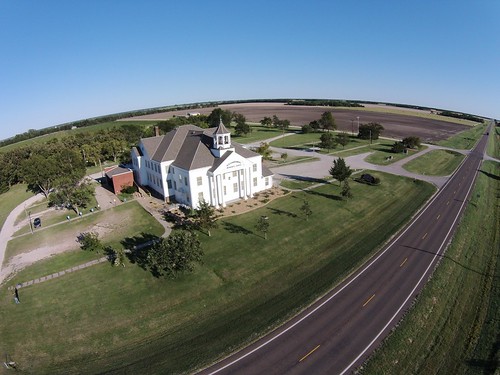
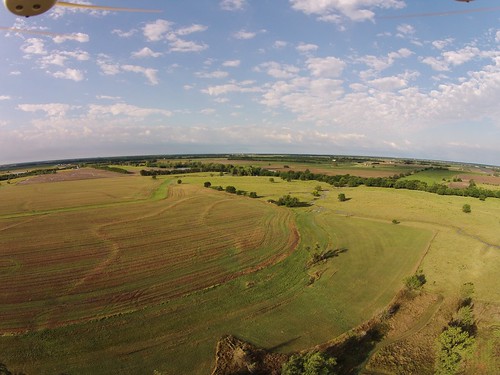
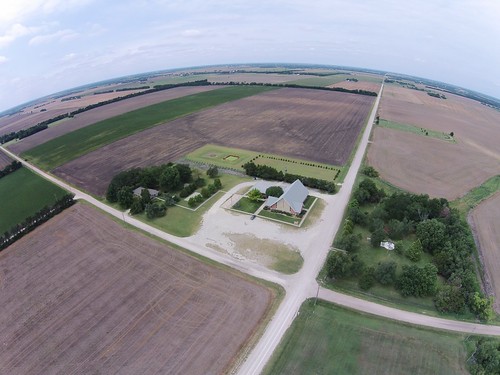
I have become meh about commercial flight over the years. The drive to the airport, the security lines, the lack of scenery at 35,000 feet. And yet, there is much more to flight than that. When I purchased what was essentially a flying camera, I saw a whole new dimension of the earth s amazing beauty. All the photos in this post, in fact, are ones I took. I then got a RC airplane, because flying the quadcopter was really way too easy.
It s wonderful to climb the liquid mountains of the sky.
Behind me and before me is God, and I have no fears.
Helen Keller
Start talking to pilots, and you notice a remarkable thing: this group of people that tends to be cool and logical, methodical and precise, suddenly finds themselves using language almost spiritual. Many have told me that being a pilot brings home how much all humans have in common, the unifying fact of sharing this beautiful planet together. Many volunteer with organizations such as Angel Flight. And having been up in small planes a few times, I start to glimpse this. Flying over my home at 1000 up, or from lake to lake in Seattle with a better view than the Space Needle, seeing places familiar and new, but from a new perspective, drives home again and again the beauty of our world, the sheer goodness of it, and the wonderful color of the humanity that inhabits it.
The air up there in the clouds is very pure and fine, bracing and delicious.
And why shouldn t it be?
It is the same the angels breathe.
Mark Twain
The view from 1000 feet, or 3000, is often so much more spectacular than the view from 35,000 ft as you get on a commercial flight. The flexibility is too; there are airports all over the country that smaller planes can use which the airlines never touch.
Here is one incredible video from a guy that is slightly crazy but does ground-skimming, flying just a few feet off the ground: (try skipping to 9:36)
So what comes next is something I blame slightly on my dad and younger brother. My dad helped get me interested in photography as a child, and that interest has stuck. It s what caused me to get into quadcopters ( a flying camera for less than the price of a nice lens! ). And my younger brother started mentioning airplanes to me last year for some reason, as if he was just trying to get me interested. Eventually, it worked. I started talking to the pilots I know (I know quite a few; there seems to be a substantial overlap between amateur radio and pilots). I started researching planes, flight, and especially safety the most important factor.
And eventually I decided I wanted to be a pilot. I ve been studying feverishly, carrying around textbooks and notebooks in the car, around the house, and even on a plane. There is a lot to learn.
And today, I took my first flight with a flight instructor. Today I actually flew a plane for awhile. Wow! There is nothing quite like that experience. Seeing a part of the world I am familiar with from a new perspective, and then actually controlling this amazing machine I really fail to find the words to describe it. I have put in many hours of study already, and there will be many more studying and flying, but it is absolutely worth it.
Here is one final video about one of the most unique places you can fly to in Kansas.
And a blog with lots of photos of a flight to Beaumont called Horse on the runway .
For some reason, I ve decided that gallivanting around the London Underground for the day one Saturday is a fine way to raise money for a local children s hospice. You d make my day by supporting us we aren t deducting expenses from pledges, so there s no penalty to the charity for our travel.
We re going to run a modified version of the Guinness-recognised Tube Challenge starting about 05:15 (modified to allow for unavoidable maintenance works; we don t have the luxury of being able to pick a day when that s not going to be a problem) and likely finishing about midnight.
I m also interested to hear ideas for some kind of micro-blogging platform that we can update on the move, preferably presenting in stream format and with an Android-friendly site/app that can cope with uploading a photo smoothly. Not Twitter or Facebook; it ll probably be a short-lived account. I don t want to part with personal information and I want to be able to throw it away afterwards. Suggestions?
Tube in a Day is a post from: jwiltshire.org.ukFlattr
Four architectures types of computing device that you can use to run Debian didn t make it through architecture qualification for Jessie and won t be part of the official stable release this weekend.
It s always difficult to see architectures go, particularly when there is still a community interested in maintaining support for them. Nevertheless, sometimes a port just doesn t have enough momentum behind it or sufficient upstream interest from the toolchain to be economical. Whether a port is of sufficient quality for stable is a complex decision involving several different teams Debian System Administration, the security team, those who maintain the auto-builder network, the release team, and so on and will continue to affect them for several years.
It s not all gloom though: new architectures in Jessie include arm64, ppc64el (a 64-bit version of powerpc) and s390x (replacing Wheezy s s390). Architecture rotation can be healthy.
(source: https://release.debian.org/jessie/arch_qualify.html. ia64 and s390 were planned retirements following Wheezy, leaving hurd-i386, kfreebsd-i386, kfreebsd-amd64 and sparc which didn t satisfy all qualification criteria by the time decisions had to be taken.)
Jessie Countdown: 4 is a post from: jwiltshire.org.ukFlattr
A few months ago, I wrote a long post about what I called back then the
"Gnocchi experiment".
Time passed and we me and the rest of the Gnocchi team continued to work on
that project, finalizing it.
It's with a great pleasure that we are going to release our first 1.0 version
this month, roughly at the same time that the integrated
OpenStack projects release their Kilo milestone. The
first release candidate numbered 1.0.0rc1
has been released this morning!
The problem to solve
Before I dive into Gnocchi details, it's important to have a good view of what
problems Gnocchi is trying to solve.
Most of the IT infrastructures out there consists of a set of resources. These
resources have properties: some of them are simple attributes whereas others
might be measurable quantities (also known as metrics).
And in this context, the cloud infrastructures make no exception. We talk about
instances, volumes, networks which are all different kind of resources. The
problems that are arising with the cloud trend is the scalability of storing
all this data and being able to request them later, for whatever usage.
What Gnocchi provides is a REST API that allows the user to manipulate
resources (CRUD) and their attributes, while preserving the history of those
resources and their attributes.
Gnocchi is fully documented and the
documentation is available online.
We are the first OpenStack project to require patches to integrate the
documentation. We want to raise the bar, so we took a stand on that. That's
part of our policy, the same way it's part of the OpenStack policy to require
unit tests.
I'm not going to paraphrase the whole Gnocchi documentation, which covers
things like installation (super easy), but I'll guide you through some basics
of the features provided by the REST API. I will show you some example so you
can have a better understanding of what you could leverage using Gnocchi!
Handling metrics
Gnocchi provides a full REST API to manipulate time-series that are called
metrics. You can easily create a metric using a simple HTTP request:
The archive_policy_name parameter defines how the measures that are being
sent are going to be aggregated. You can also define archive policies using the
API and specify what kind of aggregation period and granularity you want. In
that case , the low archive policy keeps 1 hour of data aggregated over 1
second and 1 day of data aggregated to 30 minutes. The functions used for
aggregations are the mathematical functions standard deviation, minimum,
maximum, and even 95th percentile. All of that is obviously customizable and
you can create your own archive policies.
If you don't want to specify the archive policy manually for each metric, you
can also create archive policy rule, that will apply a specific archive
policy based on the metric name, e.g. metrics matching disk.* will be high
resolution metrics so they will use the high archive policy.
It's also worth noting Gnocchi is precise up to the nanosecond and is not tied
to the current time. You can manipulate and inject measures that are years old
and precise to the nanosecond. You can also inject points with old timestamps
(i.e. old compared to the most recent one in the timeseries) with an archive
policy allowing it (see back_window parameter).
It's then possible to send measures to this metric:
These measures are synchronously aggregated and stored into the configured
storage backend. Our most scalable storage drivers for now are either based on
Swift or Ceph which are both
scalable storage objects systems.
It's then possible to retrieve these values:
As older Ceilometer users might notice here, metrics are only storing points
and values, nothing fancy such as metadata anymore.
By default, values eagerly aggregated using mean are returned for all supported
granularities. You can obviously specify a time range or a different
aggregation function using the aggregation, start and stop query
parameter.
Gnocchi also supports doing aggregation across aggregated metrics:
This computes the mean of mean for the metric
65071775-52a8-4d2e-abb3-1377c2fe5c55 and
9ccdd0d6-f56a-4bba-93dc-154980b6e69a starting on 6th October 2014 at 14:34
UTC.
Indexing your resources
Another object and concept that Gnocchi provides is the ability to manipulate
resources. There is a basic type of resource, called generic, which has very
few attributes. You can extend this type to specialize it, and that's what
Gnocchi does by default by providing resource types known for OpenStack such as
instance, volume, network or even image.
The resource is created with the UUID provided by the user. Gnocchi handles the
history of the resource, and that's what the revision_start and
revision_end fields are for. They indicates the lifetime of this revision of
the resource. The ETag and Last-Modified headers are also unique to this
resource revision and can be used in a subsequent request using If-Match or
If-Not-Match header, for example:
Which is useful to synchronize and update any view of the resources you might
have in your application.
You can use the PATCH HTTP method to modify properties of the resource, which
will create a new revision of the resource. The history of the resources are
available via the REST API obviously.
The metrics properties of the resource allow you to link metrics to a
resource. You can link existing metrics or create new ones dynamically:
Haystack, needle? Find!
With such a system, it becomes very easy to index all your resources, meter
them and retrieve this data. What's even more interesting is to query the
system to find and list the resources you are interested in!
You can search for a resource based on any field, for example:
That query will return a list of all resources owned by the user_idbd3a1e52-1c62-44cb-bf04-660bd88cd74d.
You can do fancier queries such as retrieving all the instances started by a
user this month:
And you can even do fancier queries than the fancier ones (still following?).
What if we wanted to retrieve all the instances that were on host foobar the
15th April and who had already 30 minutes of uptime? Let's ask Gnocchi to look
in the history!
I could also mention the fact that you can
search for value in metrics.
One feature that I will very likely include in Gnocchi 1.1 is the ability to
search for resource whose specific metrics matches some value. For example,
having the ability to search for instances whose CPU consumption was over 80%
during a month.
Cherries on the cake
While Gnocchi is well integrated and based on common OpenStack technology,
please do note that it is completely able to function without any other
OpenStack component and is pretty straight-forward to deploy.
Gnocchi also implements a full RBAC system based on the
OpenStack standard oslo.policy
and which allows pretty fine grained control of permissions.
There is also some work ongoing to have HTML rendering when browsing the API
using a Web browser. While still simple, we'd like to have a minimal Web
interface served on top of the API for the same price!
Ceilometer alarm subsystem supports Gnocchi with the Kilo release, meaning you
can use it to trigger actions when a metric value crosses some threshold. And
OpenStack Heat also supports auto-scaling your
instances based on Ceilometer+Gnocchi alarms.
And there are a few more API calls that I didn't talk about here, so don't
hesitate to take a peek at the
full documentation!
Towards Gnocchi 1.1!
Gnocchi is a different beast in the OpenStack community. It is under the
umbrella of the Ceilometer program, but it's one of the first projects that is
not part of the (old) integrated release. Therefore we decided to have a
release schedule not directly linked to the OpenStack and we'll release more
often that the rest of the old OpenStack components probably once every 2
months or the like.
What's coming next is a close integration with Ceilometer (e.g. moving the
dispatcher code from Gnocchi to Ceilometer) and probably more features as we
have more requests from our users. We are also exploring different backends
such as InfluxDB (storage) or MongoDB (indexer).
Stay tuned, and happy hacking!
Background
R relies on package repositories for initial installation of a package via install.packages(). A crucial second step is update.packages(): For all currently installed packages, a list of available updates is constructed or offered for either one-by-one or bulk updates. This keeps the local packages in sync with upstream, and provides for a very convenient way to obtain new features, bug fixes and other improvements. So by installing from a repository, we automatically have the ability to track the repository for updates.
Enter drat
Fairly recently, the drat package was added to the R ecosystem. It makes both aspects of package distribution easy: providing a package (if you are an author) as well as installing it (if you are a user). Now, because drat is at the same time source code (as it is also a package providing the functionality), and a repository (using what drat provides ib features), the "namespace" becomes a little cluttered.
But because a key feature of drat is the "one variable" unique identification via the GitHub, I opted to create a drat repository in the name of a new organisation: ghrr. This is a simple acronym for GitHub Hosted R Repository.
Use cases
We can outline several use case for packages in ghrr:
packages not published in a repo by their authors: I already use two like that:
fasttime, an impeccably fast parser for ISO datetimes by Simon Urbanek which was however never released into a repo by Simon, and
RcppR6, a very nice extension to both R6 (by Winston) and Rcpp, by Rich FitzJohn; similarly never released beyond GitHub;
packages possibly unsuitable for mainline repos:
Rblpapi is a great package by Whit Armstong and John Laing to which I have been contributing quite a bit of late. As it requires a free-to-use but not open source library and headers from Bloomberg, it will never make it to the mainline repository for R, but hosting it in ghrr is perfect as I can easily update several machines at work once I cut a new development release;
winsorize is a small package I needed a few weeks ago; it is spun out of robustHD but does not yet contain new code so Andreas and I are content to keep it in this drat for now;
packages in pre-relase mode:
RcppArmadillo where I announced both a release candidate before Armadillo 5.000 came out, as well as the actual RcppArmadillo 0.500.0.0 which is not (yet) on the mainline repository as two affected packages need a small update first. Users, however, can get RcppArmadillo already from the sibling Rcpp drat repo.
RcppToml is a new package I am currently working on implementing a toml parser based on cpptoml. It works, but it not quite ready for public announcements yet, and hence perfect for ghrr.
Going forward
ghrr is meant to be open. While anybody can open a drat repository, particularly on GitHub, it may be beneficial to somehow group packages. This is however not something that can be planned ex-ante: it may just happen if others who see similar benefits in this can in fact contribute. In that spirit, I strongly encourage pull requests.
Early on, I made my commit messages conform to a pattern of package version sha1 repourl to make code provenance of every commit very clear. Ideally, subsequent commits would conform to such a scheme, or replace it with a better one.
Some Resources
A few links to learn more about drat and ghrr:
Comments and questions via email or issue tickets are more than welcome. We hope that others find ghrr to be a useful tool for easy repository management and use via GitHub.
I m a big fan of org-mode (see previous posts), and I ve started maintaining (sic) my professional webpage(s) with it.
But I ve also recently tried and publish some more Semantic/Linked Data aware documents too (again, previous posts).
Ideally, I think my preferred workflow for publishing articles or documents of some importance, would be to author them in org-mode, and then publish them as HTML5 including RDFa meta-data and annotations. Instead, I ve more frequently been doing conversions of org-mode to LaTeX, in order to submit a printable version, and later-on decided to convert the LaTeX to HTML5+RDFa
But one of the issues is how to properly embed the RDF meta-data inside the org-mode documents, so that the syntax is both compact and expressive enough.
I doubt there s a universal solution, given that RDF tends to be complex, and graphs may not project easilly along a mainly linear structure of an org-mode document, but anyway, there seems to be possible middle grounds that are practically good enough.
I ve tried and implement a solution, which reuses the principles set by John Kitchin in Extending the org-mode link syntax with attributes, i.e. implementing an HTML exporter for a particular custom link type, which will convert the plist-like syntax to some RDFa constructs.
Here s a description of the whole solution : http://www-public.telecom-sudparis.eu/~berger_o/test-org-publishing-rdfa.html
The nice thing about org-mode, and its litterate programming babel environment, is that it allows to embed the code of the links exporter inside the org document, avoiding to dissociate the converter from the document s source, making it auto-complete.
Next step will probably be to author a paper (or convert back a preprint of mines) with org-mode, in order to provide Linked Research meta-data.
Stay tuned for more details, and in the meantime, I welcome any improvement to the org/babel/elisp setup.
Edit: I ve recorded a webcast to provide a bit more details, available on YouTube : https://youtu.be/OyI3DVqllx4
 Whilst the rest of Debian was very busy actually making the Jessie release, I was trying to prepare the ground to test the armhf installer images.
Cubietruck is fine, it s a nice install and the documentation on the wiki works nicely. I tried to automate it (as it would be something I d like to test in LAVA which is new in Jessie) with preseeding but although I have got a jessie-x86 preseed file which works in libvirt, the cubietruck installer doesn t seem to want to listen to all of the preseeding. Some of the options (notably the wifi firmware screen, hostname and user passwords) don t go away. x86 wasn t completely as expected either though it works nicely in libvirt and Virtual Machine Manager but trying to (automate it again) do it manually on the command line with qemu raised an awkward grub2 bug where it couldn t work out where to install and failed to then reboot if manually installed.
iMX.53 was the next target got a few steps along the road with that one, except that the kernel in the installer isn t able to see the SATA even though the bootloader can, nor can it see the USB stick. This means that the only media the installer can see is the SD card from which the installer was booted trying to use that ends badly.
Beaglebone-black required a little bit of tweaking. Don t forget that the firmware & partition.img together don t give a lot of space, so creating a second partition on the SD card upon which to put the CD image itself is useful. The Debian ARMMP kernel in Jessie doesn t see USB, so the option here is actually what I wanted. Install from SD card onto eMMC. It s a 2Gb space, but it s ideal for a default location, leaving the SD card for other testing. I ran out of time to see about preseeding BBB installs to eMMC but one word of warning, installing to the eMMC doesn t mean that you have a bootloader on the eMMC the SD card is still needed to reboot, unless that is fixed manually post-install. (Haven t got that working yet either.)
Speaking of time, this post is more brief on the detail than I would like for a couple of reasons:

 Repeating what I did for the last Debian release with the

 What happens if you remove randomness from
 I'm happy with the progress we've made for debian-installer and
related packages for the Jessie release. We're going to end up with a
release that's better in a number of ways than what we've had
before.
1. Big EFI enhancements
I've already blogged a lot about the stuff I've worked on here, so
I'll just summarise for now some of the improvements we've got over
Wheezy.
 A new major version 5.000 of
 I've had a half-broken temperature monitoring setup at home for quite
some time. It started out with a Atom-based NAS, a USB-serial adapter
and a passive 1-wire adapter. It sometimes worked, then stopped
working, then started when poked with a stick. Later, the NAS was
moved under the stairs and I put a Beaglebone Black in its old place.
The temperature monitoring thereafter never really worked, but I
didn't have the time to fix it. Over the last few days, I've managed
to get it working again, of course by replacing nearly all the
existing components.
I'm using the DS18B20 sensors. They're about USD 1 a piece on Ebay
(when buying small quantities) and seems to work quite ok.
My first task was to address the reliability problems: Dropouts and
really poor performance. I thought the passive adapter was
problematic, in particular with the wire lengths I'm using and I
therefore wanted to replace it with something else. The BBB has GPIO
support, and various blog posts suggested using that. However, I'm
running Debian on my BBB which doesn't have support for DTB
overrides, so I needed to patch the kernel DTB. (Apparently, DTB
overrides are landing upstream, but obviously not in time for Jessie.)
I've never even looked at Device Tree before, but the structure was
reasonably simple and with a


 Gnocchi provides a full REST API to manipulate time-series that are called
metrics. You can easily create a metric using a simple HTTP request:


 Another object and concept that Gnocchi provides is the ability to manipulate
resources. There is a basic type of resource, called generic, which has very
few attributes. You can extend this type to specialize it, and that's what
Gnocchi does by default by providing resource types known for OpenStack such as
instance, volume, network or even image.


 I m a big fan of