Search Results: "sto"

7 May 2010

Christoph Berg: Clamav segfaults

If you are still using clamav on etch, you might want to upgrade now:
# /etc/init.d/clamav-daemon start  
Starting ClamAV daemon: clamd LibClamAV Warning: ***********************************************************
LibClamAV Warning: ***  This version of the ClamAV engine is outdated.     ***
LibClamAV Warning: *** DON'T PANIC! Read http://www.clamav.net/support/faq ***
LibClamAV Warning: ***********************************************************
/etc/init.d/clamav-daemon: line 240:  5221 Segmentation fault      start-stop-daemon --start -o -c $User --exec $DAEMON
 failed!
Rolling back to yesterday's daily.cld fixes the issue, at least for the segfault.

David Welton: Better Software 2010

Florence, Italy, is an extremely popular tourist destination, and for a good reason: it's absolutely full of beautiful architecture and famous art. It apparently gets more than a million tourists a year. So it felt kind of odd for me, as a foreigner, to hole up in a conference talking about computers, software and business within a stone's throw of this. It was well worth it though. "Better Software" was a very interesting conference, and extremely professional. One anecdote: since there were so many people signed up, they did the lunch and coffee breaks in another facility nearby, about a block away. However, the weather wasn't very nice, so the organizers rounded up a bunch of umbrellas, and put them near the door with a sign saying "take one if you need it", so that people could stay dry while going back and forth. Of course, having grown up in Oregon, I don't trust the weather much, and carry an umbrella, but it was a really nice gesture and attention to detail. I expected it to be good, but it ended up being a really great event. Some memorable bits: I suppose that, given the huge success of the event this year, they may look for a larger facility for future events, but I hope it doesn't end up in some soulless place in the suburbs; even if I didn't do any sightseeing, I liked being in the city center. While the organizers would be more than capable of putting on a more international event, I enjoyed the focus on Italy, and the cool things people are doing here, and I feel it also contributed some to the positive atmosphere. It's one thing to have some guy come in from abroad and tell you something, another to see someone like Peldi talk about how he did what he did. And what with all the problems Italy has right now, some "positive energy" was more than welcome. Like I said, Italy has a lot of really talented people; the problems lie elsewhere. A big thanks to the organizers and everyone who came, and I hope to see you there next year.

6 May 2010

Petter Reinholdtsen: Parallellizing the boot in Debian Squeeze - ready for wider testing

These days, the init.d script dependencies in Squeeze are quite complete, so complete that it is actually possible to run all the init.d scripts in parallell based on these dependencies. If you want to test your Squeeze system, make sure dependency based boot sequencing is enabled, and add this line to /etc/default/rcS:
CONCURRENCY=makefile
That is it. It will cause sysv-rc to use the startpar tool to run scripts in parallel using the dependency information stored in /etc/init.d/.depend.boot, /etc/init.d/.depend.start and /etc/init.d/.depend.stop to order the scripts. Startpar is configured to try to start the kdm and gdm scripts as early as possible, and will start the facilities required by kdm or gdm as early as possible to make this happen. Give it a try, and see if you like the result. If some services fail to start properly, it is most likely because they have incomplete init.d script dependencies in their startup script (or some of their dependent scripts have incomplete dependencies). Report bugs and get the package maintainers to fix it. :) Running scripts in parallel could be the default in Debian when we manage to get the init.d script dependencies complete and correct. I expect we will get there in Squeeze+1, if we get manage to test and fix the remaining issues. If you report any problems with dependencies in init.d scripts to the BTS, please usertag the report to get it to show up at the list of usertagged bugs related to this.

Adrian von Bidder: Inglourious Basterds

Whew. Thank God I did download that one and not spend money on it. If you're trying to poke fun (or be satirical) at the Nazis, do it like Chaplin, or do it like Monty Python. Inglourious Basterds is just not funny and hasn't got enough substance to be satire. It's just fooling around by people with too big an ego and too much money. I'm extremely disappointed with Tarantino here; I liked his other movies and had expected quite a bit more here. I'm not surprised to see Brad Pitt in such a movie (he's not a bad actor, but I've always had the impression that he's not picky about the roles he's playing), and Uma Thurman gets bonus points for not appearing :-) It just occurs to me that as well as completely missing the mark with the plot here, Tarantino also utterly fails at assembling a gripping soundtrack. Coincidence? If we ignore all this, the film is at least well made, and most of the actors show a good performance (I particularly like Christoph Waltz being the complete asshole.) (On second thought: now, he didn't miss the mark with the plot, but with the way he's been filming it. Use the same plot but do it as a slapstick comedy, I think it could have been really funny. Use the same basic plot but take it seriously, it might have been a real thrilling war movie. Etc. So the plot is not to blame.)

Ian Wienand: How much slower is cross compiling to your own host?

The usual case for cross-compiling is that your target is so woefully slow and under-powered that you would be insane to do anything else. However, sometimes for one of the best reasons of all, "historical reasons", you might ship a 64-bit product but support building on 32-bit hosts, and thus cross-compile even on a very fast architecture like x86. How much does this cost, even though almost everyone is running the 32-bit cross-compiler on a modern 64-bit machine? To test, I got a a 32-bit cross and a 64-bit native x86_64 compiler and toolchain; in this case based on gcc-4.1.2 and binutils 2.17. I then did a allyesconfig build of Linux 2.6.33 x86_64 kernel 3 times using the cross compilier toolchain and then native one. The results (in seconds):
32-bit64-bit
60905684
60505616
60635652
average
60675650
So, all up, ~7% less by building your 64-bit code on a 64-bit machine with a 32-bit cross-compiler.

5 May 2010

MJ Ray: General Election 2010

You may have noticed that the UK votes in a General Election tomorrow. It looks like the closest for at least 18 years and maybe more. Happily, all the major parties are saying nice things about cooperatives, but I wonder how much of that will translate into policies that are practical for co-ops like mine. Our national body Cooperatives UK has gathered the commitments from 18 manifestos and summarised them in a PDF. The first 7 pages deal with the five biggest English parties. One striking thing is how many gaps there are in the Labour, LibDem and UKIP policies, while it s not really clear to me that the Conservatives or LibDems really understand cooperatives. The Conservatives seem to suggest council-controlled co-ops (which wouldn t normally be co-ops if they lack autonomy), while the LibDems mention employee trusts more often than worker co-ops. I m sulking at Labour after several recent schemes that subsidised private competitors and excluded worker co-ops and I don t believe Labour can win in Weston-super-Mare. That would leave the Greens, who probably can t win but do seem to get it, except that there s no Green candidate where I live because he stood aside and recommended the LibDems (as I understand it). Drat. So, only a few hours to go before the start of the ballot and I m still an undecided voter.

Gunnar Wolf: Post-apocalyptic times

Pestilence, War, Famine, and Death, the mythological Four Horsemen of the Apocalypse. Mexico's de facto president, Felipe Calder n, once again showed his involuntary aptitude for deep political analysis: On Monday, on a State visit to Germany, he declared Mexico has faced the Five Horsemen of the Apocalypse (second source, in English). I agree: One year ago, we were facing a health emergency, the AH1N1 epidemic, hence pestilence. Since he took power in December 2006, the president's main action has been the war on drugs, hence war. The country was the worst performing Latin American country in 2009, with our economy falling 6.5%, more than any other country, and prices have been really on the rise, hence famine. Finally, death... official numbers state that there have been over 22000 deaths in the "war on drugs" And merrily he stated that only 10% of that were civilians. Whatever that meant... But... What about the fifth? Who is he? A plausible hypothesis is offered by cartoonist El Fisg n in today's cartoon in La Jornada:
We don't know how he got here, but he is the most effective one Now... However good El Fisg n's analysis might be... Lets not get distracted with silly details. Hern ndez, another of La Jornada's great cartoonists, shows the hidden meaning:
We are over the apocalypse!
Does that mean we are facing the Final Judgement?
The coming of the five horsemen of apocalypse can only mean... It is time for the Final Judgement and the end of time!
AttachmentSize
hernandez_20100505.jpg16.6 KB
fisgon_20100505.jpg28.11 KB

4 May 2010

Erich Schubert: Facebook tracking users via "like" function.

Facebook recently launched the "Like" function, which basically can be embedded into arbitrary web sites. Naively, it does two things:
  1. Provide a "Like" button for sharing the web site
  2. Show you how many other users like the web site
Sounds good, doesn't it?But now reconsider: even when you don't use the "Like" function, facebook is in fact notified of which web sites you visit!.Encouraging you to "share" content with friends is the hanger for this function. This is what makes web masters install it on their sites: they expect to get some extra traffic from your friends, so they just add it.But whether you like it or not, it basically allows Facebook to track your complete web viewing habits. And it's the target web site that opts in, not the user! Combined with all the personal information Facebook already has on you, this is a major privacy concern. Combining this information might even be illegal in some countries (but probably not in the US where Facebook lives, privacy unfortunately has a low role here).The best workaround currently is to blacklist Facebooks "Like" function using some kind of AdBlock, for example using this element filter:
IFRAME[src^="http://www.facebook.com/plugins/like.php"]
But in general, we should try to make this kind of data aggregation illegal without explicit consent and force Facebook to make this an opt-in feature. Political work needed here ...P.S.: Make sure to check if your AdBlock actually blocks and not just hides. As far as I can tell, WebKit Adblock, including Chromes, only hide ads. Firefoxs AdblockPlus seems to be more powerful.P.P.S.: yes I've read the claim that Facebook doesn't track. No wait, all they basically said was that they are not going to announce at F8 they will be selling web surfing behaviour based ads to their customers. They actually did NOT state (or guarantee) they will NOT use data mining on this data. Just that you probably will not be able to buy eyeballs based on rules such as "has visited/liked disney.com" ...P.P.P.S.: I've been told that facebook.com/widgets/like.php also needs to be blocked, since some sites use this URI scheme. And of course, Privoxy and similar privacy-increasing proxies are a useful addition, too.

3 May 2010

Russell Coker: Flash, Apple, and Linux

Steve Jobs has published an interesting article about Flash [1]. He criticises Flash for being proprietary, this seems a little hypocritical coming from Apple (who s the only competitor for Microsoft in terms of being the most proprietary computer company) but is in fact correct. Steve advocates HTML5 which is a better technical solution to a lot of the things that Flash does. He claims that Apple users aren t missing out on much, but I think that sites such as Physics Games [2] demonstrate the benefits of Flash. I think that Apple s attack on Flash is generally a good thing. HTML5 web sites will work everywhere which will be a good incentive for web designers to fix their sites. I also think that we want to deprecate it, but as it s unfortunately popular it s useful to have tools such as GNASH to use Flash based web sites with free software. Microsoft has belatedly tried to compete with flash, but it s Silverlight system and the free but patent encumbered Linux equivalent Moonlight have very little content to play and will probably disappear soon. As an aside the relentless determination of GNOME people to force the MONO project (including Moonlight) on it s users convinced me to remove GNOME from all systems that I run. OS News has a good analysis of the MPEG-LA patents [3] which are designed to prevent anyone making any commercial use of H.264 which includes putting such videos on sites that contain Google advertising! These patent terms are so horrible that they want to control video streams that were ever encoded with them, so you can t even transcode a H.264 stream to an open format without potentially having the scum at MPEG-LA going after you. This is worth noting when examining Apple s actions, they support MPEG patents and therefore seem happy to do anything that reduces the freedom of their customers. Apple s 1984 commercial has been proven to be a lie, it s Apple that wants to control our freedom. Charles Stross makes some good points about the issues related to Apple and Flash [4]. He believes that it s all part of an Apple push to cloud computing and that Apple wants to own all our data at the back-end while providing a relatively reliable front-end (IE without all the anti-virus nonsense that is needed on the MS-Windows platform. Cloud computing is a good thing and I can t wait for the Linux support for it to improve, I support a number of relatives who run Linux and it would be a lot easier for me if they could have the primary storage for everything be on the cloud so that I can do central backups of user data and they can use their own data while visiting each other. I think that a network filesystem that is similar in concept to offline-IMAP would be a really good thing, I know that there are some filesystems such as AFS and CODA that are designed for wide area network use with client-side caching but as far as I am aware they aren t designed for the type of operation that offline/caching IMAP supports. Matt Brubeck has given a good status report of the work porting Firefox to Android [5]. He notes that the next version of Fennec (mobile Firefox) will have Electrolysis the Firefox one process per tab feature that was first implemented in Google Chrome [6]. I think that the development of Fennec and the one process per tab feature are both great developments. Matt also says One of my personal goals is to make Firefox compatible with more mobile sites, and to give web developers the tools and information they need to make their sites work great in mobile Firefox. I ll write much more about this in future articles , that sounds great, I look forward to the results of his coding and to reading his blog posts about it!

David Welton: Mochiweb proto-deb and hacking

I had some time over the weekend to play a bit with Mochiweb. It's a very nice little bit of work, but kind of strange for an open source project. I think both things come from the fact that it was built to do some very specific things in a business, and once those goals were accomplished, that suited the owner just fine. There is no nice/fancy project home page, no links to documentation, and in general, all of the stuff you're supposed to do for a successful open source project. The code, however, is good, fast, and pretty easy to deal with. Anyway, I wanted to use it for a thing or two I'm working on, so I created some .deb packaging for it. It's been ages since I've done that (indeed, I officially retired from Debian), so it's probably missing something, but I thought I'd throw it out there for people to have a look. The git repository is here: http://github.com/davidw/mochiweb - my changes live in the 'deb' branch. The big thing I've tried to do is make it so that if you have several mochiweb projects on the same machine, they'll all be started/stopped by the init scripts, if you so choose. What you do is add a file with the path to the application to the /etc/mochiweb/apps directory, and when you do /etc/init.d/mochiweb start, it will start all of those. At stop time, it will run the stop.sh script, which shuts things down. It runs things as the user that owns the start.sh script, unless it's root, in which case it simply doesn't run. The thing that's missing right now is a way to get the thing to write logs somewhere, and I'm not quite sure how to do that, so here's hoping someone will write in with a suggestion. The .deb file I generated ought to be attached to this post, although there are no guarantees that I'll keep it up to date.

Mike Hommey: Important milestone for Iceweasel in Debian

I just uploaded a pre-release of Iceweasel 3.6.4 to experimental. This is an important milestone for several reasons:

2 May 2010

Dominique Dumont: Improve config file upgrades Ep 01

Hello The GSoC project Krzysztof and I are working aims to facilitate configuration upgrade during package upgrades. Most of the cases, this upgrade should not require any input from the user, even if the user had previously customized his configuration file. Currently configuration upgrade may ask questions to the user which may be hard to answer for most non-technical users. For more details see PackageConfigUpgrade on Debian wiki. (If you are not familiar with upgrade issues, you might want to read this page.) At the 2 extremes of upgrade tools, we have: Each tool has its own advantages and drawbacks. On the plus side of diff3 tools : On the other hand, here are the issues with diff3 based tools: For more details on diff3 issues, see Benjamin Pierce s paper (thanks to David Lutterkort from Augeas for the info) On the other end of the spectrum, Config::Model pros are: But, Config::Model main problem is: diff3 tools is lackluster for users. While Config::Model puts too much strain on packagers because it requires configuration models where all parameters are defined and declared in the model. For fast evolving projects, this can be a huge recurrent task (been there, done that for Xorg) . (Well, this recurrent task is a problem until doc, implementation and config model can be extracted from a single meta-description But I digress, this may be a project for GSoC 2011 :-p ) So, this GSoC project (for 2010) aims to find a compromise between these 2 extreme cases. On Config::Model, I ve always had a drawer statement whenever I was asked why Config::Model does not handle unknown parameter:
a configuration file cannot be validated if an unknown parameter can t be distinguished from a user typo.
This stance is fine for casual user interaction on a stable system: an unknown parameter is most likely an error. And the user must be warned of his error as soon as possible. For a stable distro release, packagers should have the time to provide complete models, so basing upgrade on complete models should be possible (famous last words ?). On the other hand, a lot of configuration upgrades will be done on unstable systems where software evolve quite fast, where models will likely fall behind software evolutions. Another shorcoming of my drawer statement is that it assumes user interaction where erroneous input is more likely. In case of configuration upgrades, there should be no user interaction. And we can assume that the config file to be upgraded was used (and thus validated) by the old version of the software. So unknown parameters should be tolerated and managed as best as possible. Now, the big question is: how ? In all attempts I ve seen in managing upgrades that goes beyond diff3 tools, the configuration is stored as structured data. Sometimes this structure can be infered from the configuration file syntax (shell vars, INI files, YAML, XML), sometimes not (sshd config file). In the latter case, some structural knowledge must be built in the upgrade tool. Currently, Config::Model is designed to bring a complete description of the structure and semantics of a configuration file. This is perceived as bringing too much structural and semantic knowledge ( too semantic ). So the maintenance cost is perceived as too important. That may be right or wrong, but that does not matter. Perception is more important here. So, let s figure out a way to reduce the amount of work required to perform upgrades (you may want to read a little bit more on configuration model creation before going on ) One possibility would be to support configuration models that allow unknown leaves in nodes. Such a model would provide a kind of fallback leaf description. Something like: this parameter is unknown, let s assume it s a simple string value . Let s consider sshd_config example to see how such a behavior would pan out for some upgrade scenarios. sshd model is made of 2 main classes:
- Sshd
- SshdMatchElement The second one contains all parameters allowed in a Match class (in fact, Match parameter is the only one in sshd that defines a new hierarchical level. All other parameters are simple leaves). Now let s consider typical upgrade scenarios from old version (with old models) to a more modern version. Let s assume that the model is lagging behind and the model does not follow sshd evolutions. So Config::Model will face 3 upgrade cases (extracted from sshd config history):
  1. Unexpected parameter that are actually simple leaf parameters. E.g. introduction of ClientAliveInterval.
  2. Obsolete parameters that should be migrated. E.g KeepAlive is renamed into TCPKeepAlive
  3. New structural parameters (introduction of Match element)
So what would happen with a model allowing unknown parameters but lacking specific instructions for these upgrades:
  1. ClientAliveInterval value would be kept. :-)
  2. KeepAlive would be kept as is.TCPKeepAlive would also be kept. No migration is performed, but the configuration would be good. As long as sshd supports the old parameter, we re good. :-/
  3. Without knowledge of the structure brought by Match parameters, Config::Model would consider that parameter in Match block would duplicate parameters in the main block and remove the duplicate. User data may be lost. :-(
So, there s not silver bullet. Let s resume what we ve learnt: Next step is to figure out what would happen if the same strategy is applied to other types of configuration files. But that will be for another blog. All the best

Russell Coker: Lexmark Supposedly Supports Linux

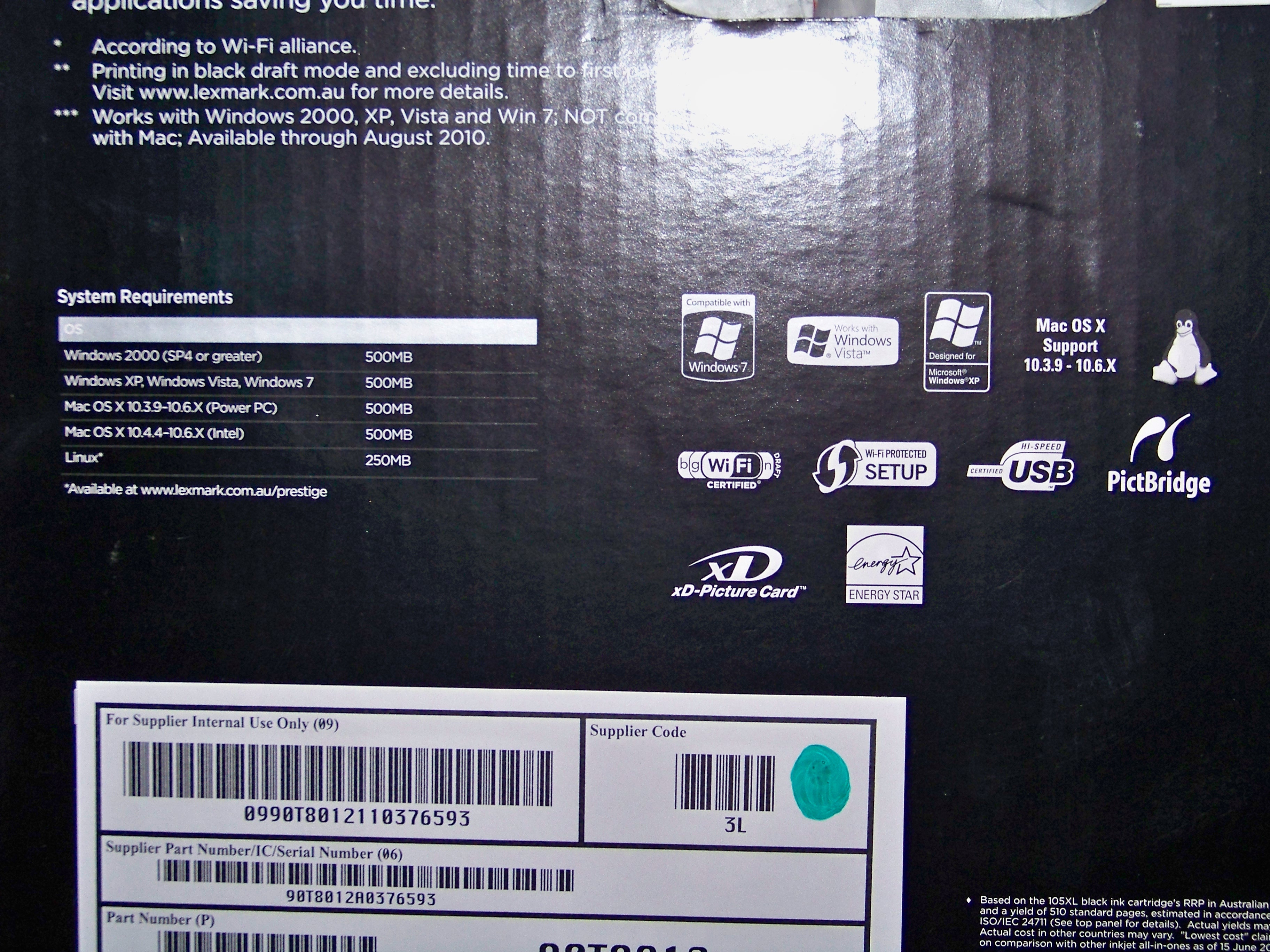
I wanted to get a Lexmark Prestige Pro805 printer to work under Linux, due to bad drivers from Lexmark and no driver support in Debian/Unstable I ve given up and advised the people who purchased it to return it for a refund. I recommend that Lexmark not be considered when purchasing a printer for use with Linux. The box advertises the URL http://www.lexmark.com.au/prestige for downloading Linux drivers. The driver file is named lexmark-inkjet-09-driver-1.5-1.i386_ts.deb.sh.tar.gz which makes anyone expect a tar.gz archive of a shell archive of a Debian package. But that s not what it is at all, in Lexmark-land deb is not the file name extension for a Debian package, but just a random bit of text to identify a file that is somewhat related to Debian, the fact that the Linux driver for Ubuntu/Debian Package Manager based distros doesn t use the string ubu in it s name is something that would lead a typical Linux user to believe that deb means a Debian package. Similarly the file named lexmark-inkjet-09-driver-1.5-1.i386_ts.rpm.sh.tar.gz and described as Linux driver for RedHat Package Manager based distros is not actually an RPM package or inherently for RPM based distros, it s just a shar archive that is built and tested for some unspecified version of some Red Hat distribution (RHEL? Fedora? SUSE?). Now when I execute lexmark-inkjet-09-driver-1.5-1.i386_ts.deb.sh on an AMD64 version of Linux it opens an X11 window, prompts for the root password, and then fails because an i386 Debian package that it somehow built couldn t be installed. When I ran the shar archive with the options --noexec --keep and examined the files it contained it has a few AMD64 executables so obviously the software they used to create the installer has some support for AMD64 but they just decided not to use it. It seems that the only way to buy an i386 system nowadays is to buy an embedded system or a NetBook, all Desktops, laptops, and servers run the AMD64 architecture, as most people do a Linux install that matches the full capabilities of their system (IE running AMD64 software on an AMD64 CPU) that means most systems sold in the last few years can t be used with a new Lexmark printer without an unreasonable amount of work. Sure it is possible to setup a chroot environment or KVM virtual machine for running printer drivers, but I don t really want to do that and a significant portion of the potential customers don t have the skill needed to do so. While technically their claims about having Linux driver support are correct (they support some distributions of Linux on i386), the majority of new systems won t work with it unless someone who has good skills spends some time and effort on it. Probably the majority of Linux Desktop and server systems that are in use today use AMD64 and are run by people who don t know how to setup a chroot so therefore for most real installations it s not supported. Even for i386 systems installation is unlikely to be trouble-free, when they support RPM based distributions (without identifying which of the many wildly different RPM systems they tested on) and Debian (without mentioning a version number) it seems that the incidence of people running a distribution that is supported is going to be quite low. Lexmark uses the Linux logo to claim compatibility Based on this experience I am not inclined to trust Lexmark in future, I will not trust any future claims of Linux support that they may make. The above picture of the Lexmark box shows Tux (the Linux logo), it doesn t mean support out of the box as you would hope, but instead means support for old systems with some effort.

1 May 2010

Sean Finney: Nouveau, Gallium3D, and Compiz on Debian

update: 20100503: It's been brought to my attention that there might have been a regression in one of the libraries, mesa, maybe, so that master might not be as reliable a reference point for this guide. so, just in case, here are the commit hashes that were used from the different projects: for the non-git-savvy: git checkout -b mybranch <hash> we now return to your regular broadcasting... A week or two ago I figured it was about time that I took the plung and tried out the latest nouveau drivers from experimental on my laptop. Unfortunately, it meant bidding adieu to compiz (apart from the bling it does actually provide some pretty damned useful features). I thought I'd give it a shot at least for a while on principal, since I've always had to think of the nvidia drivers as a necessary evil, and their lack of proper xrandr support is really, really annoying. Since then I haven't noticed any problems, apart from the following message after every suspend/resume:
[  931.213239] Uhhuh. NMI received for unknown reason 80 on CPU 0.
[  931.213240] You have some hardware problem, likely on the PCI bus.
[  931.213242] Dazed and confused, but trying to continue

No idea what's causing it, but otherwise the system is stable and functional. If anyone knows what can be done about this, I'd appreciate hearing from you. My graphics card, by the way:
01:00.0 VGA compatible controller: nVidia Corporation G72M [Quadro NVS 110M/GeForce Go 7300] (rev a1)

In the time since then, the nouveau driver has made its way into unstable, and a lot of distros (ubuntu, fedora, ...) are even using it as the default driver. So before going any further with the 3d/compiz stuff, I highly recommend that you get the packaged version working first. This will not only make sure that the basic driver works, but it will also make recovery/rollback a lot easier. Since it's all packaged in the standard repositories, it's not much harder than installing a few packages and editing a few files... so come on give it a try :) Getting the 2d driver working in Debian sid Really, this is so easy it's hardly worth writing up, but i'm running with the -v flag this morning... Make sure you don't have any reference to nvidia in /etc/modules or other places that might cause it to be automatically loaded. Then remove the proprietary glx bindings, which would otherwise interfere with the nouveau driver.
sudo apt-get remove nvidia-glx

Next, you'll need to install a kernel that includes updated drm support. Normally this would require a kernel >= 2.6.33.1, but the debian kernel maintainers have graciously backported this code to the 2.6.32-4 kernel package. note this isn't the default kernel version in testing/unstable at the time of writing so you have to explicitly install it along with the nouveau driver.
sudo apt-get install linux-image-2.6.32-4-amd64 xserver-xorg-video-nouveau

If you are already running this kernel and using the proprietary nvidia drivers, via module-assistant or otherwise, you /might/ need to uninstall them first. On my system I left them installed in the old kernel version but did not install them on the new kernel version. Required xorg configuration I don't believe that nouveau is picked by default if available at the time of writing, so you have to have the following in your xorg.conf:
sudo sh -c "cat > /etc/X11/xorg.conf" << EOF
Section "Device"
    Identifier     "nVidia Corporation G72M [Quadro NVS 110M/GeForce Go 7300]"
    Driver         "nouveau"
EndSection
EOF

This was all I needed to do, apart from rebooting into the new kernel. For those who don't want to venture outside the packaging system, this is about as far as you can go for the time being. Though really, if you're bothering to read this far along, you're probably more interested in what comes next :) Getting 3d working (without voiding your distro warranty) So I thought I'd give the 3d-accelerated gallium a go. Their wiki page certainly makes one think twice, but at this point I was seriously fiending to get my bling back (well, the compiz scale plugin, anyway) and figured it wouldn't hurt too much to try. Via google and trawling around in various forums I found a number of how-to documents for getting Gallium3d on debian/ubuntu systems, but most of them recommended doing things in a way that wasn't easily reversible and that could totally hose your system in a not-so-hypothetical worst-case scenario. It's pretty hard to roll back a make install done into /usr, for example, and subsequent package upgrades can leave your system even worse off as they will probably clobber half of what you just did, leaving the other half totally broken. And if you have a laptop which requires the gui for networking (i.e. network-manager), then fixing/rolling-back the changes is not entirely trivial, since you'd likely have to re-download the various drm/mesa/xorg packages. So enter the tried and true unix utility stow (apt-get install stow, of course). stow is a utility that lets you install software into arbitrary folders, and then manage the system-wide installation of the software via a farm of symlinks pointing at the installed location. It's probably more well known among the sysadmin crowd than the desktop user crowd, but it's incredibly useful for the task at hand as it will let us easily install multiple copies of different software in a way that's very easy to update and/or roll-back. RTFM stow(1) for more information. So, on to the juicy stuff... Install needed software, remove problematic packages, setup, etc At least on my system, I had to remove libdrm-dev to keep things from accidentally linking against it instead of the updated version that we install later on below. There's probably a way to override this with CFLAGS but I figure this is simpler.
sudo apt-get remove libdrm-dev
sudo apt-get install stow build-essential xorg-dev git-core libtool mesa-common-dev automake autoconf 
mkdir ~/nouveau

Compile a linux-2.6.34 RC kernel
cd ~/nouveau
git clone git://git.kernel.org/pub/scm/linux/kernel/git/torvalds/linux-2.6.git
cd linux-2.6
git remote add -f nouveau git://anongit.freedesktop.org/nouveau/linux-2.6
git checkout -b nouveau-master nouveau/master
make menuconfig

Enable device drivers -> staging drivers -> nouveau. Make any other changes you might want to make (I just took defaults for everything else).
make deb-pkg

The linux-firmware-free debian package ships some of the same stuff from the generated linux-firmware-image package. I decided to opt for the upstream firmware, though I'm not sure that this is necessary:
sudo apt-get remove linux-firmware-free
sudo dpkg -i ~/nouveau/linux-image*.deb ~/nouveau/linux-firmware-image*.deb
sudo update-grub

Install a copy of dri2proto
cd ~/nouveau
git clone git://anongit.freedesktop.org/xorg/proto/dri2proto
cd dri2proto
./autogen.sh --prefix=/usr/local/stow/dri2proto-20100428
sudo mkdir -p /usr/local/stow/dri2proto-20100428
sudo make install
sudo stow -d /usr/local/stow dri2proto-20100428

Install a cutting-edge version of libdrm
cd ~/nouveau
git clone git://anongit.freedesktop.org/git/mesa/drm/
cd drm
./autogen.sh --prefix=/usr/local/stow/drm-20100428 --disable-intel --disable-radeon --enable-nouveau-experimental-api
make
sudo mkdir -p /usr/local/stow/drm-20100428
sudo make install
sudo stow  -d /usr/local/stow  drm-20100428

Likewise for mesa
cd ~/nouveau
git clone git://anongit.freedesktop.org/git/mesa/mesa
cd mesa
./autogen.sh --prefix=/usr/local/stow/mesa-20100428  --enable-debug --enable-glx-tls --disable-asm --with-dri-drivers= --enable-gallium-nouveau --disable-gallium-intel --disable-gallium-radeon --disable-gallium-svga --with-state-trackers=glx,dri --with-demos=xdemos,demos,trivial,tests
make
sudo mkdir -p /usr/local/stow/mesa-20100428 
sudo make install
sudo stow -d /usr/local/stow mesa-20100428

And now the xorg driver...
cd ~/nouveau
git clone git://anongit.freedesktop.org/git/nouveau/xf86-video-nouveau/
cd xf86-video-nouveau
./autogen.sh --prefix=/usr/local/stow/xf86-video-nouveau-20100428
make
sudo mkdir -p /usr/local/stow/xf86-video-nouveau-20100428
sudo make install
sudo stow -d /usr/local/stow xf86-video-nouveau-20100428

Configuration Configure xorg to look in alternate location for xorg modules and set up DRI
sudo sh -c "cat > /etc/X11/xorg.conf" << EOF
Section "Files"
    ModulePath "/usr/local/lib/xorg/modules,/usr/lib/xorg/modules"
EndSection
Section "ServerFlags"
    Option "GlxVisuals" "all"
Endsection
Section "Device"
    Identifier     "nVidia Corporation G72M [Quadro NVS 110M/GeForce Go 7300]"
    Driver         "nouveau"
EndSection
EOF

I've /heard/ that disabling TV out is a necessity on some cards, though I haven't seen this myself:
sudo sh -c "cat > /etc/modprobe.d/nouveau.conf" << EOF
# not entirely sure this is necessary, but heard it helped with vsync
options nouveau tv_disable=1
EOF

Finally, the one thing that can not be done in /usr/local is making the nouveau DRI driver available. From what I could tell the path that mesa uses to find the DRI libraries is hard-coded (corrections welcome). Since you won't already have this file (otherwise, why would you be following along here?), just drop in a symlink to the file in /usr/local:
sudo ln -s /usr/local/lib/dri/nouveau_dri.so /usr/lib/dri/

Finally, reboot, and hope for the best :) Riding the bleeding edge: how to upgrade later on Again, stow really shows its usefullness here. Using drm as an example case, upgrading an individual component would look something like:
cd ~/nouveau/drm
git clean -dfx
git pull
today= date +%Y%m%d 
./autogen.sh --prefix=/usr/local/stow/drm-$today --disable-intel --disable-radeon --enable-nouveau-experimental-api
make
sudo mkdir -p /usr/local/stow/drm-$today
sudo make install
sudo stow -d /usr/local/stow -D drm-20100428
sudo stow -d /usr/local/stow  drm-$today

Note how the old version is still installed, so you can switch components around pretty freely. Abort! Abort!: How to roll back changes In case your system becomes totally unusable, or you've decided that you just want to go back to the safe and cozy world of what's provided by the debian packages, simply do the following: Assuming that you're using the nouveau driver from unstable, this should be all that is necessary. Conclusion Overall impression I am very, very happy with the resulting setup. I was led to believe that this whole thing was much more unstable and unusable than it actually is! While there are certainly some glitches and missing features, I feel comfortable enough using it that I don't have plans to switch back. But if I find myself in a situation where I can't use the new setup, rolling back shouldn't be a problem either. I figure I'm happy with what I have now and it will only get better. What works, at least to a "kinda works" level. What still doesn't work Further reading, references Thanks A couple shoutouts to those who helped me with this on the way: Feedback / Corrections Unforunately, I've had to disable comments for the time being due to overwhelming quantities of spam. So please drop me a line via email or on IRC (seanius on oftc/freenode).

30 April 2010

Biella Coleman: Baby Panda wants YOU to submit to DEBCONF


bad mood destroyer, originally uploaded by the biella.
People s the deadline is fast approaching. Don t worry though, the best ideas come under deadlines and your proposal need not be lengthy. So get those typing hands out and submit a proposal (a few sentences suffices) for a presentation! The annual Debian conference is being held in NYC this year. First time
setting foot in the imperial empire. Are you doing something related to
free software that might be interesting to share, show off or talk about
at Debconf? I bet you are! We are looking for art installations,
performances, movie screenings, maybe you are wanting to host a
roundtable/panel discussion, coordinate a workshop (you dont have to
know the subject deeply to do this!). I know the deadline is soon, but don t let that scare you. The
submission requirement bar is very low, and we are flexible! here is the submission information: [1] ********************* Calling all potential contributors to DebConf10! One more week until
the final submission deadline! The DebConf team is excited to announce that we are now accepting
proposals for contributions to this year s Debian conference! We
invite you to submit proposals for how you would contribute until the
deadline: soon There are many ways you can contribute, you could present a technical
paper, host a panel discussion, put on a tutorial, do a performance,
an art installation, a debate, host a meeting (BoFS, or Birds of a
Feather Session), or other possibilities that you devise. This year we
are also accepting proposals for tracks=E2=80=94a thematic grouping around a
particular subject, and people to coordinate those tracks. If you are
looking for ideas of things that you could contribute, or have ideas
for things that you would like to see happen at DebConf, have a look
at the Contribution Brainstorm[0] page. DebConf talks will be broadcast live on the Internet where possible,
unless otherwise requested. Videos of the talks will be published on
the web along with the presentation slides and papers. =3D=3D Step 1. Submit Proposal =3D=3D Proposals should provide an overview of your proposed contribution,
similar to an abstract, and be no more than 600 words. Since
contributions can cover a range of issues, please describe what your
proposal covers, be it political (Free Software, law, advocacy,
access, etc.), technical (d-i, OpenPGP, etc.), social (Debian
structures and groups). It s okay to hit all three of these. Your
proposal should also include some information on why you re qualified
to present, or coordinate this topic. For example, you can include
links to posts you have made to Debian mailing lists or other material
that indicates your qualifications. Proposals and their abstracts will
be accepted until May 1st, 2010, 23h59 UTC. To submit your proposal, go to Penta[1] and register as an
attendee. Once you are registered, there is a Submit a proposal
link. You will see your proposal on the site. You can choose between
different presentation types. If you are unsure what type you should
use, please read our glossary of definitions[2]. If it s not there for
some reason, or you have questions, please contact us immediately at
mailto:talks@debconf.org. =3D=3D Step 2. Committee Review =3D=3D The review committee for this year will make its decision by May 1st,
2010. All correspondence will be done by email. =3D=3D Step 3. Paper Submission =3D=3D Like last year, we are asking for papers to be submitted along with
the presentations. A full paper is optional, however we strongly
encourage you to submit one if possible as we intend to provide
written information along with transcripts of the sessions for later
viewing. Having written papers in advance will allow us to get
translations done to help non-native-English speakers feel more
comfortable with the topics presented. Papers are due by July 1st,
2010, and should cover the topic in reasonable depth (3 pages A4 text,
plus pictures and diagrams). We will use LaTeX to typeset the
proceedings. Please submit your paper formatted in LaTeX. Should you
be unfamiliar with LaTeX earlier submission in plain text is also
fine. =3D=3D Step 4. Live Presentation =3D=3D Longer presentations may have a break in the middle and should include
workshop items that directly involve the participants. If using slides
or any other presentation, please consider that your audience will
consist of people who use free software, and your choice of
application to prepare and display the slides should reflect this if
at all possible. =3D=3D Fine Print Publication Rights =3D=3D DebConf requires non-exclusive publication rights to papers,
presentations, and any additional handouts or audio/visual materials
used in conjunction with the presentation. The authors have the
freedom to pick a DFSG-free license for the papers themselves and
retain all copyrights. The presentations will be recorded, and may be
broadcast over the Internet. Any copies of the presentation will be
made available =3D=3D Failure to Submit =3D=3D In the event that a deadline is missed we reserve the right to revoke
any offer to present. =3D=3D About DebConf =3D=3D The annual DebConf conference is a technical and social forum for
Debian developers, sponsors, affiliates, and friends. It allows
various groups within Debian a chance to come together, network, and
share their work. Until we see you in the big city,
DebConf Talks Team [1] introduction written by Micah Anderson

Michael Banck: 30 Apr 2010

Science Track at Debconf10 This year's Debconf will probably have for the first time tracks pertaining to certain subjects. One of the proposed tracks will be "Math and Science and Debian" and I was asked to organize it. We have some talk proposals already, and we will have a panel discussion about Debian science packaging between the major contributors of the various packaging teams, but more talks are welome! Talks could be about science with/on Debian, or Debian development in scientific fields. Additionally, I would like to encourage contributions on three types of topics: Full length talks are not required, we could split up each topic among a number of people depending on interest and submissions. Talks can be officially submitted until the end of tomorrow (Saturday May 1st, 23h59 UTC), but even afterwards, if you plan to go to Debconf and would like to give a talk about Math, Science and Debian, please contact me and we will see what can be done. Especially contributions to the three topics above can be made later as the events will be registered already.

Russell Coker: Link Within

Good Things about LinkWithin For the last 10 weeks I ve been using the LinkWithin.com service to show links to other blog posts at the end of each post (the links are only shown to visitors of my blog not in the RSS feed, so people who read my posts through RSS syndication will miss this). The service shows excerpts of pictures from my blog at the bottom of each post to entice readers into reading other posts. When you click on a LinkWithin icon on my blog you visit a LinkWithin page that redirects you back to my page, so people who use that show up as new visitors being referred by LinkWithin. Currently this month LinkWithin is the fourth highest referrer to my blog, below Google, Reddit, and WebWombat.com.au so it is clearly doing some good in enticing people to read other posts that they might not otherwise read! Bad Things about LinkWithin The first problem with LinkWithin is that the Wordpress plugin was written by people who don t know much about Wordpress. Unlike every other plugin I use it doesn t support configuration options for the user in the database but instead has it hard coded in the PHP code! When you download a plugin from their web site it creates a custom zip that includes the PHP code automatically generated just for you! I have some friends using the same web server as me for running blogs, and I have to tell them you can install any plugin apart from LinkWithin it works for no-one but me . The next problem is that LinkWithin advertises that it will display related posts, it seems to be doing a poor job of that on my blog although admittedly only a minority of my blog posts have pictures so this limits what it has to work with. This has however inspired me to use more pictures in my posts. Another problem is that it produces web pages that are not valid XHTML, the following patch fixes this. --- /tmp/linkwithin.php 2010-02-22 02:09:47.000000000 +0000
+++ ./wp-content/plugins/linkwithin/linkwithin.php 2010-02-22 02:17:29.000000000 +0000
@@ -15,7 +15,7 @@
global $post, $wp_query, $linkwithin_code_start, $linkwithin_code_end; $permalink = get_permalink($post->ID);
- $content .= '<div class="linkwithin_hook" id="'.$permalink.'"></div>';
+ $content .= '<div class="linkwithin_hook" id="'.str_replace('/','-',$permalink).'"></div>';
$content = linkwithin_add_code($content);

return $content;
@@ -26,13 +26,13 @@
global $post, $wp_query, $linkwithin_code_start, $linkwithin_code_end; if ($wp_query->current_post + 1 == $wp_query->post_count)
- $embed_code = '<script>
+ $embed_code = '<script type="text/javascript">
<!-- //LinkWithinCodeStart
var linkwithin_site_id = 151382;
var linkwithin_div_class = "linkwithin_hook";
//LinkWithinCodeEnd -->
</script>
-<script src="http://www.linkwithin.com/widget.js"></script>
+<script src="http://www.linkwithin.com/widget.js" type="text/javascript"></script>
<a href="http://www.linkwithin.com/"><img src="http://www.linkwithin.com/pixel.png" alt="Related Posts with Thumbnails" style="border: 0" /></a>';
$content .= $embed_code;
Finally LinkWithin shows up badly on the FireBug analysis (see my previous post about using Firebug to speed up my blog) [1] see the below picture for details. As an aside, given that Google recommend Firebug it is rather ironic that Google Adsense related URLs cover the majority of the Firebug issues that are not caused by LinkWithin. demonstration of how Linkwithin lowers my page speed What Next? I ve sent email to the LinkWithin people about all these issues other than the FireBug problem reports, given that they haven t responded to some suggestions for over 10 weeks it seems hardly worth my effort in informing them of other issues. I m thinking of trying OutBrain.com again. 18 monthe ago I tried OutBrain but never got it working due to technical issues and then forgot about it. It has some similar features and may work better at least it has tech support people who respond to queries!

Matt Brubeck: Fennec on Android: user feedback and next steps

Last month I joined Mozilla as a UI engineer on the Fennec (Mobile Firefox) project. Firefox is already available for Nokia's Maemo platform, and now a group of Mozilla programmers are porting it to Google's Android OS. This Tuesday they made an early preview build available for public feedback. Until now, the only people working on Firefox for Android were platform developers getting the back-end code to build and run. This week was the first time most other people including me got to try it out. We front-end developers and designers are now starting to adapt the user interface to Android. (The preview build used the look and feel of Firefox for Maemo, designed for rather different hardware and software.) Because we are an open source project, we like to share our work and hear your feedback even at this early stage of development. While I wasn't directly involved in the Android development effort, I spent some of my spare time this week talking to users via Twitter and our Android feedback group. Here's what I heard, in rough order of importance to users, plus some information on our future plans.1 We don't have a regular schedule yet for releasing new builds on Android. Once we get the code merged and automated build servers configured, we'll publish nightly builds of Firefox for Android alongside our Maemo and desktop nightlies. Later this year we will have alpha and beta versions, and hopefully a stable release. Until then, you can follow @MozMobile or Vlad (@vvuk) to hear about any new previews.
  1. Please remember I am still new to the project, and cannot speak for the whole team. This is a personal blog, not a Firefox roadmap!

Russell Coker: CPL Still Sucks

I previously described my experience with Computers and Parts Land (CPL) [1] who gave me a product that didn t do what I wanted (because they thought that they knew better than me) and then gave me attitude when I returned it. As it s almost a year since that incident I had to buy something else from them to use the credit note as I decided that it s not worth making a Trade Practices Act (TPA) [2] issue out of it. Thanks Tim for the suggestion though. Firstly I went to their new store that is advertised on their web site. The people at the new store refused to honor the credit note (they probably hoped that I would just let it go and give them an extra $60 in profit). Claiming that I need to take a credit note back to the store it came from is bogus. Anyway I went back to the original store and bought a new 1.5TB SATA hard drive which seems to work well enough. The service was really slow, I was the only customer in the store and there were several employees not doing much but it still took them ages to print a receipt and give me the hard drive. It will be the last CPL purchase I ever make. In the unlikely situation that there is ever any new gear that is only sold by CPL then I will wait a year and buy it on ebay. It would be good if someone started working as a TPA complainant. They would take donations from dis-satisfied customers who want to pay for an investigation of a shonky company (I d pay $10 for an investigation of CPL). When enough donations were collected they would buy some stuff and make a video of every interaction with the employees and then launch a private legal action under the TPA if they do anything wrong. The TPA complainant would get to keep everything that they buy, any excess donation money after proving the case, and any money offered by the company to settle law suits. While it s not a good use of my time and money to go after CPL directly it would be good to give some money to someone who would then see them dealt with properly.

29 April 2010

John Goerzen: Some More Gopher Data

Yesterday, I invited you to download a piece of Internet history. Today I have unearthed a bit more data to add to it. There is a new torrent with 1.5GB more data (3GB uncompressed). This includes the FTP site from boombox.micro.umn.edu/pub/gopher, which was a large collection of Gopher client and server software. Also included was ftp.unicom.com/pub/gn-tools, the old GN server, and wiretap.area.com. This last site was mirrorable via FTP, and included the UMN Gopherd .cap and .Links files, so it can be served up via PyGopherd. The full contents are available in my post to the Gopher mailing list. Incidentally, thank you to everyone that has helped seed, download, store, host, and otherwise preserve the 2007 archive. It is much appreciated. I have contacted several institutions recommended to me in comments or emails to try to arrange a stable long-term home for the data. Enjoy.

Next.

Previous.