Search Results: "ema"

2 May 2007

Michal Čihař: What happened on last day of April?

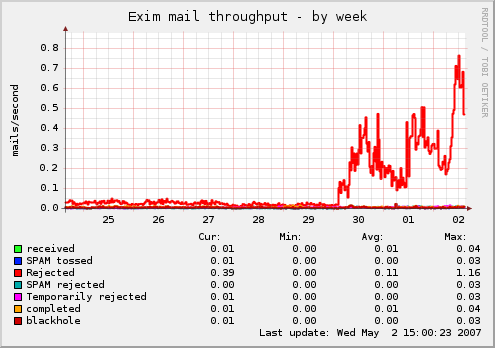
I just looked on server statistics and I was shocked by amount of spam and viruses rejected during last three days. Is there some new virus for Windows which tries random email addresses on all servers it can reach? I didn't analyse those messages, as they are rejected at RCPT time, because sender tries random addresses which do not work on my server. For now I try to reduce them by blacklisting in iptables, but this doesn't seem to help much as IP addresses change too often. I think that graph shows best what big change has happened: Mail graphs Update: It seems to be new Sober variant causing this mess.

MJ Ray: Moving slickly from ranting to advertising

I love email newsletters that move slickly from ranting to advertising. Here's one from Gossypium:
"We believe that something is critically wrong with all those head in the sand neoclassical giant companies, that have been built on economical models that we would now consider antique and even dangerous for the human evolution. New business models like Gossypium have managed to rebalance the relationships between the economy, society and the environment. It is now accepted by all that we will need to change and that there is no turning back. We as a brand are trying to make this easier by offering positive alternatives. So here is our great T-shirt collection"
Source I just wish I could do that in such an amusing way. But I can't, so I'm currently shuffling a few things around to make my Business feed a bit more work-relevant. If you are subscribed to my Business-only feed for the Media items, please switch to the Hacks feed. Meanwhile, Webmastering articles will change from the Hacks feed to the Business one. And there's some more changes which I'm still working out. Watch this space.

Simon Richter: due to popular demand

09 F9 11 02 9D 74 E3 5B D8 41 56 C5 63 56 88 C0

1 May 2007

Isaac Clerencia: Back from the States + so it turns out I m celiac

Hi there! I’m back :P I spent a really nice time in the United States with my friends. We stayed two weeks in Boston and New York, and basically did everything we had planned to do and more … We visited the MIT at Boston, went to several comedy shows, ice skated in Central Park, spent a whole day in the Barnes and Noble book megastore, went to an NBA basketball game, saw Monty Python’s Spamalot musical, discussed politics with fellow Americans, visited the Delaware Water Gap waterfalls, enjoyed an helicopter ride, even watched The Grindhouse in its first day in the cinemas, and well, did lots of other stuff. Now for the celiac thing … I was somewhat sick during the whole trip, I felt weary the whole day without any reason, so as soon as I got back to Spain I went to the doctor and after some tests that spanned over a week and a quick visit to the hospital they diagnosed me with celiac disease. That means that I can’t ever eat anything containing gluten, a protein present in wheat, barley and rye. It’s quite an inconvenient illness, but nothing more than that, as just following an strict gluten-free diet is enough to keep it at bay. The main drawback is that you have to be really careful when you go out for dinner. I have already been in sick leave for three weeks because I had lost weight and was a bit anemic, but I’m quite ok again, and I expect to be back at work really soon now :)

Russell Coker: LUG talks today

Today I gave three talks at my local LUG. The first was my latest SE Linux talk (I’ll put the notes online soon). The second was a talk about voting. I asked for a show of hands, who has already decided which party they will vote for at the next federal election (about 12 people put their hands up). I then asked people to put their hands down if they were not a member of the party that they intend to vote for, including myself there were only two raised hands in the room (including mine)! With the way party politics works nowadays the major parties are not very interested in representing their core voters. Why try to please for people who will vote for you anyway? Instead they try to appeal to swinging voters and pressure groups. If you have decided to vote for a party they have no reason to try and impress you. Therefore you should join the party and try and influence the policy decision making process from within. The issues that I believe are most important to the Linux community are free software use in government, sane intellectual property laws, the right to a fair trial, and not pandering to the US (which is related to the previous two points). If you have already decided who to vote for then you should join that party and make your vote count in the party room. One member of the audience said that he had been a member of one of the major parties but that the internal politics turned him off. If that is your experience then I think you should ask yourself whether you want to vote for a group of people that you can’t work with. The final talk I gave was about getting speakers for Linux Users’ Groups. There is always difficulty in finding speakers for clubs. Ideally we would have meetings planned a few months ahead of time so that they could be advertised in various ways. Newspapers often have columns dedicated to providing information about public meetings but the lead time is usually at least a week (and the meeting would have to be advertised at least two weeks in advance - so more than a month’s planning ahead is required). Getting a larger number and variety of speakers will attract new members, encourage existing members to attend more meetings, and inspire members in their Linux work. Talks can be given by almost anyone. There is a constant demand for speakers who have expert knowledge in the topic, but anyone who is a decent speaker and has the confidence to stand up at the podium can give a good talk. For expert speakers possibilities include academics, industry leaders, leaders of free software development projects, and journalists. But that’s not all, anyone who wants to spend the time researching a topic can give a talk on it. For example I’ve been learning about MySQL recently for my own servers and will probably offer a talk about MySQL aimed at sys-admins who don’t want to become DBAs but who just want to get a database running. I’m not a MySQL expert (and don’t plan to become one) but I believe that there are many people who want to do the things I do with MySQL and who could benefit from a talk that I might give. The best place to find speakers is a conference or trade-show. If they give a talk that works well you can suggest that they give it again for your local LUG. You can also find speakers at conferences that you can’t attend. If someone visits your country for a trade-show in a different city you could send them an email saying “unfortunately I can’t attend your talk, but if you are interested in visiting my city in the same trip then there will be an audience of X people interested in seeing you”. There’s no harm in asking, the worst that they can do is decline. Ask everyone who you think can do a good job. Also make sure that you don’t make any commitment (unless you are member of the LUG committee).

30 April 2007

Kai Hendry: Etrex plotting

Etrex via a USB interface This morning I thought I couldn’t get my GPS tracklog from my bike ride through London off my Etrex GPS device as I didn’t have:
  1. A serial port on my X40
  2. Google plus (20USD for getting data off my GPS!) on my Windows desktop at work
As I left work, a colleague suggested I try an USB serial adaptor that was lying around. He also gave me a CD with the drivers. I said I don’t need drivers! I run Debian, much to my colleague’s bemusement. Anyhoo, the USB/Serial interface works well, it comes up like so:
Apr 30 22:56:53 monty kernel: usbcore: registered new driver usbserial
Apr 30 22:56:53 monty kernel: drivers/usb/serial/usb-serial.c: USB Serial support registered for generic
Apr 30 22:56:53 monty kernel: usbcore: registered new driver usbserial_generic
Apr 30 22:56:53 monty kernel: drivers/usb/serial/usb-serial.c: USB Serial Driver core
Apr 30 22:56:53 monty kernel: drivers/usb/serial/usb-serial.c: USB Serial support registered for pl2303
Apr 30 22:56:53 monty kernel: pl2303 2-1:1.0: pl2303 converter detected
Apr 30 22:56:53 monty kernel: usb 2-1: pl2303 converter now attached to ttyUSB0
Then I ran: gpsbabel -t -i garmin -f /dev/ttyUSB0 -o gpx -F tracklog.gpx To download the track log from the Garmin. Then I converted the GPX into KML with this Gpsvisualizer Web application. Then I load up the KML with Google Earth to see where and when I have been cycling London. Google Earth really needs the package libgl1-mesa-dri installed to get DRI working on my X40 machine. Google earth showing my track log Though I prefer not to use Google Earth. I wish I could load the data with this Google maps animator, though the service doesn’t seem to accepting new accounts. Grrr… Update: Just a couple of comments about riding in London:

Enrico Zini: tg-quirk

Turbogears form quirk I had a great idea:
@validate(model_form)
@error_handler()
@expose(template='kid:myproject.templates.new')
def new(self, id, tg_errors=None, **kw):
    """Create new records in model"""
    if tg_errors:
        # Ask until there is still something missing
        return dict(record = defaults, form = model_form)
    else:
        # We have everything: save it
        i = Item(**kw)
        flash("Item was successfully created.")
        raise redirect("../show/%d" % i.id)
It was perfect: one simple method, simple error handling, nice helpful messages all around. Except, check boxes and select fields would not get the default values while all other fields would. After two hours searching and cursing and tracing things into widget code, I found this bit in InputWidget.adjust_value:
# there are some input fields that when nothing is checked/selected
# instead of sending a nice name="" are totally missing from
# input_values, this little workaround let's us manage them nicely
# without interfering with other types of fields, we need this to
# keep track of their empty status otherwise if the form is going to be
# redisplayed for some errors they end up to use their defaults values
# instead of being empty since FE doesn't validate a failing Schema.
# posterity note: this is also why we need if_missing=None in
# validators.Schema, see ticket #696.
So, what is happening here is that since check boxes and option fields don't have a nice behaviour when unselected, turbogears has to work around it. So in order to detect the difference between "I selected 'None'" and "I didn't select anything", it reasons that if the input has been validated, then the user has made some selections, so it defaults to "The user selected 'None'". If the input has not been validated, then we're showing the form for the first time, then a missing value means "Use the default provided". Since I was doing the validation all the time, this meant that Checkboxes and Select fields would never use the default values. Hence, if you use those fields then you necessarily need two different controller methods, one to present the form and one to save it:
@expose(template='kid:myproject.templates.new')
def new(self, id, **kw):
    """Create new records in model"""
    return dict(record = defaults(), form = model_form)
@validate(model_form)
@error_handler(new)
@expose()
def savenew(self, id, **kw):
    """Create new records in model"""
    i = Item(**kw)
    flash("Item was successfully created.")
    raise redirect("../show/%d"%i.id)
If someone else stumbles on the same problem, I hope they'll find this post and they won't have to spend another two awful hours tracking it down again.

29 April 2007

Biella Coleman: Blogus Christ, My Savior

Academics in the humanities and social sciences often struggle with their writing. I just figured that as you did more and more, you got better and better. Well this recent post by Radical Tenure was pretty eye opening because she confesses about losing her writing groove (in part because of sh*t going down at her university) and then she gives a fascinating account about how blogging “saved” her. Now I am stunned because her writing is pretty darn succulent. Really. I love reading her( and am proud that she is a lady blogger too given how many males dominate the “famous” scene). Now I am more inspired because I think indeed writing, especially in very competitive environments, can be a torturous and fraught task. And while it may get easier, there are circumstances that may derail even the strongest of writers. It is great to see this confronted head-on, in ways positive, honest, inspiring. Here are the relevant bits:
Another reason being anonymous didn t work for me is really internal to Zen - er, Wesleyan, stultifying features of which I was trying to escape following the Unfortunate Events. Like being watched and talked about all the time and treated like yesterday’s news for having done the teaching and institutional work I was asked to do while struggling to find time for my scholarship even as other people were chosen to be groomed as “the scholars.” What happened to me during the last three years nearly destroyed me as a writer and an intellectual (I am actually not joking about this), and I had to start all over again, recreating a literary voice for myself and a confidence that I could command an audience with my thoughts and prose, from the ground up. It was either that or quit. ….
Do not dare feel sorry for me about this, and let me underline the point: I am a highly privileged, senior faculty member at a very wealthy institution, and many other bloggers are not. Furthermore, regardless of this messy coming-out period, my strategy actually worked. Because of this blog *and its audience*, I was able to start writing again, to finish articles that were lying about undone, to write a book review for the Village Voice, to write a book proposal, to get going on revising the book that various people and committees eliminated all over during the Unfortunate Events, to do a ton of research on a new project and to begin speaking about some critical reforms that might really help faculty on the right and the left enjoy their work as academics again. In other words: I Saved Myself. And I have been transformed into something more powerful as a result of my trials.

28 April 2007

Meike Reichle: Full Metal Village

Should you live in or near one of the few German cities that have a cinema that shows Full Metal Village, do watch it! We just returned from Hanover where the Kino am Raschplatz plays it. Terrific movie! (Trailer on youtube) The documentary by Sung-Hyung Cho describes the small and rather rual German village Wacken, before and during the Heavy Metal Festival Wacken Open Air. It portrays some of its inhabitants and shows their life in a rural area and how they adopted to world's largest Heavy Metal Open Air happening on their acres each year. It's at the same time poetic and funny. More funny though ... (We were in tears from laughing by the end) PS: Also noteworthy, attac have produced a promotional film that is shown during the advertisings in German cinemas and calls to join the G8 protests at Heiligendam. Wouldn't have expected that! Nice idea though.

27 April 2007

Eddy Petrișor: change www.debian.org look, but don't forget wiki.debian.org

Lately, there has been a lot of discussion around reorganizing the layout and looks of the www.debian.org site and related sites.

Gustavo made a mock-up of the site with methors.debian.net/debian-live.alioth.debian.org theme.

All fine and dandy, but please, don't forget about wiki.debian.org.

P.S.: I am thinking of remaking the theme I did for wiki.debian.org to match this theme.

Biella Coleman: Eugenics and Sterilization in Alberta 35 Years Later

Eugenics is considered to be a technology and social practice of the past, swept away in our closest of all things ugly and bad. But the past is, in fact, quite recent, especially in the Alberta region in so far as forced sterilization was only outlawed in 1972–yes 1972. If your physical body is here in Edmonton and are interested in the ways in which science and technology can has been placed on a truly “mad path” in the name of progress and how we are in danger of repeating the past via new genetic technologies, do check out this conference Eugenics and Sterilization in Alberta
35 Years Later
. Free and open to the public, it kicks off tonight and continues all day tomorrow. The line-up of speakers is great and most important is that it includes talks by some of those who were caught by the very unfortunate web of eugenic laws.

John Goerzen: Online Internet Bank Review

Back in mid-2000, I set up my first Internet bank account. I have been using the same bank ever since. The whole notion of Internet banks has changed a lot since then, since virtually every bank offers varying degrees of online access these days. Lately I checked on banks to see if I was still using the best one. Here are my reviews of the two banks.

Internet Banks

Let's first talk about what makes a bank an "Internet bank" or "online bank". So many banks let you manage your account online now, that the distinction is blurry. But generally, I would say that unique features of Internet banks are:


There are a few to highlight.

Real-time transaction posting is a great thing to have. If you go to the website and transfer money from your savings to your checking account, you can go to the ATM *now* and withdraw it, and when you get back to your desk, the ATM transaction shows up. There are none of these confusing "business day" rules with cutoff times that traditional banks seem to love. And none of this annoying "process all withdrawals first" business that large traditional banks (hello, Bank of America) love to do in order to screw with customers.

High interest rates. Don't even bother with an online bank if the savings interest rate is less than 3% (or checking less than 1%, in my opinion). It is almost impossible to find a traditional bank with these rates.

Note: if you're reading this after April, 2007, these guidelines may no longer apply due to interest rate changes.

Electronic transfers from other banks. Another great feature. A number of banks let you set up, and then initiate, electronic transfers to and from your accounts at other banks. This is usually free if you are using the feature to transfer money into your account, and with a flat per-transaction fee (usually about the same as a foreign ATM fee) for transferring money out.

Ability to do all business without visiting a branch. Not only should this be possible, but routine business (such as making deposits) should be easy to do without visiting a branch. You should be able to order new checks online.

Now let's look at the individual banks.

First Internet Bank of Indiana

FirstIB (they provide nationwide service, despite the name) is the bank I signed up with in 2000. I had found a bank in Dallas that I really liked, but when I moved to Indianapolis, I tried two and liked neither. They all seemed to have really poor interest rates, offer few useful services, and fees for so many conditions that it was hard to avoid them. (More on that in the traditional banks section below)

I looked at the online banking scene at the time, and wound up opening a checking and savings account with FirstIB. FirstIB started as an online-only bank, but recently acquired a bricks-and-mortar bank as well.

I found FirstIB's customer service at the time to be top-notch; I would dial their toll-free number, select *one* option from a menu, and a rep would answer *immediately*. (Take that, Bank of America, with your 45-minute hold times...) Since FirstIB was based in Indianapolis, I actually visited their offices a couple of times. They had a locked lobby. You picked up a phone, pressed 0, and went into the same queue that callers to the 800 number did, then just asked them to come to the lobby and transact your business. (They would not give out cash there, but could take new account paperwork and deposits and the like)

Their interest rates have consistently outperformed traditional banks, and they offer all the online banking amenities listed above. They did not offer online statements at first, but these days online statements are the norm (there is a fee if you want paper statements). Check ordering is accomplished using a linking with the Deluxe check printers. The web interface uses Digital Insight, and the ACH transfer interface uses CashEdge.

FirstIB will actually reimburse you, at the end of the month, for ATM fees that other banks charge you, up to $6/mo. They also provide an unlimited supply of free postage-paid deposit envelopes, and have a PDF of deposit slips that you can print out should you run out.

FirstIB's customer service has slipped in recent times. I know of some people that have been impacted by some errors that FirstIB has made (simply not processing paperwork that they should have processed). Wait times have gone up for the phone line, and a lot of the great "small bank" feel (where they actually knew their customers, and you might actually know the reps) is gone.

Presidential Bank, FSB

Presidential Bank is the bank I'm looking at now. I was initially drawn to them by their extraordinarly high interest rates (5.25% for savings!), but some other things have convinced me to use them.

Initially, I was suspicious. Presidential is a bricks-and-mortar operation that has been around for awhile, and was one of the very first Internet banks. Their website says that they started offering Internet accounts in 1995, and very much looks like it hasn't been updated since. (Thankfully, the account management interface is more modern). I almost thought the site was a fraud up front, a "too good to be true" deal with the high interest rates and bad-looking website. But after doing some research, realized that it is quite real.

Before setting up accounts with them, I had a few questions (such as whether or not transactions post in real time). Presidential has a simple email address for people that want to send in questions (unlike FirstIB's obvious queue system). I sent an email, and got a response an hour or two later, from a real person with a first and last name, and a personal e-mail address I could use to follow up. Nice. I also had occasion to talk to people on the phone. They were polite, speedy, and helpful.

So I set up my accounts with them. I activated the online access, bill payment, and money transfer features. All worked as expected. I did have a couple more occasions to call them after the account was set up (a more crucial test than the pre-account calls), and they remained helpful. Strangely, this bank, which seems to be a much larger operation than FirstIB, had a more small bank feel. Several times, as I started talking to a rep, he or she would say something like "Oh, I remember processing the setup paperwork on this account last week" or "I think I talked to you about this before?"

Customer service is one of those things you rarely need after the first month or so of an account. But with your bank, it is vital that the reps know what they are doing and are willing to help you when you call -- which Presidential is doing better than FirstIB these days.

Presidential does not rebate ATM fees like FirstIB does. They do provide a few deposit envelopes with your initial account setup packet, but they are not postage paid or unlimited. However, because Presidential's interest rates are so much better than FirstIB's, it doesn't take much in your account to more than balance out that difference. Plus, with so many retail stores offering "cash back" when you use an ATM or debit card, it isn't too bad to get cash for free with Presidential. (And, most employers offer direct deposit, so we rarely use deposit-by-mail) One other trick is to find some local bank and open a no-minimum free checking account with them. You can deposit checks there and withdraw cash from their ATM, and use Presidential's free incoming ACH to electronically transfer the funds to Presidential when you get too much in the local account. (Chances are that these local accounts will not pay any interest)

Presidential offers a few features FirstIB does not. First, they scan all your deposits (not just your canceled checks) and offer to let you view them online. Secondly, they automatically send you an email when they've received a bank-by-mail deposit (you can opt out of that, of course). Third, they let you view *all* of your old statements online (FirstIB only lets you view the last 6 months worth, though both have the complete history available in the web interface).

Like FirstIB, Presidential uses DigitalInsight for the web interface and CashEdge for the ACH feature.

Internet Bank Comparison Both banks offer two primary checking and two primary savings accounts. This table compares all four accounts.

FeatureCheckingSavings
FirstIBPresidentialFirstIBPresidential
AccountInterestFreeInternet PlusInternetMoney MktRegPremierInternet
APY1.26%0%4.50%1.25%3.90%2.75%5.25%1.50-2.50%
Min Balance$500$0$1000$500$4000$1000$0$100
Min MethodAvg DailyDailyAvg DailyDaily
Min to Open$100$25$1500$500$100$100$5000$100
Online Bill Pay$0$4.95/mo$0$5.95/mo (up to 10 payments)Not available
ATM surchage rebate$6$0$0$0
Online Canceled Check ImagesFreeN/A
Online Deposit ImagesNoFreeNoFree
Email Deposit NotificationsNoFreeNoFree
Email Balance AlertsFree
ACH policyFree when initiated at other end; free for deposits when initiated at the bank's website; small fee for withdrawals when initiated at bank's website


Online options at traditional banks

As I mentioned, Presidential is a traditional bank that has offered Internet accounts for some time now. Some other traditional banks do that as well, but look carefully at them, especially if they're a big nationwide bank.

I looked at options from Bank of America, Citibank, HSBC USA, ETrade Bank, and some other large national banks. In general, these were just regular bank accounts with a web interface (HSBC and ETrade being somewhat of exceptions). Read the fine print and you'll find poor interest rates and traditional banking hassles (lack of immediacy in transactions, predatory posting practices, fees for just about everything).

Plus I can tell from personal experience that Bank of America customer service is downright awful. One example: they used to pressure me to open a credit card with them every time I visited a branch. I declined every time, and had to be forceful about it sometimes. Then one day, not long after a visit with a particularly annoying employee, I got a Bank of America credit card -- which I had specifically refused -- in the mail. Hmmmmmm.

They also, unlike any other bank I've ever used, charged a fee to receive wire transfers. Which they had not disclosed. Then, of course, they apply withdrawals before deposits, and caused an overdraft from the undisclosed fee, even though the wire transfer was a *deposit* that would have very easily covered it. That was the last straw for me. After nearly an hour on the phone with them, I got them to agree to reverse both the fee and the overdraft charge. THEN I said I wanted to close my account.

When traditional banks are better

There are a few situations where Internet banks don't work out so well:

Living paycheck to paycheck. If you are constantly running out of money, and it is vital that any deposits get posted *NOW*, you probably don't want an Internet bank (and wouldn't benefit from their higher interest anyway). When you mail in a check, it can take some time before you have access to the money; the postal service has to deliver it, and then most of your checks will be subject to the "non-local" availability policy and held for about a week (though interest will start to accrue immediately).

Not being able to meet minimum balances. Internet banks do tend to offer a variety of accounts, but if you aren't able to regularly maintain $500 to $1000 in your checking account or $2000 to $5000 in your savings, you will likely fall into a category with lower interest and fewer free benefits. These accounts may not have many benefits over traditional banks, and may in fact be worse in some ways. The interest rate gap won't make that much of a difference either. There are several online banks that offer savings accounts only, with high interest rates and low minimums, that you may want to investigate -- though you will have availability into your checking account measured in days, not seconds. Presidential's savings has no minimum, but requires $5000 to open. (They do have lower-interest savings accounts without that requirement) Watch out for FirstIB's accounts; you can open an account with less than the monthly minimum balance, and will run into fees unless you deposit enough to meet the minimums.
MJ Ray: Daddy or Chips? MJ Ray or Sony?

26 April 2007

Biella Coleman: Abbot and the Slimy Politics of Drug Patents

For those of you who like to follow cutting edge developments in the politics of intellectual property law, do not miss today’s Democracy Now program AIDS Activists Call for Global Boycott of Abbott for Withholding Drug Sales in Thailand. It is sort of stunning in that empowering and disempowering way. The show discusses protests launched again the large pharmaceutical company Abbot who in reaction–no, make that retaliation–to Thailand’s decision to issue compulsory licenses on AIDS drugs, and import generic drugs acted in highly questionable ways:
“Abbott responded in a way that shocked many AIDS activists - the company announced it would withhold seven new drugs from sale in Thailand including a new AIDS drugs and treatments for arthritis and high blood pressure.”
It is great to see countries use the very slim rights granted to them by organizations like the WTO but in order for the rights to have any punch, these countries *must* be given the space to make these decisions without the deep intimation and that is exactly what Abbot is up to. To learn more, read the transcript, listen to the show. And if you want to go on, I have pasted the “favorite” part of the show: (more…)

David Welton: "Ideas are worthless"

In one of his many well written and thought provoking essays (Ideas for Startups), Paul Graham has this to say:
Actually, startup ideas are not million dollar ideas, and here's an experiment you can try to prove it: just try to sell one. Nothing evolves faster than markets. The fact that there's no market for startup ideas suggests there's no demand. Which means, in the narrow sense of the word, that startup ideas are worthless.
While I agree with his main point that execution counts, his affermation bugs me a little bit because it clashes with my understanding of economics. To wit, that ideas are "Non-excludable goods". As the linked page says,
Non-excludable goods are defined in economics as goods or service whereby it is impossible to prevent an individual who does not pay for that thing from enjoying the benefits of it. Market allocation of such goods is not feasible.
How would a market for ideas work, in any case? How could you prevent someone from listening to a bunch of ideas and just walking away with the ones they like? Perhaps with lots of lawyering and monitoring schemes, something could be kludged together, but at that point, since the ideas alone most likely aren't worth that much compared to well executed ideas, putting together that market would probably be more trouble than it's worth. So Paul Graham is right, for practical purposes, but his economics don't seem correct to me.

Miriam Ruiz: Debian packages for Gnash

As it’s quite predictable that we’ll have a newer version of Gnash in one or two months, I’ve created a newer experimental set of packages from the CVS, so that everything is ready when the release comes out. There is really much more to do before they’re in a decent state, mainly making them work out-of-the box for Konqueror, and decide how to handle the shared objects that are being built right now. The plugin for iceweasel works out-of-the-box for me. Do not expect a stable program for the moment anyway, it’s still under heavy development. I’ve been reported some more bugs about these packages anyway, so be careful with them. Chipi has built the packages for amd64 for me, so if you want them, they’re available online. According to one of the developers: “gnash should not have shared objects, they have been enabled again recently to allow builds on Darwin, altought I think we should disable them again”, so I think that matter about shared objects is likely to be solved soon. As it is right now, I’m pretty sure it wouldn’t be compliant with The Policy. As there’s no API for gnash yet, it doesn’t really make sense to create a -dev package for the moment, even though there seem to be some demand for it. Somewhere in the future we will likely have one. For those who want to experiment with later versions, I’m using SVN for handling the packaging, so it’s quite easy to create some really extreme latest version of the packages: svn co svn://svn.debian.org/svn/pkg-flash/packages/gnash/trunk/ latest-gnash
cd latest-gnash
fakeroot debian/rules get-orig-source
cd gnash-0.7.2+cvs*.????
dpkg-buildpackage -rfakeroot

Gunnar Wolf: tbm's Release Management talk

Thanks to Romain Francoise, I found and watched Martin Michlmayr's Release Management in Large Free Software Projects talk on Google Video's Open Source Speaker series. Martin: Thanks a lot, great talk. I've been following your presentations lately, as I've given some talks on this topic - Quality Assurance on Free Software Projects (Spanish only) - However hard I try to remain faithful to the subject, I end up giving a talk on what Free Software is and how its processes are naturally more prone to yielding better quality than propietary projects.
Anyhow, with this post I want to do basically three things:

25 April 2007

Evan Prodromou: 5 Flor al CCXV

The panel ratings for SXSW07 just came out today. I'm glad to see that my talk on the commercialization of wikis scored so highly (4.42 out of 5). I'm already planning to pull together a panel for next year -- we'll see how that works out. You can get the slides for my talk this year at Talks/SXSW07 and on slideshare.net. tags:

Creacamp So, I just found out about Creacamp, a meeting for female DIY "creators" d'ici ("from here", but... a loaded word in Quebec). It's happening Saturday, 5 May at noon at the Me dia world headquarters, 2025 rue Parthenais, #304. I'm going to go, but it's interesting -- sounds like there's a real crossover with BarCampMontreal, with the exception that the presenters will be exclusively female. Local BarCamp organizers are trying to attract more women, so Creacamp makes me feel like we've failed in some way. But I take this kind of thing way too negatively; I'm sure it will work out to be a positive thing. Maybe there's something too phallic about the "bar" in "BarCamp". I dunno. I'm at La ka today working with Niko, so when I heard about Creacamp I went across the caf and asked Hugh McGuire about it. He'd heard about it just seconds before, in a blog comment. Weird, wired world. Hugh has a blog post about BarCampMontreal and women, by the way. tags:

Jordi Mallach: natura upgraded to etch

Last week I started the final round of Debian upgrades for the servers I maintain here and there, which is mostly complete today. I haven't been so lucky with upgrades this time, for a long list of different reasons. In the end, the smoothest upgrades were those boxes I upgraded when etch froze or so. natura.oskuro.net is the box serving these pages. It's an old, extremely noisy Pentium 150 which I've been intending to replace for a while now. I started the upgrade early on Thursday, knowing it'd take a while (natura takes its time only to read the Dpkg database), and it had apparently finished when I was ready to leave the office. Three issues: The very same night of last Thursday, I decided to dist-upgrade the box which serves the Spanish Debian website mirror. That's the only purpose on the box, so you can imagine the upgrade should have been pretty straight-forward. And so it seemed, until, in the middle of unpacking, dpkg died with a horrible I/O error, and I dropped into an unusable remote terminal with no working commands. Fortunately, apache2 was still up and running, and the web service has been working without interruption since the hard drive crash, albeit with no syncs from www-master. Today, Sergio visited the campus and had a look. It was a XFS crash, which got cleanly repaired using an install CD. We have an empty partition in the box, and will probably move the system to it temporarily, and back to the RAID, but on ext3. When the box was back online, I just had to resume the upgrade process, make mdadm happy and update lilo.conf before rebooting into the new kernel. This box uses LILO for some obscure reason I can't remember too clearly anymore. The box has just one partition on a md array, on two SCSI disks on a aic7xxx-based controller. Can anyone hint me why GRUB would have failed on us back in sarge, and if any fixes in the etch version would work any better? Using LILO here is error prone, and basically feels like a step back. Anyway, www.es.debian.org is now back up and running with updated content. Sindominio.net had its bi-annual upgrading party last monday, but unfortunately I wasn't able to help much as when I tried to log into the server, I must have caught the system in the middle of some key lib upgrade or something, and again I was locked in a unusable shell which would only segfault. Given my previous experience, I assumed that something had gone wrong and the box would need to be fixed at the console, and after 20 minutes I gave up helping on that front. Until I noticed, quite a long while later that I was still getting mail from the server. I managed to log in to discover the upgrade was done, with just a few bits remaining to be done. The major issues were encountered with our pam and ldap setup, plus nscd kept dying causing quite a lot of mayhem all over the place. Great work from Seajob, Syvic, nogates, apardo and the rest of the people who handled it! With etch, we can finally move back to an official Debian kernel, something we've been longing to do for a long time. The only pending upgrade issue is that we need to move from our old jabber server to either the traditional jabberd 1.x or ejabberd; our current implementation is no longer supported in Debian. The last of the etch upgrades stories involves Sofcatal 's servers. The box was running on a CentOS 4.4, which was moved away into a subdir just after booting Debian-Installer, and then lobotomised so it would run as a Linux-VServer under a new Debian etch install. I'll probably write more details about it soon though, as it could be a maybe less scary alternative to Guillem's debtakeover. Yay for etch!

Daniel Burrows: Kitties

Kate and I have been thinking for a while now about maybe adopting cats once we were settled into our new apartment. Two weekends ago, we went to a local cat shelter and adopted a pair of kittens. Photos below; the brown one is a female named Diana, and the orangish one is a male named Mars.


Not only are they INCREDIBLY CUTE, but they're very sweet-tempered and affectionate, at least when they can spare the time from chasing cat toys and play-fighting with each other. There's really nothing like having a pair of purring cats curled up on your lap together.

Kittens make everything better. :-)

(PS: more kitty pictures are available here)

Next.

Previous.