Search Results: "tim"

19 March 2013

Daniel Pocock: My low-tech investment strategy

People often ask me why I invest in low-tech, old-school investments like gold and silver bullion. Surely for somebody working with technology every day, I would have some advantage in the world of investment? The events of Cyprus this week should provide a clear answer: we've all been told that there is nothing safer than cash in the bank, protected by a Government deposit insurance scheme. Yet it appears that in a pattern reminiscent of the real life Ocean's 11 bank robbery, the culprits waited for a long weekend and set about doing the unthinkable after the lights went out on a Friday night. Three days wasn't enough for them to complete their plan (or getaway?), and so Cypriot banks are closed for a further two days. Just like in the type of bank robbery seen in the movies, the money was put there by people who worked for it, and it is taken away by people who didn't. Sadly, this is also a reflection on a society as a whole. As a result of apathy, contentedness, obsession with non-issues such as immigration, or excuses about how we don't care about politics, nobody has bothered to watch the politicians. The 2008 British film The Bank Job showed real robbers sent into a bank in the traditional manner (it is based on the true story of the 1971 Baker Street robbery). Although not substantiated, conjecture in the press suggests that British authorities were involved and got real crooks to make it look authentic. Today's press suggests that Cypriot authorities are in a similar way trying to make it look like Germany is the bad guy. Back to the gold and silver. A recent report in Science Magazine suggests it takes 100,000 years for natural processes such as earthquakes to create even small deposits of precious metals. Most politicians are taking their pension in less than 10 years and wouldn't have the time or power to interfere with or manipulate such an inherently natural physical phenomenon, and this is why bullion has remained a consistent and respected investment for thousands of years. Does anyone imagine that fresh reserves of gold are forming in the cavities under Cyprus during this week's tremors? Or will those cavities be somewhat more sparse?

Matthew Garrett: Using pstore to debug awkward kernel crashes

The problem with Samsung laptops bricking themselves turned out to be down to the UEFI variable store becoming more than 50% full and Samsung's firmware being dreadful, but the trigger was us writing a crash dump to the nvram. I ended up using this feature to help someone get a backtrace from a kernel oops during suspend today, and realised that it's not been terribly well publicised, so.

First, make sure pstore is mounted. If you're on 3.9 then do:

mount -t pstore /sys/fs/pstore /sys/fs/pstore

For earlier kernels you'll need to find somewhere else to stick it. If there's anything in there, delete it - we want to make sure there's enough space to save future dumps. Now reboot twice[1]. Next time you get a system crash that doesn't make it to system logs, mount pstore again and (with luck) there'll be a bunch of files there. For tedious reasons these need to be assembled in reverse order (part 12 comes before part 11, and so on) but you should have a crash log. Report that, delete the files again and marvel at the benefits that technology has brought to your life.

[1] UEFI implementations generally handle variable deletion by flagging the space as reclaimable rather than immediately making it available again. You need to reboot in order for the firmware to garbage collect it. Some firmware seems to require two reboot cycles to do this properly. Thanks, firmware.

comment count unavailable comments

Michal Čihař: Libravatar support in Weblate

For some time, Weblate was showing avatars for users. Just as I've discovered Libravatar - free and federated alternative to Gravatar, I thought it would be better replacement. Quickly looking at their website, it seems that they transparently provide all avatars from Gravatar as well, so the migration seems to be pretty much painless. Basic replacement to use their server is just matter of changing base URLs, however to support federated behavior, you have to install pyLibravatar. Weblate in Git now supports both these ways. While implementing the client side, I did also setup my own instance of Surrogator to provide avatars for some of my domains. Surprisingly this worked fine without problems, but let's see how much used this will actually become.

Filed under: English Phpmyadmin Weblate 2 comments Flattr this!

Gergely Nagy: Rebuttals, or the lack of thereof

It is customary during Debian Project Leader elections to write a rebuttal of the other candidate's platform. However, this is very hard to do this year, as there are a lot of overlaps between platforms, goals and ideas this time around. It is hard to rebute another platform, without also rebuting one's own. So instead of trying to highlight where I disagree (there's very little of that, if at all), I'd like to point out where I found each platform lacking.Mind you, these notes are primarily based off of the platforms, because I'm sadly still behind on my debian-vote@ reading list. Furthermore, due to the high level of similarity between platforms, I will not always single out one or the other, but mention what I found lacking, or troublesome in general instead. So unless stated otherwise, my thoughts below apply to both Moray's and Lucas' platforms.The thing I miss most from both platforms is the curious lack of plans about non-packaging project members (something which I strongly emphasize in my own platform). Similarly, even though Moray does mention encouraging more local events, I find those few paragraphs a little bit lacking; and Lucas does not even mention local teams in his platform, even though they are a very, very important part of the wider Debian community, and a terrific tool in our asset. They can further our reach by long miles! Considering their importance, little's said about either local teams or local events, even when the candidate does explicitly recognise their importance.On the other hand, Lucas writes about innovation within Debian (which I found lacking in Moray's platform) - but while he does bring up the topic, I sadly found that section of his platform vague, a mistake I made last year myself, and which I tried to avoid this time, by explicitly listing a few of my ideas on how I'd imagine inspiring & motivating people (which, in turn, would foster innovation within the project).From what I see - and I may be wrong here, and I am obviously biased - both platforms are reasonably explicit when it comes to easier topics, things that we know to work, and which we'd all continue doing in the very same spirit as our predecessor. But when it comes to experimenting, to new ideas, I found both platforms too vague. There are exceptions, of course, Moray's intern idea for example is sufficiently well explained, as far as it is possible within the limits of a platform. I found no similar thing in Lucas' platform, however, most of the ideas he explained were technical things, and those are the areas where we're fairly good at, where we already have a reasonably chance of improving - and thus, an easier topic. I was suprised by Lucas' platform, because even though he lists the need for experimentation important, the lack of truly experimental ideas was lacking - I found more in Moray's platform.All in all, I found the discussions on debian-vote@ much more useful so far, than the platforms, a lot of things were asked and answered there that the platforms did not touch.

18 March 2013

Richard Hartmann: Bee happy

Finally.. My bee box has arrived. Initially I had planned to build it myself, but with current time constraints and in light of the fact that the commercial variant is built in a sheltered workshop, I decided to go for a pre-built one. The bee box is designed to give bees a natural habitat and allow them to get through the winter without the need for artificial sugar. Harvest is limited to about 15 kg in a good year as opposed to up to 50 kg in commercial beehives, but this method of beekeeping is less stressful for the bees. The trick is that there are two sections in every bee box; starting in the second year, you open the second section as soon as the bees have started to run out of space. As that's done relatively late in May, the bees will mainly build honey-only non-larvae honeycombs. During harvest, you remove only those secondary honeycombs; as a result, the bees will not need to defend their larvae and thus be a lot more relaxed. As those bees are under supervision of a human with access to oxalic acid, it's trivial to protect those bees against infestations by varroa destructor and to keep them safe form mice during winter. Bees are incredibly important for nature's cycle, so this is a hobby with a lot of positive impact on your local flora, and subsequently fauna. And hey.. free honey!

Hideki Yamane: Monthly magazine and Ubuntu Server


Recently, I've got two books. One is "Software Design" as monthly Debian article, and another is "Ubuntu Server (Ubuntu Server practical bible)" by Fumihito Yoshida (hito, who is a member of Ubuntu Japanese LoCo (and I'm same Loco member, too).

Well, it's bit a hard to write "hot" topic since it's paper magazine, I should write an article as possible (magazine would be published, then next deadline comes 2 or 3 days after that...), anyway I'm enjoying to write about Debian :-)


Also I've got a "Ubuntu Server " - it means "hey, you should put review to the web!!!" - okay, hito. I'll do so! :)

It probably targets "beginners" but "practical" as named and worth for non-beginners, too. If you want to try set up servers, this would help you a lot. However, if you just want "Copy & Paste" thing, this book is not suitable for you. google it (but we cannot assume search result as best suitable one, and most of that lucks "why you should do this operation", of course). This book shows process of thinking and background for set up servers.

I like "conclusion first, then show its reason and other methods" style, but sometimes not in this book, it frustrated me a bit. But anyway, explorations may be fun.

This book doesn't cover "cloud", but he says "if sales is good, I'll write about it". I'll be glad to review it.

Daniel Pocock: Switzerland Glacier Express

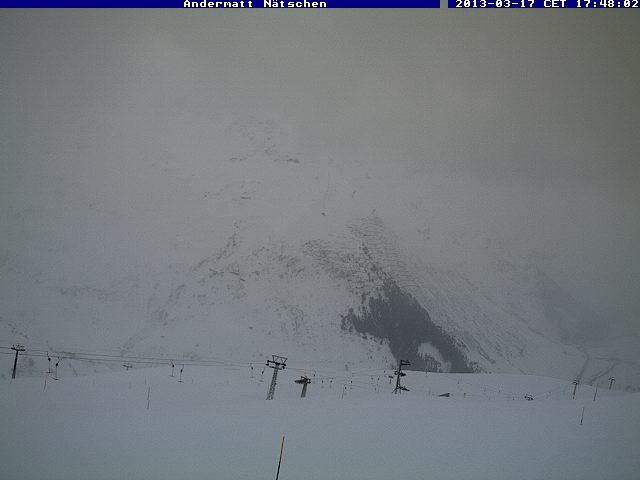
With many people coming to visit this year, both for DebConf13 and holidays, I'm going to start sharing some Swiss travel tips here in the blog. One of Switzerland's most popular tourist promotions is the Glacier Express railway. Here are the facts and a cool video. Avoid tickets/itineraries with fixed dates for visiting the mountains. The full Glacier Express journey is about 6 hours, and if it is cloudy or foggy, it is 6 hours in a train just like any other train. Some days really are cloudy and you won't see a single mountain. Try and make sure you have several flexible days in Switzerland so you can go up the mountains when the weather is optimal. Check the weather using the live webcam service Below is a typical webcam image for a bad day (I was up there Saturday skiing and it was perfect, Sunday was every tourist's nightmare). Compare this picture with the video further down: You can find a live feed like this for most Swiss mountain destinations with a web search Regular passenger trains run on the same route You don't need to buy an expensive Glacier Express' ticket. A regular passenger train does the same route every hour. No fixed reservation is necessary either and you can hop off and back on again along the way at many little stops. Oberalp Pass, at 2000 meters, is a good place to stop and hike (up to the peaks if you are keen, down to Andermatt if you want an easy walk with breathtaking views) What's more, the expensive trains are fully sealed and you can't open the windows. The regular trains do let you open the windows, so you can fully immerse yourself in the experience like this riding down from Natschen to Andermatt (1,500m): <video controls="" height="340" poster="http://danielpocock.com/sites/danielpocock.com/files/train-poster.png" width="560">
<source src="http://danielpocock.com/sites/danielpocock.com/files/DSC_1776.mp4" type="video/mp4"></source>
<source src="http://danielpocock.com/sites/danielpocock.com/files/DSC_1776.webm" type="video/webm"></source>
</video> To plan an itinerary, you can check Swiss train timetables at the official web site http://www.sbb.ch/en

Gerfried Fuchs: Backports Integrated Into The Main Archive

Dear users and supporters of the backports service! The Backports Team is pleased to announce the next important step on getting backports more integrated. People who are reading debian-infrastructure-announce will have seen that there was an archive maintenance last weekend: starting with wheezy-backports the packages will be accessible from the regular pool instead of a separate one, and all backports uploads will be processed through the regular upload queue (including those for squeeze-backports and squeeze-backports-sloppy). For Users What exactly does that mean for you? For users of wheezy, the sources.list entry will be different, a simple substitute of squeeze for wheezy won't work. The new format is:
deb http://ftp.debian.org/debian/ wheezy-backports main
So it is debian instead of debian-backports, and offered through the regular mirror network. Feel invited to check your regular mirror if it carries backports and pull from there. For Contributers What does it mean for contributing developers? Uploads for backports are no longer to be pushed to backports-master but to ftp.upload.debian.org, like any other regular package. Also, given that the packages are served from the same archive install there is no need to include the original tarball in the upload any longer because the archive knows it (Squeeze and beyond). Also, given that the upload goes to the same upload queue, there is only one keyring used anymore, so no more pain with expired or replaced keys. We though still keep the rule of adding your UID to an ACL list (this also includes DM additions). This is mostly only to give us the chance to remind you that uploads to backports are directly available for installation onto stable systems and you thus should take special care there. We carefully tried to take over the old ACLs, in case you can't upload anymore, please tell us so we can look into the issue. I've mentioned wheezy-backports (and squeeze-backports-sloppy) a few times here already, and you might wonder when it will be available. Technically, it is available from now on. Practically, while you could already upload to it, the set up of the buildd network is more painful than expected, so please allow the Buildd Team some days for setting them up. The upload rules for wheezy-backports are the same: packages that are in the next suite are accepted. Given that Jessie isn't created yet, we want you to think about whether the package you want to upload will go into Jessie final, and that you are taking a closer look once Jessie is created and the package entered there about the upgradeability. For the time until the suite is available, you can see this as relaxed upload rule. The same goes for squeeze-backports-sloppy: packages from two suites after Squeeze are acceptable, which turns it into the same relaxed rule as wheezy-backports above. Please also keep in mind that uploads to squeeze-backports-sloppy usually should be accompanied by uploads to wheezy-backports so people are able to upgrade from squeeze-backports-sloppy to wheezy with wheezy-backports. Thanks Finally, we want to thank the FTP-Master Team for their fine work on making this happen. The documentation on backports-master has been updated, and in case of any doubt or question, feel free to ask them on either the debian-backports mailinglist, or in case of sensitive topics ask us directly. Enjoy!
Rhonda for the Backports Team

/debian permanent link Comments: 1 Flattr this

17 March 2013

Gregor Herrmann: RC bugs 2013/11

& another week has gone by where I tried to work on RC bugs. here's the overview:

Soeren Sonnenburg: Shogun Toolbox Version 2.1.0 Released!

We have just released shogun 2.1.0. This release contains over 800 commits since 2.0.0 with a load of bugfixes, new features and improvements (see the changelog for details) that make Shogun more efficient, robust and versatile. In particular, Christian Montanari developed a first alpha version of a perl modular interface, Heiko Strathmann did add Linear Time MMD on Streaming Data, Viktor Gal wrote a new structured output solver and Sergey Lisitsyn added support for tapkee - a dimension reduction framework. Read more at http://www.shogun-toolbox.org

16 March 2013

Lucas Nussbaum: Ideas from the -vote@ DPL election discussions

After one week of campaign on -vote@, many subjects have been mentioned already. I m trying here to list the concrete, actionable ideas I found interesting (does not necessarily mean that I agree with all of them) and that may be worth further discussion at a less busy time. There s obviously some amount of subjectivity in such a list, and I m also slightly biased ;) . Feel free to point to missing ideas or references (when an idea appeared in several emails, I ve generally tried to use the first reference). On the campaign itself, and having general discussions inside Debian: On getting new users and contributors to Debian: Infrastructure, processes, releases: Relationships with upstreams/downstreams: This list could be moved to wiki.d.o if others find sufficiently useful to help maintaining it.

Stefano Zacchiroli: bits from the DPL for February 2013 and a half

Dear project members, here's another report of DPL activities, this time for a period longer than usual (February + 1st week of March), so that the next one will be at the very end of the current DPL term. Highlights Appointments DPL helpers Two more DPL helpers IRC meetings have happened, minutes and logs of both are available. Assets Events Past At the beginning of February, I've attended FOSDEM 2013, together with many other Debian people. I didn't have any specific talk this year, but it's been a chance to talk F2F about several ongoing issues (see logs), and help mediating in some conflicts. I've also accepted the invitation to participate in the GNOME Advisory Board meeting, together with Laurent Bigonville of our GNOME team. No report of that has been prepared as of yet (sorry about that), but we have both reported "live" to the rest of the team on IRC. Future Miscellaneous A couple of months ago I've mentioned that I had filed an application, as Debian representative, to participate in a working table to define software procurement rules for the Italian public administration. Good news: my application has been accepted, together with those of other well-known FOSS communities and organizations (e.g. KDE, FSFE). I'll keep you posted of how it goes. Let's go back to elect a new DPL and release Wheezy now,
Cheers.
PS the day-to-day activity logs for February and March 2013 are available at the usual place master:/srv/leader/news/bits-from-the-DPL.txt.20130 2,3

Clint Adams: Los pollitos dicen p o-p o, eternamente

A boy died. He knew he was dying. He tried to get help. We don't know if it occurred to him to switch off the modem and make a phone call, or if he was too weak to get up and do it. We know he sent an email. He didn't type perfect English at the best of times, and as his life slipped away from him, he misspelled many things. He misspelled ambulance . He may have misspelled diabetes . That was all fine the meaning was clear enough but the bit where it gets tragic is that he misspelled .net in the To: line. So instead of arriving at its destination, the NOC of his employer, where it would have opened up a ticket and been seen by a human at some point, the email bounced. We will never know whether they could have or would have done anything in time. We will never know if, had whoever been on postmaster duty at his ISP at the time been paying attention, he could have been saved. These things were debated angrily, by people struggling to make sense of something, but it changes nothing. The email bounced, and he died.

Russ Allbery: On (not) drinking

Captain Awkward, which is still the best advice column on the Internet, just posted an entry about someone being pestered to drink after saying that they don't drink. As another one of those people who just don't drink, but not for any specific reason that people seem to accept, I felt like blathering a bit more about that. This is mostly about me rather than about the thread over there, so I figured I'd do it on my own journal. First, I completely agree with the response that it's no one else's business why you do or don't drink, and people who persist in trying to get you to drink (or do anything else, no matter how innocuous) after you have clearly told them no are being rude and have forfeited the right to further conversation. But it also really frustrates me to see that people have to cope with that situation, particularly since I suspect it's gendered. My personal experience (as a man, and one who has a fairly firm way of expressing myself naturally) is that I say I don't drink and that's the end of it. Occasionally someone will ask me why. I've never had anyone pester me beyond that. I think the age of the letter writer (22) has something to do with this, but I suspect gender sadly also has something to do with this. People seem to be much more willing to tell women what to do and not take no for an answer. It's unbelievably rude when people do that. Don't do that. If you decide you can pester someone about their personal choices because of their gender (and, for that matter, their age, or any other reason), you deserve to get your head handed to you on a plate. Second, I wonder if some of the reason why I don't run into problems with this is that I work on a college campus. The latter means that there's a lot of surrounding culture around drinking and dealing with drinking, such as the university policy that any party have EANABs (Equally Attractive Non-Alcoholic Beverages) available as well. There's a bit of a cultural understanding that pushing people into drinking isn't okay. Third, since people do occasionally ask why I don't drink, or assume that anyone who doesn't drink is doing so for religious reasons or because they're an alcoholic, or might object to them drinking, here are a few reasons why I don't drink. It may be useful information in case you run into more people in the world like me. So, that's me. It makes no difference at all to me if other people drink. Enjoy! You won't offend me, there isn't any overtone to it, I'm not being judgemental when I say I don't drink, and it's not a dangerous topic or anything. There are probably others like me. If you run into us, all you have to say after "no thanks, I don't drink" is "oh, okay."

Russ Allbery: rra-c-util 4.8

This package is my collection of random utility functions, sort of like my version of Gnulib. (At some point, I do want to retire the bits that just duplicate Gnulib, which is less and less of it, and figure out how to properly use Gnulib for my packages as well.) The big changes in this package put the name somewhat to lie: I finally took the time to write some comprehensive infrastructure for integrating Perl tests. This is primarily in the form of three new modules and a bunch of tests that use them. The modules are Test::RRA, which provides some general facilities for handling maintainer-only tests and skipping tests when prerequisites are missing; Test::RRA::Config, which reads configuration from a separate file and allows me to use the same code verbatim in multiple packges; and Test::RRA::Automake, which provides a bunch of useful functions for intergrating tests written in Perl into packages that use Automake. Some of the test scripts were in the previous version, but they've now been overhauled to use the new modules, which makes them much simpler and more robust. But I also added a new perl/t directory, which holds all the test scripts that I use for Perl module testing, either standalone or embedded in a larger package. There are a variety of other changes, but they're minor or internal. It is worth noting, though, that all the code in rra-c-util now passes clang --analyze with clang 3.0. You can get the latest version from the rra-c-util distribution page.

15 March 2013

Lior Kaplan: Team work on RTL bugs

After returning from a vacation, I went over my RTL bugs backlog. I missed helping with checking a few patches, so I got left with verifying the fixes done by the KACST guys on master. Last week was dedicated for verifications of the bug fixes, even found a regression and reverted the commit after discussion with the author. Yesterday, I took my time with pushing these fixes also to the 4-0 branch, having them available as soon as possible instead of waiting for the 4.1 release. Total of 7 bugs got pushed, see https://wiki.documentfoundation.org/RTL_Bugs#4.0.3 for the list. I notified the developers, so they ll know their changes are available to the public sooner than expected (and let the people enjoy their work earlier). All these pushes make sure that master doesn t have any RTL support superiority over the current stable branch. In one of the cases I had to do some follow up about the commit, finding another relevant commit. This was merged with a trick Eike taught me a while ago for squashing commits with git rebase. Fridrich quickly helped with verifying that the squash stills looks good, letting me push another dependent fix on top of it.
Filed under: LibreOffice

John Goerzen: It s Warm Enough For Mud

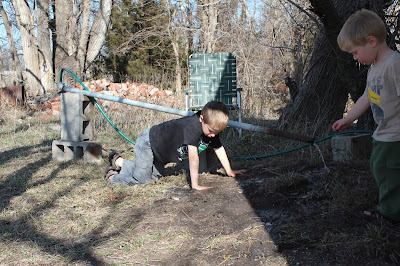
Today the outdoor temperatures got to nearly 75F/24C. The boys had this idea to go play with their streams . Here s one of the cleaner moments: I had set up an old pipe and a hose, with the water coming slowly out of the pipe onto a little mound of dirt. They can then use their fingers to make channels in the dirt for the water to flow through. They ve found that sticks can become bridges, making a hole in the earth makes a pond, and, oh yes, it s quite muddy and a lot of fun. Oliver at one point realized that he could splash the mud all around quite nicely. And he wanted to make sure I took photos of his hands. They could have played out there for hours, I m sure. When it was time to clean up, they enjoyed seeing the mud come off their sandals, arms, hands, and feet. It was a perfect use for the first really warm day of spring.

14 March 2013

Iustin Pop: Types as control flow constructs

A bug I've recently seen in production code gave me the idea for this blog post. Probably smarter people already wrote better things on this topic, so this is mostly for myself, to better summarise my own thoughts. Corrections are welcome, please leave a comment! Let's say we have a somewhat standard API in Python or C++: Signalling failures to initialise the object can be done in two ways: either by raising an exception, or by returning a null/None result. There are advantages and disadvantages to both: The None model can create latent bugs, for example in the following code:
ok = True
for arg in input_list:
  t = init_t(arg)
  if t is None:
    ok = False
    continue
  t.process()
return ok
The presence of the continue statement there is critical. Removing it, or moving it after some other statements which work with t will result in a bug. So using value-based returns forces us to introduce (manually) control points, without having the possibility to validate the model by the compiler (e.g. in C++). So it would seem that this kind of latent bugs pushes us to use the exception model, with its drawbacks. Let's look at how this interface would be implemented in (IMHO) idiomatic Haskell (where the a and b types represent the input and output types):
initT :: a -> Maybe T
processT :: T -> b
my_fn =
  
 case initT arg of
   Nothing -> -- handle failure
   Just v -> processT v
Yes, this can be written better, but it's beside the main point. The main point is that by introducing a wrapper type around our main type (T), we are forced via the type system to handle the failure case. We can't simply pass the result of initT to a function which accepts T, because it won't type check. And, no matter what we do with the result value, there are no exceptions involved here, so we only have to think about types/values, and not control flow changes. In effect, types become automatically-validated control-flow instructions. Or so it looks to me . So using types properly, we can avoid the exception-vs-return-value debate, and have all advantages without the disadvantages of either. If that is the case, why isn't this technique used more in other languages? At least in statically typed languages, it would be possible to implement it (I believe), via a C++ template, for example. In Python, you can't actually apply it, as there's no static way of enforcing the correct decapsulation. I was very saddened to see that Google's Go language, which is quite recent, has many examples where initialisation functions return a tuple err, value = , separating the actual value from the error, making it not safer than Python. It might be that polymorphic types are not as easy to work with, or it might be the lack of pattern matching. In any case, I don't think this was the last time I've seen a null pointer dereference (or the equivalent AttributeError: 'NoneType' object has no attribute ). Sadly You can even go further in Haskell and introduce more control flow structure via wrapper types. Please bear another contrived example: an HTML form that gets some input data from the user, validates it, saves it to the database, and echoes it back to the user. Without types, you would have to perform these steps manually, and ensure they are kept in the correct order when doing future modifications. With types, you only have to design the types correctly and export only smart contructors (but not the plain ones):
module Foo ( ValidatedValue
           , validateValue
           , RecordId
           , CommittedValue
           , commitValue
           , buildFeedbackForm
           ) where
data ValidatedValue a = ValidatedValue a
validateValue :: a -> Maybe (ValidatedValue a)
data RecordId =  
data CommittedValue a = CommittedValue a RecordId
commitValue :: ValidatedValue a -> ComittedValue a
buildFeedbackForm :: CommittedValue a -> HTMLDoc
From these types, it follows more or less that the only correct workflow is:
  1. get a value from the user
  2. validate it
  3. commit it, getting a transaction/record ID
  4. send the response to the user
In other words:
handleFeedbackForm = buildFeedbackForm . commitValue . validateValue
There are still issues here, e.g. the type a is completely hidden behind the wrapper types, and we can't recover some basic properties (even if we use newtype, unless we use GeneralizedNewtypeDeriving). But it does offer a way to improve control flow safety. And that is my 0.02 currency unit for today.

Richard Hartmann: The day the Reader died

...we stopped the singing. This may be irony:
No More Google Reader
from Google Operating System by Alex Chitu
via What's Hot in Google Reader

but the topic at hand remains serious. This is a stark reminder of why it's important to be able to get your data out of cloud services at a moment's notice and why you should always keep local backups of important data. Thankfully, Google is quite fair about this, as opposed to a lot of other large players. (As a side note, export of full data should be doable, but come with another layer of security like a grace period, password confirmation, verification email, or other means. Imagine someone gains temporary access to your account and exports all your digital life at once. And yes, I know how that relates to IMAP.) Google Reader has felt like a second class citizen for quite some time now, the removal of features to push Google+ and the slow updates for Android were two signs that didn't forebode well (Vim's spelling correction does not know "forbode", how weird is that)(turns out I'm simply stupid, see comments; thanks Jim). I can see how this move may make sense from Google's POV even though I am sad to see an old companion go. Anyway, the stats page of two of my accounts show how sadly I will miss Google Reader in two simple lines:
Since January 24, 2010 you have read a total of 59,253 items.
Since February 20, 2011 you have read a total of 215,285 items.

Farewell, my friend. PS: Maybe those petitions will sway them, but I won't get my hopes up. PS: Speaking of Google, I found this gem today; TMI.

Richard Hartmann: Gitify your life

sage@guug This January, I held an updated version of my "Gitify your life" talk at sage@guug, which is the Munich chapter of the German Unix User Group. Once again, it was quite successful and turnout was about three times that of normal attendance. Afterwards, I was asked if I would be willing to hold the same talk at the German Unix User Group's Spring Meeting in 2014 as the programme for 2013 has been finalized for quite some time, already. Obviously, I said I would be willing to do that and will submit the talk once registration opens. Open Source Days By the way, I am writing this post from a hotel room in Copenhagen. Tomorrow, there will be a world first... "Gitify your life" will not only be held as a talk, it will be expanded into a full three hour workshop (with the option of extending it if there's interest as the room will be free after my workshop). Having never held a workshop of this scope, I am really looking forward to this experience. Besides enabling me to get people up and running with their personal data, this will allow me to see where new users are having issues with vcsh. I keep hearing of people not getting their heads around the concept easily, but no matter how many promises of updates to my docs I get while helping them, no one really follows through with that promise once they know how to use vcsh. Maybe I will find someone willing to follow through and/or simply gather enough material for docs 2.0. Your place? As an aside, and I will probably try to put a real announcement together as well, if you know of a conference, user group or other place where a lightning talk, a full talk, or a workshop about one or all of these topics would fit, please let me know. I will gladly submit proposals to or accept invitations from most places as long as I can spread this message. Especially if the venue happens to be reasonably close to Southern Germany, covers travel cost, or if they can guarantee video recording of the talk. Joey Hess has speculated if the talk isn't really called "git naked" as I seem to keep on giving that particular talk at venues which don't have video recordings. Please help me make Joey happy... ...with a video recording, I mean.

Next.

Previous.