
Search Results: "sto"

25 May 2010

Lucas Nussbaum: Booting ISO or USB key images directly from Grub2?

I m playing with the idea of booting ISO images and USB key images stored in a disk partition directly from Grub2. That would allow to install Linux or test liveCDs without even using a USB key. It seems that Grub2 has everything needed for that (with a combination of drivemap and chainloader), but I can t seem to get it working and, as usual with boot stuff, it s a pain to understand what s happening. Has somebody recently tried that, or can point me to a howto?

Matt Zimmerman: The behavioral economics of free software

People who use and promote free software cite various reasons for their choice, but do those reasons tell the whole story? If, as a community, we want free software to continue to grow in popularity, especially in the mainstream, we should understand better the true reasons for choosing it especially our own. Some believe that it offers higher quality, that the availability of source code results in a better product with higher reliability. Although it s difficult to do an apples-to-apples comparison of software, there are certainly instances where free software components have been judged superior to their proprietary counterparts. I m not aware of any comprehensive analysis of the general case, though, and there is plenty of anecdotal evidence on both sides of the debate. Others prefer it for humanitarian reasons, because it s better for society or brings us closer to the world we want to live in. These are more difficult to analyze objectively, as they are closely linked to the individual, their circumstances and their belief system. For developers, a popular reason is the possibility of modifying the software to suit their needs, as enshrined in the Free Software Foundation s freedom 1. This is reasonable enough, though the practical value of this opportunity will vary greatly depending on the software and circumstances. The list goes on: cost savings, educational benefits, universal availability, social rewards, etc. The wealth of evidence of cognitive bias indicates that we should not take these preferences at face value. Not only are human choices seldom rational, they are rarely well understood even by the human themselves. When asked to explain our preferences, we often have a ready answer indeed, we may never run out of reasons but they may not withstand analysis. We have many different ways of fooling ourselves with regard to our own past decisions and held beliefs, as well as those of others. Behavioral economics explores the way in which our irrational behavior affects economies, and the results are curious and subtle. For example, the riddle of experience versus memory (TED video), or the several examples in The Marketplace of Perception (Harvard Magazine article). I think it would be illuminating to examine free software through this lens, and consider that the vagaries of human perception may have a very strong influence on our choices. Some questions for thought: If you re aware of any studies along these lines, I would be interested to read about them.

John Goerzen: Free-Range Kids: A Parental Rant

There s a lot of unreasonable panic out there these days. Parents that don t want to let their kids even walk to the mailbox because of an irrational fear of abduction. (Children are more likely to die falling out of bed than be abducted, and before anyone panics, that s also exceptionally rare.) A woman that let her 11-year-old travel unaccompanied on the NYC subway he d been riding all his life unleashed a huge controversy. And there s also this maddening tendency for some parents to be so worried about wounding their children s self-esteem that they never want to say they ve done something wrong, and be so positive to them. Recent studies, as well as common sense, suggest that both attitudes are rather harmful. Terah and I are believers in letting children have cheap mistakes . If I see Jacob running through the kitchen about to trip over a toy he left out, I probably won t say anything. Him crashing to the floor after running on it won t even hurt him enough that he ll cry, but it will probably be far more effective at teaching safety than 20 days worth of me saying no running in the kitchen. Of course, we ll provide comfort for him when he s sad and be there to support him, but also give him more and more freedom to succeed or fail as he grows. This starts even younger. When he first started feeding himself, he got into this habit of throwing food on the floor. We had some natural consequences as a result. If his supper landed on the floor, then he would be all done eating. (Note: Jacob was always on the heavy side at that age anyway.) He couldn t reach his supper on the floor, and we weren t going to keep bending over to pick it up for him. Fixed that problem pretty quickly at least until he learned that he could wait until he was pretty full before throwing his food down on the floor (at which point we added a brief time-out). Or how about our reaction when he has mistakes. When he breaks something, whether accidentally or on purpose, we don t give him some sort of affirmation like Oh, that s OK, we can fix it or good try; you ll do better next time. It is NOT OK to rip the pull-up flaps out of a book or to stomp on those peas you dropped on the floor, and there will be predictable and reasonable consequences for doing so. As a result, when he does a good job, it ll mean more. He, at 3, has started sounding out letters, knows his alphabet, and can count to about 15 in English and about 3 in German. And those are things we give him a good job about. Two of the best things we can do for our children are: 1) be honest about their successes and failures; and 2) give them room to succeed and room to fail, so they can learn from both while the consequences mean a skinned knee or broken toy instead of a broken rib or foreclosure on a mortgage. The Free Range Kids FAQ makes excellent reading, and discusses how many of today s parents grew up enjoying this kind of freedom, and for various reasons are too scared to allow their children that today. Rather sad, really, especially given that today s world is safer.

24 May 2010

Lior Kaplan: Taking the rust of my debian packaging skills

582784 It s been a long time since my last upload to the archive. Actually more than a year and a half. This weekend I tried to get back to packaging, hoping to catch up with some of the needed work. The beginning was very weird, forcing me to review the developer references, the policy and the new maintainer guide for information I already forgot. After a few hours of hacking, it felt like I wasn t MIA at all. After 72 hours, I quite happy with the results: Another issue I started and not sure how to continue is finding programs who lost their bidi support due to the last upgrade of libfribidi-dev. In the last version (0.19.x), the fribidi-config utility was dropped by upstream and pkg-config should be used instead. The problem is that programs which build against libfribidi-dev, look for fribidi-config and FTBFS (see #571351) or ignore it s disappearance and stop providing bidi support (see #582784).
Filed under: Debian GNU/Linux

Axel Beckert: Perfect Team: autossh and GNU Screen

SSH is definitely one of my most often used tools, not only for system administration at work but also on the road with my netbook, an EeePC 701 running Debian Sid. On the road, it often happens that I have a flaky WLAN or UMTS connection, so I often have to kill (via <Enter>~.) and reconnect my SSH session due to a changed IP address or so. First step against problems arising from using SSH over unreliable network connections is of course GNU Screen. Second step is use SSH keys and ssh-agent to not needing to type the password on every reconnect. But it s still very annoying to kill the SSH connection and call ssh again manually. For luck there is autossh, a wrapper around SSH which regularily checks via two tunnels connect to each other on the remote side if the connection is still alive, and if not, it kills the ssh and starts a new one with the same parameters (i.e. tunnels, port forwardings, commands to call, etc.). It s quite obvious that this is perfect to be combined with screen s -R and -d options (Reattach if a detached screen is around, else start a new screen; detach a currently attached screen), so I found myself very often typing (or fetching it from the commandline history :-):
autossh -t sym.noone.org 'screen -Rd'
-t is necessary to allocate a terminal device on the remote machine which is not done by default if you directly call a command via ssh. In comparision to OpenSSH, autossh needs the single quotes, because otherwise it would parse -Rd as options to parse to ssh and bail out. That s not a real problem, but when you re used to just type ssh -t sym.noone.org screen -Rd without any quotes, you ll run into this then and when. Update, 25-May-2010, 14:55: As Carsten Hey points out, autossh also supports the -- option to declare that all following options and parameters must be passed to ssh itself. (End of Update) Typing that often and mistyping it then and when cries for an shell alias or an shell function. So I came up with the following shell function:
asc()  
    autossh -x -a -t "$@" 'screen -RdU'
 
I used a function instead of an alias in case of autossh will in future regard all parameters given after the command as part of the command as ssh does. The additional options -x and -a disable X and SSH Agent forwarding which both don t work if you reattach to an already running screen. And if you re using Zsh as I do, you can even add some more format string magic to set the window title more or less to the expanded alias, eh, function:
function asc()  
    # Set the title to something more obvious, e.g. the expanded
    # alias, eh, function
    print -Pn "\e]0;%n@%m: autossh -t $* 'screen -RdU'\a";
    autossh -x -a -t "$@" 'screen -RdU'
 
compdef asc=ssh
Update, 25-May-2010, 14:59: As Hauke points out in a comment, Zsh users should also declare that asc should have the same tab completion as ssh itself. The example above has been updated accordingly. (End of Update) In the meanwhile on the EeePC I use asc on the commandline more often than ssh itself. And I nearly no more type autossh. (The most common exception here is autossh hostname tail -F /path/to/some/logfile.) Using that function you can also add common ssh options for tunneling, etc. I use it most often like this:
asc -D 1080 sym.noone.org
This opens a SOCKS proxy on localhost, port 1080 and that way I can surf via the host I m connecting to by SSH. There s one small drawback though: You didn t expect that I can just invent some new three letter command without a namespace clash, did you? There is a free game called Advanced Strategic Command whose binary (and Debian package) is named asc, too. If you have that game installed, you can always call it using its full path, e.g. /usr/games/asc on Debian. P.S.: My whole grml based .zshrc is also available via git at git.noone.org as well as on github.

Christine Spang: Christine Spang: out with the old, in with the new(er)

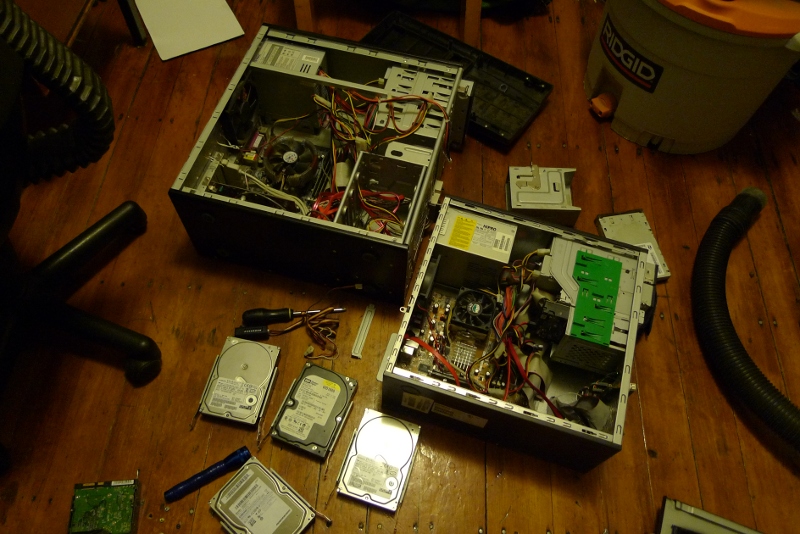
I just replaced my aging 2004-era PC with wait for it a 2005-era PC. A friend is moving across the country so I'm taking it off his hands. Swapping hardware between Freyja and Earlgrey The differences between the two are more than just the year of time, though: one was hand-built from parts, while the other was a commodity off-the-shelf Compaq. So the new machine, while not strictly faster by the clock, is 64-bit and is much more amenable to upgrades. While the added bulk is a bit annoying, the case has a lot more space in it up to 8 or so drive slots (I can't imagine ever needing that many), and 4 RAM slots which is a sure step up from the limitation of two drive slots and two RAM slots in my old machine. The most visibly shiny parts in the new desktop experience are 4G RAM versus 1G, and a nice ATI GPU. While I'm glad my OS allowed me to squeeze six years out of my main machine, I'll be happy to stop shaking my fist at Chromium for eating all my memory! The new machine will keep its old name: earlgrey.
23 May 2010

Roland Mas: FusionForge news, May 2010

The usual semi-regular bits of news from the FusionForge project. We continue being quite active, with several hundred commits each month. The momentum doesn't seem to stop even after the 5.0 release last month. A large part of the activity stems from the Coclico project, which has several work-packages related to convergence of code across forges (mostly between FusionForge and Codendi). This convergence comes in three flavours: All in all, a fairly busy period for FusionForge. The current trunk is evolving rather fast, with some long-overdue rewrites being underway. Interesting times.

Thorsten Glaser: Cancelling bash, retrieving a command, mksh rules :

In response to a planet.d.o series (mentioned in #grml on IRC) of postings: In a sensible shell, Esc+# not only pushes it back but also re-enables the command. Try it out: l s Esc # Cursor-Up Esc #
tg@blau:~ $ #ls
tg@blau:~ $ ls
The command sticks in the history, and is not immediately shown in the next interactive input line, which I consider a plus in most use cases. Anyway, try mksh (just a-g i it), there are a lot of goodies. I found out about Ctrl-O only a year or so ago myself I wonder why schizo didn t write about how to do it in posh tho

22 May 2010

Ben Hutchings: Cancelling a command in bash

Rog rio Brito writes:
[...] whenever I was typing a command line, changed my mind and pressed C-c, I got a ^C printed on the screen, usually overwriting one or two characters of what I had typed. And this prevented me from automatically copying and pasting the command that I had typed.
There is an alternative to using C-c, and that is M-#. This adds a '#' to the start of the line, commenting it out, and then behaves as if you pressed Return. The result is that the command is cancelled but still remains on-screen and in your history. You can then copy the command later using the mouse or keyboard.

Marco d'Itri: Less widely known features of iproute

While iproute (AKA ip(8)) nowadays has become the ultimate Linux network configuration tool, it is also poorly documented: many features are not documented in the man page or even in the built-in help. With this post I would like to raise the attention to some of its more recent features which are not getting the attention they deserve. And remember: every time you use ifconfig(8), Cthulhu eats a kitten. Please, think of the kittens. VLANs management
ip link add link eth0 type vlan name eth0.2 id 2
ip link add link eth0 type vlan name myvlan2 id 2 loose_binding on
ip link add foo type vlan help
This replaces the obsolete vconfig(8) program and adds new features. The loose_binding flag stops the VLAN interface from tracking the line protocol status of the underlying device. Creation of dummy interfaces
ip link add mydummy type dummy
The only way to create more dummy interfaces after the dummy module has been loaded used to be loading it again with a different name, and they were all named dummyN. Since module-init-tools does not support anymore loading the same module multiple times, iproute fully replaced this method. Ethernet in GRE tunnels
ip link add mygretun type gretap remote 192.0.2.1
ip link add foo type gretap help
A practical way to remotely bridge two Ethernet networks. The IP MTU is reduced of the expected 20 (IP) + 4 (GRE) + 14 (Ethernet II) bytes. L2TPv3 static tunnels See Documentation/networking/l2tp.txt for details, this requires kernels >= 2.6.34.

Rog rio Brito: Changing Some Configuration from Defaults

Two of my most frequently used tools are, hands down, Emacs and bash. Having a pleasant configuration of one s toolbox is necessary for long-term productivity. However, newer versions of the programs (any programs) don t always have good, comfortable defaults. That is the case with Emacs 23 and bash 4. With Emacs 23, by default, the scratch buffer shows some text that, if you want to quickly enter text to be saved, has to be deleted. This can be tolerated for some invocations of the editor. But at some point, it gets on one s nerves. Luckily, Emacs is so fully customizable that this is not a problem, unless you have to hunt down the right knobs and you are an e-lisp illiterate. That is my case. After reading an admittedly small amount of documentation, some good lines that ought to be put into one s .emacs file are:
(setq inhibit-startup-echo-area-message "rbrito")
(setq initial-scratch-message nil); show an empty scratch buffer
(setq inhibit-startup-message t); remove splash screen
Another line that may make things more comfortable (especially if you, like me, use Emacs s dired as a filemanager to navigate your folders):
(defalias 'yes-or-no-p 'y-or-n-p)
But configuring Emacs is not always that hard. Seeing a change of behaviour with your shell is scarier. When bash 4 was released, one thing that got implemented is the echo of some characters from the terminal to the screen. In practice and with my usage pattern, this meant that whenever I was typing a command line, changed my mind and pressed C-c, I got a ^C printed on the screen, usually overwriting one or two characters of what I had typed. And this prevented me from automatically copying and pasting the command that I had typed. Looking for an answer to that was much harder than to see how to change a parameter on Emacs: every search that I tried on Google with the words bash and Ctrl-C or some variants of that eventually lead me to how do I trap a Ctrl-C on my shell script? . Decided to see what changed, I read the documentation of readline. It didn t help, because I was reading something from version 5. I, then, downloaded the source code and started looking for SIGINT. Then, perusing the code (and the changelog), I saw that with bash 4 and readline 6, a new configuration option was introduced: the echo-control-characters option of readline. Of course, after knowing this, stopping the undesired behaviour was a simple matter of inserting set echo-control-characters off in my .inputrc and think about how much time I spent with that uncomfortable behaviour in some of my preferred tools. As an addendum to the previous paragraphs (written on February of this year, but only now published), the Debian package of Emacs 23.2, the newest version as of this writing, comes with some configuration that makes it ignore the settings that are used with fontconfig. I did not spend any time trying to see the cause of the problem, but adding a simple
Emacs*font:			Mono
to my .Xdefaults file did the trick and restored back the ability to use DejaVu Sans Mono at the right size on my system.

Russell Coker: A School IP Project

The music industry seems fairly aggressive in taking legal action against children when they break the licence terms of copyright material. I think it would be good to teach children about how the IP industry really works. It seems to me that you could have a school project that involves an entire year level (maybe 100 students depending on the size of the school) each of whom can produce copyright material (everything they do in art and English classes would be suitable as a start). Then they could register their work (make digital photographs and then store them in a school database that records the entry date) and sue anyone who infringes their work. Every student would receive licence fees for their work, but if they are sued for infringement they would have to pay all revenue plus damages. Other students could work as lawyers and take a portion of the proceeds of any successful law suit, and finally some students could run recording companies and spend their time hunting for infringing work for the purpose of launching legal action. In terms of the licence fees paid, this could be done by just allocating a fixed value per item to each student as a way to get the system running without regard to the fact that some students just aren t able to create good art. It could however have a large portion of the value coming from what other students choose to spend, every student gets to spend $10 per week on art and they can choose from the database what they want to buy copies of. The most popular art could then be printed on every notice-board in the school as an incentive for students to vote with their play-money for something that they don t mind seeing all the time. It s obvious that popularity would be a significant factor in the success of some artists, but that s OK, a casual review of the chart topping music reveals that it s quite obviously not created by the world s best musicians so it seems that rewarding popularity rather than skill just adds some realism. One possibility would be to allow the students to elect representatives to create their own IP laws. It would be interesting to see how the IP laws voted on by representatives of the students (who are all in some way involved with the process of creating, buying, selling, and distributing artistic products) differ from those which we have foisted upon us in the real-world. Also an interesting possibility would be to allow corruption in the election process and observe how the results differ from year levels where corruption is not permitted. I expect that teaching children how political corruption works would be a little controversial, but it s nothing that they can t learn from reading news reports about what the entertainment industry is really doing. Really being a corrupt politician for a school project shouldn t be as bad as playing a murderer in a school play! Naturally this couldn t be done with real money, but giving higher marks at the end of the year to the students who accumulate the most play money would be quite reasonable. I don t think that there would be a problem with giving higher marks to a student who succeeded through political corruption as long as they gave a good written report of how they did so and the implications for society. Please note that I am not suggesting this for a subject that is used for university entrance, I think it would be a good project for years 8-10 which in Australia have no relevance to university entrance. So the marks would just be letters on a bit of paper that might make parents happy or unhappy and otherwise mean nothing. I anticipate responses from people who believe that educating children about how the world works is not appropriate for a school. Such people are never going to convince me, but if anyone thinks that they can make a good point to convince some of the readers then I encourage them to write it up in the comments section if it s short or on their own blog if it s longer.

21 May 2010

John Goerzen: Bicycling in Rain and Mud

I recently posted here about bicycling in the mud and rain, and got some good suggestions (and also on the icebike mailing list). I eventually decided to replace my current bike (Trek 7.3FX) with a Specialized Tricross Sport Triple. As I mentioned in the bike store, it seems odd to spend this kind of money on a bike only to ride it through mud and sand. Another customer overheard and said, It sure does but don t worry, it ll be fine! But on the other hand, I figure that it is probably realistic for me to ride it around 3600 miles (5793 km) per year. At that rate, it will pay for itself in reduced car costs in about a year. I picked it up last Friday, and on Saturday moved my accessories (headlight mount, tail light, water bottle cage, etc.) to it. The Bontrager Back Rack I from the 7.3FX did not fit well, so I ordered the Specialized Tricross Rack Set, which did fit well (I m not using the front rack though). This has been a wet week. I rode Thursday when it had stopped raining about 20 minutes before I left in the morning, and we got more rain in the afternoon. Although both the Tricross and the 7.3FX have 700 32C tires, even the factory tires on the Tricross performed far better in mud than the 7.3FX ever did and I can still go much more wide if I feel it necessary. Actually, somewhat to my surprise, I didn t really have a problem with kicking up mud; my enemy turned out to be kicking up sand. It didn t really damage anything, and I had to try not to cringe as I saw the sand hitting the chain, etc. I rinse it off when I get to my destination, and clean/lubricate the chain frequently in these conditions. I haven t yet been on the bike during an active rain, but from what I ve done so far, I think it will be fine. So at this point, there s very little that will prevent me from riding.

20 May 2010

Martin Zobel-Helas: Brainstorming for DMUP 2.0

Now that we have released the slightly updated version of Debian's Machine Usage Policy (DMUP), I am thinking about a major rework for the next version. Maybe we should even start with a completely new text for it. I am currently doing a bit of brainstorming about how the new version could look.

Here are some of my ideas (completely unsorted):


Please note that this brain dump is my very personal opinion and does not reflect the opinion of the complete DSA team.

I would like to see a discussion on what the new DMUP should look like. Even though the final decision on which paragraphs make it into DMUP should stay with DSA, I think the Debian community should be involved in the evolution of this document.

Even though i am not attending DebConf10 (actually I think no one from DSA will make it), it might be a good idea if the conference could be used to do some further brainstorming. Maybe having a BoF on DMUP 2.0 might be a good idea.

Aigars Mahinovs: So, what is Microsoft Azure and how it compares to Amazon s AWS

We had a Microsoft salesperson stop at our offices today to tell people about wonders of cloud computing and Microsoft s Azure will save us all. The following is a short and non-exhaustive list of what Azure does not do according to their own experts: The Microsoft presenter also repeatedly engaged in shady tactics when presenting his information: So to summarize, Microsoft has build a cloud of Windows-like machines which can run your programs (as long as they are in .Net or Silverlight) and which does not have even a third of the features of such de-facto market leader as Amazon AWS. They try giving away their product for free and only get 14k applications in 6+ months. Note: Amazon has at least 300 000 public applications and God only knows how many more private ones. They will grow, due to companies locked-into Microsoft s way of thinking buying into their marketing, but if you have a head on your shoulders, you should avoid it as a trap, which it actually is. All that can be done on Azure, can also be done on Amazon. The opposite is not always true. In addition, if you will want have a mixed environment with both Windows and Linux servers, you will not be able to deploy Linux servers to Azure (or they will be very slow) and you ll have to put your Linux servers into Amazon (or another) cloud and pay double traffic fees for every byte of traffic between your own servers. Microsoft Azure prices are exactly the same as Amazon EC2 prices with Windows instances. However on Amazon you actually get fully capable Windows Server instances. And if you don t need Windows, you can get a much better price on Amazon. The only companies that can safely use Azure are companies that only have Windows servers AND plan to only have Windows servers for the foreseeable future. Knowing how dominant Linux is in the server market and how many Windows-only shops actually have a few Linux servers in the back room, there is very little future for Azure, until they wise up and make Linux instances first class citizens in their cloud. If not because their customers need them, then because their customers think that they at least might need them in the future. Update: Amazon now released a Reduced Redundancy storage for S3 that provides the exacts same level of storage guarantees that regular Microsoft Azure SLA (99.9%) for two thirds of the price, and also Amazons now explicitly says that their regular S3 is Designed for 99.999999999% Durability , which is worlds above what Microsoft provides. Now in this case Amazon again is cheaper than MS. Also Amazon bandwidth prices are 33% lower compared to Azure. In Azia the difference is simply staggering (0.45$ vs 0.19$ per Gb).

19 May 2010

John Goerzen: Time to learn a new language

I have something of an informal goal of learning a new programming language every few years. It s not so much a goal as it is something of a discomfort. There are so many programming languages out there, with so many niches and approaches to problems, that I get uncomfortable with my lack of knowledge of some of them after awhile. This tends to happen every few years. The last major language I learned was Haskell, which I started working with in 2004. I still enjoy Haskell and don t see anything displacing it as my primary day-to-day workhorse. Yet there are some languages that I d like to learn. I have an interest in cross-platform languages; one of my few annoyances with Haskell is that it can t (at least with production quality) be compiled into something like Java bytecode or something else that isn t architecture-dependent. I have long had a soft spot for functional languages. I haven t had such a soft spot for static type checking, but Haskell s type inference changed that for me. Also I have an interest in writing Android apps, which means some sort of Java tie-in would be needed. Here are my current candidates: Of some particular interest to me is that Haskell has interpreters for Scheme, Lua, and JavaScript as well as code generators for some of these languages (though not generic Haskell-to-foo compilers). Languages not in the running because I already know them include: OCaml, POSIX shell, Python, Perl, Java, C, C++, Pascal, BASIC, Common Lisp, Prolog, SQL. Languages I have no interest in learning right now include Ruby (not different enough from what I already know plus bad experiences with it), any assembly, anything steeped in the Microsoft monoculture (C#, VB, etc.), or anything that is hard to work with outside of an Emacs or vim environment. (If your language requires or strongly encourages me to use your IDE or proprietary compiler, I m not interested that means you, flash.) Brief Reivews of Languages I Have Used To give you a bit of an idea of where I m coming from:

18 May 2010

Bernd Zeimetz: gimp-plugin-registry package updated

Yesterday I finally found the time to update gimp-plugin-registry, the (hopefully!) largest and best collection of plugins for The GIMP. As usual here comes a short summary of the changes: Hope you like my work, suggestions and bug reports are welcome as usual!

Sam Hartman: Moonshot: Federated Authentication Beyond the Web

Recently, I ve been working on an exciting project with JaNet(UK) on a project to bring federated authentication to non-web applications. I ve worked on authentication projects a lot, although this is the first federation project I ve worked on. The big difference appears to be an emphasis on credential independence: the subject (person trying to authenticate) and service will not share a common credential type. Within their organization, the subject and their identity provider share a credential. Then, the federation has some credential mechanism such that the user s organization and the service share some (probably completely different) type of credential. The other emphasis is on providing personalization. For web applications, there are a lot of options to achieve this: Information Card, Open ID, SAML, and OAuth all provide solutions in this space. However there are not good options for non-web applications. If you out-source your mail and chat infrastructure but want to use your own chat client or IMAP client, then you will not get the same federation benefits you can get with the web. If you re using usernames and passwords and don t mind the potential problems with your out-sourcing provider being able to impersonate all your users, you can simply synchronize usernames and passwords. Within an enterprise, you can do better using Kerberos. JaNet(UK) runs the UK Access Federation, which is a SAML-based web single-sign-on federation. In order to better meet the needs of their customers they d like to expand this offering to non-web applications. This demand is apparently shared across the European academic community. I suspect there is also some demand in the US academic community and in enterprise situations. With the web, it turns out that you have a convenient platform for interactions with the identity provider: you can simply direct a web browser to the identity provider and need not specify the user interaction with the web browser at all. This is seen as a significant branding and usability advantage. With other environments, it becomes necessary to specify the interaction with the identity provider. Consider an automated client that wishes to examine a mail box and provide advanced mail sorting or aggregation. That automated client cannot directly use a web browser. OAuth solves this issue with an enrollment step that does typically involve a web browser that produces a consumer key and an authentication step that does not. However for non-web clients it seems like avoiding reliance on the browser authentication will be important. It turns out we already have widely used technologies that do this: the Extensible Authentication Protocol (EAP) mediates the interaction between a subject and identity provider for obtaining network access. It also turns out that we have fairly good technologies for abstract security services within non-web applications: thanks to Kerberos and Active Director, many application protocols and a fair number of applications support GSS-API. JaNet(UK) proposes to combine these technologies with SAML in order to produce a solution for federation beyond the web. I prepared a feasibility analysis of this proposal. At a technical level, the proposal is sound. There s a lot of standardization and implementation work, but there appears to be sufficient motivation to form the seeds of a standards activity and put together a proof-of-concept implementation. However, the big question is Will anyone use it? In particular, to be useful beyond fairly small communities, support from client vendors and application framework vendors will be needed. It s taken massive money and around 20 years to get Kerberos support to a point where it is effective within an enterprise. Moonshot can leverage that work to a large extent, but moonshot may also have greater usability and penetration goals. It s interesting that I m advocating EAP for application layer authentication. When I was a Security AD, I made a strong statement that EAP must only be used for network access. I ve been fairly consistent about that since then. I think there are two huge problems with using EAP for application authentication. The first is that EAP only authenticates the home realm; it does not authenticate what service you re going to. So you might try to connect to your e-mail and end up giving something access to your stored files and pictures instead. That is, EAP has a phishing exposure in the federated context. If the only thing you can get by using EAP is network access, that exposure is only moderate. However in a fully federated environment that is a huge exposure. Moonshot will address this problem by using EAP channel binding and by doing the necessary work to make that a viable solution. The second concern is that interoperability is reduced when you have multiple authentication approaches for the same problem. If EAP is going to be used for application authentication, we need to understand how it relates to the rest of the application authentication metasystem. Moonshot proposes such a relationship, addressing my objection. Moonshot is designed to work well with the objectives of the Identity Metasystem and its laws of identity. It uses a different technology, but does have an approach for dealing with claims-based identity and hopefully will have a user experience very similar to the identity metasystem. It uses a different underlying technology. However one of the main beliefs behind the identity metasystem is that is the user experience and universal interoperability that is important, not any specific technology. In its domain, the technologies Moonshot selects will be a better fit than a web services stack. It s strange not to be working on Kerberos; Moonshot uses some Kerberos technology, but its core is definitely not today s Kerberos. In some ways it is fun to be working on something new. There s one aspect of Kerberos I really miss: Moonshot has nothing like tickets. There s no place to remember state or exchange to directly involve the client in what the server learns. My analysis talks about ways to make Moonshot more like Kerberos; there are some potential advantages, but so far, the tradeoffs do not justify changes. We re hoping to have a bar BOF at IETF 77 and a BOF in the summer at IETF 78.

Andrew Pollock: [life] Zoe, 2 weeks later

The fact that it's only two weeks feels totally surreal. I think it's the feeding approximately every 3 hours. That's approximately 100 interactions that we've had with her in only 2 weeks. We had her two week weight check at the paediatrician's today. She's now weighing 6 lbs 12 oz (3061 grams), so she's made back her birth weight and then some. We're still largely bottle feeding her with pumped breast milk. The paediatrician said that once she's 7 pounds she should have enough strength to breastfeed exclusively, so we'll get a lactation consultant involved if that isn't the case in another week or so. Other than that, everything's going swimmingly. She eats, sleeps and poops. She sleeps amazingly well. I keep telling myself it won't last, but we're making the most of not needing to tip-toe around the house. In the last week, we had a new stove installed, which involved the contractor using a hammer drill to install the anti-tip brackets. He also used a drop-saw to modify one of the drawers. Didn't bother her. We had some shutters installed in the kitchen, which involved a lot of cordless drilling. Also didn't bother her. The gardeners for the complex were mowing the lawn and using a leaf blower right outside her window. Not a peep. Today, after the paediatrician's appointment, we dropped in to Palo Alto Animal Services, the animal shelter where Sarah has volunteered for the last 4.5 years, to show them Zoe. They threw a bit of a surprise baby shower, and gave us a ton of baby clothes, which was very nice and totally unexpected. Zoe slept in her car seat on the table in the lunch room while a good dozen people or so made a lot of noise around her, and she was oblivious to it all. Sarah's Mum arrives on Wednesday. Tomorrow will be a busy day of final cleaning up in preparation.

17 May 2010

Dirk Eddelbuettel: Rcpp 0.8.0

Romain and I are happy to announce the release of Rcpp version 0.8.0. It has been uploaded to CRAN. A Debian upload is delayed until the now-required inline package is accepted into Debian. The source package is also available from here. This release brings a number of changes that are detailed below. Of particular interest may be the much more robust treatment of exceptions, the new classes for data frames and formulae, and the availability of the new helper function cppfunction for use with inline. Also of note is the new support for the 'LinkingTo' directive with which packages using Rcpp will get automatic access to the header files. An announcement email went to the r-packages list (ETH Zuerich, Gmane); Romain also blogged about the release. The full NEWS entry for this release follows below:
0.8.0   2010-05-17
    o   All Rcpp headers have been moved to the inst/include directory,
	allowing use of 'LinkingTo: Rcpp'. But the Makevars and Makevars.win
	are still needed to link against the user library.
    o   Automatic exception forwarding has been withdrawn because of
	portability issues (as it did not work on the Windows platform).
	Exception forwarding is still possible but is now based on explicit
	code of the form:
	
	  try  
	    // user code
	    catch( std::exception& __ex__)  
	    forward_exception_to_r( __ex___ ) ;
	   
	
	Alternatively, the macro BEGIN_RCPP and END_RCPP can use used to enclose
	code so that it captures exceptions and forward them to R. 
	
	  BEGIN_RCPP
	  // user code
	  END_RCPP
	
    o   new __experimental__ macros 
	
	The macros RCPP_FUNCTION_0, ..., RCPP_FUNCTION_65 to help creating C++
	functions hiding some code repetition: 
	
	  RCPP_FUNCTION_2( int, foobar, int x, int y) 
	    return x + y ;
	   
	The first argument is the output type, the second argument is the 
	name of the function, and the other arguments are arguments of the C++ 
	function. Behind the scenes, the RCPP_FUNCTION_2 macro creates 
	an intermediate function compatible with the .Call interface and handles 
	exceptions
	
	Similarly, the macros RCPP_FUNCTION_VOID_0, ..., RCPP_FUNCTION_VOID_65 
	can be used when the C++ function to create returns void. The generated
	R function will return R_NilValue in this case.
	
	  RCPP_FUNCTION_VOID_2( foobar, std::string foo ) 
	    // do something with foo
	   
	  
	The macro RCPP_XP_FIELD_GET generates a .Call compatible function that
	can be used to access the value of a field of a class handled by an 
	external pointer. For example with a class like this: 
	
	  class Foo 
		public:
			int bar ;
	   
	
	  RCPP_XP_FIELD_GET( Foo_bar_get, Foo, bar ) ;
	  
	RCPP_XP_FIELD_GET will generate the .Call compatible function called
	Foo_bar_get that can be used to retrieved the value of bar.
	
	
	The macro RCPP_FIELD_SET generates a .Call compatible function that 
	can be used to set the value of a field. For example:
	
	  RCPP_XP_FIELD_SET( Foo_bar_set, Foo, bar ) ;
	
	generates the .Call compatible function called "Foo_bar_set" that 
	can be used to set the value of bar
	
	
	The macro RCPP_XP_FIELD generates both getter and setter. For example
	
	  RCPP_XP_FIELD( Foo_bar, Foo, bar )
	  
	generates the .Call compatible Foo_bar_get and Foo_bar_set using the 
	macros RCPP_XP_FIELD_GET and RCPP_XP_FIELD_SET previously described
	
	  
	The macros RCPP_XP_METHOD_0, ..., RCPP_XP_METHOD_65 faciliate 
	calling a method of an object that is stored in an external pointer. For 
	example: 
	
	  RCPP_XP_METHOD_0( foobar, std::vector<int> , size )
	
	creates the .Call compatible function called foobar that calls the
	size method of the std::vector<int> class. This uses the Rcpp::XPtr<
	std::vector<int> > class.
	
	The macros RCPP_XP_METHOD_CAST_0, ... is similar but the result of
	the method called is first passed to another function before being
	wrapped to a SEXP.  For example, if one wanted the result as a double
	
	   RCPP_XP_METHOD_CAST_0( foobar, std::vector<int> , size, double )
	
	The macros RCPP_XP_METHOD_VOID_0, ... are used when calling the
	method is only used for its side effect.
	
	  RCPP_XP_METHOD_VOID_1( foobar, std::vector<int>, push_back ) 
	
	Assuming xp is an external pointer to a std::vector<int>, this could
	be called like this :
	
	  .Call( "foobar", xp, 2L )
	
    o	Rcpp now depends on inline (>= 0.3.4)
	
    o   A new R function "cppfunction" was added which invokes cfunction from
	inline with focus on Rcpp usage (enforcing .Call, adding the Rcpp
	namespace, set up exception forwarding). cppfunction uses BEGIN_RCPP
	and END_RCPP macros to enclose the user code
    o	new class Rcpp::Formula to help building formulae in C++
    
    o   new class Rcpp::DataFrame to help building data frames in C++
	
    o   Rcpp.package.skeleton gains an argument "example_code" and can now be
	used with an empty list, so that only the skeleton is generated. It
	has also been reworked to show how to use LinkingTo: Rcpp
	
    o   wrap now supports containers of the following types: long, long double,
	unsigned long, short and unsigned short which are silently converted
	to the most acceptable R type.
	
    o	Revert to not double-quote protecting the path on Windows as this
	breaks backticks expansion used n Makevars.win etc
        
    o   Exceptions classes have been moved out of Rcpp classes,
	e.g. Rcpp::RObject::not_a_matrix is now Rcpp::not_a_matrix
As always, even fuller details are in Rcpp Changelog page and the Rcpp page which also leads to the downloads, the browseable doxygen docs and zip files of doxygen output for the standard formats. A local directory has source and documentation too. Questions, comments etc should go to the rcpp-devel mailing list off the R-Forge page

Next.

Previous.


