Search Results: "ron"

27 August 2008

Benjamin Mako Hill: Feminism in Practice

When my friends Karen and Annina were confronted with an offensive sticker on the laptop of someone working at our lab, they organized a very constructive and effective intervention. I was so impressed that I made a short illustrated write-up of the story on my wiki.

Dirk Eddelbuettel: littler 0.1.1 released

The new release 0.1.1 of r (pronounced littler) was just rolled up. The only new feature is due to a suggestion by Paul Gilbert: r now reports the value of the optional status variable when calling q() at the end of a script:
$ r -e'q(status=42)'; echo $?
42
This can be very useful to signal exit codes and branching on those in other scripts or Makefile. We also applied a patch to manual page which adds some examples there (thanks, Seb!) and made some small changes to tests and examples. As usual, our code in our svn archive, on my r page, and in the local directory here. A fresh package is in Debian's incoming queue, and Jeff's littler page at Vanderbilt should reflect the new release soon too.

Daniel Baumann: Debian Live Lenny Beta1

The Debian Live team is pleased to announce the first beta of Debian Lenny's Live images. Although we missed releasing images for Etch along with the installer images, we are now prepared to release live images within the regular Lenny release process. This is the first official release of Debian Live and the whole team has been working hard during the past 2.5 years to make Debian's own live systems become a reality. Nevertheless, we do need your help to find more bugs and improve the live systems, so please try them out. The images are available at:
	http://cdimage.debian.org/cdimage/lenny_live_beta1/
Please also have a look at the known issues listed below. Main features 100% Debian The build process of Debian Live basically consists of creating a Debian chroot, installing one or more kernels along with live-initramfs (a set of hooks into initramfs-tools for handling booting from read-only media) and generating a bootable image from that. This process is handled by live-helper, a collection of shell scripts that allow us to automate and customize this process. Considerable care is taken to ensure that the resulting live system is not tainted by the host system and that installed packages are not modified morethan absolutely necessary. This ensures that Debian Live really is Debian, and not "just another" a Debian-based live system. Flavours Although live-helper is a toolkit to produce your very own live systems with only a few steps, we also provide prebuilt images that are meant to be used as reference systems for end-users. Currently, this consists of the three major desktop environments (GNOME, KDE and Xfce), as well as a small 'standard' image without a graphical environment. For the desktop environments, package selection is performed by 'tasksel' with the respective desktop task, whilst the 'standard' image contains only packages of "Priority: standard" or greater, notwithstanding a handful of live-specific packages (console-common, eject, file, kbd, live-initramfs, locales, sudo and vim-tiny). Image types Debian Live offers prebuilt images for CD/DVD discs, USB sticks (or any HD-media-like device), tarballs (for PXE netboot) as well as a bare squashfs image to boot from the web directly. Live Magic Live Magic is an GUI frontend around the live-helper scripts, offering a subset of the features of live-helper in an easy-to-use graphical user interface. live-magic 1.0 was recently uploaded to sid and is the recommended version. It currently supports 7 languages. Live Installer Live Installer is a special udeb for the Debian Installer that (optionally) replaces a part of d-i in order to install the system from the live image instead of to bootstrapping it from .deb packages. This way, a live system can be easily installed to the harddisk, ensuring that the look and feel of the installation (including preseeding) works the same as the regular installer process. Unfortunately, live-installer does still have a few minor bugs left and is thus not included in our builds yet; we hope to be able to include it in the next beta. Known issues in this release Plans for next Beta release We are looking forward to upload Beta2 in about two weeks from now (maybefollowed by a third beta) with one final RC after that which should be identical to the final release. Some more details about the open things we would like to address in Beta2 and later can be found at the wiki page. The Debian Live team is still looking for more contributors for new features (post-lenny, though) as well as documentation writers for the manual (always). If you care about live systems, please join and help! Thanks Last but not least, our thanks goes to everyone who has contributed and to all maintainers that have kindly fixed live-specific bugs in their packages.

Ingo Juergensmann: re: Killing Servers with Virtualisation and Swap

Russel Coker blogs about a problem, which concerned me as well: Killing Servers with Virtualisation and Swap, i.e.: what happens when one domU is happily swapping the whole day?

Luckily this didn't happen to me yet, but as Russel do I tend as well to give a small sized swap area to domUs. If they're doing extensive swapping, something is wrong and most probably a task has a memory leakiing problem or the virtual machine is undersized with its RAM.

Anyway, Russel had some thoughts and ideas how to deal with the problem, such as giving dedicated swap areas on single disks to some domUs to seperate disk I/O for the filesystem and the I/O for swap. He proceeds with:

Now if you have a server with 8 or 12 disks (both of which seem to be reasonably common capacities of modern 2RU servers) and if you decide that RAID is not required for the swap space of DomUs then it would be possible to assign single disks for swap spaces for groups of virtual machines. So if one client had several virtual machines they could have them share the same single disk for the swap, so a thrashing server would only affect the performance of other VMs from the same client. One possible configuration would be a 12 disk server that has a four disk RAID-5 array for main storage and 8 single disks for swap. 8 CPU cores is common for a modern 2RU server, so it would be possible to lock 8 groups of DomUs so that they share CPUs and swap spaces. Another possibility would be to have four groups of DomUs where each group had a RAID-1 array for swap and two CPU cores.


I would myself consider a different approach:


Of course you can mix up both approaches or even use swap over NFS or NBD/DRBD. There are many ways and possible solutions, but the best way to deal with swapping is to take care that it doesn't happen, of course... ;)

26 August 2008

Steve Kemp: Let me show you the way.

So I got bored tonight and figured I'd write a game... I'm genuinely not sure whether I've seen this concept before, or came up with it myself. I suspect the former. I know that I sat down with the intention of coding this game and knew how it would play and what the mechanics would be. Having said that though I cannot think of a similar game I've played - though parts are obviously derivitive. Anyway the aim of the game: Thus far the game exists only in the skelital form with the minimum required functionality. There are two modes currently: "easy" & "hard". The hard mode was primarily added to prove to myself that the "leveling" system could work in a fun way. Feedback welcome. Especially if it can tell me where I'm going wrong with the collision detection - but even if it is to critique my hacked-up SDL coding. (The only other SDL coding I've done was in C, and was the mousetrap game.) Obviously the game is written in perl, and I admit nasty perl at that. To play it you'll only need:
apt-get install libsdl-perl
Code: ObQuote: The Chronicles of Riddick

MJ Ray: Solved but Why? Belkin F5D7630 to Realtek 8139 Drop-outs

I’d been having problems connecting my laptop to my router to the Phone Coop using a new network cable that I laid under the floor just after the new heating system was installed. It’s a 1970s building - cat-5 wasn’t installed with the original wiring and mains homeplug networking is tricky on this wiring layout. The growing number of people with WiFi and video senders on my hillside (70% of UK users “never or rarely switch off their broadband wireless routers”) seems to be causing more interference and slow-downs, so it seemed worth installing a wired connection while the floors were up. The connection seemed to work fine, but then kept stopping for 20 seconds at a time - that’s just long enough to break network connections, but barely long enough to start up debugging tools, let alone get useful output. I was pretty sure the cable wasn’t at fault - Paul tested it with his fancy test gear when he completed the wiring for me. That left the hardware: my much-hated Belkin F5D7630 and the Realtek 8139 in the bizarre Compaq Evo N1015v. I’ve still not got around to replacing that Belkin and it’s been behaving itself well enough recently, while the Compaq has run smoothly once I actually got Linux onto it. I found the end of this Ubuntu Forums thread which pointed to this archlinux bulletin board thread which suggested pnpbios=off pnpacpi=off in the boot options. After adding that, the 20-second network pauses have stopped. But why? The ACPI and BIOS in this laptop are generally troublesome (and it looks like this also happens on some Presarios), but what in particular is going wrong this time? Will I suffer ill effects from switching off PNP options? Time will tell, I guess.

Neil Williams: Using Zenity to review (RC) bugs

I've written a simple perl script using SOAP to add some useful data to the RC bug list (or any list of bugs). It can easily be extended but right now it supports simple things like the date the bug was filed, short description of the package, the name of the maintainer, the most recent upload data, the debtags for the package, apt-cache policy data and whether the bug is already tagged pending.
Zenity presents this info in a question dialog, clicking OK loads the bug and the PTS in your browser using 'sensible-browser'.
Clicking cancel offers a new zenity dialog asking for the next bug number. (Click Cancel there to end the script.)
Code: http://linux.codehelp.co.uk/rc-zenity.pl (GPLv3 or later)
POD: http://linux.codehelp.co.uk/rc-zenity.html (easily convertible into a manpage using pod2man)
If you like it, use it.
If lots of people like it, maybe it can go into an existing package.
If I've duplicated another script that I just didn't know about, tell me.
:-)
It's not exclusively for RC bugs, it could work with any bug list or be modified to only look for particular severity settings.
Thanks to Don Armstrong for making debbugs so accessible using SOAP. The debbugs SOAP implementation is just so straightforward with a whole load of useful data returned without needing repeated queries, it makes scripts like this really satisfying.

25 August 2008

Jeff Licquia: Standards and Conversations, Part 2

Picking up where we left off last time…
The LSB spec invents things without consulting distros. Like the whole init scripts thing. But that s not as bad as depending on RPM or requiring a specific layout.
What can be very frustrating is that we do reach out to all the major distros, and a number of the less major ones. But we don’t talk to every single person on every single distro; we can’t. We also try to follow best practices for an open project: open version control, open IRC, open mailing lists. Part of the problem may be that we also talk to independent software developers, and sometimes, distro people aren’t prepared to hear what developers are saying. So, it looks like we’re pushing things on them, like predictable directory layouts, hooks for working with the user environment, different options for software installation, and the like. We used to just listen to distros and do what they wanted. Part of the reason there’s still a lingering perception that “the LSB failed” is that software developers saw us as irrelevant. And they were right: we were irrelevant, because we only listened to the distros. So now we listen to both sides, and try to get them to talk to each other, and act as a go-between when they don’t seem able to. I had an eye-opening experience in Berlin in 2006. We talked to packaging people, and talked about the need for cooperation between package managers and third-party installer tools. A lot of people thought that was a bad idea. So we got them together with some major ISVs in Berlin, and told them to figure it out. And they did figure something out, and surprise! Communication between package managers and third-party installers became a good thing, at least if done right. And we don’t have a problem with the “done right” part, either. We made a few attempts at proposals for the communication system above, and someone has created an independent implementation. Some of those proposals came under sharp criticism. And we’re cool with that; happy, in fact, that it got attention. So if you want to find out what’s going on with us, and what terrible things we’re going to make you do in the future, check out our project plan, sign up for our mailing list, or just come by our IRC channel (irc.linuxfoundation.org, #lsb) and ask some questions. We try to be friendly and helpful.

24 August 2008

Jonathan McDowell: DebConf8 writeup

I took a note of the various talks I attended at DebConf, with the aim of writing a few notes about each so that I could try to explain to my work mates exactly what I get out of going. However I think a lot of the benefit is about general face to face contact with fellow DDs and random conversations that happen. Having worked from home for over 3 years I'm finding it quite nice to be back in an office with people working on the same things as me; there are conversations that you will have over a quick cup of coffee or in the corridor that you wouldn't bother typing on IRC or email or picking up the phone for. Debian is a lot like a large organisation full of telecommuters and DebConf provides a vital opportunity for us to have those "minor" conversations that prove quite useful and to remind each other what we're actually like in person. I didn't end up writing a lot of notes during the talks so these are just snippets after the fact. If I'd been more organised I'd have done a write up on a daily basis rather than leaving it all until the week after. A lot of the below is fragmented thoughts, but the longer I leave it the less relevant it gets and the more chance I forget something. It'd have been up faster if I hadn't been fighting Movable Type to try and get some sort of headings. Sunday
Introduction, Marga The "Welcome to DebConf" bit. Marga got up and talked about how at DebConf4 (Brazil) she hadn't been a DD and now she was and how it had been a life changing event. She'd thought she was to blame for DebConf8 in Argentina, but trawling mail archives had shown it was originally Mart n's idea. She hadn't realised at the start quite how much work it would be. Steve's DPL talk, Steve McIntyre The DPL welcomes us to DebConf and talks about Debian's achievements, some of the results of his team survey (the teams largely say they need more manpower. Not really a huge surprise.). NM/User Survey BOF, Paul Wise Paul emailed debian-user, debian-newmaint and various other places (I think) asking about people's experiences as a Debian user or applicant to New Maint. His final results aren't yet published and I got the impression a disappointing number of our users had replied. The NM problems these days seem to be largely down to a lack of AMs, at least according to the stats on nm.debian.org. Meet SPI board - bdale, maulkin, jimmy, michael, others A chance to meet those of the SPI board who were present. The usual "If you're involved with Debian you should seriously consider joining SPI". Some discussion about the fact that although SPI was originally mostly Debian these days other projects are making more and more use of it - OFTC, PostgreSQL and Madwifi for example. Not a huge amount of new information for me. I've been an SPI member for some time and I think they perform a vital role for Debian. They've had issues in the past but it's really good to see them overcome and more projects on board. Monday
http://hp.com/go/debian, bdale Bdale talks about the history of Debian and HP. And makes the point that HP aren't doing any of this to be "nice"; their primary responsibility is to their shareholders. Not surprising, but it's good that even with that criteria at the fore front Debian ends up a good idea for a large multinational. Managing 666 packages, Mart n Ferrari Mostly centered around the pkg-perl experience and the tools/workflow they have to help manage things. Impressive web tool (DEHS) to help track packages with new upstreams, issues or pending uploads. Quality Assurance in Lenny + 1 I can't remember a lot of this, which is a bit bad. I remember a discussion about whether we should release with orphaned packages, or if they should be removed. The argument for not removing them seemed to revolve around a theory that if they weren't buggy then what was the harm, the argument for was that if they were unmaintained and not really used than how did we actually know they weren't buggy, and was it reasonable that they potentially held up library transitions etc? Bugs in large packages Don Armstrong and ways in which the BTS can help people with lots of bugs. This (thankfully) doesn't affect me, but it was interesting to hear Don talk about his work on the BTS and his various ideas. I was sorry I'd missed his talk on SOAP access to it; I shall have to find time to watch the video. Tuesday
Debian and Ubuntu, Mark Shuttleworth The usual interaction with Debian stuff, including how we interact with our upstreams. If a bug is raised with an Ubuntu package then it might well be appropriate to raise it with Debian and upstream as well, but each set of people should be able to use their own bug reporting systems rather than having to go to a foreign system. I don't think it was actually said, but I guess the idea is that launchpad is the thing that will do this gluing together. He also talked about Ubuntu as an "experiment" rather than a fork of Debian; something that has potentially different ideas about how to do things but that these ideas may lead to things that should be fed back into Debian. The point was made that even if you consider Ubuntu a fork they've forked 9 times now; it hasn't been a case of forking once and diverging wildly since thast point. I have a few thoughts on all the whole Debian/Ubuntu stuff which I should really try to form into something coherant and post. I think it's important to take Mark's talk in the context of bdale's "Shareholders come first" point. Derivatives round table Didn't stay for most of this. Ubuntu, Debian-EDU (which I hadn't realised was a derivative rather than a team within Debian, but apparently there are various things it was much easier for them just to patch now and try to work towards a generic solution later), someone from Extramadura and someone from the Munich government Linux stuff. I'm sure I've missed someone off. tdebs/i18n This was a useful BOF. It helped that we said no to the usual video team requirement that if you want to speak you had to wait for the microphone. This works fine for a normal talk, but really impedes the flow of conversation in something like a BOF. tdebs are something that have partly come from a need of Emdebian to reduce installed package size and partly from the desire of the i18n team to be able to update package translations without having to do a full binary NMU of a package. We had some of the FTP team, the release team, the i18n team and Emdebian there and I think some progress has been made. There'd been various conversations had before this meeting which I think helped people think about the issues and objections so that we had answers by the time we all sat down together - an excellent example of the use of DebConf. DebConf9 C ceres Various bits of discussion about next year's DebConf in Extramadura. Temperature is likely to be an issue for me as they reckon it could easily get up to 40C! I'll melt! Venue sounds good; some queries regarding late night hacklabs and net connections to same, but I'm sure the networking team will sort it all out as usual. ;) DebConf10 bids Venezela and New York were both pitching. Lots of people don't want to travel to the US or think they'll have problems doing so (I hadn't realised there was such an issue for people from South America). I suspect various people will have issues with Venezela as well; I heard expressions of doubt over their political stability expressed. However I'd be happy to go to either (and preferably both! DebConf10 + 12 perhaps?) Speaking of which, what ever happened to the Sarajevo bid? If they're reading, have you considered DebConf11? Wednesday
A day trip to an Argentinian ranch and lunch was an asido. Fantastic food and a pleasant afternoon spent sitting in the sun chatting to people. That evening was the formal, but thanks to having stayed up until after 4 on Tuesday I had to wimp out and go to bed fairly early. Not until I'd seen the DPL dance though. :) Thursday
Internationalization in Debian I forget most of this other than pretty graphs from Christian regarding what's translated and what other languages we might have; e.g. you can consider South America to be covered largely by Spanish and Portuguese, or you can consider it to not be covered very much at all by the local indigenous languages. dh-make-webapp: yeah right! Mainly what I took away from this was "It'll never happen thanks to the fact that every web app author uses a different system" and that more work needs to be done on the web apps best practices document. I don't really do web apps, but having them easily installable on my systems is a good thing so I hope some standardisation within Debian comes from this. Best practises in team-maintaining packages Various team members got up to talk about work flow in their teams. Not unsurprisingly different things seem to work for different people. Predictable PRNG in the Vulnerable Debian OpenSSL Package Lucian giving his Black Hat talk about the OpenSSL issues we faced earlier this year. Some queries about automated testing and that it should have found this, which originally I agreed with until I thought about it - you'd have to have run > 65536 tests and compared all the data to find this; something like the FIPS tests against a single run wouldn't have shown any issues. Lucian wanted feedback on ensuring he was presenting the Debian side of things acceptably as well. Keysigning Run by Don Armstrong. Nothing to really remark except I think key signing attendance is dropping off after things like the Helsinki experience. Also I've now managed to get my new RSA key signed by keys other than my own (and I'll try to get sorted out to sign keys myself soon). Friday
LessWatts Intel's drive towards reducing power usage. Odd to hear such things from someone who wasn't Matthew Garrett and I think I'd heard most of it before. Debian technical policy update Sorry Manoj, I should have been paying more attention. Debian Policy is something I think is important, but I'm not enough of a nitpicker to really feel I can contribute a whole lot. Virtualisation in Debian - Present and future This was depressing. What I took away was "We had 2 forms of virtualisation in etch (Xen + vserver) and we're supporting neither for Lenny". As someone running a Xen machine this is problematic. The host does have the hardware support that would allow kvm, but I'm worried about smooth migration (it's a colo box). There was some mention of Xenner, which isn't packaged for Debian. I took a look at doing so but there are some worrying items in the TODO list (like, oh, locking to enable reliable SMP) and I've spectacularly failed to get it compiling so far. I should have another go. Emdebian update Neil Williams about where Emdebian is and waved his Balloon3 about. Some interest from the Openmoko guys and discussion about why it might be better than OpenEmbedded. And equally what it couldn't do that OpenEmbedded can manage (mainly very small installs; a minimal Emdebian install is 24MB+ and with X that goes up to 75MB+ I believe). netconf I'd never actually seen Martin talk about netconf before. Am impressive flow of control diagram. It all sounds quite complex for little benefit at present, but if he pulls it off then I can see it being a much more flexible replacement for the likes of Network Manager. Saturday
Lenny - The Road To Release Neil played with putting the heads of the release team on random images. And tried to tell us all how to behave during the release process in terms of what should and shouldn't be uploaded etc. Most of it is just common sense, but apparently everything he talked about he'd experienced. Also pointed out we were supposed to release in 3 weeks and didn't even have the appropriate kernel in testing yet so it's probably not going to happen. Colour me surprised. Sustainable Computing Low power consumption/affordable computing. Interesting points about the OLPC being used in the middle of nowhere with no chance of an Internet connection being close by compared to neighbours in large cities where people can't necessarily afford top of the line computers or individual connections - in this sort of scenario mesh networking is really viable in terms of getting people connected up. Multi winner voting Manoj needs pretty diagrams, probably drawn by Martin Krafft. ;) Semi-interesting discussion about multi-winner voting (e.g. SPI board elections) and how the current Debian voting system is completely tied to Debian's infrastructure eg the LDAP setup. Manoj would like to make it more generic so it could be used by other groups as well as for different sorts of votes in Debian.

22 August 2008

Adeodato Sim : When PC goes wrong...

I’m sure this was an honest mistake, but it sure was amusing:
This week has been a little hectic, as I’ve been struggling with testing different versions of the GNU/Linux kernel.

Enrico Zini: Unpacking the new FreeRunner

Unpacking the new FreeRunner I got myself a FreeRunner. Here are some notes from the first few days: Available operating systems The FreeRunner comes with the Om 2007.2 distribution: it works for basic phone things, and it has an opkg package manager that you can use to install all sort of extra software. Only issue: the SMS application was rather unstable with my SIM card. I then tried Om 2008.8, which is a major new redesign, partly based on Qtopia. It's definitely more advanced on how it looks, with smooth animations all around, but I did not manage to get the GSM part to work, because I did not manage to get it to ask for a PIN. I then tried plain Qtopia and I got what looks and feels like a properly working mobile phone. The only issue that it has is that I did not manage to make it suspend, so battery life is much shorter than it could be. Apparently, this should improve as kernel 2.6.26 reaches the phone. I kept Qtopia installed in the phone flash as a "stable" phone system. And finally, Debian. Debian is based on the freesmartphone.org software stack, which is an attempt to create a UI agnostic DBUS frontend to the hardware that supports multiple applications running on top of it. It is a young project, but it can already drive a mobile phone in a useful way. It has a demo interface that is basically a showcase of what is implemented in the DBUS frontend, but does most of the basic things you need from a mobile phone, including taking and making phone calls. And then it has Debian behind, all of it. I need to buy a bigger microsd card. Tips and tricks Flashing things
  1. apt-get install dfu-util
  2. Start the Freerunner bios/bootloader, by holding down Power and then pressing AUX (standard bootloader), or by holding down AUX and then pressing Power (factory, unbrickable, read only fail safe bootloader).
  3. dfu-util -l shows you a list of devices it can access. If you see more than once, you need to specify in all dfu-util commands which one you want, using -d USBID. In my case, I have to always use dfu-util -d 0x1d50:0x5119
  4. To flash the kernel: dfu-util -a kernel -R -D /path/to/uImage
  5. To flash the root file system: dfu-util -a rootfs -R -D rootfs_filename.jffs2
  6. To flash the bootloader: dfu-util -a u-boot -R -D uboot_filename.bin
  7. To flash the u-boot configuration: dfu-util -a u-boot_env -D env.new
You can also download all of these things from the FreeRunner by using -U instead of -D. Networking via USB All of the distributions I tried, by default configure the USB as a gadget with ethernet over usb. You can form a lan with it using the cdc_ether module, and you will find your phone preconfigured as 192.168.0.202 expecting to find a gateway at 192.168.0.200. I made myself this script to start and stop networking with the phone:
#!/bin/sh
case "$1" in
    start)
        iptables -t nat -A POSTROUTING -o eth0 -j MASQUERADE -s 192.168.0.200/29
        ifconfig usb0 192.168.0.200 netmask 255.255.255.248
        /etc/init.d/dnsmasq start
        echo 1 > /proc/sys/net/ipv4/ip_forward
        ;;
    stop)
        echo 0 > /proc/sys/net/ipv4/ip_forward
        /etc/init.d/dnsmasq stop
        iptables -t nat -F POSTROUTING
        ifconfig usb0 down
        ;;
esac

Besides doing masquerading, it also brings up dnsmasq so that the phone can always find a DNS together with the router. Another useful trick is to configure the phone to share the approx cache with the laptop:
deb http://192.168.0.200:9999/debian unstable main
deb http://192.168.0.200:9999/debian experimental main
deb http://pkg-fso.alioth.debian.org/debian unstable main

So yes, my laptop can now be turned into a phone charger with networking, DNS and apt cache services. I shall look into hooking that script into dbus to have it run automatically when the phone is plugged and unplugged. Changing the ringtone in Debian In case you don't like the default ringtone, this is how to change it:
  1. vi /usr/share/python-support/fso-frameworkd/framework/subsystems/oeventd/receiver.py
  2. look for def _play( self ):
  3. change the codec in decoder = gst.element_factory_make, if needed. The list of available plugins is on the gstreamer website.
  4. change the path in filesrc.set_property
  5. /etc/init.d/fso-frameworkd restart and maybe /etc/init.d/zhone-session restart
Yes, the ringtone is currently hardcoded, but it does say it's a prototype after all. Or, if you prefer, it's fully configurable and the configuration can be found in /usr/share/python-support/fso-frameworkd. Configuring the bootloader You can connect to the u-boot bootloader via a serial terminal on /dev/ttyACM0. Type help and you will find that it can do a lot of things. The OpenMoko wiki has pages on the bootloader itself, its commands and the environment. The environment is the configuration of the bootloader, similar somehow to /boot/grub/menu.lst. Unlike grub, you can edit the environment from within the bootloader and then save it using the saveenv command. What I did:
  1. A boot entry for Debian, with the kernel on an ext2 partition instead of fat: setenv menu_3 Boot from microSD (FAT+ext2): setenv bootargs \$ bootargs_base rootfstype=ext2 root=/dev/mmcblk0p2 rootdelay=5 \$ mtdparts ro\; mmcinit\; fatload mmc 1 0x32000000 \$ sd_image_name \; bootm 0x32000000
  2. Stay in the bootloader until a choice has been made: setenv bootdelay -1
  3. Don't power down the bootloader when idle: setenv boot_menu_timeout 99999
  4. Always show the menu at boot: setenv stop_in_menu yes
  5. saveenv
So now my phone dual boots, and I can choose if I want a more reliable phone now (Qtopia) or if I want to play with my future phone (Debian). Configuring ssh for two host keys on the same host Minor issue, but annoying: since both QTopia and Debian show up on 192.168.0.202, ssh will complain about changed host keys. Here is how to configure ssh to avoid the problem (in ~/.ssh/config):
Host debian
HostName 192.168.0.202
User root
HostKeyAlias debian
Host qtopia
HostName 192.168.0.202
User root
HostKeyAlias qtopia

MJ Ray: USB Charging: Greener or Not?

I’ve ordered some USB charging leads for various portable devices, mainly because I’ve already got mains-USB and car-USB power adapters (they came with a bluetooth headset that charges from USB) and I agree with things like this:
“management of an individual charger for each device is becoming a pain in the backside. Since the USB power form specification is a standard, ANY charger with sufficient load capability should be able to charge ANY device.” (from USB As A Power Source)
but I’ve also heard that charging from USB is greener - or more precisely that because your computer’s power supply is running anyway, it uses less electricity to plug battery chargers onto the Universal Serial Bus than to plug in “wall-wart” DC adapters. But is this claim true? Claims from USB recharging product sellers concentrate on the obvious “less waste compared to disposable batteries” strength, although some smarter chargers cut power to charged devices - it’s not clear whether the mass-market USB battery chargers do this, but the reasons and the electronics don’t look that complicated. China (not famous for environmental protection yet) now requires USB-charging of mobile phones while a mobile phone industry body has recommended the same approach in general. However, there are concerns about whether Power over Ethernet is making networks less green, which might be true for USB if devices demand more high-power sockets and device makers don’t include intelligent control electronics (which people generally don’t want to pay for). Is USB charging greener than mains charging? I’m not sure and I haven’t found any great answers - can you? I guess in the worst case, I can try some tests with a power meter later…

21 August 2008

Russell Coker: Switches and Cables

I’ve just read an amusing series of blog posts about bad wiring [1]. I’ve seen my share of wiring horror in the past. There are some easy ways of minimising wiring problems which seem to never get implemented. The first thing to do is to have switches near computers. Having 48 port switches in a server room and wires going across the building causes mess and is difficult to manage. A desktop machine doesn’t need a dedicated Gig-E (or even 100baseT) connection to the network backbone. Cheap desktop switches installed on desks allow one cable to go to each group of desks (or two cables if you have separate networks for VOIP and data). If you have a large office area then a fast switch in the corner of the room connecting to desktop switches on the desks is a good way to reduce the cabling requirements. The only potential down-side is that some switches are noisy, the switches with big fans can be easily eliminated by a casual examination, but the ones that make whistling sounds from the PSU need to be tested first. The staff at your local electronics store should be very happy to open one item for inspection and plug it in if you are about to purchase a moderate number (they will usually do so even if you are buying a single item). A common objection to this is the perceived lack of reliability of desktop switches. One mitigating factor is that if a spare switch is available the people who work in the area can replace a broken switch. Another is that my observation is that misconfiguration on big expensive switches causes significantly more down-time than hardware failures on cheap switches ever could. A cheap switch that needs to be power-cycled once a month will cause little interruption to work, while a big expensive switch (which can only be configured by the “network experts” - not regular sysadmins such as me) can easily cause an hour of down-time for most of an office during peak hours. Finally the reliability of the cables themselves is also an issue, having two cables running to the local switch in every office can allow an easy replacement to fix a problem - it can be done without involving the IT department (who just make sure that both cables are connected to the switch in the server room). If there is exactly one cable running to each PC from the server room and one of the cables fails then someone’s PC will be offline for a while. In server rooms the typical size of a rack is 42RU (42 Rack Units). If using 1RU servers that means 42 Ethernet cables. A single switch can handle 48 Ethernet ports in a 1RU mount (for the more dense switches), others have 24 ports or less. So a single rack can handle 41 small servers and a switch with 48 ports (two ports to go to the upstream switch and five spare ports). If using 2RU servers a single rack could handle 20 servers and a 24port switch that has two connections to the upstream switch and two spare ports. Also it’s generally desirable to have at least two Ethernet connections to each server (public addresses and private addresses for connecting to databases and management). For 1RU servers you could have two 48 port switches and 40 servers in a rack. For 2RU servers you could have 20 servers and either two 24port switches or one 48port switch that supports VLANs (I prefer two switches - it’s more difficult to mess things up when there are two switches, if one switch fails you can login via the other switch to probe it, and it’s also cheaper). If the majority of Ethernet cables are terminated in the same rack it’s much harder for things to get messed up. Also it’s very important to leave some spare switch ports available as it’s a common occurrence for people to bring laptops into a server room to diagnose problems and you really don’t want them to unplug server A to diagnose a problem with server B… Switches should go in the middle of the rack. While it may look nicer to have the switch at the top or the bottom, that means that the server which is above or below it will have the cables for all the other switches going past it. Ideally the cables would go in neat cable runs at the side of the rack but in my experience they usually end up just dangling in front. If the patch cables are reasonably short and they only dangle across half the servers things won’t get too ugly (this is harm minimisation in server room design). The low end of network requirements is usually the home office. My approach to network design for my home office is quite different, I have no switches! I bought a bunch of dual-port Ethernet cards and now every machine that I own has at least two Ethernet ports (and some have as many as four). My main router and gateway has four ports which allows connections from all parts of my house. Then every desktop machine has at least two ports so that I can connect a laptop in any part of the house. This avoids the energy use of switches (I previously used a 24 port switch that drew 45W [2]), switches of course also make some noise and are an extra point of failure. While switches are more reliable than PCs, as I have to fix any PC that breaks anyway my overall network reliability is increased by not using switches. For connecting the machines in my home I mostly use bridging (only the Internet gateway acts as a router), I have STP enabled on all machines that have any risk of having their ports cross connected but disable it on some desktop machines with two ports (so that I can plug my EeePC in and quickly start work for small tasks).

Holger Levsen: Custom Debian Distributions shall now be called...

Debian Integrated Solutions. (DIS, pronounced "dish".)

Or at least, that's what seems to become the result of this thread on thedebian-custom mailinglist (and some RL discussions at DebConf8).

I've not yet participated in the renaming discussions, at the moment I can only say what others already said: the terms "custom" and "distribution" both have several problems and renaming won't be easy. Now that I've said that, it occurs to me that I do have something to add: renaming established names is never easy, but can very well be worth the effort, if the established name is problematic / has shortcomings and the new one is way better.

And there I have my doubts. TTBOMK or IME, neither Debian Med nor Debian Edu qualify as "solutions", but are a (great) basis to build solutions...

Hmm, I mostly started to write this blog post, to make more people aware of this discussion and not to add new arguments. This should better be done on the debian-custom mailinglist. Please reply there :-)

In not totally unrelated news I'm back in Europe and catching up on my various backlogs. Tomorrow I plan to connect the harddrive with the Debconf8 videos and start/continue with that backlog... If you notice any problems with the already released videos, please don't tell me, but put them in that wiki page. Thanks!

Frank Lichtenheld: Source Views

(This is a more detailled and hopefully better structured explanation of the topic of my Lightning Talk during Debconf) With the ever growing number of packages in our archive we need ever better methods to structure, sort, and search this collection. While projects like debtags try to improve the search in packages, my idea is about improving the way the results are displayed. There is one relation between packages that is currently never strongly featured when presenting package meta-data: the source ↔ binary relation. Usually package managers operate either on binary packages or source packages, but seldomly do they expose the fact that one is generated from the other. In the trivial case of one source package producing one binary package there is probably nothing to gain. But there are a large number of source packages where this isn't true (at the moment about 29% of all the source packages in main build more than one binary package, together producing about 61% of all binary packages). I have the idea (which so far is nothing more) that if we could present packages through their source packages that this could drastically reduce the number of packages to choose from and make some common search actions more effective. This is not by any meaning a trivial task, though, since on the other hand not all source packages necessarily produce binary packages that have much to do with each other, and even for the ones that do, the exact relationship between the binary packages can vary greatly. Also some source packages are really belonging together but are split to make maintenance easier (e.g. KDE and X.org). These splits might not necessarily make any sense to an user. Some ideas what to implement in terms of code to make it easier to let the user benefit from the fact that multiple binaries have the same source:

Add support for a Description field for source packages.
For bonus points implement automatic substvars $ source:Description , $ source:Short-Description , and $ source:Long-Description that make it trivial to reuse (parts of) that description in the descriptions of the binary packages.
Add some way to identify the "main" package built from a common source.
Identify source package usage patterns.
There are a lot of source packages that share common patterns about what they build. Example patterns include:
Application
Main package + -data package + -doc package + ...
Library
-dev package + shlib package + -doc package + ...
Application + Library
Collection of Applications
etc.
I guess many of us already look out for these patterns when searching for packages but identifying them explicetly might make this easier and allow more users to benefit from this information.

Frank Lichtenheld: RC bugs in etch (Starting Stable QA, Part 1)

As everyone can see in the graph of release critical bugs, the number of RC bugs in etch had constantly risen since the release (which was already noted in some other blogs) up until last week. Since I suspected that this number included a lot of false positives, I began to triage this list last week during Debconf. I started with identifying all bugs that were filed against the version in etch, but really only meant the package in testing/unstable (but can't be interpreted correctly with version tracking alone since the version in stable, testing, and unstable is actually identical). There are a lot of reasons why an RC bug might be valid for testing/unstable, but not for stable, even though they share the same package:
Library transitions.
While most cases of library transitions can be handled with targeted binNMUs these days, there remain a few cases where a sourceful upload is needed, e.g. for renamed -dev packages and necessary source changes to adapt to new APIs.
Build-Problems caused by toolchain changes.
Newer gcc versions are often more strict about what constructs they allow. This can cause build problems in a lot of packages once the default version used is increased. Other packages that regulary cause new build problems are linux-libc-dev and dpkg-dev. Since we only require that a package is buildable in the release it is contained in, these are not valid RC bugs for stable.
Changes in the RC policy of the release team.
One example during the lenny release cycle was the use of invoke-rc.d in maintainer scripts to (re-)start daemons. Bugs were filed against a lot of packages not using invoke-rc.d before the etch release but they were only declared to be of RC severity after etch.
etc.
So as the first part of my triaging efforts I tried to identify these cases. I also looked for bugs that were listed as affecting etch due to incomplete version information (i.e. if there is no version given, the bug is assumed to affect all versions). As you can see from the bump in the graph I was able to identify about 200 bugs that met one of these conditions. We should avoid in the future to let the number of false positives grow to such large numbers. Everyone can help with that:
Maintainers
If you get bugs reported without a version number and you can verify that this bug was not present in an older version of the package, add correct "found" information. If you get a bug reported against a version that is both in stable and in testing/unstable, but not valid for stable, tag the bug appropriatly. I would recommend to err on the side of false positives though instead of on the side of false negatives!
Mass-bug filers
Most mass-bug filing that involve RC bugs should use tags to avoid creating false positives.
QA Group
Bugs filed about the proposed orphaning or removal of packages should usually be tagged, since only in very few cases these actually warrant any changes in stable.
At this point you probably ask yourself: What are the appropriate tags? This is much less clear than one might hope, since the involved tags (<suite>) changed/lost their meaning somewhat with the introduction of version tracking. Following my question about the appropriate tags on debian-release the release team and Don Armstrong for the debbugs maintainers seem to have agreed on their new meaning: A bug with suite tags affects the intersection of the set of suites indicated by its version information and the set of suites indicated by its suite tags. Next post: What about the other 600 RC bugs in stable?

Josselin Mouette: Don t worry, your data is safe

Computer security is generally defined as the following:
  1. The data should remain available to those who need it.
  2. The data should not be available to those who don t have the right to.
The critical software component to the first item is your well-known nightmare: the backup software. Backups are easy! In many corporate environments, here is how you ensure you have backups: Isn t that cool? So little work to have all your data completely safe! Wait if you look more closely, there is something wrong here. Nowhere in this process did you specify credentials to the backup guy, nor did you add anything to identify the backup server. Or to say it otherwise, once you have installed the backup agent, the backup server has full access to your data. But you didn t even specify anywhere the IP of the backup server. So this means that anyone on the network has full access to your data. Which, while trying to make your data secure, actually brings a gaping security issue on your system. Security by nullity When you install a well-designed backup agent, like Bacula, you have to specify a password for each client and make this password known to the backup server. A simple authentication protocol ensures that only the backup server is able to backup your data. However, when you install, for example, the HP Data protector agent, it starts listening on a TCP socket and (no kidding!) binds it to a restricted shell which has access to a small list of commands. The backup server only needs to connect to this TCP socket and issue commands. While this has the great advantage of simplifying the development process of the backup server, such a software has a name: a rootkit. Several other proprietary backup software have different implementations, like RPC-based or proprietary protocols, but the basis remains the same: you connect to the TCP port, and you have a way to read absolutely any file on the system. Of course, there are so-called security options, that you can buy besides the disk agent or the nifty web interface. Yes, when you buy software that is critical for your security, the very lowest level of security that you d expect from any software not turning your box into a self-service is a paying option. In the end, what prevents your data from being available to anyone on the intarweb is the ultimate solution to everything(tm): the firewall. As people are not stupid enough to use the same backup system in the DMZ, you can t simply bounce from it after having used a hole in the lousy PHP code that is never updated. (Well, that will still work in many cases since people actually are stupid enough.) No, what makes it very fun is the backup network. The hackup network A tape library is expensive hardware, therefore you only want to buy one. However, when you have several departments or, in outsourced environments, several clients, you can t simply access to the backup agents on all these servers, because of all these evil routers and firewalls that are blocking you. The solution is trivial: use the second network card on all servers to connect to a backup network. The backup network is entirely managed by backup people who have no idea of network security, and is routed all the way down to the backup server. If you are lucky, some ACLs set up by the network guy who plugged the switch will prevent some parts of the network to access some others. In all cases, it s very likely that many people in the company (or from other companies!) have full IP access to all your private servers where sensitive data is stored. That includes access to your databases setup without a password, and of course to your highly secure backup agent. That generally also includes full IP access to the lousy maintained backup server, on which security updates are never installed. But don t worry. Your data is safe. Note: no, this is not a worst-case scenario. Such badly-designed software is widespread. Such practice is widespread in several companies I know.

20 August 2008

Russell Coker: DNS Secondaries and Web Security

At the moment there are ongoing security issues related to web based services and DNS hijacking. the Daily Ack has a good summary of the session hijacking issue [1]. For a long time it has been generally accepted that you should configure a DNS server to not allow random machines on the Internet to copy the entire zone. Not that you should have any secret data there anyway, but it’s regarded as just a precautionary layer of security by obscurity. Dan Kaminsky (who brought the current DNS security issue to everyone’s attention) has described some potential ways to alleviate the problem [2]. One idea is to use random case in DNS requests (which are case insensitive but case preserving), so if you were to lookup wWw.cOkEr.CoM.aU and the result was returned with different case then you would know that it was forged. Two options which have been widely rejected are using TCP for DNS (which is fully supported for the case where an answer can not fit in a single UDP packet) and sending requests twice (to square the number of combinations that would need to be guessed). They have been rejected due to the excessive load on the servers (which are apparently already near capacity). One option that does not seem to get mentioned is the possibility to use multiple source IP addresses, so instead of merely having 2^16 ports to choose from you could multiply that by as many IP addresses as you have available. In the past I’ve worked for ISPs that could have dedicated a /22 (1024 IP addresses) to their DNS proxy if it would have increased the security of their customers - an ISP of the scale that has 1024 spare IP addresses available is going to be a major target of such attacks! Also with some fancy firewall/router devices it would not be impossible to direct all port 53 traffic through the DNS proxies. That would mean that an ISP with 200,000 broadband customers online could use a random IP address from that pool of 200,000 IP addresses for every DNS request. While attacking a random port choice out of 65500 ports is possible, if it was 65500 ports over a pool of 200,000 IP addresses it would be extremely difficult (I won’t claim it to be impossible). One problem with the consideration that has been given to TCP is that it doesn’t account for the other uses of TCP, such as for running DNS secondaries. In Australia we have two major ISPs (Telstra and Optus) and four major banks (ANZ, Commonwealth, NAB, and Westpac). It shouldn’t be difficult for arrangements to be made for the major ISPs to have their recursive DNS servers (the caching servers that their customers talk to) act as slaves for the DNS zones related to those four banks (which might be 12 zones or more given the use of different zones for stock-broking etc). If that was combined with a firewall preventing the regular ISP customers (the ones who are denied access to port 25 to reduce the amount of spam) from receiving any data from the Internet with a source port of 53 then the potential for attacks on Australian banks would be dramatically decreased. I note that the Westpac bank has DNS secondaries run by both Optus and Telstra (which makes sense for availability reasons if nothing else), so it seems that the Telstra and Optus ISP services could protect their customers who use Westpac without any great involvement from the bank. Banks have lots of phone lines and CTI systems. It would be easy for each bank to have a dedicated phone number (which is advertised in the printed phone books, in the telephone “directory assistance” service, and in brochures available in bank branches - all sources which are more difficult to fake than Internet services) which gave a recorded message of a list of DNS zone names and the IP addresses for the master data. Then every sysadmin of every ISP could mirror the zones that would be of most use to their customers. Another thing that banks could do would be to create a mailing list for changes to their DNS servers for the benefit of the sysadmins who want to protect their customers. Signing mail to such a list with a GPG key and having the fingerprint available from branches should not be difficult to arrange. Another possibility would be to use the ATM network to provide security relevant data. Modern ATMs have reasonably powerful computers which are used to display bank adverts when no-one is using them. Having an option to press a button on the ATM to get a screen full of Internet banking security details of use to a sysadmin should be easy to implement. For full coverage (including all the small building societies and credit unions) it would be impractical for every sysadmin to have a special case for every bank. But again there is a relatively easy solution. A federal agency that deals with fraud could maintain a list of zone names and master IP addresses for every financial institution in the country and make it available on CD. If the CD was available for collection from a police station, court-house, the registry of births, deaths, and marriages, or some other official government office then it should not have any additional security risks. Of course you wouldn’t want to post such CDs, even with public key signing (which many people don’t check properly) there would be too much risk of things going wrong. In a country such as the US (which has an unreasonably large number of banks) it would not be practical to make direct deals between ISPs and banks. But it should be practical to implement a system based on a federal agency distributing CDs with configuration files for BIND and any other DNS servers that are widely used (is any other DNS server widely used?). Of course none of this would do anything about the issue of Phishing email and typo domain name registration. But it would be good to solve as much as we can.

John Goerzen: From Dell, a Uniquely Terrible Experience

Ah, Dell. Seeming inventors of the tech support pit of bureaucratic indifferences, inventors of the flamingo pink Inspiron, perpetrators of fraud in New York...

I have, for over a year now, been on a crusade trying to get them to stop sending me their Dell Home and Home Office catalog to my mailbox. It has been a bundle of fun, let me tell you.

They have a nice-sounding privacy policy. It says you can opt out of all their mailings by filling out a form online. Yeah, good luck with that. First of all, there are different forms for different departments at Dell. I've filled out them all, multiple times. They do nothing whatsoever. Perhaps they use them as lists of known-good addresses to send new advertisements to, rather than lists of people to remove. Oh well.

Now, unfortunately I feel compelled to bore you with the saga so far, involving telephone hang-ups, broken privacy policies, and the like. But there is a silver lining at the end, in which I submitted a request to the postal service asking them to block Dell from sending me any more mail, and it appears that they are very likely to violate Federal Law any day now.

I have called them about it. Dealt with the old "let me transfer you to the correct department" then hang up on me ploy. Spoken to people that have promised up and down that I'll be off their list in 30-60 days. It's always 30-60 days, isn't it? Very convenient that I can't tell for 2 months whether or not they've processed my request.

I've tried their online chat. One of my attempts went like this:

Session Started with Agent (Sneha Ranga)

Agent (Sneha Ranga): "Due to circumstances that have affected Dell Communications I am temporarily unable to pull up any information. The down time is temporary. We apologize for the inconvenience, as we value your time as a customer. Please contact us back after an hour."

Session Ended


Ah Dell, only you could reach such a pinnacle of customer service. /kicking someone out of a chat room before they have a chance to say a word.

Finally, last fall, I blogged about the situation (that's the link above). Debbie from Dell red the post and emailed me. Great, I thought. She asked for my address information and catalog information and sent me a removal confirmation:


From: Debbie@Dell.com
Date: Thu, 18 Oct 2007 13:08:18 -0500
To: jgoerzen@complete.org
Subject: RE: Dell mailing list

Thank you, Mr. Goerzen, your request to have the below address
information removed from our marketing lists has been received:

[ my address here ]

We will process your request promptly. However, it may take several
weeks for some changes to take effect. If you are still receiving
catalogs after thirty (30) days feel free to email me. Sorry for any
inconvenience you may have experienced.

Thank you,
Debbie


So that was October. In December, I replied to that message, saying: "I received another mailing today, and it's been nearly 2 months since your initial message. If there's anything further you can do, I'd appreciate it." Debbie said, "I am very sorry Mr. Goerzen, I will resubmit your request." Guess how successful that was.

So in February, I manage to figure out a way to send in a support ticket without having a Dell system serial number. I wrote:

I keep getting your Dell Home and Home Office catalog. I have tried for months to get off your mailing list. I have called in, talked to people in multiple departments, who have promised to remove me from the list. I have contacted you online. NOTHING IS HELPING. This has gone on for MONTHS.

PLEASE NEVER SEND ME MAIL AGAIN, EVER, AND DO NOT RENT OR SHARE MY NAME.

My address is above.

The code on the mailing I received is: [ snipped ]


The form letter I got back said:

If you are currently receiving our catalog or mailings and would like to be removed, please visit the following web page and select the appropriate link under the "Opt-out of direct mail, phone or fax communications" heading: http://www.dell.com/OptOut


I replied, saying that form didn't work. Guess what I got back?

Thank you for signing up for Dell Email Subscriptions. Please save this email for your records.


Yes, that's right. Asking them to take me off their postal mailing lists got them to PUT ME ON their email lists. ARGH.

So they eventually manage to correctly take me off the email list, and of course promise to do the same with the postal list. This back in February.

I contacted them again in March and July, only to have a similar stupidity-laced run-in with clueless form-answer-laden Dell support reps. Each one claimed to have now, finally, and permanently removed me from the list. It never happened, and none of them lifted a finger to find out way, and no amount of begging could make them.

So, here's the good part.

Junkbusters has spent years educating people on how to get rid of unwanted mail, and documents getting a prohibitory order against the sender. It was originally designed for people that didn't want to receive obscene advertising mailings, but thanks to the happy fact that one non-adult-mailer challenged a prohibitory order all the way to the Supreme Court, you can now get prohibitory order against anyone. Yes, even Dell. (The supreme court's ruling even gave an example: you can prohibit a clothing catalog if you want.)

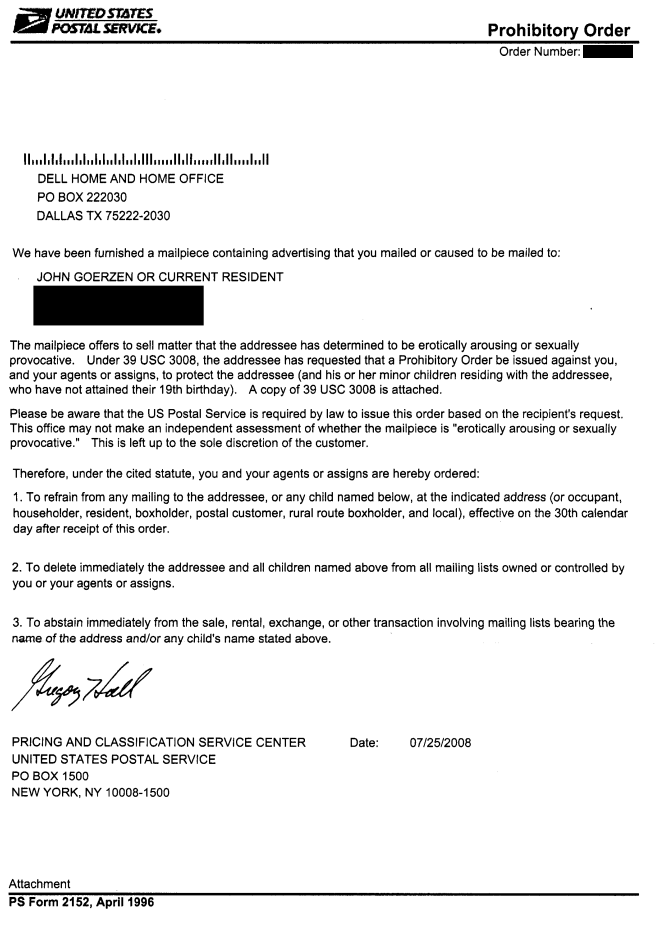
And last month, that's exactly what I did. The USPS sent me back a copy of the letter they sent to Dell, as well as a second page with instructions on reporting violations. Here's the letter they sent to Dell:

dell-usps

Somehow I get a chuckle over some Dell mail clerk trying to figure out how an 11-pound laptop is sexually provocative.

From August 25 on, it is a federal offense for Dell to send me another Home and Home Office catalog. This is a branch of criminal law, not civil law. That is, it's the maybe-go-to-jail branch of law.

How disappointed I was to receive yet another catalog from them today. If only they had waited 5 more days, I could have turned them in now.

Oh well. There's always next month's catalog. Let's just hope the clerk that received the USPS letter removed my name with a better system than everyone else at Dell uses, eh?

Sami Haahtinen: Setting up an OpenVPN tunnel

Recently I fixed my OpenVPN tunnel and figured out what was wrong with my bridge setup. Here is the complete setup that I have. Server I wanted to have as much of the configuration on the server as possible so that I could easily add more clients and wouldn't have a need to update client configuration when ever the server preferences change. Here is my OpenVPN server configuration:
mode server
tls-server
dev tap0
server-bridge 10.5.6.1 255.255.255.0 10.5.6.200 10.5.6.209
ifconfig-pool-persist /var/run/openvpn-ip.txt
keepalive 10 60
ping-timer-rem
persist-tun
push "route 10.5.6.0 255.255.255.0"
push "dhcp-option DNS 10.5.6.1"
ca /root/easy-rsa-2.0/keys/ca.crt
key /root/easy-rsa-2.0/keys/ressukka.net.key
cert /root/easy-rsa-2.0/keys/ressukka.net.crt
dh /root/easy-rsa-2.0/keys/dh1024.pem
client-to-client
up /etc/openvpn/ovpn-ressukka.sh

and the up script:
#!/bin/sh
# Bind the tunnel interface to the bridge
BRIDGE=br0
ifup $1
brctl addif $BRIDGE $1

There is nothing really special about that configuration. The server is in TLS mode configures a bridge. The keys are generated with easy-rsa by following a openvpn howto entry. The up script just binds the tap0 device to the network bridge after bringing up the device. Next I created the interface configuration by adding the following to /etc/network/interfaces:
iface br0 inet static  
 address 10.5.6.17  
 gateway 10.5.6.1  
 netmask 255.255.255.0  
 bridge-ports eth0

The trick here is to create a single bridge with just the eth0 device. We use the up script for openvpn to add the tunnel device to the bridge. Otherwise the bridge would never contain the proper devices. Client As for the client, you simply set the client to use the CA-certificate and Host key created with easy-rsa, set the hostname and tunnel type. Tunnel type is assumed to be a tun-device instead of tap, so in my case I needed to change it too. There is no need to tell the client anything else. Everything else will be negotiated through the tunnel. And since I use NetworkManager to set up my tunnels I didn't have a need to drop in to a shell even once at the client.

Next.

Previous.