Search Results: "will"

4 January 2012

Jon Dowland: Ready Player One

I recently completed "Ready Player One", Ernest Cline's debut novel. It's a Sci-Fi fan-service novel that explores a dystopian future (yes, another one) where the majority of the populace hide inside a VR environment to escape their "real" lives. The sole-genius who authored the VR software hid a series of easter eggs inside, in the form of challenges relating to pop-culture and video game trivia circa the 80s. He constructs his will such that whoever first completes the challenges inherits the mega-bucks company who control the VR simulation. Mike Hoye has an excellent summary:
Ready Player One is a nerdculture bender of a book, about as hard to hate while you re in the middle of it as it is to love in hindsight; it s young adult literature for people who were born in the late seventies and haven t really grown up yet. Of which I am apparently one, it has become clear, but you re still left with the sense that you re reading a Cory Doctorow book whose discerning virtue is that the lead isn t a thinly-veiled Cory Doctorow. Which is a huge, huge improvement, make no mistake, but it s stills relentless, pandering fanservice.
(Whilst you are over on Mike's website you should really read this excellent piece on libraries and publishers.) Despite the points above, I enjoyed the book. My biggest complaint was that the ending was quite abrupt. Quite often when I read a story which is essentially about a journey, I am disappointed if the story ends when the journey does. I hope I am not spoiling too much here by revealing that someone eventually solves the riddles and inherits essentially the earth. But what do they do with it? What impact do they make on the miserable world, described only briefly in sparse passages dotted around the bulk of the text detailing the VR one? During the book, the characters opine on what to do with the fortune, but we never see that come to fruition. Perhaps in a sequel.

Matthew Garrett: The economic incentive to violate the GPL

My post yesterday on how Google gains financial benefit from vendor GPL violations contained an assertion that some people have questioned - namely, "unscrupulous hardware vendors save money by ignoring their GPL obligations". And, to be fair, as written it's true but not entirely convincing. So instead, let's consider "unscrupulous hardware vendors have economic incentives to ignore their GPL obligations".

The direct act of compliance costs money
Complying with the GPL means having the source code that built the binaries you ship. This is easy if your workflow involves putting source in at one end and getting binaries out at the other, but getting to that workflow means having a certain degree of engineering rigour. If your current build process involves mixing a bunch of known good binaries you got from somewhere but you can't remember where with a hacked up source tree that exists on someone's hard drive and then pushing all of these into a tool that only runs on Windows ME, before taking the resulting image and replacing chunks of it by hand, compliance is effectively impossible.

We all know that this is against all kinds of best practices and probably causes so many problems that it's more expensive in the long term, but retooling and hiring someone to oversee all of this takes time and money, and given the margins on many of these devices that's probably enough to make you uncompetitive for a couple of product cycles. Maybe you'll be in a better position afterwards, but you don't know that there'll be an afterwards.

Suppliers who don't provide you with the source code may be cheaper than those who do
You can't be in compliance if you don't have the source code in the first place. The same arguments that apply to the hardware vendors also apply to the people selling you your chips, so there's also an economic incentive for them to avoid complying. And there's an obvious incentive for you to choose the cheaper chipset, even if they don't comply.

Getting the source may cost money
Buying a chipset doesn't necessarily get you the software that makes it work - several silicon vendors will charge you for the SDK. But many of these devices are effectively reference platforms, so are basically identical from a hardware perspective. So if one of your competitors paid for the SDK, you can just dump the binaries off their machine, flash them onto your own boards and save yourself a decent amount of money. You obviously don't get the source, and nor do you have the standing to insist that the vendor whose binaries you misappropriated give you the source.

In the absence of enforcement, GPL compliance only works if it's the norm
Let's imagine two companies, A and B. Both build a tablet device, and buy the full SDK including source code. Both find a bunch of bugs in the vendor SDK and fix a different subset of them. They ship. A provides source code. B doesn't. B can now take A's bugfixes and incorporate them, resulting in a more compelling product without any significant extra cost. You now have two products that can sell for the same price, but B's is better. A would need to prove that B copied their bugfixes rather than simply fixing them themselves , which probably isn't going to happen.

In a larger market, if B is the only vendor who does this then their advantage isn't large - some of A's work is misappropriated by B, but A does benefit from the engineering work contributed by C, D, E, F and G. A combination of social pressure and legal threats may bring B into compliance. But if infringement is the norm, A has no incentive at all to release the source - by doing so they'll be helping not only B, but also C, D, E, F and G. Everyone undercuts A and they go out of business quite quickly.

Moral: In the absence of enforcement, if everyone else is infringing, a single company who complies is at a disadvantage.

If compliance cost nothing then everyone would do it
You can argue that cheap tablets from China are infringing simply because nobody knows better. But what's HTC's excuse? They've clearly decided that there's a benefit in holding back their source code releases[1], balancing this against the risk of being sued. They know full well what they're doing. If compliance was free they'd ship the source at the same time as they shipped the binaries. Other significant vendors are also fully aware of their obligations but choose to ignore them anyway.

Summary
There are economic incentives to infringe the GPL, and therefore (all else being equal) an infringing device can be sold for less money. All else being equal, a cheaper device will sell more units. More sales means more devices selling adverts for Google. Google makes more money because Android vendors infringe the GPL.

Edited to add:

But don't just take my word for it - Jean-Baptiste Queru says the same here (search for "scrubbing" - is there any way to link directly to a Google plus comment?)

[1] The usual argument is "We will release the source code within 120 days", implying that it's a process that takes time and we should just be patient. Every single time I've started making threatening noises, the source has appeared within a week.

comment count unavailable comments

Michal Čihař: uTidyLib dead?

uTidyLib is definitely something you would call a dead project - no new release for seven years, dozens of open bugs and submitted patches and no active development. On the other side it is still used by several packages in Debian, thus worth maintaining. This is also reason, why there are few crucial patches in Debian repository to make it work (for example on 64-bit architectures). While googling whether there is something new going on with uTidyLib, I've noticed two efforts. One is PyTidyLib, a complete reimplementation, which provides different API and thus does not seem to be used anywhere yet. Another (well almost two years old, but I did not look earlier) effort is to fork in on Github and make it work with MacOS X. Okay, when somebody took the "effort", lets try to merge Debian patches there, hopefully there will be a release sometimes. So here is the pull request. Update: I've just learned, there is another fork going on - https://github.com/lachlan-00/utidylib2

Filed under: Debian English 0 comments Flattr this!

Pau Garcia i Quiles: FOSDEM 2012 CrossDesktop DevRoom: deadline extension

FOSDEM is one of the largest gatherings of Free Software contributors in the world and happens each February in Brussels (Belgium). One of the developer rooms will be the CrossDesktop DevRoom, which will host Desktop-related talks. Are you interested in giving a talk about open source and Qt, KDE, Enlightenment, Gnome, XFCE, Windows, Mac OS X, general desktop matters, mobile development, applications that enhance desktops and/or web? We have extended the deadline for a few more days, until January 8th. If you want to submit a talk proposal, hurry up! I have to say I am very surprised to see very few Qt/KDE talk proposals. Is there nothing interesting the Qt and KDE world have to say to 5,000+ people?
There is more information in the Call for Talks we published a couple of months. If you are interested in Qt/KDE, come visit us at the KDE booth. If you add yourself to the KDE FOSDEM 2012 wiki page, we will be able to better organize the usual dinner on Sunday and/or smaller meetings for special interest groups .

Russell Coker: Autism and a Child Beauty Contest

Fenella Wagener wrote an article for the Herald Sun about an Autistic girl who won the best personality award from the controversial new Australian children s beauty pageant [1]. The girl s mother is complaining that an Autistic girl shouldn t win a prize for personality and is critizing the pageant organisers. A beauty contest involves queuing, being quiet, appearing on stage, wearing cosmetics and unusual/uncomfortable clothes. It probably also involves having someone else assist with dressing and applying cosmetics (being touched by another person). These are all things which tend to be difficult or impossible for Autistic kids. So any girl who can get on stage wearing make-up can probably do whatever is required to avoid being obviously excluded from a personality prize. As any such prize has to be largely subjective I don t think it would ever be possible to prove that someone was the correct choice for the winner, it would merely be possible to prove that some candidates excluded themselves. But whether the girl deserved to win isn t the real issue here. I think that beauty pageants should be restricted to adults, merely entering a child in such a contest is bad enough, but making nasty public statements about a child is horrible. If other children made a Facebook page claiming that the girl in question didn t deserve to win a best personality prize it would probably be reported as cyber-bullying. I don t think that publishing the name or photo of the girl in question is in the public interest either. Many news sites that have picked up the story have shown the same lack of journalistic ethics so now the girl has some high traffic sites with her name linked to this story, it seems unlikely that anything good she might do in the near future will get a higher ranking for her name in search engines. So any time she searches for her name on Google (which most people do regularly) she will be reminded that her mother thinks she has some sort of defective personality because she is Autistic. High school is generally bad for almost everyone on the Autism Spectrum. Presumably any parent who would abuse their child by allowing such an article to be published would also send them to a regular school (as opposed to Home Schooling which is probably the only good option for Autistic kids in Australia). I m sure that the standard practice at every high school nowadays is that the kids all use Google to discover things to tease each other about. So in a few years the Herald Sun article will probably be the basis of a high school bullying campaign. The girl in question is only 9, so she s got another 6 or 7 years before she can legally leave her mother. In Australia 16 is the minimum legal age to live without parents and the police won t forcibly return runaway children who are almost 16. The Journalistic Code of Ethics Here is a link to the Australian Media Alliance code of Journalistic Ethics [2]. Section 8 includes Never exploit a person s vulnerability or ignorance of media practice . I think that publishing the name and photograph of a 9yo girl in a way that is likely to lead to bullying in a few years is a clear example of exploiting a vulnerable person. The code of ethics has a guidance clause which says Only substantial advancement of the public interest or risk of substantial harm to people allows any standard to be overridden . Even if it was a proven fact that a beauty pageant was issuing awards to unqualified children there would not be any substantial advancement of the public interest in publishing that. Beauty Contests are Evil The Australian has an article about the same beauty contest by Caroline Overington which quotes adolescent and child psychotherapist Collett Smart calling for government intervention [3]. Catherine Manning has written a good article explaining some of the reasons for opposing child beauty pageants [4]. The American Psychological Association has published a report on the Sexualization of Girls [5], they have lots of references to psychological research which gives a variety of reasons for opposing child beauty contests. IMHO each of the reasons alone should be sufficient to convince people that child beauty pageants are bad. Finally the pictures of contestants who are less than 10yo but made up to look like they are 20+ are rather disturbing. Related posts:
  1. Child Abuse and Censorship In Australia we are currently in the middle of a...
  2. Autism Awareness and the Free Software Community It s Autism Awareness Month April is Autism Awareness month, there...
  3. Autism, Food, etc James Purser wrote Stop Using Autism to Push Your Own...

3 January 2012

Matthew Garrett: TVs are all awful

A discussion a couple of days ago about DPI detection (which is best summarised by this and this and I am not having this discussion again) made me remember a chain of other awful things about consumer displays and EDID and there not being enough gin in the world, and reading various bits of the internet and wikipedia seemed to indicate that almost everybody who's written about this has issues with either (a) technology or (b) English, so I might as well write something.

The first problem is unique (I hope) to 720p LCD TVs. 720p is an HD broadcast standard that's defined as having a resolution of 1280x720. A 720p TV is able to display that image without any downscaling. So, naively, you'd expect them to have 1280x720 displays. Now obviously I wouldn't bother mentioning this unless there was some kind of hilarious insanity involved, so you'll be entirely unsurprised when I tell you that most actually have 1366x768 displays. So your 720p content has to be upscaled to fill the screen anyway, but given that you'd have to do the same for displaying 720p content on a 1920x1080 device this isn't the worst thing ever in the world. No, it's more subtle than that.

EDID is a standard for a blob of data that allows a display device to express its capabilities to a video source in order to ensure that an appropriate mode is negotiated. It allows resolutions to be expressed in a bunch of ways - you can set a bunch of bits to indicate which standard modes you support (1366x768 is not one of these standard modes), you can express the standard timing resolution (the horizontal resolution divided by 8, followed by an aspect ratio) and you can express a detailed timing block (a full description of a supported resolution).

1366/8 = 170.75. Hm.

Ok, so 1366x768 can't be expressed in the standard timing resolution block. The closest you can provide for the horizontal resolution is either 1360 or 1368. You also can't supply a vertical resolution - all you can do is say that it's a 16:9 mode. For 1360, that ends up being 765. For 1368, that ends up being 769.

It's ok, though, because you can just put this in the detailed timing block, except it turns out that basically no TVs do, probably because the people making them are the ones who've taken all the gin.

So what we end up with is a bunch of hardware that people assume is 1280x720, but is actually 1366x768, except they're telling your computer that they're either 1360x765 or 1368x769. And you're probably running an OS that's doing sub-pixel anti-aliasing, which requires that the hardware be able to address the pixels directly which is obviously difficult if you think the screen is one size and actually it's another. Thankfully Linux takes care of you here, and this code makes everything ok. Phew, eh?

But ha ha, no, it's worse than that. And the rest applies to 1080p ones as well.

Back in the old days when TV signals were analogue and got turned into a picture by a bunch of magnets waving a beam of electrons about all over the place, it was impossible to guarantee that all TV sets were adjusted correctly and so you couldn't assume that the edges of a picture would actually be visible to the viewer. In order to put text on screen without risking bits of it being lost, you had to steer clear of the edges. Over time this became roughly standardised and the areas of the signal that weren't expected to be displayed were called overscan. Now, of course, we're in a mostly digital world and such things can be ignored, except that when digital TVs first appeared they were mostly used to watch analogue signals so still needed to overscan because otherwise you'd have the titles floating weirdly in the middle of the screen rather than towards the edges, and so because it's never possible to kill technology that's escaped into the wild we're stuck with it.

tl;dr - Your 1920x1080 TV takes a 1920x1080 signal, chops the edges off it and then stretches the rest to fit the screen because of decisions made in the 1930s.

So you plug your computer into a TV and even though you know what the resolution really is you still don't get to address the individual pixels. Even worse, the edges of your screen are missing.

The best thing about overscan is that it's not rigorously standardised - different broadcast bodies have different recommendations, but you're then still at the mercy of what your TV vendor decided to implement. So what usually happens is that graphics vendors have some way in their drivers to compensate for overscan, which involves you manually setting the degree of overscan that your TV provides. This works very simply - you take your 1920x1080 framebuffer and draw different sized black borders until the edge of your desktop lines up with the edge of your TV. The best bit about this is that while you're still scanning out a 1920x1080 mode, your desktop has now shrunk to something more like 1728x972 and your TV is then scaling it back up to 1920x1080. Once again, you lose.

The HDMI spec actually defines an extension block for EDID that indicates whether the display will overscan or not, but doesn't provide any way to work out how much it'll overscan. We haven't seen many of those in the wild. It's also possible to send an HDMI information frame that indicates whether or not the video source is expecting to be overscanned or not, but (a) we don't do that and (b) it'll probably be ignored even if we did, because who ever tests this stuff. The HDMI spec also says that the default behaviour for 1920x1080 (but not 1366x768) should be to assume overscan. Charming.

The best thing about all of this is that the same TV will often have different behaviour depending on whether you connect via DVI or HDMI, but some TVs will still overscan DVI. Some TVs have options in the menu to disable overscan and others don't. Some monitors will overscan if you feed them an HD resolution over HDMI, so if you have HD content and don't want to lose the edges then your hardware needs to scale it down and let the display scale it back up again. It's all awful. I recommend you drink until everything's already blurry and then none of this will matter.

comment count unavailable comments

Russell Coker: Standardising Android

Don Marti wrote an amusing post about the lack of standards for Android phones and the fact that the iPhone has a better accessory market as a result [1]. I d like to see some Android phones get standardised in a similar manner to the PC. The big thing about the IBM PC compatible market was that they all booted the same way, ran the same OS and applications, had the same expansion options, connectors, etc. The early PCs sucked in many ways (there were many other desktop computers in the 80 s that were better in various ways) but the larger market made the PC win. The PC even killed the Mac! This is something we should remember now when discussing the iPhone. I d like to see different Android phones that can run the same OS with the same boot loader. Having HTC, LG, Samsung, and others all sell phones that can run the same version of CyanogenMod and have the same recovery options if a mistake is made when loading CyanogenMod shouldn t be any more difficult than having IBM, Compaq, HP, DEC, Dell, and others selling PCs that run the same versions of all the OSs of the day and had the same recovery options. Then there should be options for common case sizes. From casual browsing in phone stores it seems that most phones on sale in Australia are of a tablet form without a hardware keyboard, they have a USB/charger socket, an audio socket, and hardware buttons for power, volume up/down, and home with the settings and back buttons being through the touch-screen on the Galaxy S but hardware in most others. A hardware button to take a picture is available in some phones. The variation in phone case design doesn t seem to be that great and there seems to be a good possibility for a few standards for common formats, EG large tablet, small tablet, and large tablet with hardware keyboard. The phone manufacturers are currently competing on stupid things like how thin a phone can be while ignoring real concerns of users such as having a phone that can last for 24 hours without being charged! But they could just as easily compete on ways of filling a standard case size, with options for screen resolution, camera capabilities, CPU, GPU, RAM, storage, etc. There could also be ways of making a standard case with several options, EG having an option for a camera that extends from the back of the case for a longer focal length such an option wouldn t require much design work for a second version of anything that might connect to the phone. Also standards would need to apply for a reasonable period of time. One advantage that Apple has is that it has only released a few versions of the iPhone and each has been on sale for a reasonable amount of time (3 different sizes of case in 4 years). Some of the Android phones seem to only be on sale in mass quantities for a few months before being outdated, at which time many of the stores will stop getting stock of matching accessories. Finally I d be a lot happier if there was good support for running multiple Android phones with the same configuration. Then I could buy a cheap waterproof phone for use at the beach and synchronise all the configuration before leaving home. This is a feature that would be good for manufacturers as it would drive the average rate of phone ownership to something greater than 1 phone per person.

Raphaël Hertzog: My Debian Activities in December 2011

This is my monthly summary of my Debian related activities. If you re among the people who made a donation to support my work (364.18 , thanks everybody!), then you can learn how I spent your money. Otherwise it s just an interesting status update on my various projects. Dpkg and Multiarch I had some hope to have a multiarch-enabled dpkg in sid for Christmas as Guillem told me that it was realistic. Alas Guillem got sick. We re in January and we re still not there. While some of Guillem s commits in December were related to multi-arch, the size of his pu/multiarch/master branch did not really shrink. We still have 36 commits to merge most of the work he did was refactoring some parts of the code that were already merged. And he initiated some discussion on interface changes. I participated to those discussions hoping to bring them to a quick resolution. I m still maintaining my own pu/multiarch/full branch, it is based on Guillem s branch but with further fixes that I developed and that he has not yet merged and with a change reverted (Guillem s branch allows crossgrading packages between different architectures while dpkg does not manage this correctly yet). I can only hope that January will be the last month of this never-ending saga. It s been one year since I started working on this project. :- Misc dpkg work I reviewed (and later merged) a patch of Kees Cook to enhance dpkg-buildflags so that it can report which hardening features are enabled. This feature might then be used by tools like lintian to detect missing hardening features. I mentored Gianluca Ciccarelli who is trying to enhance dpkg-maintscript-helper to take care of replacing a directory by a symlink and vice-versa. I took care of #651993 so that dpkg-mergechangelogs doesn t fail when it encounters an invalid version in the changelog, and of #652414 so that dpkg-source --commit accepts a relative filename when a patch file is explicitly given. Guillem also merged a fix I developed for LP#369898. Packaging work WordPress 3.3 came out so I immediately packaged it. Despite my upstream bug report, they did not update their GPL compliance page which offers the corresponding sources for what s bundled in the tarball. So I hunted for the required sources myself, and bundled them in the debian.tar.xz of the Debian source package. It s a rather crude solution but this allowed me to close the release critical bug #646729 and to reintroduce the Flash files that were dropped in the past which is great since the Flash-based file uploader is nicer than the one using the browser s file field. Quilt 0.50 came out after 2 years of (slow) development. The Debian package has many patches and several of them had to be updated to cope with the new upstream release. Fortunately some of them were also merged upstream. It still took an entire morning to complete this update. I also converted the packaging from CDBS to dh with a short rules file. Zim 0.54 came out and I immediately updated the package since it fixed a bug that was annoying me. Review of the ledgersmb packaging As the sql-ledger maintainer (and a user of this software for my accounting), I have been hoping to get ledgersmb packaged as a possible replacement for it. I have been following the various efforts initiated over time but none of them resulted in a real package in Debian. This is a real pity so I tried to fix this by offering to sponsor package uploads. That s why I did a first review of the packaging. It took several hours because you have to explain everything that s not good enough. I also filed a wishlist bug against lintian (#652963) to suggest that lintian should detect improper usage of dpkg-statoverride (this is a mistake that was present in the package that I reviewed). nautilus-dropbox work I wanted to polish the package in time for the Ubuntu LTS release and since Debian Import Freeze is in January, I implemented some of the important fixes that I wanted. The Debian package diverges from upstream in that the non-free binaries are installed in /var/lib/dropbox/ instead of $HOME.

Due to a bug, the files were not properly root-owned so I first fixed this (unpacking the tarball as root lead to reuse of the embedded user & group information, and those information changed recently on the Dropbox side apparently). Then we recently identified other problems related to proxy handling (see #651065). I fixed this too because it s relatively frequent that the initial download triggered during the package configuration fails and in that case it s the user that will re-trigger a package download after having given the appropriate credentials through PackageKit. Without my fix, usage of pkexec would imply the loss of the http_proxy environment variable and thus it would not be possible for a user to download through a proxy. Last but not least I reorganized the Debian specific patches to better separate what can and should be merged upstream, from the changes that upstream doesn t want. Unfortunately Dropbox insists on being able to auto-update their non-free binaries, they are, thus, against the installation under /var/lib/dropbox and the corresponding changes. Book update We re making decent progress in the translation of the Debian Administrator s Handbook, about 6 chapters are already translated (not yet reviewed though). The liberation campaign is also (slowly) going forward. We re at 67% now (thanks to 90 new supporters!) while we were only at 60% at the start of December. Thanks See you next month for a new summary of my activities.

No comment Liked this article? Click here. My blog is Flattr-enabled.

Petter Reinholdtsen: Fixing an hanging debian installer for Debian Edu

During christmas, I have been working getting the next version of Debian Edu / Skolelinux ready for release. The initial problem I looked at was particularly interesting. The installer would hang at the end when it was doing it post-installation configuration, and whatevery I did to try to find the cause and fix it always worked while I tested it, but never when I integrated it into the installer and ran the installation from scratch. I would try to restart processes, close file descriptors, remove or create files, and the installer would always unblock and wrap up its tasks. Eventually the cause was found. The kernel was simply running out of entropy, causing the Kerberos setup to hang waiting for more. Pressing keys was adding entropy to the kernel, and thus all my tries to fix the problem worked not because what I was typing to fix it, but because I was typing. The fix I implemented was to add a background process looking at the level of entropy in the kernel (by checking /proc/sys/kernel/random/entropy_avail), and if it was too small, the installer will flush the kernel file buffers and do 'find /' to generate some disk IO. Disk IO generate entropy in the kernel, and is one of the few things that can be initated from within the system to generate entropy. The fix is in beta1 of the Debian Edu/Squeeze version, and we welcome more testers and developers. We plan to release beta2 this weekend.

2 January 2012

Michal Čihař: ColorHug for Debian and in Czech

Today, I've spent some time on ColorHug software (which I've preordered some time ago). The first missing bit there were Debian packages. There are already some packages available for Ubuntu, but I've chosen clean start and did all the packaging on my own. The packages are now waiting in NEW queue (which is amazingly empty in last months) and will hopefully get accepted soon. In case you are too impatient, you can look to git repository on Alioth (you will need libgusb as well). Packaging effort lead to writing (quite minimalistic) man page for colorhug-ccmx, which I've also sent upstream. The other thing, where I can help right now (not owning the device itself) is translation. As you can see on Transifex, my task is done here and Czech translation is complete :-).

Filed under: Debian English Photography 0 comments Flattr this!

Gunnar Wolf: Happy Public Domain day, even for the inhabitants of the longest-copyright-term country

Happy Public Domain day, even for the inhabitants of the longest-copyright-term country
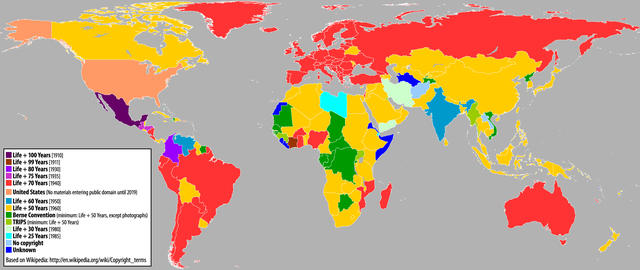
Every year, on January 1st, new material ceases to be protected by copyright and enters the public domain. This means, every year, more knowledge, literature, paintings, music, movies and a long etcetera becomes collective property, instead of being artificially held by the current holders of their rights. As this image shows (source: http://publicdomainday.org/node/39 ), I have the honor(?) to live in the country with the longest copyright protection term in the world. Copyright in Mexico does not only last for 100 years It lasts for the natural life of the author plus 100 years. This means that the popular corridos that tell the stories of the 1910 revolution are still not in the public domain. La sucesi n presidencial, the book which Francisco I. Madero wrote to justify that a peaceful political change was needed for the 1910 elections, will not enter the public domain until 2014 (president Madero was killed during 1913). Does it make any sense to kidnap cultural, political or artistic works for over a century? Not only that: Material that is legally sold as public domain in other countries is illegal in ours. Take as an example the recordings of Enrico Carusso, the great Italian tenor who died in 1921. Over 15 years ago, I bought a couple of CDs with his recordings (even if the sources were quite low-quality, as they had been copied over from wax cylinders to magnetic tapes to optical media). I bought them surprisingly cheap, as they were genuine public domain. But they are still protected in my country. That means, I ilegally have some stolen(!) works of art which I lawfully bought outside my country. Copyright law needs to be revised to match reality. Technological advances have strongly changed reality since 1717's promulgation of the first copyright laws. The solution is not to extend the terms, but to rethink the whole process. (yes, this rant was mainly made as an excuse for me to copy this image and put it in a location I can easily refer to later. But I hope it is interesting to you!)

Thomas Koch: Perils of not switching to Git

Somebody probably already recommended you to switch to Git, because it's the best VCS. I'd like to go a step further now and talk about the risk you're taking if you won't switch soon.
By still using SVN (if you're using CVS you're doomed anyway), you communicate the following:
Be aware that good developers today will not consider working with or for you if you're still using SVN. - And that's the risk.
Until recently I thought that Mercurial would be an acceptable alternative to Git. Until I used mercurial for some time. It is not.

Update: The comments are not too approving, to say the least. Lets see what time will tell. In the meanwhile I'll attach links to this blogpost:

1 January 2012

Joey Hess: a resolution that stuck

Last year, my new year's resolution was to write in my journal every day. That actually stuck, I wrote 262 journal entries in 2011. While I've been keeping a journal intermittently since 1998, last year I doubled the number of entries in it. And wrote a novel's worth of entries -- 53 thousand words! Most of it is of course banal and mundane stuff. Not good compared with Lars, who does something with his journal where he goes into some detail about code he's working on, and other work. The excerpts I've seen are quite nice. But after I've written code, written a commit message, documentation, perhaps bug reports etc, I often can't find much to say about it in my journal, beyond the bare bones that I worked on $foo today or faced a particularly hard bug. I also worry that the journal, and my reluctance to repeat myself, often tips the balance away from me blogging, if I write down something in the journal first.
Here's my journal for today:
Compare what jokes are funny now with those in 1982. The 1982 ones from net.jokes on olduse.net seem juvenile. Now compare what Unix joke man pages are funny now with those I'm reading from 1982. They seem basically the same. What would Biella make of this? Liw noticed ikiwiki OOM on pell. Tracked down to a perl markdown bug with long lines. Had quite enough of perl markdown; ikiwiki will be moving to a different engine. Added discount support to it today, still needs Debian package tho. [censored] Really gorgeous sunset, with a high wind, moon, puffy low, fast moving clouds. Enjoyed it ecstaticly. It's going to get cold soon. Very rainy early, but then got intermittently sunny; power is holding out ok. Was going to roast a chicken today, but got distracted and had a large lunch besides. Need to find some quick food for supper. I need to start a new book, should it be the River Cottage book about meat that I stole from Anna, or some SF? Blogged about journaling, and put this journal entry in it, so also journaled about blogging. Wrote it somewhat self-conciously.

The benefits for me have ranged from being able to go back and work out dates of events, to forwarding the odd excerpts to others. The best thing though is certianly having a regular time of introspection, to look back over my the day. If you've not got a new year's resolution yet, I recommend this one. (Learning Haskell would be another good one, if you haven't yet.) Just write something, anything, down in your journal every day.

Gunnar Wolf: A happy and disconnected new year

I came to Argentina with my girlfriend to visit her family and friends, and to spend here some disconnected days during my winter^Wsummer vacations. And so it was, we had some very nice, relaxing days, with everything running smooth and with infrequent but enough sessions of mail access to withstand the disconnection without pain. Of course, I didn't anticipate that the Network Operations Center of my university would break my institute's connectivity while performing their planned maintenance on December 23. After some days, I was able to talk with one person in the university, but connectivity was not restored. Nobody with knowledge to look at the firewall's screen is available. So, as of today (happy new year 2012!), I have been mail-less for over a week. I will be back in my office soon now, so I'll get mail connectivity within the upcoming week. Meanwhile, everybody who mailed me for any reason (job, Debian, holiday greetings, whatever)... Well, I'm sad to tell you that the mails were lost. But worry not, I will act as if nothing like that happened and I received all of your best wishes.

Lucas Nussbaum: Re: Ubuntu vs Ruby

(original post) > If Ubuntu 12.04 if a LTS release, and Ruby 1.8.7 goes out of support in June of
> 2013, then why is the default still 1.8.7?
>
> Ruby 1.9.2 was released in 2010. Ruby 1.9.3 was released in October of this year. First, there s almost nobody in the Ubuntu development community doing any Ruby work. Packages are just imported from Debian, and Ubuntu follows what is done on the Debian side. In the Debian/Ruby team, we are currently transitioning to a new packaging helper (gem2deb) that makes it much
easier to support several Ruby versions. Once this will be done, switching to 1.9.3 by default will be very easy. We already provide a way for the sysadmin to change the default on a system. Now, doing that transition takes time, and we could have used *your* help (and could still use it). We are still quite on time to do it for Debian wheezy, but it sounds very hard to do it for Ubuntu 12.04 unless someone from Ubuntu steps
up to help.

31 December 2011

Steve Kemp: The final updates of 2011

I've been informed by a couple of people that the Debian Administration site is down. Sadly it is; at the moment the host isn't showing anything on the serial console and remotely power-cycling it isn't showing any signs of life. At this time of year I don't want to drag anybody in to take care of it, so ETA on recovery/replacement hardware is Monday/Tuesday. In other news I've made it to year five of the KVM hosting sub-project/thing. Originally started as a Xen host its been running happily for quite some time. I suspect next year, or the year after that the price/specification ratio will end up losing out and we'll cancel the whole thing - but there are no immediate reasons to make any change. Finally I knocked up a simple tool to validate my TinyDNS records prior to uploading them. It is simplistic, but adequate to catch the kind of mistakes I make: Honestly it probably wants to be rationalised a little more - and check records more carefully. e.g. Ensure that the host a CNAME refers to itself exists, and making sure that the nameservers specified are valid. I just wanted to make something quick after accidentally uploading a zonefile where I'd managed to fat-finger several important records. le sigh. Oddly enough asking on serverfault.com showed no real suggestions - other than actually running tinydns locally and doing a zone-xfer to validate records. Overkill and harder than I'd like. Happy New year if you care about such things.. "I finished growing up, L on. I just get older. " - Leon

Russell Coker: Links December 2011

Barry Ritholtz wrote an insightful post quoting Federal Reserve Bank of Kansas City President Thomas Hoenig, who warns that the nation s biggest banks are putting the U.S. capitalist society at risk [1]. Big banks oppose capitalism. Glenn Greenwald has written an insightful article for Salon about the modern definition of American excellence being the killing of supposedly bad people without any due process [2]. Mazuma Mobile buys used mobile phones [3]. They can send a post-pack to ship your old mobile to them. This is good for the environment and also saves some money. Sam Varghese has written an informative article about the Trans Pacific Partnership Agreement that will probably end up benefiting US corporations at the expense of Australian citizens [4]. Cory Doctorow has written an informative article for The Guardian about the BBC DRM plans[5]. He received information that was denied in a FOI request which shows how poor the BBC case is and how bad the Ofcom oversight is. Sam Harris has written an insightful blog post about self-defense [6]. He also has many other posts that are worth reading. Aparna Roa gave an interesting TED presentation about her robotic art [7].

Russell Coker: My Blog Server was Cracked

On the 1st of August I noticed that the server which runs my blog among other things was having an occasional SEGV from a sshd process. Unfortunately I was busy and didn t pay much attention to this, which turned out to be a big mistake. On the 12th of September I started investigating this properly and noticed that when someone tried to connect to ssh with password authentication sshd would SEGV after it was denied access to a shared memory region or a semaphore which had a SE Linux type of unconfined_t. I added some SE Linux auditallow rules and discovered that the memory region in question was created by the ssh client. Shortly after that I came to the conclusion that this wasn t some strange feature of ssh (or one of the many shared objects it uses) but hostile activity. The ssh client appeared to be storing passwords that it used in a shared memory region and sshd was also collecting passwords in the same region and presumably offering them to a ssh client which uses some extension to the ssh protocol. The sshd process was crashing because it couldn t handle EPERM on access to shared memory or semaphores. Presumably if the system in question wasn t running SE Linux then the exploit would have remained undetected for a lot longer. At this stage we don t know how the attacker got in. Presumably one of the people with root access ran a ssh client on a compromised system and had their password sniffed. One such client system was mysteriously reinstalled at about that time, the sysadmin of the system in question claimed to have no backups which made it impossible to determine if that system had been compromised. I believe that the sysadmin of the client system knew that their system was compromised, kept that information secret, and allowed other systems to become and remain compromised. The attacker made no good effort to conceal their presence, they replaced ssh, sshd, and ssh-add and didn t bother changing the Debian checksums so the debsums program flagged the files as modified. Note that I have kept copies of the files in question and am willing to share them with anyone who wants to analyse them. Steinar H. Gunderson has named this trojan Ebury [1]. Recovery By the evening of the 13th of September I had the system mostly working again. Jabber still isn t working because ejabberd is difficult to get working at the best of times, I am now investigating whether there is a better Jabber server to use, but as I don t use Jabber often this hasn t been a priority for me. Some of the WordPress plugins I use and all of the WordPress themes that are installed were outside the Debian packaging system, as I couldn t be sure that they hadn t been altered (because the people who wrote WordPress plugins don t keep old versions online) I had to upgrade to the newer versions. Of course the newer versions weren t entirely compatible so I had to use a different theme and I couldn t get all plugins working. Link Within no longer works, not that it ever worked properly [2], I wanted to try Outbrain again but their web site won t let me login (and they haven t responded to my support request). Does anyone know of a good WordPress plugin to provide links to related content? Either related content on my blog or on the Internet in general will be OK. Some people have asked me about the change in appearance of my blog. It was simply impossible (for someone with my PHP skills) to get my blog looking the same way as it did before the server was cracked. I think that the new look is OK and don t mind if people think it looks likw a VW advert VW make great cars, I was very satisfied with the VW Passat I used to drive. Future Plans I had bought some Yubikeys (USB devices that generate one-time passwords) [3] to control access to that server, if I had configured the software to use them then this might not have happened. The use of one-time password devices can prevent passive password-sniffing attacks. It would still allow active attacks (such as using ControlPath/ControlMaster options on the ssh client to allow a hostile party to connect later (EG the -M, -S, and -o ControlPersist options for the ssh client). It s a pity that there doesn t seem to be a way to configure the ssh server to disable ControlMaster. Conclusion It would be good to have some changes to sshd to allow more restrictions on what a client can request, as ControlMaster functionality isn t needed by most users it should be possible to disable it. SE Linux doesn t protect against a compromised client system or any other way of stealing passwords. It did do a good job of stopping Ebury from doing all the things it wanted to do and thus making me aware of the problem. So I count this as a win for SE Linux. Yubikeys are the cheapest and easiest way of managine one-time passwords. I had already bought some for use on the system in question but hadn t got around to configuring them. I have to make that a priority.

29 December 2011

Jon Dowland: backup

Backups are something I don't do well. I hope to write a more thorough article about them at some point. For now, here are some tips. Like most home users, I don't have access to a tape drive or jukebox for backups. I'm therefore looking for a solution that backs up to a local block device. I haven't ruled out a solution that backs up to DVD-Rs, but I haven't found a suitable one. I first tried rsnapshot, which uses hard link trees to represent increments. I found that this resulted in enormous filesystem metadata, sufficient to cause the machine I was running it on (an embedded ARM system) to slow to a crawl. I'd recommend to avoid anything using this technique. I more recently have been using rdiff-backup. This has appeared to work quite well for a number of years. However, it does not gracefully handle the backup volume being full, spewing python backtraces. This is compounded with some confusing use of temporary directies and not honouring $TMPDIR. This has been known about for years (1, 2). I've just independently discovered these problems for the second time. Aside from that, because it does not de-duplicate files, it is sensitive to large files being moved around in the source being backed up. It also cannot do a dry-run estimate of the disk space required for the next increment. So: time to move on. Back in 2010 I discovered bup, an intriguing backup tool that used a git-style backing store. It's interesting enough that I packaged it and use it in a few situations, but I wouldn't rely on it for my main backups, for two reasons: one, it's not tried-and-tested enough yet (but that is rapidly being resolved), two: you can't get rid of old increments, so your backup volume will always increase in size over time, and never throw away old data. So, for now: move on. Next on my list to try is Lars Wirzenius' obnam.

28 December 2011

Paul Tagliamonte: libolla (from the useless script department)

Hello, World! Today s hacks come remotely, on the first day of my long trek to Cleveland. As many debian readers know, debian URLs are usually transmitted over IRC or email with some snappy abbreviations. Usually, you ll see something like:
Feel free to check out information about frob at wiki.d.o/Frob
or something like:
I have uploaded package bar onto mentors.d.n for review
What bugs me most about this is that I have to expand URLs by hand. Which is lame. Enter libolla (a fitting name as well as a graceful nod to my alma mater John Carroll University s crest). When LD_PRELOAD d, it ll intercept and expand calls to getaddrinfo transparently. It seems to work fine on SSH, and chrome (but I can t test well, since I m not on a real line). This was all hacked up in a few hours I had to spare, and without any sort of internet love, so I m willing to bet there are some bits that can be cleaned up (after all, the name of the blog is Peace, Love and C++ , not Peace, Love and C - I don t clam to be a c expert ;) ) So, feel free to fork the project on github (or as I can now do - http://g.c/paultag/libolla) Now, I just need to find a way to globally pre-load this for apps that I start in my DE. Should be easy enough fiddling with some env-var files.

Next.

Previous.