Search Results: "tim"

1 April 2013

Benjamin Mako Hill: Mystery Hunt 2013

A few months late, perhaps, but I wanted to mention that my team (Codex) competed, once again, in the MIT Mystery Hunt. The prize for winning is the responsibility of writing the hunt next year. After being on the 2012 writing team I have mixed feelings about the fact that we did not win again. Although I did not walk away with another coin, I did manage to make an appearance in a multimedia story that the MIT Tech shot about the hunt which provides nice introductions to those who are not familiar with it. <iframe allowfullscreen="" frameborder="0" height="315" src="http://www.youtube.com/embed/R-tmBfZ8CwQ" width="560"></iframe> It was fun to reflect a little bit on why I find the hunt so fun. I said:
In my day job, I work on a lot of problems that maybe don t have answers. It s really awesome to work in a space where if you put in 1-5 hours of mental energy, you will have a solution. Someone has test-solved for it, you know that it s solvable; you know that there is an answer and that there was designed to be an answer. There s something really satisfying about being able to do that.
If you re looking for a team to hunt on next year, feel free get in contact codex is generally quite open to new members.

Hideki Yamane: Release Note translation


Once finished translating Wheezy Release Note to Japanese language.

Before releasing Wheezy, I've prepared to translate Release Note to Japanese. I know, it will be changed some times before it would be really released but do much as we can before it is good thing.

Also I think if we can do time-based update for Release Note - add new info, delete obsolete info, review and finish it (since sometimes some English speakers may not care about translations unintentionally or ignore it to hurry. We translators require some days to do it - to make it with good enough quality, at least. ;)

Russ Allbery: Review: Echo

Review: Echo, by Jack McDevitt
Series: Alex Benedict #5
Publisher: Ace
Copyright: November 2010
Printing: November 2011
ISBN: 1-937007-00-6
Format: Mass market
Pages: 367
This is the fifth book in the ongoing Alex Benedict series, but reading the previous volumes is generally optional. While there are references to earlier events (and indeed I resorted to Wikipedia at one point to refresh my memory of the plot of the the first book in the series), they aren't critical to the plot. They mostly are background for the reactions of other characters to Benedict and his firm. Echo opens with the now-familiar prologue, giving us a fleeting and limited glimpse into the mystery that Benedict and Chase Kolpath will be pursuing for the rest of the book. This time, it features the explorer Somerest Tuttle, who has spent most of his life looking for intelligent alien life. (In the far future setting of these books, humanity has spread through a large region of the galaxy but has only encountered one other alien race.) In the twilight of his career and life, a friend who works as a tour guide for astronomical tours comes to him with a story about something she saw. What, we don't know, and won't for most of the book. But, whatever it is, Tuttle never goes public with it, which is directly contrary to what everyone would expect him to do with any news about alien life. Benedict and Kolpath get involved some years later, after Tuttle's death, when a stone slab with unknown markings that was part of his estate shows up on the future equivalent of Craigslist, free to the first person who will haul it away. Benedict finds that interesting enough to go pick up, but then is really hooked when someone else goes to considerable lengths to try to make the slab disappear before anyone can get a good look at it. This, slowly, leads into poking around Tuttle's life and connections, the star tour industry, and the possible origins of the slab. If you've read any of the previous books in this series, Echo is more of the same, and I mean that in a good way. I think McDevitt is at his best when writing this sort of cross between scientific puzzle, mystery, and non-military adventure, full of people who care deeply about knowing and understanding things and don't like to be thwarted in their efforts. There is McDevitt's trademark halting and red-herring-ridden investigation that succeeds in being engrossing and compelling, plenty of opportunities to guess what's really going on (a bit easier this book than in some others), and a bit of action that I thought was better-handled than the somewhat strained action scenes of The Devil's Eye. The book moves right along, despite multiple reversals in the progress of the investigation, and the final revelation does indeed justify the strange behavior of the various people Benedict encounters. As with McDevitt in general and this series in particular, there is one caveat: the astronomical details are often interesting, but the world building in general is not terribly believable. Despite supposedly taking place millennia into the future, the society is a straight transplant (projection would imply more change than exists) of middle-class American culture, with bonus air cars, space ships, and slightly better computers. Similarly, alien ecologies suffer from severe Star Trek problems: all the planets feel like copies of Earth with a few minor tweaks. This just goes with the territory, and if you're up to the fifth book of the series, you've probably gotten used to it, but the unrealistic lack of divergence is actually used as a plot point here. That strained my suspension of disbelief a bit. That said, this sort of extremely familiar social context does give the books an oddly calm, comfortable feeling. It's tempting to describe McDevitt as cozy science fiction. There's a bit of danger, a bit of suspense, but one is fairly certain that everything will work out in the end and the reader will leave the book knowing the solutions to most of the mysteries raised without having to work very hard at understanding the society or the puzzle. If that's what you're in the mood for (and I was when I read Echo), McDevitt delivers reliably. If you like the Alex Benedict series in general, recommended, as this is an excellent example of the type. Rating: 8 out of 10

Francois Marier: Poor man's RAID1 between an SSD and a hard drive

After moving from a hard drive to an SSD on my work laptop, I decided to keep the hard drive spinning and use it as a backup for the SSD. With the following setup, I can pull the SSD out of my laptop and it should still boot up normally with all of my data on the hard drive.

Manually setting up an encrypted root partition Before setting up the synchronization between the two drives, I had to replicate the partition setup. I used fdisk, cfdisk and gparted to create the following partitions:
   Device Boot      Start         End      Blocks   Id  System
/dev/sdb1   *        2048      499711      248832   83  Linux
/dev/sdb2          501760   500117503   249807872    5  Extended
/dev/sdb5          503808   500117503   249806848   83  Linux
and then loosely followed these instructions to create an encrypted root partition on /dev/sdb5:
$ cryptsetup luksFormat /dev/sdb5
$ cryptsetup luksOpen /dev/sdb5 sdb5_crypt
$ pvcreate /dev/mapper/sdb5_crypt
$ vgcreate akranes2 /dev/mapper/sdb5_crypt
$ vgchange -a y akranes2
$ lvcreate -L247329718272B -nroot akranes2
$ lvcreate -L8468299776B -nswap_1 akranes2
$ mkfs.ext4 /dev/akranes2/root
Finally, I added the new encrypted partition to the list of drives to bring up at boot time by looking up its UUID:
$ cryptsetup luksUUID sdb5_crypt
and creating a new entry for it in /etc/crypttab.

Copying the boot partition Setting up the boot partition was much easier because it's not encrypted. All that was needed was to format it and then copy the files over:
$ mkfs.ext2 /dev/sdb1
$ mount /dev/sdb1 /mnt/boot
$ cp -a /boot/* /mnt/boot/
The only other thing to remember is to install grub on the boot loader of that drive. On modern Debian systems, that's usually just a matter of running dpkg-reconfigure grub-pc and adding the second drive (/dev/sdb in my case) to the list of drives to install grub on.

Sync scripts To keep the contents of the SSD and the hard drive in sync, I set up a regular rsync of the root and boot partitions using the following mount points (as defined in /etc/fstab):
/dev/mapper/akranes-root /           ext4    noatime,discard,errors=remount-ro 0       1
/dev/mapper/akranes2-root /mnt/root  ext4    noatime,errors=remount-ro         0       2
UUID=0b9109d0-... /boot              ext2    defaults                          0       2
UUID=6e6f05fb-... /mnt/boot          ext2    defaults                          0       2
I use this script (/usr/local/sbin/ssd_boot_backup) for syncing the boot partition:
#!/bin/sh
if [ ! -e /mnt/boot/hdd.mounted ] ; then
    echo "The rotating hard drive is not mounted in /mnt/boot."
    exit 1
fi
if [ ! -e /boot/ssd.mounted ] ; then
    echo "The ssd is not the boot partition"
    exit 1
fi
nice ionice -c3 rsync -aHx --delete --exclude=/ssd.mounted --exclude=/lost+found/* /boot/* /mnt/boot/
and a similar one (/usr/local/sbin/ssd_root_backup) for the root partition:
#!/bin/sh
if [ ! -e /mnt/root/hdd.mounted ] ; then
    echo "The rotating hard drive is not mounted in /mnt/root."
    exit 1
fi
if [ ! -e /ssd.mounted ] ; then
    echo "The ssd is not the root partition"
    exit 1
fi
nice ionice -c3 rsync -aHx --delete --exclude=/dev/* --exclude=/proc/* --exclude=/sys/* --exclude=/tmp/* --exclude=/boot/* --exclude=/mnt/* --exclude=/lost+found/* --exclude=/media/* --exclude=/var/tmp/* --exclude=/ssd.mounted --exclude=/var/lib/lightdm/.gvfs --exclude=/home/francois/.gvfs /* /mnt/root/
To ensure that each drive is properly mounted before the scripts run, I created empty ssd.mounted files in the root directory of each of the partitions on the SSD, and empty hdd.mounted files in the root directory of the hard drive partitions.

Cron jobs The sync scripts are run every couple of hours through this crontab:
10 */4 * * *                root    /usr/local/sbin/ssd_boot_backup
20 0,4,8,12,16,20 * * *     root    /usr/local/sbin/ssd_root_backup
20 2,6,10,14,18,22 * * *    root    /usr/bin/on_ac_power && /usr/local/sbin/ssd_root_backup
which includes a reduced frequency while running on battery to avoid spinning the hard drive up too much.

31 March 2013

Enrico Zini: A proposal to solve gender imbalance in Debian

A proposal to solve gender imbalance in Debian We've done all we can so far: Debian Women, the Diversity Statement, the anti-harassment contact, gender neutral language, lots of education all round, but we still suffer from a strong gender imbalance in Debian. I think that the reason is that the majority group of cisgender men in the project, although they don't actively work /against/ the rest, still have /no incentive/ to be inclusive, and generally do not understand what bearing a female name online is like. I think it is about time we addressed that, and after a lot of thinking and discussing with many other concerned debianers, I think I have just the right proposal, which is twofold. The first part is this: since the goal is to have an equal gender perception in Debian, we can just decide to only approve one obviously-male-named DD for every obviously-female-named one. That's right: no new obviously-male-named DD unless an obviously-female-named DD has just been approved. It may sound like affirmative action gone wild, but please stop a moment to think about it: this would create precisely the right incentive for the currently dominant group of developers to be inclusive! People shouldn't just assume they can get a Debian account regardless of what happens around them. We already ask NM candidates to fix RC bugs and, well, gender imbalance should be treated as an RC bug, and everyone should feel compelled to join the effort to fix it! Now, of course since there currently are many male names in NM but not a single female name, it would not be reasonable to just stop the flow of new developers into the project: that would just have the effect to make us starve on personpower. So here is the second part of the proposal: the one-female-name-one-male-name policy will not be enforced for, say, a year. But during this year, everyone currently in NM or joining NM will be asked to adopt a female identity. Crazy? No, genius! It's about time people understood what it means to get advances in private every time they make a public contribution! What better way than just trying it out for themselves? On top of that, as more and more female names appear in Debian changelogs, fake or not, people will finally start to understand that it does not matter what name is used to sign the contribution, but the contribution itself. I don't know if this will give us a community where people realise female or male contributions are equally valuable, which is what I hope, or a community where people will think that everyone is a cisgender man even if they have female names. In the end, really, it does not matter. Either way, we finally get to have a community where everyone is /guaranteed/ to be treated the same. But gender imbalance isn't the only imbalance we have in Debian. People accrue a reputation over time, good or bad, and this reputation tends to stick on you for years, regardless of how you may change, for better or for worse. When we evaluate the merit a contribution, we should not be biased by the reputation of the contributor! How can new contributors be taken seriously otherwise? I believe we are loosing lots of fresh, good ideas this way. And how much damage could be wrecked on the project by a well-respected contributor, like a Debian Account Manager, who is having a funny day? I think we can address this just as I propose to address gender imbalance: let's swap identities from time to time, like it usually happens with nametags at the end of Debconfs. Let's see gregoa upload a patched versions of python3.2, and enrico upload a new upstream version of eglibc! See if we won't finally have some peer review at last! Reputation and real identities have many merits, but we have come to rely too much on them, and it is hurting us. It is time we did something about it, before it is too late!

Russell Coker: Links March 2013

Russ Allbery wrote an informative post about how to determine which charities are worth donating to [1]. He has a link to another article about the charities to which he donates and concentrates on ways of analysing the effectiveness of charities. So someone who has different ideas about which types of charity are worthy of donation could still learn a lot from his post. Adam Green wrote an interesting article for The New Yorker about Apollo Robbins who is one of the world s best pick-pockets [2]. Apollo picks pockets as a magician to entertain people and always returns what he steals. Now he is working with neuroscientists who are devising experiments to determine why his tricks work. Rick Falkvinge wrote an insightful article describing the way that the copyright monopoly is in direct opposition to the freedom to make contracts [3]. It s a good rebuttal of a common argument in favor of copyright law. Seth Godin gave an interesting TED talk about the problems with the education system, how and why it teaches conformity and little else [4]. One of his suggestions for improvement is to have students spend their evenings watching lectures by experts and class time asking questions. He also says that everything should be open book and that there is no value in memorising anything it s a bit of an overstatement but it s essentially correct. Cory Doctorow wrote an interesting article for The Guardian about positive externalities and copyright law [5]. I think that he didn t choose the best way of framing this issue, but he makes some very interesting points anyway. Andrew Norton wrote an interesting article about how to reduce corruption in the police force and other government agencies [6]. A large part of this is based on making them subject to the same laws as everyone else, which seems to be a radical idea. Valerie Aurora wrote an insightful blog post about suicide [7]. Emily Oster gave an interesting TED talk about the factors that determine the spread of AIDS in Africa [8]. It s quite different to what you probably expect.

Nathan Handler: Debian Mobile

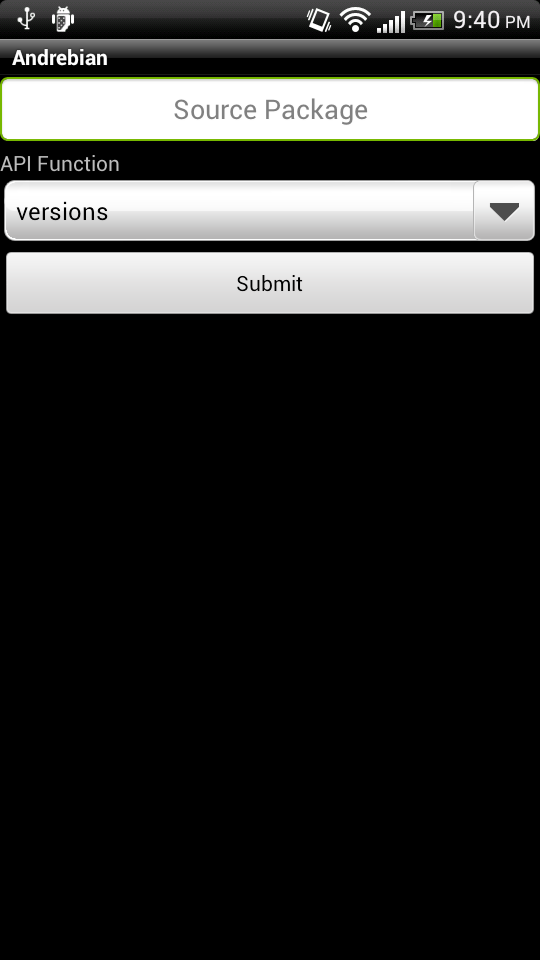
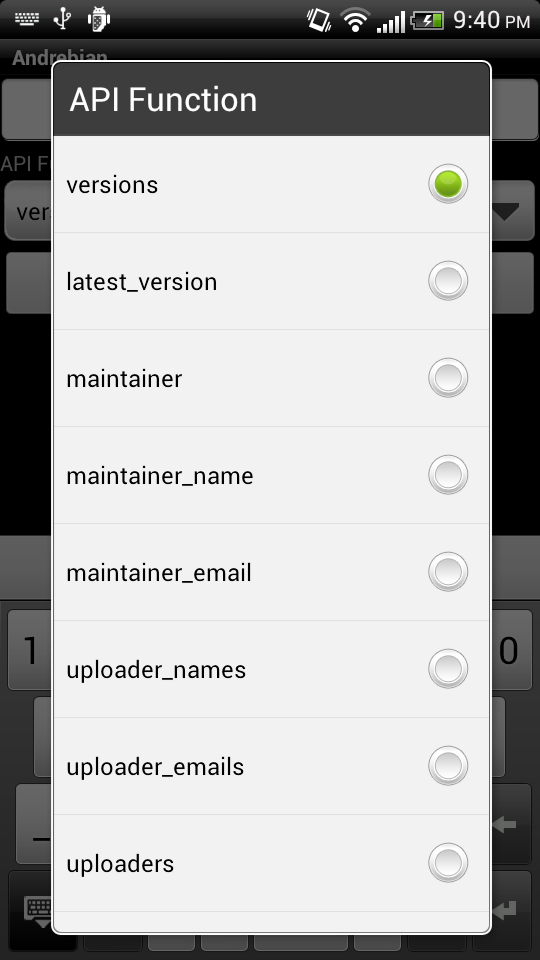
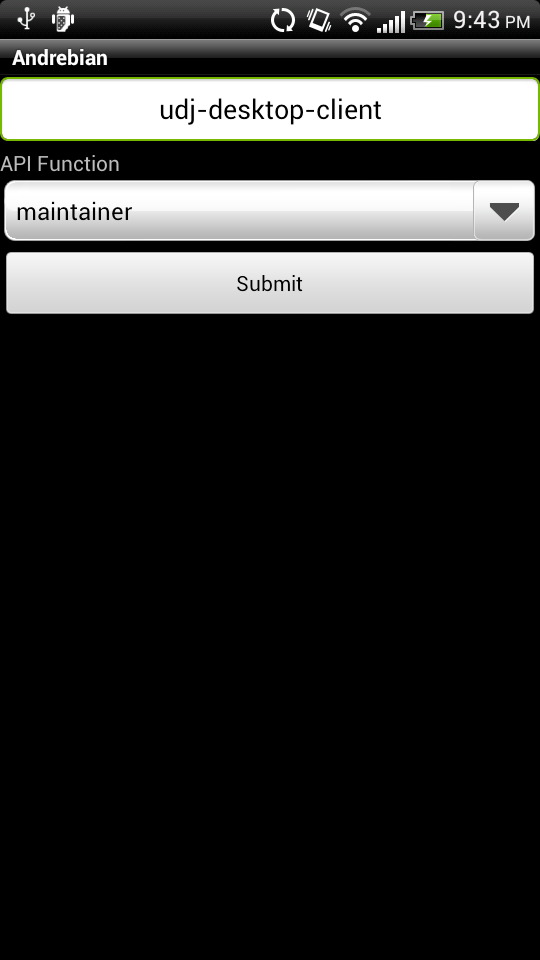
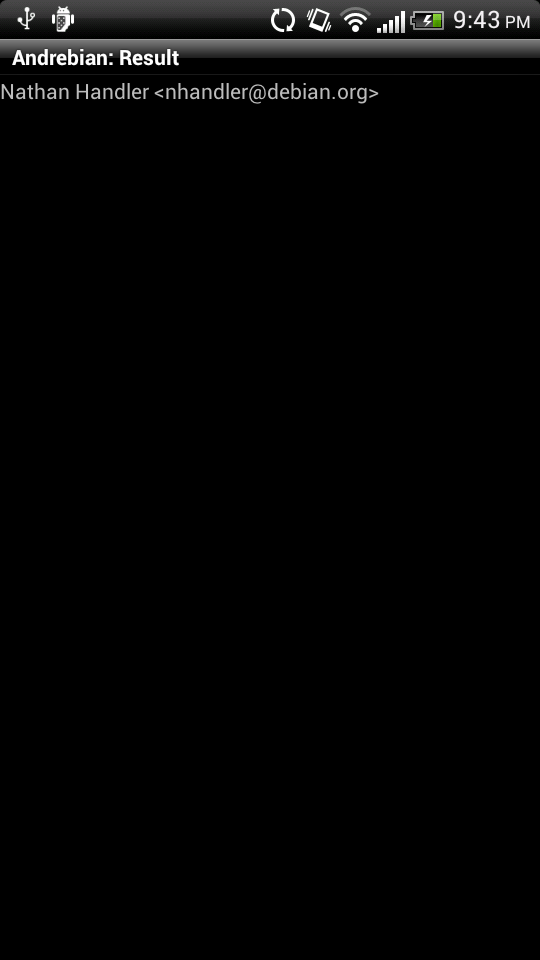
For one of my classes, the final project is to work on a personal project for four weeks. Since I have never done mobile programming before, I decided I would use this project as a chance to teach myself the basics of Android development. Paul Tagliamonte recently blogged about a Google Summer of Code project idea for a Debian Android application. It was this post that motivated me to create a Debian Android application for my final project. We are only in the middle of week one, but my plan is to have at least a basic BTS and PTS interface done by the end of the project. Then, depending on a few things, I hope to turn it into a Google Summer of Code project or simply continue developing it on my own. As I mentioned, I am only a few days into the project. One of the first hurdles I encountered was interacting with the SOAP interfaces available for the PTS and BTS. There are a few examples available on the wiki, but there are not any for Java. A Google search also failed to return any clear and simple results. As a result, I decided I would create a Python script that would accept requests from the Java Android application via a REST API and pass them on to the SOAP API before returning the result as JSON. Before I could finish writing the script, Paul mentioned that he had already written a similar program a few months ago. I immediately stopped working on my script and began preparing a patch for Paul's program to add support for some missing PTS SOAP functions as well as the entire BTS. After a few hours, I had the ability to query the PTS and BTS via a REST API from Java. While I normally prefer to use VIM for my programming, I decided to follow Google's recommendation and use Eclipse. I was able to follow their guide to get the SDK setup and a simple demo application running. One of the few hurdles I encountered was when I wanted to make web requests. Due to the ability for such requests to stall, you are required to perform them in a separate thread. This only becomes aparant when you try to test your application on an actual device; the emulator will happily run the process in the main thread. Regardless, I was eventually able to modify the demo application to allow me to make requests to my Python REST server and then parse and display the result. Here are some screenshots of the application running. Main Screen API Functions Information Entered Result If you have any feature suggestions, questions, or comments, feel free to send me an email (nhandler@debian.org). The source code for the Android application is currently not available, but I plan to put it up in a git repository sometime in the near future. The source code for the Python script that provides a REST API to access the PTS and BTS SOAP interface is available on GitHub.

30 March 2013

Michael Stapelberg: Analyzing RC bug messages

Recently, I was wondering how many Debian Developers are actively working on RC bugs in some way or another in the time period of the last release (squeeze) to now (shortly? before wheezy). I therefore grabbed the mailing list archives of debian-bugs-dist@ from gmane, used only those messages whose X-Debian-PR-Message header matches an RC bug (list retrieved from UDD) and then attributed the message counts to the appropriate Debian Developer. I am sure that there are subtle mistakes in the data I retrieved and that there most likely is a better way to achieve the same results, but this is only to get a trend and should be good enough for that. So, it turns out that 514 different Debian Developers have sent messages regarding RC bugs since squeeze. That s about half of our 985 total active Debian Developers. I would love to show a good histogram of the actual message counts (not sure how well received showing the raw data is ), but I suck at visualizing such data in a compact way. Is there anyone familiar with R (or other free data visualization tools) and willing to help? I can send you the CSV file, just send me an email to stapelberg@.

Joey Hess: Goodreads vs LibraryThing vs Free software

Four years ago I started using Goodreads to maintain the list of books I've read (which had lived in a flat text file for a decade+ before that). Now it's been aquired by Amazon. I doubt it will survive in its current form for more than 2 years. Anyway, while Goodreads has been a quite good way to find what my friends are reading, I've been increasingly annoyed by the quality of its recommendations, and its paucity of other features I need. It really doesn't seem to help me keep up with new and interesting fiction at all, unless my friends happen to read it. So I looked at LibraryThing. Actually, I seem to have looked at it several times before, since it had accounts named "joey", "joeyh", and "joeyhess" that were all mine. Which is what happens to me on sites that lack Openid or Browserid. Digging a little deeper this time, I am finding its recommendations much better than Goodreads' -- although it seems to sometimes recommend books I've already read. And it has some nice features like tracking series, so you can easily tell when you've read all the books in a series or not. The analytics overall seem quite impressive. The UI is cluttered and it seems to take 5 clicks to add and rate a single book. It supports half stars. Overall I get the feeling this was designed for a set of needs that doesn't quite match mine. For example, it seems it doesn't have a single database entry per book; instead each time I add a book, it seems to pull in data from primary sources (library of congress, Amazon cough) and treat this as a separate (but related) entry somehow. Weird. Perhaps this makes sense to say, librarians. I'm willing to adjust how I think about things if there's an underlying reason that can be grasped. There's a quite interesting thread on LibraryThing where the founder says:
Don't say we should open-source the code. That would be a nightmare! And I have limited confidence in APIs. LibraryThing has the book geeks, but not so much the computers geeks.
I assume that the nightmare is that there would be dozens of clones of the site, all balkanized, with no data transfer, no federation between them. Except, that's the current situation, as every Goodreads user who is now trying to use LibraryThing is discovering. Before I ever started using Goodreads, I made sure it met my minimum criteria for putting my data into a proprietary silo: That I could get the data back out. I can, and have. LibraryThing can import it. But the import process loses data! And it's majorly clunky. If I want to continue using Goodreads due to its better UI, and get the data into LibraryThing, for its better analytics, I have to do periodic dumps and loads of CSV files with manual fixups. This is why we have standards. This is why we're building federated social networks like status.net and the upcoming pump.io that can pass structured data between nodes transparently. It doesn't have to be a nightmare. It doesn't have to rely on proprietary APIs. We have the computer geeks. Thing is, sites like GoodReads and LibraryThing need domain-specific knowledge, and communities to curate data, and stuff like that. Things that work well in a smallish company. (LibraryThing even has a business model that makes sense, yearly payments to store more books in it.) With free software, it's much more appealing to sink the time we have into the most general-purpose solution we can. Why build a LibraryThing when we could build something that tracks not only books but movies and music? Why build that when we could build a generic federated network for structured social data? And that's great, as infrastructure, but if that infrastructure is only used to build a succession of proprietary data silos, what was the point? So, could some computer & book geeks please build a free software alternative to these things, focused on books, that federates using any of the fine APIs we have available? Bear in mind that there is already a nice start at a comprehensive collection of book data in the Open Library. I'd happily contribute to a crowd funded project doing this.

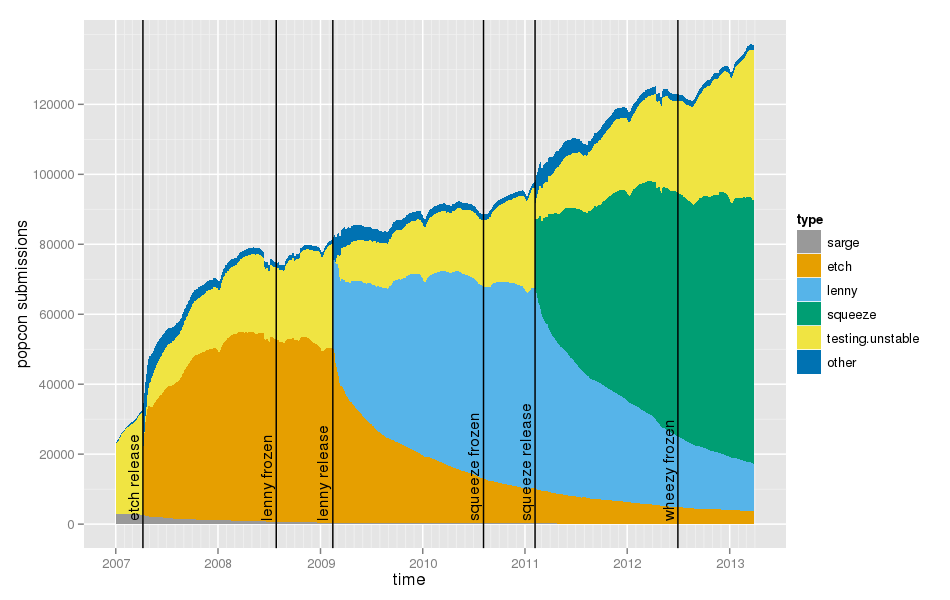
Lucas Nussbaum: Debian releases used by popcon participants

The graph below is generated from popcon submissions. Since they include the version of the popularity-contest package, one can determine the Debian release that was used by the submitter (a new version of the popularity-contest package is generally uploaded just after the release to make that tracking possible). The graph is similar to the one found on popcon, except that versions newer than the latest stable release are aggregated as testing/unstable . Comments: Scripts are available on git.debian.org.

Steve Kemp: Time passes, Thorin sits down and starts singing about gold.

This weekend I have mostly been reading Longitude: The True Story of a Lone Genius Who Solved the Greatest Scientific Problem of His Time . In modern times we divide the earth up into rings of lines, latitude and longitude, as wikipedia will explain. Finding your latitude is easy, finding your longitude is a difficult process, and it was vitaly important when people started to sail large distances, the book contained lots of stories of sailors being suddenly suprised by the appearance of land - because they'd misjudged their position. Having four ships, containing garlic, pepper, and other goods of value exceeding the total wealth of the UK, sink all at once was a major blow. Not to mention the large number of sailors who lost their lives. There were several solutions proposed, involving steady hands and telescopes, etc, but the book mostly discusses John Harrison and his use of watches/clocks.
John Harrison was featured in Only Fools & Horses, as the designer of the watch that made Delboy & Rodney millionaires. ->Time on our hands
The idea of using a clock is that you take one with you, set to the time of your departure location. Using that clock you can compare the time to the local-time, by viewing the sun, etc. Calculating the difference between the two times allows you to see how far away, in degrees, from your port, and thus how far you've traveled. Until harrison came along clocks weren't accurate enough to keep time. His clocks would lose a second a month, until then clocks might lose 15 minutes a day. (With more variations depending on temperture, location, and pressure. Clearly things like pendulum clocks weren't suitable for rocking ships either.) All in all this book was a great read, there were mentions of Galilao, Newton, and similar folk who we've all heard of. There was angst, drama, deceit, and some stunning craftmanship. Harrison was a woodworker, and he made his clocks out of wood (+brass where necessary). Choosing fast/slow-grown wood depending on purpose, and using wood that secreted oils naturally allowed him to avoid lubrication - which improved accuracy, as lubricants tend to thin/thicken when temperature/pressure change. A lovely read, thank you very much. In other news I received several patches for my templer static-site generator, and this has resulted in much improvement. I've also started using Test::Exception now, and slowly updating all my perl code to use this.

Steve McIntyre: Scanning for assembly code in Free Software packages

In the Linaro Enterprise Group, my task for the last several weeks was to work through a huge number of packages looking for assembly code. Why? So that we could identify code that would need porting to work well on AArch64, the new 64-bit execution state coming to the ARM world Real Soon Now. Working with some Ubuntu and Fedora developers, we generated a list of packages included in each distribution that seemed to contain assembly code of some sort. Then I worked through that list, checking to see:
  1. if there was actually any assembly there;
  2. if so, what it was for, and
  3. whether it was actually used
I've written a full report about what I found in the scan, and I'll be writing some more articles based on it shortly.

29 March 2013

Olivier Berger: Managing Python code with UTF-8 (french chars) in org-mode + babel + minted for LaTeX export

The goal of this article is to illustrate how to manage Python code which includes comments in UTF-8 characters inside a latin-1 source org-mode for LaTeX export. Note that I ve pasted in wordpress the HTML generated by org-mode, so I hope it isn t broken too much. My typical use case is a french lecture on Python where the text is written in french, as well as some of the code comments and examples We ll use org-mode s babel module to include and manage the Python
examples. The goal is to write the source of the Python programs
directly in the same org source as the class book s text, and to extract them into a subdir (with the tangle feature), so that they can be shipped to the students to experiment with. The minted LaTeX environment is used, for babel, to make the Python syntax highlighting.

1.1 Issues
  • The source org-mode is in latin-1 so that it compiles with pdflatex
  • The examples source-code will be in UTF-8 so that Python 2.7 executes them well on a modern Linux desktop
  • Minted relies on pygmentize wich doesn t seem to handle UTF-8 so well

1.2 Solution
We ll show how to patch minted s use of pygmentize to take advantage
of its conversion capacity to convert the Python sources from UTF-8 to
latin-1 at document rendering time (LaTeX compilation). It s a hack, but works. The current document s source shows how this works

1.2.1 Customization
The org document should contain the following headers :
#+LANGUAGE:  fr
#+LaTeX_HEADER: \usepackage[latin1] inputenc 
#+LaTeX_HEADER: \usepackage[french] babel 
#+LaTeX_HEADER: \usepackage color \usepackage minted 
and the footers :
# Local Variables:
# coding: latin-1
# org-src-preserve-indentation: true
# tab-width: 4
# End:
Also note that pdflatex should use the -shell-escape option necessary for minted Now, the document should also include the following patch for minted :
#+LATEX_HEADER: \makeatletter
#+LATEX_HEADER: \renewcommand\minted@pygmentize[2][\jobname.pyg] 
#+LATEX_HEADER:   \def\minted@cmd pygmentize -l #2 -f latex -F tokenmerge
#+LATEX_HEADER:     \minted@opt gobble  \minted@opt texcl  \minted@opt mathescape 
#+LATEX_HEADER:     \minted@opt startinline  \minted@opt funcnamehighlighting 
#+LATEX_HEADER:     \minted@opt linenos  -P "verboptions=\minted@opt extra "
#+LATEX_HEADER:     -O encoding=UTF-8,outencoding=iso-8859-1 -o \jobname.out.pyg #1 
#+LATEX_HEADER:   \immediate\write18 \minted@cmd 
#+LATEX_HEADER:   % For debugging, uncomment:
#+LATEX_HEADER:   %\immediate\typeout \minted@cmd 
#+LATEX_HEADER:   \ifthenelse \equal \minted@opt@bgcolor 
#+LATEX_HEADER:     
#+LATEX_HEADER:     \begin minted@colorbg \minted@opt@bgcolor 
#+LATEX_HEADER:   \input \jobname.out.pyg 
#+LATEX_HEADER:   \ifthenelse \equal \minted@opt@bgcolor 
#+LATEX_HEADER:     
#+LATEX_HEADER:     \end minted@colorbg 
#+LATEX_HEADER:   \DeleteFile \jobname.out.pyg 
#+LATEX_HEADER: \makeatother
The important change is the addition of the -O encoding=UTF-8,outencoding=iso-8859-1 option of pygmentize, that will convert the UTF-8 source code to latin-1. Hopefully most of the characters will convert fine, for a document written in french.

2 Examples

2.1 Basic Python
This is a generic verbatim example, which doesn t use babel / minted.
$ python
Python 2.7.3 (default, Jan  2 2013, 16:53:07) 
[GCC 4.7.2] on linux2
Type "help", "copyright", "credits" or "license" for more information.
>>> print "Hello, world!"
Hello, world!
>>>

2.2 Python source code for french speakers
Here, we first include the source code, so that it can be exported to
an examples/ subdir, with the following (note that the #+ BEGIN_src / #+ END_src should be changed to get rid of the space
character between + and BEGIN / END, and that the :shebang and following text should be on the BEGIN_SRC line I seem to have not quoted
these properly in this document):
#+name: helloworld
#+ BEGIN_src python :tangle examples/helloworld.py :noweb yes \\
:shebang #!/usr/bin/python :padline no :exports none
# -*- coding: utf-8 -*-
# Ceci est un exemple d'affichage d'une cha ne accentu e
name = raw_input("Quel est v tre nom ? ")
print "J'esp re que  a va bien aujourd'hui", name
#+ END_src
Editing it with C-c will open an UTF-8 buffer, so hopefully, this will be consistent with the utf-8 coding system declared on the second line. The regeneration of the examples/helloworld.py file is made with C-c C-v t (babel tangling ). Note that we don t add the #!/usr/bin/python first line in the source, as we want it to be added by the tangling process (which will also make the script executable). Once this is done, the script may be run :
$ python examples/helloworld.py 
Quel est v tre nom ? Fran ois
J'esp re que  a va bien aujourd'hui, cher Fran ois
Now, to add the colorized rendering in the lecture book, we do (here again, remove the spaces):
# +BEGIN_latex
\inputminted python examples/helloworld.py 
# +END_latex
And here it is, rendered by minted:
# -*- coding: utf-8 -*-
# Ceci est un exemple d'affichage d'une cha ne accentu e
name = raw_input("Quel est v tre nom ? ")
print "J'esp re que  a va bien aujourd'hui, cher", name
Here are links to : the source, the PDF result, and the generated Python program.

28 March 2013

Russ Allbery: lbcd 3.4.1

lbcd is an agent that we run on systems that use software load balancing. It returns a weight and an increment that's used by the lbnamed DNS server. This is a minor feature release. The main point of this release is to add support for an /etc/nolbcd file (or /usr/local/etc/nolbcd in the default build) that's akin to /etc/nologin except it just drops the system from an lbnamed load balance pool rather than denying all logins. Sometimes it's more convenient to do that than to stop the lbcd daemon, particularly when the latter is monitored by configuration management software. Also in this release, the lbcd -t mode, which prints all the data to standard output, is now documented and has been improved, and lbcdclient no longer rewrites maximum weights to -1. You can get the latest release from the lbcd distribution page.

Eddy Petri&#537;or: The sorry state of the Android universe


Update: Corrected the code name for 4.2.2 is Jelly Bean, not Ice Cream Sandwich as I initially stated. I also described in the comments why the calendar application is also crap.

I recently bought a phone based on the Android platform (version 4.2.2 aka Jelly Bean). Before the purchase I had the wrong idea that this platform - Android - is the best thing since sliced bread. Let me tell you, that idea is so wrong, it's a shame anybody thinks or has ever thought that.

My previous phone was a Nokia E71 and with its stock set of applications and in spite of its old and rusty Symbian OS, I still have a hard time to even match the basic functionalities on the Android phone even using the most praised apps from the Play Store.

The dialer is crap, there is no decent speed dialer, the focus is on the apps instead of the phone functionality, the homescreen-type-to-search-in-contacts functionality of E71 is probably impossible due to the retarded decision to forget you're using a phone, notifications, even important ones, are hidden, to the point that the ones needing attention can be missed (e.g. entering the PIN/confirmation for Bluetooth pairing must be searched for in the notification area), when looking in the agenda there is no straight one step to edit a contact, you must jump to another application and do the edit there, treating SMS conversations as one to one instant messages works until you want to reply to multiple people at once.

Volume for ringing, SMS notification and the headset are controlled all together, so if during the last conversation you turned down the volume because it was too loud, you can miss a call because our will ring at a lower volume.

And these are only broken things in the basic functionality (for a post 2008 cell phone).

Android phones are smart phones, so more advanced features are required: playing audio and video files, GPS related applications, podcasting support, email handling and web browsing are among the features that can be expected on such a phone.

Only web related functionality and simple media playing are at a reasonable level compared with my old E71, maybe due to Google being web oriented and the new phones having better screens than the old Nokia.

But I am an avid podcast listener, so I've been searching for an application that can match Nokia's Podcasts stock application, and I've come to the conclusion Android users which love podcasts either have to wait for Nokia to develop on Android (which seems unlikely) or find one or two talented developers to create a decent application.

I don't understand how can such an application not have a playlist with the downloaded episodes, not have download all new episodes or mark all/selected as listened. I have found applications that have at least one of these issues and have an average of over 4 out of 5 stars in Google Play. Poor users!

In the light of these issues, I'm having so much difficulty coming up with an excuse for Nokia losing its position as a market leader, but our seems technical superiority is not necessary or enough to dominate the mobile phone market. Sadly, that says a lot about our species, and the words aren't nice.

Russ Allbery: wallet 1.0

Finally. The wallet is a system management tool for storing and retrieving secure data. I originally wrote it as part of our Kerberos v5 migration project to replace the old Kerberos v4 system we had for distributing srvtabs. It's still mostly used at Stanford for distributing keytabs, but it's extensible and supports storing arbitrary secure data. We also use it internally for storing database passwords, SSL private keys, and anything else that needs to be kept secure and retrieved later. It supports a rich ACL mechanism and namespace enforcement and is built on top of remctl for security and confidentiality. I did a bunch of development on it originally in 2006 and 2007, but then it solved our immediate problems and I didn't have much time to work on it. I used pre-1.0 versions because there was so much more on it that I wanted to do. But we've been running it in production for years, and while there's still tons more work that needs to be done, it really deserves a 1.0 version. Jon Robertson converted the database backend to DBIx::Class (which added PostreSQL support) and implemented schema upgrading, which were two of the major things that were keeping me from putting a 1.0 version on it. So it's time. Other new features since the previous release include a change to the default ACLs so that owners of objects can destroy them by default, a new ldap-attr ACL type that checks whether the caller has a particular attribute set in LDAP (which will let us use our entitlement system to control access), and support for storing and managing key rotation for WebAuth keyrings. There's also a new acl check command to determine whether an ACL exists and a new comment field and command to store an arbitrary comment about an object. Our local naming policy has also gotten much more complex, so I turned it into a module to provide an example to others of how to implement some reasonably detailed namespace and object autocreation controls. You can get the latest version from the wallet distribution page. I'm going to upgrade Debian packages to experimental or unstable (depending on the freeze status) as soon as I get a chance to write a bit more documentation and hopefully figure out debconf integration with the database setup support inside Debian for the server piece.

27 March 2013

Bits from Debian: Debian Project Leader elections 2013: interview with Moray Allan

We have asked Moray Allan, one of the three candidates for DPL elections 2013, to tell our readers about himself and his ideas for the Debian Project. You can also read the interviews to the other two candidates: Lucas Nussbaum and Gergely Nagy.
Please tell us a little about yourself. I'm Moray Allan, from Edinburgh in Scotland. I'm 32. After working in academic research for a few years, I'm now working freelance on a wide mixture of topics, with recent projects in Indonesia, Romania and Kuwait. When I'm not working, I'm likely to be found walking through a city or the countryside, or otherwise relaxing at home reading a novel in French or Spanish. What do you do in Debian and how did you started contributing? In recent years, most of my Debian time was taken up organising the annual Debian conferences. But I still have a load of packages, mostly connected to an upstream Linux-on-handheld-computers project I was working on before I joined Debian to create packages for it. Why did you decide to run as DPL? I've been involved in Debian for about 10 years now, including working for the last few years in DebConf in a way similar to how the DPL acts within overall Debian. Previously I'd ruled out running due to lack of time, but currently I'm in a more flexible work situation. It seems the right time to put myself forward, and see if the ideas in my platform interest project members. Three keywords to summarise your platform. Transparency, communication, openness. (Three ways I'd like us to think about teams in Debian.) What are the biggest challenges that you envision for Debian in the future? I think the biggest challenges are for free software in general.
End-users are moving to more closed hardware -- will our software be able to run on the phones and tablets people are shifting towards? At the same time, end-users and server users are moving to "the cloud", and often depending more heavily on non-free infrastructure outside their own control. What are, in your opinion, the areas of the project more in need of technical and/or social improvements? In my platform I give a few ideas about teams and delegations, coordination and mediation, and both internal and external communication, including more organised fundraising. These are areas where I think relatively simple changes can give big benefits. Why should people vote for you? I have proven leadership experience within Debian, as I've been working on coordination and mediation tasks for some years already. At the same time, I do regular packaging work, and work in other parts of Debian like the press and publicity teams, so I'm in touch with the experience of normal Debian contributors. People should vote for me if they support my platform, which is about coordination-level changes that I would have no mandate or authority to push through unless I am elected. Name three tools you couldn't stay without. APT, emacs, ssh. What keep you motivated to work in Debian? I've used Debian on all my computers for a long time, and by now working on the distribution myself feels a natural part of that.
Fortunately I'm constantly positively surprised by Debian and by the Debian community. Are there any other fields where you call yourself a geek, besides computers? Certainly history (such as the eastern Mediterranean region in late antiquity), languages (including dead ones) and music (especially Josquin to Monteverdi).

Bits from Debian: Debian Project Leader elections 2013: interview with Lucas Nussbaum

We have asked Lucas Nussbaum, one of the three candidates for DPL elections 2013, to tell our readers about himself and his ideas for the Debian Project. You can also read the interviews to the other two candidates: Gergely Nagy and Moray Allan.
Please tell us a little about yourself. Hi! I'm a 31 years old french computer geek. In my day job, I'm an assistant professor (Ma tre de Conf rences) of Computer Science at Universit de Lorraine. What do you do in Debian and how did you started contributing? Like many, I started contributing to Debian by creating and maintaining packages for my own software, in the Ruby team. Then, I discovered that, even if it's not so obvious from the outside, there are a lot of areas in Debian that could use more contributors. So I just started to contribute to more and more things. There's a list of things I did in Debian in my platform. What I have been doing recently is: Why did you decide to run as DPL? Two main reasons: Three keywords to summarise your platform. (re-)make Debian the center of the Free Software ecosystem; foster innovation inside Debian; reduce barriers to contributions What are the biggest challenges that you envision for Debian in the future? I often have the impression that the project is losing momentum, positive energy, and slowing down. It feels like we are living on the benefits of the past. A lot of very cool things happen in the Debian ecosystem, but very often outside the Debian project (in derivative distributions). Debian should aim at reinforcing its position in the center of the Free Software ecosystem: it should be the main active intermediary between upstream projects and final users. To achieve that, we need to reinforce the visibility and the impact of Debian. This is extremely important because the values we fight for as a project are often neglected by our derivatives. What are, in your opinion, the areas of the project more in need of technical and/or social improvements? Fostering innovation inside Debian: we should be more welcoming towards innovation and experiments inside the project. Often, we merely tolerate them, and bureaucracy makes them hard and slow to conduct. As a result, people tends to innovate outside the Debian project. Making it easier to contribute to Debian: we compete with more and more projects to attract contributors. While we are already quite good at welcoming new contributors with good documentation and mentoring (much better than people usually think), there's still a lot of room for improvement. Why should people vote for you? A great thing in Debian's voting system is that you don't vote "for" or "against" a specific candidate. Instead, due to our use of the Condorcet method, you rank candidates (and also indicate those who you consider suitable for the role by ranking a virtual "None of the above" candidate). Why am I a good candidate? My previous contributions to Debian show that I have a pretty good understanding of the inner workings of the project, and that I have a track record of managing projects successfully inside Debian. I think that those are two required qualities for a DPL. Name three tools you couldn't stay without. vim, mutt, ssh. What keep you motivated to work in Debian? Debian is a fantastic project from a technical point of view (focus on technical excellence, lots of interesting challenges), but also from a social point of view: the Debian community is a great community where I have lots of good friends. Also, what's great when you contribute to Debian is that your work has a real impact, and that you see people using stuff you worked on everywhere. Are there any other fields where you call yourself a geek, besides computers? I'm not sure this really qualifies as "besides computers", but I've gotten very interested in the OpenStreetMap project lately. I very much enjoy exploring unmapped areas on a mountain bike. It feels like being Christopher Columbus or Marco Polo, but 20 minutes from home. ;) The OpenStreetMap and Debian projects also share many values, such as a great attention to quality and details.

Bits from Debian: Debian Project Leader elections 2013: interview with Gergely Nagy

We have asked Gergely Nagy, one of the three candidates for DPL elections 2013, to tell our readers about himself and his ideas for the Debian Project. You can also read the interviews to the other two candidates: Lucas Nussbaum and Moray Allan.
Please tell us a little about yourself. I was born in Hungary, a little bit over three decades ago, as a son of a biochemist and a pharmacist, who gave me the name Gergely Nagy (however, online - and offline too by now - I'm mostly known by my nickname, algernon). I went on to study human arts (hungarian grammar & literature, in particular), and to support this passion, I work as a software engineer, one who gets paid to work on free software. As such, I'm in a fortunate situation where my hobby supports my passion, and my hobby aligns well with my Debian work too. What do you do in Debian and how did you started contributing? At the moment, apart from maintaining a few packages, I'm doing a few other, mostly invisible things, like reassigning misfiled bugs so they don't end up being forgotten; or review newly uploaded packages before they enter the archive, making sure we are allowed to distribute them, and that their quality is up to our standards. I used to do quite a lot of other things, but I chose to spend the past year mostly invisible, learning. I started contributing by packaging an editor I was using at the time, but quickly ended up adopting another package - things escalated from there quickly. Why did you decide to run as DPL? There were two reasons that motivated me to run: one is that I believe I can bring something new to the table, that I can help Debian expand in new directions. The other reason is that I'm always on the lookout for new ways to contribute back to Debian, and being the project leader is a position where I believe I could contribute most at this point in time. Three keywords to summarise your platform. Non-technical contributors. What are the biggest challenges that you envision for Debian in the future? The biggest challenge is growing up, to become more than a group of computer geeks creating an amazing distribution. To become a community of a wide variety of people, where both computer geeks and art geeks feel equally at home. Yet, at the same time, where we as a project, keep our focus straight, and be the champions of Free Software. We just need to realize that there's much more to Free Software than the software itself. What are, in your opinion, the areas of the project more in need of technical and/or social improvements? I believe that while we do have many areas where we could use technical improvements, we are reasonably safe there, because we do have very skilled technical people to help us solve these problems. We can make our tools better, we can develop our infrastructure better to aid us even more - and so on and so forth. While we need work on many areas, we're on the right track there. However, when it comes to social issues, we're at a loss. We have serious trouble keeping certain topics civilised on mailing lists, we have trouble attracting women, and we have trouble reaching people who are not naturally exposed to Debian (or Free Software). We could really use a more diverse community, but that requires us to overcome quite a lot of social roadblocks, so to say. Outreach is one particular area where we need much more technical and social improvements. Why should people vote for you? People should vote me, because they found my platform, my answers on debian-vote@, and my ideas and goals convincing and worthy to pursue. People should vote me, because they trust I'll be able to serve the project well. Name three tools you couldn't stay without. Emacs, git and a pencil. Because with these three, I can pretty much do anything. What keep you motivated to work in Debian? The community. Over the years, I had the good fortune to meet with a lot of people I hold in high esteem, whose enthusiasm and motivation I found inspiring. For any other common goals Debian and I may share, in the end, it is the people within Debian that keep me motivated. Are there any other fields where you call yourself a geek, besides computers? I'm not quite there yet, but I'm working hard on becoming a human arts geek, or at least a geek of the hungarian language.

Benjamin Mako Hill: The Institute for Cultural Diplomacy and Wikipedia

A month ago, Mark Donfried from the Institute for Cultural Diplomacy (ICD) an organization dedicated to promoting open dialogue sent me this letter threatening me with legal action because of contributions I ve made to Wikipedia. Yesterday, he sent me this followup threat. According to the letters, Donfried has threatened me with legal action because I participated in a discussion on Wikipedia that resulted in his organization s article being deleted. It is not anything I wrote in any Wikipedia article that made Donfried so upset although Donfried is also unhappy about at least one off-hand comment I made during the deletion discussion on a now-deleted Wikipedia process page. Donfried is unhappy that my actions, in small part, have resulted in his organization not having an article in Wikipedia. He is able to threaten me personally because unlike many people I edit Wikipedia using my real, full, name. Donfried s letter is the latest step in a saga that has been ongoing since last June. It has been a frustrating learning experience for me that has made me worried about Wikipedia, its processes, and its future. In Wikipedia, debates can be won by stamina. If you care more and argue longer, you will tend to get your way. The result, very often, is that individuals and organizations with a very strong interest in having Wikipedia say a particular thing tend to win out over other editors who just want the encyclopedia to be solid, neutral, and reliable. These less-committed editors simply have less at stake and their attention is more distributed. The ICD is a non-profit organization based in Berlin. According to its own website, a large part of the organization s activities are based around arranging conferences. Its goals peace, cultural interchange, human rights are admirable and close to my heart. Its advisors and affiliates are impressive. I had never heard of the ICD before their founder, Mark Donfried, emailed me in April 2012 asking me to give a keynote address at their conference on The 2012 International Symposium on Cultural Diplomacy & Human Rights. I replied, interested, but puzzled because my own research seems very far afield of both cultural diplomacy (which I had never heard of) and human rights. I replied saying:
What would you like me to talk about I ask because I don t consider myself an expert in (or even particularly knowledgeable about) cultural diplomacy. Did someone else refer you to me?
Donfried replied with a long message seemingly copy and pasted thanking me for considering attending and asking me for details of my talk. I replied again repeating text from my previous email and asking why he was interested in me. Donfried suggested a phone call to talk about details. But by this point, I had looked around the web for information about the ICD and had decided to decline the invitation. Among things I found was a blog post by my friend James Grimmelmann that suggests that, at least in his case, the ICD had a history of sending unsolicited email and an apparently inability to take folks off their email lists even after repeated requests. I also read the Wikipedia article about the ICD. Although the Wikipedia article was long and detailed, it sent off some internal Wikipedian-alarm-bells for me. The page read, to me, like an advertisement or something written by the organization being described; it simply did not read to me like an encyclopedia article written by a neutral third-party. I looked through the history of the article and found that the article had been created by a user called Icd_berlin who had made no other substantive edits to the encyclopedia. Upon further examination, I found that almost all other significant content contributions were from a series of anonymous editors with IP addresses associated with Berlin. I also found that a couple edits had removed criticism when it had been added to the article. The criticism was removed by an anonymous editor from Berlin. Criticisms on the article included links to a website called Inside the ICD which was a website that mostly consisted of comments by anonymous people claiming to be former interns of the ICD complaining about the working conditions at the organization. There were also many very positive descriptions of work at the ICD. A wide array of pseudonymous users on the site accused the negative commenters of being liars and detractors and the positive commenters of being ICD insiders. I also found that there had been evidence on Wikipedia also removed without discussion by an anonymous IP from Berlin of an effort launched by the youth wing of ver.di one of the largest trade unions in Germany to campaign for good internships at the ICD. Although details of the original campaign have been removed from ver.di s website, the campaigned ended after coming to an agreement with the ICD that made explicit a set of expectations and created an Intern Council. Although the article about ICD on Wikipedia had many citations, many were to the ICD s own website. Most of the rest were to articles that only tangentially mentioned the ICD. Many were about people with ICD connections but did not mention the ICD at all. As Wikipedia editor, I was worried that Wikipedia s policies on conflict of interest, advertising, neutrality, and notability were not being served by the article in its state. But as someone with no real experience or knowledge of the ICD, I wasn t sure what to do. I posted a request for help on Wikipedia asking for others to get involved and offer their opinions. It turns out, there were several editors who had tried to improve the article in the past and had been met by pro-ICD editors reverting their changes. Eventually, those editors lost patience or simply moved on to other topics. By raising the issue again, I kicked off a round of discussion about the article. At the termination of that discussion, the article was proposed for deletion under Wikipedia s Articles for Deletion policy. A new Wikipedia editor began working enthusiastically to keep the article by adding links and by arguing that the article should stay. The new user edited the Wikipedia article about me to accuse me of slander and defamation although they removed that claim after I tried to explain that I was only trying to help. I spent quite a bit of time trying to rewrite and improve the article during the deletion discussion and I went link by link through the many dozens of citations. During the deletion discussion, Mark Donfried contacted me over email and explained that his representatives had told him that I was working against the ICD in Wikipedia. He suggested that we meet. We had a tentative plan to meet in Berlin on an afternoon last July but, in the end, I was too busy trying to submit my thesis proposal and neither of us followed up to confirm a particular time within the time window we had set. I have still never met him. My feeling, toward the end of the deletion discussion on Wikipedia, was mostly exasperation. Somewhat reluctantly, I voted to delete the article saying:
Delete This AFD is a complete mess for all the reasons that the article itself is. Basically: there are a small number of people who seem to have a very strong interest in the Institute for Cultural Diplomacy having an article in Wikipedia and, from what I can tell, very little else. Hessin fahem, like all the major contributors to the page, joined Wikipedia in order to participate in this issue. This article has serious problems. I have posted a detailed list of my problems on the article talk page: primary sources, conflict of interest for nearly all substantive contributions and reading like an advert are the biggest issues. My efforts to list these problems were reverted without discussion by an anonymous editor from Berlin. I have seen no evidence that the Institute for Cultural Diplomacy satisfies WP:ORG but I agree that it is possible that it does. I strongly agree with Arxiloxos that articles should always be fixed, and not deleted, if they are fixable. But I also know that Wikipedia does not deserve this article, that I don t know to fix it, and that despite my efforts to address these issues (and I ll keep trying), the old patterns of editing have continued and the article is only getting worse. This ICD seems almost entirely based around a model that involves organizing conferences and then calling and emailing to recruit speakers and attendees. A large number of people will visit this Wikipedia article to find out more about the organization before deciding to pay for a conference or to join to do an internship. What Wikipedia shows to them reads like an advert, links almost exclusively to of pages on the organizations websites and seems very likely to have been written by the organization itself. We are doing an enormous disservice to our readers by keeping this page in its current form. If somebody wants to make a serious effort to improve the article, I will help and will happily reconsider my !vote. But after quite a bit of time trying to raise interest and to get this fixed, I m skeptical this can be addressed and my decision reflects this fact. mako 05:18, 12 June 2012 (UTC)
I concluded that although the organization might be notable according to Wikipedia s policies and although the Wikipedia article about it might be fixable, the pattern of editing gave me no faith that it could be fixed until something changed. When the article was deleted, things became quiet. Several months later a new article was created again, by an anonymous user with no other edit history. Although people tend to look closely at previously deleted new pages, this page was created under a different name: The Institute of Cultural Diplomacy and was not noticed. Deleted Wikipedia articles are only supposed to be recreated after they go through a process called deletion review. Because the article was recreated out of this process, I nominated it for what is called speedy deletion under a policy specifically dealing with recreated articles. It was deleted again. Once again, things were quiet. In January, it seems, the Inside the ICD website was threatened with a lawsuit by the ICD and the maintainers of the site took it down with the following message:
Apparently, the ICD is considering filing a lawsuit against this blog and it will now be taken down. We completely forgot about this blog. Let s hope no one is being sued. Farewell.
On February 25, the Wikipedia article on ICD was recreated once again out of process and by a user with almost no previous edit history. The next day, I received an email from Mark Donfried. In the message, Donfried said:
Please note that the ICD is completely in favor of fostering open dialogue and discussions, even critical ones, however some of your activities are raising serious questions about the motives behind your actions and some even seem to be motives of sabotage, since they resulted in ICD not having any Wikipedia page at all. We are deeply concerned regarding these actions of yours, which are causing us considerable damages. As the person who initiated these actions with Wikipedia and member of the board of Wikipedia [1], we would therefore request your answer regarding our questions below within the next 10 days (by March 6th). If we do not receive your response we will unfortunately have to consider taking further legal actions with these regards against you and other anonymous editors.
I responded to Donfried to say that I did not think it was prudent to speak with him while he was threatening me. Meanwhile, other Wikipedia editors nominated the ICD article for deletion once again and unanimously decided to delete it. And although I did not participate in the discussion, Donfried emailed again with more threats of legal action hours after the ICD article was deleted:
[A]s the case of the ICD and its presentation on the Wikipedia has seriously worsened in recent days, we see no alternative but to forward this case (including all relevant visible and anonymous contributors) to our legal representatives in both USA and Europe/Germany as well as to the authorities and other corresponded organizations in order to find a remedy to this case.
Donfried has made it very clear that his organization really wants a Wikipedia article and that they believe they are being damaged without one. But the fact that he wants one doesn t mean that Wikipedia s policies mean he should have one. Anonymous editors in Berlin and in unknown locations have made it clear that they really want a Wikipedia article about the ICD that does not include criticism. Not only do Wikipedia s policies and principles not guarantee them this, Wikipedia might be hurt as a project when this happens. The ICD claims to want to foster open dialogue and criticism. I think they sound like a pretty nice group working toward issues I care about personally. I wish them success. But there seems to be a disconnect between their goals and the actions of both their leader and proponents. Because I used my real name and was skeptical about the organization on discussion pages on Wikipedia, I was tracked down and threatened. Donfried insinuated that I was motivated to sabotage his organization and threatened legal action if I do not answer his questions. The timing of his first letter the day after the ICD page was recreated means that I was unwilling to act on my commitment to Wikipedia and its policies. I have no problem with the ICD and I deeply regret being dragged into this whole mess simply because I wanted to improve Wikipedia. That said, Donfried s threat has scared me off from attempts to improve the ICD articles. I suspect I will not edit ICD pages in Wikipedia in the future. The saddest part for me is that I recognize that what is in effect bullying is working. There are currently Wikipedia articles about the ICD in many languages. For several years, ICD has had an article on English Wikipedia. For almost all of that period, that article has consisted entirely of universally positive text, without criticism, and has been written almost entirely by anonymous editors who have only contributed to articles related to the ICD. In terms of the ICD and its article on Wikipedia, I still have hope. I encourage Donfried and his representatives to create accounts on Wikipedia with their full names just like I have. I encourage them to engage in open dialogue in public on the wiki. I encourage them go through deletion review, make any conflicts of interest they have unambiguously clear, and to work with demonstrably non-conflicted editors on Wikipedia to establish notability under Wikipedia s policies. The result still can be an awesome, neutral, article about their organization. I have offered both advice on how to do this and help in that process in the past. I have faith this can happen and I will be thrilled when it does. But the general case still worries me deeply. If I can be scared off by threats like these, anybody can. After all, I have friends at the Wikimedia Foundation, a position at Harvard Law School, and am close friends with many of the world s greatest lawyer-experts on both wikis and cyberlaw. And even I am intimidated into not improving the encyclopedia. I am concerned by what I believe is the more common case where those with skin in the game will fight harder and longer than a random Wikipedian. The fact that it s usually not me on the end of the threat gives me lots of reasons to worry about Wikipedia at a time when its importance and readership continues to grow as its editor-base remains stagnant.
[1] It s a minor mistake but worth pointing out that I am not on the board of Wikipedia ; I am on its advisory board which carries no power or responsbility within the organization. Sometimes, the foundation asks for my advice and I happily give it.

Next.

Previous.