Search Results: "tar"

12 January 2012

Paul Tagliamonte: json / vim love

Use vim? Check out some sweet vim exrc stuff for editing one-line JSON files:
autocmd BufRead,BufNewFile *.json set filetype=json
command Js silent %!jp
command Jc silent %!jcompress
autocmd FileType json Js
jcompress and jp are both on my github. Have fun!

11 January 2012

Craig Small: MediaServer with Rygel

Rygel XVI

Image by Cayusa via Flickr

Like a lot of people, I have one of those set-top TV boxes that can record TV shows at set times. I made sure that I could get at the files (using a FTP server in this case) and that the files were some sort of common standard (MPEG 4 TS). I also have a bunch of mp3 music files. That s fine when I m on the desktop because the files are local. I wanted to make these available to anyone in the household. DLNA seemed to be a reasonably OK way of doing this, the problem was, how to get it working in Linux? A lot of the problem is that it is hard to find a DLNA only server. Sure MythTV could do it, but it needs a tv tuner or a lot of fiddling around. XMBC can also do it, but it needs to be running a GUI. I even tried mediatomb but could not get the thing to compile as the library calls to mozjs were all using deprecated functions. I just wanted a daemon that served stuff, nothing more; no fancy ui, no need for X just file serving goodness. Rygel is almost that. You could say it is a user server much like a torrent client/server. The nice thing is you can fiddle around with rygel so it becomes close to a real server. This is how I did it. First, I made a rygel user with a home directory, but disabled login. I don t like programs running root if they don t need it and rygel doesn t need it. The home directory needs to be writeable to the rygel user too otherwise the program doesn t work too well. I use /var/local/rygel as its home. For the configuration, copy /etc/rygel.conf to ~rygel/.config/rygel.conf This is the configuration file for rygel. I disabled all of the modules except MediaExport. Make sure you disable Tracker otherwise MediaExport will not work. Tracker is only useful for real users who are logged in and have dbus etc going which this user is certainly not. I made a simple rygeld file in /usr/local/sbin which basically starts the program, forks and grabs the PID to write to a pidfile. This mean it was easier to track the program in the init scripts.
#!/bin/sh
#
# Rygel daemon handling
RYGEL='/usr/bin/rygel'
RYGEL_ARGS=''
su -s /bin/sh -c "nohup $RYGEL $RYGEL_ARGS > /var/local/rygel/rygel.log 2>&1 &"
rygel
EXIT_CODE=$?
if [ $EXIT_CODE != 0 ] ; then
        return $EXIT_CODE
fi
PGROUP= ps --no-headers -o pgrp $$ 
PID= pgrep -g $PGROUP -f $RYGEL 
echo $PID > /var/run/rygel.pid
exit 0
In case you were wondering, the pgrp finds the program group so the pgrep finds the right rygel process that has the same program group as the starting shell. The init script is a standard init script except the exec flag checks for /usr/bin/rygel but the start line starts /usr/local/sbin/rygeld This is because we want to kill the real rygel process but start it with the script. This setup works rather well. You do get some messages in the logfile about dbus not working but it is harmless. I tried disabling the mpris and external plugins but no matter what flag or configuration file option I tried, they would always try to start and fail with no dbus. Rygel is a a reasonably light-weight way of serving media to your home network. It idles 200 MB virtual with 16MB resident and when idle uses almost no CPU.

Michal Čihař: Configuring standalone XBMC

I have a laptop used for playing music (and occasionally also videos) which is currently running Windows XP with XBMC. Reinstalling this beast to Linux is on my todo list for ages and now I've finally found time to try that. Starting Debian installer worked like charm and in few minutes I got Debian system running. I've chosen to run sid, well for reason I run it usually on place where I want latest software. Installing XBMC from Debian multimedia worked also fine and you can easily find some howtos for directly starting XBMC. And that's where I ran into trouble - XBMC is damn slow. Notebook has oldish nVidia GeForce FX Go5200 card, which seems to be poorly supported by nouveau (and "Do not file bug reports about this driver." suggest that this is what authors do expect). Okay, I can survive having some binary crap so let's try nVidia proprietary drivers. I've quickly realized that the legacy drivers won't work with recent xserver and probably also not with the kernel. Maybe I should try installing something older, what would run binary drivers, but for now I gave up and system is back on Windows (with all problems I have there...).

Filed under: Debian English Linux 7 comments Flattr this!

10 January 2012

Andrew Pollock: [life] Breaking and entering, with permission

I had a bit of an adventure yesterday, which would have taken some explaining if the police had gotten involved. It went a little something like this... My friend and former co-worker Sara was in the US Virgin Islands for the holidays. Her boyfriend, Karl, flew there separately for the tail end of her time there. Yesterday, I received a phone call from Sara, saying that Karl had managed to fly out to the Virgin Islands without his passport. Apparently you can get there without one, but to get back into the mainland US, you need one. She wanted to know if I could get one of my lock-picking co-workers to break into their apartment and retrieve Karl's passport and mail it them. Karl was supposed to fly out the next day. Attempts by Sara to contact her landlord had failed, so they didn't have many other options (apart from mailing me a key, which would have cost them another day). I asked one of my co-workers, Jason, who I knew was into lock picking, if he was up for it, and he offered to put me in touch with another guy who had dominated the recent lock picking night that he'd run. So now I'm talking to David, who's on board with the mission, but doesn't have his lock picking gear on him. No problem, Jason says he'll lend me his, which was at work with him. So we have a plan. Our friends Ian and Melinda are currently in Australia. They've lent us their car because it's leased, and they have some minimum mileage they're supposed to do and they're under it, so I've been driving to work in their car some days. As it happens, I drove to work in it yesterday. So now David and I set out in a car that neither of us own, with a lock picking set that belongs to another person, to break into an apartment of someone who's in the Virgin Islands. What could possibly go wrong? I'm told that it's not illegal to own a lock picking set, but if you're caught with one on your person and you're not a locksmith, you can get into all sorts of trouble. On top of that I'd have a hard time explaining the car I'm driving. We get to Sara and Karl's condo complex. It has a common gate that visitors would normal get buzzed through. Turns out it's not that hard to climb over. It's got some benign-looking spiky things on top, but I could get a leg over from the left hand side of the gate and jump over without impaling myself. Then I let David in and we proceeded upstairs to Sara and Karl's apartment door, where David set to work. Sara said that just the dead bolt was locked. David started at it with Jason's tools, trying to be as discreet as possible. It was about 3:30pm and there was no one around, but we could hear some noises from the neighbouring apartment (the two front doors were right next to each other). After what felt like about half an hour without success (the last pin of the lock was particularly tricky apparently) David was having to resort to more noisy techniques with the lock, so I decided to take the up-front approach and just inform the next door neighbour what we were doing in case he/she (I think it was a she) decided to call the cops on us. I told her through the door why we were there and what we were doing. She didn't seem to care too much. David then proceeded to start "raking" the lock, essentially brute forcing the pins with a lot of jiggling, and finally managed to pick it and we were in. I quickly found Karl's passport where it was suspected to be, and then we pondered how we were going to lock the door again. We could have just locked the door knob instead of the deadbolt and closed the door behind us, but we weren't sure if Sara and Karl had a key to the doorknob (Sara said they always just locked the deadbolt). Sara was fine with leaving the door unlocked until they got home, but weren't so keen on leaving our fingerprints all over the place and then leaving the door unlocked. David tried to re-pick the deadbolt so that he could lock it via the same means as opened it, and I scouted around for a key. I managed to find a key that locked both the deadbolt and the doorknob, so I took that with us and locked up their apartment. In David's defense, the deadbolt was a bit stiff to lock even with the key. I dropped David back at work, collected my stuff (it was now about 4:30pm) and headed to the UPS Store to ship Karl's passport to him as fast as humanly possible. I just made the 5pm pick up. Today I received an SMS from Sara informing me that they had received the passport. I was very impressed with how fast it got to them. So that was all a bit of an adventure. I'm not sure how much longer Karl is going to have to stay in the Virgin Islands as a result. I'm going to suggest that Sara and Karl leave a spare key with someone in future.

John Goerzen: Social Overload

I m finding social media is becoming a bit annoying. I enjoy using it to keep in touch with all sorts of people, but my problem is the proliferation of services that don t integrate well with each other. Right now, I have: So my problems are:
  1. Posting things multiple places. I currently can post on identi.ca, which automatically posts to twitter, which automatically posts to Facebook. But then I d still have to post to Google+, assuming it s something that I d like to share with both my Facebook friends and my Google+ circles it usually is.
  2. The situation is even worse for re-tweeting/re-sharing other people s posts. That is barely possible between platforms and usually involves cutting and pasting. Though this is somewhat more rare.
  3. It s probably possible to make my blog posts automatically generate a tweet, but not to automatically generate a G+ post.
All the hassle of posting things multiple places leads me to just not bother at all some of the time, which is annoying too. There are some tools that would take G+ content and put it on Twitter, but without a character counter on G+, I don t think this would be useful. Anyone else having similar issues? How are you coping?

Petter Reinholdtsen: Changing the default Iceweasel start page in Debian Edu/Squeeze

In the Squeeze version of Debian Edu / Skolelinux soon to be released, users of the system will get their default browser start page set from LDAP, allowing the system administrator to point all users to the school web page by updating one setting in LDAP. In addition to setting the default start page when a machine boots, users are shown the same page as a welcome page when they log in for the first time. The LDAP object dc=skole,dc=skolelinux,dc=no have an attribute labeledURI with "http://www/ LDAP for Debian Edu/Skolelinux" as the default content. By changing this value to another URL, all users get to see the page behind this new URL. An easy way to update it is by using the ldapvi tool. It can be called as "ldapvi -ZD '(cn=admin)'' to update LDAP with the new setting. We have written the code to adjust the default start page and show the welcome page, and I wonder if there is an easier way to do this from within Iceweasel instead.

Michal Čihař: Flattr losing it's momentum?

From what I can see on both my personal Flattr account (where was never really much going on) and on (more attractive) phpMyAdmin's profile, the amount of people using Flattr there goes down there every month. There was definitely big momentum when it has been introduced, many geeks saw it as great opportunity for making micro payments work. Maybe people who started to use it at beginning are slowly abandoning it (what is true for me as well) and new ones simply don't come that much or whatever else. Anyway I definitely don't have the big picture to see whether is global trend or just my project is more unlucky...

Filed under: English Phpmyadmin 9 comments Flattr this!

Axel Beckert: Illegal attempt to re-initialise SSL for server (theoretically shouldn't happen!)

After dist-upgrading my main Hetzner server from Lenny to Squeeze, Apache failed to come up, barfing the following error message in the alphabetically last defined and enabled virtual host s error log:
[error] Illegal attempt to re-initialise SSL for server (theoretically shouldn't happen!)
Well this is not theory but the real world and it did happen and it took me a while to find out what was wrong with the configuration despite it worked with Lenny s Apache version. To avoid that others have to search as long as I had to, here s the solution: Look at all enabled sites, pick out those which have a VirtualHost on port 443 defined and verify that all these VirtualHost containers do have their own SSLEngine On statement. If at least one is missing, you ll run into the above mentioned error message. And it won t necessarily show up in the error log of those VirtualHosts which are missing the statement but only in the last VirtualHost (or the last VirtualHost on port 443). To find the relevant site files, I used the following one-liner:
grep -lE 'VirtualHost.*443' sites-enabled/*[^~]   \
  xargs grep -ci "SSLEngine On"   \
  grep :0
Should work for all sites which have defined just one VirtualHost on port 443 per file. I suspect that the raise of SNI made Apache s SSL implementation more picky with regards to VirtualHosts. Oh, and kudos to this comment to an article on Debian-Administration.org because it finally pointed me in the right direction. :-)

9 January 2012

Craig Small: procps 3.32 Debian packages

Following up from the upstream release of a new procps, the debian packages have also been updated. This upload has a significant change in that, I hope, procps is now multi-arch compliant. To make this happen, the libprocps library is now in it s own package, separate from the binaries. It also means that if you have programs not from procps that link to this library they are now broken. I put in a Breaks: line for the three I know about (xmem, guymager and open-vm-tools) which will need a recompile with a small tweak in the control file and linked statements. As suggested in the multi arch implementation wiki page, I tested the libprocps0-dev package by compiling something against it, in this case another Debian package xmem. Doing this was very useful for teasing out some bugs on the dev package itself that did not appear while linking the library to the procps binaries. In short, the new procps has a lot fewer patches than the old ones and the next version will have less as I have already included the current changes into the upstream git repository. The main differences are now The three are really bugs, especially the last, which is why the patches will disappear next release.

Steve McIntyre: Armhf buildds and status in Debian

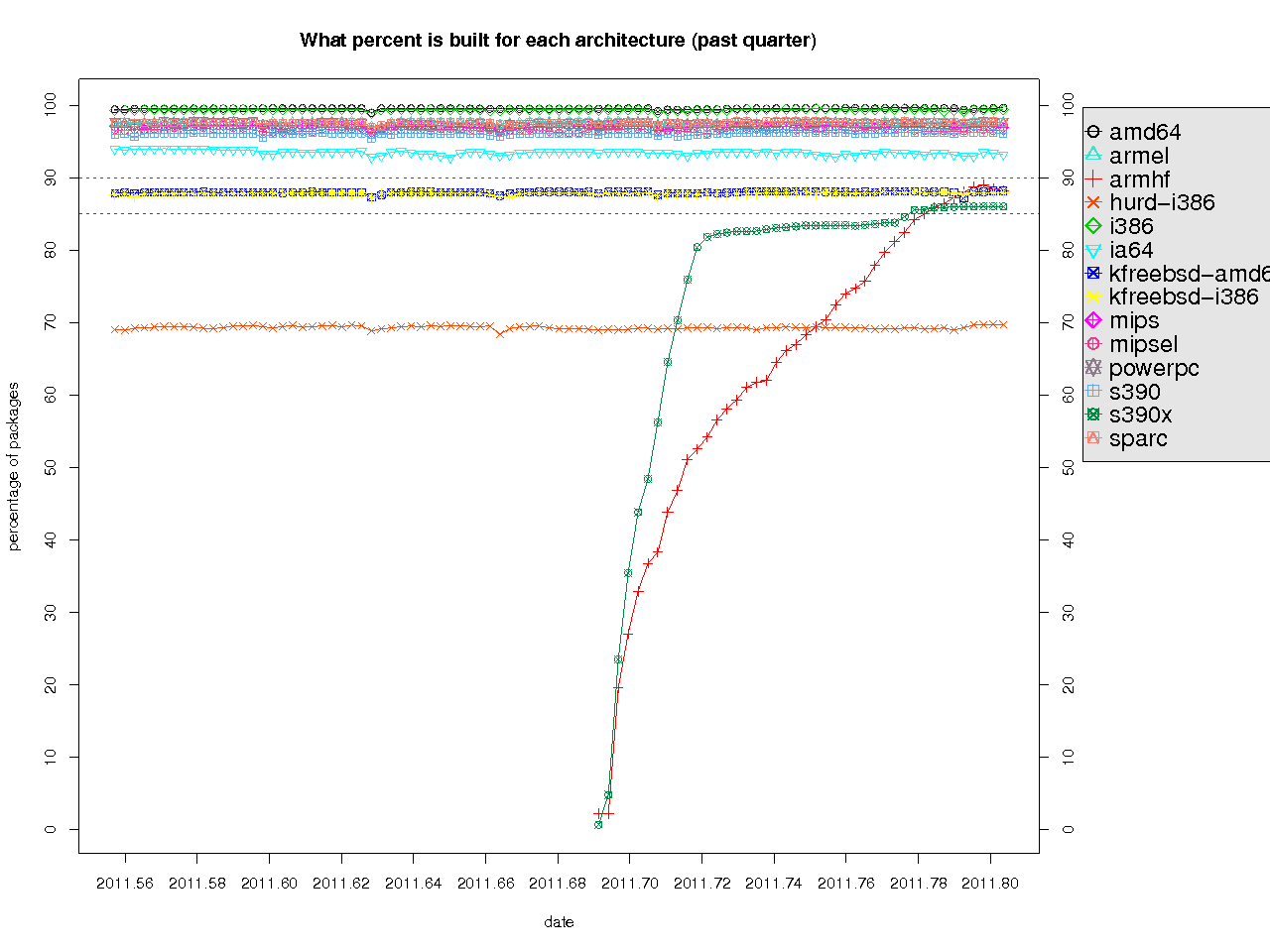
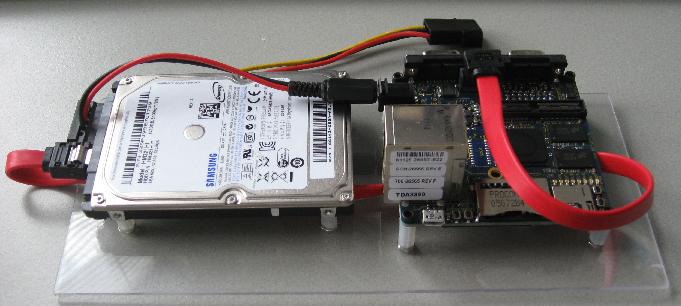
Current status Back in September, I wrote about the machines that I set up to help bootstrap the new armhf port in Debian. Basing on Konstantinos' huge efforts in bringing up the new "architecture" in debian-ports, we started importing armhf into the main Debian archive on the 24th of November. Since then, those builders have been churning away night and day to build the huge collection of software that makes up the Debian archive. The current state can be seen on the armhf buildd status page, and there's a nice graph showing how quickly we've managed to run from 0 to over 90% of the archive here. (Click on the image for a larger version, or visit https://buildd.debian.org/stats/ for other versions. We overtook hurd-i386 quickly and are now ahead of the kfreebsd-* architectures. armhf bootstrap graph We've recently brought 3 more similar build machines online (hildegard, howells and hummel), again sponsored by the nice folks at Linaro but now hosted at the York NeuroImaging Centre at the University of York. This gives us both more build horsepower to keep up with building more different bits of Debian (experimental, updates etc.) and more redundancy in case of problems. We now have the vast majority of the archive built, and now a number of us are concentrating on fixing the remaining issues: language bootstraps and bugs. Also, on the 7th of January we were just added into testing, the next step on our path for inclusion as a Debian release architecture. Setting up the machines A lot of people have been asking me about the physical setup I showed in my last blog about these machines, so here's more details for those who are interested. Mount the 6 boards into the mini-rack, connect up the Molex power connectors to each board, attach ethernet cables and turn it all on! Each board comes with a micro-SD card containing uboot and an Ubuntu installation. I've configured uboot to boot off the hard drive directly, but leaving configuration available to use the Ubuntu on the micro-SD as a simple rescue system should the need arise. The Quickstart boards are not ideal physically for two reasons: the lack of SATA power, plus you need to push a power button on each board to boot it - they don't boot automatically the moment power is applied. However, they're quite inexpensive little machines and have done a great job of building the Debian archive so far! The ideal machines for us would also include more RAM at this point. CPU on these is adequate, but the larger C++ packages (yay webkit!) use a huge amount of memory at link time. Linking in swap is not the best thing, performance-wise... :-( UPDATE 2012-01-12: Ian tells me that the newer Quickstart-R boards apparently have a different power controller; these now boot up straight away without needing you to push a button. That sounds useful.

Antonio Terceiro: Life after exec()

From the not necessarily big news, but still useful department. The situation: for Very Good Reasons 1, you want to replace your current process by calling exec(), but you still want to have the chance to do something after the process you exec()ed finishes. This is a simple technique I just came up with: just before replacing the current process by calling exec(), you fork() a process in the background that will wait for the current process id to disappear from the process list, and then does whatever you want to do. A simple proof-of-concept I wrote is composed of two bash programs: wrapper and real. real is really simple: it just waits a few seconds and then prints its process id to the console:
#!/bin/bash
sleep 5
echo $BASHPID
wrapper is the program that handles the situation we want to exercise: it replaces itself with real, but still has the chance to do something after real finishes. In this case, wrapper notifies the user that real finished.
#!/bin/bash
echo $BASHPID
real_program_pid=$BASHPID
(
  while ps -p "$real_program_pid" >/dev/null; do
    sleep 0.1s
  done
  notify-send 'real program finished'
) &
exec ./real
One nice property that wrapper explores is that when exec() starts real, it really replaces wrapper, and therefore has the same process id (in this case accessible by bash in the $BASHPID variable). Because of this, the background process that wrapper starts just before the exec() call already knows which process it has to watch for. The actual code for waiting is not optimal, though. I cannot use waitpid() (the wait builtin in bash), since real is not a child process of wrapper. I went with a brute force approach here, and I am pretty sure there is a cheaper way to wait for a random PID without a busy loop (but that wasn t the point here). 1 update: I am aware of the classic fork()/exec() pattern. My Very Good Reasons include the fact that I can t control the flow: I am writing a plugin for a program that calls its plugins in sequence, and after that, calls exec(), but my plugin is interested in doing some work after exec() finishes.

8 January 2012

Russell Coker: My First Cruise

A few weeks ago I went on my first cruise, from Sydney to Melbourne on the Dawn Princess. VacationsToGo.com (a discount cruise/resort web site) has a review of the Dawn Princess [1], they give it 4 stars out of a possible 6. The 6 star ships seem to have discount rates in excess of $500 per day per person, much more than I would pay. The per-person rate is based on two people sharing a cabin, it seems that most cabins can be configured as a double bed or twin singles. If there is only one person in a cabin then they pay almost double the normal rate. It seems that most cruise ships have some support for cabins with more than two people (at a discount rate), but the cabins which support that apparently sell out early and don t seem to be available when booking a cheap last-minute deal over the Internet. So if you want a cheap cruise then you need to have an even number of people in your party. The cruise I took was two nights and cost $238 per person, it was advertised at something like $220 but then there are extra fees when you book (which seems to be the standard practice). The Value of Cruises To book a hotel room that is reasonably comfortable (4 star) in Melbourne or Sydney you need to spend more than $100 per night for a two person room if using Wotif.com. The list price of a 4 star hotel room for two people in a central city area can be well over $300 per night. So the cost for a cruise is in the range of city hotel prices. The Main Dining Room (MDR) has a quality of food and service that compares well with city restaurants. The food and service in the Dawn Princess MDR wasn t quite as good as Walter s Wine Bar (one of my favorite restaurants). But Walter s costs about $90 for a four course meal. The Dawn Princess MDR has a standard 5 course meal (with a small number of options for each course) and for no extra charge you can order extra serves. When you make it a 7 course meal the value increases. I really doubt that I could find any restaurant in Melbourne or Sydney that would serve a comparable meal for $119. You could consider a cruise to be either paying for accommodation and getting everything else for free or to be paying for fine dining in the evening and getting everything else for free. Getting both for the price of one (along with entertainment etc) is a great deal! I can recommend a cruise as a good holiday which is rather cheap if you do it right. That is if you want to spend lots of time swimming and eating quality food. How Cruise Companies Make Money There are economies of scale in running a restaurant, so having the MDR packed every night makes it a much more economic operation than a typical restaurant which has quiet nights. But the expenses in providing the services (which involves a crew that is usually almost half the number of passengers) are considerable. Paying $119 per night might cover half the wages of an average crew member but not much more. The casino is one way that the cruise companies make money. I can understand that someone taking a luxury vacation might feel inclined to play blackjack or something else that seems sophisticated. But playing poker machines on a cruise ship is rather sad not that I m complaining, I m happy for other people to subsidise my holidays! Alcohol is rather expensive on board. Some cruise companies allow each passenger to take one bottle of wine and some passengers try to smuggle liquor on board. On the forums some passengers report that they budget to spend $1000 per week on alcohol! If I wanted a holiday that involved drinking that much I d book a hotel at the beach, mix up a thermos full of a good cocktail in my hotel room, and then take my own deck-chair to the beach. It seems that the cruise companies specialise in extracting extra money from passengers (I don t think that my experience with the Dawn Princess is unusual in any way). Possibly the people who pay $1000 per night or more for a cruise don t get the nickel-and-dime treatment, but for affordable cruises I think it s standard. You have to be in the habit of asking the price whenever something is offered and be aware of social pressure to spend money. When I boarded the Dawn Princess there was a queue, which I joined as everyone did. It turned out that the queue was to get a lanyard for holding the key-card (which opens the cabin door and is used for payment). After giving me the lanyard they then told me that it cost $7.95 so I gave it back. Next time I ll take a lanyard from some computer conference and use it to hold the key-card, it s handy to have a lanyard but I don t want to pay $7.95. Finally some things are free at some times but not at others, fruit juice is free at the breakfast buffet but expensive at the lunch buffet. Coffee at the MDR is expensive but it was being served for free at a cafe on deck. How to have a Cheap Cruise VacationsToGo.com is the best discount cruise site I ve found so far [2]. Unfortunately they don t support searching on price, average daily price, or on a customised number of days (I can search for 7 days but not 7 or less). For one of the cheaper vessels it seems that anything less than $120 per night is a good deal and there are occasional deals as low as $70 per night. Princess cruises allows each passenger to bring one bottle of wine on board. If you drink that in your cabin (to avoid corkage fees) then that can save some money on drinks. RumRunnerFlasks.com sells plastic vessels for smuggling liquor on board cruise ships [3]. I wouldn t use one myself but many travelers recommend them highly. Chocolate and other snack foods are quite expensive on board and there are no restrictions on bringing your own, so the cheap options are to bring your own snack food or to snack from the buffet (which is usually open 24*7). Non-alcoholic drinks can be expensive but you can bring your own and use the fridge in your cabin to store it, but you have to bring cans or pressurised bottles so it doesn t look like you are smuggling liquor on board. Generally try not to pay for anything on board, there s enough free stuff if you make good choices. Princess offers free on-board credit (money for buying various stuff on-board) for any cruise that you book while on a cruise. The OBC starts at $25 per person and goes as high as $150 per person depending on how expensive the cruise is. Generally booking cruises while on-board is a bad idea as you can t do Internet searches. But as Princess apparently doesn t allow people outside the US to book through a travel agent and as they only require a refundable deposit that is not specific to any particular cruise there seems no down-side. In retrospect I should have given them a $200 on the off chance that I ll book another cruise with them some time in the next four years. Princess provide a book of discount vouchers in every cabin, mostly this is a guide to what is most profitable for them and thus what you should avoid if you want a cheap holiday. But there are some things that could be useful such as a free thermos cup with any cup of coffee if you buy coffee then you might as well get the free cup. Also they have some free contests that might be worth entering. Entertainment It s standard practice to have theatrical shows on board, some sort of musical is standard and common options include a magic show and comedy (it really depends on which cruise you take). On the Dawn Princess the second seating for dinner started at 8PM (the time apparently varies depending on the cruise schedule) which was the same time as the first show of the evening. I get the impression that this sort of schedule is common so if you want to see two shows in one night then you need to have the early seating for dinner. The cruise that I took lasted two nights and had two shows (a singing/dancing show and a magic show), so it was possible to have the late seating for dinner and still see all the main entertainment unless you wanted to see one show twice. From reading the CruiseCritic.com forum [4] I get the impression that the first seating for dinner is the most popular. On some cruises it s easy to switch from first to second seating but not always possible to switch from second to first. Therefore the best strategy seems to be to book the first seating. Things to do Before Booking a Cruise Read the CruiseCritic.com forum for information about almost everything. Compare prices for a wide variety of cruises to get a feel for what the best deals are. While $100 per night is a great deal for the type of cruise that interests me and is in my region it may not be a good match for the cruises that interest you. Read overview summaries of cruise lines that operate in your area. Some cruise lines cater for particular age groups and interests and are thus unappealing to some people EG anyone who doesn t have children probably won t be interested in Disney cruises. Read reviews of the ships, there is usually a great variation between different ships run by one line. One factor is when the ships have been upgraded with recently developed luxury features. Determine what things need to be booked in advance. Some entertainment options on board support a limited number of people and get booked out early. For example if you want to use the VR golf simulator on the Dawn Princess you should probably check in early and make a reservation as soon as you are on board. The forums are good for determining what needs to be booked early. Also see my post about booking a cruise and some general discussion of cruise related things [5]. Related posts:
  1. Cruises It seems that in theory cruises can make for quite...
  2. Combat Wasps One of the many interesting ideas in Peter F. Hamilton s...
  3. Victoria Hotel Melbourne I have just stayed at the Victoria Hotel Melbourne. I...

7 January 2012

Steve Kemp: Review of the Panasonic Lumix FS-16 camera

Recently I've been wanting to replace my old point and shoot camera, a Canon PowerShot A620. I've got a pair of DLSR cameras and I do frequently carry one of them out with me, but there are undoubtedly occasions where I'd rather not bother, or where I find myself wanting to take a picture without having one to hand. Unfortunately the PowerShot is pretty large itself, although significantly less so than the DSLRS I possess. (I cannot remember the last time I used the PowerShot outside my flat, that is how rarely it goes outdoors). The PowerShot has been a good camera to me for many years and the three features I liked the most: Picking a replacement camera, even with the help of fine comparison websites like snapsort.com is hard. Cameras have moved on and "improved" a lot over the last few years - to the extent that finding one with a built-in viewfinder is hard. Finding one with a built-in viewfinder and running on easily replaceable batteries was virtually impossible. Eventually I settled on the Panasonic Lumix FS16, which omits both: The way that you use the LCD or viewfinder differs pretty significantly, but the LCD wasn't as bad as I'd feared:
ViewFinder
You hold the camera to your eye, and press the appropriate buttons.
LCD
You typically hold the camera at arms length, which means you're prone to shaking your hands/arms and getting blurry shots. Because you're holding the camera relatively far away from your eyes if you have the sun at your back you're liable to need to squint.
The LCD on the Lumix FS-16 isn't amazing, but neither is it horrific and it is better than expected in dark locations. So after a week what do I think? On the whole it is a fine camera, better than the PowerShot in many ways, and while it has draw-backs none are deal-breakers:
Size
The best camera is one you have with you; on that basis this camera is a clear win being smaller, lighter, and more compact than the Canon. I've taken this camera with me, randomly, to several places and returned with useful and interesting images.
Low Light
Low light performance is pretty poor. With only one manual control you see noise if you're shooting in gloomy pubs, and outdoors. With the flash you can get acceptable pictures if you're careful - but its a tricky thing to get right. (To update this a little: Outdoors at night? No. In a pub with poor lighting you'll be alright.)
Manual Controls
The camera features precisely two manual controls:
  • "Flash on" vs. "Flash off".
  • ISO can be changed from: Auto, 100, 200, 400, 800, 1200 and 1600.
There is no notion of shutter speed, nor is there any ability to change the aperture size. (Though both these values are displayed on the screen as you take a picture I wonder why? As you can't change anything you can't use the information in any useful fashion, and presumably a non-camera-person wouldn't understand what these numbers represent.) The lack of these two controls is a little galling, but pretty common for the low-end P&S cameras.
Video Recording
There is no external MIC so sounds aren't great, but they're not horrible either. Video recordings are limited to the smaller of 8 minutes or 2Gb. So no long films, but short ones look fine. Just be aware that once you start recording focus won't change, nor will zooming work. Compared to the canon the quality is improved; but the Canon allowed you to (optically) zoom whilst recording. Here you can only zoom with your feet.
Recharging Time
When I received the camera it took about an hour to charge. The battery life seems reasonable - the level is 2/3 a week later and I've been shooting, reviewing, and deleting regularly. (Note: I never use USB to transfer pictures, I always remove the card and plug it into my PC. Whether this makes a difference to battery life I don't know.)
Controls
Physical controls are reasonable. There is a mechanical slide-switch to turn on/off. I like that, as it is less prone to being knocked by keys, change, etc. There is also a physical slide-switch to change from "shoot" to "review current images/videos". (Same as my Canon) I think this is a mistake, and don't see why it can't be a soft-button.
Full Auto
There are several modes available in the camera (remember the caveat about lack of aperture/shutter speed) I've been using both full-auto and manual modes, and both are good. Full auto would suit most people - it has clever face-tracking.
Focusing Speed
As expected this is not stellar. Walking to the corner shop the other lunchtime I found a cat in the road, I talked to her and she rubbed herself against my ankles. Could I focus fast enough to catch her looking up at me? No. For static scenes, and candid shots of people it'll suffice. For fast action and moving children probably not a chance.
On balance, the upgrade was worthwhile. ObQuote: "I don't mean to lecture and I don't mean to preach. And I know I'm not your father..." - Spider-Man

Christian Perrier: [life] [running] 2011 summary

That time of the year comes where I summarize my running activities. It's now 4.5 years that I resumed running, after nearly 10 years without active sports. Apparently, things continue to improve, though I'm logically reaching my limits in some way. I finally missed the 2500km mark by 14 kilometers, mostly because of a cold I had during the last 2 days of the year. The grand total is thus 2486 kilometers run, in 237 hours (9 days 21hours), at about 10.5km/h. The climbed height difference is 27700 meters, so about three times the altitude of Mount Sagarmatha..:-) This was achieved in 294 "activities". That seems to be a lot (nearly 1 activity per day): indeed, there are days where I have up to 4 activities, when I run to/back work, which means two runs in the morning (3+4km) and two in the evening. If I count the number of days where I had at least one running activity, this lowers to 181. In short, I ran about every 2 days. Indeed, along the year, the biggest timeframe between two runs has been 7 days. In short, I ran at least once every week during this year. The most active month was July with 272km and the less active was September with 163.5. When counted by distance, this summarizes to: When it comes at results, I ran 8 official races during the year : two "ultra" races (70km Le Puy-Firminy in November, by night and 55km Paris Ecotrail), two marathons (Paris, two weeks after Ecotrail, and Berlin in September), one 35km trail race (Trail des Cerfs in May), two half-marathons and one 12km cross-country race in my hometown. The seasons "peaks" were clearly the Ecotrail+Paris Marathon succession in March/April, the Berlin marathon in September and my longest race ever in November. Most were as successful as I expected, except maybe Berlin marathon, were I was secretly hoping to break my record (indeed, I can still be proud of running in the same race than Patrick Makau breaking the world record in 2h03'38"). An injured ankle unfortunately prevented me to prepare it as serously as I was hoping. This year was indeed the first year where I was trying to go beyond the marathon distance as another challenge. And, believe me, ultra distances are really fun (yes, running 9 hours by night *is* fun!). Indeed, I only regret not breaking one of my best times (either half-marathon or marathon). I'll try to do that in 2012. How about next^W this year? Well, my goals are currently being secured: Busy program....I cross fingers for no injury to come and disturb all this.

Christian Perrier: Towards 100% in wheezy for debconf translations

This article could become one of my recurring "let's make noise about translators work" articles. You've been warned. In Squeeze, a few languages reached full completion of debconf strings, those "questions" that are asked during packages installation or upgrades. This can be followed here (for unstable: we don't have an online status page for testing).. Many of you, particularly those who aren't bored at reading me, know that I like pushing this friendly "competition" as a good way to encourage progress in localization of that part of Debian. As of now, we have really good and active teams that are able to maintain a great completion in this. Several of them are likely to reach full 100% completion for wheezy. Let's look at the current status: I hope this maybe gave you the idea of joining these efforts. Please pop up on one of the i18n mailing lists if you're interested, and if you don't know where to start, then debian-i18n< is what you're looking for. See you soon!

Craig Small: rpath bites me again

Debian OpenLogo

Image via Wikipedia

It s funny, in bad way, when certain sorts of bugs come back to bite you. People may remember the fun debian had with rpath issues around in the late 90s where some binaries wanted to set the path of where their libraries were located. After much contraversy the consensus was at least in Debian (with some specific exceptions) RPATH is bad and don t use it. I lived through that fun and remember hacking libtool or autoconf or some such file. The horror of those times came back to haunt me today while working on procps 3.3.2 packages. lintian was suddenly complaining that binary-or-shlib-defines-rpath for all my binaries. I ve not seen rpath set for many years and as I m also part of the upstream and never saw it set there it took me a while to work out what was going on. Certainly, my binaries were setting the RPATH, it wasn t lintian getting the wrong idea. You can see this with objdump myfile grep RPATH. If you get a hit, you got RPATH set, an empty result means no RPATH. libtool was definitely setting the rpath, with
cc -Iproc -g -O2 -o \$progdir/\$file pmap.o  ./proc/.libs/libprocps.so \
 -Wl,-rpath -Wl,/home/csmall/debian/procps/procps/proc/.libs \
 -Wl,-rpath -Wl,//usr/lib/x86_64-linux-gnu
That s not one rpath setting but two, for double insult. Configure flags such as disable-rpath wouldn t work. I flicked back to a pure upstream archive and there was no rpath there in either the compile flags or objdump. There was obviously some sort of side-effect going on. The problem, after much testing, was in the debian/rules file:
        ./configure \
          --build=$(DEB_BUILD_GNU_TYPE) \
          --enable-watch8bit --enable-w-from \
          --prefix=/ \
          --mandir=\$$ prefix /usr/share/man  \
          --libdir=\$$ prefix /usr/lib/$(DEB_HOST_MULTIARCH)
The problem is above, and all it was was a / . libtool does some checking to see if the library directory exists and if it doesn t silently turns on rpath. It s not smart enough to know that //usr/lib/x86_64-linux-gnu is the same as /usr/lib/x86_64-linux-gnu and so it enables rpath. Removing the slash before the usr fixed the problem. I d say this is bad behavour on libtools part. It should know that / is // or all the other alternative ways of specifying paths. Hopefully this post will stop someone else wasting their time like I did.

Paul Wise: apt-get purge defoma

Debian is finally transitioning from the unmaintained and Debian-specific font manager called defoma. The replacement is called fontconfig and it is maintained upstream and in Debian (by upstream) and is cross-distribution with wide support from our upstreams and other distributions. With the upload of libwmf 0.2.8.4-9 (thanks Lo c!) the last package in Debian sid declaring a strict dependency on defoma has removed this dependency. There is still more to do, some more bugs to file and some lenny->squeeze->wheezy upgrade testing to do. Thanks go to Christian PERRIER for slogging through and providing encouragement, bug reports and NMUs. The transition is unfortunately not without loss of functionality; TeX uses a different directory for fonts to the rest of the system. Fonts used by TeX cannot be used by the rest of the system and vice versa. This issue has always existed in Debian and other distributions and is unrelated to the removal of defoma. If your software doesn't use one of the text renderers (such as Pango, Qt or QuesoGLC) that find fonts on their own and fall back on other fonts where needed (due to missing fonts or glyphs), please switch text rendering systems. If you are unable to switch, please use fontconfig to search for font filenames rather than hard-coding them at build time. This message brought to you by the Debian Fonts Task Force. We welcome people who want to help us maintain font packages or improve support and quality assurance for fonts and font related software.

6 January 2012

Mirco Bauer: Smuxi 0.8.9 "One Giant Leap" Release

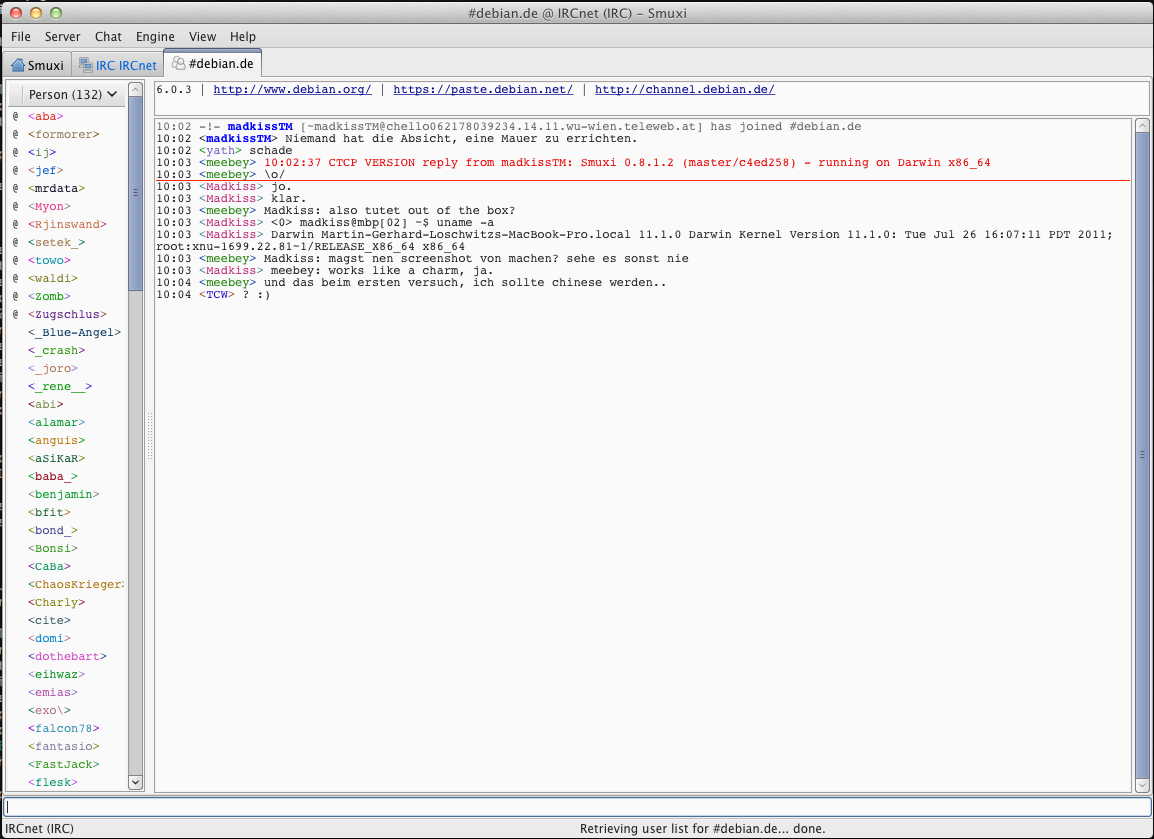
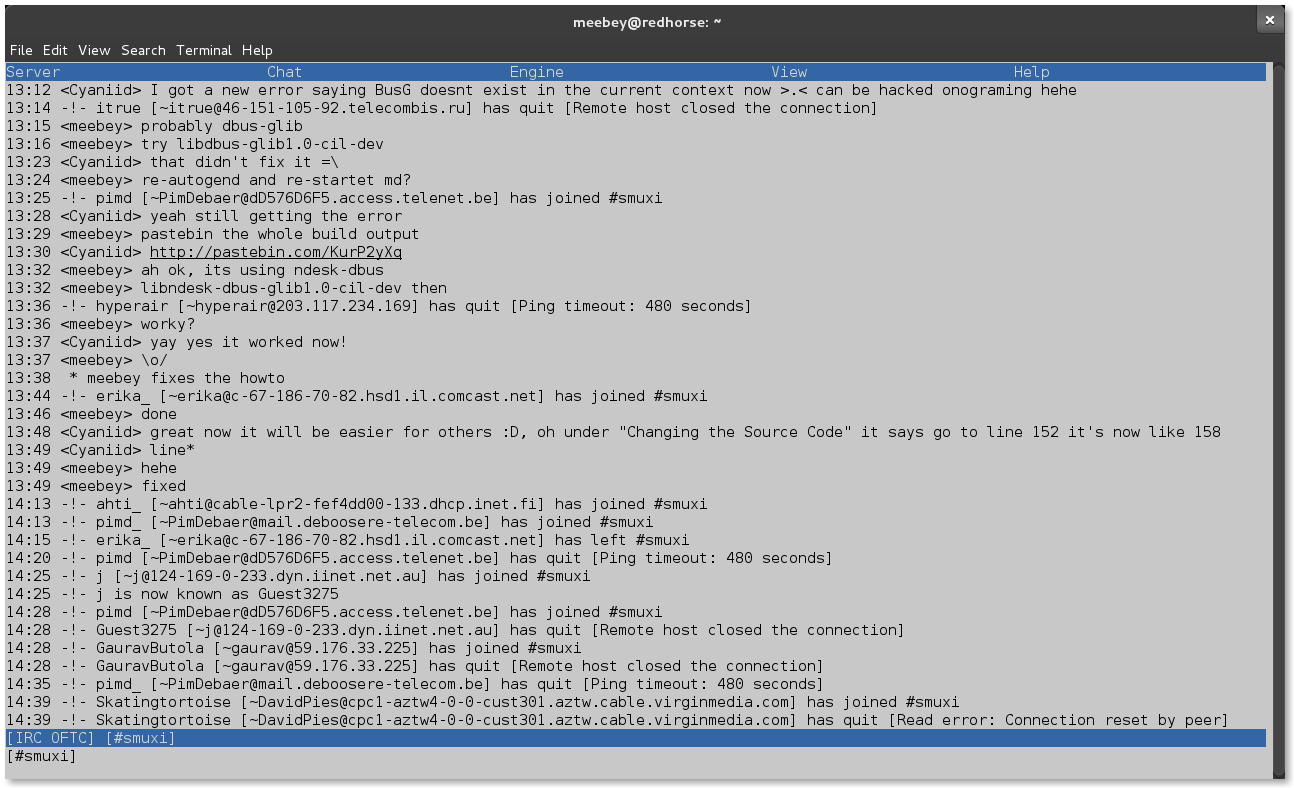
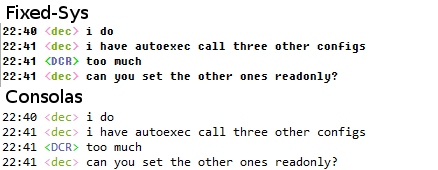
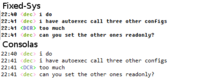
Just in time for 2012 I am very pleased to announce Smuxi 0.8.9 codenamed "One Giant Leap". During the development 56 bug reports and 33 feature requests in 593 commits were worked on making this release a major milestone of the Smuxi project. At the Chaos Communication Congress (28C3) in Berlin I was doing the final development sprint to get 0.8.9 done, which was a very intensive and refreshing experience. Here are the highlights of this release: Development Builds / Rolling Releases After the 0.8 release it became clear that a continious and short development -> test cycle is important to keep the project going quickly. At some point I have received requests if the project is dead while it was more active than ever. The lack of new releases (for about 15 months) lead to this wrong impression. Thus Smuxi can be obtained from development builds now. This includes daily builds for Debian (Squeeze, Wheezy, Sid), Ubuntu (Lucid, Maverick, Natty, Oneiric, Precise) and Windows. Thanks goes to Hannes Tismer for providing the Windows autobuilder and to Canonical for the PPA autobuilder. We invite everyone to use these daily builds to keep track of the latest development of Smuxi. Issues and regressions are fixed in a very short period (usually the same day). Thanks to our users who ran development builds and reported issues which led to many bug fixes prior to this release. On the other hand one of my New Year's resolutions are to "release early, release often" So there should be no nerd left behind... Screenshot of Smuxi 0.8.9 on Mac OS X Mac OS X support With the help of Steven McGrath (Steve[cug]) who created the initial Mac OS X installer for Smuxi we now have official support for Mac OS X. The download page contains the instructions how to obtain and install Smuxi on Mac OS X. This makes the 4th platform where Smuxi can be used on besides Windows, Linux and *BSD. For now Smuxi 0.8.9 doesn't feel as native as it could as it relies on the GTK+ port. We are looking into enhancing the experience though, just stay tuned. Chat History on Disk (Beta) The most exciting feature in this release I think are the "persistent message buffers". With this feature I could solve one of the biggest drawbacks IRC ever had: IRC does not retain any messages you have sent or received. All messages are only relayed to all users. The issue is that if you close your IRC client or even just leave a channel, all your received messages are gone. One workaround in most clients was to create text log files which then contains the chat history, but it is annoying and not user-friendly to open some text file somewhere from your disk to read the history outside of your IRC client. Now with Smuxi 0.8.9 you no longer have this issue, all chat history gets automatically written and read to a message database when you start Smuxi, join channels or open queries! As this feature is not fully stable yet it is not enabled by default. If you want to try it go to: File -> Preferences -> Interface and change "Persistency Type" from "Volatile" to "Persistent", hit OK and restart Smuxi. Now all messages are saved into the database and will automatically be shown. Click here for a screencast of this feature Jabber / XMPP Support (Beta) You probably have friends not on IRC and Twitter, say on Jabber, gTalk or Facebook? This is where the new XMPP engine of Smuxi comes into play. You can send and receive messages to/from them now! The implementation is far from complete, though. It has no buddy list for example and needs only to be treated as a technical preview of what will be coming in future Smuxi releases. Click here for a screencast of this feature Screenshot of Smuxi's Text Interface Text Interface (Alpha) This is the first release that contains a text frontend based on the STFL library. STFL is a library that uses ncurses to draw text based user interface using a markup language (like Glade for GTK+). This frontend is in early alpha state and lacks a lot of interface features and likes to crash. It is still included to attract potential developers who want to enhance this frontend. The frontend can be enabled by passing --enable-frontend-stfl to the configure script and then by executing smuxi-frontend-stfl. NetworkManager Support Everyone with a laptop knows how annoying it can be to suspend and resume when network based applications suddenly go crazy because they have lost the connection and either spew errors or take forever to get back in shape. Smuxi will now detect the network state right away with the help of the new Network Manager support. It automatically reconnects when needed right away for you. Next Generation Internet Support You can now connect to IRC servers using the IPv6 protocol Enhanced Find Group Chat Support Users had real issues to find out how to search for channels, thus Bianca Mix added a neat feature. The /list command will now simply open the Find Group Chat dialog for you. This way everyone used to IRC will find it in no time. Searching for channels on freenode wasn't working correctly, this is now fixed. Smuxi also supports the SAFELIST feature of the IRC protocol now which allows to retrieve a full channel list and do client side search which makes consecutive searches much faster. Enhanced Windows Experience For a long time you could not use Smuxi with the latest GTK# version of 2.12.10 on Windows. The issue was that Smuxi relied on SVG support which 2.12.10 no longer had. Smuxi is no longer using SVG instead it uses pre-scaled PNG images thus it works just fine with GTK# 2.12.10 on Windows now. At the same time the issue that the maximized state of the main window was left when restoring from task bar is fixed with GTK# 2.12.10. Screenshot of Fixed-Sys vs Consolas font Smuxi used by default the FixedSys font on Windows to give it the typical IRC look most people are used to. Since Windows Vista there is a better console-like font available called Consolas. Smuxi will now use the Consolas font instead on Windows Vista or later. Another important enhancement is that Smuxi no longer has issues with multiple GTK+ installs on the same computer, which was getting more common with more popular ported GTK+ applications such as GIMP or Pidgin. SSL for IRC fixed IRC with SSL was only working with the default port of 6697. Thanks to Jo Shields now any port can be used with SSL. Crash Related Issues Desktop notifications could crash Smuxi in case of errors related to the notification system or an absent notification daemon. There was a chance that the crash dialog simply disappeared which made reporting bugs more difficult no longer happens. Rapid use of ctrl+w, /window close (Jimmie Elvenmark) and opening the Find Group Chat dialog on the Smuxi tab do no longer crash. Also number-only network names, /network switch freenode and GTK+ install without SVG support no longer lead into a crash. Enhanced Notice Handling Notices will no longer open query tabs for you instead it will show them on tabs you share with the person who sent it with the server tab as fallback. This also avoids ChanServ, NickServ and spammy IRCop tabs. Twitter fixes Twitter made some changes to their API which broke the Twitter support of Smuxi 0.8. This was taken care of and also a few other issues were solved allowing Smuxi 0.8.9 to work smoothly with Twitter again. Extended Keybindings Smuxi allows now to use the ctrl+tab / ctrl+shift+tab and ctrl+n / ctrl+p keys to switch tabs. The keybindings still work even with a hidden menu bar now. Smuxi Server specific highlights More interactive and much faster synchronization When connecting to a smuxi-server you had to wait till Smuxi finished the synchronization before you could use the interface. Also you could not tell how far the synchronization was and just had to wait till it was completed. With Smuxi 0.8.9 the connect just takes a few seconds and all chats are synchronized in the background with a progress bar so you can use the interface from the first moment on and know how far it is. The speed how much it takes to synchronize all chats also reduced drastictly by 400%! Click here for a screencast of this feature More background communication When using a smuxi-server the interface sometimes had load times like when opening the preferences or when using the nickname completion (Andrew Kannan). These operations are done in the background and no longer blocks the interface. Also when the communication is lost to the smuxi-server the frontend will now automatically reconnect to it in the background. Low Bandwidth Mode When it comes to mobile internet connectivity such as UMTS/HSDPA, Edge and GRPS it can be a real pain to connect to the smuxi-server as it has to transfer all the messages over that. If you just want to ask someone you know then you don't need any old messages to do that. With the "Low Bandwidth Mode" you can now connect to the smuxi-server without loading old messages which makes the connect very quick. You find this option in the engine connect dialog. Stable Protocol Initially I didn't plan to make the protocol of Smuxi stable before the 0.9 release, but as it turned out the 0.8 protocol was good enough to still use it and for that reason Smuxi 0.8.9 is still compatible with 0.8. The 0.8 protocol will see no breakages, instead the next protocol will be on-top or opt-in of the current one. This means future Smuxi versions stay compatible with it. Shutdown Command You can now shutdown the smuxi-server if you like using the /shutdown command. It it safe to use the command, it will do a clean shutdown sequence for you. For example it makes sure all messages are written to disk in the case of enabled persistent message buffers. If you have your smuxi-server daemon monitored (e.g. with runit) it can also automatically be restarted and upgraded this way. Built-in SSH Keyfile Support It is no longer needed to fiddle with the .ssh/config file or pagent to get SSH key authorization working. You can now simply tell Smuxi which SSH keyfile you want to use to connect to your smuxi-server. Updated Translations
  • Catalan (Siegfried-Angel Gevatter Pujals)
  • Danish (Joe Hansen)
  • Finnish (Kalle Kaitala)
  • French (Cl ment Bourgeois)
  • German (Bianca Mix)
  • Italian (Vincenzo Campanella)
  • Portuguese (Americo Monteiro)
  • Spanish (Castilian) (Ricardo A. Hermosilla Carrillo)
New Translations
  • Chinese Simp (Dean Lee)
  • Slovak (Tom Vadina)
  • Swedish (Jimmie Elvenmark)
  • partially Russian (Aleksandr P)
  • partially Turkish (Umut Albayrak)
  • partially Urdu (makki)
Contributors Contributors to this release are the following people:
  • Mirco Bauer (497 commits)
  • Tuukka Hastrup (10 commits)
  • Bianca Mix (10 commits, translations)
  • Cl ment Bourgeois (8 commits, translations)
  • Andrius Bentkus (5 commits)
  • Carlos Mart n Nieto (3 commits)
  • Jimmie Elvenmark (3 commits, translations)
  • Hannes Tismer (1 commit)
  • Jonathan Pryor (1 commit)
  • Jo Shields (1 commit)
  • Siegfried-Angel Gevatter Pujals (translations)
  • Dean Lee (translations)
  • Aleksandr P (translations)
  • Americo Monteiro (translations)
  • Andrew Kannan (translations)
  • Joe Hansen (translations)
  • Kalle Kaitala (translations)
  • makki (translations)
  • Ricardo A. Hermosilla Carrillo (translations)
  • Tom Vadina (translations)
  • Umut Albayrak (translations)
  • Vincenzo Campanella (translations)
Thank you very much for your contributions to Smuxi! After reading this whole pile of text, head over here and grab this smexy stuff!
Posted Sun Jan 1 22:58:29 2012

Michal &#268;iha&#345;: Adding API to Django application

One of Django applications I maintain is our internal tool used at SUSE used for managing incoming L3 requests. Recently request to add some API arose (read only for now). Looking at available solutions, I came to conclusion that django-piston should be the best choice for me. Adding simple model based API with it is indeed quite simple, all basic information you need is written in getting started part of their documentation. On the other side, things can never go without problems, so I was hit by well known bug. Fortunately fix exists, though it is not yet merged upstream. While digging so deep into problem anyway, I've submitted a request to include this patch in devel:languages:python OBS repo.

Filed under: Django English Suse 4 comments Flattr this!

Robert Collins: Public service announcement: signals implies reentrant code even in Python

This is a tiny PSA prompted by my digging into a deadlock condition in the Launchpad application servers. We were observing a small number of servers stopping cold when we did log rotation, with no particularly rhyme or reason. tl;dr: do not call any non-reentrant code from a Python signal handler. This includes the signal handler itself, queueing tools, multiprocessing, anything with locks (including RLock). Tracking this down I found we were using an RLock from within the signal handler (via a library ) so I filed a bug upstream: http://bugs.python.org/issue13697 Some quick background: when a signal is received by Python, the VM sets a status flag saying that signal X has been received and returns. The next chance that thread 0 gets to run bytecode, (and its always thread 0) the signal handler in Python itself runs. For builtin handlers this is pretty safe e.g. for SIGINT a KeyboardInterrupt is raised. For custom signal handlers, the current frame is pushed and a new stack frame created, which is used to execute the signal handler. Now this means that the previous frame has been interrupted without regard for your code: it might be part way through evaluating a multi-condition if statement, or between receiving the result of a function and storing it in a variable. Its just suspended. If the code you call somehow ends up calling that suspended function (or other methods on the same object, or variations on this theme), there is no guarantee about the state of the object; it becomes very hard to reason about. Consider, for instance, a writelines() call, which you might think is safe. If the internal implementation is for line in lines: foo.write(line) , then a signal handler which also calls writelines, could have what it outputs appear between any two of the lines in writelines. True reentrancy is a step up from multithreading in terms of nastiness, primarily because guarding against it is very hard: a non-reentrant lock around the area needing guarding will force either a deadlock, or an exception from your reentered code; a reentrant lock around it will provide no protection. Both of these things apply because the reentering occurs within the same thread kindof like a generator but without any control or influence on what happens. Safe things to do are: In Launchpad s case, we will be setting a flag variable unconditionally from the signal handler, and the next log write that occurs will lock out other writers, consult the flag, and if needed do a rotation, resetting the flag. Writes after the rotation signal, which don t see the new flag, would be ok. This is the only possible race, if a write to the variable isn t seen by an in-progress or other-thread log write. That is all.

Next.

Previous.