Search Results: "sf"

30 March 2022

Ulrike Uhlig: How do kids conceive the internet?

I wanted to understand how kids between 10 and 18 conceive the internet. Surely, we have seen a generation that we call digital natives grow up with the internet. Now, there is a younger generation who grows up with pervasive technology, such as smartphones, smart watches, virtual assistants and so on. And only a few of them have parents who work in IT or engineering

Pervasive technology contributes to the idea that the internet is immaterial With their search engine website design, Google has put in place an extremely simple and straightforward user interface. Since then, designers and psychologists have worked on making user interfaces more and more intuitive to use. The buzzwords are usability and user experience design . Besides this optimization of visual interfaces, haptic interfaces have evolved as well, specifically on smartphones and tablets where hand gestures have replaced more clumsy external haptic interfaces such as a mouse. And beyond interfaces, the devices themselves have become smaller and slicker. While in our generation many people have experienced opening a computer tower or a laptop to replace parts, with the side effect of seeing the parts the device is physically composed of, the new generation of end user devices makes this close to impossible, essentially transforming these devices into black boxes, and further contributing to the idea that the internet they are being used to access with would be something entirely intangible.

What do kids in 2022 really know about the internet? So, what do kids of that generation really know about the internet, beyond purely using services they do not control? In order to find out, I decided to interview children between 10 and 18. I conducted 5 interviews with kids aged 9, 10, 12, 15 and 17, two boys and three girls. Two live in rural Germany, one in a German urban area, and two live in the French capital. I wrote the questions in a way to stimulate the interviewees to tell me a story each time. I also told them that the interview is not a test and that there are no wrong answers. Except for the 9 year old, all interviewees possessed both, their own smartphone and their own laptop. All of them used the internet mostly for chatting, entertainment (video and music streaming, online games), social media (TikTok, Instagram, Youtube), and instant messaging. Let me introduce you to their concepts of the internet. That was my first story telling question to them:

If aliens had landed on Earth and would ask you what the internet is, what would you explain to them? The majority of respondents agreed in their replies that the internet is intangible while still being a place where one can do anything and everything . Before I tell you more about their detailed answers to the above question, let me show you how they visualize their internet.

If you had to make a drawing to explain to a person what the internet is, how would this drawing look like? Each interviewee had some minutes to come up with a drawing. As you will see, that drawing corresponds to what the kids would want an alien to know about the internet and how they are using the internet themselves.

Movies, series, videos A child's drawing. In the middle, there is a screen, on the screen a movie is running. Around the screen there are many people, at least two dozens. The words 'film', 'series', 'network', 'video' are written and arrows point from these words to the screen. There's also a play icon. The youngest respondent, a 9 year old girl, drew a screen with lots of people around it and the words film, series, network, video , as well as a play icon. She said that she mostly uses the internet to watch movies. She was the only one who used a shared tablet and smartphone that belonged to her family, not to herself. And she would explain the net like this to an alien:
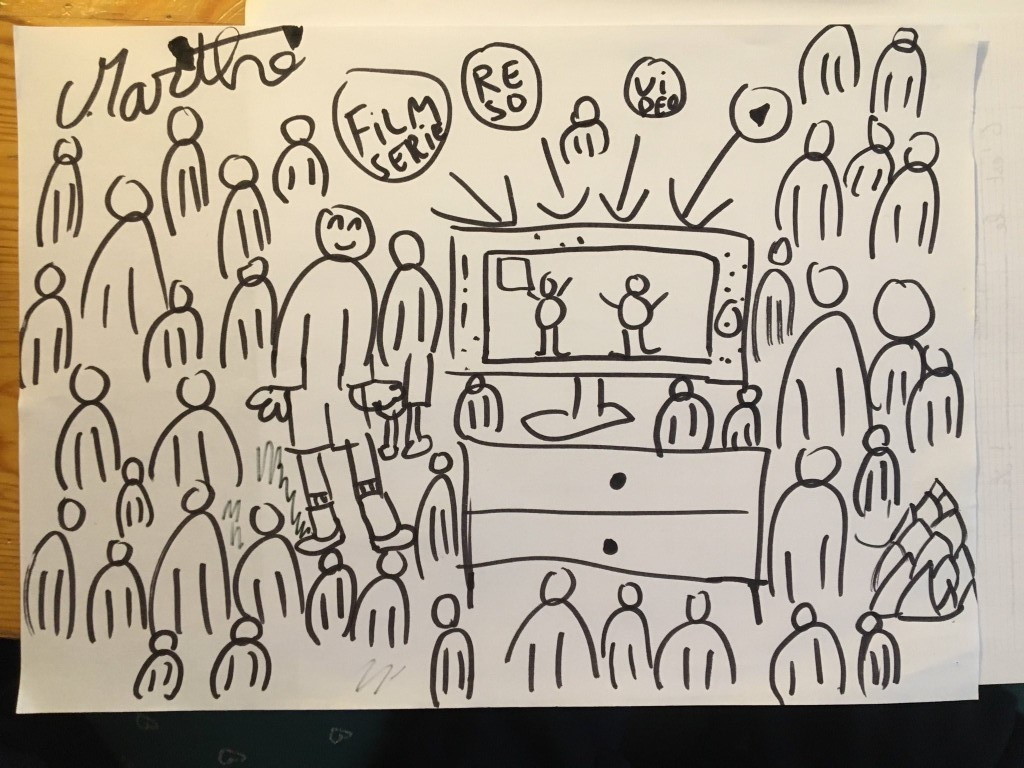
"Internet is a er one cannot touch it it s an, er [I propose the word idea ], yes it s an idea. Many people use it not necessarily to watch things, but also to read things or do other stuff."

User interface elements There is a magnifying glass icon, a play icon and speech bubbles drawn with a pencil. A 10 year old boy represented the internet by recalling user interface elements he sees every day in his drawing: a magnifying glass (search engine), a play icon (video streaming), speech bubbles (instant messaging). He would explain the internet like this to an alien:
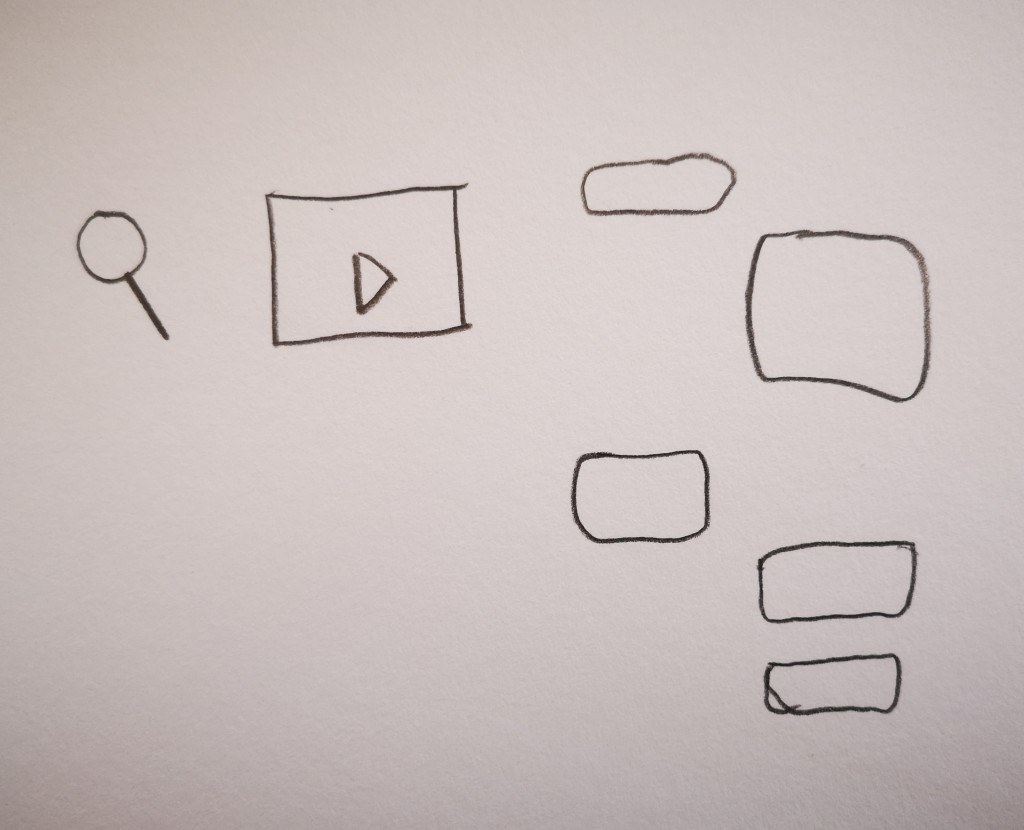
"You can use the internet to learn things or get information, listen to music, watch movies, and chat with friends. You can do nearly anything with it."

Another planet Pencil drawing that shows a planet with continents. The continents are named: H&M, Ebay, Google, Wikipedia, Facebook. A 12 year old girl imagines the internet like a second, intangible, planet where Google, Wikipedia, Facebook, Ebay, or H&M are continents that one enters into.
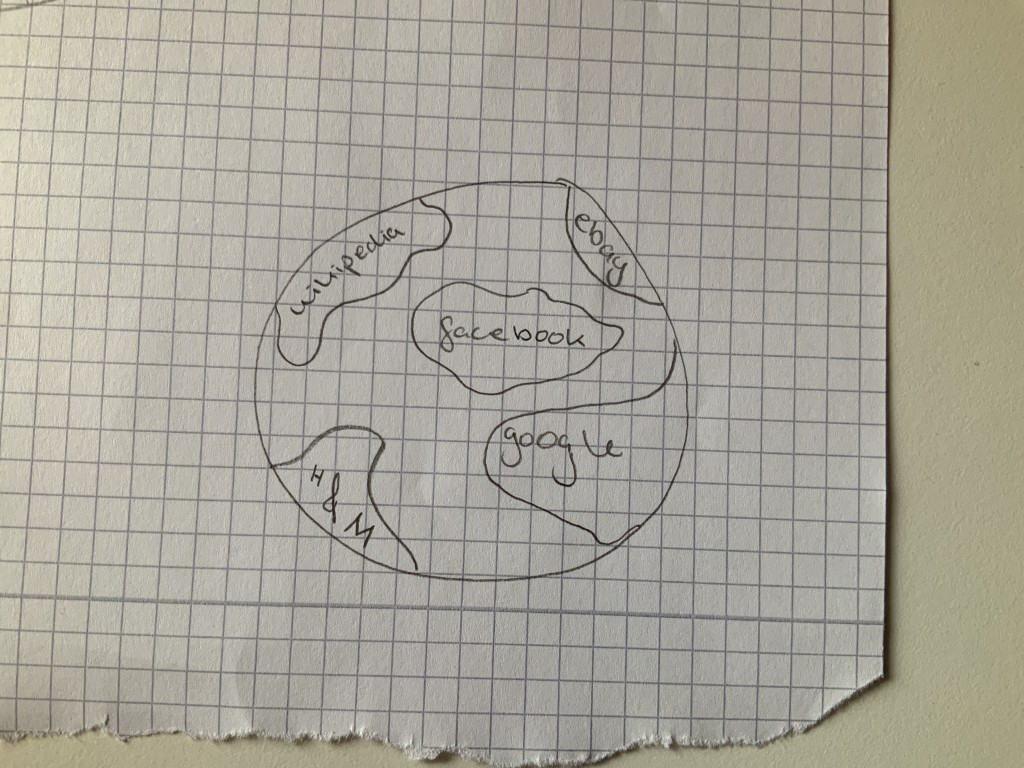
"And on [the] Ebay [continent] there s a country for clothes, and ,trousers , for example, would be a federal state in that country."
Something that was unique about this interview was that she told me she had an email address but she never writes emails. She only has an email account to receive confirmation emails, for example when doing online shopping, or when registering to a service and needing to confirm one s address. This is interesting because it s an anti-spam measure that might become outdated with a generation that uses email less or not at all.

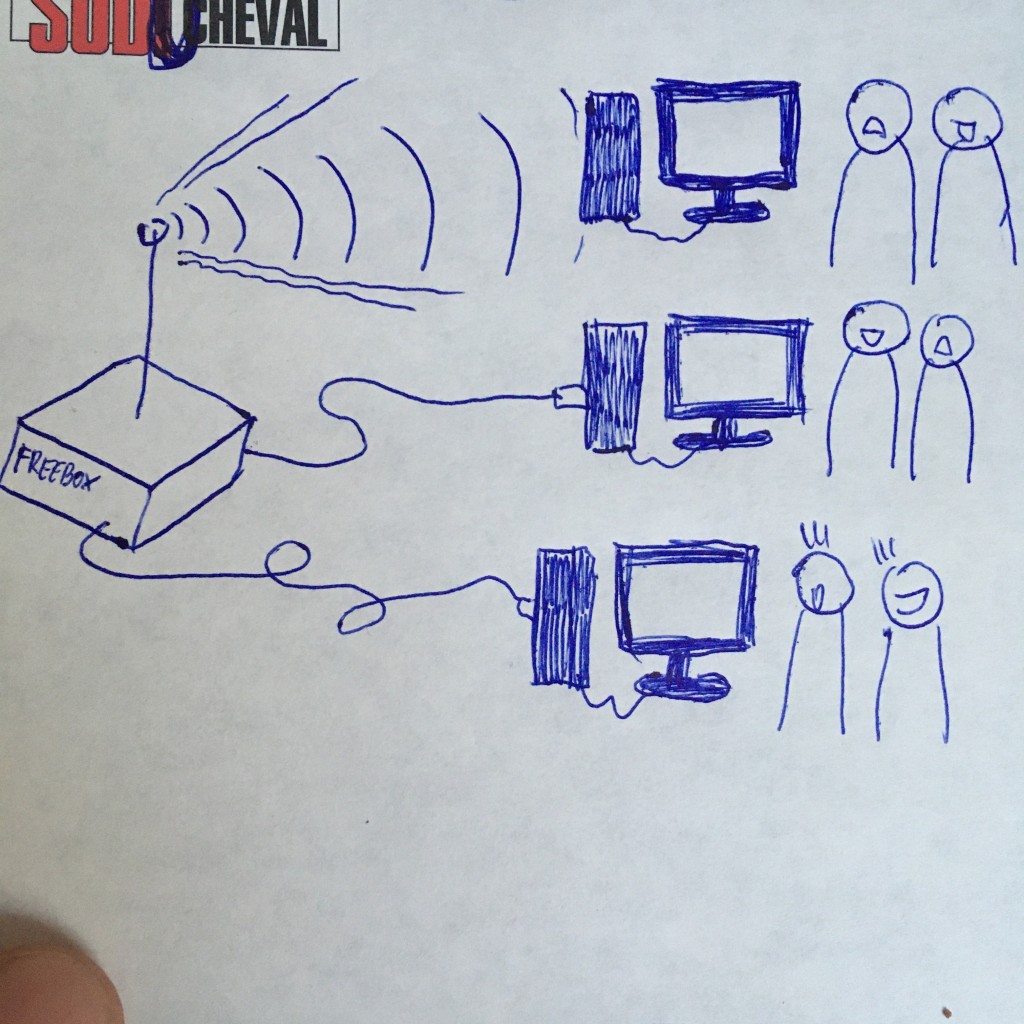
Home network Kid's drawing: there are three computer towers and next to each there are two people. The first couple is sad, the seconf couple is smiling, the last one is suprised. Each computer is connected to a router, two of them by cable, one by wifi. A 15 year old boy knew that his family s devices are connected to a home router (Freebox is a router from the French ISP Free) but lacked an imagination of the rest of the internet s functioning. When I asked him about what would be behind the router, on the other side, he said what s behind is like a black hole to him. However, he was the only interviewee who did actually draw cables, wifi waves, a router, and the local network. His drawing is even extremely precise, it just lacks the cable connecting the router to the rest of the internet.
Satellite internet This is another very simple drawing: On top left, there's planet Earth an there are lines indicating that earth is a sphere. Around Earth there are two big satellites reaching most of Earth. on the left, below, there are three icons representing social media services on the internet: Snapchat, Instagram, TikTok. On the right, there are simplified drawings of possibilities which the internet offers: person to person connection, email (represented by envelopes), calls (represented by an old-style telephone set). A 17 year old girl would explain the internet to an alien as follows:
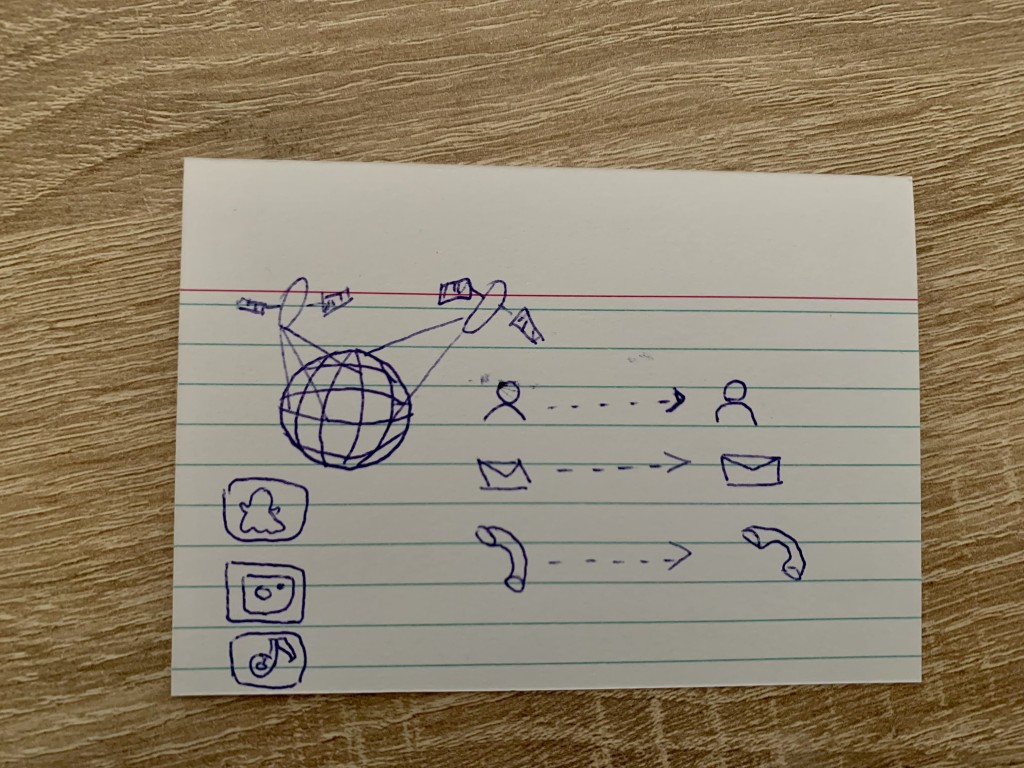
"The internet goes around the entire globe. One is networked with everyone else on Earth. One can find everything. But one cannot touch the internet. It s like a parallel world. With a device one can look into the internet. With search engines, one can find anything in the world, one can phone around the world, and write messages. [The internet] is a gigantic thing."
This interviewee stated as the only one that the internet is huge. And while she also is the only one who drew the internet as actually having some kind of physical extension beyond her own home, she seems to believe that internet connectivity is based on satellite technology and wireless communication.

Imagine that a wise and friendly dragon could teach you one thing about the internet that you ve always wanted to know. What would you ask the dragon to teach you about? A 10 year old boy said he d like to know how big are the servers behind all of this . That s the only interview in which the word server came up. A 12 year old girl said I would ask how to earn money with the internet. I always wanted to know how this works, and where the money comes from. I love the last part of her question! The 15 year old boy for whom everything behind the home router is out of his event horizon would ask How is it possible to be connected like we are? How does the internet work scientifically? A 17 year old girl said she d like to learn how the darknet works, what hidden things are there? Is it possible to get spied on via the internet? Would it be technically possible to influence devices in a way that one can listen to secret or telecommanded devices? Lastly, I wanted to learn about what they find annoying, or problematic about the internet.

Imagine you could make the internet better for everyone. What would you do first? Asked what she would change if she could, the 9 year old girl advocated for a global usage limit of the internet in order to protect the human brain. Also, she said, her parents spend way too much time on their phones and people should rather spend more time with their children. Three of the interviewees agreed that they see way too many advertisements and two of them would like ads to disappear entirely from the web. The other one said that she doesn t want to see ads, but that ads are fine if she can at least click them away. The 15 year old boy had different ambitions. He told me he would change:
"the age of access to the internet. More and more younger people access the internet ; especially with TikTok there is a recommendation algorithm that can influcence young people a lot. And influencing young people should be avoided but the internet does it too much. And that can be negative. If you don t yet have a critical spirit, and you watch certain videos you cannot yet moderate your stance. It can influence you a lot. There are so many things that have become indispensable and that happen on the internet and we have become dependent. What happens if one day it doesn t work anymore? If we connect more and more things to the net, that s not a good thing."

The internet - Oh, that s what you mean! On a sidenote, my first interview tentative was with an 8 year old girl from my family. I asked her if she uses the internet and she denied, so I abandoned interviewing her. Some days later, while talking to her, she proposed to look something up on Google, using her smartphone. I said: Oh, so you are using the internet! She replied: Oh, that s what you re talking about? I think she knows the word Google and she knows that she can search for information with this Google thing. But it appeared that she doesn t know that the Google search engine is located somewhere else on internet and not on her smartphone. I concluded that for her, using the services on the smartphone is as natural as switching on a light in the house: we also don t think about where the electricity comes from when we do that.

What can we learn from these few interviews? Unsurprisingly, social media, streaming, entertainment, and instant messaging are the main activities kids undertake on the internet. They are completely at the mercy of advertisements in apps and on websites, not knowing how to get rid of them. They interact on a daily basis with algorithms that are unregulated and known to perpetuate discrimination and to create filter bubbles, without necessarily being aware of it. The kids I interviewed act as mere service users and seem to be mostly confined to specific apps or websites. All of them perceived the internet as being something intangible. Only the older interviewees perceived that there must be some kind of physical expansion to it: the 17 year old girl by drawing a network of satellites around the globe, the 15 year old boy by drawing the local network in his home. To be continued

27 March 2022

Russ Allbery: Review: A Song for a New Day

Review: A Song for a New Day, by Sarah Pinsker
Publisher: Berkley
Copyright: September 2019
ISBN: 1-9848-0259-3
Format: Kindle
Pages: 372
Luce Cannon was touring with a session band when the shutdown began. First came the hotel evacuation in the middle of the night due to bomb threats against every hotel in the state. Then came the stadium bombing just before they were ready to go on stage. Luce and most of the band performed anyway, with a volunteer crew and a shaken crowd. It was, people later decided, the last large stage show in the United States before the congregation laws shut down public gatherings. That was the end of Luce's expected career, and could have been the end of music, or at least public music. But Luce was stubborn and needed the music. Rosemary grew up in the aftermath: living at home with her parents well away from other people, attending school virtually, and then moving seamlessly into a virtual job for Superwally, the corporation that ran essentially everything. A good fix for some last-minute technical problems with StageHoloLive's ticketing system got her an upgraded VR hoodie and complimentary tickets to the first virtual concert she'd ever attended. She found the experience astonishing, prompting her to browse StageHoloLive job openings and then apply for a technical job and, on a whim, an artist recruiter role. That's how Rosemary found herself, quite nerve-wrackingly, traveling out into the unsafe world to look for underground musicians who could become StageHoloLive acts. A Song for a New Day was published in 2019 and had a moment of fame at the beginning of 2020, culminating in the Nebula Award for best novel, because it's about lockdowns, isolation, and the suppression of public performances. There's even a pandemic, although it's not a respiratory disease (it's some variety of smallpox or chicken pox) and is only a minor contributing factor to the lockdowns in this book. The primary impetus is random violence. Unfortunately, the subsequent two years have not been kind to this novel. Reading it in 2022, with the experience of the past two years fresh in my mind, was a frustrating and exasperating experience because the world setting is completely unbelievable. This is not entirely Pinsker's fault; this book was published in 2019, was not intended to be about our pandemic, and therefore could not reasonably predict its consequences. Still, it required significant effort to extract the premise of the book from the contradictory evidence of current affairs and salvage the pieces of it I still enjoyed. First, Pinsker's characters are the most astonishingly incurious and docile group of people I've seen in a recent political SF novel. This extends beyond the protagonists, where it could arguably be part of their characterization, to encompass the entire world (or at least the United States; the rest of the world does not appear in this book at all so far as I can recall). You may be wondering why someone bombs a stadium at the start of the book. If so, you are alone; this is not something anyone else sees any reason to be curious about. Why is random violence spiraling out of control? Is there some coordinated terrorist activity? Is there some social condition that has gotten markedly worse? Race riots? Climate crises? Wars? The only answer this book offers is a completely apathetic shrug. There is a hint at one point that the government may have theories that they're not communicating, but no one cares about that either. That leads to the second bizarre gap: for a book that hinges on political action, formal political structures are weirdly absent. Near the end of the book, one random person says that they have been inspired to run for office, which so far as I can tell is the first mention of elections in the entire book. The "government" passes congregation laws shutting down public gatherings and there are no protests, no arguments, no debate, but also no suppression, no laws against the press or free speech, no attempt to stop that debate. There's no attempt to build consensus for or against the laws, and no noticeable political campaigning. That's because there's no need. So far as one can tell from this story, literally everyone just shrugs and feels sad and vaguely compliant. Police officers exist and enforce laws, but changing those laws or defying them in other than tiny covert ways simply never occurs to anyone. This makes the book read a bit like a fatuous libertarian parody of a docile populace, but this is so obviously not the author's intent that it wouldn't be satisfying to read even as that. To be clear, this is not something that lasts only a few months in an emergency when everyone is still scared. This complete political docility and total incuriosity persists for enough years that Rosemary grows up within that mindset. The triggering event was a stadium bombing followed by an escalating series of random shootings and bombings. (The pandemic in the book only happens after everything is locked down and, apart from adding to Rosemary's agoraphobia and making people inconsistently obsessed with surface cleanliness, plays little role in the novel.) I lived through 9/11 and the Oklahoma City bombing in the US, other countries have been through more protracted and personally dangerous periods of violence (the Troubles come to mind), and never in human history has any country reacted to a shock of violence (or, for that matter, disease) like the US does in this book. At points it felt like one of those SF novels where the author is telling an apparently normal story and all the characters turn out to be aliens based on spiders or bats. I finally made sense of this by deciding that the author wasn't using sudden shocks like terrorism or pandemics as a model, even though that's what the book postulates. Instead, the model seems to be something implicitly tolerated and worked around: US school shootings, for instance, or the (incorrect but widespread) US belief in a rise of child kidnappings by strangers. The societal reaction here looks less like a public health or counter-terrorism response and more like suburban attitudes towards child-raising, where no child is ever left unattended for safety reasons but we routinely have school shootings no other country has at the same scale. We have been willing to radically (and ineffectually) alter the experience of childhood due to fears of external threat, and that's vaguely and superficially similar to the premise of this novel. What I think Pinsker still misses (and which the pandemic has made glaringly obvious) is the immense momentum of normality and the inability of adults to accept limitations on their own activities for very long. Even with school shootings, kids go to school in person. We now know that parts of society essentially collapse if they don't, and political pressure becomes intolerable. But by using school shootings as the model, I managed to view Pinsker's setup as an unrealistic but still potentially interesting SF extrapolation: a thought experiment that ignores countervailing pressures in order to exaggerate one aspect of society to an extreme. This is half of Pinsker's setup. The other half, which made less of a splash because it didn't have the same accident of timing, is the company Superwally: essentially "what if Amazon bought Walmart, Google, Facebook, Netflix, Disney, and Live Nation." This is a more typical SF extrapolation that left me with a few grumbles about realism, but that I'll accept as a plot device to talk about commercialization, monopolies, and surveillance capitalism. But here again, the complete absence of formal political structures in this book is not credible. Superwally achieves an all-pervasiveness that in other SF novels results in corporations taking over the role of national governments, but it still lobbies the government in much the same way and with about the same effectiveness as Amazon does in our world. I thought this directly undermined some parts of the end of the book. I simply did not believe that Superwally would be as benign and ineffectual as it is shown here. Those are a lot of complaints. I found reading the first half of this book to be an utterly miserable experience and only continued reading out of pure stubbornness and completionism. But the combination of the above-mentioned perspective shift and Pinsker's character focus did partly salvage the book for me. This is not a book about practical political change, even though it makes gestures in that direction. It's primarily a book about people, music, and personal connection, and Pinsker's portrayal of individual and community trust in all its complexity is the one thing the book gets right. Rosemary's character combines a sort of naive arrogance with self-justification in a way that I found very off-putting, but the pivot point of the book is the way in which Luce and her community extends trust to her anyway, as part of staying true to what they believe. The problem that I think Pinsker was trying to write about is atomization, which leads to social fragmentation into small trust networks with vast gulfs between them. Luce and Rosemary are both characters who are willing to bridge those gulfs in their own ways. Pinsker does an excellent job describing the benefits, the hurt, the misunderstandings, the risk, and the awkward process of building those bridges between communities that fundamentally do not understand each other. There's something deep here about the nature of solidarity, and how you need both people like Luce and people like Rosemary to build strong and effective communities. I've kept thinking about that part. It's also helpful for a community to have people who are curious about cause and effect, and who know how a bill becomes a law. It's hard to sum up this book, other than to say that I understand why it won a Nebula but it has deep world-building flaws that have become far more obvious over the past two years. Pinsker tries hard to capture the feeling of live music for both the listener and the performer and partly succeeded even for me, which probably means others will enjoy that part of the book immensely. The portrayal of the difficult dynamics of personal trust was the best part of the book for me, but you may have to build scaffolding and bracing for your world-building disbelief in order to get there. On the whole, I think A Song for a New Day is worth reading, but maybe not right now. If you do read it now, tell yourself at the start that this is absolutely not about the pandemic and that everything political in this book is a hugely simplified straw-man extrapolation, and hopefully you'll find the experience less frustrating than I found it. Rating: 6 out of 10

25 March 2022

Reproducible Builds (diffoscope): diffoscope 208 released

The diffoscope maintainers are pleased to announce the release of diffoscope version 208. This version includes the following changes:
[ Brent Spillner ]
* Add graceful handling for UNIX sockets and named pipes.
  (Closes: reproducible-builds/diffoscope#292)
* Remove a superfluous log message and reformatt comment lines.
[ Chris Lamb ]
* Reformat various files to satisfy current version of Black.
You find out more by visiting the project homepage.

24 March 2022

Ingo Juergensmann: New Server NVMe Issues

My current server is somewhat aged. I bought it new in July 2014 with a 6-core Xeon E5-2630L, 32 GB RAM and 4x 3.5 hot-swappable drives. Gladly I had the opportunity to extend the memory to 128 GB RAM at no additional cost by using memory from my ex-employer. It also has 4x 2 TB WD Red HDDs with 5400 rpm hooked up to the SATA backplane, but unfortunately only two of them are SATA-3 with 6 Gbit/s. The new server is a used/refurbished Supermicro server with 2x 14-core Xeon E5-2683 and 256 GB RAM and 4x 3.5 hot-swappable drives. It also came with a Hardware-RAID SAS/SATA 8-port controller with BBU. I also ordered two slim drive kits (MCP-220-81504-0N & MCP-220-81506-0N) to be able to use 2x 3.5 slots for rotational HDDs as a cheap storage. Right now I added 2x 128 GB Supermicro SATA DOMs, 4x WD Red 4 TB SSDs and a Sonnet Fusion 4 4 Silent and 4x 1 TB Seagate Firecuda 520 NVMe disks. And here the issue starts: The NVMe should be capable of 4-5 GB/s, but they are connected to a PCIe 3.0 x16 port via the Sonnet Fusion 4 4, which itself features a PCIe bridge, so bifurbacation is not necessary. When doing some tests with bonnie++ I get around 1 GB/s transfer rates out of a RAID10 setup with all 4 NVMes. In fact, regardless of the RAID level there are only transfer rates of about 1 1.2 GB/s with bonnie++. (All software RAIDs with mdadm.) But also when constructing a RAID each NVMe gives around 300-600 MB/s in sync speed except for one exception: RAID1. Regardless of how many NVMe disks in a RAID1 setup the sync speed is up to 2.5 GB/s for each of the NVMe disks. So the lower transfer rates with bonnie++ or other RAID levels shouldn t be limited by bus speed nor by CPU speed. Alas, atop shows upto 100% CPU usage for all tests. I even tested In my understanding RAID10 should perform similar to RAID1 in terms of syncing and better and while bonnie++ tests (up to 2x write and 4x read speed compared to a single disk). For the bonnie++ tests I even made some tests that are available here. You can find the test parameters listed in the hostname column: Baldur is the hostname, then followed by the layout (near-2, far-2, offset-2), chunk size and concurrency of bonnie++. In the end there was no big impact of the chunk size of the RAID. So, now I m wondering what the reason for the slow performance of those 4x NVMe disks is? Bus speed of the PCIe 3.0 x16 shouldn t be the cause, because I assume that the software RAID will need to transfer the blocks in RAID1 as well as in RAID10 over the bus. Same goes for the CPU: the amount of CPU work should be roughly the same for RAID1 and for RAID10. RAID10 should even have an advantage because the blocks only need to be synced to 2 disks in a stripe set. Bonnie++ tests are a different topic for sure. But when testing reading with dd from the md-devices I only get around 1-1.5 GB/s as well. Even when using LVM RAID instead of LVM on top of md RAID. All NVMe disks are already set to 4k and IO scheduler is set to mq-deadline. Is there anything I could do to improve the performance of the NVMe disks? On the other head, pure transfer rates are not that important to a server that runs a dozen of VMs. Here the improved IOPS performance over rotation disks is a clear performance gain. But I m still curious if I could get maybe 2 GB/s out of a RAID10 setup with the NVMe disks. Then again having two independent RAID1 setups for MariaDB and for PostgreSQL databases might be a better choice over a single RAID10 setup?

22 March 2022

Ulrike Uhlig: Workshops about anger, saying NO, and mapping one s capacities and desires

For the second year in a row, I proposed some workshops at the feminist hackers assembly at the remote C3. I m sharing them here because I believe they might be useful to others.

Anger workshop Based on my readings about the subject and a mediation training, I created a first workshop about dealing with one s own anger for the feminist hackers assembly in 2020. Many women who attended said they recognized themselves in what I was talking about. I created the exercises in the workshop with the goal of getting participants to share and self-reflect in small groups. I m not giving out solutions, instead proposals on how to deal with anger come from the participants themselves. (I added the last two content pages to the file after the workshop.) This is why this workshop is always different, depending on the group and what they want to share. The first time I did this workshop was a huge success and so I created an improved version for the assembly of 2021. Angry womxn* workshop

The act of saying NO We often say yes, despite wanting to say no, out of a sense of duty, or because we learned that we should always be nice and helpful, and that our own needs are best served last. Many people don t really know how to say no. Sarah Cooper, a former Google employee herself, makes fun of this in her fabulous book How to Be Successful Without Hurting Men s Feelings (highly recommended read!): A drawing of a woman who says: How I say yes: I'd love to. How I say no: sure. That s why a discussion space about saying NO did not seem out of place at the feminist hackers assembly :) I based my workshop on the original, created by the Institute of War and Peace Reporting and distributed through their holistic security training manual. I like this workshop because sharing happens in a small groups and has an immediately felt effect. Several people reported that the exercises allowed them to identify the exact moment when they had said yes to something despite really having wanted to say no. The exercises from the workshop can easily be done with a friend or trusted person, and they can even be done alone by writing them down, although the effect in writing might be less pronounced. The act of saying NO workshop

Mapping capacities and desires Based on discussions with a friend, whose company uses SWOT analysis (strengths weaknesses opportunities threats) to regularly check in with their employees, and to allow employees to check in with themselves, I created a similar tool for myself which I thought would be nice to share with others. It s a very simple self-reflection that can help map out what works well, what doesn t work so well and where one wants to go in the future. I find it important to not use this tool narrow-mindedly only regarding work skills and expertise. Instead, I think it s useful to also include soft skills, hobbies, non-work capacities and whatever else comes to mind in order to create a truer map. Fun fact: During the assembly, a bunch of participants reported that they found it hard to distinguish between things they don t like doing and things they don t know how to do. Mapping capacities and desires

Known issues One important feedback point I got is that people felt the time for the exercises in all three workshops could have been longer. In case you want to try out these workshops, you might want to take this into account.

21 March 2022

Gunnar Wolf: Long, long, long live Emacs after 39 years

Reading Planet Debian (see, Sam, we are still having a conversation over there? ), I read Anarcat s 20+ years of Emacs. And.. Well, should I brag contribute to the discussion? Of course, why not? Emacs is the first computer program I can name that I ever learnt to use to do something minimally useful. 39 years ago.
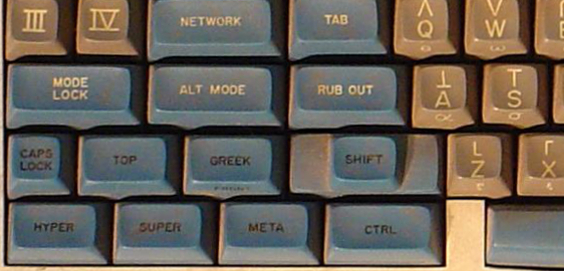
From the Space Cadet keyboard that (obviously ) influenced Emacs early design
The Emacs editor was born, according to Wikipedia, in 1976, same year as myself. I am clearly not among its first users. It was already a well-established citizen when I first learnt it; I am fortunate to be the son of a Physics researcher at UNAM, My father used to take me to his institute after he noticed how I was attracted to computers; we would usually spend some hours there between 7 and 11PM on Friday nights. His institute had a computer room where they had very sweet gear: Some 10 Heathkit terminals quite similar to this one: The terminals were connected (via individual switches) to both a PDP-11 and a Foonly F2 computers. The room also had a beautiful thermal printer, a beautiful Tektronix vectorial graphics output terminal, and some other stuff. The main user for my father was to typeset some books; he had recently (1979) published Integral Transforms in Science and Engineering (that must be my first mention in scientific literature), and I remember he was working on the proceedings of a conference he held in Oaxtepec (the account he used in the system was oax, not his usual kbw, which he lent me). He was also working on Manual de Lenguaje y Tipograf a Cient fica en Castellano, where you can see some examples of TeX; due to a hardware crash, the book has the rare privilege of being a direct copy of the output of the thermal printer: It was not possible to produce a higher resolution copy for several years But it is fun and interesting to see what we were able to produce with in-house tools back in 1985! So, what could he teach me so I could use the computers while he worked? TeX, of course. No, no LaTeX (that was published in 1984). LaTeX is a set of macros developed initially by Leslie Lamport, used to make TeX easier; TeX was developed by Donald Knuth, and if I have this information correct, it was Knuth himself who installed and demonstrated TeX in the Foonly computer, during a visit to UNAM. Now, after 39 years hammering at Emacs buffers Have I grown extra fingers? Nope. I cannot even write decent elisp code, and can barely read it. I do use org-mode (a lot!) and love it; I have written basically five books, many articles and lots of presentations and minor documents with it. But I don t read my mail or handle my git from Emacs. I could say, I m a relatively newbie after almost four decades. Four decades When we got a PC in 1986, my father got the people at the Institute to get him memacs (micro-emacs). There was probably a ten year period I barely used any emacs, but always recognized it. My fingers hve memorized a dozen or so movement commands, and a similar number of file management commands. And yes, Emacs and TeX are still the main tools I use day to day.

18 March 2022

Bits from Debian: DebConf22 registration and call for proposals are open!

DebConf22 banner open registration Registration for DebConf22 is now open. The the 23rd edition of DebConf will take place from July 17th to 24th, 2022 at the Innovation and Training Park (ITP) in Prizren, Kosovo, and will be preceded by DebCamp, from July 10th to 16th. Along with the registration, the DebConf content team announced the call for proposals. Deadline to submit a proposal to be considered in the main schedule is April 15th, 2022 23:59:59 UTC (Friday). DebConf is an event open to everyone, no matter how you identify yourself or how others perceive you. We want to increase visibility of our diversity and work towards inclusion at Debian Project, drawing our attendees from people just starting their Debian journey, to seasoned Debian Developers or active contributors in different areas like packaging, translation, documentation, artwork, testing, specialized derivatives, user support and many other. In other words, all are welcome. To register for the event, log into the registration system and fill out the form. You will be able to edit and update your registration at any point. However, in order to help the organizers have a better estimate of how many people will attend the event, we would appreciate if you could access the system and confirm (or cancel) your participation in the conference as soon as you know if you will be able to come. The last day to confirm or cancel is July 1st, 2022 23:59:59 UTC. If you don't confirm or you register after this date, you can come to the DebConf22 but we cannot guarantee availability of accommodation, food and swag (t-shirt, bag, and so on). For more information about registration, please visit registration information. Submitting an event You can now submit an event proposal. Events are not limited to traditional presentations or informal sessions (BoFs): we welcome submissions of tutorials, performances, art installations, debates, or any other format of event that you think would be of interest to the Debian community. Regular sessions may either be 20 or 45 minutes long (including time for questions), other kinds of sessions (workshops, demos, lightning talks, and so on) could have different durations. Please choose the most suitable duration for your event and explain any special requests. In order to submit a talk, you will need to create an account on the website. We suggest that Debian Salsa account holders (including DDs and DMs) use their Salsa login when creating an account. However, this isn't required, as you can sign up with an e-mail address and password. Bursary for travel, accommodation and meals In an effort to widen the diversity of DebConf attendees, the Debian Project allocates a part of the financial resources obtained through sponsorships to pay for bursaries (travel, accommodation, and/or meals) for participants who request this support when they register. As resources are limited, we will examine the requests and decide who will receive the bursaries. They will be destined: Giving a talk, organizing an event or helping during DebConf22 is taken intoa account when deciding upon your bursary, so please mention them in your bursary application. For more information about bursaries, please visit applying for a bursary to DebConf. Attention: the registration for DebConf22 will be open until the conference starts, but the deadline to apply for bursaries using the registration form before May 1st, 2022 23:59:59 UTC. This deadline is necessary in order to the organizers use time to analyze the requests, and for successful applicants to prepare for the conference. DebConf would not be possible without the generous support of all our sponsors, especially our Platinum Sponsors Lenovo and Infomaniak. DebConf22 is accepting sponsors; if you are interested, or think you know of others who would be willing to help, please get in touch!

17 March 2022

Gunnar Wolf: Speaking about the OpenPGP WoT on LibrePlanet this Saturday

So, LibrePlanet, the FSF s conference, is coming! I much enjoyed attending this conference in person in March 2018. This year I submitted a talk again, and it got accepted of course, given the conference is still 100% online, I doubt I will be able to go 100% conference-mode (I hope to catch a couple of other talks, but well, we are all eager to go back to how things were before 2020!)

Anyway, what is my talk about? My talk is titled Current challenges for the OpenPGP keyserver network. Is there a way forward?. The abstract I submitted follows:
Many free projects use OpenPGP encryption or signatures for various important tasks, like defining membership, authenticating participation, asserting identity over a vote, etc. The Web-of-Trust upon which its operation is based is a model many of us hold dear, allowing for a decentralized way to assign trust to the identity of a given person. But both the Web-of-Trust model and the software that serves as a basis for the above mentioned uses are at risk due to attacks on the key distribution protocol (not on the software itself!) With this talk, I will try to bring awareness to this situation, to some possible mitigations, and present some proposals to allow for the decentralized model to continue to thrive towards the future.
I am on the third semester of my PhD, trying to somehow keep a decentralized infrastructure for the OpenPGP Web of Trust viable and usable for the future. While this is still in the early stages of my PhD work (and I still don t have a solution to present), I will talk about what the main problems are and will sketch out the path I intend to develop. What is the relevance? Mainly, I think, that many free software projects use the OpenPGP Web of Trust for their identity definitions Are we anachronistic? Are we using tools unfit for this century? I don t think so. I think we are in time to fix the main sore spots for this great example of a decentralized infrastructure.

When is my talk scheduled? This Saturday, 2022.03.19, at
GMT / UTC time
19:25 20:10
Conference schedule time (EDT/GMT-4)
15:25 16:10
Mexico City time (GMT-6)
13:25 14:10

How to watch it? The streams are open online. I will be talking in the Saturn room, feel free to just appear there and watch! The FSF asks people to [register for the conference](https://my.fsf.org/civicrm/event/info?reset=1&id=99) beforehand, in order to be able to have an active participation (i.e. ask questions and that). Of course, you might be interested in other talks take a look at the schedule! LibrePlanet keeps a video archive of their past conferences, and this talk will be linked from there. Of course, I will link to the recording once it is online. Update: As of 2022.03.30, LibrePlanet has posted the videos for all of their talks, all linked from the program. And of course, for convenience, I copied the talk over here: Current challenges for the OpenPGP keyserver network. Is there a way forward?

7 March 2022

Ayoyimika Ajibade: Progress Report!! Modifying Expectations...

Wait! Just like yesterday when I was accepted as an Outreachy intern and the first half of the internship is finished . How time flies when you are having a good time As part of the requirements for the final application during the contribution period for the Outreachy internship, I needed to provide a timeline to achieve our goal on my outreachy task which is transitioning of dependencies in node16 and webpack5. Having consulted my mentors who implied that the packages depending on webpack and nodejs combined are so numerous that its impossible to finish all within a space of three months but we have steps to guide us through the entire process to achieve most of our goals which are As of this writing(though a little late ) we have successfully rebuilt all reverse dependencies of webpack5 and split them equally each for I and my co-intern for all Javascript modules as ruby packages also depend on webpack which is a total of 44 packages. Filed a bug report on Debian bug tracking system for failing packages, also the original maintainer or uploader of the package to the Debian archive mostly Debian developers also get a mail in references to the package bug report. Sometimes the uploader who also receives the bug report decides to help out to fix the package and forward the patch upstream if need be. We have also filed an issue to upstream repo mostly via github where some respond and create PR to solve those errors and others are plain aversive to the whole idea. PR from the upstream developer is cherry-picked and a patch is created by us to incorporate the code into our own working repository. some package upstream maintainer rejects such issues or doesn't respond, we take it upon ourselves to fix the package. The total number of packages that are successfully updated and ready to be merged is 10 packages while 12 packages remain on my own end to be updated. One of the most challenging packages to update so far was prop-type as its runs its large test suite using jest of a lower version 19.0.2 compared to that of Debian OS which is version 27.5.1 updating and migrating its API's and methods to use the Debian updated version is so challenging after several googling, testing out the solution from StackOverflow, trials, and errors, reading documentations we eventually made progress with the help of my mentor, co-intern and the whole community member. It's so crazy that when I got it working I said to myself. phew it's not rocket science why can I figure it out sooner than expected I initially proposed that I would be halfway done with the project by now, I guess the reason am not able to achieve some of our goals which are finishing up with the packages for webpack and moving to transition some of the nodejs packages at all is DEBUGGING. Yes DEBUGGING! where you never can predict what the solution is. is the problem coming from Debian? or dependencies of the package you are working on, upstream bug, or dependencies of dependencies of the package you are working on, so many questions to answer. You can't easily find a solution to a bug as it takes time to try out so many guesses more of an educated guess, or even try out all the solutions from stack overflow and still no viable progress. Obviously, you cannot really know about something to set up a plan for unless you get right into it. One way of doing this, if I have to start again is the truly understand how the javascript package work under the hood, how its handles different interaction between packages, some of its dos and don't of transpiling, bundling, testing, e.t.c I guess my unrealistic goals need to be modified because some drawback that was not envisaged popped up and I underestimated the complexity of the tasks, which will be reducing the number of packages to update in transitioning of nodejs from what I planned My major focus for the second half of the internship is to fix bugs and errors I discover, file bug reports for future bugs to seek help from co-maintainer or developers, file issues upstream and close those whose bugs are already resolved for the remaining 12 packages, and ultimately successfully uploading all reverse dependencies. Also diving into transitioning of nodejs16. Thanks for stopping by

3 March 2022

John Goerzen: Tools for Communicating Offline and in Difficult Circumstances

Note: this post is also available on my website, where it will be updated periodically. When things are difficult maybe there s been a disaster, or an invasion (this page is being written in 2022 just after Russia invaded Ukraine), or maybe you re just backpacking off the grid there are tools that can help you keep in touch, or move your data around. This page aims to survey some of them, roughly in order from easiest to more complex.

Simple radios Handheld radios shouldn t be forgotten. They are cheap, small, and easy to operate. Their range isn t huge maybe a couple of miles in rural areas, much less in cities but they can be a useful place to start. They tend to have no actual encryption features (the privacy features really aren t.) In the USA, options are FRS/GMRS and CB.

Syncthing With Syncthing, you can share files among your devices or with your friends. Syncthing essentially builds a private mesh for file sharing. Devices will auto-discover each other when on the same LAN or Wifi network, and opportunistically sync. I wrote more about offline uses of Syncthing, and its use with NNCP, in my blog post A simple, delay-tolerant, offline-capable mesh network with Syncthing (+ optional NNCP). Yes, it is a form of a Mesh Network! Homepage: https://syncthing.net/

Briar Briar is an instant messaging service based around Android. It s IM with a twist: it can use a mesh of Bluetooh devices. Or, if Internet is available, Tor. It has even been extended to support the use of SD cards and USB sticks to carry your messages. Like some others here, it can relay messages for third parties as well. Homepage: https://briarproject.org/

Manyverse and Scuttlebutt Manyverse is a client for Scuttlebutt, which is a sort of asynchronous, offline-friendly social network. You can use it to keep in touch with your family and friends, and it supports syncing over Bluetooth and Wifi even in the absence of Internet. Homepages: https://www.manyver.se/ and https://scuttlebutt.nz/

Yggdrasil Yggdrasil is a self-healing, fully end-to-end Encrypted Mesh Network. It can work among local devices or on the global Internet. It has network services that can egress onto things like Tor, I2P, and the public Internet. Yggdrasil makes a perfect companion to ad-hoc wifi as it has auto peer discovery on the local network. I talked about it in more detail in my blog post Make the Internet Yours Again With an Instant Mesh Network. Homepage: https://yggdrasil-network.github.io/

Ad-Hoc Wifi Few people know about the ad-hoc wifi mode. Ad-hoc wifi lets devices in range talk to each other without an access point. You just all set your devices to the same network name and password and there you go. However, there often isn t DHCP, so IP configuration can be a bit of a challenge. Yggdrasil helps here.

NNCP Moving now to more advanced tools, NNCP lets you assemble a network of peers that can use Asynchronous Communication over sneakernet, USB drives, radios, CD-Rs, Internet, tor, NNCP over Yggdrasil, Syncthing, Dropbox, S3, you name it . NNCP supports multi-hop file transfer and remote execution. It is fully end-to-end encrypted. Think of it as the offline version of ssh. Homepage: https://nncp.mirrors.quux.org/

Meshtastic Meshtastic uses long-range, low-power LoRa radios to build a long-distance, encrypted, instant messaging system that is a Mesh Network. It requires specialized hardware, about $30, but will tend to get much better range than simple radios, and with very little power. Homepages: https://meshtastic.org/ and https://meshtastic.letstalkthis.com/

Portable Satellite Communicators You can get portable satellite communicators that can send SMS from anywhere on earth with a clear view of the sky. The Garmin InReach mini and Zoleo are two credible options. Subscriptions range from about $10 to $40 per month depending on usage. They also have global SOS features.

Telephone Lines If you have a phone line and a modem, UUCP can get through just about anything. It s an older protocol that lacks modern security, but will deal with slow and noisy serial lines well. XBee SX radios also have a serial mode that can work well with UUCP.

Additional Suggestions It is probably useful to have a Linux live USB stick with whatever software you want to use handy. Debian can be installed from the live environment, or you could use a security-focused distribution such as Tails or Qubes.

References This page originated in my Mastodon thread and incorporates some suggestions I received there. It also formed a post on my blog.

28 February 2022

Junichi Uekawa: The World is changing.

The World is changing. People are not satisfied with COVID-19.

23 February 2022

Ian Jackson: Rooting an Eos Fairphone 4

Last week I received (finally) my Fairphone 4, supplied with a de-googled operating system, which I had ordered from the E Foundation s shop in December. (I m am very hard on hardware and my venerable Fairphone 2 is really on its last legs.) I expect to have full control over the software on any computing device I own which is as complicated, capable, and therefore, hazardous, as a mobile phone. Unfortunately the Eos image (they prefer to spell it /e/ os , srsly!) doesn t come with a way to get root without taking fairly serious measures including unlocking the bootloader. Unlocking the bootloader wouldn t be desirable for me but I can t live without root. So. I started with these helpful instructions: https://forum.xda-developers.com/t/fairphone-4-root.4376421/ I found the whole process a bit of a trial, and I thought I would write down what I did. But, it s not straightforward, at least for someone like me who only has a dim understanding of all this Android stuff. Unfortunately, due to the number of missteps and restarts, what I actually did is not really a sensible procedure. So here is a retcon of a process I think will work: Unlock the bootloader The E Foundation provide instructions for unlocking the bootloader on a stock FP4, here https://doc.e.foundation/devices/FP4/install and they seem applicable to the Murena phone supplied with Eos pre-installed, too. NB tht unlocking the bootloader wipes the phone. So we do it first. So:
  1. Power on the phone, with no SIM installed
  2. You get a welcome screen.
  3. Skip all things on startup including wifi
  4. Go to the very end of the settings, tap a gazillion times on the phone s version until you re a developer
  5. In the developer settings, allow usb debugging
  6. In the developer settings, allow oem bootloader unlocking
  7. Connect a computer via a USB cable, say yes on phone to USB debugging
  8. adb reboot bootloader
  9. The phone will reboot into a texty kind of screen, the bootloader
  10. fastboot flashing unlock
  11. The phone will reboot, back to the welcome screen
  12. Repeat steps 3-9 (maybe not all are necessary)
  13. fastboot flashing unlock_critical
  14. The phone will reboot, back to the welcome screen
Note that although you are running fastboot, you must run this command with the phone in bootloader mode, not fastboot (aka fastbootd ) mode. If you run fastboot flashing unlcok from fastboot you just get a don t know what you re talking about . I found conflicting instructions on what kind of Vulcan nerve pinches could be used to get into which boot modes, and had poor experiences with those. adb reboot bootloader always worked reliably for me. Some docs say to run fastboot oem unlock; I used flashing. Maybe this depends on the Android tools version. Initial privacy prep and OTA update We want to update the supplied phone OS. The build mine shipped with is too buggy to run Magisk, the application we are going to use to root the phone. (With the pre-installed phone OS, Magisk crashes at the patch boot image step.) But I didn t want to let the phone talk to Google, even for the push notifications registration.
  1. From the welcome screen, skip all things except location, date, time. Notably, do not set up wifi
  2. In settings, microg section
    1. turn off cloud messaging
    2. turn off google safetynet
    3. turn off google registration (NB you must do this after the other two, because their sliders become dysfunctional after you turn google registration off)
    4. turn off both location modules
  3. In settings, location section, turn off allowed location for browser and magic earth
  4. Now go into settings and enable wifi, giving it your wifi details
  5. Tell the phone to update its operating system. This is a big download.
Install Magisk, the root manager (As a starting point I used these instructions https://www.xda-developers.com/how-to-install-magisk/ and a lot of random forum posts.) You will need the official boot.img. Bizarrely there doesn t seem to be a way to obtain this from the phone. Instead, you must download it. You can find it by starting at https://doc.e.foundation/devices/FP4/install which links to https://images.ecloud.global/stable/FP4/. At the time of writing, the most recent version, whose version number seemed to correspond to the OS update I installed above, was IMG-e-0.21-r-20220123158735-stable-FP4.zip.
  1. Download the giant zipfile to your computer
  2. Unzip it to extract boot.img
  3. Copy the file to your phone s storage . Eg, via adb: with the phone booted into the main operating system, using USB debugging, adb push boot.img /storage/self/primary/Download.
  4. On the phone, open the browser, and enter https://f-droid.org. Click on the link to install f-droid. You will need to enable installing apps from the browser (follow the provided flow to the settings, change the setting, and then use Back, and you can do the install). If you wish, you can download the f-droid apk separately on a computer, and verify it with pgp.
  5. Using f-droid, install Magisk. You will need to enable installing apps from f-droid. (I installed Magisk from f-droid because 1. I was going to trust f-droid anyway 2. it has a shorter URL than Magisk s.)
  6. Open the Magisk app. Tell Magisk to install (Magisk, not the app). There will be only one option: patch boot file. Tell it to patch the boot.img file from before.
  7. Transfer the magisk_patched-THING.img back to your computer (eg via adb pull).
  8. adb reboot bootloader
  9. fastboot boot magisk_patched-THING.img (again, NB, from bootloader mode, not from fastboot mode)
  10. In Magisk you ll see it shows as installed. But it s not really; you ve just booted from an image with it. Ask to install Magisk with Direct install .
After you have done all this, I believe that each time you do an over-the-air OS update, you must, between installing the update and rebooting the phone, ask Magisk to Install to inactive slot (after OTA) . Presumably if you forget you must do the fastboot boot dance again. After all this, I was able to use tsu in Termux. There s a strange behaviour with the root prompt you get apropos Termux s request for root; I found that it definitely worked if Termux wasn t the foreground app You have to leave the bootloader unlocked. Howwever, as I understand it, the phone s encryption will still prevent an attacker from hoovering the data out of your phone. The bootloader lock is to prevent someone tricking you into entering the decryption passkey into a trojaned device. Other things to change There are probably other things to change. I have not yet transferred my Signal account from my old phone. It is possible that Signal will require me to re-enable the google push notifications, but I hope that having disabled them in microg it will be happy to use its own system, as it does on my old phone.

comment count unavailable comments

Jonathan McDowell: Upgrading my home internet; a story of yak shaving

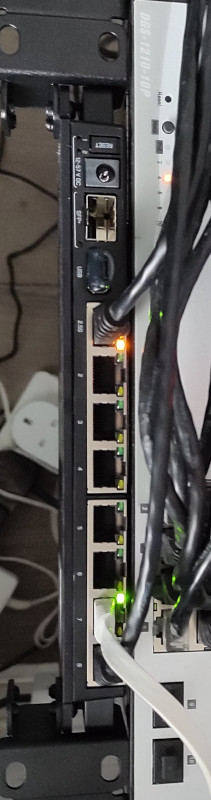
RB5009 This has ended up longer than I expected. I ll write up posts about some of the individual steps with some more details at some point, but this is an overview of the yak shaving I engaged in. The TL;DR is:
The desire for a faster connection When I migrated my home connection to FTTP I kept the same 80M/20M profile I d had on FTTC. I didn t have a pressing need for faster, and I saved money because I was no longer paying for the phone line portion. I wanted more, but at the time I think the only option was for a 160M/30M profile instead and I didn t need it and it wasn t enough better to convince me. Time passed and BT rolled out their GigE (really 900M) download option. And again, I didn t need it, but I wanted it. My provider, Aquiss, initially didn t offer this (I think they had up to 330M download options available by this point). So I stayed on 80M/20M. And the only time I really wanted it to be faster was when pushing off-site backups to rsync.net. Of course, we ve had the pandemic, and that s involved 2 adults working from home with plenty of video calls throughout the day. The 80M/20M connection has proved rock solid for this, so again, I didn t feel an upgrade was justified. We got a 4K capable TV last year and while the bandwidth usage for 4K streaming is noticeably higher, again the connection can handle it no problem. At some point last year I noticed Aquiss had added speed options all the way to 900M down. At the end of the year I accepted a new role, which is fully remote, so I had a bit of an acceptance about the fact that I wasn t going back into an office any time soon. The combination (and the desire for the increased upload speed) finally allowed me to justify the upgrade to myself.

Testing the current setup for bottlenecks The first thing to do was see whether my internal network could cope with an upgrade. I m mostly running Cat6 GigE so I wasn t worried about that side of things. However I m using an RB3011 as my core router, and while it has some coprocessors for routing acceleration they re not supported under mainline Linux (and unlikely to be any time soon). So I had to benchmark what it was capable of routing. I run a handful of VLANs within my home network, with stateful firewalling between them, so I felt that would be a good approximation of the maximum speed to the outside world I might be able to get if I had the external connection upgraded. I went for the easy approach and fired up iPerf3 on 2 hosts, both connected via ethernet but on separate networks, so routed through the RB3011. That resulted in slightly more than a 300Mb/s throughput. Ok. I confirmed that I could get 900Mb/s+ on 2 hosts both on the same network, just to be sure there wasn t some other issue I was missing. Nope, so unsurprisingly the router was the bottleneck. So. To upgrade my internet speed I need to upgrade my router. I could just buy something off the shelf, but I like being able to run Debian (or OpenWRT) on the router rather than some horrible vendor firmware. Lucky MikroTik launched the RB5009 towards the end of last year. RouterOS is probably more than capable, but what really interested me was the fact it s an ARM64 platform based on an Armada 7040, which is pretty well supported in mainline kernels already. There s a 10G connection from the internal switch to the CPU, as well as a 2.5Gb/s ethernet port and a 10G SFP+ cage. All good stuff. I ordered one just before the New Year. Thankfully the OpenWRT folk had done all of the hard work on getting a mainline kernel booting on the device; Sergey Sergeev and Robert Marko in particular fighting RouterBoot and producing a suitable device tree file to get everything up and running. I ended up soldering a serial console connection up to aid debugging, and lightly patching Rob s u-boot to fix the incorrect RAM size reported by RouterBoot. A few kernel tweaks were necessary to make the networking entirely happy and at that point it was time to think about actually doing a replacement.

Upgrading to Debian 11 (bullseye) My RB3011 is currently running Debian 10 (buster); an upgrade has been on my todo list, but with the impending replacement I decided I d hold off and create a new Debian 11 (bullseye) image for the RB5009. Additionally, I don t actually run off the internal NAND in the RB3011; I have a USB flash drive for the rootfs and just the kernel booting off internal NAND. Originally this was for ease of testing, then a combination of needing to figure out a good read-only root solution and a small enough image to fit in the 120M available. For the upgrade I decided to finally look at these pieces. I ve ended up with a script that will build me a squashfs image, and the initial rootfs takes care of mounting this and then a tmpfs as an overlay fs. That means I can easily see what pieces are being written to. The RB5009 has a total of 1G NAND so I m not as space constrained, but the squashfs ends up under 50M. I ve added some additional pieces to allow me to pre-populate the overlay fs with updates rather than always needing to rebuild the squashfs image. With that done I decided to try it out on the RB3011; I tweaked the build script to be able to build for armhf (the RB3011) or arm64 (the RB5009) and to deal with some slight differences in configuration between the two (e.g. interface naming). The idea here was to ensure I d got all the appropriate configuration sorted for the RB5009, in the known-good existing environment. Everything is still on a USB stick at this stage and the new device has an armhf busybox root meaning it can be used on either device, and the init script detects the architecture to select the appropriate squashfs to mount.

A problem with ESP8266 home automation devices Everything seemed to work fine - a few niggles with the watchdog, which is overly sensitive on the RB3011, but I got those sorted (and the build script updated) and the device came up and successfully did the PPPoE dance to bring up external connectivity. And then I noticed that my home automation devices were having problems connecting to the mosquitto MQTT server. It turned out it was only the ESP8266 based devices that were failing, and examining the serial debug output on one of my test devices revealed it was hitting an out of memory issue (displaying E:M 280) when establishing the TLS MQTT connection. I rolled back to the Debian 10 image and set about creating a test environment to look at the ESP8266 issues. My first action was to try and reduce my RAM footprint to try and ensure there was enough spare to establish the connection. I moved a few functions that were still sitting in IRAM into flash. I cleaned up a couple of buffers that are on the stack to be more correctly sized. I tried my new image, and I didn t get the memory issue. Instead I progressed a bit further and got a watchdog reset. Doh! It was obviously something related to the TLS connection, but I couldn t easily see what the difference was; the same x509 cert was in use, it looked like the initial handshake was the same (and trying with openssl s_client looked pretty similar too). I set about instrumenting the ancient Mbed TLS used in the Espressif SDK and discovered that whatever had changed between buster + bullseye meant the EPS8266 was now trying a TLS-DHE-RSA-WITH-AES-256-CBC-SHA256 handshake instead of a TLS-RSA-WITH-AES-256-CBC-SHA256 handshake and that was causing enough extra CPU usage that it couldn t complete in time and the watchdog kicked in. So I commented out MBEDTLS_KEY_EXCHANGE_DHE_RSA_ENABLED in the config_esp.h for mbedtls and rebuilt things. Hacky, but I ll go back to trying to improve this generally at some point.

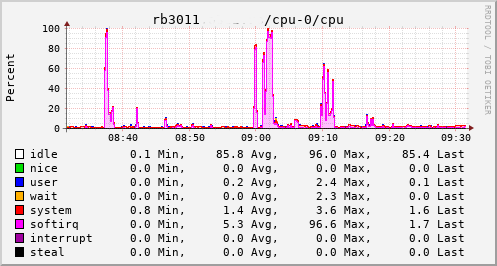
A detour into interrupt load Now, my testing of the RB3011 image is generally done at weekends, when I have enough time to tear down and rebuild the connection rather than doing it in the evening and having limited time to get things working again in time for work in the morning. So at the point I had an image ready to go I pulled the trigger on the line upgrade. I went with the 500M/75M option rather than the full 900M - I suspect I d have difficulty actually getting that most of the time and 75M of upload bandwidth seems fairly substantial for now. It only took a couple of days from the order to the point the line was regraded (which involved no real downtime - just a reconnection in the night). Of course this happened just after the weekend I d discovered the ESP8266 issue. collectd CPU usage for RB3011 This provided an opportunity to see just what the RB3011 could actually manage. In the configuration I had it turned out to be not much more than the 80Mb/s speeds I had previously seen. The upload jumped from a solid 20Mb/s to 75Mb/s, so I knew the regrade had actually happened. Looking at CPU utilisation clearly showed the problem; softirqs were using almost 100% of a CPU core. Now, the way the hardware is setup on the RB3011 is that there are two separate 5 port switches, each connected back to the CPU via a separate GigE interface. For various reasons I had everything on a single switch, which meant that all traffic was boomeranging in and out of the same CPU interface. The IPQ8064 has dual cores, so I thought I d try moving the external connection to the other switch. That puts it on its own GigE CPU interface, which then allows binding the interrupts to a different CPU core. That helps; throughput to the outside world hits 140Mb/s+. Still a long way from the expected max, but proof we just need more grunt.
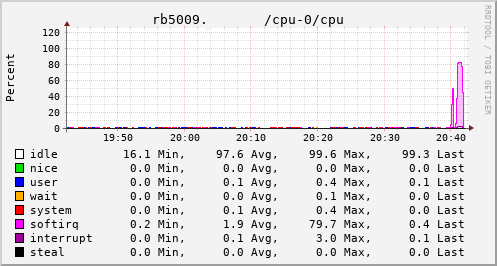
Success collectd CPU usage for RB5009 Which brings us to this past weekend, when, having worked out all the other bits, I tried the squashfs root image again on the RB3011. Success! The home automation bits connected to it, the link to the outside world came up, everything seemed happy. So I double checked my bootloader bits on the RB5009, brought it down to the comms room and plugged it in instead. And, modulo my failing to update the nftables config to allow it to do forwarding, it all came up ok. Some testing with iperf3 internally got a nice 912Mb/s sustained between subnets, and some less scientific testing with wget + speedtest-cli saw speeds of over 460Mb/s to the outside world. Time from ordering the router until it was in service? Just under 8 weeks

Russ Allbery: Review: Elder Race

Review: Elder Race, by Adrian Tchaikovsky
Publisher: Tordotcom
Copyright: November 2021
ISBN: 1-250-76871-3
Format: Kindle
Pages: 199
(It's a shame that a lot of people will be reading this novella on a black-and-white ebook reader, since the Emmanuel Shiu cover is absolutely spectacular. There's a larger image without the words at the bottom of that article.) When reports arrive at the court about demons deep in the forest that are taking over animals and humans and bending them to their will, the queen doesn't care. It's probably some unknown animal, and regardless, the forest kingdom is a rival anyway. Lynesse Fourth Daughter disagrees vehemently, but she has no power at court. Even apart from her lack of seniority, her love of stories and daring and adventures is a source of endless frustration to her mother. That is why this novella opens with her climbing the mountain path to the Tower of Nyrgoth Elder, the last of the ancient wizards, to seek his help. Nyr Illim Tevitch is an anthropologist second class of Earth's Explorer Corps, part of the second wave of Earth's outward expansion through the galaxy. In the first wave, colonies were seeded on habitable planets, only to be left stranded when Earth's civilization collapsed in an ecological crisis. Nyr was a member of a team of four, sent to make careful and limited contact with one of those lost colonies as part of Earth's second flourishing with more advanced technology. When the team lost contact with Earth, the other three went back while Nyr stayed to keep their field observations going. It's now 291 years of intermittent suspended animation later. Nyr's colleagues never came back, and there have been no messages from Earth. Elder Race is a Prime Directive anthropology story, a subgenre so long-standing that it has its own conventions and variations. Variations of the theme have been written by everyone from Eleanor Arnason to Iain M. Banks (linking to the book I have in mind is arguably a spoiler). Per the dedication, Tchaikovsky's take is based on Gene Wolfe's story "Trip, Trap," which I have not read but whose plot looks very similar. To that story structure, Tchaikovsky brings two major twists. First, Nyr is cut off from his advanced civilization, and has considerable reason to believe that civilization no longer exists. Do noninterference rules still have any meaning if Nyr is stranded and the civilization that made the rules is gone? Second, Nyr has already broken those rules rather spectacularly. More than a hundred years previously, he had ridden with Astresse Regent, a warrior queen and Lynesse's ancestor, to defeat a local warlord who had found control codes for abandoned advanced machinery and was using it as weaponry. In the process, he fell in love and made a rash promise to come to the aid of any of her descendants if he were needed. Lynesse has come to collect on the promise. Elder Race is told in alternating chapters between Nyr and Lynesse's viewpoints: first person for Nyr and tight third person for Lynesse. The core of the story is this doubled perspective, one from a young woman who wants to live in a fantasy novel and one from a deeply depressed anthropologist torn between wanting human contact, wanting to follow the rules of his profession, and wanting to explain to Lynesse that he is not a wizard. Nyr talks himself into helping with another misuse of advanced technology using the same logic he used a hundred years earlier: he's protecting Lynesse's pre-industrial society from interference rather than causing it. But the demons Lynesse wants him to fight are something entirely unexpected. This parallel understanding is a great story structure. What worked less for me was Tchaikovsky's reliance on linguistic barriers to prevent shared understanding. Whenever Nyr tries to explain something, Lynesse hears it in terms of magic and high fantasy, and often exactly backwards from how Nyr intended it. This is where my suspension of disbelief failed me, even though I normally don't have suspension of disbelief problems in SF stories. I was unable to map Lynesse's misunderstandings to any realistic linguistic model. Lynesse's language is highly complex (a realistic development within an isolated population), and Nyr complains about his inability to speak it properly given it's blizzard of complex modifiers. This is entirely believable. What is far less believable is that Lynesse perceives him as fluent in her language, but often saying the precise opposite of what he's trying to say. One chapter in the middle of the book gives Nyr's intended story side-by-side with Lynesse's understanding. This is a brilliant way to show the divide, but I found the translation errors unbelievable. If Nyr is failing that profoundly to communicate his meaning, he should be making more egregious sentence-level errors, occasionally saying something bizarre or entirely nonsensical, referring to a person as an animal or a baby, or otherwise not fluently telling a coherent story that's fundamentally different than the one he thinks he's telling. If you can put that aside, though, this is a fun story. Nyr has serious anxiety and depression made worse by his isolation, and copes by using an implanted device called a Dissociative Cognition System that lets him temporarily turn off his emotions at the cost of letting them snowball. He has a wealth of other augments and implants, including horns, which Lynesse sees as evidence that he's a different species of magical being and which he sees as occasionally irritating field equipment with annoying visual menus. The key to writing a story like this is for both perspectives to be correct given their own assumptions, and to offer insight that the other perspective is missing. I thought the linguistic part of that was unsuccessful, but the rest of it works. One of the best parts of novellas is that they don't wear out their welcome. This is a fun spin on well-trodden ground that tells a complete story in under 200 pages. I wish the ending had been a bit more satisfying and the linguistics had been more believable, but I enjoyed the time I spent in this world. Content warning for some body horror. Rating: 7 out of 10

22 February 2022

Russ Allbery: Review: Children of Earth and Sky

Review: Children of Earth and Sky, by Guy Gavriel Kay
Publisher: New American Library
Copyright: 2016
ISBN: 0-698-18327-4
Format: Kindle
Pages: 572
Nine hundred years have passed since the events of Lord of Emperors. Twenty-five years ago, Sarantium, queen of cities, fell to the Osmanlis, who have renamed it Asharias in honor of their Asherite faith. The repercussions are still echoing through the western world, as the Osmanlis attempt each spring to push farther west and the forces of Rodolfo, Holy Emperor in Obravic and defender of the Jaddite faith, hold them back. Seressa and Dubrava are city-state republics built on the sea trade. Seressa is the larger and most renown, money-lenders to Rodolfo and notorious for their focus on business and profit, including willingness to trade with the Osmanlis. Dubrava has a more tenuous position: smaller, reliant on trade and other assistance from Seressa, but also holding a more-favored trading position with Asharias. Both are harassed by piracy from Senjan, a fiercely Jaddite raiding city north up the coast from Dubrava and renown for its bravery against the Asherites. The Senjani are bad for business. Seressa would love to wipe them out, but they have the favor of the Holy Emperor. They settled for attempting to starve the city with a blockade. As Children of Earth and Sky opens, Seressa is sending out new spies. One is a woman named Leonora Valeri, who will present herself as the wife of a doctor that Seressa is sending to Dubrava. She is neither his wife nor Seressani, but this assignment gets her out of the convent to which her noble father exiled her after an unapproved love affair. The other new spy is the young artist Pero Villani, a minor painter whose only notable work was destroyed by the woman who commissioned it for being too revealing. Pero's destination is farther east: Grand Khalif Gur u the Destroyer, the man whose forces took Sarantium, wants to be painted in the western style. Pero will do so, and observe all he can, and if the opportunity arises to do more than that, well, so much the better. Pero and Leonora are traveling on a ship owned by Marin Djivo, the younger son of a wealthy Dubravan merchant family, when their ship is captured by Senjani raiders. Among the raiders is Danica Gradek, the archer who broke the Seressani blockade of Senjan. This sort of piracy, while tense, should be an economic transaction: some theft, some bargaining, some ransom, and everyone goes on their way. That is not what happens. Moments later, two men lie dead, and Danica's life has become entangled with Dubravan merchants and Seressani spies. Children of Earth and Sky is in some sense a sequel to the Sarantine Mosaic, and knowing the events of that series adds some emotional depth and significant moments to this story, but you can easily read it as a stand-alone novel. (That said, I recommend the Sarantine Mosaic regardless.) As with nearly all of Kay's work, it's historical fiction with the names changed (less this time than in most of this books) and a bit of magic added. The setting is the middle of the 15th century. Seressa is, of course, Venice. The Osmanlis are the Ottoman Turks, and Asharias is Istanbul, the captured Constantinople. Rodolfo is a Habsburg Holy Roman Emperor, holding court in an amalgam of northern cities that (per the afterward) is primarily Prague. Dubrava, which is central to much of this book, is Dubrovnik in Croatia. As usual with Kay's novels, you don't need to know this to enjoy the story, but it may spark some fun secondary reading. The touch of magic is present in several places, but comes primarily from Danica, whose grandfather resides as a voice in her head. He is the last of her family that she is in contact with. Her father and older brother were killed by Osmanli raiders, and her younger brother taken as a slave to be raised as a djanni warrior in the khalif's infantry. (Djannis are akin to Mamluks in our world.) Damaz, as he is now known, is the remaining major viewpoint character I've not mentioned. There are a couple of key events in the book that have magic at the center, generally involving Danica or Damaz, but most of the story is straight historical fiction (albeit with significant divergences from our world). I'd talked myself out of starting this novel several times before I finally picked it up. Like most of Kay's, it's a long book, and I wasn't sure if I was in the mood for epic narration and a huge cast. And indeed, I found it slow at the start. Once the story got underway, though, I was as enthralled as always. There is a bit of sag in the middle of the book, in part because Kay didn't follow up on some relationships that I wish were more central to the plot and in part because he overdoes the narrative weight in one scene, but the ending is exceptional. Guy Gavriel Kay is the master of a specific type of omniscient tight third person narration, one in which the reader sees what a character is thinking but also gets narrative commentary, foreshadowing, and emotional emphasis apart from the character's thoughts. It can feel heavy-handed; if something is important, Kay tells you, explicitly and sometimes repetitively, and the foreshadowing frequently can be described as portentous. But in return, Kay gets fine control of pacing and emphasis. The narrative commentary functions like a soundtrack in a movie. It tells you when to pay close attention and when you can relax, what moments are important, where to slow down, when to brace yourself, and when you can speed up. That in turn requires trust; if you're not in the mood for the author to dictate your reading pace to the degree Kay is attempting, it can be irritating. If you are in the mood, though, it makes his novels easy to relax into. The narrator will ensure that you don't miss anything important, and it's an effective way to build tension. Kay also strikes just the right balance between showing multiple perspectives on a single moment and spending too much time retelling the same story. He will often switch viewpoint characters in the middle of a scene, but he avoids the trap of replaying the scene and thus losing the reader's interest. There is instead just a moment of doubled perspective or retrospective commentary, just enough information for the reader to extrapolate the other character's experience backwards, and then the story moves on. Kay has an excellent feel for when I badly wanted to see another character's perspective on something that just happened. Some of Kay's novels revolve around a specific event or person. Children of Earth and Sky is not one of those. It's a braided novel following five main characters, each with their own story. Some of those stories converge; some of them touch for a while and then diverge again. About three-quarters of the way through, I wasn't sure how Kay would manage a satisfying conclusion for the numerous separate threads that didn't feel rushed, but I need not have worried. The ending had very little of the shape that I had expected, focused more on the small than the large (although there are some world-changing events here), but it was an absolute delight, with some beautiful moments of happiness that took the rest of the novel to set up. This is not the sort of novel with a clear theme, but insofar as it has one, it's a story about how much of the future shape and events of the world are unknowable. All we can control is our own choices, and we may never know their impact. Each individual must decide who they want to be and attempt to live their life in accordance with that decision, hopefully with some grace towards others in the world. The novel does, alas, still have some of Kay's standard weaknesses. There is (at last!) an important female friendship, and I had great hopes for a second one, but sadly it lasted only a scant handful of pages. Men interact with each other and with women; women interact almost exclusively with men. Kay does slightly less awarding of women to male characters than in some previous books (although it still happens), but this world is still weirdly obsessed with handing women to men for sex as a hospitality gesture. None of this is too belabored or central to the story, or I would be complaining more, but as soon as one sees how regressive the gender roles typically are in a Kay novel, it's hard to unsee. And, as always for Kay, the sex in this book is weirdly off-putting to me. I think this goes hand in hand with Kay's ability to write some of the best conversations in fantasy. Kay's characters spar and thrust with every line and read nuance into small details of wording. Frequently, the turn of the story rests on the outcome of a careful conversation. This is great reading; it's the part of Kay's writing I enjoy the most. But I'm not sure he knows how to turn it off between characters who love and trust each other. The characters never fully relax; sex feels like another move in ongoing chess games, which in turn makes it feel weirdly transactional or manipulative instead of open-hearted and intimate. It doesn't help that Kay appears to believe that arousal is a far more irresistible force for men than I do. Those problems did get in the way of my enjoyment occasionally, but I didn't think they ruined the book. The rest of the story is too good. Danica in particular is a wonderful character: thoughtful, brave, determined, and deeply honest with herself in that way that is typical of the best of Kay's characters. I wanted to read the book where Danica's and Leonora's stories stayed more entwined; alas, that's not the story Kay was writing. But I am in awe at Kay's ability to write characters who feel thoughtful and insightful even when working at cross purposes, in a world that mostly avoids simple villains, with a plot that never hinges on someone doing something stupid. I love reading about these people. Their triumphs, when they finally come, are deeply satisfying. Children of Earth and Sky is probably not in the top echelon of Kay's works with the Sarantine Mosaic and Under Heaven, but it's close. If you like his other writing, you will like this as well. Highly recommended. Rating: 9 out of 10

18 February 2022

Colin Watson: Launchpad now supports SSH Ed25519 keys and RSA SHA-2 signatures

As of 2022-02-16, Launchpad supports a couple of features on its SSH endpoints (git.launchpad.net, bazaar.launchpad.net, ppa.launchpad.net, and upload.ubuntu.com) that it previously didn t: Ed25519 public keys (a well-regarded format, supported by OpenSSH since 6.5 in 2014) and signatures with existing RSA public keys using SHA-2 rather than SHA-1 (supported by OpenSSH since 7.2 in 2016). I m hesitant to call these features new , since they ve been around for a long time elsewhere, and people might quite reasonably ask why it s taken us so long. The problem has always been that Launchpad can t really use a normal SSH server such as OpenSSH because it needs features that aren t practical to implement that way, such as virtual filesystems and dynamic user key authorization against the Launchpad database. Instead, we use Twisted Conch, which is a very extensible Python SSH implementation that has generally served us well. The downside is that, because it s an independent implementation and one that occupies a relatively small niche, it often lags behind in terms of newer protocol features. Catching up to this point has been something we ve been working on for around five years, although it s taken a painfully long time for a variety of reasons which I thought some people might find interesting to go into, at least people who have the patience for details of the SSH protocol. Many of the delays were my own responsibility, although realistically we probably couldn t have added Ed25519 support before OpenSSL/cryptography work that landed in 2019. Phew! Thanks to everyone who works on Twisted, cryptography, and OpenSSL - it s been really useful to be able to build on solid lower-level cryptographic primitives - and to those who helped with code review.

5 February 2022

Reproducible Builds: Reproducible Builds in January 2022

Welcome to the January 2022 report from the Reproducible Builds project. In our reports, we try outline the most important things that have been happening in the past month. As ever, if you are interested in contributing to the project, please visit our Contribute page on our website.
An interesting blog post was published by Paragon Initiative Enterprises about Gossamer, a proposal for securing the PHP software supply-chain. Utilising code-signing and third-party attestations, Gossamer aims to mitigate the risks within the notorious PHP world via publishing attestations to a transparency log. Their post, titled Solving Open Source Supply Chain Security for the PHP Ecosystem goes into some detail regarding the design, scope and implementation of the system.
This month, the Linux Foundation announced SupplyChainSecurityCon, a conference focused on exploring the security threats affecting the software supply chain, sharing best practices and mitigation tactics. The conference is part of the Linux Foundation s Open Source Summit North America and will take place June 21st 24th 2022, both virtually and in Austin, Texas.

Debian There was a significant progress made in the Debian Linux distribution this month, including:

Other distributions kpcyrd reported on Twitter about the release of version 0.2.0 of pacman-bintrans, an experiment with binary transparency for the Arch Linux package manager, pacman. This new version is now able to query rebuilderd to check if a package was independently reproduced.
In the world of openSUSE, however, Bernhard M. Wiedemann posted his monthly reproducible builds status report.

diffoscope diffoscope is our in-depth and content-aware diff utility. Not only can it locate and diagnose reproducibility issues, it can provide human-readable diffs from many kinds of binary formats. This month, Chris Lamb prepared and uploaded versions 199, 200, 201 and 202 to Debian unstable (that were later backported to Debian bullseye-backports by Mattia Rizzolo), as well as made the following changes to the code itself:
  • New features:
    • First attempt at incremental output support with a timeout. Now passing, for example, --timeout=60 will mean that diffoscope will not recurse into any sub-archives after 60 seconds total execution time has elapsed. Note that this is not a fixed/strict timeout due to implementation issues. [ ][ ]
    • Support both variants of odt2txt, including the one provided by the unoconv package. [ ]
  • Bug fixes:
    • Do not return with a UNIX exit code of 0 if we encounter with a file whose human-readable metadata matches literal file contents. [ ]
    • Don t fail if comparing a nonexistent file with a .pyc file (and add test). [ ][ ]
    • If the debian.deb822 module raises any exception on import, re-raise it as an ImportError. This should fix diffoscope on some Fedora systems. [ ]
    • Even if a Sphinx .inv inventory file is labelled The remainder of this file is compressed using zlib, it might not actually be. In this case, don t traceback and simply return the original content. [ ]
  • Documentation:
    • Improve documentation for the new --timeout option due to a few misconceptions. [ ]
    • Drop reference in the manual page claiming the ability to compare non-existent files on the command-line. (This has not been possible since version 32 which was released in September 2015). [ ]
    • Update X has been modified after NT_GNU_BUILD_ID has been applied messages to, for example, not duplicating the full filename in the diffoscope output. [ ]
  • Codebase improvements:
    • Tidy some control flow. [ ]
    • Correct a recompile typo. [ ]
In addition, Alyssa Ross fixed the comparison of CBFS names that contain spaces [ ], Sergei Trofimovich fixed whitespace for compatibility with version 21.12 of the Black source code reformatter [ ] and Zbigniew J drzejewski-Szmek fixed JSON detection with a new version of file [ ].

Testing framework The Reproducible Builds project runs a significant testing framework at tests.reproducible-builds.org, to check packages and other artifacts for reproducibility. This month, the following changes were made:
  • Fr d ric Pierret (fepitre):
    • Add Debian bookworm to package set creation. [ ]
  • Holger Levsen:
    • Install the po4a package where appropriate, as it is needed for the Reproducible Builds website job [ ]. In addition, also run the i18n.sh and contributors.sh scripts [ ].
    • Correct some grammar in Debian live image build output. [ ]
    • Shell monitor improvements:
      • Only show the offline node section if there are offline nodes. [ ]
      • Colorise offline nodes. [ ]
      • Shrink screen usage. [ ][ ][ ]
    • Node health check improvements:
      • Detect if live package builds encounter incomplete snapshots. [ ][ ][ ]
      • Detect if a host is running with today s date (when it should be set artificially in the future). [ ]
    • Use the devscripts package from bullseye-backports on Debian nodes. [ ]
    • Use the Munin monitoring package bullseye-backports on Debian nodes too. [ ]
    • Update New Year handling, needed to be able to detect real and fake dates. [ ][ ]
    • Improve the error message of the script that powercycles the arm64 architecture nodes hosted by Codethink. [ ]
  • Mattia Rizzolo:
    • Use the new --timeout option added in diffoscope version 202. [ ]
  • Roland Clobus:
    • Update the build scripts now that the hooks for live builds are now maintained upstream in the live-build repository. [ ]
    • Show info lines in Jenkins when reproducible hooks have been active. [ ]
    • Use unique folders for the artifacts from each live Debian version. [ ]
  • Vagrant Cascadian:
    • Switch the Debian armhf architecture nodes to use new proxy. [ ]
    • Misc. node maintenance. [ ].

Upstream patches The Reproducible Builds project attempts to fix as many currently-unreproducible packages as possible. In January, we wrote a large number of such patches, including:

And finally If you are interested in contributing to the Reproducible Builds project, please visit our Contribute page on our website. However, you can get in touch with us via:

Louis-Philippe V ronneau: Migrating from ledger to hledger

I first started using ledger the original plain-text accounting software in 2017. Since then, I had been pretty happy with my accounting routine, but grew a little annoyed by the repetitive manual work I had to do to assign recurring transactions to the right account. To make things easier, I had a collection of bash scripts to parse and convert the CSV files from my bank's website1 into ledger entries. They were of course ugly, unreadable piles of sed-grep-regex and did not let met achieve the automation complexity I longed for. Dissatisfied with ledger's features, I decided to migrate to hledger. Contrary to ledger, hledger comes with a CSV parser one can use to import and classify recurring transactions automagically. Having a proper DSL for this makes all the difference: I can easily add new rules and understand the old ones. In the end, I get a very consistent result, something my old bash scripts weren't great at. Here is what my debit.csv.rules file looks like. It is used to tell hledger how CSV data from my debit card should be parsed:
# skip the headings line:
skip 1
# assign fields
fields , , , date, , description, , amount2-in, amount2-out
# assign account where the money comes from
# 99 to get it at the bottom of the transaction
account99 assets:checking
include matchers.rules
As you can see, the rules matching transactions to specific accounts are imported from another file, matchers.rules. I'm doing this since I want to be able to use the same set of rules for debit and credit and use the cards interchangeably. Here's a snippet of my matchers.rules file:
# house
if Loyer/bail
  account2  expenses:rent
# leisure
if PAYPAL .*STEAM GAMES
  account2  expenses:leisure:videogame
if PAYPAL .*BANDCAMP
  account2  expenses:leisure:music
Using this ruleset, a transaction looking like this:
"SOME ACCOUNT DESC","111111","EOP","2022/01/03",00002,"Loyer/bail","",521.00,"","","","",""
Would be transformed into:
2022-01-03 Loyer/bail
    expenses:rent                               521.00
    assets:checking
Sadly, hledger's CSV rules won't let you do arithmetics. This can be useful when you know a certain transaction needs to be split between accounts. This is where auto postings come in. They are a way to specify arbitrary rules when an account is encountered. Going back to my previous rent example, I split it 50/50 with my SO using this rule:
= expenses:rent
    assets:receivable:rent    *0.5
    assets:checking
After it is applied, the final transaction looks like this:
2022-01-03 Loyer/bail  ; modified:
    expenses:rent                               521.00
    assets:receivable:rent                      260.50  ; generated-posting: = expenses:rent
    assets:checking
Neat eh? Here is the little bash script I've written to automate all these steps:
 #!/bin/bash
#
# Convert CSV to ledger using hledger
declare -a assets=("credit" "debit")
# Read the array values with space
for i in "$ assets[@] "
do
  if test -f "$i.csv"
  then
    # convert to ledger
    LEDGER=$(hledger -f "$i.csv" --rules-file rules/"$i.csv".rules print)
    # add auto_postings
    LEDGER=$(printf "include rules/auto_postings.ledger\n\n$LEDGER\n"   hledger print -f- --auto)
    # remove superfluous assets:checking lines
    LEDGER=$(printf "$LEDGER"   sed '/assets:checking \+; generated.\+/d')
    printf "$LEDGER" > "$i.ledger"
  else
    printf "File $i.csv does not exist\n"
  fi
done
Migrating to hledger, I've cut down the time I spend on accounting from 1 hour per month to about 10 minutes, all while making my workflow much cleaner. Many thanks to the kind folks on #hledger @irc.libera.chat for the help!

  1. One for my checking+savings account and another one for my credit card.

31 January 2022

Ingo Juergensmann: XMPP and Mail Clients

I really like XMPP, but I m a little unhappy about the current general situation of XMPP. I think XMPP could do better if there were some benefits of having an XMPP address. For me one of those benefits is to have the option to have just one address I need to communicate to others. If everything is in place and well-configured, a user can be reached by mail, XMPP and SIP (voice/video calls) by just one address. To address this I would like to see XMPP support in mail clients (MUAs). So when you reply to a mail or write a new one, the client will do a lookup in your addressbook if the address has an XMPP field associated with it and (if not) do a DNS lookup for _xmpp-server._tcp.example.com (or the matching domain part of recipients address). If there is an XMPP address listed in mail header, that JID will be used. When the lookup is successful and an xmpp: protocol handler is configured in the system, the MUA offers an option to begin a chat with the recipient and/or displays the presence status of the recipients (depending on available web-presence or presence subscription). Basically a good candidate could be Thunderbird, because it already has XMPP support built in, albeit not a good implementation and lacking many modern features like OMEMO. But for basic functions (like presence status and such) it should be sufficient for a start. Other candidates could be Evolution, Kmail (as KDE MUA and Kaidan as a native KDE XMPP client) or even Apple Mail.app, because Apples addressbook supports XMPP fields for each contact. Basically the same could be done for SIP contacts: if a SIP SRV record for that domain does exist, the MUA could offer an option to call the recipient. I would be willing to give some money via Bountysource or similar platforms. Is anyone aware of such a project or willing to write some addons? Maybe within the GSoC? PS: there is RFC7259 about Jabber/XMPP JID in mail headers and there is also a page in the XMPP.org wiki.

Russ Allbery: Review: The Story of the Treasure Seekers

Review: The Story of the Treasure Seekers, by E. Nesbit
Publisher: Amazon
Copyright: 1899
Printing: May 2012
ASIN: B0082ZBXSI
Format: Kindle
Pages: 136
The Story of the Treasure Seekers was originally published in 1899 and is no longer covered by copyright. I read the free Amazon Kindle version because it was convenient. My guess is that Amazon is republishing the Project Gutenberg version, but they only credit "a community of volunteers." There are six Bastable children: Dora, Oswald, Dicky, the twins Alice and Noel, and Horace Octavius (H.O.), the youngest. Their mother is dead and the family's finances have suffered in the wake of her death (or, as the first-person narrator puts it, "the fortunes of the ancient House of Bastable were really fallen"), which means that their father works long hours and is very absorbed with his business. That leaves the six kids largely to fend for themselves, since they can't afford school. Clearly the solution is to find treasure. This is a fix-up novel constructed from short stories that were originally published in various periodicals, reordered and occasionally rewritten for the collected publication. To be honest, calling it a fix-up novel is generous; there are some references to previous events, but the first fourteen chapters can mostly stand alone. The last two chapters are closely related and provide an ending. More on that in a moment. What grabs the reader's attention from the first paragraph is the writing style:
This is the story of the different ways we looked for treasure, and I think when you have read it you will see that we were not lazy about the looking. There are some things I must tell before I begin to tell about the treasure-seeking, because I have read books myself, and I know how beastly it is when a story begins, "Alas!" said Hildegarde with a deep sigh, "we must look our last on this ancestral home" and then some one else says something and you don't know for pages and pages where the home is, or who Hildegarde is, or anything about it.
The first-person narrator of The Story of the Treasure Seekers is one of the six kids.
It is one of us that tells this story but I shall not tell you which: only at the very end perhaps I will.
The narrator then goes on to elaborately praise one of the kids, occasionally accidentally uses "I" instead of their name, and then remembers and tries to hide who is telling the story again. It's beautifully done and had me snickering throughout the book. It's not much of a mystery (you will figure out who is telling the story very quickly), but Nesbit captures the writing style of a kid astonishingly well without making the story poorly written. Descriptions of events have a headlong style that captures a child's sense of adventure and heedless immortality mixed with quiet observations that remind the reader that kids don't miss as much as people think they do. I think the most skillful part of this book is the way Nesbit captures a kid's disregard of literary convention. The narrator in a book written by an adult tends to fit into a standard choice of story-telling style and follow it consistently. Even first-person narrators who break some of those rules feel like intentionally constructed characters. The Story of the Treasure Seekers is instead half "kid telling a story" and half "kid trying to emulate the way stories are told in books" and tends to veer wildly between the two when the narrator gets excited, as if they're vaguely aware of the conventions they're supposed to be following but are murky on the specifics. It feels exactly like the sort of book a smart and well-read kid would write (with extensive help from an editor). The other thing that Nesbit handles exceptionally well is the dynamic between the six kids. This is a collection of fairly short stories, so there isn't a lot of room for characterization. The kids are mostly sketched out with one or two memorable quirks. But Nesbit puts a lot of effort into the dynamics that arise between the children in a tight-knit family, properly making the group of kids as a whole and in various combinations a sort of character in their own right. Never for a moment does either the reader or the kids forget that they have siblings. Most adventures involve some process of sorting out who is going to come along and who is going to do other things, and there's a constant but unobtrusive background rhythm of bickering, making up, supporting each other, being frustrated by each other, and getting exasperated at each other's quirks. It's one of the better-written sibling dynamics that I've read. I somehow managed to miss Nesbit entirely as a kid, probably because she didn't write long series and child me was strongly biased towards books that were part of long series. (One book was at most a pleasant few hours; there needed to be a whole series attached to get any reasonable amount of reading out of the world.) This was nonetheless a fun bit of nostalgia because it was so much like the books I did read: kids finding adventures and making things up, getting into various trouble but getting out of it by being honest and kind, and only occasional and spotty adult supervision. Reading as an adult, I can see the touches of melancholy of loss that Nesbit embeds into this quest for riches, but part of the appeal of the stories is that the kids determinedly refuse to talk about it except as a problem to be solved. Nesbit was a rather famous progressive, but this is still a book of its time, which means there's one instance of the n-word and the kids have grown up playing the very racist version of cowboys and indians. The narrator also does a lot of stereotyping of boys and girls, although Nesbit undermines that a bit by making Alice a tomboy. I found all of this easier to ignore because the story is narrated by one of the kids who doesn't know any better, but your mileage may vary. I am always entertained by how anyone worth writing about in a British children's novel of this era has servants. You know the Bastables have fallen upon hard times because they only have one servant. The kids don't have much respect for Eliza, which I found a bit off-putting, and I wondered what this world looks like from her perspective. She clearly did a lot of the work of raising these motherless kids, but the kids view her as the hired help or an obstacle to be avoided, and there's not a lot of gratitude present. As the stories unfold, it becomes more and more clear that there's a quiet conspiracy of surrounding adults to watch out for these kids, which the kids never notice. This says good things about society, but it does undermine the adventures a little, and by the end of the book the sameness of the stories was wearing a bit thin. The high point of the book is probably chapter eight, in which the kids make their own newspaper, the entirety of which is reproduced in the book and is a note-perfect recreation of what an enterprising group of kids would come up with. In the last two stories, Nesbit tacks on an ending that was probably obligatory, but which I thought undermined some of the emotional subtext of the rest of the book. I'm not sure how else one could have put an ending on this book, but the ending she chose emphasized the degree to which the adventures really were just play, and the kids are rewarded in these stories for their ethics and their circumstances rather than for anything they concretely do. It's a bit unsatisfying. This is mostly a nostalgia read, but I'm glad I read it. If this book was not part of your childhood, it's worth reading if only for how well Nesbit captures a child's narrative voice. Rating: 7 out of 10

Next.

Previous.