Search Results: "rul"

28 April 2017

Joachim Breitner: ghc-proofs rules more now

A few weeks ago I blogged about an experiment of mine, where I proved equalities of Haskell programs by (ab)using the GHC simplifier. For more details, please see that post, or the video of my talk at the Z rich Haskell User Group, but one reason why this approach has any chance of being useful is the compiler s support for rewrite rules. Rewrite rules are program equations that the programmer specifies in the source file, and which the compiler then applies, from left to right, whenever some intermediate code matches the left-hand side of the equation. One such rule, for example, is
 -# RULES "foldr/nil" forall k z. foldr k z [] = z #- 
taken right out of the standard library. In my blog post I went through the algebraic laws that a small library of mine, successors, should fulfill, and sure enough, once I got to more interesting proofs, they would not go through just like that. At that point I had to add additional rules to the file I was editing, which helped the compiler to finish the proofs. Some of these rules were simple like
 -# RULES "mapFB/id" forall c. mapFB c (\x -> x) = c #- 
 -# RULES "foldr/nil" forall k n. GHC.Base.foldr k n [] = n #- 
 -# RULES "foldr/undo" forall xs. GHC.Base.foldr (:) [] xs = xs #- 
and some are more intricate like
 -# RULES "foldr/mapFB" forall c f g n1 n2 xs.
    GHC.Base.foldr (mapFB c f) n1 (GHC.Base.foldr (mapFB (:) g) n2 xs)
    = GHC.Base.foldr (mapFB c (f.g)) (GHC.Base.foldr (mapFB c f) n1 n2) xs
    #- 
But there is something fishy going on here: The foldr/nil rule is identical to a rule in the standard library! I should not have to add to my file that as I am proving things. So I knew that the GHC plugin, which I wrote to do these proofs, was doing something wrong, but I did not investigate for a while. I returned to this problem recetly, and with the efficient and quick help of Simon Peyton Jones, I learned what I was doing wrong.1 After fixing it, I could remove all the simple rules from the files with my proofs. And to my surprise, I could remove the intricate rule as well! So with this bug fixed, ghc-proofs is able to prove all the Functor, Applicative and Monad rules of the Succs functor without any additional rewrite rules, as you can see in the example file! (I still have to strategically place seqs in a few places.) That s great, isn t it! Yeah, sure. But having to introduce the rules at that point provided a very good narrative in my talk, so when I will give a similar talk next week in Pairs (actually, twice, first at the university and then at the Paris Haskell meetup, I will have to come up with a different example that calls for additional rewrite rules. In related news: Since the last blog post, ghc-proofs learned to interpret proof specifications like
applicative_law4 :: Succs (a -> b) -> a -> Proof
applicative_law4 u y = u <*> pure y
                   === pure ($ y) <*> u
where it previously only understood
applicative_law4 = (\ u (y::a) -> u <*> (pure y :: Succs a))
               === (\ u (y::a) -> pure ($ y) <*> u)
I am not sur if this should be uploaded to Hackage, but I invite you to play around with the GitHub version of ghc-proofs.

  1. In short: I did not initialize the simplifier with the right InScopeSet, so RULES about functions defined in the current module were not always applied, and I did not feed the eps_rules to the simplifier, which contains all the rules found in imported packages, such as base.

27 April 2017

Russ Allbery: Review: Necessity

Review: Necessity, by Jo Walton
Series: Thessaly #3
Publisher: Tor
Copyright: July 2016
ISBN: 0-7653-7902-3
Format: Hardcover
Pages: 331
Athena's experiment with a city (now civilization) modeled after Plato's Republic continues, but in a form that she would not have anticipated, and in a place rather far removed from its origins. But despite new awareness of the place and role of gods, a rather dramatic relocation, and unanticipated science-fiction complications, it continues in much the same style as in The Just City: thoughtful, questioning debate, a legal and social system that works surprisingly well, and a surprising lack of drama. At least, that is, until the displaced cities are contacted by the mainstream of humanity, and Athena goes unexpectedly missing. The latter event turns out to have much more to do with the story than the former, and I regret that. Analyzing mainline human civilization and negotiating the parameters of a very odd first contact would have, at least in my opinion, lined up a bit better with the strengths of this series. Instead, the focus is primarily on metaphysics, and the key climactic moment in those metaphysics is rather mushy and incoherent compared to the sharp-edged analysis Walton's civilization is normally capable of. Not particularly unexpected, as metaphysics of this sort are notoriously tricky to approach via dialectical logic, but it was a bit of a letdown. Much of this book deals with Athena's disappearance and its consequences (including the title), and it wasn't bad, but it wanders a bit into philosophical musings on the nature of gods. Necessity is a rather odd book, and I think anyone who started here would be baffled, but it does make a surprising amount of sense in the context of the series. Skipping ahead to here seems like a truly bad idea, but reading the entire series (relatively closely together) does show a coherent philosophical, moral, and social arc. The Just City opens with Apollo confronted by the idea of individual significance: what does it mean to treat other people as one's equals in an ethical sense, even if they aren't on measures of raw power? The Thessaly series holds to that theme throughout and follows its implications. Many of the bizarre things that happen in this series seem like matter-of-fact outcomes once you're engrossed in the premises and circumstances at the time. Necessity adds a surprising amount of more typical science fiction trappings, but they turn out to be ancillary to the story. What matters is considered action, trying to be your best self, and the earnest efforts of a society to put those principles first. And that's the strength of the whole series, including Necessity: I like these people, I like how they think, and I enjoy spending time with them, almost no matter what they're doing. As with the previous books, we get interwoven chapters from different viewpoints, this time from three primary characters plus some important "guest" chapters. As with the previous books, the viewpoint characters are different again, mostly a generation younger, and I had to overcome my initial disappointment at not hearing the same voices. But Walton is excellent at characterization. I really like this earnest, thoughtful, oddly-structured society that always teeters on the edge of being hopelessly naive and trusting but is self-aware enough to never fall in. By the end of the book, I liked this round of characters nearly as much as I liked the previous rounds (although I've still never liked a character in these books as well as I liked Simmea). I think one incomplete but important way to sum up the entire Thessaly series is that it's a trilogy of philosophical society-building on top of the premise of a universal love for and earnest, probing, thoughtful analysis of philosophy. Walton's initial cheat is to use an deus ex machina to jumpstart such a society from a complex human world that would be unlikely to provide enough time or space for it to build its own separate culture and tradition. I think the science-fiction trick is required to make this work real-world societies that try this end up having to spend so much of their energy fighting intrusion from the outside and diffusion into the surrounding culture that they don't have the same room to avoid conformity and test and argue against their own visions. Necessity is not at all the conclusion of that experiment I would expect, but it won me over, and I think it worked, even if a few bits of it felt indulgent. Most importantly for that overall project, this series is generational, and Necessity shows how it would feel to grow up deep inside it, seeing evolution on top of a base structure that is ubiquitous and ignored. Even the generation in The Philosopher Kings wasn't far enough removed to support that; Necessity is, and in a way this book shows how distinctly different and even alien human culture can become when it has space to evolve on top of different premises. I enjoyed the moments of small surprise, where characters didn't react the way that I'd expect for reasons now buried generations-deep in their philosophical foundations. This book will not win you over if you didn't already like the series, and I suspect it will lose a few people who read the previous two books. The plot structure is a little strange, the metaphysics are a touch strained, and the ending is, well, not quite the payoff that I was hoping for, although it's thematically appropriate and grew on me after a few days of thinking it over. But I got more Socrates, finally, who is as delightful as always and sorely needed to add some irreverence and contrariness to the the mix. And I got to read more about practical, thoughtful people who are trying hard to do their best, to be their best selves, and to analyze and understand the world. There's something calming, delightful, and beautifully optimistic about their approach, and I'm rather sad to not have more of it to read. Rating: 7 out of 10

25 April 2017

Wouter Verhelst: Removing git-lfs

Git is cool, for reasons I won't go into here. It doesn't deal very well with very large files, but that's fine; when using things like git-annex or git-lfs, it's possible to deal with very large files. But what if you've added a file to git-lfs which didn't need to be there? Let's say you installed git-lfs and told it to track all *.zip files, but then it turned out that some of those files were really small, and that the extra overhead of tracking them in git-lfs is causing a lot of grief with your users. What do you do now? With git-annex, the solution is simple: you just run git annex unannex <filename>, and you're done. You may also need to tell the assistant to no longer automatically add that file to the annex, but beyond that, all is well. With git-lfs, this works slightly differently. It's not much more complicated, but it's not documented in the man page. The naive way to do that would be to just run git lfs untrack; but when I tried that it didn't work. Instead, I found that the following does work:

23 April 2017

Shirish Agarwal: Debconf 17 in Montreal

Debconf Montreal 17 logo Before I start, debconf registration opened about a week back depending upon what time-frame you are in. So, if you have used and contributed to Debian or are curious to know and try out Debian, this would be right time to register for the conference. For those who are either financially weak (like yours truly) or those who are a minority in any way can avail those
sponsorships, more information about the sponsorship/travel bursary can be found here. Also make sure that you read, understand and accept the Debconf Code of conduct before trying to register. Even if Debconf does give the bursary, getting a visa for Canada might be tricky but then what would be life without any challenges. In the hierarchy of wants and needs, I would say attending debconf would come in the want category and not the needs category as needs are simply food, clothes and roof over one s head, thankfully all of which have been there for as long as I remember or know. To dream is necessary for life and being part of debconf would be part of that dream. While I have put up couple of talks, I have asked if somebody would be willing to tackle/share some basic things in Debconf 17 as well. Let s see if I m able to get any response to that. There was a recent Debian BSP in Montreal. While I don t know how many bugs were fixed, although UDD shows only 32 bugs remain to be fixed before Stretch could be released. Indian cricket team To put things into perspective, I had gone to a friend s place at Market Yard and came to know of a local cricket league which is being played in the city on the likes/basis of the IPL . The amount they will get is INR 88,000 (which is 1,361 USD, around the cost of ticket to and fro from Pune to Montreal and back as of date) and similar and 10 teams of 11-15 people are vying from it. The winning team will get that amount along with a trophy and signed certificates. Of course at the highest level i.e. the IPL, each night the players would probably earn a million or more for each play. One IPL season pay is what 90% of the people don t/can t earn in their whole lifetime. Montreal Metro image from Wikimedia Commons Apart from the conference, I have shared about the northern lights and the snacks on stand thing, there is one thing more to explore and that is the Montreal Metro . While I was re-reading the wiki entry today I was very much reminded about Pune Metro and Metro Samvaad that I attended couple of weeks before. That too as it was not held too far from my house, around 500 metres so could attend. The only hitch I see is the question mark on fate of 6,133 trees . I have shared one probable solution but then it has its own challenges . In the end, Metro is the need of the hour as vehicles in pune are reaching the 5 million mark while residents are around 3 million plus something depending on whether you chose to believe the 2011 census or the more recentish world population review . In either case/scenario I do not see any improvement unless consistent public transport is available. While Buses don t run on time, it is hoped that the metro would run on time. Some of the similarities between the two system, apart from the fact that from what I read Montreal Metro is mostly subway while Pune Metro would be mostly elevated. There is the idea/thought of having POI (Points of Interest) and free shows etc. in order to attract young and old to travel to destinations to and fro. There are a lot of theatre groups, stand-up comedians, rock and roll as well as classical musical concerts for which people like me would be willing to travel week-ends to attend such shows. Of course, this is all in the head, we will know the reality starting this May and commercial journeys if everything goes as planned in end 2018.
Filed under: Miscellenous Tagged: #Canadian Visa, #Debconf Montreal 2017, #Debconf registration, #Debian BSP, #Debian Stretch, #Environment, #Montreal Metro, #Montreal Subway, #planet-debian, #Points of Interest, #Pune Metro, #travel bursary, Debian, Economics

19 April 2017

Antoine Beaupr : The rise of Linux-based networking hardware

Linux usage in networking hardware has been on the rise for some time. During the latest Netdev conference held in Montreal this April, people talked seriously about Linux running on high end, "top of rack" (TOR) networking equipment. Those devices have long been the realm of proprietary hardware and software companies like Cisco or Juniper, but Linux seems to be making some significant headway into the domain. According to Shrijeet Mukherjee, VP of Engineering at Cumulus Networks: "we are seeing a 28% adoption rate in the Fortune 50" companies. As someone who has worked in system administration and networking for over a decade, I was surprised by this: switches have always been black boxes of proprietary hardware that we barely get a shell into. But as more and more TOR hardware gets Linux support, some of that work trickles down outside of that niche. Are we really seeing the rise of Linux in high-end networking hardware?

Linux as the standard interface During his keynote at Netdev, Jesse Brandeburg explained that traffic is exploding on the Internet: "From 2006 to 2016 the compound annual growth rate was 78% of network traffic. So the network traffic is growing like crazy. In 2010 to 2023, it's going to grow by a thousand times." He also mentioned Intel was working on devices that could do up to 400 Gbps. In his talk, he argued that Linux has a critical place in the modern world by repeating the mantra that "everything is on the network, and the network runs Linux", but does it really? Through Android, Linux has become the most popular end-user device operating system and is also dominant on the server but what about the actual fabric of the network: the routers and switches that interconnect all those machines? Mukherjee, in his own keynote, argued that even though Linux has achieved dominance in the server and virtualization markets, there is a "discontinuity [...] at the boundary where the host and the network meet" and argued "that the host without the network will not survive". In other words, proprietary hardware and software in the network threaten free software in the server. Even though some manufacturers are already providing a "Linux interface" in their hardware, it is often only some sort of compatibility shell which might be compared with the Ubuntu compatibility layer in Windows: it's not a real Linux. Mukherjee pushed this idea further by saying that those companies are limiting themselves by not using the full Linux stack. He presented Linux as the "top vehicle for innovation" that provides a featureful network stack, citing VXLAN, eBPF, and Quagga as prime features used on switches. Mukherjee also praised the diversity of the user-space Linux ecosystem as something that commercial alternatives can't rival; he compared the faster Linux development to the commercial sector where similar top features stay in the beta stage for up to 3 years. Because of its dominance in the server market, consumers are expecting a Linux-like interface on their networking gear now, which means Linux could be the standard interface all providers strive toward. As a Debian developer, I can't help but smile at the thought; if there's one thing we have not been able to do among Linux distributions, it's pretty much standardize user space in a consistent interface. POSIX is old and incomplete, the FHS is showing its age, and most distributions have abandoned LSB. Yet, the idea is certainly enticing: there is a base set of tools and applications, especially for the Linux kernel, that are standardized: iproute2, ethtool, and iptables are generally consistent across distributions, even though each distribution has its own way of using them. Yet Linux is not dominant, why? Mukherjee identified the problem as "packaging issues" and listed a set of features he would like Linux to improve:
  • Standardization of the ethtool interface. The idea is to make ethtool a de-facto standard to manage switches and ports. Mukherjee gave the example that data centers spend more money on cables than any other hardware and explained that making it easier to identify cables is therefore a key functionality. Getting consistent interface naming was also a key problem identified by numerous participants at the conference. While systemd tried to fix this with the predictable network interface names specification, the interface names are not necessarily predictable across virtual machines or on special hardware; in fact, this was the topic of the first talk of the conference. ethtool also needs to support interfaces that run faster than 1 Gbps, something that still has limited support in Linux at the moment.
  • Scaling of the Linux bridge. Through the rise of "software defined networking", we are likely to see multi-switch virtual environments that need to scale to hundreds of interfaces and devices easily. This is something the Linux bridge was never designed to do and it's showing scalability issues. During the conference, there was hope that the new XDP and eBPF developments could help, but also concerns this would create yet another bridge layer inside the kernel.
Cumulus's goal seems to be to establish Linux as the industry standard for this new era of networking and it is not alone. Through its Open Compute project, Facebook is sharing open designs of data center products and, while we have yet to see commercial off-the-shelf (COTS) 24 and 48-port gigabit switches trickle down to the consumer market, the company is definitely deploying new hardware based on those specifications in its own data centers, and those devices are often based on Linux.

The Linux switch implementation So how exactly do switches work in Linux? The Linux kernel manipulates switches with three different operation structures: switchdev_ops, which we previously covered, ethtool_ops, and netdev_ops. Certain switches, however, also need distributed switch architecture (DSA) features to be properly handled. DSA is a more obscure part of the network stack that allows Linux to represent hardware switches or chains of switches using regular Linux tools like bridge, ifconfig, and so on. While switchdev is a new layer, DSA has been in the kernel since 2.6.28 in 2008. Originally developed to support Marvell switches, DSA is now a generic layer deployed in WiFi access points, set-top boxes, on-board flight entertainment systems, trains, and other industrial equipment. Switches that have an Ethernet controller need DSA, whereas the kernel can support switches without Ethernet controllers directly with switchdev drivers. The first years of DSA's development consisted only of basic maintenance but, in the last three years, DSA has seen a resurgence of contributions, as part of Linux networking push to support hardware offloading and network switches. Between 2014 and 2015, DSA added support for Broadcom hardware, wake on LAN, and hardware port bridging, among other features. DSA's development was parallel to swconfig, written by the OpenWrt project to support the small office and home office (SOHO) routers that the project is targeting. The main difference between swconfig and DSA is that DSA-supported switches show one network interface per port, whereas swconfig-configured switches show up as a single port, which limits the amount of information that can be extracted from the switch. For example, you cannot have per-port traffic statistics with swconfig. That limitation is what led to the creation of the switchdev framework, when swconfig was proposed (then refused) for inclusion in mainline. Another goal of switchdev was to support bridge hardware offloading and network interface card (NIC) virtualization. Also, whereas swconfig uses virtual LAN (VLAN) tagging to address ports, DSA enables the use of device-specific tagging headers to address different ports, which enables DSA to have better control over the switches. This allows, for example, DSA to do internet group management protocol (IGMP) snooping or implement the spanning tree protocol, whereas swconfig doesn't have those features. Some switches are actually connected to the host CPU through an Ethernet interface instead of regular PCI-Express interface, and DSA supports this as well. One advantage that remains in the swconfig approach is that it treats the internal switch as a simple external switch, and addresses ports with standard VLAN tags. This is something DSA could do, as well, but no one has bothered implementing this just yet. For now, DSA drivers use device-specific tagging mechanisms that limit the number of supported devices. Other areas of future improvement for DSA are better multi-chip support, IGMP snooping, and bonding, as well as firewall, NAT, and TC offloading.

Where is the freedom? Given all those technical improvements, you might rightfully wonder if your own wireless router or data center switch runs Linux. In recent years, we have seen more and more networking devices shipped with Linux and sometimes even OpenWrt (e.g. in the case of the Turris Omnia, which we previously covered), and especially on SOHO routers, but it sometimes means a crippled operating system that only offers you a proprietary web interface. But at least those efforts make it easier to deploy free operating systems on those devices. Based on my experience running OpenWrt on wireless routers to build the Montreal mesh network, deploying Linux on routers and switches has always been a manual process. The Ubiquiti hardware being used in the mesh network comes with an OpenWrt derivative, but it includes proprietary drivers and a proprietary web interface. To use the mesh networking protocol that was chosen, it was necessary to deploy custom OpenWrt images by hand. For years, it was a continuous struggle for OpenWrt developers to liberate generation after generation of proprietary hardware with companies like Cisco locking down the venerable WRT platform in 2006 and the US Federal Communications Commission (FCC) rules that forced TP-Link to block free software on its routers, a change that was later reverted. Most hardware providers are obviously not dedicated to software freedom: deploying Linux on their hardware is for them an economic, not political choice. As you might expect, a "Linux router" these days often means a closed device and operating system, using Linux as the only free component. I had the privilege of doing some reverse engineering on the SmartRG SR603n VDSL modem, which also doubles as a WiFi router and VoIP phone adapter. I was able to get a shell on that machine, and what I found was a custom operating system built on top of the Linux kernel. I wrote a detailed report about this two years ago and the situation then was pretty grim. Another experience I had was working over a decade in data centers, which tells an even worse story: most switches and routers there are not running free software at all. We have deployed HP ProCurve switches that provide free (as in beer) software updates and have struggled for years to find free (as in speech) software alternatives for those. We built our own routers using COTS server hardware, at a significant performance cost over the dedicated application-specific integrated circuits (ASICs) built into commercial routers, which do not offer us the trust and flexibility we were looking for. But Linux is definitely making some headway, and has been for a while. When we covered switchdev in February 2016, it was just getting started, but now vendors like Mellanox, Broadcom, Cumulus, and Intel are writing and shipping code using the framework. Cumulus, in particular, is developing a Debian-based distribution (Cumulus Linux) that it deploys for clients on targeted hardware. Most of the hardware in that list, however, is not actually open in the more radical sense: they are devices that can run free software but are not generally open-source hardware. There are some exceptions, but they sit at the higher end of the spectrum: most organizations probably don't need a 100 Gbps ports, let alone the 128 ports in the Backpack switch that Cumulus is shipping. How much this translates to actual freedom for the end-user is therefore questionable. While I have seen encouraging progress on the high end of the hardware spectrum at Netdev, I'm not sure this will translate into immediate wins in the data center or even for home users in the short term. In the long term, however, we will hopefully see some progress in Linux's rise in general-purpose networking hardware following its dominance in general-purpose computing.
The author would like to thank the Netdev organizers for travel assistance. Also, thanks to Andrew Lunn for a technical review of this article. Note: this article first appeared in the Linux Weekly News.

Lior Kaplan: Open source @ Midburn, the Israeli burning man

This year I decided to participate in Midburn, the Israeli version of burning man. Whiling thinking of doing something different from my usual habit, I found myself with volunteering in the midburn IT department and getting a task to make it an open source project. Back into my comfort zone, while trying to escape it. I found a community of volunteers from the Israeli high tech scene who work together for building the infrastructure for Midburn. In many ways, it s already an open source community by the way it works. One critical and formal fact was lacking, and that s the license for the code. After some discussion we decided on using Apache License 2.0 and I started the process of changing the license, taking it seriously, making sure it goes by the rules . Our code is available on GitHub at https://github.com/Midburn/. And while it still need to be more tidy, I prefer the release early and often approach. The main idea we want to bring to the Burn infrastructure is using Spark as a database and have already began talking with parallel teams of other burn events. I ll follow up on our technological agenda / vision. In the mean while, you are more than welcome to comment on the code or join one of the teams (e.g. volunteers module to organize who does which shift during the event).
Filed under: Israeli Community

13 April 2017

Antoine Beaupr : New approaches to network fast paths

With the speed of network hardware now reaching 100 Gbps and distributed denial-of-service (DDoS) attacks going in the Tbps range, Linux kernel developers are scrambling to optimize key network paths in the kernel to keep up. Many efforts are actually geared toward getting traffic out of the costly Linux TCP stack. We have already covered the XDP (eXpress Data Path) patch set, but two new ideas surfaced during the Netconf and Netdev conferences held in Toronto and Montreal in early April 2017. One is a patch set called af_packet, which aims at extracting raw packets from the kernel as fast as possible; the other is the idea of implementing in-kernel layer-7 proxying. There are also user-space network stacks like Netmap, DPDK, or Snabb (which we previously covered). This article aims at clarifying what all those components do and to provide a short status update for the tools we have already covered. We will focus on in-kernel solutions for now. Indeed, user-space tools have a fundamental limitation: if they need to re-inject packets onto the network, they must again pay the expensive cost of crossing the kernel barrier. User-space performance is effectively bounded by that fundamental design. So we'll focus on kernel solutions here. We will start from the lowest part of the stack, the af_packet patch set, and work our way up the stack all the way up to layer-7 and in-kernel proxying.

af_packet v4 John Fastabend presented a new version of a patch set that was first published in January regarding the af_packet protocol family, which is currently used by tcpdump to extract packets from network interfaces. The goal of this change is to allow zero-copy transfers between user-space applications and the NIC (network interface card) transmit and receive ring buffers. Such optimizations are useful for telecommunications companies, which may use it for deep packet inspection or running exotic protocols in user space. Another use case is running a high-performance intrusion detection system that needs to watch large traffic streams in realtime to catch certain types of attacks. Fastabend presented his work during the Netdev network-performance workshop, but also brought the patch set up for discussion during Netconf. There, he said he could achieve line-rate extraction (and injection) of packets, with packet rates as high as 30Mpps. This performance gain is possible because user-space pages are directly DMA-mapped to the NIC, which is also a security concern. The other downside of this approach is that a complete pair of ring buffers needs to be dedicated for this purpose; whereas before packets were copied to user space, now they are memory-mapped, so the user-space side needs to process those packets quickly otherwise they are simply dropped. Furthermore, it's an "all or nothing" approach; while NIC-level classifiers could be used to steer part of the traffic to a specific queue, once traffic hits that queue, it is only accessible through the af_packet interface and not the rest of the regular stack. If done correctly, however, this could actually improve the way user-space stacks access those packets, providing projects like DPDK a safer way to share pages with the NIC, because it is well defined and kernel-controlled. According to Jesper Dangaard Brouer (during review of this article):
This proposal will be a safer way to share raw packet data between user space and kernel space than what DPDK is doing, [by providing] a cleaner separation as we keep driver code in the kernel where it belongs.
During the Netdev network-performance workshop, Fastabend asked if there was a better data structure to use for such a purpose. The goal here is to provide a consistent interface to user space regardless of the driver or hardware used to extract packets from the wire. af_packet currently defines its own packet format that abstracts away the NIC-specific details, but there are other possible formats. For example, someone in the audience proposed the virtio packet format. Alexei Starovoitov rejected this idea because af_packet is a kernel-specific facility while virtio has its own separate specification with its own requirements. The next step for af_packet is the posting of the new "v4" patch set, although Miller warned that this wouldn't get merged until proper XDP support lands in the Intel drivers. The concern, of course, is that the kernel would have multiple incomplete bypass solutions available at once. Hopefully, Fastabend will present the (by then) merged patch set at the next Netdev conference in November.

XDP updates Higher up in the networking stack sits XDP. The af_packet feature differs from XDP in that it does not perform any sort of analysis or mangling of packets; its objective is purely to get the data into and out of the kernel as fast as possible, completely bypassing the regular kernel networking stack. XDP also sits before the networking stack except that, according to Brouer, it is "focused on cooperating with the existing network stack infrastructure, and on use-cases where the packet doesn't necessarily need to leave kernel space (like routing and bridging, or skipping complex code-paths)." XDP has evolved quite a bit since we last covered it in LWN. It seems that most of the controversy surrounding the introduction of XDP in the Linux kernel has died down in public discussions, under the leadership of David Miller, who heralded XDP as the right solution for a long-term architecture in the kernel. He presented XDP as a fast, flexible, and safe solution. Indeed, one of the controversies surrounding XDP was the question of the inherent security challenges with introducing user-provided programs directly into the Linux kernel to mangle packets at such a low level. Miller argued that whatever protections are expected for user-space programs also apply to XDP programs, comparing the virtual memory protections to the eBPF (extended BPF) verifier applied to XDP programs. Those programs are actually eBPF that have an interesting set of restrictions:
  • they have a limited size
  • they cannot jump backward (and thus cannot loop), so they execute in predictable time
  • they do only static allocation, so they are also limited in memory
XDP is not a one-size-fits-all solution: netfilter, the TC traffic shaper, and other normal Linux utilities still have their place. There is, however, a clear use case for a solution like XDP in the kernel. For example, Facebook and Cloudflare have both started testing XDP and, in Facebook's case, deploying XDP in production. Martin Kafai Lau, from Facebook, presented the tool set the company is using to construct a DDoS-resilience solution and a level-4 load balancer (L4LB), which got a ten-times performance improvement over the previous IPVS-based solution. Facebook rolled out its own user-space solution called "Droplet" to detect hostile traffic and deploy blocking rules in the form of eBPF programs loaded in XDP. Lau demonstrated the way Facebook deploys a three-part chained eBPF program: the first part allows debugging and dumping of packets, the second is Droplet itself, which drops undesirable traffic, and the last segment is the load balancer, which mangles the packets to tweak their destination according to internal rules. Droplet can drop DDoS attacks at line rate while keeping the architecture flexible, which were two key design requirements. Gilberto Bertin, from Cloudflare, presented a similar approach: Cloudflare has a tool that processes sFlow data generated from iptables in order to generate cBPF (classic BPF) mitigation rules that are then deployed on edge routers. Those rules are created with a tool called bpfgen, part of Cloudflare's BSD-licensed bpftools suite. For example, it could create a cBPF bytecode blob that would match DNS queries to any example.com domain with something like:
    bpfgen dns *.example.com
Originally, Cloudflare would deploy those rules to plain iptables firewalls with the xt_bpf module, but this led to performance issues. It then deployed a proprietary user-space solution based on Solarflare hardware, but this has the performance limitations of user-space applications getting packets back onto the wire involves the cost of re-injecting packets back into the kernel. This is why Cloudflare is experimenting with XDP, which was partly developed in response to the company's problems, to deploy those BPF programs. A concern that Bertin identified was the lack of visibility into dropped packets. Cloudflare currently samples some of the dropped traffic to analyze attacks; this is not currently possible with XDP unless you pass the packets down the stack, which is expensive. Miller agreed that the lack of monitoring for XDP programs is a large issue that needs to be resolved, and suggested creating a way to mark packets for extraction to allow analysis. Cloudflare is currently in a testing phase with XDP and it is unclear if its whole XDP tool chain will be publicly available. While those two companies are starting to use XDP as-is, there is more work needed to complete the XDP project. As mentioned above and in our previous coverage, massive statistics extraction is still limited in the Linux kernel and introspection is difficult. Furthermore, while the existing actions (XDP_DROP and XDP_TX, see the documentation for more information) are well implemented and used, another action may be introduced, called XDP_REDIRECT, which would allow redirecting packets to different network interfaces. Such an action could also be used to accelerate bridges as packets could be "switched" based on the MAC address table. XDP also requires network driver support, which is currently limited. For example, the Intel drivers still do not support XDP, although that should come pretty soon. Miller, in his Netdev keynote, focused on XDP and presented it as the standard solution that is safe, fast, and usable. He identified the next steps of XDP development to be the addition of debugging mechanisms, better sampling tools for statistics and analysis, and user-space consistency. Miller foresees a future for XDP similar to the popularization of the Arduino chips: a simple set of tools that anyone, not just developers, can use. He gave the example of an Arduino tutorial that he followed where he could just look up a part number and get easy-to-use instructions on how to program it. Similar components should be available for XDP. For this purpose, the conference saw the creation of a new mailing list called xdp-newbies where people can learn how to create XDP build environments and how to write XDP programs.

In-kernel layer-7 proxying The third approach that struck me as innovative is the idea of doing layer-7 (application) proxying directly in the kernel. This comes from the idea that, traditionally, we build firewalls to segregate traffic and apply controls, but as most services move to HTTP, those policies become ineffective. Thomas Graf, presented this idea during Netconf using a Star Wars allegory: what if the Death Star were a server with an API? You would have endpoints like /dock or /comms that would allow you to dock a ship or communicate with the Death Star. Those API endpoints should obviously be public, but then there is this /exhaust-port endpoint that should never be publicly available. In order for a firewall to protect such a system, it must be able to inspect traffic at a higher level than the traditional address-port pairs. Graf presented a design where the kernel would create an in-kernel socket that would negotiate TCP connections on behalf of user space and then be able to apply arbitrary eBPF rules in the kernel. Graf's design of in-kernel proxying In this scenario, instead of doing the traditional transfer from Netfilter's TPROXY to user space, the kernel directly decapsulates the HTTP traffic and passes it to BPF rules that can make decisions without doing expensive context switches or memory copies in the case of simply wanting to refuse traffic (e.g. issue an HTTP 403 error). This, of course, requires the inclusion of kTLS to process HTTPS connections. HTTP2 support may also prove problematic, as it multiplexes connections and is harder to decapsulate. This design was described as a "pure pre-accept() hook". Starovoitov also compared the design to the kernel connection multiplexer (KCM). Tom Herbert, KCM's author, agreed that it could be extended to support this, but would require some extensions in user space to provide an interface between regular socket-based applications and the KCM layer. In any case, if the application does TLS (and lots of them do), kTLS gets tricky because it breaks the end-to-end nature of TLS, in effect becoming a man in the middle between the client and the application. Eric Dumazet argued that HA-Proxy already does things like this: it uses splice() to avoid copying too much data around, but it still does a context switch to hand over processing to user space, something that could be fixed in the general case. Another similar project that was presented at Netdev is the Tempesta firewall and reverse-proxy. The speaker, Alex Krizhanovsky, explained the Tempesta developers have taken one person month to port the mbed TLS stack to the Linux kernel to allow an in-kernel TLS handshake. Tempesta also implements rate limiting, cookies, and JavaScript challenges to mitigate DDoS attacks. The argument behind the project is that "it's easier to move TLS to the kernel than it is to move the TCP/IP stack to user space". Graf explained that he is familiar with Krizhanovsky's work and he is hoping to collaborate. In effect, the design Graf is working on would serve as a foundation for Krizhanovsky's in-kernel HTTP server (kHTTP). In a private email, Graf explained that:
The main differences in the implementation are currently that we foresee to use BPF for protocol parsing to avoid having to implement every single application protocol natively in the kernel. Tempesta likely sees this less of an issue as they are probably only targeting HTTP/1.1 and HTTP/2 and to some [extent] JavaScript.
Neither project is really ready for production yet. There didn't seem to be any significant pushback from key network developers against the idea, which surprised some people, so it is likely we will see more and more layer-7 intelligence move into the kernel sooner rather than later.

Conclusion All of this work aims at replacing a rag-tag bunch of proprietary solutions that recently came up to bypass the Linux kernel TCP/IP stack and improve performance for firewalls, proxies, and other key edge network elements. The idea is that, unless the kernel improves its performance, or at least provides a way to bypass its more complex code paths, people will work around it. With this set of solutions in place, engineers will now be able to use standard APIs to hook high-performance systems into the Linux kernel.
The author would like to thank the Netdev and Netconf organizers for travel assistance, Thomas Graf for a review of the in-kernel proxying section of this article, and Jesper Dangaard Brouer for review of the af_packet and XDP sections. Note: this article first appeared in the Linux Weekly News.

12 April 2017

Vincent Bernat: Proper isolation of a Linux bridge

TL;DR: when configuring a Linux bridge, use the following commands to enforce isolation:
# bridge vlan del dev br0 vid 1 self
# echo 1 > /sys/class/net/br0/bridge/vlan_filtering

A network bridge (also commonly called a switch ) brings several Ethernet segments together. It is a common element in most infrastructures. Linux provides its own implementation. A typical use of a Linux bridge is shown below. The hypervisor is running three virtual hosts. Each virtual host is attached to the br0 bridge (represented by the horizontal segment). The hypervisor has two physical network interfaces: Typical use of Linux bridging with virtual machines The main expectation of such a setup is that while the virtual hosts should be able to use resources from the public network, they should not be able to access resources from the infrastructure network (including resources hosted on the hypervisor itself, like a SSH server). In other words, we expect a total isolation between the green domain and the purple one. That s not the case. From any virtual host:
# ip route add 192.168.14.3/32 dev eth0
# ping -c 3 192.168.14.3
PING 192.168.14.3 (192.168.14.3) 56(84) bytes of data.
64 bytes from 192.168.14.3: icmp_seq=1 ttl=59 time=0.644 ms
64 bytes from 192.168.14.3: icmp_seq=2 ttl=59 time=0.829 ms
64 bytes from 192.168.14.3: icmp_seq=3 ttl=59 time=0.894 ms
--- 192.168.14.3 ping statistics ---
3 packets transmitted, 3 received, 0% packet loss, time 2033ms
rtt min/avg/max/mdev = 0.644/0.789/0.894/0.105 ms

Why? There are two main factors of this behavior:
  1. A bridge can accept IP traffic. This is a useful feature if you want Linux to act as a bridge and provide some IP services to bridge users (a DHCP relay or a default gateway). This is usually done by configuring the IP address on the bridge device: ip addr add 192.0.2.2/25 dev br0.
  2. An interface doesn t need an IP address to process incoming IP traffic. Additionally, by default, Linux accepts to answer ARP requests independently from the incoming interface.

Bridge processing After turning an incoming Ethernet frame into a socket buffer, the network driver transfers the buffer to the netif_receive_skb() function. The following actions are executed:
  1. copy the frame to any registered global or per-device taps (e.g. tcpdump),
  2. evaluate the ingress policy (configured with tc),
  3. hand over the frame to the device-specific receive handler, if any,
  4. hand over the frame to a global or device-specific protocol handler (e.g. IPv4, ARP, IPv6).
For a bridged interface, the kernel has configured a device-specific receive handler, br_handle_frame(). This function won t allow any additional processing in the context of the incoming interface, except for STP and LLDP frames or if brouting is enabled1. Therefore, the protocol handlers are never executed in this case. After a few additional checks, Linux will decide if the frame has to be locally delivered:
  • the entry for the target MAC in the FDB is marked for local delivery, or
  • the target MAC is a broadcast or a multicast address.
In this case, the frame is passed to the br_pass_frame_up() function. A VLAN-related check is optionally performed. The socket buffer is attached to the bridge interface (br0) instead of the physical interface (eth0), is evaluated by Netfilter and sent back to netif_receive_skb(). It will go through the four steps a second time.

IPv4 processing When a device doesn t have a protocol-independent receive handler, a protocol-specific handler will be used:
# cat /proc/net/ptype
Type Device      Function
0800          ip_rcv
0011          llc_rcv [llc]
0004          llc_rcv [llc]
0806          arp_rcv
86dd          ipv6_rcv
Therefore, if the Ethernet type of the incoming frame is 0x800, the socket buffer is handled by ip_rcv(). Among other things, the three following steps will happen:
  • If the frame destination address is not the MAC address of the incoming interface, not a multicast one and not a broadcast one, the frame is dropped ( not for us ).
  • Netfilter gets a chance to evaluate the packet (in a PREROUTING chain).
  • The routing subsystem will decide the destination of the packet in ip_route_input_slow(): is it a local packet, should it be forwarded, should it be dropped, should it be encapsulated? Notably, the reverse-path filtering is done during this evaluation in fib_validate_source().
Reverse-path filtering (also known as uRPF, or unicast reverse-path forwarding, RFC 3704) enables Linux to reject traffic on interfaces which it should never have originated: the source address is looked up in the routing tables and if the outgoing interface is different from the current incoming one, the packet is rejected.

ARP processing When the Ethernet type of the incoming frame is 0x806, the socket buffer is handled by arp_rcv().
  • Like for IPv4, if the frame is not for us, it is dropped.
  • If the incoming device has the NOARP flag, the frame is dropped.
  • Netfilter gets a chance to evaluate the packet (configuration is done with arptables).
  • For an ARP request, the values of arp_ignore and arp_filter may trigger a drop of the packet.

IPv6 processing When the Ethernet type of the incoming frame is 0x86dd, the socket buffer is handled by ipv6_rcv().
  • Like for IPv4, if the frame is not for us, it is dropped.
  • If IPv6 is disabled on the interface, the packet is dropped.
  • Netfilter gets a chance to evaluate the packet (in a PREROUTING chain).
  • The routing subsystem will decide the destination of the packet. However, unlike IPv4, there is no reverse-path filtering2.

Workarounds There are various methods to fix the situation. We can completely ignore the bridged interfaces: as long as they are attached to the bridge, they cannot process any upper layer protocol (IPv4, IPv6, ARP). Therefore, we can focus on filtering incoming traffic from br0. It should be noted that for IPv4, IPv6 and ARP protocols, the MAC address check can be circumvented by using the broadcast MAC address.

Protocol-independent workarounds The four following fixes will indistinctly drop IPv4, ARP and IPv6 packets.

Using VLAN-aware bridge Linux 3.9 introduced the ability to use VLAN filtering on bridge ports. This can be used to prevent any local traffic:
# echo 1 > /sys/class/net/br0/bridge/vlan_filtering
# bridge vlan del dev br0 vid 1 self
# bridge vlan show
port    vlan ids
eth0     1 PVID Egress Untagged
eth2     1 PVID Egress Untagged
eth3     1 PVID Egress Untagged
eth4     1 PVID Egress Untagged
br0     None
This is the most efficient method since the frame is dropped directly in br_pass_frame_up().

Using ingress policy It s also possible to drop the bridged frame early after it has been re-delivered to netif_receive_skb() by br_pass_frame_up(). The ingress policy of an interface is evaluated before any handler. Therefore, the following commands will ensure no local delivery (the source interface of the packet is the bridge interface) happens:
# tc qdisc add dev br0 handle ffff: ingress
# tc filter add dev br0 parent ffff: u32 match u8 0 0 action drop
In my opinion, this is the second most efficient method.

Using ebtables Just before re-delivering the frame to netif_receive_skb(), Netfilter gets a chance to issue a decision. It s easy to configure it to drop the frame:
# ebtables -A INPUT --logical-in br0 -j DROP
However, to the best of my knowledge, this part of Netfilter is known to be inefficient.

Using namespaces Isolation can also be obtained by moving all the bridged interfaces into a dedicated network namespace and configure the bridge inside this namespace:
# ip netns add bridge0
# ip link set netns bridge0 eth0
# ip link set netns bridge0 eth2
# ip link set netns bridge0 eth3
# ip link set netns bridge0 eth4
# ip link del dev br0
# ip netns exec bridge0 brctl addbr br0
# for i in 0 2 3 4; do
>    ip netns exec bridge0 brctl addif br0 eth$i
>    ip netns exec bridge0 ip link set up dev eth$i
> done
# ip netns exec bridge0 ip link set up dev br0
The frame will still wander a bit inside the IP stack, wasting some CPU cycles and increasing the possible attack surface. But ultimately, it will be dropped.

Protocol-dependent workarounds Unless you require multiple layers of security, if one of the previous workarounds is already applied, there is no need to apply one of the protocol-dependent fix below. It s still interesting to know them because it is not uncommon to already have them in place.

ARP The easiest way to disable ARP processing on a bridge is to set the NOARP flag on the device. The ARP packet will be dropped as the very first step of the ARP handler.
# ip link set arp off dev br0
# ip l l dev br0
8: br0: <BROADCAST,MULTICAST,NOARP,UP,LOWER_UP> mtu 1500 qdisc noqueue state UP mode DEFAULT group default qlen 1000
    link/ether 50:54:33:00:00:04 brd ff:ff:ff:ff:ff:ff
arptables can also drop the packet quite early:
# arptables -A INPUT -i br0 -j DROP
Another way is to set arp_ignore to 2 for the given interface. The kernel will only answer to ARP requests whose target IP address is configured on the incoming interface. Since the bridge interface doesn t have any IP address, no ARP requests will be answered.
# sysctl -qw net.ipv4.conf.br0.arp_ignore=2
Disabling ARP processing is not a sufficient workaround for IPv4. A user can still insert the appropriate entry in its neighbor cache:
# ip neigh replace 192.168.14.3 lladdr 50:54:33:00:00:04 dev eth0
# ping -c 1 192.168.14.3
PING 192.168.14.3 (192.168.14.3) 56(84) bytes of data.
64 bytes from 192.168.14.3: icmp_seq=1 ttl=49 time=1.30 ms
--- 192.168.14.3 ping statistics ---
1 packets transmitted, 1 received, 0% packet loss, time 0ms
rtt min/avg/max/mdev = 1.309/1.309/1.309/0.000 ms
As the check on the target MAC address is quite loose, they don t even need to guess the MAC address:
# ip neigh replace 192.168.14.3 lladdr ff:ff:ff:ff:ff:ff dev eth0
# ping -c 1 192.168.14.3
PING 192.168.14.3 (192.168.14.3) 56(84) bytes of data.
64 bytes from 192.168.14.3: icmp_seq=1 ttl=49 time=1.12 ms
--- 192.168.14.3 ping statistics ---
1 packets transmitted, 1 received, 0% packet loss, time 0ms
rtt min/avg/max/mdev = 1.129/1.129/1.129/0.000 ms

IPv4 The earliest place to drop an IPv4 packet is with Netfilter3:
# iptables -t raw -I PREROUTING -i br0 -j DROP
If Netfilter is disabled, another possibility is to enable strict reverse-path filtering for the interface. In this case, since there is no IP address configured on the interface, the packet will be dropped during the route lookup:
# sysctl -qw net.ipv4.conf.br0.rp_filter=1
Another option is the use of a dedicated routing rule. Compared to the reverse-path filtering option, the packet will be dropped a bit earlier, still during the route lookup.
# ip rule add iif br0 blackhole

IPv6 Linux provides a way to completely disable IPv6 on a given interface. The packet will be dropped as the very first step of the IPv6 handler:
# sysctl -qw net.ipv6.conf.br0.disable_ipv6=1
Like for IPv4, it s possible to use Netfilter or a dedicated routing rule.

About the example In the above example, the virtual host get ICMP replies because they are routed through the infrastructure network to Internet (e.g. the hypervisor has a default gateway which also acts as a NAT router to Internet). This may not be the case. If you want to check if you are vulnerable despite not getting an ICMP reply, look at the guest neighbor table to check if you got an ARP reply from the host:
# ip route add 192.168.14.3/32 dev eth0
# ip neigh show dev eth0
192.168.14.3 lladdr 50:54:33:00:00:04 REACHABLE
If you didn t get a reply, you could still have issues with IP processing. Add a static neighbor entry before checking the next step:
# ip neigh replace 192.168.14.3 lladdr ff:ff:ff:ff:ff:ff dev eth0
To check if IP processing is enabled, check the bridge host s network statistics:
# netstat -s   grep "ICMP messages"
    15 ICMP messages received
    15 ICMP messages sent
    0 ICMP messages failed
If the counters are increasing, it is processing incoming IP packets. One-way communication still allows a lot of bad things, like DoS attacks. Additionally, if the hypervisor happens to also act as a router, the reach is extended to the whole infrastructure network, potentially exposing weak devices (e.g. PDU) exposing an SNMP agent. If one-way communication is all that s needed, the attacker can also spoof its source IP address, bypassing IP-based authentication.

  1. A frame can be forcibly routed (L3) instead of bridged (L2) by brouting the packet. This action can be triggered using ebtables.
  2. For IPv6, reverse-path filtering needs to be implemented with Netfilter, using the rpfilter match.
  3. If the br_netfilter module is loaded, net.bridge.bridge-nf-call-ipatbles sysctl has to be set to 0. Otherwise, you also need to use the physdev match to not drop IPv4 packets going through the bridge.

Daniel Pocock: What is the risk of using proprietary software for people who prefer not to?

Jonas berg has recently blogged about Using Proprietary Software for Freedom. He argues that it can be acceptable to use proprietary software to further free and open source software ambitions if that is indeed the purpose. Jonas' blog suggests that each time proprietary software is used, the relative risk and reward should be considered and there may be situations where the reward is big enough and the risk low enough that proprietary software can be used. A question of leadership Many of the free software users and developers I've spoken to express frustration about how difficult it is to communicate to their family and friends about the risks of proprietary software. A typical example is explaining to family members why you would never install Skype. Imagine a doctor who gives a talk to school children about the dangers of smoking and is then spotted having a fag at the bus stop. After a month, if you ask the children what they remember about that doctor, is it more likely to be what he said or what he did? When contemplating Jonas' words, it is important to consider this leadership factor as a significant risk every time proprietary software or services are used. Getting busted with just one piece of proprietary software undermines your own credibility and posture now and well into the future. Research has shown that when communicating with people, what they see and how you communicate is ninety three percent of the impression you make. What you actually say to them is only seven percent. When giving a talk at a conference or a demo to a client, or communicating with family members in our everyday lives, using a proprietary application or a product or service that is obviously proprietary like an iPhone or Facebook will have far more impact than the words you say. It is not only a question of what you are seen doing in public: somebody who lives happily and comfortably without using proprietary software sounds a lot more credible than somebody who tries to explain freedom without living it. The many faces of proprietary software One of the first things to consider is that even for those developers who have a completely free operating system, there may well be some proprietary code lurking in their BIOS or other parts of their hardware. Their mobile phone, their car, their oven and even their alarm clock are all likely to contain some proprietary code too. The risks associated with these technologies may well be quite minimal, at least until that alarm clock becomes part of the Internet of Things and can be hacked by the bored teenager next door. Accessing most web sites these days inevitably involves some interaction with proprietary software, even if it is not running on your own computer. There is no need to give up Some people may consider this state of affairs and simply give up, using whatever appears to be the easiest solution for each problem at hand without thinking too much about whether it is proprietary or not. I don't think Jonas' blog intended to sanction this level of complacency. Every time you come across a piece of software, it is worth considering whether a free alternative exists and whether the software is really needed at all. An orderly migration to free software In our professional context, most software developers come across proprietary software every day in the networks operated by our employers and their clients. Sometimes we have the opportunity to influence the future of these systems. There are many cases where telling the client to go cold-turkey on their proprietary software would simply lead to the client choosing to get advice from somebody else. The free software engineer who looks at the situation strategically may find that it is possible to continue using the proprietary software as part of a staged migration, gradually helping the user to reduce their exposure over a period of months or even a few years. This may be one of the scenarios where Jonas is sanctioning the use of proprietary software. On a technical level, it may be possible to show the client that we are concerned about the dangers but that we also want to ensure the continuity of their business. We may propose a solution that involves sandboxing the proprietary software in a virtual machine or a DMZ to prevent it from compromising other systems or "calling home" to the vendor. As well as technical concerns about a sudden migration, promoters of free software frequently encounter political issues as well. For example, the IT manager in a company may be five years from retirement and is not concerned about his employer's long term ability to extricate itself from a web of Microsoft licenses after he or she has the freedom to go fishing every day. The free software professional may need to invest significant time winning the trust of senior management before he is able to work around a belligerant IT manager like this. No deal is better than a bad deal People in the UK have probably encountered the expression "No deal is better than a bad deal" many times already in the last few weeks. Please excuse me for borrowing it. If there is no free software alternative to a particular piece of proprietary software, maybe it is better to simply do without it. Facebook is a great example of this principle: life without social media is great and rather than trying to find or create a free alternative, why not just do something in the real world, like riding motorcycles, reading books or getting a cat or dog? Burning bridges behind you For those who are keen to be the visionaries and leaders in a world where free software is the dominant paradigm, would you really feel satisfied if you got there on the back of proprietary solutions? Or are you concerned that taking such shortcuts is only going to put that vision further out of reach? Each time you solve a problem with free software, whether it is small or large, in your personal life or in your business, the process you went through strengthens you to solve bigger problems the same way. Each time you solve a problem using a proprietary solution, not only do you miss out on that process of discovery but you also risk conditioning yourself to be dependent in future. For those who hope to build a successful startup company or be part of one, how would you feel if you reach your goal and then the rug is pulled out underneath you when a proprietary software vendor or cloud service you depend on changes the rules? Personally, in my own life, I prefer to avoid and weed out proprietary solutions wherever I can and force myself to either make free solutions work or do without them. Using proprietary software and services is living your life like a rat in a maze, where the oligarchs in Silicon Valley can move the walls around as they see fit.

10 April 2017

Daniel Pocock: If Alan Turing was born today, would he be a Muslim?

Alan Turing's name and his work are well known to anybody with a theoretical grounding in computer science. Turing developed his theories well before anybody invented file sharing, overclocking or mass surveillance. In fact, Turing was largely working in the absence of any computers at all: the transistor was only invented in 1947 and the microchip, the critical innovation that has made computing both affordable and portable, only came in 1960, four years after Turing's death. To this day, the Turing Test remains a well known challenge in the field of Artificial Intelligence. The most prestigious prize in computing, the A.M. Turing Award from the ACM, equivalent to the Nobel Prize in other fields of endeavour, is named in Turing's honour. (This year's award is another British scientist, Sir Tim Berners-Lee, inventor of the World Wide Web).
Potentially far more people know of Alan Turing for his groundbreaking work at Bletchley Park and the impact it had on cracking the Nazi's Enigma machines during World War 2, giving the allies an advantage against Hitler. While in his lifetime, Turing exposed the secret communications of the Nazis, in his death, he exposed something manifestly repugnant about his own society. Turing's challenges with his sexuality (or Britain's challenge with it) are just as well documented as his greatest scientific achievements. The 2014 movie The Imitation Game tells Turing's story, bringing together the themes from his professional and personal life. Had Turing chosen to flee British persecution by going abroad, he would be a refugee in the same sense as any person who crossed the seas to reach Europe today to avoid persecution elsewhere. Please prove me wrong In March, I blogged about the problem of racism that plagues Britain today. While some may have felt the tone of the blog was quite strong, I was in no way pleased to find my position affirmed by the events that occurred in the two days after the blog appeared. Two days and two more human beings (both immigrants and both refugees) subjected to abhorrent and unnecessary acts of abuse in Great Britain. Both cases appear to be fuelled directly by the evil that has been oozing out of number 10 Downing Street since they decided to have a referendum on "Brexit". What stands out about these latest crimes is not that they occurred (this type of thing has been going on for months now) but certain contrasts between their circumstances and to a lesser extent, the fact they occurred immediately after Theresa May formalized Britain's departure from the EU. One of the victims was almost beaten to death by a street gang, while the other was abused by men wearing uniforms. One was only a child, while the other is a mature adult who has been in the UK almost three decades, completely assimilated into British life, working and paying taxes. Both were doing nothing out of the ordinary at the time the abuse occurred: one had engaged in a conversation at a bus stop, the other was on a routine visit to a Government office. There is no evidence that either of them had done anything to provoke or invite the abhorrent treatment meted out to them by the followers of Theresa May and Nigel Farage. The first victim, on 30 March, was Stojan Jankovic, a refugee from Yugoslavia who has been in the UK for 26 years. He had a routine meeting at an immigration department office where he was ambushed, thrown in the back of a van and sent to rot in a prison cell by Theresa May's gestapo. On Friday, 31 March, it was Reker Ahmed, a 17 year old Kurdish-Iranian beaten to the brink of death by a crowd in south London. One of the more remarkable facts to emerge about these two cases is that while Stojan Jankovic was basically locked up for no reason at all, the street thugs who the police apprehended for the assault on Ahmed were kept in a cell for less than 48 hours and released again on bail. While the harmless and innocent Jankovic was eventually released after a massive public outcry, he spent more time locked up than that gang of violent criminals who beat Reker Ahmed. In other words, Theresa May and Nigel Farage's Britain has more concern for the liberty of violent criminals than somebody like Jankovic who has been working and paying taxes in the UK since before any of those street thugs were born. A deeper insight into Turing's fate With gay marriage having been legal in the UK for a number of years now, the rainbow flag flying at the Tate and Sir Elton John achieving a knighthood, it becomes difficult for people to relate to the world in which Turing and many other victims were collectively classified by their sexuality, systematically persecuted by the state and ultimately died far sooner than they should have. (Turing was only 41 when he died). In fact, the cruel and brutal forces that ripped Turing apart (and countless other victims too) haven't dissipated at all, they have simply shifted their target. The slanderous comments insinuating that immigrants "steal" jobs or that Islam is about terrorism are eerily reminiscent of suggestions that gay men abduct young boys or work as Soviet spies. None of these lies has any basis in fact, but repeat them often enough in certain types of newspaper and these ideas spread like weeds. In an ironic twist, Turing's groundbreaking work at Bletchley Park was founded on the contributions of Polish mathematicians, their own country having been the first casualty to Hitler, they were also both immigrants and refugees in Britain. Today, under the Theresa May/Nigel Farage leadership, Polish citizens have been subjected to regular vilification by the media and some have even been killed in the street. It is said that a picture is worth a thousand words. When you compare these two pieces of propaganda: a 1963 article in the Sunday Mirror advising people "How to spot a possible homo" and a UK Government billboard encouraging people to be on the lookout for people who look different, could you imagine the same type of small-minded and power-hungry tyrants crafting them, singling out a minority so as to keep the public's attention in the wrong place?
Many people have noticed that these latest UK Government posters portray foreigners, Muslims and basically anybody who is not white using a range of characteristics found in anti-semetic propaganda from the Third Reich: Do the people who create such propaganda appear to have any concern whatsoever for the people they hurt? How would Alan Turing have felt when he encountered propaganda like that from the Sunday Mirror? Do posters like these encourage us to judge people by their gifts in science, the arts or sporting prowess or do they encourage us to lump them all together based on their physical appearance? It is a basic expectation of scientific methodology that when you repeat the same experiment, you should get the same result. What type of experiment are Theresa May and Nigel Farage conducting and what type of result would you expect? Playing ping-pong with children If anybody has any doubt that this evil comes from the top, take a moment to contemplate the 3,000 children who were baited with the promise of resettlement from the Calais "jungle" camp into the UK under the Dubs amendment. When French authorities closed the "jungle" in 2016, the children were lured out of the camp and left with nowhere to go as Theresa May and French authorities played ping-pong with them. Given that the UK parliament had already agreed they should be accepted, was there any reason for Theresa May to dig her heels in and make these children suffer? Or was she just trying to prove her credentials as somebody who can bastardize migrants just the way Nigel Farage would do it? How do British politicians really view migrants? Parliamentarian Keith Vaz, former chair of the Home Affairs Select Committee (responsible for security, crime, prostitution and similar things) was exposed with young men from eastern Europe, encouraging them to take drugs before he ordered them "Take your shirt off. I'm going to attack you.". How many British MP's see foreigners this way? Next time you are groped at an airport security checkpoint, remember it was people like Keith Vaz and his committee who oversee those abuses, writing among other things that "The wider introduction of full-body scanners is a welcome development". No need to "take your shirt off" when these machines can look through it as easily as they can look through your children's underwear. According to the World Health Organization, HIV/AIDS kills as many people as the September 11 attacks every single day. Keith Vaz apparently had no concern for the possibility he might spread this disease any further: the media reported he doesn't use any protection in his extra-marital relationships. While Britain's new management continue to round up foreigners like Stojan Jankovic who have done nothing wrong, they chose not to prosecute Keith Vaz for his antics with drugs and prostitution. Who is Britain's next Alan Turing? Britain's next Alan Turing may not be a homosexual. He or she may have been a child turned away by Theresa May's spat with the French at Calais, a migrant bundled into a deportation van by the gestapo (who are just following orders) or perhaps somebody of Muslim appearance who is set upon by thugs in the street who have been energized by Nigel Farage. If you still have any uncertainty about what Brexit really means, this is it. A country that denies itself the opportunity to be great by subjecting itself to be ruled under the "divide and conquer" mantra of the colonial era. Throughout the centuries, Britain has produced some of the most brilliant scientists of their time. Newton, Darwin and Hawking are just some of those who are even more prominent than Turing, household names around the world. One can only wonder what the history books will have to say about Theresa May and Nigel Farage however. Next time you see a British policeman accosting a Muslim, whether it is at an airport, in a shopping centre, keeping Manchester United souvenirs or simply taking a photograph, spare a thought for Alan Turing and the era when homosexuals were their target of choice.

7 April 2017

Arturo Borrero Gonz lez: openvpn deployment with Debian Stretch

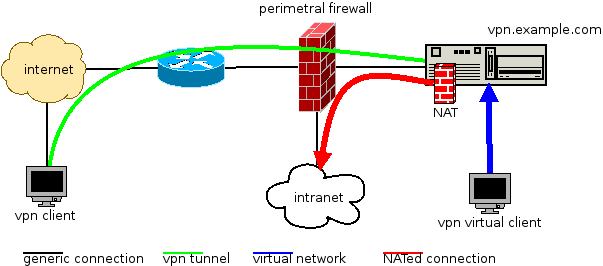
Debian Openvpn Debian Stretch feels like an excellent release by the Debian project. The final stable release is about to happen in the short term. Among the great things you can do with Debian, you could set up a VPN using the openvpn software. In this blog post I will describe how I ve deployed myself an openvpn server using Debian Stretch, my network environment and my configurations & workflow. Before all, I would like to reference my requisites and the characteristics of what I needed: I agree this is a rather complex scenario and not all the people will face these requirements. The service diagram has this shape: VPN diagram (DIA source file) So, it works like this:
  1. clients connect via internet to our openvpn server, vpn.example.com
  2. the openvpn server validates the connection and the tunnel is established (green)
  3. now the client is virtually inside our network (blue)
  4. the client wants to access some intranet resource, the tunnel traffic is NATed (red)
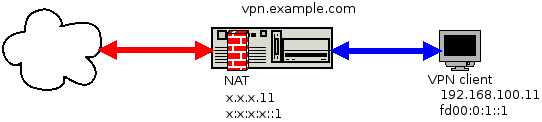
Our datacenter intranet is using public IPv4 addressing, but the VPN tunnels use private IPv4 addresses. To don t mix public and private address NAT is used. Obviously we don t want to invest public IPv4 addresses in our internal tunnels. We don t have this limitations in IPv6, we could use public IPv6 addresses within the tunnels. But we prefer sticking to a hard dual stack IPv4/IPv6 approach and also use private IPv6 addresses inside the tunnels and also NAT the IPv6 from private to public. This way, there are no differences in how IPv4 and IPv6 network are managed. We follow this approach for the addressing: The NAT runs in the VPN server, since this is kind of a router. We use nftables for this task. As the final win, I will describe how we manage all this configuration using the git version control system. Using git we can track which admin made which change. A git hook will deploy the files from the git repo itself to /etc/ so the services can read them. The VPN server networking configuration is as follows (/etc/network/interfaces file, adjust to your network environments):
auto lo
iface lo inet loopback
# main public IPv4 address of vpn.example.com
allow-hotplug eth0
iface eth0 inet static
        address x.x.x.4
        netmask 255.255.255.0
        gateway x.x.x.1
# main public IPv6 address of vpn.example.com
iface eth0 inet6 static
        address x:x:x:x::4
        netmask 64
        gateway x:x:x:x::1
# NAT Public IPv4 addresses (used to NAT tunnel of client 1)
auto eth0:11
iface eth0:11 inet static
        address x.x.x.11
        netmask 255.255.255.0
# NAT Public IPv6 addresses (used to NAT tunnel of client 1)
iface eth0:11 inet6 static
        address x:x:x:x::11
        netmask 64
# NAT Public IPv4 addresses (used to NAT tunnel of client 2)
auto eth0:12
iface eth0:12 inet static
        address x.x.x.12
        netmask 255.255.255.0
# NAT Public IPv6 addresses (used to NAT tunnel of client 2)
iface eth0:12 inet6 static
        address x:x:x:x::12
        netmask 64
Thanks to the amazing and tireless work of the Alberto Gonzalez Iniesta (DD), the openvpn package in debian is in very good shape, ready to use. In vpn.example.com, install the required packages:
% sudo aptitude install openvpn openvpn-auth-ldap nftables git sudo
Two git repositories will be used, one for the openvpn configuration and another for nftables (the nftables config is described later):
% sudo mkdir -p /srv/git/vpn.example.com-nft.git
% sudo git init --bare /srv/git/vpn.example.com-nft.git
% sudo mkdir -p /srv/git/vpn.example.com-openvpn.git
% sudo git init --bare /srv/git/vpn.example.com-openvpn.git
% sudo chown -R :git /srv/git/*
% sudo chmod -R g+rw /srv/git/*
The repositories belong to the git group, a system group we create to let systems admins operate the server using git:
% sudo addgroup --system git
% sudo adduser admin1 git
% sudo adduser admin2 git
For the openvpn git repository, we need at least this git hook (file /srv/git/vpn.example.com-openvpn.git/hooks/post-receive with execution permission):
#!/bin/bash
NAME="hooks/post-receive"
OPENVPN_ROOT="/etc/openvpn"
export GIT_WORK_TREE="$OPENVPN_ROOT"
UNAME=$(uname -n)
info()
 
        echo "$ UNAME  $ NAME  $1 ..."
 
info "checkout latest data to $GIT_WORK_TREE"
sudo git checkout -f
info "cleaning untracked files and dirs at $GIT_WORK_TREE"
sudo git clean -f -d
For this hook to work, sudo permissions are required (file /etc/sudoers.d/openvpn-git):
User_Alias      OPERATORS = admin1, admin2
Defaults        env_keep += "GIT_WORK_TREE"
 
OPERATORS       ALL=(ALL) NOPASSWD:/usr/bin/git checkout -f
OPERATORS       ALL=(ALL) NOPASSWD:/usr/bin/git clean -f -d
Please review this sudoers file to match your environment and security requirements. The openvpn package deploys several systemd services:
% dpkg -L openvpn   grep service
/lib/systemd/system/openvpn-client@.service
/lib/systemd/system/openvpn-server@.service
/lib/systemd/system/openvpn.service
/lib/systemd/system/openvpn@.service
We don t need all of them, we can use the simple openvpn.service:
% sudo systemctl edit --full openvpn.service
And put a content like this:
% systemctl cat openvpn.service
# /etc/systemd/system/openvpn.service
[Unit]
Description=OpenVPN server
Documentation=man:openvpn(8)
Documentation=https://community.openvpn.net/openvpn/wiki/Openvpn23ManPage
Documentation=https://community.openvpn.net/openvpn/wiki/HOWTO
 
[Service]
PrivateTmp=true
KillMode=mixed
Type=forking
ExecStart=/usr/sbin/openvpn --daemon ovpn --status /run/openvpn/%i.status 10 --cd /etc/openvpn --config /etc/openvpn/server.conf --writepid /run/openvpn/server.pid
PIDFile=/run/openvpn/server.pid
ExecReload=/bin/kill -HUP $MAINPID
WorkingDirectory=/etc/openvpn
ProtectSystem=yes
CapabilityBoundingSet=CAP_IPC_LOCK CAP_NET_ADMIN CAP_NET_BIND_SERVICE CAP_NET_RAW CAP_SETGID CAP_SETUID CAP_SYS_CHROOT CAP_DAC_READ_SEARCH CAP_AUDIT_WRITE
LimitNPROC=10
DeviceAllow=/dev/null rw
DeviceAllow=/dev/net/tun rw
 
[Install]
WantedBy=multi-user.target
We can move on now to configure nftables to perform the NATs. First, it s good to load the NAT configuration at boot time, so you need a service file like this (/etc/systemd/system/nftables.service):
[Unit]
Description=nftables
Documentation=man:nft(8) http://wiki.nftables.org
 
[Service]
Type=oneshot
RemainAfterExit=yes
StandardInput=null
ProtectSystem=full
ProtectHome=true
WorkingDirectory=/etc/nftables.d
ExecStart=/usr/sbin/nft -f ruleset.nft
ExecReload=/usr/sbin/nft -f ruleset.nft
ExecStop=/usr/sbin/nft flush ruleset
 
[Install]
WantedBy=multi-user.target
The nftables git hooks are implemented as described in nftables managed with git. We are interested in the git hooks: (file /srv/git/vpn.example.com-nft.git/hooks/post-receive):
#!/bin/bash
NAME="hooks/post-receive"
NFT_ROOT="/etc/nftables.d"
RULESET="$ NFT_ROOT /ruleset.nft"
export GIT_WORK_TREE="$NFT_ROOT"
UNAME=$(uname -n)
info()
 
        echo "$ UNAME  $ NAME  $1 ..."
 
info "checkout latest data to $GIT_WORK_TREE"
sudo git checkout -f
info "cleaning untracked files and dirs at $GIT_WORK_TREE"
sudo git clean -f -d
info "deploying new ruleset"
set -e
cd $NFT_ROOT && sudo nft -f $RULESET
info "new ruleset deployment was OK"
This hook moves our nftables configuration to /etc/nftables.d and then applies it to the kernel. So a single commit changes the runtime configuration of the server. You could implement some QA using the git hook update, check this file! Remember, git hooks requires exec permissions to work. Of course, you will need again a sudo policy for these nft hooks. Finally, we can start configuring both openvpn and nftables using git. For the VPN you will require the configure the PKI side: server certificates, and the CA signing your client s certificates. You can check openvpn s own documentation about this. Your first commit for openvpn could be the server.conf file:
plugin		/usr/lib/openvpn/openvpn-plugin-auth-pam.so common-auth
mode		server
user		nobody
group		nogroup
port		1194
proto		udp6
daemon
comp-lzo
persist-key
persist-tun
tls-server
cert		/etc/ssl/private/vpn.example.com_pub.crt
key		/etc/ssl/private/vpn.example.com_priv.pem
ca		/etc/ssl/cacert/clients_ca.pem
dh		/etc/ssl/certs/dh2048.pem
cipher		AES-128-CBC
dev		tun
topology	subnet
server		192.168.100.0 255.255.255.0
server-ipv6	fd00:0:1:35::/64
ccd-exclusive
client-config-dir ccd
max-clients	100
inactive	43200
keepalive	10 360
log-append	/var/log/openvpn.log
status		/var/log/openvpn-status.log
status-version	1
verb		4
mute		20
Don t forget the ccd/ directory. This directory contains a file per user using the VPN service. Each file is named after the CN of the client certificate:
# private addresses for client 1
ifconfig-push		192.168.100.11 255.255.255.0
ifconfig-ipv6-push	fd00:0:1::11/64
# routes to the intranet network
push "route-ipv6 x:x:x:x::/64"
push "route x.x.3.128 255.255.255.240"
# private addresses for client 2
ifconfig-push		192.168.100.12 255.255.255.0
ifconfig-ipv6-push	fd00:0:1::12/64
# routes to the intranet network
push "route-ipv6 x:x:x:x::/64"
push "route x.x.3.128 255.255.255.240"
You end with at leats these files in the openvpn git tree:
server.conf
ccd/CN=CLIENT_1
ccd/CN=CLIENT_2
Please note that if you commit a change to ccd/, the changes are read at runtime by openvpn. In the other hand, changes to server.conf require you to restart the openvpn service by hand. Remember, the addressing is like this: Addressing (DIA source file) In the nftables git tree, you should put a ruleset like this (a single file named ruleset.nft is valid):
flush ruleset
table ip nat  
	map mapping_ipv4_snat  
		type ipv4_addr : ipv4_addr
		elements =  	192.168.100.11 : x.x.x.11,
				192.168.100.12 : x.x.x.12  
	 
	map mapping_ipv4_dnat  
		type ipv4_addr : ipv4_addr
		elements =  	x.x.x.11 : 192.168.100.11,
				x.x.x.12 : 192.168.100.12  
	 
	chain prerouting  
		type nat hook prerouting priority -100; policy accept;
		dnat to ip daddr map @mapping_ipv4_dnat
	 
	chain postrouting  
		type nat hook postrouting priority 100; policy accept;
		oifname "eth0" snat to ip saddr map @mapping_ipv4_snat
	 
 
table ip6 nat  
	map mapping_ipv6_snat  
		type ipv6_addr : ipv6_addr
		elements =  	fd00:0:1::11 : x:x:x::11,
				fd00:0:1::12 : x:x:x::12  
	 
	map mapping_ipv6_dnat  
		type ipv6_addr : ipv6_addr
		elements =  	x:x:x::11 : fd00:0:1::11,
				x:x:x::12 : fd00:0:1::12  
	 
	chain prerouting  
		type nat hook prerouting priority -100; policy accept;
		dnat to ip6 daddr map @mapping_ipv6_dnat
	 
	chain postrouting  
		type nat hook postrouting priority 100; policy accept;
		oifname "eth0" snat to ip6 saddr map @mapping_ipv6_snat
	 
 
table inet filter  
	chain forward  
		type filter hook forward priority 0; policy accept;
		# some forwarding filtering policy, if required, for both IPv4 and IPv6
	 
 
Since the server is in fact routing packets between the tunnel and the public network, we require forwarding enabled in sysctl:
net.ipv4.conf.all.forwarding = 1
net.ipv6.conf.all.forwarding = 1
Of course, the VPN clients will require a client.conf file which looks like this:
client
remote vpn.example.com 1194
dev tun
proto udp
resolv-retry infinite
comp-lzo
verb 5
nobind
persist-key
persist-tun
user nobody
group nogroup
 
tls-client
ca      /etc/ssl/cacert/server_ca.crt
pkcs12  /home/user/mycertificate.p12
verify-x509-name vpn.example.com name
cipher AES-128-CBC
auth-user-pass
auth-nocache
Workflow for the system admins:
  1. git clone the openvpn repo
  2. modify ccd/ and server.conf
  3. git commit the changes, push to the server
  4. if server.conf was modified, restart openvpn
  5. git clone the nftables repo
  6. modify ruleset
  7. git commit the changes, push to the server
Comments via email welcome!

Dirk Eddelbuettel: #3: Follow R-devel

Welcome to the third post in the rarely relevant R recommendation series, or R4 for short. Today will be brief, but of some importance. In order to know where R is going next, few places provide a better vantage point than the actual ongoing development. A few years ago, I mentioned to Duncan Murdoch how straightforward the setup of my CRANberries feed (and site) was. After all, static blog compilers converting textual input to html, rss feed and whatnot have been around for fifteen years (though they keep getting reinvented). He took this to heart and built the (not too pretty) R-devel daily site (which also uses a fancy diff tool as it shows changes in NEWS) as well as a more general description of all available sub-feeds. I follow this mostly through blog aggregations -- Google Reader in its day, now Feedly. A screenshot is below just to show that it doesn't have to be ugly just because it is on them intertubes:
This shows a particularly useful day when R-devel folded into the new branch for what will be the R 3.4.0 release come April 21. The list of upcoming changes is truly impressive and quite comprehensive -- and the package registration helper, focus of posts #1 and #2 here, is but one of these many changes. One function I learned about that day is tools::CRAN_package_db(), a helper to get a single (large) data.frame with all package DESCRIPTION information. Very handy. Others may have noticed that CRAN repos now have a new top-level file PACKAGES.rds and this function does indeed just fetch it--which you could do with a similar one-liner in R-release as well. Still very handy. But do read about changes in R-devel and hence upcoming changes in R 3.4.0. Lots of good things coming our way.

This post by Dirk Eddelbuettel originated on his Thinking inside the box blog. Please report excessive re-aggregation in third-party for-profit settings.

1 April 2017

David Kalnischkies: Winning the Google Open Source Lottery

I don't know about you, but I frequently get mails announcing that I was picked as the lucky winner of a lottery, compensation program or simply as "business associate". Obvious Spam of course, that never happens in reality. Just like my personal "favorite" at the moment: Mails notifying me of inheritance from a previously (more or less) unknown relative. Its just that this is what has happend basically a few weeks ago in reality to me (over the phone through) and I am still dealing with the bureaucracy required of teaching the legal system that I have absolutely no intention of becoming the legal successor of someone I haven't seen in 20 years, regardless of how close the family relation is on paper but that might be the topic of another day. On the 1st March a mail titled "Google Open Source Peer Bonus Program" looked at first as if it would fall into this lottery spam class. It didn't exactly help that the mail was multipart HTML and text, but the text really only the text, not mentioning the embedded links used in the HTML part. It even included a prominent and obvious red flag: "Please fill out the form". 20% Bayes score didn't come from nothing. Still, for better or worse the words "Open Source" made it unlikely to be spam similar to how the word PGP indicates authenticity. So it happened, another spam message became true for me. I wonder which one will be next You have probably figured out by now that I didn't know that program before. Kinda embarrassing for a previous Google Summer of Code student (GSoC is run by the same office), but the idea behind it is simple: Google employees can nominate contributors to open source stuff for a small monetary "thank you!" gift card. Earlier this week winners for this round were announced 52 contributors including yours truly. You might be surprised, but the rational given behind my name is APT (I got a private mail with the full rational from my "patron", just in case you wonder if at least I would know more). It is funny how a guy who was taken aback by the prospect of needing a package manager like YaST to use Linux contributed just months later the first patch to apt and has roughly 8 years later amassed more than 2400 commits. It's birthday season in my family with e.g. mine just a few days ago, so its seems natural that apt has its own birthday today just as if it would be part of my family: 19th years this little bundle of bugs joy is now! In more sober moments I wonder sometimes how apt and I would have turned out if we hadn't meet. Would apt have met someone else? Would I? Given that I am still the newest team member and only recently joined Debian as DD at all APT has some strange ways of showing that it loves you: It e.g. helps users compose mails which end in a dilemma to give a recent example. Perhaps you need to be a special kind of crazy1 to consider this good, but as I see it apt has a big enough userbase that regardless of what your patch is doing, someone will like it. That drastically increases the chances that someone will also like it enough to say so in public offsetting complains from all those who don't like the (effects of the) patch which are omnipresent. And twice in a blue moon some of those will even step forward and thank you explicitly. Not that it would be necessary, but it is nice anyhow. So, thanks for the love supercow, Google & apt users! Or in other words: APT might very well be one of the most friendly (package manager related) project to contribute to as the language-specific managers have smaller userbases and hence a smaller chance of having someone liking your work (in public) so contribute a patch or two and be loved, too! Disclaimer: I get no bonus for posting this nor are any other strings attached. Birthdays are just a good time to reflect. In terms of what I do with my new found riches (in case I really receive them I haven't yet so that could still be an elaborate scam ): APT is a very humble program, but even it is thinking about moving away from a dev-box with less than 4 GB of RAM and no SSD, so it is happily accepting the gift and expects me to upgrade sooner now. What kind of precedence this sets for the two decades milestone next year? If APT isn't obsolete by then We will see.

  1. which even ended up topping Hacker News around New Year's Eve who would have thought that apt and reproducibility bugs are top news ;)

31 March 2017

Chris Lamb: Free software activities in March 2017

Here is my monthly update covering what I have been doing in the free software world (previous month):
Reproducible builds

Whilst anyone can inspect the source code of free software for malicious flaws, most software is distributed pre-compiled to end users. The motivation behind the Reproducible Builds effort is to permit verification that no flaws have been introduced either maliciously or accidentally during this compilation process by promising identical results are always generated from a given source, thus allowing multiple third-parties to come to a consensus on whether a build was compromised. I have generously been awarded a grant from the Core Infrastructure Initiative to fund my work in this area. This month I:
I also made the following changes to our tooling:
diffoscope

diffoscope is our in-depth and content-aware diff utility that can locate and diagnose reproducibility issues.

  • New features/optimisations:
    • Extract squashfs archive in one go rather than per-file, speeding up ISO comparison by ~10x.
    • Add support for .docx and .odt files via docx2txt & odt2txt. (#859056).
    • Add support for PGP files via pgpdump. (#859034).
    • Add support for comparing Pcap files. (#858867).
    • Compare GIF images using gifbuild. (#857610).
  • Bug fixes:
    • Ensure that we really are using ImageMagick and not the GraphicsMagick compatibility layer. (#857940).
    • Fix and add test for meaningless 1234-content metadata when introspecting archives. (#858223).
    • Fix detection of ISO9660 images processed with isohybrid.
    • Skip icc tests if the Debian-specific patch is not present. (#856447).
    • Support newer versions of cbfstool to avoid test failures. (#856446).
    • Update the progress bar prior to working to ensure filename is in sync.
  • Cleanups:
    • Use /usr/share/dpkg/pkg-info.mk over manual calls to dpkg-parsechangelog in debian/rules.
    • Ensure tests and the runtime environment can locate binaries in /usr/sbin (eg. tcpdump).

strip-nondeterminism

strip-nondeterminism is our tool to remove specific non-deterministic results from a completed build.

  • Fix a possible endless loop while stripping .ar files due to trusting the file's own file size data. (#857975).
  • Add support for testing files we should reject and include the filename when evaluating fixtures.

buildinfo.debian.net

buildinfo.debian.net is my experiment into how to process, store and distribute .buildinfo files after the Debian archive software has processed them.

  • Add support for Format: 1.0. (#20).
  • Don't parse Format: header as the source package version. (#21).
  • Show the reproducible status of packages.


Debian


I submitted my platform for the 2017 Debian Project Leader Elections. This was subsequently covered on LWN and I have been participating in the discussions on the debian-vote mailing list since then.


Debian LTS

This month I have been paid to work 14.75 hours on Debian Long Term Support (LTS). In that time I did the following:
  • "Frontdesk" duties, triaging CVEs, etc.
  • Issued DLA 848-1 for the freetype font library fixing a denial of service vulnerability.
  • Issued DLA 851-1 for wget preventing a header injection attack.
  • Issued DLA 863-1 for the deluge BitTorrent client correcting a cross-site request forgery vulnerability.
  • Issued DLA 864-1 for jhead (an EXIF metadata tool) patching an arbitrary code execution vulnerability.
  • Issued DLA 865-1 for the suricata intrusion detection system, fixing an IP protocol matching error.
  • Issued DLA 871-1 for python3.2 fixing a TLS stripping vulnerability in the smptlib library.
  • Issued DLA 873-1 for apt-cacher preventing a HTTP response splitting vulnerability.
  • Issued DLA 876-1 for eject to prevent an issue regarding the checking of setuid(2) and setgid(2) return values.

Uploads
  • python-django:
    • 1:1.10.6-1 New upstream bugfix release.
    • 1:1.11~rc1-1 New upstream release candidate.
  • redis:
    • 3:3.2.8-2 Avoid conflict between RuntimeDirectory and tmpfiles.d(5) both attempting to create /run/redis with differing permissions. (#856116)
    • 3:3.2.8-3 Revert the creation of a /usr/bin/redis-check-rdb to /usr/bin/redis-server symlink to avoid a dangling symlink if only the redis-tools package is installed. (#858519)
  • gunicorn 19.7.0-1 & 19.7.1-1 New upstream releases.
  • adminer 4.3.0-1 New upstream release.

Finally, I also made the following non-maintainer uploads (NMUs):


FTP Team

As a Debian FTP assistant I ACCEPTed 121 packages: 4pane, adql, android-platform-system-core, android-sdk-helper, braillegraph, deepnano, dh-runit, django-auth-ldap, django-dirtyfields, drf-extensions, gammaray, gcc-7, gnome-keysign, golang-code.gitea-sdk, golang-github-bluebreezecf-opentsdb-goclient, golang-github-bsm-redeo, golang-github-cupcake-rdb, golang-github-denisenkom-go-mssqldb, golang-github-exponent-io-jsonpath, golang-github-facebookgo-ensure, golang-github-facebookgo-freeport, golang-github-facebookgo-grace, golang-github-facebookgo-httpdown, golang-github-facebookgo-stack, golang-github-facebookgo-subset, golang-github-go-openapi-loads, golang-github-go-openapi-runtime, golang-github-go-openapi-strfmt, golang-github-go-openapi-validate, golang-github-golang-geo, golang-github-gorilla-pat, golang-github-gorilla-securecookie, golang-github-issue9-assert, golang-github-issue9-identicon, golang-github-jaytaylor-html2text, golang-github-joho-godotenv, golang-github-juju-errors, golang-github-kisielk-gotool, golang-github-kubernetes-gengo, golang-github-lpabon-godbc, golang-github-lunny-log, golang-github-makenowjust-heredoc, golang-github-mrjones-oauth, golang-github-nbutton23-zxcvbn-go, golang-github-neelance-sourcemap, golang-github-ngaut-deadline, golang-github-ngaut-go-zookeeper, golang-github-ngaut-log, golang-github-ngaut-pools, golang-github-ngaut-sync2, golang-github-optiopay-kafka, golang-github-quobyte-api, golang-github-renstrom-dedent, golang-github-sergi-go-diff, golang-github-siddontang-go, golang-github-smartystreets-go-aws-auth, golang-github-xanzy-go-cloudstack, golang-github-xtaci-kcp, golang-github-yohcop-openid-go, graywolf, haskell-raaz, hfst-ospell, hikaricp, iptraf-ng, kanboard-cli, kcptun, kreport, libbluray, libcatmandu-store-elasticsearch-perl, libcsfml, libnet-prometheus-perl, libosmocore, libpandoc-wrapper-perl, libseqlib, matrix-synapse, mockldap, nfs-ganesha, node-buffer, node-pako, nose-el, nvptx-tools, nx-libs, open-ath9k-htc-firmware, pagein, paleomix, pgsql-ogr-fdw, profanity, pyosmium, python-biotools, python-django-extra-views, python-django-otp, python-django-push-notifications, python-dnslib, python-gmpy, python-gmpy2, python-holidays, python-kanboard, python-line-profiler, python-pgpy, python-pweave, python-raven, python-xapian-haystack, python-xopen, r-cran-v8, repetier-host, ruby-jar-dependencies, ruby-maven-libs, ruby-psych, ruby-retriable, seafile-client, spyder-unittest, stressant, systray-mdstat, telegram-desktop, thawab, tigris, tnseq-transit, typesafe-config, vibe.d, x2goserver & xmlrpc-c. I additionally filed 14 RC bugs against packages that had incomplete debian/copyright files against: golang-github-cupcake-rdb, golang-github-sergi-go-diff, graywolf, hfst-ospell, libbluray, pgsql-ogr-fdw, python-gmpy, python-gmpy2, python-pgpy, python-xapian-haystack, repetier-host, telegram-desktop, tigris & xmlrpc-c.

Enrico Zini: Raspberry Pi as a Hi-Fi component

I have a 25 years old Technics hifi system that still works fine, and I gave it a new life by replacing the CD player and cassette player modules with a Raspberry Pi. Technics hifi with a Raspberry Pi attached Connection Each component of the hifi has a mains input and a mains plug that is used to power the next component. The element where the main power lead goes in is the radio component, which has a remote control receiver, a watch and a timer, and will power on the rest of the system when turned on by its power button, the remote control, or the alarm function. I disconnected the cassette and cd player modules, and plugged the Raspberry Pi phone charger/power supply in the free plug behind the amplifier module, at the end of the (now very short) power lead chain. I also connected the audio output of the Raspberry Pi to the CD input of my stereo. The advantage of CD over AUX is that the remote control buttons for switching audio sources don't cover the AUX inputs. With alsamixer I adjusted the output volume to match that of the radio component, so that I can switch between the two without surprising jumps in volume. I used alsactl store to save the mixer levels. Now when I turn the hifi on I also turn the Raspberry Pi on, and when I turn the hifi off, I also cut power from the Raspberry Pi. Operating system Operating system install instructions:
  1. I downloaded a Raspbian Jessie Lite image
  2. I put it on an SD card
  3. I created an empty ssh file on the boot partition
  4. I put the SD card on the Raspberry Pi and turned on the stereo.
  5. ssh pi@raspberrypi password raspberry
  6. sudo raspi-config to change the hostname, the password, and to enlarge the root partition to include all the rest of the space available in the SD card.
Music Player Daemon This is the set up of the music player part, with mpd.
apt install mpd
The configuration file is /etc/mpd.conf. The changes I made are: Make mpd accessible from my local network:
bind_to_address         "any"
Make mpd discoverable:
zeroconf_enabled                "yes"
zeroconf_name                   "stereo"
Allow anyone who visits me to control the playlist, and only me to run admin functions:
password                        "SECRET@read,add,control,admin"
default_permissions             "read,add,control"
At my first try, mpd hung when changing songs. I had to disable dmix by uncommenting the device option in the audio_output configuration. use_mmap is cargo-culted from the archlinux wiki.
audio_output  
        type            "alsa"
        name            "My ALSA Device"
        device          "hw:0,0"        # optional
        use_mmap        "yes"
 
If at some point I'll decide to use other audio software on the system, I'll probably want to play via pulseaudio. Sending music to the stereo I made a little script to sync the music directory on my laptop with /var/lib/mpd/music:
#!/bin/sh
rsync -avz --filter=". sync-stereo.filter" --copy-links --prune-empty-dirs --delete ./ pi@stereo:/var/lib/mpd/music
ssh pi@stereo "chmod u=rwX,go=rX -R /var/lib/mpd/music"
It uses this sync-stereo.filter rules file for rsync:
hide /_archive
include */
include **.mp3
hide *
mpd clients mpc
$ mpc -h stereo status
UltraCat - Unexpected Little Happenings
[playing] #15/22   0:03/4:06 (1%)
volume: 80%   repeat: off   random: on    single: off   consume: off
M.A.L.P. On my phone I installed M.A.L.P. and now I have a remote control for mpd. In its settings, I made a profile for home where I just had to set the hostname for the stereo and the admin password. Cantata On my laptop I installed cantata, set the hostname and password in the preferences, and had the client ready. Profit! Now I can take the remote control of my hi-fi, turn it on, and after a while mpd will resume playing the song that was playing when I last shut it down. I also have realtime player status on my phone and on my laptop, and can control music from either at any time. Friends who visit me can do that as well. Everything was rather straightforward, well documented and easy to replicate. The hardware is cheap and very easy to come by.

29 March 2017

Dirk Eddelbuettel: #1: Easy Package Registration

Welcome to the first actual post in the R4 series, following the short announcement earlier this week.

Context Last month, Brian Ripley announced on r-devel that registration of routines would now be tested for by R CMD check in r-devel (which by next month will become R 3.4.0). A NOTE will be issued now, this will presumably turn into a WARNING at some point. Writing R Extensions has an updated introduction) of the topic. Package registration has long been available, and applies to all native (i.e. "compiled") function via the .C(), .Call(), .Fortran() or .External() interfaces. If you use any of those -- and .Call() may be the only truly relevant one here -- then is of interest to you. Brian Ripley and Kurt Hornik also added a new helper function: tools::package_native_routine_registration_skeleton(). It parses the R code of your package and collects all native function entrypoints in order to autogenerate the registration. It is available in R-devel now, will be in R 3.4.0 and makes adding such registration truly trivial. But as of today, it requires that you have R-devel. Once R 3.4.0 is out, you can call the helper directly. As for R-devel, there have always been at least two ways to use it: build it locally (which we may cover in another R4 installment), or using Docker. Here will focus on the latter by relying on the Rocker project by Carl and myself.

Use the Rocker drd Image We assume you can run Docker on your system. How to add it on Windows, macOS or Linux is beyond our scope here today, but also covered extensively elsewhere. So we assume you can execute docker and e.g. bring in the 'daily r-devel' image drd from our Rocker project via
~$ docker pull rocker/drd
With that, we can use R-devel to create the registration file very easily in a single call (which is a long command-line we have broken up with one line-break for the display below). The following is real-life example when I needed to add registration to the RcppTOML package for this week's update:
~/git/rcpptoml(master)$ docker run --rm -ti -v $(pwd):/mnt rocker/drd \  ## line break
             RD --slave -e 'tools::package_native_routine_registration_skeleton("/mnt")'
#include <R.h>
#include <Rinternals.h>
#include <stdlib.h> // for NULL
#include <R_ext/Rdynload.h>
/* FIXME: 
   Check these declarations against the C/Fortran source code.
*/
/* .Call calls */
extern SEXP RcppTOML_tomlparseImpl(SEXP, SEXP, SEXP);
static const R_CallMethodDef CallEntries[] =  
     "RcppTOML_tomlparseImpl", (DL_FUNC) &RcppTOML_tomlparseImpl, 3 ,
     NULL, NULL, 0 
 ;
void R_init_RcppTOML(DllInfo *dll)
 
    R_registerRoutines(dll, NULL, CallEntries, NULL, NULL);
    R_useDynamicSymbols(dll, FALSE);
 
edd@max:~/git/rcpptoml(master)$ 

Decompose the Command We can understand the docker command invocation above through its components:
  • docker run is the basic call to a container
  • --rm -ti does subsequent cleanup (--rm) and gives a terminal (-t) that is interactive (-i)
  • -v $(pwd):/mnt uses the -v a:b options to make local directory a available as b in the container; here $(pwd) calls print working directory to get the local directory which is now mapped to /mnt in the container
  • rocker/drd invokes the 'drd' container of the Rocker project
  • RD is a shorthand to the R-devel binary inside the container, and the main reason we use this container
  • -e 'tools::package_native_routine_registration_skeleton("/mnt") calls the helper function of R (currently in R-devel only, so we use RD) to compute a possible init.c file based on the current directory -- which is /mnt inside the container
That it. We get a call to the R function executed inside the Docker container, examining the package in the working directory and creating a registration file for it which is display to the console.

Copy the Output to src/init.c We simply copy the output to a file src/init.c; I often fold one opening brace one line up.

Update NAMESPACE We also change one line in NAMESPACE from (for this package) useDynLib("RcppTOML") to useDynLib("RcppTOML", .registration=TRUE). Adjust accordingly for other package names.

That's it! And with that we a have a package which no longer provokes the NOTE as seen by the checks page. Calls to native routines are now safer (less of a chance for name clashing), get called quicker as we skip the symbol search (see the WRE discussion) and best of all this applies to all native routines whether written by hand or written via a generator such as Rcpp Attributes. So give this a try to get your package up-to-date.

This post by Dirk Eddelbuettel originated on his Thinking inside the box blog. Please report excessive re-aggregation in third-party for-profit settings.

28 March 2017

Axel Beckert: Maintaining Debian Packages of Perl Modules with dh-dist-zilla

Maintaining Debian packages of Perl modules usually can be done with the common git-buildpackage (aka gbp) workflow with its three git branches master (or debian), upstream and pristine-tar: This also works more or less fine for Perl modules, where the Debian package maintainer is also the upstream developer. In that case mostly the upstream branch is used (and then maybe called master while the Debian packaging branch is then called debian). But the files needed for a proper so called CPAN distribution of a Perl module often contain redundant information (version numbers, required modules, etc.) which needs to be maintained. And for that, many people prefer Don t Repeat Yourself (DRY) as a principle. Dist::Zilla One nice and common tool for that is Dist::Zilla or short dzil. It generates most redundant but required data out of a central source, e.g. Dist::Zilla s dist.ini or the contained .pm files, etc. dzil build creates tar ball which contains all files necessary by CPAN. But now we have a dilemma: Debian expects those generated files inside the upstream branch while the files are only generated from other files in that branch. There are multiple solutions, but all of them involve committing generated files to the git repository: librun-parts-perl aka Run::Parts (a Perl wrapper around and a pure-perl implementation of Debian s run-parts tool) was initially maintained in the latter way. But especially in cases where we just need a Perl module packaged as .deb without uploading it to CPAN (e.g. project-internal modules), this is a tedious workflow and overkill. It would be much nicer if debhelper would just call dzil to generate all the stuff it needs to build the package. dh-dist-zilla Well, you can do that now, at least with Debian Jessie. This is what dh-dist-zilla does: It is a debhelper sequence plugin which calls dzil build and dzil clean in the right moment and takes care that all dh_auto_* commands look in the directory with the generated files instead of the rather clean project root directory. To use dh-dist-zilla, you just need to add a build-dependency on it and the Dist::Zilla plugins you use, and add --with dist-zilla to your minimal dh-style debian/rules file:
#!/usr/bin/make -f
%:
	dh $@ --with dist-zilla
That s it. With regards to workflow and git branches, you may still want to use separate branches for upstream work and debian work, and you may want to continue to use pristine-tar, but you don t have to commit generated files to git anymore and you can maintain a clean master branch with nearly no redundancy. And if you need to generate to final upstream tar ball for you debian package, just call dh get-orig-source or maybe easier to use with tab completion dh_dist_zilla_origtar. This is how the librun-parts-perl package is maintained nowadays. There s otherwise not much difference to the old, classically maintained versions. More DRY Next step in the DRY evolution is to reduce redundancies between upstream (Dist::Zilla based) packaging and the Debian packaging. There are a few tools available, partially brand new, partially not yet packaged: I wouldn t be surprised if there s more to come in this area. P.S.: I actually started this blog posting in September 2014 and never finished it until now. Had to kick out some already outdated again stuff, but also could add some more recent things.

23 March 2017

Simon McVittie: GTK hackfest 2017: D-Bus communication with containers

At the GTK hackfest in London (which accidentally became mostly a Flatpak hackfest) I've mainly been looking into how to make D-Bus work better for app container technologies like Flatpak and Snap. The initial motivating use cases are: At the moment, Flatpak runs a D-Bus proxy for each app instance that has access to D-Bus, connects to the appropriate bus on the app's behalf, and passes messages through. That proxy is in a container similar to the actual app instance, but not actually the same container; it is trusted to not pass messages through that it shouldn't pass through. The app-identification mechanism works in practice, but is Flatpak-specific, and has a known race condition due to process ID reuse and limitations in the metadata that the Linux kernel maintains for AF_UNIX sockets. In practice the use of X11 rather than Wayland in current systems is a much larger loophole in the container than this race condition, but we want to do better in future. Meanwhile, Snap does its sandboxing with AppArmor, on kernels where it is enabled both at compile-time (Ubuntu, openSUSE, Debian, Debian derivatives like Tails) and at runtime (Ubuntu, openSUSE and Tails, but not Debian by default). Ubuntu's kernel has extra AppArmor features that haven't yet gone upstream, some of which provide reliable app identification via LSM labels, which dbus-daemon can learn by querying its AF_UNIX socket. However, other kernels like the ones in openSUSE and Debian don't have those. The access-control (AppArmor mediation) is implemented in upstream dbus-daemon, but again doesn't work portably, and is not sufficiently fine-grained or flexible to do some of the things we'll likely want to do, particularly in dconf. After a lot of discussion with dconf maintainer Allison Lortie and Flatpak maintainer Alexander Larsson, I think I have a plan for fixing this. This is all subject to change: see fd.o #100344 for the latest ideas. Identity model Each user (uid) has some uncontained processes, plus 0 or more containers. The uncontained processes include dbus-daemon itself, desktop environment components such as gnome-session and gnome-shell, the container managers like Flatpak and Snap, and so on. They have the user's full privileges, and in particular they are allowed to do privileged things on the user's session bus (like running dbus-monitor), and act with the user's full privileges on the system bus. In generic information security jargon, they are the trusted computing base; in AppArmor jargon, they are unconfined. The containers are Flatpak apps, or Snap apps, or other app-container technologies like Firejail and AppImage (if they adopt this mechanism, which I hope they will), or even a mixture (different app-container technologies can coexist on a single system). They are containers (or container instances) and not "apps", because in principle, you could install com.example.MyApp 1.0, run it, and while it's still running, upgrade to com.example.MyApp 2.0 and run that; you'd have two containers for the same app, perhaps with different permissions. Each container has an container type, which is a reversed DNS name like org.flatpak or io.snapcraft representing the container technology, and an app identifier, an arbitrary non-empty string whose meaning is defined by the container technology. For Flatpak, that string would be another reversed DNS name like com.example.MyGreatApp; for Snap, as far as I can tell it would look like example-my-great-app. The container technology can also put arbitrary metadata on the D-Bus representation of a container, again defined and namespaced by the container technology. For instance, Flatpak would use some serialization of the same fields that go in the Flatpak metadata file at the moment. Finally, the container has an opaque container identifier identifying a particular container instance. For example, launching com.example.MyApp twice (maybe different versions or with different command-line options to flatpak run) might result in two containers with different privileges, so they need to have different container identifiers. Contained server sockets App-container managers like Flatpak and Snap would create an AF_UNIX socket inside the container, bind() it to an address that will be made available to the contained processes, and listen(), but not accept() any new connections. Instead, they would fd-pass the new socket to the dbus-daemon by calling a new method, and the dbus-daemon would proceed to accept() connections after the app-container manager has signalled that it has called both bind() and listen(). (See fd.o #100344 for full details.) Processes inside the container must not be allowed to contact the AF_UNIX socket used by the wider, uncontained system - if they could, the dbus-daemon wouldn't be able to distinguish between them and uncontained processes and we'd be back where we started. Instead, they should have the new socket bind-mounted into their container's XDG_RUNTIME_DIR and connect to that, or have the new socket set as their DBUS_SESSION_BUS_ADDRESS and be prevented from connecting to the uncontained socket in some other way. Those familiar with the kdbus proposals a while ago might recognise this as being quite similar to kdbus' concept of endpoints, and I'm considering reusing that name. Along with the socket, the container manager would pass in the container's identity and metadata, and the method would return a unique, opaque identifier for this particular container instance. The basic fields (container technology, technology-specific app ID, container ID) should probably be added to the result of GetConnectionCredentials(), and there should be a new API call to get all of those plus the arbitrary technology-specific metadata. When a process from a container connects to the contained server socket, every message that it sends should also have the container instance ID in a new header field. This is OK even though dbus-daemon does not (in general) forbid sender-specified future header fields, because any dbus-daemon that supported this new feature would guarantee to set that header field correctly, the existing Flatpak D-Bus proxy already filters out unknown header fields, and adding this header field is only ever a reduction in privilege. The reasoning for using the sender's container instance ID (as opposed to the sender's unique name) is for services like dconf to be able to treat multiple unique bus names as belonging to the same equivalence class of contained processes: instead of having to look up the container metadata once per unique name, dconf can look it up once per container instance the first time it sees a new identifier in a header field. For the second and subsequent unique names in the container, dconf can know that the container metadata and permissions are identical to the one it already saw. Access control In principle, we could have the new identification feature without adding any new access control, by keeping Flatpak's proxies. However, in the short term that would mean we'd be adding new API to set up a socket for a container without any access control, and having to keep the proxies anyway, which doesn't seem great; in the longer term, I think we'd find ourselves adding a second new API to set up a socket for a container with new access control. So we might as well bite the bullet and go for the version with access control immediately. In principle, we could also avoid the need for new access control by ensuring that each service that will serve contained clients does its own. However, that makes it really hard to send broadcasts and not have them unintentionally leak information to contained clients - we would need to do something more like kdbus' approach to multicast, where services know who has subscribed to their multicast signals, and that is just not how dbus-daemon works at the moment. If we're going to have access control for broadcasts, it might as well also cover unicast. The plan is that messages from containers to the outside world will be mediated by a new access control mechanism, in parallel with dbus-daemon's current support for firewall-style rules in the XML bus configuration, AppArmor mediation, and SELinux mediation. A message would only be allowed through if the XML configuration, the new container access control mechanism, and the LSM (if any) all agree it should be allowed. By default, processes in a container can send broadcast signals, and send method calls and unicast signals to other processes in the same container. They can also receive method calls from outside the container (so that interfaces like org.freedesktop.Application can work), and send exactly one reply to each of those method calls. They cannot own bus names, communicate with other containers, or send file descriptors (which reduces the scope for denial of service). Obviously, that's not going to be enough for a lot of contained apps, so we need a way to add more access. I'm intending this to be purely additive (start by denying everything except what is always allowed, then add new rules), not a mixture of adding and removing access like the current XML policy language. There are two ways we've identified for rules to be added: Initially, many contained apps would work in the first way (and in particular sockets=session-bus would add a rule that allows almost everything), while over time we'll probably want to head towards recommending more use of the second. Related topics Access control on the system bus We talked about the possibility of using a very similar ruleset to control access to the system bus, as an alternative to the XML rules found in /etc/dbus-1/system.d and /usr/share/dbus-1/system.d. We didn't really come to a conclusion here. Allison had the useful insight that the XML rules are acting like a firewall: they're something that is placed in front of potentially-broken services, and not part of the services themselves (which, as with firewalls like ufw, makes it seem rather odd when the services themselves install rules). D-Bus system services already have total control over what requests they will accept from D-Bus peers, and if they rely on the XML rules to mediate that access, they're essentially rejecting that responsibility and hoping the dbus-daemon will protect them. The D-Bus maintainers would much prefer it if system services took responsibility for their own access control (with or without using polkit), because fundamentally the system service is always going to understand its domain and its intended security model better than the dbus-daemon can. Analogously, when a network service listens on all addresses and accepts requests from elsewhere on the LAN, we sometimes work around that by protecting it with a firewall, but the optimal resolution is to get that network service fixed to do proper authentication and access control instead. For system services, we continue to recommend essentially this "firewall" configuration, filling in the $ variables as appropriate:
<busconfig>
    <policy user="$ the daemon uid under which the service runs ">
        <allow own="$ the service's bus name "/>
    </policy>
    <policy context="default">
        <allow send_destination="$ the service's bus name "/>
    </policy>
</busconfig>
We discussed the possibility of moving towards a model where the daemon uid to be allowed is written in the .service file, together with an opt-in to "modern D-Bus access control" that makes the "firewall" unnecessary; after some flag day when all significant system services follow that pattern, dbus-daemon would even have the option of no longer applying the "firewall" (moving to an allow-by-default model) and just refusing to activate system services that have not opted in to being safe to use without it. However, the "firewall" also protects system bus clients, and services like Avahi that are not bus-activatable, against unintended access, which is harder to solve via that approach; so this is going to take more thought. For system services' clients that follow the "agent" pattern (BlueZ, polkit, NetworkManager, Geoclue), the correct "firewall" configuration is more complicated. At some point I'll try to write up a best-practice for these. New header fields for the system bus At the moment, it's harder than it needs to be to provide non-trivial access control on the system bus, because on receiving a method call, a service has to remember what was in the method call, then call GetConnectionCredentials() to find out who sent it, then only process the actual request when it has the information necessary to do access control. Allison and I had hoped to resolve this by adding new D-Bus message header fields with the user ID, the LSM label, and other interesting facts for access control. These could be "opt-in" to avoid increasing message sizes for no reason: in particular, it is not typically useful for session services to receive the user ID, because only one user ID is allowed to connect to the session bus anyway. Unfortunately, the dbus-daemon currently lets unknown fields through without modification. With hindsight this seems an unwise design choice, because header fields are a finite resource (there are 255 possible header fields) and are defined by the D-Bus Specification. The only field that can currently be trusted is the sender's unique name, because the dbus-daemon sets that field, overwriting the value in the original message (if any). To make it safe to rely on the new fields, we would have to make the dbus-daemon filter out all unknown header fields, and introduce a mechanism for the service to check (during connection to the bus) whether the dbus-daemon is sufficiently new that it does so. If connected to an older dbus-daemon, the service would not be able to rely on the new fields being true, so it would have to ignore the new fields and treat them as unset. The specification is sufficiently vague that making new dbus-daemons filter out unknown header fields is a valid change (it just says that "Header fields with an unknown or unexpected field code must be ignored", without specifying who must ignore them, so having the dbus-daemon delete those fields seems spec-compliant). This all seemed fine when we discussed it in person; but GDBus already has accessors for arbitrary header fields by numeric ID, and I'm concerned that this might mean it's too easy for a system service to be accidentally insecure: It would be natural (but wrong!) for an implementor to assume that if g_message_get_header (message, G_DBUS_MESSAGE_HEADER_FIELD_SENDER_UID) returned non-NULL, then that was guaranteed to be the correct, valid sender uid. As a result, fd.o #100317 might have to be abandoned. I think more thought is needed on that one. Unrelated topics As happens at any good meeting, we took the opportunity of high-bandwidth discussion to cover many useful things and several useless ones. Other discussions that I got into during the hackfest included, in no particular order: More notes are available from the GNOME wiki. Acknowledgements The GTK hackfest was organised by GNOME and hosted by Red Hat and Endless. My attendance was sponsored by Collabora. Thanks to all the sponsors and organisers, and the developers and organisations who attended.

15 March 2017

Michal &#268;iha&#345;: Life of free software project

During last week I've noticed several interesting posts about challenges being free software maintainer. After being active in open source for 16 years I can share much of the feelings I've read and I can also share my dealings with the things. First of all let me link some of the other posts on the topic: I guess everybody involved in in some popular free software project knows it - there is much more work to be done than people behind the project can handle. It really doesn't matter it those are bug reports, support requests, new features or technical debt, it's simply too much of that. If you are the only one behind the project it can feel even more pressing. There can be several approaches how to deal with that, but you have to choose what you prefer and what is going to work for you and your project. I've used all of the below mentioned approaches on some of the projects, but I don't think there is a silver bullet. Finding more people Obviously if you can not cope with the work, let's find more people to do the work. Unfortunately it's not that easy. Sometimes people come by, contribute few patches, but it's not that easy to turn them into regular contributor. You should encourage them to stay and to care about the part of the project they have touched. You can try to attract completely new contributors through programs as Google Summer of Code (GSoC) or Outreachy, but that has it's own challenges as well. With phpMyAdmin we're participating regularly in GSoC (we've only missed last year as we were not chosen by Google that year) and it indeed helps to bring new people on the board. Many of them even stay around your project (currently 3 of 5 phpMyAdmin team members are former GSoC students). But I think this approach really works only for bigger organizations. You can also motivate people by money. It's way which is not really much used on free software projects, partly because lack of funding (I'll get to that later) and partly because it doesn't necessarily bring long time contributors, just cash hunters. I've been using Bountysource for some of my projects (Weblate and Gammu) and so far it mostly works other way around - if somebody posts bounty on the issue, it means it's quite important for him to get that fixed, so I use that as indication for myself. On attracting new developers it never really worked well, even when I've tried to post bounties to some easy to fix issues, where newbies could learn our code base and get paid for that. These issues stayed opened for months and in the end I've fixed them myself because they annoyed me. Don't care too much I think this is most important aspect - you simply can never fix all the problems. Let's face it and work according to that. There can be various levels of don't caring. I find it always better to try to encourage people to fix their problem, but you can't expect big success rate in that, so you might find it not worth of the time. What I currently do: If you still can't handle that, you should consider abandoning the project as well. Does it bring something to you other than frustration of not completed work? I know it can be hard decision, in the end it is your child, but sometimes it's the best think you can do. Get paid to do the work Are you doing your fulltime job and then work on free software on nights or weekends? It can probably work for some time, but unless you find some way to make these two match, you will lack free time to relax and spend with friends or family. There are several options to make these work together. You can find job where doing free software will be natural part of it. This worked for me pretty well at SUSE, but I'm sure there are more companies where it will work. It can happen that the job will not cover all your free software activities, but this still helps. You can also make your project to become your employer. This can be sometimes challenging to make volunteers and paid contractors to work on one project, but I think this can be handled. Such setup currently works currently quite well for phpMyAdmin (we will announce second contractor soon) and works quite well for me with Weblate as well. Funding free software projects Once your project is well funded, you can fix many problems by money. You can pay yourself to do the work, hire additional developers, get better infrastructure or travel to conferences to spread word about it. But the question is how to get to the point of being well funded. There are several crowdfunding platforms which can help you with that (Liberapay, Bountysource salt, Gratipay or Snowdrift to mention some). You can also administer the funding yourself or using some legal entity such as Software Freedom Conservancy which handles this for phpMyAdmin. But the most important thing is to persuade people and companies to give back. You know there are lot of companies relying on your project, but how to make them fund the project? I really don't know, I still struggle with this as I don't want to be too pushy in asking for money, but I'd really like to see them to give back. What kind of works is giving your sponsors logo / link placement on your website. If your website is well ranked, you can expect to get quite a lot of SEO sponsors and the question is where to draw a line what you still find acceptable. Obviously the most willing to pay companies will have nothing to do with what you do and they just want to get the link. The industry you can expect is porn, gambling, binary options and various MFA sites. You will get some legitimate sponsors related to your project as well. We felt we've gone too far with phpMyAdmin last year and we've stricten the rules recently, but the outcome is still not visible on our website (as we've just limited new sponsors, but existing contracts will be honored). Another option is to monetize your project more directly. You can offer consulting services or provide it as a service (this is what I currently do with Weblate). It really depends on the product if you can build customer base on that or not, but certainly this is not something what would work well for all projects. Thanks for reading this and I hope it's not too chaotic, as I've moved parts there and back while writing and I'm afraid it got too long in the end.

Filed under: Debian English Gammu phpMyAdmin SUSE Weblate 0 comments

13 March 2017

Sean Whitton: Initial views of 5th edition DnD

I ve been playing in a 5e campaign for around two months now. In the past ten days or so I ve been reading various source books and Internet threads regarding the design of 5th edition. I d like to draw some comparisons and contrasts between 5th edition, and the 3rd edition family of games (DnD 3.5e and Paizo s Pathfinder, which may be thought of as 3.75e). The first thing I d like to discuss is that wizards and clerics are no longer Vancian spellcasters. In rules terms, this is the idea that individual spells are pieces of ammunition. Spellcasters have a list of individual spells stored in their heads, and as they cast spells from that list, they cross off each item. Barring special rules about spontaneously converting prepared spells to healing spells, for clerics, the only way to add items back to the list is to take a night s rest. Contrast this with spending points from a pool of energy in order to use an ability to cast a fireball. Then the limiting factor on using spells is having enough points in your mana pool, not having further castings of the spell waiting in memory. One of the design goals of 5th edition was to reduce the dominance of spellcasters at higher levels of play. The article to which I linked in the previous paragraph argues that this rebalancing requires the removal of Vancian magic. The idea, to the extent that I ve understood it, is that Vancian magic is not an effective restriction on spellcaster power levels, so it is to be replaced with other restrictions adding new restrictions while retaining the restrictions inherent in Vancian magic would leave spellcasters crippled. A further reason for removing Vancian magic was to defeat the so-called five minute adventuring day . The compat ability of a party that contains higher level Vancian spellcasters drops significantly once they ve fired off their most powerful combat spells. So adventuring groups would find themselves getting into a fight, and then immediately retreating to fully rest up in order to get their spells back. This removes interesting strategic and roleplaying possibilities involving the careful allocation of resources, and continuing to fight as hit points run low. There are some other related changes. Spell components are no longer used up when casting a spell. So you can use one piece of bat guano for every fireball your character ever casts, instead of each casting requiring a new piece. Correspondingly, you can use a spell focus, such as a cool wand, instead of a pouch full of material components since the pouch never runs out, there s no mechanical change if a wizard uses an arcane focus instead. 0th level spells may now be cast at will (although Pathfinder had this too). And there are decent 0th level attack spells, so a spellcaster need not carry a crossbow or shortbow in order to have something to do on rounds when it would not be optimal to fire off one of their precious spells. I am very much in favour of these design goals. The five minute adventuring day gets old fast, and I want it to be possible for the party to rely on the cool abilities of non-spellcasters to deal with the challenges they face. However, I am concerned about the flavour changes that result from the removal of Vancian magic. These affect wizards and clerics differently, so I ll take each case in turn. Firstly, consider wizards. In third edition, a wizard had to prepare and cast Read Magic (the only spell they could prepare without a spellbook), and then set about working through their spellbook. This involved casting the spells they wanted to prepare, up until the last few triggering words or gestures that would cause the effect of the spell to manifest. They would commit these final parts of the spell to memory. When it came to casting the spell, the wizard would say the final few words and make the required gestures, and bring out relevant material components from their component pouch. The completed spell would be ripped out of their mind, to manifest its effect in the world. We see that the casting of a spell is a highly mentally-draining activity it rips the spell out of the caster s memory! not to be undertaken lightly. Thus it is natural that a wizard would learn to use a crossbow for basic damage-dealing. Magic is not something that comes very naturally to the wizard, to be deployed in combat as readily as the fighter swings their sword. They are not a superhero or video game character, pew pew ing their way to victory. This is a very cool starting point upon which to roleplay an academic spellcaster, not really available outside of tabletop games. I see it as a distinction between magical abilities and real magic. Secondly, consider clerics. Most of the remarks in the previous paragraph apply, suitably reworked to be in terms of requesting certain abilities from the deity to whom the cleric is devoted. Additionally, there is the downgrading of the importance of the cleric s healing magic in 5th edition. Characters can heal themselves by taking short and long rests. Previously, natural healing was very slow, so a cleric would need to convert all their remaining magic to healing spells at the end of the day, and hope that it was enough to bring the party up to fighting shape. Again, this made the party of adventurers seem less like superheroes or video game characters. Magic had a special, important and unique role, that couldn t be replaced by the abilities of other classes.
There are some rules in the back of the DMG Slow Natural Healing , Healing Kit Dependency , Lingering Wounds which can be used to make healing magic more important. I m not sure how well they would work without changes to the cleric class.
I would like to find ways to restore the feel and flavour of Vancian clerics and wizards to 5th edition, without sacrificing the improvements that have been made that let other party members do cool stuff too. I hope it is possible to keep magic cool and unique without making it dominate the game. It would be easy to forbid the use of arcane foci, and say that material component pouches run out if the party do not visit a suitable marketplace often enough. This would not have a significant mechanical effect, and could enhance roleplaying possibilities. I am not sure how I could deal with the other issues I ve discussed without breaking the game. The second thing I would like to discuss is bounded accuracy. Under this design principle, the modifiers to dice rolls grow much more slowly. The gain of hit points remains unbounded. Under third edition, it was mechanically impossible for a low-level monster to land a hit on a higher-level adventurer, rendering them totally useless even in overwhelming numbers. With bounded accuracy, it s always possible for a low-level monster to hit a PC, even if they do insigificant damage. That means that multiple low-level monsters pose a threat. This change opens up many roleplaying opportunities by keeping low-level character abilities relevant, as well as monster types that can remain involves in stories without giving them implausible new abilities so they don t fall far behind the PCs. However, I m a little worried that it might make high level player characters feel a lot less powerful to play. I want to cease a be a fragile adventurer and become a world-changing hero at later levels, rather than forever remain vulnerable to the things that I was vulnerable to at the start of the game. This desire might just be the result of the video games which I played growing up. In the JRPGs I played and in Diablo II, enemies in earlier areas of the map were no threat at all once you d levelled up by conquering higher-level areas. My concerns about bounded accuracy might just be that it clashes with my own expectations of how fantasy heroes work. A good DM might be able to avoid these worries entirely. The final thing I d like to discuss is the various simplifications to the rules of 5th edition, when it is compared with 3rd edition and Pathfinder. Attacks of opportunity are only provoked when leaving a threatened square; you can go ahead and cast a spell when in melee with someone. There is a very short list of skills, and party members are much closer to each other in skills, now that you can t pump more and more ranks into one or two abilities. Feats as a whole are an optional rule. At first I was worried about these simplifications. I thought that they might make character building and tactics in combat a lot less fun. However, I am now broadly in favour of all of these changes, for two reasons. Firstly, they make the game so much more accessible, and make it far more viable to play without relying on a computer program to fill in the boxes on your character sheet. In my 5th edition group, two of us have played 3rd edition games, and the other four have never played any tabletop games before. But nobody has any problems figuring out their modifiers because it is always simply your ability bonus or penalty, plus your proficiency bonus if relevant. And advantage and disadvantage is so much more fun than getting an additional plus or minus two. Secondly, these simplifications downplay the importance of the maths, which means it is far less likely to be broken. It is easier to ensure that a smaller core of rules is balanced than it is to keep in check a larger mass of rules, constantly being supplemented by more and more addon books containing more and more feats and prestige classes. That means that players make their characters cool by roleplaying them in interesting ways, not making them cool by coming up with ability combos and synergies in advance of actually sitting down to play. Similarly, DMs can focus on flavouring monsters, rather than writing up longer stat blocks. I think that this last point reflects what I find most worthwhile about tabletop RPGs. I like characters to encounter cool NPCs and cool situations, and then react in cool ways. I don t care that much about character creation. (I used to care more about this, but I think it was mainly because of interesting options for magic items, which hasn t gone away.) The most important thing is exercising group creativity while actually playing the game, rather than players and DMs having to spend a lot of time preparing the maths in advance of playing. Fifth edition enables this by preventing the rules from getting in the way, because they re broken or overly complex. I think this is why I love Exalted: stunting is vital, and there is social combat. I hope to be able to work out a way to restore Vancian magic, but even without that, on balance, fifth edition seems like a better way to do group storytelling about fantasy heroes. Hopefully I will have an opportunity to DM a 5th edition campaign. I am considering disallowing all homebrew and classes and races from supplemental books. Stick to the well-balanced core rules, and do everything else by means of roleplaying and flavour. This is far less gimmicky, if more work for unimaginative players (such as myself!). Some further interesting reading:

Next.

Previous.