Search Results: "otto"

17 October 2008

David Welton: Linux in Sardinia

This was a pleasant surprise: La Sardegna adotta il software libero What that means is that the region of Sardinia (Sardegna, in Italian) will be adopting "software libero" for their IT infrastructure.

15 October 2008

Russell Coker: Programming and Games for Children

The design of levels for computer games is a form of programming, particularly for games with deterministic NPCs. It seems to me that for a large portion of the modern computer user-base the design of games levels will be their first experience of programming computers, the people who don’t start programming by creating games levels would be writing spread-sheets. Probably a few people start programming by writing “batch files” and shell scripts, but I expect that they form a minute portion of the user-base. I believe that learning some type of programming is becoming increasingly important, not just for it’s own sake (most people can get through their life quite well without doing any form of programming) but because of the sense of empowerment it gives. A computer is not a mysterious magic box that sometimes does things you want and sometimes doesn’t! It’s a complex machine that you can control. Knowing that you can control it gives you more options even if you don’t want to program it yourself, little things like knowing that you have an option of using a different choice of software or paying someone to write new software open significant possibilities to computer use in business environments. Games which involve strategic or tactical thought seem to have some educational benefit (which may or may not outweigh the negative aspects of games). To empower children and take full advantage of the educational possibilities I think that there are some features that are needed in games. Firstly levels that are created by the user need to be first class objects in the game. Having a game menu provide the option of playing predefined levels or user-defined levels clearly shows to the user that their work is somehow less important than that of the game designer. While the game designer’s work will tend to be of a higher quality (by objective measures), by the subjective opinion of the user their own work is usually the most important thing. So when starting a game the user should be given a choice of levels (and/or campaigns) to play with their levels being listed beside the levels of the game creator. Having the users levels displayed at the top of the list (before the levels from the game designer) is also a good thing. Games that support campaigns should allow the user to create their own campaigns. The KDE game kgoldrunner [1] is the best example I’ve seen of this being implemented correctly (there may be better examples but I don’t recall seeing them). In kgoldrunner when you start a game the game(s) that you created are at the bottom of the list. While I believe that it would be better to have my own games at the top of the list, having them in the same list is adequate. When a user is playing the game they should be able to jump immediately from playing a level to editing it. For example in kgoldrunner you can use the Edit Any Level menu option at any time while playing and it will default to allowing you to edit the level you are playing (and give you a hint that you have to save it to your own level). This is a tremendous encouragement for editing levels, any time you play a level and find it too hard, too easy, or not aesthetically pleasing you can change it with a single menu selection! When editing a level every option should have a description. There should be no guessing as to what an item does - it should not be assumed that the user has played the game enough to fully understand how each primary object works. Kgoldrunner provides hover text to describe the building blocks. Operations that seem likely to be performed reasonably often should have menu options. While it is possible to move a level by loading it and saving it, having a Move Level menu option (as kgoldrunner does) is a really good feature. Kgoldrunner’s Edit Next Level menu option is also a good feature. Finally a game should support sharing levels with friends. While kgoldrunner is great it falls down badly in this area. While it’s OK for a game to use multiple files for a campaign underneath the directory it uses for all it’s configuration, but it should be able to export a campaign to a single file for sharing. Being able to hook in to a MUA to enable sending a campaign as a file attached to an email as a single operation would also be a good feature. I have filed Debian bug #502372 [2] requesting this feature.

8 October 2008

Wouter Verhelst: Why I don't want an iSomething, part II

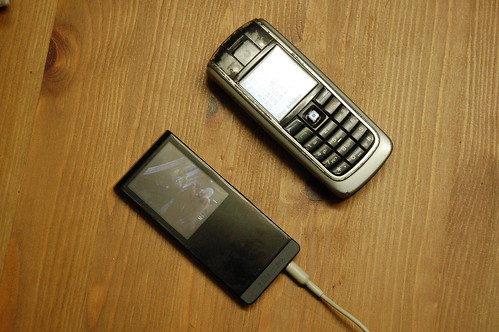
Bjorn mentions that he doesn't want the nokia internet tablet, because it doesn't have a phone and he doesn't want to carry two devices with him. portable media player Bottom left, my portable media player. 4G solid-state storage, plays movies (the display shows a scene from Star Trek: Deep Space Nine that I converted from DVD), audio, FM radio, and after a firmware update can do games and some random applications. Does bluetooth. Does not do phone calls. Upper right, my cell phone. A simple Nokia 6021. Does bluetooth, makes phone calls, and (as the display somewhat shows) can do calendaring, too. With SyncML, I can synchronize it with my laptop. Together, they perform anything I'd possibly want from a smartphone (and don't anyone tell me 'SSH', because doing ssh on any screen smaller than, 7" and without decent keyboard is laughable). Together, they're smaller and weigh less than a smartphone. Together, they're less expensive than a smartphone ( 125 for the phone, 85 for the portable media player). Why does anyone buy a smartphone?
7 October 2008

Alexander Reichle-Schmehl: About the number of rc bugs

In addition to my last post, here some information about the current number of release critical bugs. Yes, it is true, that our official bug tracker lists the next release has still 264 bugs1. And some wonder, when Lenny will be released. It's a little bit difficult to work with that page, let's look at the unofficial rc bug thingy I already mentioned in my previous post. As you might have noticed it supports several filters mechanism the official bts don't have. At the very bottom of the detailed list you'll see the overall number of the bugs matching your selected filter. So let's have a look at the number of bugs, which are already fixed in the unstable branch and need to propagate to Lenny. Currently that are 118 RC bugs. Of those 264 preventing us to release, 118 are already fixed; the fix just hasn't arrived in Lenny, yet. Okay, but there are still 147 rc Bugs open in both Lenny and Sid. So let's take a look at them. By using the filters at the top, you can calculate, that 19 already have a patch. 14 are marked pending (so they are already fixed, but the maintainer hasn't uploaded the package yet). 15 of these bugs have been reported multiple times and have been merged. Oh, and 3 are about packages in non-free and contrib. Granted, for some of them, there is a patch, but the patch needs to be tested, or the bug has been marked pending by mistake. But still: If you ignore all these types of bugs, there are only 104 bugs left. one-hundred-and-four! Summary: So the only thing left (beside the points I mention in my previous post) to do, is to migrate 118 fixes to Lenny somehow, get the 33 fixes for the probably fixed bugs uploaded, and fix the remaining 104 bugs. Yes, that's still a lot of work to do... So let's get things rolling, shall we? 1: You might further notice, that the current stable release is affected by more than 700 bugs. However many of them are false counts, e.g. when a specific package doesn't build with a newer version of a compiler. The package in the current stable release is of course affected, so there it is kind of buggy. However, we can ignore these kind of bugs, since the newer version of the compiler isn't shipped in the current stable release at all. Those bugs should actually be tagged sid and lenny...

29 September 2008

MJ Ray: Demutualised Building Society Survival Hits Rock Bottom

Our webmaster cooperative is just switching from a building society to a cooperative bank because of support for free software and web standards in their online banking - I’ve just given up waiting for it. That’s disappointing, but the building society has given pretty good service over the years and were early accepters of our LLP company type. For comparison, look at this list of building societies which converted to banks late last century, which have been in the news lately:-

  1. National and Provincial Building Society was taken over by Abbey National
  2. Abbey National was itself taken over by Banco Santander
  3. Alliance + Leicester is being bought by Banco Santander
  4. Birmingham Midshires was bought by the Halifax
  5. Halifax was bought by Bank of Scotland to form HBOS, which is now merging into Lloyds TSB
  6. Cheltenham and Gloucester was bought by Lloyds TSB
  7. Bristol and West was bought by the Bank of Ireland
  8. The Woolwich was bought by Barclays plc
  9. Northern Rock, nationalised earlier this year
  10. Bradford and Bingley, nationalisation announced today
So that’s it. All gone. 0% survival rate of demutualised building societies. I’ll be amazed if any more convert in future.

28 September 2008

Jonathan McDowell: Which data contract?

I bought an EEE 901. More on that later.
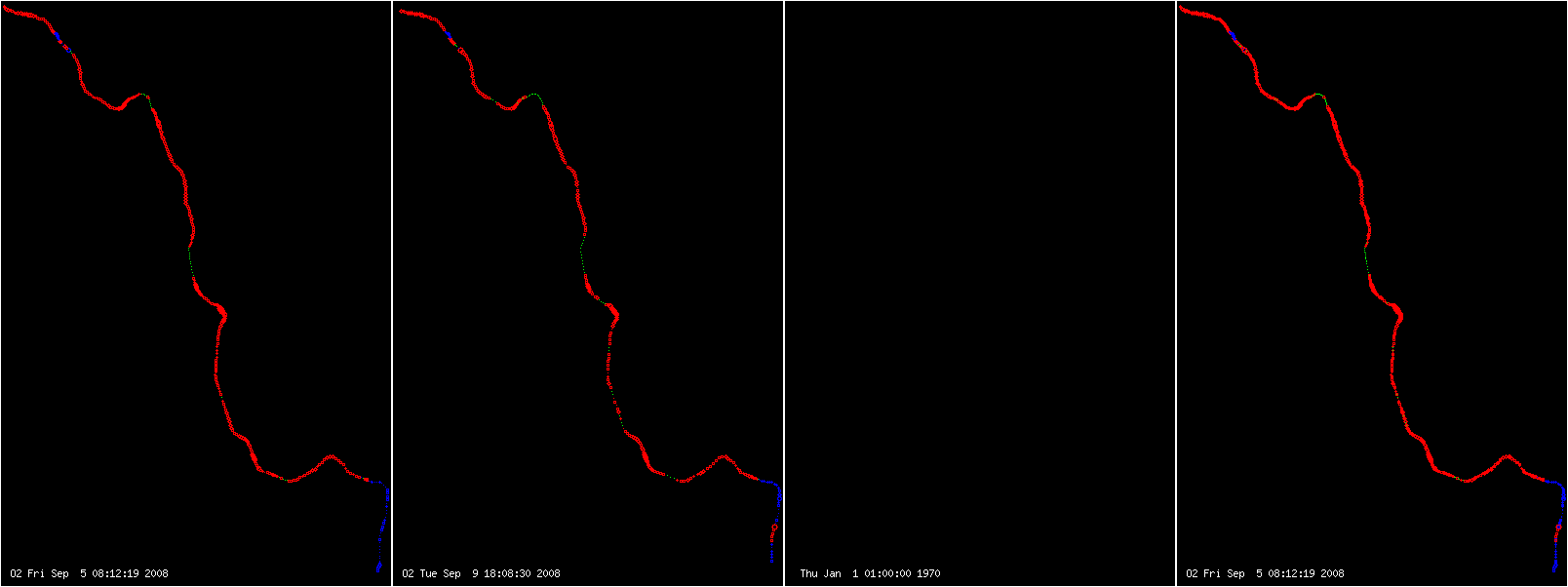
For the past few weeks I've been trying to work out which "mobile broadband" provider to go with for my daily commute. It's a train journey from the north coast of Northern Ireland to Belfast and goes through some sparsely populated areas, so I wasn't expecting to get anything that would provide 3G all the way. However I do want a provider that can do their best to keep a session up for the journey, handing over between 2G + 3G as necessary. Coverage maps/checkers aren't too bad if you just want to check a static point, but really even then it's better to actually try the provider in the location yourself. So, armed with a bluetooth GPS (Bl eNEXT BN-909GR), an Option GT 3G Quad PCMCIA card and my laptop I set about measuring signal strength along my train journey for each of the 5 providers available. I also made sure to actually try a session with them for at least one journey, because signal strength is not everything.

I wrote some Perl using Net::GPSD and Device::Gsm to query my current location, signal strength, 2G/3G status and network every 10 seconds. I did this for 3 train journeys (except for O2) and then also produced an "optimistic" file of all the data points combined for that provider.

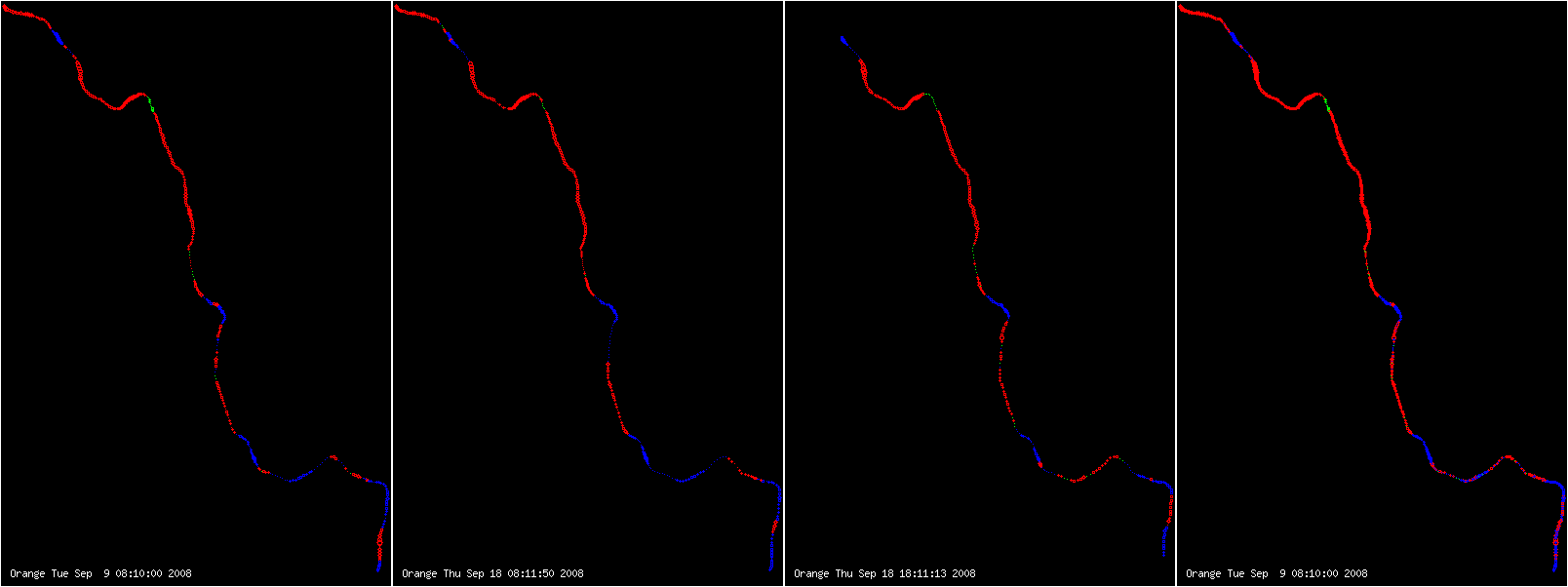
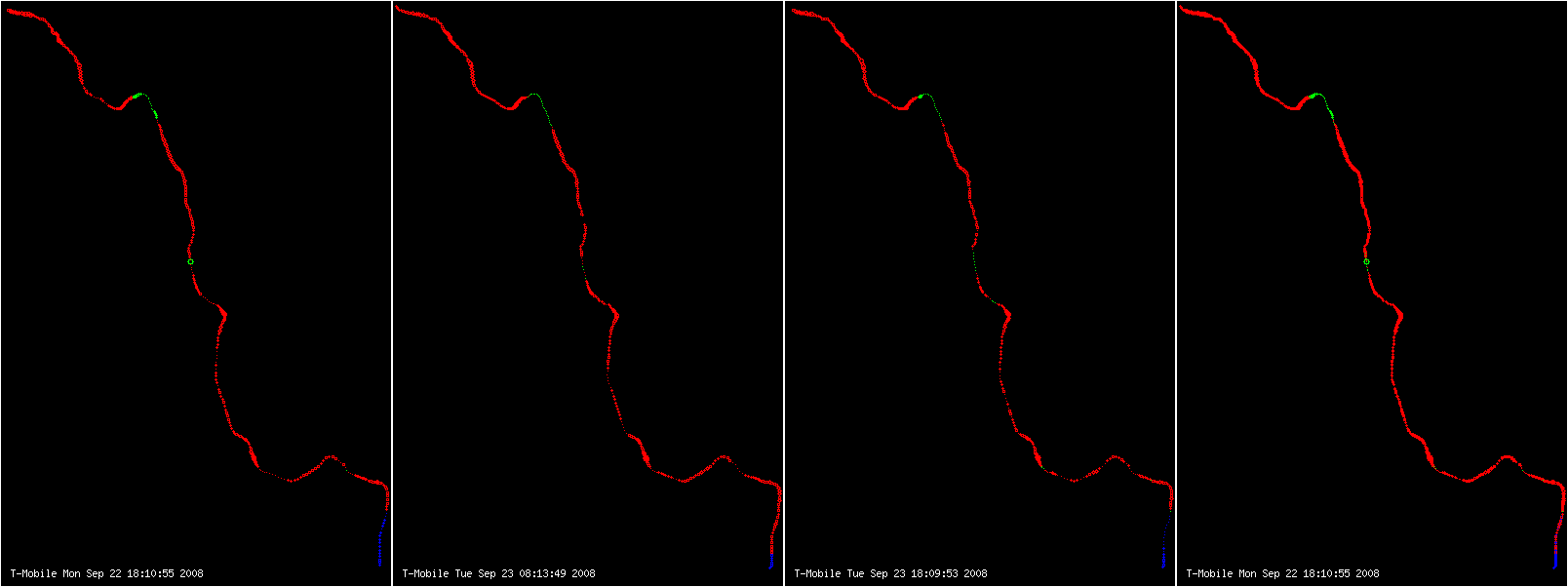
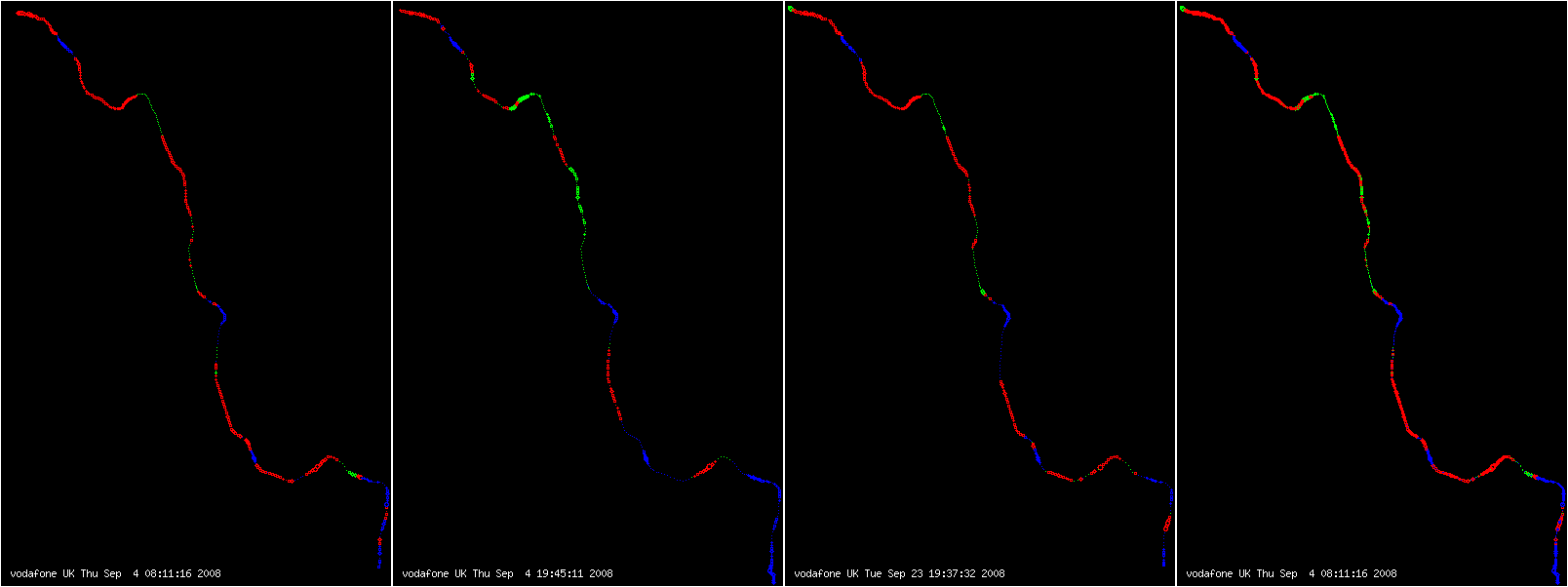
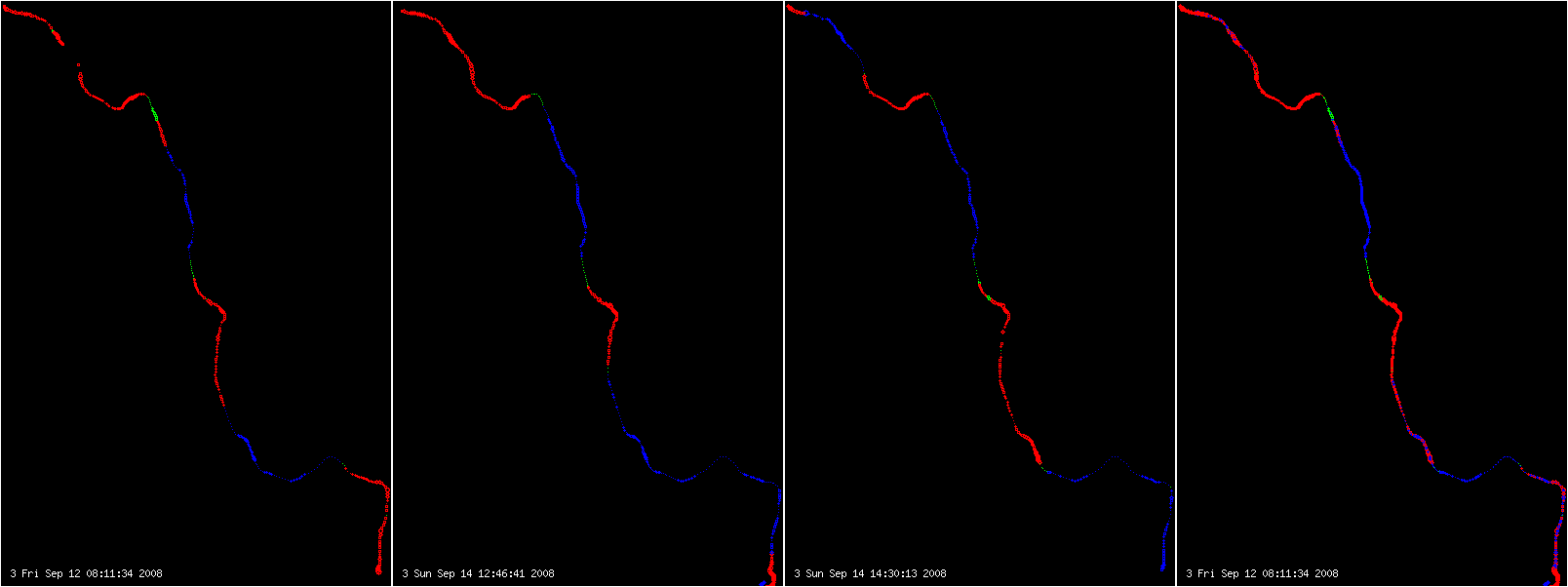
A second piece of Perl took this data and drew the maps you see below. The graph on the right for each provider is all data points. Red means 2G, blue means 3G, green means "Limited Service" (ie it could see a signal, but not one it was allowed to connect to). White means that we had a GPS location and no signal at all. Click on the maps for bigger versions. You can see the route on OpenStreetMap - my graphs are a little squished horizontally, but the journey is from Castlerock (top left on the coast near Coleraine) to Belfast (bottom right).

3
O2
Orange
T-Mobile
Vodafone

At first glance 3 look to be the best bet. Lots of blue, a reasonably priced data plan. Except they can't hold up a session to save themselves. Not only does a 2G/3G handover almost always seem to result in a drop, but I had periods of failing to get a 2G session up at all and had some random drops while in 3G coverage as well. So strike them off.

O2 and T-Mobile don't manage any 3G outside Belfast (that's the bottom right corner btw). I found that a few periods of 3G along the journey helped a lot; it meant I could do a quick mail sync rather than the long drawn out affair it was on a 2G connection. They can both handle handover between 2G/3G and keep a session up for most of the journey, but the lack of speed counts them out.

Vodafone managed the worst reception, which is disappointing. I found them quite good when I lived in England (my datacard is from a Vodafone Pay as You Use data contract). I did find sessions being dropped during the no signal regions, so they just don't seem to be a good bet.

Which leaves Orange. I've had issues with Orange and data in the past (pre 2004 IIRC) but in testing they were able to keep a session up between Belfast and Castlerock, handling 2G/3G handover fine. Coverage was reasonably good and they manage 3G at several points along the journey (the blue points roughly correspond to Coleraine, Ballymena, Antrim and Belfast). I understand Orange have some EDGE capability, but my card doesn't do EDGE so I've no idea if that'll be an extra gain or not. I had a few issues with getting dud DNS servers but this happened with the other providers too so I was beginning to suspect the datacard of playing up. Manually setting known good servers in resolv.conf worked fine.

So, before I go and sign up to an 18 month Orange contract, what have I forgotten?

18 September 2008

Vincent Fourmond: pdfcrop vs pdfnup --trim

I make heavy use of pdfcrop (the version by Heiko Oberdiek included in texlive) for printing, as it allows to remove all the white spaces around the text before nupping and printing. However, with recent ghostscript, the bounding box detection is dreadfully slow, anything from one to ten seconds for a single page ! When you have a 60 pages article to print, it can be quite tedious... Well, I've just discovered that the --trim option of pdfnup can do very similar things too. It removes a given amount of margins on the side, with the syntax 'left bottom right top'. Most of the time, a well-thought pdfnup --trim ... will work as well as pdfcrop while in the meantime being much faster...

17 September 2008

Biella Coleman: Smiles all around

I needed a little humor to offset what has been a pretty grueling and trying and tiring week of work so today’s visit to the bosom of American Freedom was quite welcome. Stephen Colbert is as great to see in person/live as he is on his show (or better). His energy seems bottomless, though of course his large crew of helpers and assistants I am helps sustain his energy. The last time I saw a T.V. show being taped was also on my birthday, my 8th one to be exact, when I went to watch one of the first boy toy bands Menudo as they strutted their stuff for a bunch of screaming girls. Though Colbert has *nothing* on these fine shiny Menudo outfits (no one really can), he has a lot else to offer, like his biting wit. It is well worth the time, trip, long wait on line, and freezing conditions of the studio. For those also in a week of bottomless work and in need of some humor, take a look here

15 September 2008

Jeff Licquia: Free Software EULAs?

Ubuntu is now being forced to show a EULA before letting users run Firefox, on pain of losing the rights to the Firefox trademark. (You know, End User License Agreements: those pop-ups Windows and Mac users have to put up with all the time, with the big “I Accept” button at the bottom.) Mark Shuttleworth, Ubuntu top dog, weighs in on the bug:
Please feel free to make constructive suggestions as to how we can meet Mozilla’s requirements while improving the user experience. It’s not constructive to say “WTF?”, nor is it constructive to rant and rave in allcaps. Your software freedoms are built on legal grounds, as are Mozilla’s rights in the Firefox trademark. To act as though your rights are being infringed misses the point of free software by a mile.
This is a bit surprising, and a bit disappointing. Both the decision itself, and Mark’s take on it, are quite wrong. One of the most important benefits of free software is the legal agreement you work in. You don’t have to agree to some long contract every time you need to do something new on your system, or sometimes even when you get a “critical update” to something you’re already doing. You don’t have to read pages of legalese, or go through some long process with your company’s legal department, or just click the “make it go away” button with this vague unease that you’ve just signed your first-born child away to the Devil. Most importantly, you feel like you actually own your computer when you run free software on it. When you enter a situation where you always have to ask permission to do things, and have to be constantly reminded of the rules, you don’t feel comfortable. Clearly, the thing in front of you is not yours, whatever your credit card bill might say; if it were, there wouldn’t be all this stress over you doing something the real owners don’t like. Free software returns your computer to you, by guaranteeing that you don’t have to enter into all these contracts before you can use it. Well, unless that “free” software is Firefox 3.0.2 or later, it seems. It’s “free” by a technical definition (you can strip the Firefox trademark rather easily, and get rid of the EULA as well). But when users fire up Ubuntu, and decide to do some browsing, and get confronted with pages of legal garbage and ALL CAPS, they will ask: “What’s so different about this open source stuff? I thought I was getting rid of all this legal crap.” And, suddenly, they’re slogging through the same drudgery they had to endure with every Windows service pack, and they wonder what they’ve gained. Perhaps there is a price we should be willing to pay to help Mozilla preserve their trademarks, but this price is too great. Mozilla should never have asked this of us, and Ubuntu should never have decided, on our behalf, that this price was acceptable. Debian has already turned its back on Firefox, and I have yet to have a problem with Iceweasel (the branding Debian chose for its Firefox-alike) that was caused by the branding change. But I’m tempted to bring it back, in Debian’s “non-free” software repository. Perhaps we could provide Firefox, complete with nasty EULA, but launch Iceweasel instead of Firefox if the user clicks “No”. There are probably all kinds of reasons why this is a bad idea, but I’m still drawn to the idea of illustrating how silly and useless click-through EULAs are. But it would be much more productive for Mozilla to back down, and not ask us to sacrifice such a large part of our identity on the altar of their sacred mark. UPDATE: First, I notice I was remiss in not giving a hat tip to Slashdot. Second, Mark has posted another comment on the bug. I encourage people to read the whole comment, but here’s a telling part:
For example, at the moment, we’re in detailed negotiations with a
company that makes a lot of popular hardware to release their drivers as
free software - they are currently proprietary. It would not be possible
to hold those negotiations if every step of the way turned into a public
discussion. And yet, engaging with that company both to make sure Ubuntu
works with its hardware and also to move them towards open source
drivers would seem to be precisely in keeping with our community values. In this case, we have been holding extensive, sensitive and complex
conversations with Mozilla. We strongly want to support their brand
(don’t forget this is one of the few companies that has successfully
taken free software to the dragons lair) and come to a reasonable
agreement. We want to do that in a way which is aligned with Ubuntu’s
values, and we have senior representatives of the project participating
in the dialogue and examining options for the implementation of those
agreements. Me. Matt Zimmerman. Colin Watson. Those people have earned
our trust.
On the one hand, yes, I believe that the Canonical people have earned our trust, and I do appreciate the utility of quiet persuasion with a proprietary software company that doesn’t understand our community. On the other hand, I had been under the impression that Mozilla was not a proprietary software company, and didn’t need persuasion and secret negotiations to see our point of view. Is Mozilla still a free software company, or not? UPDATE 2: Cautious optimism is appropriate, I think. Mitchell Baker, Mozilla chair:
We (meaning Mozilla) have shot ourselves in the foot here given the old, wrong content. So I hope we can have a discussion on this point, but I doubt we ll have a good one until we fix the other problems.
The actual changes aren’t available yet, and I wonder how much of this had been communicated to Canonical beforehand. Still, it’s a good sign.

14 September 2008

Russell Coker: The Problem is Too Many Remote Controls

I am often asked for advice about purchasing TVs and consumer electronics. Not that I am any great expert in those areas, but my general experience in specifying and purchasing electronics goods in related to my computer work does translate to other areas (and I know where to find advice on the net). As part of this I get to closely observe what happens when people install new home entertainment systems. I have not observed anyone who uses anywhere near the full function of their system, even using the bare minimum functionality in all areas is very rare. I believe that the first problem with this is the input devices. A remote control is designed around the idea of one button for each high-level command, this can be compared to languages such as Chinese and Japanese which have one character per word. In terms of language evolution it seems that the benefits of having multiple characters became apparent and widely accepted thousands of years ago. Now for a simple input device having one button for each high-level operation makes sense. For the basic functions of a VCR you have PLAY, STOP, Fast-Forward, Rewind, Record, and Eject - 6 buttons is quite reasonable. But then you want slightly advanced features such as “record from 8PM to 9PM on channel A and then record from 10PM to 11PM on channel B” and things become unreasonably difficult. More than 10 years ago I was recommending that people just buy 5 hour tapes and press record before leaving home, getting the full functionality out of a VCR was just too hard. Jokes are often made about people who leave their VCR flashing 12:00 (because it’s too difficult to set the time), I only set the time on a VCR to stop the flashing (flashing lights annoy me). Since programmable VCRs became popular things have only continued to develop. Now it’s not uncommon to have separate remote controls for the TV, VCR, DVD player, and the Cable TV box - a total of four remote controls! This is obviously a problem, and the solution that some people are adopting is to have a single more complex remote control - this is an example of problems not being solved by the same type of thinking that caused them. One of the attempts to solve this is to have everything controlled by a PVR [1]. This means that you have one device recording content (maybe from multiple sources or multiple channels), playing recorded content or live content, and maybe playing DVDs and CDs. Of course then you have a complex remote control for that device which just shifts the problem. To solve these problems we need to consider the entire problem space from a high-level. We start with the signal that is displayed by the TV, it can come from cable TV, digital TV, analogue TV, VCR, or DVD - these input sources have names such as “Composite”, “RCA1″, “RCA2″, “RCA3″, “DTV”, and “ATV”. Often people have written instructions near their TV to map these names to what they do. Obviously the TV needs to be able to be programmed with human friendly names, and as these names are not of much use on their own it should be possible to use compound names and abbreviations. If I want to watch ABC (the Australian Government sponsored TV channel) then I would rather type “ABC” on a keyboard and then have the entertainment system determine whether that maps to “cable:abc”, “dtv:abc”, or “atv:abc” depending on what options are available. The current process of choosing an input source (such as RCA1 mapping to cable TV) and then choosing a channel (102 mapping to ABC) means among other things that it is essentially impossible for a guest to control the TV. A further problem is the lack of available output. While it might seem that a large-screen HDTV has adequate output available, it’s often the case that you don’t want to stop watching one show while trying to find another. When something of wide interest is happening (another war or an election) it’s common for several people in one room to want to watch the news. Having everyone stop watching while someone goes through menus to find a different news channel is not well accepted. It seems to me that we need a separate output mechanism for controlling the entire system from that which is used for the main display. This of course requires integration between all parts of the entertainment system, which shouldn’t be that difficult given the complexity of all the components (every one of which has more compute power than a typical server of 20 years ago). It is currently quite common for PVRs and DVD players to support playing videos from USB and SD devices, so the next logical step is to get an Ethernet port in each device (and maybe have Ethernet switches built in to some of the high-end entertainment hardware). Then XML transferred over HTTP could be used for controlling the different components from a single web server which provides a web-based GUI. While a random guest would not get much functionality out of my TV configuration (or that of most homes where I have assisted in the configuration of new hardware), they shuold be able to use a web-based GUI with ease. For controlling the entire system a NetBook [2] computer such as the EeePC should do well. As high-end TVs cost over $5,000 an EeePC which costs $500 (list price - surely less in bulk) could easily be bundled without much impact on the overall price in the same way that companies selling computers in the $1,000,000 price range used to bundle $10,000 workstations to manage them. An EeePC has abut the same size and mass as four remote controls (so it wouldn’t be inconvenient to use). Also the built-in wifi could be used for the remote control (wires are inconvenient and Infra-Red has limited bandwidth so probably wouldn’t provide a good web based GUI). Also someone who wanted to save some money could instead choose to use an old laptop on a coffee table (any web browser would do). I have deployed Linux desktop machines for some people who had no trouble using it, but who then had trouble using TVs that I configured for them - so I conclude that a modern Linux distribution is significantly more user friendly than the equipment that you find in a modern lounge room. Cable TV companies all seem to be ISPs and often provide compelling value as an ISP service if you want to use the TV service. So it seems that the “Cable Modem” could be built in to the Cable TV box for added savings in hardware purchase and less boxes to manage in the home. This of course would increase the value of a NetBook [2] as a remote control as it could also be used for general Internet access at the same time. TV shows often promote their web sites to their customers and TV advertising also often includes a URL. If the URLs were distributed by VideoText then that would provide more information for the viewers, a better reach for advertisers and people who create the TV shows, and it when it became popular it would save us fom those stupid scrolling news tickers that appear on the bottom of most cable new shows! Some of these benefits are currently achieved by people running MythTV. The first problem with Myth is that it is still largely stuck to the bad old UI paradigm (which of course can be fixed as it’s free software). The next problem is that getting a result of comparable quality to the dedicated hardware is expensive, difficult, or both. A regular PC makes more noise than you desire in your lounge room and configuring a Myth machine for your choice of DTV hardware and the frequencies used in your location is a pain. You can buy a preconfigured machine which solves these problems, but it will be more expensive. For most lounge rooms the cheap Chinese hardware is what will be used. Ultimately I believe that TV will be killed by the Internet. The range of content on the net is increasing and the rate of acceleration is also increasing. TV seems to have not made any significant changes since the introduction of cable and satellite TV (both of which happened a long time ago and were not significant changes). But I don’t expect it to happen soon. I predict another 10 years of the current TV business model. I believe that better integration of home entertainment hardware so that it can obey simpler commands from the user in a more friendly manner while not getting in the way of the main purpose (displaying the TV picture) has the potential to extend the life of the current TV business model. Not that I care whether the TV industry dies sooner or later. I just want to escape from having to provide phone-support to people who can’t get their TV to work correctly!

11 September 2008

Andrew Pollock: [life] Woot! Vacation!

We're heading off on a vacation, the first real "put our feet up" kind of vacation since our belated honeymoon a couple of years ago. Our ultimate destination is the Seychelles, a tiny set of islands off the east coast of Africa, near Madagascar. Sarah's aunty and uncle live here. Her uncle's the deputy commissioner for the United Nations Indian Ocean Tuna Commission. Getting there is pretty heinous. We're flying to Houston, then to Dubai, then to the Seychelles. Originally we were leaving tomorrow, but Sarah noticed that we only had an hour to transfer in Houston, and when she checked with the airline, they agreed (despite them booking the entire trip in the first place). So now we've changed to a flight today, with a night in a hotel in Dubai. Emirates only fly to the Seychelles a couple of times a week, so we really don't want to miss the Dubai-Seychelles leg. The flight from Houston to Dubai is 15 hours. That's worse than San Francisco to Sydney. Not looking forward to sitting on a plane for that long. Flying on September 11 is an interesting experience so far. It seems that the airlines are "randomly selecting" all passengers who aren't US citizens for secondary inspections at the security checkpoints. I was vaguely aware, but had largely forgotten, that if they print SSSS in the bottom corner of your bording pass, then you've been randomly selected. The TSA guy was very apologetic, as he proceeded to completely dismantle our carry-on luggage. The other fun aspect is that hurricane Ike is busy making its way towards Houston. It's not supposed to make landfall until Saturday, but since they've already evacuated some cities south of Houston, I'm really hoping it doesn't bugger up our flights. We're in the Seychelles for 10 days, and then we're going to spend 3 days in Dubai on the way back. It'll be during Ramadan, which is apparently an unpopular time for Westerners, so all of the hotels are nice and cheap. It looks like it's going to be pretty hot as well.

10 September 2008

Russell Coker: Efficiency of Cooling Servers

One thing I had wondered was why home air-conditioning systems are more efficient than air-conditioning systems for server rooms. I received some advice on this matter from the manager of a small server room (which houses about 30 racks of very powerful and power hungry servers). The first issue is terminology, the efficiency of a “chiller” is regarded as the number of Watts of heat energy removed divided by the number of Watts of electricity consumed by the chiller. For example when using a 200% efficient air cooling plant, a 100W light bulb is rated as being a 150W heat source. 100W to Heat it, 50W from the cooling plant to cool it. For domestic cooling I believe that 300% is fairly common for modern “split systems” (it’s the specifications for the air-conditioning on my house and the other air-conditioners on display had similar ratings). For high-density server rooms with free air cooling I have been told that a typical efficiency range is between 80% and 110%! So it’s possible to use MORE electricity on cooling than on running the servers! One difficulty in cooling a server room is that the air often can’t flow freely (unlike a big open space such as the lounge room of your house). Another is the range of temperatures and the density of heat production in some parts (a 2RU server can dissipate 1000W of heat in a small space). These factors can be minimised by extracting hot air at the top and/or rear of racks and forcing cold air in the bottom and/or the front and by being very careful when planning where to place equipment. HP offers some services related to designing a server room to increase cooling efficiency, one of the services is using computational fluid dynamics to simulate the air-flow in the server-room [1]! CFD is difficult and expensive (the complete package from HP for a small server room costs more than some new cars), I believe that the fact that it is necessary for correct operation of some server rooms is an indication of the difficulty of the problem. The most effective ways of cooling servers involve tight coupling of chillers and servers. This often means using chilled water or another liquid to extract the heat. Chilled water refrigeration systems largely remove the problem of being unable to extract the heat from the right places, but instead you have some inefficiency in pumping the water and the servers are fixed in place. I have not seen or heard of chilled water being used for 2RU servers (I’m not saying that it doesn’t get used or that it wouldn’t make sense - merely that I haven’t seen it). When installing smaller servers (2RU and below) there is often a desire to move them and attaching a chilled-water cooling system would make such a move more difficult and expensive. When a server weighs a ton or more then you aren’t going to move it in a hurry (big servers have to be mostly disassembled before the shell can be moved, and the shell might require the efforts of four men to move it). Another issue related to water cooling is the weight. Managing a moderate amount of water involves a lot of heavy pipes (a leak would be really bad) and the water itself can weigh a lot. A server room that is based around 20Kg servers might have some issues with the extra weight of water cooling (particularly the older rooms), but a server room designed for a single rack that weighs a ton can probably cope. I have been told that the cooling systems for low density server rooms are typically as efficient as those used for houses, and may even be more efficient. I expect that when designing an air-conditioner the engineering trade-offs when designing for home use favor low purchase price. But someone who approves the purchase of an industrial cooling system will be more concerned about the overall cost of operations and will be prepared to spend some extra money up-front and recover it over the course of a few years. The fact that server rooms run 24*7 also gives more opportunity to recover the money spent on the purchase (my home A-C system runs for about 3 months a year for considerably less than 24 hours a day). So it seems that the way to cool servers efficiently is to have low density server rooms (to the largest extent possible). One step towards this goal would be to have servers nearer the end users. For example having workgroup servers near the workgroup (instead of in the server room). Of course physical security of those servers would be more challenging - but if all the users have regular desktop PCs that can be easily 0wned then having the server for them in the same room probably doesn’t make things any worse. Modern tower servers are more powerful than rack mounted servers that were available a few years ago while also being very quiet. A typical rack-mounted server is not something you would want near your desk, but one of the quiet tower servers works quite well.

5 September 2008

MJ Ray: Friday Opinion Request 2: Are Your Free Software T-Shirts Ethical?

News reports have described the use of forced child labour for cotton harvesting in Uzbekistan, which is then used in t-shirts and so on, including those sold by some major shops in England like Asda/Wal-Mart, as I mentioned on the debian-project email list last autumn. When you buy badly-produced T-shirts to support free software projects, you may be helping provide freedom for more software users in your country, but you may also be helping to enslave vulnerable workers in other countries. If you buy Debian T-shirts from the UK, you’re probably OK. This is something that the Debian UK Society seems to do right. Their buyer (and current Debian Project Leader) Steve McIntyre wrote:
“[Fruit of the Loom premium Ts, Kustom Kit Augusta/405 polo shirts ...] both FotL and KK have ethics statements that describe their standards. The KK one is linked off the front page of their website; the FotL details I have in .doc format that I’ll pass on if people would like to see them.” (original)
I also asked my local perl mongers group to do similar but there’s been no response to that yet (or any t-shirts AFAIK). I’ve been told that all of the FSF Europe gear is Fair Trade but it doesn’t say that on their web shop. How about other free software projects? Have you asked about your T-shirts? Is there a central site for this sort of information?

2 September 2008

Runa Sandvik: I heart London

While sitting on a bench in Hyde Park, watching the leaves fall from the trees, thinking that fall is just around the corner, I started to write on the back of an old receipt. One that says 108,- for a Banana Passion Split and a bottle of Coca Cola. It’s just something I do when I’m nervous, excited, lonely, happy or all of the above. Sometimes I spend so long thinking about how to express myself, that I forget what I was going to write. I spend too long trying to find the right adjectives. And I wish I could find the right words to describe some of the best moments. My trip to London was more than just Big Ben, The London Eye, Madame Tussauds and Oxford Street. A lot more. Another receipt says 590,- for a haircut. It’s from July 15th, 2008. My ramblings on the back, blue ink, some words crossed out, some misspelled; at least 1 of the 268 Underground stations has a staircase with 78 steps, a shop on Oxford Street sells salt from the Dead Sea, and some very big soap bubbles were seen in Camden Town. There are some keywords at the bottom of the second receipt. Just to remember all the other things that happened. Like the time we almost got lost on the Underground, the elevator with no buttons, the Kanye West sunglasses in white and pink, and the lack of a proper breakfast - even though I don’t mind white bread and strawberry jam. There was just one small thing I wasn’t too happy about; you can’t write on receipts from Tesco. They have THANK YOU FOR SHOPPING WITH US printed all over it. And it took me a while to find that piece of paper in my bag. This time I saw fall in London, and a white pigeon. I will make sure I have my notebook with me next time.

1 September 2008

MJ Ray: Oddments from Planet Debian

Three replies to things I saw today on Planet Debian on blogs of people that don’t have fully-working web comment systems:-
  1. Professional Slide Installer (usual buggy blogger.com CAPTCHA) - yes, they exist. My village’s council sometimes hires them. I think they’re carpenters who have specialised. There are also professional slide inspectors (well, childrens’ play area safety inspectors, but professional slide inspector sounds cooler).
  2. Internet Speed Hype (usual buggy wordpress kind-a captcha) - ThePhone.Coop (UK) doesn’t cap, but charges extra if you go over your subscription amount. We have a monitoring system that lets you check your usage fairly easily and set up email alerts when your prepaid amount is almost used up. (I work for agent AG_471 of ThePhone.Coop but I think I’d like them anyway.)
  3. home of the madduck/ blog/ Recovering a lost default route (site under construction - see bottom of page) - I was told by a very wise man to always start a delayed reboot (shutdown -r +5) before messing with anything to do with the networking on a remote machine.

21 August 2008

Russell Coker: Switches and Cables

I’ve just read an amusing series of blog posts about bad wiring [1]. I’ve seen my share of wiring horror in the past. There are some easy ways of minimising wiring problems which seem to never get implemented. The first thing to do is to have switches near computers. Having 48 port switches in a server room and wires going across the building causes mess and is difficult to manage. A desktop machine doesn’t need a dedicated Gig-E (or even 100baseT) connection to the network backbone. Cheap desktop switches installed on desks allow one cable to go to each group of desks (or two cables if you have separate networks for VOIP and data). If you have a large office area then a fast switch in the corner of the room connecting to desktop switches on the desks is a good way to reduce the cabling requirements. The only potential down-side is that some switches are noisy, the switches with big fans can be easily eliminated by a casual examination, but the ones that make whistling sounds from the PSU need to be tested first. The staff at your local electronics store should be very happy to open one item for inspection and plug it in if you are about to purchase a moderate number (they will usually do so even if you are buying a single item). A common objection to this is the perceived lack of reliability of desktop switches. One mitigating factor is that if a spare switch is available the people who work in the area can replace a broken switch. Another is that my observation is that misconfiguration on big expensive switches causes significantly more down-time than hardware failures on cheap switches ever could. A cheap switch that needs to be power-cycled once a month will cause little interruption to work, while a big expensive switch (which can only be configured by the “network experts” - not regular sysadmins such as me) can easily cause an hour of down-time for most of an office during peak hours. Finally the reliability of the cables themselves is also an issue, having two cables running to the local switch in every office can allow an easy replacement to fix a problem - it can be done without involving the IT department (who just make sure that both cables are connected to the switch in the server room). If there is exactly one cable running to each PC from the server room and one of the cables fails then someone’s PC will be offline for a while. In server rooms the typical size of a rack is 42RU (42 Rack Units). If using 1RU servers that means 42 Ethernet cables. A single switch can handle 48 Ethernet ports in a 1RU mount (for the more dense switches), others have 24 ports or less. So a single rack can handle 41 small servers and a switch with 48 ports (two ports to go to the upstream switch and five spare ports). If using 2RU servers a single rack could handle 20 servers and a 24port switch that has two connections to the upstream switch and two spare ports. Also it’s generally desirable to have at least two Ethernet connections to each server (public addresses and private addresses for connecting to databases and management). For 1RU servers you could have two 48 port switches and 40 servers in a rack. For 2RU servers you could have 20 servers and either two 24port switches or one 48port switch that supports VLANs (I prefer two switches - it’s more difficult to mess things up when there are two switches, if one switch fails you can login via the other switch to probe it, and it’s also cheaper). If the majority of Ethernet cables are terminated in the same rack it’s much harder for things to get messed up. Also it’s very important to leave some spare switch ports available as it’s a common occurrence for people to bring laptops into a server room to diagnose problems and you really don’t want them to unplug server A to diagnose a problem with server B… Switches should go in the middle of the rack. While it may look nicer to have the switch at the top or the bottom, that means that the server which is above or below it will have the cables for all the other switches going past it. Ideally the cables would go in neat cable runs at the side of the rack but in my experience they usually end up just dangling in front. If the patch cables are reasonably short and they only dangle across half the servers things won’t get too ugly (this is harm minimisation in server room design). The low end of network requirements is usually the home office. My approach to network design for my home office is quite different, I have no switches! I bought a bunch of dual-port Ethernet cards and now every machine that I own has at least two Ethernet ports (and some have as many as four). My main router and gateway has four ports which allows connections from all parts of my house. Then every desktop machine has at least two ports so that I can connect a laptop in any part of the house. This avoids the energy use of switches (I previously used a 24 port switch that drew 45W [2]), switches of course also make some noise and are an extra point of failure. While switches are more reliable than PCs, as I have to fix any PC that breaks anyway my overall network reliability is increased by not using switches. For connecting the machines in my home I mostly use bridging (only the Internet gateway acts as a router), I have STP enabled on all machines that have any risk of having their ports cross connected but disable it on some desktop machines with two ports (so that I can plug my EeePC in and quickly start work for small tasks).

19 August 2008

Roland Mas: Netfilter-based port-knocking

When you have a server on the Internet, you get lots of "brute force" attacks on the SSH daemon, trying plausible logins with a variety of passwords. Even with good passwords, these attacks might eventually succeed (and they're annoying even when they don't), so you want to thwart them. One way is to use fail2ban, a script that monitors the failed connections, and sets up firewall rules (for instance) blocking further connections from the attacking IP addresses. It's good, but it fills your logs with messages about IPs getting banned and unbanned after a while. And you're still at risk that the multiple connections crash the SSH daemon, or trigger a bug in it, or whatever. A second layer of protection can be to block all SSH connection attempts except when they come from known IP addresses, but that doesn't work when you're away from home, and you're locked out. Been there, done that. So, some wise people have devised a trick called "port-knocking". It's similar to only opening the door to people who use a special knock (think "That's all, folks"): the firewall stays closed, but it opens a tiny targeted hole to some IP addresses for a limited length of time, based on a secret handshake. The window for attack is therefore very small, and the SSH daemon stays idle most of the time. And you can still log on your hosted server when you're attending conferences. There are a variety of implementations for this concept. Some could be web-based (you need to submit the right password to a web page), some could use other services or a dedicated daemon. But when I started investigating port-knocking, I wanted something simple, preferably with no dependencies on a daemon that would need to be exposed to the net and potentially crash. I found an article on the Debian Administration website, but I wasn't entirely satisfied with it. The principles appealed to me (netfilter-only, secret handshake in the form of opening connections to secret ports), though, so I evolved it into my own implementation, which I proudly present to you today. The goals of this implementation were: The bulk of the work therefore stays in the kernel's netfilter (that's for robustness and no user-land dependency), but the control interface is integrated with the usual firewalling script. Resistance to replay attacks is achieved by choosing hard-to-predict ports. So if someone snoops the wireless while I'm at a conference and catches my secret handshake, it'll only be valid for a short period of time, hopefully short enough to prevent dictionary attacks. The handshake is therefore calculated as a function of the current date and time, with an added secret seed. The following shell function calculates 5 port numbers within a given range (requires dc to be installed, for big-integer arithmetic):
calc_knock_ports ()  
    secret=$1
    bottomport=$2
    topport=$3
    nbports=$(( $topport - $bottomport + 1 ))
    hash=$(TZ=UTC date +%Y-%m-%d-%H-$secret   md5sum   awk ' print $1 '   tr a-z A-Z)
    num=$(echo 16i $hash f   dc)
    pk_port1=$(echo $num $nbports 0 ^ / $nbports % $bottomport + f   dc)
    pk_port2=$(echo $num $nbports 1 ^ / $nbports % $bottomport + f   dc)
    pk_port3=$(echo $num $nbports 2 ^ / $nbports % $bottomport + f   dc)
    pk_port4=$(echo $num $nbports 3 ^ / $nbports % $bottomport + f   dc)
    pk_port5=$(echo $num $nbports 4 ^ / $nbports % $bottomport + f   dc)
 
Okay. So this function calculates ports, now what? Now we're going to define a few chains by which netfilter will store states of IP addresses as they progress through the handshake:
setup_portknocking_tables ()  
    iptables -N portknock_into_phase1
    iptables -A portknock_into_phase1 -m recent --name PK_PHASE1 --set
    # iptables -A portknock_into_phase1 -j LOG --log-level notice --log-prefix "INTO PK_PHASE1: "
    iptables -N portknock_into_phase2
    iptables -A portknock_into_phase2 -m recent --name PK_PHASE1 --remove
    iptables -A portknock_into_phase2 -m recent --name PK_PHASE2 --set
    # iptables -A portknock_into_phase2 -j LOG --log-level notice --log-prefix "INTO PK_PHASE2: "
    iptables -N portknock_into_phase3
    iptables -A portknock_into_phase3 -m recent --name PK_PHASE2 --remove
    iptables -A portknock_into_phase3 -m recent --name PK_PHASE3 --set
    # iptables -A portknock_into_phase3 -j LOG --log-level notice --log-prefix "INTO PK_PHASE3: "                     
    iptables -N portknock_into_phase4
    iptables -A portknock_into_phase4 -m recent --name PK_PHASE3 --remove
    iptables -A portknock_into_phase4 -m recent --name PK_PHASE4 --set
    # iptables -A portknock_into_phase4 -j LOG --log-level notice --log-prefix "INTO PK_PHASE4: "
    iptables -N portknock_into_phase5
    iptables -A portknock_into_phase5 -m recent --name PK_PHASE4 --remove
    iptables -A portknock_into_phase5 -m recent --name PK_PHASE5 --set
    iptables -A portknock_into_phase5 -m recent --name PK_ESTABLISHED --set
    # iptables -A portknock_into_phase5 -j LOG --log-level notice --log-prefix "INTO PK_PHASE5: "
    iptables -N portknock_accept
    iptables -A portknock_accept -m limit -j LOG --log-level notice --log-prefix "ACCEPTED AFTER PORTKNOCKING: "
    # iptables -A portknock_accept -m recent --name PK_PHASE5 --remove
    iptables -A portknock_accept -j ACCEPT
    iptables -N portknocking
 
These chains use the recent module, which seems to be commonly available in standard kernels. You'll notice how, as one packet goes through these rules, its originating IP address moves from one set of "recent" addresses to the next. But no logic exists yet to make the packet actually go through these rules, so here comes the glue:
refresh_portknocking ()  
    calc_knock_ports f00b4r 10000 10999
    iptables -F portknocking
    iptables -A portknocking -p tcp --dport $pk_port1 -m state --state NEW                                                 -j portknock_into_phase1
    iptables -A portknocking -p tcp --dport $pk_port2 -m state --state NEW -m recent --rcheck --name PK_PHASE1 --seconds 5 -j portknock_into_phase2
    iptables -A portknocking -p tcp --dport $pk_port3 -m state --state NEW -m recent --rcheck --name PK_PHASE2 --seconds 5 -j portknock_into_phase3
    iptables -A portknocking -p tcp --dport $pk_port4 -m state --state NEW -m recent --rcheck --name PK_PHASE3 --seconds 5 -j portknock_into_phase4
    iptables -A portknocking -p tcp --dport $pk_port5 -m state --state NEW -m recent --rcheck --name PK_PHASE4 --seconds 5 -j portknock_into_phase5
    # echo clear > /proc/net/ipt_recent/PK_DONE
    echo clear > /proc/net/ipt_recent/PK_PHASE1
    echo clear > /proc/net/ipt_recent/PK_PHASE2
    echo clear > /proc/net/ipt_recent/PK_PHASE3
    echo clear > /proc/net/ipt_recent/PK_PHASE4
    echo clear > /proc/net/ipt_recent/PK_PHASE5
 
Right. This function adds rules to the portknocking chain. A packet injected into this ruleset will, depending on its destination port and whether its source IP address has already been seen, end up in one of the PK_PHASE* sets. All we have to do now is therefore to send some packets to this portknocking chain, and use the port-knocking sets to decide whether to accept incoming connections or not:
iptables -A INPUT -j portknocking
iptables -A INPUT -m recent --rcheck --seconds 5 --name PK_PHASE5 -m state --state NEW -p tcp --dport ssh -j portknock_accept
This example only mentions accepting incoming SSH connections, but it's in no way a limitation: a server of mine uses similar rules to DNAT certain ports to internal IP addresses. And there we have it for the server part: incoming SSH connections are usually ignored (well, handled by the rest of the firewall script, but let's assume that it drops these packets by default), but if one IP address knows the appropriate ports and sends a connection attempt to them in order, then it'll be able to open SSH connections for a little while after that. Of course, it's going to be boring if one has to send these packets by hand, but it can be easily automated by a script. Here's a ~/bin/portknock.sh I have:
#! /bin/sh
host=$1
port=$2
calc_knock_ports ()  
[...]
 
calc_knock_ports f00b4r 10000 10999
for i in $pk_port1 $pk_port2 $pk_port3 $pk_port4 $pk_port5 ; do
    nc -w 1 $host $i < /dev/null > /dev/null 2>&1
done
nc $host $port
It's designed to be called with two parameters, a host and a port, and it needs netcat in addition to dc. Why the last line, I hear you cry? Because then I can just add the following lines to my ~/.ssh/config:
Host blahblah
  IdentityFile foobar
  ProxyCommand /home/roland/bin/portknock.sh %h %p
...and SSH will automagically tunnel its network socket through the script, which will in turn happily tunnel that through netcat after completing the secret handshake. And when I type ssh myserver on my laptop, interesting stuff happens behind the scenes, and a special, just-for-me hole is opened in the server firewall, just for the few seconds I need to establish the SSH session (packets belonging to established TCP sockets are allowed by the firewall's connection tracking). Note: This article is deliberately short on details and ready-to-run scripts. Firstly because firewall scripts vary wildly so any script would have to be adapted anyway, but mostly because security is best handled with one's brain switched on. Fiddling with a firewall can easily open gaping holes or lock everyone out. So please make sure you understand what goes on before blindly pasting stuff into your own setup. Some of the lines that are commented out may also be of interest, and were left as an exercise for the reader. Other lines were not included, and are also left as a rather important exercise to the reader; note in particular how the netfilter rules as currently established do not mitigate the replay attacks...

13 August 2008

MJ Ray: SPI Meeting Announcement and Why People Don t Join SPI

Jimmy Kaplowitz writes:
“Software in the Public Interest, Inc., will hold a public board of directors meeting on Wednesday, August 20, 2008, 19:00 UTC. [...] SPI meetings are held on the OFTC IRC network, irc.oftc.net, in #spi. [...] Agenda“
A couple of weeks ago, I asked why people do and don t join SPI? The answers I got can be grouped into a few headings:-
Don’t know about SPI
“I admit that I was unaware of SPI. However seeing its age, a few familiar names on the board and also on the project list it looks like a solid organisation.”
“I too am unfamiliar with your organization”
“I guess I would be yet aother person who was not aware of this group.”
“Lack of awareness of SPI is probably the biggest hurdle. I too, was unaware of SPI. I am aware of the Linux Foundation and the FSF and others, but how does SPI differentiate itself and its goals from those organizations?”
Don’t know about joining
“The membership page on the SPI website is buried at the bottom of a secondary menu. One has to really go looking for it. And this definitely gives the impression that adding members is not a very high priority.”
“I ve been looking a while for how to join, is not the first time, I did before and never found it until now”
Don’t see why to join
“Even as an open source software advocate, I have not joined SPI because my particular interest and focus is on Plone. The Plone Foundation handles largely the same functions that SPI does for smaller, independent groups.”
“Why, what’s in it for me? The betterment of mankind or bragging rights when a corporations steals all of my work and gets rich off of it.”
“If you are someone who is very interested FOSS (free and open source software) rights and licenses, you are probably more inclined to become a part of the FSF (Free Software Foundation) or the OSI (Open Source Initiative).”
I’d welcome any thoughts you have on how we should overcome these barriers, either in the comments here, or on IRC #spi - I think I should be there a bit before or after the meeting. I’ll try to summarise the best over the next Wednesday or two.

11 August 2008

Daniel Burrows: No hyphenation joy in GTK+.

I've thought on and off that it would be nice for the graphical version of aptitude to have decent hyphenation. Word-wrapping descriptions looks OK, but when the text area is thinner than the entire screen, it can look a little ragged on the right-hand side. For instance, take this rendering of the description of the toy program bb: Unhyphenated text is ugly Not too bad, but if I render it in LaTeX, here's how it comes out: Hyphenated text is pretty Of course, for very thin text columns (and the above is arguably pushing it), hyphenation and text justification aren't what you want. But it would be nice to be able to at least see what it looked like. Figuring that GTK+ might have some support for this, I delved into Google. I found this:
Line breaking Line breaking adds additional layers of complexity. For one, all potential line breaks must be identified, including discretionary hyphens for Latin scripts, and word boundaries in (???). Secondly, inserting hyphens may require reshaping. Third is the line breaking algorithm itself, which may be nontrivial. -- Pango 0.1 proposal, Raph Levien, 1999
and this:
Future plans for Pango include support for high quality printing, better hyphenation support, full justification, and the ability to handle vertical text such as Chinese and Japanese. -- Pango: Text handling for the World, LWN (Forrest Cook) 2001
and also this:
I've been working on code to do hyphenation, hopefully to add to Pango. My new code is faster than libhnj and groff and uses less memory. -- Hyphenation Design (Was Re: Possible Pango 1.4 ideas), Damon Chaplin, post to org.gnome.gtk-i18n-list.
But no sign that any work has been done on hyphenation recently. :-( The one intriguing thing I noticed, although it's not GTK+ at all, was the libhyphen0 library, which might be useful. Unfortunately, it's a bit more complicated than just flipping a switch in GTK+: the library is documentation-free, so to figure out how to use it I'll need to read through its source code and deduce the expected interface from that. Meh. Probably something to stick way at the bottom of the priority list.

6 August 2008

Christian Perrier: Holidays report

Sure, that sounds fairly formal to send a report for holidays, doesn't it? Anyway, as I have a few (often Debian/FLOSS related) friends around the world who are reading my blog entries, this might interest them so that's indeed a report..:-)...and I have time for it, so... I'm currently going back from Cahors to Maurepas (home), on my way to Debconf. We spent 10 days in Cahors with Elizabeth and the girls, finally joined by Jean-Baptiste on Sunday. We had great time over there, enjoying the richness of Quercy: So, I'm now heading back home, assemble stuff and will take off for Debconf on Thursday 7th (Paris Orly to Madrid, then Buenos Aires via Air Europa: IIRC nobody from Debconf is in the same flight). "Assemble stuff" here also means collecting cheese for the now famous Debconf Cheese&Wine party. That one will be tricky to achieve as most of us are coming from quite far away and...there are only 6 French citizens who attend DC8..:-)). Anyway, I already know that my fellow Nicolas Fran ois (namely nominated as Assistance CheeseMaster recently) will bring some good stuff. I haven't decided yet what to bring. I might be influenced by my holidays, so cheeses from South-West France are highly probable. Cahors wine will be the choice (prepare yourself: that is strong stuff). At Debconf itself, we'll have a quite busy schedule. I intend to mostly work along with Felipe, Nicolas, Grisu and others on i18n.debian.net. I'll have to animate the i18n sessions for which I want to prepare some schedule instead of just "lat's gather and talk" which didn't work so well last year, IMHO. And I have that bloody keynote lecture which, BTW, could be rescheduled if I properly read debconf-discuss as, finally 9am for keynotes seems to be considered too early for the late birds at DC8...:-)... We'll see: I will certainly have something that's not very well cooked and prepared. Expect some improvisation: this year I didn't want to stress myself with a talk, slides and blahblah. Elizabeth will come back from Cahors on Saturday with the kids. She'll have a holiday week at her father's place whil ethe kids will....do their stuff at Maurepas (this is what happens when kids are grown up). We'll gather together again on Aug 18th and I go back to work on 19th. Crazy, I know but I have a very busy and full work schedule for the upcoming next 2 months. September will be a hard time to go through: Jean-Baptiste will start his "Licence Profesionnelle" in Automated and Embarked Systems. He'll do it in shared time: half-time at university for classes and half-time working in a company (which turns out to be Essilor, the world leader for progressive glasses....and the company which Elizabeth is working for). He'll stay at my sister-in-law place during the week (30km away from our place but closer from university and work). Sophie, our 18-year old daughter, will spend the year in Toulouse, to prepare the admission in a Social Workers school. She'll have her own apartment, in the very center of the city, 20 meters away from Place du Capitole. Annoying, isn't it ? :-) So, we'll mostly stay with our "little" Magali, our 16 y.o. who will be attending High School, on her way to Baccalaur at. Tell us about shrinking families.... Now time to work on some slides for the Debconf keynote. Damn.

Next.

Previous.