Search Results: "hug"

5 May 2014

Robert Collins: Distributed bugtracking quick thoughts

Just saw http://sny.no/2014/04/dbts and I feel compelled to note that distributed bug trackers are not new the earliest I personally encountered was Aaron Bentley s Bugs everywhere coming up on it s 10th birthday. BE meets many of the criteria in the dbts post I read earlier today, but it hasn t taken over the world and I think this is in large part due to the propogation nature of bugs being very different to code different solutions are needed. XXXX: With distributed code versioning we often see people going to some effort to avoid conflicts semantic conflicts are common, and representation conflicts extremely common.The idions Take for example https://bugs.launchpad.net/ubuntu/+source/ntp/+bug/805661. Here we can look at the nature of the content:
  1. Concurrent cannot-conflict content e.g. the discussion about the bug. In general everyone should have this in their local bug database as soon as possible, and anyone can write to it.
  2. Observations of fact e.g. the code change that should fix the bug has landed in Ubuntu or Commit C should fix the bug .
  3. Reports of symptoms e.g. Foo does not work for me in Ubuntu with package versions X, Y and Z .
  4. Collaboratively edited metadata tags, title, description, and arguably even the fields like package, open/closed, importance.
Note that only one of these things the commit to fix the bug happens in the same code tree as the code; and that the commit fixing it may be delayed by many things before the fix is available to users. Also note that conceptually conflicts can happen in any of those fields except 1). Anyhow my humble suggestion for tackling the conflicts angle is to treat all changes to a bug as events in a timeline e.g. adding a tag foo is an event to add foo , rather than an event setting the tags list to bar,foo then multiple editors adding foo do not conflict (or need special handling). Collaboratively edited fields would be likely be unsatisfying with this approach though last-writer-wins isn t a great story. OTOH the number of people that edit the collaborative fields on any given bug tend to be quite low so one could defer that to manual fixups. Further, as a developer wanting local access to my bug database, syncing all of these things is appealing but if I m dealing with a million-bug bug database, I may actually need the ability to filter what I sync or do not sync with some care. Even if I want everything, query performance on such a database is crucial for usability (something git demonstrated convincingly in the VCS space). Lastly, I don t think distributed bug tracking is needed it doesn t solve a deeply burning use case offline access would be a 90% solution for most people. What does need rethinking is the hugely manual process most bug systems use today. Making tools like whoopsie-daisy widely available is much more interesting (and that may require distributed underpinnings to work well and securely). Automatic collation of distinct reports and surfacing the most commonly experienced faults to developers offers a path to evidence based assessment of quality something I think we badly need.

3 May 2014

Andrea Veri: Adding reCAPTCHA support to Mailman

The GNOME and many other infrastructures have been recently attacked by an huge amount of subscription-based spam against their Mailman istances. What the attackers were doing was simply launching a GET call against a specific REST API URL passing all the parameters it needed for a subscription request (and confirmation) to be sent out. Understanding it becomes very easy when you look at the following example taken from our apache.log:
May 3 04:14:38 restaurant apache: 81.17.17.90, 127.0.0.1 - - [03/May/2014:04:14:38 +0000] "GET /mailman/subscribe/banshee-list?email=example@me.com&fullname=&pw=123456789&pw-conf=123456789&language=en&digest=0&email-button=Subscribe HTTP/1.1" 403 313 "http://spam/index2.html" "Mozilla/5.0 (Windows NT 6.1; WOW64) AppleWebKit/537.36 (KHTML, like Gecko) Chrome/34.0.1847.131 Safari/537.36"
As you can the see attackers were sending all the relevant details needed for the subscription to go forward (and specifically the full name, the email, the digest option and the password for the target list). At first we tried to either stop the spam by banning the subnets where the requests were coming from, then when it was obvious that more subnets were being used and manual intervention was needed we tried banning their User-Agents. Again no luck, the spammers were smart enough to change it every now and then making it to match an existing browser User-Agent. (with a good percentage to have a lot of false-positives) Now you might be wondering why such an attack caused a lot of issues and pain, well, the attackers made use of addresses found around the web for their malicius subscription requests. That means we received a lot of emails from people that have never heard about the GNOME mailing lists but received around 10k subscription requests that were seemingly being sent by themselves. It was obvious we needed to look at a backup solution and luckily someone on our support channel suggested the freedesktop.org sysadmins recently added CAPTCHAs support to Mailman. I m now sharing the patch and providing a few more details on how to properly set it up on either DEB or RPM based distributions. Credits for the patch should be given to Debian Developer Tollef Fog Heen, who has been so kind to share it with us. Before patching your installation make sure to install the python-recaptcha package (tested on Debian with Mailman 2.1.15) on DEB based distributions and python-recaptcha-client on RPM based distributions. (I personally tested it against Mailman release 2.1.15, RHEL 6) The Patch
diff --git a/Mailman/Cgi/listinfo.py b/Mailman/Cgi/listinfo.py
index 4a54517..d6417ca 100644
--- a/Mailman/Cgi/listinfo.py
+++ b/Mailman/Cgi/listinfo.py
@@ -22,6 +22,7 @@
 
 import os
 import cgi
+import sys
 
 from Mailman import mm_cfg
 from Mailman import Utils
@@ -30,6 +31,8 @@ from Mailman import Errors
 from Mailman import i18n
 from Mailman.htmlformat import *
 from Mailman.Logging.Syslog import syslog
+sys.path.append("/usr/share/pyshared")
+from recaptcha.client import captcha
 
 # Set up i18n
 _ = i18n._
@@ -200,6 +203,9 @@ def list_listinfo(mlist, lang):
     replacements[''] = mlist.FormatFormStart('listinfo')
     replacements[''] = mlist.FormatBox('fullname', size=30)
 
+    # Captcha
+    replacements[''] = captcha.displayhtml(mm_cfg.RECAPTCHA_PUBLIC_KEY, use_ssl=False)
+
     # Do the expansion.
     doc.AddItem(mlist.ParseTags('listinfo.html', replacements, lang))
     print doc.Format()
diff --git a/Mailman/Cgi/subscribe.py b/Mailman/Cgi/subscribe.py
index 7b0b0e4..c1c7b8c 100644
--- a/Mailman/Cgi/subscribe.py
+++ b/Mailman/Cgi/subscribe.py
@@ -21,6 +21,8 @@ import sys
 import os
 import cgi
 import signal
+sys.path.append("/usr/share/pyshared")
+from recaptcha.client import captcha
 
 from Mailman import mm_cfg
 from Mailman import Utils
@@ -132,6 +130,17 @@ def process_form(mlist, doc, cgidata, lang):
     remote = os.environ.get('REMOTE_HOST',
                             os.environ.get('REMOTE_ADDR',
                                            'unidentified origin'))
+
+    # recaptcha
+    captcha_response = captcha.submit(
+        cgidata.getvalue('recaptcha_challenge_field', ""),
+        cgidata.getvalue('recaptcha_response_field', ""),
+        mm_cfg.RECPTCHA_PRIVATE_KEY,
+        remote,
+        )
+    if not captcha_response.is_valid:
+        results.append(_('Invalid captcha'))
+
     # Was an attempt made to subscribe the list to itself?
     if email == mlist.GetListEmail():
         syslog('mischief', 'Attempt to self subscribe %s: %s', email, remote)
Additional setup Then on the /var/lib/mailman/templates/en/listinfo.html template (right below <mm-digest-question-end>) add:
      <tr>
        <td>Please fill out the following captcha</td>
        <td><mm-recaptcha-javascript></TD>
      </tr>
Make also sure to generate a public and private key at https://www.google.com/recaptcha and add the following paramaters on your mm_cfg.py file: Loading reCAPTCHAs images from a trusted HTTPS source can be done by changing the following line:
replacements[''] = captcha.displayhtml(mm_cfg.RECAPTCHA_PUBLIC_KEY, use_ssl=False)
to
replacements[''] = captcha.displayhtml(mm_cfg.RECAPTCHA_PUBLIC_KEY, use_ssl=True)
EPEL 6 related details A few additional details should be provided in case you are setting this up against a RHEL 6 host: (or any other machine using the EPEL 6 package python-recaptcha-client-1.0.5-3.1.el6) Importing the recaptcha.client module will fail for some strange reason, importing it correctly can be done this way:
ln -s /usr/lib/python2.6/site-packages/recaptcha/client /usr/lib/mailman/pythonlib/recaptcha
and then fix the imports also making sure sys.path.append( /usr/share/pyshared ) is not there:
from recaptcha import captcha
That s not all, the package still won t work as expected given the API_SSL_SERVER, API_SERVER and VERIFY_SERVER variables on captcha.py are outdated (filed as bug #1093855), substitute them with the following ones:
API_SSL_SERVER="https://www.google.com/recaptcha/api"
API_SERVER="http://www.google.com/recaptcha/api"
VERIFY_SERVER="www.google.com"
And then on line 76:
url = "https://%s/recaptcha/api/verify" % VERIFY_SERVER,
That should be all! Enjoy!

1 May 2014

Siri Reiter: Last minute proposal

I've been asked to make another design proposal for the Minidebconf. People have been brainstorming. I could have asked them to do that months ago. I didn't, because I was working with my own ideas. We need to know who and what we are aiming at with the graphic communication, as well as with the conference. Who is the design for? What should they do? Why? Who is the conference for? Who should be interested? Is the design for people in Barcelona only? Is it for women only? Is it for current developers? Or is it for local politicians? Male or female? Students? - only? Does the communication have other goals than getting people at the venue? Should the design reflect the organizers - or rather not? Does the geography have to play a role in the visual imagery? These are questions that should always be asked. I made the mistake to answer a lot of the questions myself, based on my second hand knowledge and guesses. A common mistake, I've made before and will probably make again. I'm used to working on my own, that's my poor excuse. To my mind, the gathering, the meeting in the flesh and the communication and sharing of knowledge, is far more important than local landmarks. I don't feel that strongly for a location oriented identity design. La Sagrada Familia doesn't have anything to do with a gathering for free software development, does it. How? Oh, that was the minidebconf in Barcelona
Oh, that was the minidebconf arranged by Debian Women
Oh, that was the minidebconf that made a point out of being inclusive
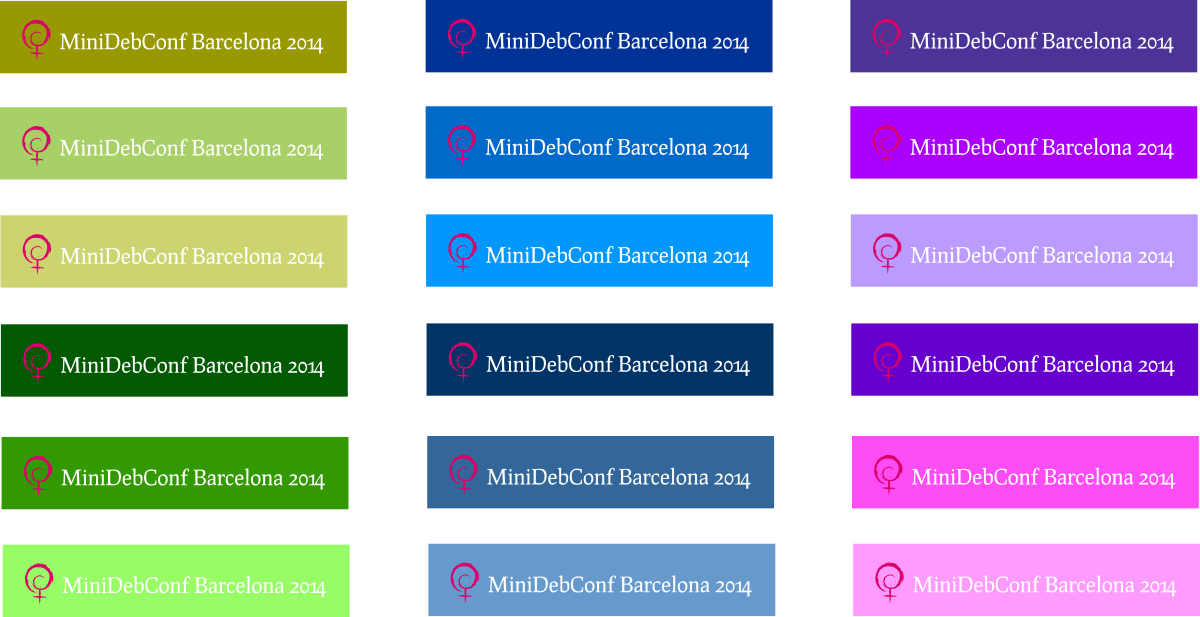
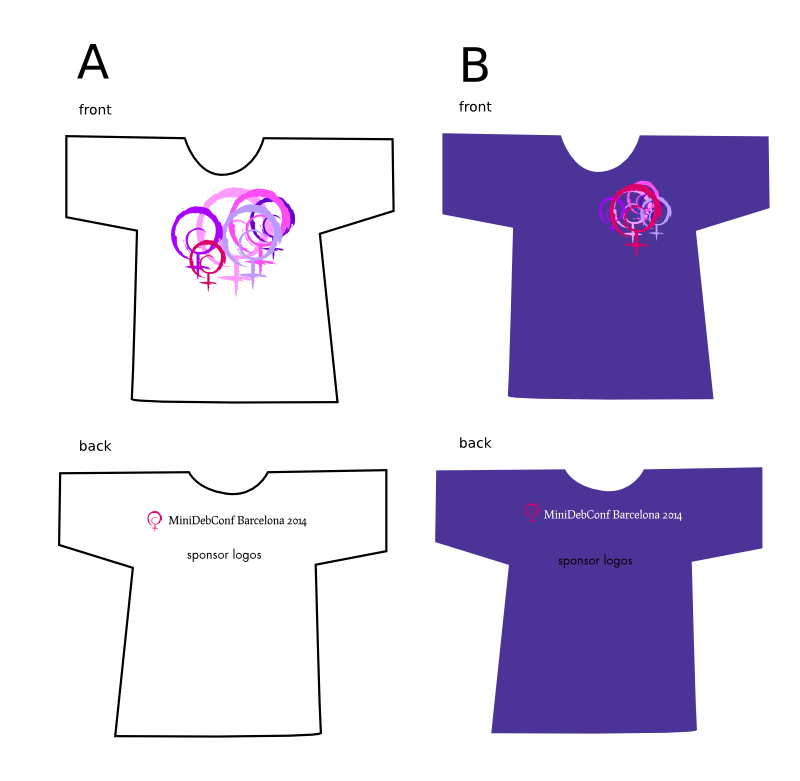
Oh, that was the minidebconf that The identity design might have more to do with support to the local group than with any of the other aspects of the conference. Interesting. This table of colors shows different ways a blue and a purple could go. I put the green colors there to have more options covered for the discussion today. You can see how the different hues interacts with the red of the logo. The colors can be referred to like this: B3, C6, A4 etc. Click on the image for full size version. Here is an idea based on all the purple colors. Fun, uplifting, feels like many voices. Too many colors for T-shirt print, maybe: Here is some ideas of how to implement a minimalistic solution that I recommend for minidebconfs: My suggestion is that the banner (and everything else displaying the event) has the logo of the organizers placed on it. The font used for headlines etc is semantically of another nature than the logo, though it could be the same. I prefer neutral fonts, that can be reused by the next minidebconf, and I suggest a sans serif font. A condensed font makes huge display easier to fit. Don't be confused by displayfonts, I aim to show you that type alone speaks loudly, and if this typography should be recycled, we should not choose one of them, but go with the "neutral" sans serif. I need suggestions of free and good sans serif fonts.

30 April 2014

Chris Lamb: Marlon Brando in the Lake District

Alan How:
There's an Italian restaurant somewhere in the Lake District in the north of England. And if you can imagine, there are hills, lots of rain, lakes, and so on and so forth. And inside this Italian restaurant is a huge picture a wall-sized mural of Marlon Brando. Now, I asked my students once: Why Marlon Brando? Well he's The Godfather! I don't think he was a Godfather, you know... But he was in that film, wasn't he? It was called The Godfather. Ah, that film from 40 years ago, virtually.. 1970-something? Yes, yes, but he was The Godfather then, wasn't he? You mean if was a mafiosi? He was a leading figure in gangsterland in New York? Well, yes, he was The Godfather, they keep saying, ... and he was Italian. Well, no, actually he was American... So you get this regular kind of placing and misplacing of the real, ie. a very large American actor who played in a film called The Godfather about American gangsters, or Italian-American gangsters, nothing to do with godfathers in Christianity, in the north of England, stuck on a huge wall in a restaurant. All of which tells us that it's an Italian restaurant. And we don't demure, we don't say "no, that's all untrue", we just take it for granted: "Yeah, that's what it means - it's an Italian restaurant". And it's that kind of slippage between the real and the imagined or the true and the fictional which Baudrillard thinks is becoming inceasingly characteristic of how our society goes on.

Andrew Pollock: [life] Day 92: Kindergarten, cleaning and more birthday party preparation

I'm mostly back into my normal routine now. Next week should be spot on. Today, after my chiropractic adjustment and another walk to the post office to collect another package, I got stuck into cleaning the house. I got that mostly done before my massage, and knocked out the rest of it before I picked up Zoe from Kindergarten. Zoe seems to have successfully dropped her day time nap at Kindergarten now, which certainly makes a huge difference to getting out of the place on time. I'd underestimated the number of kids coming to Zoe's birthday party, so I needed to get some extra goody bags made up, so we headed directly out to Westfield Carindale to raid the The Reject Shop for some more bits and pieces. After we got home from that, Zoe watched a bit of TV and helped me assemble the extra bags, and then we had dinner. After some epic procrastination (on Zoe's behalf) I managed to get her to bed approximately on time. I really need to try some different approaches to getting through the bath time routine, because it's just taking too long. I gave myself a couple of time outs because I could see the situation deteriorating if I didn't. It's unhelpful that my blog seems to be the third hit in Google at the moment for "positive parent procrastination". I don't have the answers.

29 April 2014

Russell Coker: Autism and the Treatment of Women Again

Background I ve previously written about the claim that people use Autism as an excuse for bad behavior [1]. In summary it doesn t and such claims instead lead to people not being assessed for Autism. I ve also previously written about empathy and Autism in the context of discussions about conference sexual harassment [2]. The main point is that anyone who s going to blame empathy disorders for the widespread mistreatment of women in society and divert the subject from the actions of average men to men in minority groups isn t demonstrating empathy. Discussions of the actions of average men are so often derailed to cover Autism that the Geek Feminism Wiki has a page about the issue of blaming Autism [3]. The Latest Issue Last year Shanley Kane wrote an informative article for Medium titled What Can Men Do about the treatment of women in the IT industry [4]. It s a good article, I recommend reading it. As an aside @shanley s twitter feed is worth reading [5]. In response to Shanley s article Jeff Atwood wrote an article of the same title this year which covered lots of other things [6]. He writes about Autism but doesn t seem to realise that officially Asperger Syndrome is now Autism according to DSM-V (they decided that separate diagnosis of Autism, Asperger Syndrome, and PDD-NOS were too difficult and merged them). Asperger Syndrome is now a term that refers to historic issues (IE research that was published before DSM-V) and slang use. Gender and the Autism Spectrum Jeff claims that autism skews heavily towards males at a 4:1 ratio and cites the Epidemiology of Autism Wikipedia page as a reference. Firstly that page isn t a great reference, I fixed one major error (which was obviously wrong to anyone who knows anything about Autism and also contradicted the cited reference) in the first section while writing this post. The Wikipedia page cites a PDF about the Epidemiology of Autism that claims the 4.3:1 ratio of boys to girls [7]. However that PDF is a summary of other articles and the one which originated the 4.3:1 claim is behind a paywall. One thing that is worth noting in the PDF is that the section containing the 4.3:1 claim also references claims about correlations between race and Autism and studies contradicting such claims it notes the possibility of ascertainment bias . I think that anyone who reads that section should immediately consider the possibility of ascertainment bias in regard to the gender ratio. Most people who are diagnosed with Autism are diagnosed as children. An Autism diagnosis of a child is quite subjective, an important part is an IQ test (where the psychologist interprets the intent of the child in the many cases where answers aren t clear) to compare social skills with IQ. So whether a child is diagnosed is determined by the psychologist s impression of the child s IQ vs the impression of their social skills. Whether a child is even taken for assessment depends on whether they act in a way that s considered to be obviously different. Any child who is suspected of being on the Autism Spectrum will be compared other children who have been diagnosed (IE mostly boys) and this will probably increase the probability that a boy will be assessed. So an Aspie girl might not be assessed because she acts like other Aspie girls not like the Aspie boys her parents and teachers have seen. The way kids act is not solely determined by neuro-type. Our society expects and encourages boys to be louder than girls and take longer and more frequent turns to speak, this is so widespread that I don t think it s possible for parents to avoid it if their kids are exposed to the outside world. Because of this boys who would be diagnosed with Asperger Syndrome by DSM-IV tend to act in ways that are obviously different from other kids. While the combination of Autism and the the social expectations on girls tends to result in girls who are quiet, shy, and apologetic. The fact that girls are less obviously different and that their differences cause fewer difficulties for parents and teachers makes them less likely to be assessed. Note that the differences in behavior of boys and girls who have been diagnosed is noted by the professionals (and was discussed at a conference on AsperGirls that my wife attended) while the idea that this affects assessment rates is my theory. Jeff also cites the book The Essential Difference: Male And Female Brains And The Truth About Autism by Professor Simon Baron-Cohen (who s (in)famous for his Extreme Male Brain theory). The first thing to note about the Extreme Male Brain theory are that it depends almost entirely on the 4.3:1 ratio of males to females on the Autism Spectrum (which is dubious as I noted above). The only other evidence in support of it is subjective studies of children which suffer from the same cultural issues this is why double blind tests should be used whenever possible. The book Delusions of Gender by Cordelia Fine [8] debunks Simon Baron-Cohen s work among other things. The look inside feature of the Amazon page for Delusions of Gender allows you to read about Simon Baron-Cohen s work [9]. Now even if the Extreme Male Brain theory had any merit it would be a really bad idea to cite it (or a book based on it) if you want to make things better for women in the IT industry. Cordelia s book debunks the science and also shows how such claims about supposed essential difference are taken as exclusionary. The Problem with Jeff Atwood Jeff suggests in his post that men should listen to women. Then he and his followers have a huge flame-war with many women over twitter during which which he tweeted Trying to diversify my follows by following any female voices that engaged me in a civil, constructive way recently . If you only listen to women who agree with you then that doesn t really count as listening to women. When you have a stated policy of only listening to women who agree then it seems to be more about limiting what women may feel free to say around you. The Geek Feminism wiki page about the Tone Argument [10] says the following: One way in which the tone argument frequently manifests itself is as a call for civility. A way to gauge whether a request for civility is sincere or not is to ask whether the person asking for civility has more power along whatever axes are contextually relevant (see Intersectionality) than the person being called incivil , less power, or equal power. Often, people who have the privilege of being listened to and taken seriously level accusations of incivility as a silencing tactic, and label as incivil any speech or behavior that questions their privilege. For example, some men label any feminist thought or speech as hostile or impolite; there is no way for anybody to question male power or privilege without being called rude or aggressive. Likewise, some white people label any critical discussion of race, particularly when initiated by people of color, as incivil. Writing about one topic is also a really good idea. A blog post titled What Can Men Do should be about things that men can do. Not about Autism, speculation about supposed inherent differences between men and women which are based on bad research, gender diversity in various occupations, etc. Following up a post on What Can Men Do with discussion (in blog comments and twitter) about what women should do before they are allowed to join the conversation is ridiculous. Jeff s blog post says that men should listen to women, excluding women based on the tone argument is gross hypocrisy. Swearing Jeff makes a big deal of the fact that Shanley uses some profane language in her tweets. This combines a couple of different ways of silencing women. It s quite common for women to be held to a high standard of ladylike behavior, while men get a free pass on doing the same thing. One example of this is the Geek Feminism article about the results of Sarah Sharp s request for civility in the Linux kernel community [11]. That s not an isolated incident, to the best of my recollection in 20+ years my local Linux Users Group has had only one debate about profanity on mailing lists in that case a woman (who is no longer active in the group) was criticised for using lesser profanity than men used both before and after with no comment (as an experiment I used some gratuitous profanity a couple of weeks later and no-one commented). There is also a common difference in interpretation of expressions of emotion, when a woman seems angry then she invariably has men tell her to change her approach (even when there are obvious reasons for her anger) while when a man is angry the possibility that other people shouldn t make him angry will usually be considered. The issues related to the treatment of women have had a large affect on Shanley s life and her friend s lives. It s quite understandable that she is angry about this. Her use of profanity in tweets seems appropriate to the situation. Other Links Newsweek s Gentlemen in Technology article has a section about Jeff [12], it s interesting to note his history of deleting tweets and editing his post. I presume he will change his post in response to mine and not make any note of the differences. Jacob Kaplan-Moss wrote a good rebuttal to Jeff s post [13]. It s a good article and has some other relevant links that are worth reading.

27 April 2014

Daniel Pocock: AirBNB hosts scanning identity documents and passports?

We recently had a vacation in Italy and used AirBNB to book our accommodation in three different cities we visited. We've used AirBNB quite a few times now but we had a new experience this time: one of the hosts told me she makes a scan of the passport of each guest. Sitting on the dinner table was a shiny new looking handheld scanner similar to this: I was tempted to ask if she also wanted my fingerprints and a DNA sample too. Not wanting to be too offensive though, I simply told her that there was no way she would be making a copy of our documents. I tried to explain it to her in terms that she would understand: that AirBNB had already verified my identity and that AirBNB automatically gives her insurance (Italy is included) and she doesn't need a copy of my passport to be eligible for the insurance. At best, I suggested, she would be welcome to look at the passport to see that the name matches the AirBNB account - but no copies under any circumstances. A common problem A quick search in Google reveals we weren't the first people to have such an experience with a host. However, the AirBNB FAQ has no definite comment on the topic. I wrote to AirBNB's safety team and explained the risks with copying documents onto home computers and they are now considering adding something about this issue to their policies and FAQ. I would suggest that anybody else who is asked for a copy of an identity document should also fill in the safety report form and ask AirBNB to publish a firm policy prohibiting hosts from demanding copies of identity documents. Just what is at risk? Just how bad could it be? Some of the following risks come to mind:
  • The host's computer is sold, sent for repair or stolen and the passport images all end up in the hands of strangers.
  • Viruses and trojans designed to search hard disks for sensitive documents can quickly recognise a passport image. Such viruses are far more likely to hit a home computer than one of those computers used by passport scanners at an airport or bank.
  • Maybe the host even has children or housemates who access the same computer.
  • The host may actually be making themself a target by keeping a cache of these documents - it would be a fairly low-tech hack for a criminal to look through AirBNB listings for hosts who explicitly mention they want to copy an identity document at check-in.
Did the world really get safer since September 2011? Ever since the horrors of 09/11/2011, many people have felt an urge to try and make the world safer. Simultaneously, the rise of cheap technology has made it easy for people to take these things way too far. Everywhere from bed and breakfasts to luggage storage companies are now trying to scan these documents at every opportunity. Having electronic copies of identity documents floating around in so many different places, many of them on poorly maintained computers that are used by staff to surf the web when they are not busy, is actually a huge increase in the risk of identity fraud. A good proportion of these companies are not even required to scan/copy identity documents - for some of them it is sufficient for them to simply look at the document, just as a train conductor looks at a ticket. Many are simply scanning the documents because management have realized this is the most efficient way to accurately build up a marketing database including customer date of birth (which is harder to ask for directly). There was significant outrage a few years ago when Mossad was accused of using passport images presumably acquired at Israeli airports to give fake identities to a hit-squad. The quality of passport images now available in the hard disk of a typical AirBNB host or bed'n'breakfast are now likely to be of a higher quality and yet available for misappropriation by a far wider proportion of (cyber-)criminals.

Daniel Pocock: AirBNB hosts scanning identity documents and passports?

We recently had a vacation in Italy and used AirBNB to book our accommodation in three different cities we visited. We've used AirBNB quite a few times now but we had a new experience this time: one of the hosts told me she makes a scan of the passport of each guest. Sitting on the dinner table was a shiny new looking handheld scanner similar to this: I was tempted to ask if she also wanted my fingerprints and a DNA sample too. Not wanting to be too offensive though, I simply told her that there was no way she would be making a copy of our documents. I tried to explain it to her from her own perspective: that AirBNB had already verified my identity and that AirBNB automatically gives her insurance (Italy is included) and she doesn't need a copy of my passport to be eligible for the insurance. At best, I suggested, she would be welcome to look at the passport to see that the name matches the AirBNB account - but no copies under any circumstances. A common problem A quick search in Google reveals we weren't the first people to have such an experience with a host. However, the AirBNB FAQ has no definite comment on the topic. I wrote to AirBNB's safety team and explained the risks with copying documents onto home computers and they are now considering adding something about this issue to their policies and FAQ. I would suggest that anybody else who is asked for a copy of an identity document should also fill in the safety report form and ask AirBNB to publish a firm policy prohibiting hosts from demanding copies of identity documents. Just what is at risk? Just how bad could it be? Some of the following risks come to mind:
  • The host's computer is sold, sent for repair or stolen and the passport images all end up in the hands of strangers.
  • Viruses and trojans designed to search hard disks for sensitive documents can quickly recognise a passport image. Such viruses are far more likely to hit a home computer than one of those computers used by passport scanners at an airport or bank.
  • Maybe the host even has children or housemates who access the same computer.
  • The host may actually be making themself a target by keeping a cache of these documents - it would be a fairly low-tech hack for a criminal to look through AirBNB listings for hosts who explicitly mention they want to copy an identity document at check-in.
Did the world really get safer since September 2001? Ever since the horrors of 09/11/2001, many people have felt an urge to try and make the world safer. Simultaneously, the rise of cheap technology has made it easy for people to take security precautions too far. Everywhere from bed and breakfasts to luggage storage companies are now trying to scan and make a rather permanent electronic copy of identity documents at each opportunity. Having electronic copies of identity documents floating around in so many different places, many of them on poorly maintained computers that are used by staff to surf the web when they are not busy, is actually a huge increase in the risk of identity fraud. A good proportion of these companies are not even required to scan/copy identity documents - for some of them it is sufficient for them to simply look at the document, just as a train conductor looks at a ticket. Many are simply scanning the documents because management have realized this is the most efficient way to accurately build up a marketing database including customer date of birth (which is harder to ask for directly). There was significant outrage a few years ago when Mossad agents were accused of using passport images presumably acquired at airports to give identities to a their operatives. The quality of passport images now available in the hard disk of a typical AirBNB host or bed'n'breakfast are now likely to be of a higher quality more easily accessible for any number of unintended uses.

20 April 2014

Russell Coker: Sociological Images 2012

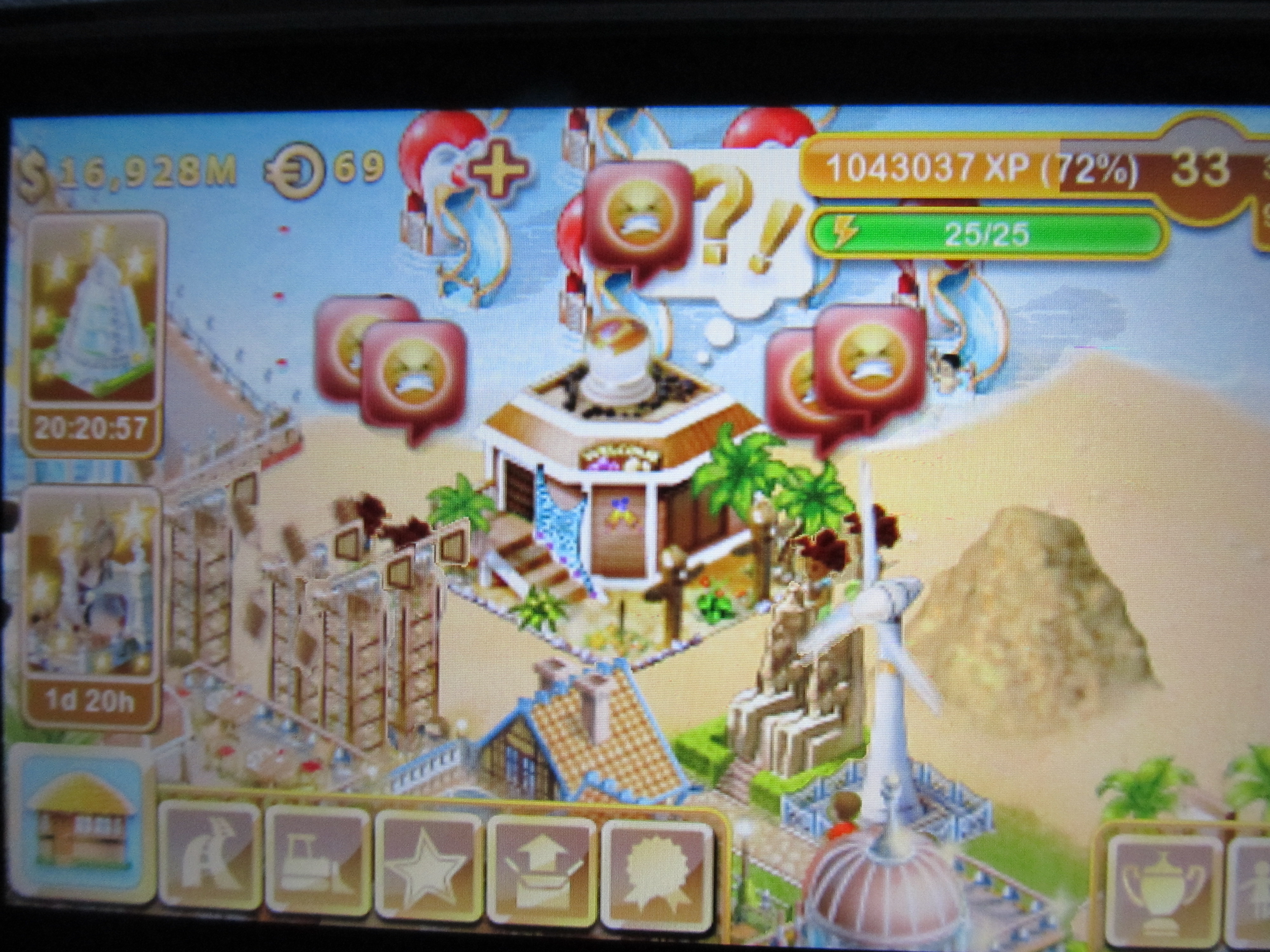
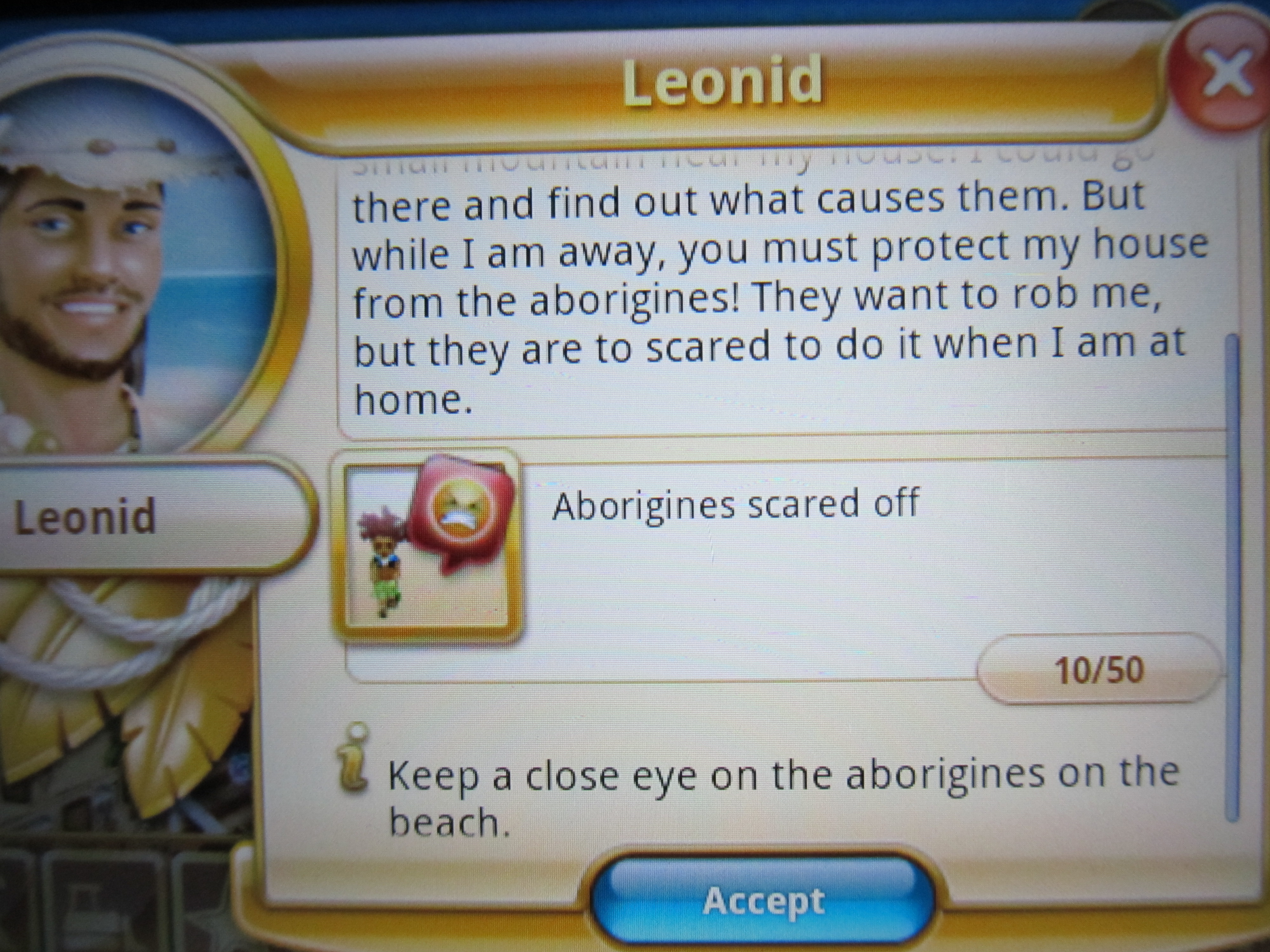
In 2011 I wrote a post that was inspired by the Sociological Images blog [1]. After some delay here I ve written another one. I plan to continue documenting such things. Playground gender segregated playground in 1918 In 2011 I photographed a plaque at Flagstaff Gardens in Melbourne. It shows a picture of the playground in 1918 with segregated boys and girls sections. It s interesting that the only difference between the two sections is that the boys have horizontal bars and a trapeze. Do they still have gender segregated playgrounds anywhere in Australia? If so what is the difference in the sections? Aborigines The Android game Paradise Island [2] has a feature where you are supposed to stop Aborigines from stealing, it plays on the old racist stereotypes about Aborigines which are used to hide the historical record that it s always been white people stealing from the people that they colonise. Angry face icons over AboriginesAborigines described as thieves There is also another picture showing the grass skirts. Nowadays the vast majority of Aborigines don t wear such clothing, the only time they do is when doing some sort of historical presentation for tourists. I took those pictures in 2012, but apparently the game hasn t changed much since then. Lemonade lemonade flavored fizzy drink Is lemonade a drink or a flavour? Most people at the party where I took the above photo regard lemonade as a drink and found the phrase Lemonade Flavoured Soft Drink strange when it was pointed out to them. Incidentally the drink on the right tastes a bit like the US version of lemonade (which is quite different from the Australian version). For US readers, the convention in Australia is that lemonade has no flavor of lemons. Not Sweet maybe gender queer people on bikes In 2012 an apple cider company made a huge advertising campaign featuring people who might be gender queer, above is a picture of a bus stop poster and there were also TV ads. The adverts gave no information at all about what the drink might taste like apart from not being as sweet as you think . So it s basically an advertising campaign with no substance other than a joke about people who don t conform to gender norms. Also it should be noted that some women naturally grow beards and have religious reasons for not shaving [3]. Episode 2 of the TV documentary series Am I Normal has an interesting interview of a woman with a beard. Revolution communist revolution Schweppes drinks A violent political revolution is usually a bad thing, using such revolutions to advertise sugar drinks seems like a bad idea. But it seems particularly interesting to note the different attitudes to such things in various countries. In 2012 Schweppes in Australia ran a marketing campaign based on imagery related to a Communist revolution (the above photo was taken at Southern Cross station in Melbourne), I presume that Schweppes in the US didn t run that campaign. I wonder whether global media will stop such things, presumably that campaign has the potential to do more harm in the US than good in Australia. Racist Penis Size Joke at Southbank racist advert in Southbank paper The above advert was in a free newspaper at Southbank in 2012. Mini Movers thought that this advert was a good idea and so did the management of Southbank who approved the advert for their paper. Australia is so racist that people don t even realise they are being racist.

19 April 2014

Russell Coker: Swap Space and SSD

In 2007 I wrote a blog post about swap space [1]. The main point of that article was to debunk the claim that Linux needs a swap space twice as large as main memory (in summary such advice is based on BSD Unix systems and has never applied to Linux and that most storage devices aren t fast enough for large swap). That post was picked up by Barrapunto (Spanish Slashdot) and became one of the most popular posts I ve written [2]. In the past 7 years things have changed. Back then 2G of RAM was still a reasonable amount and 4G was a lot for a desktop system or laptop. Now there are even phones with 3G of RAM, 4G is about the minimum for any new desktop or laptop, and desktop/laptop systems with 16G aren t that uncommon. Another significant development is the use of SSDs which dramatically improve speed for some operations (mainly seeks). As SATA SSDs for desktop use start at about $110 I think it s safe to assume that everyone who wants a fast desktop system has one. As a major limiting factor in swap use is the seek performance of the storage the use of SSDs should allow greater swap use. My main desktop system has 4G of RAM (it s an older Intel 64bit system and doesn t support more) and has 4G of swap space on an Intel SSD. My work flow involves having dozens of Chromium tabs open at the same time, usually performance starts to drop when I get to about 3.5G of swap in use. While SSD generally has excellent random IO performance the contiguous IO performance often isn t much better than hard drives. My Intel SSDSC2CT12 300i 128G can do over 5000 random seeks per second but for sustained contiguous filesystem IO can only do 225M/s for writes and 274M/s for reads. The contiguous IO performance is less than twice as good as a cheap 3TB SATA disk. It also seems that the performance of SSDs aren t as consistent as that of hard drives, when a hard drive delivers a certain level of performance then it can generally do so 24*7 but a SSD will sometimes reduce performance to move blocks around (the erase block size is usually a lot larger than the filesystem block size). It s obvious that SSDs allow significantly better swap performance and therefore make it viable to run a system with more swap in use but that doesn t allow unlimited swap. Even when using programs like Chromium (which seems to allocate huge amounts of RAM that aren t used much) it doesn t seem viable to have swap be much bigger than 4G on a system with 4G of RAM. Now I could buy another SSD and use two swap spaces for double the overall throughput (which would still be cheaper than buying a PC that supports 8G of RAM), but that still wouldn t solve all problems. One issue I have been having on occasion is BTRFS failing to allocate kernel memory when managing snapshots. I m not sure if this would be solved by adding more RAM as it could be an issue of RAM fragmentation I won t file a bug report about this until some of the other BTRFS bugs are fixed. Another problem I have had is when running Minecraft the driver for my ATI video card fails to allocate contiguous kernel memory, this is one that almost certainly wouldn t be solved by just adding more swap but might be solved if I tweaked the kernel to be more aggressive about swapping out data. In 2007 when using hard drives for swap I found that the maximum space that could be used with reasonable performance for typical desktop operations was something less than 2G. Now with a SSD the limit for usable swap seems to be something like 4G on a system with 4G of RAM. On a system with only 2G of RAM that might allow the system to be usable with swap being twice as large as RAM, but with the amounts of RAM in modern PCs it seems that even SSD doesn t allow using a swap space larger than RAM for typical use unless it s being used for hibernation. Conclusion It seems that nothing has significantly changed in the last 7 years. We have more RAM, faster storage, and applications that are more memory hungry. The end result is that swap still isn t very usable for anything other than hibernation if it s larger than RAM. It would be nice if application developers could stop increasing the use of RAM. Currently it seems that the RAM requirements for Linux desktop use are about 3 years behind the RAM requirements for Windows. This is convenient as a PC is fully depreciated according to the tax office after 3 years. This makes it easy to get 3 year old PCs cheaply (or sometimes for free as rubbish) which work really well for Linux. But it would be nice if we could be 4 or 5 years behind Windows in terms of hardware requirements to reduce the hardware requirements for Linux users even further.

14 April 2014

Christine Spang: PyCon 2014 retrospective

PyCon 2014 happened. (Sprints are still happening.) This was my 3rd PyCon, but my first year as a serious contributor to the event, which led to an incredibly different feel. I also came as a person running a company building a complex system in Python, and I loved having the overarching mission of what I'm building driving my approach to what I chose to do. PyCon is one of the few conferences I go to where the feeling of acceptance and at-homeness mitigates the introvert overwhelm at nonstop social interaction. It's truly a special event and community. Here are some highlights: I didn't get to go to a lot of talks in person this year since my personal schedule was so full, but the PyCon video team is amazing as usual, so I'm looking forward to checking out the archive. It really is a gift to get the videos up while energy from the conference is still so high and people want to check out things they missed and share the talks they loved. Thanks to everyone, hugs, peace out, et cetera!

13 April 2014

Andreas Metzler: balance sheet snowboarding season 2013/14

Little snow, but above-average season. The macro weather situation was very stable this year, very high snowfall in Austria's south (eastern tyrol and carinthia), and long periods of warm and sunny weather with little precipitation on the northern side of the alps (i.e. us). This had me going snowboarding a lot, but almost exclusively in Dam ls since it is characterized by a) grassy terrain (no stones) and b) huge numbers of snow cannons. I started early (December 7) with another 6 days on piste in December. If there had been more snow the season would have been a long one, too. - Season's end depends on the timimg of easter (because of the holidays) which would have been late. However I again stopped rather early, last day was March 30. In addition to the days listed below I had an early season's opening at the glacier in Pitztal. I attended the pureboarding in November (21st to 23rd). Looking back at the season I am not quite satisfied with my progress, I just have not managed to implement and practise the technique I should have learned there. It is next to impossible when the slopes are full, and when they aren't one likes to give it a run. ;-) Here is the balance sheet:
2005/06 2006/07 2007/08 2008/09 2009/10 2010/11 2011/12 2012/13 2013/14
number of (partial) days251729373030252330
Dam ls1010510162310429
Diedamskopf154242313414191
Warth/Schr cken030413100
total meters of altitude12463474096219936226774202089203918228588203562274706
highscore10247m8321m12108m11272m11888m10976m13076m13885m12848m
# of runs309189503551462449516468597

12 April 2014

Russ Allbery: Review: Cryptography Engineering

Review: Cryptography Engineering, by Niels Ferguson, et al.
Publisher: Wiley
Copyright: 2010
ISBN: 0-470-47424-6
Format: Kindle
Pages: 384
Subtitled Design Principles and Practical Applications, Cryptography Engineering is intended as an overview and introduction to cryptography for the non-expert. It doesn't dive deeply into the math, although there is still a fairly thorough mathematical introduction to public-key cryptography. Instead, it focuses on the principles, tools, and algorithms that are the most concretely useful to a practitioner who is trying to design secure systems rather than doing theoretical cryptography. The "et al." in the author summary hides Bruce Schneier and Tadayoshi Kohno, and this book is officially the second edition of Practical Cryptography by Ferguson and Schneier. Schneier's name will be familiar from, among other things, Applied Cryptography, and I'll have more to say later about which of the two books one should read (and the merits of reading both). But one of the immediately-apparent advantages of Cryptography Engineering is that it's recent. Its 2010 publication date means that it recommends AES as a block cipher, discusses MD5 weaknesses, and can discuss and recommend SHA-2. For the reader whose concern with cryptography is primarily "what should I use now for new work," this has huge benefit. "What should I use for new work" is the primary focus of this book. There is some survey of the field, but that survey is very limited compared to Applied Cryptography and is tightly focused on the algorithms and approaches that one might reasonably propose today. Cryptography Engineering also attempts to provide general principles and simplifying assumptions to steer readers away from trouble. One example, and the guiding principle for much of the book, is that any new system needs at least a 128-bit security level, meaning that any attack will require 2128 steps. This requirement may be overkill in some edge cases, as the authors point out, but when one is not a cryptography expert, accepting lower security by arguments that sound plausible but may not be sound is very risky. Cryptography Engineering starts with an overview of cryptography, the basic tools of cryptographic analysis, and the issues around designing secure systems and protocols. I like that the authors not only make it clear that security programming is hard but provide a wealth of practical examples of different attack methods and failure modes, a theme they continue throughout the book. From there, the book moves into a general discussion of major cryptographic areas: encryption, authentication, public-key cryptography, digital signatures, PKI, and issues of performance and complexity. Part two starts the in-depth discussion with chapters on block ciphers, block cipher modes, hash functions, and MACs, which together form part two (message security). The block cipher mode discussion is particularly good and includes algorithms newer than those in Applied Cryptography. This part closes with a walkthrough of constructing a secure channel, in pseudocode, and a chapter on implementation issues. The implementation chapters throughout the book are necessarily more general, but for me they were one of the most useful parts of the book, since they take a step back from the algorithms and look at the perils and pitfalls of using them to do real work. The third part of the book is on key negotiation and encompasses random numbers, prime numbers, Diffie-Hellman, RSA, a high-level look at cryptographic protocols, and a detailed look at key negotiation. This will probably be the hardest part of the book for a lot of readers, since the introduction to public-key is very heavy on math. The authors feel that's unavoidable to gain any understanding of the security risks and attack methods against public-key. I'm not quite convinced. But it's useful information, if heavy going that requires some devoted attention. I want to particularly call out the chapter on random numbers, though. This is an often-overlooked area in cryptography, particularly in introductions for the non-expert, and this is the best discussion of pseudo-random number generators I've ever seen. The authors walk through the design of Fortuna as an illustration of the issues and how they can be avoided. I came away with a far better understanding of practical PRNG design than I've ever had (and more sympathy for the annoying OpenSSL ~/.rnd file). The last substantial part of the book is on key management, starting with a discussion of time and its importance in cryptographic protocols. From there, there's a discussion of central trusted key servers and then a much more comprehensive discussion of PKI, including the problems with revocation, key lifetime, key formats, and keeping keys secure. The concluding chapter of this part is a very useful discussion of key storage, which is broad enough to encompass passwords, biometrics, and secure tokens. This is followed by a short part discussing standards, patents, and experts. A comparison between this book and Applied Cryptography reveals less attention to the details of cryptographic algorithms (apart from random number generators, where Cryptography Engineering provides considerably more useful information), wide-ranging surveys of algorithms, and underlying mathematics. Cryptography Engineering also makes several interesting narrowing choices, such as skipping stream ciphers almost entirely. Less surprisingly, this book covers only a tiny handful of cryptographic protocols; there's nothing here about zero-knowledge proofs, blind signatures, bit commitment, or even secret sharing, except a few passing mentions. That's realistic: those protocols are often extremely difficult to understand, and the typical security system doesn't use them. Replacing those topics is considerably more discussion of implementation techniques and pitfalls, including more assistance from the authors on how to choose good cryptographic building blocks and how to combine them into useful systems. This is a difficult topic, as they frequently acknowledge, and a lot of the advice is necessarily fuzzy, but they at least provide an orientation. To get much out of Applied Cryptography, you needed a basic understanding of what cryptography can do and how you want to use it. Cryptography Engineering tries to fill in that gap to the point where any experienced programmer should be able to see what problems cryptography can solve (and which it can't). That brings me back to the question of which book you should read, and a clear answer: start here, with Cryptography Engineering. It's more recent, which means that the algorithms it discusses are more directly applicable to day-to-day work. The block cipher mode and random number generator chapters are particularly useful, even if, for the latter, one will probably use a standard library. And it takes more firm stands, rather than just surveying. This comes with the risk of general principles that aren't correct in specific situations, but I think for most readers the additional guidance is vital. That said, I'm still glad I read Applied Cryptography, and I think I would still recommend reading it after this book. The detailed analysis of DES in Applied Cryptography is worth the book by itself, and more generally the survey of algorithms is useful in showing the range of approaches that can be used. And the survey of cryptographic protocols, if very difficult reading, provides tools for implementing (or at least understanding) some of the fancier and more cutting-edge things that one can do with cryptography. But this is the place to start, and I wholeheartedly recommend Cryptography Engineering to anyone working in computer security. Whether you're writing code, designing systems, or even evaluating products, this is a very useful book to read. It's a comprehensive introduction if you don't know anything about the field, but deep enough that I still got quite a bit of new information from it despite having written security software for years and having already read Applied Cryptography. Highly recommended. I will probably read it from cover to cover a second time when I have some free moments. Rating: 9 out of 10

8 April 2014

Russ Allbery: Review: With Charity for All

Review: With Charity for All, by Ken Stern
Publisher: Anchor
Copyright: November 2013
ISBN: 0-307-74381-0
Format: Trade paperback
Pages: 244
I've been reading a lot lately about how to measure charitable organizations and where best to give your money, which has already prompted a rethinking of which organizations I want to support. Most of that has been shorter, on-line blog posts, but I've been wanting a deeper analysis. This is the first of a couple of books I've found on the topic. (The second, an analysis of microfinance, is waiting for me to have more time to read.) For this kind of book, the background of the author matters a lot. Stern was the former CEO of National Public Radio for eight and a half years, so he has practical experience in the business side of non-profits. He's credited with improving NPR's financial position and management and oversaw an era of rapid growth. In With Charity for All, he speaks frankly about his own personal experiences as well as his research. My impression is that he's typical of competent business managers of non-profits: not particularly radical, focused mostly on business issues, and the sort of person that a non-profit needs to turn a mission or cause into a sustainable organization. It's worth noting in advance that With Charity for All is specifically about the United States charitable sector and US laws and approaches. Some of this may generalize to other countries, but non-profit and charity law is very different between different countries, and the US attitude towards government, non-profits, and the appropriate division of responsibilities between them often doesn't match the prevailing view elsewhere. This book may well be interesting to people outside the US, but only if they're curious about the US charitable sector. The short summary of the message of this book is that we're not getting our money's worth out of charity, either as donors or as taxpayers who are indirectly subsidizing these organizations. This is not (usually) due to any outright fraud, although there certainly is some of that due to the almost total lack of oversight of charitable organizations. Rather, it's the result of a complex combination of history and institutional momentum, focus on the aspects of a charity that play well to potential donors, a concerted effort at feel-good marketing, well-intentioned but misguided donor dictates, adoption of approaches and business practices from the for-profit sector, and, above everything else, the almost complete absence of evidence-based evaluation of charities. Evidence-based evaluation is currently a hot trend among charities. I heard about this book via one of the organizations that is focusing on this (GiveWell). This is not what sites like Charity Navigator do, and indeed Stern talks at some length about the serious limitations of the Charity Navigator approach. All that sites of that type can do is look at spending breakdowns. Stern makes a strong argument that a focus on reducing overhead, as measured by those financial forms, is misguided and leads to very ineffective and unorganized charities. Worse, all Charity Navigator can tell you is if the charity is spending money on something they declare to be in line with their goal, not whether that money did any good whatsoever. The short and depressing news is that most of that money does little or no good, and worse, that most charities have no systematic way of measuring whether it does any good. I'm particularly interested in how to ground charities in more concrete evidence, and Stern's discussion does not disappoint. But one of the things I liked about the book is that he doesn't stop there. Other topics include the dizzying variety of charities and the resulting confusion and dispersion of resources, the non-profits that are practically indistinguishable from for-profit companies except that they get huge tax breaks (sports organizations, as you might expect, are probably the worst offenders, but Stern has harsh commentary on the US hospital system), the mess of compensation in the non-profit sector, and the serious problems created by major donors who want to get directly involved and oversee how their money is spent. All of these topics are fascinating, if a bit depressing in the aggregate. As is typical for a book of this sort, it's a lot easier to see the problems than to describe the solutions. Stern does try to offer his own prescriptions, most of which are variations on more oversight: more regulation, more effort put into measuring results, more concrete standards for success or failure, and a stronger culture of treating tax-exempt status as a privilege, not a right, that has to be defended by showing clear social benefit. I'm convinced those steps would be helpful, although less convinced that we're able to get there from here. One of his ideas I am already using on a small scale: pooling charitable donations with professional evaluators who can take the time to look deeper than financial breakdowns and do some independent measurement of results, or at least survey relevant studies done by others and possibly demand more be done. This model of a mutual fund for charitable giving has some promise, I think (more than a managed mutual fund, in fact), and is very similar to what GiveWell is doing. This is an advocacy book, and one that's primarily focused on concrete, measurable deliverables and on the finances. There are a few places where I have reason to be dubious of the black-and-white conclusions Stern draws. For example, he makes much of the bill collecting practices of charitable hospitals, which I agree is a travesty, but doesn't mention that non-profit hospitals produce better health outcomes. I'm also not sure his analysis is as directly applicable to advocacy organizations, where measuring success is a much more challenging proposition. I think the Southern Poverty Law Center is one of the best charities in the United States (admittedly based largely on gut feeling and presentation), but the nature of their work is not amenable to the style of analysis that Stern is doing here. It's therefore worth taking this book with a grain of salt. But, that said, Stern's conclusions are in line with things I've read elsewhere. I think he's pointing in the right direction, and I would recommend this book to anyone who gives regularly to charity. Hopefully it won't just cause you to stop. There are charities out there that are trying hard to measure their results and ensure they deliver social value for the money that we give them. Our system just doesn't support them very well, yet. Rating: 8 out of 10

7 April 2014

Andrew Pollock: [life] Day 69: Walk to King Island, a picnic at Wellington Point, the long slow acquisition of some linseed and a split lip

Today was a really good day, right up until the end, when it wasn't so good, but could have been a whole lot worse, so I'm grateful for that. I've been wanting to walk out to King Island at low tide with Zoe for a while, but it's taken about a month to get the right combination of availability, weather and low tide timing to make it possible. Today, there was a low tide at about 10:27am, which I thought would work out pretty well. I wasn't sure if the tide needed to be dead low to get to King Island, so I thought we could get there a bit early and possibly follow the tide out. I invited Megan and Jason to join us for the day and make a picnic of it. It turned out that we didn't need a really low tide, the sand bar connecting King Island to Wellington Point was well and truly accessible well before low tide was reached, so we headed out as soon as we arrived. I'd brought Zoe's water shoes, but from looking at it, thought it would be walkable in bare feet. We got about 10 metres out on the sand and Zoe started freaking out about crabs. I think that incident with the mud crab on Coochiemudlo Island has left her slightly phobic of crabs. So I went back to Jason's car and got her water shoes. I tried to allay her fears a bit by sticking my finger in some of the small holes in the sand, and even got her to do it too. I'm actually glad that I did get her water shoes, because the shell grit got a bit sharp and spiky towards King Island, so I probably would have needed to carry her more than I did otherwise. Along the way to the island we spotted a tiny baby mud crab, and Zoe was brave enough to hold it briefly, so that was good. We walked all the way out and partially around the island and then across it before heading back. The walk back was much slower because where was a massive headwind. Zoe ran out of steam about half way back. She didn't like the sand getting whipped up and stinging her legs, and the wind was forcing the brim of her hat down, so I gave her a ride on my shoulders for the rest of the way back. We had some lunch after we got back to Wellington Point, and Zoe found her second wind chasing seagulls around the picnic area. After an ice cream, we went over to the playground and the girls had a great time playing. It was a pretty good park. There was this huge tree with a really big, thick, horizontal branch only about a metre or two off the ground. All the kids were climbing on it and then shimmying along the branch to the trunk. Zoe's had a few climbs in trees and seems not afraid of it, so she got up and had a go. She did really well and did a combination of scooting along, straddling the branch and doing a Brazilian Jiu-Jitsu-style "bear crawl" along the branch. It was funny seeing different kids' limits. Zoe was totally unfazed by climbing the tree. Megan was totally freaking out. But when it came to walking in bare feet in an inch of sea water, Zoe wanted to climb up my leg like a rat up a rope, in case there were crabs. Each to their own. Zoe wanted to have a swim in the ocean, so I put her into her swimsuit, but had left the water shoes back in the car. Once again, she freaked out about crabs as soon as we got ankle deep in the water, and was freaking out Megan as well, so the girls elected to go back to playing in the park. After a good play in the park, we headed back home. We'd carpooled in Jason's truck, with both girls in the back. I'd half expected Zoe to fall asleep on the way back, but the girls were very hyped up and had a great time playing games and generally being silly in the back. When we got back to our place, Jason was in need of a coffee, so we walked to the Hawthorne Garage and had coffee and babyccinos, before Megan and Jason went home. It was about 3:30pm at this point, and I wanted to make a start on dinner. I was making a wholemeal pumpkin quiche, which I've made a few times before, and I discovered we were low on linseed. I thought I'd push things and see if Zoe was up for a scooter ride to the health food shop to get some more and kill some time. She was up for it, but ran out of steam part way across Hawthorne Park. Fortunately she was okay with walking and didn't want me to carry her and the scooter. It took us about an hour to get to the health food shop. Zoe immediately remembered the place from the previous week where we'd had to stop for a post-meltdown pit stop and declared she needed to go to the toilet again. We finally made it out of the shop. I wasn't looking forward to the long walk back home, but there were a few people waiting for a bus at the bus stop near the health food shop, and on checking the timetable, the bus was due in a couple of minutes, so we just waited for the bus. That drastically shortened the trip back. Zoe managed to drop the container of linseed on the way home from the bus stop, but miraculously the way it landed didn't result in the loss of too much of the contents, it just split the container. So I carefully carried the container home the rest of the way. By this stage it was quite a bit later than I had really wanted to be starting dinner, but we got it made, and Zoe really liked the pumpkin quiche, and ate a pretty good dinner. It was after dinner when things took a turn for the worse. Zoe was eating an ice block for dessert, and for whatever reason, she'd decided to sit in the corner of the kitchen next to the dishwasher, while I was loading it. I was carrying over one of the plates, and the knife managed to fall off the plate, bounce off the open dishwasher door and hit her in the mouth, splitting her lip. Zoe was understandably upset, and I was appalled that the whole thing had happened. She never sits on the kitchen floor, let alone in the corner where the dishwasher is. And this knife came so close to her eye. Fortunately the lip didn't look too bad. It stopped bleeding quickly, and we kept some ice on it and the swelling went down. I hate it when accidents happen on my watch. I feel like I'm fighting the stigma of the incompetent single Dad, or the abusive single Dad, so when Zoe sustains an injury to the face like a fat lip, which could be misinterpreted, I, well, really hate it. This was such a freak accident, and it could have gone so much worse. I'm just so glad she's okay. Zoe recovered pretty well from it, and I was able to brush her teeth without aggravating her lip. She went to bed well, and I suspect she's going to sleep really well. It's a bit cooler tonight, so I'm half-expecting a sleep in in the morning with any luck.

6 April 2014

Steve Kemp: So that distribution I'm not-building?

The other week I was toying with using GNU stow to build an NFS-share, which would allow remote machines to boot from it. It worked. It worked well. (Standard stuff, PXE booting with an NFS-root.) Then I started wondering about distributions, since in one sense what I'd built was a minimal distribution. On that basis yesterday I started hacking something more minimal: Unfortunately here is where I ran out of patience. Using tcc and the static C library I can compile code. But I can't link it.
$ cat > t.c <>EOF
int main ( int argc, char *argv[] )
 
        printf("OK\n" );
        return 1;
 
EOF
$ /opt/tcc/bin/tcc t.c
tcc: error: file 'crt1.o' not found
tcc: error: file 'crti.o' not found
..
Attempting to fix this up resulted in nothing much better:
$ /opt/tcc/bin/tcc t.c -I/opt/musl/include -L/opt/musl/lib/
And because I don't have a full system I cannot compile t.c to t.o and use ld to link (because I have no ld.) I had a brief flirt with the portable c-compiler, pcc, but didn't get any further with that. I suspect the real solution here is to install gcc onto my host system, with something like --prefix=/opt/gcc, and then rsync that into my (suddenly huge) intramfs image. Then I have all the toys.

3 April 2014

Johannes Schauer: mapbender - maps for long-distance travels

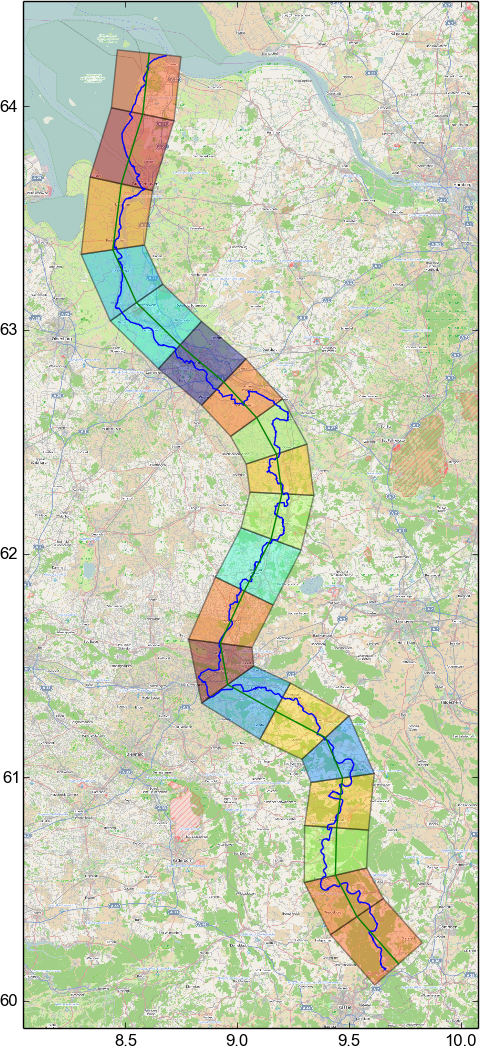
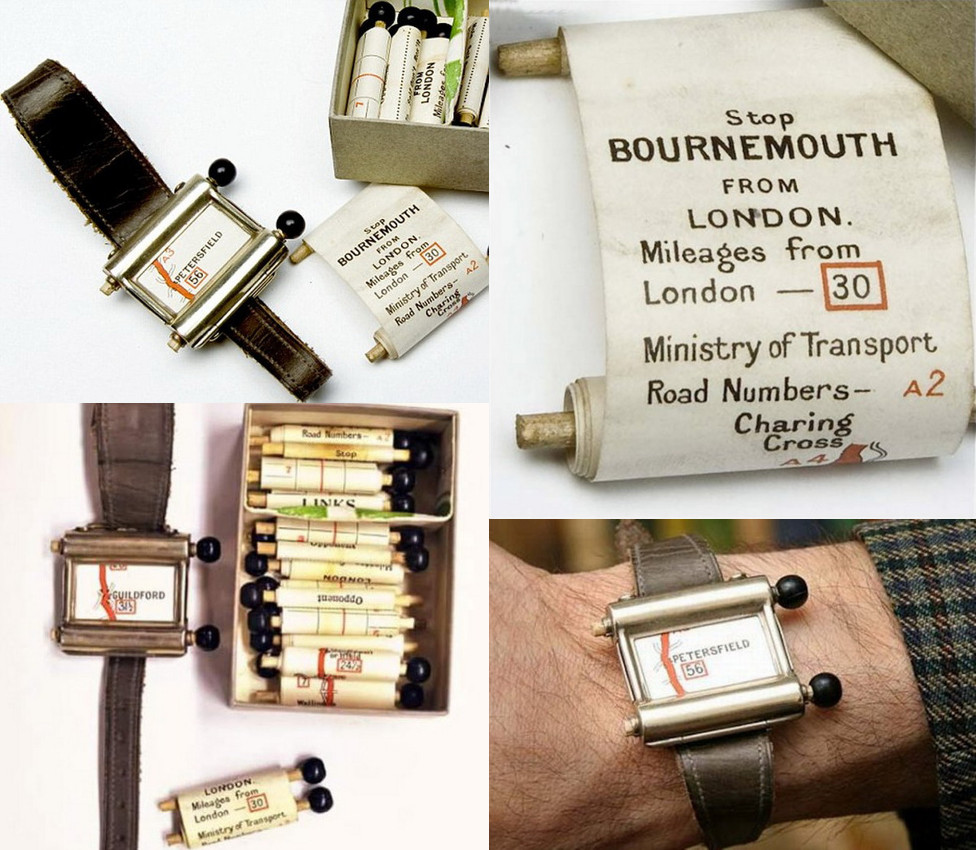
Back in 2007 I stumbled over the "Plus Fours Routefinder", an invention of the 1920's. It's worn on the wrist and allows the user to scroll through a map of the route they planned to take, rolled up on little wooden rollers. At that point I thought: that's awesome for long trips where you either dont want to take electronics with you or where you are without any electricity for a long time. And creating such rollable custom maps of your route automatically using openstreetmap data should be a breeze! Nevertheless it seems nobody picked up the idea. Years passed and in a few weeks I'll go on a biking trip along the Weser, a river in nothern Germany. For my last multi-day trip (which was through the Odenwald, an area in southern Germany) I printed a big map from openstreetmap data which contained the whole route. Openstreetmap data is fantastic for this because in contrast to commercial maps it doesnt only allow you to just print the area you need but also allows you to highlight your planned route and objects you would probably not find in most commercial maps like for example supermarkets to stock up on supplies or bicycle repair shops. Unfortunately such big maps have the disadvantage that to show everything in the amount of detail that you want along your route, they have to be pretty huge and thus easily become an inconvenience because the local plotter can't handle paper as large as DIN A0 or because it's a pain to repeatedly fold and unfold the whole thing every time you want to look at it. Strong winds are also no fun with a huge sheet of paper in your hands. One solution would be to print DIN A4 sized map regions in the desired scale. But that has the disadvantage that either you find yourself going back and forth between subsequent pages because you happen to be right at the border between two pages or you have to print sufficiently large overlaps, resulting in many duplicate map pieces and more pages of paper than you would like to carry with you. It was then that I remembered the "Plus Fours Routefinder" concept. Given a predefined route it only shows what's important to you: all things close to the route you plan to travel along. Since it's a long continuous roll of paper there is no problem with folding because as you travel along the route you unroll one end and roll up the other. And because it's a long continuous map there is also no need for flipping pages or large overlap regions. There is not even the problem of not finding a big enough sheet of paper because multiple DIN A4 sheets can easily be glued together at their ends to form a long roll. On the left you see the route we want to take: the bicycle route along the Weser river. If I wanted to print that map on a scale that allows me to see objects in sufficient detail along our route, then I would also see objects in Hamburg (upper right corner) in the same amount of detail. Clearly a waste of ink and paper as the route is never even close to Hamburg.
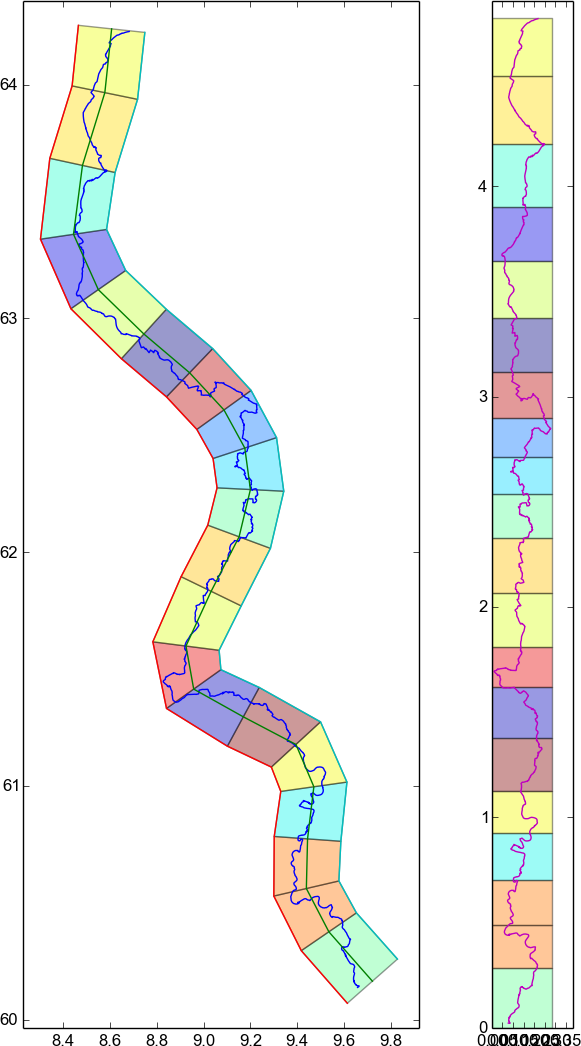
As the first step, a smooth approximation of the route has to be found. It seems that the best way to do that is to calculate a B-Spline curve approximating the input data with a given smoothness. On the right you can see the approximated curve with a smoothing value of 6. The curve is sampled into 20 linear segments. I calculated the B-Spline using the FITPACK library to which scipy offers a Python binding.
The next step is to expand each of the line segments into quadrilaterals. The distance between the vertices of the quadrilaterals and the ends of the line segment they belong to is the same along the whole path and obviously has to be big enough such that every point along the route falls into one quadrilateral. In this example, I draw only 20 quadrilaterals for visual clarity. In practice one wants many more for a smoother approximation.
Using a simple transform, each point of the original map and the original path in each quadrilateral is then mapped to a point inside the corresponding "straight" rectangle. Each target rectangle has the height of the line segment it corresponds to. It can be seen that while the large scale curvature of the path is lost in the result, fine details remain perfectly visible. The assumption here is, that while travelling a path several hundred kilometers long, it does not matter that large scale curvature that one is not able to perceive anyways is not preserved. The transformation is done on a Mercator projection of the map itself as well as the data of the path. Therefore, this method probably doesnt work if you plan to travel to one of the poles. Currently I transform openstreetmap bitmap data. This is not quite optimal as it leads to text on the map being distorted. It would be just as easy to apply the necessary transformations to raw openstreetmap XML data but unfortunately I didnt find a way to render the resulting transformed map data as a raster image without setting up a database. I would've thought that it would be possible to have a standalone program reading openstreetmap XML and dumping out raster or svg images without a round trip through a database. Furthermore, tilemill, one of the programs that seem to be one of the least hasslesome to set up and produce raster images is stuck in an ITP and the existing packaging attempt fails to produce a non-empty binary package. Since I have no clue about nodejs packaging, I wrote about this to the pkg-javascript-devel list. Maybe I can find a kind soul to help me with it.
Here a side by side overview that doesnt include the underlying map data but only the path. It shows how small details are preserved in the transformation. The code that produced the images in this post is very crude, unoptimized and kinda messy. If you dont care, then it can be accessed here

1 April 2014

Russ Allbery: Review: Asimov's, September 2011

Review: Asimov's Science Fiction, September 2011
Editor: Sheila Williams
Issue: Volume 35, No. 9
ISSN: 1065-2698
Pages: 112
Due to various other life priorities, it's been quite a while since I read this magazine. Let's see if I can remember the contents well enough to review it properly. The editorial this issue was about the Readers' Awards. Vaguely interesting, but Williams didn't have much to add beyond announcing the winners. I'm very happy to see Rusch's "Becoming One with the Ghosts" win best novella, though. The Silverberg column was more interesting: some musings and pop history about the Japanese convention of a retired emperor and how that fit into national politics. Di Filippo's book review column is all about short story collections, continuing the trend of Di Filippo mostly being interested in things I don't care about. "The Observation Post" by Allen M. Steele: A bit of alternate history set during the Cuban Missile Crisis, but with airships. The protagonist was a radioman aboard a blimp that was patrolling the ocean for Russian vessels sailing to Cuba. A storm forces them down on an island, resulting in an encounter with some claimed tourists who may be Russian spies. The SFnal twist is unlikely to come as much surprise to an experienced reader, and the barb at the end of the story suffers from the same problem. I appreciate the ethical dilemma, but I've also seen it in lots of stories and have a hard time getting fully invested in another version of it. But the story is otherwise competently written. (6) "D.O.C.S." by Neal Barrett, Jr.: Everyone has an author or two that they just don't get. Barrett is one of mine, although this story is a bit less surreal than most of his. I'm fairly sure it's an odd twist on the "death panel" conspiracy theory given a fantastic twist, but it's not entirely forthright about what's going on. Possibly of more interest to those who like Barrett better. (5) "Danilo" by Carol Emshwiller: Emshwiller's stories are always distinctive and not quite like anyone else's, involving odd outsiders and their attempts to make sense of their world. This one involves, as is common, an out-of-the-way village. Lewella claims that she's going to be married to a stranger from the north. No one believes her, although they give her bridal gifts anyway, and then one day she takes her gifts and leaves. The protagonist follows her, to look after her. The rest of the story walks the boundary that Emshwiller often walks, leaving the reader unsure whether the characters are in touch with some deeper reality or insane and suffering, but the ending is even more ambiguous than normal and, at least for me, entirely unsatisfying. (4) "Shadow Angel" by Erick Melton: This is another retread of an old SF idea. This time, it's that piloting through hyperspace involves alternate modes of consciousness and has profound effects on the pilot. The risk of this sort of story is that it turns hallucinatory and a bit incoherent, and I think that happened here. I like the world-building; the glimmers of future politics and trade and the way he weaves alternate timelines into the story caught my interest. But the story wasn't quite coherent enough (although part of this may be reviewing it quite some time after I originally read it). Promising, but not clear, and without quite enough agency for the protagonist. (6) "The Odor of Sanctity" by Ian Creasey: I found this story more memorable. The conceit is that a future society has developed technology that allows the capture and replay of scents, which has created a huge market for special scent experiences and the triggering of memories. The story is set in the Philippines and revolves around a Catholic priest who takes the mission to the poor seriously. He's dying, and several people wonder if it is possible to capture the mythical odor of scantity: the sweet scent said to follow the death of a saint rather than the normal odor of human death. Creasey handles this idea well, blending postulated future technology, the practical and cynical world of the poor streets, and a balance between mystical belief and practical skepticism. Nothing in the story is that surprising, but I was happy with the eventual resolution. (7) "Grandma Said" by R. Neube: This story's protagonist is a cleanser on a frontier planet made extremely dangerous by a virulent alien fungus. It is almost always fatal and very difficult to eradicate. Vic's job is to completely sanitize anything that had been in contact with a victim and maintain the other rules of strict quarantine required to keep the fungal infection from spreading uncontrolled. Nuebe weaves world-building together with Vic's background and adds a twist in the form of deeply unhealthy responses to the constant stress of living near death. Well told, if a bit disturbing. (7) "Stalker" by Robert Reed: Reed has a knack for fascinating and disturbing stories, and this is an excellent example of the type. The protagonist is a manufactured companion who is completely devoted to its owner. Their commercial name is Adorers, but everyone calls them Stalkers. In this case, the protagonist's owner is a serial rapist and murderer; given that, and given how good Reed is at writing these sorts of stories, you can probably imagine how chilling it is. As usual, there is a sharp barb in the ending, and not the one I was expecting. Good if you can handle the graphic violence and disturbing subject material. (7) "Burning Bibles" by Alan Wall: This is an interesting twist on the spy thriller. A three-letter agency in charge of investigating possible terrorist plots becomes suspicious after a warehouse of Bibles burns in mysterious circumstances. The agent they send in is a deaf-mute with special powers of intuition. This prompted some eye-rolling, and there's a lot of magic disability powers here to annoy, but it's played mostly straight after that introduction. The rest is a fairly conventional spy story, despite special empathic powers, but it's one I enjoyed and thought was fairly well-written. (7) Rating: 6 out of 10

31 March 2014

Francesca Ciceri: Random notes from MiniDebconf Barcelona 2014

First of all, let me say this: Barcelona MiniDebconf was awesome. So the most important part of this post is a very big thank you to the organizers, volunteers, speakers, sponsors and attendees. Now, down to business. Day 0 Day 0 was a day of travelling, more or less: the Italian Cabal (me, Enrico, Elena and Diego) left in the early morning from Varese (where we had an epic Munchkin Apocalypse game the night before), and we travelled by car across Liguria and France and finally reached Barcelona in the evening. (Boring! Even more if you don't drive. I hate long trips by car) We reached Barcelona in time for the pre-registration event at Falstaff Bar, eat a great Falafel and hugged lots of people. Day 1 To me the highlight of Day 1 was to finally meet in person Laura Arjona, Spanish translator, publicity volunteer, pump.io and mediagoblin contributor. We had decided to have a workshop together about translations and we spent the morning more or less tweaking our presentation and chatting :). So, save for Elena's talk on 3d printing in Debian ("The Universal OS: now making tabletop games and cookie cutters!" -- which was great!) I missed all the talks in the morning. But thanks to the always amazing videoteam, I'll be able to watch them later, when the recordings will be published :). For me, the best talk of the day - well, no, actually of the conference! - was that afternoon: Ana Isabel Carvalho told us about the Libre Graphics Magazine project. Libre Graphics Magazine is a well written and designed magazine at the crossroad between Free Software tools and ideals and graphic arts and design. A crossroad not very much frequented, I'd say. But then, maybe I'm wrong: it's not that graphic artists don't use Free Software tools, it's more like the one who do are invisible.
This is one purpose of a Libre Graphics Magazine: to serve as a catalyst for discussion, to build a home for the users of Libre Graphics software, standards and methods. In such a magazine, we may unite all our previously disparate successes, all the successes which have, until now, stood alone as small examples, disjointed from the larger community. We have the opportunity to elevate the discourse around Libre Graphics as a professionally viable option, to raise previously unmentioned issues and to push forward the conception of just what Libre Graphics can produce.
If you are even only vagued interested in typefaces, fonts, design and graphic art take a look at the magazine: it's CC-BY-SA licensed and you can download it for free, or buy a paper copy (which is amazing, really!). And it's not just about graphic arts: if you skim over the titles of the issues, you can find that they've talked about things like "Localisation/Internationalization", "Use Cases and Affordances" and, my favourite, "Gendering F/LOSS". On a similar topic, Siri's talk about "Why aren't more designers using Debian or working for Debian?" tried to shed a light on the difficult relationship between Free Software tools and graphic artists. These are the voices we need to listen to if we want to bring more graphic artists to Debian, and $deity knows that Debian needs them a lot :). After Solveig's talk about bug triaging and Miriam's one on packaging, it was time for the l10n workshop. I think it went well: we tried to briefly explain the translation workflow in Debian, and to translate together with the audience a po-debconf message. It wasn't maybe enough to complete and submit a translation, but hopefully it gave the audience an idea about how to do it. The day ended with a party for Debian Women 10th anniversary. And the cake wasn't a lie, beside being very good. Day 2 This, I'll remember as "the day I exited my comfort zone". Ok, I'm making a bit of fuss about it, but it was my first talk in English all alone. I spoke about the non-uploading DD process and how to keep your (and others') sanity in a big community project (slides here). I think it's very important to remind people that not all DDs are coding persons. And you don't need to be a developer to love Debian, contribute to it and become an official member of the project. But writing this presentation was for me also the occasion to take stock of my experience in Debian so far: in that talk slipped many of my demons, as impostor syndrome or overcommitment. But all the things I said are more or less, common sense - nothing new! - and lesson learned on the road: it's been now 2 years as DD and 4 as contributor. I'm pretty sure it's thanks to the special conditions of this conference (only speakers identifying themselves as female, a safe and very friendly environment) that I had the courage to give a talk. So the conference was a complete success on that regard, too. In the afternoon I was able to do one of the things I love: videoteam duty. Though I convinced Riccio to switch roles and to give me the camera: my experience in directing during last DebConf left me a bit scarred. Special mention for Laura speaking of pump.io and MediaGoblin and Solveig of Tails during the "Lightning Talks" and the people from LelaCoders during the "Bits from Local Communities" session. The Day(s) after: a Debian Contributors hackathon In my experience a measure of a conference's success is the burst of activity in pet projects just afterwards. In this, also, Barcelona MiniConf was a success: during the weekend, Enrico, Laura and I had the chance to talk together about Debian Contributors and make some plans.
So, as soon as we got in Italy again, I took possession of Enrico's couch for a couple of days and we did a little bit of hacking on Contributors. For my part, I mostly worked in trying to add more data sources to the site: my (not so) secret agenda is to map most of the non-coding contributions. That basically means: translators, publicity editors, event organizers and volunteers, etc. Being in the same room as Enrico, gave me the chance to ask him how to add data sources and to test the existing code (we spot a little problem in the prototype for svn repository mining he made a while ago). At the end of the hackathon, I had managed to: Please note that if you have contributed to one of the repo above and you are not listed there, it means that the automatic recognition of your email address didn't work. We still need to implement a manual interface for the recognition of email addresses: patches are very much welcome! Meanwhile Enrico: If you care about recognition of diverse contributions in Debian, help us: read the project todo list and subscribe to the low traffic mailing list or browse the project Git repository.

28 March 2014

Matthias Klumpp: Appstream: The next step

appstream-logoWith the release of GNOME-Software 3.12, it s also time for another update about what is going on behind the scenes of Appstream, the project providing all the data needed to make software-centers work. So here is the long overdue update :) If you have attended my FOSDEM talk or seen the slides, you know about the concept of component metadata to describe (almost) all software components which make up a Linux system, as well as their public interfaces they provide for users and other software to access. This metadata specification was originally designed as part of the Listaller project for use with the 3rd-party software installer.
But we already have the Appstream specification, which describes applications available on a distribution. And technically, applications are nothing but specialized components.
When I was asked about extending the Appstream spec with fonts and codecs, I decided to give up the Listaller components concept and merge it with the Appstream project, effectively creating a single source of metadata for all software in distributions. Appstream and components were separate, because Appstream was designed just for application metadata shown in software-centers, while component-metadata was more technical and not user-visible. This separation, however, did not reflect reality. Software centers want to show things components were designed for (codecs, fonts, ), and application meta-information also can contain technical items not shown in a software-center, but useful for other functionality (e.g. for mimehandler finding). So, if you like clear naming of things (like I do), you can now think of the upcoming Appstream release 0.6 as Appstream not being a stream of application metadata, but rather metadata provided for use in applications. ;-) Extending Appstream with components has a number of benefits:
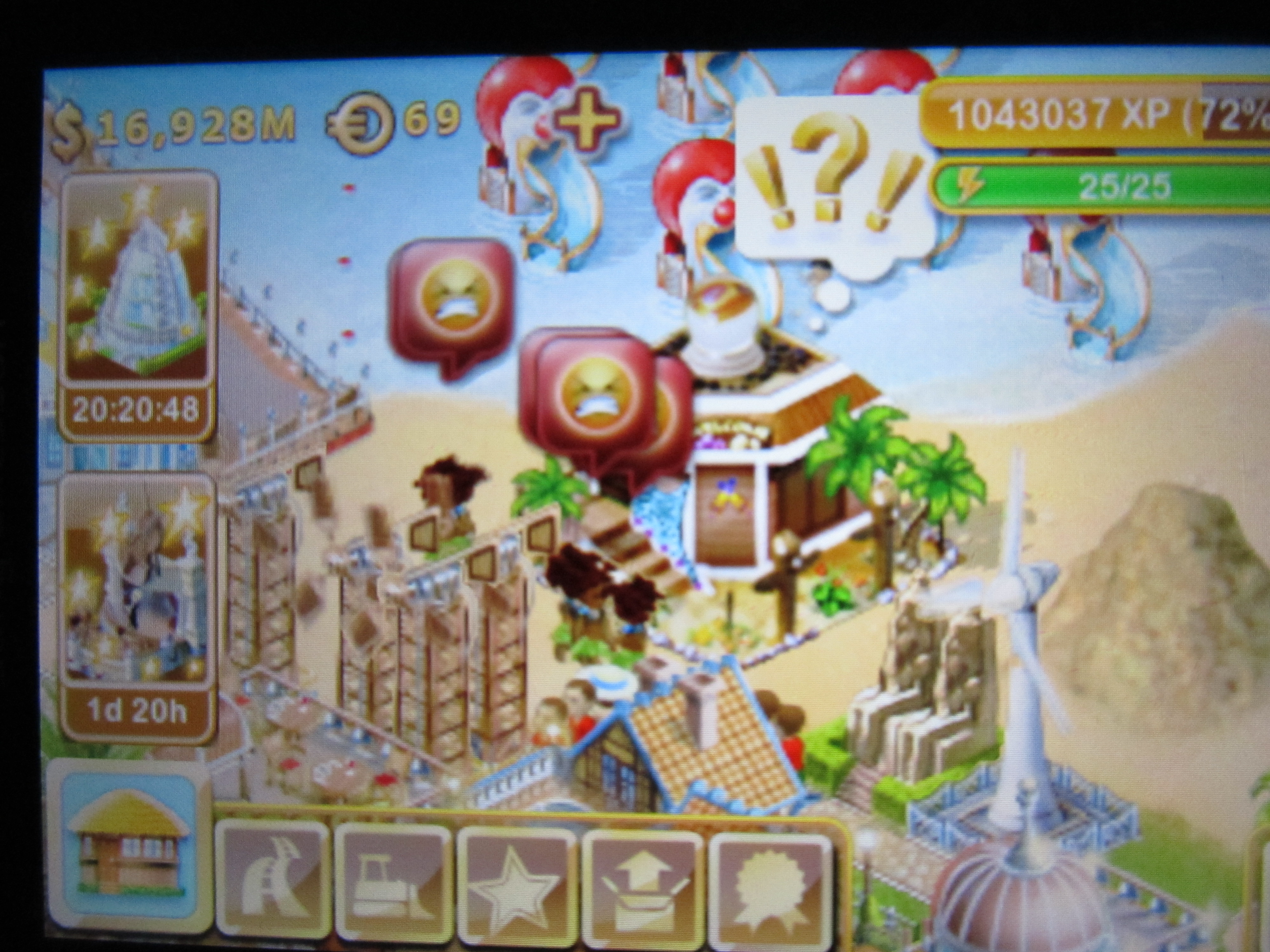
First of all, users will soon get systems which are able to automatically install missing firmware, codecs, fonts and even libraries or Python-modules. This happens in a distro-agnostic way, so any application can request installations of missing components through Appstream and PackageKit without having to care about distribution details. For distributors, you will get more information about the software upstream provides: Which public interfaces does it make available? What is the upstream s homepage? Summary? Short release-descriptions? Exposed library symbols? etc. This data was available before, of course, but we made it machine-readable and standardized now. This will also allow us to match software across distributions quickly, allowing efficient exchange of patches between distributions, and answering questions upstream has like in which distribuions is my software available, and in which version? . Tracking upstream software is also easier now. Last but not least, the metadata format gives upstreams a small say in how their software gets packaged (= how it gets split / if there is a metapackage depending on the split parts). For upstream authors, it is much easier to maintain just a few Appstream XML metafiles, instead of adding a Listaller component file as well (which was not XML). Most data for creating the metainfo files is already available, some can even be filled in automatically by the build-system. With all the advantages this new system has comes a small disadvantage: These changes broke the backwards-compatibility of the Appstream spec, so to use Appstream data in version 0.6 or higher, you need to adjust your parsers. But of course you are using a library to access the data anyway, which already does that for you ;-) GNOME-Software 3.12 has almost complete support for the new (but still not released) Appstream 0.6 spec through it s libappstream-glib library. The libappstream library in Appstream s Git branch will get 0.6 support as well very soon. The only thing you need to do is adjust your code for the new library version, which broke it s API as well due to a rewrite in C (I hope that we can provide language bindings again very soon).
Soon, there will also be a Qt library for accessing Appstream, since some people expressed a demand for it (and working with GObject in Qt C++ code always feels a litle bit odd).
The 0.6 specification is still being fine-tuned to iron out some issues which might come up and mainly to improve the documentation and adjust all tools. It will be released in 2-3 weeks, and bring not only components support, but also lots of other small improvements and additions for better description of applications/components. In some cases, tag names have changed to have less ambiguous names. Thanks to Richard Hughes for helping with the spec our discussions about the Appstream spec are highly productive and in the end lead to a better specification. Also, the new 0.6 specification includes many extensions used in GNOME-Software by default now, which makes it easier for other distributions to provide them for GS. The current draft for the Appstream 0.6 specifications can be found here. Some details might still change before the final release. As soon as the spec is final, there will be a ML announcement for distributors as well (watch the XDG distributions list), so there is enough time for distributors to future-proof their Appstream distro-data generators (I will also describe the changes more detailed then). If you are confused now about the whole components stuff: Fear not! ;-) I will do some more detailed posts in a few weeks explaining upstream projects how to provide metadata properly (after the 0.6 release). I will also finish the wiki page for Appstream AppData in KDE projects, where we can then use 0.6-style data in KDE right away.

Next.

Previous.