Search Results: "gio"

7 June 2010

Matthew Garrett: Lie Bot, what is the saddest thing?

The saddest thing is a laptop firmware that provides a valid embedded controller operation region but which then proceeds to read and write embedded controller registers by banging on ioports itself rather than listening to the operating system.

1 June 2010

Debian News: New Debian Developers (May 2010)

The following developers got their Debian accounts in the last month: Congratulations!

31 May 2010

Neil Williams: multistrap 2.1.5

multistrap is gaining some important functionality. When preparing a root filesystem for a new product, the sources used to generate the system need to be made available. So, multistrap has an option to retain the sources and 2.1.5 adds the functionality of downloading the source packages to go alongside the binaries that are downloaded to make the system itself, into a directory outside the final system.

Equally, 2.1.5 includes the idea (contributed by Rodolfo Giometti) of not listing deb-src entries inside the final filesystem - a useful idea to save space on systems where there is no likelihood of sources actually being downloaded "on-device".

Also in 2.1.5, is a handler for device tables. udev is one thing but when creating new systems from scratch, some devices still need to be created with mknod. MAKEDEV is too general, creating dozens of nodes when maybe only a handful are needed yet also omitting device nodes that actually are needed. So, /usr/share/multistrap/device-table.pl can parse a mini device table file (a tab-separated-value file), creating directories, symlinks and device nodes in a specified directory.

The aim is to combine the entire generation of a bootable root filesystem in a single call to multistrap - to which two further steps are necessary.
  1. Packing up into a tarball at the end

  2. Running a customised script outside the eventual filesystem, passing it the location and architecture of the filesystem.


Both are in 2.1.5 - the config script can be used to pre-seed debconf questions, write out custom configuration changes, run the device table parser and various other tasks.

As with earlier versions, multistrap supports creating package building chroots (including cross-building chroots) and, to go alongside this functionality, pdebuild-cross has now entered unstable. pdebuild-cross is a set of hooks for pbuilder to support cross-building inside a pbuilder chroot created by multistrap.

I'm hoping to be able to cover more about these issues at DebConf10.

If debootstrap is not doing what you need, multistrap is probably the answer - and if it doesn't quite do what you need yet, ask.

30 May 2010

Gregor Herrmann: RC bugs 2010/19 - 2010/21

as a short reminder that there are still a few RC bugs waiting to be fixed here's a short list of the ones I've worked on in the last time:

25 May 2010

Gunnar Wolf: One more fatal accident in my usual environment

I was about to close down a good day of hard work, a heavy but useful day... I had even decided to take some time off to listen to some good music, and was heading off to bed on a good mood... Until I decided to read my contacts' latest rants. And I found very sad news - again. A ten year old kid was killed while cycling in Calle Nezahualpilli, Colonia Ajusco. I happen to know quite well that precise area - I lived very close to that street for some months in 2008. I eat in a small restaurant (what we call either a cocina econ mica, comida corrida or fondita) on that street. One of my usual bycicle workshops is also on that street - In fact, I wanted to go today, as both of my bikes' rear tires are flat, but had no time to make it. Anyway... Colonia Ajusco and Colonia Santo Domingo ("colonia" is basically... a neighbourhood in es_MX) are two very popular, economically depressed areas, just North-East of the University. Probably hundreds or thousands of students live in rented rooms in the area, as UNAM with its 300,000 students does not have any dorms (due to political reasons leading all the way back to the 1960s). Santo Domingo and Ajusco are also the part where Mexico City's main valley finishes. The hills begin, not too abruptly (we have a ~150m difference in the ~2Km spanned by both colonias). And... When I lived there, I was amazed at the amount of people moving by bike. The streets are too slow for motorized transit to properly flow, and it's often annoying to have to cross the region. It is mostly safe for cyclists. Anyway, this kid was having a good time on the street, and was killed by a microbus driver fighting his fellow over more clients. The driver, yes, was caught (by his passengers and other bystanders, according to the note), and did not run away as they often do in cases such as this one. Still, the kid died almost instantly, so catching the driver serves very little consolation. This Friday we will have BiciUNAMonos second monthly meeting. It is too soon, and I don't think we will end up going there. But I do feel this accident falls squarely inside UNAM user's territory. We cannot ignore it just because it happened outside our University's gates.

24 May 2010

Carl Chenet: Nagstamon 0.9.3 in sid

Nagstamon 0.9.3 just landed in Sid. Nagstamon is a Nagios status monitor for the desktop. It connects to multiple Nagios or Opsview monitoring servers and resides in systray or as a floating statusbar at the desktop showing a brief summary of critical, warning, unknown, unreachable and down hosts and services and pops up a detailed status overview when moving the mouse pointer over it. Connecting to displayed hosts and services is easily established by context menu via SSH, RDP and VNC. Users can be notified by sound. Hosts and Services can be filtered by category and regular expressions.

Nagstamon in the toolbar

Successfully tested Nagios versions include 2.x and 3.x. Opsview connectivity has been tested with Opsview 3.5.

Hosts details with Nagstamon

If you don t like having a Nagios webpage always running in your web browser, you ll appreciate Nagstamon.

20 May 2010

Aigars Mahinovs: So, what is Microsoft Azure and how it compares to Amazon s AWS

We had a Microsoft salesperson stop at our offices today to tell people about wonders of cloud computing and Microsoft s Azure will save us all. The following is a short and non-exhaustive list of what Azure does not do according to their own experts: The Microsoft presenter also repeatedly engaged in shady tactics when presenting his information: So to summarize, Microsoft has build a cloud of Windows-like machines which can run your programs (as long as they are in .Net or Silverlight) and which does not have even a third of the features of such de-facto market leader as Amazon AWS. They try giving away their product for free and only get 14k applications in 6+ months. Note: Amazon has at least 300 000 public applications and God only knows how many more private ones. They will grow, due to companies locked-into Microsoft s way of thinking buying into their marketing, but if you have a head on your shoulders, you should avoid it as a trap, which it actually is. All that can be done on Azure, can also be done on Amazon. The opposite is not always true. In addition, if you will want have a mixed environment with both Windows and Linux servers, you will not be able to deploy Linux servers to Azure (or they will be very slow) and you ll have to put your Linux servers into Amazon (or another) cloud and pay double traffic fees for every byte of traffic between your own servers. Microsoft Azure prices are exactly the same as Amazon EC2 prices with Windows instances. However on Amazon you actually get fully capable Windows Server instances. And if you don t need Windows, you can get a much better price on Amazon. The only companies that can safely use Azure are companies that only have Windows servers AND plan to only have Windows servers for the foreseeable future. Knowing how dominant Linux is in the server market and how many Windows-only shops actually have a few Linux servers in the back room, there is very little future for Azure, until they wise up and make Linux instances first class citizens in their cloud. If not because their customers need them, then because their customers think that they at least might need them in the future. Update: Amazon now released a Reduced Redundancy storage for S3 that provides the exacts same level of storage guarantees that regular Microsoft Azure SLA (99.9%) for two thirds of the price, and also Amazons now explicitly says that their regular S3 is Designed for 99.999999999% Durability , which is worlds above what Microsoft provides. Now in this case Amazon again is cheaper than MS. Also Amazon bandwidth prices are 33% lower compared to Azure. In Azia the difference is simply staggering (0.45$ vs 0.19$ per Gb).

14 May 2010

Matthew Garrett: Using qemu to instrument Windows

Part of the problem that we face in providing Linux hardware support is that we're lucky if there's a spec, and even if there's a spec there almost certainly isn't a test suite. Linux still isn't high on the list of things that vendors test with, so as a result hardware and firmware tend to be written to work with Windows rather than some more ideal notion of what a spec actually says.

This can lead to all kinds of problems. If the spec says we can do something and Windows never does that, we'll often find that there's at least one piece of hardware out there somewhere that breaks in response. But sometimes there'll be several different workarounds, and picking the wrong one may break some other system instead. It's helpful to know what Windows is actually doing, if only because that's the only configuration most systems have been tested with.

The problem is that doing this at the hardware level is next to impossible. I'm sure there are people out there who salivate at the possibility of working out i8042 initialisation sequences by hooking up oscilloscopes to their mouse, but I'm not one of them. There's a much easier alternative involving qemu.

The qemu source base is reasonably large and complex, but that's ok - we don't need to care about most of it. For our purposes we really only want to trace accesses to given bits of hardware. There's three main types of hardware access we're likely to care about: io ports, memory mapped io and pci configuration space. io ports are easy. Each piece of qemu that performs hardware emulation will call register_ioport_read or register_ioport_write. Just grep for those, find the ports that correspond to your hardware and then edit the functions to dump the information you want. PCI configuration space will be handled via pci_default_read_config or pci_default_write_config unless the driver overrides them. Finally, for PCI devices mmio will be handled via pci_register_bar - the last argument is the function called when the memory region is accessed.

All of which makes it pretty easy to watch register reads and writes performed by Windows when it's starting up. Suspend/resume is also an interesting problem, but sadly one that's harder to work with. First of all, you need at least version 0.6c of vgabios in order to indicate to Windows that it's possible to suspend at all. Secondly, for Vista or later you'll also need a WDDM driver for the graphics. Sadly there isn't one for the Cirrus that qemu emulates, which is unsurprising given how ancient it is. So I've had to perform my testing under XP, which was enough to give me an indication as to what Windows does with the SCI_EN bit on resume (answer: Ignores both the bit of the spec that says it should already be enabled and the bit of the spec that says it should never be written by hand). Nice, but if someone would like to write a WDDM driver for Cirrus it'd make my life easier.

The other thing I've been testing is keyboard controller probing. Some Macs deal badly with you banging on the keyboard controller, which is dumb but on the other hand they don't claim to have one. Linux will look at your ACPI tables and use any keyboard controllers it finds there, but if there isn't one it'll go on to try probing the legacy locations. Adding some debug code to the read and write functions of the keyboard driver in qemu and then editing the DSDT in Seabios to remove the declarations for the keyboard showed that Windows will only probe if there's a device with a recognised keyboard PNP ID. No keyboard for you if that's missing. So we probably need to emulate that behaviour as well.

The main reason to do this work is to try to reduce the number of DMI tables in the kernel. These are cases where we alter the kernel's behaviour based on the identity string of the hardware, allowing us to work around functional differences. The problem with this approach is that Windows generally works fine on these machines without knowing anything special about them, and chances are that the tables aren't exhaustive - there may well be some other piece of hardware that's also broken, but the user just gave up and went back to Windows instead of ever letting us know. Using qemu to work out how Windows actually behaves gives us the opportunity to fix things up in a way that will (with luck) work on all machines.

11 May 2010

MJ Ray: TravelWatch SouthWest General Meeting

Weeks ago, I was at a TravelWatchSW meeting in Taunton for Cooperatives-SW. The Chair s theme for the meeting was the journey was going so well, but is there trouble ahead? contemplating cuts due to the debt crisis and possible change of government. Lots of good people were present, so it was quite an illuminating meeting. First, we listened to Dr Gabriel Scally, Director of Public Health for the South West NHS, as he spoke on fat, exercise and transport He s a keen cyclist, so I asked for suggestions of how to get better parking at health centres and hospitals. Sadly, he had no easy answer. One tip: Primary Care Trusts control most money, so they re probably the best ones to persuade. The second keynote address was First Great Western s Projects and Planning Director Matthew Golton. He spoke about railway development, unsurprisingly. Rail is vital for co-operatives in the South West, as it s a greener way to travel the 250 miles length of this peninsula and avoids our poor congested roads. The big news is that class 150s (Sprinters) will replace the Exeter area 142s (Pacers/Railbuses) and there will be grade-seperated junctions at Reading by 2016 to reduce congestion between the various routes that converge at that point. There s bad news on the Intercity Express Programme and HST2 being delayed until after the election, but the original High Speed Train fleet should continue as reliably as ever. After lunch, there were a series of Just a minute comments on topics including: west country commuter services, staffing, Taunton nhs parking, axminster peak times, a TransWilts meeting. Finally before the reports and forum came the third and final keynote from Mike Lambden, head of corporate affairs for National Express Group. He outlined their plans including longer coaches, but asked for better coach stations. One strange mistake had been increasing the leg room on some coaches so much that they got complaints from shorter passengers that they couldn t reach the footrest any more oops! The forum was a scary discussion of rail under-provision planned in our region. Even if we only continue to grow rail use at the last decade s rates, overcrowding will increase. The forum ended with applause for all the hard work done by TWSW and the next meetings will be 9 October 2010 in Taunton, 5 March 2011, 1 October 2011.

4 May 2010

Wouter Verhelst: On clue and opinions

How does one define one's "national identity"? One way is to look at where a person is born. By that definion, I could be called Flemish, Belgian, or European, whatever you think about it. Another way to look at it is how one feels about one's own identity. This, of course, is a much more accurate way to describe a person; and by that definition, I am either Belgian or European. I do not feel any affinity with much of the so-called "flemish" identity, nor do I wish to be associated with it any more than is strictly necessary. Obviously, some people feel different about that for themselves. This I can understand. In fact, the statement to feel more Belgian than Flemish is probably not one that is very common in this general area. I am not stupid; I know that Belgium is not a Nation (it is a state, but that is a different matter). I just do not feel a lot of warm fuzzy feelings about Flanders. Naturally, other people have other feelings about that. This, too, I can understand. The logical result of the above is that my personal opinions about the somewhat convoluted politics in this country are not shared by many; that when I state my opinion, I may expect opposition, or at the very least someone stating why they disagree with me. This, of course, I can also understand. But what I cannot understand is that every time I state my opinion, someone must come out and insult my intelligence by telling me I "do not have a clue". Please do not mistake my disagreement for misunderstanding. Martijn asks me to "check the facts". Let's do that, shall we?
  1. There's been a judgement by the constitutional court that the current situation regarding which party may run for election in the BHV region is unconstitutional.
  2. One group of politicians wishes to resolve this issue by splitting the BHV region in two. That would certainly solve the issue.
  3. Another group of politicians dislikes this solution. They may be willing to go along, but they want other concessions before they will do so. This is what I referred to when I said that there were "a huge heap of all kinds of side issues" in my previous post.
  4. The first group does not wish to make such concessions. Some of their numbers have even stated in the press that there is no need to make them, because, given the first point, there's only one solution and that is to split.
That last point is, of course, complete and utter bullshit. It would hold merit if there was only one way to solve a constitutional crisis; but by definition, there are always at least two ways: one is to change the law to comply with the constitution, the other is to change the constitution to make the law no longer be unconstitutional. So a group that feels strongly about one of these two possible solutions should be prepared to negotiate with the other group so as to hammer out an agreement that benefits both parties. In some cases, this will mean doing things that they do not completely like; but if they're not willing to do that, at all, they have no business being politicians. For the longest time during the early negotiations, however, both parties have stubbornly refused to even acknowledge the other position, let alone talk about it. Now, for clarity, I'm not advocating that the latter of the two options in that previous paragraph is what should happen. Frankly, I don't even care what happens, so long as they manage to resolve the issue at hand in some way. What I do care about, however, is that this country has been in a near-constant state of stalemate over these past few years for an issue that only matters to politicians; I don't care who or what a group of people in a (to me) obscure part of the country can vote for. This country needs a stable government which can act on things that actually matter. Like, say, the international economic crisis of the past two years; I think it matters much more whether the man in the street has a job than whether John Q. Politician will past these next elections.

3 May 2010

Wouter Verhelst: Yves Leterme, Belgian minister for resignation.

At least that's what it looks like right now. No less than five times did he offer his resignation as prime minister of Belgium to the king. Looks like fifth time is a charm now, too we get to go elect a new parliament in a month or two. Sigh. The 'fun' bit is, there's no real reason why this is necessary. The main issue that they've been talking about these past few years is the 'BHV' thing. While the issue is somewhat complex and, I'm sure, involves a huge heap of all kinds of side issues, the crux of the matter is that there's one group of politicians who wants to forbid another group of politicians from running in a region of the country around the capital. Now I'm sure that's hugely important to politicians after all, their career depends on it but beyond a few fanatics in and around that very capital, I'm pretty sure nobody actually cares what the particular names are of the particular groups of people that appear on the list of people they can vote for. Because, you see, this isn't actually about politicians wanting to forbid other politicians from running; it's about politicians wanting to forbid other political parties from running. Which, of course, makes a whole world of difference. Yeah, right. Now I wouldn't care about this much, except that it interferes with the smooth running of this country. The fact that they've come up with "problem" after "problem" related to this BHV "issue" for these past years has made it hard(er) for the government to actually to any real work. So although I hate the current situation, I'm actually quite relieved that an election is coming up. Perhaps this time we can get the fanaticals out and have a real government. (no comments allowed on this item; please use your own blog)

28 April 2010

Jan Wagner: [bpo] Couple new packages uploaded

In the last days I uploaded several (new) packages to backports.org: A new haproxy 1.4.4-1~bpo50+1 package is in preparation and needs testing before uploading. You can find the package here.

27 April 2010

Matthew Garrett: Radeon reclocking

Alex released another set of Radeon power management patches over the weekend, and I've been adding my own code on top of that (Alex's patches go on top of drm-next, mine go on top of there). I've left it stress-testing for a couple of hours without it falling over, which tells me that it's stable enough that I can feel smug. This is a pleasing counterpoint to the previous experiences I've been having, which have been rife with a heady mixture of chip lockups or kernel deadlocks. It turns out that gpus are hard.

There's a few things you need to know about gpus. The first is that if they're discrete devices they typically have their own memory controller and video memory. The second is that there's an impressive number of ways that you can end up touching that memory. The third is that they tend to get upset if something tries to touch that memory and the memory controller is in the middle of reclocking at the time.

The first and most obvious use of video memory is by the gpu itself. Accelerated operations on radeon are carried out by sending a command packet to the command processor. This is achieved by sharing a ring buffer between the cpu and the gpu, with the gpu reading packets out of that ring buffer and performing the operations contained within them. Many of these operations will touch video memory (that being the nature of most things you want a gpu to do), and if that happens bad things occur. Like the card locking up and potentially taking your PCI bus with it.

So, obviously, we don't want that to happen. The first thing we do is take a mutex that blocks any further accelerated operations from being submitted by userspace. Then we wait until we get an interrupt from the gpu telling us that the display engine has gone idle. The problem here is that we don't have a terribly good idea of how many more operations there are to complete and we don't know how long each of those operations is going to take, but this is less bad than some of the alternatives[1]. Jerome Glisse has some ideas on how to improve this to require less waiting, but the effects should still be pretty much invisible to the average user.

So we've stopped the command processor touching ram. Everything's good, right?

Well, not really. The obvious problem is that users typically want to display something, so there's a separate chunk of chip that's repeatedly copying video memory over to your monitor. That's got to go too. Thankfully, there's a convenient bit in the crtc registers that lets us turn that off, but the pretty unsurprising downside is that your screen goes blank while that's happening. So we don't want to do that. Instead, we try to perform the reclock while there's nothing being displayed on the screen - that is, while we're in the screen region where a crt's electron gun would be scanning back from the bottom of the screen to the top. It turns out that rather a lot of display assumptions depend on this happening even if there's no crt, no electron gun and no thick sheet of glass with a decent approximation of vacuum behind it, so we get to do this even if we're displaying to an LVDS. And we have about 400-500 microseconds to do it - an almost generous amount of time.

So we ask the hardware to generate an interrupt when we enter vblank and then we reclock. Except the hardware has an irritating habit of lying - sometimes we get the interrupt a line or two before vblank, sometimes we get it after we've already gone out the other side. Vexing, and not entirely solved yet - so sometimes you'll still get a single blank frame during reclock. But there are plans, and they'll probably even work.

At this point the acceleration hardware isn't touching the memory and the scanout hardware isn't touching the memory. Except it still crashes under some workloads. This one took me longer to track down, but the answer turned out to be pretty straightforward. Not all operations are accelerated. When they're not accelerated they have to be done in software. That means that the CPU has to write to the video memory itself. I'm sure you can see where this is going. This was fixed without too much trouble once I'd finished picking through the driver to work out every location where objects might be mapped into the CPU's address space, at which point it's a simple matter of unmapping them and blocking the fault handler from remapping them until the reclock is finished. Linux, thankfully, has lots of synchronisation primitives. And now everything works.

Except when it doesn't. This took a final period of head scratching, followed by the discovery that ttm (the memory allocator used by radeon) has a background thread that would occasionally fire to clean up objects. And by clean up objects, I mean change their mapping - which means updating their status in the gart, which means touching video memory. So, let's block that. And that tripped me off to the fact that even if it couldn't submit new commands, the CPU could still create or destroy objects - with the same consequences.

So, once all of these are blocked, video memory is quiescent and we can do what we want. And we do, at least once I'd sorted out the bits where I was taking locks in the wrong order and deadlocking. Depending on the powerplay tables available on your card we'll chose different rates and so your power savings will vary heavily depending on the values that your vendor provided, but the card I'm testing on sees a handy 30W drop at idle. Right now we're only changing clocks and not dropping voltage so there's potentially a little more to come.

While getting this stable was pretty miserable, the documented entry points for clock changing made a lot of this easier than it would otherwise have been. It's also probably worth noting that Intel's clock configuration registers are entirely missing from any public documentation and the dirver Intel submitted to make them work in their latest chips appeared to have been deliberately obfuscated, so thanks to AMD for making all of this possible.

[1] It's possible to insert various command packets that either indicate when they've passed or stall until a register value gets updated, but these either cause awkward problems with the cp locking or mean that the gui idle functionality never goes idle, so they're not ideal either.

25 April 2010

Jan Wagner: 3DSupply with new Website?

Jesus shirtYesterday, my co-worker notified my about a promotion of 3DSupply and I recognized, that they have new design and you have also the choise to select from various models and colors for your shirts. I like the new site much more than the old.
For just speading they word, they offer to give a shirt (or any other item < 20 Eur) for free. So it seems to be a good idea to equip my dear wife, which is a teacher of catholic religion, with a new Jesus shirt.
Update: Today I got a reply from 3DSupply, stating that they deny the shirt request, cause I don t have 10 posts in the last 6 month. As this is unfortunately true, due my always limited time, I can t find this hard requirement in their terms. Looks like my blog doesn t match their minimal requirements and I m advised to equip my girls somewhere else with geekware. :o)

Russell Coker: Links April 2010

Sam Harris gave an interesting TED talk about whether there are scientific answers to moral questions [1]. One of his insightful points was that when dealing with facts certain opinions should be excluded it would be good if journalists who report on issues of science could understand this. Another insight was that religious people most strongly agree with him regarding the issue of whether there are factual answers to moral questions but they think that God just handed the answers to their ancesters rather than making it an issue that requires consideration. He cites the issue of gay marriage as being a distraction from moral issues such as genocide and poverty. He asks how have we convinced ourself that every culture has a point of view worth considering? . He asks how the ignorance of the Taliban on the topic of physics is any less obvious than on the topic of human well-being. Dan Gilbert gave an insightful TED talk titled Why Are We Happy? [2]. One interesting fact he cites is that people who become paraplegic are no less happy in the long term than people who win the lottery. He points out that a shopping mall full of Zen monks is not going to be particularly profitable and uses this fact to explain the promotion of natural happiness over synthetic happiness in our society. Dan Barber gave an amusing and informative TED talk How I Fell in Love with a Fish [3]. He speaks about ecological fish farming and how the fish are more tasty as well as the farm being good for the environment. The farm in question is in the south-west of Spain, hopefully there will be more similar farms in other parts of the world soon. Gary Lauder gave an interesting brief TED talk about road signs [4]. His main point was to advocate a road sign saying take turns , but there are already signs in the US at freeway on-ramps saying that 1 or 2 cars may enter every time the light turns green which is a similar concept. The innovative thing he did was to estimate the amount of time and petrol wasted by stop signs, add that over a year based on the average income and then estimate that an annuity covering that ongoing expense would cost more than $2,000,000. This makes two stop signs at an intersection have an expense of $1,000,000 each. He suggests that rather than installing stop signs it would be cheaper to buy the adjacent land, chop down all trees, and then sell it again. Alan Siegel gave an insightful TED talk about simplifying legal documents [5]. He gives an example of an IRS document which was analysed with a Heat Map to show which parts confused the readers the IRS adopted a new document that his group designed which made it easier for taxpayers. He advocates legislation to make legal documents easier to understand for customers of financial services. Tim Berners Lee gave an interesting TED talk about Open Data, he illustrated it with some fantastic videos showing how mashups have been used with government data [6] and how the Open Street Map project developed over time. Martin F. Krafft gave an interesting Debconf talk about Tool Adoption Behavior in the Debian project [7]. One thing that I found particularly interesting was his description of the Delphi Method that he used to assemble a panel of experts and gather a consensus of opinion. The post-processing on this talk was very good, in some sections Martin s presentation notes are shown on screen with the video of him in the corner. As an aside, I think we really do need camera-phones. The Big Money has an interesting article comparing the Mafia Bust Out with the practices of US banks [8]. Mark Roth gave an exciting TED talk about using Hydrogen Sulphide to trigger suspended animation [9]. They are now doing human trials for suspending people who have serious injuries to reduce tissue damage during the process of surgery. Pawan Sinha gave an interesting TED talk about how brains learn to see [10]. He started by talking about curing blindness in people who have been blind since birth. But he then ended by showing some research into the correlation between visual processing and Autism, he showed that an Autistic child had significantly different visual patterns when playing Pong to an NT child. Adora Svitak gave an insightful TED talk about what adults can learn from kids [11]. She made some particularly interesting points about the education system requiring that adults respect children more and expect them to do better than their parents which is essential for all progress in society. The NY Times has an interesting article on animal homosexuality [12]. In terms of research it focusses on lesbian relationships between albatrosses. But a large part of the article is devoted to the politics of scientific research into animal sexuality. BrowserShots.org shows you what your web site looks like in different web browsers [13]. Cory Doctorow wrote an insightful article titles Can You Survive a Benevolent Dictatorship about the Apple DRM [14]. He describes the way the Apple Digital Restrictions Management (DRM) doesn t stop copyright violation but does reduce competition in the computer industry. He is not going to sell his work on the Apple store (for the iPad or iPhone etc) and suggests that customers should choose a more open platform. It s unfortunate that he didn t suggest a better platform.

23 April 2010

Wouter Verhelst: Touching up a video with Cinelerra

I found myself with a problem: trying to linearly edit a movie clip with a non-linear editor isn't very simple, nor is it meant to be. Case at hand: I have about 1 hour and 40 minutes of film material that was recorded with dvswitch, and which is 90% fine; but given what we wish to do with it, we really wish to remove the errors from the recording things like failed transitions, rogue camera movements, and so on. This is why we recorded the individual video streams on tape too, so that we could indeed do some retouching afterwards. Cinelerra, however, is not really made for that. If you want to create a transition, you need to have two segments of clips that are stuck together on the timeline, and the transition is then applied to the border between the two. You can create multiple video tracks, but you cannot cut from one track to another; you really have to add a clip to the timeline. Doing that has obvious issues if you have multiple video streams that were recorded on the same time and that can be time-synced on multiple tracks. You would prefer to just select one track or the other on a certain point in time, but cinelerra just doesn't do that. So the workflow that I found is the following: Add all video streams to the time line, each on a separate track. Make sure the to-be-touched-up stream is on top; when multiple tracks are in use, and the are not faded to 50% or so, cinelerra will only show the top stream in the final rendition. Synchronize the streams: first, create a rough alignment by moving them with the mouse. Then, press arrow-down until you can see the streams on a frame-by-frame basis. Now for each of your camera streams, do the following:
  1. In the 'main' stream, search a section that was filmed by the camera which we are trying to align.
  2. Hit 'l' to create a label
  3. Search for the exact same frame in the camera stream. It may help to disable playback for the 'main' stream temporarily to visually verify that the frame is the same in the compositor window.
  4. Move the cursor to that frame, and create another label.
  5. If the streams are indeed desynced, then one of the tracks will lead, and the other will follow. If the leading track is the 'main' track, arm the main track and any tracks that you have already synced before, and make sure to remember the audio tracks. If, on the other hand, this is the camera track, then only arm that camera track. At any rate, make sure to disarm the track(s) that are following.
  6. Use the control and arrow keys to select the first label. Use control, shift, and the arrow keys to select the section up to the second label.
  7. At the bottom right of the program window, you can see three entry boxes with time indexes. The first is the time index to your first label; the third the time index to your second label; an in between those, the second is the length of the interval from the first label to the second label. Set the contents of the first box to all-zeroes, to move the selection to the beginning of the time line; then press tab (to move to the second entry box) and enter (to confirm that you wish to create a selection of that length at the beginning of the timeline).
  8. Press Shift-Space to insert silence at the location of the selection. This will move the armed tracks to the right, and not touch the not armed tracks.
  9. If you did everything right, the two tracks should now be aligned. Move the cursor to the second label, and verify that this is true by disabling 'play' for the main track and any tracks in between the main track and the track you're syncing. The frame in the compositor window should not change if you re-enable the main track. If it does, use 'z' for undo, remove your labels and try again.
Once your video tracks are aligned, you need one final video track that comes all the way on top. This is an empty, 'override' track. Anything you put in this track will override the main track. This way, you do not have to cut from the main track to another camera; instead, you just copy from a camera track and paste on the override track. It is, of course, possible to paste onto the main track, but that has the disadvantage that you cannot easily undo such edits after a 'save' operation. Using a separate 'override' track does allow that. To copy from one track to another track without moving in time, use the following method:
  1. Select the region where you wish to select another camera.
  2. Arm the camera track that you wish to copy from, and make sure not to arm any other track.
  3. Hit 'c' to copy the clip at that point.
  4. Disarm the camera track, and arm the 'override' track
  5. Without moving or removing the selection, hit 'v' to paste onto the override track.
All this may be basic knowledge for people who are more flexed in nonlinear editors than me; but I couldn't find this procedure on the Internet, so I thought I'd put it out there so that the next person who tries this doesn't have to try for days on end to come up with this, as I had to do.

Jan Wagner: [fun] Integrate nagios users with system ones

While I normaly don t care much about Ubuntu, I m subscribed to lauchpad.net for the packages I m involved within Debian.
Sometimes apears informative stuff there, which reminds me about my todos or just pointing me to real problems. Most of the time, I m just ignoring the reports, as the are useless or just unrelated to me packages in Debian.
But in some cases the reports are just making my day.

14 April 2010

Petter Reinholdtsen: Kerberos for Debian Edu/Squeeze?

Yesterdays NUUG presentation about Kerberos was inspiring, and reminded me about the need to start using Kerberos in Skolelinux. Setting up a Kerberos server seem to be straight forward, and if we get this in place a long time before the Squeeze version of Debian freezes, we have a chance to migrate Skolelinux away from NFSv3 for the home directories, and over to an architecture where the infrastructure do not have to trust IP addresses and machines, and instead can trust users and cryptographic keys instead. A challenge will be integration and administration. Is there a Kerberos implementation for Debian where one can control the administration access in Kerberos using LDAP groups? With it, the school administration will have to maintain access control using flat files on the main server, which give a huge potential for errors. A related question I would like to know is how well Kerberos and pam-ccreds (offline password check) work together. Anyone know? Next step will be to use Kerberos for access control in Lwat and Nagios. I have no idea how much work that will be to implement. We would also need to document how to integrate with Windows AD, as such shared network will require two Kerberos realms that need to cooperate to work properly. I believe a good start would be to start using Kerberos on the skolelinux.no machines, and this way get ourselves experience with configuration and integration. A natural starting point would be setting up ldap.skolelinux.no as the Kerberos server, and migrate the rest of the machines from PAM via LDAP to PAM via Kerberos one at the time. If you would like to contribute to get this working in Skolelinux, I recommend you to see the video recording from yesterdays NUUG presentation, and start using Kerberos at home. The video show show up in a few days.

13 April 2010

Gunnar Wolf: Regarding the fatal cycling accident in Ciudad Universitaria

My blog is written in English, even though I sometimes post content relevant locally. Anyway, I want this to be as widely known as possible. We are about to launch a website/community for my University's cyclists, BiciUNAMonos. Please note the site I'm linking is still very preliminary in several ways. But that's the least relevant for now. I am translating here a message written by fellow cyclist (and researcher in the Institute of Astronomy of my University) Sergio Mendoza.
Regarding the fatal cycling accident in Ciudad Universitaria Yesterday night I got home, and was quite surprised to open my mailbox and find a considerable amount of messages under the subject Urgent: Fallen cyclist! I immediately noticed something was very wrong, and was surprised they were contacting me. When I decided to read the first such message, I realized what happened: Dr. Jorge Villanueva was run over by the Puma [internal University service] bus number 14, route 2, which was being driven over the speed limit. This happened last Sunday, April 11. On Sundays, all of Ciudad Universitaria becomes a cycling and running circuit. I was immediately brought back to the moment that, when I was leaving my office in the Astronomy Institute and heading towards Cerro del Agua avenue, a lady driving over the speed limit on the circuit that comes from Metro Universidad threw her car at me. I saw her at a few centimeters distance from her windshield... To the day I don't know how I pulled my bike away, as I was going to hit the windshield with my shoulder. Everything happened in slow motion, I just heard several cars honking at this imprudent lady. I didn't have a scratch, but got excessively close to getting a strong hit, and with the adrenaline raging I gave a kind caress with my closed fist to her brand new car. I had to free my adrenaline somehow... My legs were trembling when I tried to pedal. I told her, lady, I am excessively visible in my bike, why did you do this? , she didn't answer, she just looked despectively at me. This kind of accidents happen every day in the University and its main entries. Precisely today, a University professor threw his car at me entering the University via Cerro del Agua. When I reached him and confronted him, he told me completely sure of his words that I was invading the lane with my bike, and that it was my fault. Anybody would have thought a car-driving university professor is capable of reading the Metropolitant Transit Regulations that clearly states on its 1st article: The priority for using the public space, for the different transport modes will be according to the following priorization: I. Pedestrians; II. Cyclists; III. Users and providers of massive, collective or individual public transport service; IV. users of particular automotor transport; and V. users and providers of freight transport. We are now organizing to put up the first ghost bike in Ciudad Universitaria. This happens few days before the formal inauguration of BiciUNAMonos, the universitary association of urban cyclists; we will do this remembering our university mate. I see every day more people in the University hitting their bike pedals to get to their faculties, centers and research institutes, but what is striking is the lack of University infrastructure. The few cycleways we have are built to use a bycicle system that is open only until 16:00. It is good, but it is in no way useful for those of us who use the bike every day and at every hour, no matter the weather. The main problem lies at the communication points, when cyclists arrive from outside Ciudad Universitaria and have to take the regular circuits to reach the cycleways. The Transit Regulation, in the 1st article I quoted above, defines in an excellent way the priorities that must exist to allow human movility. In this regard we have to mention that:
  1. The pedestrians must be enormously protected with walkways and semaphores to allow them to safely walk. In Ciudad Unviersitaria there are many places that don't even have a walkway or semaphores, and drivers do not respect the pedestrian's preference. Also, now in the central area of Ciudad Universitaria we have the Pumabus system on a confined lane, providing an excellent service to the pedestrians to move within the campus.
  2. The cyclist comes next in this priorization, but there is nothing obvious for him. There are a couple of cyclist ways, usually invaded by pedestrians, and explicitly made to use the Bicipuma system. Cyclists need their own lane for circulation in the Universitary circuit; pedestrians have walkways, Pumab s has its confined lanes, but the cyclists still lack it. The third lane that remains is precisely for the IV and V entries in the Metropolitan Transport Regulations. They can perfectly share the remaining lane in the campus.
The last thing I wanted was to formally announce BiciUNAMonos reminding a fallen cyclist and dedicating a ghost bycicle to his memory in Ciudad Universtiaria, but we don't have a choice. We have to make it very clear to the University community that the bicycle is the best transport system, and that the drivers' imprudence inside Ciudad Universitaria must be strongly punished. Sergio Mendoza
President
http://www.biciunamonos.org
Coincidentally, today I also had a freightening experience. Taking one of my usual routes to work, going up from the sporting area in the Western half of the campus (just before where the map lists the highest point in my ride), just by Investigaciones Biom dicas, I heard a car hitting the breaks behind me and passing me (on my right side) quite narrowly. I was, as always, driving towards the center of the lane, to be able to respond to unforseen events (as this one, precisely). The Universitary authorities had the great(?) idea of placing round, small bumps before the Pumabus stations to avoid drivers parking in front of them. I have seen a strong accident caused by them, and was close to suffering one myself some months ago. I know that just after Biom dicas there are some such bumps, so I never ride too much to the right I don't know what was on this driver's head. Ciudad Universitaria has a 40 Km/h speed limit. Yes, it might seem too low - Circuits are wide and well planned. But there is a lot of cyclist and pedestrian transit, at all times, and I must recognize such a limit is well in place. I often take a longer route to my Institute, bordering the University along Av. Delf n Madrigal. People tell me I'm crazy, as this is an avenue that's often taken at high speed - Usually, cars pass me by between 60 and 80 Km/h. However, I even feel safer going that way than going inside the University. Contrary to the popular belief, Universitary people do not have better driving habits than the bulk of the population. And it's often much easier to drive along a way where the traffic even if it goes at three times my speed runs only in one direction, unlike the swarming of people going in every possible direction inside the main campus. Anyway, last Sunday we lost a University professor, we lost a cyclist. Some people lost a friend, a family member. We have to make this case well known, we have to speak with the authorities so they see the Bicipuma system is good, but not enough. Cycling is the only way to go for a city as complex as ours. A much needed first step is to allow proper vial connections linking the University and the many avenues that surround it. Another one is to make a campaign so the cyclists are not seen as Sergio regards as intruders in the streets The street belongs to us all. Cyclists should never drive on walkways or among pedestrians. Drivers need to learn to share the streets with us.

8 April 2010

John Goerzen: Face to Face With Destruction

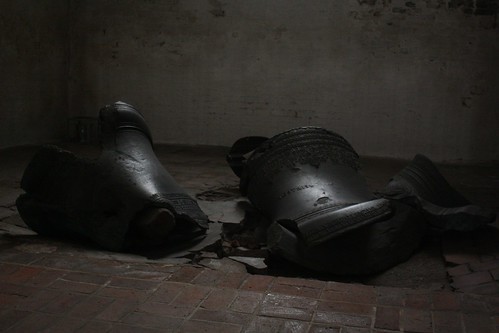
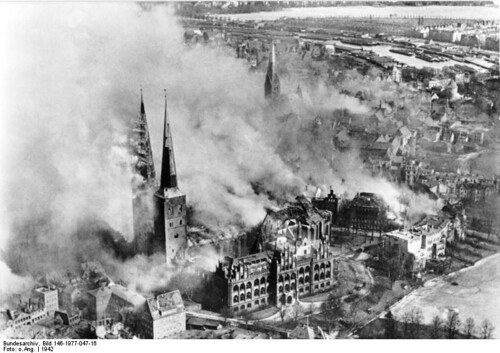
IMG_2641 Seeing these church bells in L beck wasn t easy for me. They melted and fell to the ground after an air raid in 1942, and have been left exactly as they fell. I wasn t alive in 1942, and even my parents hadn t yet been born. My grandfather was relocated by the American government because he refused to fight in the military for religious reasons. And yet, I still felt a sense of embarrassment, being an American standing there in Germany next to those bells. My country* did things like this. Why? Even if there s a war on, and whatever the other side may be doing, do we really have to bomb all their churches? Then, we went to the Dom (cathedral). It has a small gallery of photos of the destruction in 1942, and how it took 40 years to restore (though some original works are simply irreplaceable.) Burning L beck Cathedral after an air raid in 1942 I had just been walking through the beautiful Dom, and then saw pictures like that. It was very sad. I imagined the people in 1942, seeing the smoking remains of so many buildings that had been important to the town for centuries. Places where, no doubt, some of them worshiped, and their parents and grandparents had too. I imagined my sadness if a country bombed one of the churches that my ancestors helped start or build. I felt ashamed of what the democracy in which I live (and its allies) did to the Dom, to Marienkirche, and to the other churches and civilians there. Then, a few days ago, Wikileaks posted a video from an American helicopter in which our soldiers begged Come on, let us shoot! at people, most or all of which were completely unarmed. They killed a bunch of people. Then a van came to try to get the wounded to the hospital. Then the soldiers in helicopter killed those people, and wounded some children. Even if they thought their lives were in danger, I d expect to hear some quiet sadness at what they thought was a regrettable need to use force. Instead, you d hear them cheering whenever they killed someone, as if they had just won a round on some video game. They killed civilians, and considered it a fun experience and a mission accomplished. There was no sadness for knocking a man to the ground, leaving him writhing. Just jokes. There was no more care for human life here than there was 60 years ago. It saddens me that every year we celebrate our military on independence day celebrating its ability to kill, not its ability to feed. I wish that we could rather celebrate the times Americans have saved lives, whether in Berlin or in Port-au-Prince, or helped to topple dictatorships. Military power shouldn t be our first choice so often. L beck wasn t attacked for any strategic purpose; the British did it to destroy the morale of the enemy civil population , as the Americans did in Dresden or the Germans in London. In other words, those bells fell to the ground for no reason other than that they were German. People lost their lives for the same reason in Germany and in London. The British had no reason to believe that those civilians meant them any harm, that they were anything but caught between two strong powers. And the same held true in Iraq. When we went to Berlin, we walked through the replica of Checkpoint Charlie, with the big sign announcing that you are leaving the American sector. There is little positive to be said about the Cold War, but there is something the British and American military did of which I am not the least ashamed: the Berlin Airlift. Although I didn t see it, I feel a sense of the USA having been a force for good when I read about the Berlin Airlift Monument at Tempelhof, which has the names of the 70 British and American men that lost their lives in the airlift (due to accidents), above the inscription They gave their lives for the freedom of Berlin. That s the spirit I wish we d see more often in the world today: people giving their lives not just for their own security, but for strangers in need on a different continent. We Americans have been, compared to many countries in Europe, relatively sheltered from the ravages of war in our own midst. I wish that more of us would have the opportunity to gaze at fallen church bells, to wonder through a magnificent old church and then to see photos of it on fire, or to see a monument to our soldiers in a far away land. Perhaps then we could better learn from history, and see firsthand that some of our most positive contributions to the world have come in the form of coal and candy bars instead of incendiary devices. A small post script Many historic buildings or locations we saw in Germany had plaques on their exterior with a brief history, often in German and in English. I was interested to note that some (though not all) of these plaques had language such as destroyed by fire in 1942 , with no mention that the cause of the fire was a bombing. I was even more interested to note that same sort of description at several sites in Prague Castle, mentioning that the original building was lost in the fire of 1142. It was only on the third or fourth building in the Castle that we learned that the fire of 1142 was caused by a military siege of Prague Castle. * I know it was the British at L beck, but the Americans did similar things elsewhere. I also acknowledge that, at a macro level at least, the Berlin Airlift wasn t purely an altruistic act, as there were geopolitical factors in play. But I am speaking of the actions of the airmen here, who took on considerable risk to help others.

Next.

Previous.