Search Results: "eric"

18 November 2014

Erich Schubert: Generate iptables rules via pyroman

Vincent Bernat blogged on using Netfilter rulesets, pointing out that inserting the rules one-by-one using iptables calls may leave your firewall temporarily incomplete, eventually half-working, and that this approach can be slow.
He's right with that, but there are tools that do this properly. ;-)
Some years ago, for a multi-homed firewall, I wrote a tool called Pyroman. Using rules specified either in Python or XML syntax, it generates a firewall ruleset for you.
But it also adresses the points Vincent raised:
  • It uses iptables-restore to load the firewall more efficiently than by calling iptables a hundred times
  • It will backup the previous firewall, and roll-back on errors (or lack of confirmation, if you are remote and use --safe)
It also has a nice feature for the use in staging: it can generate firewall rule sets offline, to allow you reviewing them before use, or transfer them to a different host. Not all functionality is supported though (e.g. the Firewall.hostname constant usable in python conditionals will still be the name of the host you generate the rules on - you may want to add a --hostname parameter to pyroman)
pyroman --print-verbose will generate a script readable by iptables-restore except for one problem: it contains both the rules for IPv4 and for IPv6, separated by #### IPv6 rules. It will also annotate the origin of the rule, for example:
# /etc/pyroman/02_icmpv6.py:82
-A rfc4890f -p icmpv6 --icmpv6-type 255 -j DROP
indicates that this particular line was produced due to line 82 in file /etc/pyroman/02_icmpv6.py. This makes debugging easier. In particular it allows pyroman to produce a meaningful error message if the rules are rejected by the kernel: it will tell you which line caused the rule that was rejected.
For the next version, I will probably add --output-ipv4 and --output-ipv6 options to make this more convenient to use. So far, pyroman is meant to be used on the firewall itself.
Note: if you have configured a firewall that you are happy with, you can always use iptables-save to dump the current firewall. But it will not preserve comments, obviously.

10 November 2014

Matthias Klumpp: Introducing Limba a software installer experiment

As some of you already know, since the larger restructuring in PackageKit for the 1.0 release, I am rethinking Listaller, the 3rd-party application installer for Linux systems, as well. During the past weeks, I was playing around with a lot of different ideas and code, to make installations of 3rd-party software easily possible on Linux, but also working together with the distribution package manager. I now have come up with an experimental project, which might achieve this. Motivation Many of you know Lennart s famous blogpost on how we put together Linux distributions. And he makes a lot of good and valid points there (in fact, I agree with his reasoning there). The proposed solution, however, is not something which I am very excited about, at least not for the use-case of installing a simple application[1]. Leaving things like the exclusive dependency on technology like Btrfs aside, the solution outlined by Lennart basically bypasses the distribution itself, instead of working together with it. This results in a duplication of installed libraries, making it harder to overview which versions of which software component are actually running on the system. There is also a risk for security holes due to libraries not being updated. The security issues are worked around by a superior sandbox, which still needs to be implemented (but will definitively come soon, maybe next year). I wanted to explore a different approach of managing 3rd-party applications on Linux systems, which allows sharing as much code as possible between applications. Limba Glick2 and Listaller concepts mergedlimba-small In order to allow easy creation of software packages, as well as the ability to share software between different 3rd-party applications, I took heavy inspiration from Alexander Larssons Glick2 project, combining it with ideas from the application-directory based Listaller. The result is Limba (named after Limba tree, not the voodoo spirit I needed some name starting with li to keep the prefix used in Listaller, and for a tool like this the name didn t really matter ;-) ). Limba uses OverlayFS to combine an application with its dependencies before running it, as well as mount namespaces and shared subtrees. Except for OverlayFS, which just landed in the kernel recently, all other kernel features needed by Limba are available for years now (and many distributions ship with OverlayFS on older kernels as well). How does it work? In order to to achieve separation of software, each software component is located in a separate container (= package). A software component can be an application, like Kate or GEdit, but also be a single shared library (openssl) or even a full runtime (KDE Frameworks 5 parts, GNOME 3). Each of these software components can be identified via AppStream metadata, which is just a few bits of XML. A Limba package can declare a dependency on any other software component. In case that software is available in the distribution s repositories, the version found there can be used. Otherwise, another Limba package providing the software is required. Limba packages can be provided from software repositories (e.g. provided by the distributor), or be nested in other packages. For example, imagine the software Kate requires a version of the Qt5 libraries, >= 5.2. The downloadable package for Kate can be bundled with that dependency, by including the Qt5 5.2 Limba package in the Kate package. In case another software is installed later, which also requires the same version of Qt, the already installed version will be used. Since the software components are located in separate directories under /opt/software, an application will not automatically find its dependencies, or be able to locate its own files. Therefore, each application has to be run by a special tool, which merges the directory trees of the main application and it s dependencies together using OverlayFS. This has the nice sideeffect that the main application could override files from its dependencies, if necessary. The tool also sets up a new mount namespace, so if the application is compiled with a certain prefix, it does not need to be relocatable to find its data files. At installation time, to achieve better system integration, certain files (like e.g. the .desktop file) are split out of the installed directory tree, so the newly installed application achieves almost full system integration. AQNAY* Can I use Limba now? Limba is an experiment. I like it very much, but it might happen that I find some issues with it and kill it off again. So, if you feel adventurous, you can compile the source code and use the example Foobar application to play around with Limba. Before it can be used in production (if at all), some more time is needed. I will publish documentation on how to test the project soon. Doesn t OverlayFS have a maximum stacking depth? Oh yes it has! The How does it work explanation doesn t tell the whole truth in that regard (mainly to keep the section small). In fact, Limba will generate a runtime for the newly installed software, which is a directory with links to the actual individual software components the runtime consists of. The runtime is identified by an UUID. This runtime is then mounted together with the respective applications using OverlayFS. This works pretty great, and also results in no dependency-resolution to be done immediately before an application is started. Than dependency stuff gives me a headache Admittedly, allowing dependencies adds a whole lot of complexity. Other approaches, like the one outlined by Lennart work around that (and there are good reasons for doing that as well). In my opinion, the dependency-sharing and de-duplication of software components, as well as the ability to use the components which are packaged by your Linux distribution is worth the extra effort. Can you give an overview of future plans for Limba? Sure, so here is the stuff which currently works: These features are planned for the new future: Remember that Limba is an experiment, still ;-) XKCD 927 Technically, I am replacing one solution with another one here, so the situation does not change at all ;-). But indeed, some duplicate work is done due to more people working in this area now on similar questions. But I think this is a good thing, because the solutions worked on are fundamentally different approaches, and by exploring multiple ways of doing things, we will come up with something great in the end. (XKCD reference) Doesn t the use of OverlayFS have an impact on the performance of software running with Limba? I ran some synthetic benchmarks and didn t notice any problems even the startup speed of Limba applications is only a few milliseconds slower than the startup of the raw native application. However, I will still have to run further tests to give a definitive answer on this. How do you solve ABI compatibility issues? This approach requires software to keep their ABI stable. But since software can have strict dependencies on a specific version of a software (although I d discourage that), even people who are worried about this issue can be happy. We are getting much better at tracking unwanted ABI breaks, and larger projects offer stable API/ABI during a major release cycle. For smaller dependencies, there are, as explained above, stricter dependencies. In summary, I don t think ABI incompatibilities will be a problem with this approach at least not more than they have been in general. (The libuild facilities from Listaller to minimize dependencies will still be present im Limba, of course) You are wrong because of $X! Please leave a comment in this case! I d love to discuss new ideas and find the limits of the Limba concept that s why I am writing C code afterall, since what looks great on paper might not work in reality or have issues one hasn t thought about before. So any input is welcomed! Conclusion Last but not least I want to thank Alexander Larsson for writing Glick2, which Limba is heavily inspired from, and for his patient replies to my emails. If Limba turns out to be a good idea, you can expect a few more blog posts about it soon.
* Answered questions nobody asked yet [1]: Don t get me wrong, I would like to have these ideas implemented they offer great value. But I think for simple software deployment, the solution is an overkill.

9 November 2014

Erich Schubert: GR vote on init coupling

Overregulation is bad, and the project is suffering from the recent Anti-Systemd hate campaigning.
There is nothing balanced about the original GR proposal. It is bullshit from a policy point of view (it means we must remove software from Debian that would not work with other inits, such as gnome-journal, by policy).At the same time, it uses manipulative language like "freedom to select a different init system" (as if this would otherwise be impossible) and "accidentally locked in". It is exactly this type of language and behavior which has made Debian quite poisonous the last months.
In fact, the GR pretty much says "I don't trust my fellow maintainers to do the right thing, therefore I want a new hammer to force my opinion on them". This is unacceptable in my opinion, and the GR will only demotivate contributors. Every Debian developer (I'm not talking about systemd upstream, but about Debian developers!) I've met would accept a patch that adds support for sysvinit to a package that currently doesn't. The proposed GR will not improve sysvinit support. It is a hammer to kick out software where upstream doesn't want to support sysvinit, but it won't magically add sysvinit support anywhere.
What some supporters of the GR may not have realized - it may as well backfire on them. Some packages that don't yet work with systemd would violate policy then, too... - in my opinion, it is much better to make the support on a "as good as possible, given available upstream support and patches" basis, instead of a "must" basis. The lock-in may come even faster if we make init system support mandatory: it may be more viable to drop software to satisfy the GR than to add support for other inits - and since systemd is the current default, software that doesn't support systemd are good candidates to be dropped, aren't they? (Note that I do prefer to keep them, and have a policy that allows keeping them ...)
For these reasons I voted:
  1. Choice 4: GR not required
  2. Choice 3: Let maintainers do their work
  3. Choice 2: Recommended, but not mandatory
  4. Choice 5: No decision
  5. Choice 1: Ban packages that don't work with every init system
Fact is that Debian maintainers have always been trying hard to allow people to choose their favorite software. Until you give me an example where the Debian maintainer (not upstream) has refused to include sysvinit support, I will continue to trust my fellow DDs. I've been considering to place Choice 2 below "further discussion", but essentially this is a no-op GR anyway - in my opinion "should support other init systems" is present in default Debian policy already anyway...
Say no to the haters.
And no, I'm not being unfair. One of the most verbose haters going by various pseudonyms such as Gregory Smith (on Linux Kernel Mailing list), Brad Townshend (LKML) and John Garret (LKML) has come forward with his original alias - it is indeed MikeeUSA, a notorious anti-feminist troll (see his various youtube "songs", some of them include this pseudonym). It's easy to verify yourself.
He has not contributed anything to the open source community. His songs and "games" are not worth looking at, and I'm not aware of any project that has accepted any of his "contributions". Yet, he uses several sock puppets to spread his hate.
The anti-systemd "crowd" (if it acually is more than a few notorious trolls) has lost all its credibility in my opinion. They spread false information, use false names, and focus on hate instead of improving source code. And worse, they tolerate such trolling in their ranks.

7 November 2014

Riku Voipio: Adventures in setting up local lava service

Linaro uses LAVA as a tool to test variety of devices. So far I had not installed it myself, mostly due to assuming it to be enermously complex to set up. But thanks to Neil Williams work on packaging, installation has got a lot easier. Follow the Official Install Doc and Official install to debian Doc, roughly looking like: 1. Install Jessie into kvm

kvm -m 2048 -drive file=lava2.img,if=virtio -cdrom debian-testing-amd64-netinst.iso
2. Install lava-server

apt-get update; apt-get install -y postgresql nfs-kernel-server apache2
apt-get install lava-server
# answer debconf questions
a2dissite 000-default && a2ensite lava-server.conf
service apache2 reload
lava-server manage createsuperuser --username default --email=foo.bar@example.com
$EDITOR /etc/lava-dispatcher/lava-dispatcher.conf # make sure LAVA_SERVER_IP is right
That's the generic setup. Now you can point your browser to the IP address of the kvm machine, and log in with the default user and the password you made. 3 ... 1000 Each LAVA instance is site customized for the boards, network, serial ports, etc. In this example, I now add a single arndale board.

cp /usr/lib/python2.7/dist-packages/lava_dispatcher/default-config/lava-dispatcher/device-types/arndale.conf /etc/lava-dispatcher/device-types/
sudo /usr/share/lava-server/add_device.py -s arndale arndale-01 -t 7001
This generates us a almost usable config for the arndale. For site specifics I have usb-to-serial. Outside kvm, I provide access to serial ports using the following ser2net config:

7001:telnet:0:/dev/ttyUSB0:115200 8DATABITS NONE 1STOPBIT
7002:telnet:0:/dev/ttyUSB1:115200 8DATABITS NONE 1STOPBIT
TODO: make ser2net not run as root and ensure usb2serial devices always get same name.. For automatic power reset, I wanted something cheap, yet something that wouldn't require much soldering (I'm not a real embedded engineer.. I prefer software side ;) . Discussed with Hector, who hinted about prebuilt relay boxes. Chose one from Ebay, a kmtronic 8-port USB Relay. So now I have this cute boxed nonsense hack. The USB relay is driven with a short script, hard-reset-1

stty -F /dev/ttyACM0 9600
echo -e '\xFF\x01\x00' > /dev/ttyACM0
sleep 1
echo -e '\xFF\x01\x01' > /dev/ttyACM0
Sidenote: If you don't have or want automated power relay for lava, you can always replace this this script with something along "mpg123 puny_human_press_the_power_button_now.mp3" Both the serial port and reset script are on server with dns name aimless. So we take the /etc/lava-dispatcher/devices/arndale-01.conf that add_device.py created and make it look like:

device_type = arndale
hostname = arndale-01
connection_command = telnet aimless 7001
hard_reset_command = slogin lava@aimless -i /etc/lava-dispatcher/id_rsa /home/lava/hard-reset-1
Since in my case I'm only going to test with tftp/nfs boot, the arndale board needs only to be setup to have a u-boot bootloader ready on power-on. Now everything is ready for a test job. I have a locally built kernel and device tree, and I export the directory using the httpd available by default in debian.. Python!

cd out/
python -m SimpleHTTPServer
Go to the lava web server, select api->tokens and create a new token. Next we add the token and use it to submit a job

$ sudo apt-get install lava-tool
$ lava-tool auth-add http://default@lava-server/RPC2/
$ lava-tool submit-job http://default@lava-server/RPC2/ lava_test.json
submitted as job id: 1
$
The first job should now be visible in the lava web frontend, in the scheduler -> jobs part. If everything goes fine, the relay will click in a moment and the job will finish in a few minutes.

30 October 2014

Juliana Louback: JSCommunicator at xTupleCon 2014

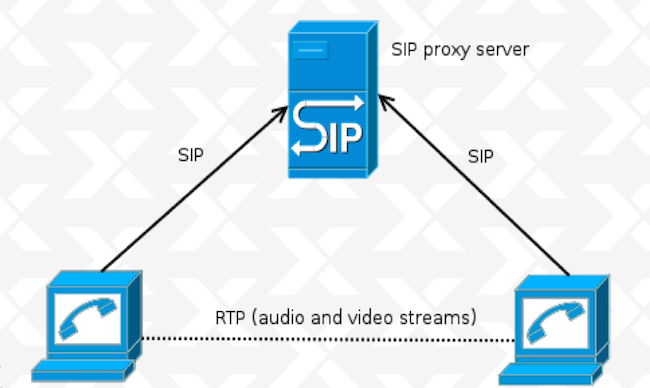
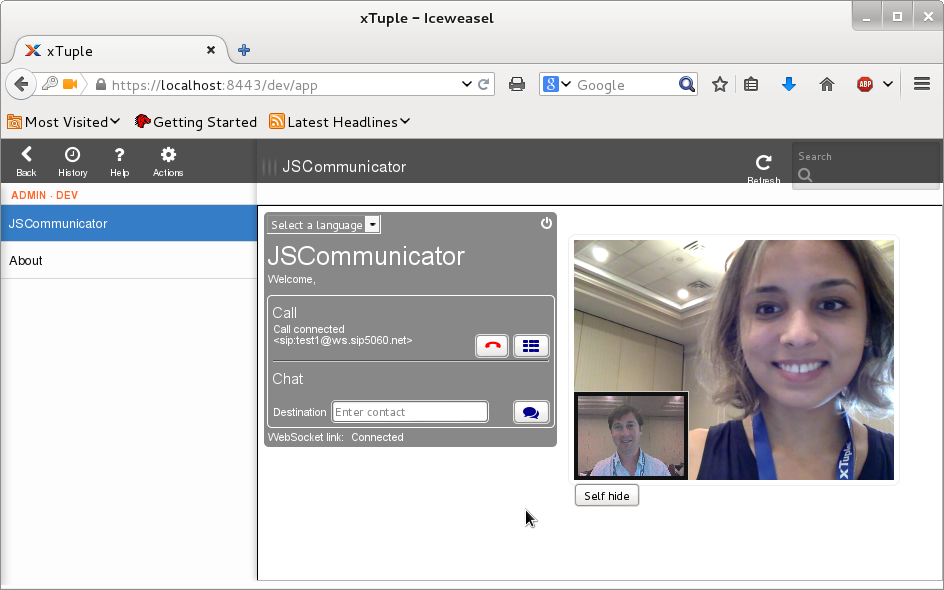
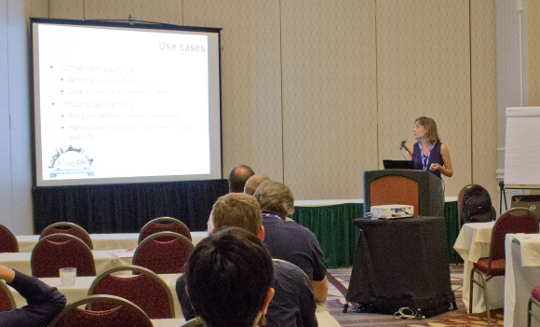
Two weeks ago I left NYC for a day trip to Norfolk, Virginia, to attend xTupleCon 2014. For those who don t know, xTuple is an incredibly reknown open source Enterprise Resource Planning (ERP) software. If you ve been following this blog, you might recall that during my participation in the Google Summer of Code 2014, I wrote a beta JSCommunicator extension for xTuple (to see how I went about doing that, look up Kickstarting the JSCommunicator-xTuple extension). Now, I wasn t flying down to Virginia on the eve of my first grad school midterms (gasp!) for fun - although I will admit, I enjoyed myself a fair amount. My GSoC mentor, Daniel Pocock was giving a talk about WebRTC and JSCommunicator at xTupleCon and invited me to participate. So that was the first perk of going to xTupleCon, I got to finally meet my GSoC mentor in person! During the presentation, Daniel provided a high level expanation of WebRTC and how it works. WebRTC (Web Real Time Communications) enables real time transmission of audio, video and data streams through browser-to-browser applications. This is one of the many perks of WebRTC; it doesn t require installation of plugins, making its use less vulnerable to security breaches. Websockets are used for the signalling channel and the SIP or XMPP can be used as the signaling protocol - in JSCommunicator, we used SIP. What was also done in JSCommunicator and can be done in other applications is to use a library to implement the signaling and SIP stack. JSCommunicator uses (and I highly reccomend) JsSIP. The basic SIP architecture is comprised of peers and a SIP Proxy Server that supports SIP over Websockets transport: sipArch If you have users behind NAT, you ll also need a TURN server for relay: sipArch2 In both cases, setup is not too difficult, particularly if using reSIProcate which offers both the SIP proxy and the TURN server. Daniel Pocock has an excellent post on how to setup and configure your SIP proxy and TURN server. With regard to JSCommunicator, it is a generic telephone in HTML5 which can easily be embedded in any web site or web app. Almost every aspect of JSCommunicator is easily customizable. More about JSCommunicator setup and architecture is detailed in a previous post. The JSCommunicator-xTuple extension can be installed in xTuple as an npm package (xtuple-jscommunicator). It is still at a very beta - or even pre-beta - stage and there are various limitations; the configuration must be hard-coded and dialing is done manually as opposed to clicking on a contact. Some of these limitations are features are on the wish list for future work. For example, some ideas for the next version of the extension are a click to dial from CRM records functionality and to bring up CRM records for an incomming call. Additionaly, the SIP proxy could be automatically installed with the xTuple server installation if desired. We closed the presentation with a live demo during which I made a video call from a JSCommunicator instance embedded in freephonebox.net to the JSCommunicator xTuple extension running on Daniel s laptop. Despite the occasionally iffy hotel Wifi, the demo was a hit - at one point I even left the conference room and took a quick walk around the hotel and invited other xTupleCon attendees to say hello to those in the room. The audience s reception was more enthusiastic than I anticipated, giving way to a pretty extensive Q&A session. It s great to see more and more people interested in WebRTC, I can t emphasize enough what a useful and versatile tool it is. Here s an action shot of part of the xTuple WebRTC presentation: xtuple

26 October 2014

Russ Allbery: California general election

Probably only of interest to California residents. Time again for the general election voting. This is probably too late to be helpful for a lot of people voting permanent absentee, but may as well write this down anyway. (Hm, I apparently didn't do this in 2012.) Propositions: Proposition 1: YES. Now is one of the best times in history to borrow money for infrastructure improvements, and our water infrastructure in the state can certainly use it. Proposition 2: YES. I have somewhat mixed feelings about this, since I hate passing complex legislation like this via proposition, but this already went through the legislature. It would be dumb for the federal government, which can more easily borrow money, but given how the finances of state governments work in the US, this sort of rainy day fund is probably prudent. This one seems reasonably well-designed, and the opposition is panic about a secondary effect on how school reserves are managed that can be changed with later legislative action and which is rather unconvincing. Proposition 45: YES. I can't get very enthused about yet more bandaids on top of our completely broken health care system, but forcing insurance companies to justify rate increases results in some public pressure against profit-taking by insurance companies. Single payer is what we actually need, but this might be mildly helpful. Plus, the argument against is more incoherent nonsense. So, I'm voting yes, but I don't think it's important and I won't mind if it loses. Proposition 46: NO. There are a lot of things that we should do about preventable medical errors, starting with funding our health care system properly, testing drugs properly, and investing in proper inspections and medical licensing investigations. Drug testing doctors is not among those things. This is a well-meaning but horrible idea pushed by a victim's advocacy group that won't do anything to improve our health care system. The fear-mongering of the opponents about malpractice lawsuits is a bit much, but there are essentially no positive benefits here. Proposition 47: YES. Requires that misdemeanor crimes actually be misdemeanors, rather than giving prosecutors discretion to charge them as felonies if the person charged happens to be black-- er, I mean, if the prosecutor doesn't like them for some reason. Obviously a good idea on all fronts: stop over-charging crimes, stop giving prosecutors discretion to choose the impact of laws on particular people (since they rarely use it appropriately), and further try to decriminalize our completely worthless "war on drugs." Proposition 48: YES. I'm opposed to the Indian gaming system in general, but this proposition appears to be a rather cynical attempt to block new casino development by tribes that already have casinos. My general feeling is that if we're going to have casinos, they should generally be legal; the bizarre system where each casino is subject to public approval seems designed to create political cronyism. State offices: I'm not going to comment on the partisan offices, since no one interesting survived the primaries. Across the board, it's basically the Democratic incumbants against various Republicans. The state Republican party in California is dominated by science denialists, Randian objectivists, and people who think the solution to all problems is ensuring rich people don't pay taxes, so it takes rather a lot to get me to vote for any of them. At the moment, the Democrats are doing a reasonably good job running the state, so while I'd vote for challengers from the left against several of them, given the boring candidate slate, I'm just voting Democrat down the line. California has a system that requires voter approval for various state judicial offices. In general, I don't agree with voter approval for judges, since voters are rarely in a position to make reasonable choices about justices. Since there's a Democratic administration in power at the moment, these are probably the best judges that we're going to get (the few I've heard of are good choices), and I don't think the yes/no approval voting is useful anyway. So I'm voting to approve across the board. Superintendent of Public Instruction: Tom Torlakson. I'm not a huge fan of Torlakson, but Tuck is a Harvard MBA who ran charter schools and then a school privatization initiative. Everyone always claims that they want to reduce bureaucracy and empower teachers, but Tuck has a past track record of trying to do so by taking public education private, something that I am passionately opposed to. So Torlakson it is. Local measures: Measure B: YES. Increases the local hotel tax and uses it for local infrastructure. I'm generally in favor of raising taxes, and the amount certainly won't be significant in the ridiculous Palo Alto hotel market. The arguments against feature one of my favorite stupid right-wing talking points: the tax is unfair because it isn't earmarked to benefit the people paying it. Measure C: YES. Reasonable, small reform of the local utility tax, opposed by the Libertarian Party and "taxpayer associations" using an "all taxation is theft" argument. What's not to like? Measure D: NO. Reduces the size of the city council for no clear reason. The stated reasons are saving money (not credible given how little money is involved) and making city meetings not take as long. I'm going to need something better than that to vote for this. Local offices: Judge of the Superior Court, Office #24: Matthew S. Harris. I'm making one exception for my normal rule against voting for former prosecutors for judges because the incumbant, Diane Ritchie, is apparently a train wreck. All it takes is a quick Google search to reveal multiple news stories about strange behavior, clear conflicts of interest, and other serious problems, including a rebuke by the local bar association. Even if not all of that information is true, judges should be above reproach, or at least farther above reproach than this. Palo Alto City Council: I have an agenda here: I think housing density is about the best thing that the local community could support. Housing density enables better mass transit options, makes housing more affordable and brings more housing under possible rent control, and simply makes more sense given the cost of housing in the area. A lot of the city council members run on low-density or anti-growth platforms; I vote against those and for people who support development. And, of course, I'll filter out candidates who believe stupid things, like claiming a minimum wage is un-American (Seelam-Sea Reddy). The best seem to be Greg Scharff, A.C. Johnston, Nancy Shepherd, Cory Wolbach, and Wayne Douglass. Palo Alto Unified School District: The Democratic party has endorsed four out of the five candidates, so it probably doesn't matter too much. Gina Dalma and Ken Dauber sound like the best of the candidates to me, so I will probably vote for them. Santa Clara Valley Water District #7: I voted for Brian Schmidt last time, and I don't see a reason to change my mind. His opponent is a Silicon Valley millionaire who is spending a surprisingly large amount of money on this race and is involved with a business that sells software to water boards, which raises some eyebrows.

24 October 2014

Daniel Pocock: Positive results from Outreach Program for Women

In 2013, Debian participated in both rounds of the GNOME Outreach Program for Women (OPW). The first round was run in conjunction with GSoC and the second round was a standalone program. The publicity around these programs and the strength of the Google and Debian brands attracted a range of female candidates, many of whom were shortlisted by mentors after passing their coding tests and satisfying us that they had the capability to complete a project successfully. As there are only a limited number of places for GSoC and limited funding for OPW, only a subset of these capable candidates were actually selected. The second round of OPW, for example, was only able to select two women. Google to the rescue Many of the women applying for the second round of OPW in 2013 were also students eligible for GSoC 2014. Debian was lucky to have over twenty places funded for GSoC 2014 and those women who had started preparing project plans for OPW and getting to know the Debian community were in a strong position to be considered for GSoC. Chandrika Parimoo, who applied to Debian for the first round of OPW in 2013, was selected by the Ganglia project for one of five GSoC slots. Chandrika made contributions to PyNag and the ganglia-nagios-bridge. Juliana Louback, who applied to Debian during the second round of OPW in 2013, was selected for one of Debian's GSoC 2014 slots working on the Debian WebRTC portal. The portal is built using JSCommunicator, a generic HTML5 softphone designed to be integrated in other web sites, portal frameworks and CMS systems. Juliana has been particularly enthusiastic with her work and after completing the core requirements of her project, I suggested she explore just what is involved in embedding JSCommunicator into another open source application. By co-incidence, the xTuple development team had decided to dedicate the month of August to open source engagement, running a program called haxTuple. Juliana had originally applied to OPW with an interest in financial software and so this appeared to be a great opportunity for her to broaden her experience and engagement with the open source community. Despite having no prior experience with ERP/CRM software, Juliana set about developing a plugin/extension for the new xTuple web frontend. She has published the extension in Github and written a detailed blog about her experience with the xTuple extension API. Participation in DebConf14 Juliana attended DebConf14 in Portland and gave a presentation of her work on the Debian RTC portal. Many more people were able to try the portal for the first time thanks to her participation in DebConf. The video of the GSoC students at DebConf14 is available here. Continuing with open source beyond GSoC Although GSoC finished in August, xTuple invited Juliana and I to attend their annual xTupleCon in Norfolk, Virginia. Google went the extra mile and helped Juliana to get there and she gave a live demonstration of the xTuple extension she had created. This effort has simultaneously raised the profile of Debian, open source and open standards (SIP and WebRTC) in front of a wider audience of professional developers and business users. Juliana describes her work at xTupleCon, Norfolk, 15 October 2014 It started with OPW The key point to emphasize is that Juliana's work in GSoC was actually made possible by Debian's decision to participate in and promote Outreach Program for Women in 2013. I've previously attended DebConf myself to help more developers become familiar with free and open RTC technology. I wasn't able to get there this year but thanks to the way GSoC and OPW are expanding our community, Juliana was there to help out.

23 October 2014

Alessio Treglia: Bits from the Debian Multimedia Maintainers

This brief announcement was released yesterday to the debian-devel-announce mailing list. Ciao! The Debian Multimedia Maintainers have been quite active since the Wheezy release, and have some interesting news to share for the Jessie release. Here we give you a brief update on what work has been done and work that is still ongoing. Let s see what s cooking for Jessie then. Frameworks and libraries Support for many new media formats and codecs. The codec library libavcodec, which is used by popular media playback applications including vlc, mpv, totem (using gstreamer1.0-libav), xine, and many more, has been updated to the latest upstream release version 11 provided by Libav. This provides Debian users with HEVC playback, a native Opus decoder, Matroska 3D support, Apple ProRes, and much more. Please see libav s changelog for a full list of functionality additions and updates. libebur128 libebur128 is a free implementation of the European Broadcasting Union Loudness Recommendation (EBU R128), which is essentially an alternative to ReplayGain. The library can be used to analyze audio perceived loudness and subsequentially normalize the volume during playback. libltc libltc provides functionalities to encode and decode Linear (or Longitudinal) Timecode (LTC) from/to SMPTE data timecode. libva libva and the driver for Intel GPUs has been updated to the 1.4.0 release. Support for new GPUs has been added. libva now also supports Wayland. Pure Data A number of new additional libraries (externals) will appear in Jessie, including (among others) Eric Lyon s fftease and lyonpotpourrie, Thomas Musil s iemlib, the pdstring library for string manipulation and pd-lua that allows to write Pd-objects in the popular lua scripting language. JACK and LADI LASH Audio Session Handler was abandoned upstream a long time ago in favor of the new session management system, called ladish (LADI Session Handler). ladish allows users to run many JACK applications at once and save/restore their configuration with few mouse clicks. The current status of the integration between the session handler and JACK may be summarized as follows: Note that ladish uses the D-Bus interface to the jack daemon, therefore only Jessie s jackd2 provides support for and also cooperates fine with it. Plugins: LV2 and LADSPA Debian Jessie will bring the newest 1.10.0 version of the LV2 technology. Most changes affect the packaging of new plugins and extensions, a brief list of packaging guidelines is now available.
A number of new plugins and development tools too have been made available during the Jessie development cycle: LV2 Toolkit LVTK provides libraries that wrap the LV2 C API and extensions into easy to use C++ classes. The original work for this was mostly done by Lars Luthman in lv2-c++-tools. Vee One Suite The whole suite by Rui Nuno Capela is now available in Jessie, and consists of three components: All three are provided in both forms of LV2 plugins and stand-alone JACK client. JACK session, JACK MIDI, and ALSA MIDI are supported too. x42-plugins and zam-plugins LV2 bundles containing many audio plugins for high quality processing. Fomp Fomp is an LV2 port of the MCP, VCO, FIL, and WAH plugins by Fons Adriaensen. Some other components have been upgraded to more recent upstream versions: We ve packaged ste-plugins, Fons Adriaensen s new stereo LADSPA plugins bundle. A major upgrade of frei0r, namely the standard collection for the minimalistic plugin API for video effects, will be available in Jessie. New multimedia applications Advene Advene (Annotate Digital Video, Exchange on the NEt) is a flexible video
annotation application. Ardour3 The new generation of the popular digital audio workstation will make its very first appearance in Debian Jessie. Cantata Qt4 front-end for the MPD daemon. Csound Csound for jessie will feature the new major series 6, with the improved IDE CsoundQT. This new csound supports improved array data type handling, multi-core rendering and debugging features. din DIN Is Noise is a musical instrument and audio synthesizer that supports JACK audio output, MIDI, OSC, and IRC bot as input sources. It could be extended and customized with Tcl scripts too. dvd-slideshow dvd-slideshow consists of a suite of command line tools which come in handy to make slideshows from collections of pictures. Documentation is provided and available in /usr/share/doc/dvd-slideshow/ . dvdwizard DVDwizard can fully automate the creation of DVD-Video filesystem. It supports graphical menus, chapters, multiple titlesets and multi-language streams. It supports both PAL and NTSC video modes too. flowblade Flowblade is a video editor like the popular KDenlive based on the MLT engine, but more lightweight and with some difference in editing concepts. forked-daapd Forked-daapd switched to a new, active upstream again dropping Grand Central Dispatch in favor of libevent. The switch fixed several bugs and made forked-daapd available on all release architectures instead of shipping only on amd64 and i386. Now nothing prevents you from setting up a music streaming (DAAP/DACP) server on your favorite home server no matter if it is based on mips, arm or x86! harvid HTTP Ardour Video Daemon decodes still images from movie files and serves them via HTTP. It provides frame-accurate decoding and is main use-case is to act as backend and second level cache for rendering the
videotimeline in Ardour. Groove Basin Groove Basin is a music player server with a web-based user interface inspired by Amarok 1.4. It runs on a server optionally connected to speakers. Guests can control the music player by connecting with a laptop, tablet, or smart phone. Further, users can stream their music libraries remotely.
It comes with a fast, responsive web interface that supports keyboard shortcuts and drag drop. It also provides the ability to upload songs, download songs, and import songs by URL, including YouTube URLs. Groove Basin supports Dynamic Mode which automatically queues random songs, favoring songs that have not been queued recently.
It automatically performs ReplayGain scanning on every song using the EBU R128 loudness standard, and automatically switches between track and album mode. Groove Basin supports the MPD protocol, which means it is compatible with MPD clients. There is also a more powerful Groove Basin protocol which you can use if the MPD protocol does not meet your needs. HandBrake HandBrake, a versatile video transcoder, is now available for Jessie. It could convert video from nearly any format to a wide range of commonly supported codecs. jack-midi-clock New jackd midiclock utility made by Robin Gareus. laborejo Laborejo, Esperanto for Workshop , is used to craft music through notation. It is a LilyPond GUI frontend, a MIDI creator and a tool collection to inspire and help music composers. mpv mpv is a movie player based on MPlayer and mplayer2. It supports a wide variety of video file formats, audio and video codecs, and subtitle types. The project focuses mainly on modern systems and encourages developer activity. As such, large portions of outdated code originating from MPlayer have been removed, and many new features and improvements have been added. Note that, although there are still some similarities to its predecessors, mpv should be considered a completely different program (e.g. lacking compatibility with both mplayer and mplayer2 in terms of command-line arguments and configuration). smtube SMTube is a stand-alone graphical video browser and player, which makes YouTube s videos browsing, playing, and download such a piece of cake.
It has so many features that, we are sure, will make YouTube lovers very, very happy. sonic-visualiser Sonic Visualiser Application for viewing and analysing the contents of music audio files. SoundScapeRenderer SoundScapeRenderer (aka SSR) is a (rather) easy to use render engine for spatial audio, that provides a number of different rendering algorithms, ranging from binaural (headphone) playback via wave field synthesis to higher-order ambisonics. Videotrans videotrans is a set of scripts that allow its user to reformat existing movies into the VOB format that is used on DVDs. XBMC XBMC has been partially rebranded as XBMC from Debian to make it clear that it is changed to conform to Debian s Policy. The latest stable release, 13.2 Gotham will be part of Jessie making Debian a good choice for HTPC-s. zita-bls1 Binaural stereo signals converter made by Fons Adriaensen zita-mu1 Stereo monitoring organiser for jackd made by Fons Adriaensen zita-njbridge Jack clients to transmit multichannel audio over a local IP network made by Fons Adriaensen radium-compressor Radium Compressor is the system compressor of the Radium suite. It is provided in the form of stand-alone JACK application. Multimedia Tasks With Jessie we are shipping a set of multimedia related tasks.
They include package lists for doing several multimedia related tasks. If you are interested in defining new tasks, or tweaking the current, existing ones, we are very much interested in hearing from you. Upgraded applications and libraries What s not going to be in Jessie With the aim to improve the overall quality of the multimedia software available in Debian, we have dropped a number of packages which were abandoned upstream: We ve also dropped mplayer, presently nobody seems interested in maintaining it.
The suggested replacements for users are mplayer2 or mpv. Whilst the former is mostly compatible with mplayer in terms of command-line arguments and configuration (and adds a few new features too), the latter adds a lot of new features and improvements, and it is actively maintained upstream. Please note that although the mencoder package is no longer available anymore, avconv and mpv do provide encoding functionality. For more information see avconv s manual page and documentation, and mpv s encoding documentation. Broken functionalities rtkit under systemd is broken at the moment. Activity statistics More information about team s activity are available. Where to reach us The Debian Multimedia Maintainers can be reached at pkg-multimedia-maintainers AT lists.alioth.debian.org for packaging related topics, or at debian-multimedia AT lists.debian.org for user and more general discussion.
We would like to invite everyone interested in multimedia to join us there. Some of the team members are also in the #debian-multimedia channel on OFTC. Cheers! Alessio Treglia
on behalf of the Debian Multimedia Maintainers

Erich Schubert: Clustering 23 mio Tweet locations

To test scalability of ELKI, I've clustered 23 million Tweet locations from the Twitter Statuses Sample API obtained over 8.5 months (due to licensing restrictions by Twitter, I cannot make this data available to you, sorry.
23 million points is a challenge for advanced algorithms. It's quite feasible by k-means; in particular if you choose a small k and limit the number of iterations. But k-means does not make a whole lot of sense on this data set - it is a forced quantization algorithm, but does not discover actual hotspots.
Density-based clustering such as DBSCAN and OPTICS are much more appropriate. DBSCAN is a bit tricky to parameterize - you need to find the right combination of radius and density for the whole world. Given that Twitter adoption and usage is quite different it is very likely that you won't find a single parameter that is appropriate everywhere.
OPTICS is much nicer here. We only need to specify a minimum object count - I chose 1000, as this is a fairly large data set. For performance reasons (and this is where ELKI really shines) I chose a bulk-loaded R*-tree index for acceleration. To benefit from the index, the epsilon radius of OPTICS was set to 5000m. Also, ELKI allows using geodetic distance, so I can specify this value in meters and do not get much artifacts from coordinate projection.
To extract clusters from OPTICS, I used the Xi method, with xi set to 0.01 - a rather low value, also due to the fact of having a large data set.
The results are pretty neat - here is a screenshot (using KDE Marble and OpenStreetMap data, since Google Earth segfaults for me right now):
Screenshot of Clusters in central Europe
Some observations: unsurprisingly, many cities turn up as clusters. Also regional differences are apparent as seen in the screenshot: plenty of Twitter clusters in England, and low acceptance rate in Germany (Germans do seem to have objections about using Twitter; maybe they still prefer texting, which was quite big in Germany - France and Spain uses Twitter a lot more than Germany).
Spam - some of the high usage in Turkey and Indonesia may be due to spammers using a lot of bots there. There also is a spam cluster in the ocean south of Lagos - some spammer uses random coordinates [0;1]; there are 36000 tweets there, so this is a valid cluster...
A benefit of OPTICS and DBSCAN is that they do not cluster every object - low density areas are considered as noise. Also, they support clusters of different shape (which may be lost in this visualiation, which uses convex hulls!) and different size. OPTICS can also produce a hierarchical result.
Note that for these experiments, the actual Tweet text was not used. This has a rough correspondence to Twitter popularity "heatmaps", except that the clustering algorithms will actually provide a formalized data representation of activity hotspots, not only a visualization.
You can also explore the clustering result in your browser - the Google Drive visualization functionality seems to work much better than Google Earth.
If you go to Istanbul or Los Angeles, you will see some artifacts - odd shaped clusters with a clearly visible spike. This is caused by the Xi extraction of clusters, which is far from perfect. At the end of a valley in the OPTICS plot, it is hard to decide whether a point should be included or not. These errors are usually the last element in such a valley, and should be removed via postprocessing. But our OpticsXi implementation is meant to be as close as possible to the published method, so we do not intend to "fix" this.
Certain areas - such as Washington, DC, New York City, and the silicon valley - do not show up as clusters. The reason is probably again the Xi extraction - these region do not exhibit the steep density increase expected by Xi, but are too blurred in their surroundings to be a cluster.
Hierarchical results can be found e.g. in Brasilia and Los Angeles.
Compare the OPTICS results above to k-means results (below) - see why I consider k-means results to be a meaningless quantization?
k-means clusters
Sure, k-means is fast (30 iterations; not converged yet. Took 138 minutes on a single core, with k=1000. The parallel k-means implementation in ELKI took 38 minutes on a single node, Hadoop/Mahout on 8 nodes took 131 minutes, as slow as a single CPU core!). But you can see how sensitive it is to misplaced coordinates (outliers, but mostly spam), how many "clusters" are somewhere in the ocean, and that there is no resolution on the cities? The UK is covered by 4 clusters, with little meaning; and three of these clusters stretch all the way into Bretagne - k-means clusters clearly aren't of high quality here.
If you want to reproduce these results, you need to get the upcoming ELKI version (0.6.5~201410xx - the output of cluster convex hulls was just recently added to the default codebase), and of course data. The settings I used are:
-dbc.in coords.tsv.gz
-db.index tree.spatial.rstarvariants.rstar.RStarTreeFactory
-pagefile.pagesize 500
-spatial.bulkstrategy SortTileRecursiveBulkSplit
-time
-algorithm clustering.optics.OPTICSXi
-opticsxi.xi 0.01
-algorithm.distancefunction geo.LngLatDistanceFunction
-optics.epsilon 5000.0 -optics.minpts 1000
-resulthandler KMLOutputHandler -out /tmp/out.kmz
and the total runtime for 23 million points on a single core was about 29 hours. The indexes helped a lot: less than 10000 distances were computed per point, instead of 23 million - the expected speedup over a non-indexed approach is 2400.
Don't try this with R or Matlab. Your average R clustering algorithm will try to build a full distance matrix, and you probably don't have an exabyte of memory to store this matrix. Maybe start with a smaller data set first, then see how long you can afford to increase the data size.

21 October 2014

Lucas Nussbaum: Tentative summary of the amendments of the init system coupling GR

This is an update of my previous attempt at summarizing this discussion. As I proposed one of the amendments, you should not blindly trust me, of course. :-) First, let s address two FAQ: What is the impact on jessie?
On the technical level, none. The current state of jessie already matches what is expected by all proposals. It s a different story on the social level. Why are we voting now, then?
Ian Jackson, who submitted the original proposal, explained his motivation in this mail. We now have four different proposals: (summaries are mine) [plessy] is the simplest, and does not discuss the questions that the other proposals are answering, given it considers that the normal Debian decision-making processes have not been exhausted. In order to understand the three other proposals, it s useful to break them down into several questions. Q1: support for the default init system on Linux
A1.1: packages MUST work with the default init system on Linux as PID 1.
(That is the case in both [iwj] and [lucas]) A1.2: packages SHOULD work with the default init system on Linux as PID 1.
With [dktrkranz], it would no longer be required to support the default init system, as maintainers could choose to require another init system than the default, if they consider this a prerequisite for its proper operation; and no patches or other derived works exist in order to support other init systems. That would not be a policy violation. (see this mail and its reply for details). Theoretically, it could also create fragmentation among Debian packages requiring different init systems: you would not be able to run pkgA and pkgB at the same time, because they would require different init systems. Q2: support for alternative init systems as PID 1
A2.1: packages MUST work with one alternative init system (in [iwj])
(Initially, I thought that one here should be understood as sysvinit , as this mail, Ian detailed why he chose to be unspecific about the target init system. However, in that mail, he later clarified that a package requiring systemd or uselessd would be fine as well, given that in practice there aren t going to be many packages that would want to couple specifically to systemd _or_ uselessd, but where support for other init systems is hard to provide.)
To the user, that brings the freedom to switch init systems (assuming that the package will not just support two init systems with specific interfaces, but rather a generic interface common to many init systems).
However, it might require the maintainer to do the required work to support additional init systems, possibly without upstream cooperation.
Lack of support is a policy violation (severity >= serious, RC).
Bugs about degraded operation on some init systems follow the normal bug severity rules. A2.2: packages SHOULD work with alternative init systems as PID 1. (in [lucas])
This is a recommendation. Lack of support is not a policy violation (bug severity < serious, not RC). A2.3: nothing is said about alternative init systems (in [dktrkranz]). Lack of support would likely be a wishlist bug. Q3: special rule for sysvinit to ease wheezy->jessie upgrades
(this question is implicitly dealt with in [iwj], assuming that one of the supported init systems is sysvinit)
A3.1: continue support for sysvinit (in [lucas])
For the jessie release, all software available in Debian wheezy that supports being run under sysvinit should continue to support sysvinit unless there is no technically feasible way to do so. A3.2: no requirement to support sysvinit (in [dktrkranz])
Theoretically, this could require two-step upgrades: first reboot with systemd, then upgrade other packages Q4: non-binding recommendation to maintainers
A4.1: recommend that maintainers accept patches that add or improve
support for alternative init systems. (in both [iwj] and [lucas], with a different wording) A4.2: say nothing (in [dktrkranz]) Q5: support for init systems with are the default on non-Linux ports
A5.1: non-binding recommendation to add/improve support with a high priority (in [lucas]) A5.2: say nothing (in [iwj] and [dktrkranz]) Comments are closed: please discuss by replying to that mail.

Erich Schubert: Avoiding systemd isn't hard

Don't listen to trolls. They lie.
Debian was and continues to be about choice. Previously, you could configure Debian to use other init systems, and you can continue to do so in the future.
In fact, with wheezy, sysvinit was essential. In the words of trolls, Debian "forced" you to install SysV init!
With jessie, it will become easier to choose the init system, because neither init system is essential now. Instead, there is an essential meta-package "init", which requires you to install one of systemd-sysv sysvinit-core upstart. In other words, you have more choice than ever before.
Again: don't listen to trolls.
However, notice that there are some programs such as login managers (e.g. gdm3) which have an upstream dependency on systemd. gdm3 links against libsystemd0 and depends on libpam-systemd; and the latter depends on systemd-sysv systemd-shim so it is in fact a software such as GNOME that is pulling systemd onto your computer.
IMHO you should give systemd a try. There are some broken (SysV-) init scripts that cause problems with systemd; but many of these cases have now been fixed - not in systemd, but in the broken init script.
However, here is a clean way to prevent systemd from being installed when you upgrade to jessie. (No need to "fork" Debian for this, which just demonstrates how uninformed some trolls are ... - apart from Debian being very open to custom debian distributions, which can easily be made without "forking".)
As you should know, apt allows version pinning. This is the proper way to prevent a package from being installed. All you need to do is create a file named e.g. /etc/apt/preferences.d/no-systemd with the contents:
Package: systemd-sysv
Pin: release o=Debian
Pin-Priority: -1
from the documentation, a priority less than 0 disallows the package from being installed. systemd-sysv is the package that would enable systemd as your default init (/sbin/init).
This change will make it much harder for aptitude to solve dependencies. A good way to help it to solve the dependencies is to install the systemd-shim package explicitly first:
aptitude install systemd-shim
After this, I could upgrade a Debian system from wheezy to jessie without being "forced" to use systemd...
In fact, I could also do an aptitude remove systemd systemd-shim. But that would have required the uninstallation of GNOME, gdm3 and network-manager - you may or may not be willing to do this. On a server, there shouldn't be any component actually depending on systemd at all. systemd is mostly a GNOME-desktop thing as of now.
As you can see, the trolls are totally blaming the wrong people, for the wrong reasons... and in fact, the trolls make up false claims (as a fact, systemd-shim was updated on Oct 14). Stop listening to trolls, please.
If you find a bug - a package that needlessly depends on systemd, or a good way to remove some dependency e.g. via dynamic linking, please contribute a patch upstream and file a bug. Solve problems at the package/bug level, instead of wasting time doing hate speeches.

18 October 2014

Erich Schubert: Beware of trolls - do not feed

A particularly annoying troll has been on his hate crusade against systemd for months now.
Unfortunately, he's particularly active on Debian mailing lists (but apparently also on Ubuntu and the Linux Kernel mailing list) and uses a tons of fake users he keeps on setting up. Our listmasters have a hard time blocking all his hate, sorry.
Obviously, this is also the same troll that has been attacking Lennart Poettering.
There is evidence that this troll used to go by the name "MikeeUSA", and has quite a reputation with anti-feminist hate for over 10 years now.
Please, do not feed this troll.
Here are some names he uses on YouTube: Gregory Smith, Matthew Bradshaw, Steve Stone.
Blacklisting is the best measure we have, unfortunately.
Even if you don't like the road systemd is taking or Lennart Poetting personall - the behaviour of that troll is unacceptable to say the least; and indicates some major psychological problems... also, I wouldn't be surprised if he is also involved in #GamerGate.
See this example (LKML) if you have any doubts. We seriously must not tolerate such poisonous people.
If you don't like systemd, the acceptable way of fighting it is to write good alternative software (and you should be able to continue using SysV init or openRC, unless there is a bug, in Debian - in this case, provide a bug fix). End of story.

17 October 2014

Erich Schubert: Google Earth on Linux

Google Earth for Linux appears to be largely abandoned by Google, unfortunately. The packages available for download cannot be installed on a modern amd64 Debian or Ubuntu system due to dependency issues.
In fact, the adm64 version is a 32 bit build, too. The packages are really low quality, the dependencies are outdated, locales support is busted etc.
So here are hacky instructions how to install nevertheless. But beware, these instructions are a really bad hack.
  1. These instructions are appropriate for version 7.1.2.2041-r0. Do not use them for any other version. Things will have changed.
  2. Make sure your system has i386 architecture enabled. Follow the instructions in section "Configuring architectures" on the Debian MultiArch Wiki page to do so
  3. Install lsb-core, and try to install the i386 versions of these packages, too!
  4. Download the i386 version of the Google Earth package
  5. Install the package by forcing dependencies, via
    sudo dpkg --force-depends -i google-earth-stable_current_i386.deb
    
  6. As of now, your package manager will complain, and suggest to remove the package again. To make it happy, we have to hack the installed packages list. This is ugly, and you should make a backup. You can totally bust your system this way... Fortunately, the change we're doing is rather simple. As admin, edit the file /var/lib/dpkg/status. Locate the section Package: google-earth-stable. In this section, delete the line starting with Depends:. Don't add in extra newlines or change anything else!
  7. Now the package manager should believe the dependencies of Google Earth are fulfilled, and no longer suggest removal. But essentially this means you have to take care of them yourself!
Some notes on using Google Earth:

15 October 2014

Matthew Palmer: My entry in the "Least Used Software EVAH" competition

For some reason, I seem to end up writing software for very esoteric use-cases. Today, though, I think I ve outdone myself: I sat down and wrote a Ruby library to get and set process resource limits those things that nobody ever thinks about except when they run out of file descriptors. I didn t even have a direct need for it. Recently I was grovelling through the EventMachine codebase, looking at the filehandle limit code, and noticed that the pure-ruby implementation didn t manipulate filehandle limits. I considered adding it, then realised that there wasn t a library available to do it. Since I haven t berked around with FFI for a while, I decided to write rlimit. Now to find the time to write that patch for EventMachine Since I doubt there are many people who have a burning need to manipulate rlimits in Ruby, this gem will no doubt sit quiet and undisturbed in the dark, dusty corners of rubygems.org. However, for the three people on earth who find this useful: you re welcome.

14 October 2014

Gunnar Wolf: When Open Access meets the Napster anniversary

Two causally unrelated events which fit in together in the greater scheme of things ;-) In some areas, the world is better aligning to what we have been seeking for many years. In some, of course, it is not. In this case, today I found our article on the Network of Digital Repositories for our University, in the Revista Digital Universitaria [en l nea] was published. We were invited to prepare an article on this topic because this month's magazine would be devoted to Open Access in Mexico and Latin America This, because a law was recently passed that makes conditions much more interesting for the nonrestricted publication of academic research. Of course, there is still a long way to go, but this clearly is a step in the right direction. On the other hand, after a long time of not looking in that direction (even though it's a lovely magazine), I found that this edition of FirstMonday takes as its main topic Napster, 15 years on: Rethinking digital music distribution. I know that nonrestricted academic publishing via open access and nonauthorized music sharing via Napster are two very different topics. However, there is a continuous push and trend towards considering and accepting open licensing terms, and they are both points in the same struggle. An interesting data point to add is that, although many different free licenses have existed over time, Creative Commons (which gave a lot of visibility and made the discussion within the reach of many content creators) was created in 2001 13 years ago today, two years after Napster. And, yes, there are no absolute coincidences.

12 October 2014

Iustin Pop: Day trip on the Olympic Peninsula

Day trip on the Olympic Peninsula TL;DR: drove many kilometres on very nice roads, took lots of pictures, saw sunshine and fog and clouds, an angry ocean and a calm one, a quiet lake and lots and lots of trees: a very well spent day. Pictures at http://photos.k1024.org/Daytrips/Olympic-Peninsula-2014/. Sometimes I travel to the US on business, and as such I've been a few times in the Seattle area. Until this summer, when I had my last trip there, I was content to spend any extra days (weekend or such) just visiting Seattle itself, or shopping (I can spend hours in the REI store!), or working on my laptop in the hotel. This summer though, I thought - I should do something a bit different. Not too much, but still - no sense in wasting both days of the weekend. So I thought maybe driving to Mount Rainier, or something like that. On the Wednesday of my first week in Kirkland, as I was preparing my drive to the mountain, I made the mistake of scrolling the map westwards, and I saw for the first time the Olympic Peninsula; furthermore, I was zoomed in enough that I saw there was a small road right up to the north-west corner. Intrigued, I zoomed further and learned about Cape Flattery ( the northwestern-most point of the contiguous United States! ), so after spending a bit time reading about it, I was determined to go there. Easier said than done - from Kirkland, it's a 4h 40m drive (according to Google Maps), so it would be a full day on the road. I was thinking of maybe spending the night somewhere on the peninsula then, in order to actually explore the area a bit, but from Wednesday to Saturday it was a too short notice - all hotels that seemed OK-ish were fully booked. I spent some time trying to find something, even not directly on my way, but I failed to find any room. What I did manage to do though, is to learn a bit about the area, and to realise that there's a nice loop around the whole peninsula - the 104 from Kirkland up to where it meets the 101N on the eastern side, then take the 101 all the way to Port Angeles, Lake Crescent, near Lake Pleasant, then south toward Forks, crossing the Hoh river, down to Ruby Beach, down along the coast, crossing the Queets River, east toward Lake Quinault, south toward Aberdeen, then east towards Olympia and back out of the wilderness, into the highway network and back to Kirkland. This looked like an awesome road trip, but it is as long as it sounds - around 8 hours (continuous) drive, though skipping Cape Flattery. Well, I said to myself, something to keep in mind for a future trip to this area, with a night in between. I was still planning to go just to Cape Flattery and back, without realising at that point that this trip was actually longer (as you drive on smaller, lower-speed roads). Preparing my route, I read about the queues at the Edmonds-Kingston ferry, so I was planning to wake up early on the weekend, go to Cape Flattery, and go right back (maybe stop by Lake Crescent). Saturday comes, I - of course - sleep longer than my trip schedule said, and start the day in a somewhat cloudy weather, driving north from my hotel on Simonds Road, which was quite nicer than the usual East-West or North-South roads in this area. The weather was becoming nicer, however as I was nearing the ferry terminal and the traffic was getting denser, I started suspecting that I'll spend a quite a bit of time waiting to board the ferry. And unfortunately so it was (photo altered to hide some personal information): Waiting for the ferry. The weather at least was nice, so I tried to enjoy it and simply observe the crowd - people were looking forward to a weekend relaxing, so nobody seemed annoyed by the wait. After almost half an hour, time to get on the ferry - my first time on a ferry in US, yay! But it was quite the same as in Europe, just that the ship was much larger. Once I secured the car, I went up deck, and was very surprised to be treated with some excellent views: Harbour view Looking towards the sun   and away from it The crossing was not very short, but it seemed so, because of the view, the sun, the water and the wind. Soon we were nearing the other shore; also, see how well panorama software deals with waves :P! Near the other shore And I was finally on the "real" part of the trip. The road was quite interesting. Taking the 104 North, crossing the "Hood Canal Floating Bridge" (my, what a boring name), then finally joining the 101 North. The environment was quite varied, from bare plains and hills, to wooded areas, to quite dense forests, then into inhabited areas - quite a long stretch of human presence, from the Sequim Bay to Port Angeles. Port Angeles surprised me: it had nice views of the ocean, and an interesting port (a few big ships), but it was much smaller than I expected. The 101 crosses it, and in less than 10 minutes or so it was already over. I expected something nicer, based on the name, but Anyway, onwards! Soon I was at a crossroads and had to decide: I could either follow the 101, crossing the Elwha River and then to Lake Crescent, then go north on the 113/112, or go right off 101 onto 112, and follow it until close to my goal. I took the 112, because on the map it looked "nicer", and closer to the shore. Well, the road itself was nice, but quite narrow and twisty here and there, and there was some annoying traffic, so I didn't enjoy this segment very much. At least it had the very interesting property (to me) that whenever I got closer to the ocean, the sun suddenly disappeared, and I was finding myself in the fog: Foggy road So my plan to drive nicely along the coast failed. At one point, there was even heavy smoke (not fog!), and I wondered for a moment how safe was to drive out there in the wilderness (there were other cars though, so I was not alone). Only quite a bit later, close to Neah Bay, did I finally see the ocean: I saw a small parking spot, stopped, and crossing a small line of trees I found myself in a small cove? bay? In any case, I had the impression I stepped out of the daily life in the city and out into the far far wilderness: Dead trees on the beach Trees growing on a rock Small panorama of the cove There was a couple, sitting on chairs, just enjoying the view. I felt very much intruding, behaving like I did as a tourist: running in, taking pictures, etc., so I tried at least to be quiet . I then quickly moved on, since I still had some road ahead of me. Soon I entered Neah Bay, and was surprised to see once more blue, and even more blue. I'm a sucker for blue, whether sky blue or sea blue , so I took a few more pictures (watch out for the evil fog in the second one): View towards Neah Bay port Sea view from Neah Bay Well, the town had some event, and there were lots of people, so I just drove on, now on the last stretch towards the cape. The road here was also very interesting, yet another environment - I was driving on Cape Flattery Road, which cuts across the tip of the peninsula (quite narrow here) along the Waatch River and through its flooding plains (at least this is how it looked to me). Then it finally starts going up through the dense forest, until it reaches the parking lot, and from there, one goes on foot towards the cape. It's a very easy and nice walk (not a hike), and the sun was shining very nicely through the trees: Sunny forest Sun shinning down Wooden path But as I reached the peak of the walk, and started descending towards the coast, I was surprised, yet again, by fog: Ugly fog again! I realised that probably this means the cape is fully in fog, so I won't have any chance to enjoy the view. Boy, was I wrong! There are three viewpoints on the cape, and at each one I was just "wow" and "aah" at the view. Even thought it was not a sunny summer view, and there was no blue in sight, the combination between the fog (which was hiding the horizon and even the closer islands), the angry ocean which was throwing wave after wave at the shore, making a loud noise, and the fact that even this seemingly inhospitable area was just teeming with life, was both unexpected and awesome. I took here waay to many pictures, here are just a couple inlined: First view at the cape Birds 'enjoying' the weather Foggy shore I spent around half an hour here, just enjoying the rawness of nature. It was so amazing to see life encroaching on each bit of land, even though it was not what I would consider a nice place. Ah, how we see everything through our own eyes! The walk back was through fog again, and at one point it switched over back to sunny. Driving back on the same road was quite different, knowing what lies at its end. On this side, the road had some parking spots, so I managed to stop and take a picture - even though this area was much less wild, it still has that outdoors flavour, at least for me: Waatch River Back in Neah Bay, I stopped to eat. I had a place in mind from TripAdvisor, and indeed - I was able to get a custom order pizza at "Linda's Woodfired Kitchen". Quite good, and I ate without hurry, looking at the people walking outside, as they were coming back from the fair or event that was taking place. While eating, a somewhat disturbing thought was going through my mind. It was still early, around two to half past two, so if I went straight back to Kirkland I would be early at the hotel. But it was also early enough that I could - in theory at least - still do the "big round-trip". I was still rummaging the thought as I left On the drive back I passed once more near Sekiu, Washington, which is a very small place but the map tells me it even has an airport! Fun, and the view was quite nice (a bit of blue before the sea is swallowed by the fog): Sekiu view After passing Sekiu and Clallam Bay, the 112 curves inland and goes on a bit until you are at the crossroads: to the left the 112 continues, back the same way I came; to the right, it's the 113, going south until it meets the 101. I looked left - remembering the not-so-nice road back, I looked south - where a very appealing, early afternoon sun was beckoning - so I said, let's take the long way home! It's just a short stretch on the 113, and then you're on the 101. The 101 is a very nice road, wide enough, and it goes through very very nice areas. Here, west to south-west of the Olympic Mountains, it's a very different atmosphere from the 112/101 that I drove on in the morning; much warmer colours, a bit different tree types (I think), and more flat. I soon passed through Forks, which is one of the places I looked at when searching for hotels. I did so without any knowledge of the town itself (its wikipedia page is quite drab), so imagine my surprise when a month later I learned from a colleague that this is actually a very important place for vampire-book fans. Oh my, and I didn't even stop! This town also had some event, so I just drove on, enjoying the (mostly empty) road. My next planned waypoint was Ruby Beach, and I was looking forward to relaxing a bit under the warm sun - the drive was excellent, weather perfect, so I was watching the distance countdown on my Garmin. At two miles out, the "Near waypoint Ruby Beach" message appeared, and two seconds later the sun went out. What the I was hoping this is something temporary, but as I slowly drove the remaining mile I couldn't believe my eyes that I was, yet again, finding myself in the fog I park the car, thinking that asking for a refund would at least allow me to feel better - but it was I who planned the trip! So I resigned myself, thinking that possibly this beach is another special location that is always in the fog. However, getting near the beach it was clear that it was not so - some people were still in their bathing suits, just getting dressed, so it seems I was just unlucky with regards to timing. However, I the beach itself was nice, even in the fog (I later saw online sunny pictures, and it is quite beautiful), the the lush trees reach almost to the shore, and the way the rocks are sitting on the beach: A lonely dinghy Driftwood  and human construction People on the beach Since the weather was not that nice, I took a few more pictures, then headed back and started driving again. I was soo happy that the weather didn't clear at the 2 mile mark (it was not just Ruby Beach!), but alas - it cleared as soon as the 101 turns left and leaves the shore, as it crosses the Queets river. Driving towards my next planned stop was again a nice drive in the afternoon sun, so I think it simply was not a sunny day on the Pacific shore. Maybe seas and oceans have something to do with fog and clouds ! In Switzerland, I'm very happy when I see fog, since it's a somewhat rare event (and seeing mountains disappearing in the fog is nice, since it gives the impression of a wider space). After this day, I was a bit fed up with fog for a while Along the 101 one reaches Lake Quinault, which seemed pretty nice on the map, and driving a bit along the lake - a local symbol, the "World's largest spruce tree". I don't know what a spruce tree is, but I like trees, so I was planning to go there, weather allowing. And the weather did cooperate, except that the tree was not so imposing as I thought! In any case, I was glad to stretch my legs a bit: Path to largest spruce tree Largest spruce tree, far view Largest spruce tree, closer view Very short path back to the road However, the most interesting thing here in Quinault was not this tree, but rather - the quiet little town and the view on the lake, in the late afternoon sun: Quinault Quinault Lake view The entire town was very very quiet, and the sun shining down on the lake gave an even stronger sense of tranquillity. No wind, not many noises that tell of human presence, just a few, and an overall sense of peace. It was quite the opposite of the Cape Flattery and a very nice way to end the trip. Well, almost end - I still had a bit of driving ahead. Starting from Quinault, driving back and entering the 101, driving down to Aberdeen: Afternoon ride then turning east towards Olympia, and back onto the highways. As to Aberdeen and Olympia, I just drove through, so I couldn't make any impression of them. The old harbour and the rusted things in Aberdeen were a bit interesting, but the day was late so I didn't stop. And since the day shouldn't end without any surprises, during the last profile change between walking and driving in Quinault, my GPS decided to reset its active maps list and I ended up with all maps activated. This usually is not a problem, at least if you follow a pre-calculated route, but I did trigger recalculation as I restarted my driving, so the Montana was trying to decide on which map to route me - between the Garmin North America map and the Open StreeMap one, the result was that it never understood which road I was on. It always said "Drive to I5", even though I was on I5. Anyway, thanks to road signs, and no thanks to "just this evening ramp closures", I was able to arrive safely at my hotel. Overall, a very successful, if long trip: around 725 kilometres, 10h:30m moving, 13h:30m total: Track picture There were many individual good parts, but the overall think about this road trip was that I was able to experience lots of different environments of the peninsula on the same day, and that overall it's a very very nice area. The downside was that I was in a rush, without being able to actually stop and enjoy the locations I visited. And there's still so much to see! A two nights trip sound just about right, with some long hikes in the rain forest, and afternoons spent on a lake somewhere. Another not so optimal part was that I only had my "travel" camera (a Nikon 1 series camera, with a small sensor), which was a bit overwhelmed here and there by the situation. It was fortunate that the light was more or less good, but looking back at the pictures, how I wish that I had my "serious" DSLR So, that means I have two reasons to go back! Not too soon though, since Mount Rainier is also a good location to visit . If the pictures didn't bore you yet, the entire gallery is on my smugmug site. In any case, thanks for reading!

8 October 2014

Jonathan Dowland: Ansible

I've just recently built the large bulk of VMs that we use for first semester teaching. This year that was 112. We use the same general approach for these as our others: get a generic base image up and running, with just enough configuration complete so a puppet client starts up; get it talking to our master; let puppet take it from there. There are pragmatic balances between how much we do in the kickstart versus how much we do in puppet, but also when we build a new VM from scratch versus when we clone an existing image, and how specialisation we do in the clone image. Unfortunately this year we ended up in a situation where our clone image wouldn't talk to our puppet master out of the box, due to some changes we'd made to our master set up since the clone image was prepared. We didn't really have enough time to re-clone the entire set of VMs from a fixed base image, and instead needed to fix them whilst up. However we couldn't rely on puppet to do that, since they wouldn't talk to the puppet master. We needed to manually reset the puppet client state per VM and then re-establish a trust relationship with the correct master (which is not the default master hostname in our environment anymore). Luckily, we deploy a local account with a known passphrase via the kickstart, which also has sudo access, as an interim measure before puppet strips it back out again and sets up proper LDAP and Kerberos authentication. So we can at least get into the boxes. However logging into 112 VMs by hand is not a particularly pleasant task. In the past I might have tried to achieve this using something like clusterssh but this year I decided to give ansible a try instead. Ansible started life, I believe, as a tool that would let you run arbitrary commands on remote hosts, including navigating ssh and sudo as required, without needing any agent software on the remote end. It has since seemed to grow into an enterprise product in its own right, seemingly in competition with puppet, chef, cfengine et al. Looking at the Ansible website now I'd be rather put off by just how "enterprisey" it has become - much as I am by the puppet website, if I'm honest - but if you persevere past the webinars, testimonials, etc. etc., you can find yourself to the documentation, and running an arbitrary command is as simple as The hosts file format is simple
[somehosts]
host1
host2
...
[otherhosts]
host3
The command line can be a little bit more complex, especially if you need to use one username for ssh, another for sudo, and you don't want to use ssh key auth:
ansible -i ./hostsfile somehosts -k -u someuser \
    --sudo -K -a 'puppet agent --onetime --no-daemonize --verbose 
"all" would work where I've used somehosts in the example above. So there you go: using one configuration management system to bootstrap another. I'm sure I've reserved myself a special place in hell for this.

24 September 2014

Vincent Sanders: I wanted to go to Portland because it's a really good book town.

Plane at Heathrow terminal 5 taking me to America for Debconf 14Patti Smith is right, more than any other US city I have visited, Portland feels different. Although living in Cambridge, which sometimes feels like where books were invented, might give me a warped sense of a place.

Jo McIntyre getting on the tram at PDX
I have visited Portland a few times previously and I feel comfortable every time I arrive at PDX. Sure the place still suffers from the american obsession with the car but similar to New York you can rely on public transport to get about.

On this occasion my visit was for the Debian Conference which i was excited to attend having missed the previous one in Switzerland. This time the conference has changed its format to being 10 days long and mixing the developer time in with the more formal sessions.

The opening session gave Steve McIntyre and myself the opportunity to present a small token of our appreciation to Russ. The keynote speakers that afternoon were all very interesting both Stefano Zacchiroli and Gabriella Coleman giving food for thought on two very different subjects.

The sponsored accomodation rooms were plesent
Several conferences in the past have experienced issues with sponsored accommodation and food, I am very pleased to report that both were very good this time. The room I was in had a small kitchen area, en-suite bathroom, desks and most importantly comfortable beds.

Andy and Patty in the Ondine dining area
The food provision was in the form of a buffet in the Ondine facility. The menu was not greatly varied but catered to all requirements including vegetarian and gluten free diets.

Neil, Rob, Jo, Steve , Neil, Daniel and Andy dining under the planes
Some of us went on a visit to the Evergreen air and space museum to look at some rare aircraft and rockets. I can thoroughly recommend a visit if you are in the area.

These are just the highlights of the week though, the time in the hack-labs was productive with several practical achievements Including:
- Uploading new packages reducing the bug count
- Sorting out getting an updated key into the Debian keyring.

Overall I had a thoroughly enjoyable time and got a lot out of the conference this year. The new format suited me surprisingly well and as usual the social side was as valuable as the practical.

I hope the organisers have recovered enough to appreciate just how good a job they did and not get hung up on the small number of things that went wrong when the majority of things went perfectly to plan.

Matthew Garrett: My free software will respect users or it will be bullshit

I had dinner with a friend this evening and ended up discussing the FSF's four freedoms. The fundamental premise of the discussion was that the freedoms guaranteed by free software are largely academic unless you fall into one of two categories - someone who is sufficiently skilled in the arts of software development to examine and modify software to meet their own needs, or someone who is sufficiently privileged[1] to be able to encourage developers to modify the software to meet their needs.

The problem is that most people don't fall into either of these categories, and so the benefits of free software are often largely theoretical to them. Concentrating on philosophical freedoms without considering whether these freedoms provide meaningful benefits to most users risks these freedoms being perceived as abstract ideals, divorced from the real world - nice to have, but fundamentally not important. How can we tie these freedoms to issues that affect users on a daily basis?

In the past the answer would probably have been along the lines of "Free software inherently respects users", but reality has pretty clearly disproven that. Unity is free software that is fundamentally designed to tie the user into services that provide financial benefit to Canonical, with user privacy as a secondary concern. Despite Android largely being free software, many users are left with phones that no longer receive security updates[2]. Textsecure is free software but the author requests that builds not be uploaded to third party app stores because there's no meaningful way for users to verify that the code has not been modified - and there's a direct incentive for hostile actors to modify the software in order to circumvent the security of messages sent via it.

We're left in an awkward situation. Free software is fundamental to providing user privacy. The ability for third parties to continue providing security updates is vital for ensuring user safety. But in the real world, we are failing to make this argument - the freedoms we provide are largely theoretical for most users. The nominal security and privacy benefits we provide frequently don't make it to the real world. If users do wish to take advantage of the four freedoms, they frequently do so at a potential cost of security and privacy. Our focus on the four freedoms may be coming at a cost to the pragmatic freedoms that our users desire - the freedom to be free of surveillance (be that government or corporate), the freedom to receive security updates without having to purchase new hardware on a regular basis, the freedom to choose to run free software without having to give up basic safety features.

That's why projects like the GNOME safety and privacy team are so important. This is an example of tying the four freedoms to real-world user benefits, demonstrating that free software can be written and managed in such a way that it actually makes life better for the average user. Designing code so that users are fundamentally in control of any privacy tradeoffs they make is critical to empowering users to make informed decisions. Committing to meaningful audits of all network transmissions to ensure they don't leak personal data is vital in demonstrating that developers fundamentally respect the rights of those users. Working on designing security measures that make it difficult for a user to be tricked into handing over access to private data is going to be a necessary precaution against hostile actors, and getting it wrong is going to ruin lives.

The four freedoms are only meaningful if they result in real-world benefits to the entire population, not a privileged minority. If your approach to releasing free software is merely to ensure that it has an approved license and throw it over the wall, you're doing it wrong. We need to design software from the ground up in such a way that those freedoms provide immediate and real benefits to our users. Anything else is a failure.

(title courtesy of My Feminism will be Intersectional or it will be Bullshit by Flavia Dzodan. While I'm less angry, I'm solidly convinced that free software that does nothing to respect or empower users is an absolute waste of time)

[1] Either in the sense of having enough money that you can simply pay, having enough background in the field that you can file meaningful bug reports or having enough followers on Twitter that simply complaining about something results in people fixing it for you

[2] The free software nature of Android often makes it possible for users to receive security updates from a third party, but this is not always the case. Free software makes this kind of support more likely, but it is in no way guaranteed.

comment count unavailable comments

18 September 2014

Jonathan McDowell: Automatic inline signing for mutt with RT

I spend a surprising amount of my time as part of keyring-maint telling people their requests are badly formed and asking them to fix them up so I can actually process them. The one that's hardest to fault anyone on is that we require requests to be inline PGP signed (i.e. the same sort of output as you get with "gpg --clearsign"). That's because RT does various pieces of unpacking[0] of MIME messages that mean that a PGP/MIME signatures that have passed through it are no longer verifiable. Daniel has pointed out that inline PGP is a bad idea and got as far as filing a request that RT handle PGP/MIME correctly (you need a login for that but there's a generic read-only one that's easy to figure out), but until that happens the requirement stands when dealing with Debian's RT instance. So today I finally added the following lines to my .muttrc rather than having to remember to switch Mutt to inline signing for this one special case:
send-hook . "unset pgp_autoinline; unset pgp_autosign"
send-hook rt.debian.org "set pgp_autosign; set pgp_autoinline"
i.e. by default turn off auto inlined PGP signatures, but when emailing anything at rt.debian.org turn them on. (Most of the other things I tell people to fix are covered by the replacing keys page; I advise anyone requesting a key replacement to read that page. There's even a helpful example request template at the bottom.) [0] RT sticks a header on the plain text portion of the mail, rather than adding a new plain text part for the header if there are multiple parts (this is something Mailman handles better). It will also re-encode received mail into UTF-8 which I can understand, but Mutt will by default try to find an 8 bit encoding that can handle the mail, because that's more efficient, which tends to mean it picks latin1. Update: Apparently Mutt in Jessie and beyond doesn't have the pgp_autosign option; you want crypt_autosign instead (and maybe crypt_autopgp but that defaults to yes so unless you've configured your setup to do S/MIME by default you should be fine). Thanks to Luca Capello for pointing this out.

Next.

Previous.