Search Results: "ema"

3 October 2023

Russ Allbery: Review: Monstrous Regiment

Review: Monstrous Regiment, by Terry Pratchett
Series: Discworld #31
Publisher: Harper
Copyright: October 2003
Printing: August 2014
ISBN: 0-06-230741-X
Format: Mass market
Pages: 457
Monstrous Regiment is the 31st Discworld novel, but it mostly stands by itself. You arguably could start here, although you would miss the significance of Vimes's presence and the references to The Truth. The graphical reading order guide puts it loosely after The Truth and roughly in the Industrial Revolution sequence, but the connections are rather faint.
There was always a war. Usually they were border disputes, the national equivalent of complaining that the neighbor was letting their hedge row grow too long. Sometimes they were bigger. Borogravia was a peace-loving country in the middle of treacherous, devious, warlike enemies. They had to be treacherous, devious, and warlike; otherwise, we wouldn't be fighting them, eh? There was always a war.
Polly's brother, who wanted nothing more than to paint (something that the god Nuggan and the ever-present Duchess certainly did not consider appropriate for a strapping young man), was recruited to fight in the war and never came back. Polly is worried about him and tired of waiting for news. Exit Polly, innkeeper's daughter, and enter the young lad Oliver Perks, who finds the army recruiters in a tavern the next town over. One kiss of the Duchess's portrait later, and Polly is a private in the Borogravian army. I suspect this is some people's favorite Discworld novel. If so, I understand why. It was not mine, for reasons that I'll get into, but which are largely not Pratchett's fault and fall more into the category of pet peeves. Pratchett has dealt with both war and gender in the same book before. Jingo is also about a war pushed by a ruling class for stupid reasons, and featured a substantial subplot about Nobby cross-dressing that turns into a deeper character re-evaluation. I thought the war part of Monstrous Regiment was weaker (this is part of my complaint below), but gender gets a considerably deeper treatment. Monstrous Regiment is partly about how arbitrary and nonsensical gender roles are, and largely about how arbitrary and abusive social structures can become weirdly enduring because they build up their own internally reinforcing momentum. No one knows how to stop them, and a lot of people find familiar misery less frightening than unknown change, so the structure continues despite serving no defensible purpose. Recently, there was a brief attempt in some circles to claim Pratchett posthumously for the anti-transgender cause in the UK. Pratchett's daughter was having none of it, and any Pratchett reader should have been able to reject that out of hand, but Monstrous Regiment is a comprehensive refutation written by Pratchett himself some twenty years earlier. Polly is herself is not transgender. She thinks of herself as a woman throughout the book; she's just pretending to be a boy. But she also rejects binary gender roles with the scathing dismissal of someone who knows first-hand how superficial they are, and there is at least one transgender character in this novel (although to say who would be a spoiler). By the end of the book, you will have no doubt that Pratchett's opinion about people imposing gender roles on others is the same as his opinion about every other attempt to treat people as things. That said, by 2023 standards the treatment of gender here seems... naive? I think 2003 may sadly have been a more innocent time. We're now deep into a vicious backlash against any attempt to question binary gender assignment, but very little of that nastiness and malice is present here. In one way, this is a feature; there's more than enough of that in real life. However, it also makes the undermining of gender roles feel a bit too easy. There are good in-story reasons for why it's relatively simple for Polly to pass as a boy, but I still spent a lot of the book thinking that passing as a private in the army would be a lot harder and riskier than this. Pratchett can't resist a lot of cross-dressing and gender befuddlement jokes, all of which are kindly and wry but (at least for me) hit a bit differently in 2023 than they would have in 2003. The climax of the story is also a reference to a classic UK novel that to even name would be to spoil one or both of the books, but which I thought pulled the punch of the story and dissipated a lot of the built-up emotional energy. My larger complaints, though, are more idiosyncratic. This is a war novel about the enlisted ranks, including the hazing rituals involved in joining the military. There are things I love about military fiction, but apparently that reaction requires I have some sympathy for the fight or the goals of the institution. Monstrous Regiment falls into the class of war stories where the war is pointless and the system is abusive but the camaraderie in the ranks makes service oddly worthwhile, if not entirely justifiable. This is a real feeling that many veterans do have about military service, and I don't mean to question it, but apparently reading about it makes me grumbly. There's only so much of the apparently gruff sergeant with a heart of gold that I can take before I start wondering why we glorify hazing rituals as a type of tough love, or why the person with some authority doesn't put a direct stop to nastiness instead of providing moral support so subtle you could easily blink and miss it. Let alone the more basic problems like none of these people should have to be here doing this, or lots of people are being mangled and killed to make possible this heart-warming friendship. Like I said earlier, this is a me problem, not a Pratchett problem. He's writing a perfectly reasonable story in a genre I just happen to dislike. He's even undermining the genre in the process, just not quite fast enough or thoroughly enough for my taste. A related grumble is that Monstrous Regiment is very invested in the military trope of naive and somewhat incompetent officers who have to be led by the nose by experienced sergeants into making the right decision. I have never been in the military, but I work in an industry in which it is common to treat management as useless incompetents at best and actively malicious forces at worst. This is, to me, one of the most persistently obnoxious attitudes in my profession, and apparently my dislike of it carries over as a low tolerance for this very common attitude towards military hierarchy. A full expansion of this point would mostly be about the purpose of management, division of labor, and people's persistent dismissal of skills they don't personally have and may perceive as gendered, and while some of that is tangentially related to this book, it's not closely-related enough for me to bore you with it in a review. Maybe I'll write a stand-alone blog post someday. Suffice it to say that Pratchett deployed a common trope that most people would laugh at and read past without a second thought, but that for my own reasons started getting under my skin by the end of the novel. All of that grumbling aside, I did like this book. It is a very solid Discworld novel that does all the typical things a Discworld novel does: likable protagonists you can root for, odd and fascinating side characters, sharp and witty observations of human nature, and a mostly enjoyable ending where most of the right things happen. Polly is great; I was very happy to read a book from her perspective and would happily read more. Vimes makes a few appearances being Vimes, and while I found his approach in this book less satisfying than in Jingo, I'll still take it. And the examination of gender roles, even if a bit less fraught than current politics, is solid Pratchett morality. The best part of this book for me, by far, is Wazzer. I think that subplot was the most Discworld part of this book: a deeply devout belief in a pseudo-godlike figure that is part of the abusive social structure that creates many of the problems of the book becomes something considerably stranger and more wonderful. There is a type of belief that is so powerful that it transforms the target of that belief, at least in worlds like Discworld that have a lot of ambient magic. Not many people have that type of belief, and having it is not a comfortable experience, but it makes for a truly excellent story. Monstrous Regiment is a solid Discworld novel. It was not one of my favorites, but it probably will be someone else's favorite for a host of good reasons. Good stuff; if you've read this far, you will enjoy it. Followed by A Hat Full of Sky in publication order, and thematically (but very loosely) by Going Postal. Rating: 8 out of 10

30 September 2023

Ian Jackson: DKIM: rotate and publish your keys

If you are an email system administrator, you are probably using DKIM to sign your outgoing emails. You should be rotating the key regularly and automatically, and publishing old private keys. I have just released dkim-rotate 1.0; dkim-rotate is a tool to do this key rotation and publication. If you are an email user, your email provider ought to be doing this. If this is not done, your emails are non-repudiable , meaning that if they are leaked, anyone (eg, journalists, haters) can verify that they are authentic, and prove that to others. This is not desirable (for you). Non-repudiation of emails is undesirable This problem was described at some length in Matthew Green s article Ok Google: please publish your DKIM secret keys. Avoiding non-repudiation sounds a bit like lying. After all, I m advising creating a situation where some people can t verify that something is true, even though it is. So I m advocating casting doubt. Crucially, though, it s doubt about facts that ought to be private. When you send an email, that s between you and the recipient. Normally you don t intend for anyone, anywhere, who happens to get a copy, to be able to verify that it was really you that sent it. In practical terms, this verifiability has already been used by journalists to verify stolen emails. Associated Press provide a verification tool. Advice for all email users As a user, you probably don t want your emails to be non-repudiable. (Other people might want to be able to prove you sent some email, but your email system ought to serve your interests, not theirs.) So, your email provider ought to be rotating their DKIM keys, and publishing their old ones. At a rough guess, your provider probably isn t :-(. How to tell by looking at email headers A quick and dirty way to guess is to have a friend look at the email headers of a message you sent. (It is important that the friend uses a different email provider, since often DKIM signatures are not applied within a single email system.) If your friend sees a DKIM-Signature header then the message is DKIM signed. If they don t, then it wasn t. Most email traversing the public internet is DKIM signed nowadays; so if they don t see the header probably they re not looking using the right tools, or they re actually on the same email system as you. In messages signed by a system running dkim-rotate, there will also be a header about the key rotation, to notify potential verifiers of the situation. Other systems that avoid non-repudiation-through-DKIM might do something similar. dkim-rotate s header looks like this:
DKIM-Signature-Warning: NOTE REGARDING DKIM KEY COMPROMISE
 https://www.chiark.greenend.org.uk/dkim-rotate/README.txt
 https://www.chiark.greenend.org.uk/dkim-rotate/ae/aeb689c2066c5b3fee673355309fe1c7.pem
But an email system might do half of the job of dkim-rotate: regularly rotating the key would cause the signatures of old emails to fail to verify, which is a good start. In that case there probably won t be such a header. Testing verification of new and old messages You can also try verifying the signatures. This isn t entirely straightforward, especially if you don t have access to low-level mail tooling. Your friend will need to be able to save emails as raw whole headers and body, un-decoded, un-rendered. If your friend is using a traditional Unix mail program, they should save the message as an mbox file. Otherwise, ProPublica have instructions for attaching and transferring and obtaining the raw email. (Scroll down to How to Check DKIM and ARC .) Checking that recent emails are verifiable Firstly, have your friend test that they can in fact verify a DKIM signature. This will demonstrate that the next test, where the verification is supposed to fail, is working properly and fails for the right reasons. Send your friend a test email now, and have them do this on a Linux system:
    # save the message as test-email.mbox
    apt install libmail-dkim-perl # or equivalent on another distro
    dkimproxy-verify <test-email.mbox
You should see output containing something like this:
    originator address: ijackson@chiark.greenend.org.uk
    signature identity: @chiark.greenend.org.uk
    verify result: pass
    ...
If the output ontains verify result: fail (body has been altered) then probably your friend didn t manage to faithfully save the unalterered raw message. Checking old emails cannot be verified When you both have that working, have your friend find an older email of yours, from (say) month ago. Perform the same steps. Hopefully they will see something like this:
    originator address: ijackson@chiark.greenend.org.uk
    signature identity: @chiark.greenend.org.uk
    verify result: fail (bad RSA signature)
or maybe
    verify result: invalid (public key: not available)
This indicates that this old email can no longer be verified. That s good: it means that anyone who steals a copy, can t verify it either. If it s leaked, the journalist who receives it won t know it s genuine and unmodified; they should then be suspicious. If your friend sees verify result: pass, then they have verified that that old email of yours is genuine. Anyone who had a copy of the mail can do that. This is good for email thieves, but not for you. For email admins: announcing dkim-rotate 1.0 I have been running dkim-rotate 0.4 on my infrastructure, since last August. and I had entirely forgotten about it: it has run flawlessly for a year. I was reminded of the topic by seeing DKIM in other blog posts. Obviously, it is time to decreee that dkim-rotate is 1.0. If you re a mail system administrator, your users are best served if you use something like dkim-rotate. The package is available in Debian stable, and supports Exim out of the box, but other MTAs should be easy to support too, via some simple ad-hoc scripting. Limitation of this approach Even with this key rotation approach, emails remain nonrepudiable for a short period after they re sent - typically, a few days. Someone who obtains a leaked email very promptly, and shows it to the journalist (for example) right away, can still convince the journalist. This is not great, but at least it doesn t apply to the vast bulk of your email archive. There are possible email protocol improvements which might help, but they re quite out of scope for this article.
Edited 2023-10-01 00:20 +01:00 to fix some grammar


comment count unavailable comments

Russell Coker: Links September 2023

Interesting article in Wired about adversarial attacks on ML systems to get them to do things that they are explicitely programmed not to do such as describe how to make illegal drugs [1]. The most interesting part of this is that the attacks work on most GPT systems which is probably due to the similar data used to train them. Vice has an interesting article about the Danish Synthetic Party , a political partyled by an AI [2]. Citizens can vote for candidates who will try to get laws passed that match the AI generated goals, there is no option of voting for an AI character. The policies they are advocating for are designed to appeal to the 20% of Danes who don t vote. They are also trying to inspire similar parties in other countries. I think this has the potential to improve democracy. Vice reports that in 2021 a man tried to assasinate the Queen of England with inspiration from Star Wars and an AI chat bot [3]. While someone who wants to be a real-life Sith is probably going to end up doing something bad we still don t want to have chat bots encourage it. Bruce Schneier wrote an interesting article about milestones for AI involvement in the political process [4]. Sam Varghese wrote an interesting article about the allegations that India is following the example of Saudi Arabia and assasinating people in other countries who disagree with their government [5]. We need to stop this. Ian Jackson wrote an interesting blog post advocating that DKIM PRIVATE keys be rotated and PUBLISHED [6]. The idea is that if a hostile party gets access to the mailbox of someone who received private email from you then in the normal DKIM setup of keys never changing they can prove that the email is authentic when they leak it. While if you mail server publishes the old keys as Ian advocates then the hostile party can t prove that you sent the email in question as anyone could have forged a signature. Anything that involves publishing a private key gets an immediate negative reaction but I can t fault the logic here.

Fran ois Marier: Things I do after uploading a new package to Debian

There are a couple of things I tend to do after packaging a piece of software for Debian, filing an Intent To Package bug and uploading the package. This is both a checklist for me and (hopefully) a way to inspire other maintainers to go beyond the basic package maintainer duties as documented in the Debian Developer's Reference. If I've missed anything, please leave an comment or send me an email!

Salsa for collaborative development To foster collaboration and allow others to contribute to the packaging, I upload my package to a new subproject on Salsa. By doing this, I enable other Debian contributors to make improvements and propose changes via merge requests. I also like to upload the project logo in the settings page (i.e. https://salsa.debian.org/debian/packagename/edit) since that will show up on some dashboards like the Package overview.

Launchpad for interacting with downstream Ubuntu users While Debian is my primary focus, I also want to keep an eye on how my package is doing on derivative distributions like Ubuntu. To do this, I subscribe to bugs related to my package on Launchpad. Ubuntu bugs are rarely Ubuntu-specific and so I will often fix them in Debian. I also set myself as the answer contact on Launchpad Answers since these questions are often the sign of a Debian or a lack of documentation. I don't generally bother to fix bugs on Ubuntu directly though since I've not had much luck with packages in universe lately. I'd rather not spend much time preparing a package that's not going to end up being released to users as part of a Stable Release Update. On the other hand, I have succesfully requested simple Debian syncs when an important update was uploaded after the Debian Import Freeze.

Screenshots and tags I take screenshots of my package and upload them on https://screenshots.debian.net to help users understand what my package offers and how it looks. I believe that these screenshots end up in software "stores" type of applications. Similarly, I add tags to my package using https://debtags.debian.org. I'm not entirely sure where these tags are used, but they are visible from apt show packagename.

Monitoring Upstream Releases Staying up-to-date with upstream releases is one of the most important duties of a software packager. There are a lot of different ways that upstream software authors publicize their new releases. Here are some of the things I do to monitor these releases:
  • I have a cronjob which run uscan once a day to check for new upstream releases using the information specified in my debian/watch files:
      0 12 * * 1-5   francois  test -e /home/francois/devel/deb && HTTPS_PROXY= https_proxy= uscan --report /home/francois/devel/deb   true
    
  • I subscribe to the upstream project's releases RSS feed, if available. For example, I subscribe to the GitHub tags feed for git-secrets and Launchpad announcements for email-reminder.
  • If the upstream project maintains an announcement mailing list, I subscribe to it (e.g. rkhunter-announce or tor release announcements).
When nothing else is available, I write a cronjob that downloads the upstream changelog once a day and commits it to a local git repo:
#!/bin/bash
pushd /home/francois/devel/zlib-changelog > /dev/null
wget --quiet -O ChangeLog.txt https://zlib.net/ChangeLog.txt   exit 1
git diff
git commit -a -m "Updated changelog" > /dev/null
popd > /dev/null
This sends me a diff by email when a new release is added (and no emails otherwise).

Russell Coker: Choosing Exclusion

There is an article The Inappropriately Excluded by the Polymath Archives [1] that gets cited a lot. Mainly by Mensa types who think that their lack of success is due to being too smart. The Main Claim is Wrong The main claim is:
The probability of entering and remaining in an intellectually elite profession such as Physician, Judge, Professor, Scientist, Corporate Executive, etc. increases with IQ to about 133. It then falls by about 1/3 at 140. By 150 IQ the probability has fallen from its peak by 97%! The first thing to consider is whether taking those professions is a smart thing to do. These are the types of jobs that a school career adviser would tell you are good choices for well paying jobs, but really there s lots of professional positions that get similar pay with less demanding work. Physicians have to deal with people who are sick and patients who die including cases where the physician needs to make a recommendation on incomplete information where the wrong choice will result in serious injury or death, there are significant benefits to being a medical researcher or doing biological engineering. Being a Judge has a high public profile and has a reasonable amount of pressure, good for status but you can probably earn more money with less work as a corporate lawyer. Being a professor is a position that is respected but which in many countries is very poorly paid. In a mid-size company executives probably get about $300k compared to $220k for middle managers and $100k-$180k for senior professional roles in the same company. There has been research on how much happyness is increased by having more money, here is one from CBS saying that income up to $500K can increase happiness[2] which contradicts previous research suggesting that income over $75K didn t provide much benefit. I think that part of this is determined by the conditions that you live in, if you live in a country like Australia with cheap healthcare then you won t feel as great a need to hoard money. Another part is whether you feel obliged to compete with other people for financial status, if driving an old car of a non-prestige brand while my neighbours have new BMWs concerned me then I might desire an executive position. I think that the smart thing to do is to get work that is relatively enjoyable, pays enough for all the essentials and some reasonable luxury, and doesn t require excessive effort or long hours. Unless you have a great need for attention from other people then for every job with a high profile there will be several with similar salaries but less attention. The main point of the article is that people with high IQs all want to reach the pinnacle of their career path and don t do so because they are excluded. It doesn t consider the possibility that smart people might have chosen the option that s best for them. For example I ve seen what my manager and the CIO of my company do and it doesn t look like fun for me. I m happy to have them earn more than me as compensation for doing things I don t want to do. Why is This Happening? This section of the article starts with Because of the dearth of objective evidence, the cause of the exclusion cannot be determined directly which is possibly where they should have given up. Also I could have concluded this blog post with I m not excluded from this list of jobs that suck , but I will continue listing problems with the article. One claim in the article is:
Garth Zietsman has said, referring to people with D15IQs over 152, A common experience with people in this category or higher is that they are not wanted the masses (including the professional classes) find them an affront of some sort. The question I have is whether it s being smart or being a jerk that the masses find to be an affront, I m guessing the latter. I don t recall seeing evidence outside high school of people inherently disliking smarter people. The article claims that We have no reason to conclude that this upper limit on IQ differences changes in adulthood . Schools don t cater well to smart kids and it isn t good for kids to have no intellectual peers. One benefit I ve found in the Free Software community is that there are a lot of smart people. Regarding leadership it claims D.K. Simonton found that persuasiveness is at its maximum when the IQ differential between speaker and audience is about 20 points . A good counter example is Julius Sumner Miller who successfully combined science education and advertising for children s chocolate [3]. Maybe being a little smarter than other people makes it more difficult to communicate with them but being as smart as Julius Sumner Miller can outweigh that. The article goes on to claim that the intellectual elites have an average IQ of 125 because they have to convince people who have an average IQ of 105. I think that if that 20 point difference was really a thing then you would have politicians with an IQ of 125 appointing leaders of the public service with an IQ of 145 who would then hire scientific advisers with an IQ of 165. In a corporate environment a CEO with an IQ of 125 could hire a CIO with an IQ of 145 who could then hire IT staff with an IQ of 165. If people with 165 IQs wanted to be Prime Minister or CEO that might suck for them, but if they wanted to have the most senior technical roles in public service or corporations then it would work out well. For the work I do I almost never speak to a CEO and rarely speak to anyone who regularly speaks to them, if CEOs don t like me and won t hire people like me then it doesn t matter to me as I won t meet them. Inappropriate Educational Options The section on Inappropriate Educational Options is one where I almost agree with the author. I say almost because I don t think that schools are good for anyone. Yes schools have some particular problems for smart kids, but they also have serious problems for kids who are below average IQ, kids who have problems at home, kids who are disabled, etc. Most schools fail so many groups of kids in so many ways that the overall culture of schools can t be functional. Social Isolation The section on Social Isolation is another where I almost agree with the author. But as with schools I think that society overall is poorly structured to support people such that people on the entire range of IQs have more difficulty in finding friends and relationships than they should. One easy change to make would be to increase the minimum wage such that one minimum wage job can support a family without working more than 35 hours a week and to set the maximum work week to something less than 40 hours Atlassian has a good blog post about the data on working weeks [4]. Wired has an article suggesting that 5 hours a day is an ideal work time for some jobs [5]. We also need improvements in public transport and city design to have less wasted time and better options for socialising. Conclusion The blogspot site hosting the article in question also has a very complex plan for funding a magazine for such articles [6]. The problems with that funding model start with selling advertising that converts to shares in a Turks & Caicos company in an attempt to circumvent securities regulations (things don t work that way). Then it goes in to some complex formulas for where money will go. This isn t the smart way to start a company, the smart way is to run a kickstarter with fixed rewards for specific amounts of contributions and then possibly have an offer of profit sharing with people who donate extra or something. As a general rule when doing something that s new to you it s a good idea to look at how others have succeeded at it in the past. Devising an experimental new way of doing something is best reserved to people who have some experience withe the more common methods. Mentioning this may seem like an ad hominem attack, but I think it s relevant to consider this in the context of people who score well in IQ tests but don t do so well in other things. Maybe someone who didn t think that they were a lot smarter than everyone else would have tried to launch a magazine in a more common way and actually had some success at it. In a more general sense I think that people who believe that they are suffering because of being too smart are in a similar category as incels. It s more of a psychological problem than anything else and one that they could solve for themselves.

29 September 2023

Scarlett Gately Moore: KDE: Another Busy Week! KDE neon, Debian, Snaps Oh My!

KDE Plasma 6KDE Plasma 6
I would like to welcome you to my revamped site. It is still a work in progress, so please be patient while I work out the kinks! I have also explained a bit more about myself in my About Me page for those that may have questions about my homesteader lifestyle. Check it out when you have time. My site is mostly my adventures in packaging software in Linux in a variety of formats ( mostly Debian and Ubuntu Snaps containerized packages ). This keeps me very busy, as folks don t realize the importance of packaging. Without it, applications remain in source code form which isn t very usable by the users! While turning the source code into something user friendly we often run into issues and work with upstream ( I am a very strong believer in upstream first ) to resolve any issues. This makes for a better user experience and less buggy software. Workarounds are very hard to maintain and thus fixing it right the first time is the best path! With this said, while I am not strong in any one programming language ( Well maybe Ruby from my CI tooling background ) I am versed in many languages, as I have to understand the code that I am filing bug reports for! We have to have a strong knowledge of being able to understand build failures, debug runtime failures and most importantly we have to be able to fix them, or find the resources to assist in fixing them. As most of you know I am KDE s biggest fan ( There is nothing wrong with Gnome, its a great platform ). So a big portion of my work is dedicated to KDE. A fantastic tool for working on my KDE packaging has been KDE Neon! With the developer version I have all the tools necessary to debug and fix issues that arise. There is also the added bonus of living on the edge and finding out runtime issues right away! That is enough about me for now and on to my weekly round up! KDE neon: Carlos ( check out his new blog! https://www.ethicalconstruct.au/dotclear_blog/ ) and I have been very busy with another round of KDE applications making the move to Qt6. We have finished KDE PIM and KDE Games in Neon/unstable! I have worked out issues with print-manager and re-enabled it in experimental as it s qt6 development is still happening in kf6 branch. Instructions here: https://blog.neon.kde.org/2023/08/04/announcing-kde-neon-experimental/ Fixed issues with a broken kscreenlocker and missing window decorations. You can now safely leave your computer and not worry about that dreaded black screen. Debian: I have uploaded the newest squashfuse to unstable. I have uploaded another NEW dependency for bubblegum golang-github-alecthomas-mango-kong-dev Ubuntu Snaps: This week continues working closely with Jarred Wilson of Canonical in getting his Qt6 content snap in shape for use with my KDE Frameworks 6 snap ( an essential snap to move forward with our next generation Qt6 applications and of course the Plasma snap. I spent some time debugging the neochat snap and fixed some QML issues, but I am now facing issues with wayland. It now works fine for those of us still on X11. I will continue working out wayland. Thank you! I rely on donations to upkeep my everyday living and so far thanks to each and every one of you I have survived almost a full year! It has been scary from time to time, but I am surviving. Until my snap project goes through I must rely on the kindness of my supporters. The proceeds of my donations goes to the following: I have joined the kool kids and moved to Donorbox for donations. Donate I still have Gofundme for those that don t want to signup for yetanotherdonationplatform. https://gofund.me/b8b69e54

24 September 2023

Sahil Dhiman: Abraham Raji

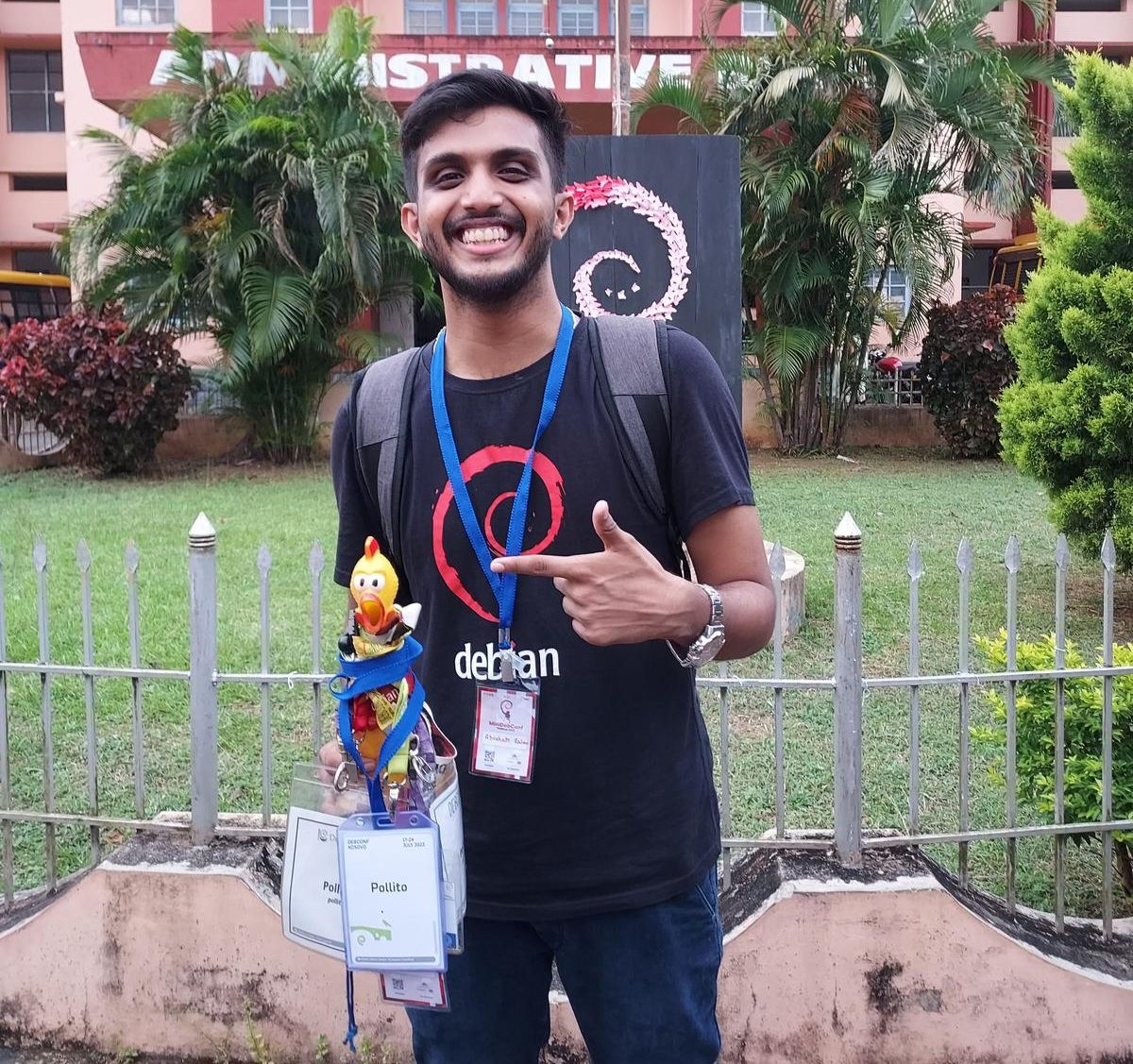
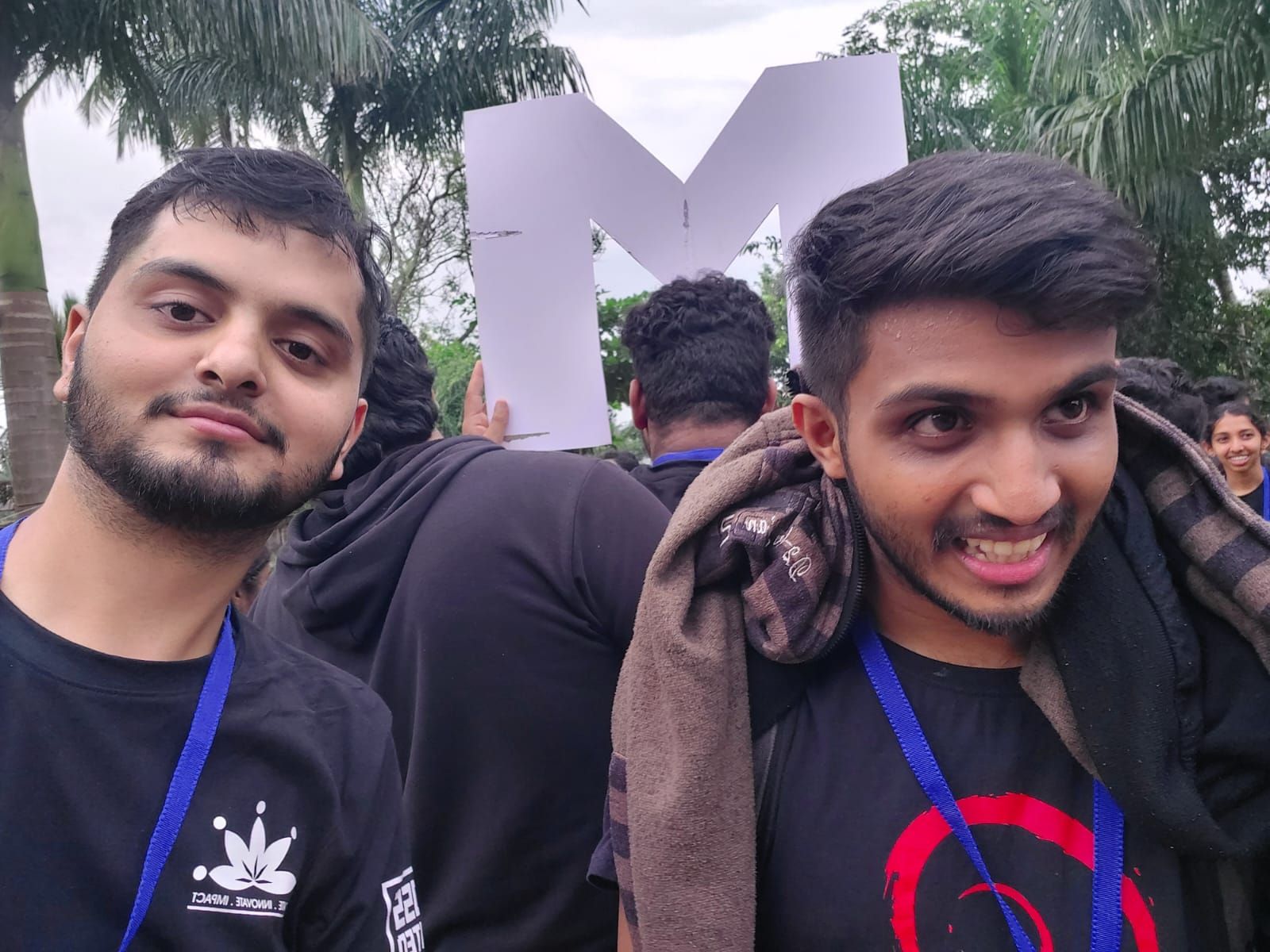
Abraham with Polito Man, you re no longer with us, but I am touched by the number of people you have positively impacted. Almost every DebConf23 presentations by locals I saw after you, carried how you were instrumental in bringing them there. How you were a dear friend and brother. It s a weird turn of events, that you left us during one thing we deeply cared and worked towards making possible since the last 3 years together. Who would have known, that Sahil, I m going back to my apartment tonight and casual bye post that would be the last conversation we ever had. Things were terrible after I heard the news. I had a hard time convincing myself to come see you one last time during your funeral. That was the last time I was going to get to see you, and I kept on looking at you. You, there in front of me, all calm, gave me peace. I ll carry that image all my life now. Your smile will always remain with me. Now, who ll meet and receive me on the door at almost every Debian event (just by sheer co-incidence?). Who ll help me speak out loud about all the Debian shortcomings (and then discuss solutions, when sober :)). Abraham and me during Debian discussion in DebUtsav Kochi It was a testament of the amount of time we had already spent together online, that when we first met during MDC Palakkad, it didn t feel we were physically meeting for the first time. The conversations just flowed. Now this song is associated with you due to your speech during post MiniDebConf Palakkad dinner. Hearing it reminds me of all the times we spent together chilling and talking community (which you cared deeply about). I guess, now we can t stop caring for the community, because your energy was contagious. Now, I can t directly dial your number to listen - Hey Sahil! What s up? from the other end, or Tell me, tell me on any mention of the problem. Nor would I be able to send reference usage of your Debian packaging guide in the wild. You already know how popular this guide of yours. How many people that guide has helped with getting started with packaging. Our last telegram text was me telling you about guide usage in Ravi s DebConf23 presentation. Did I ever tell you, I too got my first start with packaging from there. I started looking up to you from there, even before we met or talked. Now, I missed telling you, I was probably your biggest fan whenever you had the mic in hand and started speaking. You always surprised me all the insights and idea you brought and would kept on impressing me for someone who was just my age but was way more mature. Reading recent toots from Raju Dev made me realize how much I loved your writings. You wrote How the Future will remember Us , Doing what s right and many more. The level of depth in your thought was unparalleled. I loved reading those. That s why I kept pestering you to write more, which you slowly stopped. Now I fully understand why though. You were busy; really busy helping people out or just working for making things better. You were doing Debian, upstream projects, web development, designs, graphics, mentoring, free software evangelism while being the go-to person for almost everyone around. Everyone depended on you, because you were too kind to turn down anyone. Abraham and me just chilling around. We met for the first time there Man, I still get your spelling wrong :) Did I ever tell you that? That was the reason, I used to use AR instead online. You ll be missed and will always be part of our conversations, because you have left a profound impact on me, our friends, Debian India and everyone around. See you! the coolest man around. In memory: PS - Just found you even had a Youtube channel, you one heck of a talented man.

23 September 2023

Sergio Talens-Oliag: GitLab CI/CD Tips: Using Rule Templates

This post describes how to define and use rule templates with semantic names using extends or !reference tags, how to define manual jobs using the same templates and how to use gitlab-ci inputs as macros to give names to regular expressions used by rules.

Basic rule templatesI keep my templates in a rules.yml file stored on a common repository used from different projects as I mentioned on my previous post, but they can be defined anywhere, the important thing is that the files that need them include their definition somehow. The first version of my rules.yml file was as follows:
.rules_common:
  # Common rules; we include them from others instead of forcing a workflow
  rules:
    # Disable branch pipelines while there is an open merge request from it
    - if: >-
        $CI_COMMIT_BRANCH &&
        $CI_OPEN_MERGE_REQUESTS &&
        $CI_PIPELINE_SOURCE != "merge_request_event"
      when: never
.rules_default:
  # Default rules, we need to add the when: on_success to make things work
  rules:
    - !reference [.rules_common, rules]
    - when: on_success
The main idea is that .rules_common defines a rule section to disable jobs as we can do on a workflow definition; in our case common rules only have if rules that apply to all jobs and are used to disable them. The example includes one that avoids creating duplicated jobs when we push to a branch that is the source of an open MR as explained here. To use the rules in a job we have two options, use the extends keyword (we do that when we want to use the rule as is) or declare a rules section and add a !reference to the template we want to use as described here (we do that when we want to add additional rules to disable a job before evaluating the template conditions). As an example, with the following definitions both jobs use the same rules:
job_1:
  extends:
    - .rules_default
  [...]
job_2:
  rules:
    - !reference [.rules_default, rules]
  [...]

Manual jobs and rule templatesTo make the jobs manual we have two options, create a version of the job that includes when: manual and defines if we want it to be optional or not (allow_failure: true makes the job optional, if we don t add that to the rule the job is blocking) or add the when: manual and the allow_failure value to the job (if we work at the job level the default value for allow_failure is false for when: manual, so it is optional by default, we have to add an explicit allow_failure = true it to make it blocking). The following example shows how we define blocking or optional manual jobs using rules with when conditions:
.rules_default_manual_blocking:
  # Default rules for optional manual jobs
  rules:
    - !reference [.rules_common, rules]
    - when: manual
      # allow_failure: false is implicit
.rules_default_manual_optional:
  # Default rules for optional manual jobs
  rules:
    - !reference [.rules_common, rules]
    - when: manual
      allow_failure: true
manual_blocking_job:
  extends:
    - .rules_default_manual_blocking
  [...]
manual_optional_job:
  extends:
    - .rules_default_manual_optional
  [...]
The problem here is that we have to create new versions of the same rule template to add the conditions, but we can avoid it using the keywords at the job level with the original rules to get the same effect; the following definitions create jobs equivalent to the ones defined earlier without creating additional templates:
manual_blocking_job:
  extends:
    - .rules_default
  when: manual
  allow_failure: false
  [...]
manual_optional_job:
  extends:
    - .rules_default
  when: manual
  # allow_failure: true is implicit
  [...]
As you can imagine, that is my preferred way of doing it, as it keeps the rules.yml file smaller and I see that the job is manual in its definition without problem.

Rules with allow_failure, changes, exists, needs or variablesUnluckily for us, for now there is no way to avoid creating additional templates as we did on the when: manual case when a rule is similar to an existing one but adds changes, exists, needs or variables to it. So, for now, if a rule needs to add any of those fields we have to copy the original rule and add the keyword section. Some notes, though:
  • we only need to add allow_failure if we want to change its value for a given condition, in other cases we can set the value at the job level.
  • if we are adding changes to the rule it is important to make sure that they are going to be evaluated as explained here.
  • when we add a needs value to a rule for a specific condition and it matches it replaces the job needs section; when using templates I would use two different job names with different conditions instead of adding a needs on a single job.

Defining rule templates with semantic namesI started to use rule templates to avoid repetition when defining jobs that needed the same rules and soon I noticed that giving them names with a semantic meaning they where easier to use and understand (we provide a name that tells us when we are going to execute the job, while the details of the variables names or values used on the rules are an implementation detail of the templates). We are not going to define real jobs on this post, but as an example we are going to define a set of rules that can be useful if we plan to follow a scaled trunk based development workflow when developing, that is, we are going to put the releasable code on the main branch and use short-lived branches to test and complete changes before pushing things to main. Using this approach we can define an initial set of rule templates with semantic names:
.rules_mr_to_main:
  rules:
    - !reference [.rules_common, rules]
    - if: $CI_MERGE_REQUEST_TARGET_BRANCH_NAME == 'main'
.rules_mr_or_push_to_main:
  rules:
    - !reference [.rules_common, rules]
    - if: $CI_MERGE_REQUEST_TARGET_BRANCH_NAME == 'main'
    - if: >-
        $CI_COMMIT_BRANCH == 'main'
        &&
        $CI_PIPELINE_SOURCE != 'merge_request_event'
.rules_push_to_main:
  rules:
    - !reference [.rules_common, rules]
    - if: >-
        $CI_COMMIT_BRANCH == 'main'
        &&
        $CI_PIPELINE_SOURCE != 'merge_request_event'
.rules_push_to_branch:
  rules:
    - !reference [.rules_common, rules]
    - if: >-
        $CI_COMMIT_BRANCH != 'main'
        &&
        $CI_PIPELINE_SOURCE != 'merge_request_event'
.rules_push_to_branch_or_mr_to_main:
  rules:
    - !reference [.rules_push_to_branch, rules]
    - if: >-
         $CI_MERGE_REQUEST_SOURCE_BRANCH_NAME != 'main'
         &&
         $CI_MERGE_REQUEST_TARGET_BRANCH_NAME == 'main'
.rules_release_tag:
  rules:
    - !reference [.rules_common, rules]
    - if: $CI_COMMIT_TAG =~ /^([0-9a-zA-Z_.-]+-)?v\d+.\d+.\d+$/
.rules_non_release_tag:
  rules:
    - !reference [.rules_common, rules]
    - if: $CI_COMMIT_TAG !~ /^([0-9a-zA-Z_.-]+-)?v\d+.\d+.\d+$/
With those names it is clear when a job is going to be executed and when using the templates on real jobs we can add additional restrictions and make the execution manual if needed as described earlier.

Using inputs as macrosOn the previous rules we have used a regular expression to identify the release tag format and assumed that the general branches are the ones with a name different than main; if we want to force a format for those branch names we can replace the condition != 'main' by a regex comparison (=~ if we look for matches, !~ if we want to define valid branch names removing the invalid ones). When testing the new gitlab-ci inputs my colleague Jorge noticed that if you keep their default value they basically work as macros. The variables declared as inputs can t hold YAML values, the truth is that their value is always a string that is replaced by the value assigned to them when including the file (if given) or by their default value, if defined. If you don t assign a value to an input variable when including the file that declares it its occurrences are replaced by its default value, making them work basically as macros; this is useful for us when working with strings that can t managed as variables, like the regular expressions used inside if conditions. With those two ideas we can add the following prefix to the rules.yaml defining inputs for both regular expressions and replace the rules that can use them by the ones shown here:
spec:
  inputs:
    # Regular expression for branches; the prefix matches the type of changes
    # we plan to work on inside the branch (we use conventional commit types as
    # the branch prefix)
    branch_regex:
      default: '/^(build ci chore docs feat fix perf refactor style test)\/.+$/'
    # Regular expression for tags
    release_tag_regex:
      default: '/^([0-9a-zA-Z_.-]+-)?v\d+.\d+.\d+$/'
---
[...]
.rules_push_to_changes_branch:
  rules:
    - !reference [.rules_common, rules]
    - if: >-
        $CI_COMMIT_BRANCH =~ $[[ inputs.branch_regex ]]
        &&
        $CI_PIPELINE_SOURCE != 'merge_request_event'
.rules_push_to_branch_or_mr_to_main:
  rules:
    - !reference [.rules_push_to_branch, rules]
    - if: >-
         $CI_MERGE_REQUEST_SOURCE_BRANCH_NAME =~ $[[ inputs.branch_regex ]]
         &&
         $CI_MERGE_REQUEST_TARGET_BRANCH_NAME == 'main'
.rules_release_tag:
  rules:
    - !reference [.rules_common, rules]
    - if: $CI_COMMIT_TAG =~ $[[ inputs.release_tag_regex ]]
.rules_non_release_tag:
  rules:
    - !reference [.rules_common, rules]
    - if: $CI_COMMIT_TAG !~ $[[ inputs.release_tag_regex ]]

Creating rules reusing existing onesI m going to finish this post with a comment about how I avoid defining extra rule templates in some common cases. The idea is simple, we can use !reference tags to fine tune rules when we need to add conditions to disable them simply adding conditions with when: never before referencing the template. As an example, in some projects I m using different job definitions depending on the DEPLOY_ENVIRONMENT value to make the job manual or automatic; as we just said we can define different jobs referencing the same rule adding a condition to check if the environment is the one we are interested in:
deploy_job_auto:
  rules:
    # Only deploy automatically if the environment is 'dev' by skipping this job
    # for other values of the DEPLOY_ENVIRONMENT variable
    - if: $DEPLOY_ENVIRONMENT != "dev"
      when: never
    - !reference [.rules_release_tag, rules]
  [...]
deploy_job_manually:
  rules:
    # Disable this job if the environment is 'dev'
    - if: $DEPLOY_ENVIRONMENT == "dev"
      when: never
    - !reference [.rules_release_tag, rules]
  when: manual
  # Change this to  false  to make the deployment job blocking
  allow_failure: true
  [...]
If you think about it the idea of adding negative conditions is what we do with the .rules_common template; we add conditions to disable the job before evaluating the real rules. The difference in that case is that we reference them at the beginning because we want those negative conditions on all jobs and that is also why we have a .rules_default condition with an when: on_success for the jobs that only need to respect the default workflow (we need the last condition to make sure that they are executed if the negative rules don t match).

22 September 2023

Ravi Dwivedi: Debconf23

Official logo of DebConf23

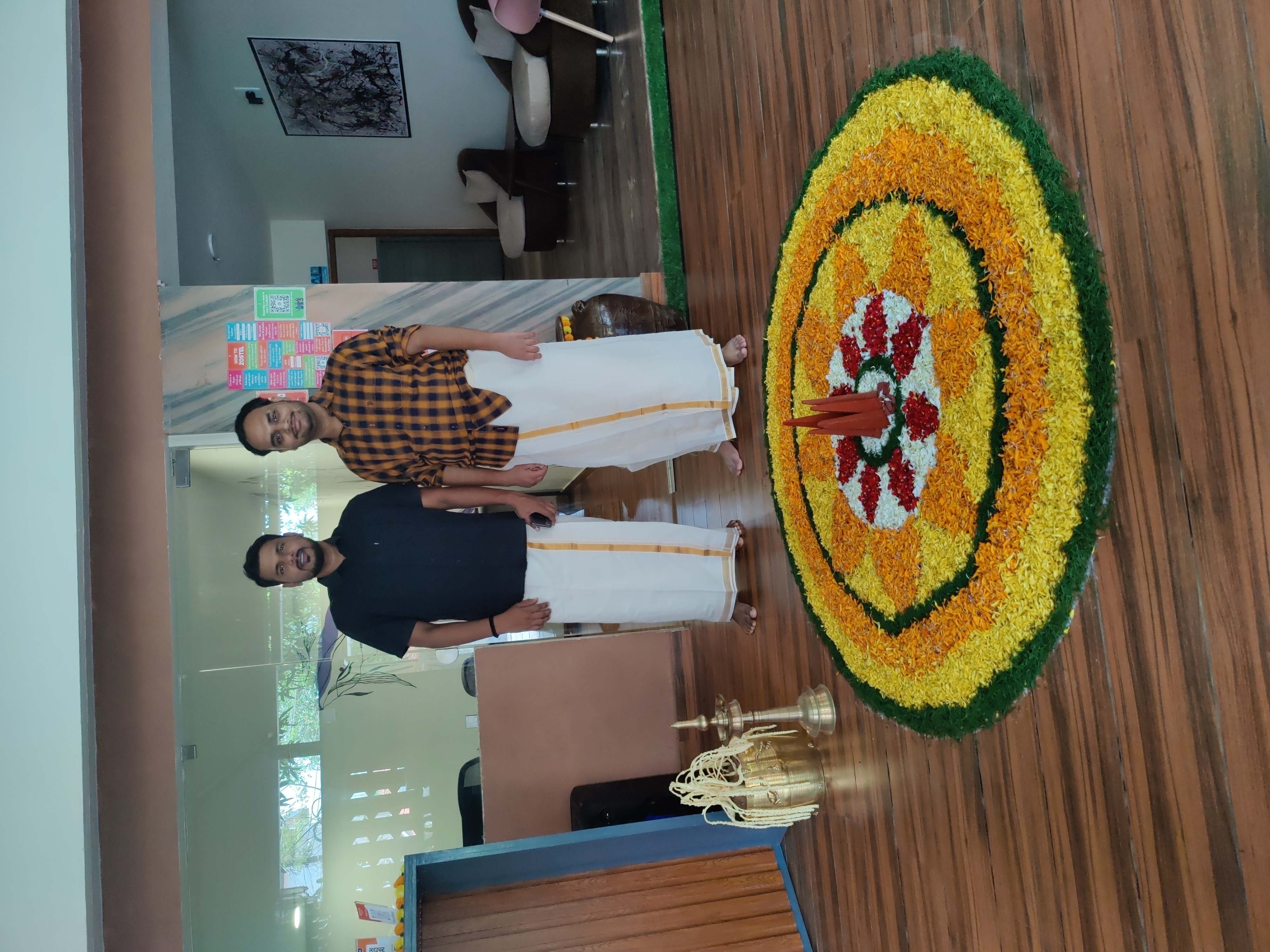
Introduction DebConf23, the 24th annual Debian Conference, was held in India in the city of Kochi, Kerala from the 3rd to the 17th of September, 2023. Ever since I got to know about it (which was more than an year ago), I was excited to attend DebConf in my home country. This was my second DebConf, as I attended one last year in Kosovo. I was very happy that I didn t need to apply for a visa to attend. I got full bursary to attend the event (thanks a lot to Debian for that!) which is always helpful in covering the expenses, especially if the venue is a five star hotel :) For the conference, I submitted two talks. One was suggested by Sahil on Debian packaging for beginners, while the other was suggested by Praveen who opined that a talk covering broader topics about freedom in self-hosting services will be better, when I started discussing about submitting a talk about prav app project. So I submitted one on Debian packaging for beginners and the other on ideas on sustainable solutions for self-hosting. My friend Suresh - who is enthusiastic about Debian and free software - wanted to attend the DebConf as well. When the registration started, I reminded him about applying. We landed in Kochi on the 28th of August 2023 during the festival of Onam. We celebrated Onam in Kochi, had a trip to Wayanad, and returned to Kochi. On the evening of the 3rd of September, we reached the venue - Four Points Hotel by Sheraton, at Infopark Kochi, Ernakulam, Kerala, India.
Suresh and me celebrating Onam in Kochi.

Hotel overview The hotel had 14 floors, and featured a swimming pool and gym (these were included in our package). The hotel gave us elevator access for only our floor, along with public spaces like the reception, gym, swimming pool, and dining areas. The temperature inside the hotel was pretty cold and I had to buy a jacket to survive. Perhaps the hotel was in cahoots with winterwear companies? :)
Four Points Hotel by Sheraton was the venue of DebConf23. Photo credits: Bilal
Photo of the pool. Photo credits: Andreas Tille.
View from the hotel window.

Meals On the first day, Suresh and I had dinner at the eatery on the third floor. At the entrance, a member of the hotel staff asked us about how many people we wanted a table for. I told her that it s just the two of us at the moment, but (as we are attending a conference) we might be joined by others. Regardless, they gave us a table for just two. Within a few minutes, we were joined by Alper from Turkey and urbec from Germany. So we shifted to a larger table but then we were joined by even more people, so we were busy adding more chairs to our table. urbec had already been in Kerala for the past 5-6 days and was, on one hand, very happy already with the quality and taste of bananas in Kerala and on the other, rather afraid of the spicy food :) Two days later, the lunch and dinner were shifted to the All Spice Restaurant on the 14th floor, but the breakfast was still served at the eatery. Since the eatery (on the 3rd floor) had greater variety of food than the other venue, this move made breakfast the best meal for me and many others. Many attendees from outside India were not accustomed to the spicy food. It is difficult for locals to help them, because what we consider mild can be spicy for others. It is not easy to satisfy everyone at the dining table, but I think the organizing team did a very good job in the food department. (That said, it didn t matter for me after a point, and you will know why.) The pappadam were really good, and I liked the rice labelled Kerala rice . I actually brought that exact rice and pappadam home during my last trip to Kochi and everyone at my home liked it too (thanks to Abhijit PA). I also wished to eat all types of payasams from Kerala and this really happened (thanks to Sruthi who designed the menu). Every meal had a different variety of payasam and it was awesome, although I didn t like some of them, mostly because they were very sweet. Meals were later shifted to the ground floor (taking away the best breakfast option which was the eatery).
This place served as lunch and dinner place and later as hacklab during debconf. Photo credits: Bilal

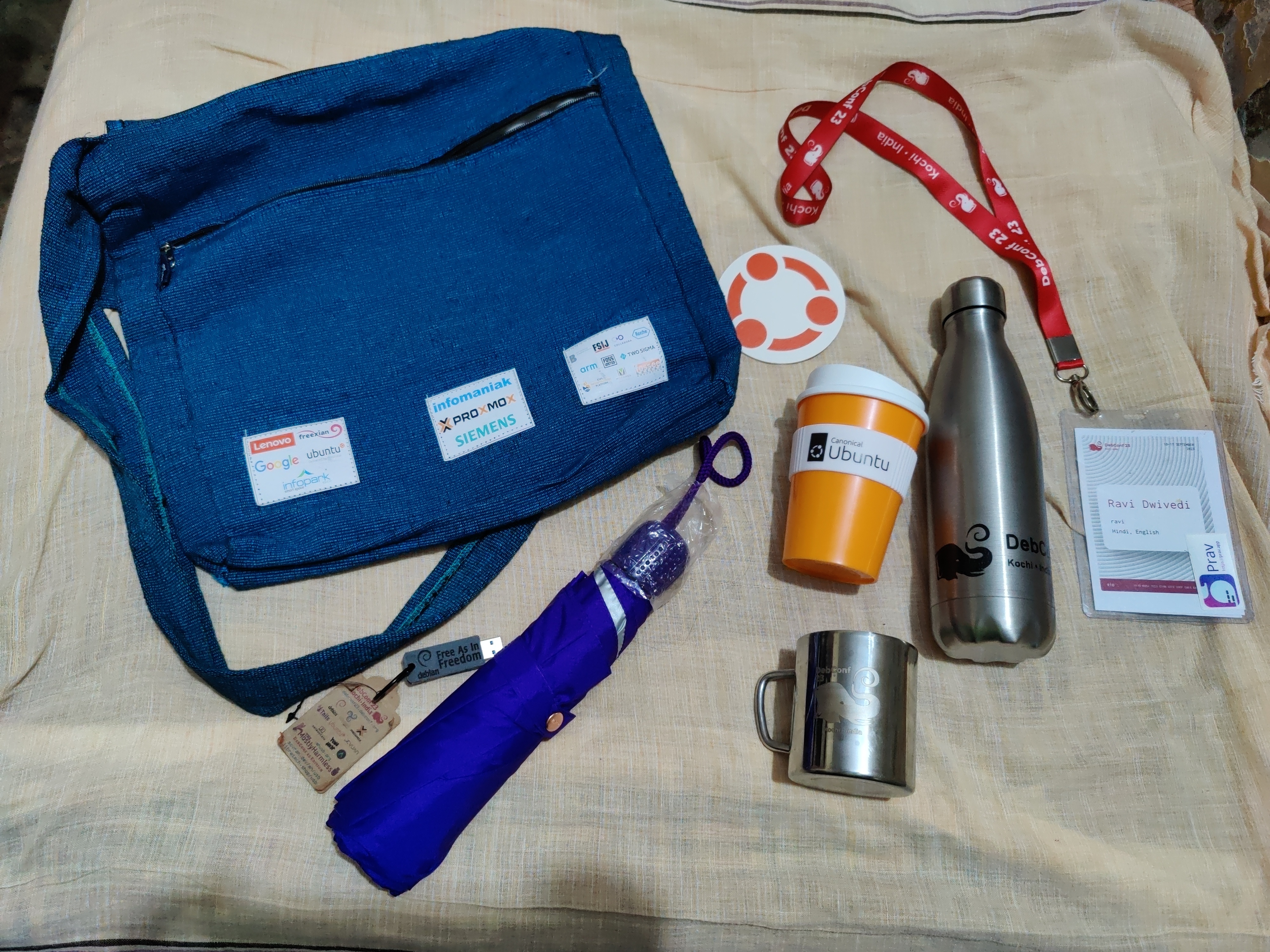
The excellent Swag Bag The DebConf registration desk was at the second floor. We were given a very nice swag bag. They were available in multiple colors - grey, green, blue, red - and included an umbrella, a steel mug, a multiboot USB drive by Mostly Harmless, a thermal flask, a mug by Canonical, a paper coaster, and stickers. It rained almost every day in Kochi during our stay, so handing out an umbrella to every attendee was a good idea.
Picture of the awesome swag bag given at DebConf23. Photo credits: Ravi Dwivedi

A gift for Nattie During breakfast one day, Nattie (Belgium) expressed the desire to buy a coffee filter. The next time I went to the market, I bought a coffee filter for her as a gift. She seemed happy with the gift and was flattered to receive a gift from a young man :)

Being a mentor There were many newbies who were eager to learn and contribute to Debian. So, I mentored whoever came to me and was interested in learning. I conducted a packaging workshop in the bootcamp, but could only cover how to set up the Debian Unstable environment, and had to leave out how to package (but I covered that in my talk). Carlos (Brazil) gave a keysigning session in the bootcamp. Praveen was also mentoring in the bootcamp. I helped people understand why we sign GPG keys and how to sign them. I planned to take a workshop on it but cancelled it later.

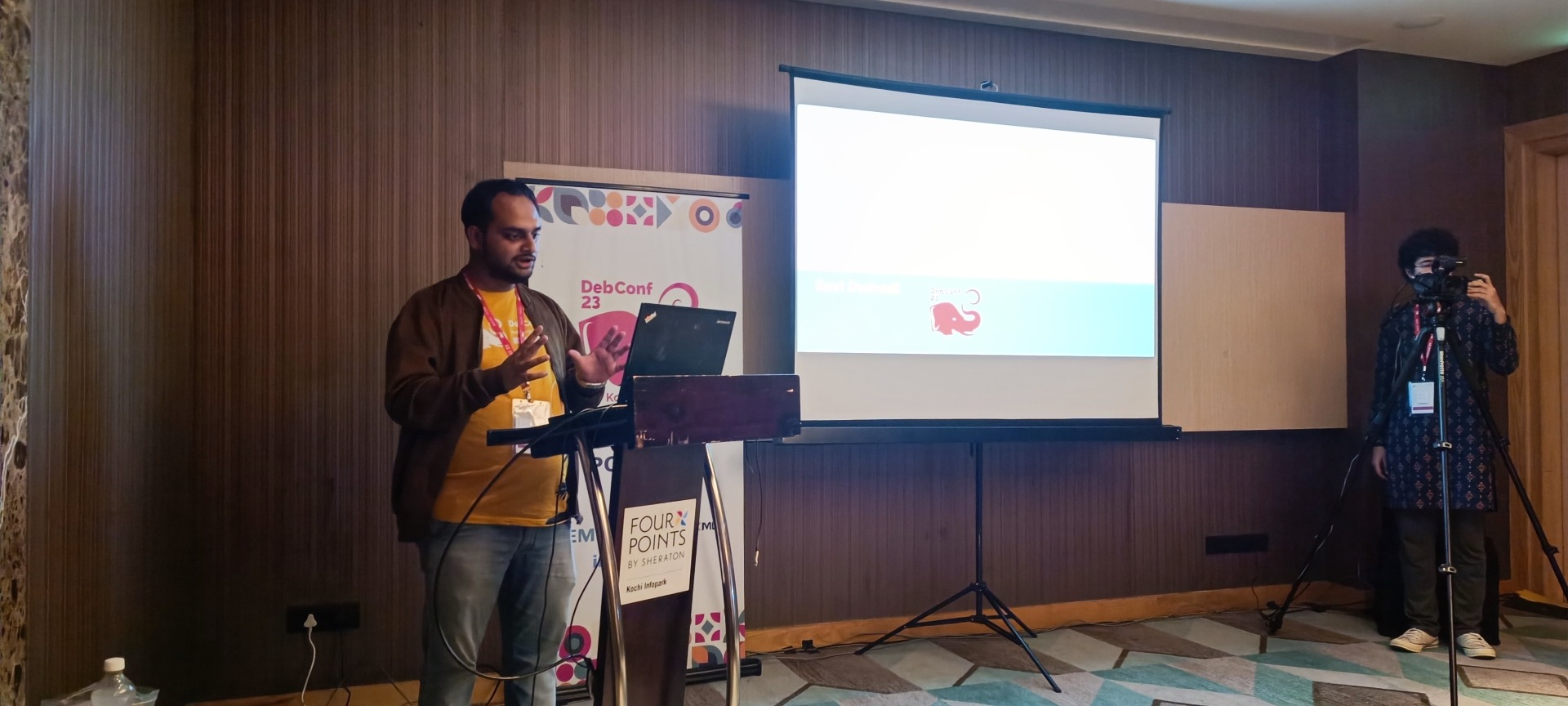
My talk My Debian packaging talk was on the 10th of September, 2023. I had not prepared slides for my Debian packaging talk in advance - I thought that I could do it during the trip, but I didn t get the time so I prepared them on the day before the talk. Since it was mostly a tutorial, the slides did not need much preparation. My thanks to Suresh, who helped me with the slides and made it possible to complete them in such a short time frame. My talk was well-received by the audience, going by their comments. I am glad that I could give an interesting presentation.
My presentation photo. Photo credits: Valessio

Visiting a saree shop After my talk, Suresh, Alper, and I went with Anisa and Kristi - who are both from Albania, and have a never-ending fascination for Indian culture :) - to buy them sarees. We took autos to Kakkanad market and found a shop with a great variety of sarees. I was slightly familiar with the area around the hotel, as I had been there for a week. Indian women usually don t try on sarees while buying - they just select the design. But Anisa wanted to put one on and take a few photos as well. The shop staff did not have a trial saree for this purpose, so they took a saree from a mannequin. It took about an hour for the lady at the shop to help Anisa put on that saree but you could tell that she was in heaven wearing that saree, and she bought it immediately :) Alper also bought a saree to take back to Turkey for his mother. Me and Suresh wanted to buy a kurta which would go well with the mundu we already had, but we could not find anything to our liking.
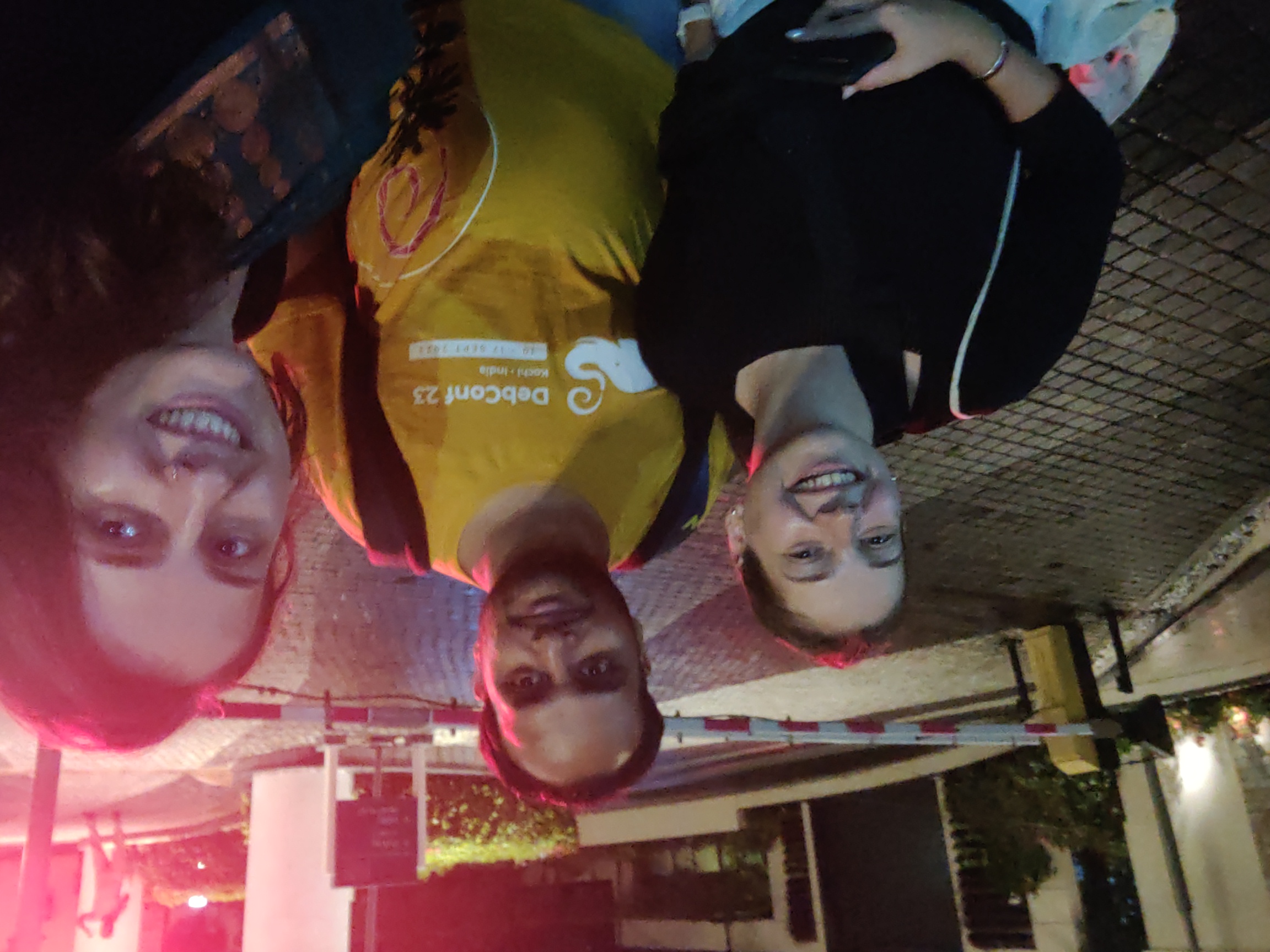
Selfie with Anisa and Kristi. Photo credits: Anisa.

Cheese and Wine Party On the 11th of September we had the Cheese and Wine Party, a tradition of every DebConf. I brought Kaju Samosa and Nankhatai from home. Many attendees expressed their appreciation for the samosas. During the party, I was with Abhas and had a lot of fun. Abhas brought packets of paan and served them at the Cheese and Wine Party. We discussed interesting things and ate burgers. But due to the restrictive alcohol laws in the state, it was less fun compared to the previous DebConfs - you could only drink alcohol served by the hotel in public places. If you bought your own alcohol, you could only drink in private places (such as in your room, or a friend s room), but not in public places.
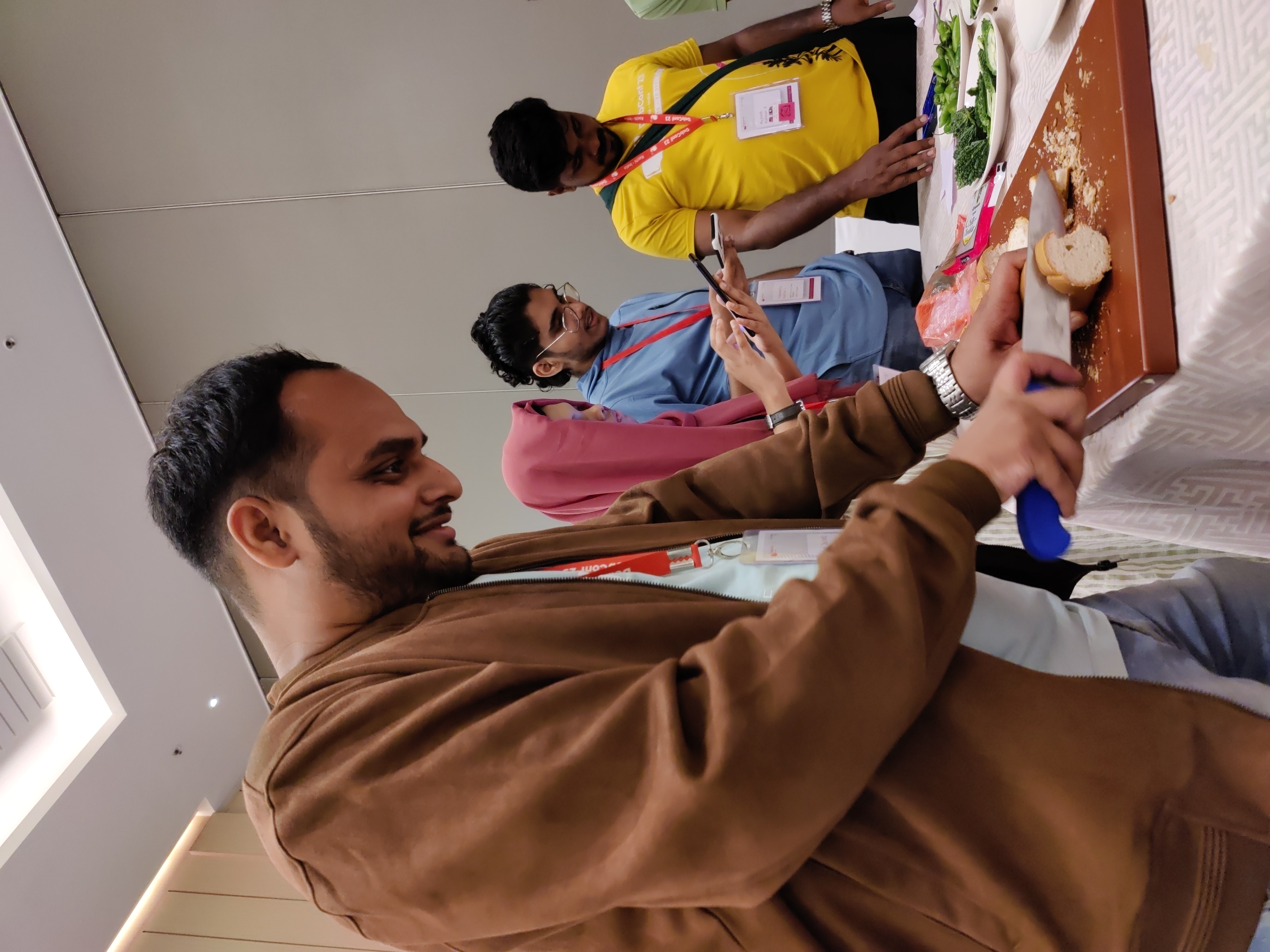
Me helping with the Cheese and Wine Party.

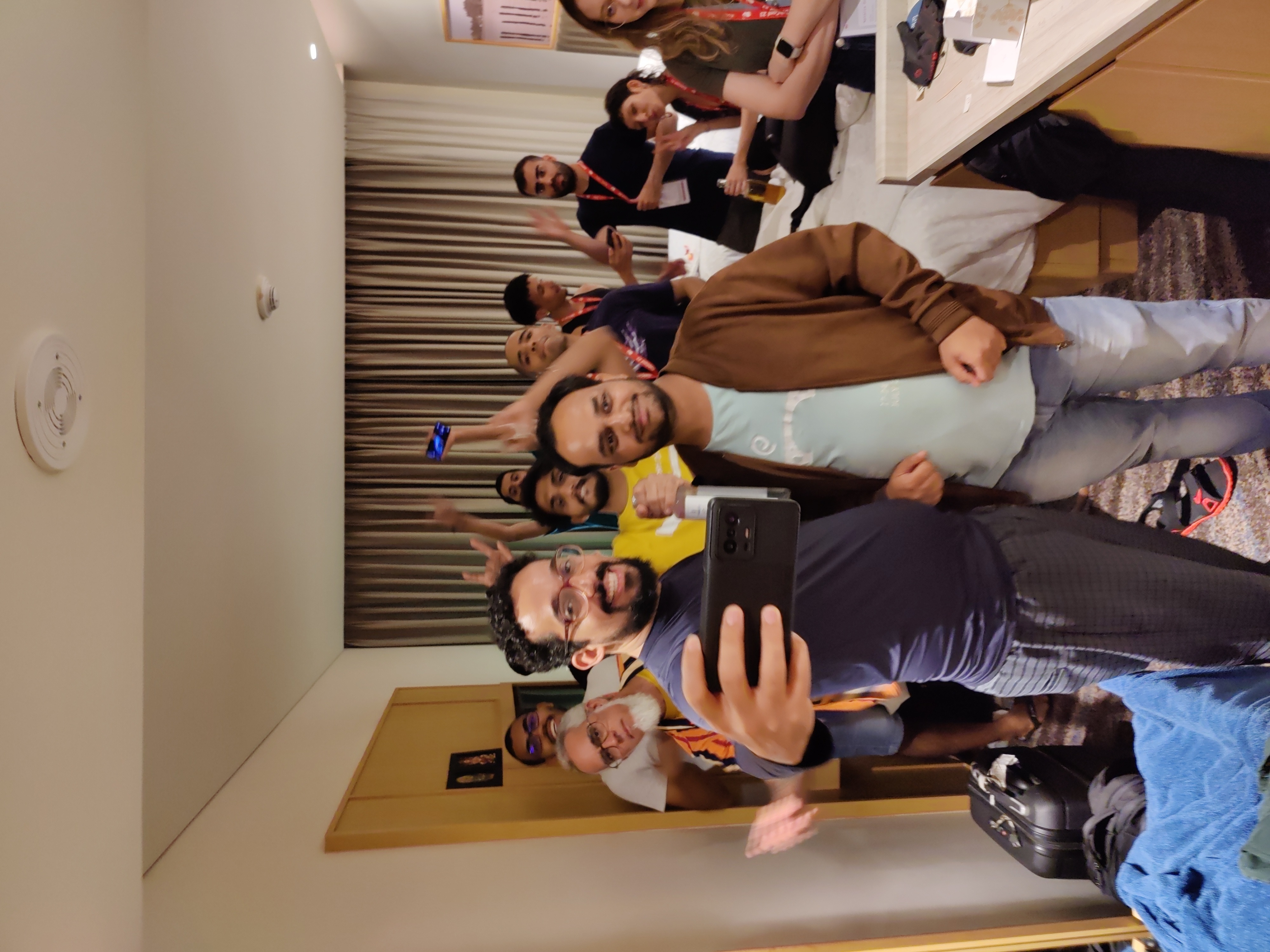
Party at my room Last year, Joenio (Brazilian) brought pastis from France which I liked. He brought the same alocholic drink this year too. So I invited him to my room after the Cheese and Wine party to have pastis. My idea was to have them with my roommate Suresh and Joenio. But then we permitted Joenio to bring as many people as he wanted and he ended up bringing some ten people. Suddenly, the room was crowded. I was having good time at the party, serving them the snacks given to me by Abhas. The news of an alcohol party at my room spread like wildfire. Soon there were so many people that the AC became ineffective and I found myself sweating. I left the room and roamed around in the hotel for some fresh air. I came back after about 1.5 hours - for most part, I was sitting at the ground floor with TK Saurabh. And then I met Abraham near the gym (which was my last meeting with him). I came back to my room at around 2:30 AM. Nobody seemed to have realized that I was gone. They were thanking me for hosting such a good party. A lot of people left at that point and the remaining people were playing songs and dancing (everyone was dancing all along!). I had no energy left to dance and to join them. They left around 03:00 AM. But I am glad that people enjoyed partying in my room.
This picture was taken when there were few people in my room for the party.

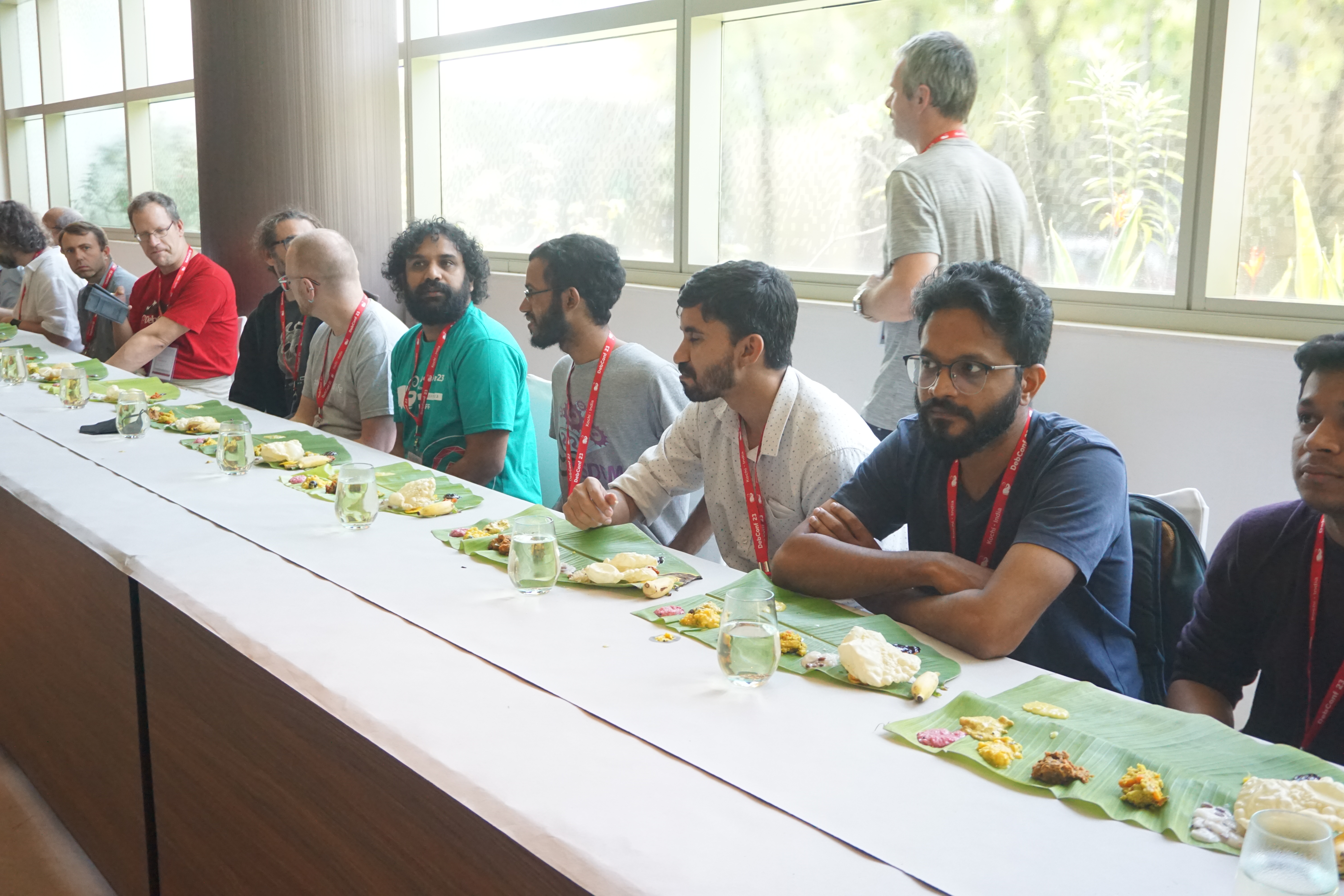
Sadhya Thali On the 12th of September, we had a sadhya thali for lunch. It is a vegetarian thali served on a banana leaf on the eve of Thiruvonam. It wasn t Thiruvonam on this day, but we got a special and filling lunch. The rasam and payasam were especially yummy.
Sadhya Thali: A vegetarian meal served on banana leaf. Payasam and rasam were especially yummy! Photo credits: Ravi Dwivedi.
Sadhya thali being served at debconf23. Photo credits: Bilal

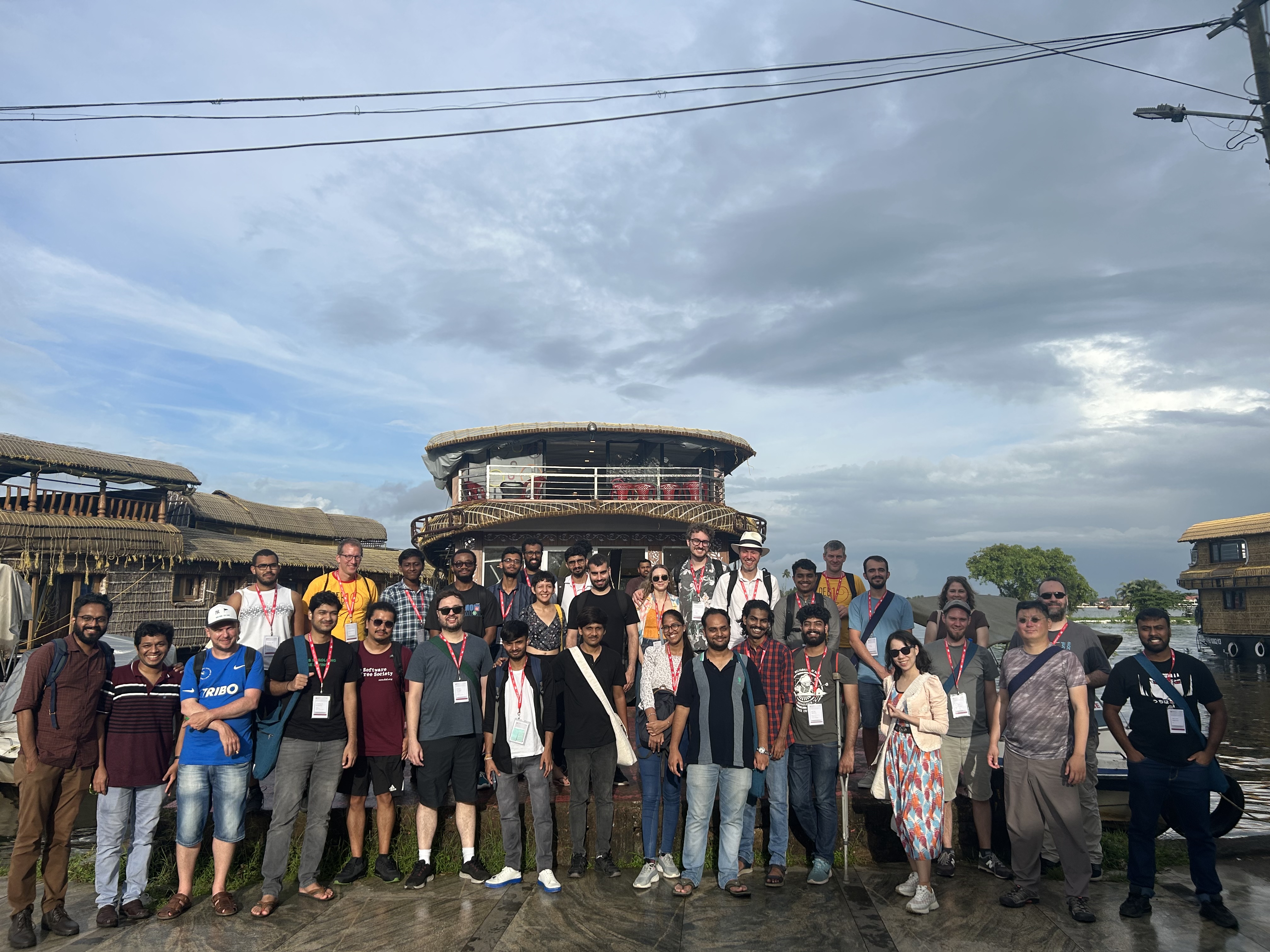
Day trip On the 13th of September, we had a daytrip. I chose the daytrip houseboat in Allepey. Suresh chose the same, and we registered for it as soon as it was open. This was the most sought-after daytrip by the DebConf attendees - around 80 people registered for it. Our bus was set to leave at 9 AM on the 13th of September. Me and Suresh woke up at 8:40 and hurried to get to the bus in time. It took two hours to reach the venue where we get the houseboat. The houseboat experience was good. The trip featured some good scenery. I got to experience the renowned Kerala backwaters. We were served food on the boat. We also stopped at a place and had coconut water. By evening, we came back to the place where we had boarded the boat.
Group photo of our daytrip. Photo credits: Radhika Jhalani

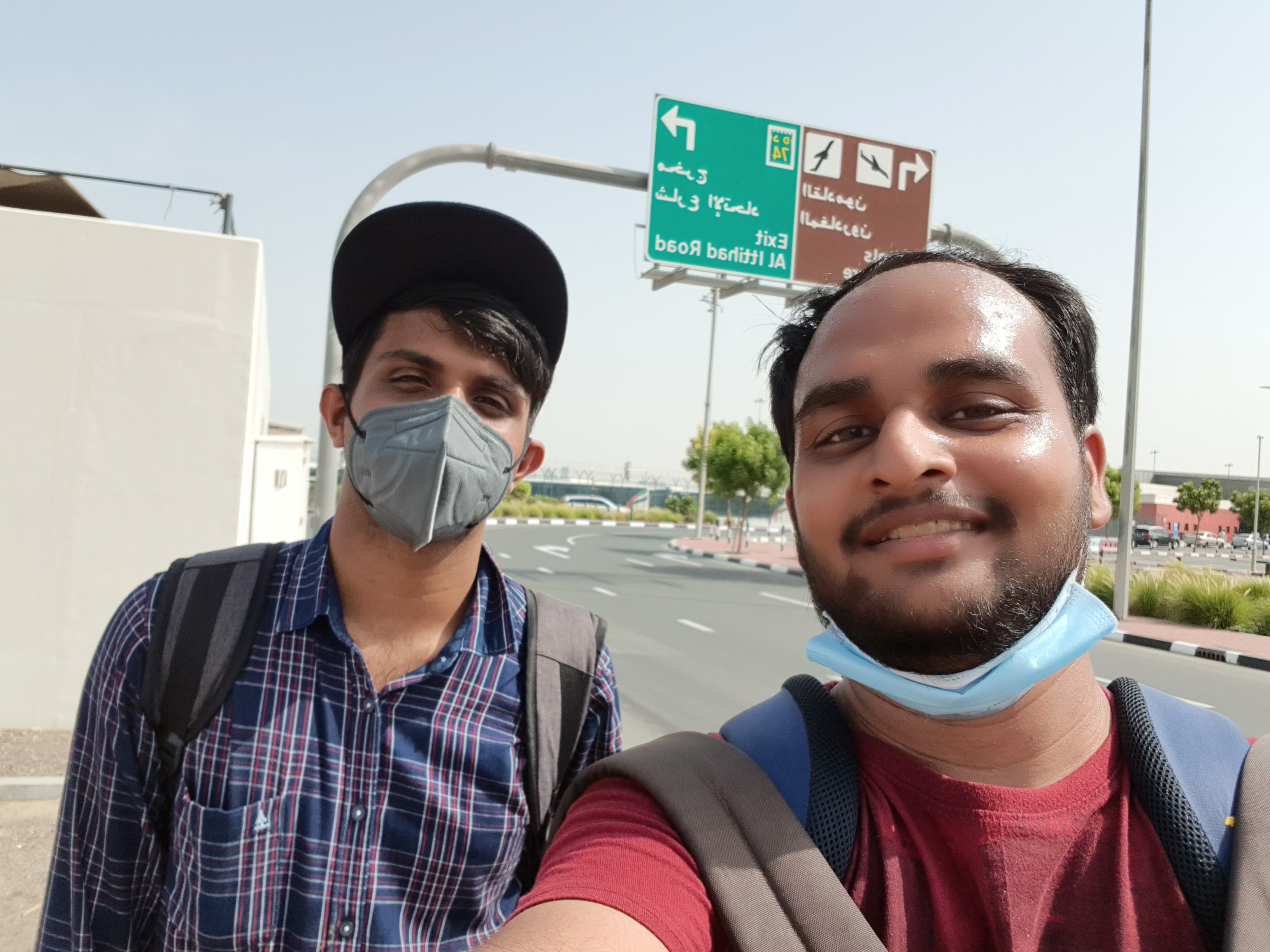
A good friend lost When we came back from the daytrip, we received news that Abhraham Raji was involved in a fatal accident during a kayaking trip. Abraham Raji was a very good friend of mine. In my Albania-Kosovo-Dubai trip last year, he was my roommate at our Tirana apartment. I roamed around in Dubai with him, and we had many discussions during DebConf22 Kosovo. He was the one who took the photo of me on my homepage. I also met him in MiniDebConf22 Palakkad and MiniDebConf23 Tamil Nadu, and went to his flat in Kochi this year in June. We had many projects in common. He was a Free Software activist and was the designer of the DebConf23 logo, in addition to those for other Debian events in India.
A selfie in memory of Abraham.
We were all fairly shocked by the news. I was devastated. Food lost its taste, and it became difficult to sleep. That night, Anisa and Kristi cheered me up and gave me company. Thanks a lot to them. The next day, Joenio also tried to console me. I thank him for doing a great job. I thank everyone who helped me in coping with the difficult situation. On the next day (the 14th of September), the Debian project leader Jonathan Carter addressed and announced the news officially. THe Debian project also mentioned it on their website. Abraham was supposed to give a talk, but following the incident, all talks were cancelled for the day. The conference dinner was also cancelled. As I write, 9 days have passed since his death, but even now I cannot come to terms with it.

Visiting Abraham s house On the 15th of September, the conference ran two buses from the hotel to Abraham s house in Kottayam (2 hours ride). I hopped in the first bus and my mood was not very good. Evangelos (Germany) was sitting opposite me, and he began conversing with me. The distraction helped and I was back to normal for a while. Thanks to Evangelos as he supported me a lot on that trip. He was also very impressed by my use of the StreetComplete app which I was using to edit OpenStreetMap. In two hours, we reached Abraham s house. I couldn t control myself and burst into tears. I went to see the body. I met his family (mother, father and sister), but I had nothing to say and I felt helpless. Owing to the loss of sleep and appetite over the past few days, I had no energy, and didn t think it was good idea for me to stay there. I went back by taking the bus after one hour and had lunch at the hotel. I withdrew my talk scheduled for the 16th of September.

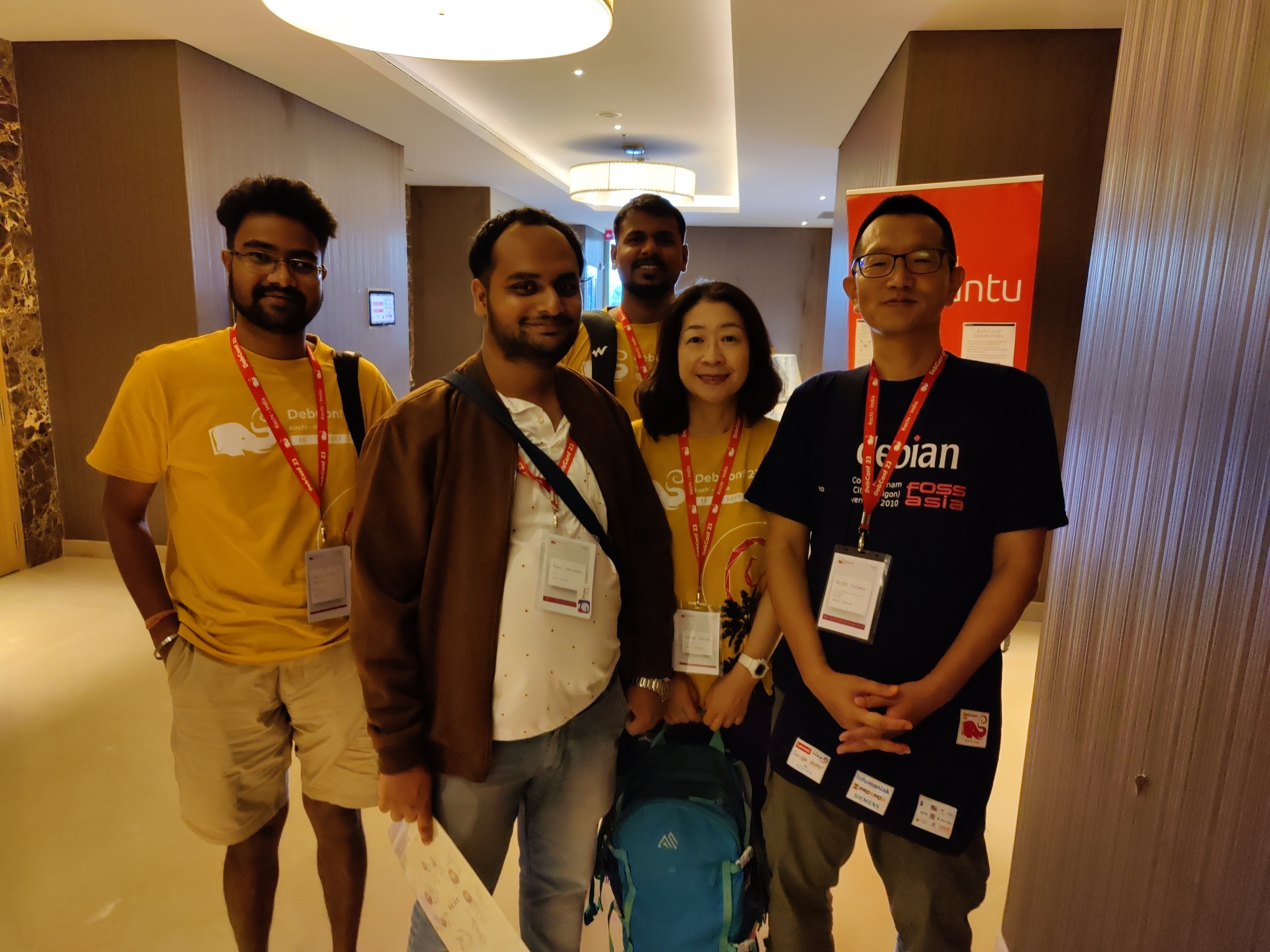
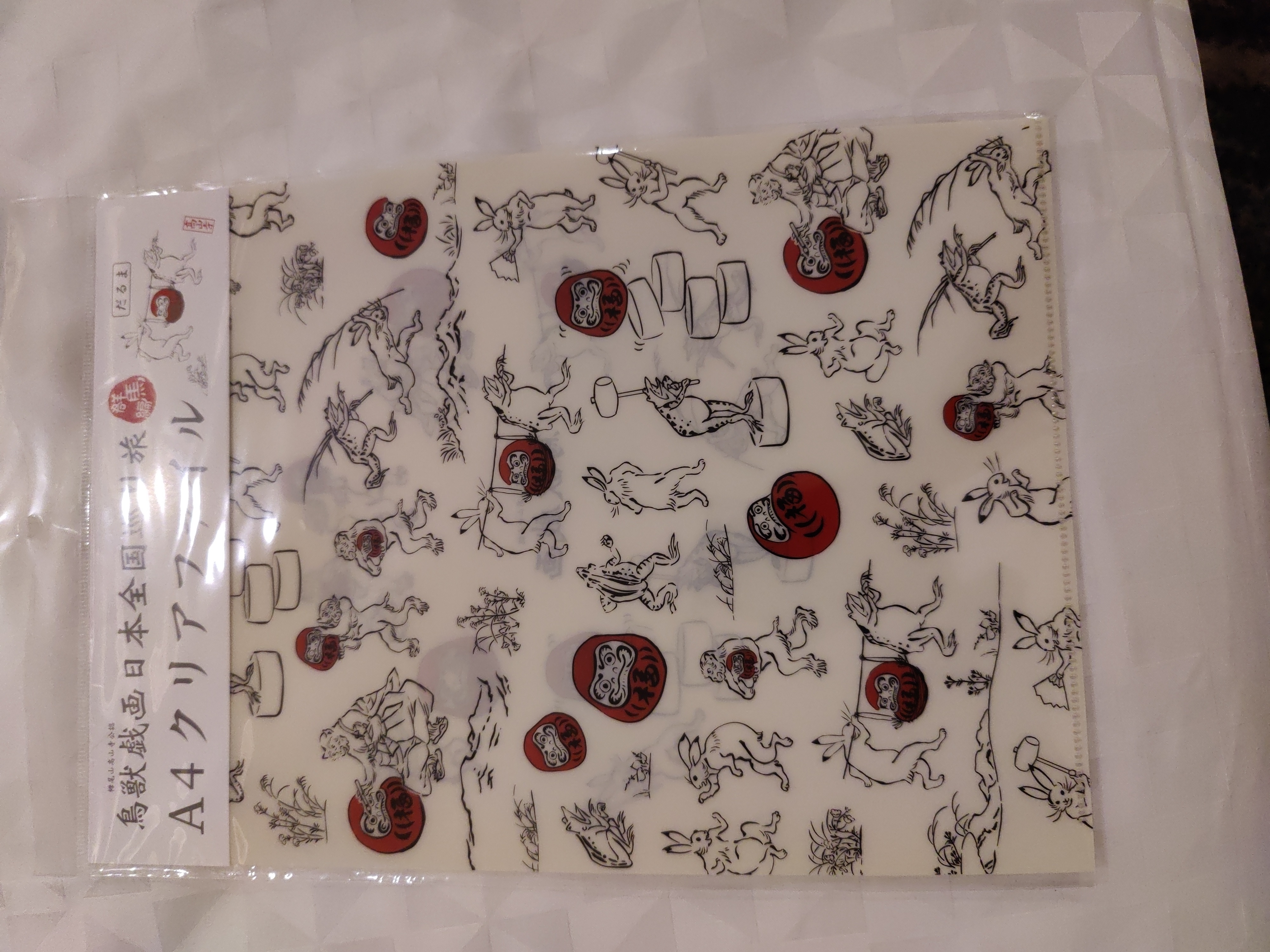
A Japanese gift I got a nice Japanese gift from Niibe Yutaka (Japan) - a folder to keep papers which had ancient Japanese manga characters. He said he felt guilty as he swapped his talk with me and so it got rescheduled from 12th September to 16 September which I withdrew later.
Thanks to Niibe Yutaka (the person towards your right hand) from Japan (FSIJ), who gave me a wonderful Japanese gift during debconf23: A folder to keep pages with ancient Japanese manga characters printed on it. I realized I immediately needed that :)
This is the Japanese gift I received.

Group photo On the 16th of September, we had a group photo. I am glad that this year I was more clear in this picture than in DebConf22.
Click to enlarge

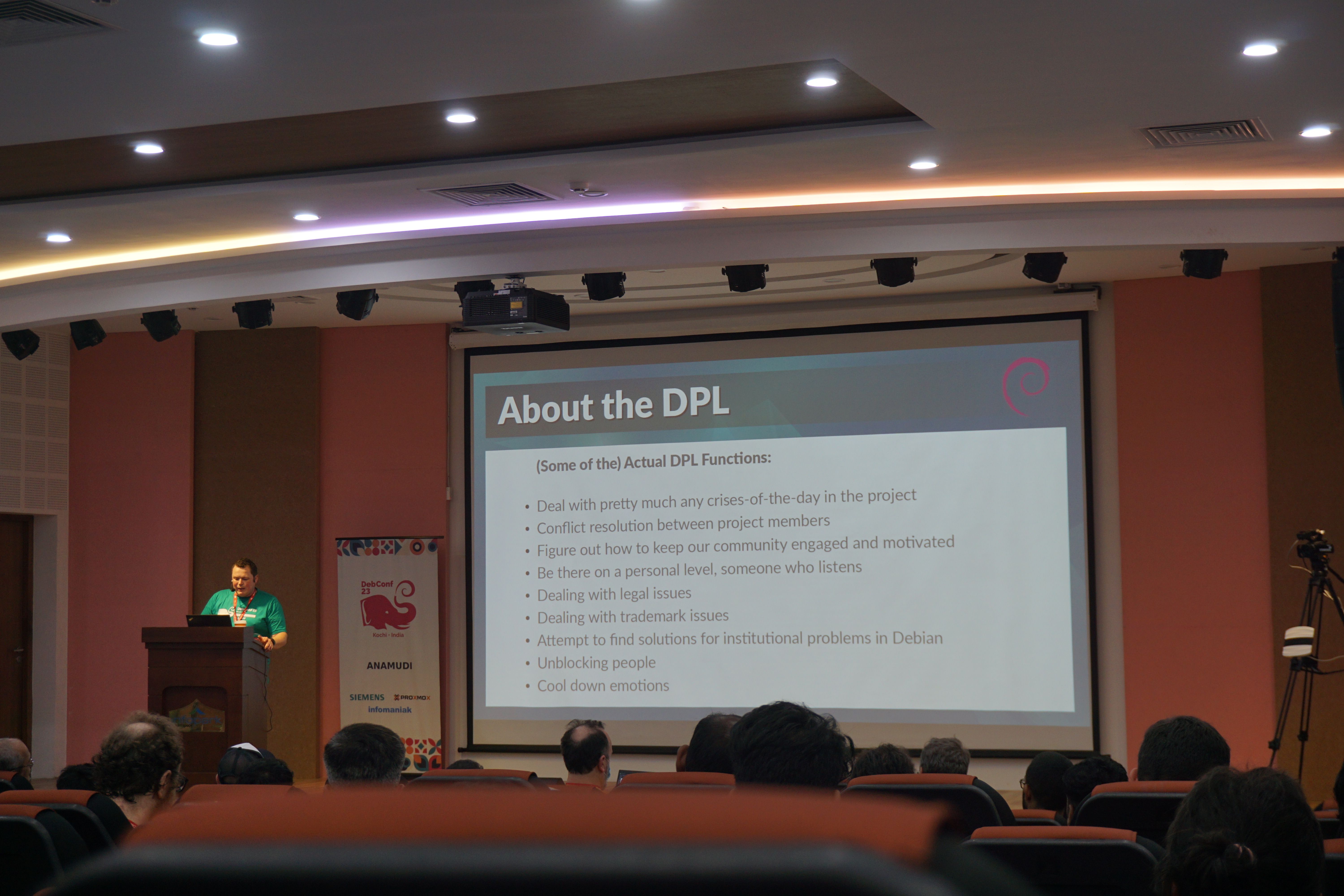
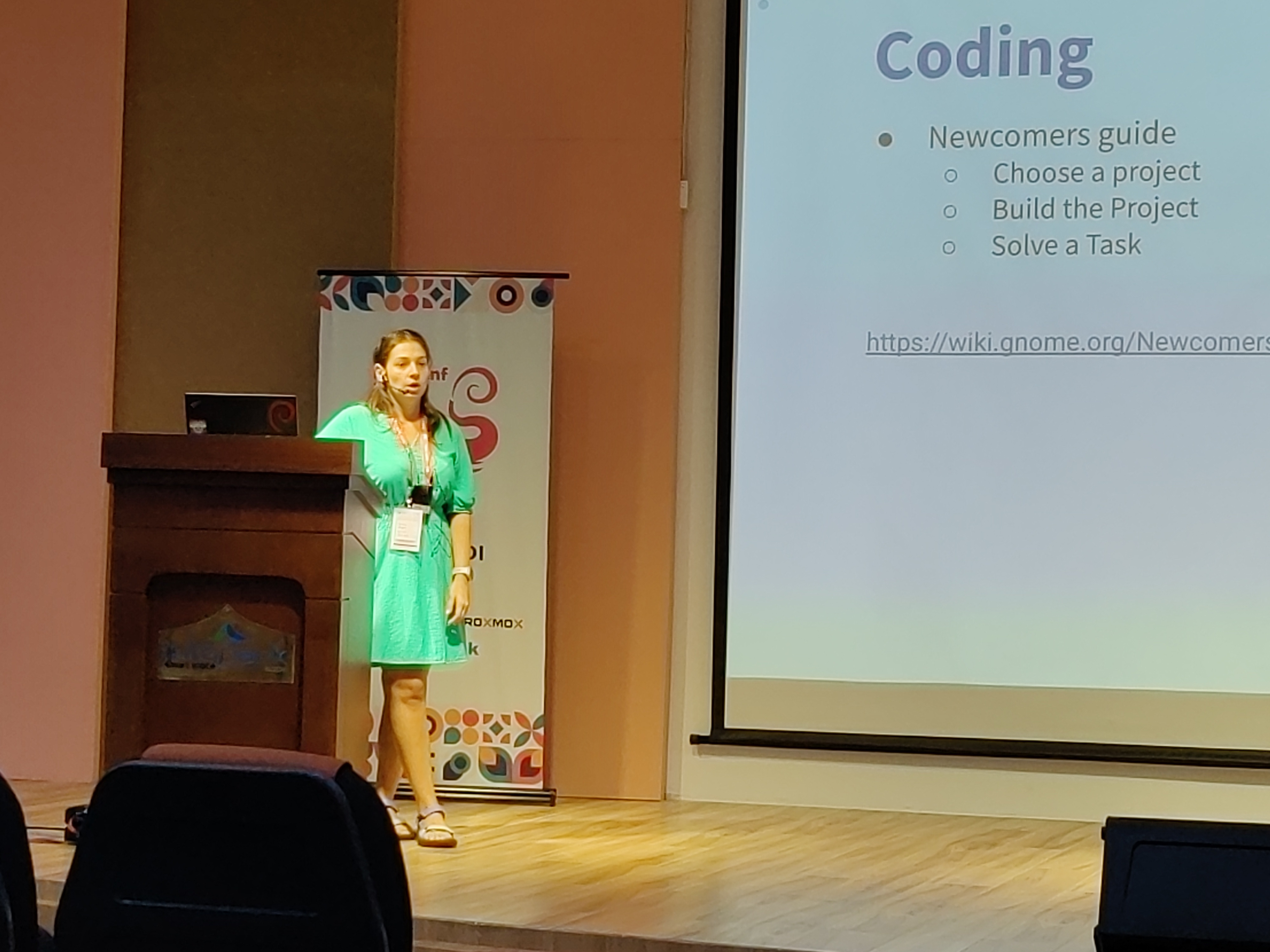
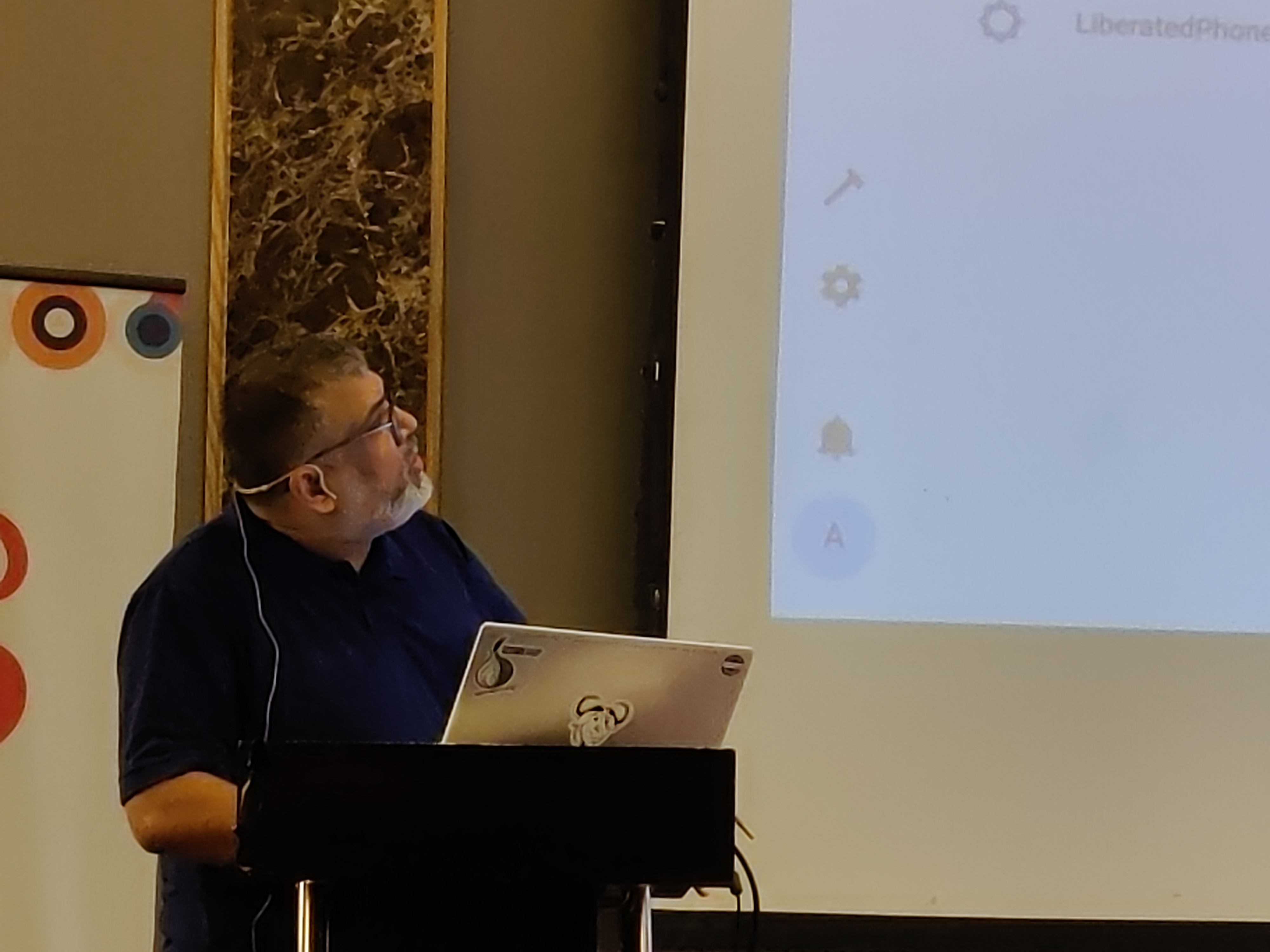
Volunteer work and talks attended I attended the training session for the video team and worked as a camera operator. The Bits from DPL was nice. I enjoyed Abhas presentation on home automation. He basically demonstrated how he liberated Internet-enabled home devices. I also liked Kristi s presentation on ways to engage with the GNOME community.
Bits from the DPL. Photo credits: Bilal
Kristi on GNOME community. Photo credits: Ravi Dwivedi.
Abhas' talk on home automation. Photo credits: Ravi Dwivedi.
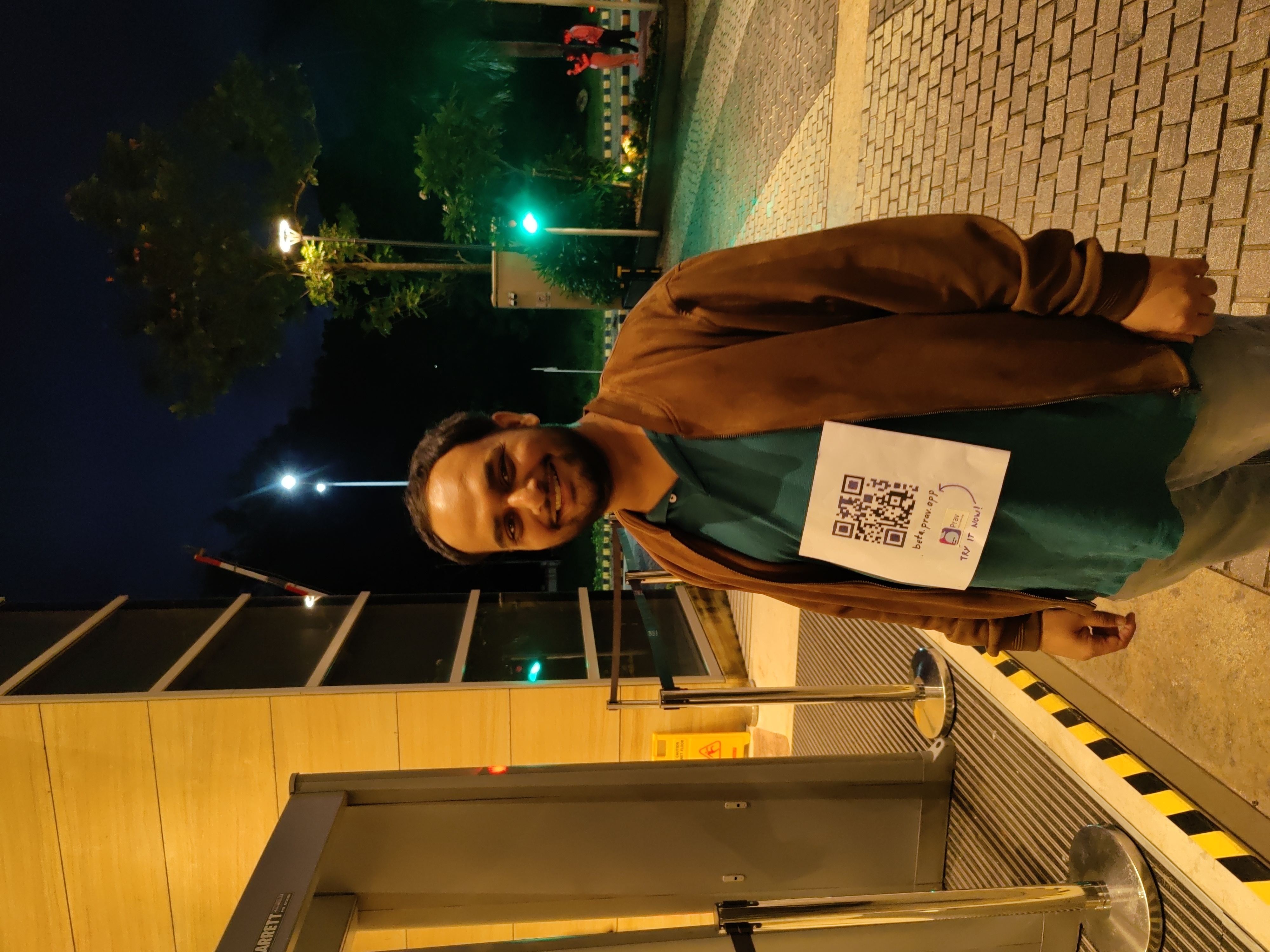
I also attended lightning talks on the last day. Badri, Wouter, and I gave a demo on how to register on the Prav app. Prav got a fair share of advertising during the last few days.
I was roaming around with a QR code on my T-shirt for downloading Prav.

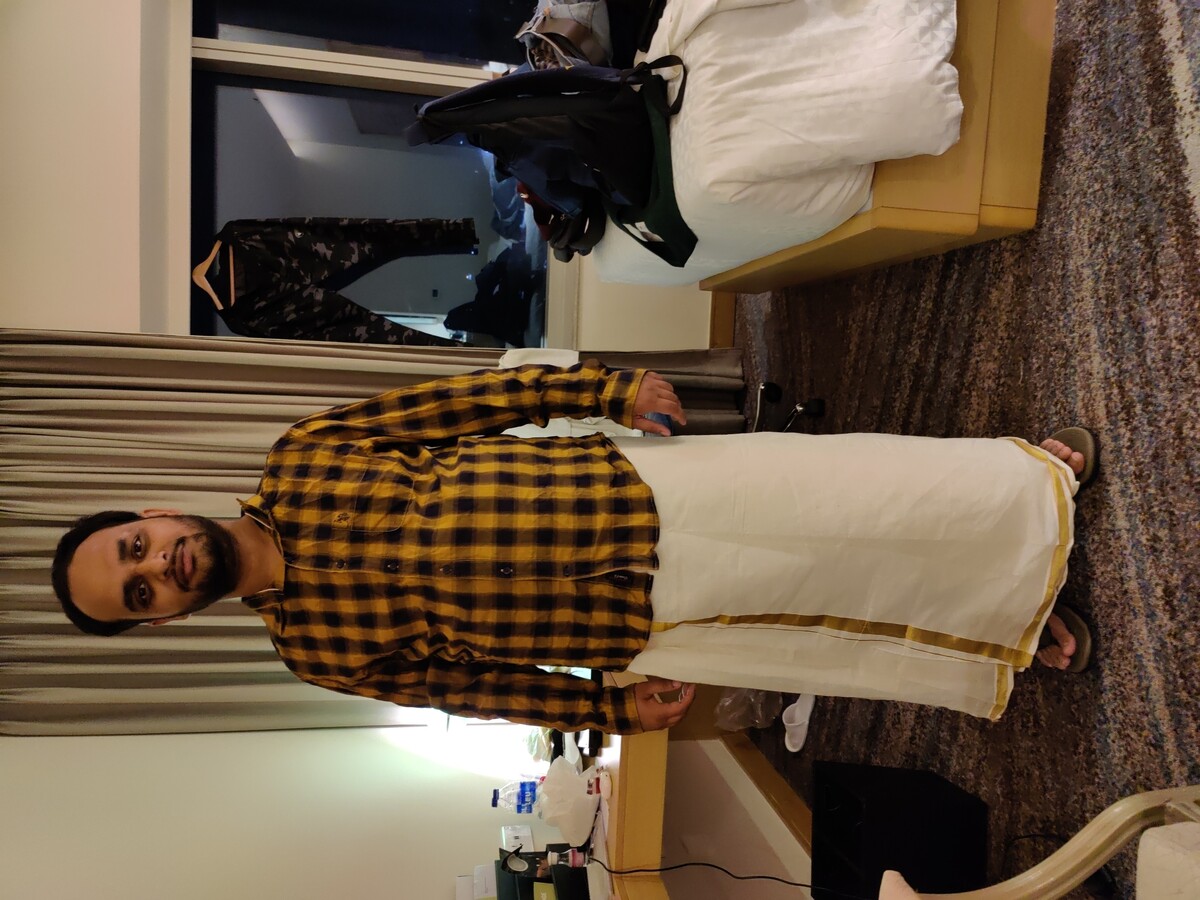
The night of the 17th of September Suresh left the hotel and Badri joined me in my room. Thanks to the efforts of Abhijit PA, Kiran, and Ananthu, I wore a mundu.
Me in mundu. Picture credits: Abhijith PA
I then joined Kalyani, Mangesh, Ruchika, Anisa, Ananthu and Kiran. We took pictures and this marked the last night of DebConf23.

Departure day The 18th of September was the day of departure. Badri slept in my room and left early morning (06:30 AM). I dropped him off at the hotel gate. The breakfast was at the eatery (3rd floor) again, and it was good. Sahil, Saswata, Nilesh, and I hung out on the ground floor.
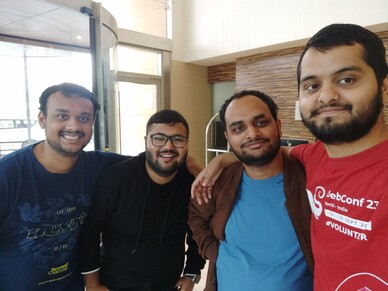
From left: Nilesh, Saswata, me, Sahil. Photo credits: Sahil.
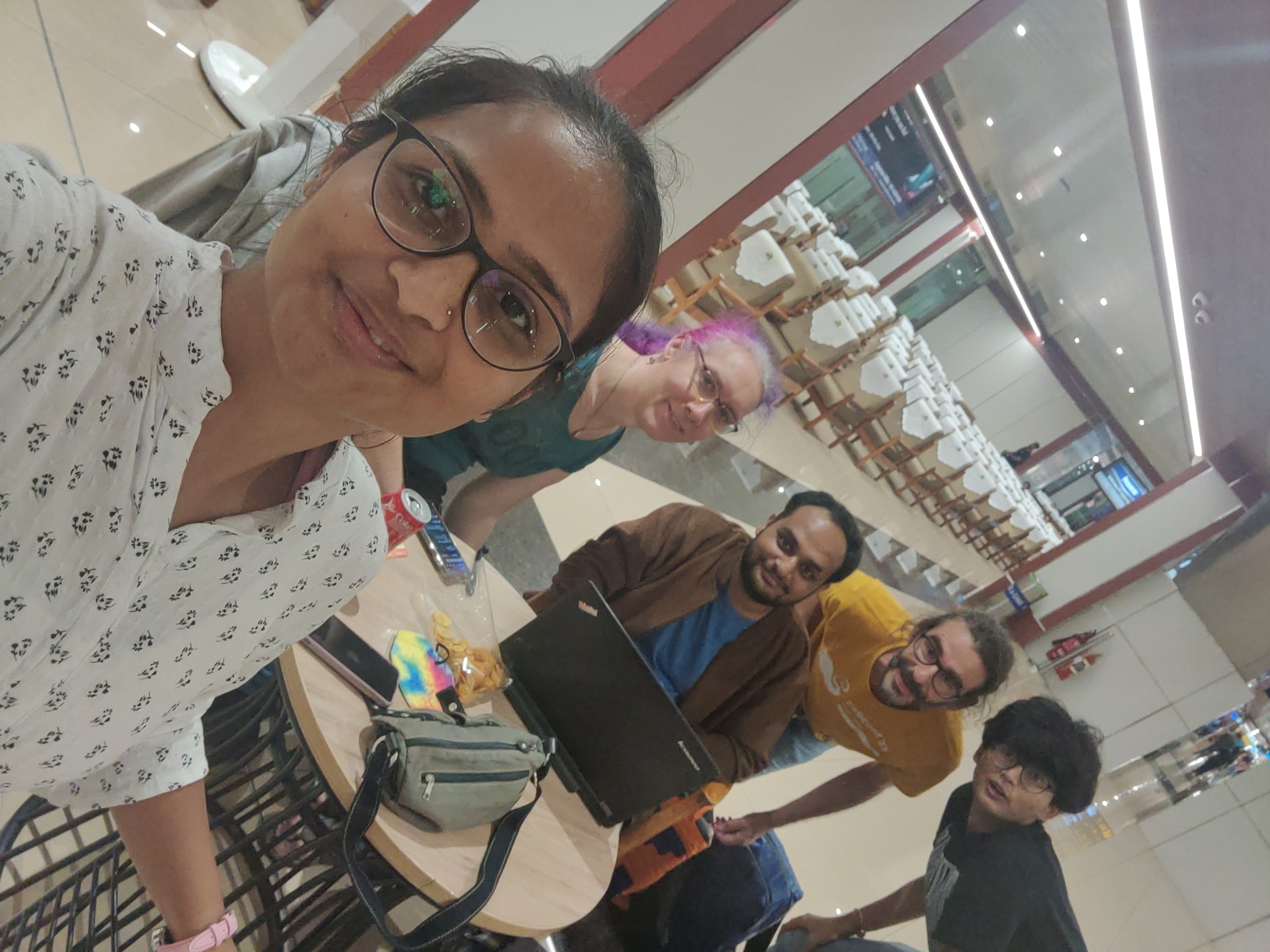
I had an 8 PM flight from Kochi to Delhi, for which I took a cab with Rhonda (Austria), Michael (Nigeria) and Yash (India). We were joined by other DebConf23 attendees at the Kochi airport, where we took another selfie.
Ruchika (taking the selfie) and from left to right: Yash, Joost (Netherlands), me, Rhonda
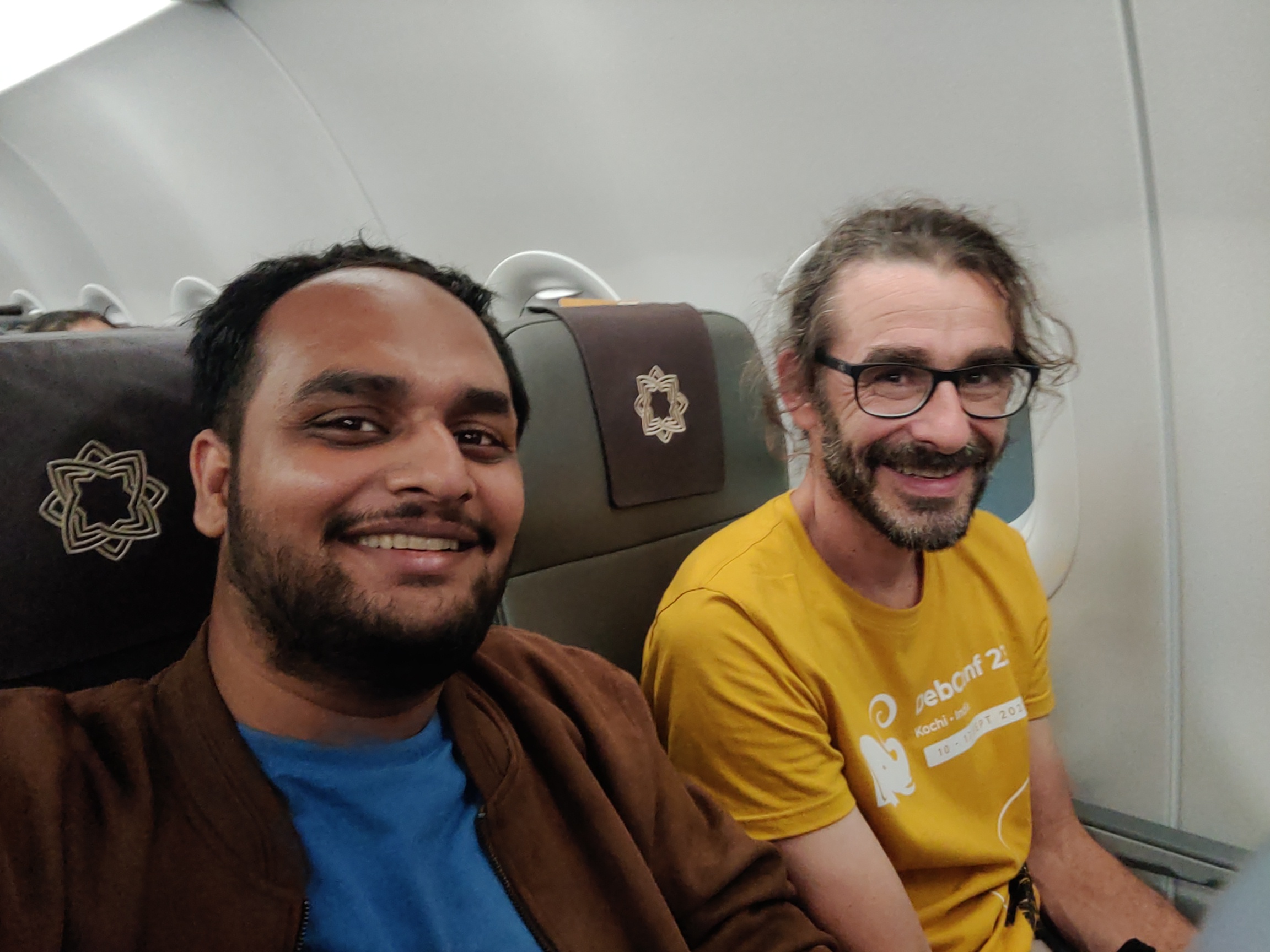
Joost and I were on the same flight, and we sat next to each other. He then took a connecting flight from Delhi to Netherlands, while I went with Yash to the New Delhi Railway Station, where we took our respective trains. I reached home on the morning of the 19th of September, 2023.
Joost and me going to Delhi. Photo credits: Ravi.

Big thanks to the organizers DebConf23 was hard to organize - strict alcohol laws, weird hotel rules, death of a close friend (almost a family member), and a scary notice by the immigration bureau. The people from the team are my close friends and I am proud of them for organizing such a good event. None of this would have been possible without the organizers who put more than a year-long voluntary effort to produce this. In the meanwhile, many of them had organized local events in the time leading up to DebConf. Kudos to them. The organizers also tried their best to get clearance for countries not approved by the ministry. I am also sad that people from China, Kosovo, and Iran could not join. In particular, I feel bad for people from Kosovo who wanted to attend but could not (as India does not consider their passport to be a valid travel document), considering how we Indians were so well-received in their country last year.

Note about myself I am writing this on the 22nd of September, 2023. It took me three days to put up this post - this was one of the tragic and hard posts for me to write. I have literally forced myself to write this. I have still not recovered from the loss of my friend. Thanks a lot to all those who helped me. PS: Credits to contrapunctus for making grammar, phrasing, and capitalization changes.

21 September 2023

Jonathan McDowell: DebConf23 Writeup

DebConf2023 Logo (I wrote this up for an internal work post, but I figure it s worth sharing more publicly too.) I spent last week at DebConf23, this years instance of the annual Debian conference, which was held in Kochi, India. As usual, DebConf provides a good reason to see a new part of the world; I ve been going since 2004 (Porto Alegre, Brazil), and while I ve missed a few (Mexico, Bosnia, and Switzerland) I ve still managed to make it to instances on 5 continents. This has absolutely nothing to do with work, so I went on my own time + dime, but I figured a brief write-up might prove of interest. I first installed Debian back in 1999 as a machine that was being co-located to operate as a web server / email host. I was attracted by the promise of easy online upgrades (or, at least, upgrades that could be performed without the need to be physically present at the machine, even if they naturally required a reboot at some point). It has mostly delivered on this over the years, and I ve never found a compelling reason to move away. I became a Debian Developer in 2000. As a massively distributed volunteer project DebConf provides an opportunity to find out what s happening in other areas of the project, catch up with team mates, and generally feel more involved and energised to work on Debian stuff. Also, by this point in time, a lot of Debian folk are good friends and it s always nice to catch up with them. On that point, I felt that this year the hallway track was not quite the same as usual. For a number of reasons (COVID, climate change, travel time, we re all getting older) I think fewer core teams are achieving critical mass at DebConf - I was the only member physically present from 2 teams I m involved in, and I d have appreciated the opportunity to sit down with both of them for some in-person discussions. It also means it s harder to use DebConf as a venue for advancing major changes; previously having all the decision makers in the same space for a week has meant it s possible to iron out the major discussion points, smoothing remote implementation after the conference. I m told the mini DebConfs are where it s at for these sorts of meetings now, so perhaps I ll try to attend at least one of those next year. Of course, I also went to a bunch of talks. I have differing levels of comment about each of them, but I ve written up some brief notes below about the ones I remember something about. The comment was made that we perhaps had a lower level of deep technical talks, which is perhaps true but I still think there were a number of high level technical talks that served to pique ones interest about the topic. Finally, this DebConf was the first I m aware of that was accompanied by tragedy; as part of the day trip Abraham Raji, a project member and member of the local team, was involved in a fatal accident.

Talks (videos not yet up for all, but should appear for most)
  • Opening Ceremony
    Not much to say here; welcome to DebConf!
  • Continuous Key-Signing Party introduction
    I ended up running this, as Gunnar couldn t make it. Debian makes heavy use of the OpenPGP web of trust (no mass ability to send out Yubikeys + perform appropriate levels of identity verification), so making sure we re appropriately cross-signed, and linked to local conference organisers, is a dull but important part of the conference. We use a modified keysigning approach where identity verification + fingerprint confirmation happens over the course of the conference, so this session was just to explain how that works and confirm we were all working from the same fingerprint list.
  • State of Stateless - A Talk about Immutability and Reproducibility in Debian
    Stateless OSes seem to be gaining popularity, so I went along to this to see if there was anything of note. It was interesting, but nothing earth shattering - very high level.
  • What s missing so that Debian is finally reproducible?
    Reproducible builds are something I ve been keeping an eye on for a long time, and I continue to be impressed by the work folks are putting into this - both for Debian, and other projects. From a security standpoint reproducible builds provide confidence against trojaned builds, and from a developer standpoint knowing you can build reproducibly helps with not having to keep a whole bunch of binary artefacts around.
  • Hello from keyring-maint
    In the distant past the process of getting your OpenPGP key into the Debian keyring (which is used to authenticate uploads + votes, amongst other things) was a clunky process that was often stalled. This hasn t been the case for at least the past 10 years, but there s still a residual piece of project memory that thinks keyring is a blocker. So as a team we say hi and talk about the fact we do monthly updates and generally are fairly responsive these days.
  • A declarative approach to Linux networking with Netplan
    Debian s /etc/network/interfaces is a fairly basic (if powerful) mechanism for configuring network interfaces. NetworkManager is a better bet for dynamic hosts (i.e. clients), and systemd-network seems to be a good choice for servers (I m gradually moving machines over to it). Netplan tries to provide a unified mechanism for configuring both with a single configuration language. A noble aim, but I don t see a lot of benefit for anything I use - my NetworkManager hosts are highly dynamic (so no need to push shared config) and systemd-network (or /etc/network/interfaces) works just fine on the other hosts. I m told Netplan has more use with more complicated setups, e.g. when OpenVSwitch is involved.
  • Quick peek at ZFS, A too good to be true file system and volume manager.
    People who use ZFS rave about it. I m naturally suspicious of any file system that doesn t come as part of my mainline kernel. But, as a longtime cautious mdraid+lvm+ext4 user I appreciate that there have been advances in the file system space that maybe I should look at, and I ve been trying out btrfs on more machines over the past couple of years. I can t deny ZFS has a bunch of interesting features, but nothing I need/want that I can t get from an mdraid+lvm+btrfs stack (in particular data checksumming + reflinks for dedupe were strong reasons to move to btrfs over ext4).
  • Bits from the DPL
    Exactly what it says on the tin; some bits from the DPL.
  • Adulting
    Enrico is always worth hearing talk; Adulting was no exception. Main takeaway is that we need to avoid trying to run the project on martyrs and instead make sure we build a sustainable project. I ve been trying really hard to accept I just don t have time to take on additional responsibilities, no matter how interesting or relevant they might seem, so this resonated.
  • My life in git, after subversion, after CVS.
    Putting all of your home directory in revision control. I ve never made this leap; I ve got some Ansible playbooks that push out my core pieces of configuration, which is held in git, but I don t actually check this out directly on hosts I have accounts on. Interesting, but not for me.
  • EU Legislation BoF - Cyber Resilience Act, Product Liability Directive and CSAM Regulation
    The CRA seems to be a piece of ill informed legislation that I m going to have to find time to read properly. Discussion was a bit more alarmist than I personally feel is warranted, but it was a short session, had a bunch of folk in it, and even when I removed my mask it was hard to make myself understood.
  • What s new in the Linux kernel (and what s missing in Debian)
    An update from Ben about new kernel features. I m paying less attention to such things these days, so nice to get a quick overview of it all.
  • Intro to SecureDrop, a sort-of Linux distro
    Actually based on Ubuntu, but lots of overlap with Debian as a result, and highly customised anyway. Notable, to me, for using OpenPGP as some of the backend crypto support. I managed to talk to Kunal separately about some of the pain points around that, which was an interesting discussion - they re trying to move from GnuPG to Sequoia, primarily because of the much easier integration and lack of requirement for the more complicated GnuPG features that sometimes get in the way.
  • The Docker(.io) ecosystem in Debian
    I hate Docker. I m sure it s fine if you accept it wants to take over the host machine entirely, but when I ve played around with it that s not been the case. This talk was more about the difficulty of trying to keep a fast moving upstream with lots of external dependencies properly up to date in a stable release. Vendoring the deps and trying to get a stable release exception seems like the least bad solution, but it s a problem that affects a growing number of projects.
  • Chiselled containers
    This was kinda of interesting, but I think I missed the piece about why more granular packaging wasn t an option. The premise is you can take an existing .deb and chisel it into smaller components, which then helps separate out dependencies rather than pulling in as much as the original .deb would. This was touted as being useful, in particular, for building targeted containers. Definitely appealing over custom built userspaces for containers, but in an ideal world I think we d want the information in the main packaging and it becomes a lot of work.
  • Debian Contributors shake-up
    Debian Contributors is a great site for massaging your ego around contributions to Debian; it s also a useful point of reference from a data protection viewpoint in terms of information the project holds about contributors - everything is already public, but the Contributors website provides folk with an easy way to find their own information (with various configurable options about whether that s made public or not). T ssia is working on improving the various data feeds into the site, but realistically this is the responsibility of every Debian service owner.
  • New Member BOF
    I m part of the teams that help get new folk into Debian - primarily as a member of the New Member Front Desk, but also as a mostly inactive Application Manager. It s been a while since we did one of these sessions so the Front Desk/Debian Account Managers that were present did a panel session. Nothing earth shattering came out of it; like keyring-maint this is a team that has historically had problems, but is currently running smoothly.

18 September 2023

Bits from Debian: DebConf23 closes in Kochi and DebConf24 announced

DebConf23 group photo - click to enlarge On Sunday 17 September 2023, the annual Debian Developers and Contributors Conference came to a close. Over 474 attendees representing 35 countries from around the world came together for a combined 89 events made up of Talks, Discussons, Birds of a Feather (BoF) gatherings, workshops, and activities in support of furthering our distribution, learning from our mentors and peers, building our community, and having a bit of fun. The conference was preceded by the annual DebCamp hacking session held September 3d through September 9th where Debian Developers and Contributors convened to focus on their Individual Debian related projects or work in team sprints geared toward in-person collaboration in developing Debian. In particular this year Sprints took place to advance development in Mobian/Debian, Reproducible Builds, and Python in Debian. This year also featured a BootCamp that was held for newcomers staged by a team of dedicated mentors who shared hands-on experience in Debian and offered a deeper understanding of how to work in and contribute to the community. The actual Debian Developers Conference started on Sunday 10 September 2023. In addition to the traditional 'Bits from the DPL' talk, the continuous key-signing party, lightning talks and the announcement of next year's DebConf4, there were several update sessions shared by internal projects and teams. Many of the hosted discussion sessions were presented by our technical teams who highlighted the work and focus of the Long Term Support (LTS), Android tools, Debian Derivatives, Debian Installer, Debian Image, and the Debian Science teams. The Python, Perl, and Ruby programming language teams also shared updates on their work and efforts. Two of the larger local Debian communities, Debian Brasil and Debian India shared how their respective collaborations in Debian moved the project forward and how they attracted new members and opportunities both in Debian, F/OSS, and the sciences with their HowTos of demonstrated community engagement. The schedule was updated each day with planned and ad-hoc activities introduced by attendees over the course of the conference. Several activities that were unable to be held in past years due to the Global COVID-19 Pandemic were celebrated as they returned to the conference's schedule: a job fair, the open-mic and poetry night, the traditional Cheese and Wine party, the group photos and the Day Trips. For those who were not able to attend, most of the talks and sessions were videoed for live room streams with the recorded videos to be made available later through the Debian meetings archive website. Almost all of the sessions facilitated remote participation via IRC messaging apps or online collaborative text documents which allowed remote attendees to 'be in the room' to ask questions or share comments with the speaker or assembled audience. DebConf23 saw over 4.3 TiB of data streamed, 55 hours of scheduled talks, 23 network access points, 11 network switches, 75 kb of equipment imported, 400 meters of gaffer tape used, 1,463 viewed streaming hours, 461 T-shirts, 35 country Geoip viewers, 5 day trips, and an average of 169 meals planned per day. All of these events, activies, conversations, and streams coupled with our love, interest, and participation in Debian annd F/OSS certainly made this conference an overall success both here in Kochi, India and On-line around the world. The DebConf23 website will remain active for archival purposes and will continue to offer links to the presentations and videos of talks and events. Next year, DebConf24 will be held in Haifa, Israel. As tradition follows before the next DebConf the local organizers in Israel will start the conference activites with DebCamp with particular focus on individual and team work towards improving the distribution. DebConf is committed to a safe and welcome environment for all participants. See the web page about the Code of Conduct in DebConf23 website for more details on this. Debian thanks the commitment of numerous sponsors to support DebConf23, particularly our Platinum Sponsors: Infomaniak, Proxmox, and Siemens. We also wish to thank our Video and Infrastructure teams, the DebConf23 and DebConf commitiees, our host nation of India, and each and every person who helped contribute to this event and to Debian overall. Thank you all for your work in helping Debian continue to be "The Universal Operating System". See you next year! About Debian The Debian Project was founded in 1993 by Ian Murdock to be a truly free community project. Since then the project has grown to be one of the largest and most influential open source projects. Thousands of volunteers from all over the world work together to create and maintain Debian software. Available in 70 languages, and supporting a huge range of computer types, Debian calls itself the universal operating system. About DebConf DebConf is the Debian Project's developer conference. In addition to a full schedule of technical, social and policy talks, DebConf provides an opportunity for developers, contributors and other interested people to meet in person and work together more closely. It has taken place annually since 2000 in locations as varied as Scotland, Argentina, and Bosnia and Herzegovina. More information about DebConf is available from https://debconf.org/. About Infomaniak Infomaniak is a key player in the European cloud market and the leading developer of Web technologies in Switzerland. It aims to be an independent European alternative to the web giants and is committed to an ethical and sustainable Web that respects privacy and creates local jobs. Infomaniak develops cloud solutions (IaaS, PaaS, VPS), productivity tools for online collaboration and video and radio streaming services. About Proxmox Proxmox develops powerful, yet easy-to-use open-source server software. The product portfolio from Proxmox, including server virtualization, backup, and email security, helps companies of any size, sector, or industry to simplify their IT infrastructures. The Proxmox solutions are based on the great Debian platform, and we are happy that we can give back to the community by sponsoring DebConf23. About Siemens Siemens is technology company focused on industry, infrastructure and transport. From resource-efficient factories, resilient supply chains, smarter buildings and grids, to cleaner and more comfortable transportation, and advanced healthcare, the company creates technology with purpose adding real value for customers. By combining the real and the digital worlds, Siemens empowers its customers to transform their industries and markets, helping them to enhance the everyday of billions of people. Contact Information For further information, please visit the DebConf23 web page at https://debconf23.debconf.org/ or send mail to press@debian.org.

12 September 2023

Jo Shields: Building a NAS

The status quo Back in 2015, I bought an off-the-shelf NAS, a QNAP TS-453mini, to act as my file store and Plex server. I had previously owned a Synology box, and whilst I liked the Synology OS and experience, the hardware was underwhelming. I loaded up the successor QNAP with four 5TB drives in RAID10, and moved all my files over (after some initial DoA drive issues were handled).
QNAP TS-453mini product photoQNAP TS-453mini product photo
That thing has been in service for about 8 years now, and it s been a mixed bag. It was definitely more powerful than the predecessor system, but it was clear that QNAP s OS was not up to the same standard as Synology s perhaps best exemplified by HappyGet 2 , the QNAP webapp for downloading videos from streaming services like YouTube, whose icon is a straight rip-off of StarCraft 2. On its own, meaningless but a bad omen for overall software quality
The logo for QNAP HappyGet 2 and Blizzard's Starcraft 2 side by sideThe logo for QNAP HappyGet 2 and Blizzard s StarCraft 2 side by side
Additionally, the embedded Celeron processor in the NAS turned out to be an issue for some cases. It turns out, when playing back videos with subtitles, most Plex clients do not support subtitles properly instead they rely on the Plex server doing JIT transcoding to bake the subtitles directly into the video stream. I discovered this with some Blu-Ray rips of Game of Thrones some episodes would play back fine on my smart TV, but episodes with subtitled Dothraki speech would play at only 2 or 3 frames per second. The final straw was a ransomware attack, which went through all my data and locked every file below a 60MiB threshold. Practically all my music gone. A substantial collection of downloaded files, all gone. Some of these files had been carried around since my college days digital rarities, or at least digital detritus I felt a real sense of loss at having to replace. This episode was caused by a ransomware targeting specific vulnerabilities in the QNAP OS, not an error on my part. So, I decided to start planning a replacement with:
  • A non-garbage OS, whilst still being a NAS-appliance type offering (not an off-the-shelf Linux server distro)
  • Full remote management capabilities
  • A small form factor comparable to off-the-shelf NAS
  • A powerful modern CPU capable of transcoding high resolution video
  • All flash storage, no spinning rust
At the time, no consumer NAS offered everything (The Asustor FS6712X exists now, but didn t when this project started), so I opted to go for a full DIY rather than an appliance not the first time I ve jumped between appliances and DIY for home storage.

Selecting the core of the system There aren t many companies which will sell you a small motherboard with IPMI. Supermicro is a bust, so is Tyan. But ASRock Rack, the server division of third-tier motherboard vendor ASRock, delivers. Most of their boards aren t actually compliant Mini-ITX size, they re a proprietary Deep Mini-ITX with the regular screw holes, but 40mm of extra length (and a commensurately small list of compatible cases). But, thankfully, they do have a tiny selection of boards without the extra size, and I stumbled onto the X570D4I-2T, a board with an AMD AM4 socket and the mature X570 chipset. This board can use any AMD Ryzen chip (before the latest-gen Ryzen 7000 series); has built in dual 10 gigabit ethernet; IPMI; four (laptop-sized) RAM slots with full ECC support; one M.2 slot for NVMe SSD storage; a PCIe 16x slot (generally for graphics cards, but we live in a world of possibilities); and up to 8 SATA drives OR a couple more NVMe SSDs. It s astonishingly well featured, just a shame it costs about $450 compared to a good consumer-grade Mini ITX AM4 board costing less than half that. I was so impressed with the offering, in fact, that I crowed about it on Mastodon and ended up securing ASRock another sale, with someone else looking into a very similar project to mine around the same timespan. The next question was the CPU. An important feature of a system expected to run 24/7 is low power, and AM4 chips can consume as much as 130W under load, out of the box. At the other end, some models can require as little as 35W under load the OEM-only GE suffix chips, which are readily found for import on eBay. In their PRO variant, they also support ECC (all non-G Ryzen chips support ECC, but only Pro G chips do). The top of the range 8 core Ryzen 7 PRO 5750GE is prohibitively expensive, but the slightly weaker 6 core Ryzen 5 PRO 5650GE was affordable, and one arrived quickly from Hong Kong. Supplemented with a couple of cheap 16 GiB SODIMM sticks of DDR4 PC-3200 direct from Micron for under $50 a piece, that left only cooling as an unsolved problem to get a bootable test system. The official support list for the X570D4I-2T only includes two rackmount coolers, both expensive and hard to source. The reason for such a small list is the non standard cooling layout of the board instead of an AM4 hole pattern with the standard plastic AM4 retaining clips, it has an Intel 115x hole pattern with a non-standard backplate (Intel 115x boards have no backplate, the stock Intel 115x cooler attaches to the holes with push pins). As such every single cooler compatibility list excludes this motherboard. However, the backplate is only secured with a mild glue with minimal pressure and a plastic prying tool it can be removed, giving compatibility with any 115x cooler (which is basically any CPU cooler for more than a decade). I picked an oversized low profile Thermalright AXP120-X67 hoping that its 120mm fan would cool the nearby MOSFETs and X570 chipset too.
Thermalright AXP120-X67, AMD Ryzen 5 PRO 5650GE, ASRock Rack X570D4I-2T, all assembled and running on a flat surface

Testing up to this point Using a spare ATX power supply, I had enough of a system built to explore the IPMI and UEFI instances, and run MemTest86 to validate my progress. The memory test ran without a hitch and confirmed the ECC was working, although it also showed that the memory was only running at 2933 MT/s instead of the rated 3200 MT/s (a limit imposed by the motherboard, as higher speeds are considered overclocking). The IPMI interface isn t the best I ve ever used by a long shot, but it s minimum viable and allowed me to configure the basics and boot from media entirely via a Web browser.
Memtest86 showing test progress, taken from IPMI remote control window
One sad discovery, however, which I ve never seen documented before, on PCIe bifurcation. With PCI Express, you have a number of lanes which are allocated in groups by the motherboard and CPU manufacturer. For Ryzen prior to Ryzen 7000, that s 16 lanes in one slot for the graphics card; 4 lanes in one M.2 connector for an SSD; then 4 lanes connecting the CPU to the chipset, which can offer whatever it likes for peripherals or extra lanes (bottlenecked by that shared 4x link to the CPU, if it comes down to it). It s possible, with motherboard and CPU support, to split PCIe groups up for example an 8x slot could be split into two 4x slots (eg allowing two NVMe drives in an adapter card NVME drives these days all use 4x). However with a Cezanne Ryzen with integrated graphics, the 16x graphics card slot cannot be split into four 4x slots (ie used for for NVMe drives) the most bifurcation it allows is 8x4x4x, which is useless in a NAS.
Screenshot of PCIe 16x slot bifurcation options in UEFI settings, taken from IPMI remote control window
As such, I had to abandon any ideas of an all-NVMe NAS I was considering: the 16x slot split into four 4x, combined with two 4x connectors fed by the X570 chipset, to a total of 6 NVMe drives. 7.6TB U.2 enterprise disks are remarkably affordable (cheaper than consumer SATA 8TB drives), but alas, I was locked out by my 5650GE. Thankfully I found out before spending hundreds on a U.2 hot swap bay. The NVMe setup would be nearly 10x as fast as SATA SSDs, but at least the SATA SSD route would still outperform any spinning rust choice on the market (including the fastest 10K RPM SAS drives)

Containing the core The next step was to pick a case and power supply. A lot of NAS cases require an SFX (rather than ATX) size supply, so I ordered a modular SX500 unit from Silverstone. Even if I ended up with a case requiring ATX, it s easy to turn an SFX power supply into ATX, and the worst result is you have less space taken up in your case, hardly the worst problem to have. That said, on to picking a case. There s only one brand with any cachet making ITX NAS cases, Silverstone. They have three choices in an appropriate size: CS01-HS, CS280, and DS380. The problem is, these cases are all badly designed garbage. Take the CS280 as an example, the case with the most space for a CPU cooler. Here s how close together the hotswap bay (right) and power supply (left) are:
Internal image of Silverstone CS280 NAS build. Image stolen from ServeTheHome
With actual cables connected, the cable clearance problem is even worse:
Internal image of Silverstone CS280 NAS build. Image stolen from ServeTheHome
Remember, this is the best of the three cases for internal layout, the one with the least restriction on CPU cooler height. And it s garbage! Total hot garbage! I decided therefore to completely skip the NAS case market, and instead purchase a 5.25 -to-2.5 hot swap bay adapter from Icy Dock, and put it in an ITX gamer case with a 5.25 bay. This is no longer a served market 5.25 bays are extinct since nobody uses CD/DVD drives anymore. The ones on the market are really new old stock from 2014-2017: The Fractal Design Core 500, Cooler Master Elite 130, and Silverstone SUGO 14. Of the three, the Fractal is the best rated so I opted to get that one however it seems the global supply of new old stock fully dried up in the two weeks between me making a decision and placing an order leaving only the Silverstone case. Icy Dock have a selection of 8-bay 2.5 SATA 5.25 hot swap chassis choices in their ToughArmor MB998 series. I opted for the ToughArmor MB998IP-B, to reduce cable clutter it requires only two SFF-8611-to-SF-8643 cables from the motherboard to serve all eight bays, which should make airflow less of a mess. The X570D4I-2T doesn t have any SATA ports on board, instead it has two SFF-8611 OCuLink ports, each supporting 4 PCI Express lanes OR 4 SATA connectors via a breakout cable. I had hoped to get the ToughArmor MB118VP-B and run six U.2 drives, but as I said, the PCIe bifurcation issue with Ryzen G chips meant I wouldn t be able to run all six bays successfully.
NAS build in Silverstone SUGO 14, mid build, panels removed
Silverstone SUGO 14 from the front, with hot swap bay installed

Actual storage for the storage server My concept for the system always involved a fast boot/cache drive in the motherboard s M.2 slot, non-redundant (just backups of the config if the worst were to happen) and separate storage drives somewhere between 3.8 and 8 TB each (somewhere from $200-$350). As a boot drive, I selected the Intel Optane SSD P1600X 58G, available for under $35 and rated for 228 years between failures (or 11,000 complete drive rewrite cycles). So, on to the big expensive choice: storage drives. I narrowed it down to two contenders: new-old-stock Intel D3-S4510 3.84TB enterprise drives, at about $200, or Samsung 870 QVO 8TB consumer drives, at about $375. I did spend a long time agonizing over the specification differences, the ZFS usage reports, the expected lifetime endurance figures, but in reality, it came down to price $1600 of expensive drives vs $3200 of even more expensive drives. That s 27TB of usable capacity in RAID-Z1, or 23TB in RAID-Z2. For comparison, I m using about 5TB of the old NAS, so that s a LOT of overhead for expansion.
Storage SSD loaded into hot swap sled

Booting up Bringing it all together is the OS. I wanted an appliance NAS OS rather than self-administering a Linux distribution, and after looking into the surrounding ecosystems, decided on TrueNAS Scale (the beta of the 2023 release, based on Debian 12).
TrueNAS Dashboard screenshot in browser window
I set up RAID-Z1, and with zero tuning (other than enabling auto-TRIM), got the following performance numbers:
IOPSBandwidth
4k random writes19.3k75.6 MiB/s
4k random reads36.1k141 MiB/s
Sequential writes 2300 MiB/s
Sequential reads 3800 MiB/s
Results using fio parameters suggested by Huawei
And for comparison, the maximum theoretical numbers quoted by Intel for a single drive:
IOPSBandwidth
4k random writes16k?
4k random reads90k?
Sequential writes 280 MiB/s
Sequential reads 560 MiB/s
Numbers quoted by Intel SSD successors Solidigm.
Finally, the numbers reported on the old NAS with four 7200 RPM hard disks in RAID 10:
IOPSBandwidth
4k random writes4301.7 MiB/s
4k random reads800632 MiB/s
Sequential writes 311 MiB/s
Sequential reads 566 MiB/s
Performance seems pretty OK. There s always going to be an overhead to RAID. I ll settle for the 45x improvement on random writes vs. its predecessor, and 4.5x improvement on random reads. The sequential write numbers are gonna be impacted by the size of the ZFS cache (50% of RAM, so 16 GiB), but the rest should be a reasonable indication of true performance. It took me a little while to fully understand the TrueNAS permissions model, but I finally got Plex configured to access data from the same place as my SMB shares, which have anonymous read-only access or authenticated write access for myself and my wife, working fine via both Linux and Windows. And that s it! I built a NAS. I intend to add some fans and more RAM, but that s the build. Total spent: about $3000, which sounds like an unreasonable amount, but it s actually less than a comparable Synology DiskStation DS1823xs+ which has 4 cores instead of 6, first-generation AMD Zen instead of Zen 3, 8 GiB RAM instead of 32 GiB, no hardware-accelerated video transcoding, etc. And it would have been a whole lot less fun!
The final system, powered up
(Also posted on PCPartPicker)

John Goerzen: A Maze of Twisty Little Pixels, All Tiny

Two years ago, I wrote Managing an External Display on Linux Shouldn t Be This Hard. Happily, since I wrote that post, most of those issues have been resolved. But then you throw HiDPI into the mix and it all goes wonky. If you re running X11, basically the story is that you can change the scale factor, but it only takes effect on newly-launched applications (which means a logout/in because some of your applications you can t really re-launch). That is a problem if, like me, you sometimes connect an external display that is HiDPI, sometimes not, or your internal display is HiDPI but others aren t. Wayland is far better, supporting on-the-fly resizes quite nicely. I ve had two devices with HiDPI displays: a Surface Go 2, and a work-issued Thinkpad. The Surface Go 2 is my ultraportable Linux tablet. I use it sparingly at home, and rarely with an external display. I just put Gnome on it, in part because Gnome had better on-screen keyboard support at the time, and left it at that. On the work-issued Thinkpad, I really wanted to run KDE thanks to its tiling support (I wound up using bismuth with it). KDE was buggy with Wayland at the time, so I just stuck with X11 and ran my HiDPI displays at lower resolutions and lived with the fuzziness. But now that I have a Framework laptop with a HiDPI screen, I wanted to get this right. I tried both Gnome and KDE. Here are my observations with both: Gnome I used PaperWM with Gnome. PaperWM is a tiling manager with a unique horizontal ribbon approach. It grew on me; I think I would be equally at home, or maybe even prefer it, to my usual xmonad-style approach. Editing the active window border color required editing ~/.local/share/gnome-shell/extensions/paperwm@hedning:matrix.org/stylesheet.css and inserting background-color and border-color items in the paperwm-selection section. Gnome continues to have an absolutely terrible picture for configuring things. It has no less than four places to make changes (Settings, Tweaks, Extensions, and dconf-editor). In many cases, configuration for a given thing is split between Settings and Tweaks, and sometimes even with Extensions, and then there are sometimes options that are only visible in dconf. That is, where the Gnome people have even allowed something to be configurable. Gnome installs a power manager by default. It offers three options: performance, balanced, and saver. There is no explanation of the difference between them. None. What is it setting when I change the pref? A maximum frequency? A scaling governor? A balance between performance and efficiency cores? Not only that, but there s no way to tell it to just use performance when plugged in and balanced or saver when on battery. In an issue about adding that, a Gnome dev wrote We re not going to add a preference just because you want one . KDE, on the other hand, aside from not mucking with your system s power settings in this way, has a nice panel with on AC and on battery and you can very easily tweak various settings accordingly. The hostile attitude from the Gnome developers in that thread was a real turnoff. While Gnome has excellent support for Wayland, it doesn t (directly) support fractional scaling. That is, you can set it to 100%, 200%, and so forth, but no 150%. Well, unless you manage to discover that you can run gsettings set org.gnome.mutter experimental-features "['scale-monitor-framebuffer']" first. (Oh wait, does that make a FIFTH settings tool? Why yes it does.) Despite its name, that allows you to select fractional scaling under Wayland. For X11 apps, they will be blurry, a problem that is optional under KDE (more on that below). Gnome won t show the battery life time remaining on the task bar. Yikes. An extension might work in some cases. Not only that, but the Gnome battery icon frequently failed to indicate AC charging when AC was connected, a problem that didn t exist on KDE. Both Gnome and KDE support night light (warmer color temperatures at night), but Gnome s often didn t change when it should have, or changed on one display but not the other. The appindicator extension is pretty much required, as otherwise a number of applications (eg, Nextcloud) don t have their icon display anywhere. It does, however, generate a significant amount of log spam. There may be a fix for this. Unlike KDE, which has a nice inobtrusive popup asking what to do, Gnome silently automounts USB sticks when inserted. This is often wrong; for instance, if I m about to dd a Debian installer to it, I definitely don t want it mounted. I learned this the hard way. It is particularly annoying because in a GUI, there is no reason to mount a drive before the user tries to access it anyhow. It looks like there is a dconf setting, but then to actually mount a drive you have to open up Files (because OF COURSE Gnome doesn t have a nice removable-drives icon like KDE does) and it s a bunch of annoying clicks, and I didn t want to use the GUI file manager anyway. Same for unmounting; two clicks in KDE thanks to the task bar icon, but in Gnome you have to open up the file manager, unmount the drive, close the file manager again, etc. The ssh agent on Gnome doesn t start up for a Wayland session, though this is easily enough worked around. The reason I completely soured on Gnome is that after using it for awhile, I noticed my laptop fans spinning up. One core would be constantly busy. It was busy with a kworker events task, something to do with sound events. Logging out would resolve it. I believe it to be a Gnome shell issue. I could find no resolution to this, and am unwilling to tolerate the decreased battery life this implies. The Gnome summary: it looks nice out of the box, but you quickly realize that this is something of a paper-thin illusion when you try to actually use it regularly. KDE The KDE experience on Wayland was a little bit opposite of Gnome. While with Gnome, things start out looking great but you realize there are some serious issues (especially battery-eating), with KDE things start out looking a tad rough but you realize you can trivially fix them and wind up with a very solid system. Compared to Gnome, KDE never had a battery-draining problem. It will show me estimated battery time remaining if I want it to. It will do whatever I want it to when I insert a USB drive. It doesn t muck with my CPU power settings, and lets me easily define on AC vs on battery settings for things like suspend when idle. KDE supports fractional scaling, to any arbitrary setting (even with the gsettings thing above, Gnome still only supports it in 25% increments). Then the question is what to do with X11-only applications. KDE offers two choices. The first is Scaled by the system , which is also the only option for Gnome. With that setting, the X11 apps effectively run natively at 100% and then are scaled up within Wayland, giving them a blurry appearance on HiDPI displays. The advantage is that the scaling happens within Wayland, so the size of the app will always be correct even when the Wayland scaling factor changes. The other option is Apply scaling themselves , which uses native X11 scaling. This lets most X11 apps display crisp and sharp, but then if the system scaling changes, due to limitations of X11, you ll have to restart the X apps to get them to be the correct size. I appreciate the choice, and use Apply scaling by themselves because only a few of my apps aren t Wayland-aware. I did encounter a few bugs in KDE under Wayland: sddm, the display manager, would be slow to stop and cause a long delay on shutdown or reboot. This seems to be a known issue with sddm and Wayland, and is easily worked around by adding a systemd TimeoutStopSec. Konsole, the KDE terminal emulator, has weird display artifacts when using fractional scaling under Wayland. I applied some patches and rebuilt Konsole and then all was fine. The Bismuth tiling extension has some pretty weird behavior under Wayland, but a 1-character patch fixes it. On Debian, KDE mysteriously installed Pulseaudio instead of Debian s new default Pipewire, but that was easily fixed as well (and Pulseaudio also works fine). Conclusions I m sticking with KDE. Given that I couldn t figure out how to stop Gnome from deciding to eat enough battery to make my fan come on, the decision wasn t hard. But even if it weren t for that, I d have gone with KDE. Once a couple of things were patched, the experience is solid, fast, and flawless. Emacs (my main X11-only application) looks great with the self-scaling in KDE. Gimp, which I use occasionally, was terrible with the blurry scaling in Gnome. Update: Corrected the gsettings command

Valhalla's Things: How I Keep my Life in Git

Posted on September 12, 2023
git secret_cabal greet
After watching My life in git, after subversion, after CVS. from DebConf, I ve realized it s been a while since I talked about the way I keep everything1 I do in git, and I don t think I ve ever done it online, so it looked like a good time for a blog post. Beyond git itself (of course), I use a few git-related programs:
  • myrepos (also known as mr) to manage multiple git repositories with one command;
  • vcsh to make it easy to keep dot-files under git;
  • git annex to store media files (anything that is big and will not change);
  • etckeeper to keep an history of the /etc directory;
  • gitolite and cgit to host my git repositories;
and some programs that don t use git directly, but easily interact with it:
  • ansible to keep track of the system configuration of all machines;
  • lesana as a project tracker and journal and to inventory the things made of atoms that are hard 2 to store in git.
All of these programs are installed from Debian packages, on stable (plus rarely backports) or testing, depending on the machine. I m also grateful to the vcs-home people, who wrote most of the tools I use, and sometimes hang around their IRC channel. And now, on to what I m actually doing. With the git repositories I ve decided to err for too much granularity rather than too little3, so of course each project has its own repository, and so do different kinds of media files, dot-files that are related to different programs etc. Most of the repositories are hosted on two gitolite servers: one runs on the home server, for stuff that should remain private, and the other one is on my VPS for things that are public (or may become public in the future), and also has a web interface with cgit. Of course things where I m collaborating with other people are sometimes hosted elsewhere, mostly on salsa, sourcehut or on $DAYJOB related gitlab instances. The .mr directory is where everything is managed: I don t have a single .mrconfig file but a few different ones, that in turn load all files in a directory with the same name:
  • collections.mr for the media file annexes and inventories (split into different files, so that computers with little disk space can only get the inventories);
  • private.mr for stuff that should only go on my own personal machine, not on shared ones;
  • projects.mr for the actual projects, with different files for the kinds of projects (software, docs, packaging, crafts, etc.);
  • setup.mr with all of the vcsh repositories, including the one that tracks the mr files (I ll talk about the circular dependency later);
  • work.mr for repositories that are related to $DAYJOB.
Then there are the files in the .mr/machines directory, each one of which has the list of repositories that should be on every specific machine, including a generic workstation, but also specific machines such as e.g. the media center which has a custom set of repositories. The dot files from my home directory are kept in vcsh, so that it s easy to split them out into different repositories, and I m mostly used the simplest configuration described in the 30 Second How-to in its homepage; vcsh gives some commands to work on all vcsh repositories at the same time, but most of the time I work on a single repository, and use mr to act on more than one repo. The media collections are also pretty straightforward git-annex repositories, one for each kind of media (music, movies and other videos, e-books, pictures, etc.) and I don t use any auto-syncing features but simply copy and move files around between clones with the git annex copy, git annex move and git annex get commands. There isn t much to say about the project repositories (plain git), and I think that the way I use my own program lesana for inventories and project tracking is worth an article of its own, here I ll just say that the file format used has been designed (of course) to work nicely with git. On every machine I install etckeeper so that there is a history of the changes in the /etc directory, but that s only a local repository, not stored anywhere else, and is used mostly in case something breaks with an update or in similar situation. The authoritative source for the configuration of each machine is an ansible playbook (of course saved in git) which can be used to fully reconfigure the machine from a bare Debian installation. When such a reconfiguration from scratch happens, it will be in two stages: first a run of ansible does the system-wide configuration (including installing packages, creating users etc.), and then I login on the machine and run mr to set up my own home. Of course there is a chicken-and-egg problem in that I need the mr configuration to know where to get the mr configuration, and that is solved by having setup two vcsh repositories from an old tarball export: the one with the ssh configuration to access the repositories and the one with the mr files. So, after a machine has been configured with ansible what I ll actually do is to login, use vcsh pull to update those two repositories and then run mr to checkout everything else. And that s it, if you have questions on something feel free to ask me on the fediverse or via email (contacts are in the about page) Update (2023-09-12 17:00ish): The ~/.mr directory is not special for mr, it s just what I use and then I always run mr -c ~/.mr/some/suitable/file.mr, with the actual file being different whether I m registering a new repo or checking out / updating them. I could include some appropriate ~/.mr/machines/some_machine.mr in ~/.mrconfig, but I ve never bothered to do so, since it wouldn t cover all usecases anyway. Thanks to the person on #vcs-home@OFTC who asked me the question :)

  1. At least, everything that I made that is made of bits, and a diary and/or inventory of the things made of atoms.
  2. until we get a working replicator, I guess :D
  3. in time I ve consolidated a bit some of the repositories, e.g. merging the repositories for music from different sources (CD rips, legal downloads, etc.) into a single repository, but that only happened a few times, and usually I m fine with the excess of granularity.

Freexian Collaborators: Monthly report about Debian Long Term Support, August 2023 (by Roberto C. S nchez)

Like each month, have a look at the work funded by Freexian s Debian LTS offering.

Debian LTS contributors In August, 19 contributors have been paid to work on Debian LTS, their reports are available:
  • Abhijith PA did 0.0h (out of 12.0h assigned and 2.0h from previous period), thus carrying over 14.0h to the next month.
  • Adrian Bunk did 18.5h (out of 18.5h assigned).
  • Anton Gladky did 7.5h (out of 5.0h assigned and 10.0h from previous period), thus carrying over 7.5h to the next month.
  • Bastien Roucari s did 17.0h (out of 15.5h assigned and 3.0h from previous period), thus carrying over 1.5h to the next month.
  • Ben Hutchings did 18.5h (out of 9.0h assigned and 9.5h from previous period).
  • Chris Lamb did 18.0h (out of 18.0h assigned).
  • Emilio Pozuelo Monfort did 18.5h (out of 18.25h assigned and 0.25h from previous period).
  • Guilhem Moulin did 24.0h (out of 22.5h assigned and 1.5h from previous period).
  • Jochen Sprickerhof did 2.5h (out of 8.5h assigned and 10.0h from previous period), thus carrying over 16.0h to the next month.
  • Lee Garrett did 18.0h (out of 9.25h assigned and 9.25h from previous period), thus carrying over 0.5h to the next month.
  • Markus Koschany did 28.5h (out of 28.5h assigned).
  • Ola Lundqvist did 0.0h (out of 0h assigned and 24.0h from previous period), thus carrying over 24.0h to the next month.
  • Roberto C. S nchez did 18.5h (out of 13.0h assigned and 5.5h from previous period).
  • Santiago Ruano Rinc n did 18.5h (out of 18.25h assigned and 0.25h from previous period).
  • Sean Whitton did 7.0h (out of 10.0h assigned), thus carrying over 3.0h to the next month.
  • Sylvain Beucler did 18.5h (out of 9.75h assigned and 8.75h from previous period).
  • Thorsten Alteholz did 14.0h (out of 14.0h assigned).
  • Tobias Frost did 16.0h (out of 16.0h assigned).
  • Utkarsh Gupta did 12.25h (out of 0h assigned and 12.25h from previous period).

Evolution of the situation In August, we have released 42 DLAs. The month of August turned out to be a rather quiet month for the LTS team. Three notable updates were to bouncycastle, openssl, and zabbix. In the case of bouncycastle a flaw allowed for the possibility of LDAP injection and the openssl update corrected a resource exhaustion bug that could result in a denial of service. Zabbix, while not widely used, was the subject of several vulnerabilities which while not individually severe did combine to result in the zabbix update being of particular note. Apart from those, the LTS team continued the always ongoing work of triaging, investigating, and fixing vulnerabilities, as well as making contributions to the broader Debian and Free Software communities.

Thanks to our sponsors Sponsors that joined recently are in bold.

10 September 2023

Bits from Debian: DebConf23 welcomes its sponsors!

DebConf23 logo DebConf23, the 24th edition of the Debian conference is taking place in Infopark at Kochi, Kerala, India. Thanks to the hard work of its organizers, it will be, this year as well, an interesting and fruitful event for attendees. We would like to warmly welcome the sponsors of DebConf23, and introduce them to you. We have three Platinum sponsors. Our Gold sponsors are: Our Silver sponsors are: Bronze sponsors: And finally, our Supporter level sponsors: A special thanks to the Infoparks Kerala, our Venue Partner! Thanks to all our sponsors for their support! Their contributions make it possible for a large number of Debian contributors from all over the globe to work together, help and learn from each other in DebConf23.

Freexian Collaborators: Debian Contributions: /usr-merge updates, Salsa CI progress, DebConf23 lead-up, and more! (by Utkarsh Gupta)

Contributing to Debian is part of Freexian s mission. This article covers the latest achievements of Freexian and their collaborators. All of this is made possible by organizations subscribing to our Long Term Support contracts and consulting services.

/usr-merge work, by Helmut Grohne, et al. Given that we now have consensus on moving forward by moving aliased files from / to /usr, we will also run into the problems that the file move moratorium was meant to prevent. The way forward is detecting them early and applying workarounds on a per-package basis. Said detection is now automated using the Debian Usr Merge Analysis Tool. As problems are reported to the bug tracking system, they are connected to the reports if properly usertagged. Bugs and patches for problem categories DEP17-P2 and DEP17-P6 have been filed. After consensus has been reached on the bootstrapping matters, debootstrap has been changed to swap the initial unpack and merging to avoid unpack errors due to pre-existing links. This is a precondition for having base-files install the aliasing symbolic links eventually. It was identified that the root filesystem used by the Debian installer is still unmerged and a change has been proposed. debhelper was changed to recognize systemd units installed to /usr. A discussion with the CTTE and release team on repealing the moratorium has been initiated.

Salsa CI work, by Santiago Ruano Rinc n August was a busy month in the Salsa CI world. Santiago reviewed and merged a bunch of MRs that have improved the project in different aspects: The aptly job got two MRs from Philip Hands. With the first one, the aptly now can export a couple of variables in a dotenv file, and with the second, it can include packages from multiple artifact directories. These MRs bring the base to improve how to test reverse dependencies with Salsa CI. Santiago is working on documenting this. As a result of the mass bug filing done in August, Salsa CI now includes a job to test how a package builds twice in a row. Thanks to the MRs of Sebastiaan Couwenberg and Johannes Schauer Marin Rodrigues. Last but not least, Santiago helped Johannes Schauer Marin Rodrigues to complete the support for arm64-only pipelines.

DebConf23 lead-up, by Stefano Rivera Stefano wears a few hats in the DebConf organization and in the lead up to the conference in mid-September, they ve all been quite busy. As one of the treasurers of DebConf 23, there has been a final budget update, and quite a few payments to coordinate from Debian s Trusted Organizations. We try to close the books from the previous conference at the next one, so a push was made to get DebConf 22 account statements out of TOs and record them in the conference ledger. As a website developer, we had a number of registration-related tasks, emailing attendees and trying to estimate numbers for food and accommodation. As a conference committee member, the job was mostly taking calls and helping the local team to make decisions on urgent issues. For example, getting conference visas issued to attendees required getting political approval from the Indian government. We only discovered the full process for this too late to clear some complex cases, so this required some hard calls on skipping some countries from the application list, allowing everyone else to get visas in time. Unfortunate, but necessary.

Miscellaneous contributions
  • Rapha l Hertzog updated gnome-shell-extension-hamster to a new upstream git snapshot that is compatible with GNOME Shell 44 that was recently uploaded to Debian unstable/testing. This extension makes it easy to start/stop tracking time with Hamster Time Tracker. Very handy for consultants like us who are billing their work per hour.
  • Rapha l also updated zim to the latest upstream release (0.74.2). This is a desktop wiki that can be very useful as a note-taking tool to build your own personal knowledge base or even to manage your personal todo lists.
  • Utkarsh reviewed and sponsored some uploads from mentors.debian.net.
  • Utkarsh helped the local team and the bursary team with some more DebConf activities and helped finalize the data.
  • Thorsten tried to update package hplip. Unfortunately upstream added some new compressed files that need to appear uncompressed in the package. Even though this sounded like an easy task, which seemed to be already implemented in the current debian/rules, the new type of files broke this implementation and made the package no longer buildable. The problem has been solved and the upload will happen soon.
  • Helmut sent 7 patches for cross build failures. Since dpkg-buildflags now defaults to issue arm64-specific compiler flags, more care is needed to distinguish between build architecture flags and host architecture flags than previously.
  • Stefano pushed the final bit of the tox 4 transition over the line in Debian, allowing dh-python and tox 4 to migrate to testing. We got caught up in a few unusual bugs in tox and the way we run it in Debian package building (which had to change with tox 4). This resulted in a couple of patches upstream.
  • Stefano visited Haifa, Israel, to see the proposed DebConf 24 venue and meet with the local team. While the venue isn t committed yet, we have high hopes for it.

9 September 2023

Dirk Eddelbuettel: Carmageddon by Daniel Knowles: A Brief Review

Carmageddon Daniel Knowles Carmageddon: How Cars Make Life Worse and What to Do About It is an entertaining, lucid, and well-written manifesto (to borrow a term from the author) aiming to get us all thinking a bit more about what cars do to society, and how to move on to a better outcome for all. The book alternates between historical context and background, lived experience (as the author is a foreign correspondent who had the opportunity to travel), and researched content. It is refreshingly free of formalities (no endless footnotes or endnotes with references, though I would have liked occassional references but hey we all went to school long enough to do a bit of research given a pointer or two). I learned or relearned a few things as I was for example somewhat unaware of the air pollution (micro-particle) impact stemming from tires and brake abrasions for which electronic vehicles do zilch, and for which the auto-obesity of ever larger and heavier cars is making things much worse. And some terms (even when re-used by Knowles) are clever such bionic duckweed. But now you need to read the book to catch up on it. Overall, the book argues its case rather well. The author brings sufficient evidence to make the formal guilty charge quite convincing. It is also recent having come out just months ago, making current figures even more relevant. I forget the exact circumstance but I think I came across the author in the context of our joint obsession with both Chicago and cycling (as there may have been a link from a related social media post) and/or the fact that I followed some of his colleagues at The Economist on social media. Either way, the number of Chicago and MidWest references made for some additional fun when reading the book over a the last few days. And for me another highlight was the ode to Tokyo which I wholeheartedly agree with: on my second trip to Japan I spent a spare day cycling across the city as the AirBnB host kindly gave me access to his bicycles. Great weather, polite drivers, moderate traffic, and just wicked good infrastructure made me wonder why I did not see more cyclists. I have little to criticize beyond the lack of any references. The repeated insistence on reminding us that Knowles comes from Birmingham gets a little old by the fifth or sixth repetition. It is all a wee bit anglo- or UK-centric. It obviously has a bit on France, Paris, and all the recent success of Anne Hidalgo (who, when I was in graduate school in France, was still a TV person rather than the very successful mayor she is now) but then does not mention the immense (and well known) success of the French train system which lead to a recent dictum to no longer allow intra-Frace air travel if train rides of under 2 1/2 hours are available which is rather remarkable. (Though in fairness that may have been enacted once the book was finished.) Lastly, the book appears to have a few sections available via Google Books. My copy will good back from one near-west suburban library to the neighbouring one. Overall a strong recommendation for a very good and timely book.

8 September 2023

Reproducible Builds: Reproducible Builds in August 2023

Welcome to the August 2023 report from the Reproducible Builds project! In these reports we outline the most important things that we have been up to over the past month. As a quick recap, whilst anyone may inspect the source code of free software for malicious flaws, almost all software is distributed to end users as pre-compiled binaries. The motivation behind the reproducible builds effort is to ensure no flaws have been introduced during this compilation process by promising identical results are always generated from a given source, thus allowing multiple third-parties to come to a consensus on whether a build was compromised. If you are interested in contributing to the project, please visit our Contribute page on our website.

Rust serialisation library moving to precompiled binaries Bleeping Computer reported that Serde, a popular Rust serialization framework, had decided to ship its serde_derive macro as a precompiled binary. As Ax Sharma writes:
The move has generated a fair amount of push back among developers who worry about its future legal and technical implications, along with a potential for supply chain attacks, should the maintainer account publishing these binaries be compromised.
After intensive discussions, use of the precompiled binary was phased out.

Reproducible builds, the first ten years On August 4th, Holger Levsen gave a talk at BornHack 2023 on the Danish island of Funen titled Reproducible Builds, the first ten years which promised to contain:
[ ] an overview about reproducible builds, the past, the presence and the future. How it started with a small [meeting] at DebConf13 (and before), how it grew from being a Debian effort to something many projects work on together, until in 2021 it was mentioned in an executive order of the president of the United States. (HTML slides)
Holger repeated the talk later in the month at Chaos Communication Camp 2023 in Zehdenick, Germany: A video of the talk is available online, as are the HTML slides.

Reproducible Builds Summit Just another reminder that our upcoming Reproducible Builds Summit is set to take place from October 31st November 2nd 2023 in Hamburg, Germany. Our summits are a unique gathering that brings together attendees from diverse projects, united by a shared vision of advancing the Reproducible Builds effort. During this enriching event, participants will have the opportunity to engage in discussions, establish connections and exchange ideas to drive progress in this vital field. If you re interested in joining us this year, please make sure to read the event page, the news item, or the invitation email that Mattia Rizzolo sent out, which have more details about the event and location. We are also still looking for sponsors to support the event, so do reach out to the organizing team if you are able to help. (Also of note that PackagingCon 2023 is taking place in Berlin just before our summit, and their schedule has just been published.)

Vagrant Cascadian on the Sustain podcast Vagrant Cascadian was interviewed on the SustainOSS podcast on reproducible builds:
Vagrant walks us through his role in the project where the aim is to ensure identical results in software builds across various machines and times, enhancing software security and creating a seamless developer experience. Discover how this mission, supported by the Software Freedom Conservancy and a broad community, is changing the face of Linux distros, Arch Linux, openSUSE, and F-Droid. They also explore the challenges of managing random elements in software, and Vagrant s vision to make reproducible builds a standard best practice that will ideally become automatic for users. Vagrant shares his work in progress and their commitment to the last mile problem.
The episode is available to listen (or download) from the Sustain podcast website. As it happens, the episode was recorded at FOSSY 2023, and the video of Vagrant s talk from this conference (Breaking the Chains of Trusting Trust is now available on Archive.org: It was also announced that Vagrant Cascadian will be presenting at the Open Source Firmware Conference in October on the topic of Reproducible Builds All The Way Down.

On our mailing list Carles Pina i Estany wrote to our mailing list during August with an interesting question concerning the practical steps to reproduce the hello-traditional package from Debian. The entire thread can be viewed from the archive page, as can Vagrant Cascadian s reply.

Website updates Rahul Bajaj updated our website to add a series of environment variations related to reproducible builds [ ], Russ Cox added the Go programming language to our projects page [ ] and Vagrant Cascadian fixed a number of broken links and typos around the website [ ][ ][ ].

Software development In diffoscope development this month, versions 247, 248 and 249 were uploaded to Debian unstable by Chris Lamb, who also added documentation for the new specialize_as method and expanding the documentation of the existing specialize as well [ ]. In addition, Fay Stegerman added specialize_as and used it to optimise .smali comparisons when decompiling Android .apk files [ ], Felix Yan and Mattia Rizzolo corrected some typos in code comments [ , ], Greg Chabala merged the RUN commands into single layer in the package s Dockerfile [ ] thus greatly reducing the final image size. Lastly, Roland Clobus updated tool descriptions to mark that the xb-tool has moved package within Debian [ ].
reprotest is our tool for building the same source code twice in different environments and then checking the binaries produced by each build for any differences. This month, Vagrant Cascadian updated the packaging to be compatible with Tox version 4. This was originally filed as Debian bug #1042918 and Holger Levsen uploaded this to change to Debian unstable as version 0.7.26 [ ].

Distribution work In Debian, 28 reviews of Debian packages were added, 14 were updated and 13 were removed this month adding to our knowledge about identified issues. A number of issue types were added, including Chris Lamb adding a new timestamp_in_documentation_using_sphinx_zzzeeksphinx_theme toolchain issue.
In August, F-Droid added 25 new reproducible apps and saw 2 existing apps switch to reproducible builds, making 191 apps in total that are published with Reproducible Builds and using the upstream developer s signature. [ ]
Bernhard M. Wiedemann published another monthly report about reproducibility within openSUSE.

Upstream patches The Reproducible Builds project detects, dissects and attempts to fix as many currently-unreproducible packages as possible. We endeavour to send all of our patches upstream where appropriate. This month, we wrote a large number of such patches, including:

Testing framework The Reproducible Builds project operates a comprehensive testing framework (available at tests.reproducible-builds.org) in order to check packages and other artifacts for reproducibility. In August, a number of changes were made by Holger Levsen:
  • Debian-related changes:
    • Disable Debian live image creation jobs until an OpenQA credential problem has been fixed. [ ]
    • Run our maintenance scripts every 3 hours instead of every 2. [ ]
    • Export data for unstable to the reproducible-tracker.json data file. [ ]
    • Stop varying the build path, we want reproducible builds. [ ]
    • Temporarily stop updating the pbuilder.tgz for Debian unstable due to #1050784. [ ][ ]
    • Correctly document that we are not variying usrmerge. [ ][ ]
    • Mark two armhf nodes (wbq0 and jtx1a) as down; investigation is needed. [ ]
  • Misc:
    • Force reconfiguration of all Jenkins jobs, due to the recent rise of zombie processes. [ ]
    • In the node health checks, also try to restart failed ntpsec, postfix and vnstat services. [ ][ ][ ]
  • System health checks:
    • Detect Debian live build failures due to missing credentials. [ ][ ]
    • Ignore specific types of known zombie processes. [ ][ ]
In addition, Vagrant Cascadian updated the scripts to use a predictable build path that is consistent with the one used on buildd.debian.org. [ ][ ]

If you are interested in contributing to the Reproducible Builds project, please visit our Contribute page on our website. However, you can get in touch with us via:

7 September 2023

Thorsten Alteholz: My Debian Activities in August 2023

FTP master This month I accepted 347 and rejected 39 packages. The overall number of packages that got accepted was 349. Debian LTS This was my hundred-tenth month that I did some work for the Debian LTS initiative, started by Raphael Hertzog at Freexian. During my allocated time I uploaded: The open CVE for ffmpeg was already fixed in a previous upload and could be marked as such.
I also started to work on amanda and did some work on security-master. Last but not least I did some days of frontdesk duties and took part in the LTS meeting. Debian ELTS This month was the sixty-first ELTS month. During my allocated time I uploaded: Yeah, finally openssl1.0 was uploaded! I also started to work on amanda, but for whatever reason the package does not build in my chroot. Why do I always choose the packages with quirks? Last but not least I did some days of frontdesk duties. debian-printing This month I tried to update package hplip. Unfortunately upstream added some new compressed files that need to appear uncompressed in the package. Even though this sounded like an easy task, which seemed to be already implemented in the current debian/rules, the new type of files broke this implementation and made the package no longer buildable. There is also an RC-bug waiting that needs some love. I still hope to upload the package soon. This work is generously funded by Freexian! Other stuff Unfortunately $job demanded lots of attention this month, so I only uploaded: Due to the recent license change of Hashicorp, I am no longer willing to spend time working on their products. I therefore filed RM-bugs for golang-github-hashicorp-go-gcp-common, golang-github-hashicorp-go-tfe, golang-github-hashicorp-go-slug and golang-github-hashicorp-terraform-json.
As there seemed to be others involved in golang-github-hashicorp-terraform-svchost and golang-github-hashicorp-go-azure-helpers, I only orphaned both packages. I hope OpenTF will be successful!

Next.

Previous.